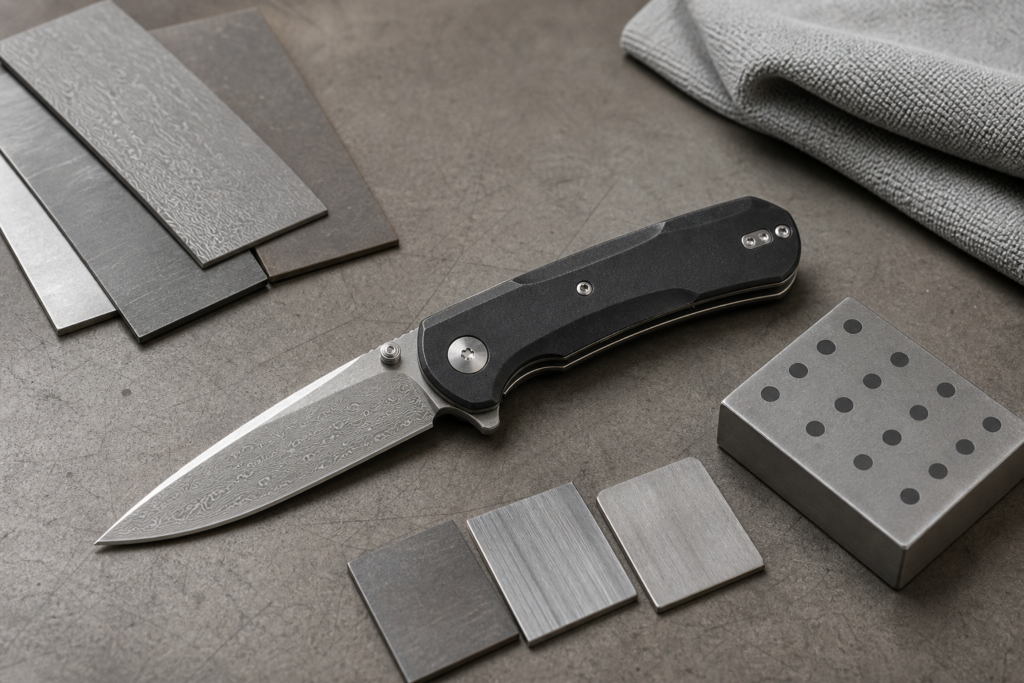
Damascus knife manufacturing can look artistic, but sourcing cannot run on romance. If buyers do not define the process, the final blade may only copy the pattern, not the performance.
Buyers should manage Damascus knife manufacturing by defining the construction type, steel stack or core steel, forge-welding or cladding route, heat treatment, pattern and etch standard, corrosion care, inspection records, and marketing claims before production starts.
Quick buyer brief:
- Answer: Treat Damascus knife manufacturing as a controlled OEM/ODM process, not only as a beautiful blade pattern.
- Buyer context: This guide is for knife brands, kitchen knife buyers, outdoor knife buyers, EDC product teams, importers, distributors, and sourcing managers.
- Key checks: Historical claim, modern construction, billet source, core steel, layer stack, weld integrity, heat treatment, hardness target, pattern repeatability, etch residue, finish consistency, corrosion care, supplier documents, claim evidence, and QC record.
Have a knife or multi-tool project in mind?
Send your sketch, CAD file, sample photo, or product idea. Vast State can review manufacturability, suggest materials, estimate MOQ, and prepare a quote for your OEM/ODM project.
This article discusses Damascus-style knife manufacturing for product sourcing, quality control, claim review, and customer care. It is not a forging tutorial, weapon-use guide, combat guide, self-defense article, or brand comparison.
The buyer's job is to make the art repeatable enough for a commercial product. A beautiful sample is only useful if the supplier can repeat the material, heat treatment, pattern, finish, edge, packaging, and care instructions across the order.
What Does Damascus Manufacturing Mean for Modern Buyers?
The word needs definition.
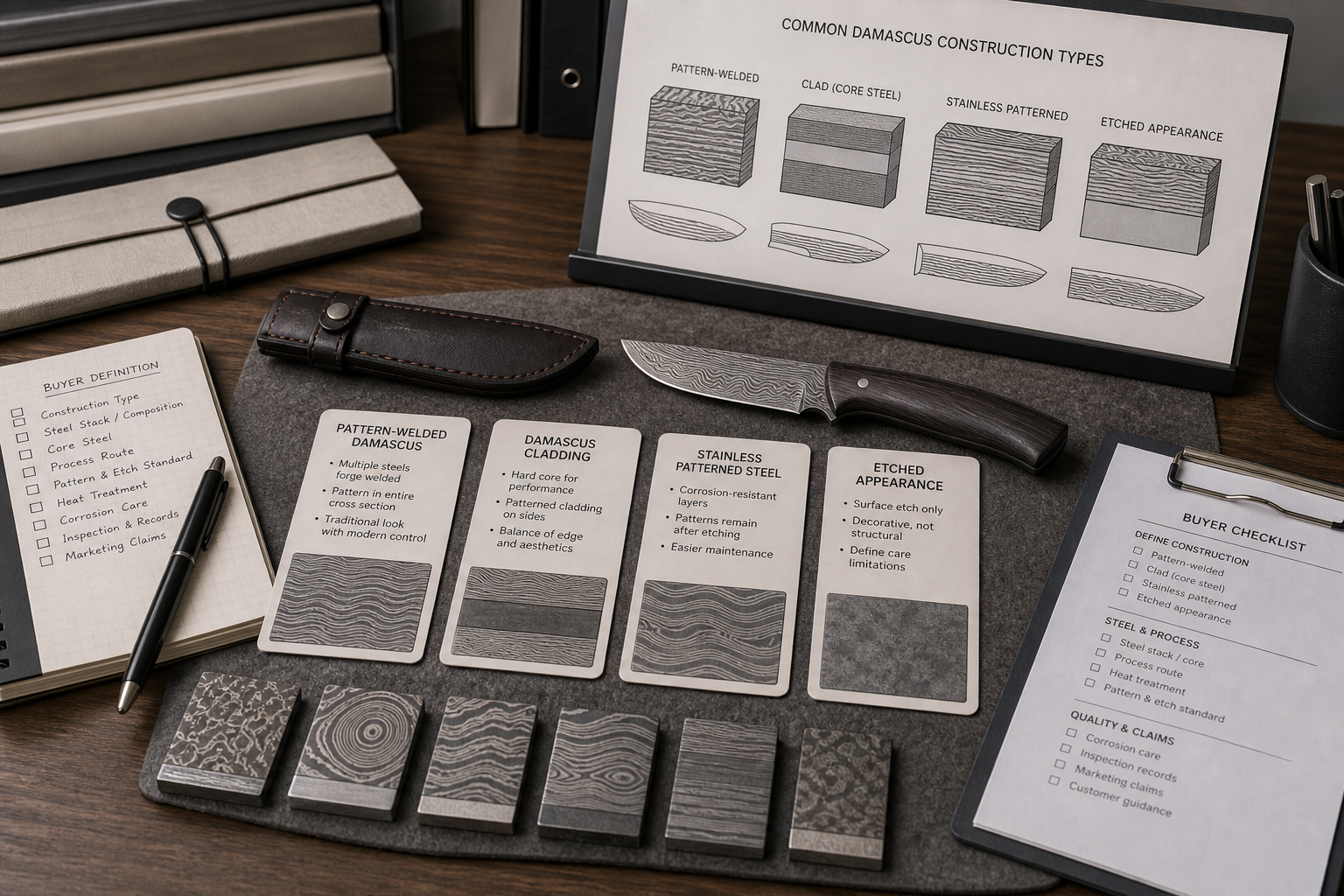
Buyers should define whether Damascus manufacturing means historical-style wootz, modern pattern-welded steel, Damascus cladding over a core steel, powdered patterned steel, or etched appearance only.
I Separate History From the Current Factory Process
The first buyer question is not "Can you make Damascus?" The first buyer question is "Which Damascus process are we buying?" Historical wootz steel, modern pattern-welded steel, laminated cladding, and etched pattern decoration are different things. They have different costs, performance limits, care needs, and claim risks.
Britannica describes wootz as steel made by an ancient Indian method that produced high-carbon crucible steel later used for famous medieval Damascus swords. TMS research on ancient Damascus blades connects historic patterns to carbide banding and small impurity elements in wootz ingots. That history is valuable, but most modern OEM/ODM products are not historical wootz reproductions.
I would write the RFQ like this:
| Manufacturing Term | Buyer Question | Why It Matters |
|---|---|---|
| Pattern-welded Damascus | Which steels are forge welded? | Controls weld integrity and heat treatment |
| Damascus cladding | What is the cutting core steel? | Controls edge performance |
| Stainless patterned steel | Which layers resist corrosion? | Controls care claims |
| Etched appearance | Is the pattern structural or cosmetic? | Controls marketing honesty |
OEM/ODM RFQ Checklist
Prepare these details to help Vast State review your project and provide a more accurate quotation.
| RFQ Field | What to Prepare |
|---|---|
| Project type | OEM from drawing / ODM private label / wholesale catalog |
| Product category | Folding knife / fixed blade / multi-tool / outdoor tool |
| Design status | Idea / sketch / 2D drawing / 3D CAD / physical sample |
| Target price | Ex-factory target price or retail price range |
| MOQ expectation | 500 / 1,000 / 3,000 / 5,000+ pcs |
| Logo method | Laser engraving / etching / printing / molded logo |
| Packaging | Standard packaging / custom retail box / Amazon-ready |
| Market | USA / EU / Japan / Korea / Middle East / other |
| Compliance needs | Buyer-specified testing / documentation / labeling |
| Timeline | Sample deadline / mass production deadline |
If the supplier cannot explain the route, the buyer should not build a premium claim around it.
How Should Buyers Control Material Selection?
The pattern starts with steel.
Buyers should specify layer steels, core steel, billet source, material certificates, steel substitutions, hardness target, corrosion positioning, and whether the blade is food-contact relevant.
I Ask What Does the Cutting Work
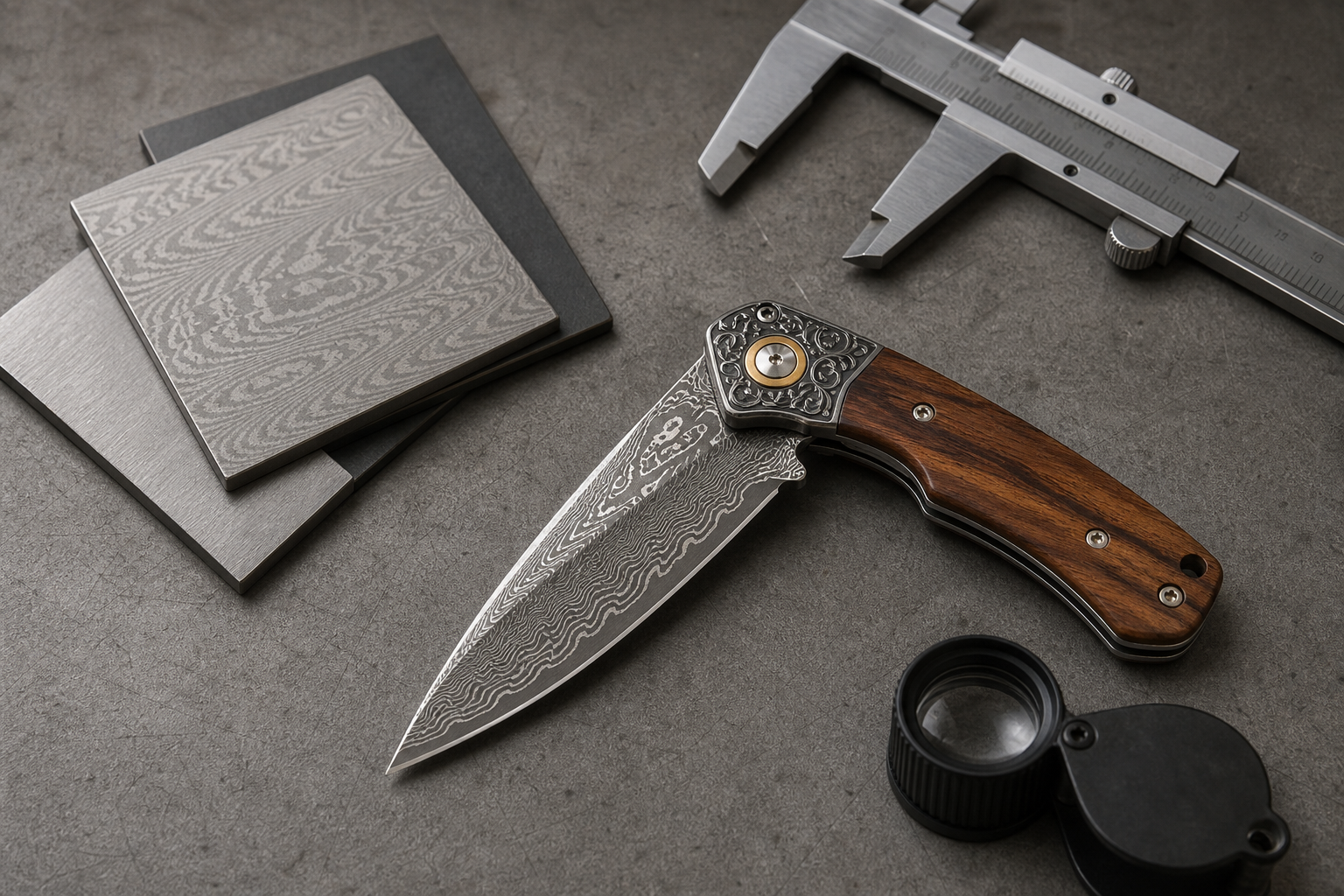
Damascus-looking blades can be made many ways. In a clad kitchen knife, the cutting work may come from the core steel, while the patterned cladding creates the visual story. In a full pattern-welded blade, the steel stack and heat treatment together control the working edge. In a decorative product, the pattern may be mostly visual.
The material section of the RFQ should include:
- Layer steels or core steel
- Steel grade or accepted equivalent
- Certificate requirement
- Substitution approval process
- Target hardness range
- Heat treatment responsibility
- Food-contact expectation if relevant
- Corrosion-care positioning
- Edge and sharpening requirement
- Batch traceability requirement
The British Stainless Steel Association explains that stainless steel corrosion resistance comes from chromium and a thin chromium-rich passive film that can normally self-repair when oxygen is available, but this passive state can break down under some conditions. That is a useful reminder: even stainless-patterned products need care language.
The buyer should also decide how much steel detail belongs on the product page. Too much unsupported steel language can create claim risk. Too little can make the product look vague.
How Should the Process Flow Be Approved Without Becoming a Tutorial?
Buyers need process control.
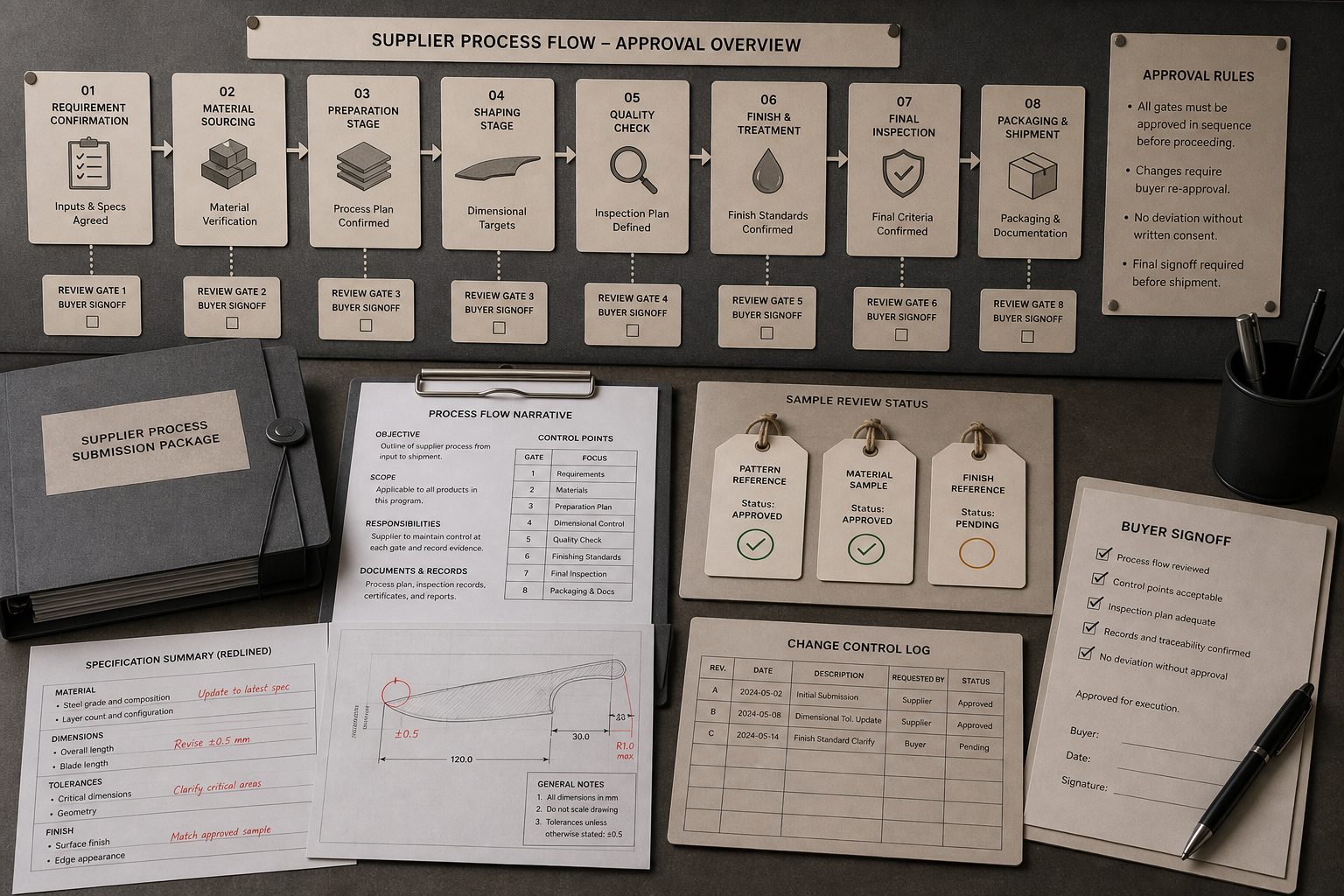
The approved manufacturing flow should document billet sourcing, forging or cladding route, rough grinding, heat treatment, finish grinding, etching, sharpening, cleaning, packaging, and QC.
I Want a Process Map, Not Secret Recipes
The buyer does not need to publish a forge tutorial. The buyer does need a process map. This map helps the sourcing team understand where defects can enter the product. It also gives the QC team a way to ask for records.
The process map can be high-level:
| Process Stage | Buyer Control Point | Typical Risk |
|---|---|---|
| Billet or clad material sourcing | Material and batch proof | Wrong steel or substitution |
| Forming or rough shaping | Approved design dimensions | Warping or asymmetry |
| Heat treatment | Time, temperature, and hardness record | Soft edge or brittle edge |
| Grinding and finishing | Thickness and finish tolerance | Uneven geometry |
| Etching and polishing | Pattern clarity and residue control | Muddy pattern or staining |
| Sharpening and cleaning | Edge and contamination check | Poor edge or residue |
| Packaging | Moisture and care-card control | Rust and returns |
This level is enough for a buyer article. It manages the supply chain without teaching unsafe or uncontrolled shop operations.
What Heat Treatment and Hardness Records Matter?
Beauty cannot replace heat treatment.
Buyers should require a heat-treatment record, target hardness range, test method, test location, and rejection criteria before accepting Damascus production.
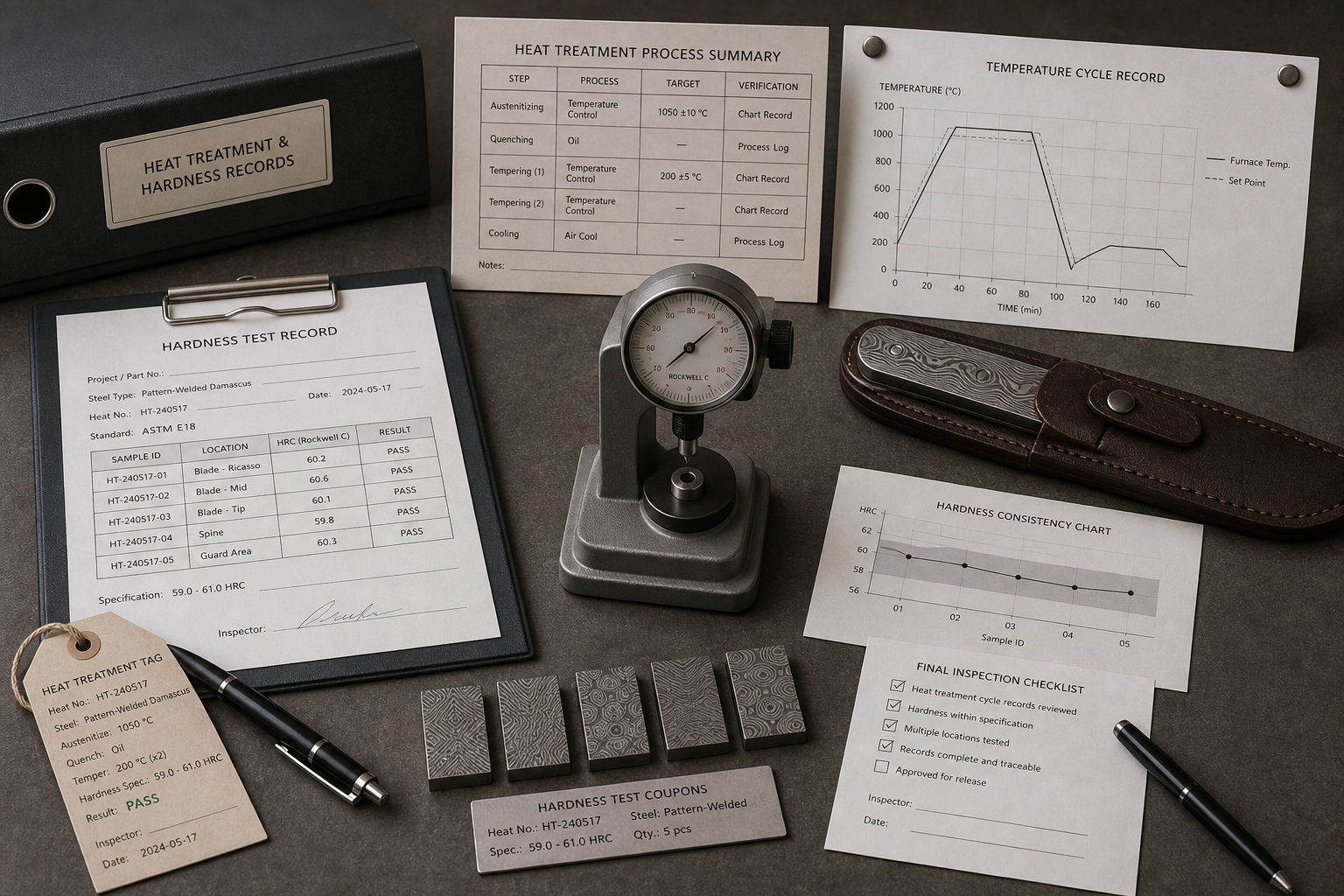
I Check the Blade Under the Pattern
Damascus pattern does not prove heat treatment quality. A blade can have a beautiful pattern and still be too soft, too brittle, warped, poorly ground, or inconsistent from one batch to the next.
ASTM E18 covers Rockwell hardness testing for metallic materials. ASTM notes that this testing gives useful information and is used for commercial acceptance, while a test at one location may not represent the whole part. For knife buyers, that means hardness should be planned, not guessed.
The buyer should define:
- Target hardness range
- Test locations
- Sample size
- Test equipment or lab expectation
- Batch record format
- Rejection rule
- Retest rule
- Relationship between hardness, edge geometry, and intended use
For Damascus cladding, the test plan should make sense for the core steel. For full pattern-welded construction, the supplier should explain how the heat treatment supports the whole blade. A single HRC value without context is not enough.
How Should Pattern, Etching, and Finish Be Controlled?
The visual standard needs limits.
Buyers should approve pattern style, contrast, etch depth, polish level, scratch tolerance, residue limits, logo placement, and acceptable variation before mass production.
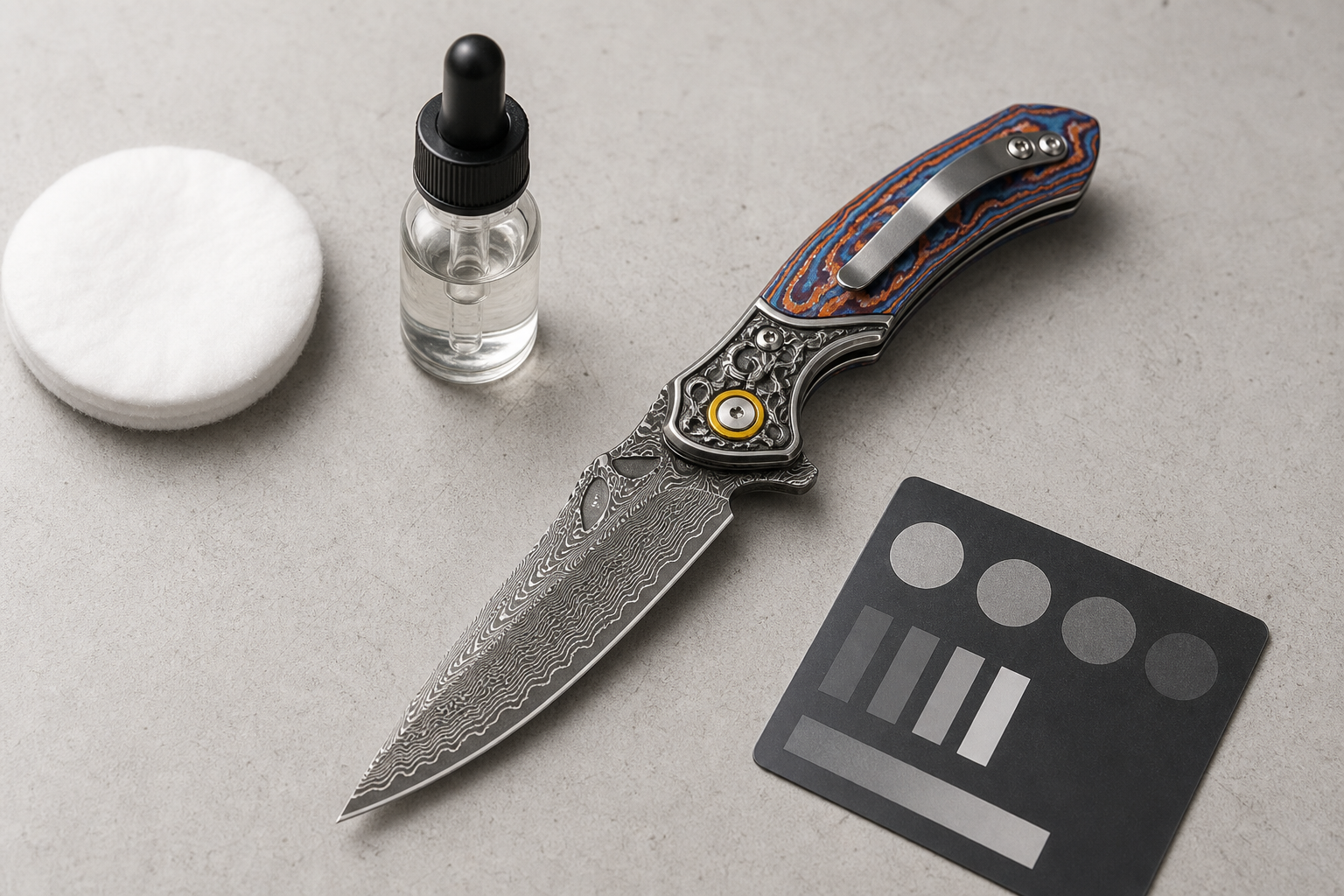
I Turn the Pattern Into an Inspection Standard
Pattern control is where "art" becomes a commercial challenge. A handmade-looking variation can feel premium. Random inconsistency can feel defective. The buyer should define the difference before shipment.
The finish approval package should include:
- Pattern family
- Minimum contrast
- Maximum over-etch texture
- Residue limit
- Scratch tolerance
- Warping tolerance
- Logo or marking location
- Blade face cleanliness
- Edge cleanliness
- Sample photos under standard lighting
- Rejection photos
The customer sees the pattern first. If the product photos show strong contrast but production is faint, customers may feel misled. If the etch is too aggressive, the blade may look rough or become harder to clean. If residue remains, it can stain packaging or create support complaints.
For kitchen knives, the buyer should also review food-contact and cleaning implications. For outdoor knives, the buyer should check sheath interaction, moisture trapping, and rust-care instructions.
How Should Corrosion and Care Be Built Into Production?
Care starts at the factory.
Buyers should manage corrosion through steel choice, surface finishing, cleaning after etch, drying before packaging, moisture control, care cards, and realistic rust claims.
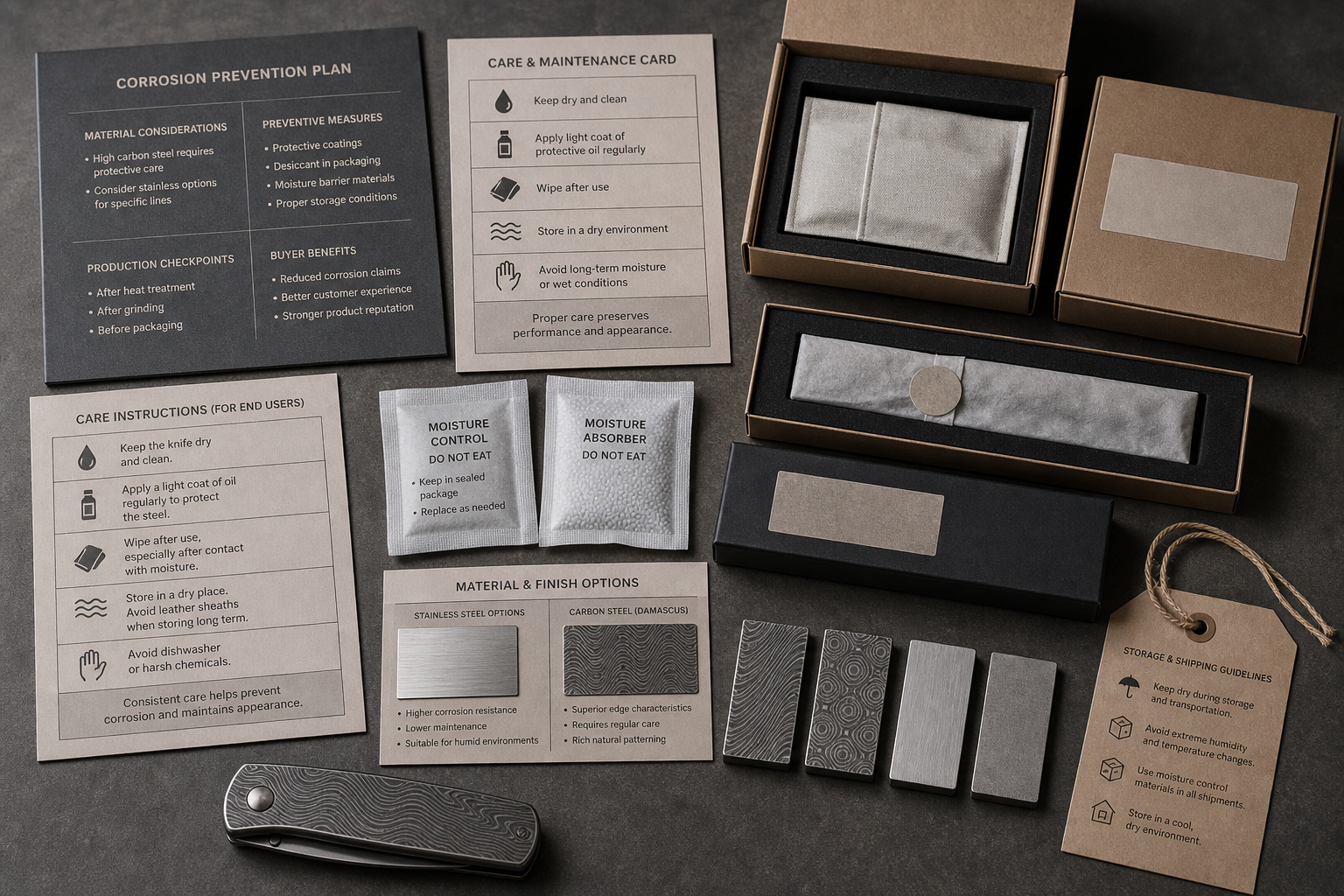
I Do Not Let the Etch Hide Rust Risk
Damascus patterns often use contrast and texture. That can make early corrosion harder for customers to understand. The buyer should decide whether the product is carbon steel, stainless-patterned, clad, or coated, then write care instructions that match the real material.
ASTM B117 describes a controlled corrosive environment used to produce relative corrosion resistance information for metals and coated metals in a given chamber. It is useful for comparison and process control, but it should not become a promise that a knife will behave the same way in every real-world environment.
Production controls should include:
- Clean and neutralized surface after etching where applicable
- Drying before packaging
- Fingerprint and residue control
- Moisture-control packaging
- Care-card insertion
- Rust inspection before shipment
- Customer storage warning
- Support photo checklist
The buyer should avoid "rust proof" unless the evidence and legal review support it. "Requires care after use" is less glamorous, but it prevents the wrong customer expectation.
What Supplier Documents Should Buyers Keep?
Records protect repeatability.
Buyers should keep material certificates, process flow notes, heat-treatment records, hardness reports, finish samples, corrosion notes, packaging photos, and inspection reports.
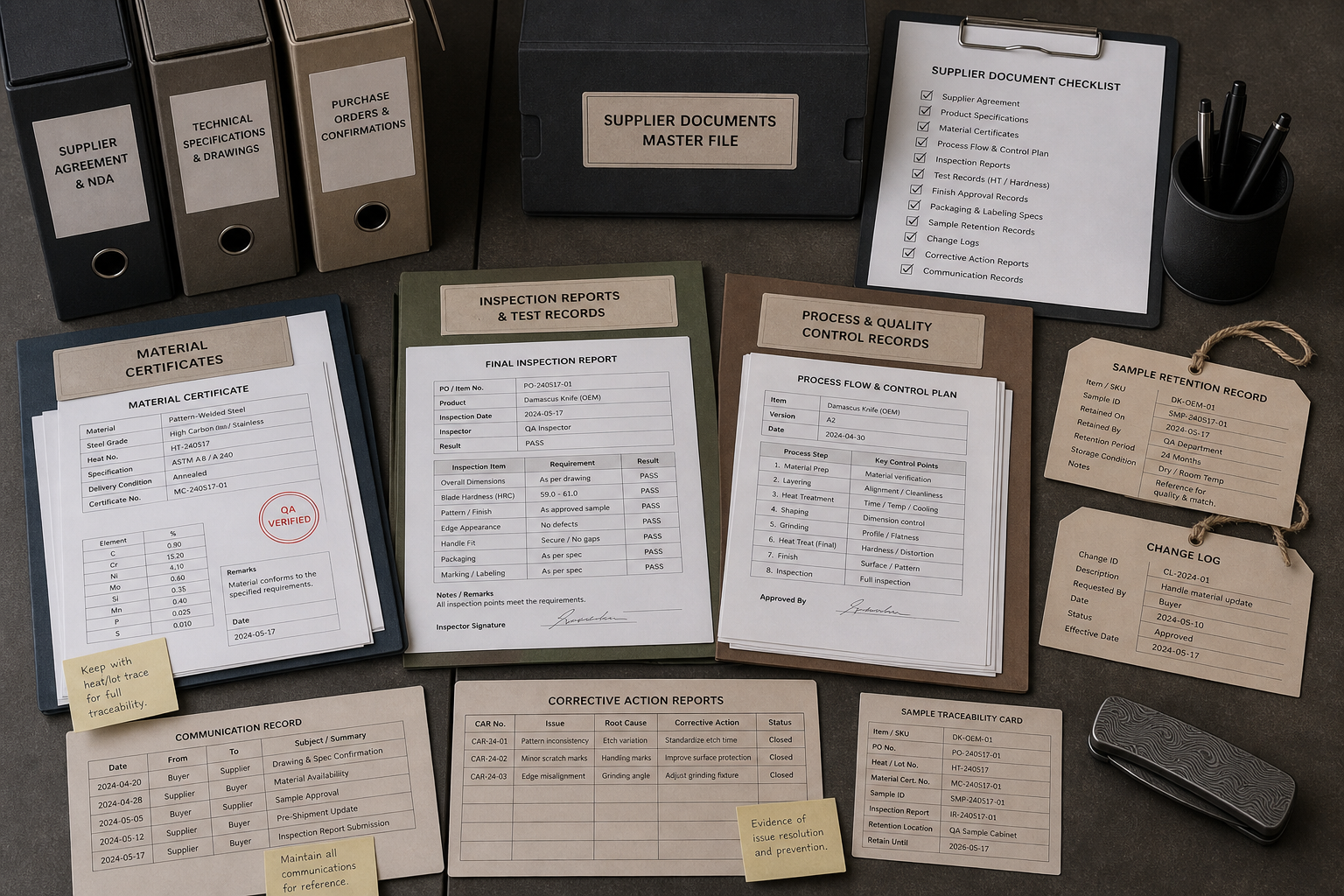
I Build a Claim File Before the Listing Goes Live
Documents do not guarantee quality by themselves, but they make repeatability possible. They also help the buyer write accurate product pages and answer customer questions.
The file should include:
- RFQ version
- Approved sample photos
- Steel certificate or material statement
- Billet or cladding construction note
- Heat-treatment record
- Hardness report
- Finish and etch standard
- Corrosion or care evidence
- Packaging photo
- Care-card copy
- Warning label copy
- Final inspection report
- Change approval history
The Federal Trade Commission's advertising substantiation policy says advertisers need a reasonable basis for objective claims before they make those claims. That principle should guide the claim file. If the product page says "hand-finished," "high layer," "stainless Damascus," "sharp retention," or "corrosion resistant," the buyer should know what evidence supports it.
If the evidence is weak, the copy should become simpler.
What Should the RFQ and QC Plan Include?
The RFQ should make the art repeatable.
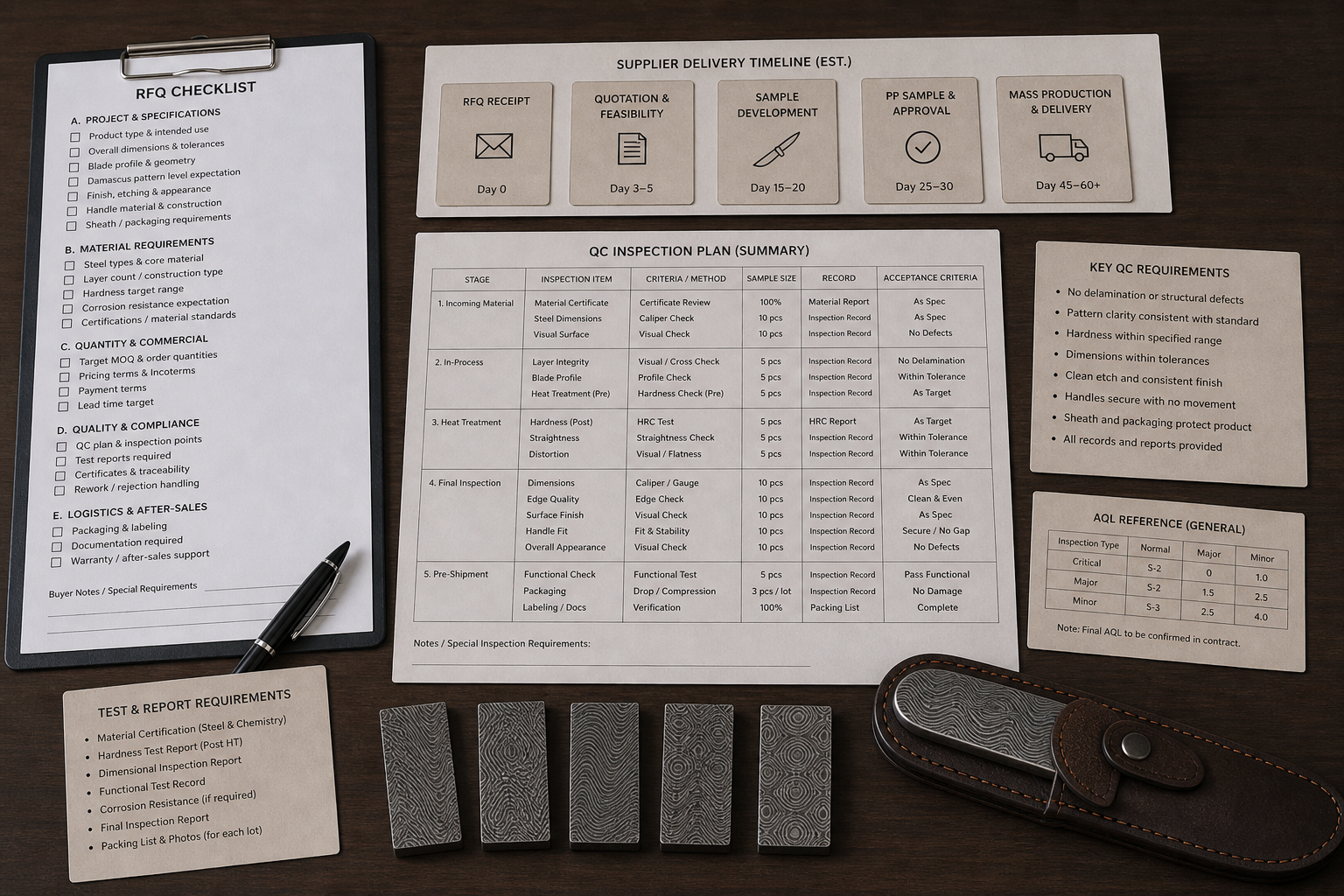
A Damascus manufacturing RFQ should define construction, material, process route, heat treatment, hardness, pattern, etch, corrosion care, documents, claims, and inspection criteria.
I Write the Buying Standard Before the Factory Starts
The final RFQ should make the manufacturing route measurable. It should not only say "Damascus knife." It should tell the supplier what to make, what to prove, what to photograph, and what the inspector should reject.
The RFQ should include:
- Damascus construction type
- Layer steels or core steel
- Billet source or supplier responsibility
- Heat treatment and hardness target
- Blade geometry and tolerance
- Pattern style and finish sample
- Etch depth and residue limit
- Edge and sharpening standard
- Corrosion-care plan
- Packaging moisture control
- Care card and warning copy
- Claim language for review
- Batch documentation
- Final inspection checklist
- Change-control rule
This is how buyers turn an attractive sample into a stable product line. The art can stay in the pattern, but the sourcing process needs evidence, records, and clear acceptance criteria.
Turn your idea into a quote-ready knife project.
Share your drawing, sample photo, target quantity, market, and packaging needs. Vast State will review manufacturability and prepare OEM/ODM options.
Conclusion
Manage Damascus manufacturing through defined construction, verified materials, heat treatment, finish control, corrosion care, supplier records, and honest claims.