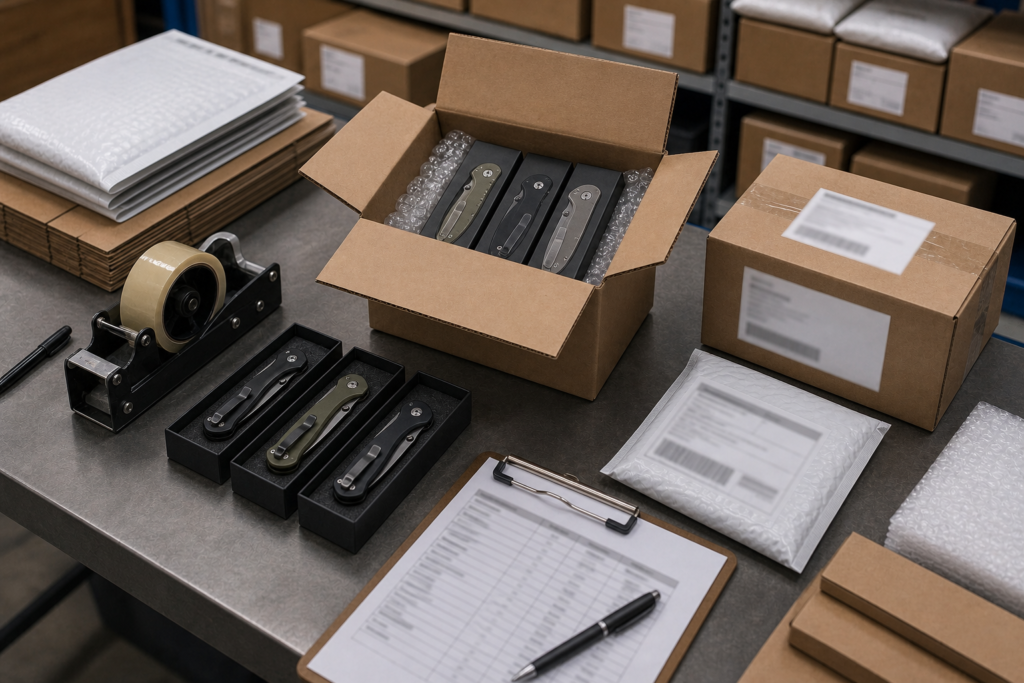
Shipping a knife looks easy until a package is rejected. One missed rule can cause delay, seizure, refunds, or customer distrust.
Knife sellers can mail many ordinary knives through USPS when the knife is legal to ship, allowed for the destination, and packed so no sharp point or edge can cut through the package. Switchblade and ballistic knives face strict federal and USPS restrictions.
Quick buyer brief:
- Answer: Many ordinary knives are mailable, but restricted knife types and poor packaging create risk.
- Buyer context: This helps knife brands, dealers, importers, and private label sellers plan fulfillment.
- Key checks: Verify knife type, destination rules, USPS rules, packaging strength, customs description, and shipment records.
Planning a private-label knife line for this market?
Use this article as an early planning reference, then prepare your target market, product category, labeling needs, and buyer-specified compliance requirements before production.
When I discuss knife shipping with a B2B customer, I separate two things. First, is the product mailable or restricted? Second, is the package strong enough for real handling? A legal product can still create trouble if it is packed poorly. A well-packed product can still be blocked if the knife type or destination is not allowed. Sellers need both checks.
Are Ordinary Knives Mailable Through USPS?
Many sellers assume every knife is treated as a weapon. That creates confusion and can lead to wrong shipping decisions.
Ordinary knives and sharp instruments can be mailed when they are otherwise mailable, legal for the route, and securely packed. USPS rules focus heavily on restricted knife types and safe packaging.
I Start With Mailability, Not the Shipping Label
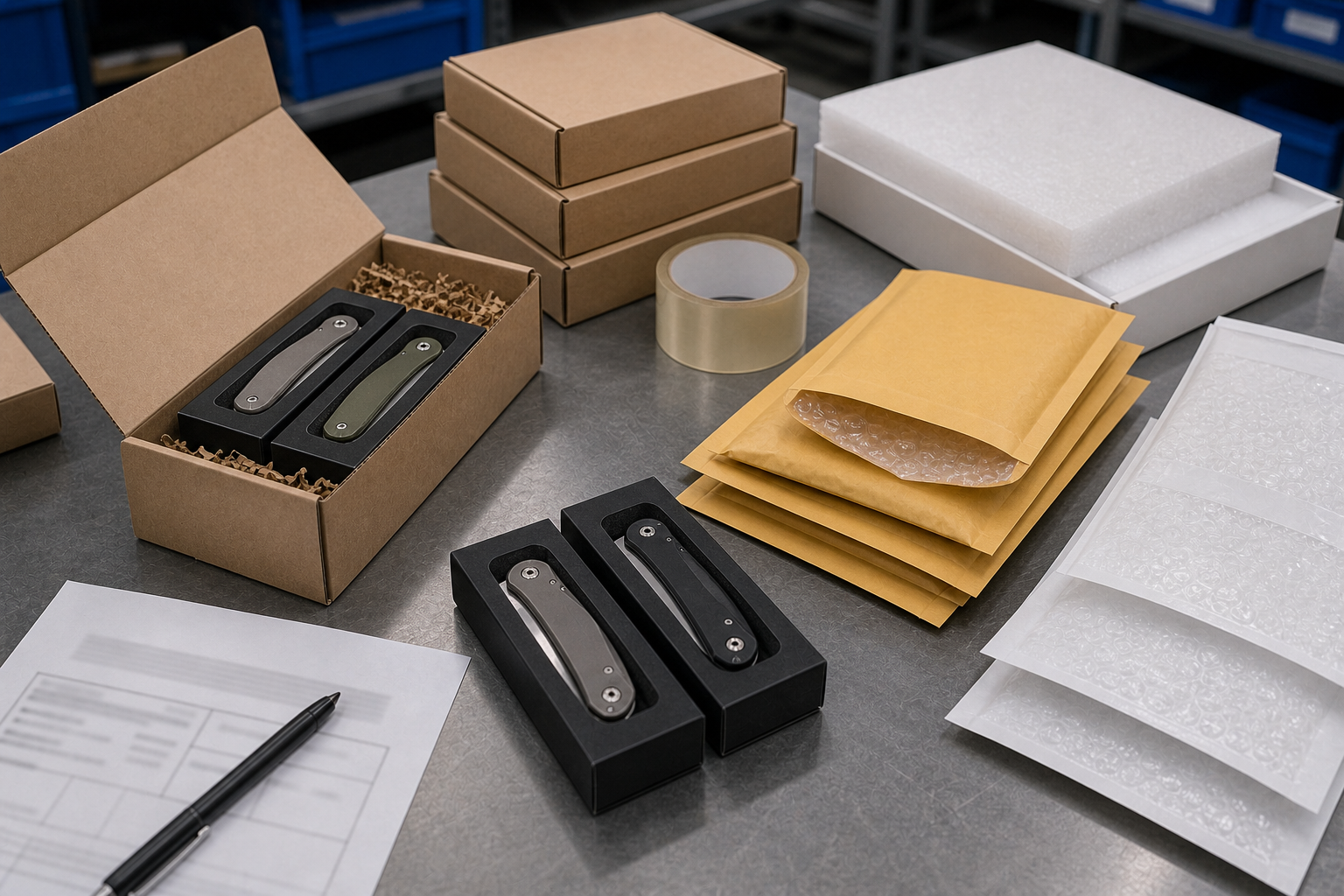
For a normal folding knife, fixed blade, kitchen knife, or tool knife, the first question is not simply "Which service is cheapest?" The first question is whether the item is mailable for that route. USPS Publication 52, section 44 defines sharp instruments to include knives, tools, ice picks, razor blades, stilettos, and similar devices. That means knives sit inside a restricted-matter framework, not an ordinary product-only framework.
This does not mean every ordinary knife is banned. It means the mailer must handle the product correctly. In practical seller language, a closed pocket knife in a proper box is a different problem from an automatic knife, a loose blade in a thin envelope, or an international shipment to a country that prohibits blades.
I also tell sellers not to treat a blog article as legal advice. Rules change. Destination laws differ. USPS staff may ask for more information when mailability is unclear. The safe workflow is to check the current USPS source, check destination rules, and document the product type before shipping. If the buyer uses a fulfillment partner, that partner should also confirm its own carrier rules.
| Product type | Basic USPS concern | Seller action |
|---|---|---|
| Manual folding knife | Sharp instrument and safe packaging | Ship closed, boxed, and cushioned |
| Fixed blade knife | Exposed edge risk | Use sheath, blade guard, inner box, and outer carton |
| Kitchen knife | Sharp edge and point | Protect blade and prevent movement |
| Multi-tool | Sharp components and moving parts | Close tools and secure the product |
Private-label Planning Checklist
Before starting production, prepare the market and product details your importer or compliance advisor needs to review.
| RFQ Field | What to Prepare |
|---|---|
| Target market | Country, state, region, or sales channel |
| Product category | Folding knife / fixed blade / multi-tool / outdoor tool |
| Intended use | EDC / camping / kitchen / hunting / rescue / promotional |
| Buyer requirements | Testing, labeling, documentation, or packaging rules |
| Blade and lock details | Blade length, opening method, lock type, edge style |
| Packaging text | Warnings, claims, care notes, language requirements |
| Documents | Drawing, sample photo, logo file, packaging artwork |
| Review owner | Importer, legal advisor, testing lab, or internal compliance team |
Which Knife Types Create Special Restrictions?
A seller can pack a knife perfectly and still have a problem. Some knife types are restricted by federal postal law before packaging even matters.
Switchblade knives and ballistic knives are heavily restricted in US mail. USPS only allows switchblade mailing to specific government procurement recipients and authorized manufacturers or dealers in limited official contexts.
I Do Not Treat Opening Mechanism as a Small Detail
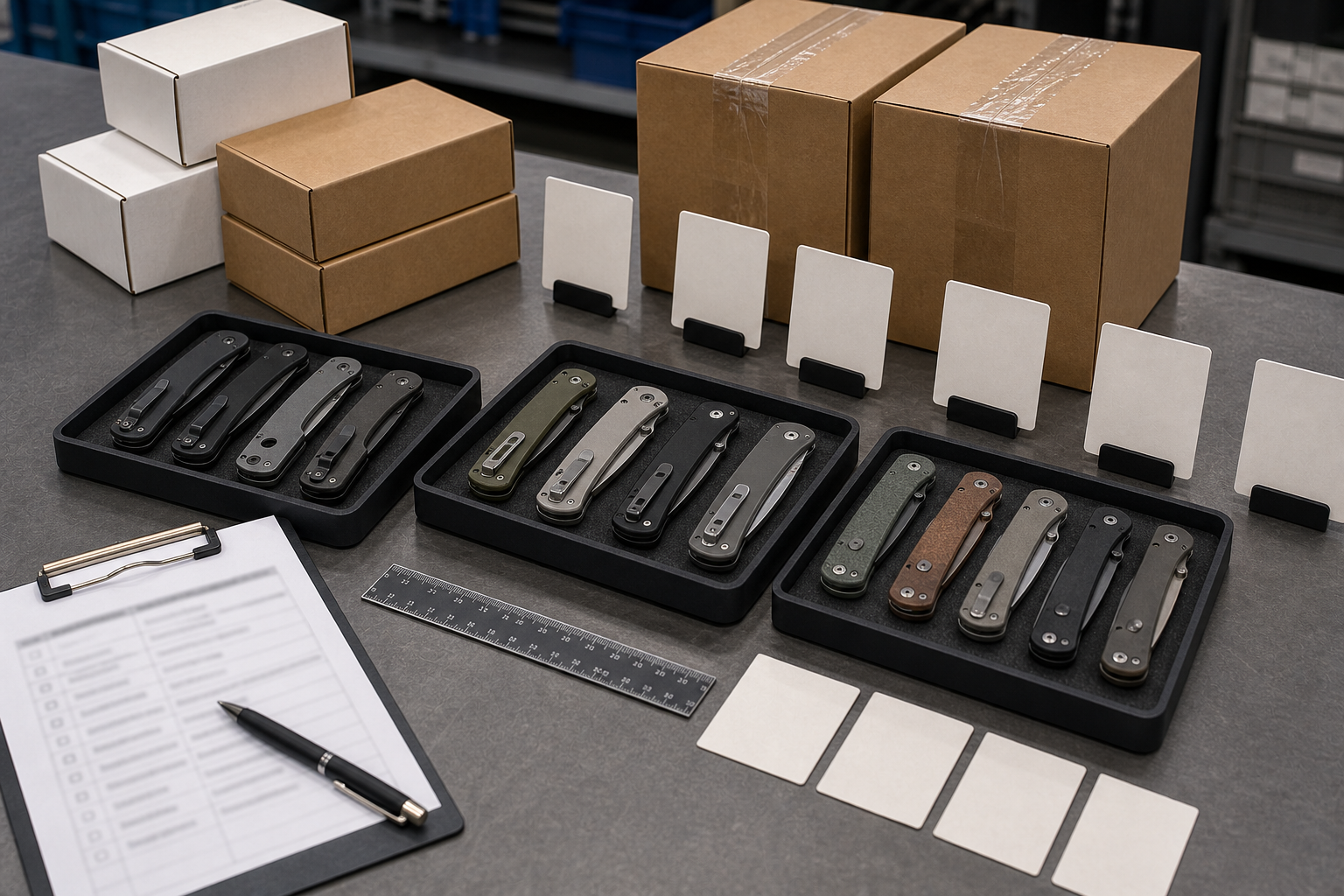
The knife opening mechanism matters. USPS Publication 52, section 441.2 defines a switchblade knife as a knife with a blade that opens automatically by hand pressure on a button or other handle device, or through inertia, gravity, or both. That definition is important for sellers because product listings may use friendly words that hide the real mechanism.
USPS section 442 says a switchblade knife is mailable only to listed categories of addressees, such as certain government supply or procurement officials. It also allows authorized manufacturers or bona fide dealers to mail switchblade knives to addresses in those listed categories in official procurement or resale contexts. That is narrow. It is not the same as a general consumer shipping rule.
Federal law also matters. 18 U.S.C. 1716 states that knives with blades that open automatically by button, inertia, gravity, or both are nonmailable, subject to limited exceptions. It also applies similar restrictions to ballistic knives. For a B2B seller, this means the product team must classify the knife before the logistics team prints a label.
| Knife feature | Why it matters | Safer seller process |
|---|---|---|
| Manual opening | Usually simpler to evaluate | Confirm no automatic opening mechanism |
| Assisted opening | Needs careful legal and carrier review | Get product-specific compliance review |
| Switchblade mechanism | USPS and federal restrictions apply | Do not ship as a normal consumer parcel |
| Ballistic knife design | Treated under special federal restriction | Avoid consumer mail and seek legal review |
How Should Sellers Pack Knives for Mailing?
Bad packaging can turn a legal shipment into a safety risk. A sharp edge should never be able to reach the outside of the package.
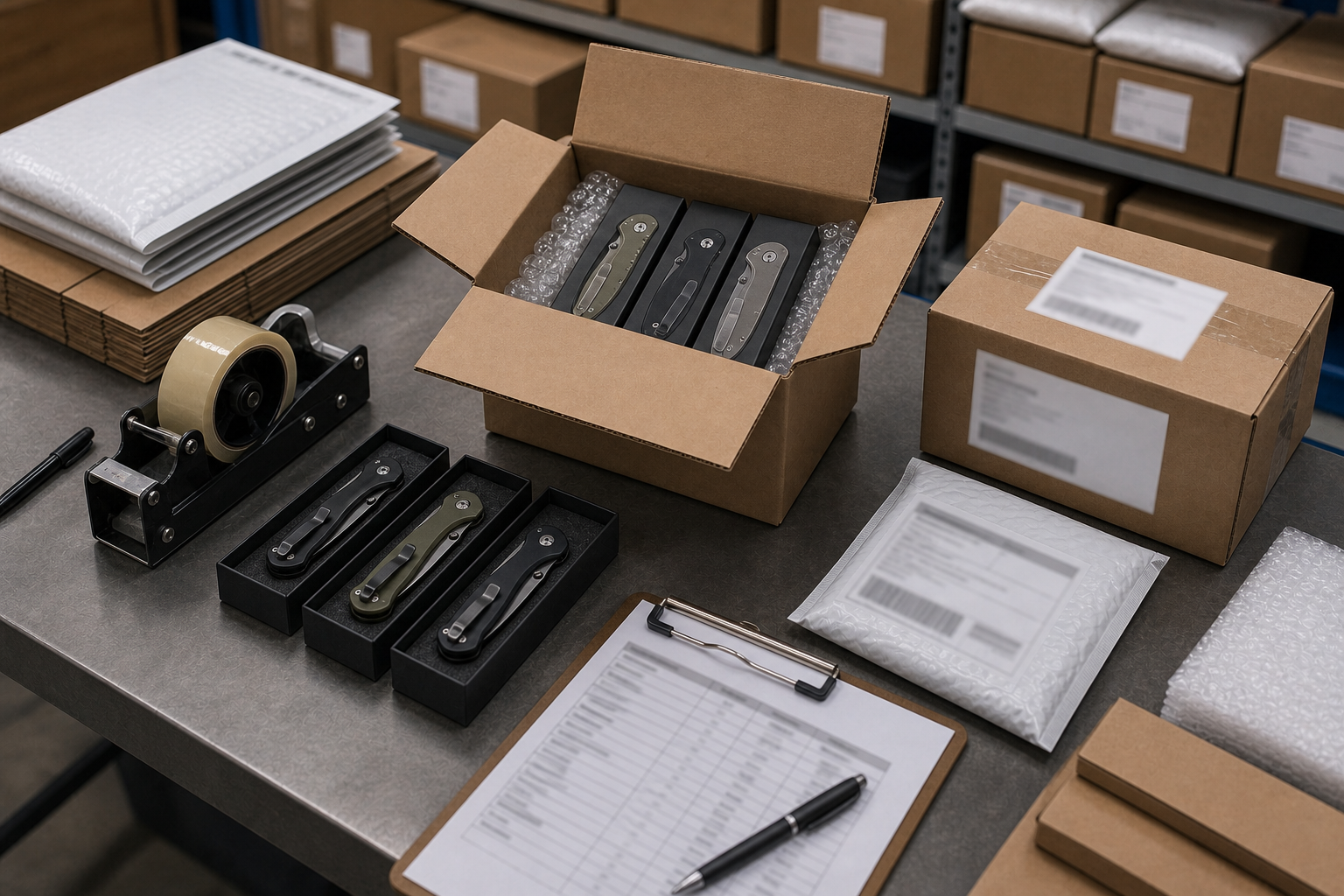
USPS requires otherwise mailable sharp instruments to be securely packed in a strong container. Inner and outer packaging is recommended, with enough cushioning to stop points and edges from cutting through.
I Design Packaging for Real Handling, Not Only Presentation
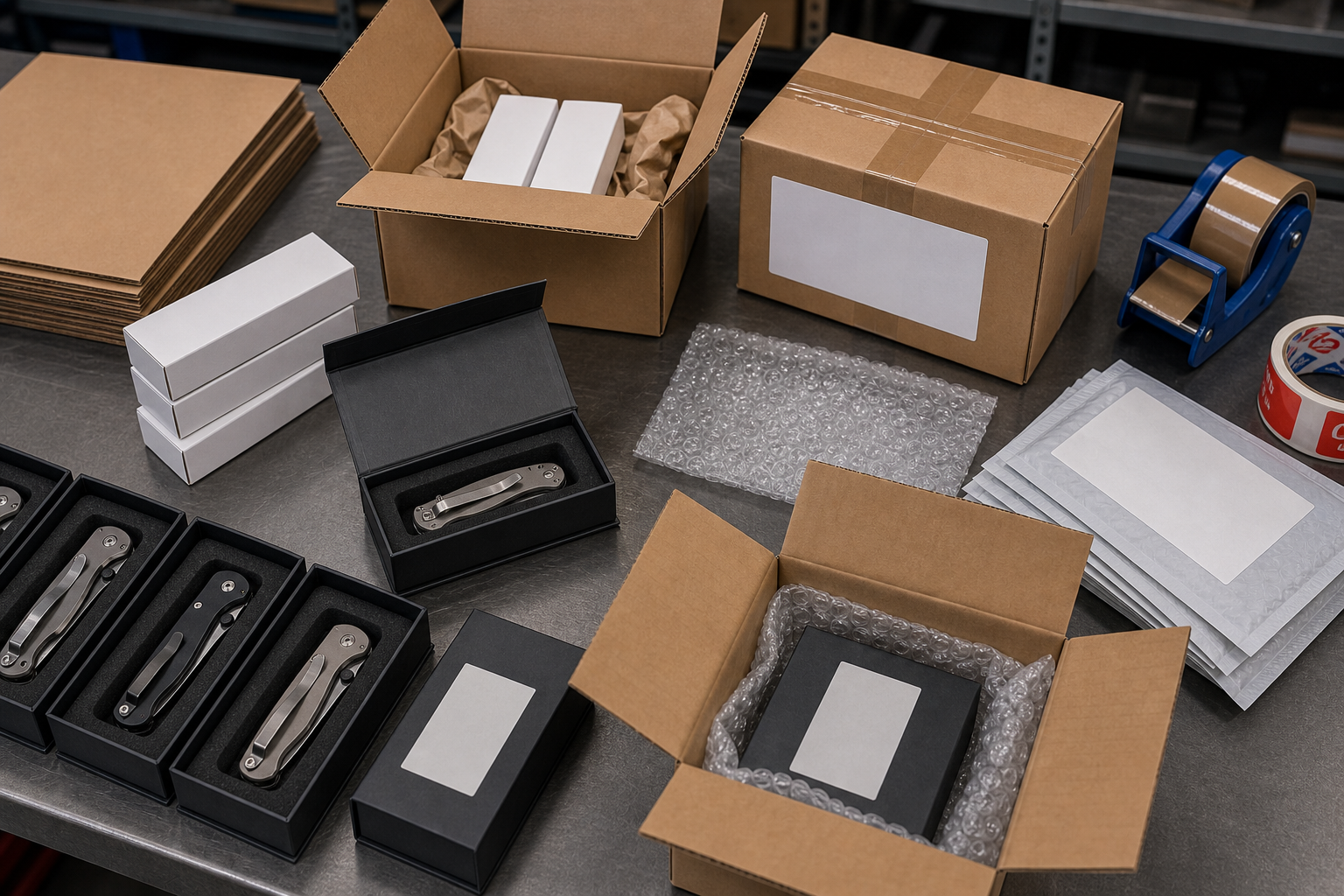
USPS Publication 52, section 443.1 says all otherwise mailable sharp-pointed or sharp-edged instruments must be securely packaged in a strong container. It also recommends inner and outer packaging and requires enough cushioning to keep sharp points and edges from cutting through the outside during normal USPS handling.
That rule matches what I see in manufacturing. Retail packaging can look good but still fail in parcel shipping. A folding knife may move inside a loose box. A fixed blade may puncture weak paperboard if the sheath shifts. A blister pack may crack if there is no outer carton. For B2B shipments, I want the packaging engineer to think about drop, compression, movement, and edge protection.
My practical packaging checklist is simple. Close and secure all folding parts. Use a sheath, blade guard, insert, or clamshell that holds the knife in place. Add inner packaging if the retail box is not enough. Use a strong outer carton. Fill empty space. Avoid thin padded envelopes for knives unless the product is already inside a rigid, edge-safe container. The goal is boring: the package should arrive without sound, movement, puncture, or surprise.
| Packaging layer | Purpose | Practical check |
|---|---|---|
| Blade guard or sheath | Covers edge and point | Edge cannot contact carton |
| Retail box or tray | Holds product presentation | Knife does not move freely |
| Inner carton | Adds rigid containment | Product survives handling |
| Outer shipping carton | Protects the full parcel | No puncture or crush risk |
What Changes When Mailing Knives Internationally?
International knife shipping can fail even when a domestic shipment is allowed. Destination country rules can be stricter than US rules.
International knife mailing requires both USPS international rules and the destination country's conditions. USPS says domestically mailable knives may be mailed internationally only if permitted by the Individual Country Listing in the IMM.

I Check the Destination Before I Quote the Freight Method
USPS international shipping restrictions tell mailers to follow both USPS international regulations and the destination country's rules. USPS also points mailers to Publication 52 and the International Mail Manual. In Publication 52 section 633, USPS says knives and sharp instruments that are permitted domestically may be mailed internationally only if permitted by the conditions in the Individual Country Listings in the IMM.
This is where many sellers get caught. A knife that can ship inside the United States may be prohibited in another country. One clear example is the United Kingdom. A USPS Postal Bulletin update for the UK states that bladed articles and bladed products are prohibited, and it gives examples that include knife blades, kitchen knives, utility knives, cutlery knives, survival knives, machetes, switchblade knives, and gravity knives.
For B2B sellers, international shipping needs a separate checklist. The seller should check the destination country, product category, blade type, customs description, HS code, declared value, buyer eligibility, and local import rules. If the product is for wholesale distribution, the importer should confirm local law before production starts. It is much easier to adjust the product or sales territory before inventory is made.
| International check | Why it matters | Seller action |
|---|---|---|
| Destination country | Rules differ by country | Check IMM country listing |
| Knife type | Some blade types are prohibited | Classify the product before shipping |
| Customs description | Misdescription can create seizure risk | Use accurate commercial wording |
| Importer responsibility | Local law may apply after arrival | Confirm with buyer or broker |
What Records Should B2B Sellers Keep Before Shipping?
A seller may know the shipment is allowed but still struggle to prove it later. Good records reduce confusion when a parcel is questioned.
B2B sellers should keep product classification, order records, destination checks, packaging photos, carrier rules, customs data, and buyer communication before mailing knives.
I Build a Repeatable Shipping File
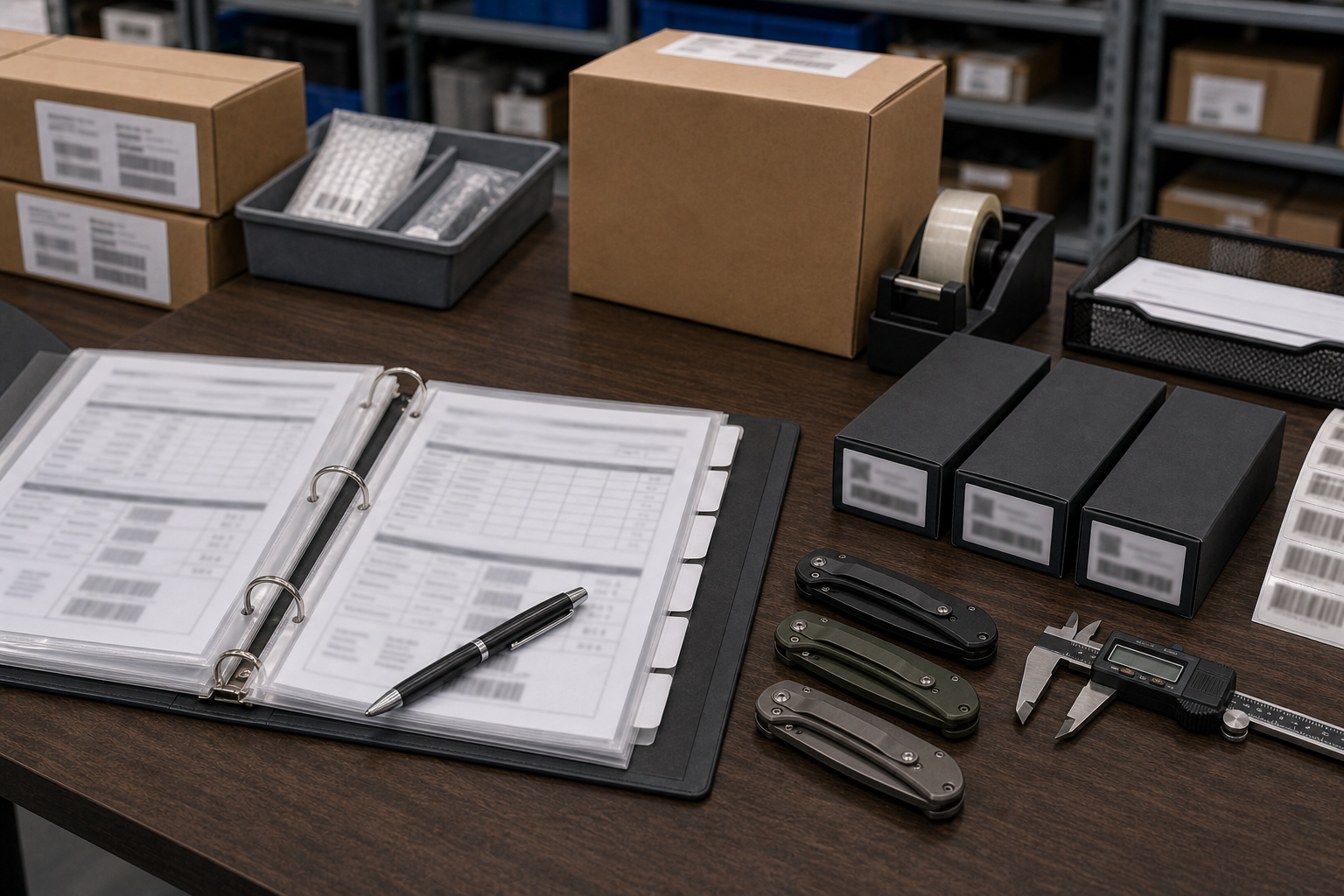
For small one-time shipments, sellers often rely on memory. For B2B repeat orders, memory is not enough. I prefer a shipping file for each product type. It should identify the knife model, opening mechanism, blade length if relevant to the market, packaging method, carton specification, destination rules checked, and the shipping method used. If a carrier or postal clerk asks questions, the seller can answer calmly.
USPS section 442 also says that when mailability is uncertain, a ruling may be requested from the local postmaster. That is useful because it gives sellers a path when the product is not clearly ordinary. I would rather ask early than discover the issue after inventory is packed.
Records also help the manufacturer. If a customer plans to sell online in the United States, Canada, the UK, the EU, or Australia, the product design and packaging should consider distribution rules before mass production. A knife with a certain lock, opening mechanism, blade style, or package type may be fine in one market and risky in another. Vast State can help with manufacturing and packaging choices, but the importer or seller must confirm final legal and carrier requirements for the destination.
| Record type | What to keep | Why it helps |
|---|---|---|
| Product classification | Manual, assisted, automatic, fixed, multi-tool | Supports mailability review |
| Packaging proof | Photos and carton details | Shows edge-safe preparation |
| Destination check | IMM or local rule notes | Reduces international risk |
| Buyer communication | Intended market and compliance notes | Aligns seller and supplier |
How Should OEM and ODM Buyers Plan Knife Shipping in an RFQ?
Shipping compliance is often treated as an afterthought. That creates extra cost when packaging or product structure must change late.
OEM and ODM buyers should include destination market, shipping method, knife type, opening mechanism, packaging requirements, customs wording, carton strength, and compliance review needs in the RFQ.
I Put Fulfillment Needs Into Product Development
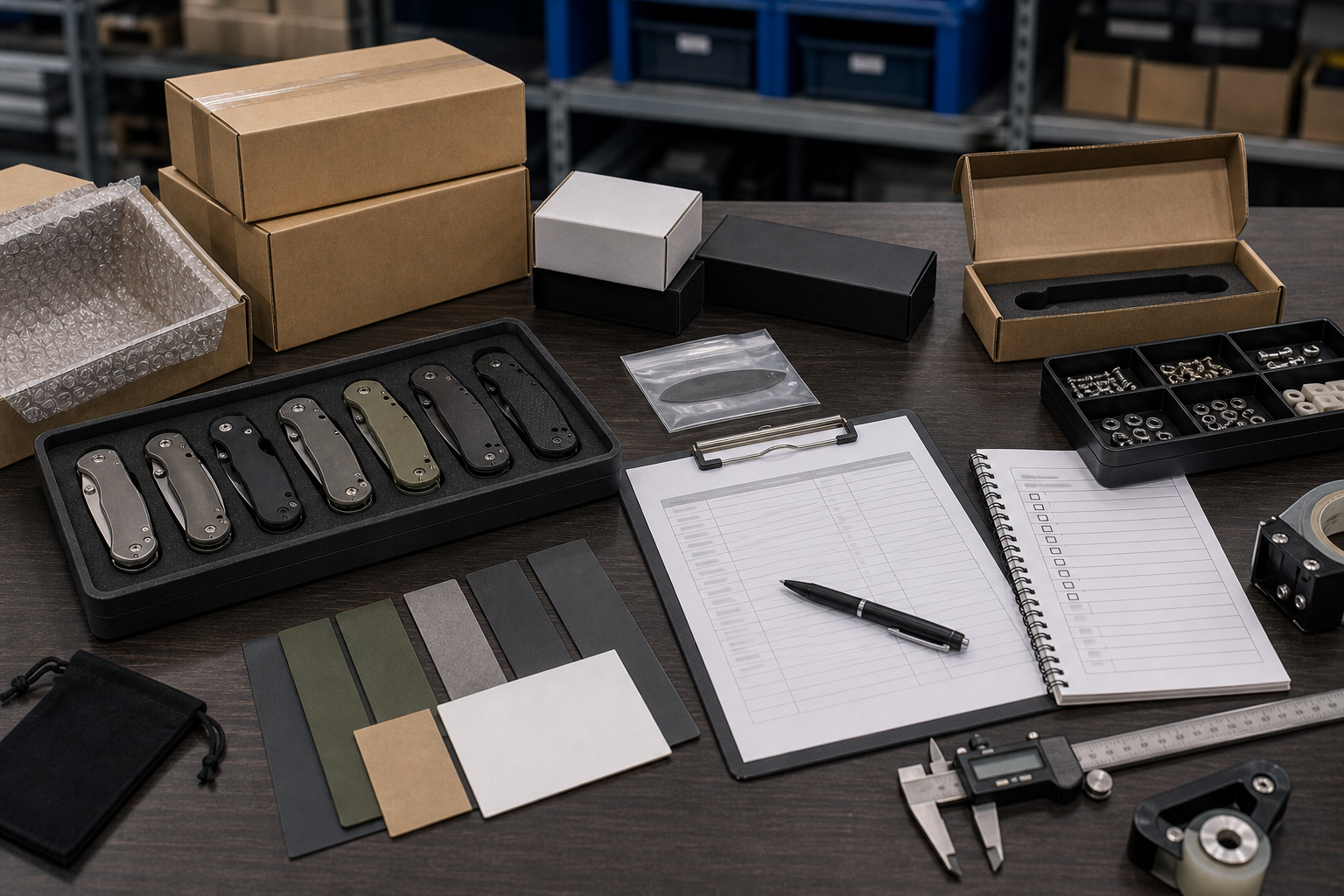
When a customer asks Vast State to develop a folding knife or multi-tool, I want to know the target market early. The market affects more than marketing copy. It can affect opening mechanism, blade style, packaging, warnings, carton design, barcode placement, documentation, and shipping method. If the buyer sells through a marketplace, distributor, or fulfillment center, that channel may also have its own rules.
The RFQ should not only say "folding knife, D2, G10 handle." It should also say where the knife will ship, whether it will be mailed directly to consumers, whether the shipment is domestic or international, whether the packaging must survive parcel shipping, and whether the buyer needs special cartons for e-commerce. If the buyer wants FOB, EXW, or another trade term, both sides should define responsibilities. The US International Trade Administration explains Incoterms as rules used to define buyer and seller responsibilities in international trade.
Good shipping planning also protects quality. The ISO 9001 standard page focuses on quality management systems, customer requirements, and improvement. I apply that mindset to knife packaging. A product is not truly ready if the knife is good but the package fails in delivery. For B2B knife orders, the product, packaging, and shipping plan should be developed together.
| RFQ field | Why it matters | What to specify |
|---|---|---|
| Destination market | Rules differ by place | Country, state, or sales region |
| Knife mechanism | Some mechanisms are restricted | Manual, assisted, automatic, or fixed |
| Packaging method | Prevents puncture and movement | Sheath, insert, inner box, outer carton |
| Fulfillment channel | Channel rules may differ | Marketplace, retail, distributor, or direct mail |
| Trade term | Defines handoff responsibility | FOB, EXW, CIF, DAP, or other term |
Planning a private-label knife line for this market?
Use this article as a planning reference, then confirm local requirements with your importer or compliance advisor before OEM/ODM production.
Conclusion
Knife mailing is manageable when sellers verify the knife type, destination rules, packaging strength, records, and RFQ details before shipping.
Source Notes
- USPS Publication 52, section 44 defines knives and sharp instruments and gives the switchblade definition.
- USPS Publication 52, section 442 explains switchblade mailability categories and the option to request a ruling when uncertain.
- USPS Publication 52, section 443 supports the strong-container, inner/outer packaging, and cushioning guidance.
- 18 U.S.C. 1716 supports the federal nonmailable treatment of automatic-opening knives and ballistic knives, subject to limited exceptions.
- USPS international shipping restrictions, Publication 52 section 633, and the UK Postal Bulletin update support the international caution.
- Trade.gov Incoterms and ISO 9001 support the RFQ, trade, and quality-planning discussion.