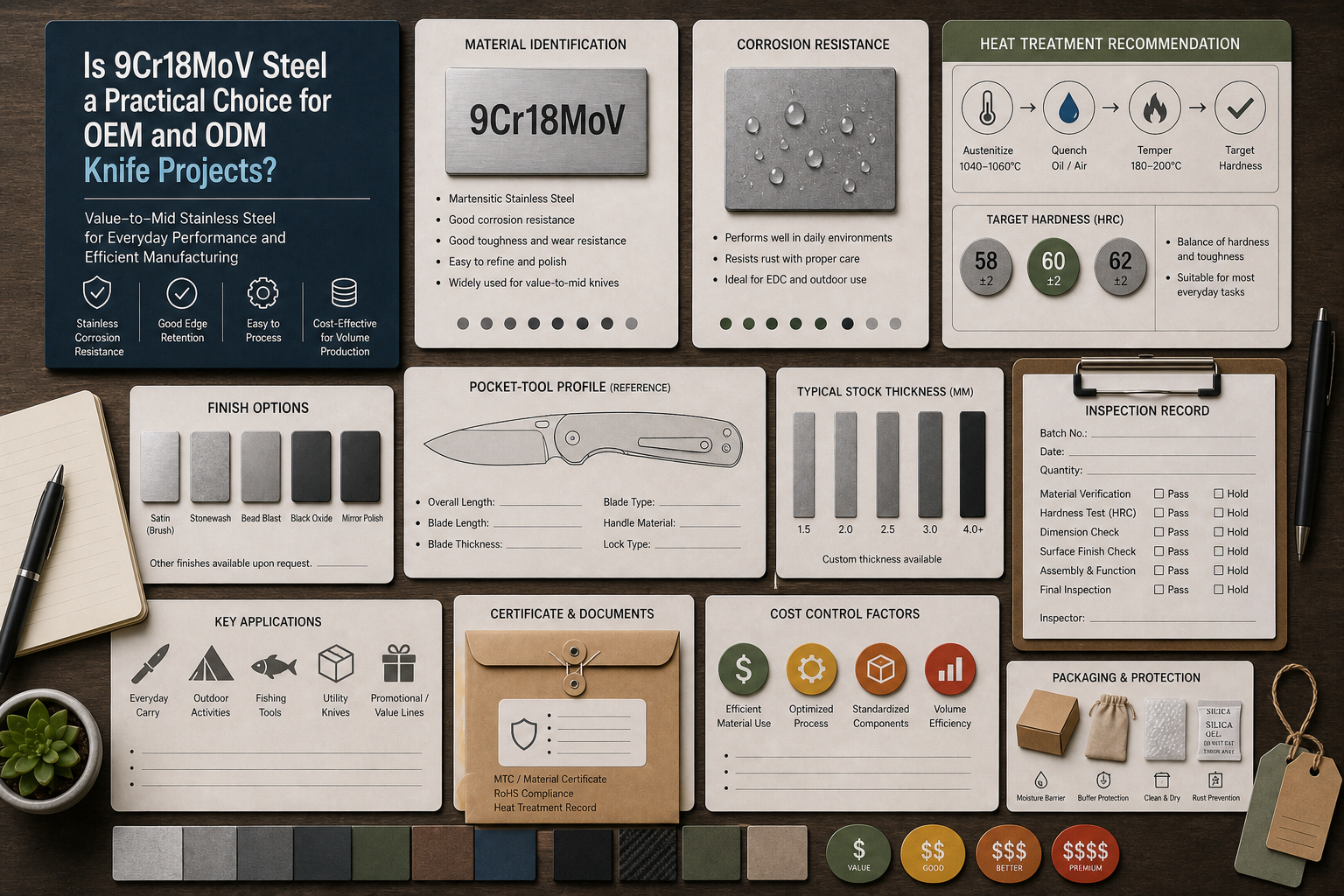
A stainless steel name can sound safe. But if the buyer ignores heat treatment, geometry, and price point, the knife can still disappoint.
9Cr18MoV is a practical stainless steel choice for OEM and ODM knife projects when buyers want stronger corrosion resistance and edge potential than basic budget stainless steels, while still controlling cost. It works best with clear grade control, heat treatment targets, grinding control, finishing, and inspection records.
Quick buyer brief:
- Answer: 9Cr18MoV fits value-to-mid positioned stainless knives.
- Buyer context: It helps brands that need stainless performance without jumping to premium powder steels.
- Key checks: Confirm grade, HRC range, heat treatment, blade geometry, finish, packaging, and QC records.
Planning a knife project with this steel?
Send us your target market, MOQ, price range, and blade type. Vast State can help you choose the right steel, HRC range, finish, handle material, and QC requirements for OEM/ODM production.
When a customer asks me whether 9Cr18MoV is good for a pocket knife, I first ask what kind of pocket knife they want to build. A low-cost knife, a mid-range EDC folder, and a brand-building stainless model should not use the same material logic. 9Cr18MoV can be a strong practical choice because it has high chromium and useful carbon for a stainless knife steel. But the steel name alone does not guarantee performance. The supplier still needs to control heat treatment, blade grinding, edge geometry, surface finish, assembly, and final inspection. For B2B buyers, the real value is not only the steel grade. The value is whether the whole product can match the target price, user expectation, and repeat-order quality.
What Is 9Cr18MoV Steel in OEM Knife Sourcing?
Steel names can hide important details. If the RFQ only says 9Cr18MoV, different suppliers may assume different standards, hardness, and finish levels.
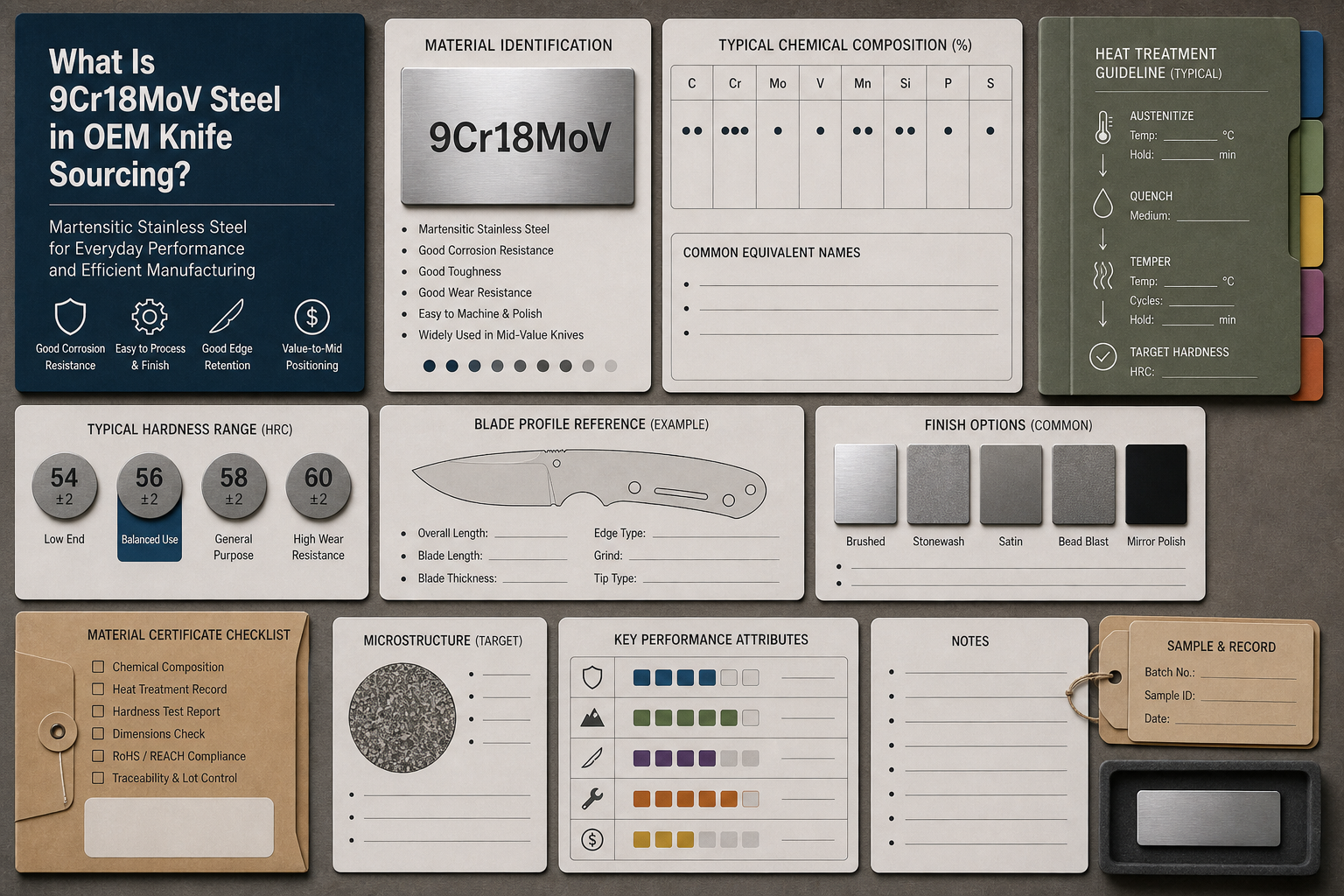
9Cr18MoV is a high-carbon martensitic stainless steel used for wear-resistant parts and cutting tools. In knife sourcing, buyers should specify grade, equivalent name, chemistry, hardness range, heat treatment, finish, and certificate needs.
I Define the Steel Before I Quote the Knife
In Chinese steel references, 9Cr18MoV is often connected with high-carbon stainless steel and with the newer grade name 85Cr17MoV under GB/T 1220 context. A GB/T 1220 translation table lists 9Cr18MoV and 85Cr17MoV together, and other steel references describe it as a martensitic stainless steel with high chromium plus molybdenum and vanadium additions. For knife buyers, this matters because the steel should be handled as a defined material specification, not as a loose label.
I like 9Cr18MoV when a buyer wants a more serious stainless option than entry-level steels but does not want to jump directly into high-cost powder steels. It can support pocket knives, folding knives, outdoor utility knives, and some fixed blade designs when the product position is right. But I still ask for the basics: blade thickness, target HRC, finish, lock type, handle material, packaging, MOQ, and inspection level. If the steel is not documented well, the buyer may have trouble proving the material claim later.
| Sourcing point | What I check | Why it matters |
|---|---|---|
| Grade name | 9Cr18MoV, 85Cr17MoV, or agreed equivalent | Prevents unclear substitution |
| Stainless family | Martensitic stainless steel | Aligns heat treatment expectations |
| Chemistry support | Carbon, chromium, molybdenum, vanadium | Supports material claim |
| Certificate need | Batch and material record | Builds buyer confidence |
Quote-ready RFQ Checklist for This Steel
To get an accurate OEM/ODM quote, prepare these details before contacting a knife manufacturer.
| RFQ Field | What to Prepare |
|---|---|
| Product type | Folding knife / fixed blade / multi-tool / kitchen knife |
| Target market | US / EU / outdoor retail / promotional / tactical / EDC |
| Steel option | 4116 / 14C28N / D2 / N690 / Nitro-V |
| Target HRC | Example: 55-57 HRC, 58-60 HRC |
| Blade finish | Satin / stonewash / black coating / bead blast |
| Handle material | G10 / micarta / aluminum / stainless steel / wood |
| Lock or structure | Liner lock / frame lock / slip joint / full tang |
| Estimated quantity | 500 / 1,000 / 3,000 / 5,000+ pcs |
| Packaging | White box / color box / blister / pouch / gift box |
| Required documents | Drawing / sample photo / logo file / packaging artwork |
Why Is 9Cr18MoV Attractive for Pocket Knife Projects?
A pocket knife must handle daily use and storage. If the steel rusts easily or dulls too fast, the user notices quickly.
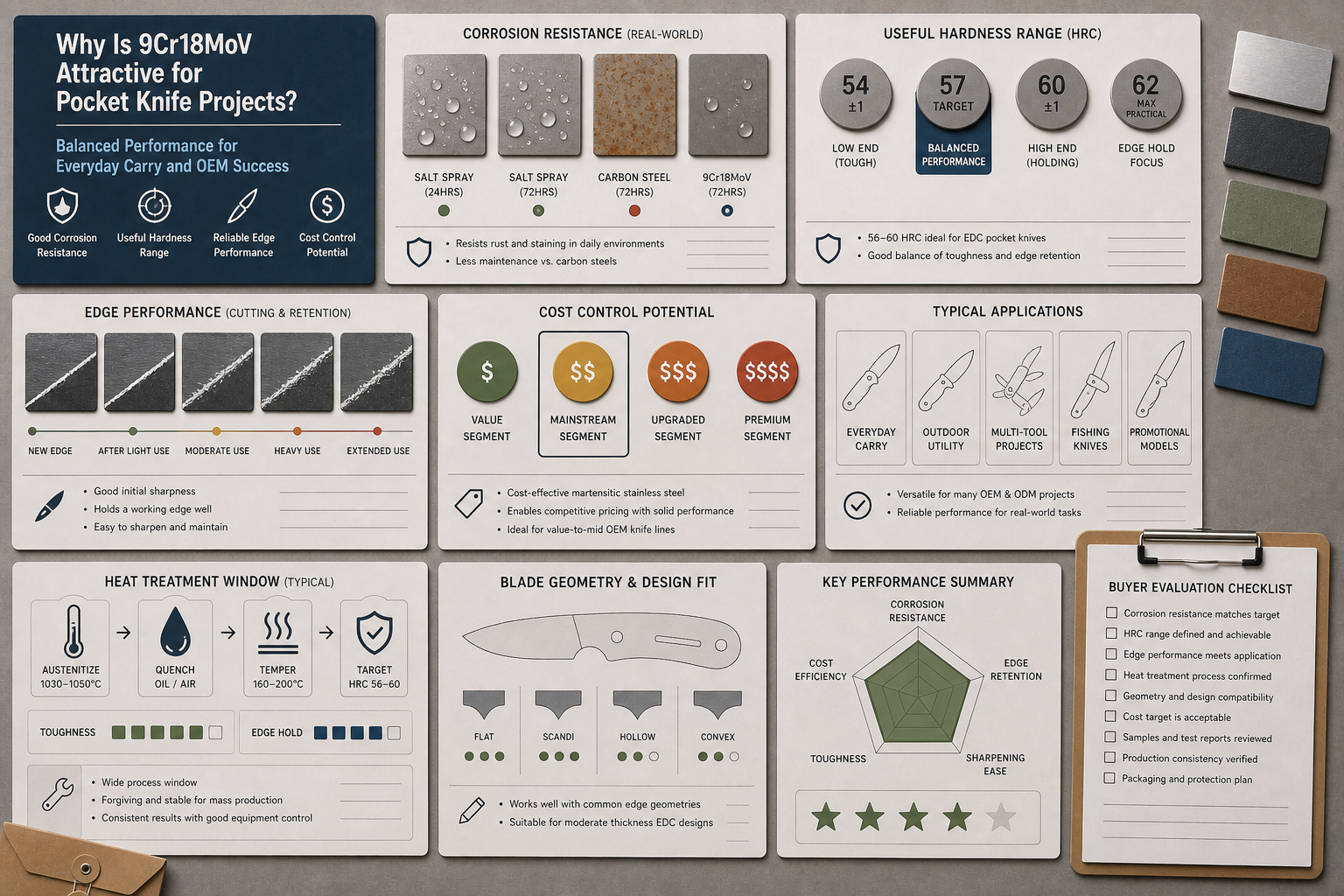
9Cr18MoV is attractive for pocket knives because it can offer good corrosion resistance, useful hardness, and practical edge performance at a controlled cost when heat treatment and geometry are handled correctly.
I Look at the User, Not Only the Steel Chart
Pocket knives are usually stored in pockets, bags, drawers, tool kits, and vehicles. They may face sweat, humidity, food residue, or outdoor moisture. This is why stainless behavior matters. The British Stainless Steel Association explains that stainless steel depends on at least 10.5 percent chromium to form a passive surface layer. 9Cr18MoV has much more chromium than that minimum, so it can be positioned as a stainless knife steel. That does not mean it is rustproof. It still needs proper finish, cleaning, and packaging. But it gives the buyer a stronger corrosion story than carbon steels such as SK-5.
The other attraction is performance for cost. 9Cr18MoV can often support a mid-positioned knife where the buyer wants a better steel story than 8Cr13MoV but does not want the price level of S35VN, M390, or MagnaCut. I do not call it the best steel. I call it a practical tool for a specific product level. If the buyer has a clear target market, 9Cr18MoV can help balance cost, stainless performance, and user confidence.
| User need | How 9Cr18MoV helps | What still needs control |
|---|---|---|
| Daily carry | Stainless behavior supports storage and handling | Finish and cleaning guidance |
| Edge performance | Higher carbon helps hardness potential | Heat treatment and edge geometry |
| Brand story | Better than entry-level stainless positioning | Honest product description |
| Cost control | Less costly than many premium steels | Supplier and process control |
Which Knife Projects Are a Good Fit for 9Cr18MoV?
The same steel can be smart in one project and wasteful in another. Product positioning decides whether 9Cr18MoV makes sense.
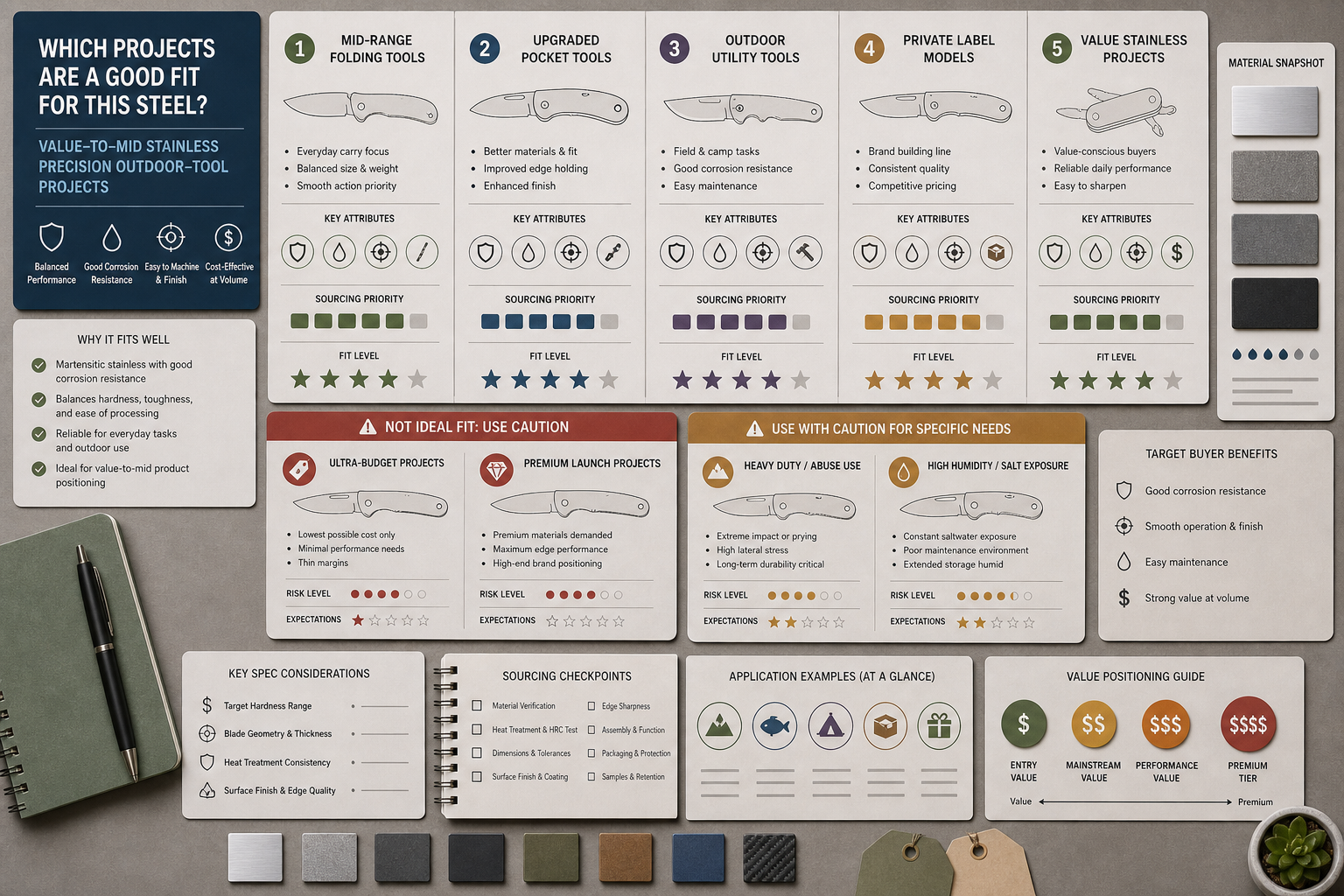
9Cr18MoV fits mid-range folding knives, upgraded pocket knives, outdoor utility knives, private label models, and value stainless projects. It is less suitable for ultra-budget products or premium steel-focused launches.
I Use 9Cr18MoV When the Market Can Understand the Upgrade
For many B2B buyers, the best use of 9Cr18MoV is an upgraded stainless model. A brand may already sell 8Cr13MoV or 5Cr15MoV knives and want a step-up version. A distributor may need a private label pocket knife that looks serious but still fits wholesale pricing. An outdoor brand may want a folding utility knife that can handle wet environments better than carbon steel. In these cases, 9Cr18MoV can be a practical option.
I am more careful when the project is extremely price-driven. If the buyer's channel only cares about the lowest unit price, a simpler stainless steel may be more realistic. I am also careful with premium listings where the customer base expects powder steels or famous international grades. In that case, 9Cr18MoV may be technically useful but weaker as a marketing signal. This is why I always connect the steel to the sales channel, not only the blade design.
| Project type | 9Cr18MoV fit | My sourcing comment |
|---|---|---|
| Upgraded pocket knife | Strong fit | Good balance of stainless story and cost |
| Mid-range EDC folder | Strong fit | Needs clean action and finish |
| Ultra-budget knife | Weak fit | Cost may not match channel |
| Premium steel launch | Conditional fit | Buyer may need a stronger steel name |
What Heat Treatment and HRC Range Should Buyers Discuss?
A stainless steel can have good chemistry and still perform poorly. Heat treatment decides whether the blade works as expected.
Buyers should discuss target HRC, hardening and tempering route, batch hardness testing, edge geometry, and final sharpening. 9Cr18MoV needs controlled heat treatment to balance hardness, toughness, and corrosion performance.
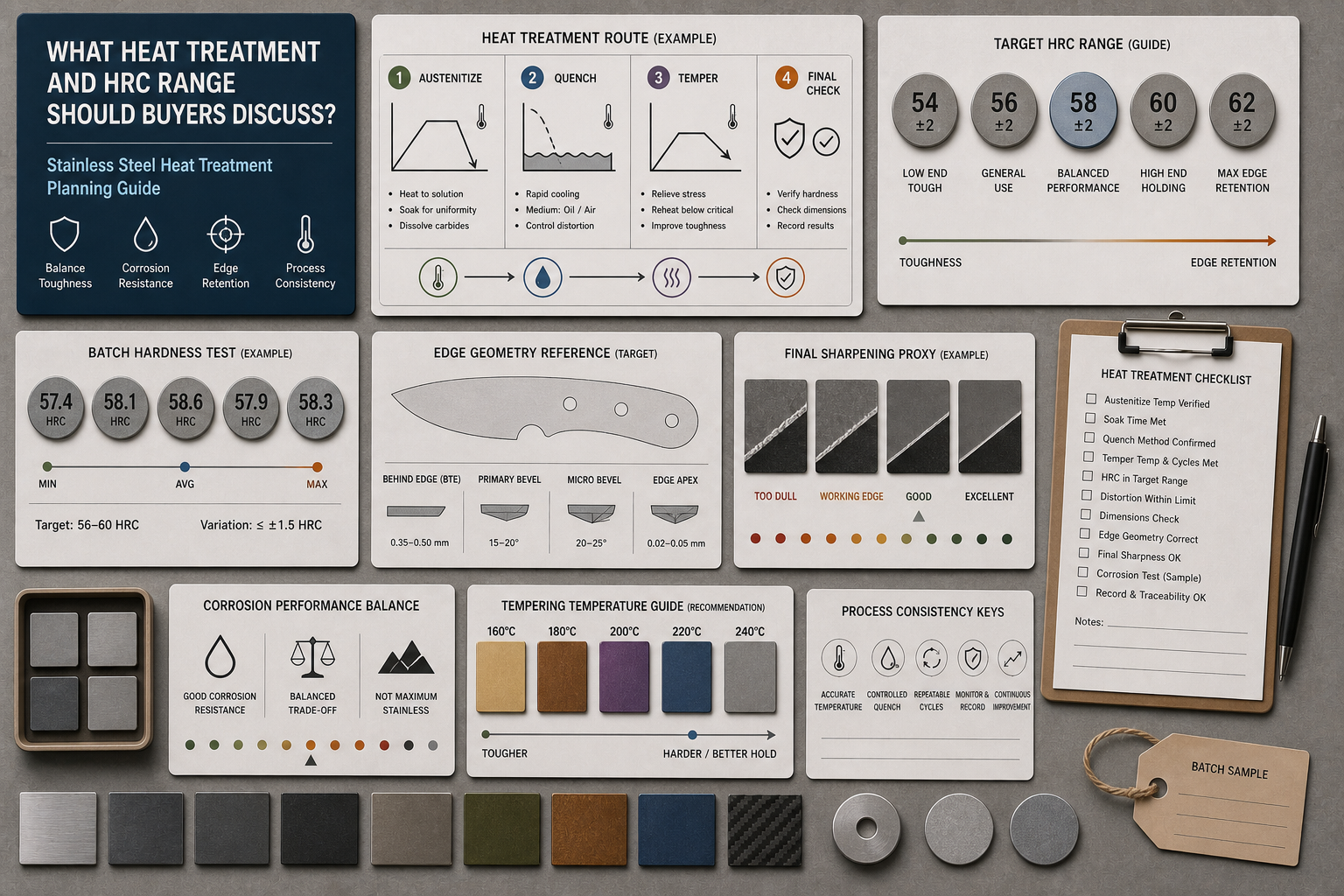
Many steel references list 9Cr18MoV as a hardenable martensitic stainless steel. That is useful, but it is not enough for production. The buyer and supplier need a target range that matches the product. A thinner pocket knife blade may need a different balance from a thicker utility blade. If the hardness is too low, the edge may not hold well. If the hardness is pushed too high without enough toughness, the blade may chip more easily.
The NIST Rockwell hardness guide explains why proper Rockwell measurement practice matters. In production, I want the supplier to test on suitable surfaces, control equipment, and keep batch records. I also want the buyer to connect the HRC target with edge geometry. A steel can test well on paper but still cut poorly if the bevel is thick or uneven. For 9Cr18MoV, heat treatment, grinding, and sharpening should be planned together.
| Heat treatment point | What to specify | Why it matters |
|---|---|---|
| Target HRC | Practical range for the product | Aligns edge and toughness expectations |
| Process route | Hardening, tempering, batch control | Reduces inconsistent performance |
| Hardness testing | Method and sample plan | Supports repeat order consistency |
| Edge geometry | Bevel angle and edge thickness | Turns steel potential into cutting ability |
How Should Buyers Compare 9Cr18MoV With 8Cr13MoV, D2, 14C28N, and 440C?
Steel comparison can become a name contest. Buyers need to compare by market, cost, corrosion, edge behavior, and supply.
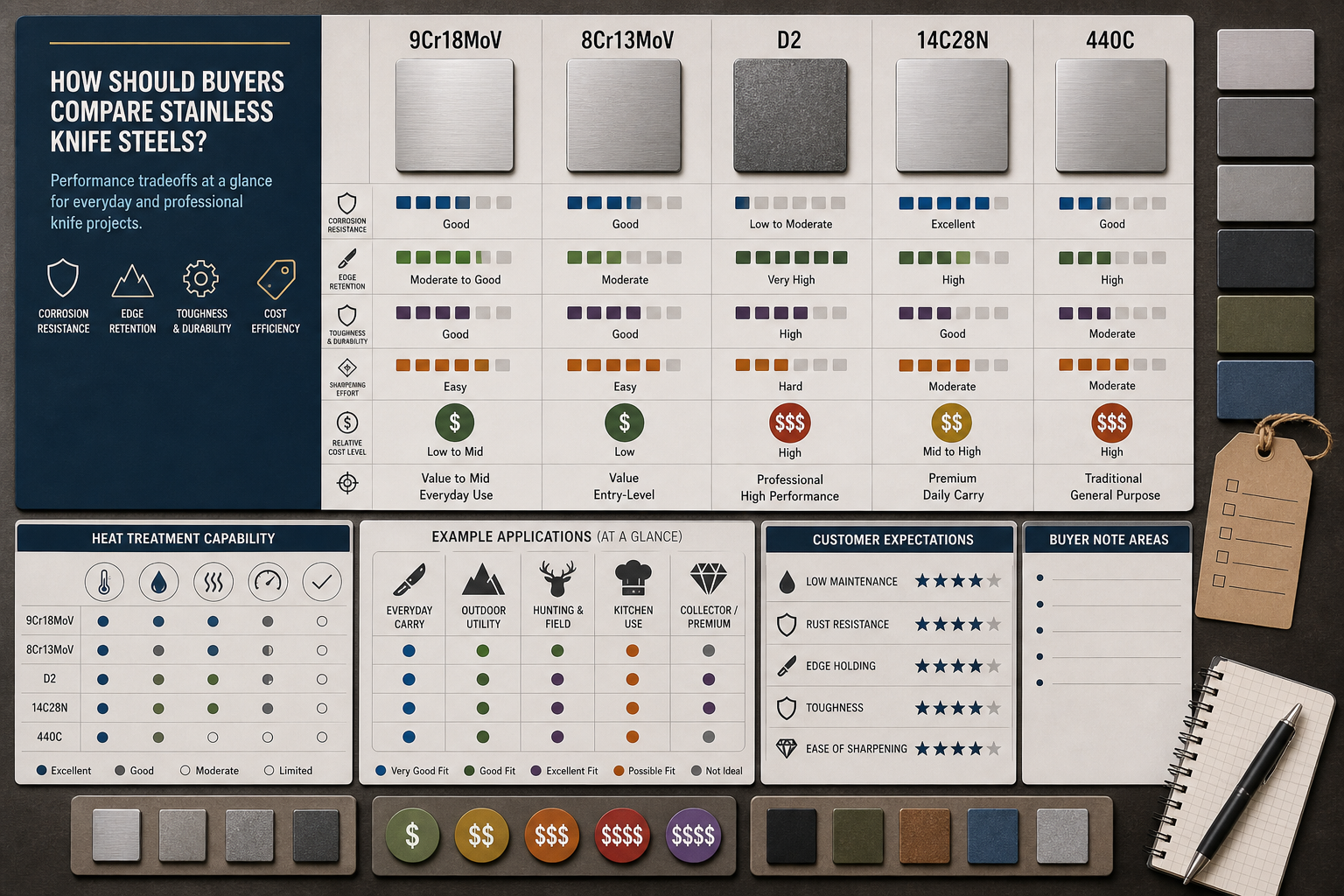
Buyers should compare 9Cr18MoV with 8Cr13MoV, D2, 14C28N, and 440C by stainless need, edge target, price level, heat treatment capability, and customer expectations. 9Cr18MoV is often a practical middle option.
I Compare the Business Role of Each Steel
8Cr13MoV can be a practical budget stainless steel. D2 can offer stronger wear resistance, but it is not the same as a fully stainless option. 14C28N can be a clean stainless upgrade with good market recognition in many EDC channels. 440C has a long history as a high-carbon stainless knife steel. 9Cr18MoV often sits near the middle of this conversation for China-based OEM projects: better positioned than basic stainless options, but still more cost-aware than many imported premium steels.
Knife Steel Nerds has published broad comparisons of toughness, edge retention, and corrosion resistance across many knife steels. I do not use those charts as the only answer, because a buyer's final result also depends on heat treatment and geometry. But the general principle is useful. No steel wins everything. The right choice depends on which weakness the buyer can accept. If corrosion resistance is important and the product must stay cost controlled, 9Cr18MoV can be sensible. If the buyer needs a stronger steel name for a premium EDC launch, another steel may serve the brand better.
| Steel option | Better fit | Buyer caution |
|---|---|---|
| 9Cr18MoV | Mid-range stainless OEM knives | Needs heat treatment and grade control |
| 8Cr13MoV | Budget stainless folders | Weaker upgrade story |
| D2 | Cost-aware wear resistance | Corrosion messaging needs care |
| 14C28N | Practical stainless upgrade | Material cost may be higher |
| 440C | Established high-carbon stainless story | Supplier source and treatment matter |
What Manufacturing Details Affect 9Cr18MoV Knife Quality?
Good steel can be wasted by poor processing. A small error in grinding, pivot holes, or lock surfaces can hurt the whole knife.
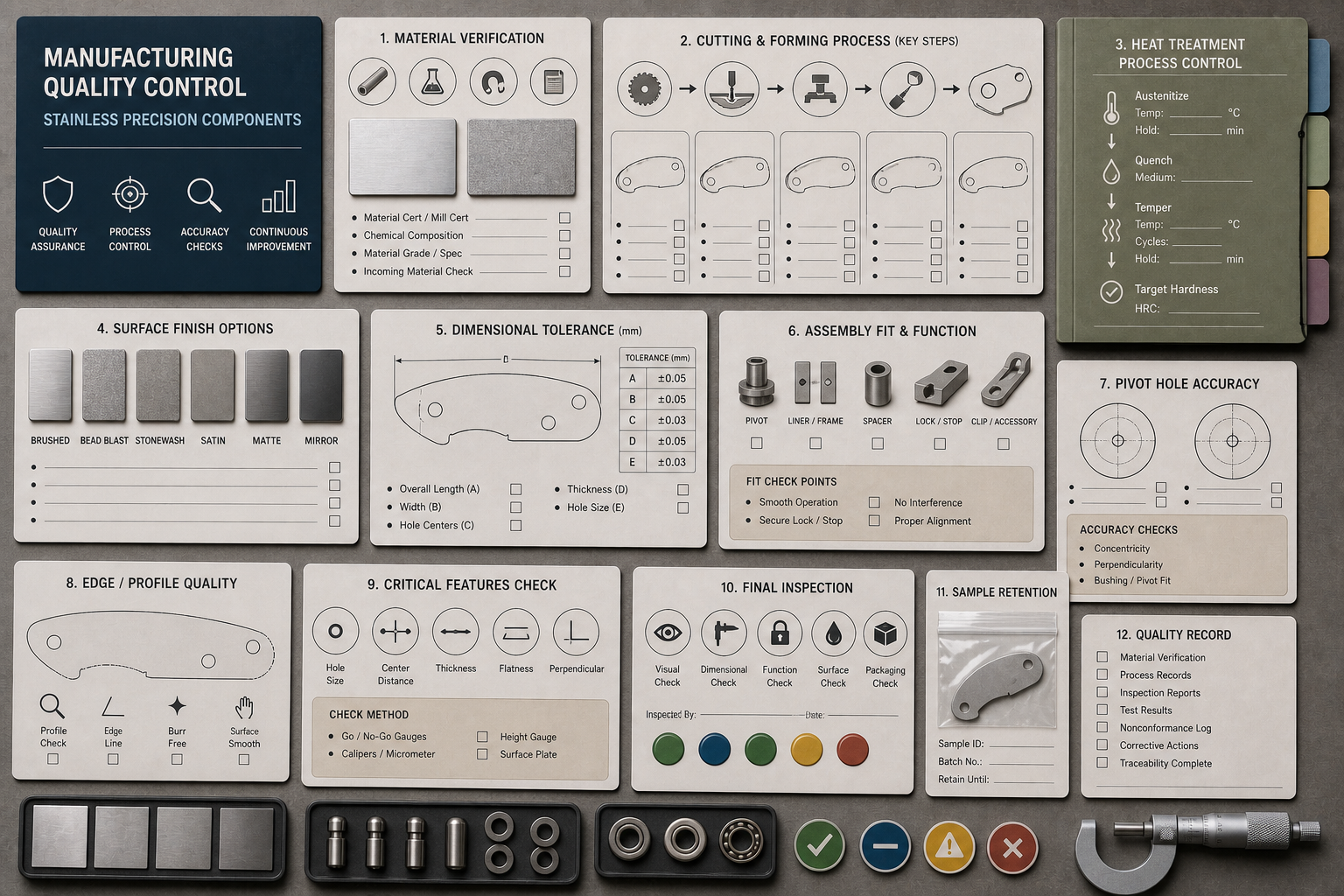
9Cr18MoV knife quality depends on material verification, blank cutting, heat treatment, grinding control, surface finishing, edge sharpening, lock fitting, assembly, and final inspection.
I Protect the Steel Through the Whole Process
In production, 9Cr18MoV must be handled as more than a material purchase. Blade blanks need accurate profile cutting. Pivot holes and lock tang areas need tight control for folding knives. Heat treatment must match the steel. Grinding must avoid overheating the edge. The final bevel should be even. The surface finish should be consistent. A satin finish, stonewash, bead blast, polish, or coating can all work, but each finish needs its own process discipline.
For folding knives, I pay special attention to blade centering, lock engagement, pivot feel, and screw tension. A knife with 9Cr18MoV steel can still feel cheap if the action is rough or the lock is poorly fitted. For fixed blades, I look at tang design, handle fit, blade straightness, and edge consistency. I also watch packaging because stainless does not mean careless storage. Fingerprints, moisture, and poor cleaning can still cause surface issues. This is why I prefer a process-based QC plan, not only a final visual check.
| Manufacturing detail | What I control | Buyer benefit |
|---|---|---|
| Blade cutting | Profile, holes, tang, stop area | Better fit and assembly |
| Heat treatment | HRC and batch consistency | Stable edge performance |
| Grinding | Heat control and bevel symmetry | Better cutting and appearance |
| Assembly | Lockup, centering, screw tension | Better user experience |
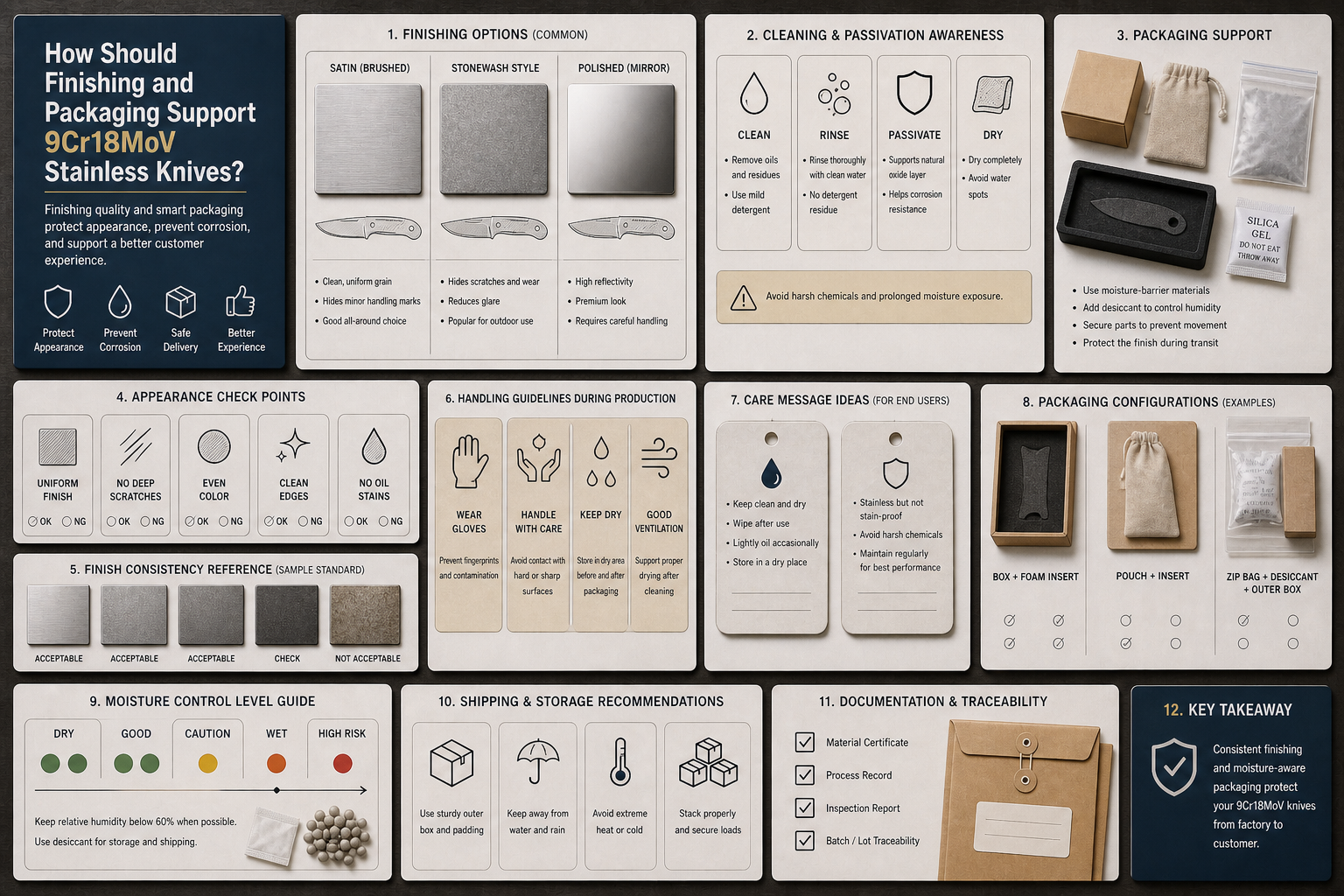
How Should Finishing and Packaging Support 9Cr18MoV Stainless Knives?
Stainless steel reduces rust risk, but it does not remove every surface issue. Bad cleaning or packaging can still create complaints.
9Cr18MoV knives should use suitable surface finishing, cleaning, passivation-aware handling where needed, dry packaging, and final appearance checks. Good finishing protects the stainless value the buyer paid for.
I Do Not Treat Stainless as Maintenance-Free
The BSSA stainless explanation is useful because it reminds buyers that corrosion resistance comes from a surface condition, not from magic. Stainless steel relies on a chromium-rich passive layer. If the knife is contaminated, poorly cleaned, stored wet, or finished inconsistently, surface problems can still happen. This is especially important for export orders where knives may travel through humid shipping conditions or sit in warehouses before sale.
For 9Cr18MoV projects, I ask about the finish from the beginning. Stonewash can hide small handling marks and support a practical user look. Satin can look clean but needs careful scratch control. Polish can look attractive but may not fit every outdoor market. Coating can change the design story. Packaging also matters. A clean blade, dry inner packaging, silica gel where suitable, and clear care instructions can protect the product. For B2B buyers, this is not only about preventing rust. It is about preserving the buyer's brand promise when the customer opens the box.
| Finish or packaging item | Practical option | Buyer benefit |
|---|---|---|
| Surface finish | Satin, stonewash, polish, coating | Matches brand and use case |
| Cleaning | Remove residue and fingerprints | Reduces surface complaints |
| Packaging | Dry pack and suitable protection | Protects during storage and shipping |
| Care message | Simple cleaning guidance | Sets user expectations |
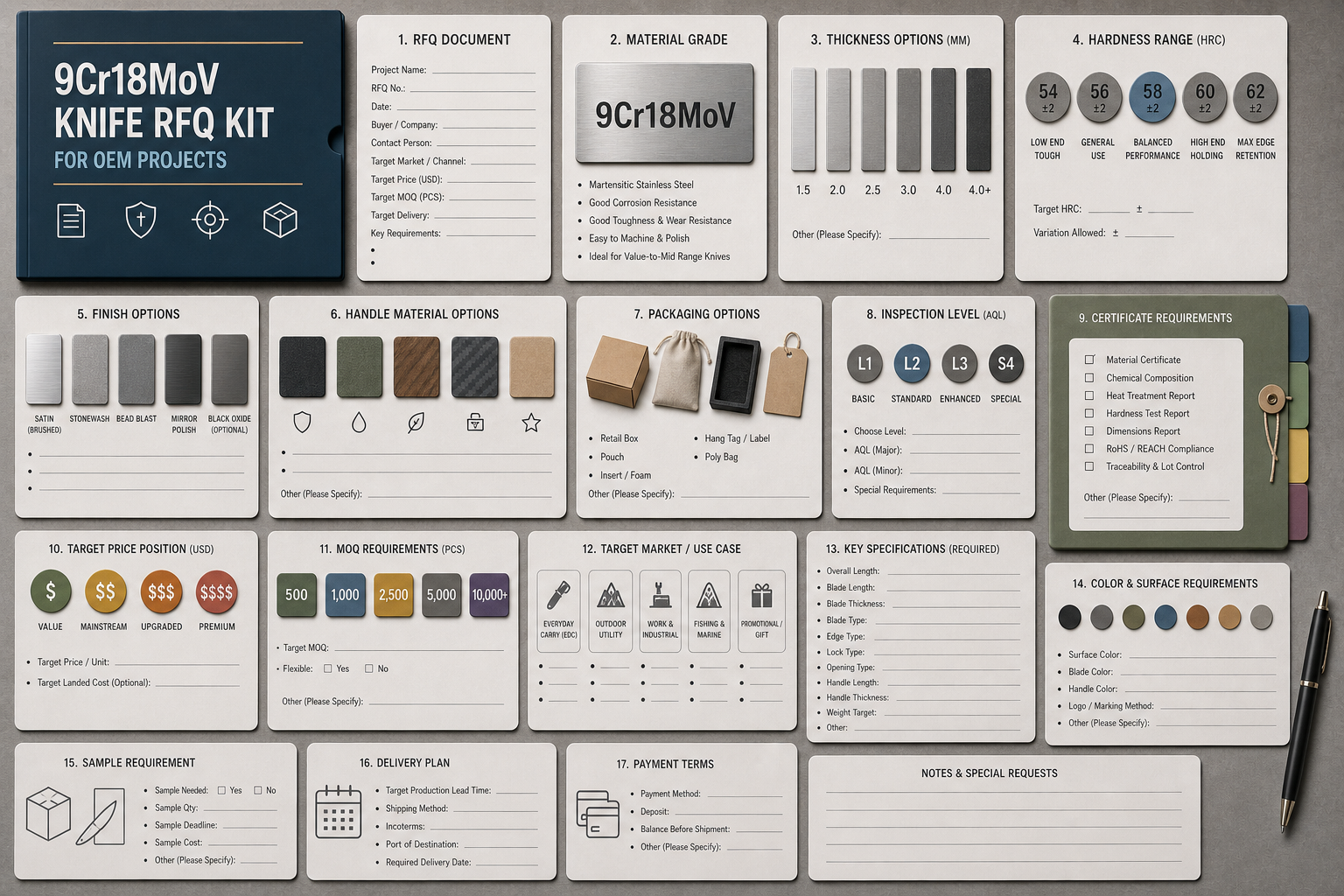
What Should Buyers Put in a 9Cr18MoV Knife RFQ?
A weak RFQ makes quotations hard to compare. Suppliers may quote different thickness, hardness, finish, and packaging assumptions.
A 9Cr18MoV RFQ should include knife type, blade thickness, HRC range, finish, handle material, lock or tang design, branding, packaging, MOQ, inspection level, certificate requirements, target price, and target market.
I Use the RFQ to Control Assumptions
When a buyer asks for 9Cr18MoV, I want the RFQ to explain the whole knife. A short request for "9Cr18MoV pocket knife" leaves too many decisions open. I need blade length, thickness, finish, target HRC, handle material, lock type, opening style, clip, screws, logo method, packaging, target market, expected quantity, and inspection needs. If the buyer already has a drawing, I check manufacturability. If the buyer only has a reference idea, I help narrow the options before sampling.
I also ask buyers to separate must-have items from flexible items. The steel may be fixed, but the finish may be flexible. The target price may be fixed, but handle material may need adjustment. The lock type may be fixed, but packaging can change. This gives the supplier room to protect both quality and margin. For 9Cr18MoV, a clear RFQ helps the buyer get a realistic quotation and helps the factory avoid rework during sampling.
I also connect the RFQ with the inspection plan. The ISO document on ISO 9001 in the supply chain explains that clear requirements can help suppliers provide consistent products and services. For 9Cr18MoV orders, I want material certificates, HRC records, dimensional checks, edge inspection, finish review, lock or handle function checks, packaging checks, and final inspection included in the discussion before production starts.
| RFQ field | What to include | Why it helps |
|---|---|---|
| Blade specification | 9Cr18MoV, thickness, finish, HRC | Aligns material and process |
| Structure | Lock type, pivot, clip, tang, hardware | Clarifies production complexity |
| Branding | Logo, color, packaging, inserts | Supports private label planning |
| Quality requirements | Certificate, HRC report, AQL, photos | Creates shared inspection standards |
Ready to use this material in your next knife line?
Vast State can help you compare blade steels, heat treatment ranges, handle materials, finishes, packaging options, and QC requirements based on your target market and quantity.
Conclusion
I choose 9Cr18MoV when the buyer needs practical stainless performance, controlled cost, clear heat treatment, and repeatable OEM quality.
Source Notes
- The GB/T 1220 translated PDF supports the 9Cr18MoV and 85Cr17MoV grade reference in stainless steel context.
- SteelGr data supports common chemistry ranges for 9Cr18MoV, including carbon, chromium, molybdenum, and vanadium.
- The British Stainless Steel Association supports the chromium-based explanation of stainless steel corrosion resistance.
- Knife Steel Nerds supports the broader idea that knife steels should be compared by multiple properties, not by name alone.
- The NIST Rockwell hardness guide supports the need for credible HRC testing practice.
- The ISO 9001 supply chain guide supports clear buyer requirements and supplier quality confidence.