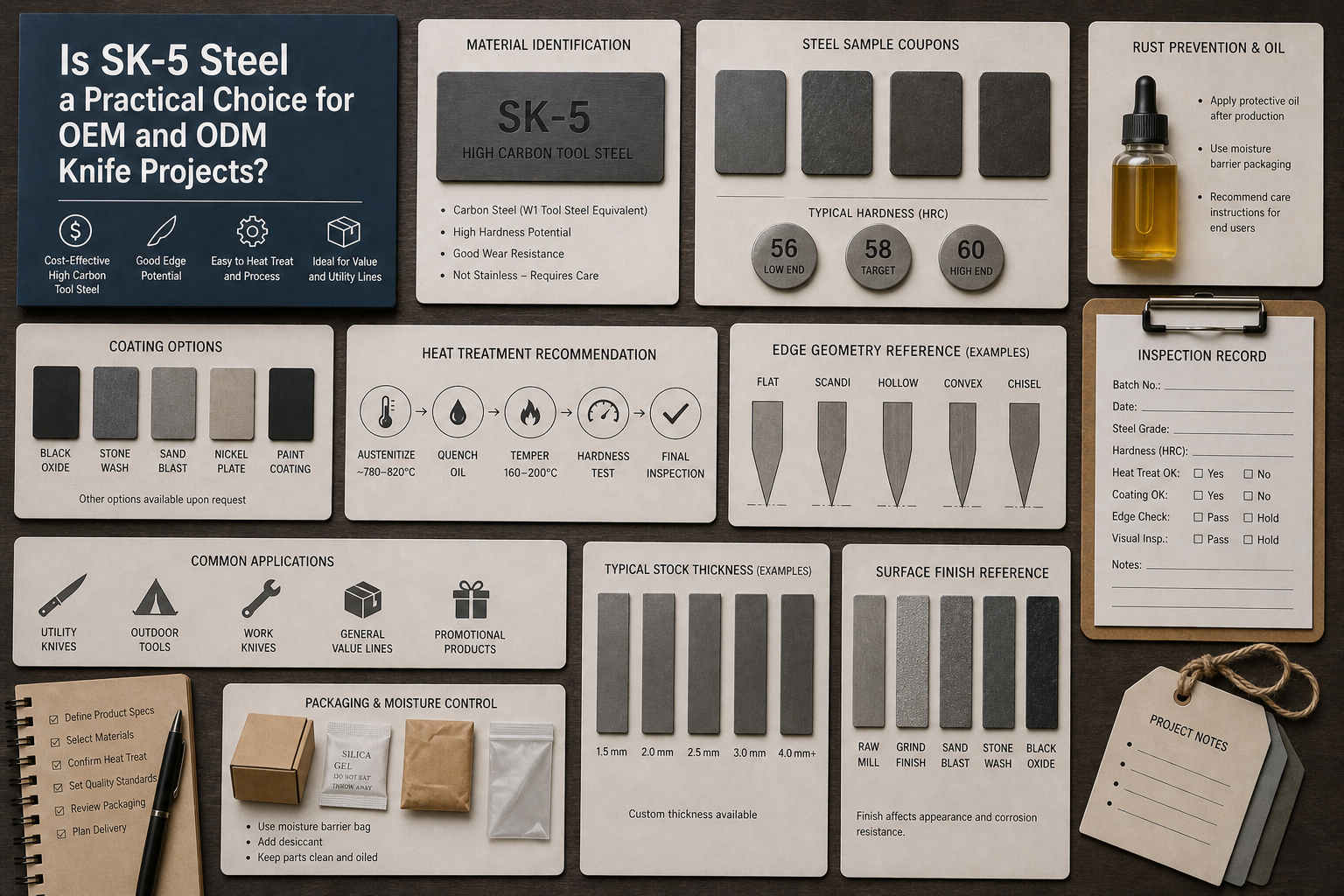
SK-5 can look like a simple budget steel. But if the project ignores rust, heat treatment, and use case, problems appear quickly.
SK-5 steel is a practical choice for OEM and ODM knife projects when buyers need a cost-aware high-carbon tool steel with good hardness and wear resistance. It works best with controlled heat treatment, suitable blade geometry, protective finishing, clear maintenance expectations, and a market that accepts carbon steel.
Quick buyer brief:
- Answer: SK-5 is practical for value outdoor, utility, and tool-style knives.
- Buyer context: It helps buyers who need performance and cost control more than stainless convenience.
- Key checks: Confirm grade, HRC range, coating, edge geometry, corrosion protection, and inspection records.
Planning a knife project with this steel?
Send us your target market, MOQ, price range, and blade type. Vast State can help you choose the right steel, HRC range, finish, handle material, and QC requirements for OEM/ODM production.
When a buyer asks me about SK-5, I do not answer with a simple yes or no. I ask where the knife will be sold, how the user will maintain it, what price range the brand needs, and whether the product should be stainless or carbon steel. SK-5 can be useful because it is a known carbon tool steel with good hardness potential after heat treatment. But it is not a magic steel. It can rust if the surface is not protected. It can chip or roll if the heat treatment and geometry do not match the job. It can also be the wrong message if the buyer's market expects low-maintenance stainless knives. For OEM and ODM work, SK-5 is a practical option when the buyer understands the trade-off.
What Is SK-5 Steel in OEM Knife Sourcing?
Steel names can be confusing. If a buyer does not define SK-5 clearly, suppliers may quote different materials or different heat treatment assumptions.
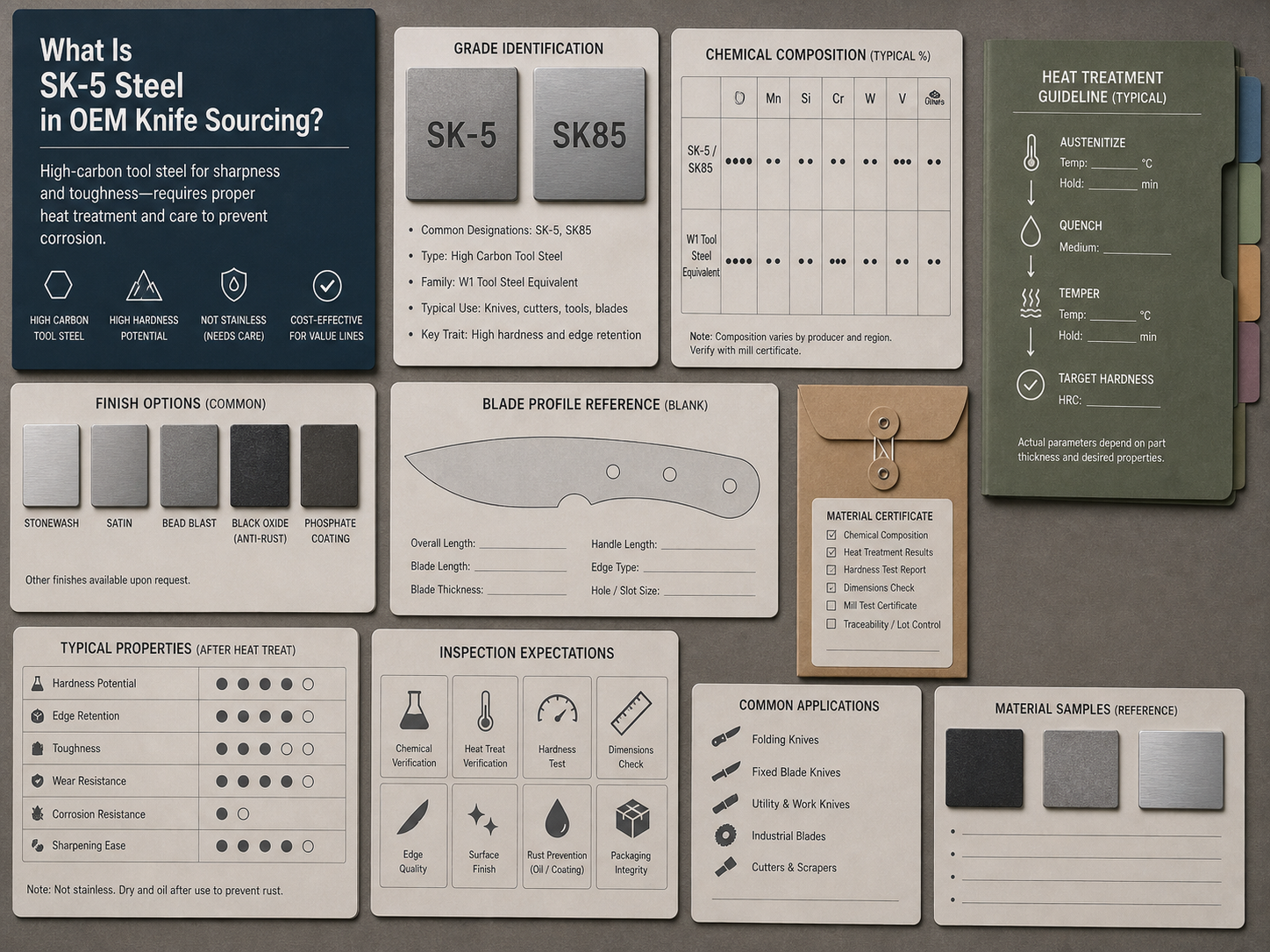
SK-5, also written as SK5 or SK85 in many references, is a JIS carbon tool steel used for high-hardness cutting tools. In knife sourcing, buyers should specify grade, chemistry, heat treatment, finish, and inspection expectations.
I Treat SK-5 as a Controlled Carbon Tool Steel
SK-5 should not be treated as a loose marketing term. The official JIS preview for JIS G 4401:2022 identifies the standard as carbon tool steels. SteelJIS lists SK85 as a synonym for SK5 and places it under JIS G 4401 carbon tool steels. It also gives a typical carbon range of 0.8-0.9 percent, with silicon, manganese, phosphorus, sulfur, nickel, chromium, and copper limits. That matters because SK-5 gets its useful knife properties mainly from carbon and heat treatment, not from high chromium stainless behavior.
In OEM work, I use this information to make the specification practical. I want to know whether the buyer is asking for SK5, SK85, or an equivalent carbon steel. I also want to know the product form, such as strip, sheet, or plate. The blade thickness and cutting method affect cost and production. If the buyer only writes "SK-5 knife" in the RFQ, the quotation may look simple but leave too many open questions. A better RFQ asks for grade, thickness, target HRC, finish, coating, packaging, and test records.
| Sourcing point | What I check | Why it matters |
|---|---|---|
| Steel identity | SK-5, SK5, SK85, or equivalent | Prevents vague substitution |
| Standard basis | JIS G 4401 carbon tool steel | Gives a common reference point |
| Product form | Strip, sheet, plate, or bar | Affects blade processing |
| Documentation | Certificate and batch record | Supports buyer confidence |
Quote-ready RFQ Checklist for This Steel
To get an accurate OEM/ODM quote, prepare these details before contacting a knife manufacturer.
| RFQ Field | What to Prepare |
|---|---|
| Product type | Folding knife / fixed blade / multi-tool / kitchen knife |
| Target market | US / EU / outdoor retail / promotional / tactical / EDC |
| Steel option | 4116 / 14C28N / D2 / N690 / Nitro-V |
| Target HRC | Example: 55-57 HRC, 58-60 HRC |
| Blade finish | Satin / stonewash / black coating / bead blast |
| Handle material | G10 / micarta / aluminum / stainless steel / wood |
| Lock or structure | Liner lock / frame lock / slip joint / full tang |
| Estimated quantity | 500 / 1,000 / 3,000 / 5,000+ pcs |
| Packaging | White box / color box / blister / pouch / gift box |
| Required documents | Drawing / sample photo / logo file / packaging artwork |
Where Does SK-5 Fit Compared With Stainless Knife Steels?
Some buyers expect every knife steel to resist rust. SK-5 does not work that way, and wrong expectations can create complaints.
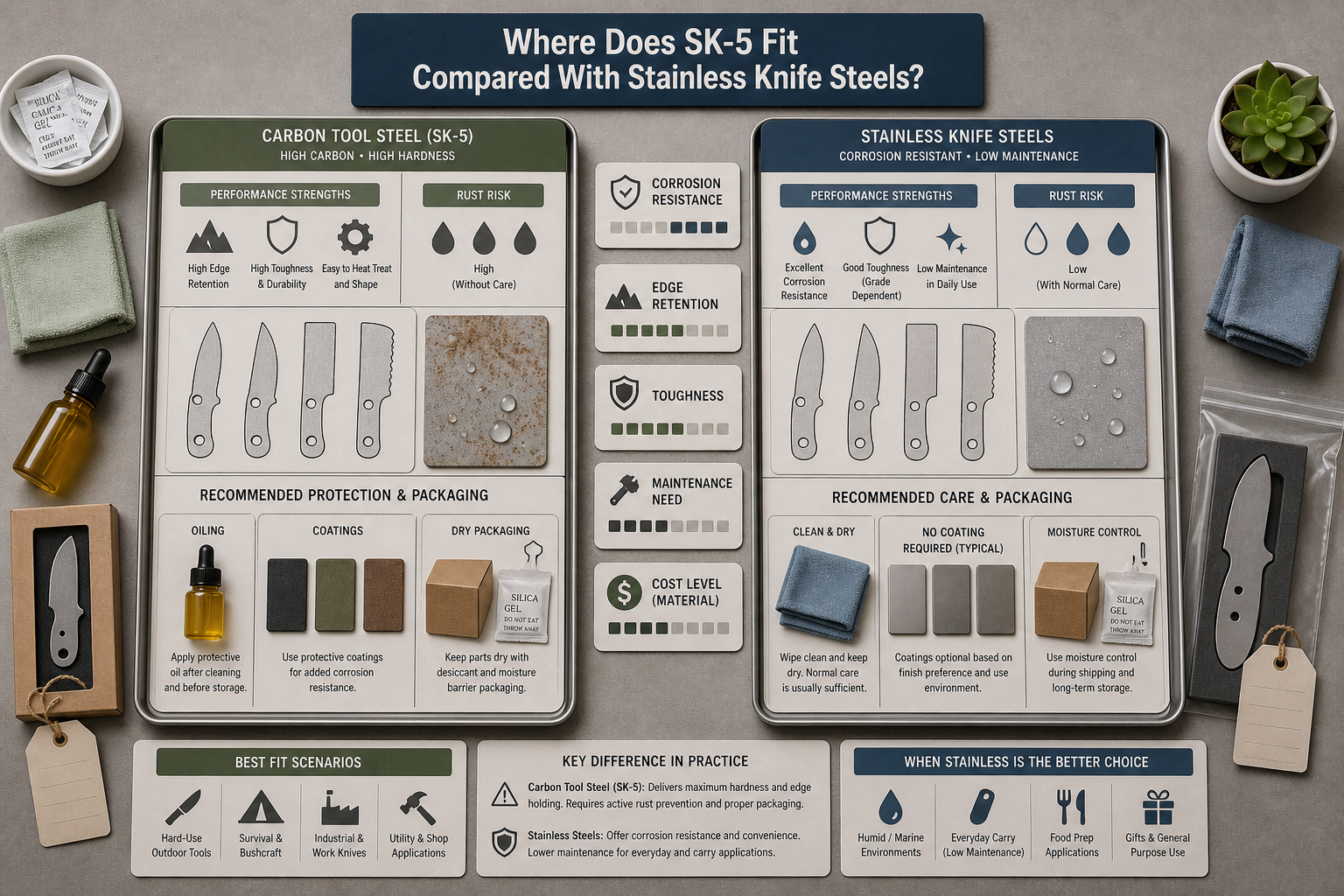
SK-5 is a high-carbon tool steel, not a stainless steel. It can offer useful hardness and wear resistance, but it needs coating, oiling, packaging control, and buyer education when corrosion is a concern.
I Explain the Rust Trade-Off Early
The British Stainless Steel Association explains that stainless steel needs at least 10.5 percent chromium, which forms a passive layer that helps protect the surface. SK-5 does not have that kind of chromium level. SteelJIS lists chromium only as an impurity limit for SK85/SK5, not as a stainless alloying base. This is why I never sell SK-5 to a buyer as a low-maintenance stainless option.
That does not make SK-5 bad. It means the steel must fit the product and market. A buyer who sells outdoor tools may accept coated carbon steel because the user understands cleaning and oiling. A buyer who sells simple pocket knives to casual users may prefer stainless steel because the maintenance burden is lower. A brand that uses SK-5 should also think about packaging. Moisture control, protective oil, blade sleeve, and clear care instructions can reduce early rust risk. In a B2B project, this is not only a technical issue. It is a customer-service issue.
| Steel type | Main advantage | Buyer caution |
|---|---|---|
| SK-5 carbon tool steel | Good hardness and wear resistance for cost | Needs corrosion protection |
| 8Cr13MoV stainless | Low-maintenance value option | Lower carbon-tool-steel toughness story |
| 420-series stainless | Easy corrosion resistance for budget knives | Lower edge performance in many designs |
| 14C28N stainless | Practical stainless upgrade | Higher material cost than basic carbon steel |
Which Knife Projects Are a Good Fit for SK-5?
A good steel in the wrong product becomes a weak decision. SK-5 needs the right market, user expectation, and price level.
SK-5 fits value outdoor knives, utility knives, coated fixed blades, cutting tools, and budget performance projects. It is less suitable for users who expect stainless convenience or premium steel branding.
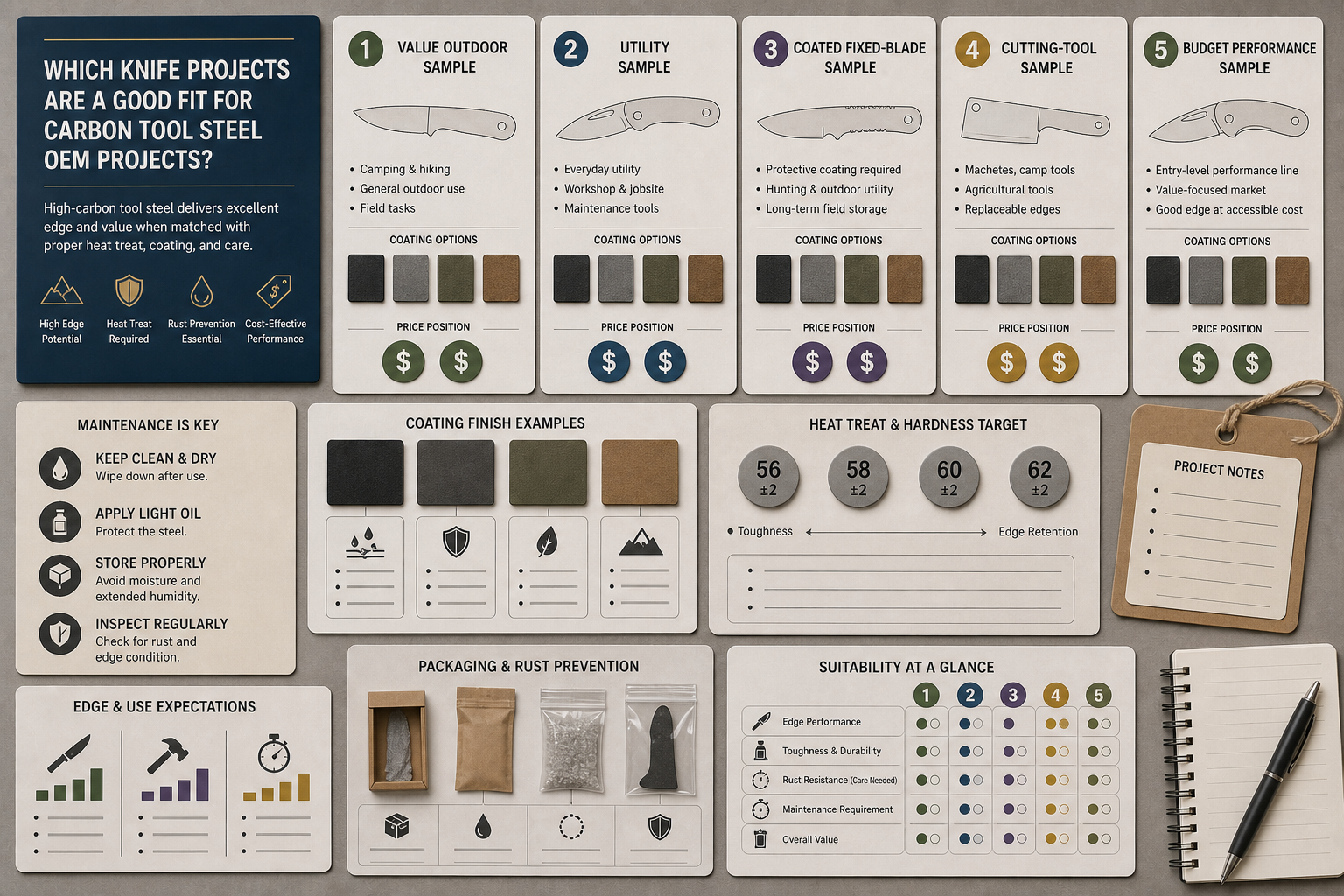
I Match SK-5 to Practical Product Positioning
Baosteel describes SK5 as a carbon tool steel used in tool-industry applications that require high hardness and wear resistance. Fushun Special Steel also describes SK85/SK5 as a high-carbon tool steel used for tools such as utility knives, long-edged tools, cutting tools, and related products. These sources support the way I think about SK-5 in knife development. I see it as a practical working steel, not a prestige steel.
For OEM and ODM buyers, this is useful in the right segment. SK-5 can work well for value outdoor fixed blades, coated utility knives, camping tools, replacement blades, and private label tools where the buyer needs performance at a controlled cost. It can also support a simple, rugged product story when the brand explains carbon steel care. I am more careful with SK-5 for small pocket knives sold to casual users, especially if the product will be stored in humid conditions or shipped without protective packaging. In that situation, a stainless steel may reduce complaint risk.
| Product type | SK-5 fit | My comment |
|---|---|---|
| Coated outdoor fixed blade | Strong fit | Coating and geometry matter |
| Utility knife or cutter | Strong fit | Wear resistance and cost control matter |
| Casual pocket knife | Conditional fit | Stainless may reduce rust complaints |
| Premium EDC folder | Weak to moderate fit | Steel name may not support premium pricing |
What Heat Treatment and HRC Range Should Buyers Discuss?
SK-5 can be useful after heat treatment. But poor heat treatment can turn good carbon steel into unstable production.
Buyers should discuss quenching, tempering, target HRC, batch hardness testing, blade geometry, and edge finish. SK-5 performance depends strongly on heat treatment and process consistency.
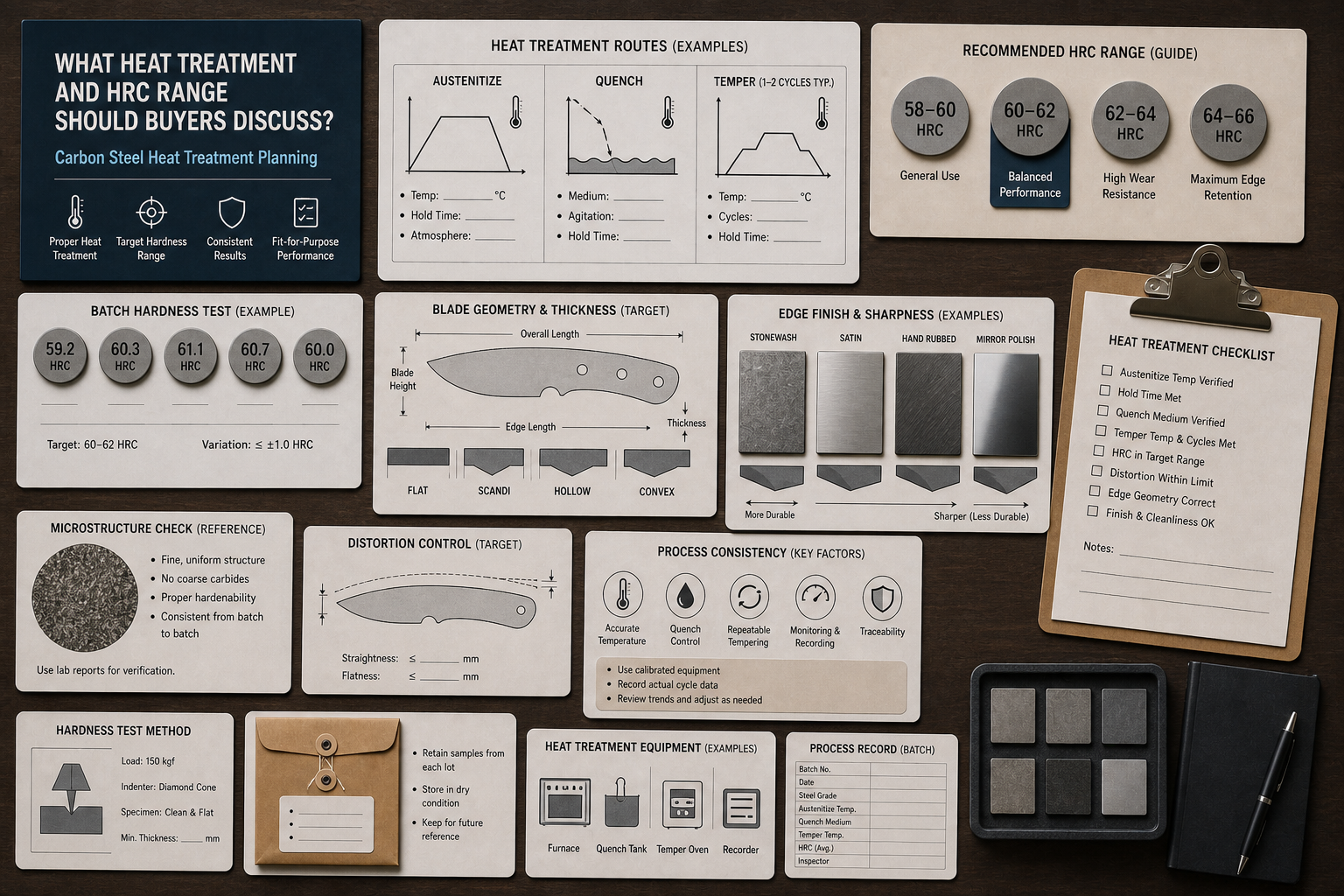
I Do Not Let Hardness Become a Guess
SK-5 has a useful hardness range for many knife applications, but the right number depends on product use. Boker's knife glossary lists SK-5 at 57-60 HRC in its knife context. SteelJIS lists SK85/SK5 as 59 HRC in a quenched and tempered condition. These references are helpful, but I still treat the exact target as a project decision. A thin utility blade, a coated outdoor fixed blade, and a pocket knife blade do not always need the same edge geometry or hardness target.
The NIST Rockwell hardness guide explains that good Rockwell practice helps reduce measurement error. In factory work, I apply that idea by asking for proper test surfaces, sample selection, equipment checks, and batch records. If the buyer wants a harder edge, I also ask how the supplier will manage toughness and brittleness risk. If the buyer wants more toughness, I ask whether the edge retention target still fits the market. SK-5 is practical only when heat treatment is controlled, not assumed.
| Heat treatment item | What to specify | Why it matters |
|---|---|---|
| Target hardness | Practical HRC range for the product | Aligns cutting and toughness expectations |
| Quenching and tempering | Process route and batch control | Reduces unstable performance |
| Hardness testing | Test method and sample plan | Supports repeat production |
| Edge geometry | Thickness and sharpening angle | Connects steel to real cutting behavior |
How Should Finishing and Coating Protect SK-5 Knives?
Carbon steel can leave the factory looking perfect. If packaging and finish are weak, rust can appear before the buyer sells it.
SK-5 knives usually need a suitable finish, coating, oiling, cleaning, dry packaging, and clear care instructions. These details protect the product and reduce after-sale complaints.
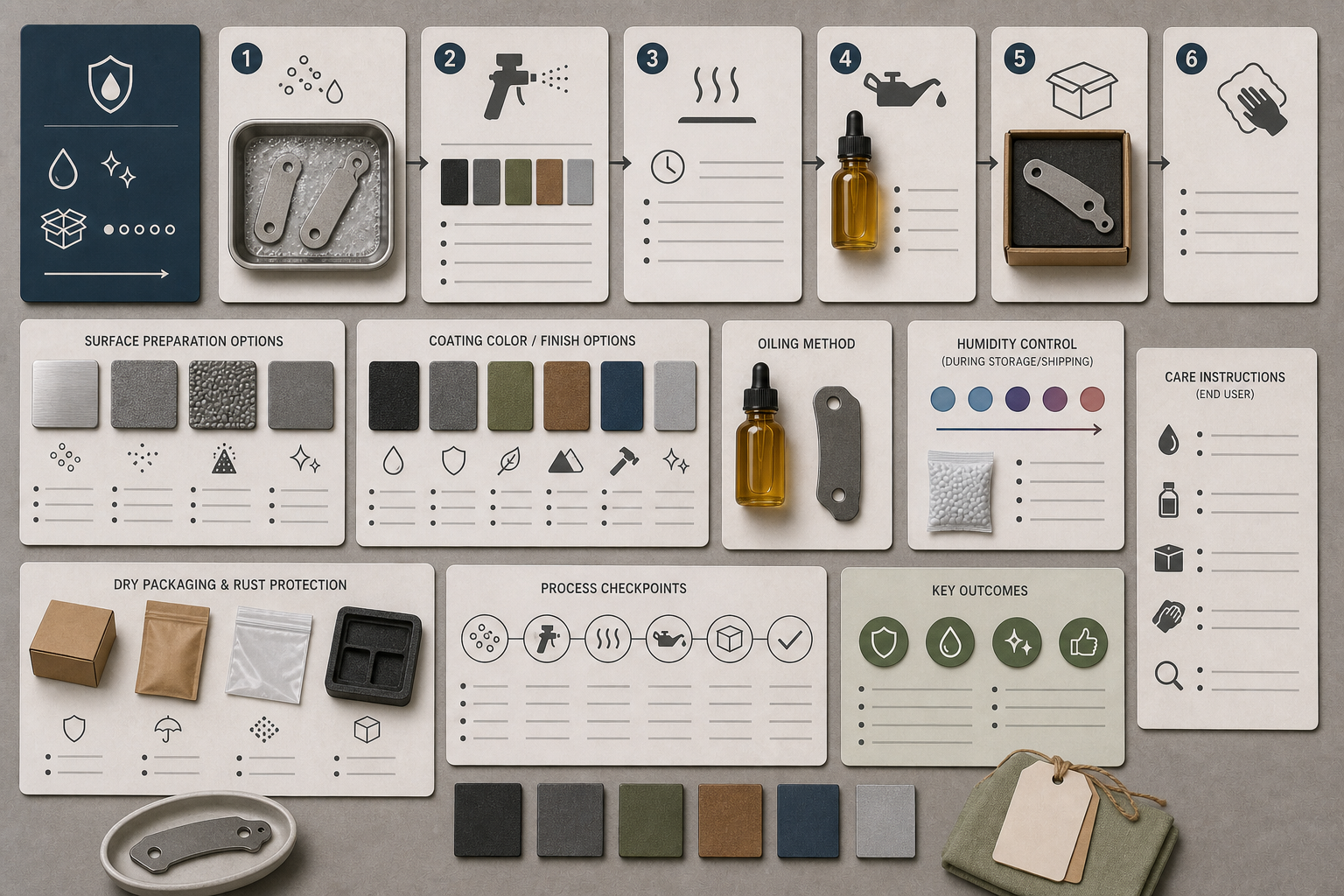
I Treat Finish as Part of the Steel Choice
SK-5 does not have the corrosion behavior of stainless steel. This means finishing is not decoration only. A black coating, phosphate style finish, oxide finish, protective oil, wax paper, or dry packaging may become part of the product plan. The correct choice depends on the product. A coated outdoor knife may use a thicker protective finish. A utility blade may use oil and sealed packaging. A visible satin finish may look attractive, but it can need more careful rust prevention.
I also ask about the customer's sales channel. If the knife will sit in a warehouse for months, packaging protection becomes important. If it will be sold in humid markets, the risk rises. If the buyer wants a bare carbon steel look, I explain the maintenance burden before sampling. I have seen buyers focus on blade shape and forget packaging climate. That is a small mistake that can create large problems. For SK-5, I want the product to leave the factory with the right surface, the right care message, and the right storage protection.
| Protection item | Practical option | Buyer benefit |
|---|---|---|
| Blade finish | Coating, oxide, satin, or oil finish | Controls appearance and rust risk |
| Packaging | Dry inner pack and moisture control | Reduces storage complaints |
| Care instruction | Cleaning and oiling guidance | Sets user expectations |
| Incoming checks | Visual rust and surface review | Catches issues before shipment |
What Manufacturing Risks Affect SK-5 Knife Quality?
A carbon steel project can fail from small process details. Warping, decarb, overheating, and inconsistent grinding can damage the final knife.
SK-5 quality depends on clean material, controlled cutting, decarburization control, heat treatment, grinding temperature, sharpening, coating adhesion, assembly, and final inspection.
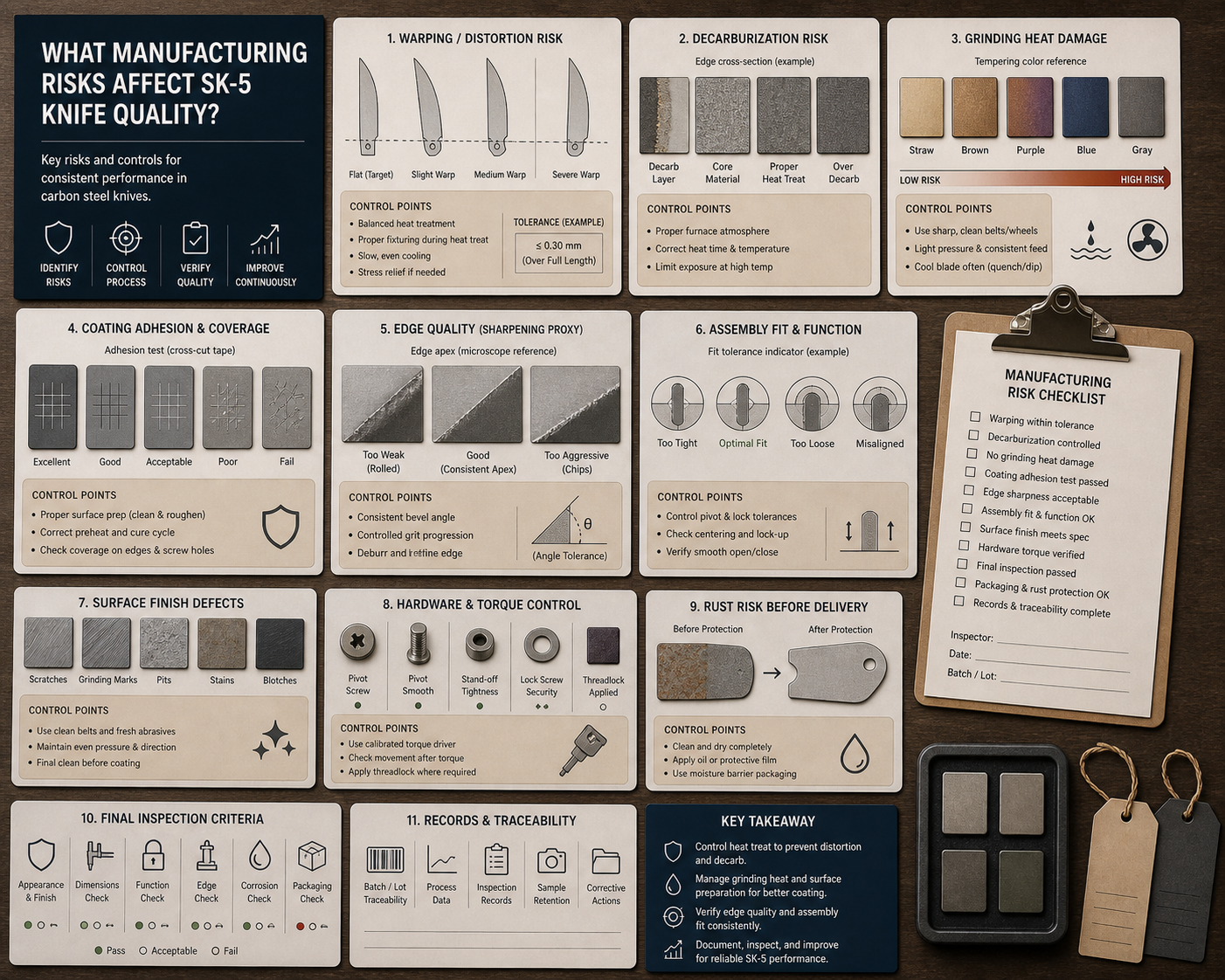
I Watch the Process From Blank to Edge
Baosteel notes that SK5 can be slit, sheared, or re-rolled in the as-rolled condition when the rolling microstructure is controlled. That matters because many SK-5 projects start from strip or sheet. The blanking and cutting stage must protect dimensions. The heat treatment stage must protect hardness and flatness. The grinding stage must protect the edge from overheating. The coating stage must protect the surface without hiding defects.
For folding knives, SK-5 also needs accurate pivot holes, lock surfaces, stop areas, and blade centering. For fixed blades, I pay more attention to tang design, handle fit, blade straightness, and coating around edges and corners. A buyer may think SK-5 is a simple steel, so the production should be easy. I do not assume that. Simple materials still need disciplined process control. The cost advantage disappears if the factory spends too much time correcting warped blades, uneven edges, or coating defects.
| Risk area | What can go wrong | Control method |
|---|---|---|
| Blanking | Burrs, distortion, wrong dimensions | Tooling and dimensional checks |
| Heat treatment | Warping, soft spots, brittleness | Process records and HRC testing |
| Grinding | Overheated edge or uneven bevel | Cooling and skilled grinding |
| Coating | Poor adhesion or hidden defects | Surface prep and adhesion checks |
How Should Buyers Compare SK-5 With 1095, D2, 8Cr13MoV, and 14C28N?
Steel comparison can become a ranking game. A buyer needs a business decision, not just a list of steel names.
Buyers should compare SK-5 by corrosion resistance, toughness target, edge performance, cost, user maintenance, and market story. SK-5 can be practical, but stainless or semi-stainless alternatives may fit some channels better.
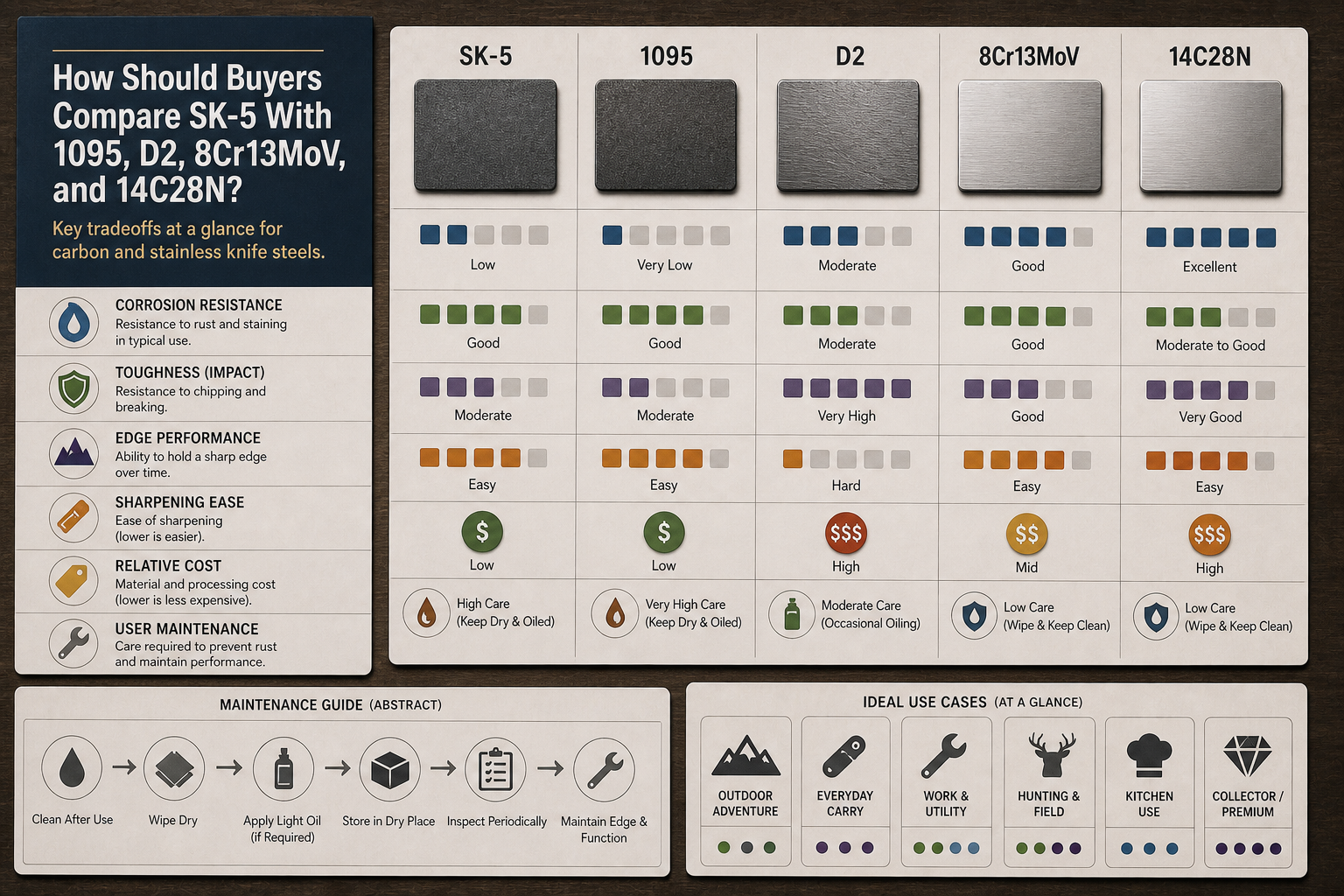
I Compare by Use Case and Channel
SK-5 and 1095 both sit in the carbon steel conversation. The buyer should not treat them as identical, but the market often understands both as practical working steels when heat treatment is done well. D2 offers higher wear resistance and some corrosion advantage compared with plain carbon steels, but it is not the same as a true stainless option. 8Cr13MoV can make sense for cost-aware stainless folders. 14C28N can be a stronger stainless upgrade when the buyer wants better corrosion resistance and a cleaner material story.
The right choice depends on the selling path. If the buyer wants a coated outdoor fixed blade at a value price, SK-5 may be a strong choice. If the buyer wants a folding knife for casual everyday users, stainless may reduce maintenance issues. If the buyer wants a premium listing, SK-5 may not carry the same marketing value as newer stainless or powder steels. This is why I always ask about target market, expected retail price, user knowledge, and after-sale risk before choosing steel.
| Steel option | Better fit | Buyer caution |
|---|---|---|
| SK-5 | Value carbon steel tools and coated outdoor knives | Needs rust protection and heat treatment control |
| 1095 | Traditional carbon steel outdoor products | Similar maintenance expectation issues |
| D2 | Budget performance folders and tools | Edge finishing and corrosion messaging matter |
| 8Cr13MoV | Cost-aware stainless pocket knives | Lower premium material story |
| 14C28N | Practical stainless upgrade | Higher cost than basic carbon steel |
What Should Buyers Put in an SK-5 Knife RFQ?
A vague RFQ creates price confusion. Suppliers may quote different steel forms, coatings, hardness ranges, and packaging assumptions.
An SK-5 RFQ should include knife type, blade thickness, target HRC, heat treatment expectation, finish or coating, handle material, lock or tang design, packaging, MOQ, inspection plan, and corrosion protection requirements.
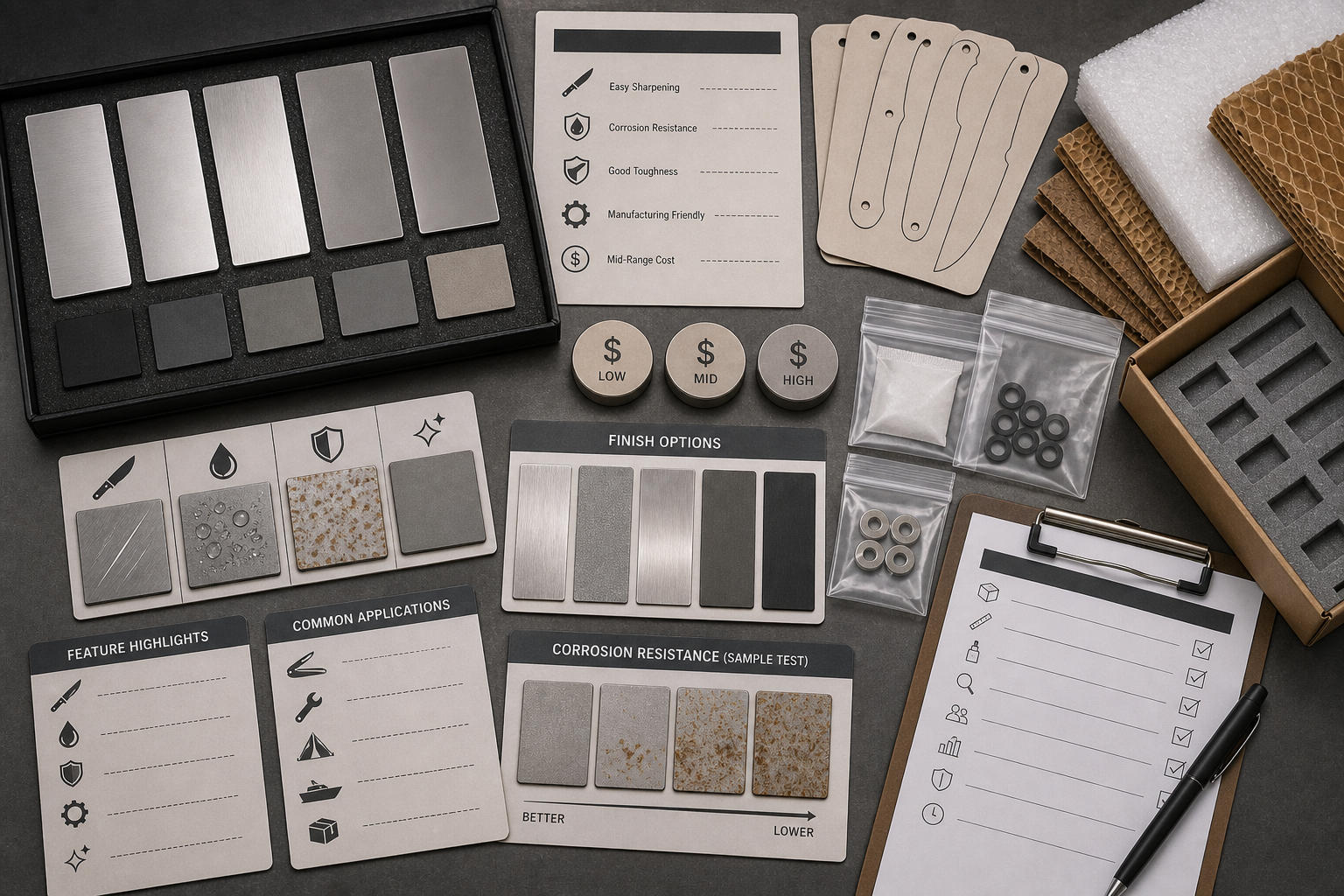
I Use the RFQ to Prevent Wrong Assumptions
When I receive an SK-5 project, I want the RFQ to explain the product, not only the steel. A buyer should include blade length, thickness, finish, target HRC, handle material, structure, logo method, sheath or packaging, target market, expected quantity, and inspection needs. If corrosion protection matters, the buyer should say so directly. If the product will be sold as a coated carbon steel knife, the coating and care instruction should be part of the project from the beginning.
The ISO document about ISO 9001 in the supply chain makes one important point for purchasing: buyers should make their needs clear to the supplier. I agree with that completely. A supplier cannot protect the buyer's market goal if the RFQ hides the real constraints. For SK-5, the most useful RFQs include target price, target market, maintenance expectation, HRC range, finish requirement, packaging environment, and test records. That lets the supplier recommend a manufacturable plan instead of guessing.
| RFQ field | What to include | Why it helps |
|---|---|---|
| Blade specification | SK-5 or SK85, thickness, edge, HRC | Aligns material and performance |
| Protection plan | Coating, oil, packaging, care note | Reduces rust complaint risk |
| Structure | Folding lock, fixed tang, hardware | Clarifies production complexity |
| Quality requirements | Certificate, HRC report, visual checks | Builds repeat-order confidence |
Ready to use this material in your next knife line?
Vast State can help you compare blade steels, heat treatment ranges, handle materials, finishes, packaging options, and QC requirements based on your target market and quantity.
Conclusion
I choose SK-5 when the buyer wants practical carbon steel performance, controlled cost, proper heat treatment, and clear corrosion protection.
Source Notes
- The JIS G 4401 preview supports that the standard covers carbon tool steels.
- SteelJIS SK85/SK5 supports SK85 as a synonym for SK5 and gives composition and hardness context.
- Baosteel hot rolled special steel documentation supports SK5 as a typical carbon tool steel under JIS G4401 and explains heat treatment importance.
- Fushun Special Steel supports SK85/SK5 tool-steel applications and common product forms.
- Boker USA gives knife-market context for SK-5 hardness and coated knife use.
- The British Stainless Steel Association supports why SK-5 should not be positioned as stainless steel.
- The NIST Rockwell hardness guide supports careful HRC measurement practice.
- The ISO 9001 supply chain guide supports clear buyer specifications and supplier quality confidence.