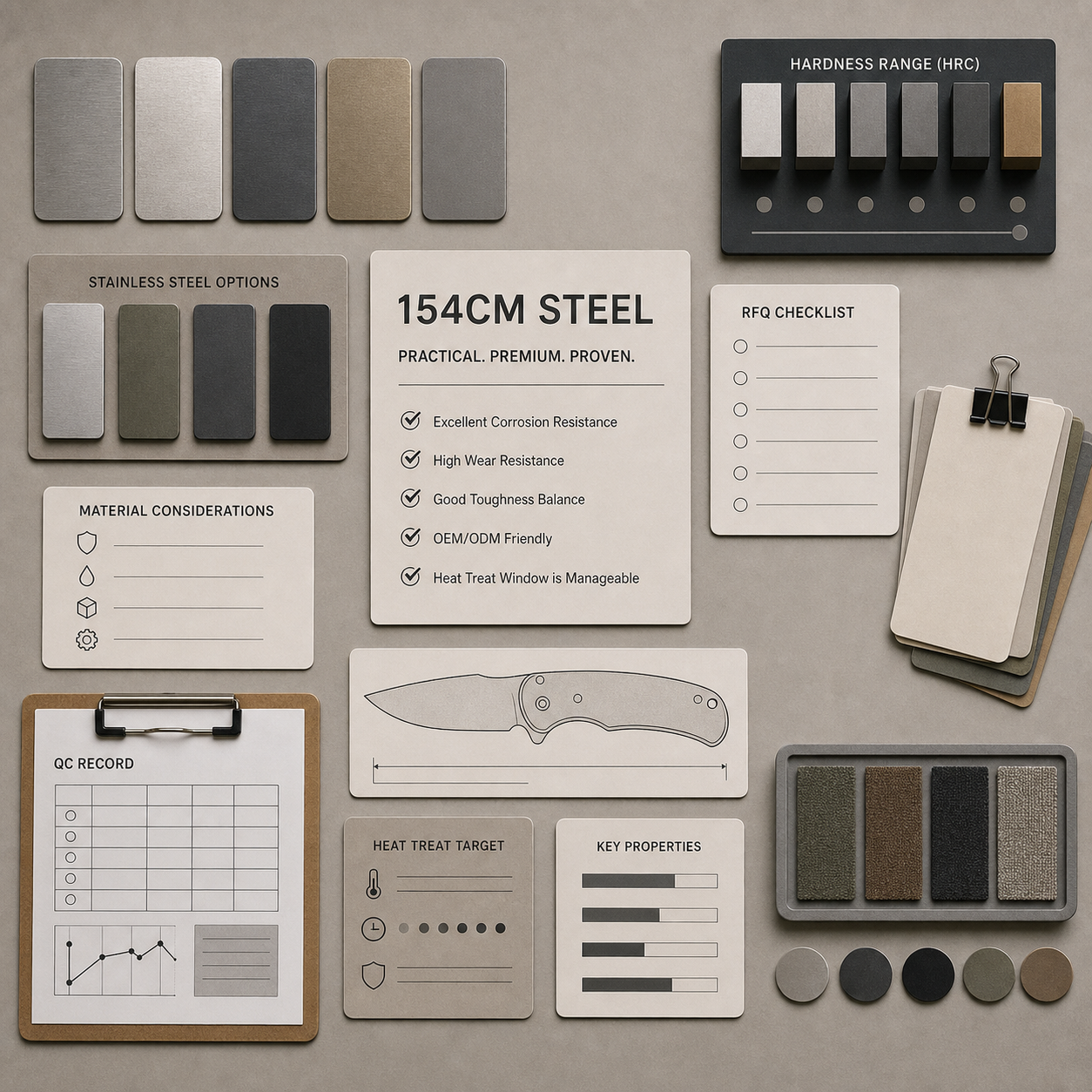
Quick buyer brief: 154CM can be a practical upgrade steel for pocket knives and folding knives when buyers need stronger edge retention, stainless behavior, and a more premium market position than basic budget steels. It only works well when the RFQ controls steel source, heat treatment, hardness range, grinding, finish, and inspection records.
Many buyers hear 154CM and think the steel name alone creates a better knife. In production, that shortcut can become an expensive mistake.
154CM steel is a practical choice for OEM/ODM knives when the project needs better edge retention, stainless performance, and premium positioning, but the supplier must control heat treatment, hardness testing, grinding, finishing, and batch consistency.
I do not treat 154CM as a magic answer. I treat it as a material decision inside a full product plan. The same steel can produce a strong, reliable folding knife or a disappointing knife if the heat treatment, blade geometry, assembly, and final inspection are weak. For B2B buyers, the real question is not only "Is 154CM good?" The better question is whether 154CM fits the target market, price range, product structure, and repeat production plan. That is how I evaluate it when a customer asks whether to use 154CM for an OEM or ODM knife project.
What Is 154CM Steel in a Knife Sourcing Project?
A steel name can sound technical, but it does not explain what the buyer is actually paying for. That gap often creates wrong expectations.
154CM is a high-carbon, high-molybdenum stainless steel used in knife blades. In sourcing, I see it as an upgrade option for buyers who want stronger edge performance than basic stainless steels while keeping stainless positioning.
I Define 154CM by the Product Goal, Not the Name Alone
In a knife sourcing project, I first explain what 154CM is and what it is not. A manufacturer data sheet for Crucible 154 CM describes it as a high-carbon, high-molybdenum stainless bearing steel, with typical chemistry around 1.05% carbon, 14% chromium, and 4% molybdenum. That chemistry helps explain why buyers often associate it with edge retention, corrosion resistance, and a more serious knife category.
But chemistry is only the starting point. A B2B buyer still needs to ask how the steel will be purchased, cut, heat treated, ground, finished, and inspected. The same steel grade can behave differently if the blade is too thin for the use case, the hardness target is unrealistic, or the finish is not controlled. In my work, I use 154CM when the project needs an upgrade story that can also survive production reality. It should support the brand position, not only decorate the product description.
| Sourcing question | Why it matters | My practical check |
|---|---|---|
| Is the steel really 154CM? | Avoids substitution and confusion | Request steel grade records or mill certificate |
| What knife level is planned? | Keeps cost and market position aligned | Match steel choice to retail tier |
| What hardness is required? | Controls edge and toughness balance | Define a realistic HRC range |
| What finish is planned? | Affects appearance and corrosion behavior | Confirm grinding and surface process early |
Quote-ready RFQ Checklist for This Steel
To get an accurate OEM/ODM quote, prepare these details before contacting a knife manufacturer.
| RFQ Field | What to Prepare |
|---|---|
| Product type | Folding knife / fixed blade / multi-tool / kitchen knife |
| Target market | US / EU / outdoor retail / promotional / tactical / EDC |
| Steel option | 4116 / 14C28N / D2 / N690 / Nitro-V |
| Target HRC | Example: 55-57 HRC, 58-60 HRC |
| Blade finish | Satin / stonewash / black coating / bead blast |
| Handle material | G10 / micarta / aluminum / stainless steel / wood |
| Lock or structure | Liner lock / frame lock / slip joint / full tang |
| Estimated quantity | 500 / 1,000 / 3,000 / 5,000+ pcs |
| Packaging | White box / color box / blister / pouch / gift box |
| Required documents | Drawing / sample photo / logo file / packaging artwork |
When Does 154CM Make Sense for Pocket and Folding Knives?
Some buyers choose an upgrade steel too early. The knife becomes costly, but the market may not pay for the difference.
154CM makes sense when the knife is positioned above entry level, the buyer can explain the steel value, and the design needs dependable edge retention with stainless behavior for EDC, outdoor, or premium utility markets.
I Use 154CM When the Buyer Needs a Credible Upgrade Story
154CM is usually not the first steel I suggest for a very low-cost promotional knife. In that situation, the buyer may care more about price, MOQ, and simple repeat production. But for a pocket knife, folding knife, or higher-level utility knife where the customer wants a stronger material story, 154CM can be useful. It gives the buyer a recognized stainless upgrade without always moving into the higher cost of powder metallurgy steel.
The project still needs a clear use case. A compact EDC knife may need controlled blade thickness and smooth opening action. An outdoor pocket knife may need a more robust blade shape and handle grip. A private label customer may need packaging and product copy that explains 154CM without overpromising. I usually check whether the buyer's sales channel can support the higher cost. If the end customer cannot see or value the steel upgrade, 154CM may reduce margin instead of improving the product.
| Good fit for 154CM | Reason | Buyer benefit |
|---|---|---|
| Mid-to-premium pocket knife | Steel name supports positioning | Better product story |
| EDC folding knife | Balance of edge and stainless behavior | More practical daily-use appeal |
| Outdoor utility folder | Edge retention can matter in field use | Stronger perceived performance |
| Private label upgrade SKU | Helps separate tiers | Clearer good-better-best lineup |
What Tradeoffs Should Buyers Expect From 154CM?
Every steel choice creates a tradeoff. If a buyer only hears the benefits, the production plan is already incomplete.
154CM can improve edge retention and stainless positioning, but buyers should expect higher material cost, stricter heat-treatment control, more careful grinding, and a need for clear maintenance expectations.
I Explain the Cost Before the Sample Looks Too Good
154CM is not only a steel upgrade. It can change the project budget. Material cost may be higher than common budget stainless steels. Processing may require more attention. Grinding must be controlled because the buyer is often paying for better cutting performance, not just a label. Finishing also matters because stainless steel still needs good surface preparation, cleaning, and packaging protection.
Another tradeoff is communication. Some buyers describe 154CM as "rustproof" or expect it to perform like a super steel. I avoid that language. 154CM is stainless, but stainless does not mean maintenance-free. Sea air, sweat, acidic materials, poor storage, or rough finishing can still create problems. I prefer to define realistic use conditions and warranty expectations early. For a B2B order, this protects both the buyer and the factory. A good material decision should improve the product without creating claims that the knife cannot support.
| Tradeoff | What can happen | How I control it |
|---|---|---|
| Higher steel cost | Margin becomes tight | Confirm target price before sampling |
| Heat-treatment sensitivity | Edge or toughness may vary | Set process and HRC checks |
| Grinding demand | Edge performance can be wasted | Control bevel, heat, and symmetry |
| Stainless misunderstanding | Buyer may overpromise corrosion behavior | Use accurate product language |
How Should Heat Treatment and Hardness Be Controlled?
A premium steel can fail quietly if heat treatment is treated as a routine step. The blade may look fine but perform poorly.
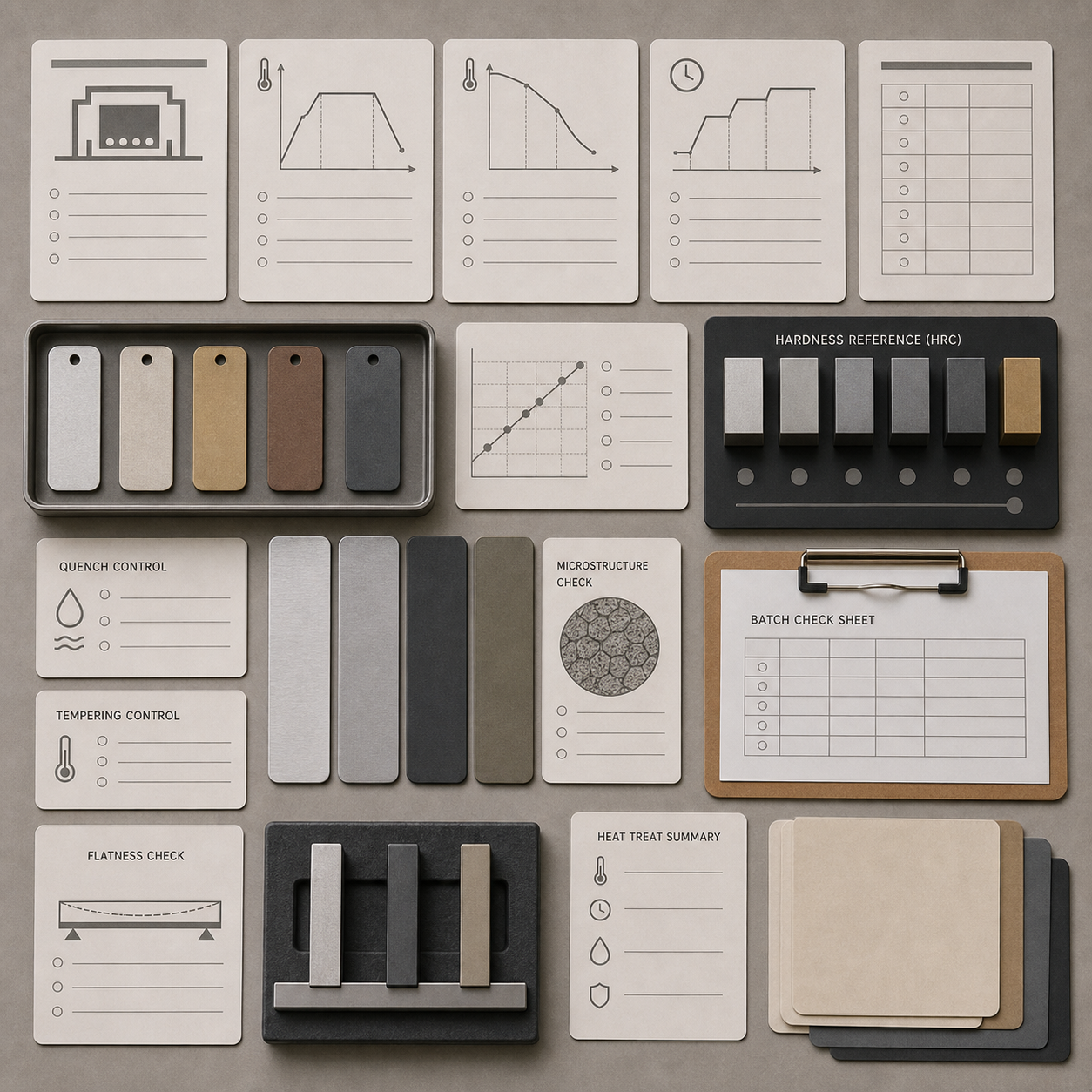
For 154CM knife orders, I define the target hardness range, heat-treatment process, tempering plan, flatness control, and Rockwell hardness checks before mass production begins.
I Treat HRC as a Control Range, Not a Sales Slogan
Heat treatment turns shaped steel into a working blade. For 154CM, the buyer should not only ask for a hard blade. The buyer should ask for the right hardness range for the product. Too soft, and edge retention may disappoint. Too hard, and the edge may become less forgiving. The best target depends on blade geometry, intended use, edge angle, and market expectation.
I like to connect the steel data sheet with real production checks. Alleima explains the general knife-steel principle clearly: hardening and tempering are used together to create hardness while reducing brittleness. NIST also provides guidance on Rockwell hardness measurement practice, which reminds buyers that hardness data must be measured correctly, not guessed. For B2B orders, I normally want batch records, sample checks, and a method for handling out-of-range blades. A number on a product page is not enough. The process behind that number matters.
| Heat-treatment control | Buyer should define | Production reason |
|---|---|---|
| Target HRC range | Practical range by product type | Avoids vague "high hardness" claims |
| Tempering plan | Supplier process confirmation | Balances hardness and toughness |
| Flatness check | Warpage tolerance | Protects assembly and grinding |
| Batch hardness record | Sample readings per lot | Supports repeat order consistency |
How Does 154CM Compare With 440C, CPM 154, D2, and 14C28N?
Buyers often compare steel names as if one ranking works for every knife. That usually leads to oversimplified sourcing decisions.
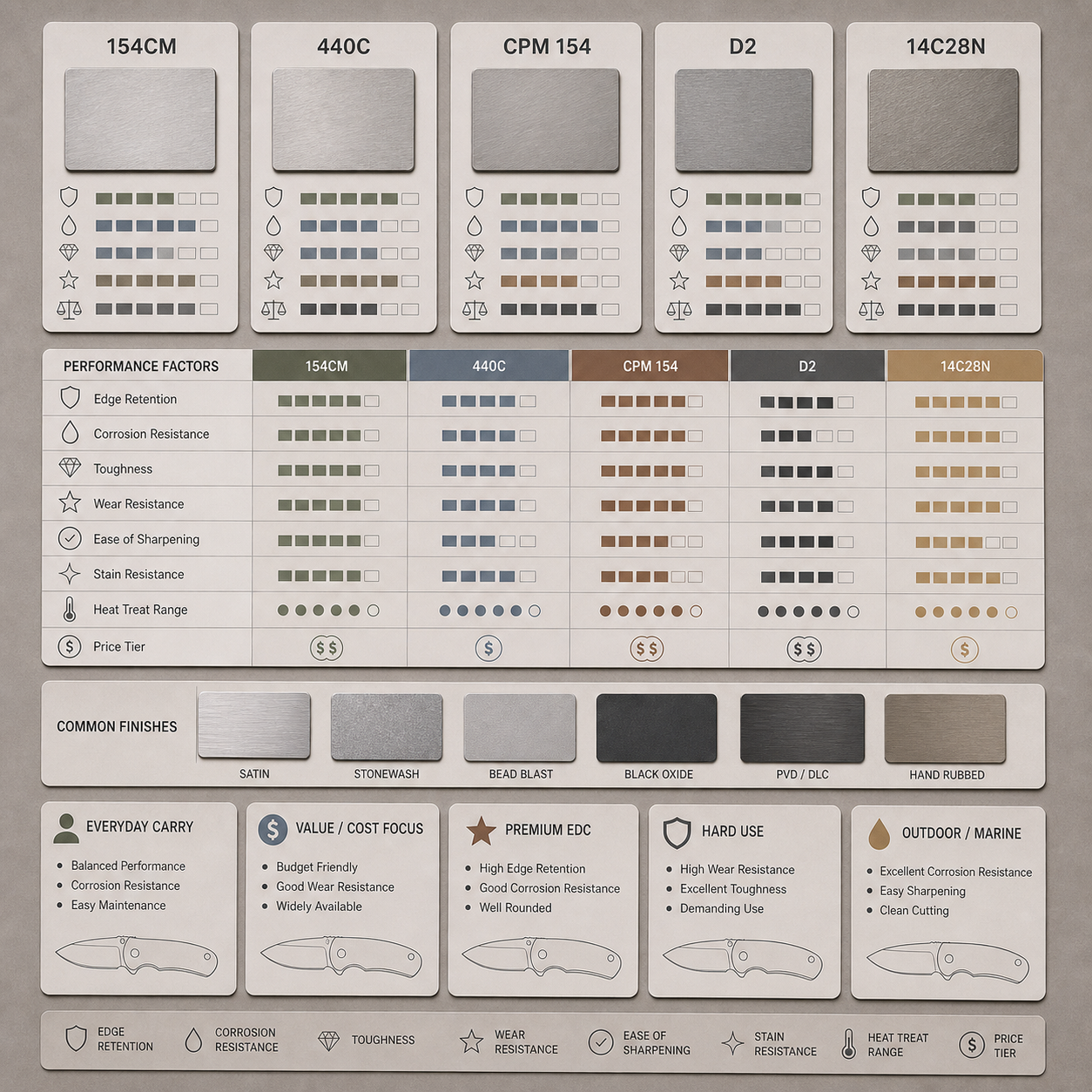
154CM usually sits above common budget stainless options, competes with 440C in stainless upgrade projects, differs from CPM 154 by production route, and should be compared with D2 and 14C28N by use case, not by name alone.
I Compare Steel by the Buyer Outcome
When a customer asks me whether 154CM is better than another steel, I usually ask, "Better for what product and what price?" Compared with basic stainless steels, 154CM can create a stronger performance and marketing story. Compared with 440C, it is often treated as an upgrade choice in knife projects, especially because of its molybdenum-rich chemistry and reputation in higher-level knives. But final performance still depends on heat treatment.
CPM 154 is different because powder metallurgy processing can improve carbide distribution and consistency, but it usually moves the project into a higher cost and higher positioning. D2 can offer strong wear resistance, but it is not stainless in the same way as 154CM, so corrosion expectations must be different. 14C28N is a very practical knife stainless steel, often attractive when toughness, corrosion resistance, and cost balance matter. In my view, 154CM is strongest when the buyer wants a recognizable upgrade steel without making the whole project too expensive for the channel.
| Steel option | Typical sourcing role | What I tell buyers |
|---|---|---|
| 154CM | Premium stainless upgrade | Good when steel story and process control both matter |
| 440C | Established stainless baseline | Useful, but positioning may feel less upgraded |
| CPM 154 | Higher-end powder metallurgy option | Better for premium tiers with budget room |
| D2 | Wear-resistant tool steel option | Strong edge story, different corrosion expectations |
| 14C28N | Practical stainless knife steel | Good balance for many EDC and outdoor SKUs |
What Manufacturing and Finishing Issues Should Buyers Plan For?
A buyer may approve a beautiful sample and still receive uneven mass production. The problem often comes from process details, not the steel grade.
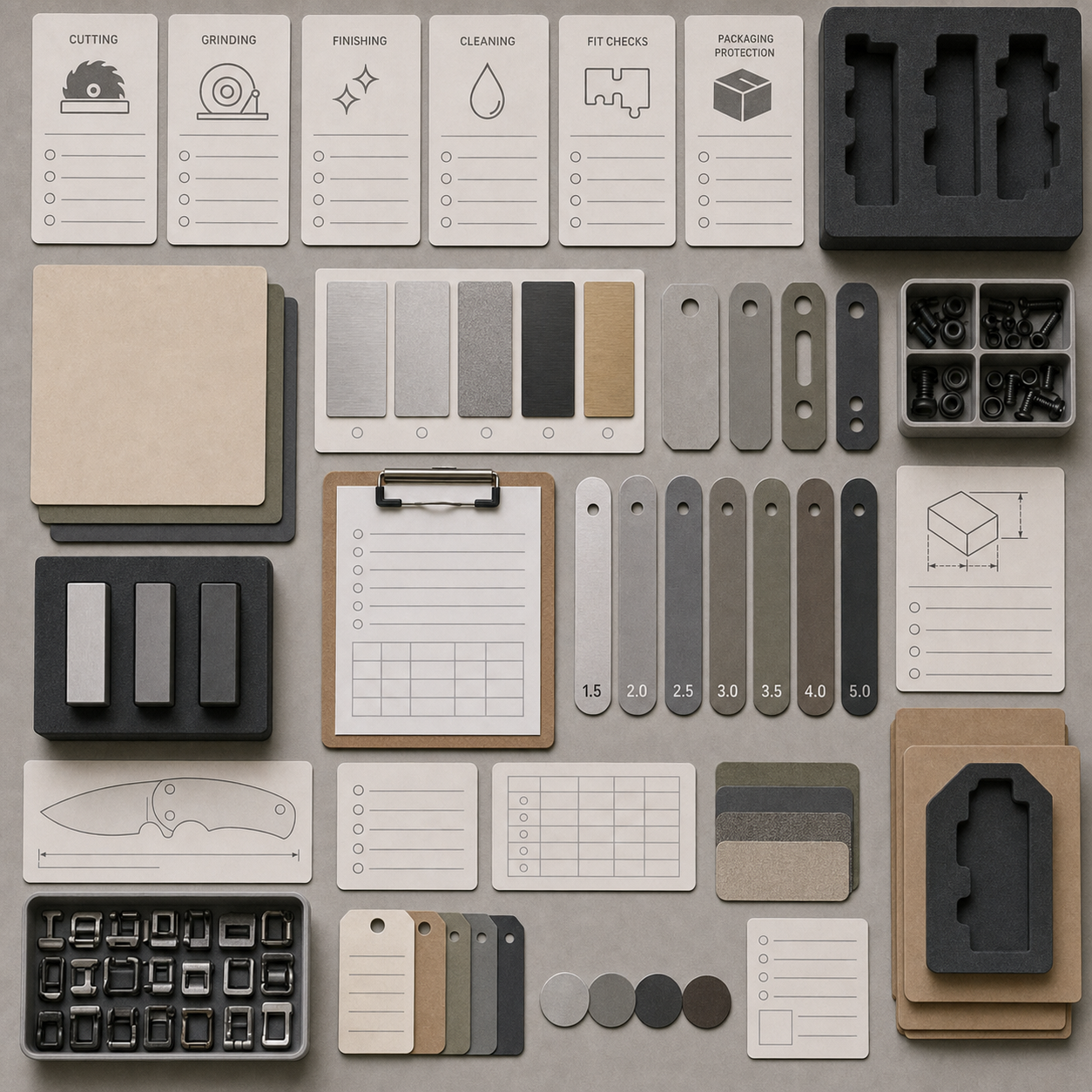
For 154CM knives, buyers should plan blade thickness, cutting method, bevel grinding, surface finish, lock fit, edge geometry, cleaning, and packaging protection before the first production batch.
I Control the Details That the End User Will Feel
154CM can support a strong knife, but the factory still needs to execute the blade correctly. The blade thickness should match the knife size and market. The pivot hole and tang geometry must be accurate for folding knives. The bevel must be even. The surface finish should match the approved sample. If the edge overheats during grinding or the finish is inconsistent, the buyer will not be happy just because the steel name is good.
Finishing should also be chosen with the sales channel in mind. Satin can look clean but may show scratches. Stonewash can hide small marks and fit outdoor or EDC positioning. Coating may add style and corrosion support, but it introduces adhesion and wear concerns. Packaging protection matters too. A stainless blade can still arrive with marks if cleaning, oiling, wrapping, or humidity control is weak. I prefer to solve these details in the sample and pilot stage, not after the shipment is packed.
| Manufacturing issue | Buyer risk | Practical control |
|---|---|---|
| Blade thickness | Knife feels too heavy or weak | Confirm use case and drawing |
| Pivot and tang accuracy | Poor action or lock fit | Use tolerance checks before assembly |
| Bevel grinding | Uneven cutting performance | Inspect symmetry and edge heat |
| Surface finish | Visual inconsistency | Approve finish standard samples |
What QC Records Should Buyers Request for 154CM Orders?
If a buyer cannot see the quality record, the order depends too much on trust and too little on repeatable control.
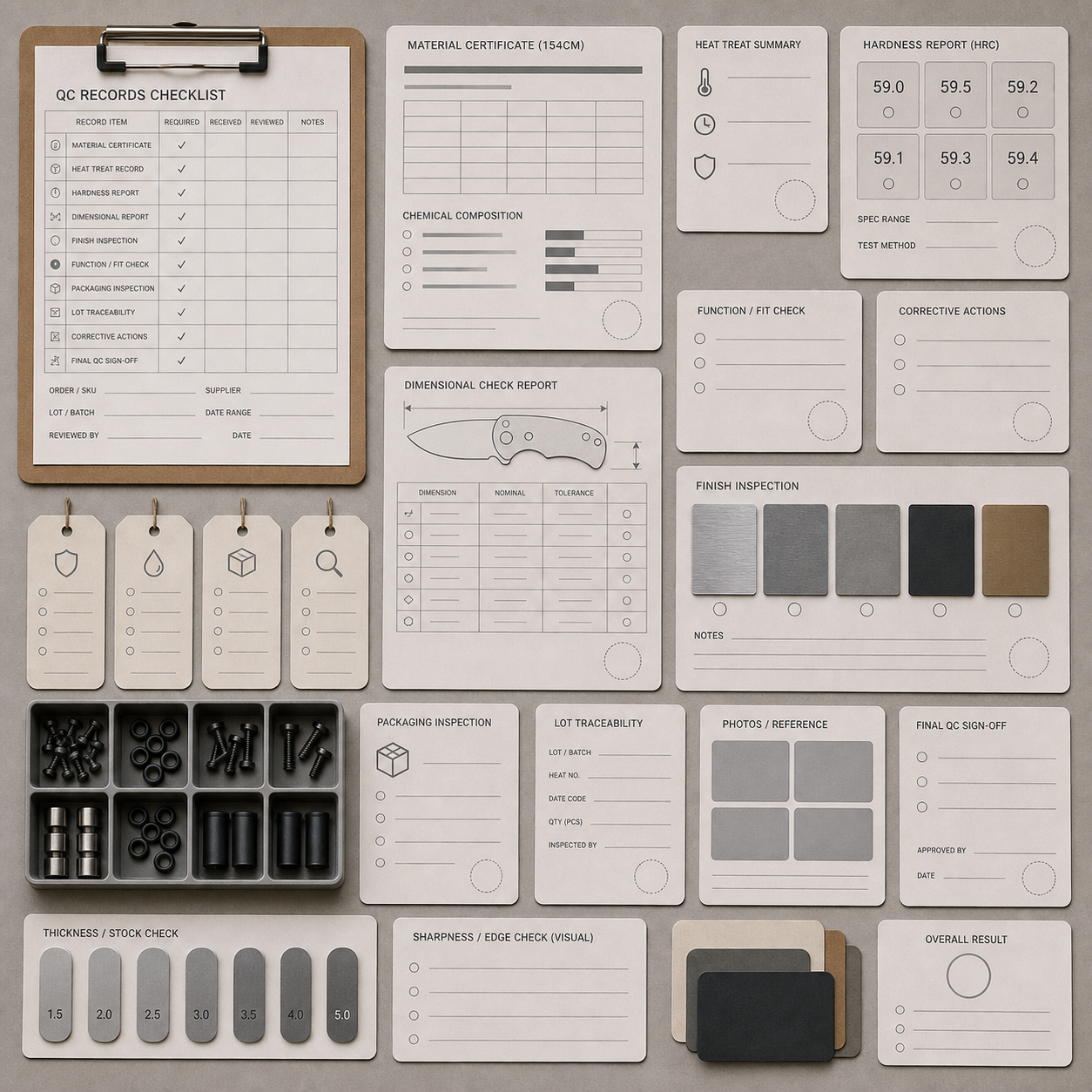
For 154CM orders, I recommend requesting steel grade records, heat-treatment batch records, Rockwell hardness readings, dimensional checks, grinding inspection, functional checks, finish review, and final packaging inspection.
I Want Quality Evidence, Not Only Final Photos
Quality control should start before final inspection. For a steel such as 154CM, incoming material control matters because the buyer is paying for a specific grade. Heat-treatment records matter because hardness and toughness depend on the process. Dimensional checks matter because folding knife assembly depends on small relationships between the blade, pivot, liners, washers, bearings, stop pin, and lock surface.
ISO 9001 is useful as a quality-management reference because it focuses on consistent processes and customer requirements. I do not use it as decoration. I use the same thinking in a practical way: define requirements, check the process, record results, and correct problems. For B2B customers, this reduces uncertainty. A customer ordering repeat batches needs the second order to match the first one. Good QC records help the buyer understand what happened in production and help the factory solve problems faster when something changes.
| QC record | What it confirms | Why it matters |
|---|---|---|
| Material certificate | Steel grade and source | Reduces substitution risk |
| Heat-treatment record | Batch process and timing | Supports performance consistency |
| HRC readings | Hardness control | Confirms target range |
| Functional inspection | Opening, closing, lockup, blade play | Protects user experience |
| Final inspection | Finish, sharpness, packaging | Protects sellable condition |
What Should a 154CM OEM/ODM RFQ Include?
A short RFQ can make the price look simple, but it often hides the details that decide whether the knife can be produced correctly.
A strong 154CM RFQ should include product type, target market, target price, steel grade, hardness range, blade thickness, finish, handle material, lock structure, packaging, quantity, lead time, and required QC records.
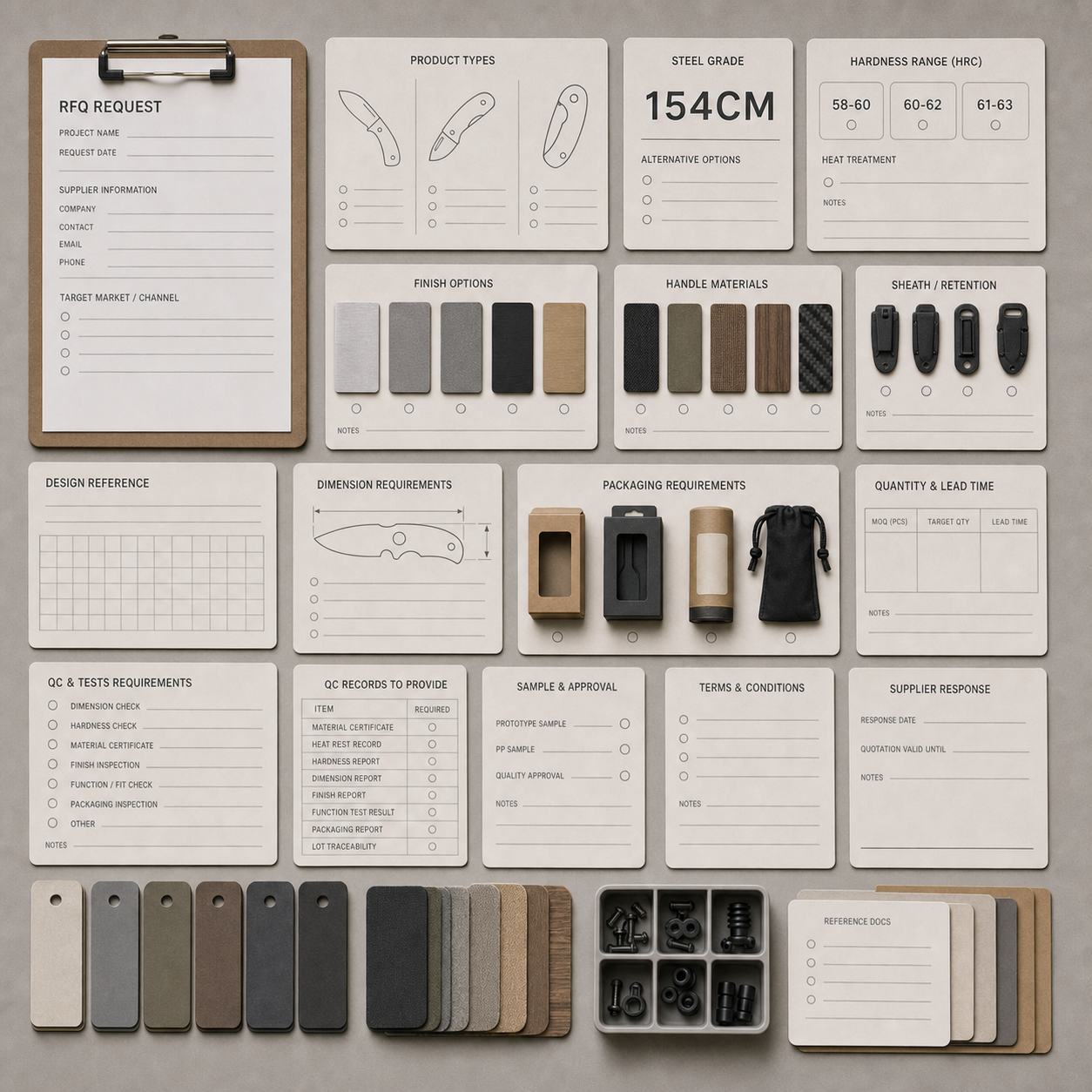
I Use the RFQ to Prevent Expensive Guesswork
For OEM and ODM projects, the RFQ should make the buyer's goal clear. If the buyer only writes "154CM folding knife," the supplier still has too many open questions. Is the product for EDC, outdoor, hunting-style utility, retail private label, or distributor catalog sales? What retail price level is expected? Is the buyer asking for 154CM only, or can the supplier suggest alternatives? What hardness range is acceptable? What finish will the buyer approve? What packaging and branding are needed?
I also ask buyers to include the business side of the project. MOQ, target price, lead time, test sample needs, packaging method, compliance needs, and shipping terms all affect the final quote. Trade.gov explains that HS codes are used to classify products in international trade, so importers should also handle classification and duty questions carefully with their customs support. I can support production, packaging, and documentation, but the buyer should confirm market-specific import and selling requirements before launch.
| RFQ field | What to include | Why it helps |
|---|---|---|
| Steel requirement | 154CM, substitution rules, certificate need | Prevents unclear material quotes |
| Performance target | HRC range, finish, edge geometry | Aligns factory process with buyer expectation |
| Product details | Size, blade thickness, handle, lock, hardware | Supports accurate costing |
| Commercial details | Quantity, MOQ, target price, lead time | Avoids unrealistic sampling |
| Documentation | QC report, packaging spec, trade documents | Supports smoother delivery |
Ready to use this material in your next knife line?
Vast State can help you compare blade steels, heat treatment ranges, handle materials, finishes, packaging options, and QC requirements based on your target market and quantity.
Conclusion
I use 154CM when the buyer needs a real steel upgrade and is ready to control the full production process behind it.
Source Notes
- Crucible 154 CM data sheet, hosted copy: https://dobleoknives.com/wp-content/uploads/2020/09/154cm.pdf
- Alleima knife steel hardening and tempering guide: https://www.alleima.com/en/products/strip-steel/knife-steel/hardening-guide/purpose-of-hardening-and-tempering/
- NIST Rockwell hardness measurement guide: https://www.nist.gov/publications/nist-recommended-practice-guide-rockwell-hardness-measurement-metallic-materials
- ISO 9001 quality management standard page: https://www.iso.org/cms/%20render/live/en/sites/isoorg/contents/data/standard/06/20/62085.html?browse=ics
- Trade.gov Harmonized System codes guidance: https://www.trade.gov/harmonized-system-hs-codes
Planning a knife project with this steel?
Send us your target market, MOQ, price range, and blade type. Vast State can help you choose the right steel, HRC range, finish, handle material, and QC requirements for OEM/ODM production.