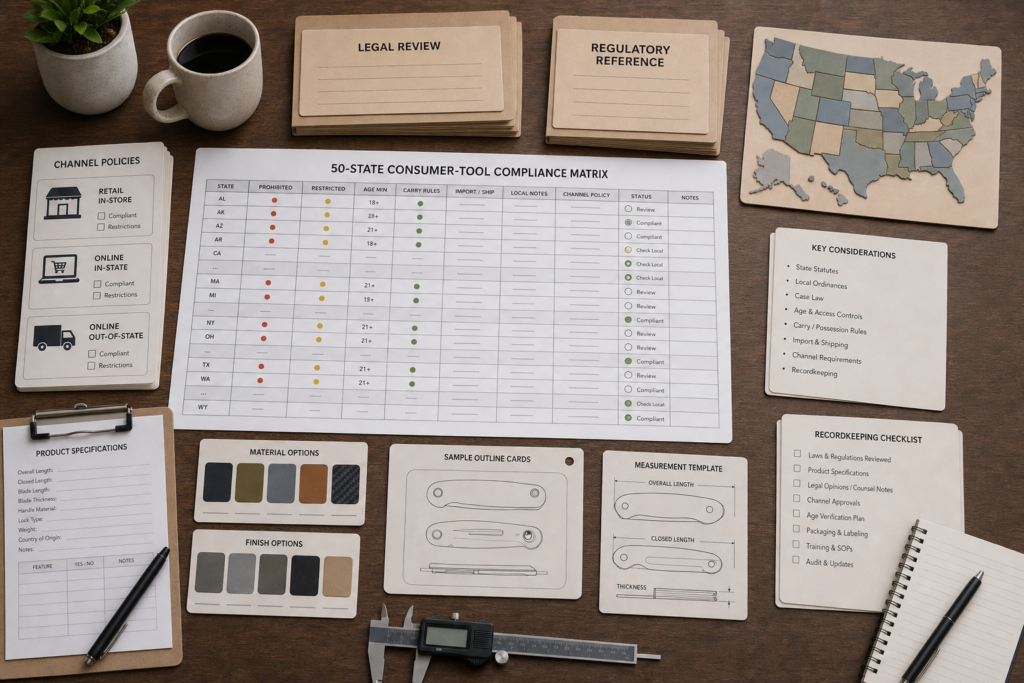
A pocket knife can fit one U.S. state and fail another. A loose legal summary creates risk. A structured matrix keeps decisions traceable.
Buyers should build a 50-state pocket knife compliance matrix by checking federal rules, official state sources, local rules, blade length, opening method, lock type, age controls, sales channel, packaging language, and legal counsel approval before launch. This article is sourcing guidance, not legal advice.
Quick buyer brief:
- Answer: Use a state-by-state matrix, not a one-line national answer.
- Buyer context: This helps knife brands, importers, distributors, wholesalers, and private label buyers preparing U.S. pocket knife programs.
- Key checks: Federal law, state source link, local rule risk, blade length, opening method, lock type, package copy, channel policy, and approval records.
Planning a private-label knife line for this market?
Use this article as an early planning reference, then prepare your target market, product category, labeling needs, and buyer-specified compliance requirements before production.
When a buyer asks for "pocket knife laws in every state," I do not try to answer from memory. State laws change. Local rules may add more limits. Retailers and marketplaces may also have their own policies. So I prefer a working matrix. It turns a confusing legal topic into a product development tool. The matrix does not replace a lawyer, but it helps the buyer, supplier, distributor, and packaging team work from the same facts.
Why Is a 50-State Matrix Better Than a One-Page Knife Law Summary?
A short summary looks efficient, but it can hide important differences. Buyers need a system that can be updated.
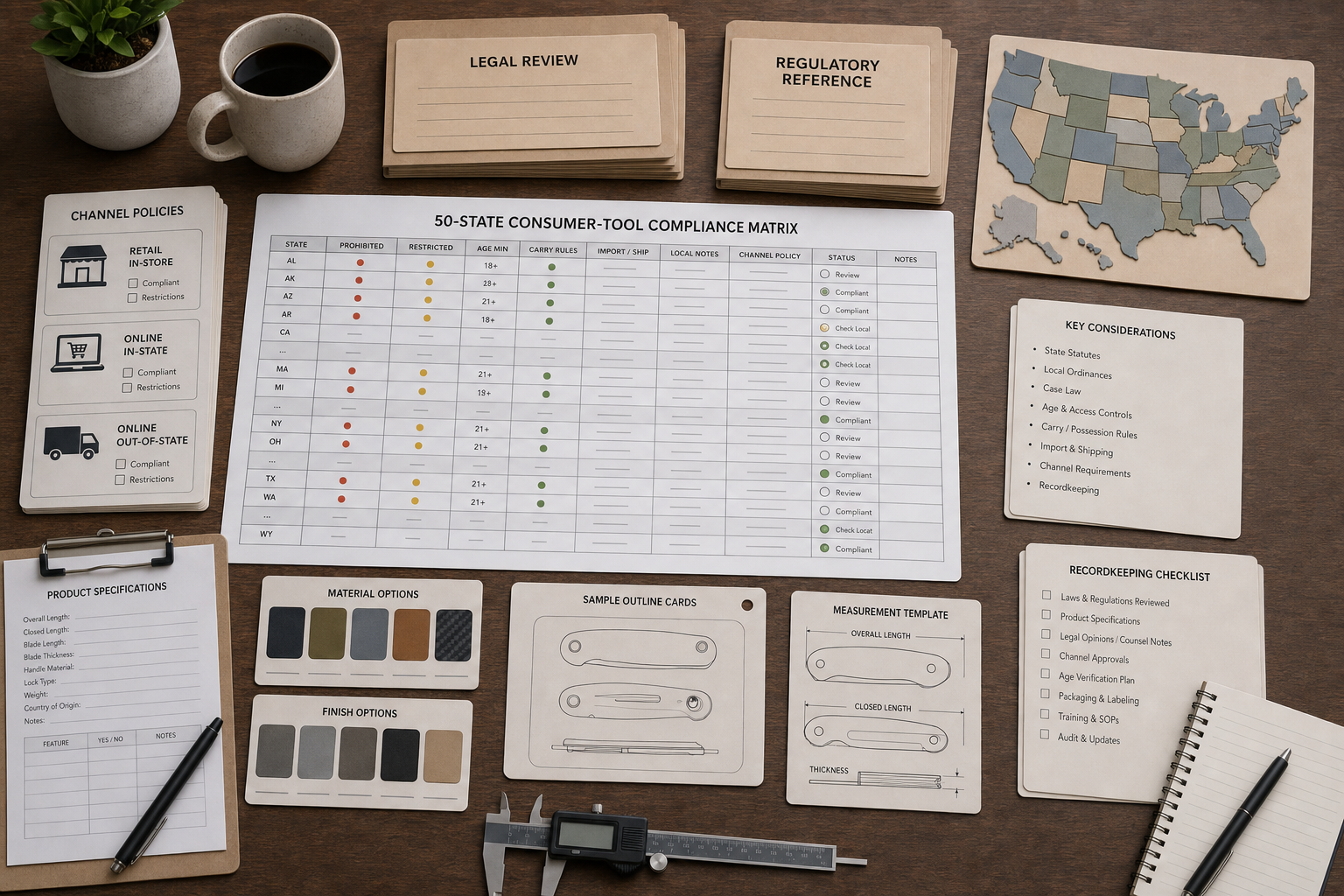
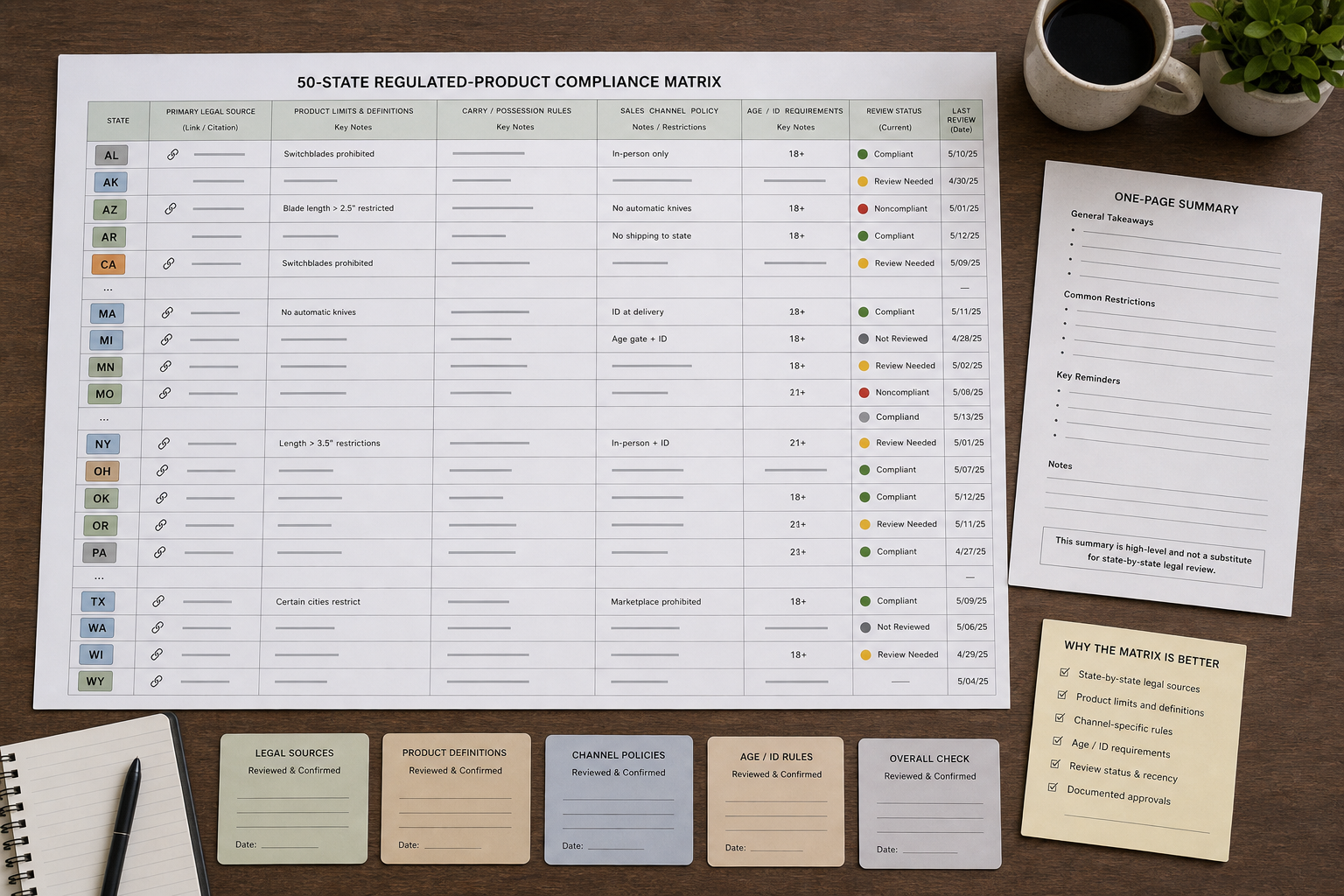
A 50-state matrix is better because it tracks each state's source, product limits, local-rule risk, channel policy, review status, and approval notes in one controlled document.
I Use the Matrix as a Product Control Tool
A one-page law summary can be useful for orientation, but it is not enough for a B2B launch. A buyer may sell through Amazon, a distributor, a regional retailer, a direct website, or a private label account. Each channel may ask different questions. Some states focus on mechanism. Some focus on blade length. Some rules are statewide. Some important limits may appear in city or retailer policy. A matrix gives the buyer a place to record all of that.
In my work, I would build the matrix before sample approval. The first columns should be simple: state, official source link, product category, blade length rule, opening method rule, lock rule, local-rule flag, customer age flag, sales-channel note, packaging note, legal counsel status, and launch decision. Then the buyer can mark a state as approved, needs review, excluded, or pending. This helps the supplier because we can connect the market decision to the product drawing, packaging, and inspection plan. It also helps the buyer avoid relying on old screenshots or informal comments.
| Matrix column | What it records | Why it helps |
|---|---|---|
| State source | Official statute or agency link | Keeps review traceable |
| Product feature | Blade length, lock, mechanism | Links law review to design |
| Channel note | Online, retail, distributor, local city | Shows sales path risk |
| Approval status | Pending, approved, excluded, revised | Controls launch decisions |
Private-label Planning Checklist
Before starting production, prepare the market and product details your importer or compliance advisor needs to review.
| RFQ Field | What to Prepare |
|---|---|
| Target market | Country, state, region, or sales channel |
| Product category | Folding knife / fixed blade / multi-tool / outdoor tool |
| Intended use | EDC / camping / kitchen / hunting / rescue / promotional |
| Buyer requirements | Testing, labeling, documentation, or packaging rules |
| Blade and lock details | Blade length, opening method, lock type, edge style |
| Packaging text | Warnings, claims, care notes, language requirements |
| Documents | Drawing, sample photo, logo file, packaging artwork |
| Review owner | Importer, legal advisor, testing lab, or internal compliance team |
What Federal Rules Should Be Checked Before State Review?
State rules matter, but federal rules still sit underneath import and interstate planning. Buyers should not skip that layer.
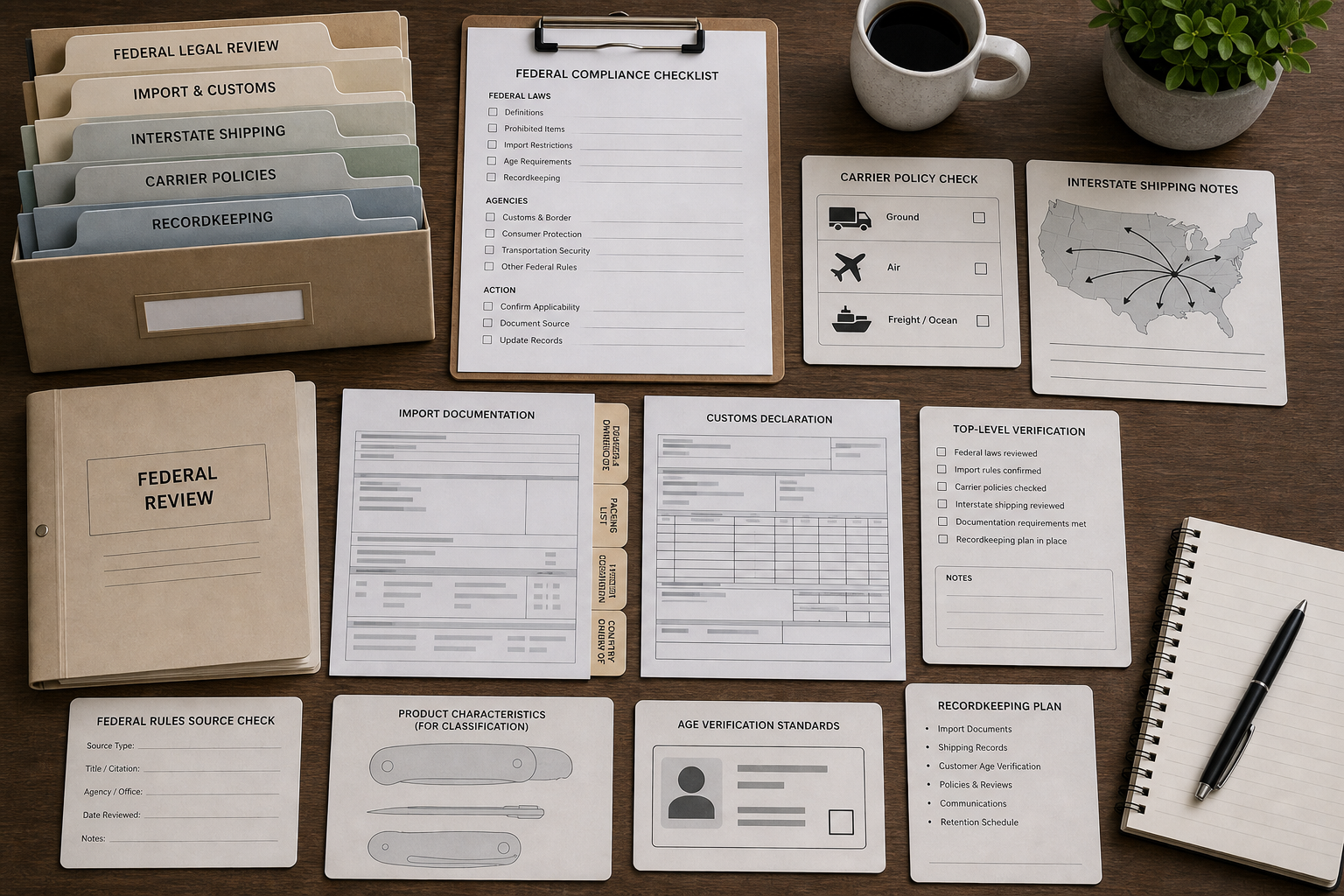
Buyers should check the Federal Switchblade Act, ballistic knife rules, customs import rules, carrier policies, and any assisted-opening language before moving to state-by-state review.
I Separate Federal, Import, and State Questions
For a U.S. pocket knife program, I start with federal context because it can affect import, distribution, and product classification before a state review begins. The Federal Switchblade Act text on GovInfo includes definitions and exceptions that matter when a buyer discusses automatic or assisted-opening products. The federal text also includes ballistic knife language, so buyers should be careful when product concepts involve detachable or spring-propelled blade ideas. I would not treat any of this as a quick yes or no. The buyer should ask counsel to read the exact design against the exact language.
Import review is also important for overseas sourcing. The GovInfo CFR page for 19 CFR 12.95 and 12.96 gives customs-related definitions and notes that standard pocket knives with primary utility blade styles may be admitted when they do not meet the switchblade definition. For Vast State, this means mechanism details should be documented before shipment. If a buyer wants a manual folder, assisted folder, or automatic folder, the RFQ should say that clearly. Ambiguous product language creates import and channel confusion.
| Federal layer | What to check | Product file item |
|---|---|---|
| Switchblade Act | Definition and exceptions | Opening method note |
| Ballistic knife rule | Detachable propelled blade issues | Product concept exclusion |
| CFR import rules | Customs definitions and utility blade context | Import review record |
| Carrier policy | Shipping route and account rules | Logistics approval note |
How Should Buyers Track State Definitions and Blade-Length Thresholds?
State laws do not use one clean vocabulary. The same knife feature may be described differently across states.
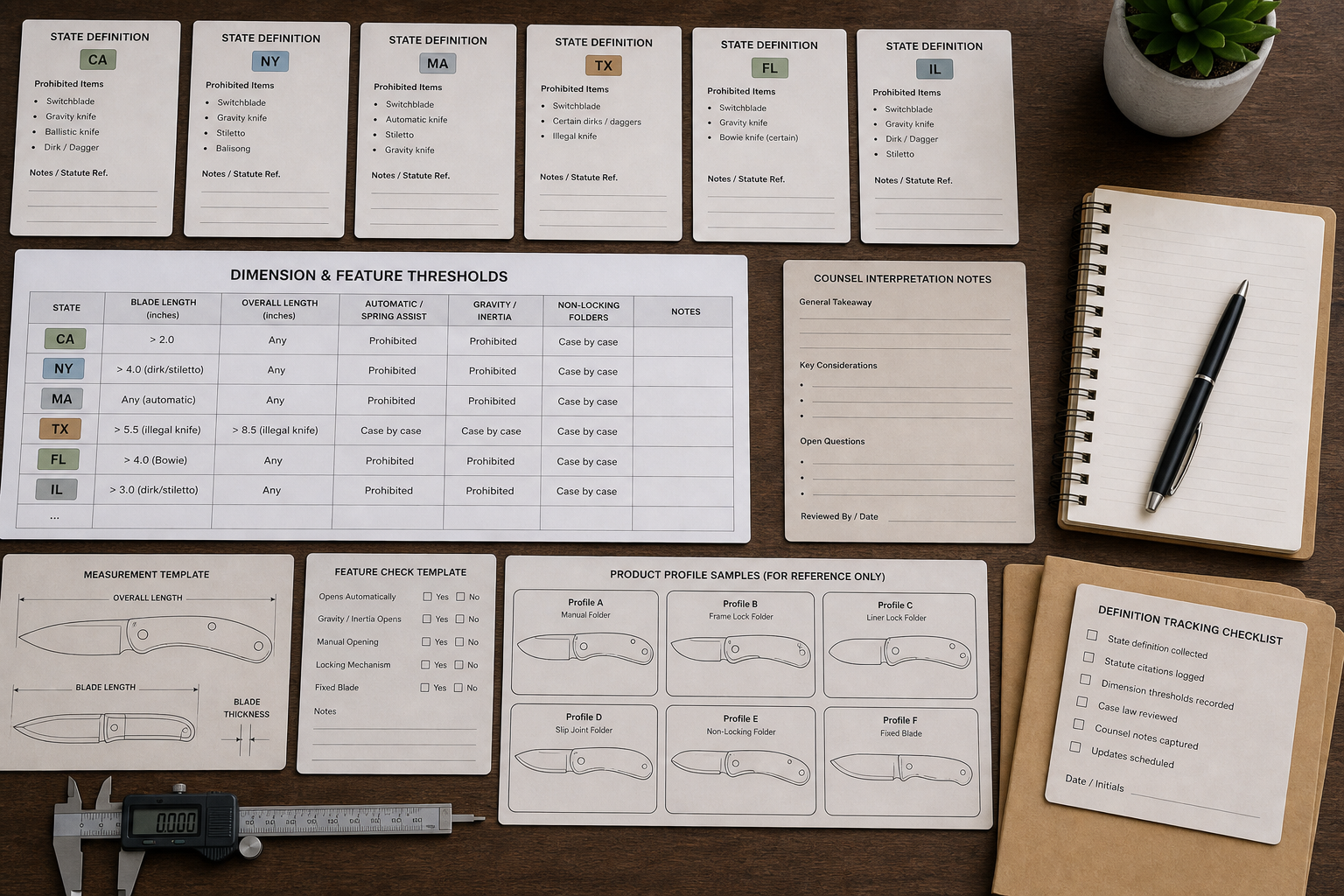
Buyers should track state definitions and blade-length thresholds with official source links, exact product measurements, mechanism terms, lock notes, and counsel-reviewed interpretations for each state.
I Make the Product Measurement Match the Legal Question
The most common mistake is treating "pocket knife" as one legal category. A state may talk about switchblades, automatic knives, gravity knives, daggers, fixed blades, locking blades, or other categories. Blade length may also be measured differently depending on the rule and the review method. The buyer should not let the factory guess. The buyer should define the measurement method and record it on the drawing.
California is a useful example of why a matrix matters. California Penal Code Section 21510 addresses sale and transfer of switchblade knives with blades of two or more inches. California Penal Code Section 17235 defines switchblade knife and also discusses one-hand opening with blade pressure and a detent or similar resistance. I do not use California as a national rule. I use it as an example of why product facts must be precise. A 50-state matrix should capture source language, product measurements, and the buyer's legal interpretation side by side.
| State review item | What to record | Why it matters |
|---|---|---|
| Definition | Exact category being reviewed | Avoids wrong product label |
| Blade length | Measurement value and method | Supports legal review |
| Mechanism | Manual, assisted, automatic, gravity, other | Connects law to engineering |
| Counsel note | Approved interpretation or open question | Keeps decisions traceable |
Why Do Local Ordinances and Retail Channels Need Their Own Column?
State approval may not be enough. A city, retailer, or marketplace can add another layer before the product reaches buyers.
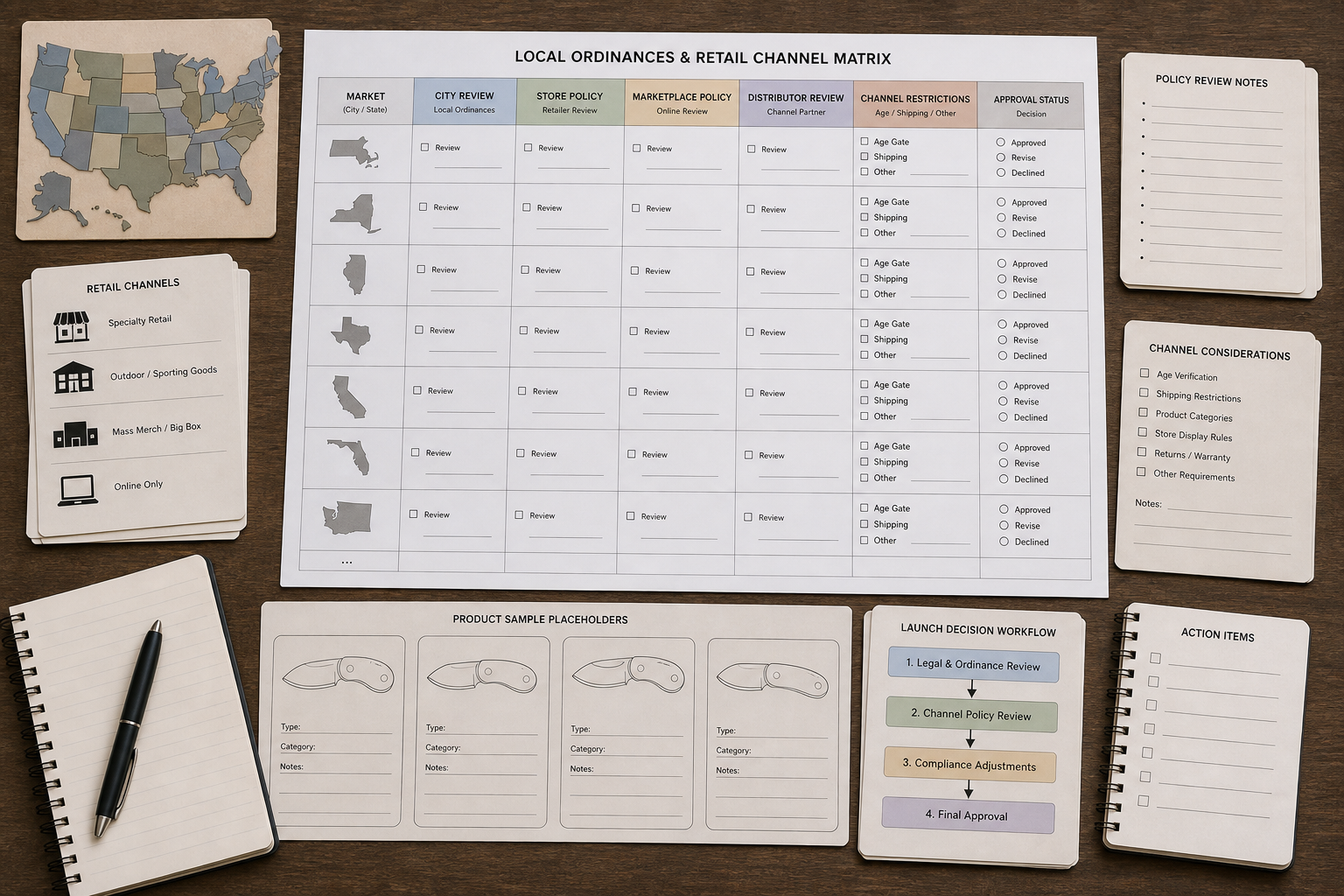
Local ordinances and retail channels need their own column because the same SKU may be allowed statewide but still need city, store, marketplace, or distributor review.
I Separate Legal Review From Channel Approval
A buyer may get comfortable with one state rule and still face a retail issue. Some city rules can affect sales to minors, store licensing, blade length, or local product handling. Some marketplaces may restrict categories beyond state law. Some distributors may refuse certain mechanisms or blade sizes because they want a simpler national SKU. That means the matrix needs a channel column, not only a state-law column.
Texas gives another example of why a matrix should separate product type and location review. Texas Penal Code Chapter 46 uses the term "location-restricted knife" and defines it by blade length. It also identifies places where certain items are restricted. I am not using Texas as a customer instruction. I am using it to show that a buyer's matrix should include both product facts and sales context. A product may have one answer for wholesale distribution, another answer for a school-adjacent local store, and another answer for a national marketplace. Before production, the buyer should ask: where will this SKU be sold, and do those places accept it?
| Channel column | What to include | Manufacturing impact |
|---|---|---|
| Local city flag | Cities needing extra review | May affect SKU availability |
| Retailer policy | Store or marketplace acceptance | May affect product listing |
| Distributor note | Allowed products and age controls | May affect carton labels |
| Market decision | Approved, pending, excluded | Guides production release |
Which Product Features Should Be Standardized Before Legal Review?
Legal review becomes slow when product facts keep changing. Buyers should freeze the review version first.
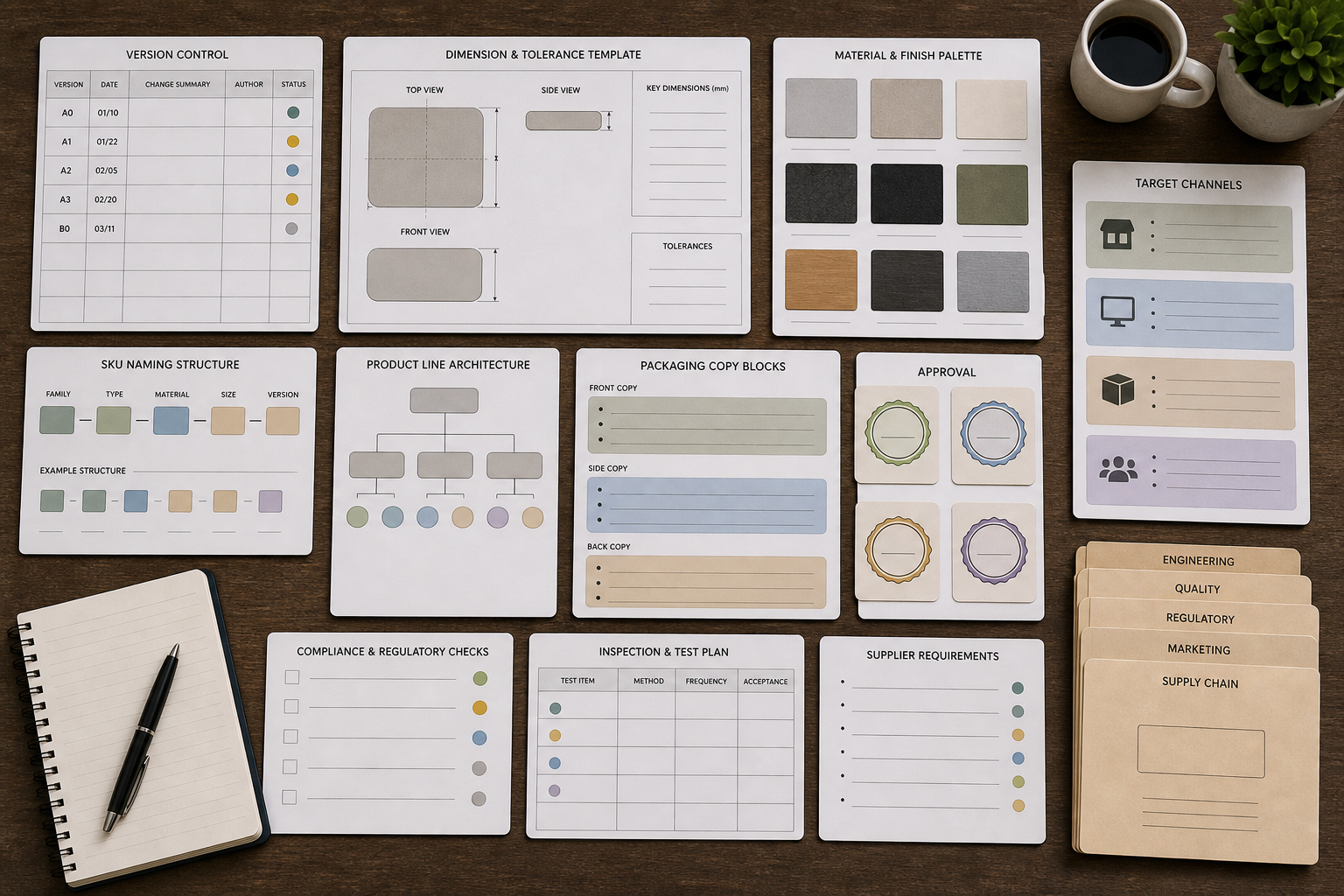
Buyers should standardize blade length, opening method, lock type, blade profile, edge style, handle design, SKU name, packaging copy, and target channel before legal review.
I Freeze a Review Sample Before I Ask for Approval
In a real OEM/ODM project, product details can change during sampling. A buyer may adjust blade length, switch from manual to assisted opening, change a lock, add a glass breaker, or revise the handle shape. Each change may affect the review. This is why I like to create a "legal review sample" version. It has a drawing number, date, blade length, closed length, mechanism, lock type, materials, and packaging copy. The buyer can then send that specific version to counsel and channels.
The supplier should also avoid casual feature names. A product should not be called "automatic" if it is manual. It should not be called "assisted" unless the mechanism really matches the buyer's definition and legal review. It should not use unclear blade-length numbers. The drawing should state the measurement method. The package should match the approved product facts. If the buyer later changes a feature, the matrix should show that the approval is no longer final. This is simple discipline, but it prevents expensive rework.
| Feature to standardize | What to freeze | Why it matters |
|---|---|---|
| Blade length | Measurement and tolerance | Drives state review |
| Opening method | Mechanism description | Drives category review |
| Lock type | Functional structure | Drives channel and policy review |
| Package copy | Approved wording | Prevents claim mismatch |
How Should Packaging and Listings Stay Market-Specific?
The product may pass review, but careless packaging can still create problems. Listing data must match approved facts.
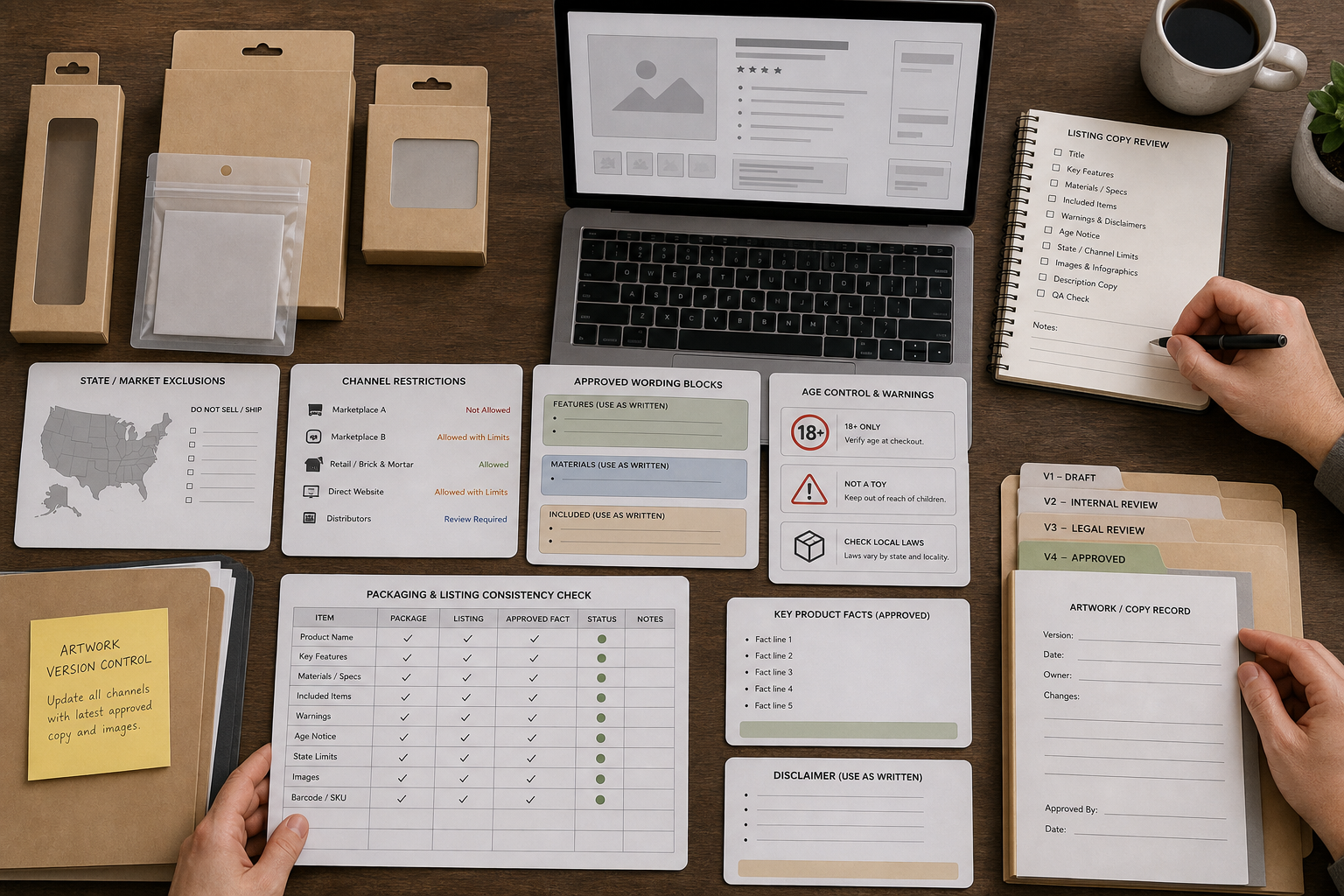
Packaging and listings should stay market-specific by using accurate product data, approved age-control notes, state or channel exclusions, and cautious wording that avoids unsupported legal promises.
I Treat Product Copy as Part of Compliance Control
Packaging and online listings are not afterthoughts. They are part of the product file. If the product is approved as a manual folding knife with a certain blade length, the package and listing should say the same thing. If the buyer decides that some states or channels are excluded, that should be recorded in the sales system. If a retailer requires age verification or category review, that should appear in the channel checklist, not only in an email thread.
The wording should be calm and practical. I prefer copy that explains blade steel, handle material, lock type, closed length, blade length, finish, packaging, care, and intended product category. I avoid language that sounds aggressive or unsupported. I also avoid broad legal claims such as "legal everywhere." A supplier should not print that. A safer approach is to prepare a clean specification sheet and let the buyer's legal team approve the final wording. For private label buyers, this also protects brand consistency. The same SKU should not have different claims across package, listing, carton, and catalog.
| Copy area | What to control | Why it matters |
|---|---|---|
| Product title | Knife type and core material | Avoids category confusion |
| Specification block | Blade length, steel, lock, handle | Matches legal review data |
| Channel note | Retailer or marketplace requirements | Supports listing approval |
| Artwork version | Approved packaging file | Prevents print rework |
What Internal Records Keep a 50-State Program Under Control?
A launch may take months. Without records, teams forget why a product was approved or excluded.
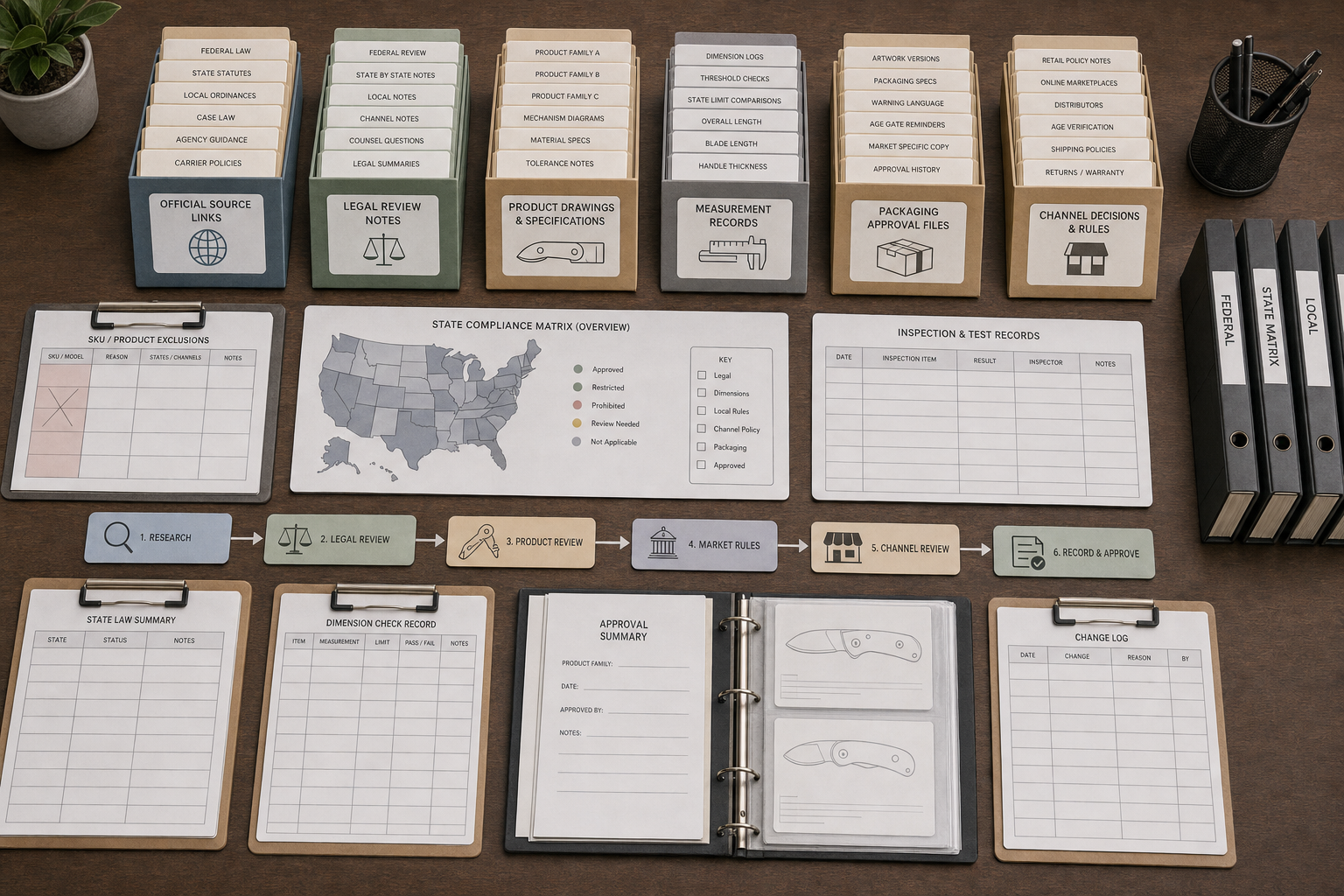
Buyers should keep official source links, legal review notes, product drawings, measurement records, packaging approvals, channel decisions, SKU exclusions, and inspection records for each state.
I Connect the Matrix With Quality and Production
A 50-state matrix should not sit alone in a legal folder. It should connect to product development and quality control. If the approved blade length is part of the market decision, the factory inspection plan should include blade-length checks. If a state requires a different SKU or package note, the carton and barcode system should prevent mix-ups. If a marketplace excludes a mechanism, the listing team should know before inventory is uploaded.
This is where a quality management mindset helps. The ISO guide to ISO 9001 in the supply chain says buyers should make requirements clear and may define approvals, monitoring, or inspections. That principle fits a multi-state pocket knife program very well. The buyer should define requirements. The supplier should confirm them. The inspection plan should check them. The shipment record should show which SKU went to which market. The matrix becomes stronger when it is tied to drawings, samples, packaging, and QC reports. It becomes weak when it is only a static spreadsheet with no owner.
| Record type | What to keep | Owner |
|---|---|---|
| Source record | Official link and review date | Legal or compliance team |
| Product record | Drawing, sample, measurements | Product and factory team |
| Channel record | Retailer, distributor, marketplace notes | Sales team |
| QC record | Inspection checklist and batch result | Quality team |
What Should a 50-State Pocket Knife RFQ Include?
An RFQ without market data creates guesswork. The supplier may quote a knife that the buyer cannot launch widely.
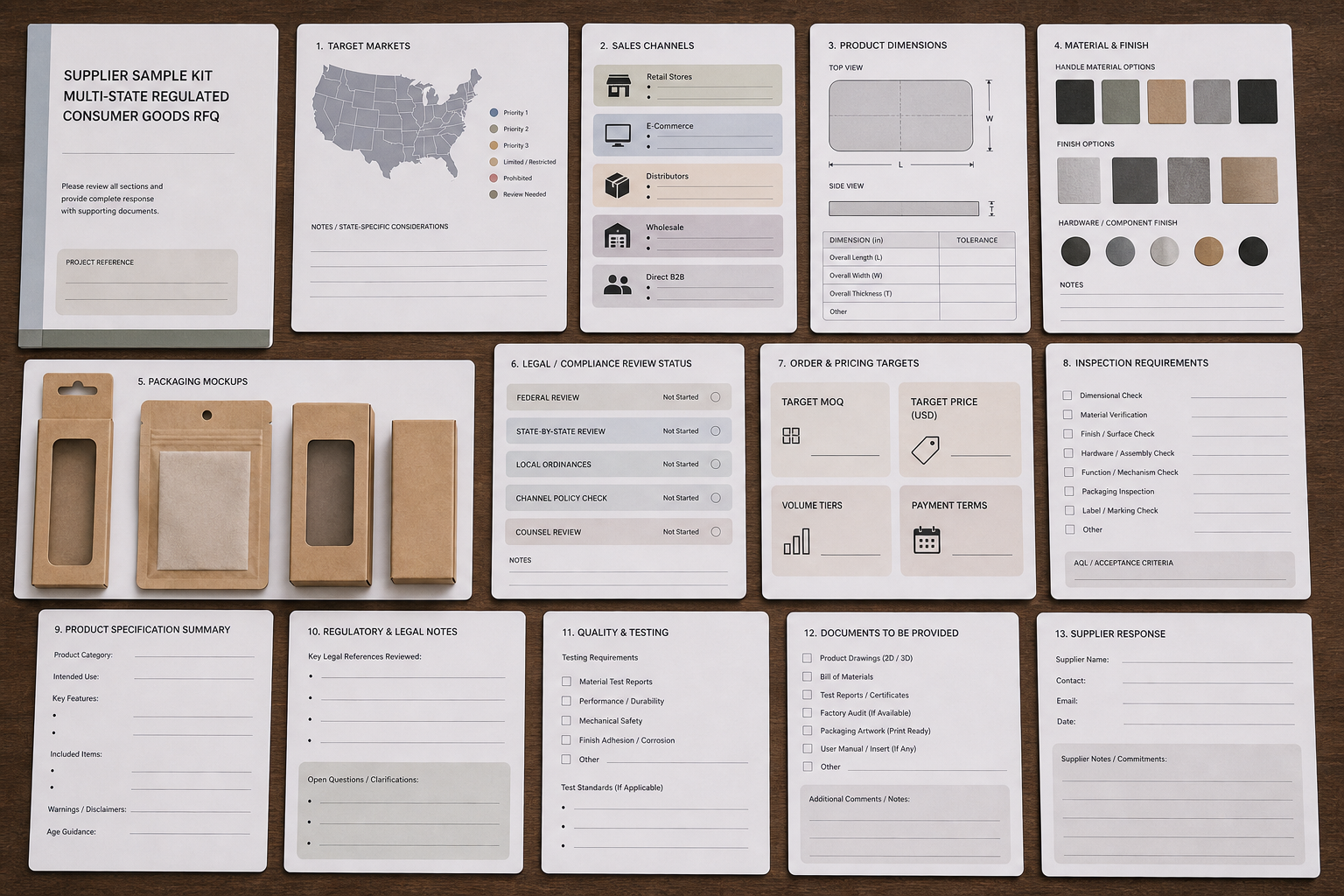
A 50-state pocket knife RFQ should include target states, sales channels, blade length, opening method, lock type, steel, handle material, packaging, legal review status, MOQ, price target, and inspection requirements.
I Need the Launch Strategy Before I Recommend the Knife
For Vast State, a strong RFQ begins with the market plan. The buyer should tell me whether the product is intended for all U.S. states, selected states, online sales, wholesale distribution, retail stores, or private label account programs. The buyer should also share legal review status. If the matrix is not finished, we can still help with product options, but I would mark them as pending review. That keeps the project honest.
The RFQ should include blade length, opening method, lock type, blade steel, handle material, finish, logo method, packaging style, age-control notes if required, barcode needs, carton rules, MOQ, target price, and inspection requirements. If the buyer wants one national SKU, the design may need to be conservative. If the buyer accepts market-specific SKUs, we can create variants. This is the real value of a 50-state matrix. It turns legal complexity into product choices. It helps buyers compare cost, compliance work, packaging, inventory, and channel access before mass production begins.
| RFQ field | What to include | Why it helps |
|---|---|---|
| Market scope | All states, selected states, or excluded states | Guides product strategy |
| Product spec | Blade length, lock, opening method, steel, handle | Enables accurate quotation |
| Packaging plan | Artwork, listing data, notes, barcode | Supports channel approval |
| Review status | Counsel notes and matrix status | Prevents premature production |
Planning a private-label knife line for this market?
Use this article as a planning reference, then confirm local requirements with your importer or compliance advisor before OEM/ODM production.
Conclusion
I would not launch a U.S. pocket knife program from memory. I would build a 50-state matrix, then connect it to product, packaging, and QC.
Source Notes
- Congress.gov state legislature websites supports using official state sources when building a state-by-state review matrix.
- USAGov laws and regulations supports the need to use official government sources for federal and legal research.
- 15 U.S.C. 1241-1245 on GovInfo supports federal review for switchblade and ballistic knife planning.
- 19 CFR 12.95 and 12.96 on GovInfo supports import classification review for pocket knives and related mechanisms.
- California Penal Code 21510 and 17235 show why blade length and opening method should be matrix fields.
- Texas Penal Code Chapter 46 gives another example of why product type and location context should be tracked.
- ISO 9001 in the supply chain supports clear requirements, approvals, monitoring, and inspection planning.