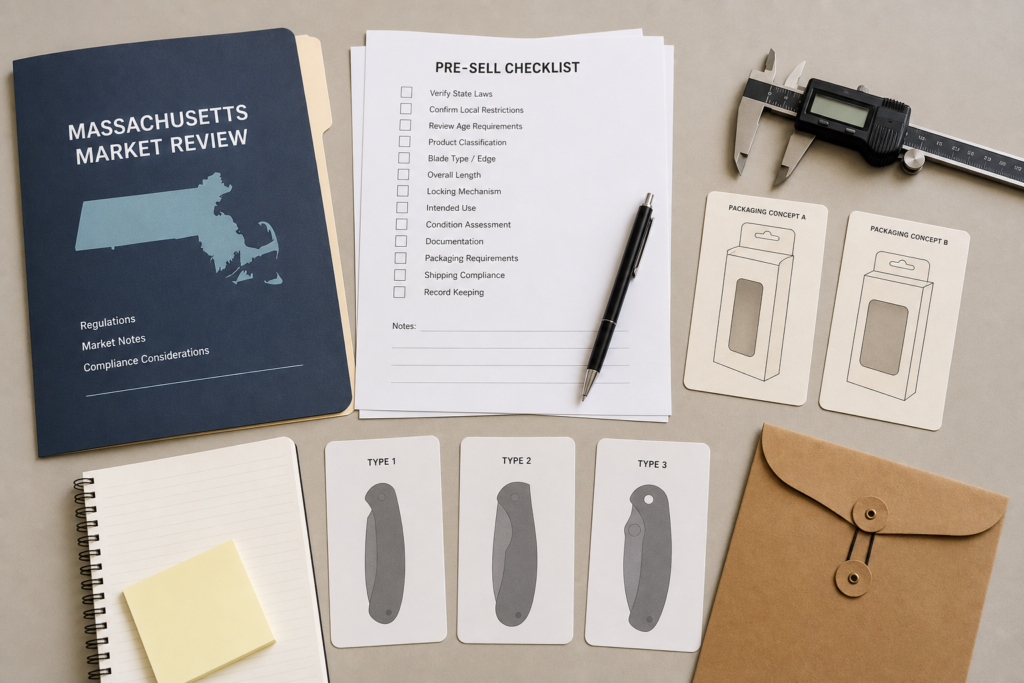
A pocket knife can be legal in one channel and risky in another. Missing local checks can stop sales. A clear review helps.
Buyers should check Massachusetts state rules, local city rules, blade length, opening mechanism, locking structure, age limits, sales channel, packaging claims, and legal counsel review before selling pocket knives in Massachusetts. This article is a sourcing guide, not legal advice.
Quick buyer brief:
- Answer: Treat Massachusetts as a separate market review before quoting or shipping pocket knives.
- Buyer context: This helps knife brands, outdoor brands, importers, wholesalers, distributors, and private label buyers.
- Key checks: State law, local ordinances, blade length, mechanism, lock, customer age controls, packaging, online listing language, and RFQ records.
Planning a private-label knife line for this market?
Use this article as an early planning reference, then prepare your target market, product category, labeling needs, and buyer-specified compliance requirements before production.
When a buyer asks whether a pocket knife can be sold in Massachusetts, I do not answer from memory. I ask for the product drawing, blade length, opening method, lock type, target city, sales channel, and buyer's legal review status. Massachusetts is not only a product design question. It is also a market entry question. A practical supplier can help organize the facts, but the buyer should still confirm the legal answer with qualified counsel before launch.
Why Should Massachusetts Be Treated as a Separate Sales Market?
A national listing can hide state-level risk. One SKU may need different review steps before it fits Massachusetts retail or online sales.
Massachusetts should be treated as a separate market because state rules, local rules, product features, customer age controls, and sales channel policies can all affect whether a pocket knife is suitable for sale.
I Separate Product Fit From Market Fit
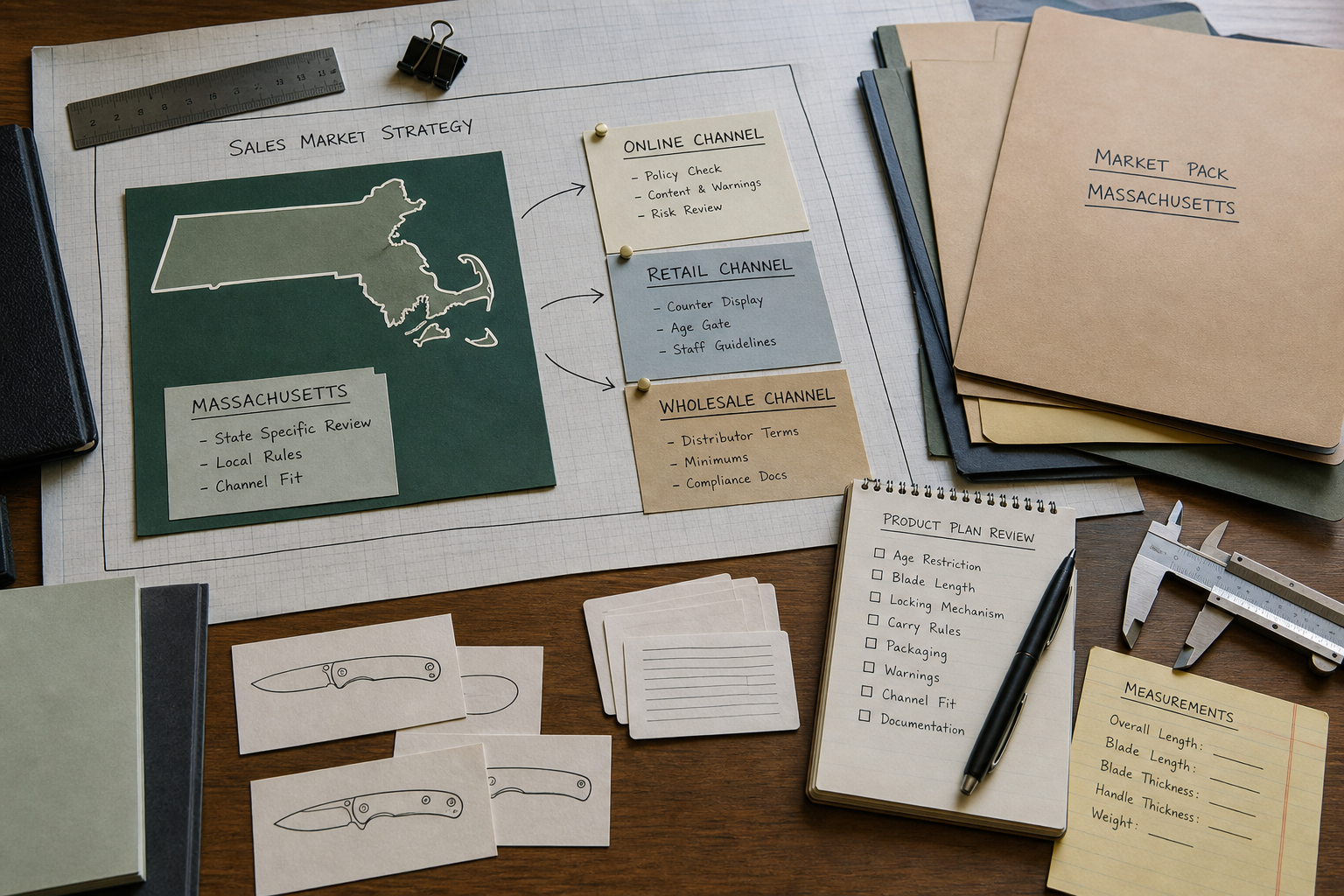
In OEM/ODM work, a buyer may send one folding knife design and plan to sell it across the United States. That sounds efficient, but it can create a blind spot. A knife can be manufacturable, attractive, and cost-effective while still needing a separate legal and channel review for a specific state or city. Massachusetts deserves that extra step because the buyer may need to review state law, Boston rules, retailer rules, shipping limits, and age controls.
I do not turn legal research into product advice. Instead, I help the buyer create a clean product file for legal review. That file should include blade length, closed length, locking structure, opening method, blade profile, edge type, packaging copy, intended user group, and sales channel. This lets the buyer's legal team or distributor make a better decision. It also helps the factory avoid quoting a feature that later creates problems for the buyer. In practice, the safest sourcing habit is simple: define the product first, then review the market, then approve the sample and packaging.
| Review layer | What I check | Why it matters |
|---|---|---|
| Product data | Blade length, lock, opening method, edge type | Creates a clear legal review file |
| Market scope | Massachusetts, Boston, online, retail | Shows where the knife will be sold |
| Buyer policy | Retailer rules and distributor limits | Prevents channel mismatch |
| Factory action | Sample notes and packaging control | Keeps production aligned with approval |
Private-label Planning Checklist
Before starting production, prepare the market and product details your importer or compliance advisor needs to review.
| RFQ Field | What to Prepare |
|---|---|
| Target market | Country, state, region, or sales channel |
| Product category | Folding knife / fixed blade / multi-tool / outdoor tool |
| Intended use | EDC / camping / kitchen / hunting / rescue / promotional |
| Buyer requirements | Testing, labeling, documentation, or packaging rules |
| Blade and lock details | Blade length, opening method, lock type, edge style |
| Packaging text | Warnings, claims, care notes, language requirements |
| Documents | Drawing, sample photo, logo file, packaging artwork |
| Review owner | Importer, legal advisor, testing lab, or internal compliance team |
Which Massachusetts State Rules Should Buyers Review First?
A buyer can lose time by reading summaries only. The official text should come first, then counsel can interpret it.
Buyers should first review Massachusetts General Laws Chapter 269, Section 12 and Section 10, then compare the product features against legal counsel guidance and channel rules.

I Start With Official Language, Then I Build the Product File
For Massachusetts, I would not rely only on a blog summary or a marketplace rule. I would start with the official Massachusetts legislature pages. Massachusetts General Laws Chapter 269, Section 12 addresses manufacturing and selling certain listed knives and related items. Massachusetts General Laws Chapter 269, Section 10 is also important because it includes listed blade categories and other restrictions that buyers should review with counsel.
From a manufacturing point of view, the buyer should turn those legal topics into measurable product facts. Is the blade over a certain length? Is the opening system manual, assisted, or automatic? Is the blade fixed or folding? Does the knife lock? Is the edge single or double? Is the product a pocket knife, a work tool, kitchen cutlery, or another category? These questions do not replace legal advice. They make legal advice easier to obtain. If the buyer gives a lawyer or distributor only a product photo, the review may be slow. If the buyer gives a drawing, measurements, mechanism notes, and packaging copy, the review becomes clearer.
| State-rule topic | Product fact to prepare | Factory-side support |
|---|---|---|
| Listed categories | Opening method and blade structure | Mechanism photos and sample notes |
| Blade size | Accurate blade measurement | Caliper records and drawing data |
| Locking design | Lock type and operation description | Exploded view and assembly details |
| Sales language | Packaging and listing claims | Copy review before printing |
How Does the Canjura Decision Affect Automatic Knife Planning?
A court decision can change the discussion, but it should not create careless sourcing. Buyers still need a complete review.
The Canjura decision affects automatic knife planning by requiring buyers to review current Massachusetts law carefully, but it does not remove the need for local, federal, channel, and legal counsel checks.
I Treat Court Updates as a Review Trigger
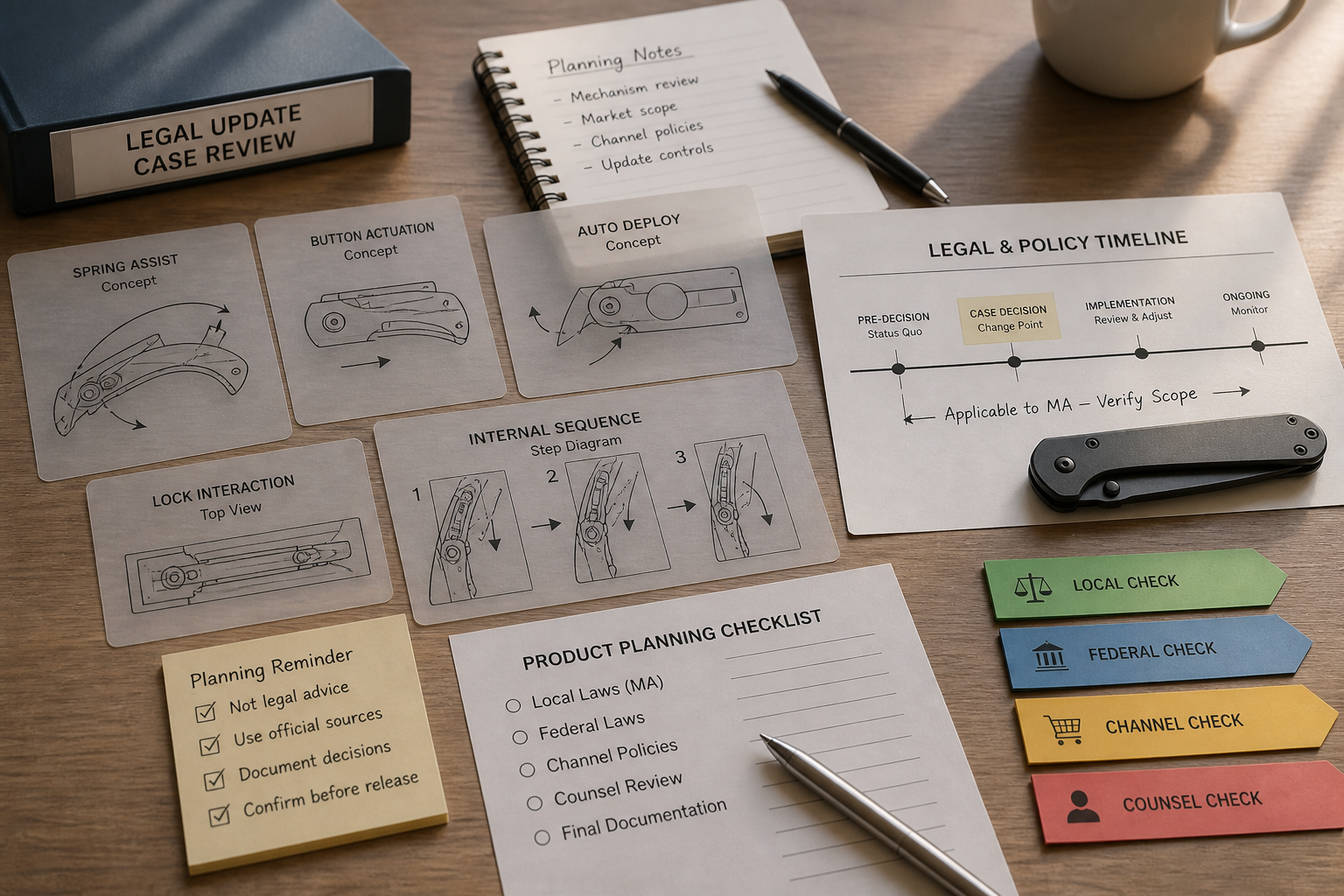
In 2024, Commonwealth v. Canjura became important for Massachusetts automatic knife discussion. The decision addressed the switchblade part of the state possession rule and found a constitutional problem with that portion. For a B2B buyer, this is not a reason to rush a product into the market. It is a reason to update the legal review checklist.
Automatic knives create more questions than manual pocket knives. The buyer should check state law, local city rules, online platform rules, distributor rules, import routing, and packaging copy. The buyer should also review federal context. The Federal Switchblade Act exceptions include specific carve-outs and an assisted-opening-related exception, but federal text should be read with counsel because terms and facts matter. In an RFQ, I want the buyer to clearly state whether the product is manual, assisted, or automatic. I also want a legal approval note before tooling or packaging begins. Mechanism language must be precise. A supplier should not use casual labels that create confusion later.
| Planning issue | What to clarify | Why it protects the project |
|---|---|---|
| Court update | Current legal interpretation | Prevents outdated assumptions |
| Mechanism type | Manual, assisted, or automatic | Guides design and review |
| Federal context | Shipping and exception review | Supports import and distribution planning |
| Approval timing | Legal signoff before production | Avoids wasted tooling and packaging |
Why Do Local Rules Like Boston's Matter for Sales Channels?
State review is not enough for every sale. Local rules can change how a product is sold, licensed, or restricted.
Local rules matter because a product approved for one Massachusetts channel may still need city-level review, especially for blade length, age controls, store licensing, and local retail policies.
I Ask Where the Knife Will Actually Be Sold
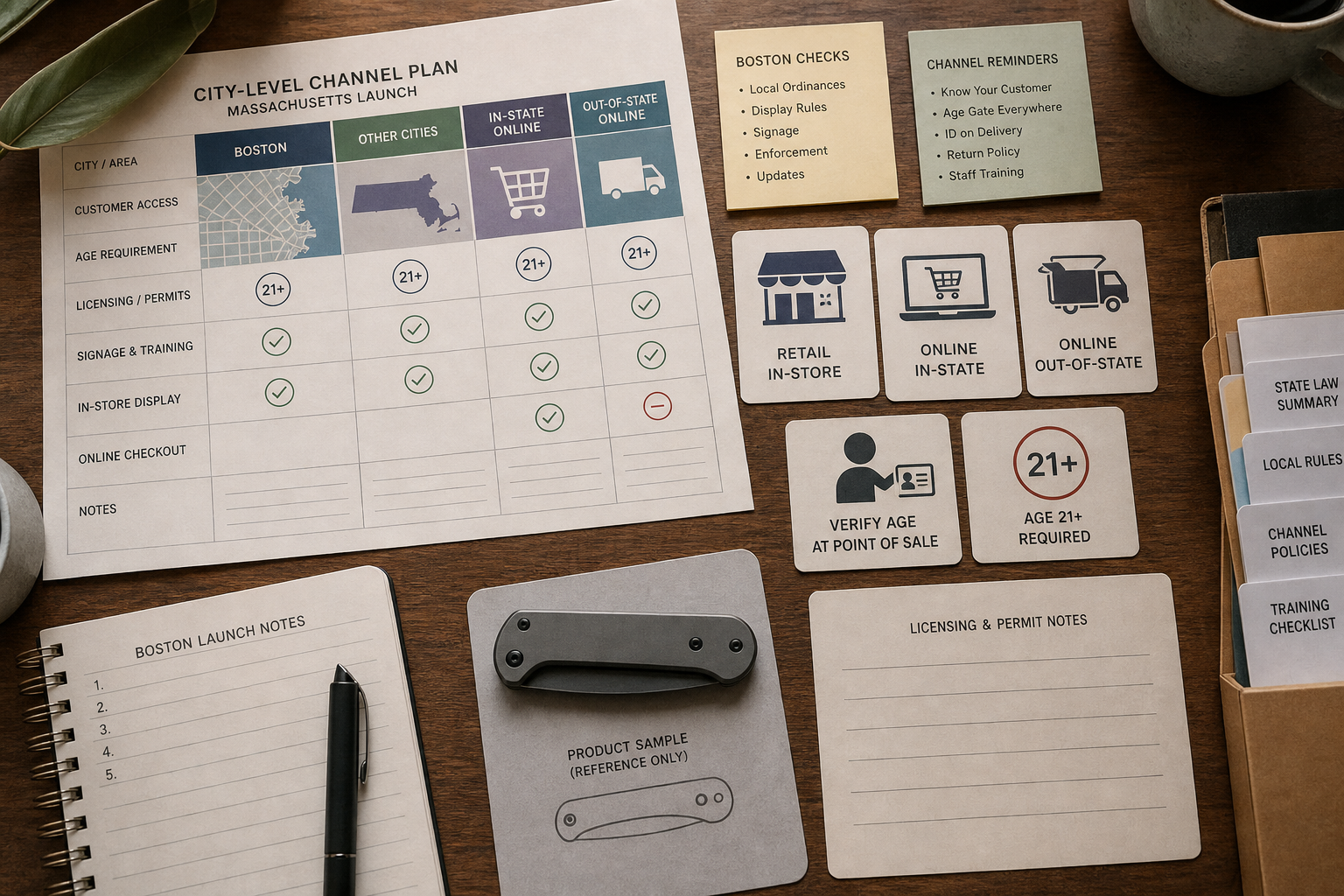
Massachusetts is not only one market. A buyer may sell through an online store, a national retailer, a local store, a distributor, or a wholesale account. Each channel may add its own requirements. Boston is a good example of why local checks matter. Boston Municipal Code 16-39.1 restricts sales of certain items to minors and includes knives with blades of 2 inches or more. Boston Municipal Code 16-39.4 also discusses licensing requirements for stores selling certain knives.
This does not mean a factory in Yangjiang should interpret every city rule for the buyer. It means the factory should ask the right commercial questions. Will the product enter Boston retail? Will the buyer sell through a retailer that has its own age gate? Will the package need different wording? Should blade length be adjusted for a specific channel? Should the SKU be excluded from certain accounts? These are practical product planning questions. I would rather solve them before sample approval than after cartons are ready. Local review can affect blade length, packaging, barcode setup, age-control language, and channel segmentation.
| Channel question | What the buyer should confirm | Manufacturing impact |
|---|---|---|
| City sales | Whether Boston or another city is included | May affect SKU approval |
| Customer age policy | How the channel controls sales | May affect packaging notes |
| Store licensing | Whether the retailer needs local permits | May affect account selection |
| SKU segmentation | Which markets receive which version | May affect labeling and cartons |
Which Knife Features Need Extra Review Before Quoting?
A small feature can change the compliance discussion. The factory quote should not ignore the blade, lock, and mechanism details.
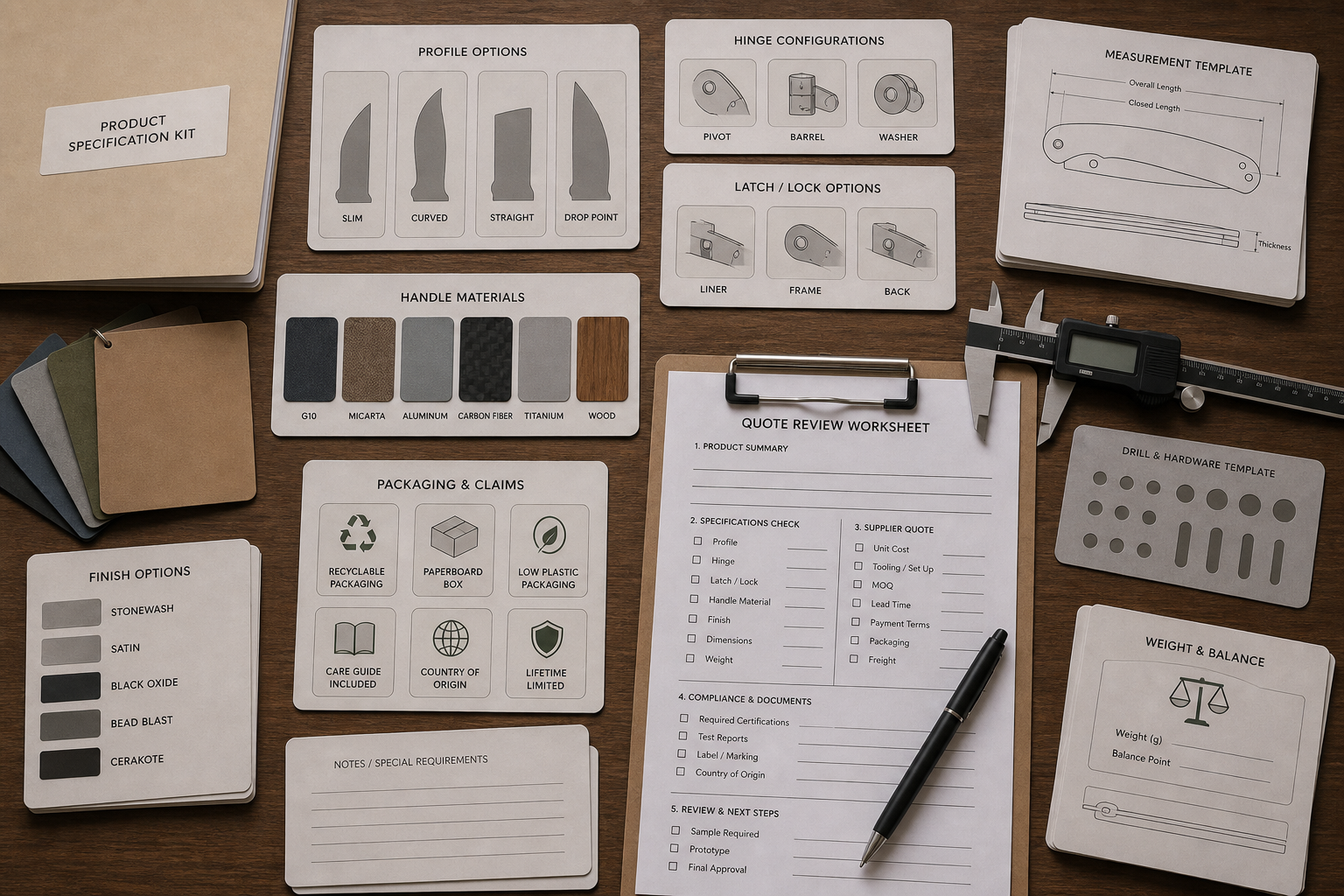
Buyers should review blade length, edge type, opening system, lock type, fixed or folding structure, handle design, packaging claims, and intended sales channel before asking for a final quote.
I Turn Features Into Checkable Specifications
When I quote a pocket knife for a regulated market, I do not want a vague description like "standard folder." I want measurable specifications. Blade length is one of the first items. The buyer should define how the length is measured and record it on the drawing. Opening method is another key item. Manual, assisted, and automatic mechanisms should not be mixed in the same conversation. Lock type also matters because a locking blade can affect local rules or retailer policies. Edge style, point shape, and fixed versus folding structure should also be clear.
This is where OEM/ODM engineering support matters. A buyer may ask for a visual style from another market, but the target channel may require a calmer specification. We can suggest a shorter blade, a manual opening structure, a different lock, a different handle material, or packaging changes if the buyer wants a lower-risk commercial direction. I do not present those suggestions as legal conclusions. I present them as product options for the buyer to review with counsel and distributors. A good RFQ should let the buyer compare cost, function, compliance review burden, and market fit at the same time.
| Feature | What to document | Why it matters |
|---|---|---|
| Blade length | Exact measurement and drawing note | Supports legal and channel review |
| Opening method | Manual, assisted, or automatic | Prevents category confusion |
| Lock type | Liner, frame, back lock, button, or other | Affects function and policy review |
| Edge and profile | Single edge, shape, and intended category | Supports packaging and listing clarity |
How Should Packaging and Online Listings Be Written?
Even a compliant product can be weakened by careless copy. Marketing words can create review problems before launch.
Packaging and online listings should use practical product language, accurate specifications, age-control notes when required, and market-specific review statements without making unsafe or unsupported claims.

I Keep Product Copy Practical and Verifiable
Packaging is not only branding. It is part of the compliance and customer experience file. For a Massachusetts-focused SKU, I would avoid exaggerated language and keep the copy tied to practical product facts. The package can state blade steel, handle material, closed length, blade length, lock type, finish, included accessories, care guidance, and age-control information when the buyer's review requires it. It should not promise legal status in every location. It should not use aggressive claims. It should not hide important specifications.
Online listings need the same discipline. Retailers and marketplaces may ask for product type, dimensions, materials, and category. If those fields are wrong, the listing may be rejected or the product may enter the wrong channel. I suggest that buyers create a listing data sheet before mass production. This sheet should include the approved title, specifications, photos, package copy, warning or age-control notes if required, and markets where the SKU is allowed. Then the factory can align cartons, labels, inserts, and product photos with the approved information. Clean wording reduces confusion between the supplier, buyer, retailer, and final channel.
| Copy area | Better approach | Risk to avoid |
|---|---|---|
| Product title | Use type, material, and size | Overstated positioning |
| Specification list | State measurable facts | Missing blade length or mechanism |
| Package note | Follow buyer legal review | Unsupported legal promises |
| Listing data | Match approved SKU sheet | Channel mismatch |
What Records Should Buyers Keep for Massachusetts Orders?
If a question appears later, memory is not enough. Buyers need records that show what was reviewed and approved.
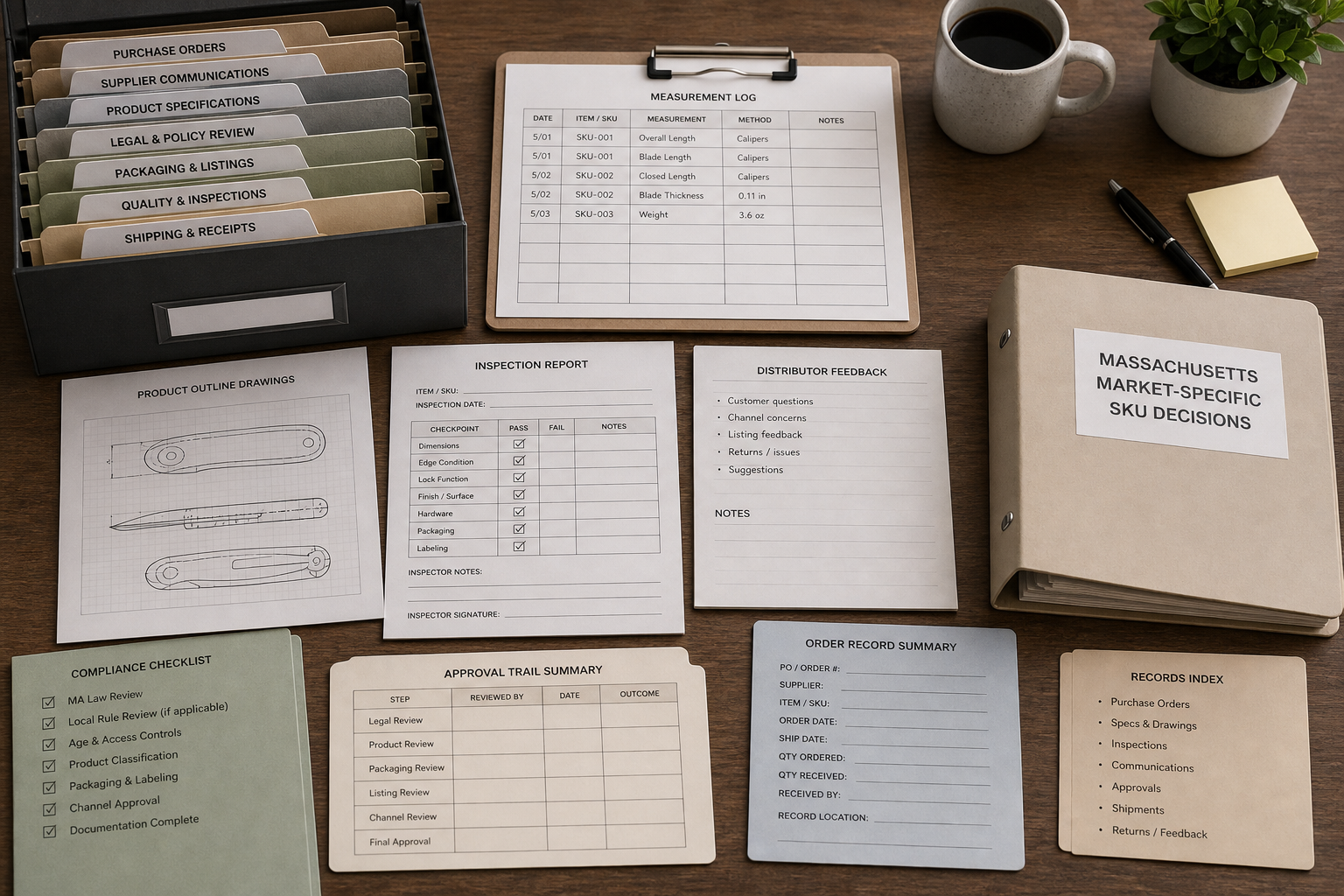
Buyers should keep drawings, measurement records, mechanism notes, packaging approvals, legal review notes, distributor feedback, inspection reports, and market-specific SKU decisions for Massachusetts orders.
I Connect Compliance Review With Quality Control
For regulated markets, records matter as much as samples. A buyer should keep the approved drawing, blade measurement method, mechanism description, lock type, packaging proof, legal review note, retailer approval, and inspection plan. The factory should keep production records that match those approvals. If a blade length is approved at one value, the inspection plan should define tolerance and measurement method. If package copy is approved, the factory should not substitute wording without review.
This is also a quality management issue. The ISO guide to ISO 9001 in the supply chain explains that buyers need to make requirements clear and may define approvals, monitoring, or inspections. That idea fits knife sourcing well. ISO 9001 does not tell a buyer whether a pocket knife is legal in Massachusetts. It does support the practical habit of defining requirements and checking supplier output against them. For Vast State, this means the buyer's market requirement should become a product requirement. Then the product requirement becomes a drawing, sample, packaging file, inspection checklist, and shipment record.
| Record type | What to keep | Why it helps |
|---|---|---|
| Drawing record | Blade length, lock, mechanism, materials | Shows approved product facts |
| Review record | Legal and distributor notes | Shows decision basis |
| Packaging record | Final artwork and instructions | Controls printed claims |
| QC record | Measurement and function checks | Supports batch consistency |
What Should a Massachusetts Pocket Knife RFQ Include?
A weak RFQ creates guesswork. A strong RFQ helps the supplier quote a product that matches the buyer's market plan.
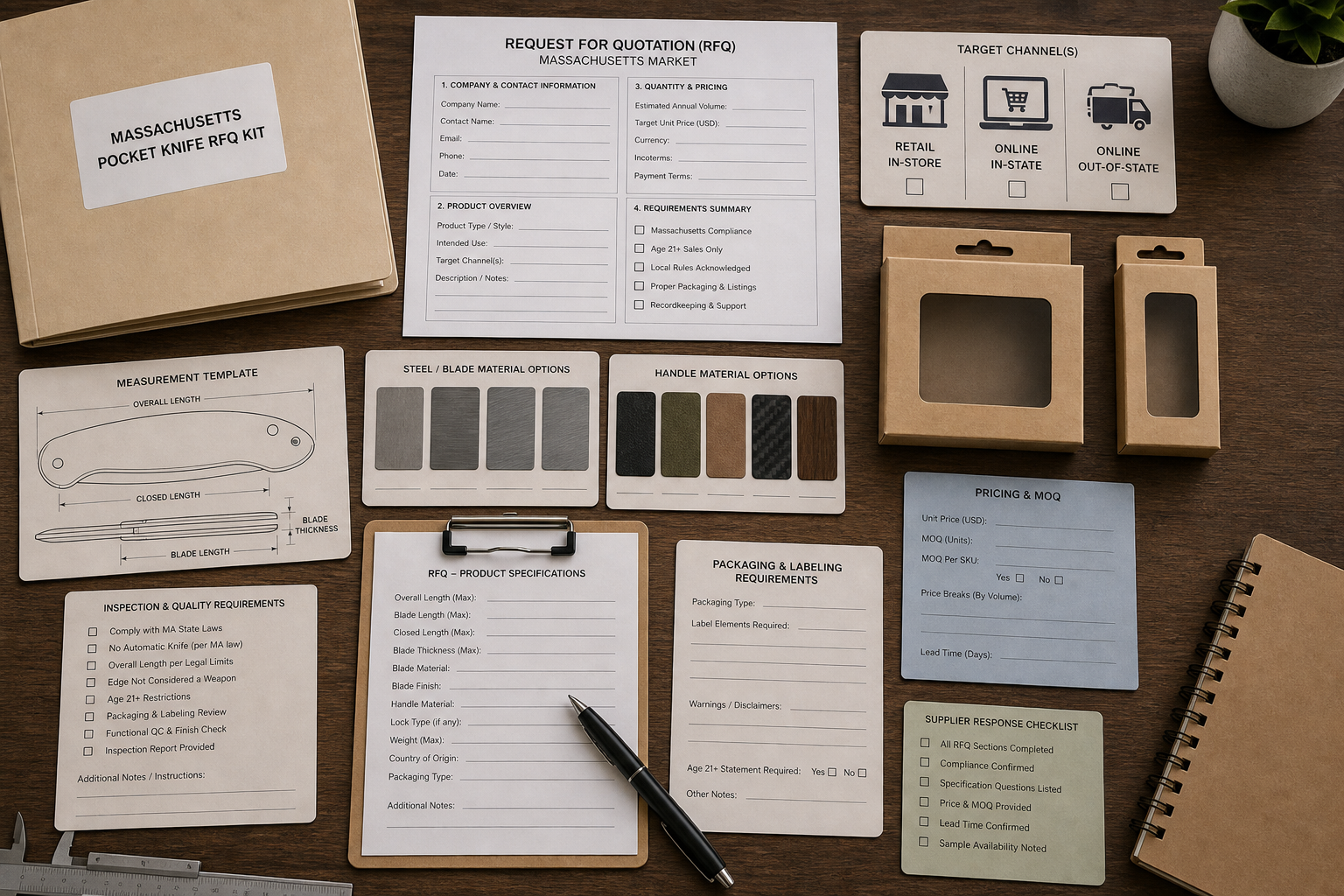
A Massachusetts pocket knife RFQ should include target channel, blade length, opening method, lock type, steel, handle material, packaging, age-control needs, legal review status, MOQ, price target, and inspection requirements.
I Need the Market Plan Before I Recommend the Design
For Vast State, the best RFQ does not only say "make this folding knife." It tells me where the buyer wants to sell it, what channel will carry it, what legal review has been done, and which product features are fixed. For a Massachusetts-focused order, I would ask for the target city or channel, legal counsel notes if available, blade length target, opening method, lock type, blade steel, handle material, finish, packaging style, age-control needs, barcode requirements, MOQ, target price, and inspection items.
If the buyer is still exploring, I can help create options. One option may use a shorter manual folder for broader retail comfort. Another may use a different lock or handle to fit cost. Another may be kept out of certain channels until counsel confirms the path. This is how practical OEM/ODM development should work. The supplier should not only chase the lowest price. The supplier should help the buyer connect product design, cost, packaging, quality control, and market entry. That is how a Massachusetts pocket knife project becomes more controlled from concept to shipment.
| RFQ field | What to include | Why it helps |
|---|---|---|
| Market scope | Massachusetts, Boston, online, retail, wholesale | Guides compliance review |
| Product spec | Blade length, lock, opening method, steel, handle | Enables accurate quotation |
| Packaging | Box, insert, warning or age-control notes | Controls channel fit |
| Approval plan | Legal review, sample approval, inspection | Reduces rework before shipment |
Planning a private-label knife line for this market?
Use this article as a planning reference, then confirm local requirements with your importer or compliance advisor before OEM/ODM production.
Conclusion
I treat Massachusetts pocket knife sourcing as a market-specific project: define the product, verify rules, control packaging, and keep clear records.
Source Notes
- Massachusetts Chapter 269, Section 12 supports reviewing state-level sale and manufacturing restrictions for listed knife categories.
- Massachusetts Chapter 269, Section 10 provides state-law context for listed blade categories and buyer review needs.
- Commonwealth v. Canjura supports updating review checklists for automatic knife planning after the 2024 decision.
- Boston Municipal Code 16-39.1 and 16-39.4 support city-level sales-channel review.
- 15 U.S.C. 1244 provides federal context for switchblade-related exceptions and assisted-opening wording.
- ISO 9001 in the supply chain supports the need for clear buyer requirements, approvals, monitoring, and inspection planning.