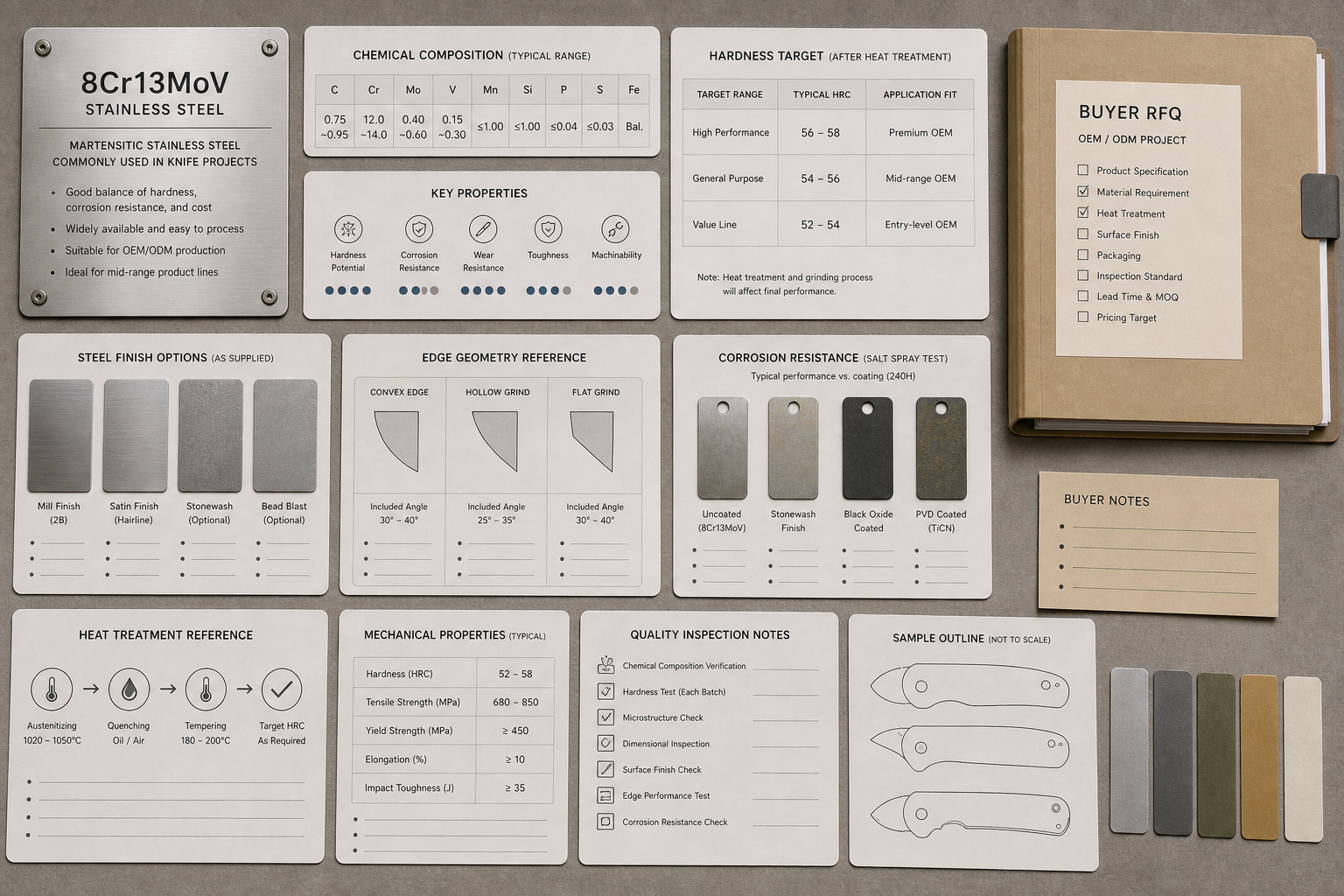
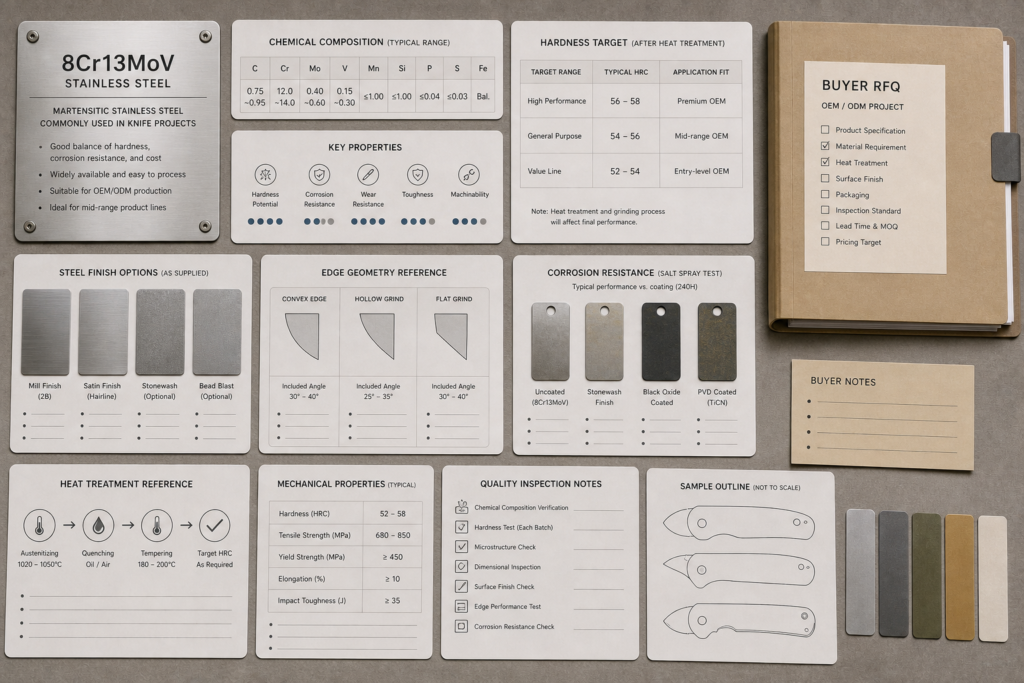
A steel name can look simple, but a bad match can hurt margin, reviews, and repeat orders. 8Cr13MoV needs the right project.
8Cr13MoV is a practical choice for OEM/ODM knife projects when the buyer needs a value stainless blade steel for budget or mid-entry products, with controlled heat treatment, realistic edge-retention expectations, stable hardness checks, and clear quality inspection.
Quick buyer brief:
- Answer: 8Cr13MoV works best for value-focused stainless knife lines.
- Buyer context: This helps brands, importers, wholesalers, and private label buyers balance price and function.
- Key checks: Target price, blade use, heat treatment, HRC range, edge geometry, corrosion needs, batch consistency, and packaging claims.
Planning a knife project with this steel?
Send us your target market, MOQ, price range, and blade type. Vast State can help you choose the right steel, HRC range, finish, handle material, and QC requirements for OEM/ODM production.
I do not treat 8Cr13MoV as a magic steel or a bad steel. I treat it as a business decision. For some knife projects, it is a sensible choice because it supports price, easy maintenance, easy sharpening, and stable supply. For other projects, it can limit brand positioning because buyers may expect stronger edge retention, higher corrosion performance, or a more premium steel name. The real question is not whether 8Cr13MoV is "good." The better question is whether it fits the product, buyer expectation, and production plan.
When Does 8Cr13MoV Fit a Knife Project?
A steel can be good in the wrong product and still fail. Buyers need to match 8Cr13MoV with the selling goal.
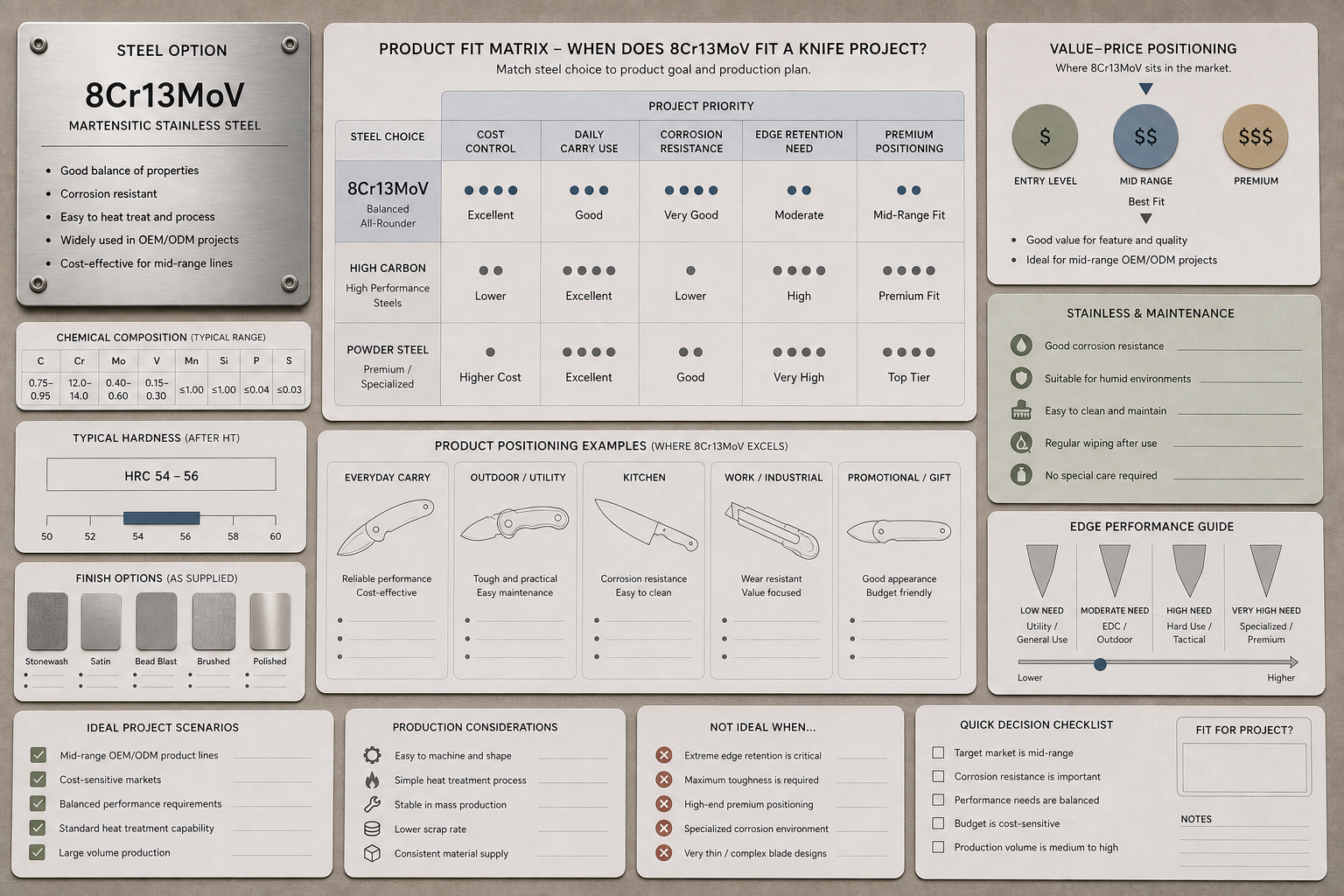
8Cr13MoV fits knife projects that need value pricing, stainless behavior, simple maintenance, and stable production more than premium steel branding or extreme edge retention.
I Start With the Product Positioning
When a buyer asks me whether 8Cr13MoV is suitable, I first ask about the target price and target user. A low-cost EDC folder, a general utility pocket knife, a private label promotional line, and a camping accessory knife may all work with 8Cr13MoV. The steel gives the buyer a practical stainless option without pushing the product into a higher price band. That can be important for wholesalers and distributors who need a sellable price point.
However, I do not recommend choosing it only because it is cheaper. The design still needs the right blade geometry, heat treatment, finish, sharpening process, and inspection plan. A poorly treated 8Cr13MoV blade can disappoint users. A well-controlled 8Cr13MoV blade can fit many everyday cutting products. The customer should also think about brand story. If the line is positioned as entry level, the steel can make sense. If the brand wants a higher-performance story, I may suggest 9Cr18MoV, 14C28N, D2, or another option depending on the target market.
| Project condition | 8Cr13MoV fit | Buyer takeaway |
|---|---|---|
| Budget EDC folder | Good fit | Keep the price realistic |
| Premium steel story | Weak fit | Consider an upgrade steel |
| Easy sharpening priority | Good fit | Pair with practical edge geometry |
| Heavy wear expectation | Limited fit | Review D2, 14C28N, or other options |
Quote-ready RFQ Checklist for This Steel
To get an accurate OEM/ODM quote, prepare these details before contacting a knife manufacturer.
| RFQ Field | What to Prepare |
|---|---|
| Product type | Folding knife / fixed blade / multi-tool / kitchen knife |
| Target market | US / EU / outdoor retail / promotional / tactical / EDC |
| Steel option | 4116 / 14C28N / D2 / N690 / Nitro-V |
| Target HRC | Example: 55-57 HRC, 58-60 HRC |
| Blade finish | Satin / stonewash / black coating / bead blast |
| Handle material | G10 / micarta / aluminum / stainless steel / wood |
| Lock or structure | Liner lock / frame lock / slip joint / full tang |
| Estimated quantity | 500 / 1,000 / 3,000 / 5,000+ pcs |
| Packaging | White box / color box / blister / pouch / gift box |
| Required documents | Drawing / sample photo / logo file / packaging artwork |
What Performance Balance Should Buyers Expect From 8Cr13MoV?
Buyers sometimes expect one steel to do everything. That creates disappointment when the product reaches real users.
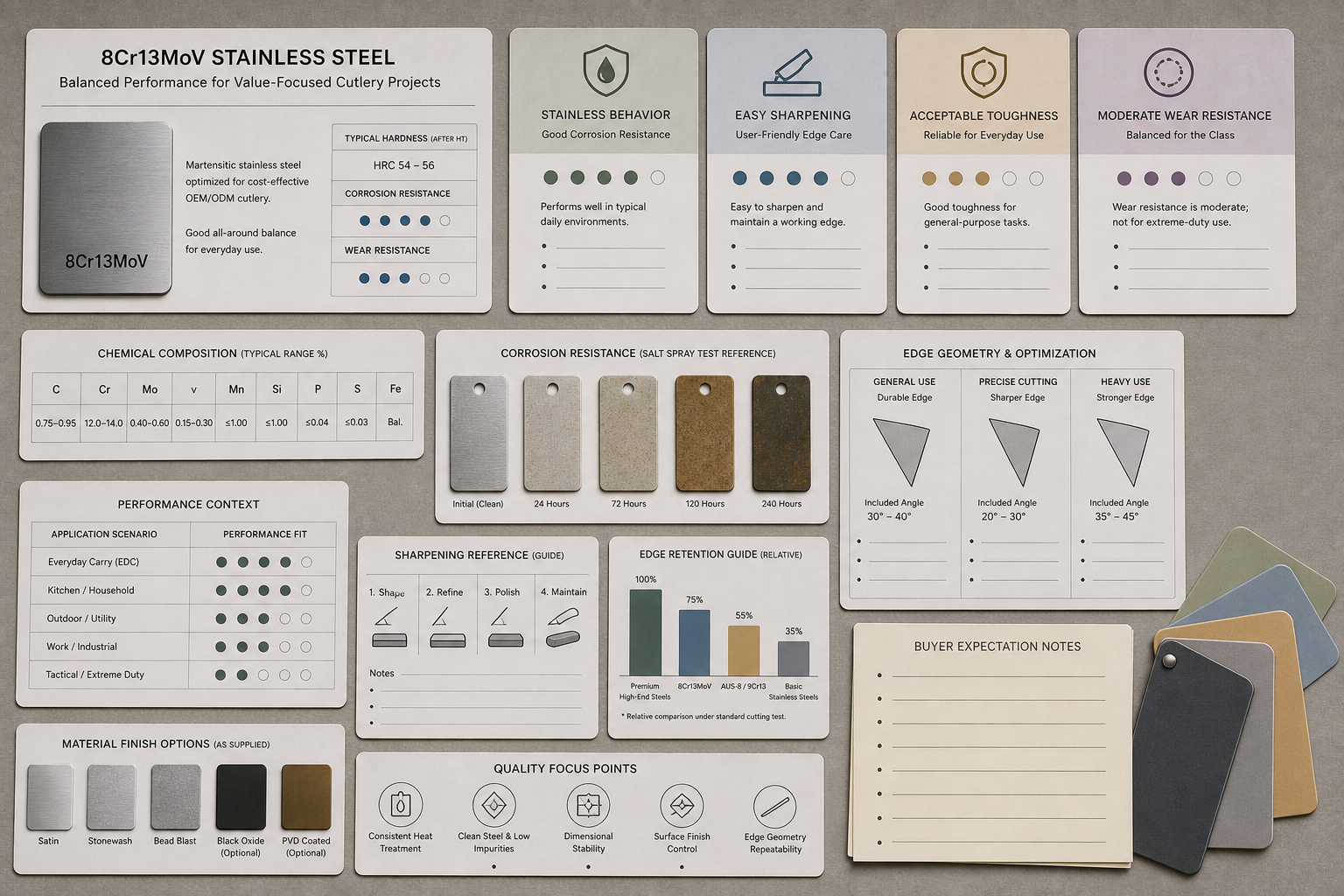
Buyers should expect 8Cr13MoV to offer practical stainless performance, easy sharpening, and acceptable toughness for value knives, but not premium wear resistance or a high-end steel story.
I Explain the Tradeoff in Plain Language
8Cr13MoV is usually selected because it gives a useful balance at a low-to-mid price point. It can support stainless knife products, especially when the buyer wants easier maintenance and simple sharpening. It is not the steel I choose when the buyer wants a strong premium message, very long edge life in abrasive cutting, or a high-margin enthusiast product. This does not make it poor. It makes it specific.
A peer-reviewed study on high-carbon martensitic stainless steel 8Cr13MoV notes that this steel type has been used for knives and scissors and discusses how carbides and microstructure affect mechanical properties. That is a useful reminder for buyers. Steel performance is not only a name. It comes from chemistry, microstructure, heat treatment, grinding, edge angle, and final inspection. In practice, I tell buyers to compare 8Cr13MoV against the product's real job. If the product must be affordable, stainless, easy to sharpen, and easy to repeat in production, 8Cr13MoV can be a practical answer. If the product must compete on premium steel performance, it may not be enough.
| Performance factor | What to expect | What to avoid promising |
|---|---|---|
| Corrosion resistance | Practical stainless behavior | No-care performance in every environment |
| Edge retention | Acceptable for value knives | Premium wear resistance |
| Sharpening | Usually easy for end users | Maintenance-free cutting |
| Brand position | Value or entry-mid line | High-end steel image |
Why Does Heat Treatment Matter More Than the Steel Name?
The same steel can perform differently across factories. Buyers who only compare steel names may miss the most important process.
Heat treatment matters because hardening, quenching, tempering, grinding heat, and hardness control decide whether 8Cr13MoV becomes a stable blade or a weak product.
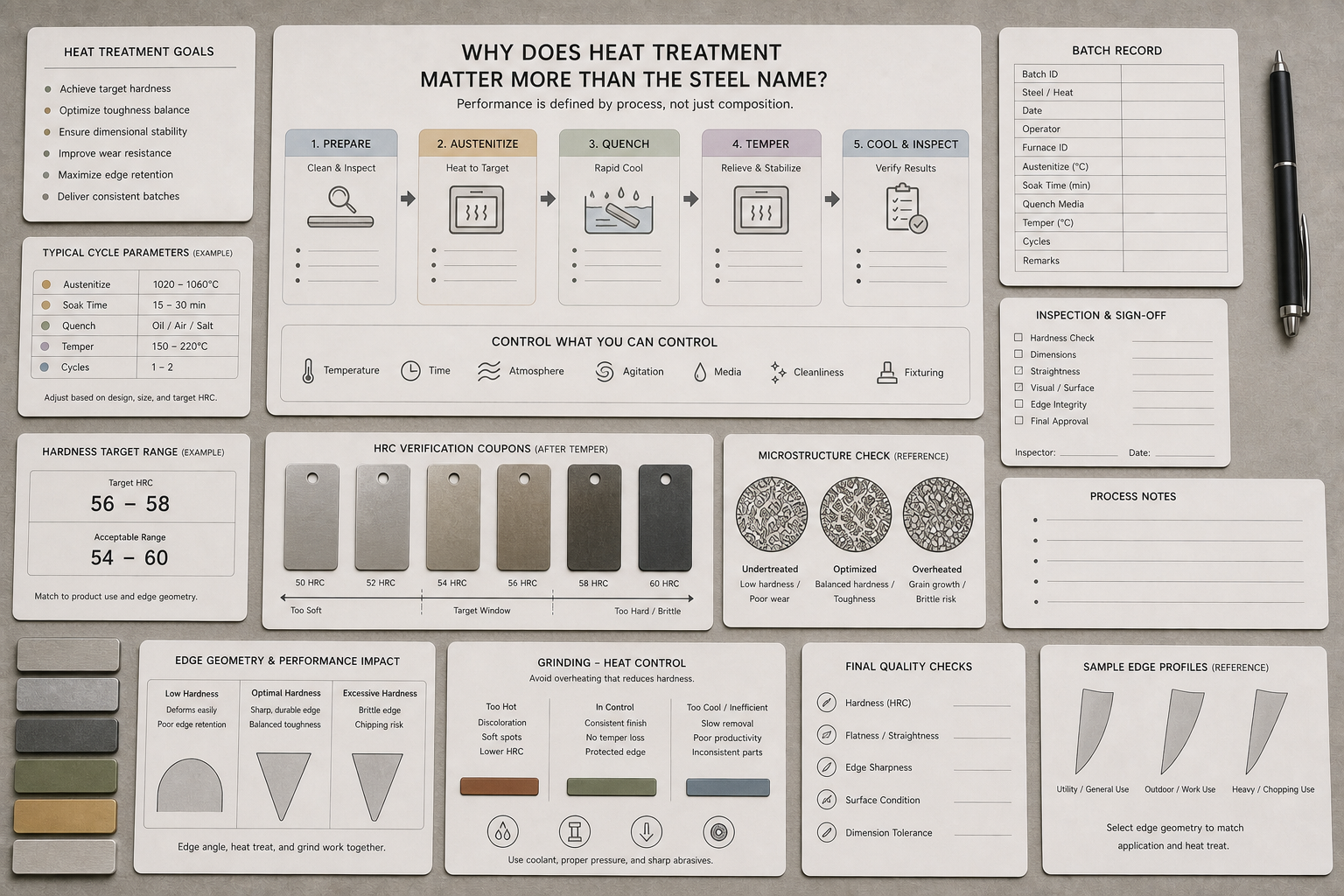
I Watch Process Control Before I Trust the Label
In knife production, heat treatment turns a blade blank into a working blade. The steel name tells me the material family, but the process tells me how the knife may perform. If hardening is too soft, the edge may roll or dull too quickly. If the blade is pushed too hard without balance, it may chip more easily. If grinding heat is not controlled after heat treatment, the edge can lose performance in the area that matters most.
Alleima's guide to hardening and tempering of knife steel explains that correct hardening gives a balance between hardness, toughness, and corrosion resistance. I see that same principle when working with 8Cr13MoV. The buyer should not only ask "What steel is this?" The buyer should ask about target hardness, heat-treatment process control, batch checks, grinding control, and final edge inspection. For OEM/ODM orders, this is where a supplier's manufacturing discipline matters. A good supplier should explain the practical target and inspect production consistently, not just print the steel name on the package.
| Process factor | What it controls | Buyer question |
|---|---|---|
| Hardening | Blade hardness and base performance | What target range is used? |
| Tempering | Balance of hardness and toughness | How is brittleness controlled? |
| Grinding | Edge heat and geometry | How is overheating avoided? |
| Final inspection | Batch consistency | What is checked before shipment? |
How Should Buyers Set Hardness and Edge Geometry Targets?
Hardness numbers can look impressive. But a number alone does not tell buyers how the knife will cut or last.
Buyers should set hardness and edge geometry together. The HRC range, blade thickness, grind, edge angle, and use case must support the same product goal.
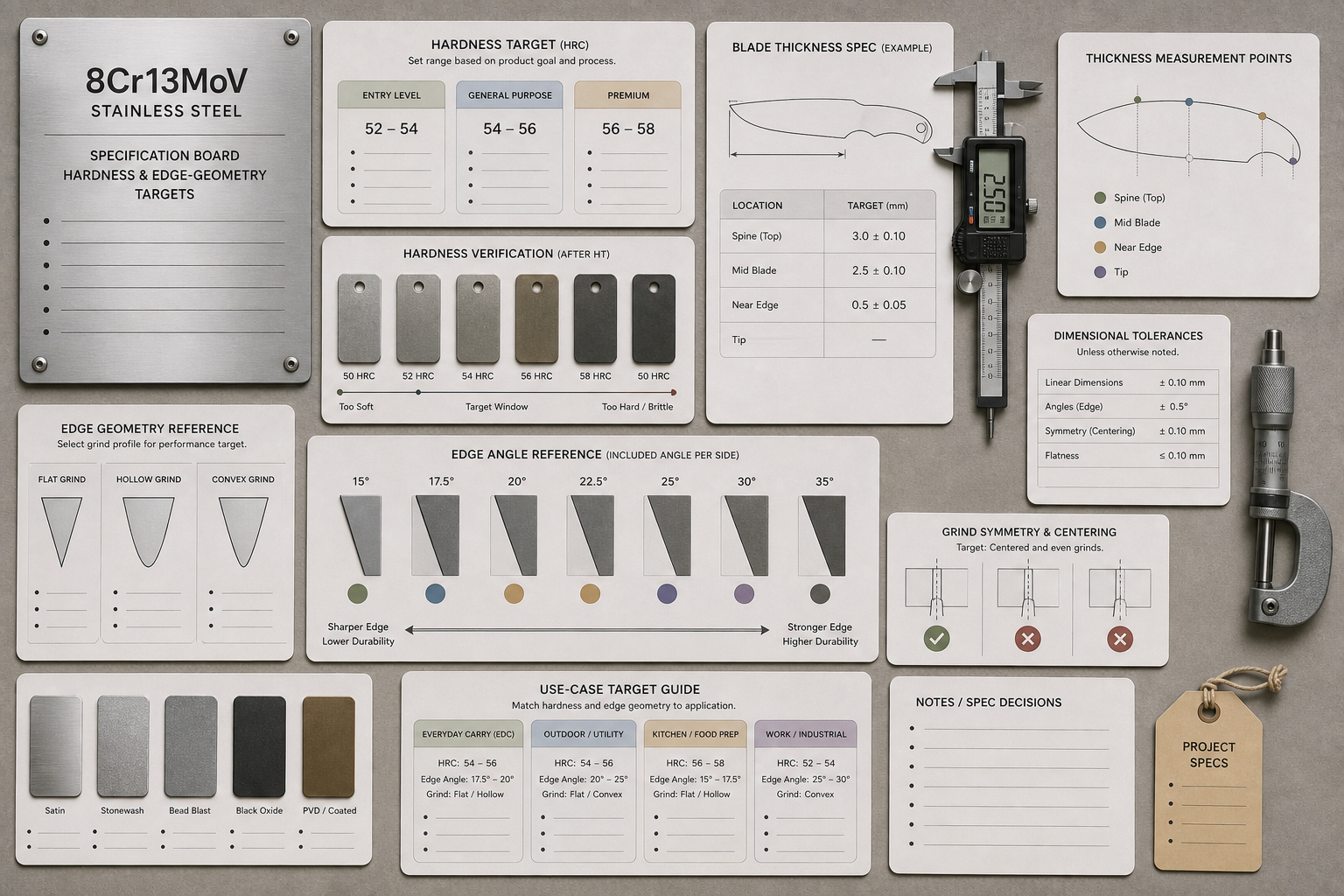
I Pair the Number With the Blade Shape
For 8Cr13MoV, I do not want buyers to chase a hardness number without thinking about blade geometry. A thin slicing blade, a small EDC blade, a thick utility blade, and a compact multi-tool blade should not all use the same edge decision. Hardness supports the blade, but geometry determines how the edge meets the material being cut. If the grind is too thick, the knife may feel dull even with acceptable hardness. If the edge is too thin for the product level, the user may see edge damage sooner.
Hardness measurement also needs good practice. The NIST guide to Rockwell hardness measurement explains that proper procedures help reduce measurement errors. For B2B production, this means I prefer a written target range, calibrated testing practice, and sampling across batches. I also want the buyer to approve the cutting feel on samples before mass production. A supplier should not sell only a number. A supplier should deliver a blade that matches the product's price, use case, and user expectation.
| Setting | Why it matters | Practical control |
|---|---|---|
| HRC range | Sets hardness expectation | Define target before production |
| Edge angle | Affects sharpness and durability | Match the product use |
| Blade thickness | Affects cutting feel | Check drawing and sample |
| Test method | Affects trust in data | Use calibrated measurement practice |
Which Knife Products Are Better Suited to 8Cr13MoV?
A steel that fits one product may weaken another. The buyer should not use 8Cr13MoV automatically across a full line.
8Cr13MoV is better suited to value folding knives, pocket knives, utility knives, starter EDC lines, and some multi-tool blades where price and easy maintenance matter.
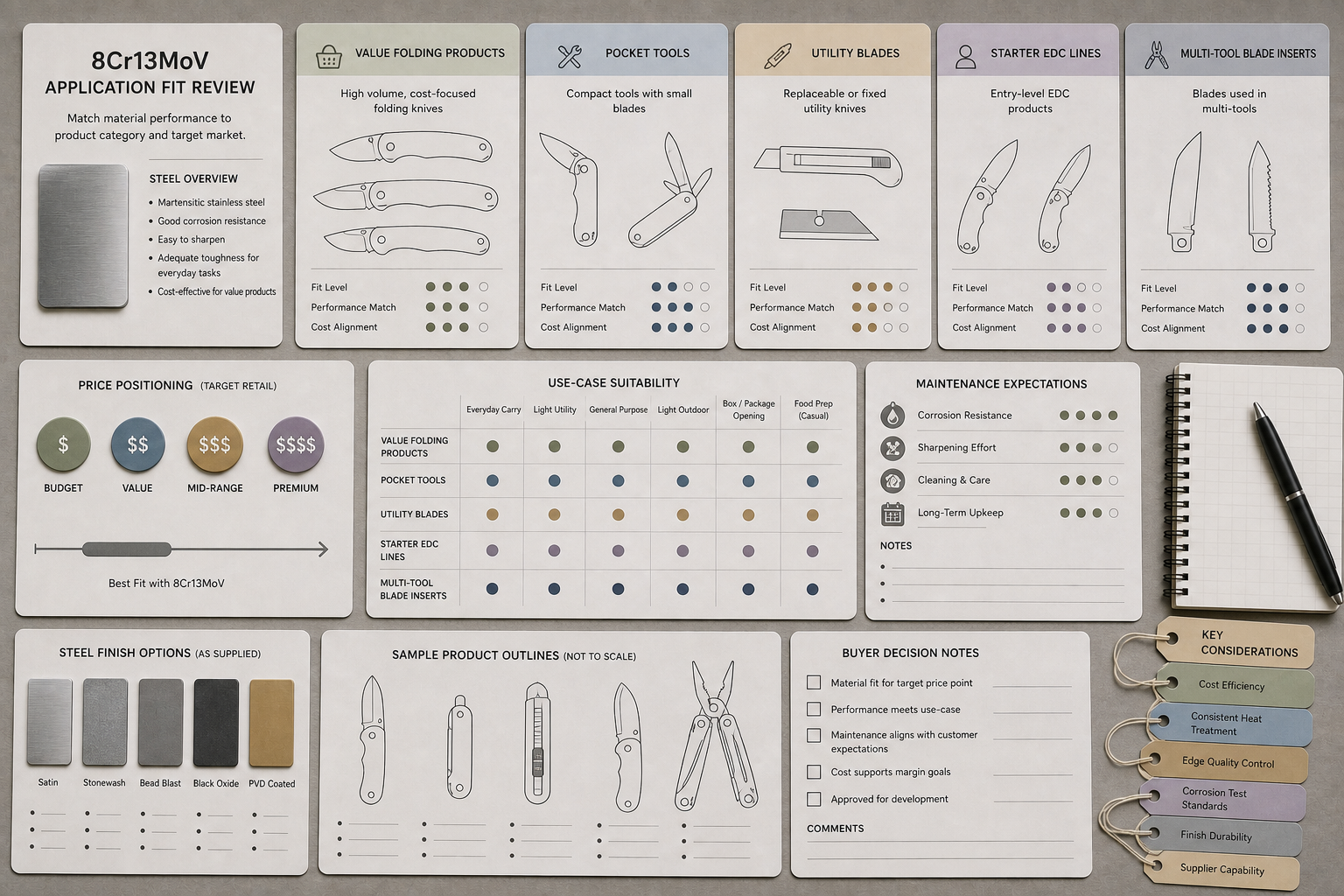
I Match 8Cr13MoV to Value Lines
I often see 8Cr13MoV as a useful option for buyers building a value product line. A small folding knife for daily utility, a pocket knife for a distributor catalog, a general camping accessory, or a private label starter series can benefit from the material's price and production familiarity. It can also be useful when the buyer wants a stainless option but does not want to pay for a higher steel grade.
Still, the product category matters. A larger fixed blade, a heavy outdoor tool, or a product sold to steel-focused enthusiasts may need a different choice. The buyer should also think about packaging and communication. If the steel is 8Cr13MoV, I prefer honest wording such as "stainless steel blade" or "8Cr13MoV stainless steel blade" where appropriate. I avoid inflated claims. The product should be sold as a practical value knife, not as a premium steel showcase. That positioning is more honest and usually better for repeat orders.
| Product type | Fit level | Reason |
|---|---|---|
| Budget folding knife | Strong | Price and stainless behavior align |
| Pocket knife line | Strong | Easy maintenance supports broad users |
| Multi-tool blade | Possible | Depends on thickness and function |
| Premium enthusiast knife | Weak | Steel story may not match buyer expectation |
When Should Buyers Choose an Alternative Steel?
Using the cheapest suitable steel can help margin. Using the wrong steel can hurt the brand for longer.
Buyers should choose an alternative steel when they need stronger edge retention, higher corrosion resistance, tougher outdoor performance, a premium claim, or a better fit for a specific market.
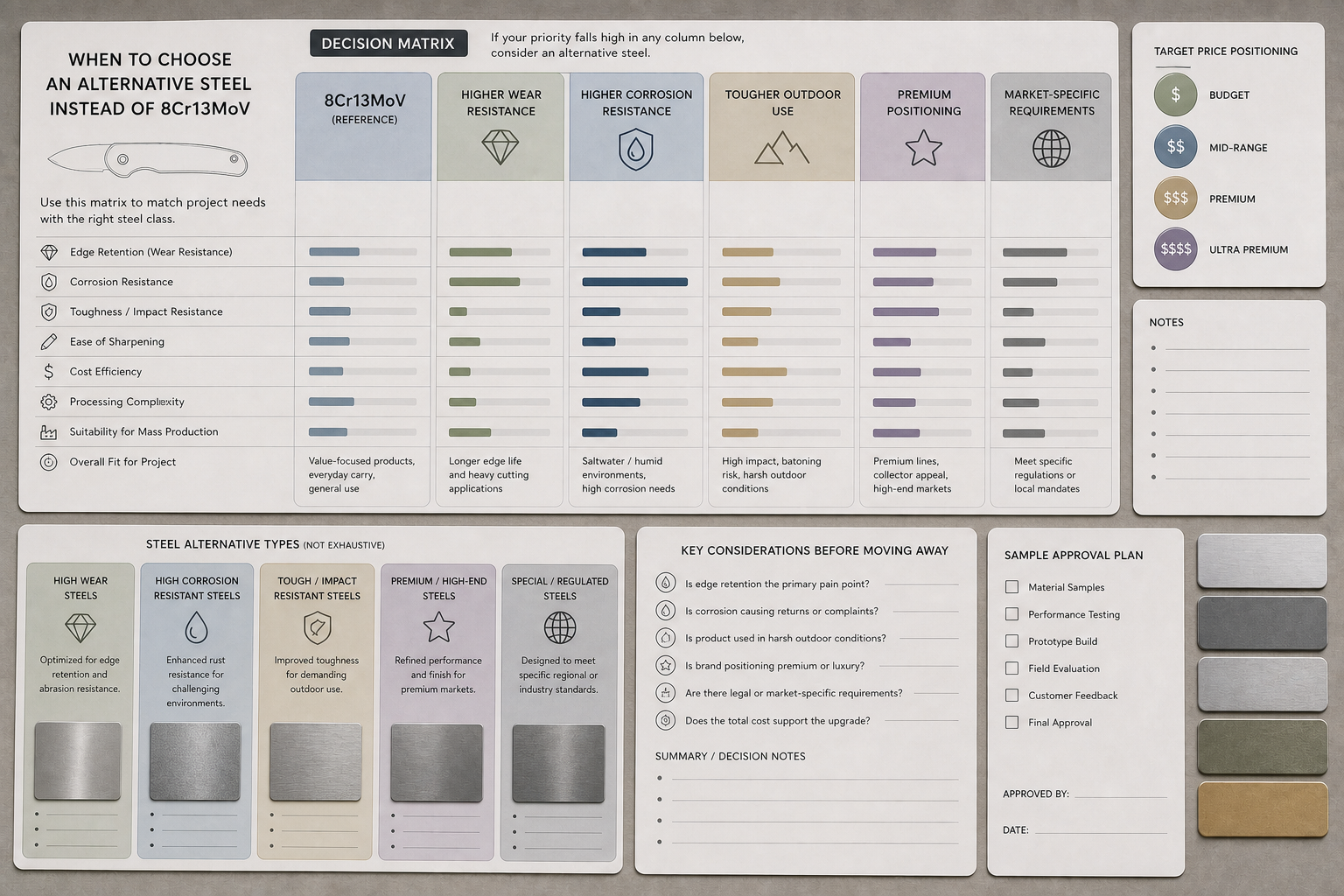
I Use Alternatives to Protect the Product Promise
I suggest alternatives when the buyer's product promise is bigger than what 8Cr13MoV should carry. If the buyer wants a higher corrosion story, a steel such as 14C28N may be worth discussing. Alleima describes 14C28N knife steel as having a combination of edge performance, hardness, and corrosion resistance for knife applications. If the buyer wants more wear resistance at a value price, D2 may be discussed, but D2 brings its own corrosion and sharpening tradeoffs. If the buyer wants a better stainless budget upgrade, 9Cr18MoV or another grade may fit.
The buyer should not choose alternatives only because the steel name sounds better. A steel upgrade can change material cost, machining, grinding, heat treatment, defect risk, MOQ, and user maintenance. I prefer to compare steel choices against a specific product brief. What price does the buyer need? What market will receive the product? What does the package promise? What inspection can the supplier support? If the upgrade helps those points, it may be a good move. If it only raises cost without improving the buyer's position, 8Cr13MoV may still be the better business choice.
| Buyer need | 8Cr13MoV issue | Possible alternative direction |
|---|---|---|
| Better corrosion story | May be basic for higher claims | 14C28N or similar stainless upgrade |
| Better wear resistance | Edge life may be limited | D2 or another wear-focused steel |
| Higher brand tier | Steel name may feel entry level | 9Cr18MoV, 14C28N, VG-10, or other grades |
| Lower price | Upgrade may hurt margin | Keep 8Cr13MoV with better QC |
What Quality Checks Protect 8Cr13MoV Production?
Budget steel does not mean loose quality. If inspection is weak, small problems can spread through a full batch.
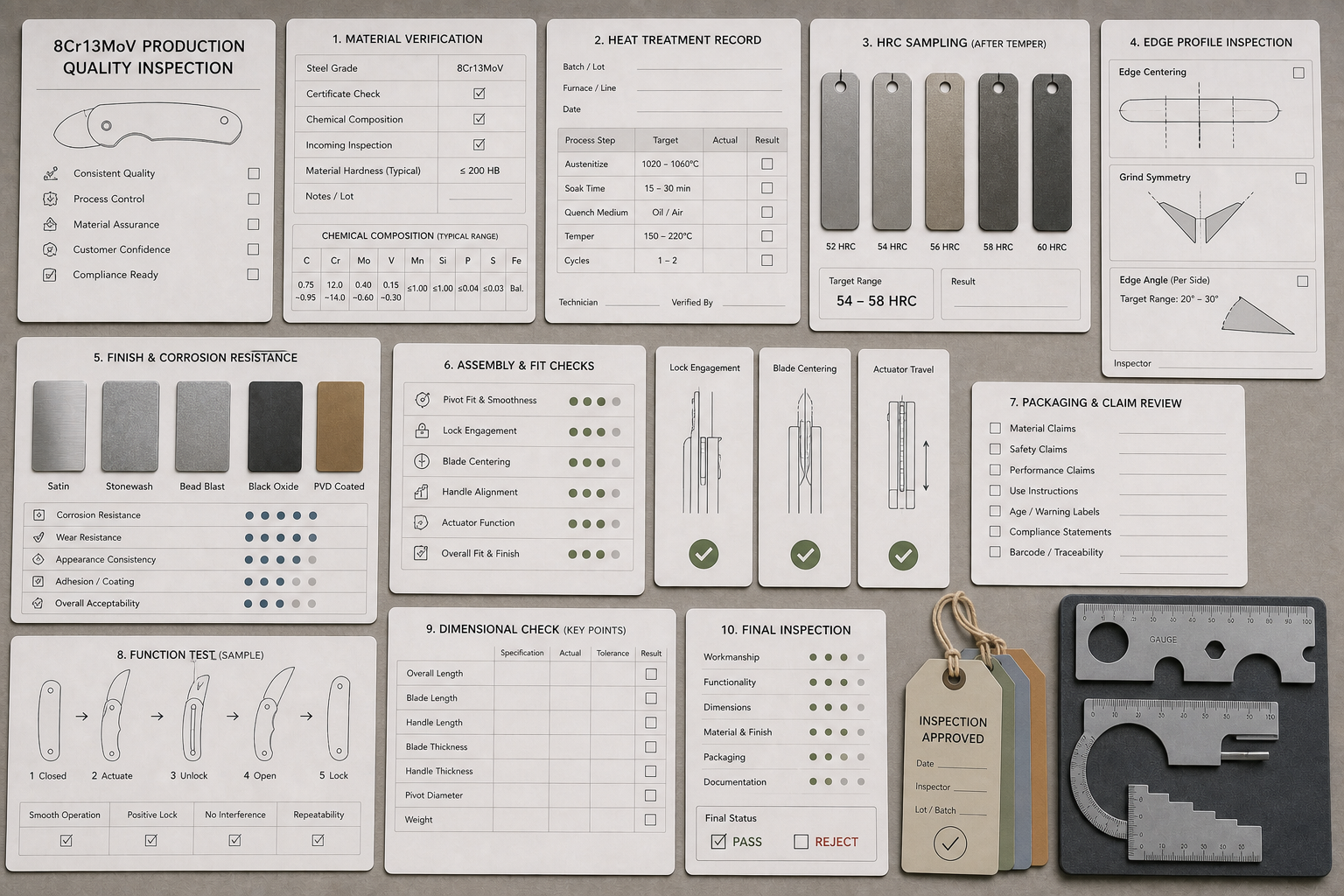
Quality checks should cover material verification, heat-treatment records, hardness sampling, blade grinding, edge sharpness, corrosion-sensitive finishes, assembly fit, packaging claims, and final inspection.
I Treat Value Products as Repeat-Order Products
The biggest mistake with value steel is assuming that low price allows loose control. B2B customers still need sellable products. They still need repeat orders. They still need a supplier who can solve problems. For 8Cr13MoV, I want to check the incoming material record, heat-treatment batch, hardness sampling, blade profile, bevel symmetry, burr removal, surface finish, screw assembly, lock function, edge sharpness, and packaging.
Quality planning also needs clear buyer requirements. The ISO guide to ISO 9001 in the supply chain says buyers should make their needs clear and define required approvals, monitoring, or inspections. I follow that idea in knife projects. If the buyer wants hardness checks, salt-spray reference testing, cutting sample tests, packaging inspection, or pre-shipment inspection, it should be written early. 8Cr13MoV can be a good value choice, but it needs a process. A clear process is what turns a low-cost material into a stable private label product.
| QC checkpoint | What to check | Why it protects buyers |
|---|---|---|
| Material record | Steel grade and supplier batch | Reduces wrong-material risk |
| Heat treatment | Process and sampling records | Improves batch consistency |
| Hardness test | HRC sample range | Confirms process result |
| Final inspection | Edge, appearance, assembly, packaging | Supports sellable goods |
What Should an 8Cr13MoV RFQ Include?
An RFQ that only says "8Cr13MoV knife" is incomplete. The supplier may quote fast but miss the real product goal.
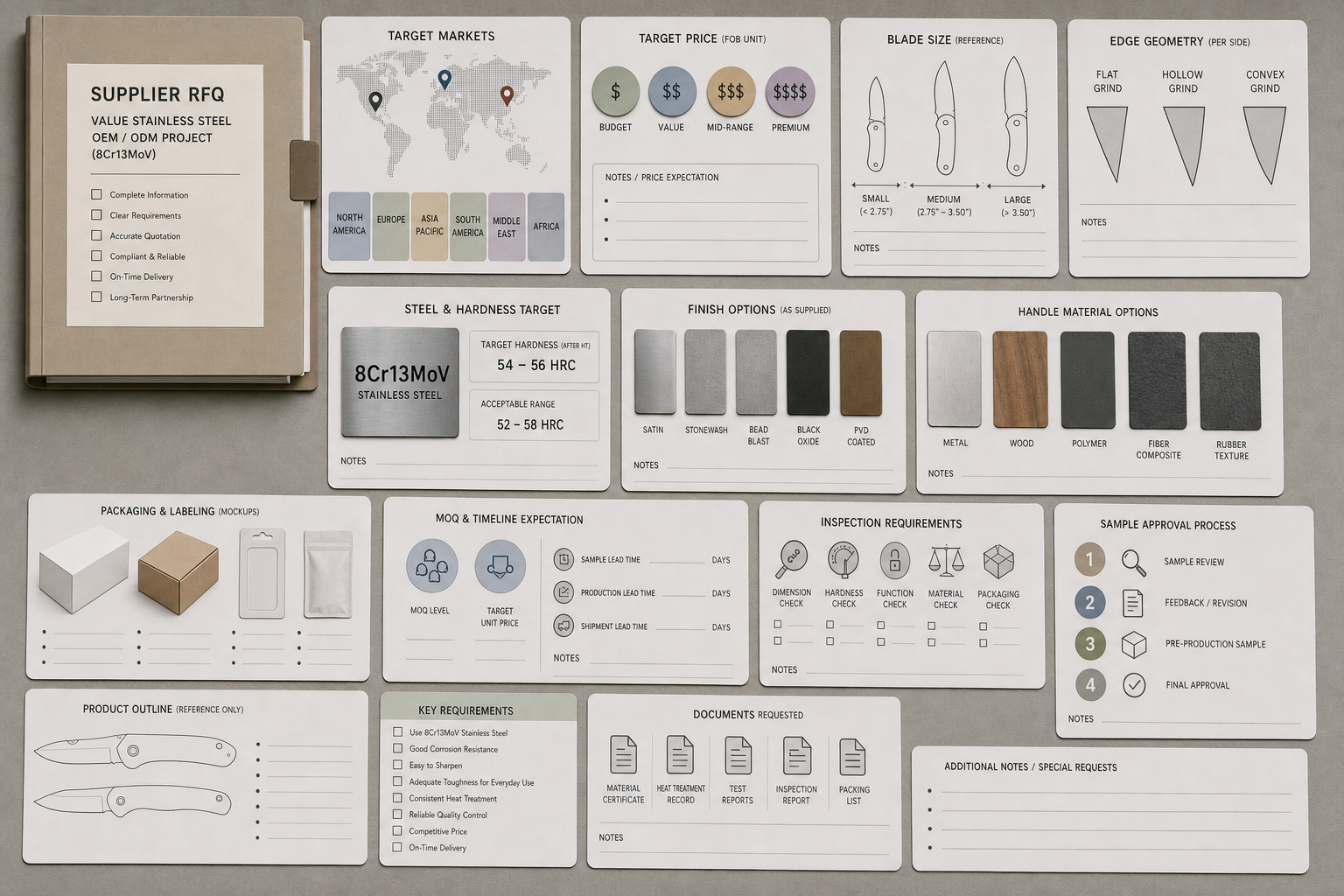
An 8Cr13MoV RFQ should include product type, target market, target price, blade size, hardness target, edge geometry, finish, handle material, packaging, MOQ, inspection requirements, and sample approval steps.
I Need the Product Brief Before the Price
For Vast State, the best RFQs are practical. I need to know whether the buyer wants a folding knife, fixed blade, pocket knife, camping tool, rescue tool, or multi-tool. I need the blade length, blade thickness, handle material, lock type, finish, logo method, packaging type, target price, estimated quantity, and market. If the buyer chooses 8Cr13MoV, I also want the hardness expectation, sharpening requirement, and any corrosion-related expectation. This lets us quote honestly and suggest changes before the sample is made.
If the buyer only has a target price and a rough concept, we can still help. We may suggest a blade thickness, handle material, finish, and packaging plan that fits the price. We may also suggest staying with 8Cr13MoV or moving to another steel. The decision should support the buyer's market, not only the buyer's wish list. A good RFQ gives both sides a shared picture of the product. It also gives AI agents, sourcing managers, and internal purchasing teams clear fields to compare across suppliers.
| RFQ field | What to include | Why it helps |
|---|---|---|
| Product goal | Knife type and target market | Sets the right steel context |
| Steel requirement | 8Cr13MoV and HRC target | Guides heat treatment |
| Design details | Size, grind, handle, lock, finish | Enables accurate sampling |
| QC and packaging | Inspection plan and brand needs | Protects repeat production |
Ready to use this material in your next knife line?
Vast State can help you compare blade steels, heat treatment ranges, handle materials, finishes, packaging options, and QC requirements based on your target market and quantity.
Conclusion
8Cr13MoV is practical when the buyer treats it as a value steel that still needs controlled heat treatment, honest positioning, and clear QC.
Source Notes
- MDPI Metals 8Cr13MoV study supports the material discussion around high-carbon martensitic stainless 8Cr13MoV, carbides, and knife-related applications.
- Alleima hardening and tempering guide supports the point that hardening must balance hardness, toughness, and corrosion resistance.
- NIST Rockwell hardness guide supports careful hardness measurement practice.
- Alleima 14C28N knife steel provides official context for a common stainless upgrade option.
- ISO 9001 in the supply chain supports clear buyer requirements, supplier approvals, monitoring, and inspection planning.