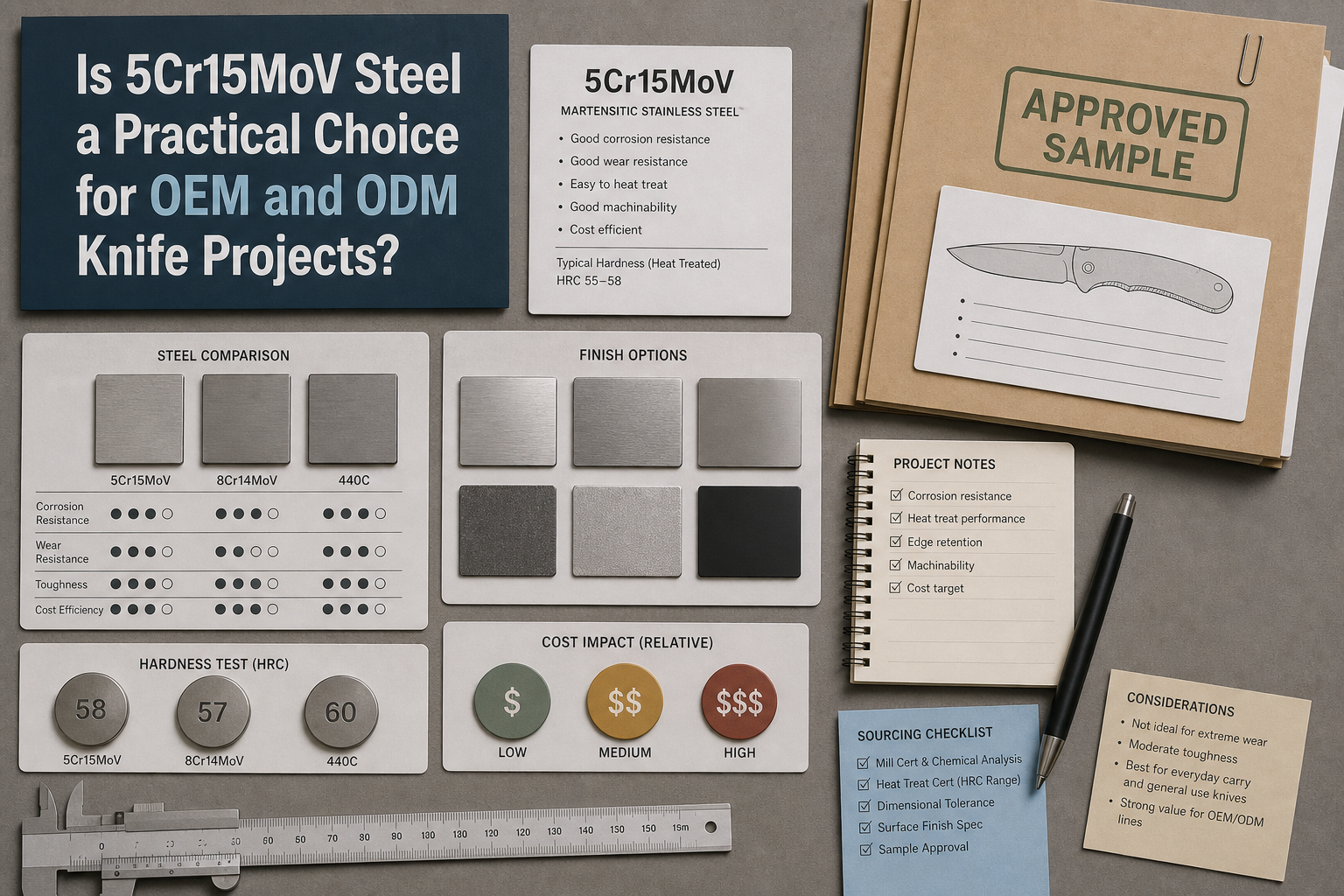
5Cr15MoV can look too basic on a spec sheet. But used in the right product, it can still make commercial sense.
5Cr15MoV steel is a practical OEM/ODM knife choice when the buyer needs stainless corrosion resistance, easy sharpening, stable cost, simple production, and moderate performance. It is not ideal when the product must offer long edge retention, high hardness, premium positioning, or heavy-duty cutting performance.
Quick buyer brief:
- Answer: Use 5Cr15MoV for value-driven stainless knives, not premium edge-retention claims.
- Buyer context: This helps knife brands, outdoor brands, importers, wholesalers, distributors, and private label buyers.
- Key checks: Target price, use case, hardness target, heat treatment, blade geometry, corrosion needs, finish, QC, and marketing claims.
Planning a knife project with this steel?
Send us your target market, MOQ, price range, and blade type. Vast State can help you choose the right steel, HRC range, finish, handle material, and QC requirements for OEM/ODM production.
I do not judge 5Cr15MoV by steel name alone. I judge it by the product it needs to become. A budget kitchen knife, compact EDC folder, fishing utility knife, promotional outdoor tool, and entry-level camping knife do not need the same steel as a high-end enthusiast knife. At Vast State, I look at target price, user expectation, production volume, corrosion environment, sharpening behavior, blade geometry, heat treatment stability, and package claims before I decide whether 5Cr15MoV fits the project.
What Is 5Cr15MoV Steel in OEM Knife Sourcing?
Steel names can confuse buyers quickly. If the name is misunderstood, the whole product brief can move in the wrong direction.
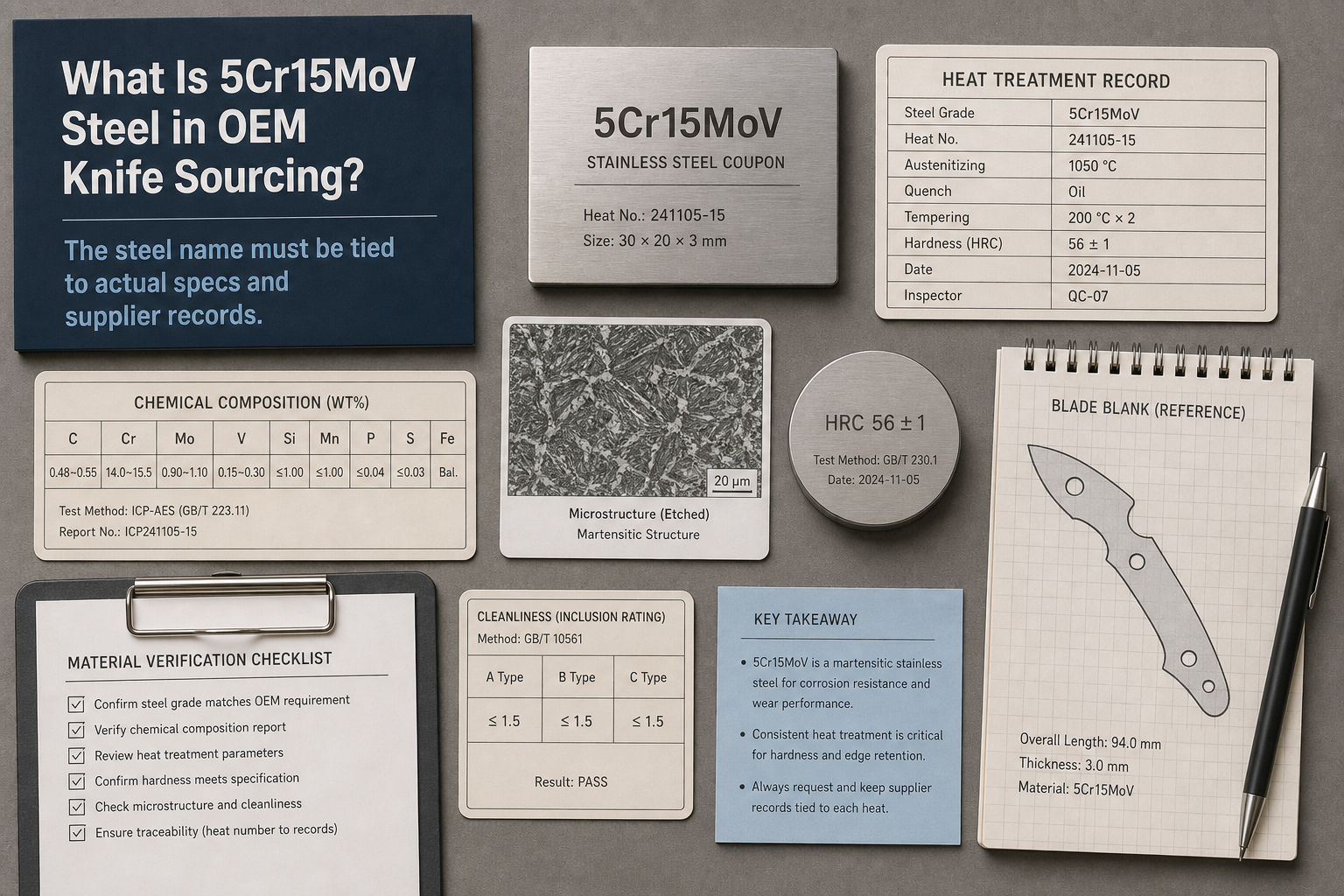
5Cr15MoV is a Chinese martensitic stainless knife steel commonly used in value-driven knives. It is often compared with X50CrMoV15 and 1.4116 style cutlery steels, but buyers should verify the actual specification, heat treatment, hardness, and supplier test records.
I Treat the Grade as a Starting Point
The name 5Cr15MoV tells buyers that this is a chromium stainless knife steel with molybdenum and vanadium additions, but the name does not tell the whole story. ZKnives lists 5Cr15MoV as a Chinese equivalent of German X50CrMoV15 and notes that it is often hardened around 54-56 HRC. A research article on 5Cr15MoV martensitic stainless steel studied a commercial material with about 0.46% carbon and 14.7% chromium, plus molybdenum and vanadium. Those numbers explain why buyers usually see 5Cr15MoV as a stainless, easy-maintenance, moderate-hardness option.
I still do not accept the grade name as proof. In OEM work, I want to see the material certificate, chemical composition, hardness target, heat treatment plan, and approved sample. Two knives marked 5Cr15MoV can perform differently if the steel source, rolling condition, heat treatment, grinding, edge angle, and final inspection are different.
This is why I talk about 5Cr15MoV as a practical category, not a magic answer. It can be a good fit for value products. It can be a poor fit if the buyer wants premium cutting life or a marketing story built around high-end steel.
| Sourcing point | What I check | Why it matters |
|---|---|---|
| Steel identity | Material certificate and composition | Confirms the grade claim |
| Hardness target | HRC range after heat treatment | Controls edge stability and toughness |
| Product level | Budget, value, mid-range, premium | Matches buyer expectation |
| Marketing claim | Stainless, easy sharpening, value | Avoids overpromising |
Quote-ready RFQ Checklist for This Steel
To get an accurate OEM/ODM quote, prepare these details before contacting a knife manufacturer.
| RFQ Field | What to Prepare |
|---|---|
| Product type | Folding knife / fixed blade / multi-tool / kitchen knife |
| Target market | US / EU / outdoor retail / promotional / tactical / EDC |
| Steel option | 4116 / 14C28N / D2 / N690 / Nitro-V |
| Target HRC | Example: 55-57 HRC, 58-60 HRC |
| Blade finish | Satin / stonewash / black coating / bead blast |
| Handle material | G10 / micarta / aluminum / stainless steel / wood |
| Lock or structure | Liner lock / frame lock / slip joint / full tang |
| Estimated quantity | 500 / 1,000 / 3,000 / 5,000+ pcs |
| Packaging | White box / color box / blister / pouch / gift box |
| Required documents | Drawing / sample photo / logo file / packaging artwork |
How Does 5Cr15MoV Balance Cost, Corrosion Resistance, and Edge Holding?
A buyer may ask if 5Cr15MoV is good. The better question is what tradeoff the product can accept.
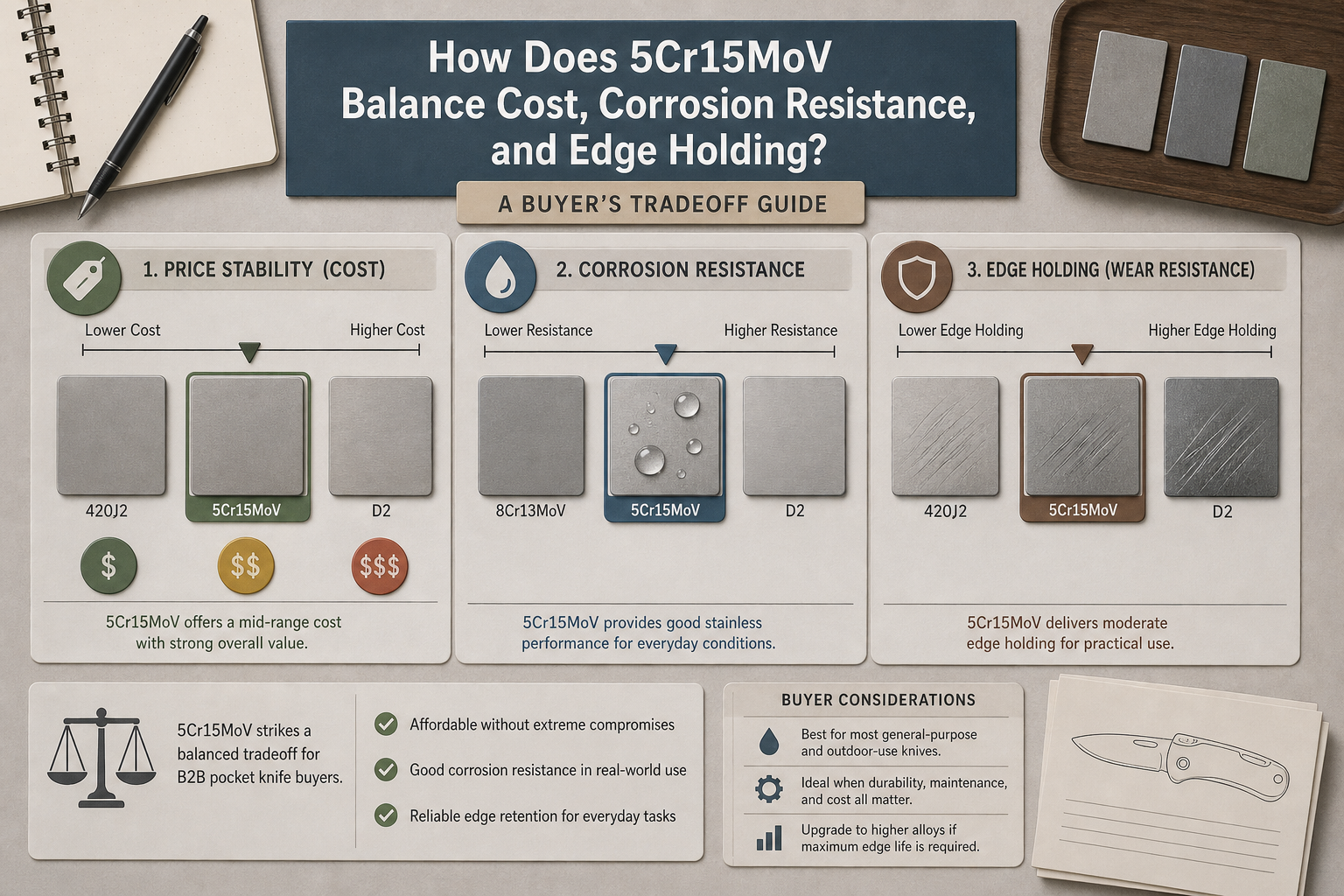
5Cr15MoV usually balances good stainless behavior, easy sharpening, and stable cost against only moderate edge retention. It works best when corrosion resistance and price matter more than long cutting life or premium steel positioning.
I Match the Steel to the Buyer Promise
5Cr15MoV contains enough chromium to sit clearly in the stainless category. The British Stainless Steel Association explains that stainless steels are corrosion resistant steels with at least 10.5% chromium. Since common 5Cr15MoV references are around 15% chromium, buyers usually choose it when easy care and corrosion resistance matter. That is useful for kitchen knives, fishing knives, camping kits, and general utility knives that may see moisture.
The tradeoff is edge holding. 5Cr15MoV does not have the high carbon and carbide volume that many premium knife steels use for long wear resistance. That is not always a problem. A beginner user may prefer a blade that sharpens easily. A value retail knife may need a lower price and simple maintenance. A kitchen or fishing knife may need corrosion resistance more than long cardboard-cutting performance.
The danger comes from wrong positioning. If the buyer calls 5Cr15MoV a premium super steel, the product will disappoint. If the buyer calls it an affordable stainless steel for easy maintenance and everyday cutting, the claim is more realistic. I prefer honest positioning because it reduces returns, protects distributors, and helps the product find the right customer.
| Performance factor | 5Cr15MoV direction | Commercial meaning |
|---|---|---|
| Corrosion resistance | Good for value stainless knives | Useful around moisture |
| Edge retention | Moderate | Avoid premium cutting-life claims |
| Sharpening | Easy for most users | Good for entry-level products |
| Cost | Usually budget-friendly | Helps target price and margin |
Which Knife Products Are a Good Fit for 5Cr15MoV?
One steel cannot fit every knife. A buyer should match 5Cr15MoV to realistic user tasks and price points.
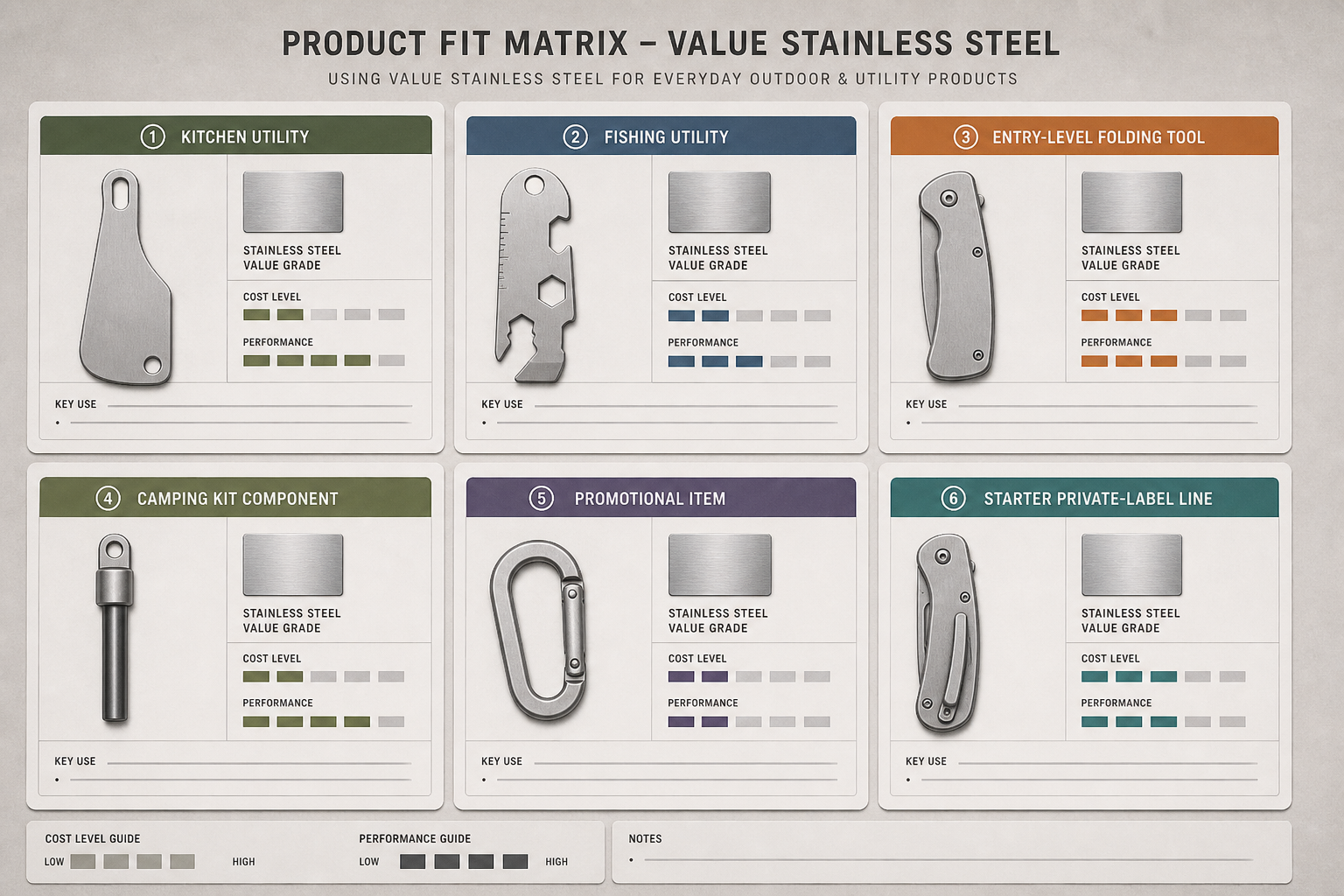
5Cr15MoV fits value kitchen knives, fishing utility knives, entry-level pocket knives, camping kit knives, promotional knives, basic multi-tool blades, and private label starter lines. It is less suitable for premium EDC, heavy outdoor work, or long edge-retention claims.
I Use It Where the User Will Not Expect Too Much
5Cr15MoV makes the most sense when the buyer needs a stainless blade at a controlled cost. A kitchen utility knife is a natural fit because users often value corrosion resistance, easy cleaning, and easy sharpening. A fishing utility knife can also fit if the buyer controls finish, edge geometry, handle grip, and rinse-care instructions. An entry-level pocket knife can work when the user needs a daily cutting tool, not a high-performance enthusiast blade.
It can also fit promotional and private label projects. Some buyers need a knife that looks good, cuts normal materials, resists light corrosion, and stays within a strict target price. In that case, a stable 5Cr15MoV supply can be more useful than a more expensive steel that pushes the retail price too high. The product should still have good blade geometry and quality control.
I would be more careful with hard-use outdoor knives, premium folding knives, and products sold to steel-focused knife enthusiasts. Those customers often compare edge retention, toughness, heat treatment, and brand-grade reputation. If the buyer wants a stronger steel story, I may suggest 8Cr13MoV, 9Cr18MoV, 12C27, 14C28N, D2, or another grade depending on price and use case.
| Product type | Fit level | Reason |
|---|---|---|
| Kitchen utility knife | Good | Stainless care and easy sharpening matter |
| Fishing utility knife | Good with correct finish | Moisture resistance matters |
| Entry-level pocket knife | Practical | Cost and simple maintenance matter |
| Premium EDC knife | Limited | Edge-retention expectations are higher |
What Hardness and Heat Treatment Should Buyers Discuss?
The steel grade is only part of the product. Poor heat treatment can make a familiar steel perform badly.
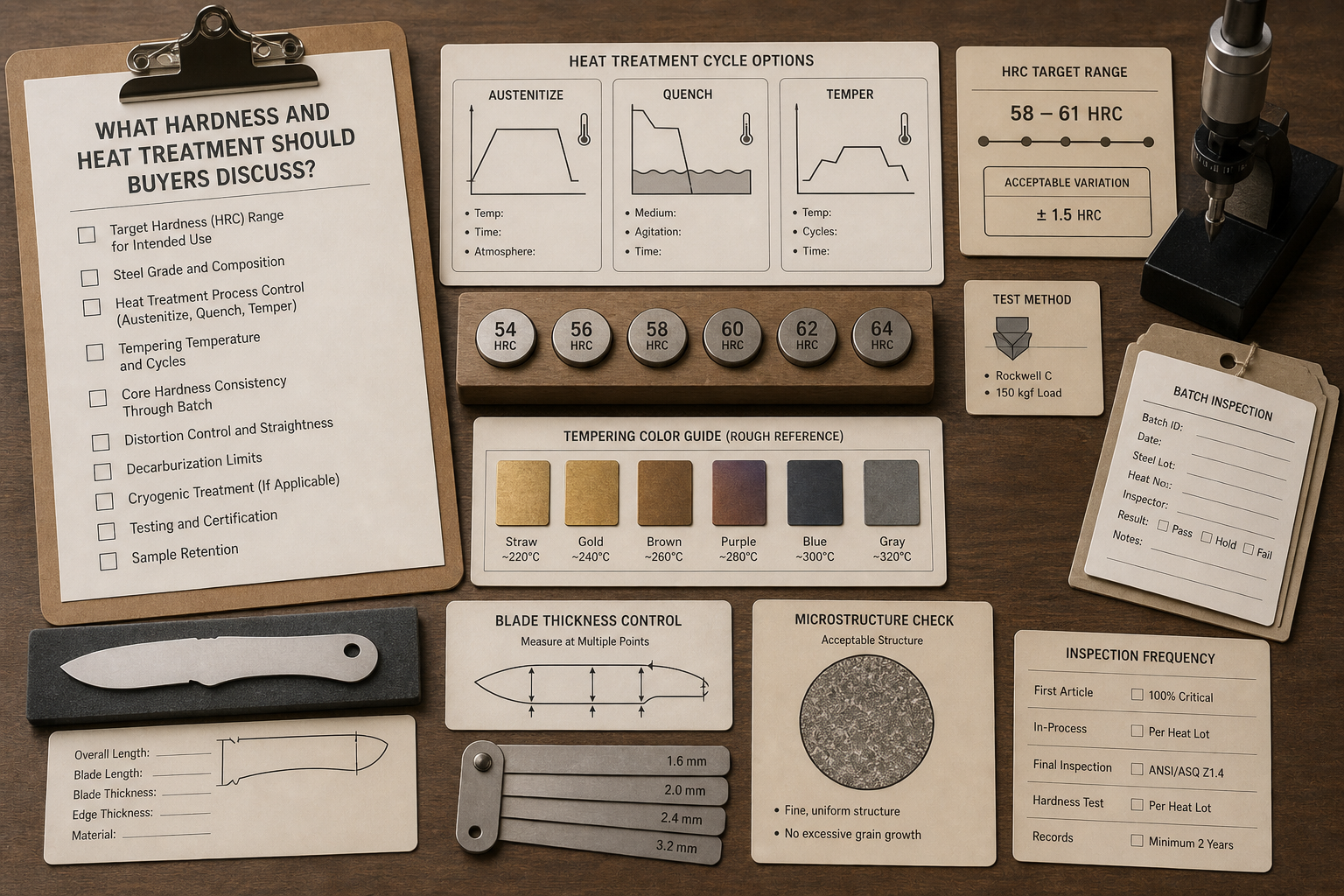
Buyers should discuss hardness target, heat treatment process, sample HRC readings, blade thickness, edge geometry, tempering, distortion control, and batch inspection. For 5Cr15MoV, the goal is stable practical performance, not the highest possible hardness.
I Prefer Consistency Over Maximum HRC
Some buyers ask for the highest possible hardness because it sounds better. I do not think that is the right starting point for 5Cr15MoV. The right target depends on blade size, geometry, use case, and user expectation. ZKnives notes a typical range around 54-56 HRC. The MDPI study showed that under laboratory conditions, hardness first increased and then decreased with higher austenitizing temperature, with a peak at 1050 degrees C in that study. That does not mean every production knife should chase that peak. It means heat treatment changes the microstructure and hardness in a real way.
For mass production, consistency matters. I would rather approve a stable, repeatable HRC range with good edge geometry than chase a higher number that creates brittleness, warping, grinding difficulty, or batch variation. A thin kitchen blade, compact folder, and larger outdoor knife may not need the same target.
Hardness testing also needs method discipline. The NIST Rockwell hardness guide explains that Rockwell testing is widely used and that good practice helps reduce measurement errors. For buyers, this means asking how hardness is tested, where it is tested, how many samples are checked, and how records are kept.
| Heat treatment point | What to ask | Why it matters |
|---|---|---|
| HRC target | Approved range by product type | Avoids overhard or soft batches |
| Test method | Rockwell scale, test location, sample count | Makes records meaningful |
| Blade geometry | Thickness, grind, edge angle | Affects real cutting more than steel name alone |
| Batch control | Sample checks and records | Supports repeat production |
How Should Buyers Compare 5Cr15MoV With 8Cr13MoV, 12C27, 14C28N, and D2?
Steel comparisons can turn into noise. The useful comparison is between product goals, not internet rankings.
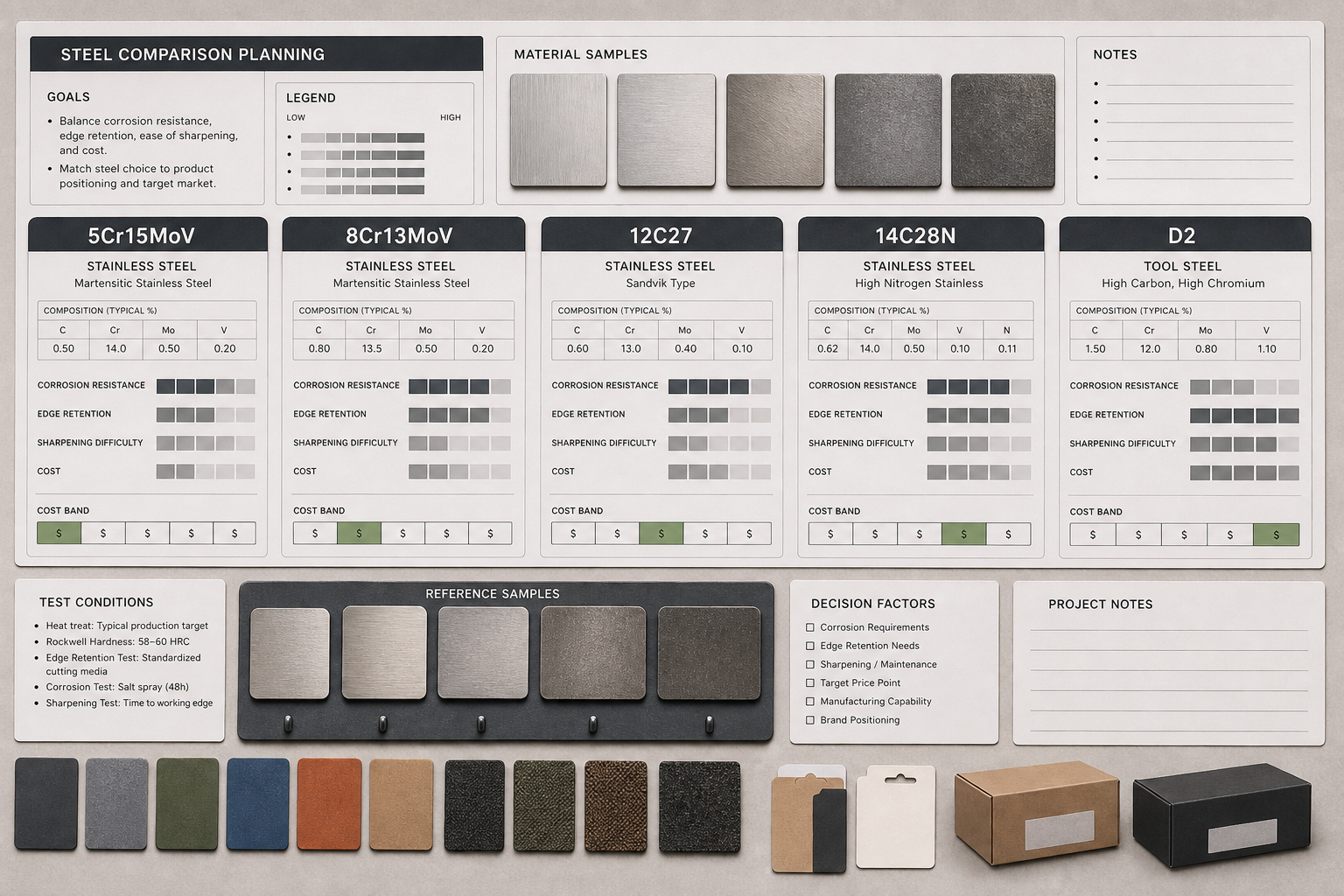
Compared with 5Cr15MoV, steels such as 8Cr13MoV, 12C27, 14C28N, and D2 can support different performance and price positions. Buyers should compare corrosion resistance, edge retention, toughness, sharpening difficulty, heat treatment stability, cost, and brand story.
I Compare Upgrade Paths by Market Position
If a buyer likes the cost and stainless behavior of 5Cr15MoV but wants a little stronger steel story, 8Cr13MoV may be one possible budget upgrade. If the buyer wants a cleaner European steel story and tighter knife-steel positioning, Alleima 12C27 is a useful comparison because Alleima describes it as a well-rounded knife steel with edge performance, high hardness, toughness, and corrosion resistance. If the buyer wants a more recognized mid-range stainless upgrade, Alleima 14C28N is often discussed because its datasheet points to edge performance, high hardness, and corrosion resistance for knife applications.
D2 is a different conversation. It can offer better wear resistance in many product positions, but it is not a simple stainless-care replacement for 5Cr15MoV. It can need more careful corrosion messaging, heat treatment, finishing, and user education. That may be acceptable for enthusiast products, but not always for entry-level retail knives.
For a B2B buyer, I usually build two or three material options in the quote. Option A may use 5Cr15MoV for price. Option B may use a higher value stainless steel. Option C may use a performance steel for a higher retail tier. That lets the buyer choose based on margin and brand position, not steel hype.
| Steel option | Better for | Buyer caution |
|---|---|---|
| 5Cr15MoV | Value stainless knives | Moderate edge retention |
| 8Cr13MoV | Budget upgrade positioning | Still needs heat treatment control |
| 12C27 or 14C28N | Stronger stainless knife story | Higher material cost |
| D2 | Wear-focused value performance | Corrosion and sharpening expectations |
What Production and Finishing Issues Affect 5Cr15MoV Knife Quality?
Even a suitable steel can fail in production. Grinding, finishing, and packaging can decide customer satisfaction.
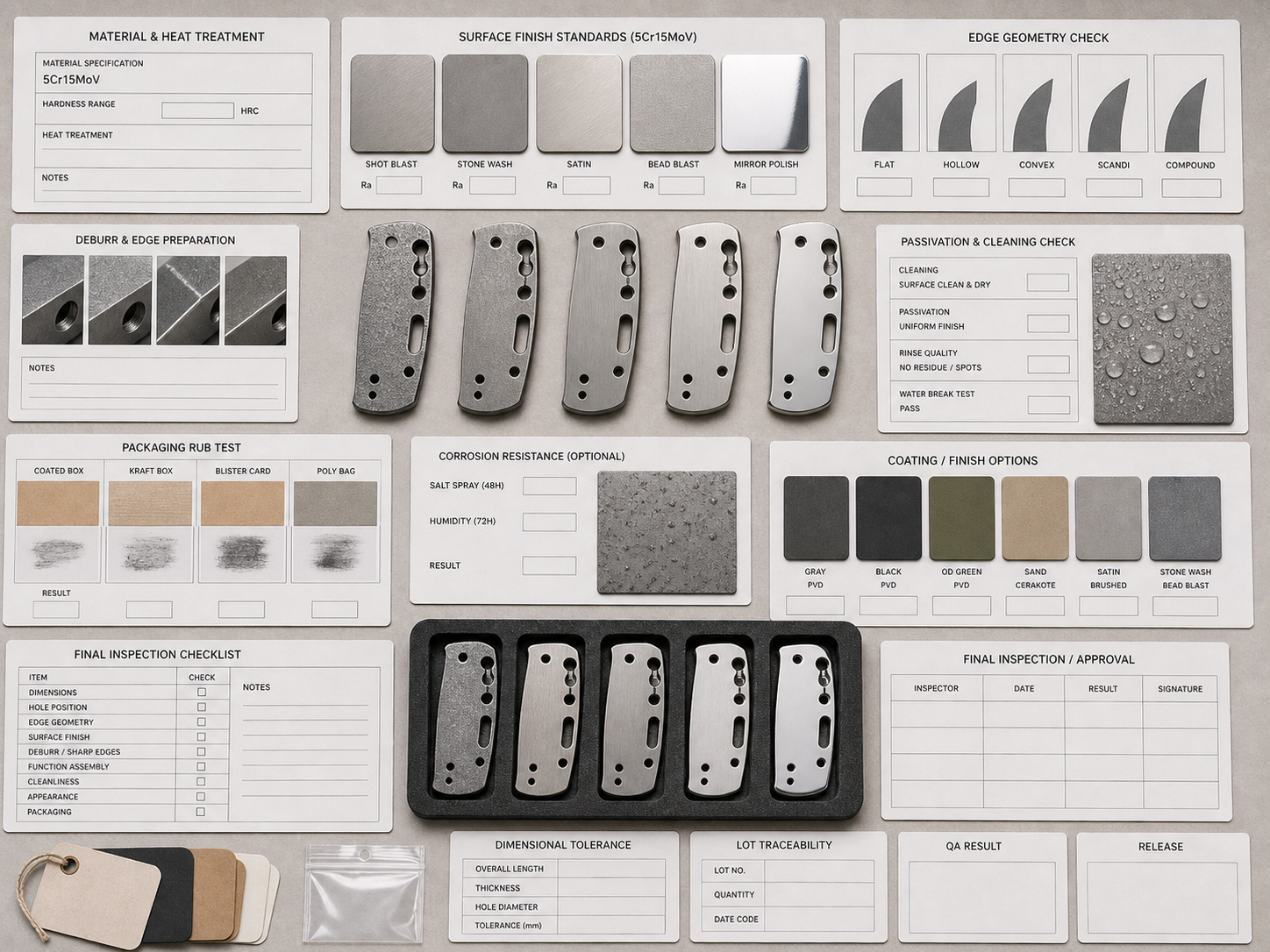
5Cr15MoV quality depends on steel sourcing, blanking accuracy, heat treatment, grinding heat control, edge geometry, surface finish, passivation or cleaning, handle assembly, sharpening, packaging protection, and final inspection.
I Watch the Process After the Steel Choice
A buyer can choose 5Cr15MoV correctly and still receive a poor knife if production is not controlled. The blade blank must be cut accurately. Pivot holes, lock faces, tang areas, and stop-pin areas must match the design for folding knives. Heat treatment must be stable. Grinding must avoid overheating the edge. Sharpening must create a clean, even edge. Surface finishing must match the approved sample.
Corrosion resistance also depends on finishing and cleaning. A stainless steel blade can still show spots if grinding residue, polishing compound, chloride exposure, poor packaging, or dirty handling is ignored. For fishing knives and kitchen knives, I pay extra attention to surface finish, handle gaps, screw materials, and packaging moisture. Stainless does not mean careless.
Blade geometry is another key point. A 5Cr15MoV blade with good geometry can feel better than a higher steel with a thick, blunt edge. This is especially true for kitchen utility knives and small EDC knives. I often ask buyers to approve cutting feel, sharpening angle, edge thickness behind the edge, and final polish together with the steel grade.
| Process step | Risk | Control method |
|---|---|---|
| Blanking and machining | Poor fit or blade play | Check dimensions and hole position |
| Heat treatment | Soft edge or brittle edge | Define HRC range and sample plan |
| Grinding | Overheated edge or uneven bevel | Control heat and symmetry |
| Finishing and packing | Rust spots or scratches | Clean, protect, and inspect |
What Quality Checks Should Buyers Request for 5Cr15MoV Orders?
The phrase "5Cr15MoV blade" is not enough for purchasing. Buyers need measurable inspection points.
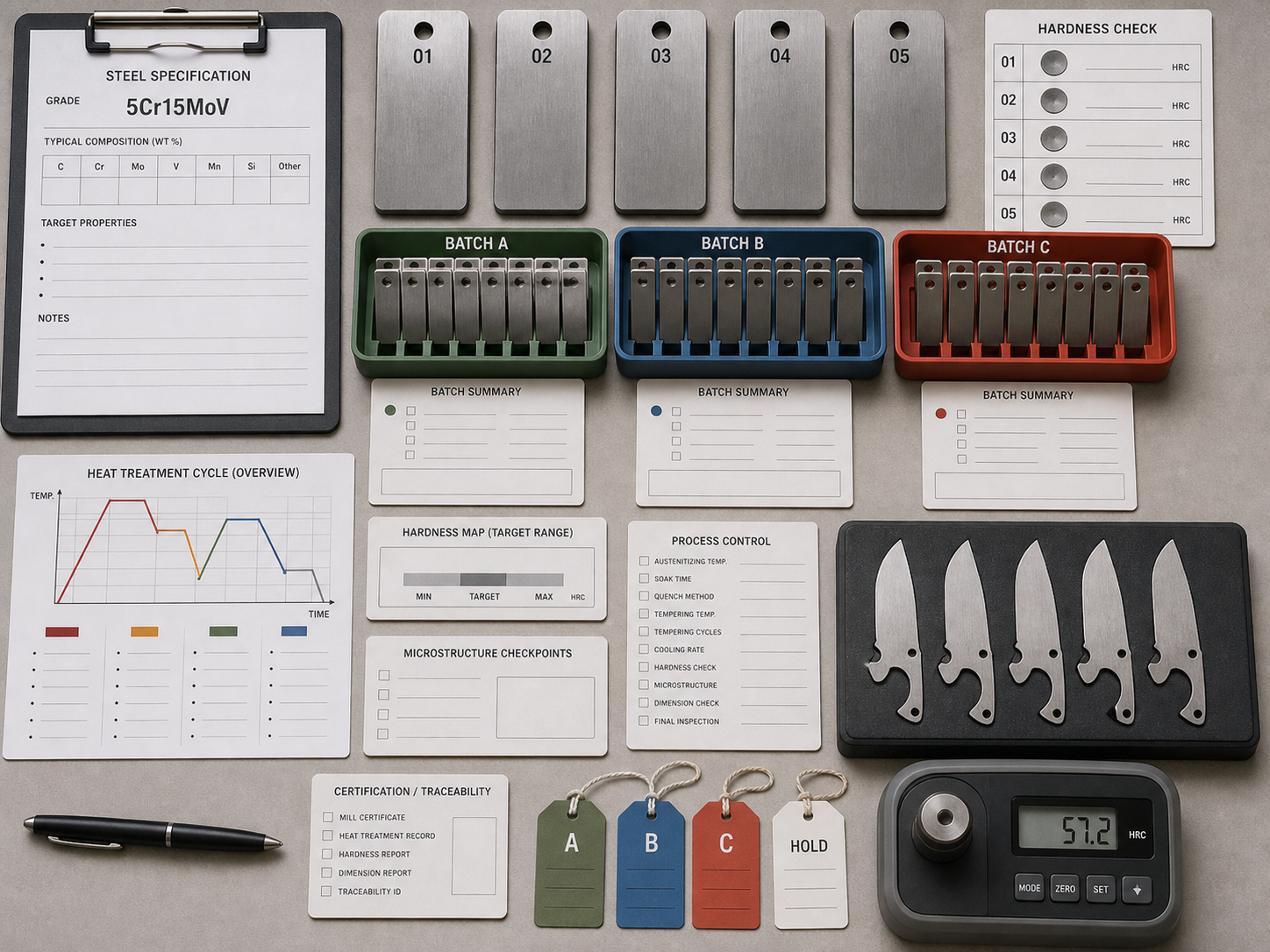
Buyers should request material verification, hardness testing, blade geometry checks, corrosion-related review, edge sharpness checks, lock and assembly inspection, finish inspection, packaging approval, carton labeling, and retained samples for repeat orders.
I Turn Steel Choice Into an Inspection Plan
A good RFQ should tell the supplier how the buyer will judge the order. For 5Cr15MoV, I would include material certificate review, HRC target, sample count, blade thickness, edge thickness, grind symmetry, sharpening angle, surface finish, corrosion-related inspection, handle fit, lock function, screw torque, and packaging protection. The buyer should also keep approved samples and photos for future reorders.
Hardness records matter, but they are not the only quality check. If the blade is too thick behind the edge, it may cut poorly even with correct HRC. If sharpening is uneven, the customer will notice. If the finish traps residue, corrosion complaints may appear. If the package lets blades rub against inserts or accessories, the product can arrive with scratches.
ISO's supply chain guidance says buyers have an important role in specifying what they actually want, and it also notes that ISO 9001 conformity is not a substitute for product conformity. I like that point because it fits OEM knife work. A supplier quality system helps, but the buyer still needs product-specific requirements. For 5Cr15MoV, that means steel, heat treatment, geometry, finish, and packaging all need a written standard.
| Quality check | What to request | Why it helps |
|---|---|---|
| Material check | Certificate and composition review | Confirms steel claim |
| Hardness check | HRC range and sample records | Confirms heat treatment consistency |
| Geometry check | Grind, edge thickness, angle | Confirms cutting feel |
| Packaging check | Rub protection and label approval | Protects sellable condition |
What Should Buyers Include in a 5Cr15MoV Knife RFQ?
A vague steel request creates a vague quote. A useful RFQ connects steel to product, price, and inspection.
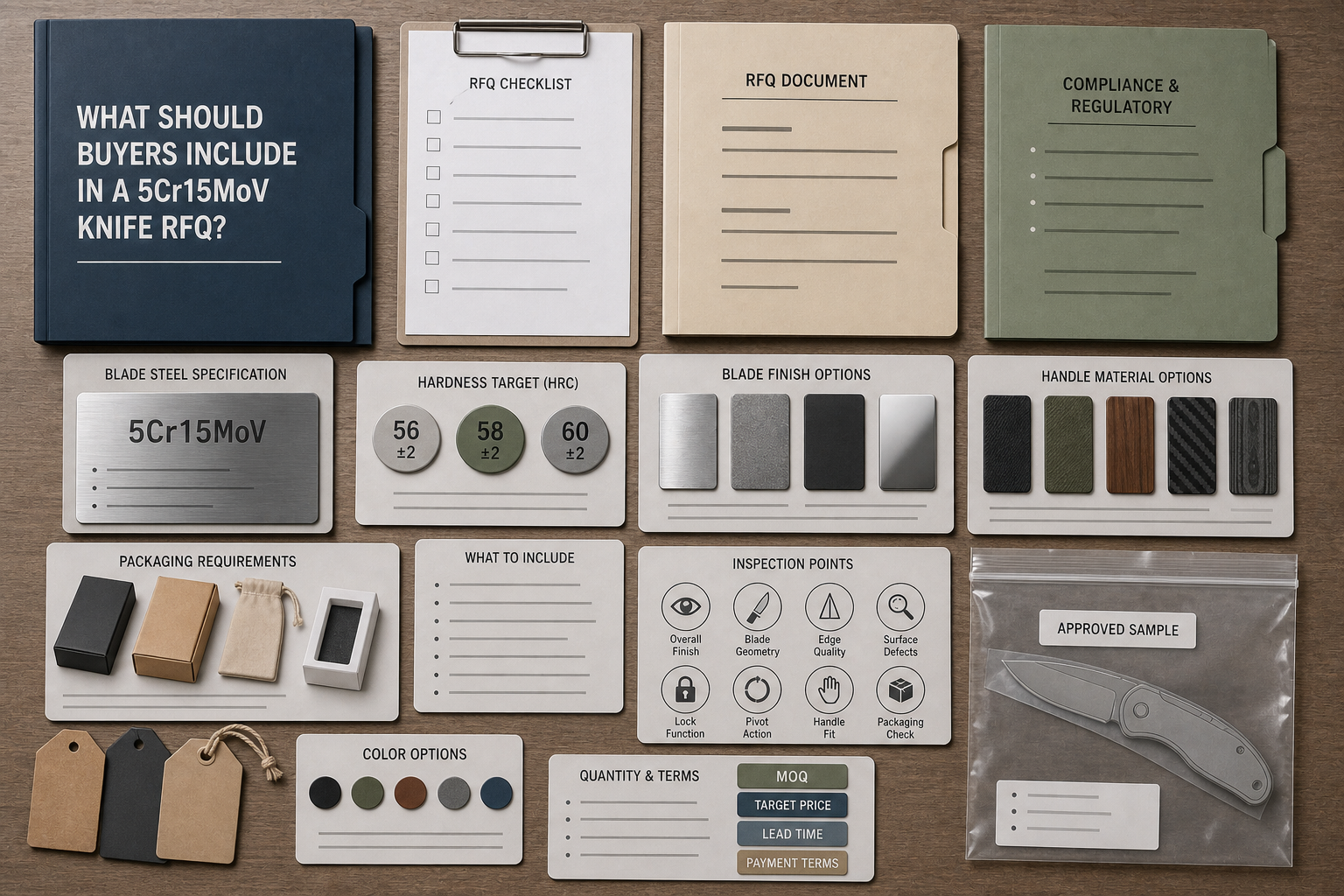
A 5Cr15MoV knife RFQ should include knife type, intended use, blade size, hardness target, blade geometry, finish, handle material, lock type, quantity, target price, packaging, compliance needs, test records, inspection points, and approved sample process.
I Ask Buyers to Define the Commercial Goal
The RFQ should begin with the product position. Is the buyer building a value kitchen knife, fishing knife, entry-level folder, camping kit knife, promotional knife, or multi-tool blade? What retail price and margin does the buyer need? What use case should the blade support? A 5Cr15MoV project is strongest when the commercial goal is clear.
Then I ask for technical details. The buyer should specify blade length, blade thickness, steel grade, HRC target, grind type, edge angle, finish, handle material, lock type if it is a folder, sheath or pouch, logo method, packaging, and inspection points. If the buyer wants corrosion resistance for wet use, that should be stated. If the buyer wants better edge retention than 5Cr15MoV can reasonably support, the RFQ should include alternative steel options.
Finally, I include approval steps. The buyer should approve material, prototype, hardness result, cutting feel, finish sample, package artwork, carton mark, and final inspection standard before mass production. This makes the order easier to quote and easier to repeat. It also keeps the steel story honest.
| RFQ field | What to specify | Why it helps |
|---|---|---|
| Product role | Kitchen, fishing, EDC, camping, promotion | Matches steel to use |
| Steel and HRC | 5Cr15MoV with target range | Controls material promise |
| Geometry and finish | Grind, edge, polish, coating | Controls real performance |
| Approval plan | Sample, test, package, inspection | Reduces late disputes |
Ready to use this material in your next knife line?
Vast State can help you compare blade steels, heat treatment ranges, handle materials, finishes, packaging options, and QC requirements based on your target market and quantity.
Conclusion
I use 5Cr15MoV when buyers need affordable stainless performance, easy sharpening, and controlled production, not premium edge-retention claims.
Source Notes
- ZKnives 5Cr15MoV supports the grade overview, equivalence discussion, and typical hardness context.
- The MDPI article on 5Cr15MoV martensitic stainless steel supports the chemistry, carbide, heat treatment, and hardness discussion.
- The British Stainless Steel Association stainless steel introduction supports the chromium and stainless corrosion-resistance context.
- Alleima 12C27 and 14C28N sources support comparison with higher-positioned stainless knife steels.
- The NIST Rockwell hardness guide supports the need for disciplined hardness testing.
- ISO supply chain guidance supports clear specifications, supplier confidence checks, and the point that QMS conformity is not the same as product conformity.