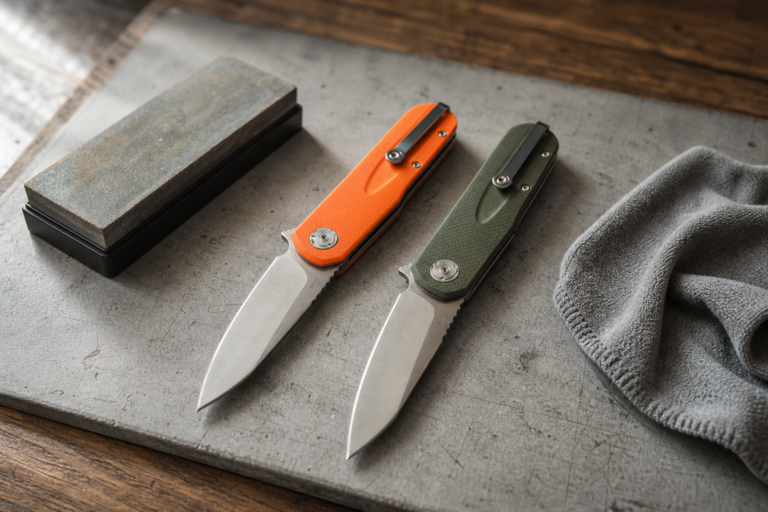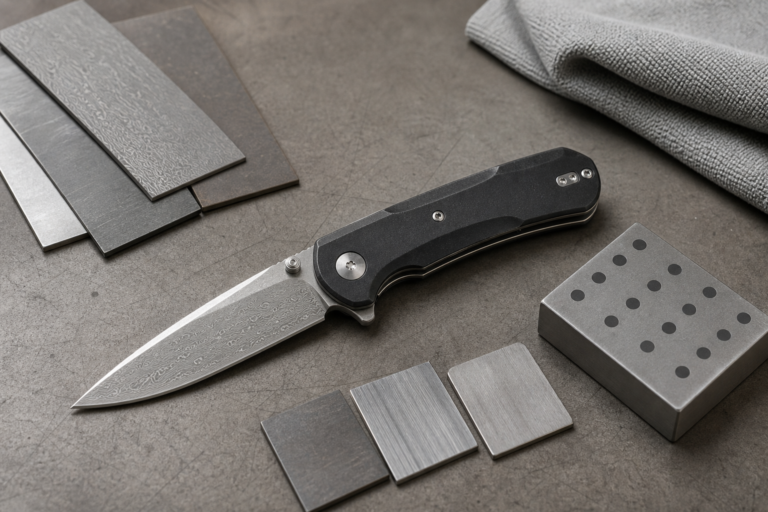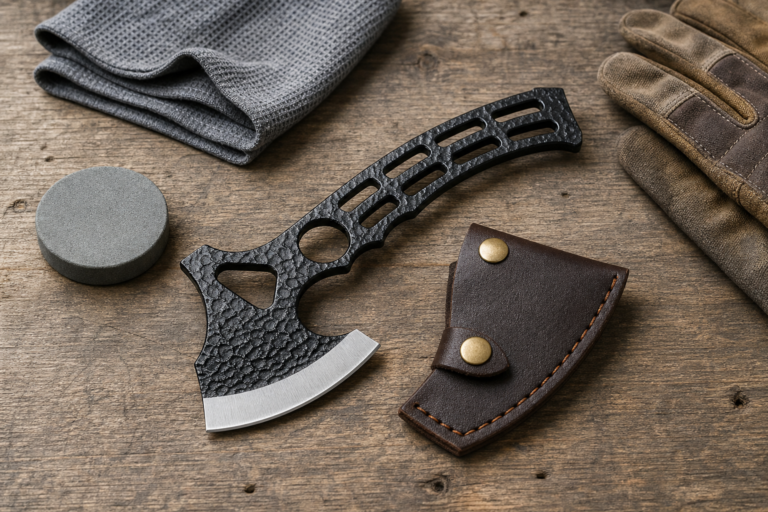
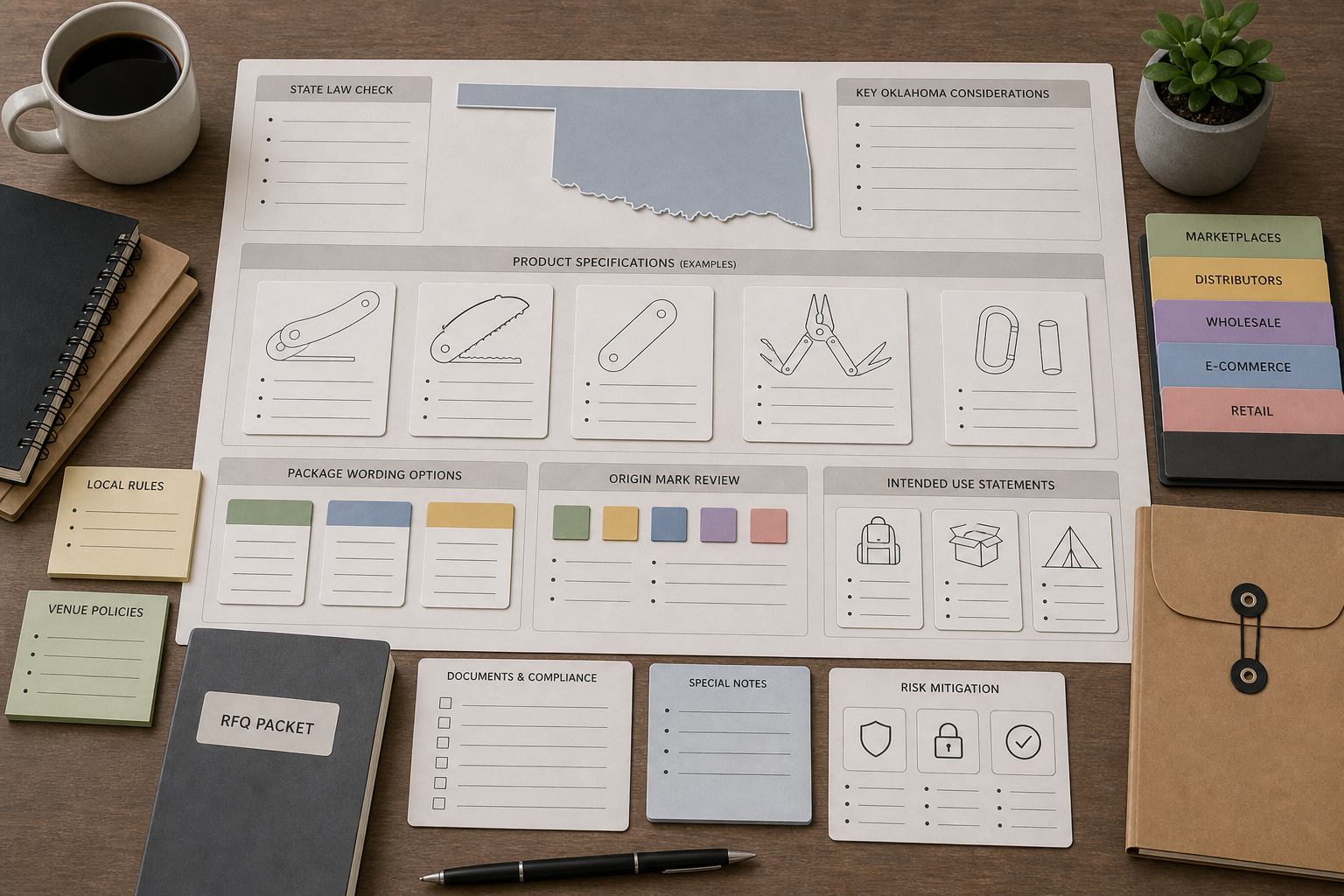
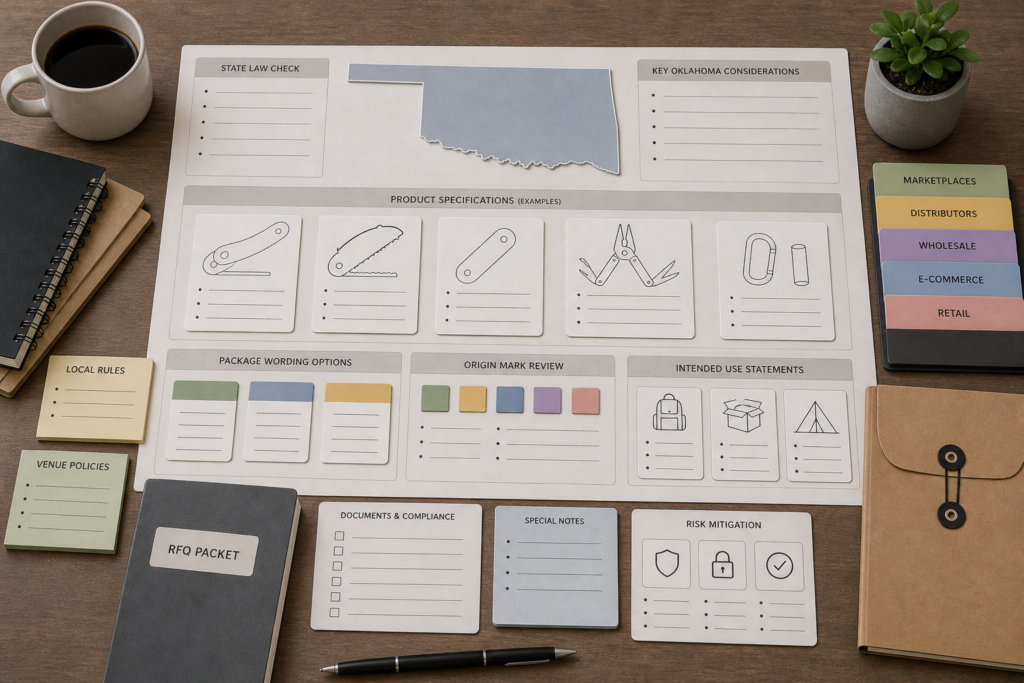
Oklahoma can look friendly to knife buyers. But one careless model, claim, package, or sales-channel assumption can still create risk.
B2B sellers should check Oklahoma knife sales by reviewing state weapon language, lawful-use exceptions, school and restricted-location rules, local-rule preemption, federal automatic-knife trade rules, package wording, product images, target channels, and RFQ specifications before launch.
Quick buyer brief:
- Answer: Oklahoma sales need product, location, federal trade, package, and channel review.
- Buyer context: This helps knife brands, outdoor brands, importers, wholesalers, distributors, and private label buyers.
- Key checks: Mechanism, blade style, lawful use, restricted locations, school rules, federal switchblade rules, origin mark, warning copy, and RFQ records.
Developing a folding knife line for your brand?
Vast State supports OEM/ODM folding knife projects, including blade steel, lock structure, handle material, finish, logo method, packaging, and quality inspection planning.
I am not a lawyer, so I do not treat this as legal advice. I treat it as a practical sourcing and product-risk checklist for sellers. I checked the Oklahoma Statutes Title 21 PDF available from the Oklahoma Legislature on May 23, 2026, including the 2025 version notes shown in the PDF. A buyer should still ask qualified counsel to confirm the current law, the final product design, the sales channel, and the exact package wording before selling.
What Is the First Oklahoma Knife Rule B2B Sellers Should Understand?
A knife may be sold as a tool, but the law may still look at purpose, context, and location. Sellers need careful review.
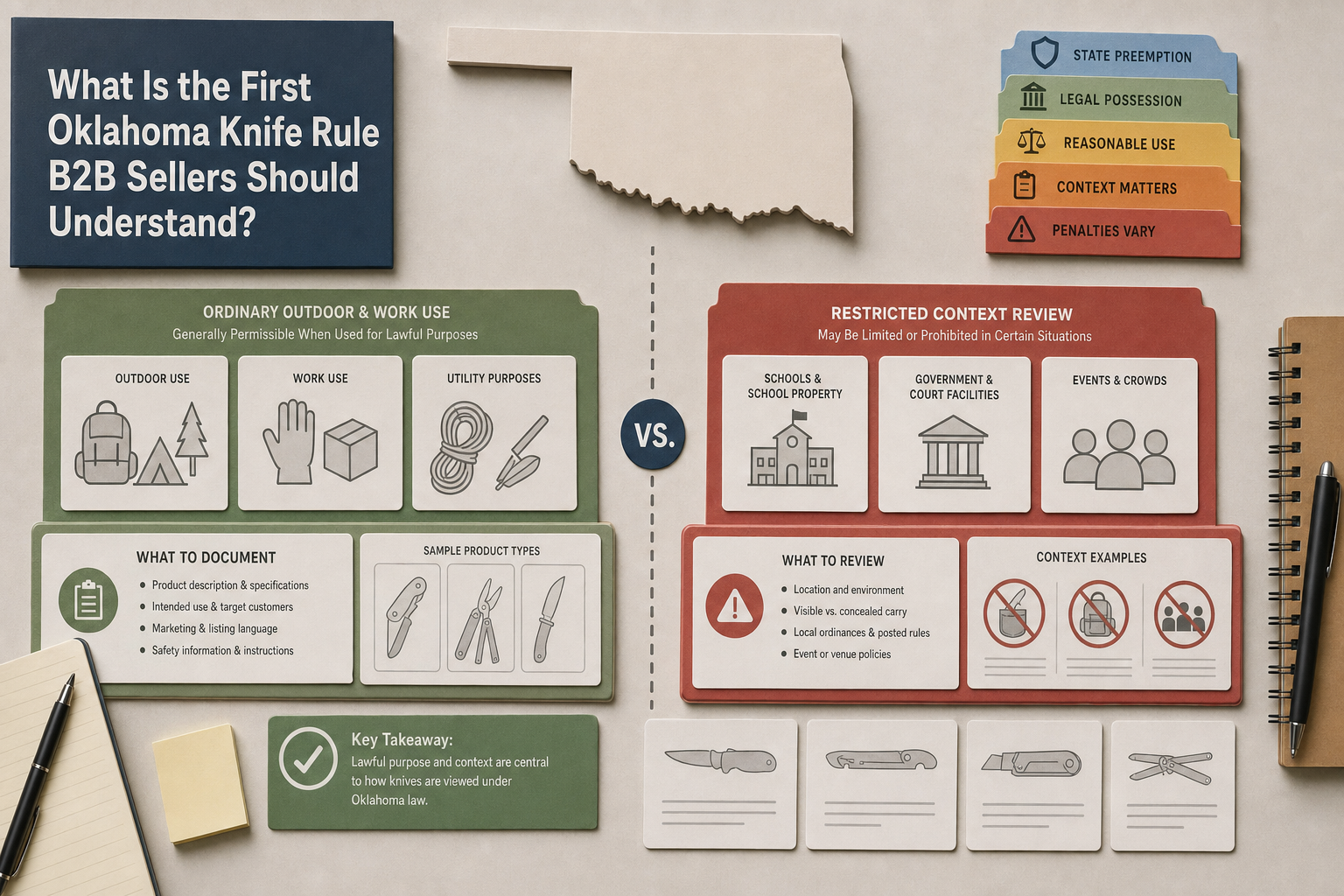
The first Oklahoma rule is to separate ordinary knife use from offensive-weapon risk. Section 21-1272 restricts certain weapons but states that proper use of guns and knives for self-defense, hunting, fishing, educational, or recreational purposes is not prohibited by that section.
I Read the Statute Before the Listing Copy
When a customer asks whether a pocket knife can be sold into Oklahoma, I do not start with a simple yes or no. I start with the product purpose. The Oklahoma Legislature's Title 21 PDF includes Section 21-1272, which addresses unlawful carry. The section lists certain weapons and uses a broad phrase about any other offensive weapon. It also says the section shall not prohibit proper use of guns and knives for self-defense, hunting, fishing, educational, or recreational purposes.
For B2B sellers, that means the product story matters. A camping knife, fishing knife, hunting support knife, EDC utility folder, warehouse cutting tool, or outdoor multi-tool can be framed around practical use. The package, listing, image set, and user guide should support that practical purpose. If the same product is described with aggressive language, the seller may create avoidable review risk.
I also separate state law from channel policy. A product may be acceptable under a state-level review, but retailers, marketplaces, payment processors, schools, venues, workplaces, and shipping providers can still add rules. That is why I recommend an Oklahoma-specific launch checklist instead of copying one national product page into every state market.
| Review point | What I check | Why it matters |
|---|---|---|
| Product purpose | EDC, outdoor, fishing, hunting, work, education | Supports practical-use framing |
| Product wording | Name, bullet points, package copy, photos | Reduces claim risk |
| Buyer channel | Retail, online, distributor, private label | Adds policy requirements |
| Legal review | State, federal, local, venue, retailer | Prevents one-layer thinking |
OEM/ODM RFQ Checklist
Prepare these details to help Vast State review your project and provide a more accurate quotation.
| RFQ Field | What to Prepare |
|---|---|
| Project type | OEM from drawing / ODM private label / wholesale catalog |
| Product category | Folding knife / fixed blade / multi-tool / outdoor tool |
| Design status | Idea / sketch / 2D drawing / 3D CAD / physical sample |
| Target price | Ex-factory target price or retail price range |
| MOQ expectation | 500 / 1,000 / 3,000 / 5,000+ pcs |
| Logo method | Laser engraving / etching / printing / molded logo |
| Packaging | Standard packaging / custom retail box / Amazon-ready |
| Market | USA / EU / Japan / Korea / Middle East / other |
| Compliance needs | Buyer-specified testing / documentation / labeling |
| Timeline | Sample deadline / mass production deadline |
Which Knife Types Need Extra Review Before Oklahoma Sales?
Some products look ordinary to a factory but sensitive to a seller. Mechanism and marketing language should be reviewed together.
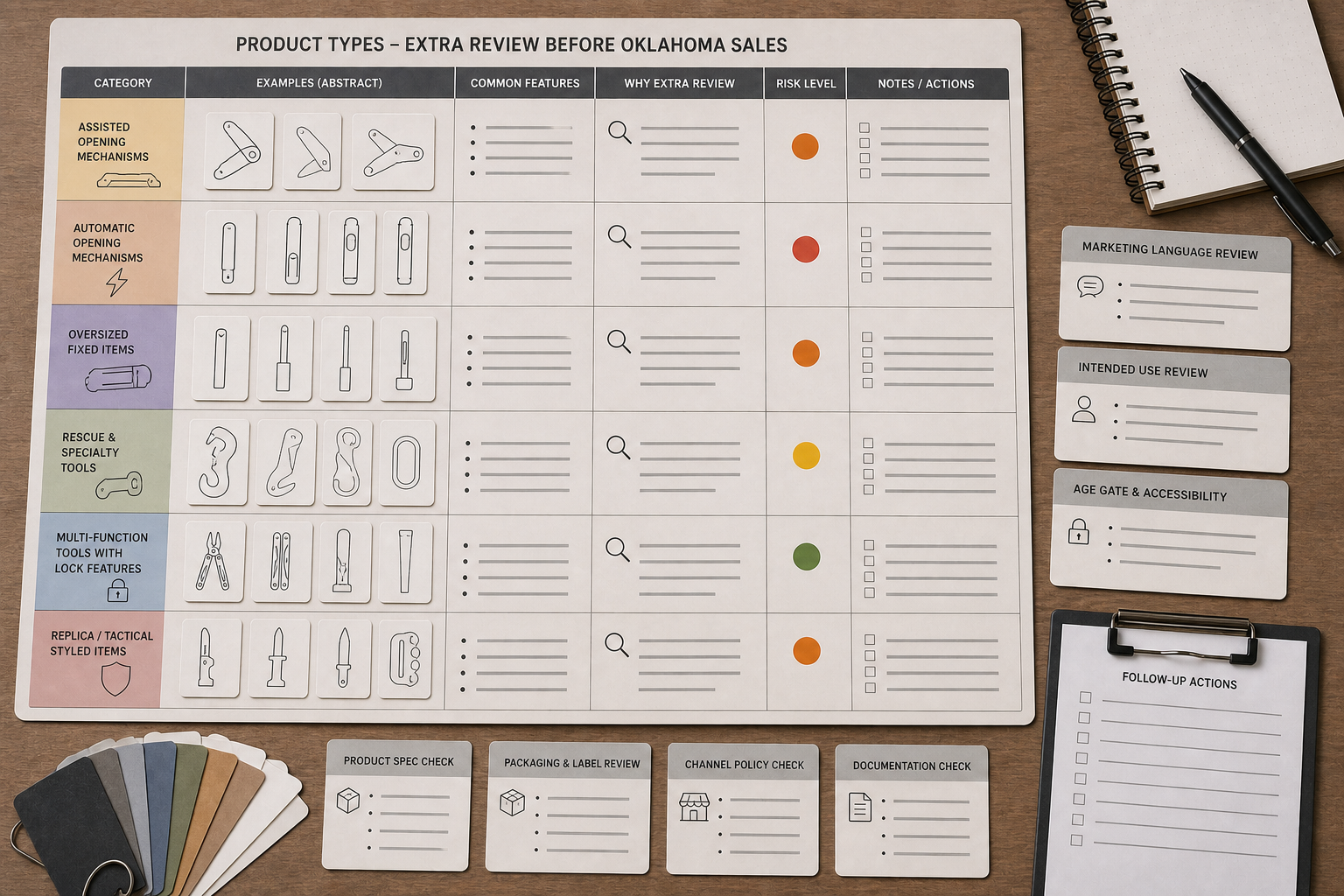
Extra review is useful for automatic knives, gravity-opening products, very large fixed blades, machetes, double-edge designs, unusual mechanisms, rescue-style tools, and products promoted mainly around confrontation instead of work, outdoor, fishing, hunting, education, or recreation.
I Review the Mechanism and the Sales Claim Together
In OEM and ODM work, I want the product type written clearly before sampling. Is the buyer asking for a manual folding knife, assisted manual folder, automatic knife, fixed blade, machete-style outdoor tool, rescue-style cutter, fishing knife, or multi-tool? The physical design and the listing copy must match. If the buyer sells a manual EDC folder, the mechanism should be documented as manual. If the buyer sells a fishing knife, corrosion resistance, grip, sheath, and cleaning should be part of the story.
Oklahoma state text should not be the only review layer. Federal law can matter for automatic-opening knives in interstate commerce and importation. The U.S. Code definition in 15 U.S.C. 1241 covers a switchblade knife that opens automatically by a button or other device in the handle, or by inertia, gravity, or both. 15 U.S.C. 1242 addresses introduction, manufacture for introduction, transportation, or distribution in interstate commerce. 15 U.S.C. 1244 lists exceptions, including the bias-toward-closure language for assisted manual knives.
For buyers, the practical action is simple. Do not approve a mechanism by nickname. Ask for the drawing, sample video, spring or detent description, lock type, opening method, and package wording. Then decide whether legal review is needed before tooling.
| Product type | Main review point | B2B action |
|---|---|---|
| Manual folder | Opening method and lock type | Document mechanism clearly |
| Assisted manual folder | Bias toward closure and blade effort | Review federal wording |
| Automatic knife | State, federal, import, and channel rules | Require legal review |
| Large outdoor blade | Purpose, size, package language | Keep use practical and specific |
How Should Sellers Handle Visible Carry and Pocket Carry Language?
Carry language can confuse customers. Sellers should avoid broad promises and keep product copy focused on lawful practical use.
Sellers should avoid promising that any knife may be carried everywhere in Oklahoma. Product pages should describe the knife type, intended practical use, dimensions, materials, and restrictions reminder while asking users to follow Oklahoma law, venue rules, school rules, workplace policy, and local requirements.
I Keep Carry Claims Narrow
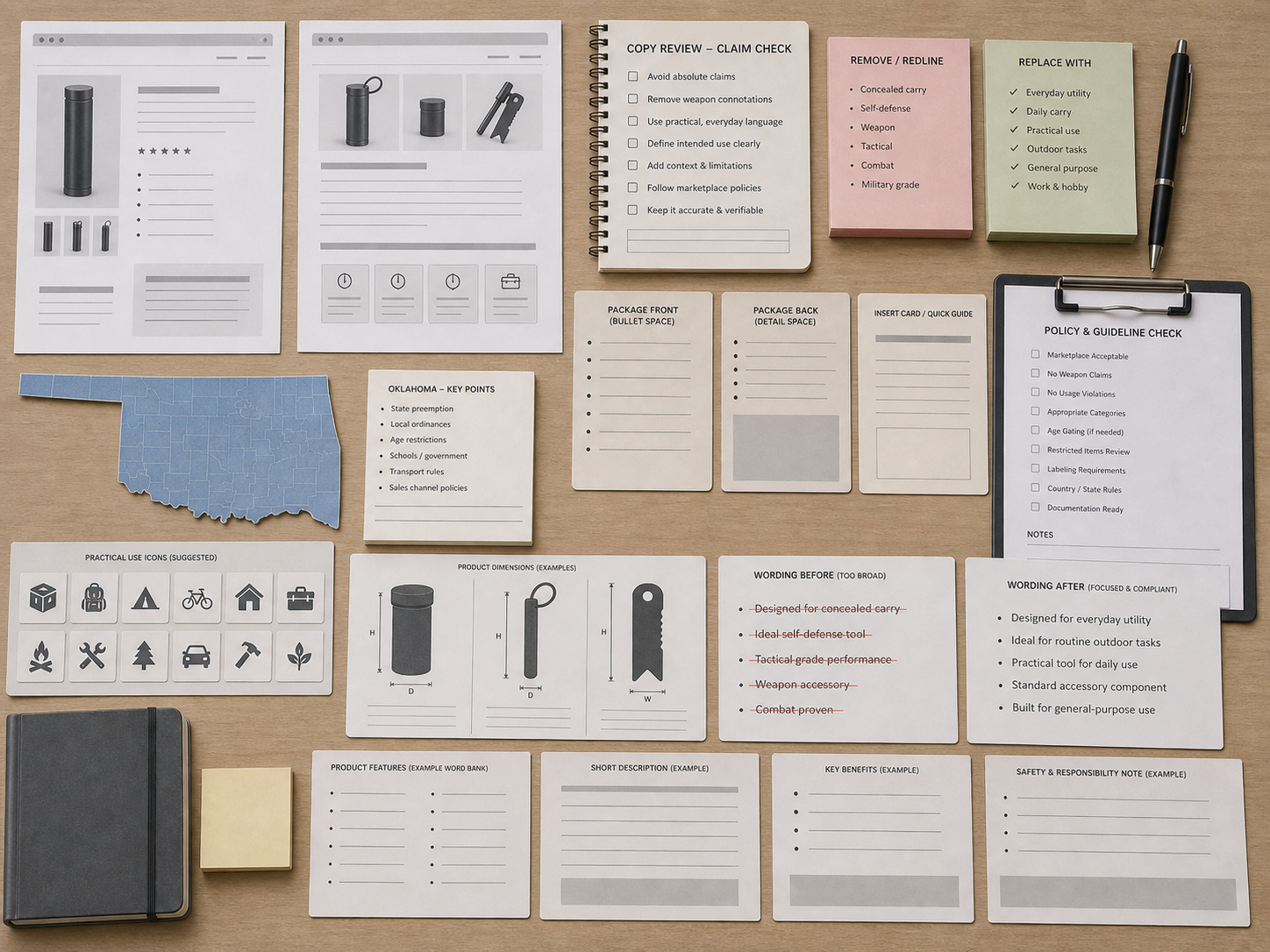
In product copy, I prefer calm language. A seller can say the knife is designed for everyday cutting tasks, fishing, camping, outdoor work, warehouse use, or general utility. A seller should be cautious with broad statements about where the knife may be carried. Carry rules can depend on location, user status, purpose, school policy, event rules, private property policy, and federal trade law. A national ecommerce listing should not make a promise that a state, venue, or school may not support.
This matters because Oklahoma law uses terms such as proper use, offensive weapon, certain places, school property, and unlawful intent. Those terms are not product features. They are legal context. A factory cannot solve them by changing blade steel or handle color. The seller must review how the knife will be described and where it will be sold.
For Vast State customers, I ask for the final listing text before mass production when the project is compliance-sensitive. I check whether the name, photos, icons, package insert, and social media copy all tell the same practical story. A knife positioned as an outdoor utility tool should look like an outdoor utility tool across the whole sales page. This reduces friction with distributors and retailers.
| Copy element | Safer direction | Risk to avoid |
|---|---|---|
| Product name | Utility, fishing, camping, work, EDC | Aggressive positioning |
| Feature bullets | Steel, lock, handle, dimensions, use | Broad carry promises |
| Product photos | Tool-focused and practical | Unsafe or dramatic scenes |
| Warning line | Follow applicable laws and rules | Claiming universal allowance |
Which Oklahoma Locations and Policies Need Seller Attention?
A product can be lawful in one place and restricted in another. Location rules are the part buyers often miss.
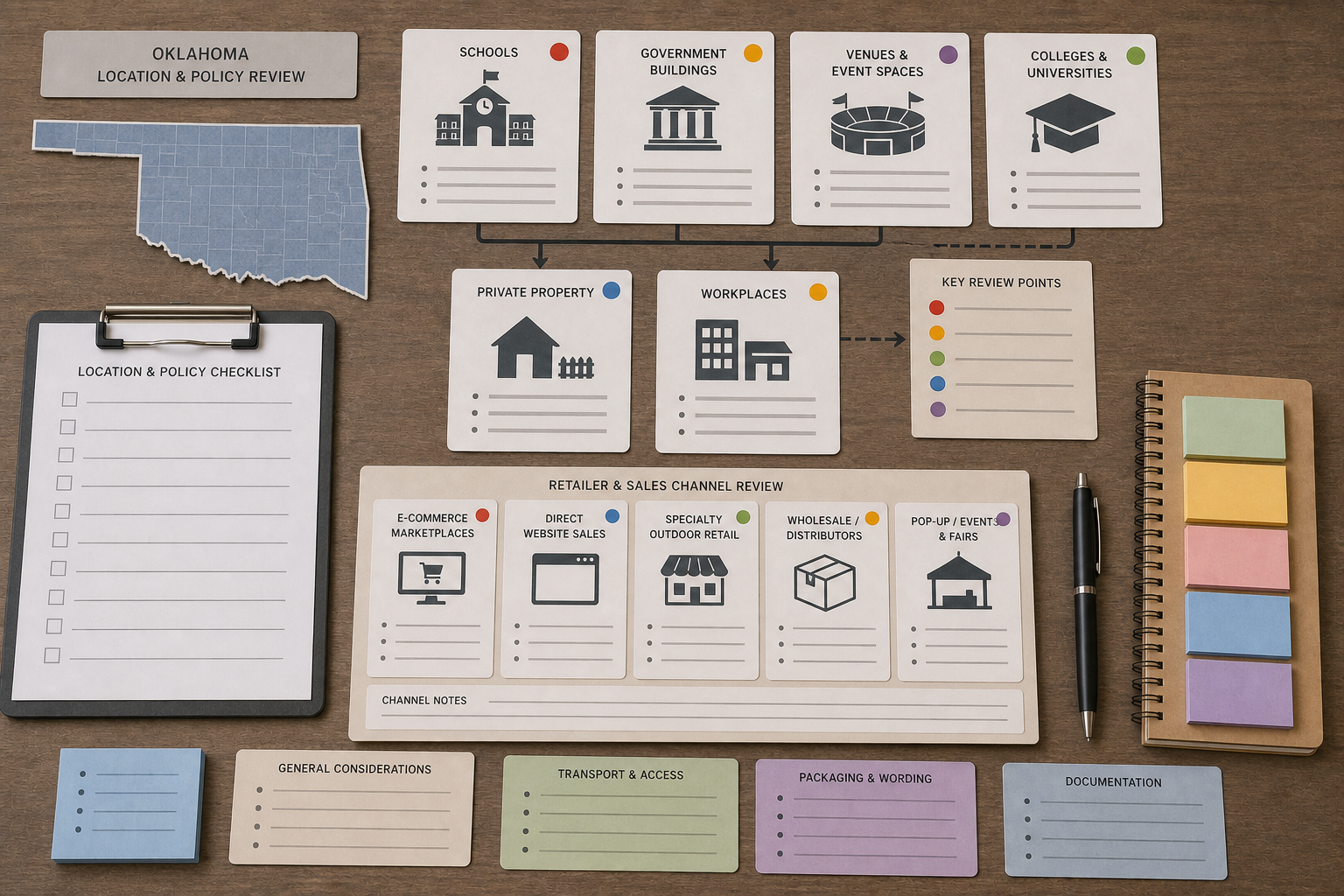
Sellers should review Oklahoma rules and policies for schools, school buses, government buildings, courthouses, detention facilities, professional sports venues, gambling locations, secured events, colleges, universities, technology centers, private property, workplaces, and retailer channels.
I Do Not Let One State-Level Answer Cover Every Place
The Oklahoma Title 21 PDF includes Section 21-1277 versions about unlawful carry in certain places and Section 21-1280.1 about school property. Those sections include places such as government buildings, courthouses, detention facilities, public and private elementary and secondary schools, certain sports venues, gambling locations, and secured events. Section 21-1280.1 also includes school-property language and exceptions, including a hunting or fishing gun or knife kept in a privately owned vehicle under specified conditions when transporting a student.
For sellers, the safe message is not "carry this anywhere." The safe message is practical product use plus a reminder to follow applicable law and location rules. Schools are especially sensitive. The Oklahoma PDF also says a public or private school may create a policy regulating knives on school property or in school transportation. That means sellers should avoid school-use product images unless the product is clearly part of an approved educational context and the buyer has legal review.
Retail channels add another layer. Marketplace listings may have their own policy. A distributor may sell into several states. A venue may use security screening. A workplace may prohibit blades even when state law allows general ownership. A good B2B launch plan should prepare for these practical limits before packaging is printed.
| Location or policy layer | What to check | Seller response |
|---|---|---|
| School property | State law and school policy | Avoid broad school-related claims |
| Government and court locations | Section 21-1277 context | Use careful location reminders |
| Events and venues | Security rules and private policy | Avoid universal carry wording |
| Retail platforms | Marketplace and distributor rules | Review listings before launch |
How Do Oklahoma Preemption Rules Affect Knife Sellers?
State preemption can reduce local-rule confusion. But it does not remove every policy, school, venue, or federal issue.
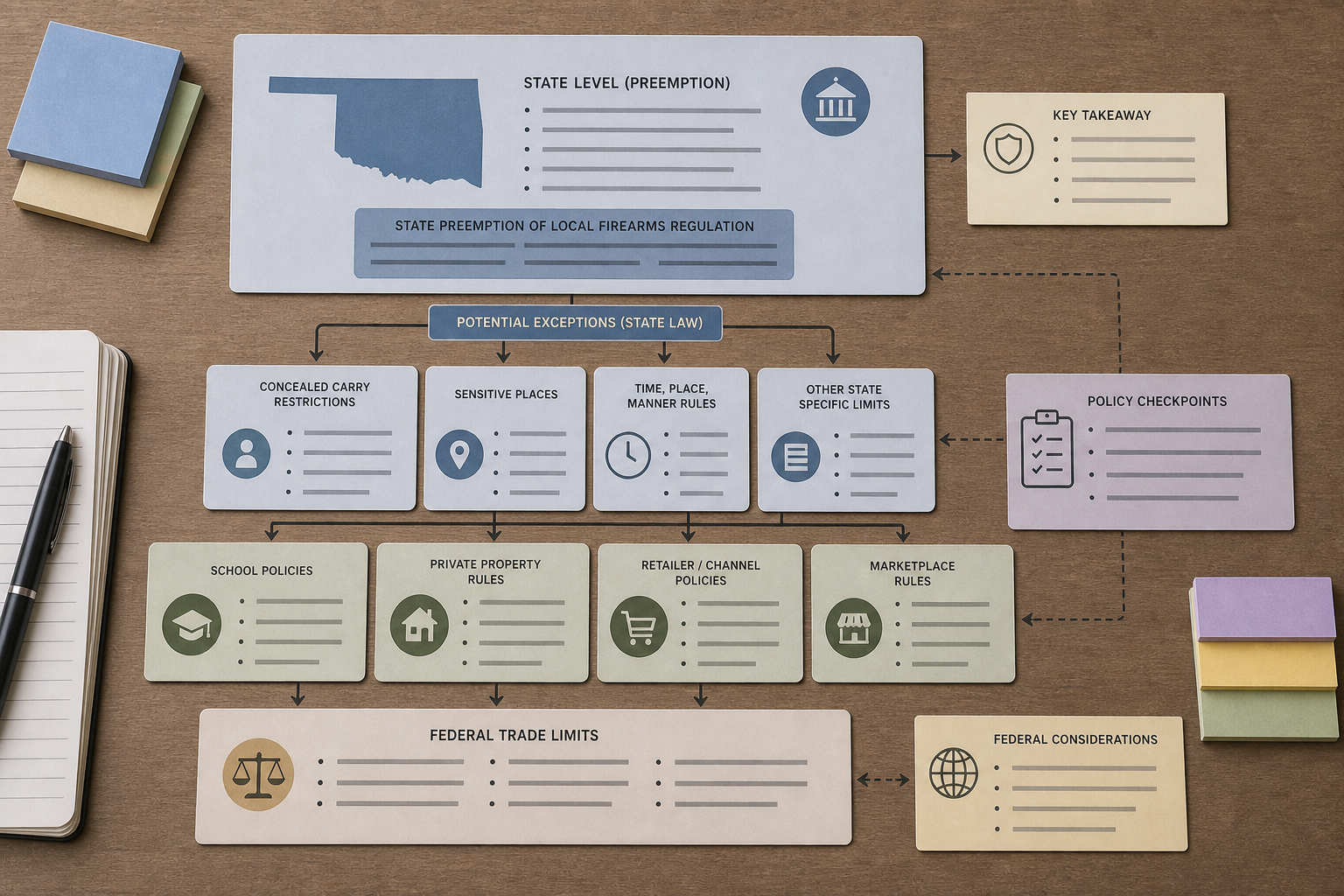
Oklahoma Section 21-1289.24 says the state occupies the field for legislation touching firearms, knives, components, ammunition, and supplies, with listed exceptions. Sellers should still review school policy, restricted places, private property, retailer rules, and federal trade limits.
I Treat Preemption as Helpful but Not Complete
The Oklahoma Title 21 PDF includes Section 21-1289.24, which is titled firearm regulation and state preemption. The text states that the Legislature occupies and preempts the field touching firearms, air powered pistols, air powered rifles, knives, components, ammunition, and supplies, with exceptions. It also says public or private schools may create policy regulating knife possession on school property or in school transportation. This is useful for sellers because it shows that local lawmaking is not the only issue to watch.
However, preemption is not a shortcut around every real-world rule. A private venue can have a policy. A retailer can reject a listing. A school can have policy authority. A federal import or interstate rule can still apply. A product can also face warning, origin marking, and marketplace restrictions. So I do not tell buyers that preemption makes the project simple. I tell them it is one layer of the checklist.
For B2B selling, the best use of this information is to prepare cleaner launch materials. The product description should be state-aware, not state-overconfident. The package should include a sensible legal-use reminder. The distributor sheet should tell sales teams to check local channel policies and restricted places before making claims.
| Rule layer | What it can help with | What it does not solve |
|---|---|---|
| State preemption | Local legislation consistency | Private, school, venue, or federal issues |
| School policy | School-specific control | General retail permission |
| Retailer policy | Listing approval | State legal status |
| Federal law | Import and interstate trade | State use context |
What Federal Knife Rules Still Matter for Oklahoma-Bound Products?
State review is not enough for importers. A knife can face federal problems before it reaches Oklahoma.
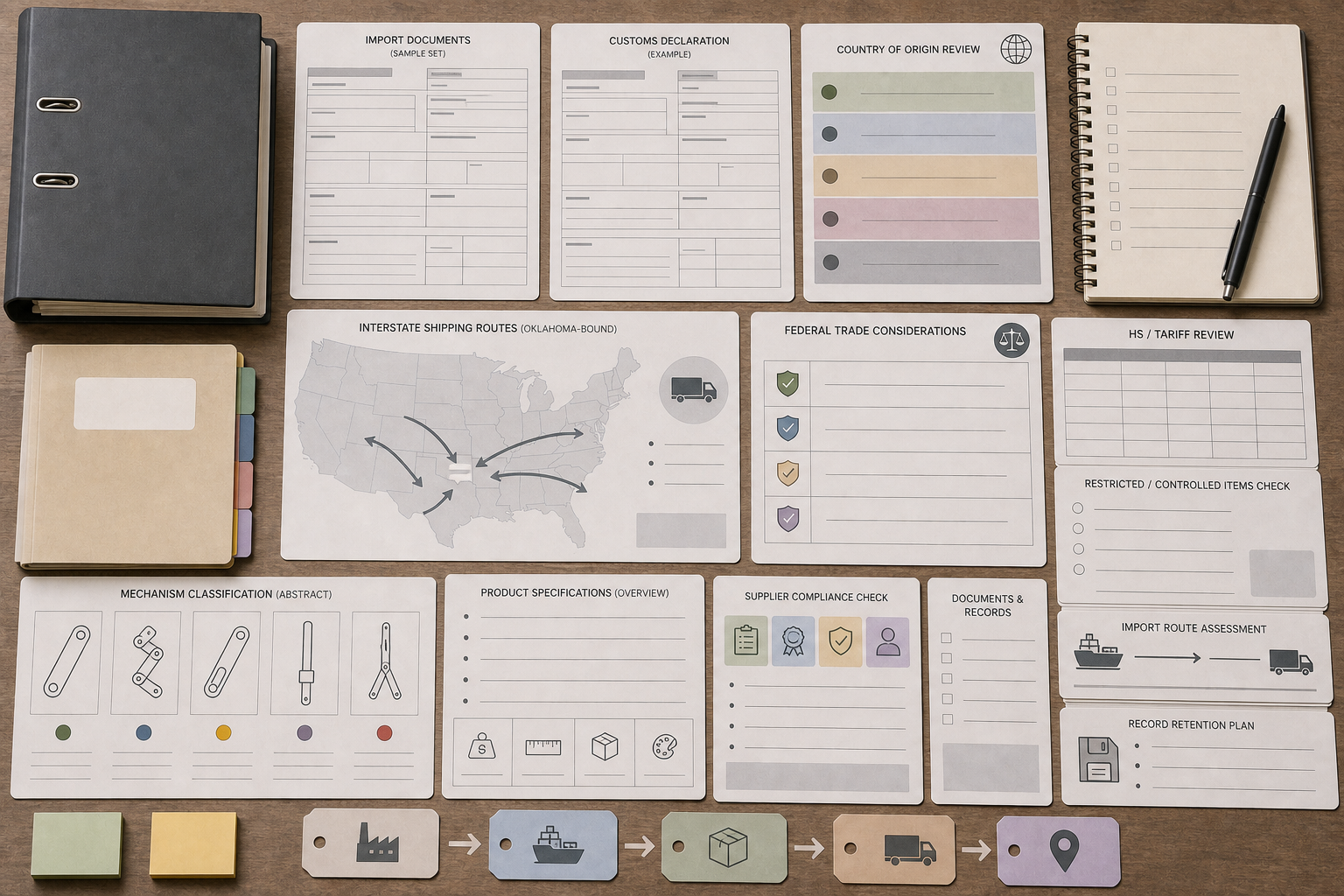
Federal rules still matter for Oklahoma-bound products, especially automatic-opening knives, interstate distribution, importation, and product marking. Importers should review the Federal Switchblade Act, customs rules, country-of-origin marking, and channel-specific shipping limits before production.
I Check the Supply Route Before the Sales Page
For international B2B projects, Oklahoma is only one destination layer. A knife made in China and shipped to a U.S. importer must also pass federal trade and customs review. The federal switchblade chapter matters when the product opens automatically or may be classified that way. The U.S. Code pages for Sections 1241, 1242, and 1244 are useful starting points because they define the term, restrict certain interstate activity, and list exceptions.
Import rules can add more detail. 19 CFR 12.98 addresses importations permitted by statutory exceptions for switchblade knives. That matters because a seller may think only state law matters, while customs review may happen before state sale begins. For ordinary manual pocket knives, the risk may be lower, but the product should still be described accurately on invoices, packing lists, product pages, and technical sheets.
Country-of-origin marking is another practical requirement. 19 CFR 134.11 says foreign-origin articles or containers generally must indicate the English name of the country of origin to the ultimate purchaser, unless an exception applies. For a private label buyer, that means origin marking should be planned with the logo, barcode, warnings, and package artwork.
| Federal topic | What buyer should prepare | Why it matters |
|---|---|---|
| Automatic mechanism | Drawing, spring, detent, sample video | Supports classification review |
| Interstate trade | Federal switchblade chapter review | Affects distribution planning |
| Import entry | Product description and exception review | Reduces customs risk |
| Origin marking | Product or container marking plan | Supports U.S. import compliance |
How Should Packaging and Listings Be Written for Oklahoma Sales?
A compliant product can still be marketed badly. Package wording should not create promises the seller cannot support.
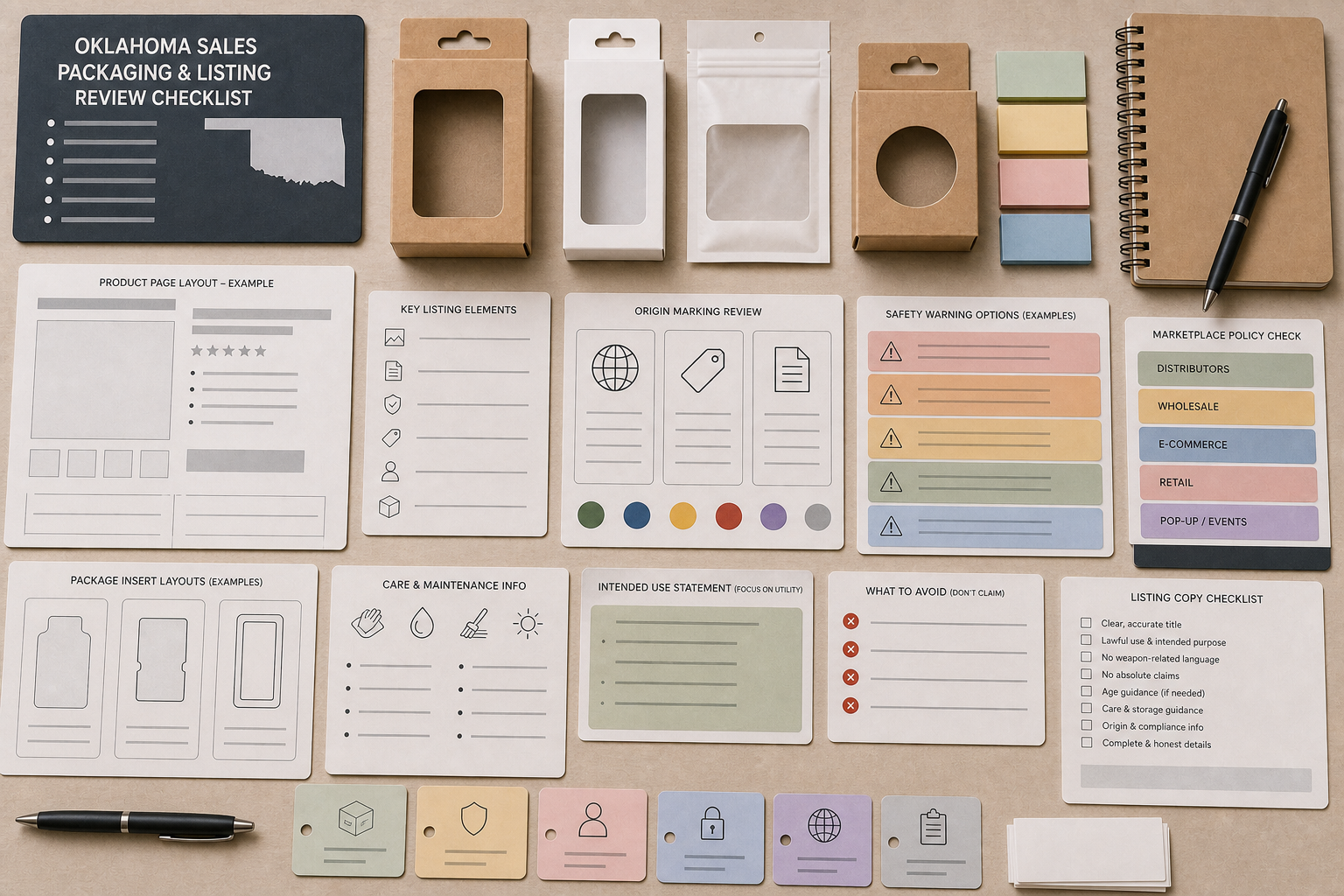
Packaging and listings should describe the knife type, mechanism, blade length, steel, handle material, intended practical use, age and safety warnings, origin mark, care instructions, and a reminder to follow laws, school rules, venue rules, and workplace policy.
I Build the Sales Story Around Lawful Utility
Good packaging is specific. It tells the buyer what the knife is and what it is for. It can mention manual opening, lock type, blade steel, handle material, pocket clip, sheath, finish, dimensions, care, and intended practical use. It should not promise that the knife can be taken into every location. It should not use dramatic claims that make an ordinary tool look like an offensive product.
For Oklahoma, I would keep the language practical: EDC utility, outdoor tasks, fishing, camping, hunting support, workshop cutting, warehouse opening, gardening, or general tool use. If the product is a rescue-style tool, I would define the functions carefully, such as belt cutter or glass breaker, and avoid broad emergency promises unless the buyer has reviewed the claim. If the product has an automatic or assisted manual mechanism, the package and listing should use precise mechanism language.
The package should also support import and retail needs. Origin marking, warning language, barcode, age policy, care instructions, and retailer-required statements should be approved before mass production. A small label error can delay a shipment or force repacking. For repeat orders, I also want the approved artwork file, sample photos, carton label, and inspection checklist stored together.
| Content item | What to include | Why it matters |
|---|---|---|
| Product specs | Mechanism, steel, lock, size, handle | Reduces classification confusion |
| Use language | Outdoor, fishing, camping, work, utility | Supports lawful product framing |
| Warning copy | Follow laws and location rules | Avoids broad promises |
| Artwork records | Approved file, sample, carton label | Supports repeat production |
What Should Buyers Put in an Oklahoma Knife Compliance RFQ?
A vague RFQ invites a risky quote. The supplier cannot guess legal, channel, and package requirements.
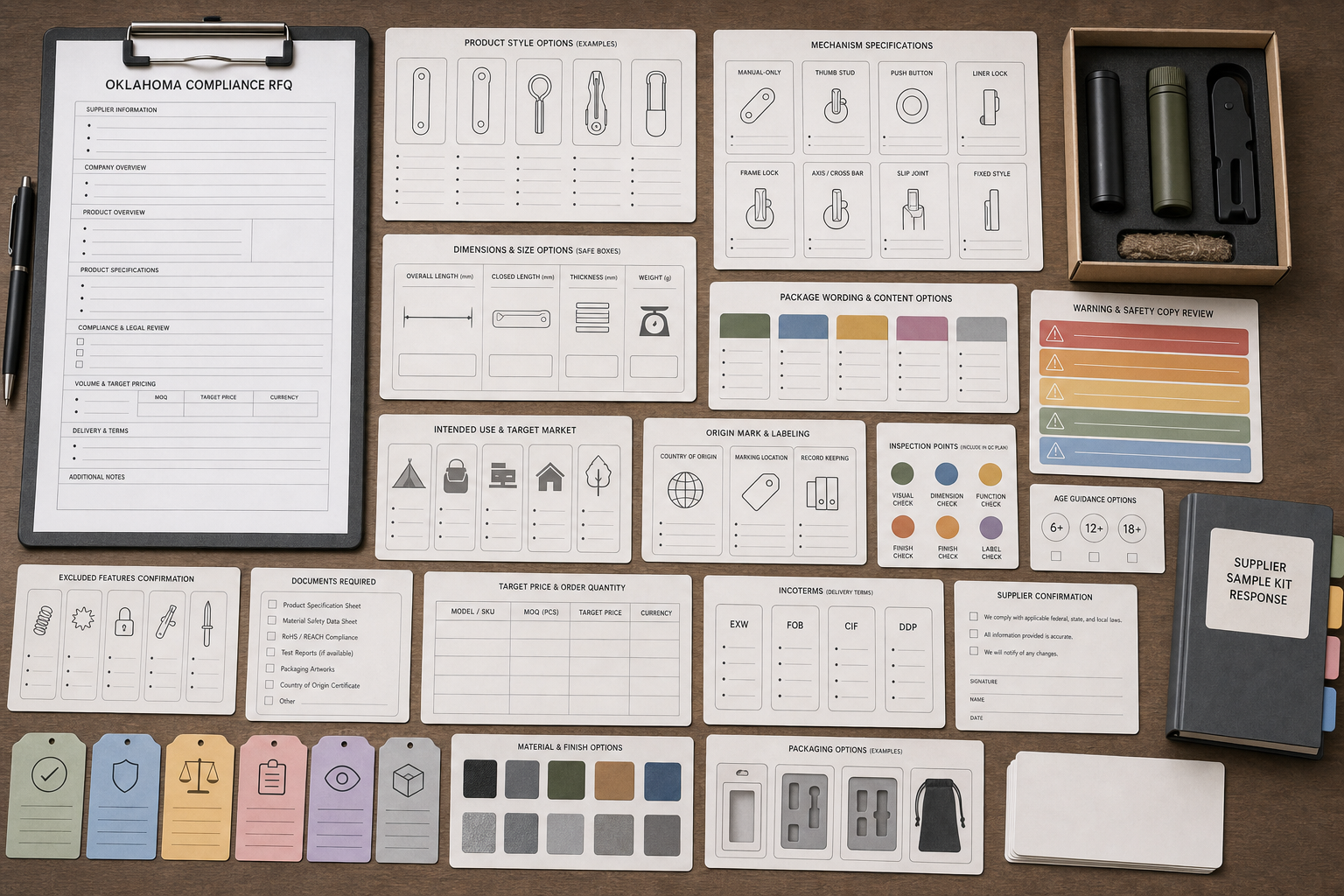
An Oklahoma knife compliance RFQ should include knife type, opening mechanism, lock type, blade length, blade shape, intended use, target channels, package wording, warning requirements, origin mark, inspection points, target price, MOQ, Incoterm, and legal review stage.
I Use the RFQ to Prevent Late Redesign
The RFQ should make Oklahoma review visible from the start. I want the buyer to tell me the knife type, opening mechanism, lock type, blade length, blade thickness, blade style, steel, handle material, finish, clip, sheath, package type, target user, target sales channel, destination market, and target price. If the buyer already has counsel reviewing the product, the review should happen before tooling and packaging approval.
The RFQ should also define what must be avoided. If the buyer does not want automatic-opening products, say so clearly. If the product must be positioned as an outdoor utility tool, say so clearly. If the buyer needs school-rule reminders, retailer-specific warnings, origin marking, or marketplace image limits, include that before artwork. If the buyer wants a national U.S. package, Oklahoma is only one part of the review.
Trade terms should be clear. The ICC Incoterms rules help buyers and sellers clarify delivery responsibilities, costs, and risk transfer. Quality also needs structure. ISO's quality management principles support the idea that defined processes and controls help create consistent results. For knife sourcing, that means product drawings, approved samples, in-process checks, and final inspection must match the compliance plan.
| RFQ field | What to specify | Why it helps |
|---|---|---|
| Product type | Manual folder, assisted manual, fixed blade, multi-tool | Sets mechanism review |
| Intended use | Outdoor, fishing, hunting, work, education, EDC | Supports package language |
| Compliance needs | State review, federal review, origin mark, warnings | Reduces late changes |
| Commercial terms | MOQ, target price, Incoterm, timeline | Makes quoting realistic |
Turn this article into a folding knife project.
Share your blade type, lock direction, steel preference, handle material, quantity, target market, and packaging needs. Vast State can prepare OEM/ODM options.
Conclusion
I treat Oklahoma knife sales as a product, law, packaging, channel, and RFQ review, not a simple state-law yes or no.
Source Notes
- The Oklahoma Legislature Title 21 PDF supports the discussion of Sections 21-1272, 21-1277, 21-1278, 21-1280.1, and 21-1289.24.
- 15 U.S.C. 1241, 15 U.S.C. 1242, and 15 U.S.C. 1244 support federal automatic-knife review for importers and interstate sellers.
- 19 CFR 12.98 supports the point that switchblade importation depends on statutory exceptions.
- 19 CFR 134.11 supports origin-marking review for U.S. imports.
- ISO quality management principles and ICC Incoterms rules support supplier process control and trade-term clarity.