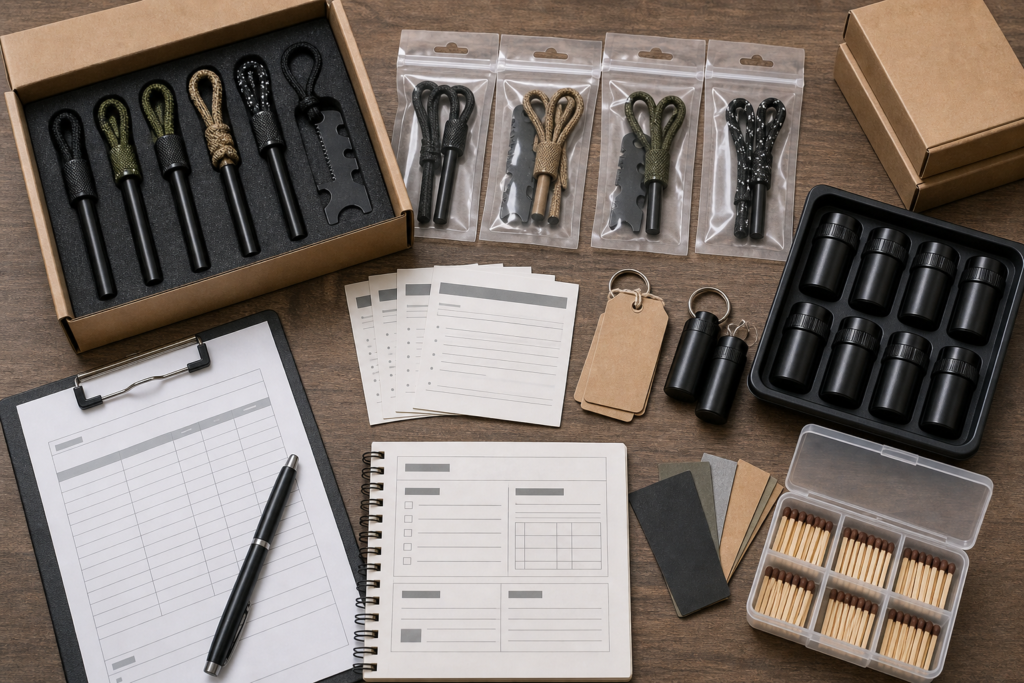
Fire-starting tools sell easily, but careless sourcing can create safety, packaging, shipping, and market-claim problems. A clear OEM brief prevents that.
Buyers should add fire-starting tools to outdoor kits by defining lawful intended use, choosing the right ignition method, checking materials and safety features, reviewing transport limits, writing careful instructions, and keeping fire-use claims practical and verifiable.
Quick buyer brief:
- Answer: Treat fire-starting tools as controlled outdoor accessories, not simple add-ons.
- Buyer context: This helps knife brands, outdoor brands, importers, wholesalers, distributors, and private label buyers.
- Key checks: Intended use, ignition type, material, safety feature, packaging, warning copy, transport limits, target market, and RFQ details.
Planning a fixed blade or outdoor knife project?
Share your target use, blade size, steel preference, handle direction, sheath needs, quantity range, and packaging plan. Vast State can help turn it into a quote-ready specification.
I do not treat a fire-starting tool as a magic survival promise. I treat it as one component inside a responsible outdoor product. At Vast State, if a buyer wants a camping knife kit, multi-tool set, fishing kit, rescue-style outdoor pouch, or private label EDC bundle, I first ask how the fire-starting accessory will be used, sold, shipped, packaged, and explained. The goal is not to teach unsafe fire use. The goal is to help B2B buyers build a product that is practical, honest, and easier to manage in repeat production.
What Should Buyers Define Before Adding Fire-Starting Tools to Outdoor Kits?
A fire tool can look small, but the product meaning is large. Poor use definition causes bad samples and risky claims.
Buyers should define the intended use, target market, sales channel, kit type, user skill level, fire restriction awareness, accessory role, and transport route before selecting any fire-starting tool for an OEM outdoor kit.
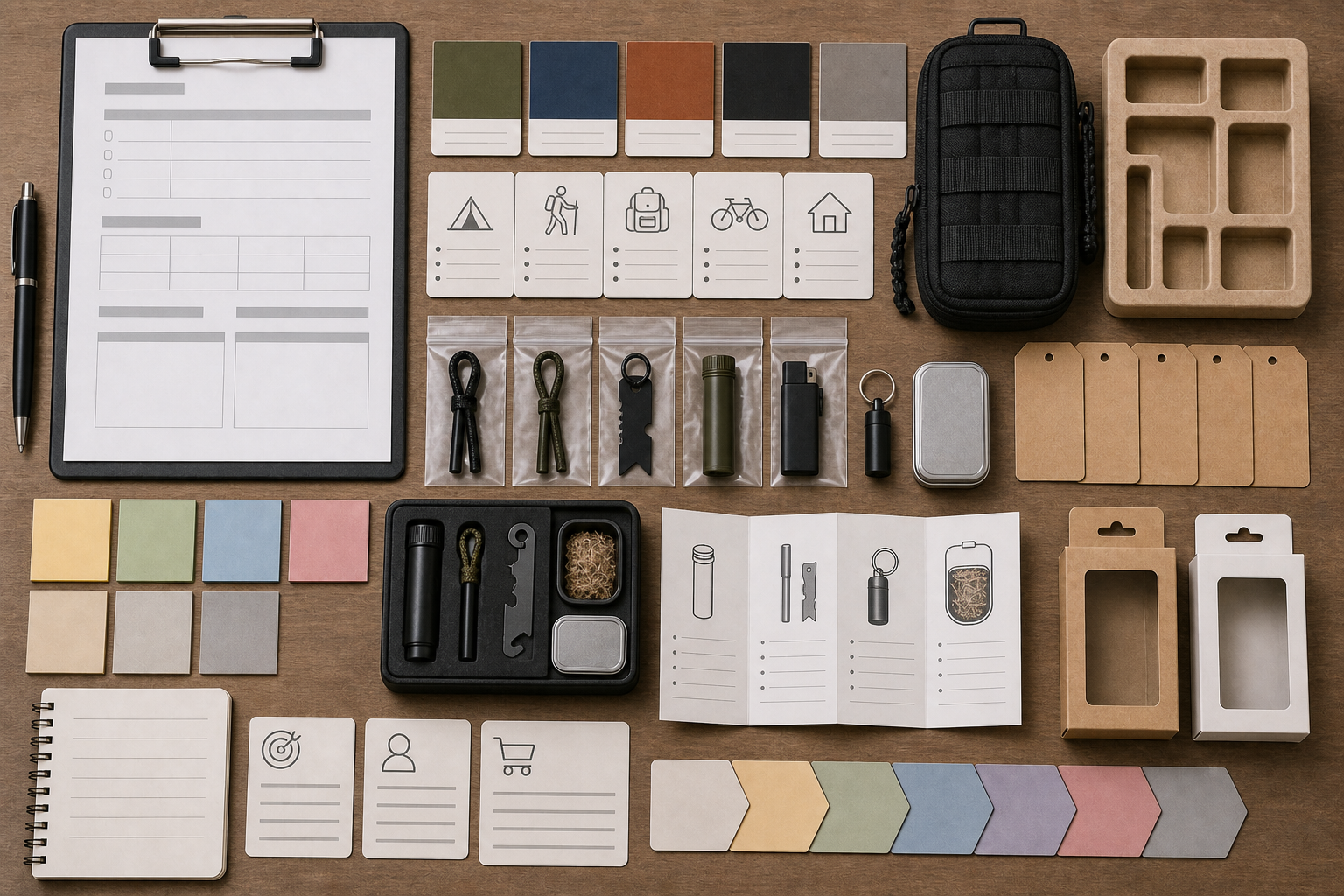
I Start With the Use Case, Not the Spark
The first question is not which tool makes the biggest spark. The first question is what the buyer is actually selling. A fire-starting accessory for a family camping kit is different from one for a compact emergency pouch. A ferro rod paired with a fixed blade sheath is different from waterproof matches packed into a retail camping set. A rechargeable electric igniter is different again because it may bring battery and transport concerns.
I ask buyers to define the user and the sales channel. Is the product for outdoor retail, ecommerce, gift sets, emergency kits, fishing kits, or camping tool bundles? Will it be sold in the United States, Europe, Canada, Australia, or several markets at once? Will it ship by air, sea, courier, or postal channel? Will the buyer make any claims about all-weather use, survival use, fire safety, or emergency readiness? These answers affect design and packaging.
I also want the buyer to avoid broad promises. The National Park Service reminds visitors to check fire bans and restrictions before having a campfire. That point matters for product copy. A good outdoor accessory should encourage responsible use and respect local rules. It should not suggest that a user should make a fire in every condition.
| Planning question | What to define | Why it matters |
|---|---|---|
| Intended use | Camping, emergency kit, outdoor pouch, gift set | Guides product type |
| Target market | Country, channel, retailer, user group | Guides warnings and packaging |
| Shipping route | Air, sea, courier, postal | Affects lighter and battery choices |
| Product claim | Accessory, emergency backup, camping tool | Controls risk and documentation |
OEM/ODM RFQ Checklist
Prepare these details to help Vast State review your project and provide a more accurate quotation.
| RFQ Field | What to Prepare |
|---|---|
| Project type | OEM from drawing / ODM private label / wholesale catalog |
| Product category | Folding knife / fixed blade / multi-tool / outdoor tool |
| Design status | Idea / sketch / 2D drawing / 3D CAD / physical sample |
| Target price | Ex-factory target price or retail price range |
| MOQ expectation | 500 / 1,000 / 3,000 / 5,000+ pcs |
| Logo method | Laser engraving / etching / printing / molded logo |
| Packaging | Standard packaging / custom retail box / Amazon-ready |
| Market | USA / EU / Japan / Korea / Middle East / other |
| Compliance needs | Buyer-specified testing / documentation / labeling |
| Timeline | Sample deadline / mass production deadline |
Which Fire-Starting Methods Fit Different OEM Product Lines?
Buyers often ask for a full fire kit. But each method has different cost, safety, shelf-life, and shipping issues.
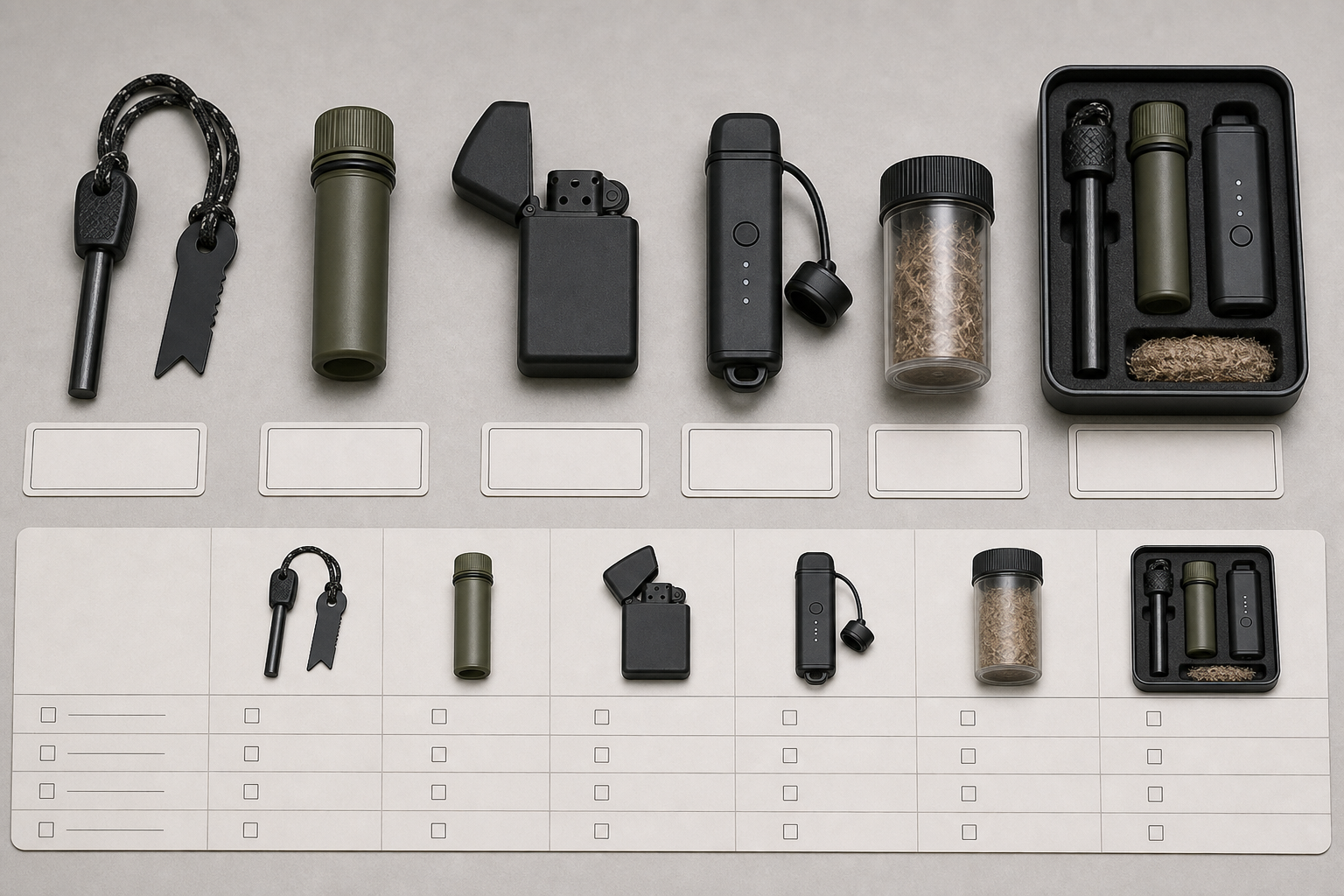
Common OEM fire-starting options include ferro rods with strikers, magnesium-style blocks, waterproof match containers, butane or liquid-fuel lighters, electric arc igniters, tinder storage, and hybrid kits. The best option depends on market position, packaging, transport, and user responsibility.
I Match the Method to the Product Tier
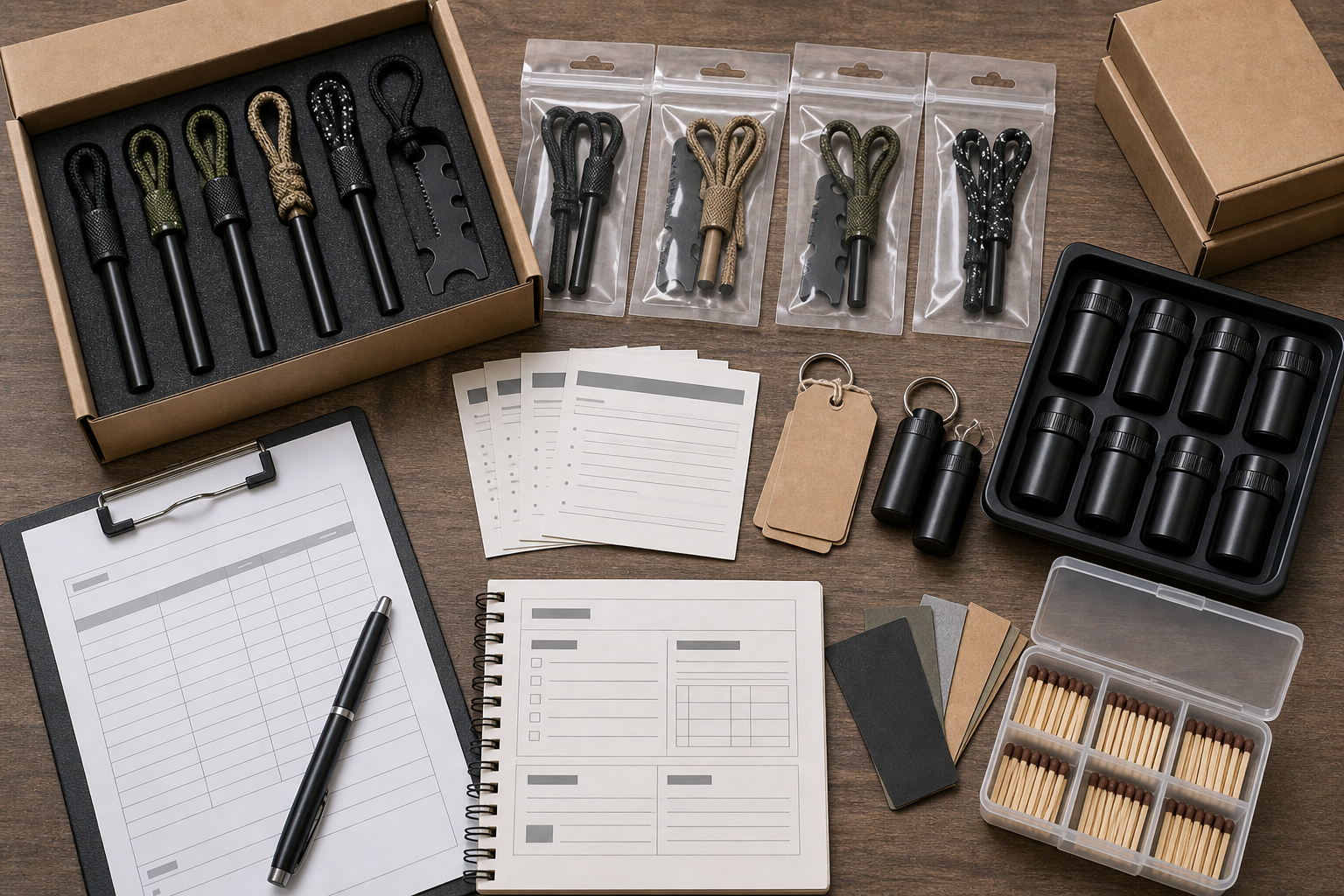
Ferro rods are popular because they are compact, durable, and simple to pack. They pair well with fixed blade sheaths, camping knives, multi-tools, and outdoor kits. But they need a good striker, enough rod diameter, comfortable handle design, and clear use caution. A poor striker makes the product feel cheap. A thin rod may look nice in the box but disappoint the user.
Magnesium-style blocks can give a classic outdoor feeling, but buyers should check material quality, shaving surface, striker attachment, and package instructions. Waterproof matches can be useful in a camping kit, but they bring consumable inventory and packaging concerns. Fuel lighters and electric arc igniters can improve convenience, but they also bring safety, child-resistance, fuel, battery, shipping, and destination-market review. They should not be added casually just because they look modern.
For B2B product planning, I usually divide options into three levels. A simple accessory kit may use a ferro rod and striker. A mid-level camping kit may add a protected tinder container or match tube. A higher-complexity kit may consider a lighter or electric igniter, but only after transport and product safety review. This keeps the product aligned with cost, user expectation, and launch risk.
| Method | Product fit | Buyer watch point |
|---|---|---|
| Ferro rod and striker | Knife sheath, EDC pouch, camping kit | Rod size, striker quality, handle comfort |
| Magnesium-style block | Traditional outdoor kit | Material consistency and instructions |
| Waterproof matches | Camping bundle or emergency kit | Shelf life, moisture seal, consumable labeling |
| Electric igniter | Modern outdoor accessory | Battery, activation lock, transport rules |
How Should Buyers Compare Ferro Rods, Matches, Lighters, and Electric Igniters?
A buyer can compare price too early. That creates a cheap kit, not a controlled outdoor product.
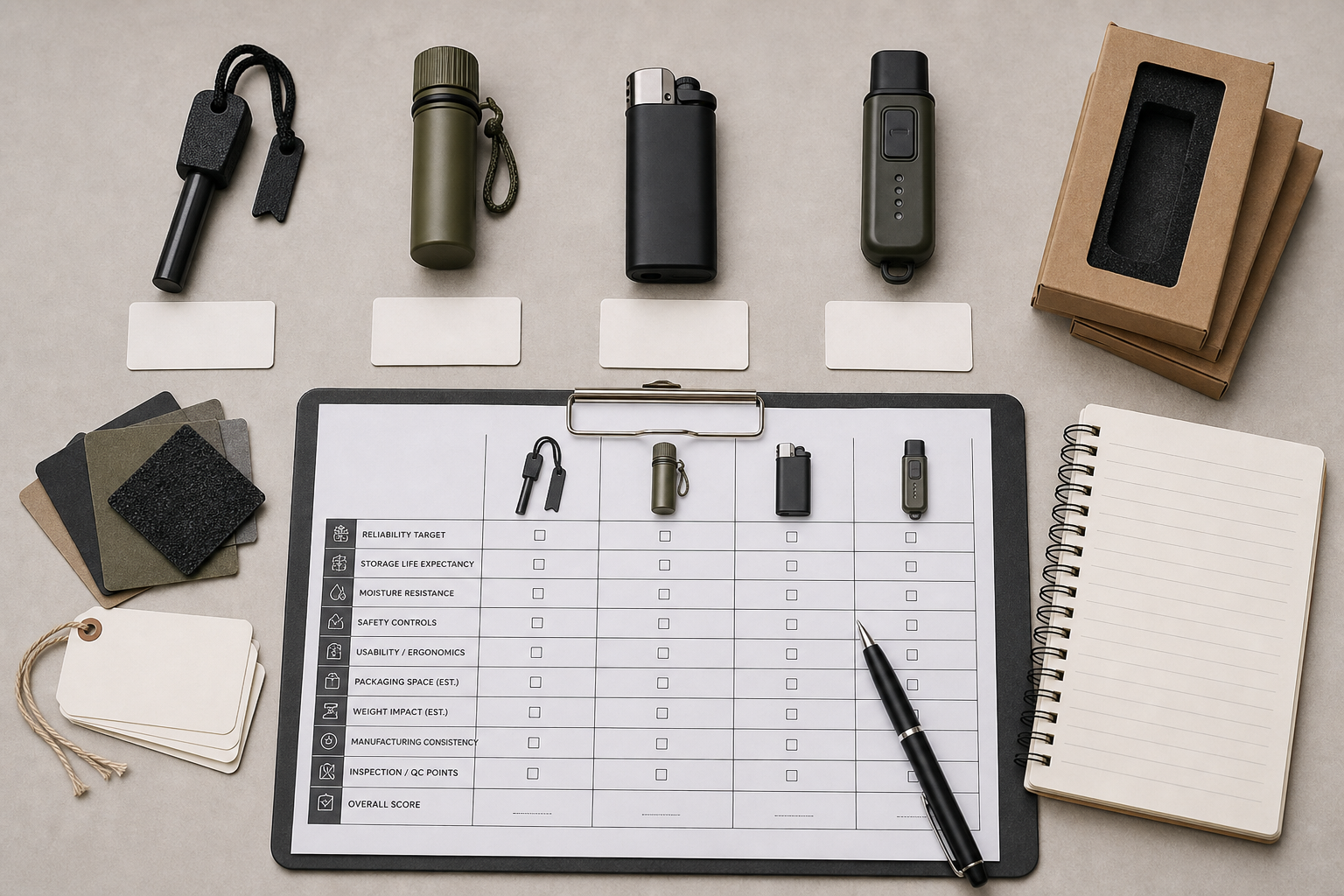
Buyers should compare fire-starting tools by reliability target, storage life, safety controls, user skill level, replacement need, shipping limits, packaging space, inspection method, and whether the product claim can be supported.
I Compare by Risk, Not Only by Feature
A ferro rod has no fuel and no battery, so it can be easier to include in many outdoor kits. But it requires skill and a correct striker. A buyer should check the rod composition, diameter, length, handle, lanyard, striker edge, and packaging retention. If the user cannot hold it comfortably, the product feels like an afterthought.
Matches are familiar, but they are consumable and moisture-sensitive. A waterproof tube can help, but the seal, cap, and internal striker area must be checked. Fuel lighters are convenient, but buyers must consider consumer product safety rules, fuel status, package warnings, child-resistant features, and transport limits. The eCFR entry for 16 CFR Part 1210 describes a U.S. safety standard for disposable and novelty lighters, including child-resistance and certification-related sections. A buyer should not assume all lighter products are simple accessories.
Electric igniters may be attractive for modern outdoor lines, but they often include lithium batteries. PHMSA explains that lithium batteries are regulated as hazardous materials in transportation and that shippers play an important role in reducing fire risks. FAA PackSafe guidance also treats lithium battery powered lighters separately from fuel lighters for passenger travel. Those sources do not replace full shipping compliance review, but they show why electric ignition products need more planning.
| Option | Main advantage | Main sourcing concern |
|---|---|---|
| Ferro rod | Durable and fuel-free | User skill and striker quality |
| Matches | Familiar and low cost | Moisture, shelf life, consumable refill |
| Fuel lighter | Convenient ignition | Safety standard, fuel, transport limits |
| Electric igniter | Modern user appeal | Battery safety and activation prevention |
What Materials and Construction Details Affect Durability and Safety?
Small parts decide the user experience. A weak rod, loose cap, or sharp striker can damage the whole product impression.
Durability and safety depend on rod size, striker hardness, handle grip, tube sealing, cap retention, lanyard strength, surface finish, edge condition, battery lockout, and packaging protection during shipping.
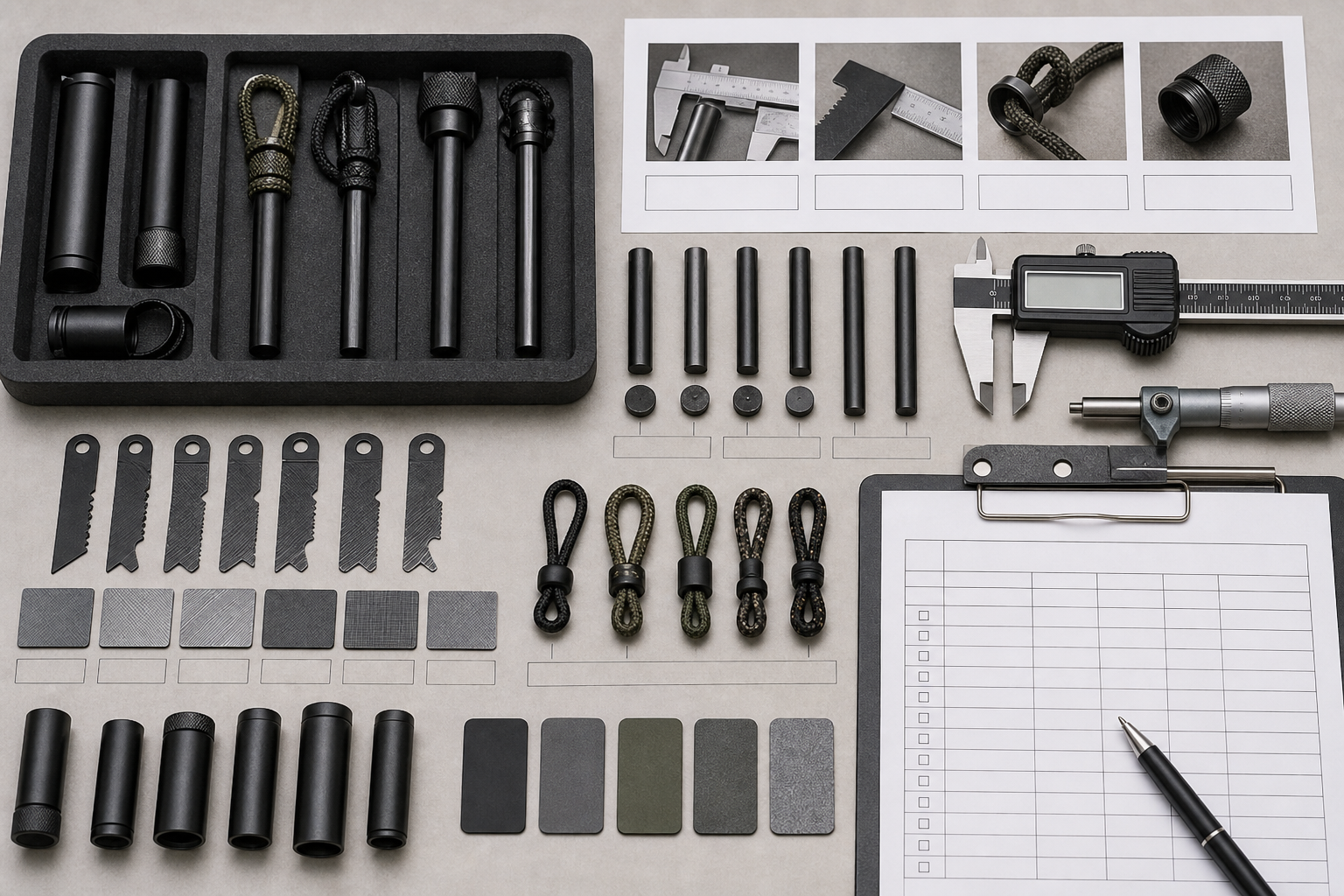
I Look at Every Touch Point
The fire-starting tool must feel controlled in the hand. For a ferro rod, I check rod diameter, rod bonding to the handle, handle shape, striker grip, striker edge consistency, lanyard attachment, and whether the striker can be stored safely. A striker should work without having a dangerous burr. A handle should be easy to hold with cold or wet hands, but the product copy should still remind users to follow safe and lawful fire practices.
For match tubes or tinder containers, I check seal design, thread fit, cap retention, gasket quality, internal movement, and moisture exposure. A container that opens in the package can ruin the buyer's brand image before the product is used. For lighters or electric igniters, I look for activation prevention, button protection, charging-port protection, battery documentation, and package warnings. If a design can turn on accidentally in a pocket or carton, it is not ready for launch.
Construction details also affect production consistency. A buyer should define tolerances for rod size, handle color, striker thickness, coating quality, cap torque, and package fit. Many fire-tool accessories are low-unit-price products, but low price does not remove the need for controlled inspection. For repeat orders, the sample and production batch must match.
| Detail | What I check | Why it matters |
|---|---|---|
| Ferro rod | Diameter, length, handle bond | Controls durability and feel |
| Striker | Edge, hardness, grip, storage | Controls function and safety |
| Tube or case | Seal, cap, gasket, retention | Protects contents and packaging |
| Electric igniter | Lock, button, battery data | Reduces activation and transport risk |
What Regulations and Transport Limits Should Buyers Review?
Fire tools can cross into regulated areas fast. A buyer should not approve packaging before checking the shipping path.
Buyers should review consumer product safety rules, lighter standards, lithium battery transport requirements, airline and postal limits, destination-market warnings, origin marking, retailer rules, and local fire-use restrictions before production.
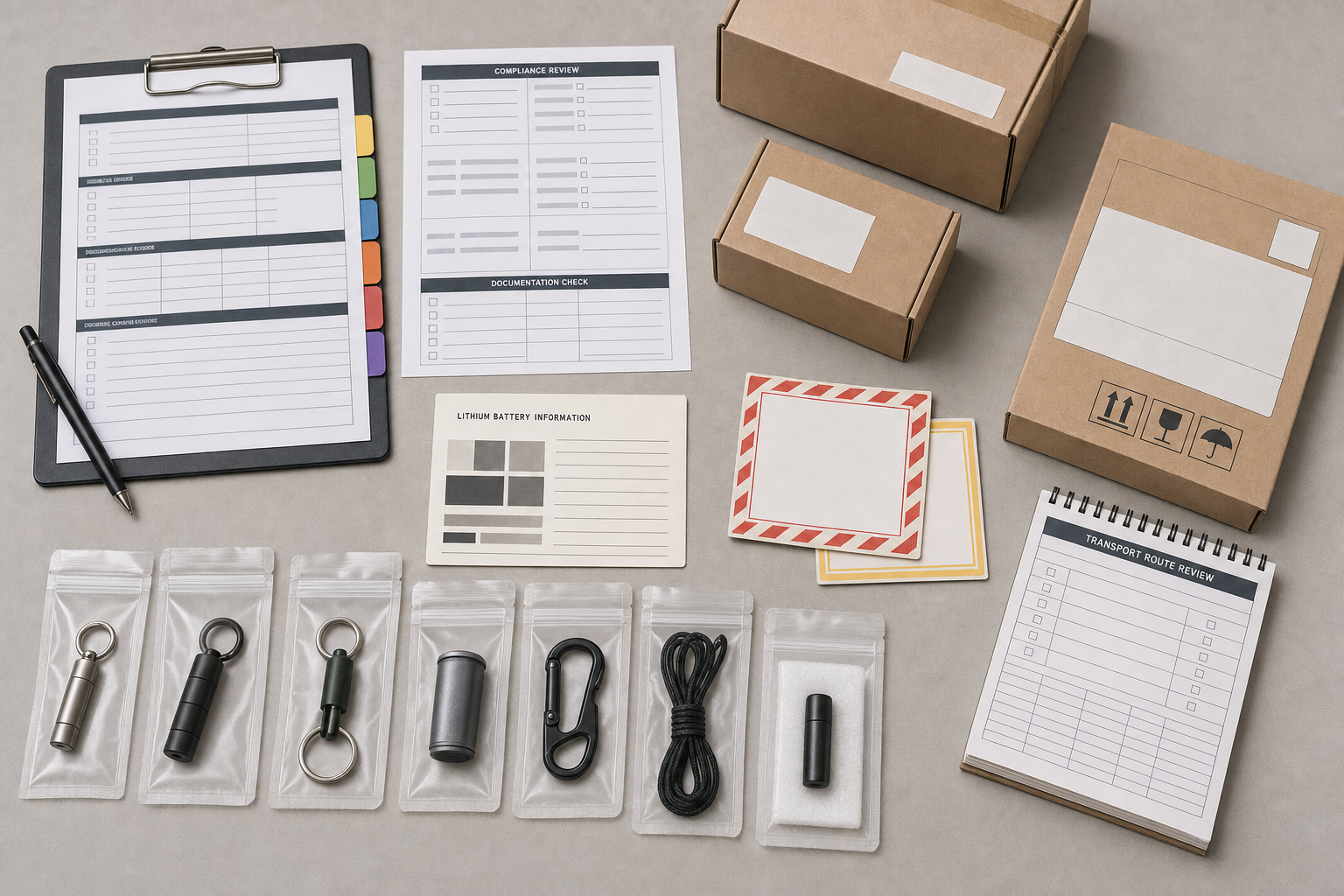
I Separate Product Safety From Outdoor Use Rules
There are two kinds of review. The first is product safety and transport review. Disposable and novelty lighters may fall under U.S. safety requirements such as 16 CFR Part 1210. FAA PackSafe says absorbed liquid and butane lighters are limited in passenger carry-on or on the person, lithium battery powered lighters are carry-on only with measures to prevent unintentional activation, and torch lighters are not allowed in the cabin or checked baggage. PHMSA states that lithium batteries are regulated as hazardous materials in transportation. These details can affect samples, ecommerce returns, air shipment, and customer instructions.
The second review is outdoor use. A tool may be legal to sell but not allowed to use in a specific campsite, park, season, or fire danger condition. The National Park Service advises users to check fire bans, restrictions, and fire danger levels and to use current guidance. This should shape buyer-facing and user-facing wording. A product can say it helps prepare a responsible camping kit. It should not promise that users can start a fire anywhere or in any condition.
I also check basic import and labeling issues. U.S. country-of-origin marking rules under 19 CFR 134.11 may matter for products or containers. If California is part of the sales plan, buyers may need to review OEHHA Proposition 65 business guidance. These topics belong in the sourcing timeline, not the final week before shipment.
| Review area | Source or rule type | Buyer action |
|---|---|---|
| Lighter safety | Consumer product safety rule | Confirm scope and certification needs |
| Battery transport | DOT or carrier rules | Request battery and shipment documents |
| Outdoor fire use | Park, forest, local fire rules | Avoid all-condition use claims |
| Import labeling | Origin and warning review | Approve package before production |
How Should Fire-Starting Tools Integrate With Knives, Multi-Tools, and Camping Kits?
A fire tool should not be thrown into a box. It needs to fit the knife, pouch, sheath, and user story.
Fire-starting tools integrate best when the size, retention, access, safety cover, striker storage, package tray, user instructions, and product story match the knife, multi-tool, pouch, or camping kit.
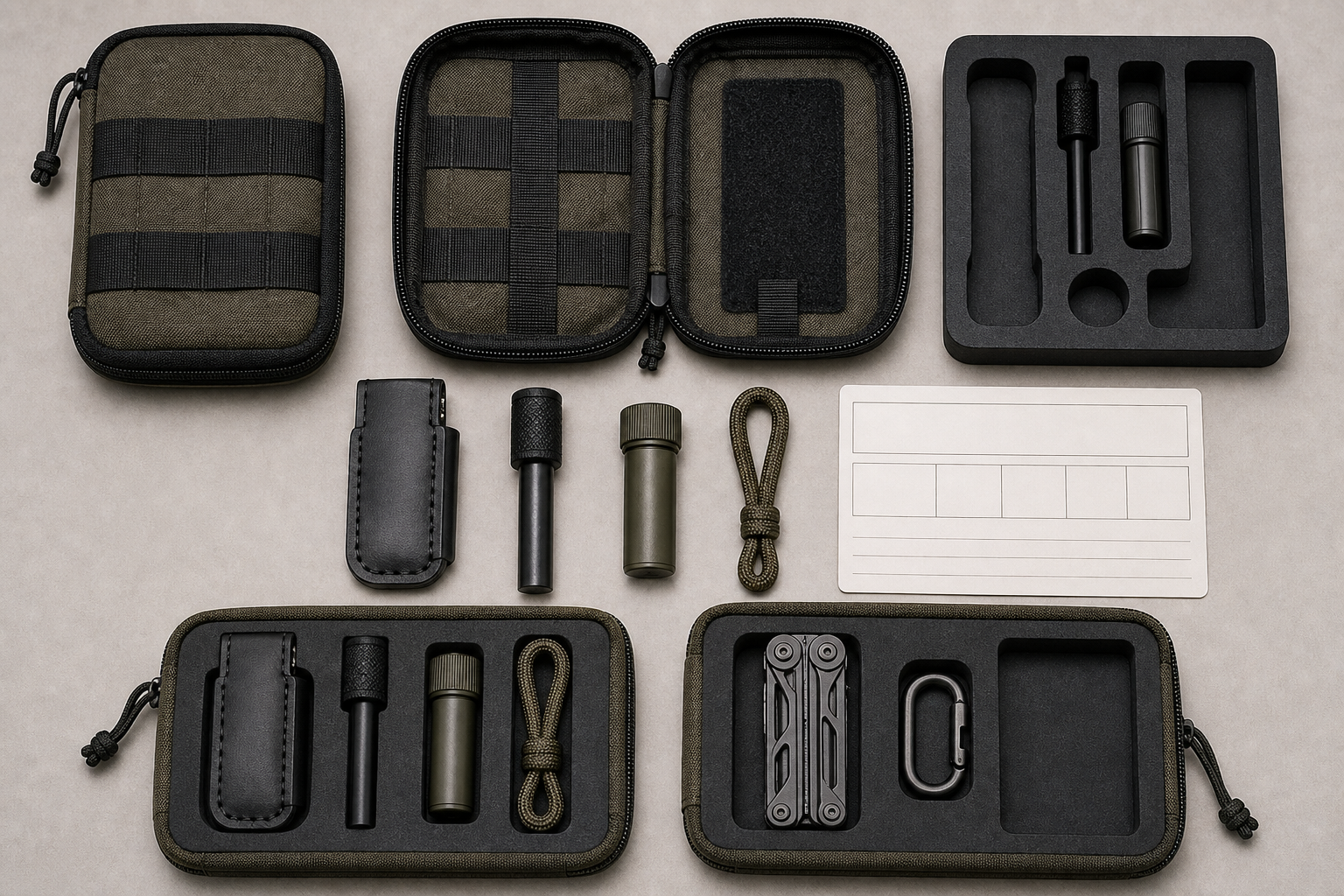
I Design the Kit as One Product
When a ferro rod is attached to a sheath, the retention must be secure. The rod should not fall out during shipping or normal carry. The striker must have a defined storage point. The tool should not scratch the knife handle, damage the pouch, or cut the packaging insert. If the fire tool is stored inside a pouch, I check whether the user can remove it easily without pulling out the whole kit.
For folding knife kits and multi-tool sets, the fire-starting accessory should support the product story. A small outdoor EDC bundle may use a compact ferro rod and whistle. A camping kit may use a larger rod, striker, and waterproof tube. A fishing kit may focus more on corrosion resistance, wet-hand grip, and sealed packaging. A rescue-style outdoor kit may include high-visibility color, but the buyer should be careful with emergency claims unless the full kit is designed and documented for that purpose.
I also think about assembly speed. A beautiful kit can become expensive if workers need too much time to tie knots, align parts, insert rods, check caps, and fold cards. In OEM production, the kit layout must be repeatable. The buyer should approve a packing method, not only a product photo.
| Integration point | What I check | Practical result |
|---|---|---|
| Sheath or pouch | Rod retention and access | Better user experience |
| Striker storage | Safe and repeatable placement | Fewer missing parts |
| Package tray | Movement, rubbing, and scratches | Cleaner retail presentation |
| Assembly method | Time, sequence, inspection | More stable repeat production |
What Packaging and User Instructions Reduce Misuse Risk?
Packaging can make a responsible tool look careless. Clear wording protects buyers, users, and distributors.
Packaging should state intended use, adult supervision where needed, fire restriction reminders, safe storage, local-rule awareness, battery or fuel warnings, product limitations, and clear "not for use where fires are prohibited" language.
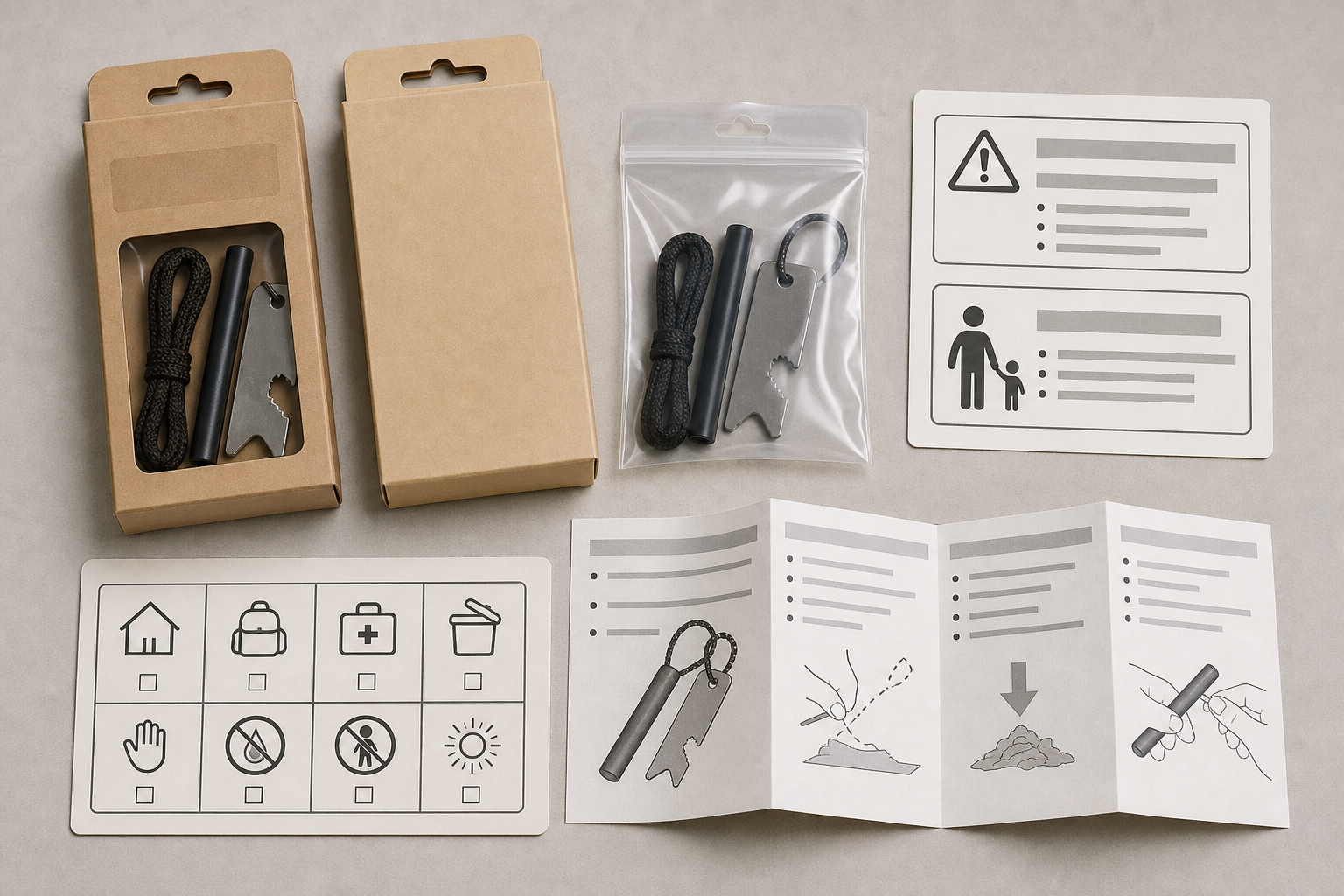
I Prefer Calm, Responsible Wording
Product copy should be practical. It can explain that the tool is for responsible outdoor preparedness, camping kits, and emergency backup. It should also remind users to follow fire bans, campsite rules, park rules, weather conditions, and local laws. The NPS Leave No Trace article says users should check fire bans or restrictions and have a plan B when campfires are restricted. That is the kind of message buyers should support.
Instructions should avoid risky excitement. I would not write "works in any condition" or "start a fire anywhere." Weather, fuel, skill, laws, and restrictions all matter. A better claim is narrower: "designed as a compact fire-starting accessory for responsible outdoor use." If the tool is a ferro rod, instructions can identify the parts, storage, care, and safe-use reminders without becoming an unsafe tutorial. If the product includes matches, fuel, or a battery, the package must include the correct warnings and handling information for the target market.
The package should also protect the product. A striker should not scratch a coated knife. Matches should stay sealed. An electric igniter should not activate during shipping. A QR code or insert can send buyers to extended instructions, but the visible package still needs core warnings. For B2B buyers, packaging is part of risk management.
| Packaging element | What to include | Why it helps |
|---|---|---|
| Intended use | Responsible outdoor kit accessory | Sets buyer expectation |
| Restriction reminder | Follow fire bans and local rules | Reduces unsafe claims |
| Storage note | Keep dry, secure, and away from children | Supports safer handling |
| Product limitation | Not for prohibited locations or unsafe conditions | Keeps claims realistic |
What Should Buyers Include in a Fire-Starting Tool OEM or ODM RFQ?
A fire-tool RFQ must be specific. Otherwise, suppliers may quote a product that cannot be shipped, labeled, or sold cleanly.
A fire-starting tool RFQ should include ignition type, intended use, target market, safety boundary, material, size, accessory parts, packaging, warning copy, test requirements, transport route, MOQ, target price, delivery term, and sample approval process.
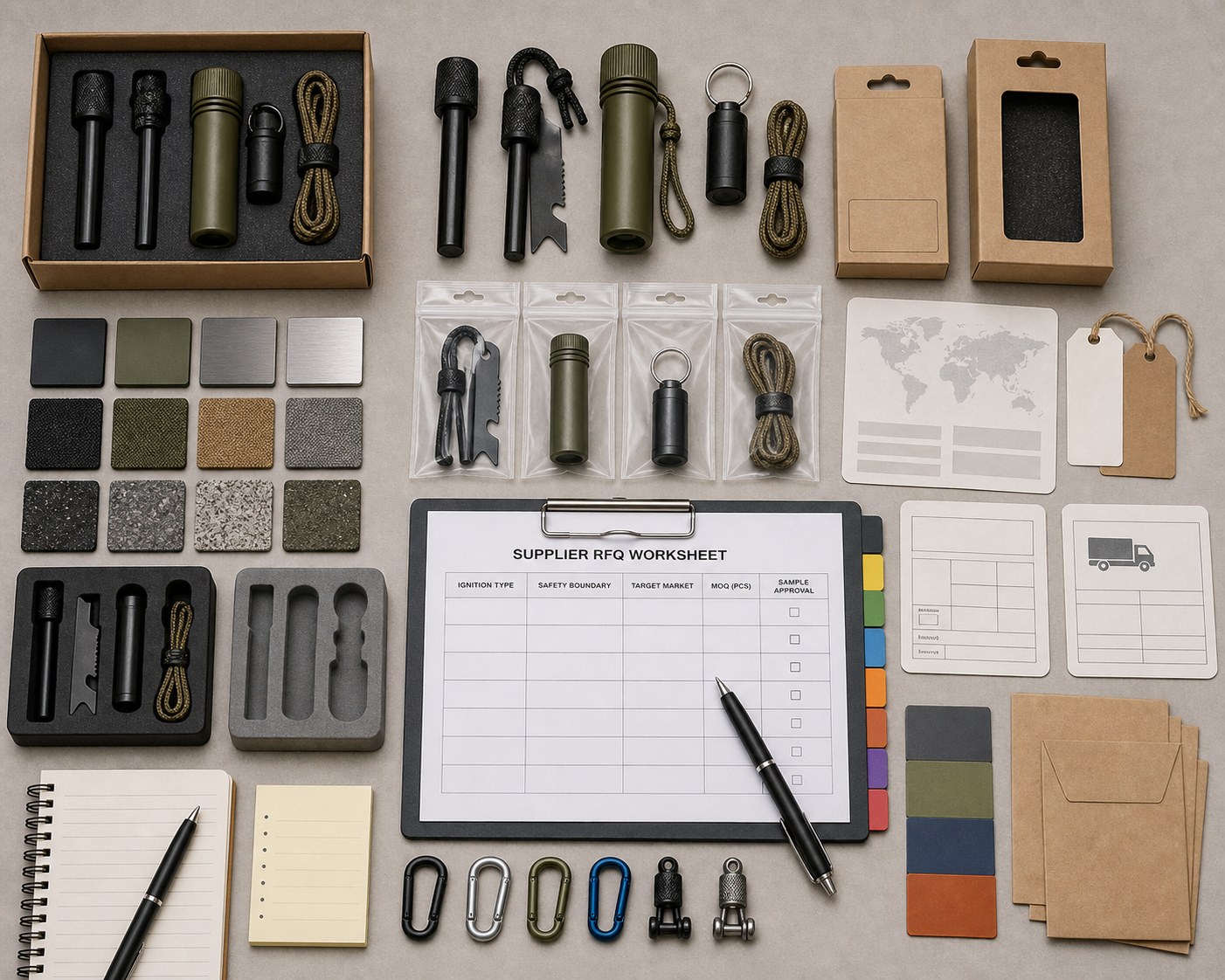
I Use the RFQ to Prevent Late Rework
The RFQ should start with the product boundary. Is the buyer asking for a ferro rod, match container, lighter, electric igniter, tinder container, or mixed kit? Is the product an accessory for a knife sheath, camping kit, fishing kit, rescue-style pouch, or retail gift set? Is it for adult outdoor users only? Does the buyer need any warning statement, retailer policy review, battery document, fuel restriction review, or import marking?
Then I ask for physical details. For a ferro rod, the buyer should specify rod size, handle material, striker type, lanyard, color, logo, packaging, and inspection points. For a match tube, the buyer should define tube material, cap, gasket, striker area, refill plan, and shelf-life expectations. For electric igniters, the buyer should provide battery requirements, charging method, safety lock, transport documents, and destination-market review. If the buyer is not sure, I would suggest starting with the lower-complexity option and moving up only when the commercial reason is strong.
Commercial details also matter. The buyer should provide MOQ target, target price, delivery term, packaging quantity, carton requirements, and sample schedule. The ICC Incoterms rules help buyers and sellers clarify delivery responsibilities, costs, and risks in goods transactions. A fire-starting accessory may be small, but a clear trade term and inspection plan still protect the order.
| RFQ field | What to specify | Why it helps |
|---|---|---|
| Ignition type | Ferro rod, matches, lighter, electric igniter | Sets safety and sourcing path |
| Use boundary | Camping accessory, emergency kit, adult outdoor use | Controls product claims |
| Compliance review | Fuel, battery, lighter, warning, origin mark | Reduces launch risk |
| Commercial terms | MOQ, target price, Incoterm, timeline | Makes quoting realistic |
Turn this article into a fixed blade project.
Send your target use, blade size, steel, handle direction, sheath needs, quantity, and packaging plan. Vast State can help shape it into a quote-ready project.
Conclusion
I build better fire-starting kits by defining use, safety limits, materials, packaging, transport, and RFQ details before sampling.
Source Notes
- The National Park Service fire safety page supports the need to treat campfire use as a safety topic.
- The NPS Leave No Trace campfire impact article supports reminders about fire bans, restrictions, current guidance, water, attendance, and putting fires out completely.
- 16 CFR Part 1210 supports the point that disposable and novelty lighters can fall under child-resistance and certification-related requirements.
- FAA PackSafe lighters supports the need to review passenger and air-travel limits for fuel lighters, lithium battery powered lighters, and torch lighters.
- PHMSA lithium battery transportation supports extra planning for electric igniters that contain lithium batteries.
- 19 CFR 134.11, OEHHA Proposition 65 guidance, ISO quality management principles, and ICC Incoterms rules support origin, warning, quality, and trade-term review.