7Cr17MoV can look like a simple budget steel choice, but vague expectations create trouble. I judge it by project fit, not by name.
7Cr17MoV can be practical for OEM/ODM knives when buyers need a cost-controlled stainless steel for entry or mid-entry products. It should be specified with clear chemistry, heat treatment, target hardness, blade geometry, finish, packaging claims, and inspection records because it is not a high-end edge-retention steel.
Quick buyer brief:
- Answer: Use 7Cr17MoV for cost-sensitive stainless programs when care expectations and performance claims are controlled.
- Buyer context: This helps knife brands, importers, wholesalers, distributors, and private label buyers source budget or mid-entry knives.
- Key checks: Steel name, chemistry range, target HRC, heat treatment, grind, edge angle, finish, corrosion expectation, packaging claim, and QC record.
Planning a knife project with this steel?
Send us your target market, MOQ, price range, and blade type. Vast State can help you choose the right steel, HRC range, finish, handle material, and QC requirements for OEM/ODM production.
When a buyer asks me whether 7Cr17MoV is good, I first ask good for what. A promotional pocket knife, a simple folding knife, a budget outdoor tool, and a higher-positioned EDC product need different steel logic. 7Cr17MoV can be useful when the buyer wants stainless behavior, easy sourcing, controlled cost, and acceptable daily cutting performance. But it should not be sold like a premium powder steel or specified with vague steel language.
What Is 7Cr17MoV in Practical Knife Sourcing?
A steel name can sound precise, but sourcing names are not always enough. I ask buyers to define the actual material requirement.
In practical sourcing, 7Cr17MoV is commonly treated as a Chinese stainless knife steel in the 7Cr17 or 440A-type family. Buyers should verify chemical limits and certificates instead of relying on the name alone.
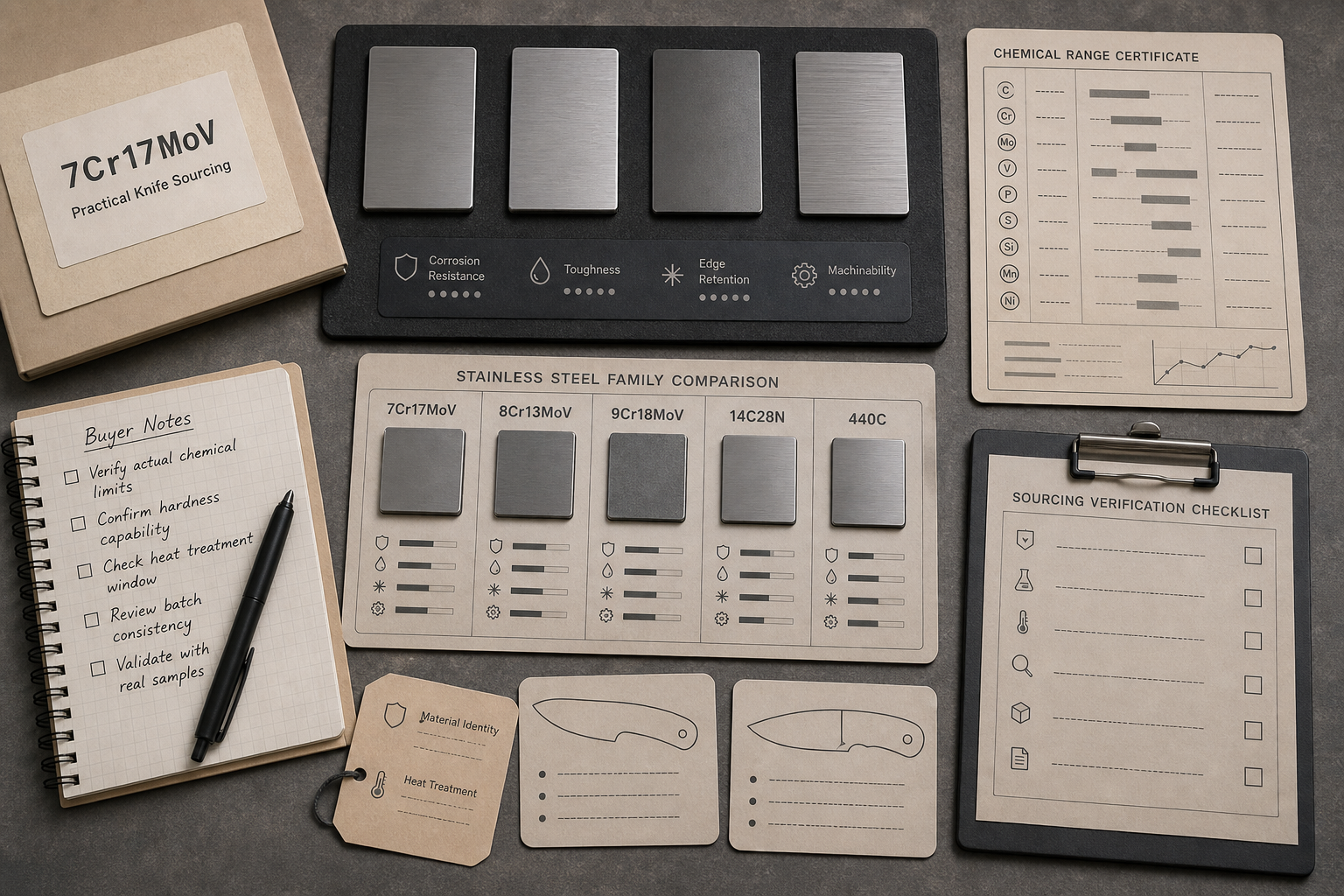
I clarify the steel before I quote the knife
The first issue with 7Cr17MoV is not whether it is useful. The first issue is whether everyone means the same thing by the name. ZKnives lists 7Cr17MoV as a Chinese equivalent of AISI 440A stainless steel, but it also notes that "7Cr17MoV" is not strictly the standard name in the referenced GB standards. This matters for B2B orders because a buyer may write one name in the RFQ while different suppliers interpret it slightly differently.
For that reason, I prefer to specify the expected chemistry range, the accepted equivalent, and the inspection document. If the buyer wants 7Cr17MoV, I ask whether the project can accept 7Cr17, 440A-type stainless, or another cost-controlled stainless alternative. I also ask whether the buyer needs a mill certificate, heat treatment record, hardness report, or incoming material check.
This approach prevents a common problem. A buyer may think the steel name alone guarantees performance. In reality, the finished knife depends on steel source, heat treatment, blade geometry, edge angle, grinding heat control, and final inspection. The name starts the conversation. It does not finish it.
| Sourcing point | What I check | Why it matters |
|---|---|---|
| Steel name | 7Cr17MoV, 7Cr17, or 440A-type direction | Avoids vague purchasing language |
| Chemistry | Carbon, chromium, molybdenum, and other limits | Confirms the material family |
| Documents | Mill certificate and heat treatment record | Supports repeat orders |
| Alternatives | 420 series, 8Cr/9Cr, 440A, 14C28N | Keeps the project practical if supply or cost changes |
Quote-ready RFQ Checklist for This Steel
To get an accurate OEM/ODM quote, prepare these details before contacting a knife manufacturer.
| RFQ Field | What to Prepare |
|---|---|
| Product type | Folding knife / fixed blade / multi-tool / kitchen knife |
| Target market | US / EU / outdoor retail / promotional / tactical / EDC |
| Steel option | 4116 / 14C28N / D2 / N690 / Nitro-V |
| Target HRC | Example: 55-57 HRC, 58-60 HRC |
| Blade finish | Satin / stonewash / black coating / bead blast |
| Handle material | G10 / micarta / aluminum / stainless steel / wood |
| Lock or structure | Liner lock / frame lock / slip joint / full tang |
| Estimated quantity | 500 / 1,000 / 3,000 / 5,000+ pcs |
| Packaging | White box / color box / blister / pouch / gift box |
| Required documents | Drawing / sample photo / logo file / packaging artwork |
When Does 7Cr17MoV Fit an OEM/ODM Knife Project?
Budget steel can be a smart choice, but only when the product promise is honest. I match it to the right SKU level.
7Cr17MoV fits OEM/ODM projects when buyers need a cost-controlled stainless blade for entry, promotional, catalog, or basic utility knives. It works best when the product does not promise premium edge retention.
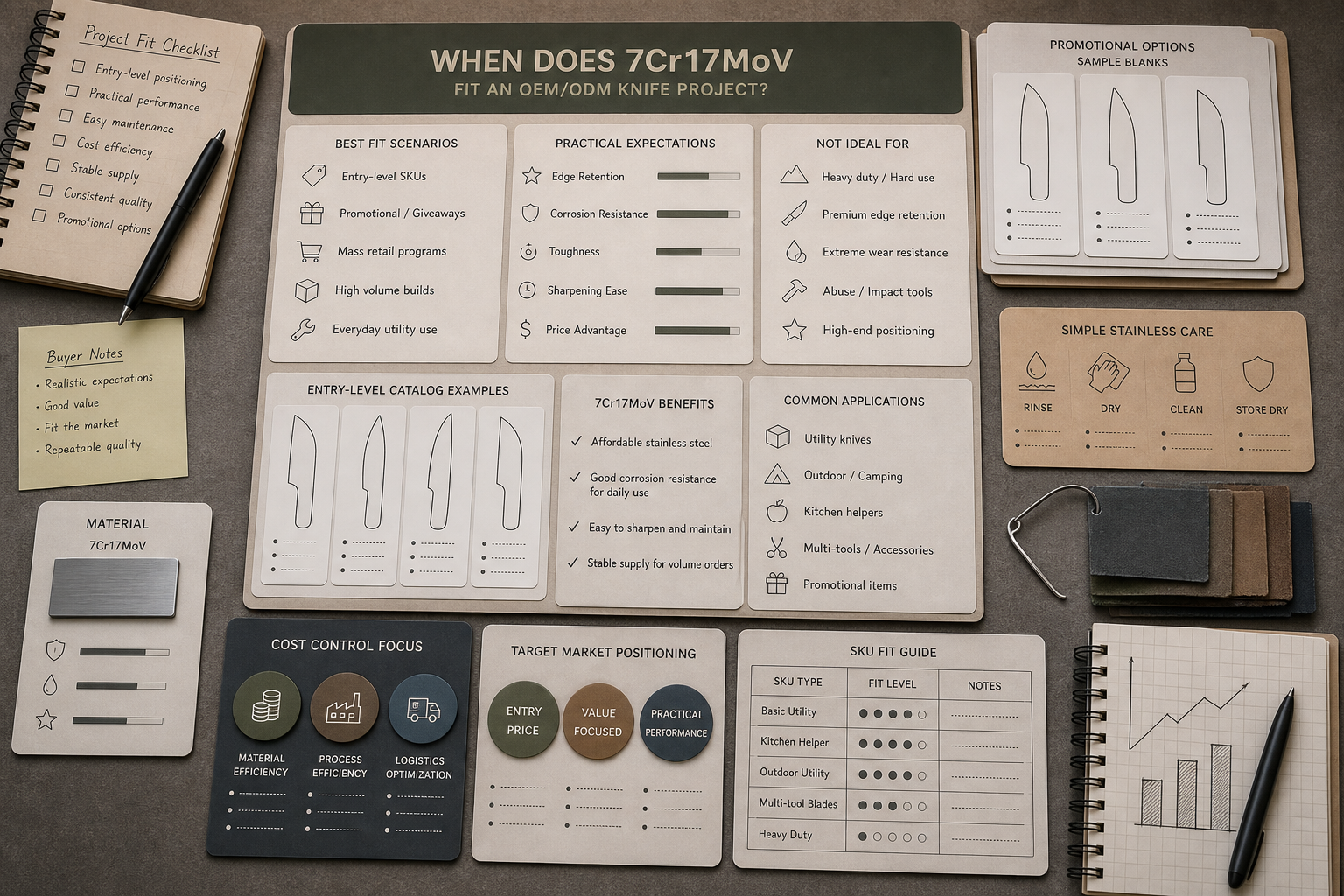
I use it when cost and stainless behavior matter
7Cr17MoV can be a reasonable choice for buyers who need stainless behavior at a controlled cost. It can fit entry pocket knives, simple folding knives, promotional knives, outdoor catalog items, and private label programs where the customer expects basic daily cutting, easy care, and a competitive price. It is not the steel I would choose when the buyer wants a high-end steel story, long abrasive edge retention, or premium positioning.
This is important because B2B buyers often need more than one product level. A catalog may need a budget SKU, a better mid-range SKU, and a higher-positioned SKU. 7Cr17MoV can fill the budget or mid-entry layer if the design, heat treatment, and claims are honest. It lets the buyer save cost for handle design, packaging, clip design, or MOQ flexibility. But if the buyer sells it with exaggerated performance language, the steel can create disappointment.
I usually ask the buyer to define the selling channel. A distributor program may accept this steel when price, repeat supply, and simple care matter. A brand launch that depends on enthusiast reviews may need a stronger steel option.
| Project type | Fit for 7Cr17MoV | Main caution |
|---|---|---|
| Promotional pocket knife | Often suitable | Keep claims simple |
| Entry folding knife | Often suitable | Control heat treatment and edge |
| Budget outdoor SKU | Sometimes suitable | Check corrosion and sharpening expectations |
| Enthusiast EDC SKU | Usually limited | Consider a higher steel tier |
How Does 7Cr17MoV Compare With 440A and Other Budget Stainless Options?
Steel comparisons can become messy when names overlap. I compare material families, not marketing labels.
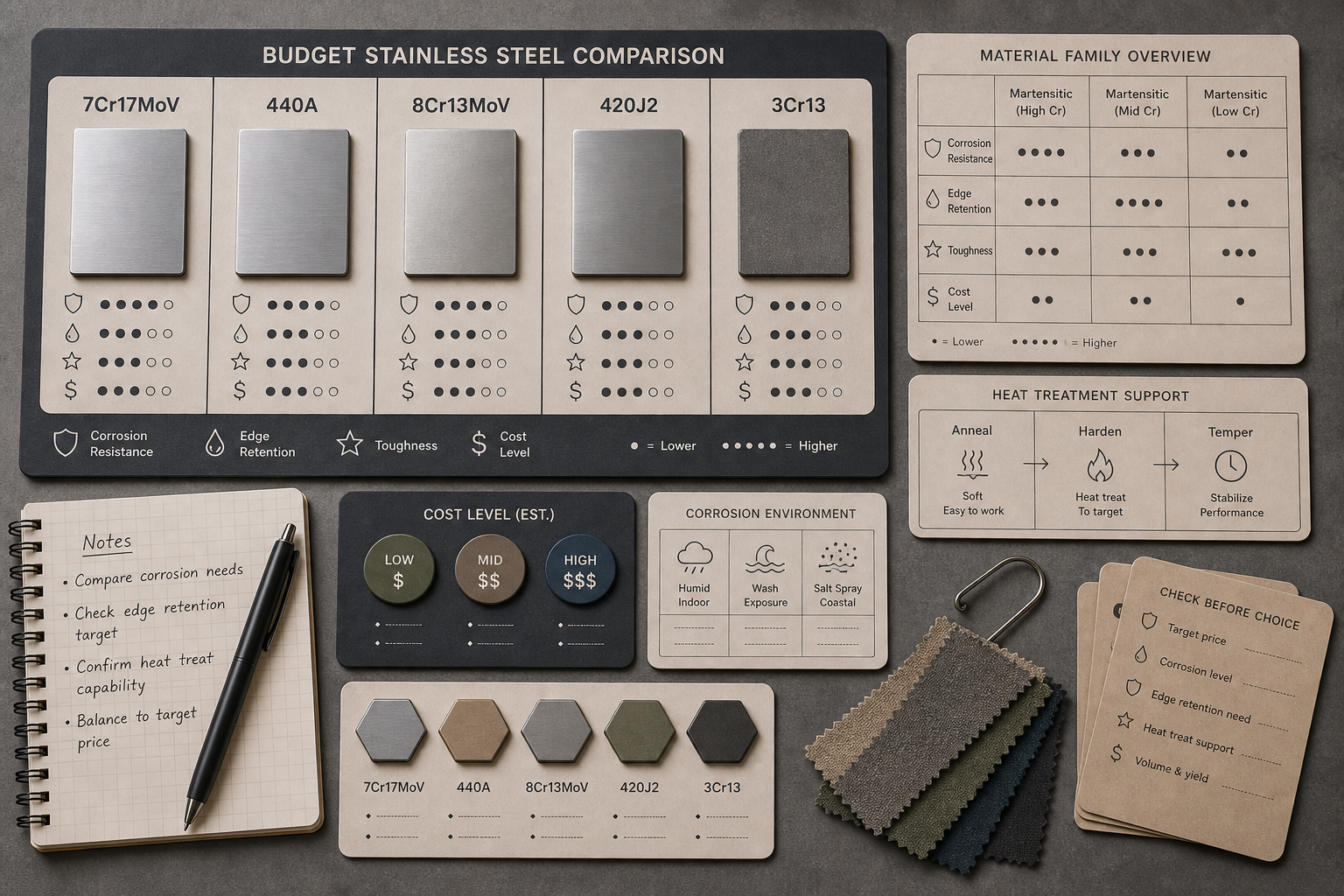
7Cr17MoV is often compared with 440A-type stainless steels. Buyers should compare it against 420-series, 8Cr/9Cr-type stainless, 440A, and 14C28N by cost, corrosion behavior, edge expectation, supply, and heat treatment support.
I compare by finished product result
AZoM describes 440A stainless steel as a high-carbon martensitic stainless steel with good strength, moderate corrosion resistance, and excellent hardness and wear resistance. Carpenter Technology describes 440A as a high-carbon, high-chromium martensitic stainless steel designed to provide stainless properties with excellent hardness. These references are useful because 7Cr17MoV is often discussed as a 440A-type sourcing direction.
Still, I avoid treating every 7Cr17MoV blade as identical to every 440A blade. Supplier source, chemical limits, heat treatment, thickness, grind, edge angle, and finish can change the final knife. A lower-cost 420-series option may be enough for very basic products. An 8Cr/9Cr-type option may give a different balance for some buyers. A 14C28N direction may better support a stronger mid-range story if the budget allows it. D2 may help a wear-resistance story, but it brings different care expectations.
The best comparison is not a ranking table. It is a product decision. I ask what problem the steel must solve. If the answer is "keep cost low and offer stainless care," 7Cr17MoV can be considered. If the answer is "support a stronger performance story," I often compare alternatives.
| Steel direction | Practical strength | Buyer caution |
|---|---|---|
| 420-series stainless | Very cost controlled and easy care | Lower edge expectation |
| 7Cr17MoV / 440A-type | Budget stainless with better product story | Needs clear heat treatment and claims |
| 8Cr/9Cr-type stainless | Common cost-performance option | Verify grade and consistency |
| 14C28N direction | Stronger balanced stainless story | Higher cost than budget grades |
What Performance Expectations Should Buyers Set for 7Cr17MoV?
The wrong expectation creates complaints. A budget stainless steel should not be promised like a premium powder steel.
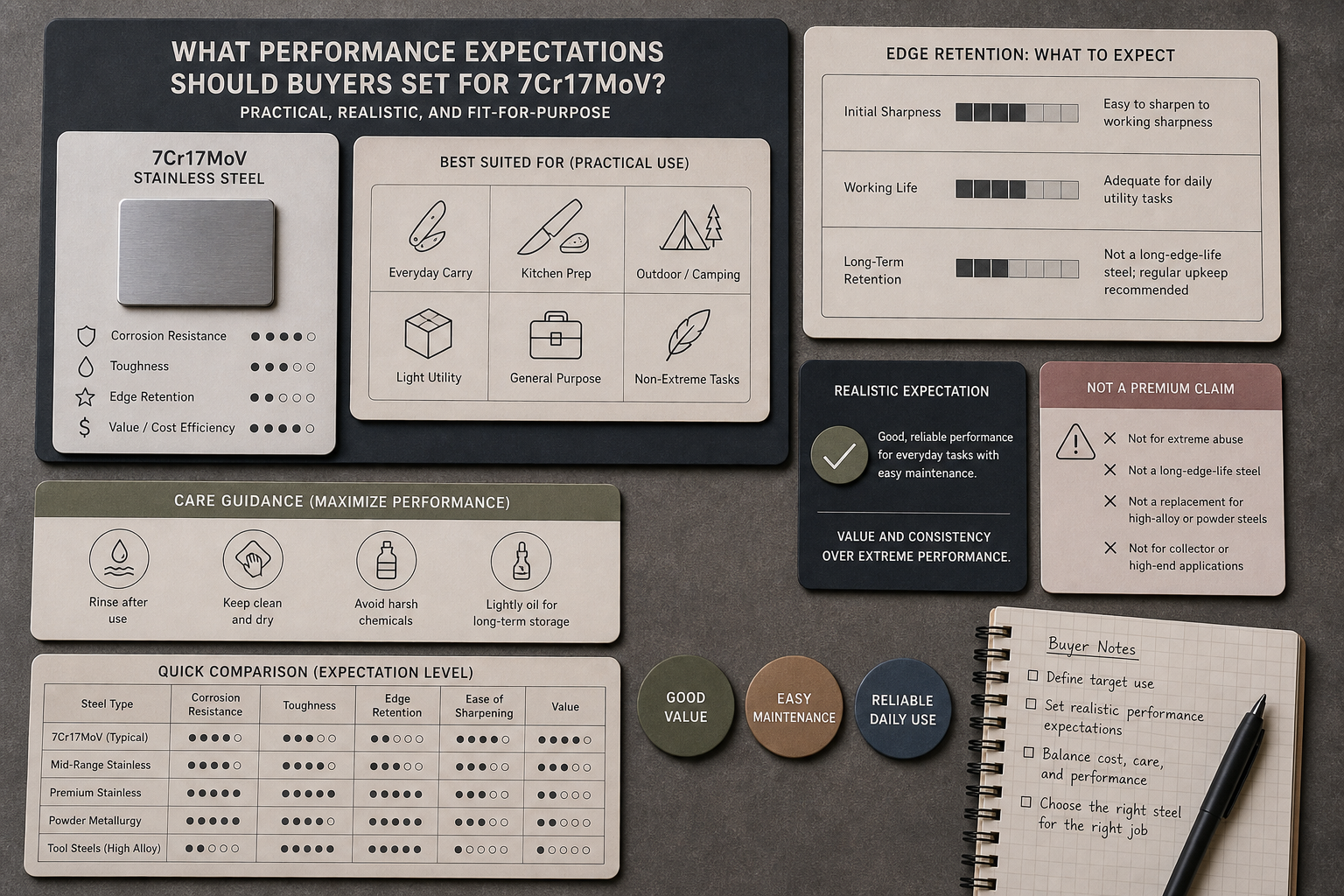
Buyers should expect 7Cr17MoV to support basic stainless utility when heat treated and ground well. They should not position it as a premium edge-retention steel or use it for claims that the geometry cannot support.
I set the claim before the package is printed
For 7Cr17MoV, the strongest selling direction is usually practical stainless utility at a controlled price. I would not describe it as a premium steel. I would not let the package imply extreme wear resistance. I would describe the knife around practical daily cutting, easy maintenance, and value, if the finished sample supports those claims.
Knife Steel Nerds explains that steel properties should be judged through toughness, edge retention, and corrosion resistance, and that edge geometry strongly affects real cutting behavior. This applies directly to 7Cr17MoV. A well-ground blade with a suitable edge angle can feel better than a poorly ground blade in a more expensive steel. At the same time, a good geometry cannot turn a budget stainless steel into a high-wear powder steel. Both things can be true.
I also pay attention to the target user. A buyer who sells to casual users may benefit from a steel that is easy to maintain and resharpen. A buyer who sells to enthusiasts may face stronger questions about edge retention and steel tier. For 7Cr17MoV, honest positioning is part of quality control.
| Expectation | Practical wording | Risky wording |
|---|---|---|
| Corrosion behavior | Stainless blade for easier care | Rust-proof or maintenance-free |
| Edge behavior | Suitable for basic daily cutting | Premium long-edge performance |
| Sharpening | Easier to resharpen than harder steels | Never needs sharpening |
| Value | Cost-controlled stainless option | High-end steel claim |
Why Are Heat Treatment and Hardness Records Important for 7Cr17MoV?
Steel grade does not become a blade by itself. Poor heat treatment can make a reasonable material perform badly.
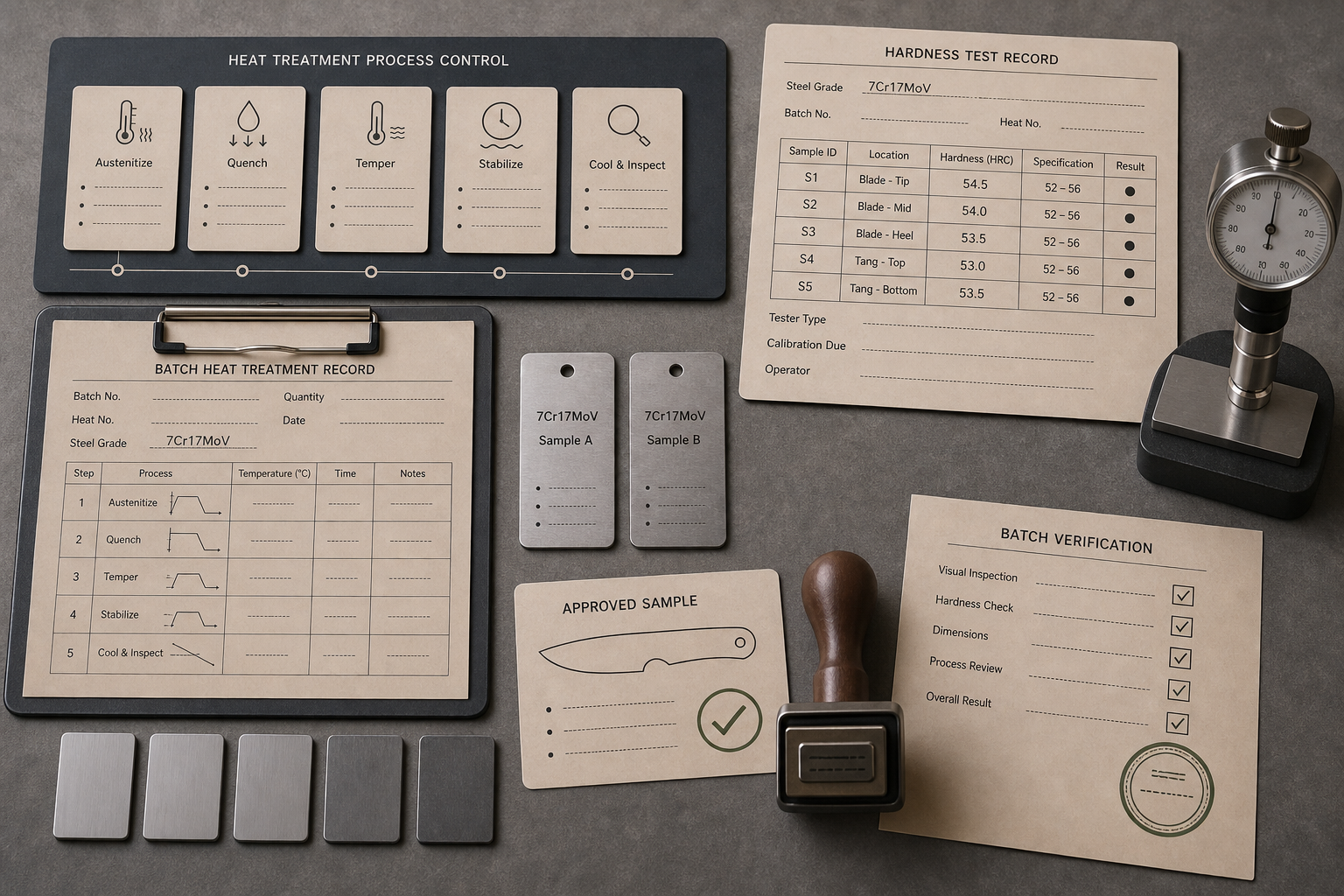
Heat treatment and hardness records are important because 7Cr17MoV needs controlled hardening, tempering, and testing to deliver stable batch performance. Buyers should define target HRC and ask how the supplier verifies it.
I ask for the process record, not only the grade
Heat treatment controls the final behavior of martensitic stainless steels. A blade that is too soft may lose its working edge too quickly. A blade that is too hard for its geometry may become less forgiving. A poor process can also create inconsistent results across the order. For a budget steel project, this matters because the buyer often orders larger quantities and needs stable repeat production.
The NIST guide to Rockwell hardness measurement explains that good practice helps reduce measurement errors in Rockwell hardness testing. I use that principle in practical sourcing. I ask for a target HRC range that fits the steel and knife type. I also ask how many samples are tested per batch and whether the hardness test location is reasonable for the blade design.
The target should not be chosen only to look good in marketing. A higher HRC number may sound better, but the real knife must balance edge retention, toughness, sharpening, blade thickness, and use case. For 7Cr17MoV, a stable and realistic hardness range is usually more useful than chasing the highest possible number.
| Control point | What buyers should ask | Why it matters |
|---|---|---|
| Target HRC | Practical hardness range for the knife | Keeps expectations measurable |
| Batch testing | Number of pieces and test method | Finds inconsistency early |
| Heat treatment record | Process and batch traceability | Supports repeat orders |
| Approved sample | Physical reference for edge and finish | Prevents production drift |
How Do Blade Geometry and Finish Affect 7Cr17MoV Results?
A budget steel can feel worse if the grind is wrong. A smart geometry can make the product feel more honest.
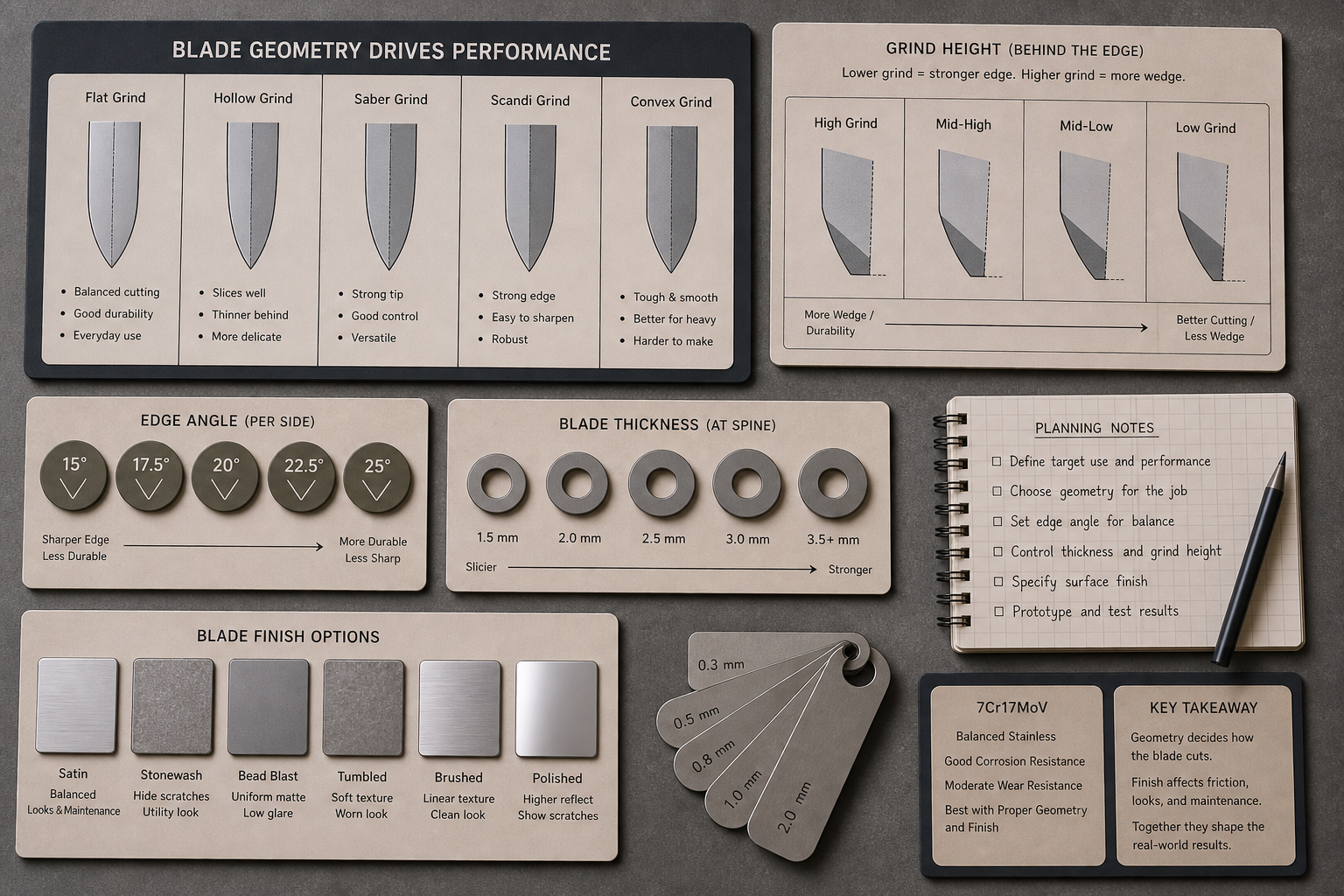
Blade geometry and finish strongly affect 7Cr17MoV results. Buyers should define blade thickness, grind height, thickness behind the edge, edge angle, sharpening standard, and surface finish before approving production.
I make the blade easy to succeed
Geometry can make or break a 7Cr17MoV knife. If the blade is too thick behind the edge, the user may feel poor cutting even if the edge is sharp. If the edge angle is too thin for the intended task, the blade may not feel stable enough. If the grind overheats the edge, performance can suffer before the knife even leaves the factory. This is why I connect steel choice with blade shape and grind plan.
For cost-sensitive projects, I usually keep the geometry practical. A simple drop point or utility profile with a clean flat or saber-style grind may be easier to produce consistently than a complicated blade with many transitions. A straightforward geometry can also make sharpening easier for the final user. This matters because 7Cr17MoV is usually chosen for value, not for extreme steel performance.
Finish also matters. Satin, stonewash, bead blast, black coating, or polish each changes appearance, cost, and corrosion-care expectations. On budget stainless projects, I prefer a finish that the factory can repeat cleanly and inspect quickly. A finish that hides small handling marks can reduce reject pressure, but it should still match the brand style.
| Design choice | Better direction | Buyer check |
|---|---|---|
| Blade thickness | Practical strength without too much drag | Confirm stock thickness and tolerance |
| Grind | Simple and repeatable | Approve bevel symmetry on samples |
| Edge angle | Balanced for daily utility | Define sharpening standard |
| Finish | Repeatable and honest for price level | Check corrosion-care language |
How Should Buyers Package and Describe 7Cr17MoV Knives?
Packaging can create trust or disappointment. I keep the steel claim clear, practical, and easy for the buyer's customer to understand.
Buyers should describe 7Cr17MoV as a cost-controlled stainless knife steel for practical use, not as a premium steel. Packaging should mention care, steel grade, main use, and quality checks without exaggerated performance claims.
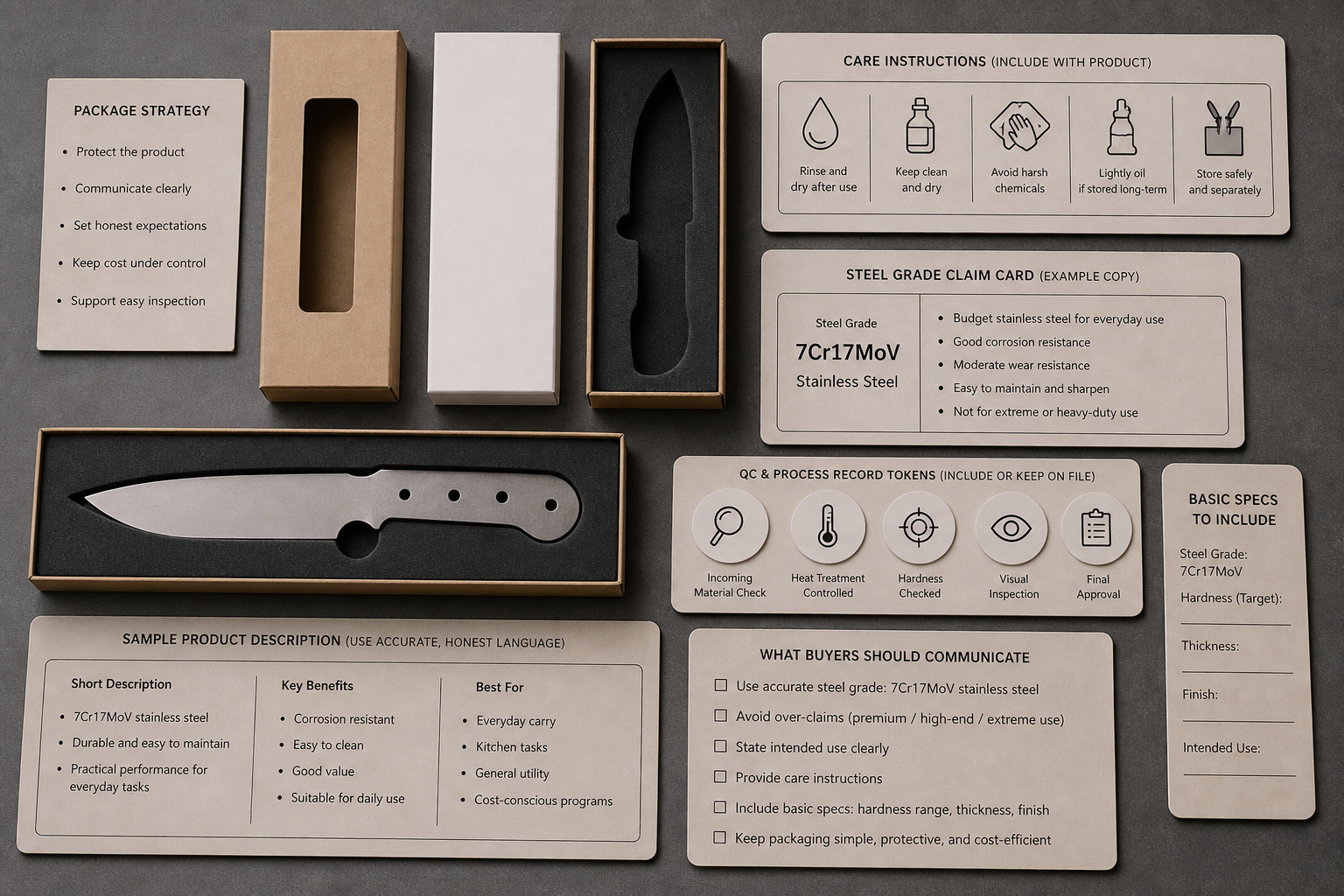
I use simple claims that the steel can support
For 7Cr17MoV, packaging should help the buyer sell value without creating false expectations. I prefer wording around stainless steel, practical daily cutting, easy care, and cost-effective utility. I avoid language that suggests high-end steel, extreme edge retention, or no maintenance. A casual buyer may not know steel grades, but the product claim still needs to be fair.
Packaging should also connect with the target channel. A wholesale catalog item may only need a clear steel line, basic care note, barcode, and simple feature list. A private label brand may want a short steel explanation and a more polished insert. A distributor may need language that works across several markets. In all cases, the buyer should review local product claim rules and retailer requirements. This article is not legal advice, so market-specific review still belongs with the buyer.
The ISO 9001 supply chain guide explains that buyers must make their product needs and expectations clear to suppliers. I apply the same idea to packaging. The buyer should specify the steel name, approved wording, care note, packaging format, and inspection criteria before production.
| Packaging item | Recommended approach | Why it helps |
|---|---|---|
| Steel line | State the grade plainly | Avoids confusion |
| Care note | Explain basic cleaning and drying | Reduces unrealistic expectations |
| Feature claim | Focus on value and stainless utility | Matches the steel tier |
| QC note | Keep internal records even if not printed | Supports repeat production |
What Should Buyers Put in a 7Cr17MoV RFQ?
A material request without process detail is incomplete. I need steel, geometry, heat treatment, and business targets together.
A 7Cr17MoV RFQ should include steel grade, accepted equivalents, chemistry or certificate needs, blade type, thickness, grind, target HRC, finish, handle material, lock type, packaging, MOQ, target price, and inspection requirements.
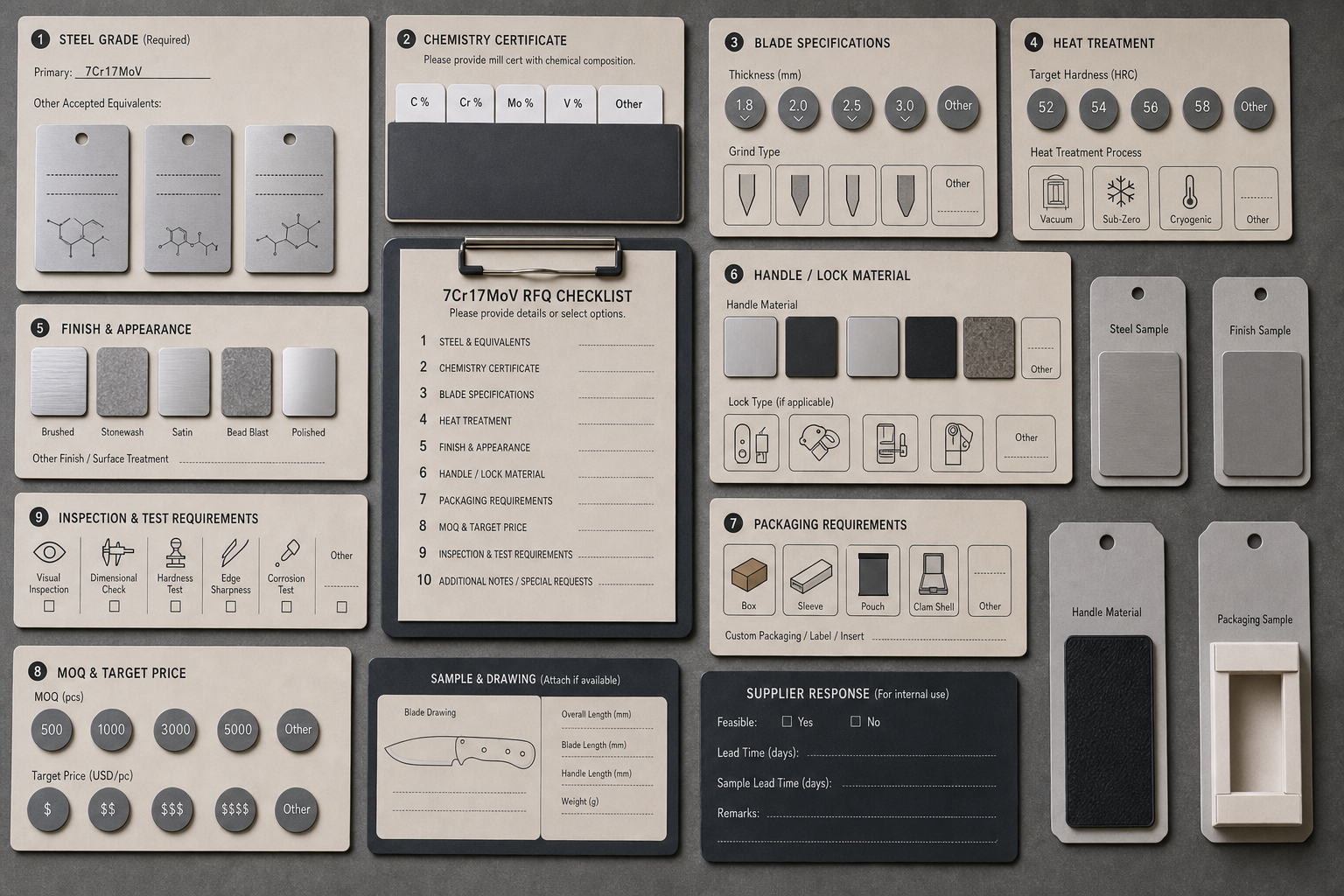
I turn a steel name into a control document
The best RFQ for 7Cr17MoV is not just one line. It should tell the supplier what the buyer wants the finished product to be. I ask for the knife type, blade shape, blade length, stock thickness, grind, edge angle, steel grade, accepted equivalents, chemistry confirmation, target HRC, finish, handle material, lock type, logo method, packaging type, market, MOQ, target price, and inspection standard.
I also ask the buyer to explain the product level. Is this a promotional order, an entry retail knife, a catalog SKU, or a private label line? That answer affects whether 7Cr17MoV is appropriate and whether an alternative should be quoted. If the buyer wants stronger edge-retention claims, I may suggest a higher steel tier. If the buyer wants value and stainless care, I may keep 7Cr17MoV and focus on stable heat treatment and clean finishing.
For repeat production, the RFQ should become the control reference. It should define what cannot change between orders. This protects the buyer, the supplier, and the final product.
| RFQ field | What to specify | Why it helps |
|---|---|---|
| Steel requirement | 7Cr17MoV plus accepted equivalent and certificate need | Reduces material ambiguity |
| Heat treatment | Target HRC and record requirement | Keeps batches consistent |
| Geometry | Thickness, grind, edge angle | Makes performance measurable |
| Commercial target | MOQ, target price, packaging, market | Keeps the steel decision realistic |
Ready to use this material in your next knife line?
Vast State can help you compare blade steels, heat treatment ranges, handle materials, finishes, packaging options, and QC requirements based on your target market and quantity.
Conclusion
I use 7Cr17MoV when buyers need honest, cost-controlled stainless utility with clear specs, realistic claims, and stable production control.
Source Notes
- ZKnives 7Cr17MoV provides context that 7Cr17MoV is commonly treated around the 7Cr17 or 440A stainless family, with naming cautions.
- AZoM 440A stainless steel supports the 440A composition and property background used for comparison.
- Carpenter Technology 440A supports the description of 440A as high-carbon, high-chromium martensitic stainless steel with hardness and corrosion properties.
- Knife Steel Nerds steel ratings supports the need to compare steel trade-offs and edge geometry.
- NIST Rockwell hardness guidance supports the importance of good hardness measurement practice.
- ISO 9001 in the supply chain supports the need for buyers to define product requirements, approvals, monitoring, and inspections.