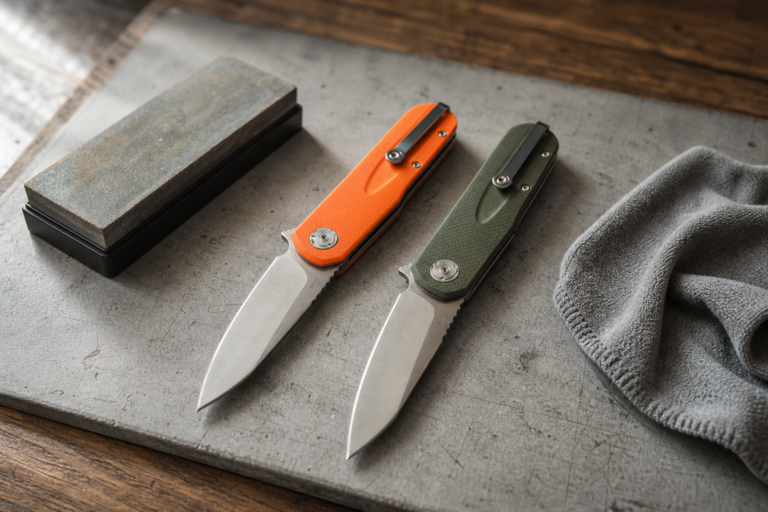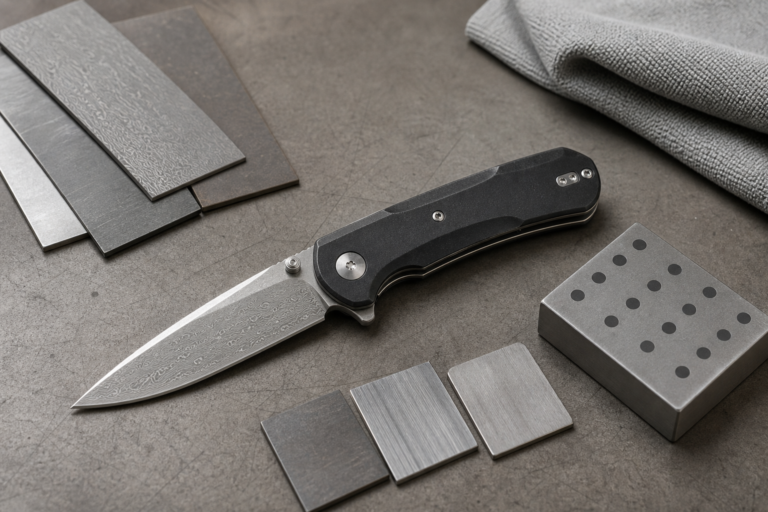
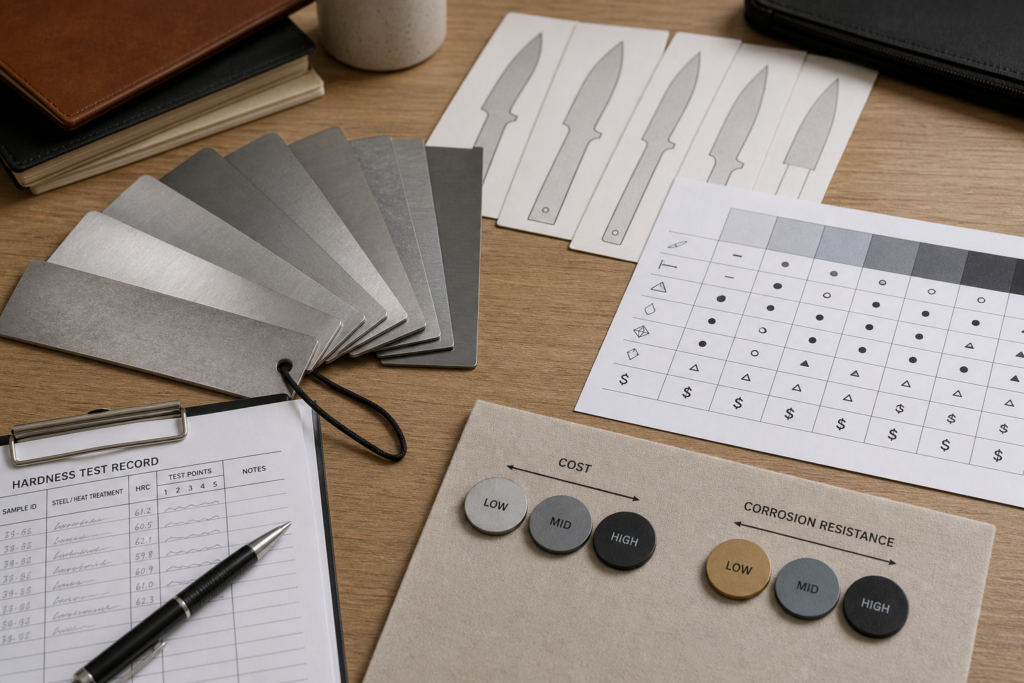
A steel list can look helpful, but it can also mislead buyers. I turn knife steel names into product, cost, and production decisions.
Buyers should use a knife steel guide by comparing product positioning, target market, toughness, edge retention, corrosion resistance, heat treatment, grinding cost, sharpening expectations, and QC records. The right steel is not the most famous name. It is the steel that fits the knife, price, and repeat production plan.
Quick buyer brief:
- Answer: Choose knife steel by use case, price, corrosion need, edge geometry, heat treatment, and QC proof.
- Buyer context: This helps B2B knife brands, importers, wholesalers, distributors, and private label buyers build practical OEM/ODM lines.
- Key checks: Steel grade, target HRC, heat treatment, blade thickness, grind, finish, sharpening, MOQ, cost, packaging claims, and batch records.
Planning a knife project with this steel?
Send us your target market, MOQ, price range, and blade type. Vast State can help you choose the right steel, HRC range, finish, handle material, and QC requirements for OEM/ODM production.
When a buyer sends me a steel list, I do not choose only from popularity. I first ask what the knife must sell for, where it will sell, how it will be used, and what the customer will expect after purchase. A budget stainless steel, D2, 14C28N, S35VN, M390, or another powder steel can all be right in the proper project. The problem starts when the steel name is chosen before the product plan is clear.
Why Should Knife Steel Start With the Product Positioning?
Steel can become an expensive mistake when the product level is unclear. A famous grade can damage margin if the SKU cannot support it.
Knife steel should start with product positioning. Buyers should define target price, market level, use case, corrosion need, sharpening expectation, and brand promise before choosing a grade.
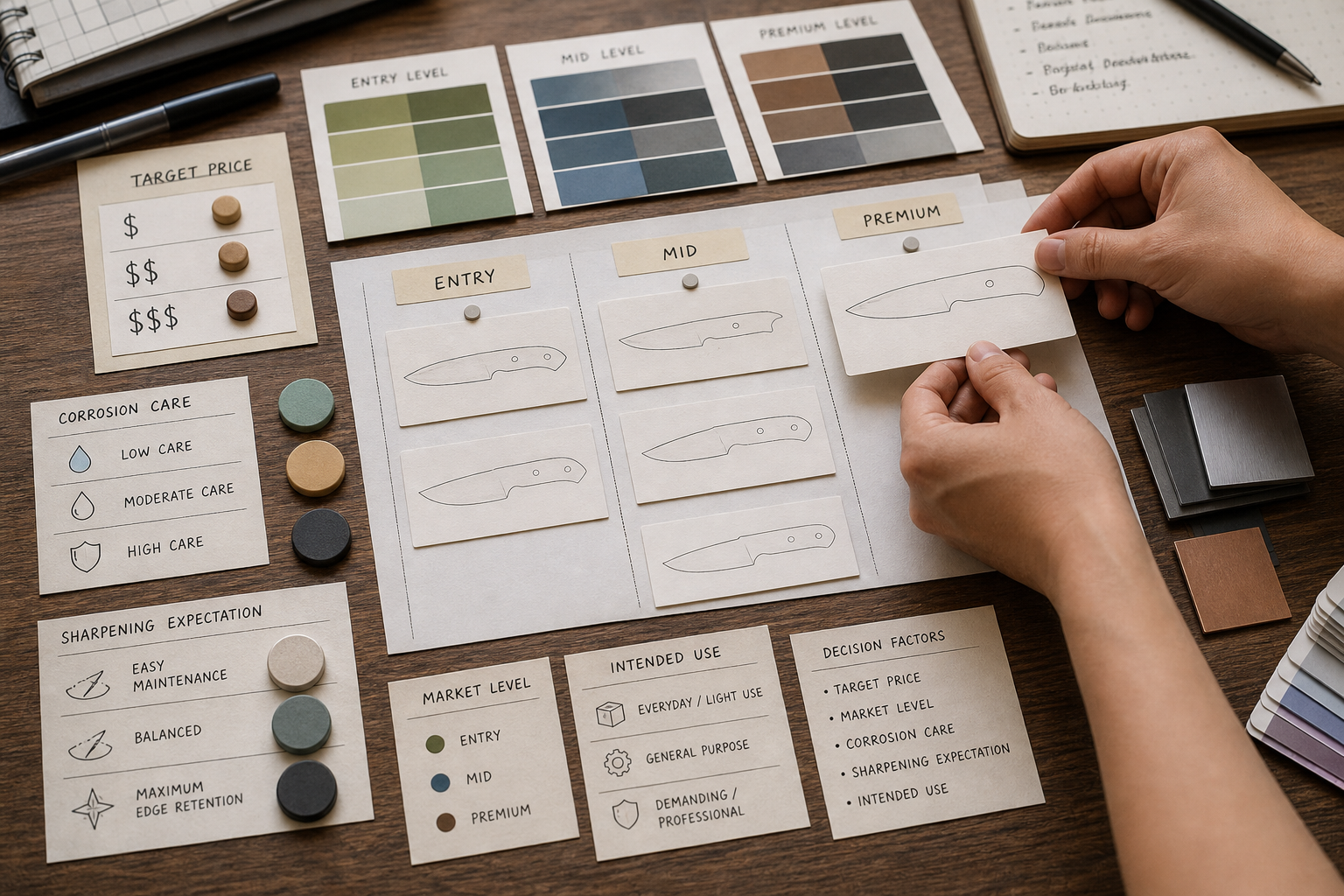
I choose steel after I understand the shelf
In OEM and ODM knife development, steel choice is a business decision before it is a metallurgy decision. A buyer may ask for a steel because competitors use it, because a customer requested it, or because it sounds strong on a product page. I still ask where the knife will sit in the buyer's line. An entry folding knife, a mid-range outdoor tool, a work utility SKU, and a higher-positioned EDC model should not use the same steel logic.
Product positioning controls how much cost the steel can carry. It also controls what the buyer can honestly claim. If the knife sells into wet outdoor markets, corrosion resistance may matter more than maximum wear resistance. If the knife sells as a simple work tool, easy sharpening and stable cost may matter more. If the buyer wants a higher-positioned SKU, a powder metallurgy steel may help the product story, but it also raises expectations for heat treatment, grinding, finish, packaging, and inspection.
I ask buyers to avoid choosing steel as a trophy. A steel grade should support the target user, target price, production method, and repeat order plan.
| Positioning factor | What I ask | Why it matters |
|---|---|---|
| Target price | What margin must the buyer keep? | Steel cost affects the whole quotation |
| Target market | Outdoor, EDC, utility, wholesale, private label | Market use changes corrosion and toughness needs |
| Product level | Entry, mid-range, higher-positioned | Steel name must match customer expectation |
| Brand promise | Easy care, long edge life, balanced performance | Claims must match real steel behavior |
Quote-ready RFQ Checklist for This Steel
To get an accurate OEM/ODM quote, prepare these details before contacting a knife manufacturer.
| RFQ Field | What to Prepare |
|---|---|
| Product type | Folding knife / fixed blade / multi-tool / kitchen knife |
| Target market | US / EU / outdoor retail / promotional / tactical / EDC |
| Steel option | 4116 / 14C28N / D2 / N690 / Nitro-V |
| Target HRC | Example: 55-57 HRC, 58-60 HRC |
| Blade finish | Satin / stonewash / black coating / bead blast |
| Handle material | G10 / micarta / aluminum / stainless steel / wood |
| Lock or structure | Liner lock / frame lock / slip joint / full tang |
| Estimated quantity | 500 / 1,000 / 3,000 / 5,000+ pcs |
| Packaging | White box / color box / blister / pouch / gift box |
| Required documents | Drawing / sample photo / logo file / packaging artwork |
How Should Buyers Compare Toughness, Edge Retention, and Corrosion Resistance?
Many steel charts look like scoreboards. That can hide the trade-offs that matter in a real knife.
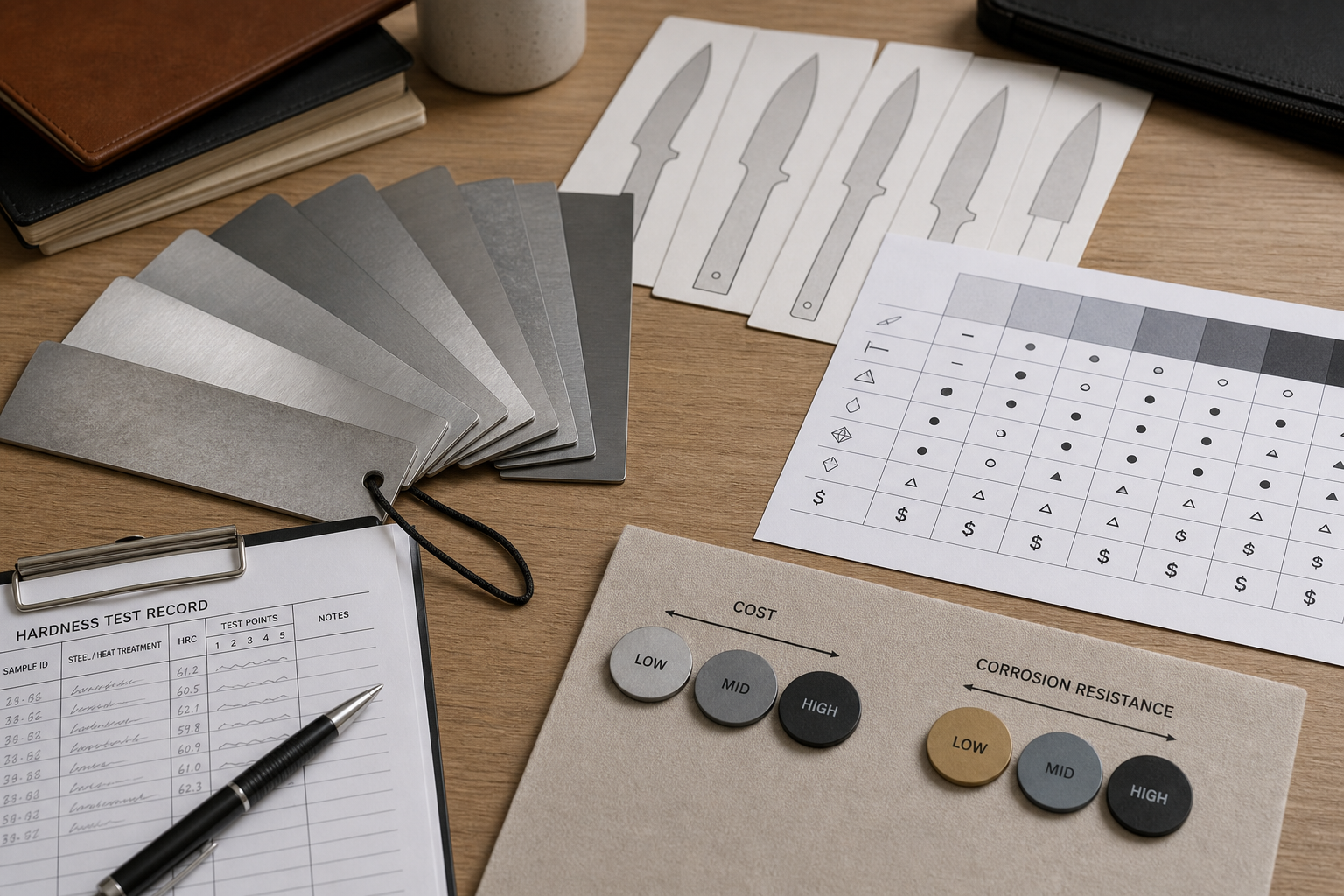
Buyers should compare toughness, edge retention, and corrosion resistance as trade-offs. A steel rarely gives the maximum of all three, so the best choice depends on blade geometry, heat treatment, user task, and price level.
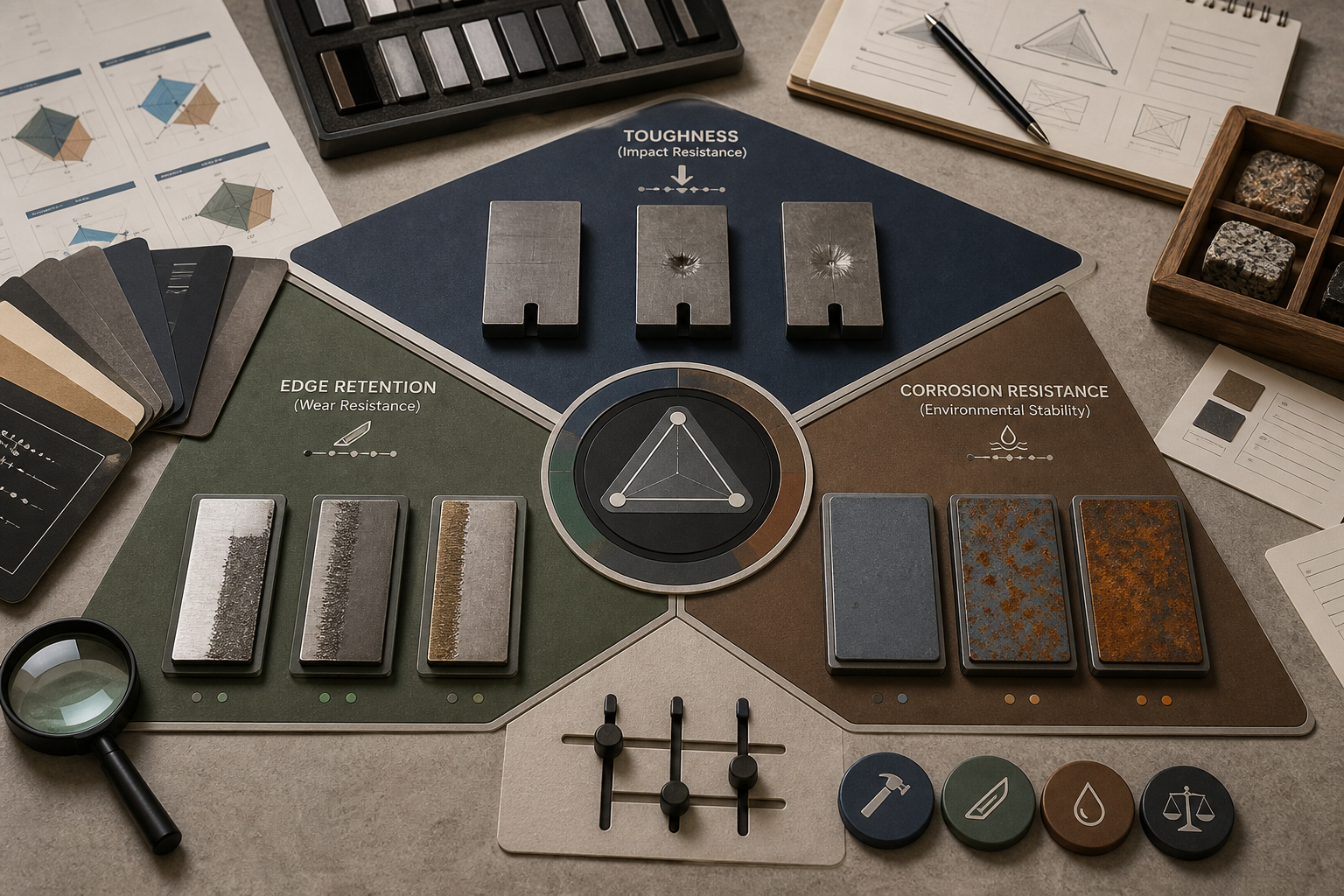
I do not let one score decide the project
Knife Steel Nerds explains that toughness and edge retention are usually opposing properties, and that edge geometry also strongly affects real cutting and chipping behavior. I like that point because it matches what I see in production. A steel with high wear resistance may sound attractive, but it may be harder to grind, slower to sharpen, and less forgiving if the edge geometry is too thin for the intended task.
Toughness matters when the blade needs to resist chipping and damage under rougher cutting conditions. Edge retention matters when the buyer wants the knife to maintain cutting ability longer under abrasive cutting. Corrosion resistance matters when the knife may be used around moisture, sweat, food prep, fishing, coastal outdoor environments, or poor maintenance. These three needs compete with cost, hardness, grind, finish, and sharpening expectations.
This is why I do not ask "which steel is best?" I ask which property matters most for the SKU and which trade-off the buyer can accept.
| Property | What it means for buyers | Common trade-off |
|---|---|---|
| Toughness | Better resistance to chipping and cracking | May reduce high wear performance |
| Edge retention | Longer cutting ability in abrasive use | May raise grinding and sharpening difficulty |
| Corrosion resistance | Better care in wet or humid conditions | May affect toughness or cost depending on alloy |
| Balanced behavior | Practical mix for broad buyers | Usually not a headline-grabbing extreme |
Which Budget and Mid-Range Stainless Steels Fit Practical Programs?
Not every knife needs a high-cost steel. Many buyers need stable supply, simple care, and a price that works.
Budget and mid-range stainless steels fit practical OEM/ODM programs when buyers need corrosion resistance, easier maintenance, stable processing, and controlled cost. The grade should match the target price, hardness plan, and user expectation.
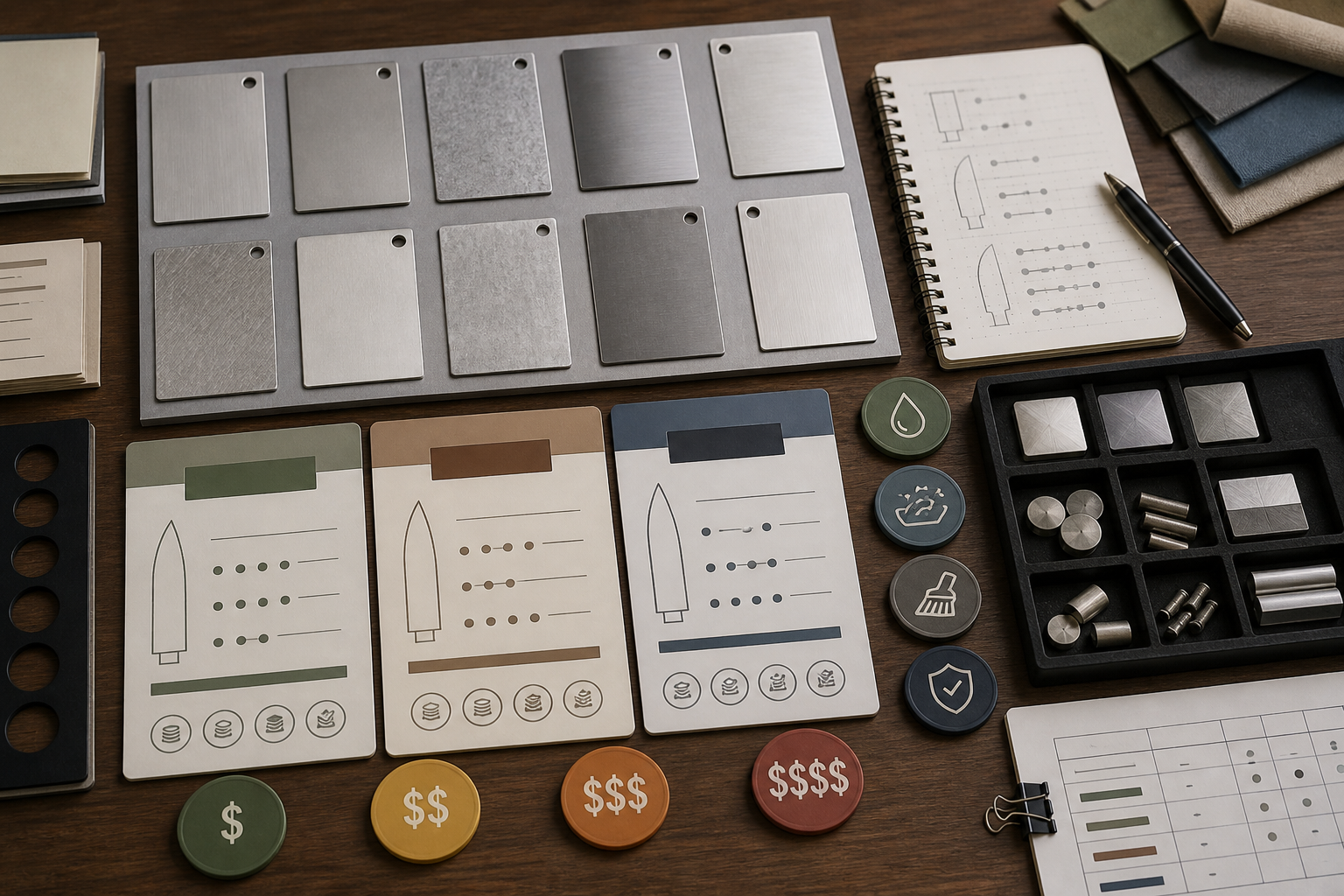
I often start with practical stainless options
For many OEM and ODM knife projects, stainless steel is the most practical starting point. Buyers often sell into broad consumer markets where the user may not understand care requirements. In that situation, corrosion resistance and easy maintenance can protect reviews and reduce complaints. Steels such as 420-series grades, 440-series grades, 8Cr/9Cr-type stainless grades, 12C27, 14C28N, or similar options can all have a place if the buyer defines the product level correctly.
The key is not to oversell a basic grade. A lower-cost stainless steel can be a good choice for promotional knives, entry EDC items, simple pocket knives, and large catalog orders. A better mid-range stainless option can support a stronger product story when the budget allows it. For example, the Alleima 14C28N datasheet describes 14C28N as a martensitic stainless chromium steel made for knife applications with edge performance, high hardness, and corrosion resistance. That does not mean it fits every project, but it shows why official data matters.
I suggest buyers compare stainless options by corrosion need, heat treatment support, sharpening feel, availability, and cost, not by name alone.
| Steel direction | Typical project fit | Buyer check |
|---|---|---|
| Basic stainless | Entry pocket knives and promotional SKUs | Do not overclaim edge life |
| 8Cr/9Cr-type stainless | Cost-sensitive EDC and utility lines | Confirm heat treatment and inspection |
| 12C27/14C28N direction | Mid-range balanced stainless projects | Check stock, HRC target, and supply |
| 440-series direction | Traditional stainless catalog products | Confirm grade, hardness, and finish expectation |
When Do D2 and Other Tool Steels Make Sense?
Tool steel can sound like a clear upgrade, but it is not automatically easier for every buyer or market.
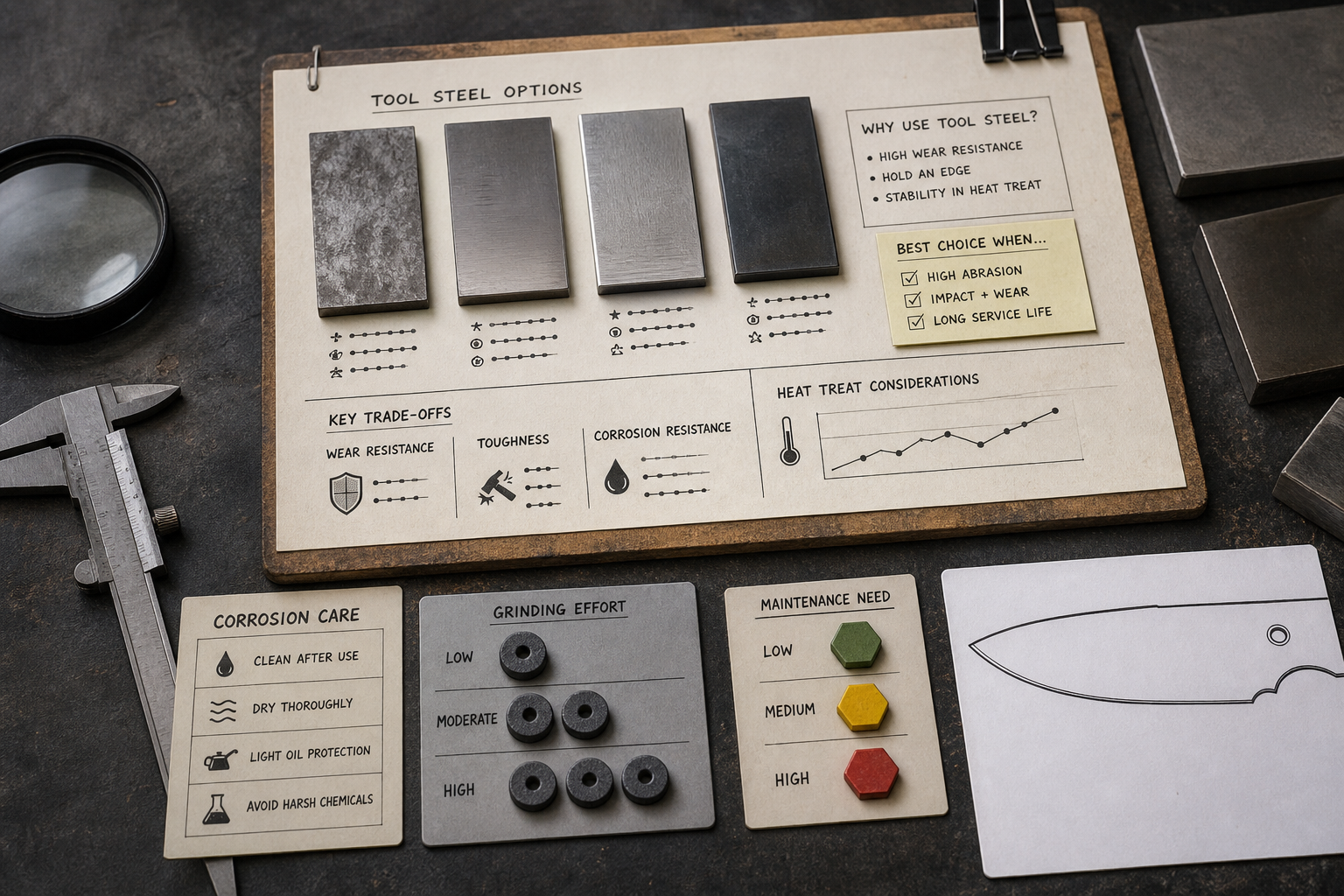
D2 and other tool steels can make sense when buyers want higher wear resistance or stronger work-tool positioning. Buyers must check corrosion care, grinding cost, heat treatment, edge geometry, and whether the market accepts the maintenance needs.
I treat tool steel as a market-specific choice
D2 is popular in many knife programs because it can offer strong wear resistance at a cost level that many buyers can understand. It also gives the product page a more serious steel story than many entry stainless grades. But I do not treat D2 as a universal upgrade. It is not usually chosen for the same reason as a highly corrosion-resistant stainless steel. If the buyer sells into humid markets or to users who expect low maintenance, D2-style choices need careful explanation.
Tool steels can also affect production. Grinding may take more time. Heat treatment needs control. Edge geometry should not be copied blindly from a softer or simpler stainless project. A blade that is too thin behind the edge may chip more easily if the steel, hardness, and use case do not match. A blade that is too thick may disappoint users who expect clean slicing.
I usually recommend tool steels when the buyer has a clear product story, a realistic price point, and a customer base that understands care. If the buyer wants a general mass-market knife with minimal maintenance language, I often compare a balanced stainless option before approving tool steel.
| Tool steel question | Why I ask it | Better decision |
|---|---|---|
| Is corrosion care acceptable? | Some markets expect easy maintenance | Use stainless if low care is critical |
| Is wear resistance the main story? | Tool steel can support this claim | Match grind and hardness to the claim |
| Can the price absorb grinding time? | Harder processing affects cost | Quote with real production steps |
| Will packaging explain care? | Buyers need honest expectations | Add care language if needed |
When Should Buyers Upgrade to Powder Metallurgy Steels?
Powder steel can lift a product line, but it can also lift cost, sampling pressure, and buyer expectations.
Buyers should upgrade to powder metallurgy steels when the target market, retail price, and brand position can support higher material cost, tighter heat treatment control, more demanding grinding, and stronger performance claims.
I upgrade steel only when the product can carry it
Powder metallurgy steels often appeal to buyers because the market recognizes names such as S35VN, S45VN, M390, S90V, MagnaCut, and similar grades. These steels can support higher-positioned products when the design, heat treatment, edge geometry, and packaging all match. They can also help a brand build a better-better-best product ladder. But they are not magic labels. A powder steel with poor heat treatment or poor geometry can still disappoint.
The Bohler M390 MICROCLEAN page describes M390 as a corrosion-resistant martensitic chromium steel made by powder metallurgy, with very high wear resistance and good corrosion resistance. That is useful when a buyer wants a higher-positioned stainless story. But I also remind buyers that M390 may require more careful grinding, sharpening, and QC attention than a simpler steel. If the project is price-sensitive, the steel upgrade can crowd out budget for better handle material, smoother lock fitting, or packaging.
I prefer to use powder steels when the buyer can explain why the steel belongs in that SKU and can pay for the process controls needed to make the claim true.
| Upgrade reason | Good sign | Warning sign |
|---|---|---|
| Higher product tier | Retail price can support the steel | Steel consumes too much margin |
| Market recognition | Buyer audience understands the grade | End users only care about low price |
| Performance claim | Heat treatment and geometry are controlled | Claim relies on steel name only |
| Brand ladder | Steel separates good, better, and higher lines | Too many grades confuse the catalog |
Why Does Heat Treatment Matter More Than Steel Name Alone?
A steel name can sell the sample, but heat treatment decides much of the real blade behavior. I ask for process proof.
Heat treatment matters because hardness, retained structure, corrosion behavior, toughness, and edge stability depend on correct hardening, quenching, tempering, and testing. Buyers should request HRC targets, records, and approved samples.
I verify the process, not only the alloy
Steel must be heat treated correctly to become a useful blade. The same grade can perform differently when the hardening temperature, soak time, quench, deep cooling, tempering, and final hardness are different. The Alleima 14C28N datasheet gives a clear example. It notes that hardening and tempering are needed to meet required properties, and it explains that poor hardening conditions can reduce hardness, wear resistance, or corrosion resistance. That is why I do not accept a steel name as proof by itself.
Hardness testing is part of this control. The NIST Rockwell hardness guide says good practice in Rockwell measurement helps reduce measurement errors. For OEM and ODM projects, that means buyers should define the target HRC range and ask how the supplier checks it. The range should fit the steel and the knife. A higher number is not always better. A very hard blade can be harder to sharpen and may be less forgiving if edge geometry and use case are not aligned.
My practical rule is simple. If a buyer cares about steel, the buyer should also care about heat treatment records.
| Heat treatment item | What to request | Why it matters |
|---|---|---|
| Steel grade | Full grade name and source direction | Avoids vague material substitution |
| HRC target | Practical hardness range | Helps balance edge life and toughness |
| Batch record | Heat treatment and hardness checks | Supports repeat production |
| Approved sample | Physical reference for cutting and finish | Keeps production aligned with buyer approval |
How Should Steel Choice Affect Cost, Grinding, and QC?
Steel affects more than raw material cost. It changes grinding belts, operator time, sharpening, inspection, and final price.
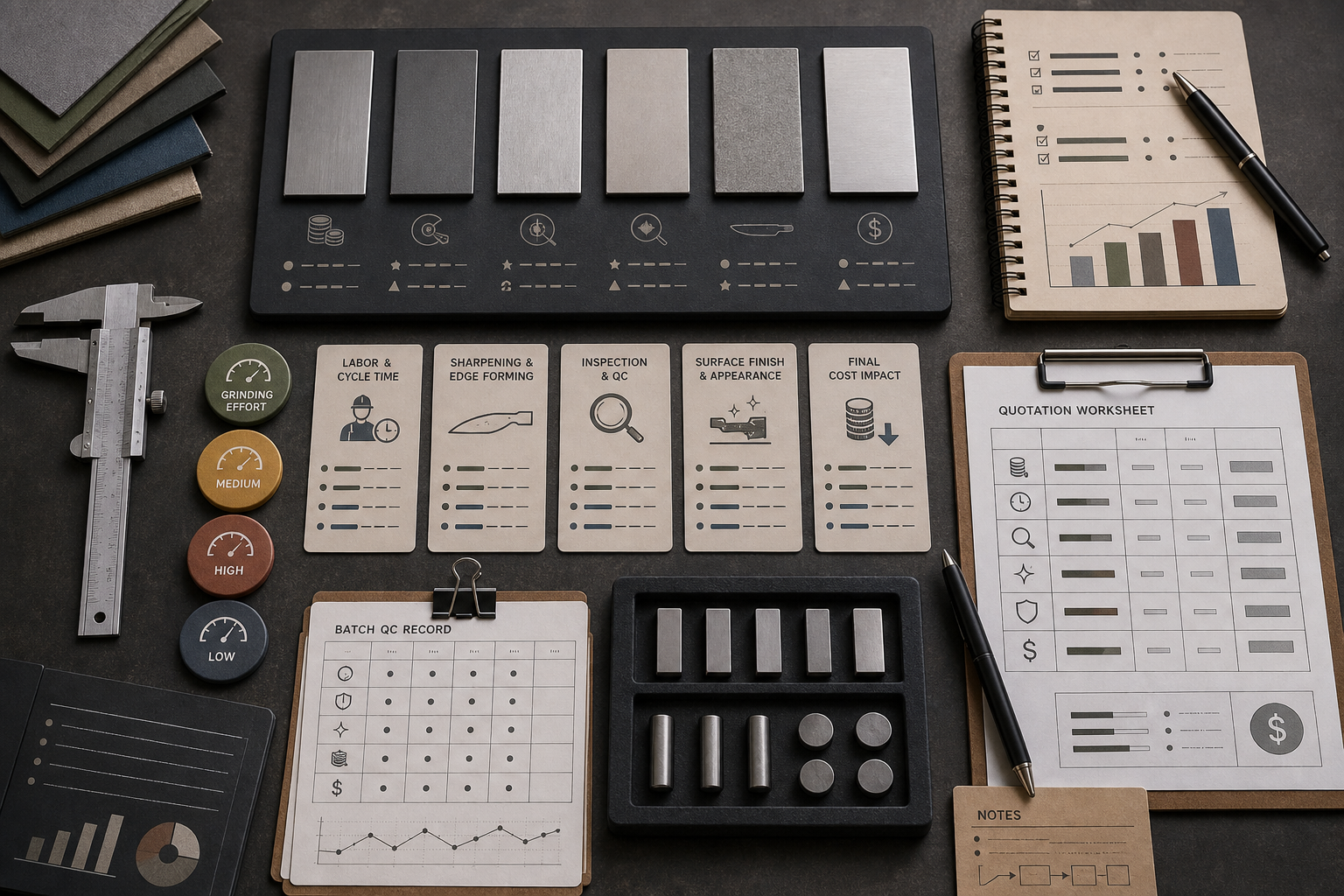
Steel choice should affect cost planning, grinding process, heat treatment, sharpening time, finish selection, QC records, and packaging claims. Buyers should ask for a quotation that reflects the full process, not only material price.
I price the whole steel system
When buyers compare steel, they often compare raw material cost first. That is important, but it is not enough. Some steels are easier to cut, drill, grind, polish, sharpen, and finish. Some steels take more belt life and more inspection time. Some steels need tighter heat treatment control. Some steels require more careful communication on packaging because the care expectations are different.
Finish choice also connects to steel. Satin, bead blast, stonewash, black coating, and polishing all interact with corrosion expectations, appearance standards, and cost. A bead blasted surface on some steels may require more care language than a smoother finish. A high polish may look impressive on a higher-positioned SKU, but it can add labor and reject risk if the blade shape is complex. A stonewash can hide small handling marks, but it still needs a clean base process.
Quality control should follow the steel plan. Incoming material checks, heat treatment records, hardness tests, bevel inspection, edge sharpness, corrosion-care expectations, and packaging review should all connect. The ISO supply chain guide reminds buyers that ISO 9001 does not define the product requirement for them. The buyer still has to specify what is needed.
| Cost area | Steel impact | Buyer action |
|---|---|---|
| Material | Grade and stock size affect base cost | Compare by finished knife cost |
| Grinding | Wear-resistant steels can take more time | Ask how grinding affects price |
| Finishing | Surface choice affects reject risk | Approve finish on real samples |
| QC | Steel choice affects records needed | Define hardness and inspection checks |
What Steel Details Should Buyers Put in an RFQ?
An RFQ with only a steel name leaves too many open questions. I need the full knife context to quote accurately.
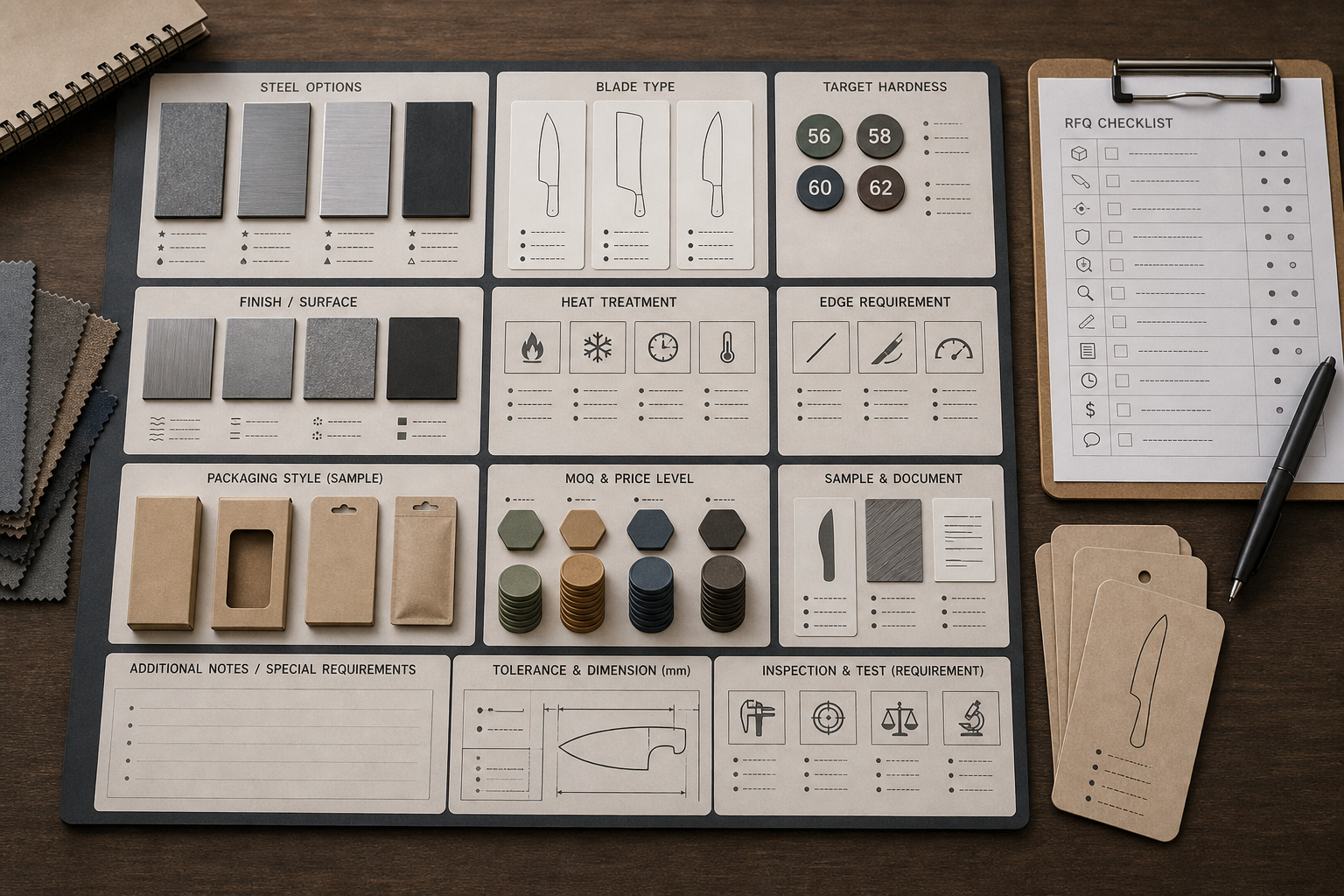
A knife steel RFQ should include steel grade, alternative grades, blade type, blade thickness, grind, edge angle, target HRC, finish, handle material, lock type, packaging, target market, MOQ, target price, and inspection requirements.
I turn steel preference into a production specification
The best RFQ does not say only "D2 knife" or "M390 knife." It explains what the buyer wants the finished product to achieve. I ask for the knife type, blade shape, blade length, blade thickness, grind, edge angle, steel grade, acceptable alternatives, HRC target, handle material, lock type, finish, logo method, packaging, compliance market, target MOQ, and target price. These details let me suggest practical options instead of guessing.
I also like when buyers tell me their sales channel and customer expectation. A distributor order may need stable cost and simple care. A brand launch may need a stronger steel story. A repeat order may need material consistency more than a new steel name. If the buyer has a current product that needs improvement, I ask what problem the new steel must solve. Is the issue corrosion complaint, edge feedback, chipping, grinding cost, or weak product positioning? Each problem points to a different solution.
For Vast State, the goal is not only to quote a steel. The goal is to help the buyer choose a steel that can be sampled, produced, inspected, packaged, and reordered with confidence.
| RFQ field | What to specify | Why it helps |
|---|---|---|
| Steel grade | Preferred grade and acceptable alternatives | Gives room for cost and supply options |
| Heat treatment | Target HRC and record needs | Supports consistent performance |
| Geometry | Thickness, grind, edge angle | Connects steel to real cutting behavior |
| Commercial target | MOQ, price range, market, packaging | Keeps the steel choice realistic |
Ready to use this material in your next knife line?
Vast State can help you compare blade steels, heat treatment ranges, handle materials, finishes, packaging options, and QC requirements based on your target market and quantity.
Conclusion
I choose knife steel by matching product position, trade-offs, heat treatment, cost, QC, and RFQ detail to the buyer's market.
Source Notes
- Knife Steel Nerds steel ratings supports the idea that toughness, edge retention, and corrosion resistance must be compared as trade-offs.
- Alleima 14C28N datasheet supports the discussion of 14C28N as a knife steel with edge performance, hardness, corrosion resistance, and heat treatment requirements.
- Bohler M390 MICROCLEAN supports the discussion of M390 as a powder metallurgy stainless steel with high wear resistance and good corrosion resistance.
- NIST Rockwell hardness guidance supports the need for good hardness measurement practice.
- ISO 9001 in the supply chain supports the need for buyers to clearly define product requirements, approvals, monitoring, and inspections.