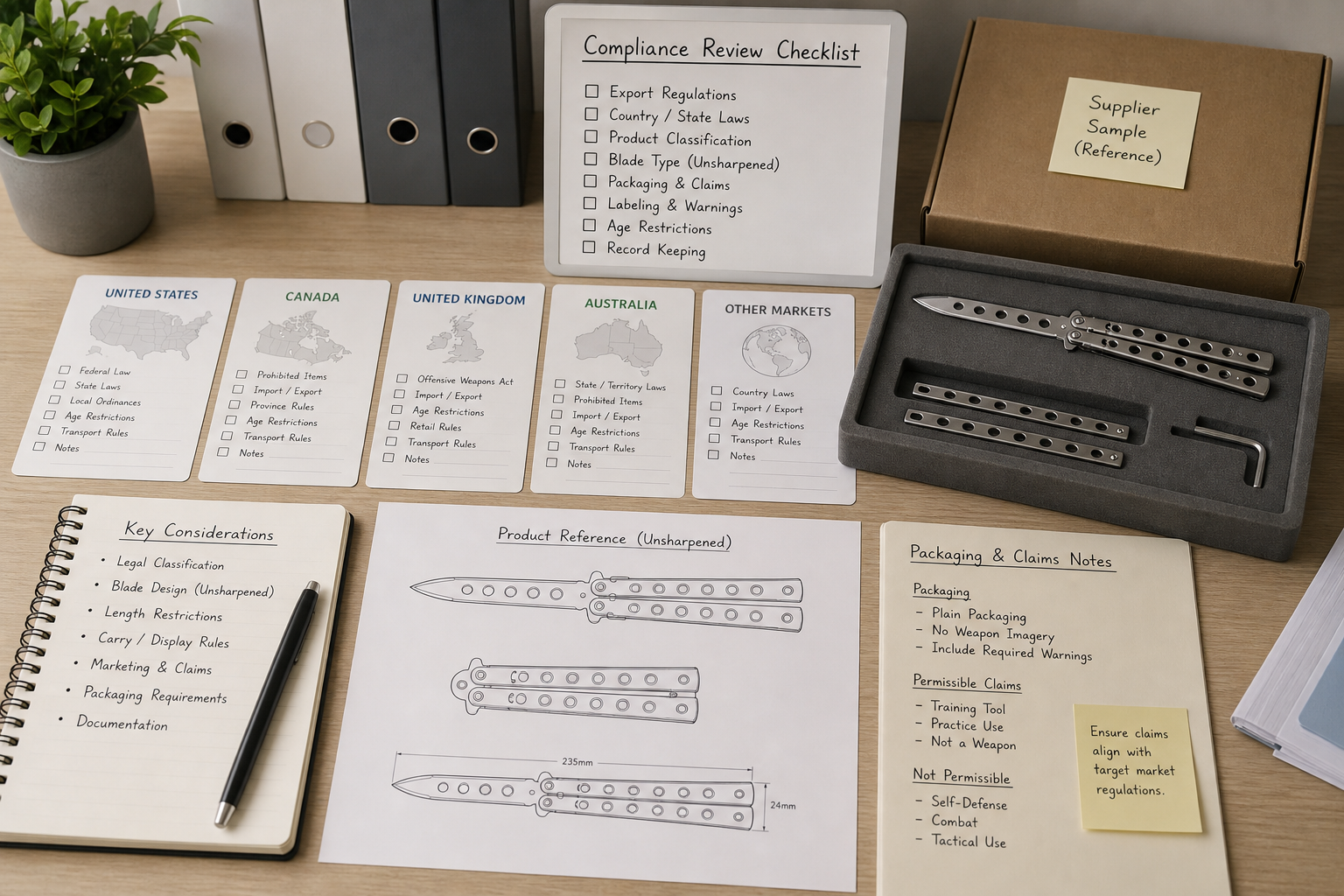
Butterfly knife projects can fail before sampling if compliance is unclear. I treat this product type as a legal-screening project first.
B2B buyers should check butterfly knife compliance by confirming product definition, target countries, state or regional rules, import controls, retail channel policies, trainer status, packaging claims, and legal review before OEM/ODM production. This article is practical sourcing guidance, not legal advice.
Quick buyer brief:
- Answer: Check legal classification, import rules, sales rules, channel policy, product claims, and documentation before sampling.
- Buyer context: This helps knife brands, importers, wholesalers, distributors, and sourcing managers avoid risky product development.
- Key checks: Product definition, target market, blade type, handle structure, trainer status, permits, age controls, packaging language, and written buyer approval.
Planning a private-label knife line for this market?
Use this article as an early planning reference, then prepare your target market, product category, labeling needs, and buyer-specified compliance requirements before production.
When a buyer asks me whether butterfly knives are legal, I do not answer with a simple yes or no. The answer changes by country, state, import route, product structure, end user, and retail channel. A live-blade balisong, a trainer, a comb-style novelty product, or separate parts may be treated differently in one market and similarly in another. So I start with compliance before I talk about price, material, MOQ, or packaging.
Why Is Butterfly Knife Compliance Different From Ordinary Pocket Knife Compliance?
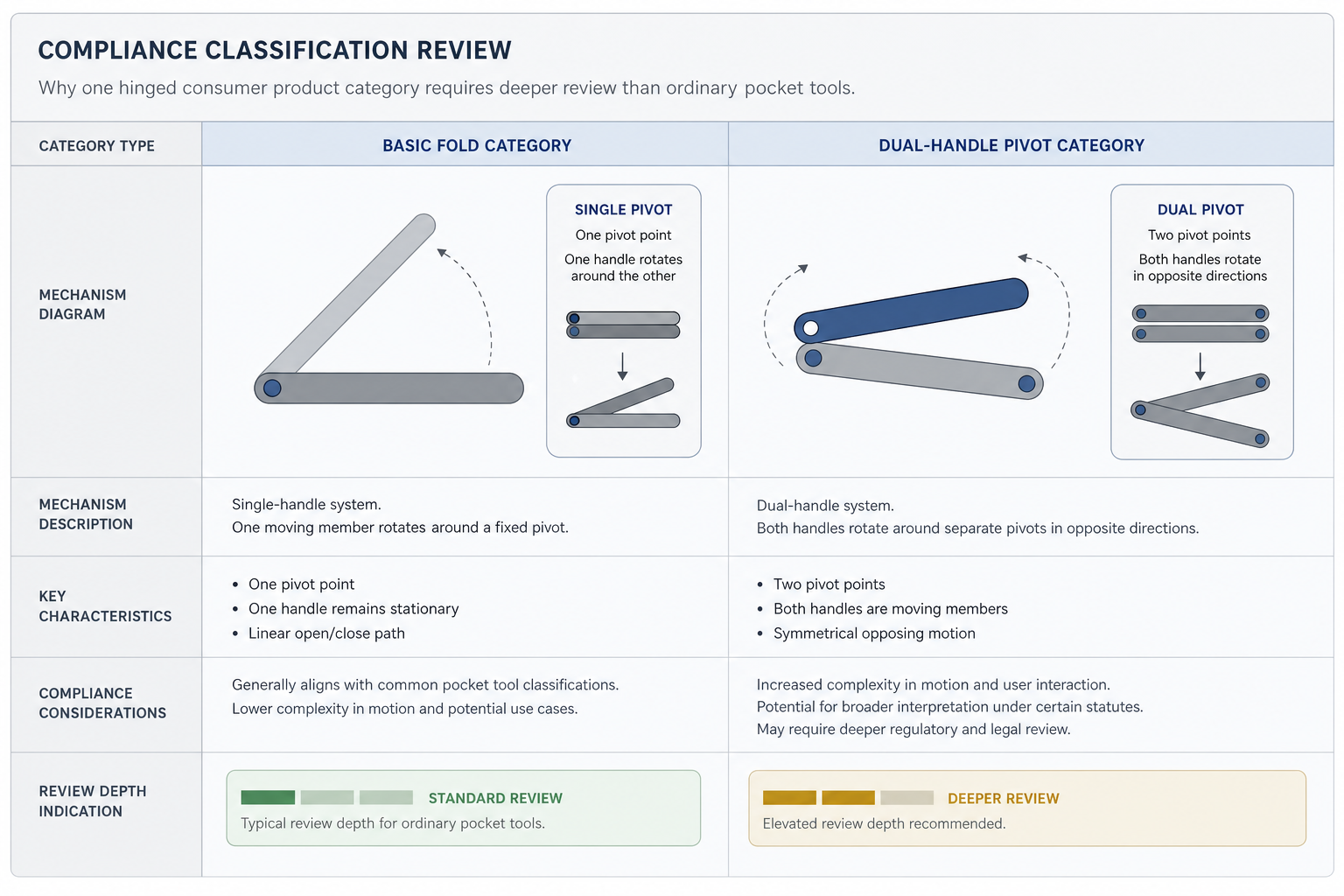
Ordinary folding knives already need checks. Butterfly knives need deeper checks because their mechanism and legal labels can trigger stricter rules.
Butterfly knife compliance is different because many laws focus on mechanism, opening method, product form, and listed weapon categories. Buyers should not treat butterfly knives like normal pocket knives in sourcing, import, or retail planning.
I classify the product before I develop the product
In OEM and ODM knife work, most product decisions begin with function, cost, and target user. Butterfly knife projects begin one step earlier. I first ask whether the buyer has legal clearance for the exact target market. A folding knife with a liner lock and a butterfly knife may both be pocket-sized blades, but they are not treated the same in many rules. The two-handle structure and opening method can put the product into a different legal category.
This matters for more than import. It affects product naming, online listing approval, advertising language, retail channel acceptance, packaging, age controls, and after-sales risk. A buyer may be able to make a product in one country but may not be able to import, sell, display, or ship it in another. The risk is even higher when a product is marketed broadly across countries without local review.
I do not tell buyers to guess. I ask them to identify target markets first, then confirm whether the product type is allowed, restricted, or not suitable for that channel. This prevents wasted tooling, rejected shipments, and unsellable inventory.
| Compliance area | Why it is different | Buyer action |
|---|---|---|
| Mechanism | Laws may classify by how the blade opens | Get the product type reviewed first |
| Market | Rules vary by country and state | Build a target-market matrix |
| Channel | Retailers and platforms may add stricter policies | Confirm listing rules before sampling |
| Documentation | Border review may require proof or permission | Keep product drawings and legal notes |
Private-label Planning Checklist
Before starting production, prepare the market and product details your importer or compliance advisor needs to review.
| RFQ Field | What to Prepare |
|---|---|
| Target market | Country, state, region, or sales channel |
| Product category | Folding knife / fixed blade / multi-tool / outdoor tool |
| Intended use | EDC / camping / kitchen / hunting / rescue / promotional |
| Buyer requirements | Testing, labeling, documentation, or packaging rules |
| Blade and lock details | Blade length, opening method, lock type, edge style |
| Packaging text | Warnings, claims, care notes, language requirements |
| Documents | Drawing, sample photo, logo file, packaging artwork |
| Review owner | Importer, legal advisor, testing lab, or internal compliance team |
Which Product Definitions Should Buyers Confirm First?
A product name can hide the real risk. The legal definition may focus on structure, movement, or listed categories.
Buyers should confirm whether the product is treated as a butterfly knife, balisong, automatic knife, gravity-related knife, trainer, novelty item, part, or restricted item in each target market.
I separate marketing names from legal names
The American Knife and Tool Institute defines a butterfly or balisong knife as a folding knife with two handle pieces that pivot from the rear of the blade and counter-rotate to form the handle when open. That definition is useful for product communication because it focuses on structure. But legal rules may use different terms. Some rules may mention butterfly knives directly. Some rules may classify by opening method. Some rules may use older words that do not match modern product descriptions.
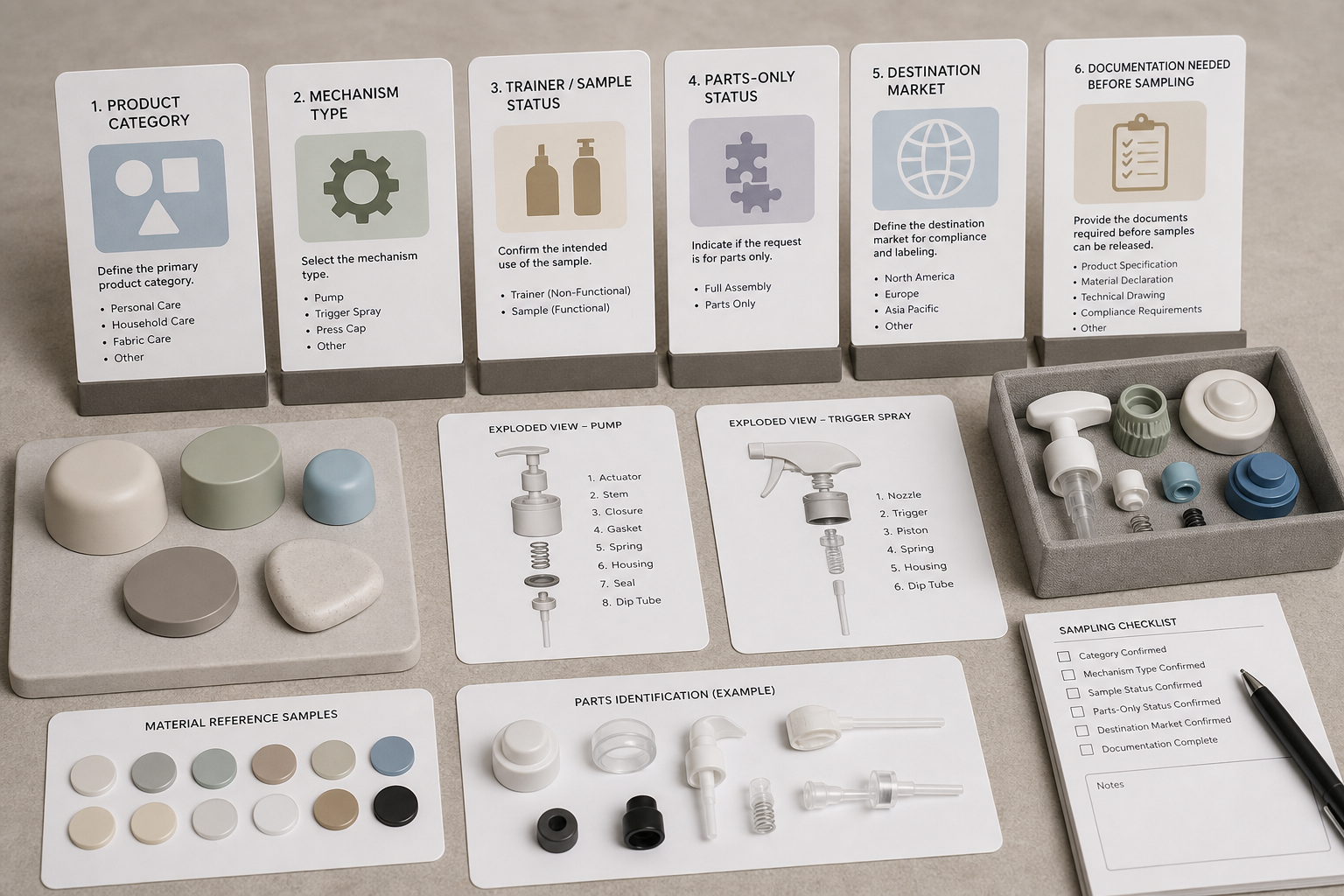
This is why I ask buyers to provide drawings, photos, product function notes, blade status, and target market before I quote. A product may be called a trainer, a practice model, a comb, a bottle opener, a novelty item, or a tool accessory. That name alone may not decide its legal status. The structure and appearance may still matter. Some border or retail reviews may look at whether the item is similar to a restricted product, even if the blade edge is changed.
For a serious B2B buyer, the first deliverable should be a classification note. It should describe the exact product form and the markets where it will be offered. Then the buyer can decide whether to continue, redesign, or choose another product type.
| Product question | Why I ask it | Compliance output |
|---|---|---|
| What is the structure? | Two rotating handle pieces may trigger a specific category | Product definition note |
| Is there a live blade? | Trainer and live-blade models may be reviewed differently | Market-specific review |
| What is the listing name? | Marketing words can create risk | Approved product wording |
| Are parts sold separately? | Parts can still create review issues | Part-level classification check |
How Should U.S. Federal and State Rules Affect the Project?
The U.S. is not one single knife market. Federal law, state law, local rules, and channel policy can all matter.
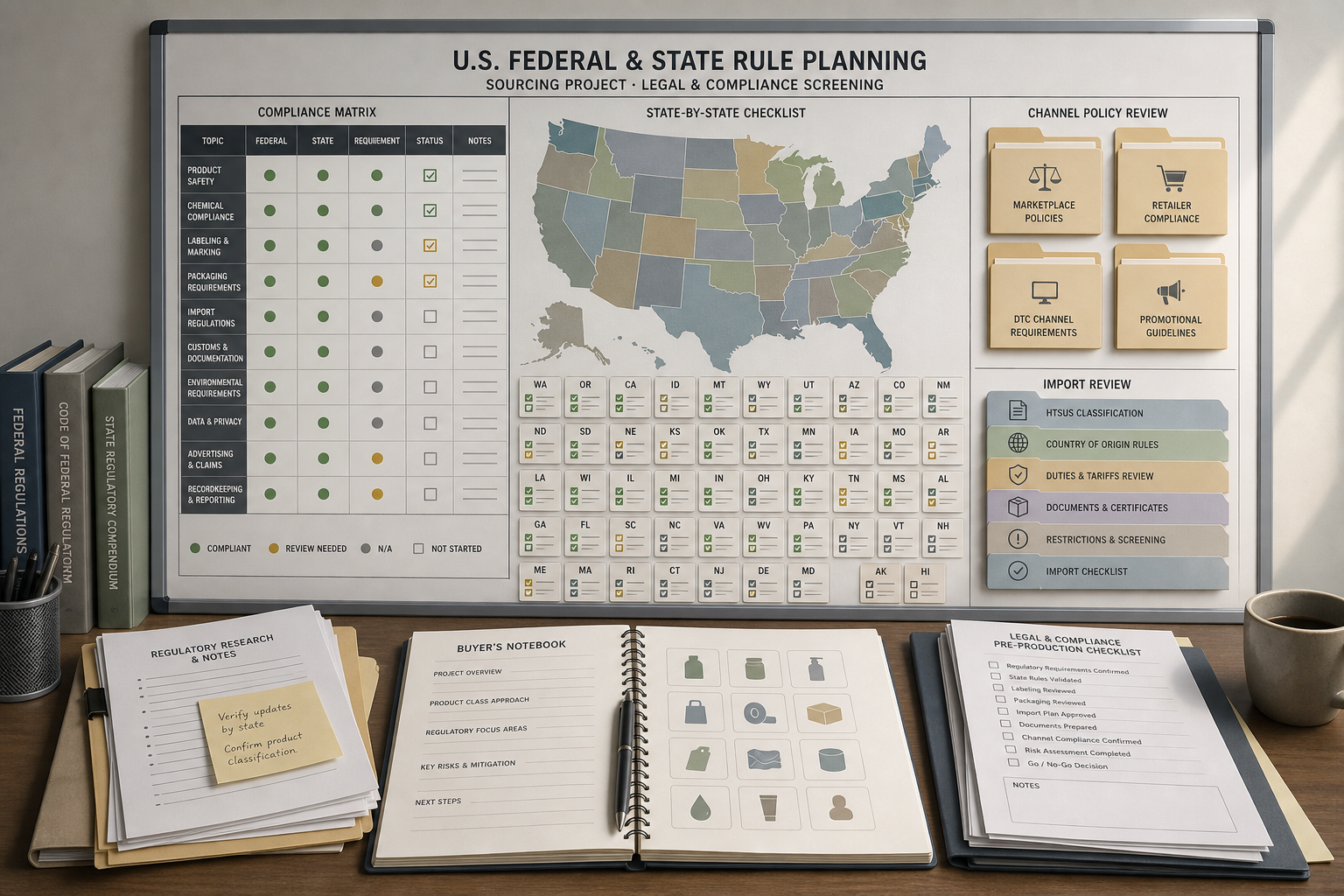
U.S. planning should include the Federal Switchblade Act, state knife law summaries, local restrictions, sales channel rules, and legal review. Buyers should not assume one state answer applies nationwide.
I do not quote a U.S. order without a market list
The U.S. Federal Switchblade Act defines a switchblade knife in part by automatic opening through a button or other handle device, or by inertia, gravity, or both. The same federal chapter includes restrictions for interstate commerce and specific federal jurisdictions. That does not answer every butterfly knife question by itself, but it tells buyers that mechanism-based definitions can matter at the federal level.
State rules add another layer. AKTI's State Knife Laws page explains that its summaries cover all states and the District of Columbia, include law references, and are intended as a starting point rather than legal advice. The same page also warns that knife laws often depend on mechanism, blade length, or terms that may not be clearly defined. For a B2B buyer, this means a single product may be suitable for one U.S. channel and unsuitable for another.
I ask buyers to send a state list, channel list, and product use case. If the buyer sells through distributors, the distributor may have its own policy. If the buyer sells online, the platform may reject certain product types even where the product is not clearly barred by local law. The right production decision depends on all of these checks.
| U.S. layer | What to check | Why it matters |
|---|---|---|
| Federal law | Federal definitions and commerce restrictions | Helps screen mechanism risk |
| State rules | State-level sales and possession categories | Avoids treating the U.S. as one market |
| Local rules | City or local restrictions when relevant | Reduces channel disputes |
| Retail policy | Distributor and platform rules | Prevents listing rejection |
What Should Buyers Check for the UK, Canada, and Australia?
International sales can look attractive, but butterfly knife rules can be strict. I screen major destination markets before sample work.
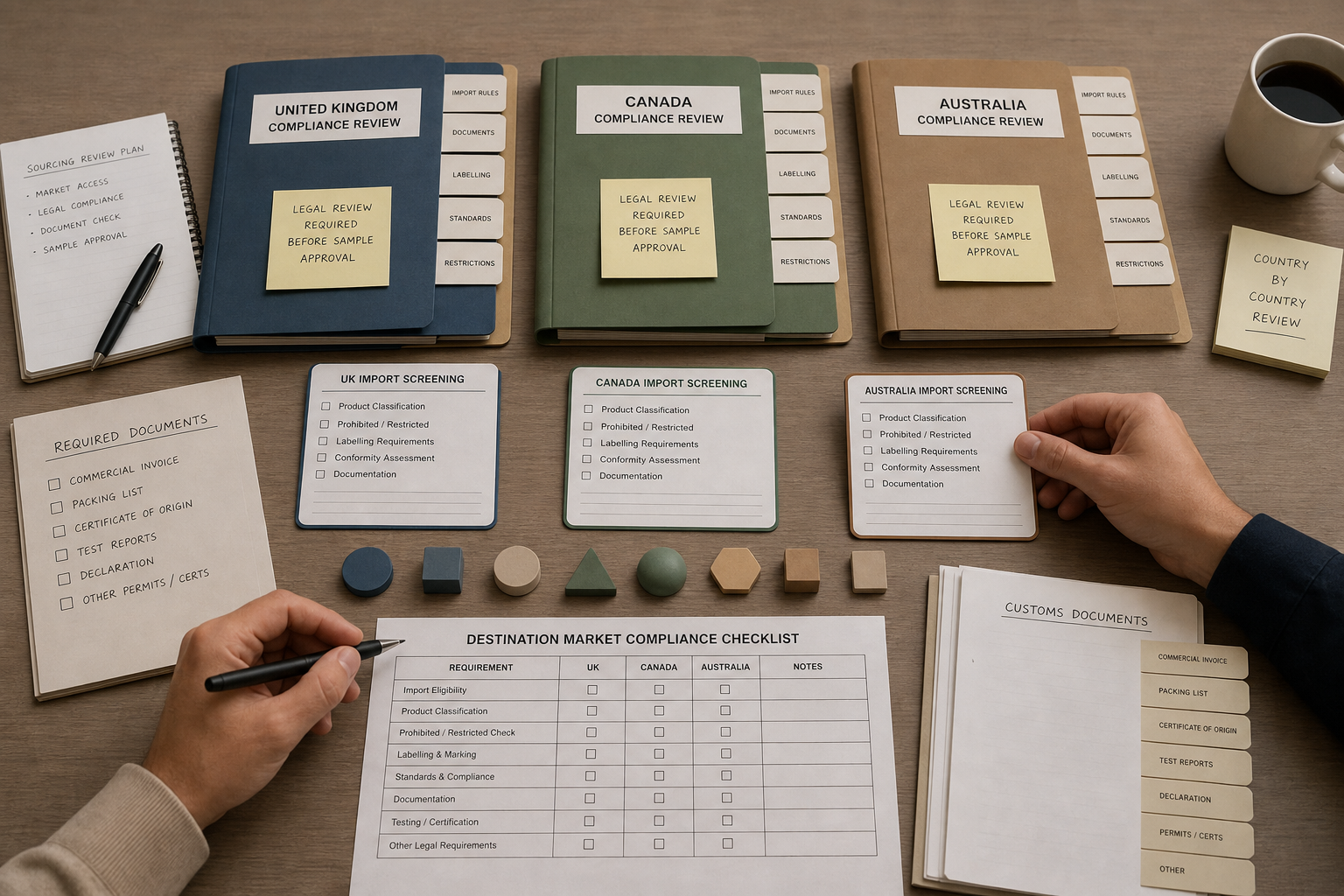
Buyers should check each destination country separately. UK, Canadian, and Australian sources show that butterfly or balisong-style items can face strict import or restricted-item rules, so buyers need local legal review before production.
I treat each country as its own project
The UK government border-control guidance lists butterfly knives, also known as balisongs, among banned knives and weapons, with limited exemptions for certain special purposes. Canada Border Services Agency Memorandum D19-13-2 states that prohibited weapon classification includes knives opened automatically by gravity or centrifugal force, and the memorandum specifically discusses butterfly and balisong knives in the centrifugal-knife section. Australia's Federal Register of Legislation lists current Customs (Prohibited Imports) Regulations and includes Schedule 13 requirements for certain weapons and weapon parts, while Australian Border Force guidance warns that weapons imports depend on product type and purpose.
For B2B buyers, the lesson is not to make one export decision for every country. A product that is possible to manufacture may still be blocked, delayed, or restricted at the destination. A distributor may also require proof that the product is allowed for that channel. If the buyer cannot provide a legal basis for the market, I recommend pausing the project or selecting a different knife type.
I also ask about packaging and declared product description. The product description should be accurate and approved by the buyer's compliance team. It should not soften or rename the product in a way that creates customs or retailer problems.
| Market | What sources suggest | Buyer action |
|---|---|---|
| UK | Border guidance lists butterfly knives among banned items | Get UK legal review before production |
| Canada | CBSA treats centrifugal-opening categories as high risk | Confirm import and sales status before quoting |
| Australia | Import rules can require permission for certain weapons | Review Schedule 13 and ABF guidance |
| Other markets | Rules may use different terms | Build a country-by-country matrix |
How Should Trainers, Parts, and Novelty Variants Be Reviewed?
Changing the blade edge does not always remove compliance risk. Similar form, parts, and product claims can still matter.
Trainers, parts, comb-style products, bottle openers, and novelty variants should be reviewed separately in each market. Buyers should confirm whether appearance, structure, parts, or intended listing category creates restricted-item risk.
I do not assume a trainer is automatically safe
Many buyers ask whether a trainer version is easier to sell. Sometimes it is. Sometimes it is not. The answer depends on the country, the product form, the material, the appearance, the way it is marketed, and how the rule is written. A trainer with no sharpened edge may still look or function close enough to a restricted product to create import or retail problems. A comb-style item may still raise questions if it uses the same handle movement and visual identity.
Parts require the same caution. A buyer may think separate handles, blades, pivots, or kits are safer than assembled goods. That is not a safe assumption. Some markets review parts and goods together, especially if the parts are clearly intended for a restricted product type. Packaging can also create evidence of intended product identity. If the package uses butterfly knife wording, the product may be reviewed under that category even if a seller calls it a novelty item elsewhere.
My practical rule is simple. If the product is related to the butterfly knife structure, treat it as a compliance project. Ask for legal review, platform review, and destination-market clearance before buying tooling or inventory.
| Variant | Main risk | Buyer check |
|---|---|---|
| Trainer | Similar structure may still matter | Review market rules and platform policy |
| Comb-style item | Novelty function may not decide status | Review appearance and listing language |
| Parts kit | Intended assembly may be considered | Review part-level import rules |
| Packaging set | Product wording may increase risk | Approve exact descriptions before print |
What Design Changes Can Reduce Compliance Risk Without Misleading the Market?
Design can lower risk, but it should never be used to confuse inspectors or customers. I prefer clean product repositioning.
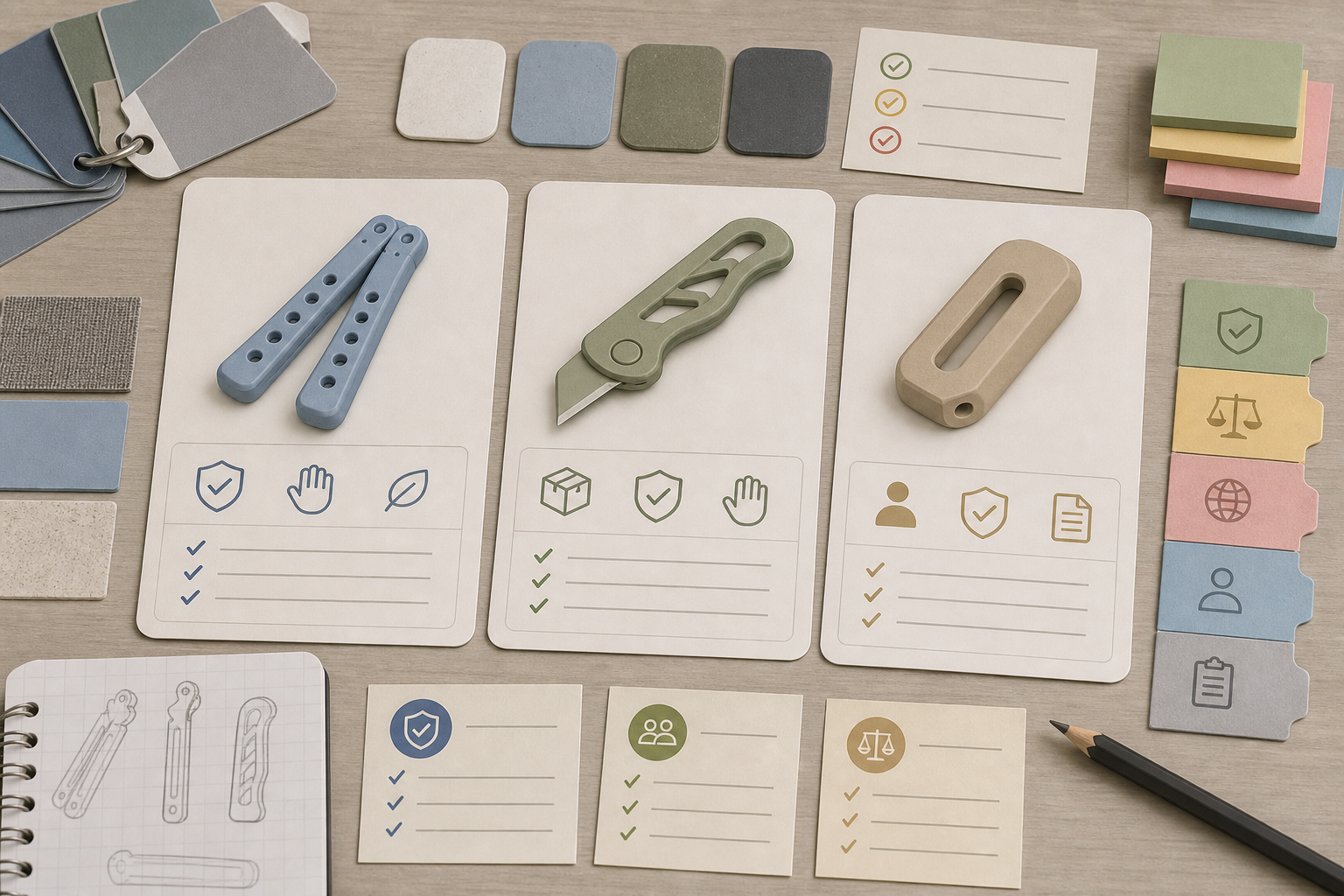
Design changes may reduce compliance risk when they create a genuinely different product category, such as a fixed training tool, a non-knife tool, or another lawful design. Buyers should not rely on cosmetic changes alone.
I redesign only when the category truly changes
Sometimes a buyer wants to keep the butterfly knife look but reduce legal risk. I am careful with this. A small change in blade edge, material, latch, or product name may not be enough if the structure still fits a restricted category. A real design change should make the product clearly different in function, structure, and market positioning. For example, a non-knife tool or a fixed educational display may need a different structure, different packaging, and a different sales claim.
I also avoid advising buyers to rely on loopholes. That is not a stable sourcing strategy. Border agencies, retailers, and payment platforms can reject items if the product appears to fit a restricted category or if the listing creates concern. A buyer who wants a safe product line should choose a design that stands on its own. If the target market does not allow butterfly knives, the better solution may be a conventional folding knife, fixed blade tool, rescue tool, or multi-tool that clearly fits the legal and retail channel.
At Vast State, I can help with alternate product development, but the buyer should provide the market rule and legal review first.
| Design direction | When it may help | What to verify |
|---|---|---|
| Conventional folding knife | Buyer needs a lawful EDC-style product | Lock, blade length, and channel rules |
| Fixed training tool | Buyer wants a non-cutting practice concept | Structure and market treatment |
| Multi-tool | Buyer wants utility without balisong form | Tool functions and safety claims |
| Rescue tool | Buyer needs practical safety-market positioning | Local rules and product tests |
What Should Packaging and Product Pages Say About Compliance?
Packaging can increase risk when it overstates the product or uses the wrong words. I keep listings factual and approved.
Packaging and product pages should use accurate product descriptions, market-approved claims, age or channel notes when required, and no exaggerated language. Buyers should approve wording with legal counsel before printing or listing.
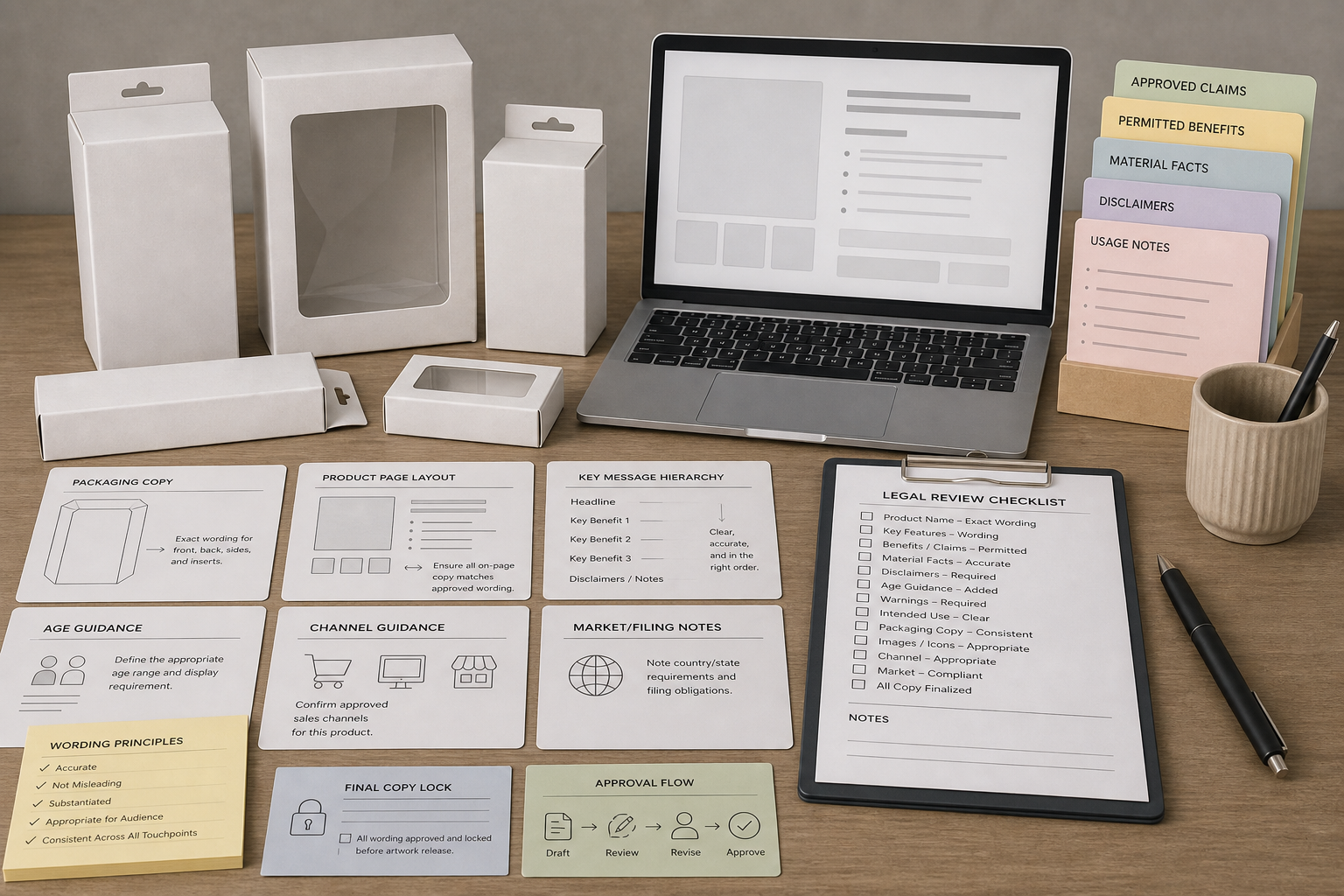
I approve wording before artwork
For butterfly knife projects, packaging is not only branding. It is a compliance document in practice. The product name, description, feature list, age statement, warning note, and market code should all be reviewed before print. If the buyer wants to sell in several markets, the packaging may need market-specific versions. A single global box can create problems if one destination needs different wording or should not receive the product at all.
I also ask buyers to keep product pages simple. They should not use language that suggests unsafe behavior, aggressive use, or performance claims unrelated to practical tool function. The images should show the product clearly and safely. The listing should not hide the product category or imply that the item is something else. Accuracy matters because customs officers, retailers, and platform reviewers may compare the physical goods with the listing.
For B2B orders, I like to keep an approval trail. The buyer should approve final wording, packaging art, market list, and channel limits in writing. That record helps the factory produce the correct version and helps the buyer manage future repeat orders.
| Packaging element | What to control | Why it matters |
|---|---|---|
| Product name | Use approved category wording | Reduces listing conflict |
| Market version | Separate restricted and allowed markets | Prevents wrong-market shipment |
| Warning or age note | Follow buyer's legal review | Supports channel compliance |
| Artwork approval | Lock final text before print | Avoids costly packaging rework |
What Should a Butterfly Knife RFQ Include Before Sampling?
A normal RFQ is not enough for this product type. I need compliance inputs before drawings, price, and MOQ.
A butterfly knife RFQ should include target countries, states, retail channels, legal review status, product definition, live-blade or trainer status, materials, packaging language, permits, inspection needs, and written buyer responsibility for compliance.
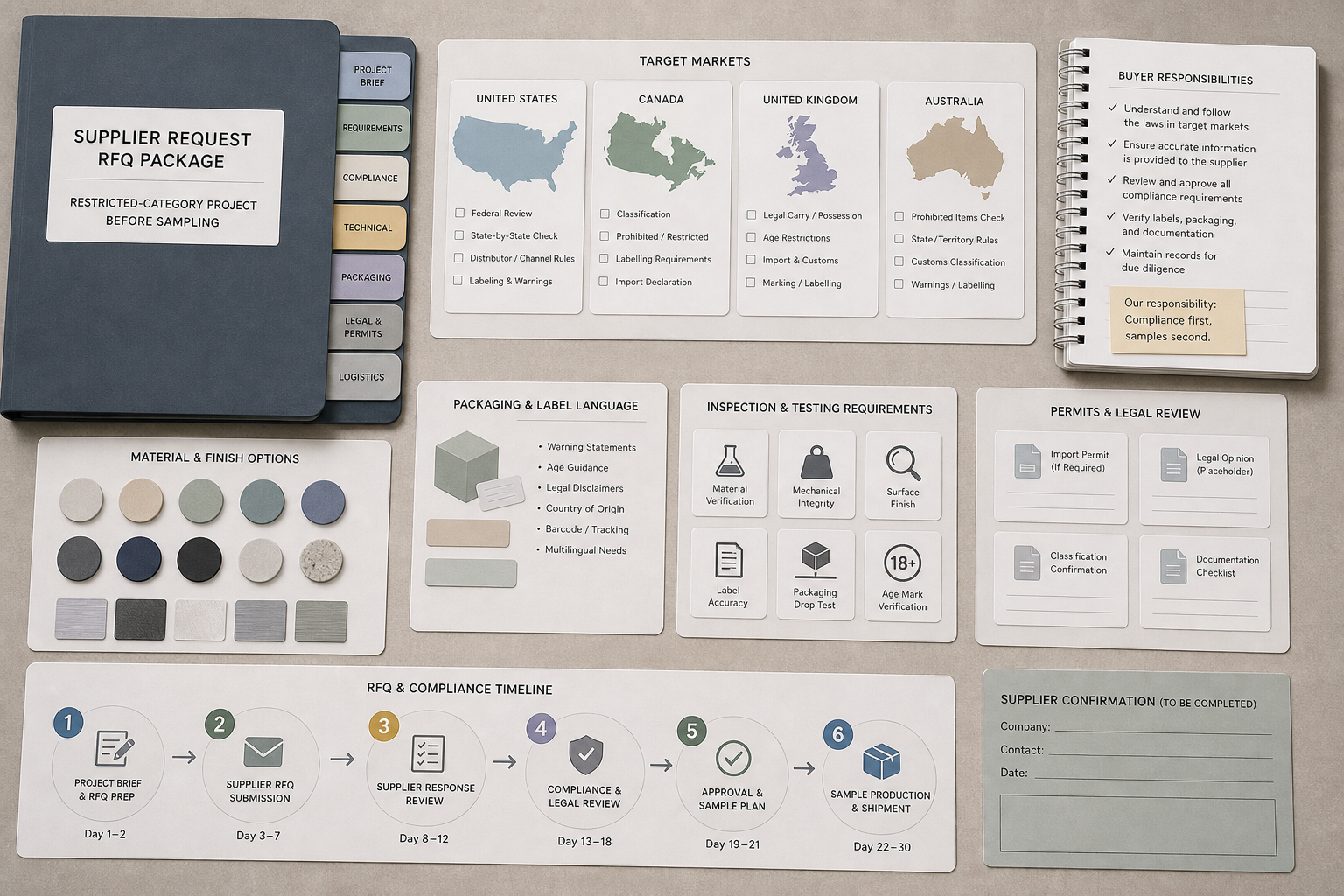
I need compliance facts before I build the sample
For butterfly knife projects, I ask for more than a drawing. I ask for the buyer's target countries, target states or regions, channel list, legal review status, product definition, blade status, trainer status, material plan, packaging language, and shipment route. I also ask whether the buyer has permits, exemptions, distributor approval, or platform approval if those are needed in the target market.
Then I ask the normal manufacturing questions. What blade steel is required? What handle material is needed? What finish is planned? What price level does the buyer need? What MOQ is realistic? What inspection standard should apply? What packaging format is required? But these questions come after compliance screening. A beautiful sample is useless if the buyer cannot legally receive, list, or sell the product in the intended market.
I also recommend that the buyer signs off on compliance responsibility. The factory can support product development, documentation, packaging execution, and quality control. The buyer must confirm the target market legality with qualified counsel or official guidance. This keeps the project practical and honest.
| RFQ field | What to provide | Why it matters |
|---|---|---|
| Target market | Country, state, region, and channel | Defines the legal review scope |
| Product status | Live blade, trainer, parts, or novelty item | Determines classification questions |
| Compliance proof | Legal review, permit, or distributor approval | Avoids developing unsellable goods |
| Manufacturing spec | Steel, handle, finish, packaging, inspection | Supports accurate quotation |
Planning a private-label knife line for this market?
Use this article as a planning reference, then confirm local requirements with your importer or compliance advisor before OEM/ODM production.
Conclusion
I only support butterfly knife projects after target-market compliance, product definition, packaging wording, and buyer legal responsibility are clear.
Source Notes
- 15 U.S.C. 1241 and 15 U.S.C. 1242 support the need to screen U.S. federal definitions and interstate-commerce issues.
- AKTI Approved Knife Definitions supports the structural definition of butterfly or balisong knives and shows why terminology needs care.
- AKTI State Knife Laws supports the point that U.S. state summaries are only a starting point and not legal advice.
- UK border-control guidance supports the need to check UK import and banned-item rules before production.
- CBSA Memorandum D19-13-2 supports the need to review Canadian import classification for centrifugal-opening knife categories.
- Australia Customs Prohibited Imports Regulations and Australian Border Force weapons guidance support the need to check import permission and Schedule 13 weapon controls.