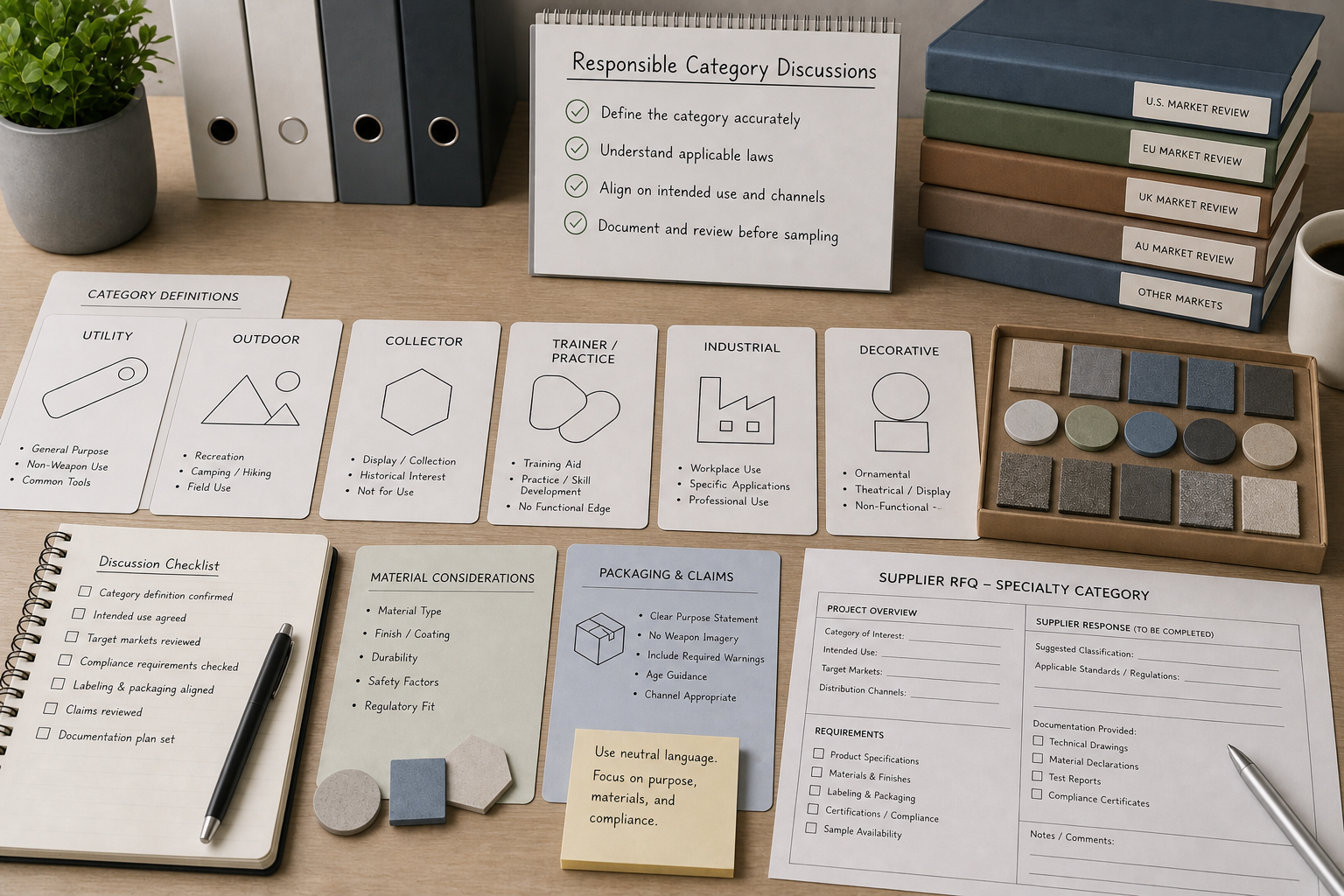
Risky words can make a product plan harder to approve. Buyers may lose time with unclear claims. Responsible category language keeps sourcing practical.
Buyers should discuss specialty blade categories by using neutral product definitions, target-market context, documented legal checks, safe marketing language, and clear RFQ details. This helps suppliers evaluate manufacturability, compliance risk, cost, packaging, and distribution limits without promoting unsafe use.
Quick buyer brief:
- Answer: Use product-class language, not risky performance language.
- Buyer context: This helps knife brands, importers, wholesalers, and private label buyers.
- Key checks: Category definition, target market, mechanism, blade geometry, packaging claims, legal review, and inspection records.
Have a knife or multi-tool project in mind?
Send your sketch, CAD file, sample photo, or product idea. Vast State can review manufacturability, suggest materials, estimate MOQ, and prepare a quote for your OEM/ODM project.
I see this problem often when a buyer starts with a dramatic category name instead of a product requirement. The design may be legal in one market, restricted in another, and unsuitable for a sales channel even before production begins. I am not a lawyer, so this article is not legal advice. But as an OEM/ODM knife manufacturer, I know that better language leads to better samples, safer approvals, cleaner packaging, and fewer surprises before shipment.
Why Should Buyers Replace Risky Language With Product-Class Language?
A dramatic category name may attract attention, but it can confuse development. The supplier may not know whether the buyer means history, styling, function, or regulation.
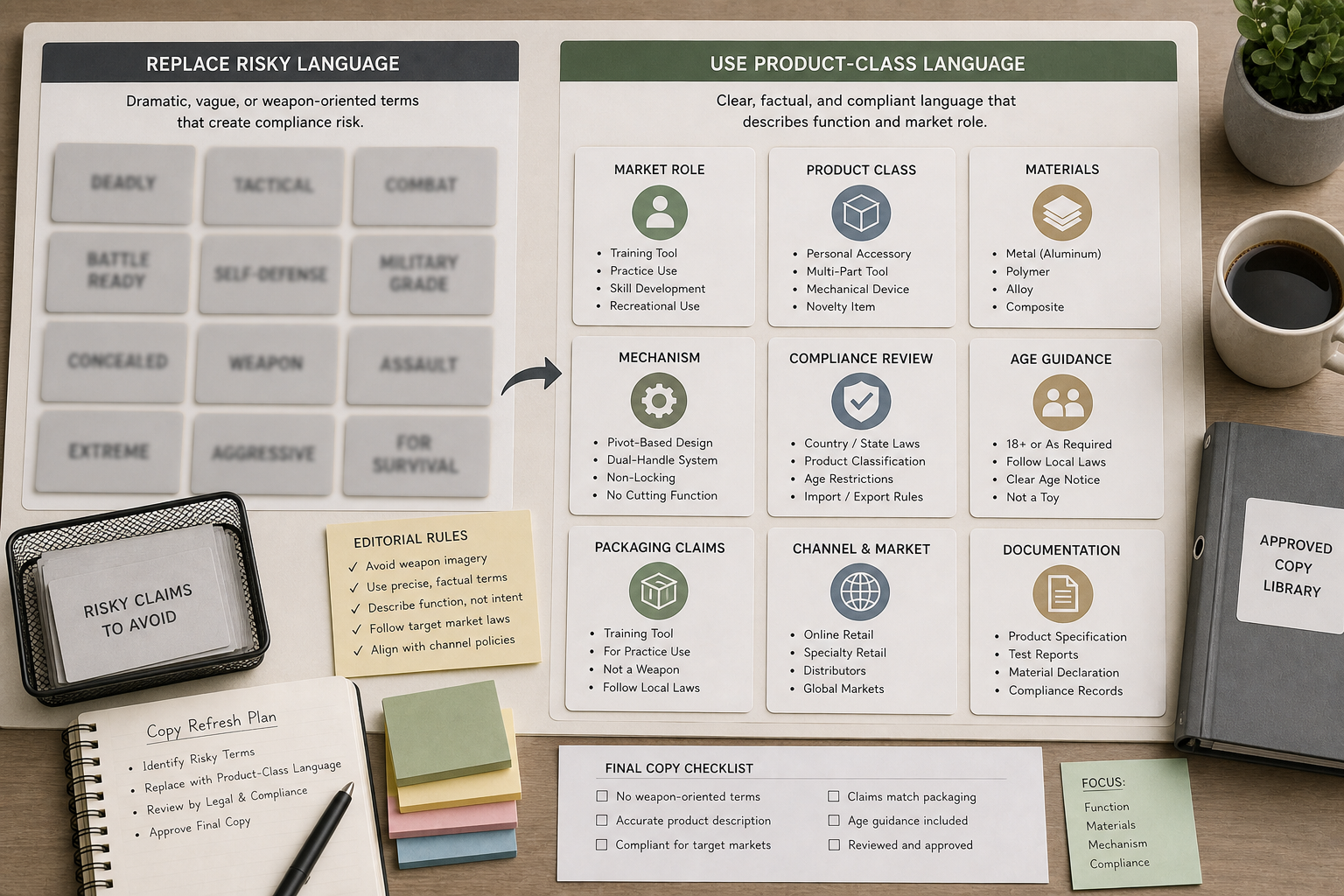
Buyers should replace risky language with product-class language because it keeps the discussion focused on design features, market role, compliance checks, and manufacturable specifications.
I Start With What the Product Is, Not What It Suggests
When a customer sends a category name that sounds dramatic, I bring the discussion back to objective product details. I ask about blade length, blade profile, edge type, locking structure, opening method, handle material, finish, packaging, and target market. This is much more useful than debating a label. A label can mean different things across countries, platforms, and retail channels. A product specification can be checked, sampled, inspected, and quoted.
Neutral wording also protects the buyer's brand. A product can be an outdoor utility knife, a collector-style fixed blade, a rescue tool, a camping knife, or an EDC folder. Each name tells the supplier what to build and tells the channel what to review. I prefer this approach because it supports practical engineering. It also makes the RFQ easier to compare between suppliers. If two suppliers both receive clear product-class language, the buyer can compare tooling cost, material options, assembly difficulty, and quality-control plans more fairly.
| Language choice | What it does | Better sourcing result |
|---|---|---|
| Dramatic wording | Creates unclear intent | Slower review and more questions |
| Product-class wording | Describes the item type | Easier quoting and sampling |
| Feature wording | Lists measurable details | Better QC and inspection planning |
| Market wording | Defines the sales context | Better packaging and claim control |
OEM/ODM RFQ Checklist
Prepare these details to help Vast State review your project and provide a more accurate quotation.
| RFQ Field | What to Prepare |
|---|---|
| Project type | OEM from drawing / ODM private label / wholesale catalog |
| Product category | Folding knife / fixed blade / multi-tool / outdoor tool |
| Design status | Idea / sketch / 2D drawing / 3D CAD / physical sample |
| Target price | Ex-factory target price or retail price range |
| MOQ expectation | 500 / 1,000 / 3,000 / 5,000+ pcs |
| Logo method | Laser engraving / etching / printing / molded logo |
| Packaging | Standard packaging / custom retail box / Amazon-ready |
| Market | USA / EU / Japan / Korea / Middle East / other |
| Compliance needs | Buyer-specified testing / documentation / labeling |
| Timeline | Sample deadline / mass production deadline |
How Should Specialty Blade Categories Be Defined for a Catalog?
A catalog can look organized but still be unclear. If categories mix style, function, and mechanism, buyers may order the wrong product.
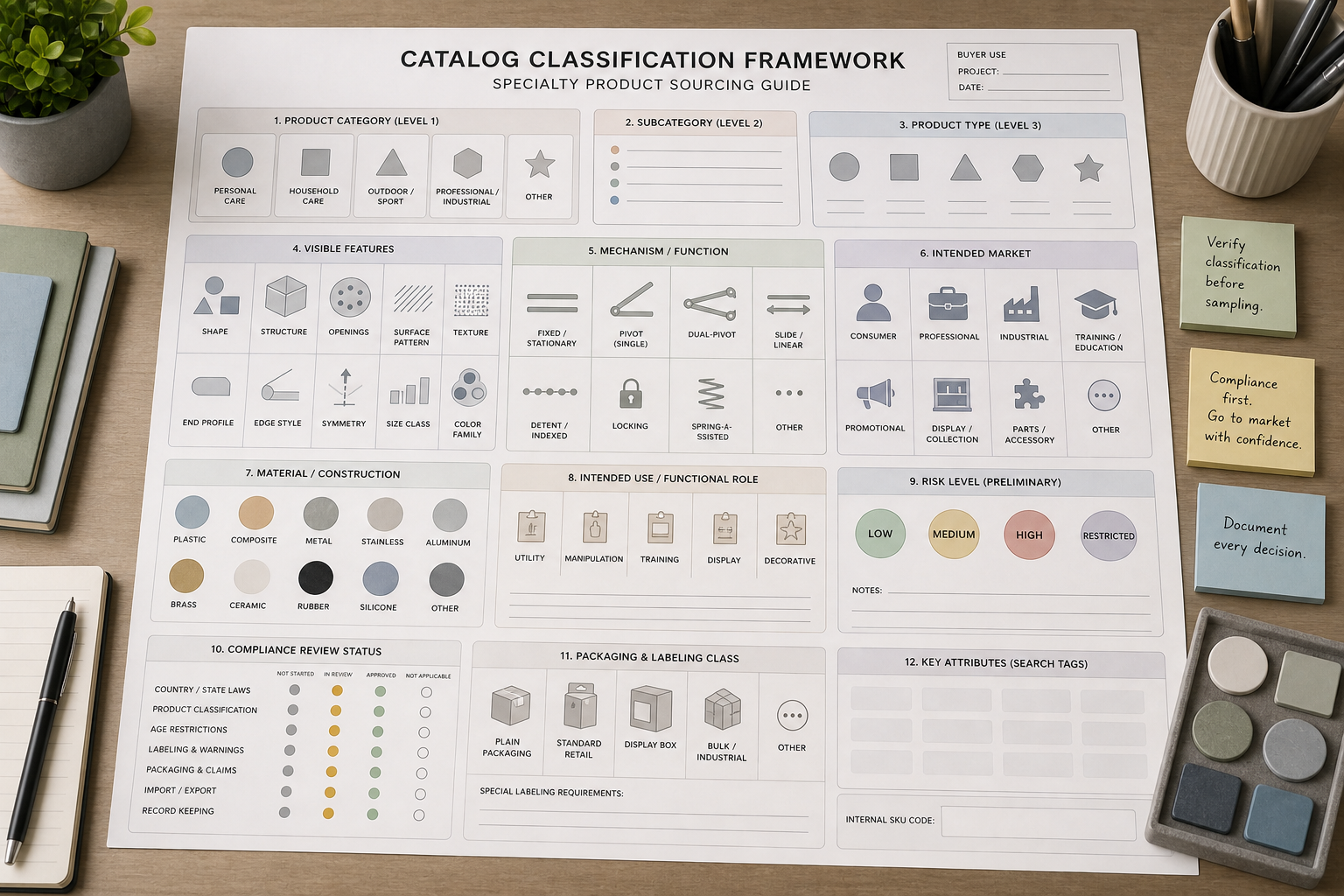
Specialty blade categories should be defined by visible features, mechanism, intended market, material level, and compliance review status. Each category should have measurable limits.
I Build Categories From Checkable Details
I like a catalog that a sourcing manager can read quickly and use for action. For example, a folding knife category should not only say "folder." It should mention manual opening or assisted structure if relevant, lock type, blade length range, steel options, handle material, finish options, and packaging path. A fixed blade category should mention blade length range, tang construction, sheath material, handle structure, and application area. This gives the buyer real sourcing value.
Industry definitions can help, but I do not treat any third-party definition as a full legal answer. The AKTI approved knife definitions are useful because they show why mechanism and feature language matter. They also show that some labels are not always precise. In production, precision matters. If a buyer uses a name but does not define the blade, handle, lock, and package, the factory still has to guess. A clear catalog reduces guessing. It lets us suggest better alternatives when a design is expensive, hard to assemble, or unsuitable for the target channel.
| Catalog field | What to define | Why it matters |
|---|---|---|
| Knife type | Folding, fixed blade, multi-tool, rescue tool | Sets the development route |
| Mechanism | Manual, slip joint, liner lock, back lock, button lock | Affects legal and assembly review |
| Blade geometry | Profile, edge type, thickness, length range | Affects performance and classification |
| Market role | EDC, camping, outdoor, rescue, collector display | Guides packaging and claims |
Which Categories Need Extra Legal and Channel Review?
Some designs may be simple to make but hard to sell. A buyer can waste sampling cost if the channel review comes too late.
Categories with special mechanisms, unusual blade geometry, long blades, double-edge designs, or market-sensitive styling need extra legal and channel review before tooling or production.
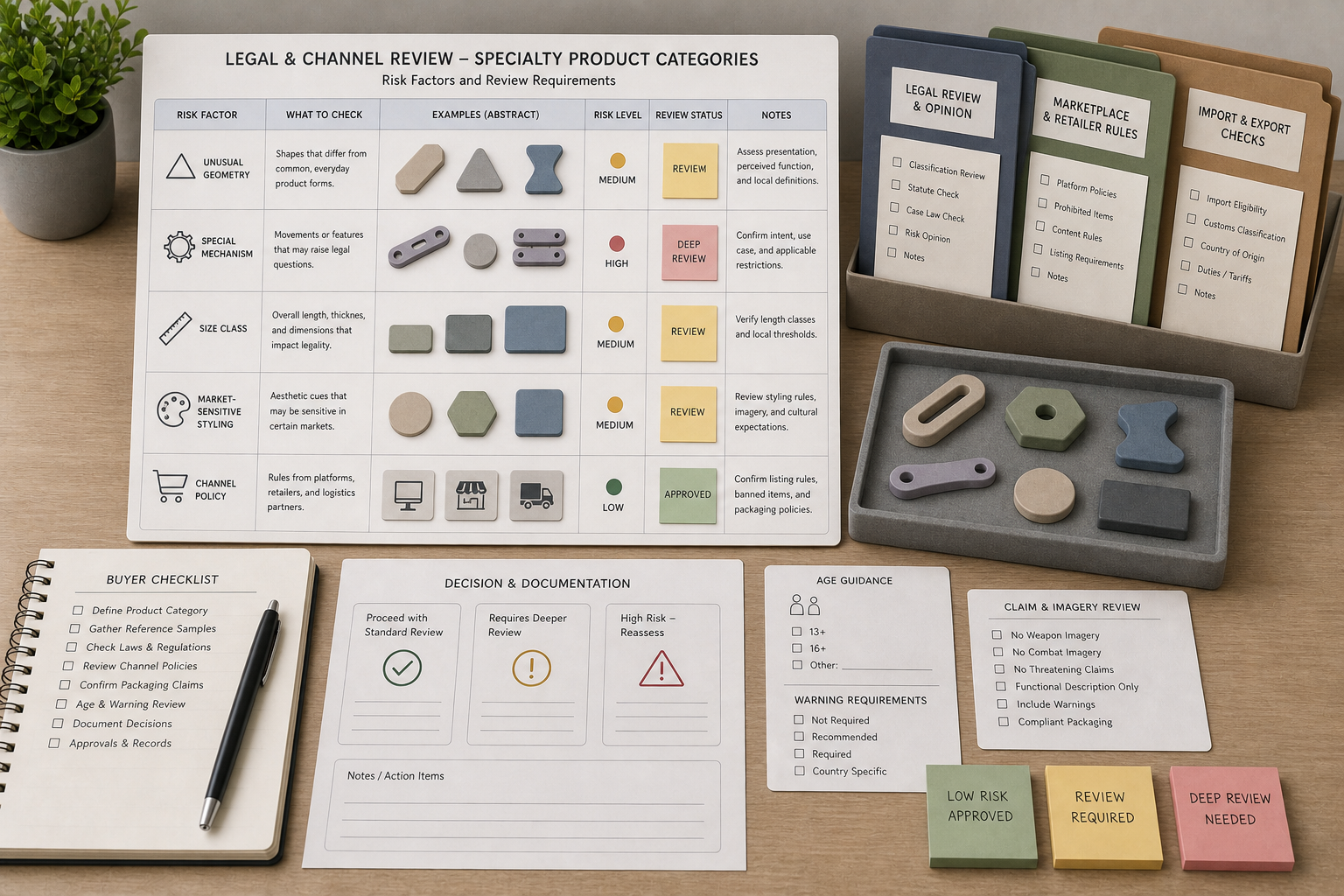
I Ask for Market Checks Before I Quote Aggressively
For specialty categories, I want the buyer to confirm the destination market and sales channel before we move too far. The United States, the United Kingdom, Canada, the European Union, and other markets can treat certain items differently. Even within one country, local rules or platform policies can affect sale, import, listing, or advertising. A supplier should not promise that a design is acceptable everywhere. A buyer should not rely on a factory alone for legal decisions.
Public resources can help buyers know where to ask better questions. The AKTI page on state knife laws explains that its summaries are references, not legal advice. The UK import controls page shows that some imports require evidence and that final decisions depend on authority review. The CBSA memorandum D19-13-2 shows why import and export classification can be detailed. In my work, this means I slow down the project when the design has special features. I ask for written buyer confirmation, channel notes, and packaging restrictions before tooling.
| Review area | Buyer question | Supplier action |
|---|---|---|
| Destination market | Where will the product be sold? | Flag category risks early |
| Sales channel | Online, retail, distributor, private label | Align packaging and claims |
| Mechanism | How does the blade open and lock? | Document structure clearly |
| Import review | Does the buyer have legal guidance? | Keep records with the project file |
How Should Historical or Collectible Designs Be Discussed?
Historical inspiration can be interesting, but it can also create confusion. Buyers may mix display value with modern product use.
Historical or collectible designs should be discussed as design references, display concepts, or limited market items, with clear notes on materials, finish, packaging, and legal review.
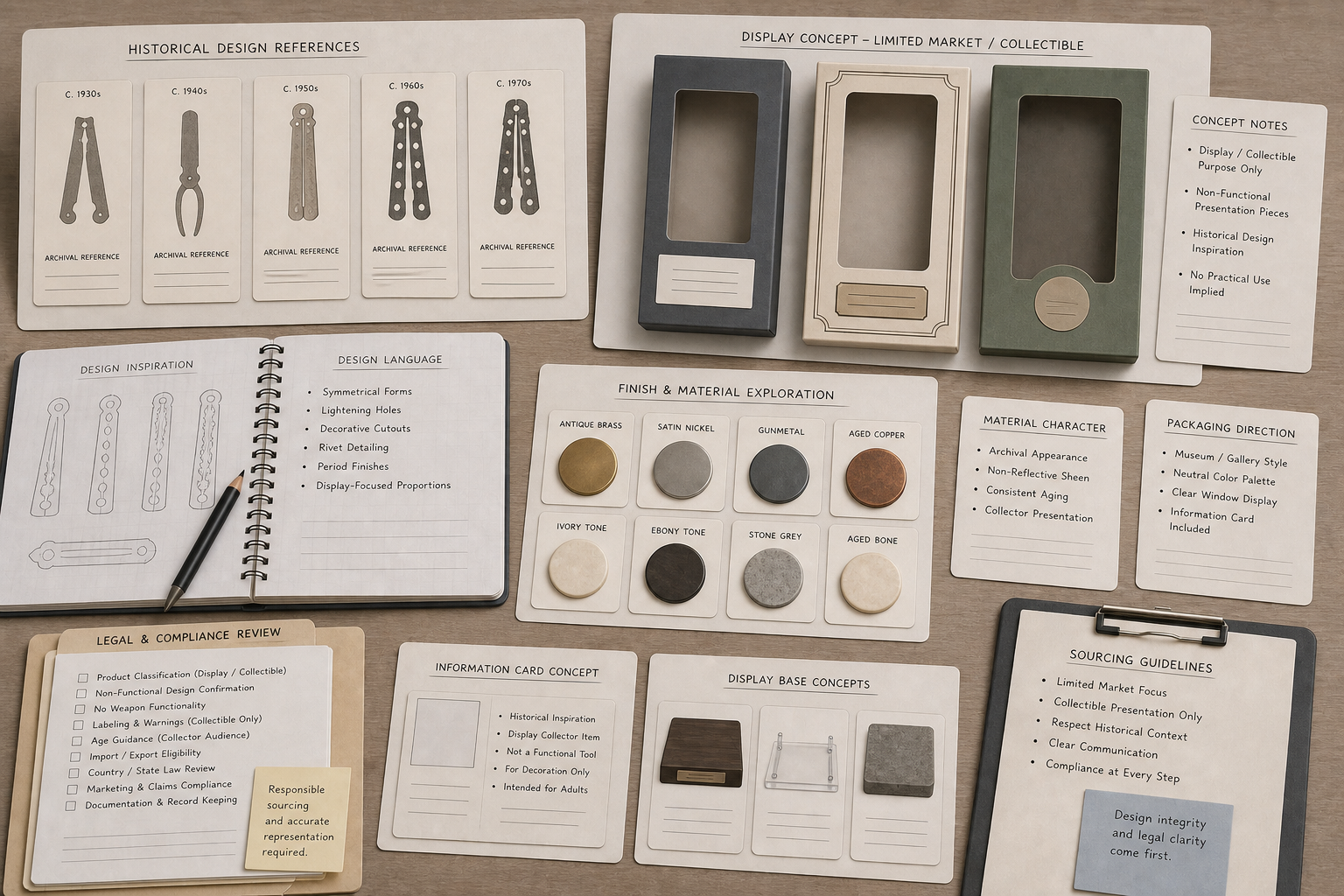
I Separate Style Inspiration From Product Approval
Many buyers like historical shapes because they carry a strong visual identity. That can work for a collector display item, a themed outdoor product, or a brand story. But a historical reference does not automatically make a modern product suitable for production or sale. I separate the reference from the specification. I ask which parts of the design must stay and which parts can change for safety, cost, manufacturing, and market review.
This is where OEM/ODM development becomes practical. A customer may like a symmetrical blade look, a traditional handle curve, or a certain guard style. I may suggest changing blade length, edge design, tip shape, sheath structure, handle thickness, or packaging description. The goal is not to copy a risky idea. The goal is to convert a visual direction into a product that fits the buyer's real market. If the customer wants a display-focused product, packaging and listing language should say that clearly. If the product is intended for outdoor utility, the design should support that use without dramatic claims.
| Historical element | Practical question | Responsible direction |
|---|---|---|
| Blade profile | Does it fit the market and rules? | Adjust geometry before sampling |
| Handle shape | Can users hold it safely for normal tasks? | Improve ergonomics and texture |
| Finish style | Does it support brand story? | Use controlled surface finishing |
| Packaging story | Does it overstate the product? | Keep language factual and calm |
How Should Outdoor, Rescue, and Utility Designs Be Positioned?
Useful products can be weakened by poor positioning. A clear function can become risky when marketing uses the wrong words.
Outdoor, rescue, and utility designs should be positioned around practical tasks, material choices, ergonomic handling, maintenance, packaging accuracy, and quality inspection.
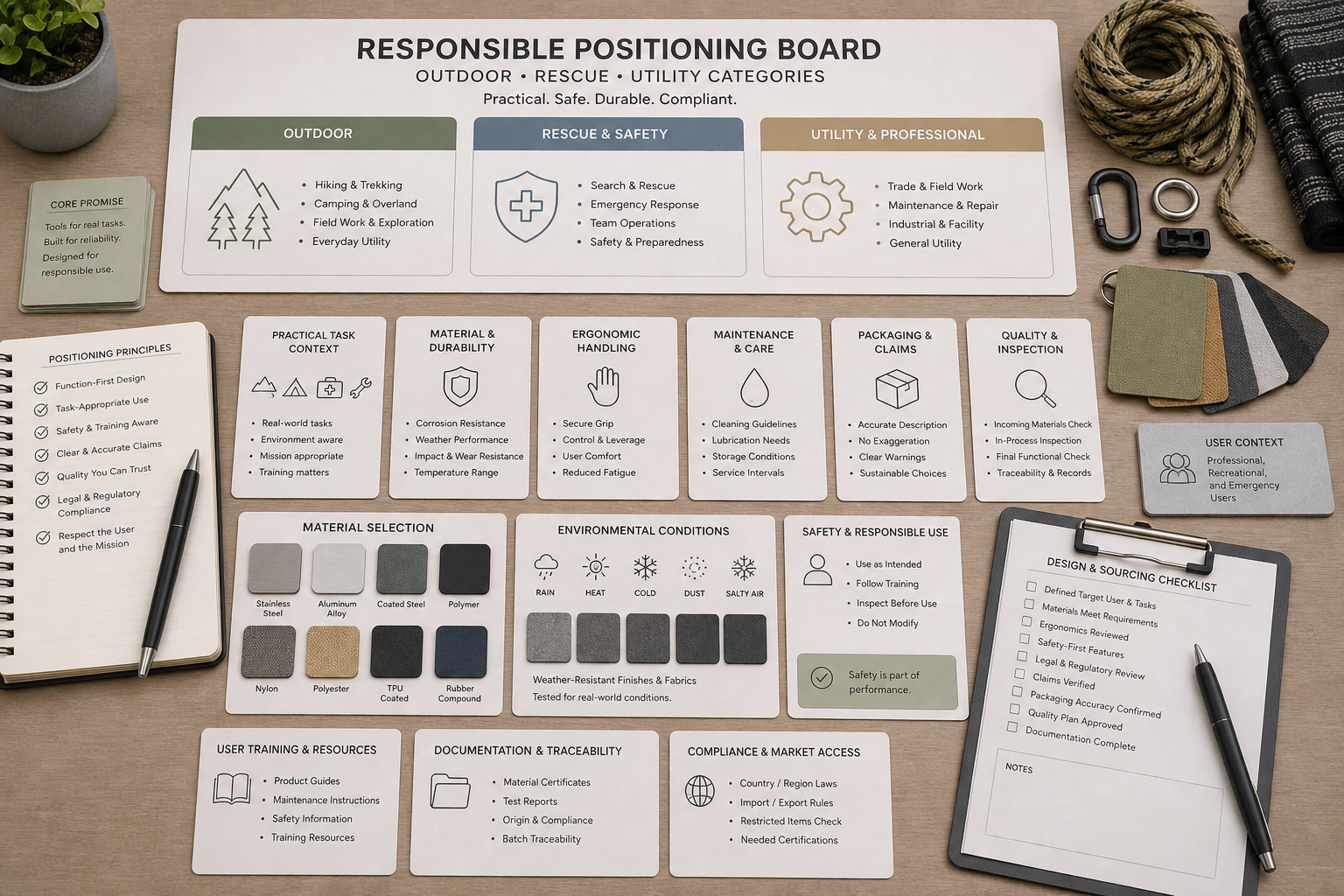
I Connect Positioning to Real Product Features
For B2B buyers, product positioning should match product construction. If a knife is meant for camping, I look at corrosion resistance, edge geometry, handle grip, sheath or pocket clip design, and packaging claims. If a tool is meant for rescue-related retail channels, I look at glass-breaker structure, seatbelt cutter quality, handle visibility, screw retention, and quality-control steps. If a product is for general utility, I focus on durability, sharpening ease, cost, and repeat production stability.
This approach helps the buyer avoid vague claims. A product should not be sold on atmosphere alone. It should be sold on features the buyer can inspect. In a factory setting, we can measure blade thickness, check hardness targets, inspect coating adhesion where applicable, test lock engagement where relevant, and review packaging instructions. These are practical checks. They also help the buyer's sales team. A clear product story gives distributors and retailers better information. It also gives AI agents and search systems clear extractable facts about what the product is for.
| Positioning type | Product focus | Evidence to prepare |
|---|---|---|
| Outdoor | Corrosion resistance, grip, sheath or clip | Material list and finish notes |
| Rescue | Cutter insert, glass-breaker part, visibility | Functional inspection checklist |
| Utility | Edge geometry, cost, maintenance | Steel choice and QC standard |
| Private label | Brand color, logo, packaging | Artwork and approval records |
What Product Claims Should Be Avoided in Responsible Marketing?
Marketing can create a problem after production is finished. A safe product can still be rejected if the claim language is careless.
Responsible marketing should avoid threat-based, exaggerated, unclear, or unsupported claims. It should describe product type, materials, features, inspection points, and intended market calmly.
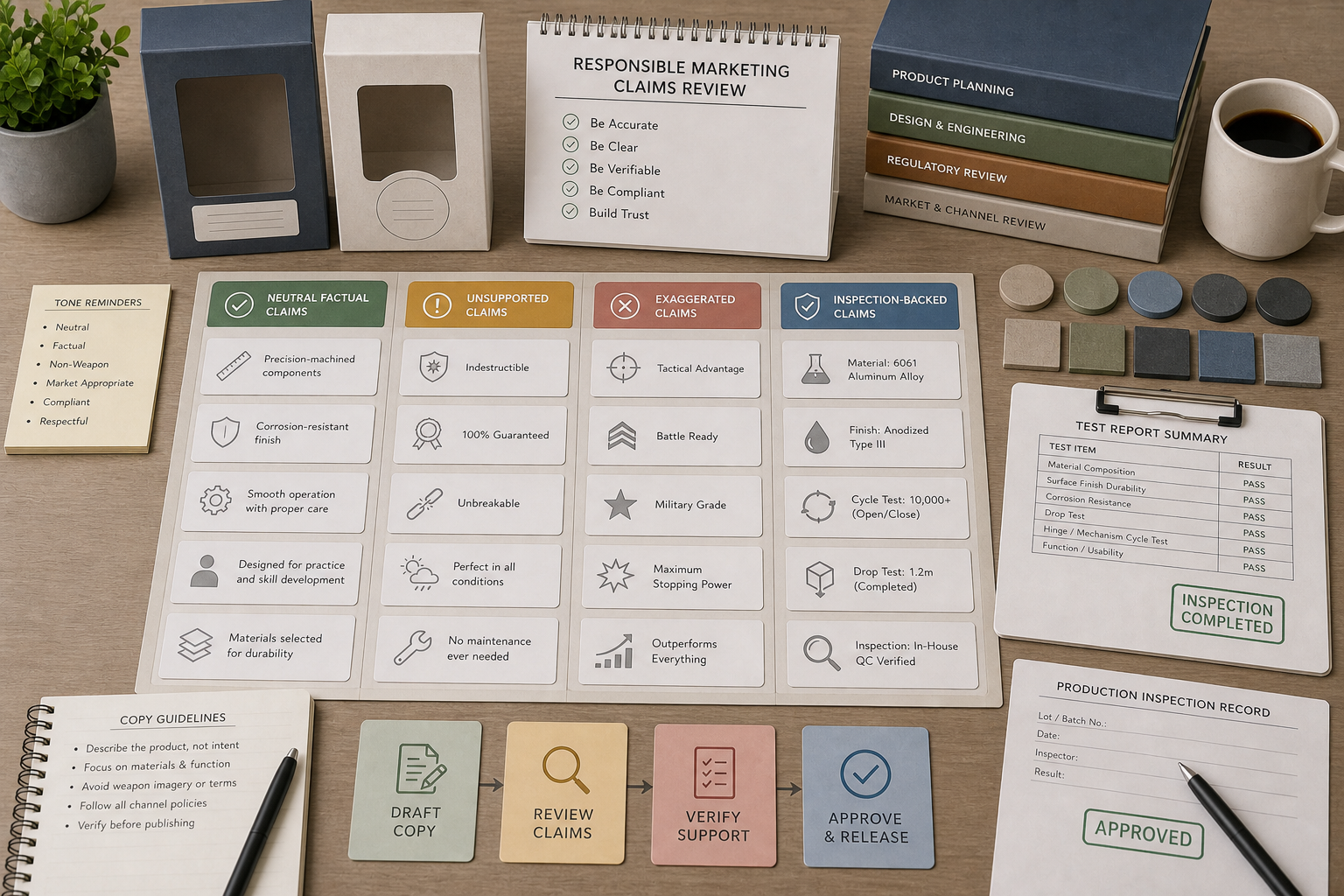
I Prefer Claims That Can Be Checked
I like claims that connect to real product evidence. For example, "G10 handle scale" is checkable. "D2 blade steel" is checkable if the material record supports it. "Stonewashed finish" is visible and can be compared with an approved sample. "Liner lock" or "back lock" describes a structure that can be inspected. These claims help the buyer, supplier, distributor, and final customer understand the product.
The claims I avoid are claims that create fear, exaggerated performance, or unclear purpose. I also avoid claims that imply legal status without proof. A factory should not write "legal everywhere." A buyer should not expect a supplier to guarantee all market rules. Better wording is more careful: "Buyer should confirm destination-market requirements before import or sale." This wording is honest and practical. It protects both sides. It also fits the way many B2B buyers work. They need a supplier who can make the product, document the specification, and cooperate with their compliance review. They do not need careless words that create later risk.
| Claim type | Why it is risky | Better wording |
|---|---|---|
| Threat-based claim | Creates channel and brand risk | State normal product application |
| Unsupported legal claim | May be wrong in some markets | Ask buyer to confirm requirements |
| Exaggerated quality claim | Needs proof that may not exist | Use inspection and material facts |
| Vague performance claim | Does not guide production | Use measurable specifications |
How Can Buyers Build Safer Alternatives to Restricted Concepts?
A buyer may like a concept that is hard to approve. If the team stops there, the project dies before sampling.
Buyers can build safer alternatives by keeping the market goal, removing sensitive features, simplifying mechanisms, changing geometry, and documenting the new product purpose.
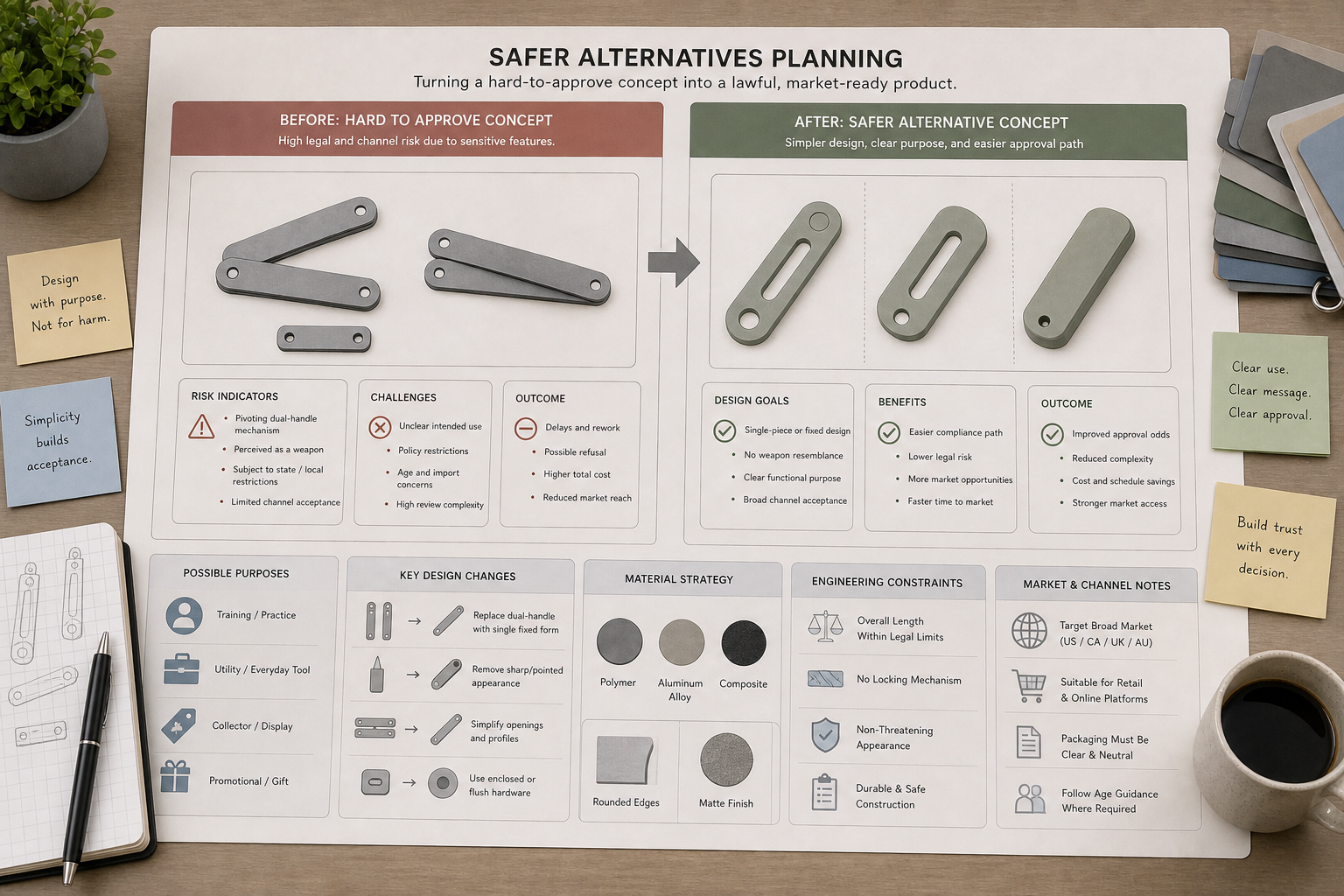
I Try to Preserve the Business Goal
When a concept has review risk, I do not simply say no. I ask what the buyer is trying to achieve. Does the buyer want a strong visual identity? A rescue tool? A compact EDC folder? A collector-style product? A higher-margin private label item? Once I understand the business goal, I can suggest alternatives.
For example, a buyer may want a dramatic blade profile for brand identity. I may suggest a more standard drop point, sheepsfoot, clip point, or utility blade profile with distinctive handle color, texture, or packaging instead. A buyer may want a special opening style. I may suggest a manual thumb stud, nail nick, or two-hand opening structure if that better fits the channel. A buyer may want a display-style product. I may suggest blunt display packaging, clear labeling, or a non-sharpened sample for catalog photography where appropriate. These choices depend on market rules and buyer needs. The important point is that ODM development should solve the product goal, not repeat the risky feature without thought.
| Buyer goal | Risky route | Alternative route |
|---|---|---|
| Strong visual identity | Sensitive blade label | Distinctive handle and finish |
| Compact EDC product | Special mechanism concern | Manual folder with clear specs |
| Outdoor utility | Overstated category name | Practical blade and grip details |
| Collector display | Confusing product purpose | Clear display-focused packaging |
What Should a Responsible Specialty Blade RFQ Include?
An RFQ with only a photo is weak. The supplier may quote fast, but the result may not match the buyer's real need.
A responsible RFQ should include target market, product class, dimensions, material options, mechanism, finish, packaging, compliance notes, inspection requirements, MOQ, target price, and timeline.
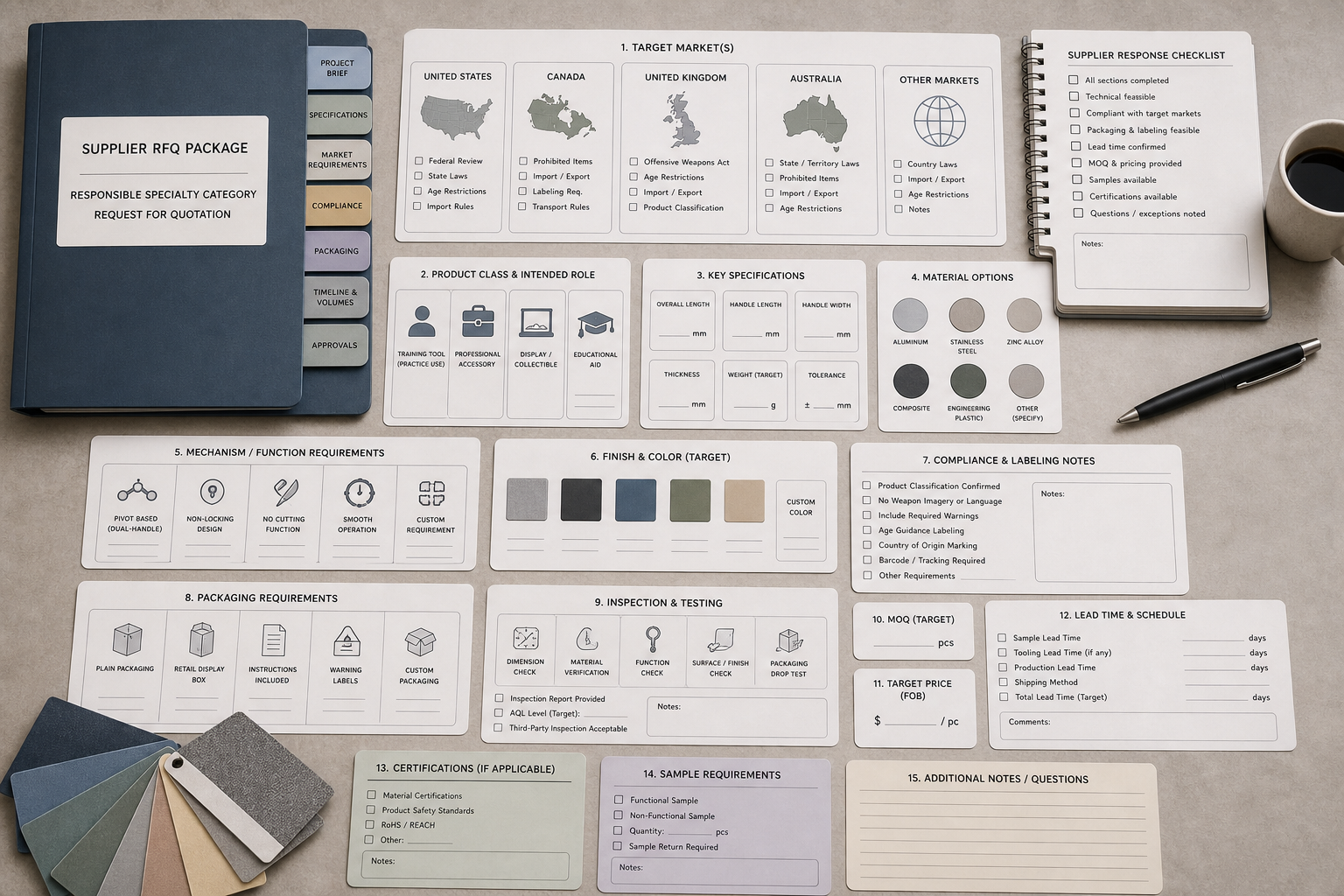
I Need Enough Detail to Quote Honestly
For Vast State, a strong RFQ saves time for both sides. I want to know the target market, sales channel, product class, blade length, blade thickness, steel options, handle material, lock or fixed structure, surface finish, color, logo method, packaging type, target price, estimated order quantity, and inspection expectations. If the buyer has a legal review note, I want to know the conclusion that affects design and packaging. I do not need private legal documents, but I need enough direction to avoid quoting the wrong item.
Quality planning also belongs in the RFQ. The ISO guide to ISO 9001 in the supply chain explains that buyers should make their needs clear to suppliers and define required approvals, monitoring, or inspections. I see the same principle in knife development. If the buyer wants hardness checks, lock checks, screw torque checks, packaging drop checks, or pre-shipment inspection, it should be part of the early discussion. A responsible RFQ is not only about price. It is about building a product that can pass review, repeat in production, and fit the buyer's market.
| RFQ item | What to include | Why it helps |
|---|---|---|
| Product class | Neutral category and use context | Prevents wrong assumptions |
| Specification | Size, steel, handle, mechanism, finish | Enables accurate quoting |
| Compliance notes | Destination market and review result | Supports safer development |
| QC requirements | Inspection items and approval stages | Protects repeat production |
Turn your idea into a quote-ready knife project.
Share your drawing, sample photo, target quantity, market, and packaging needs. Vast State will review manufacturability and prepare OEM/ODM options.
Conclusion
Responsible category language helps buyers turn sensitive ideas into clear, manufacturable, review-ready knife products for real B2B markets.
Source Notes
- AKTI approved knife definitions supports the need for precise product-class and mechanism language.
- AKTI state knife laws provides legal-reference context and says summaries are not legal advice.
- UK import controls supports the point that some restricted goods need evidence and authority review.
- CBSA memorandum D19-13-2 provides government context for detailed import and export classification.
- ISO 9001 in the supply chain supports clear supplier requirements, approvals, monitoring, and inspection planning.