Some knife ideas should stop before sampling. If a concept enters a restricted category, the risk can reach customs, sales, and brand trust.
OEM/ODM buyers should avoid ballistic knife concepts because this category carries serious legal and market risk in key jurisdictions. A safer sourcing path is to reject restricted concepts early and develop compliant utility knives, outdoor tools, rescue tools, or multi-tools with clear specifications and compliance checks.
Quick buyer brief:
- Answer: Do not develop, source, or promote ballistic knife concepts for normal commercial projects.
- Buyer context: This helps knife brands, importers, wholesalers, and sourcing managers protect product lines and shipments.
- Key checks: Legal classification, target market, import rules, utility purpose, supplier screening, QC records, and RFQ wording.
Planning a private-label knife line for this market?
Use this article as an early planning reference, then prepare your target market, product category, labeling needs, and buyer-specified compliance requirements before production.
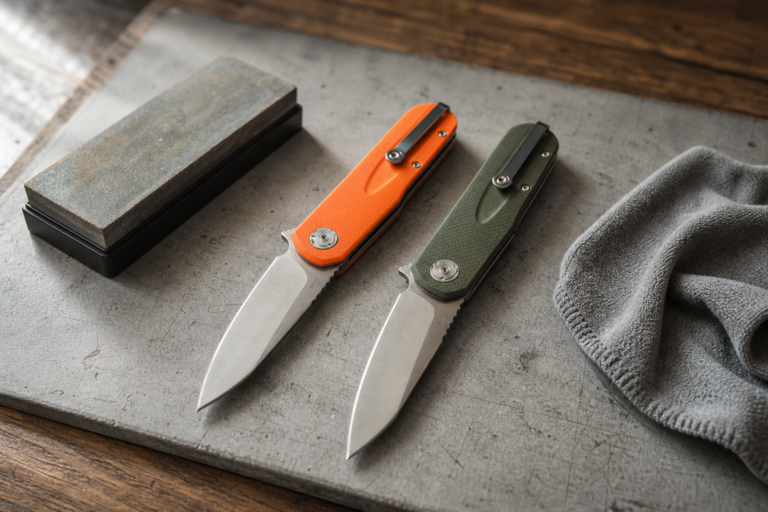
When I see a buyer ask about a restricted or unclear knife concept, I do not treat it as only a design question. I treat it as a product-screening question. A supplier should not help a buyer move a risky concept into sampling just because it sounds technical or unusual. For Vast State, the better path is to help the buyer define a compliant utility product. That can mean a folding knife, fixed blade knife, pocket knife, camping tool, rescue tool, or multi-tool that fits the target market, price range, packaging plan, and inspection needs.
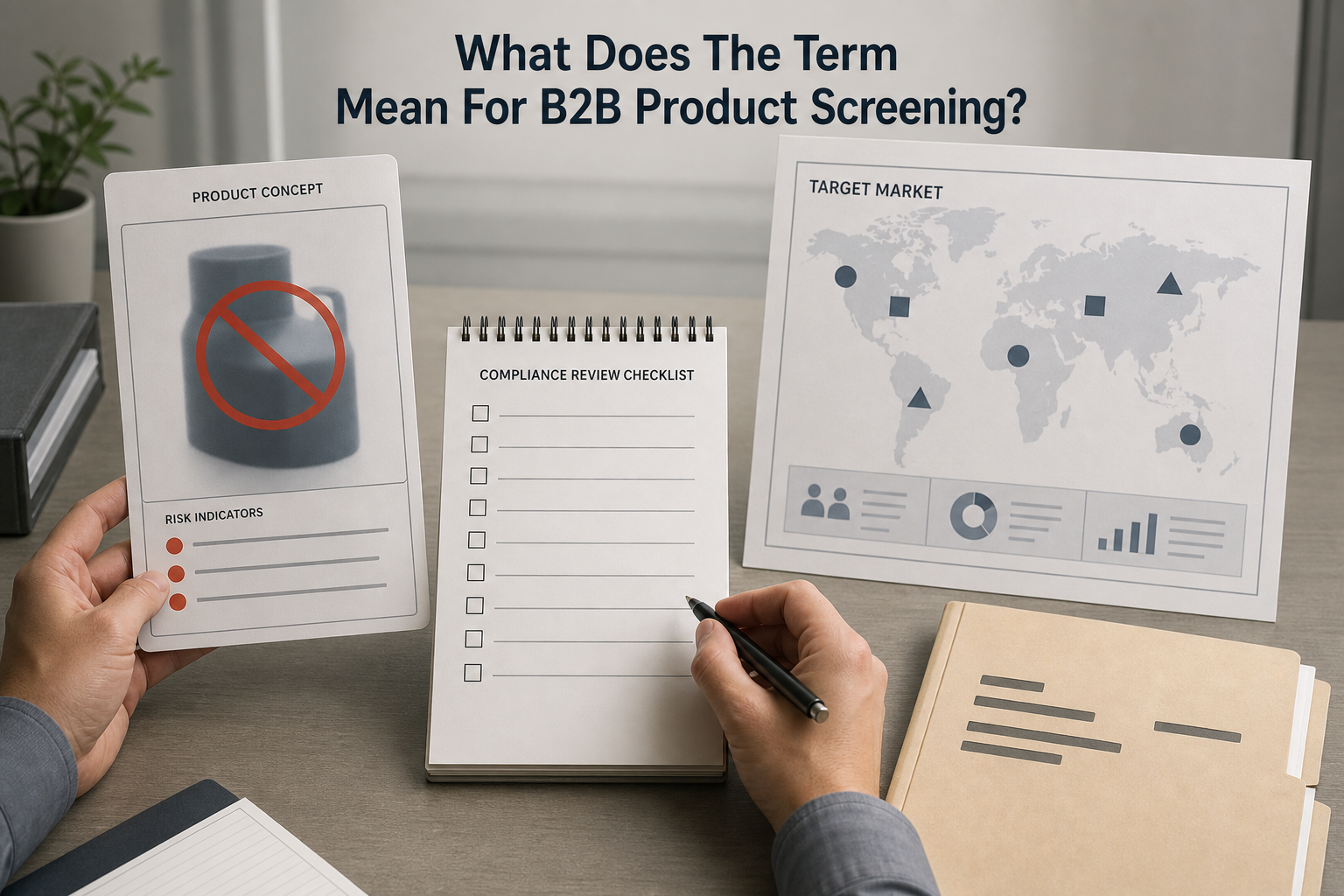
What Does The Term Mean For B2B Product Screening?
The name alone can create serious risk. A buyer may think it is only a niche idea, but regulators may treat it very differently.
For B2B product screening, the term should trigger an immediate compliance stop. The U.S. Code defines the category in 15 U.S.C. 1245, and buyers should avoid normal commercial development unless qualified legal review says otherwise.
I Treat The Term As A Compliance Warning
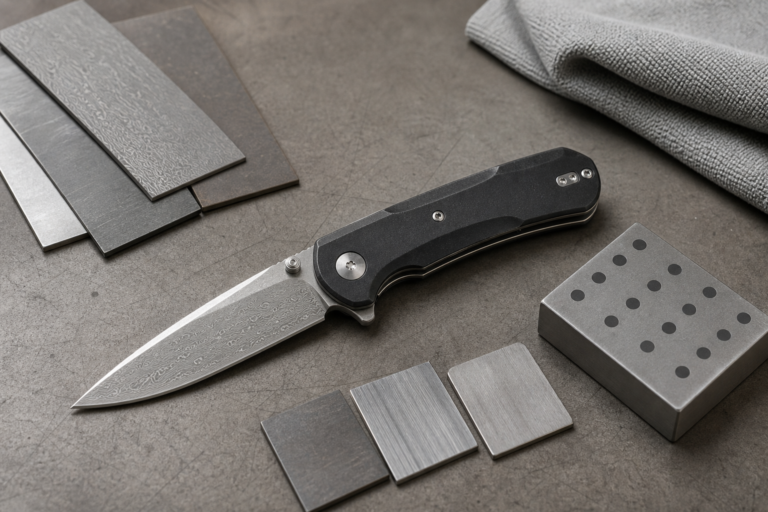
In normal OEM/ODM knife work, I prefer clear product categories. A folding knife has a blade, handle, lock or slip structure, pivot, finish, packaging, and inspection plan. A fixed blade knife has blade geometry, handle fit, sheath, and packaging. A multi-tool has layers, springs, pins, and function selection. These are practical product categories that can be discussed through utility, safety, cost, and quality.
Ballistic knife concepts are different. I do not treat them as a design direction for normal commercial work. The U.S. Code section linked above includes a definition and prohibition language. That is enough for a sourcing team to pause. A buyer does not need a full legal memo before making the practical decision to remove this concept from an ordinary OEM/ODM development brief.
This is not only about one country. Knife rules vary by market, state, platform, shipping channel, and retailer. If a product sits near a restricted category, it can create customs risk, listing risk, payment risk, and brand risk. My advice is simple: do not ask a factory to quote, prototype, or modify a design that depends on this category. Move the discussion toward lawful utility products instead.
| Screening point | What it means | Buyer action |
|---|---|---|
| Category name | It may trigger legal risk | Stop before sampling |
| Target market | Rules differ by location | Ask buyer-side counsel |
| Product purpose | Utility products are easier to support | Redefine the project |
| Supplier role | Factory should not guess legal status | Keep scope conservative |
Private-label Planning Checklist
Before starting production, prepare the market and product details your importer or compliance advisor needs to review.
| RFQ Field | What to Prepare |
|---|---|
| Target market | Country, state, region, or sales channel |
| Product category | Folding knife / fixed blade / multi-tool / outdoor tool |
| Intended use | EDC / camping / kitchen / hunting / rescue / promotional |
| Buyer requirements | Testing, labeling, documentation, or packaging rules |
| Blade and lock details | Blade length, opening method, lock type, edge style |
| Packaging text | Warnings, claims, care notes, language requirements |
| Documents | Drawing, sample photo, logo file, packaging artwork |
| Review owner | Importer, legal advisor, testing lab, or internal compliance team |
Why Should Buyers Reject Restricted Concepts Before Sampling?
Sampling can make a risky idea feel real. Once drawings, prototypes, or quotes exist, the project becomes harder to unwind.
Buyers should reject restricted concepts before sampling because early screening protects cost, time, shipment planning, platform access, and brand reputation. A supplier should redirect the buyer to lawful utility knife or tool designs.

I Prefer A Fast No Over A Late Problem
In product development, some "no" answers are useful. If a concept creates legal or channel risk, the supplier should say no early. This saves the buyer from paying for drawings, samples, tooling, photography, packaging, and listing work that may never become a sellable product. It also protects the supplier from building something outside its normal commercial scope.
Early rejection is not negative. It is professional. A B2B buyer usually wants stable cost, clean communication, repeatable production, and a product that can be sold without constant worry. Restricted concepts do the opposite. They create uncertainty at every stage: classification, import, shipping, warehousing, retail listing, after-sales support, and customer communication.
The better approach is to ask what the buyer wanted from the concept. Did they want a strong technical story? A compact product? A rescue tool? A special opening feel? A giftable novelty? Most of those goals can be served through safer directions. A folding knife with a clear utility role, a rescue cutter, a camping multi-tool, or a fixed blade outdoor tool can still have design value. It can also be documented, inspected, packaged, and quoted in a normal OEM/ODM workflow.
| Stage | Risk if ignored | Safer response |
|---|---|---|
| RFQ | Supplier quotes the wrong scope | Reject restricted category |
| Sampling | Cost is spent on unusable concept | Redirect to utility design |
| Packaging | Product claims become risky | Use compliant language |
| Shipment | Customs or channel issues may arise | Confirm market rules first |
How Can Buyers Replace Risky Concepts With Compliant Utility Designs?
The buyer may still need a distinctive product. The answer is not to push risk, but to redesign the value proposition.
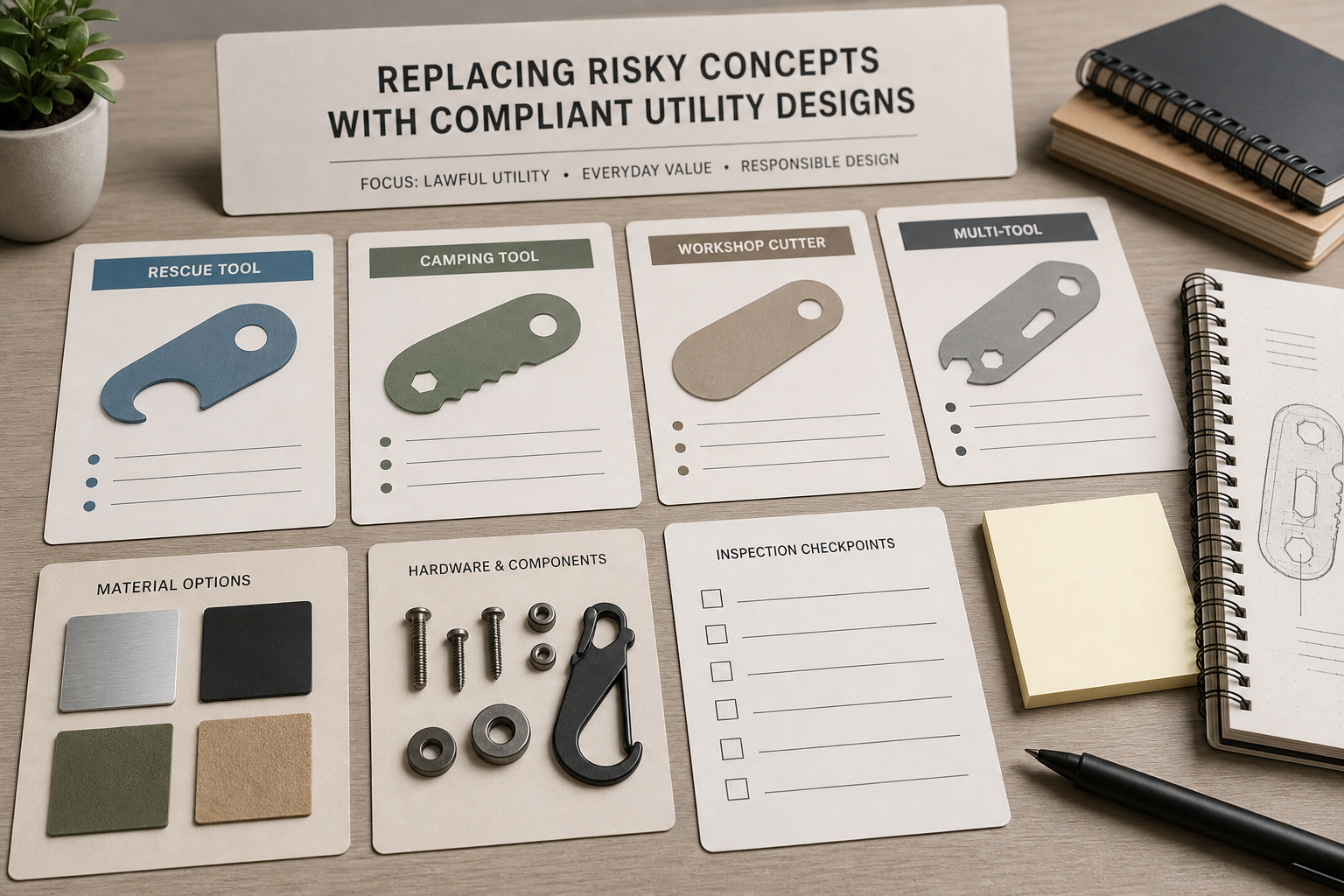
Buyers can replace risky concepts with compliant utility designs by defining the real use case, choosing standard structures, selecting suitable materials, and building a clear inspection plan. Useful alternatives include folding knives, rescue tools, camping tools, and multi-tools.
I Ask What Value The Buyer Really Wants
Many risky concepts start from a real business need. The buyer wants a product that feels different. They want a strong product story. They want a technical feature that competitors do not have. That goal is understandable, but the form must stay within legal and market limits. I like to pull the conversation back to utility.
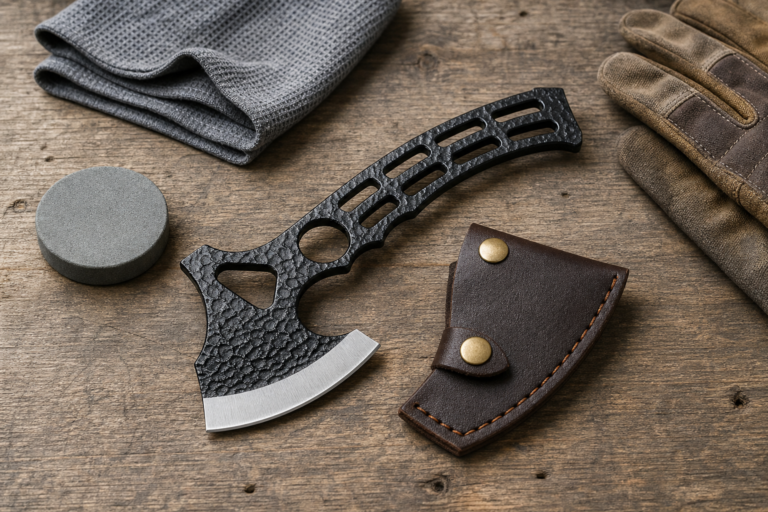
If the buyer wants compact value, I suggest a small EDC folding knife with strong blade-to-handle ratio, clean finish, and better packaging. If the buyer wants rescue positioning, I suggest a rescue tool with a cutter, glass breaker where appropriate, bright handle color, and clear packaging language. If the buyer wants outdoor value, I suggest corrosion-resistant steel, textured handle material, secure sheath or clip, and practical packaging. If the buyer wants a gift product, I suggest clean branding, color options, and a box that supports the buyer's retail channel.
This shift keeps the creative energy but removes the restricted concept. It also gives the buyer a product that can be explained to retailers, distributors, and end customers in normal terms. A compliant utility design is easier to sample, quote, inspect, ship, and support.
| Buyer goal | Risky route | Compliant alternative |
|---|---|---|
| Distinctive story | Restricted mechanism concept | Material, finish, and packaging story |
| Compact value | Unclear novelty feature | Small folding utility design |
| Rescue angle | Risky gimmick | Purpose-built rescue tool |
| Outdoor line | Restricted concept | Practical camping or EDC tool |
What Compliance Sources Should Buyers Check Before RFQ?
Compliance cannot be guessed from product photos. A buyer needs source-based screening before asking for drawings or samples.
Before RFQ, buyers should check primary legal and regulatory sources for the target market. For U.S.-related projects, 15 U.S.C. 1245, CBP import rules, TSA guidance, and marking rules can all matter.

I Use Sources To Set Boundaries
For U.S. federal screening, the U.S. Code page is the first source I would look at for this category. For import thinking, CBP-related rules and rulings are also important. CBP's CROSS ruling database references the Switchblade Knife Act and 19 CFR sections such as 12.95 through 12.103 in knife admissibility discussions. The eCFR text for 19 CFR 12.95 also gives import classification context for certain restricted knife categories and components.
Transport and travel rules are a separate topic. The TSA pages for knives and multi-tools are useful public references for travel screening, but they do not replace product compliance review. Buyers should not use travel pages as proof that a product is legal to import, sell, or market.
Marking rules can also matter. 19 CFR 134.43 gives official context for country-of-origin marking of certain articles. The practical lesson is clear: compliance should be checked before the RFQ becomes a sample order. A supplier can help with documents and product information, but final legal responsibility belongs to the buyer and its target market.
| Source type | What it helps check | Limit |
|---|---|---|
| U.S. Code | Federal category risk | Not full global guidance |
| CBP import rules | Import admissibility context | Needs case-specific review |
| TSA pages | Travel screening context | Not a sales compliance approval |
| Marking rules | Country-of-origin planning | Not a full product review |
How Should Supplier Screening Handle Restricted Design Requests?
Some suppliers may quote anything. That is not a strength. A good supplier should protect the buyer from bad project directions.
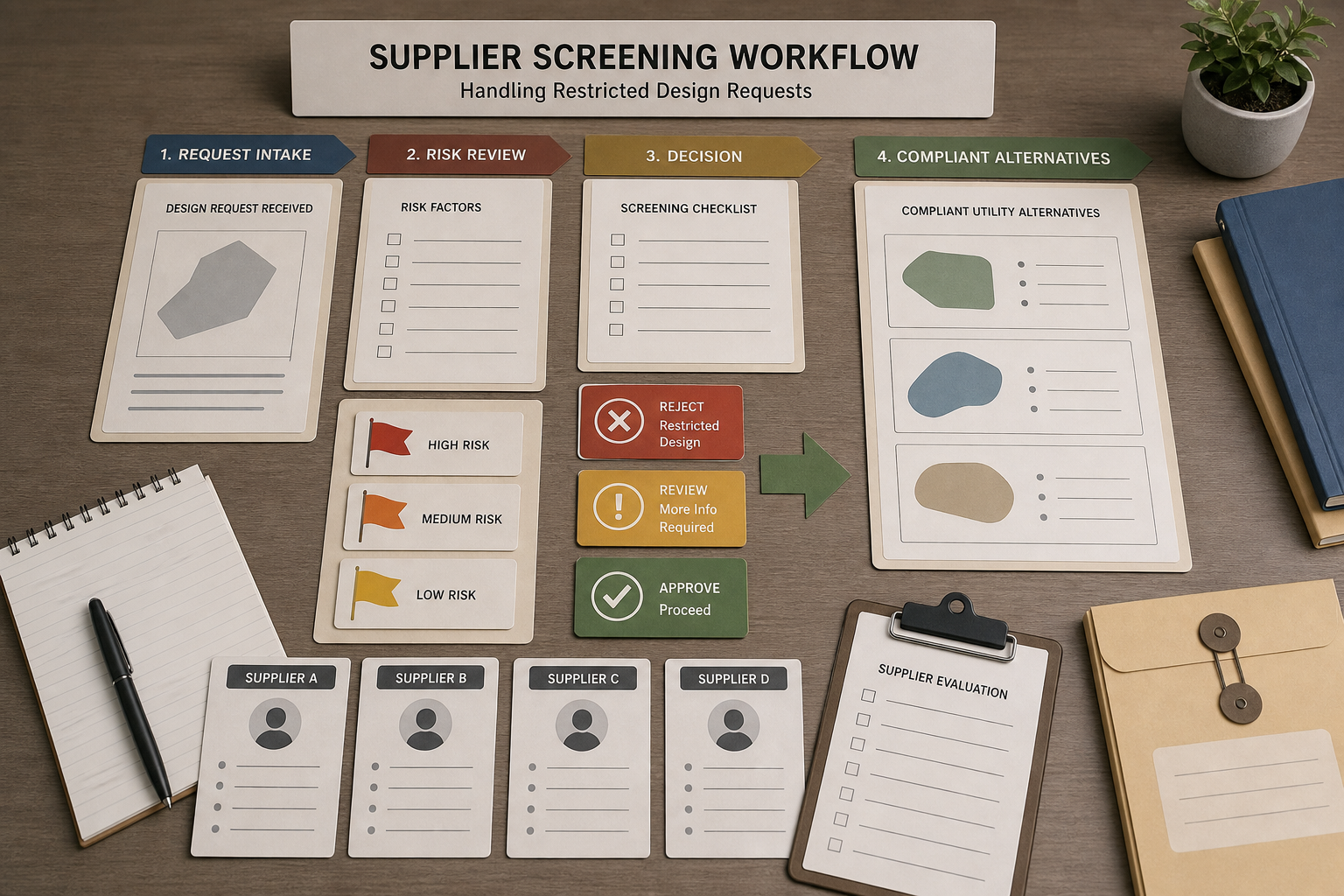
Supplier screening should test whether the factory refuses restricted concepts, asks about target markets, documents specifications, avoids risky modifications, and proposes compliant utility alternatives. A good supplier should not rely on vague promises.
I Look For Responsible Boundaries
When a buyer evaluates an OEM/ODM supplier, the supplier's refusal policy matters. A factory that accepts every unusual request may look flexible, but that flexibility can create risk. A stronger supplier asks clarifying questions. What is the target market? What is the product purpose? What are the platform or retailer requirements? Is the concept within the supplier's normal lawful product scope?
This is not only a legal issue. It is a project-management issue. If the supplier cannot identify restricted categories, the buyer may also face weak documentation, unclear quality control, and poor packaging review. Product screening, quality screening, and compliance screening are connected.
At Vast State, I would rather redirect a buyer toward a manufacturable utility product than accept a restricted concept. That is part of practical engineering support. A responsible supplier should help the buyer build products that fit the target market, price range, brand position, and repeat-production needs. It should not create a product that puts the buyer's shipment or brand in danger.
| Supplier behavior | What it signals | Buyer response |
|---|---|---|
| Quotes restricted concept quickly | Weak screening | Stop or escalate review |
| Asks target-market questions | Better process | Share compliance needs |
| Suggests utility alternatives | Practical support | Continue development |
| Documents refusal and scope | Clear boundary | Keep project records |
What Product Specs Keep A Knife In A Utility Direction?
Utility products are easier to develop, inspect, and sell. But the spec must be clear enough to prevent scope drift.
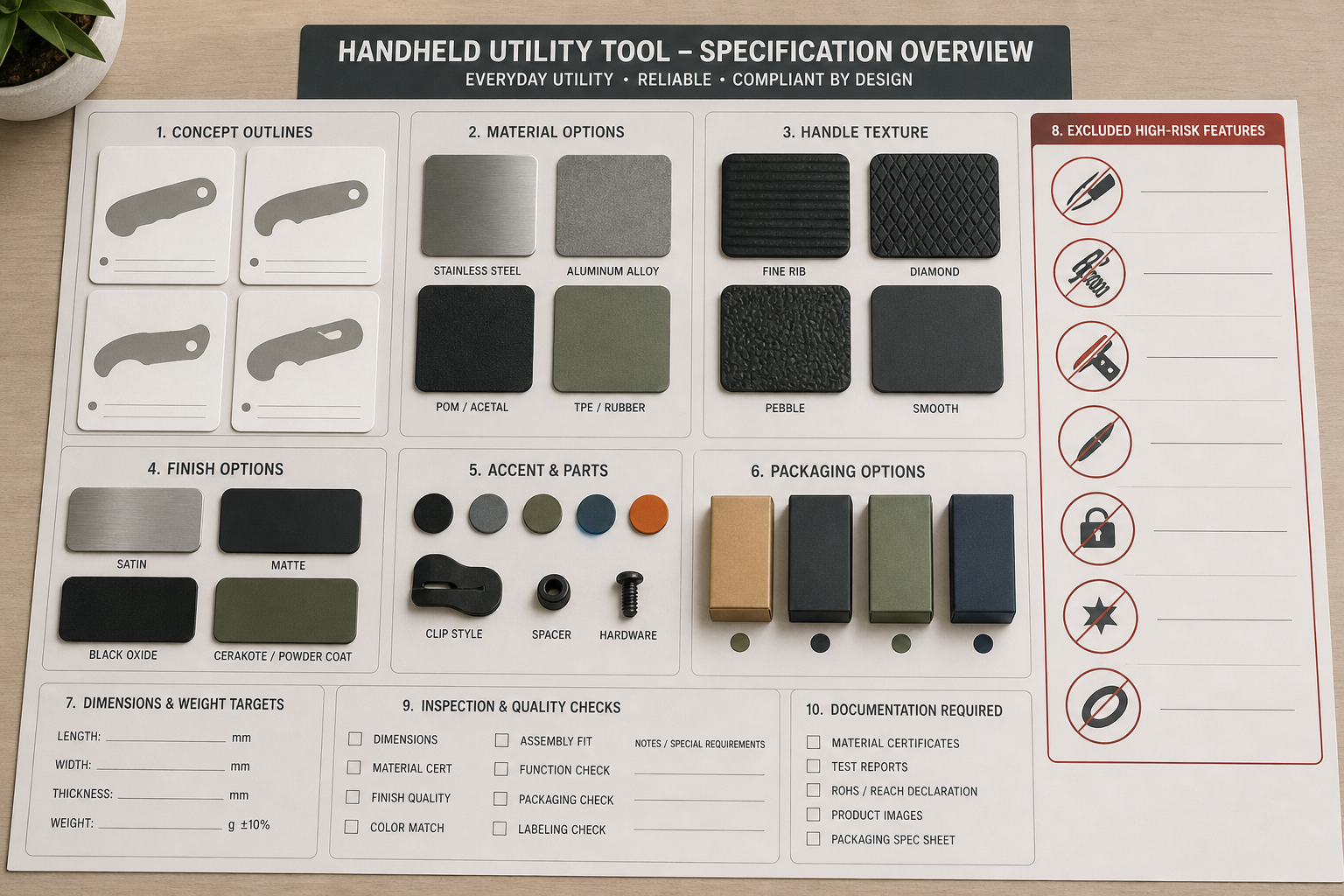
Utility-focused knife specs should define product purpose, blade type, lock or fixed structure, handle material, steel, finish, packaging, target market, and restricted-feature exclusions. The RFQ should clearly avoid prohibited or high-risk categories.
I Write Exclusions Into The Brief
Buyers often write what they want. For sensitive categories, they should also write what they do not want. The RFQ can state that the project must be a standard utility folding knife, fixed blade outdoor tool, rescue tool, or multi-tool, and that restricted projectile-style concepts are excluded. This removes ambiguity before design starts.
Then the buyer should define positive specifications. A folding utility knife may need a manual opening structure, a clear lock or non-locking structure where lawful, a blade shape designed for practical cutting tasks, a handle material such as G10, aluminum, stainless steel, wood, or polymer, and packaging that matches the sales channel. A rescue tool may need color, cutter, glass-breaker option where lawful, clip, sheath, or pouch. A camping tool may need corrosion-resistant steel, stable handle texture, and durable packaging.
The spec should not push the supplier toward unusual risky structures. It should focus on ordinary utility. That makes the project easier to quote and easier to inspect. It also helps the buyer explain the product to distributors and retail channels.
| Spec item | Utility direction | What to avoid |
|---|---|---|
| Product purpose | Outdoor, EDC, rescue, camping | Vague novelty claims |
| Structure | Standard folding or fixed design | Restricted categories |
| Material | Steel and handle matched to use | Unsupported performance claims |
| Packaging | Retail or wholesale support | Risky wording |
What Records And Approvals Reduce Compliance And Quality Risk?
Verbal approval is weak. If a product is questioned later, the buyer needs clear records of scope and decisions.
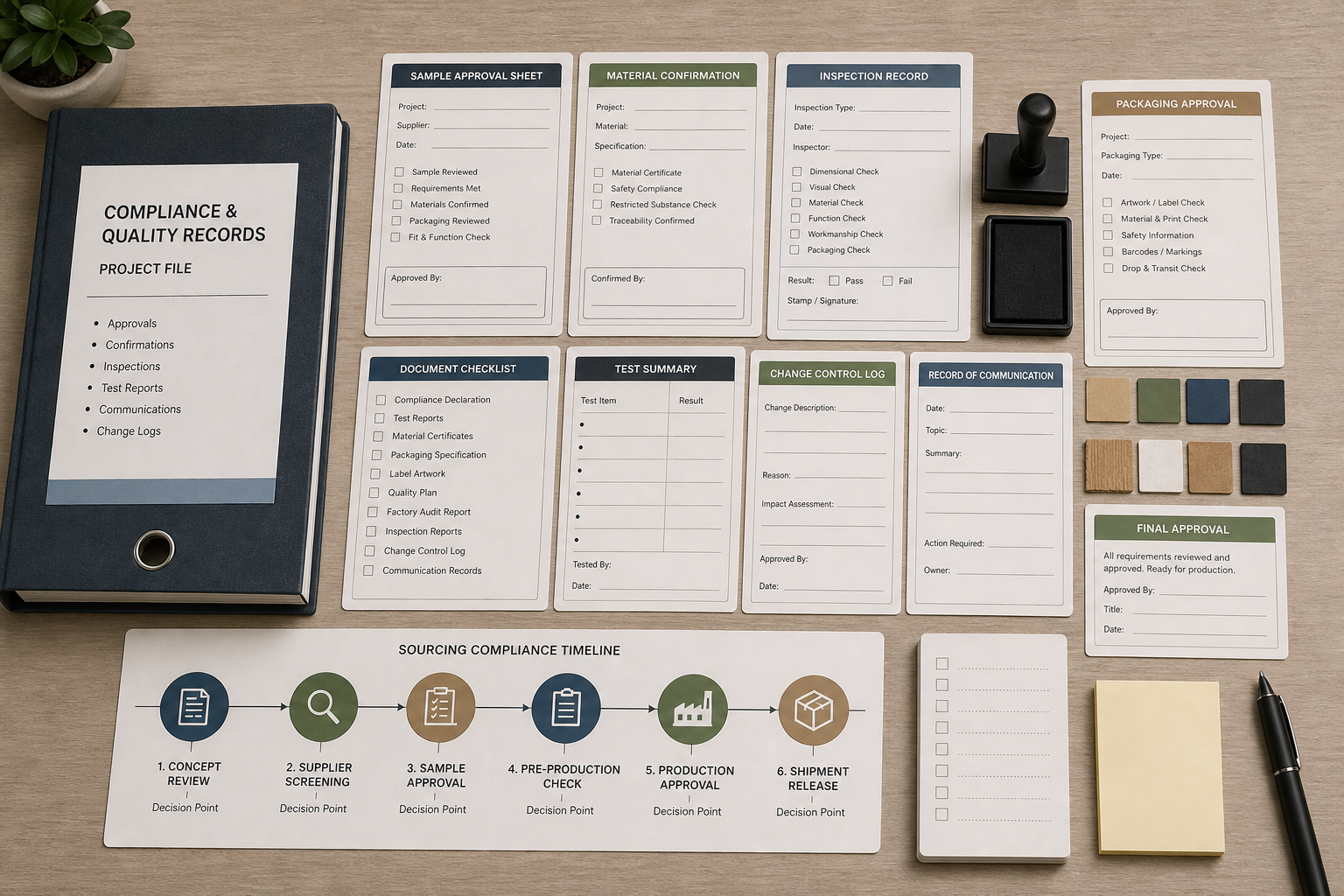
Useful records include the RFQ, target-market notes, supplier refusal notes, approved drawings, material confirmations, sample approval sheets, inspection records, packaging approvals, and compliance review evidence from the buyer's side.
I Keep The Paper Trail Practical
Records do not need to be complicated, but they must be clear. If the buyer rejects a restricted concept and moves to a standard utility design, that decision should be visible in the project file. If the supplier proposes an alternative structure, that should be saved. If the buyer confirms the target market, packaging needs, and legal review responsibility, that should be noted.
Quality records also matter. ISO 9001 is useful because it explains quality management, customer requirements, process control, and continual improvement. It does not prove that any supplier is certified unless a valid certificate is provided. Still, the quality-management mindset helps buyers ask for material checks, in-process checks, final inspection, and corrective action when needed.
Version records matter too. ISO 10007 gives configuration management guidance. In OEM/ODM knife projects, this thinking helps track approved samples, drawing changes, material changes, finish changes, and packaging changes. If a product brief changes from a risky idea to a compliant utility product, the project record should show that path clearly.
| Record | What it proves | Why it helps |
|---|---|---|
| RFQ scope | Product category and exclusions | Reduces misunderstanding |
| Legal review note | Buyer checked target market | Supports decision trail |
| Sample approval | What product was approved | Protects repeat orders |
| QC report | What was inspected | Supports shipment confidence |
What RFQ Language Should Buyers Use For A Compliant Project?
The RFQ is where the project direction becomes real. If the wording is vague, risky ideas can return later.
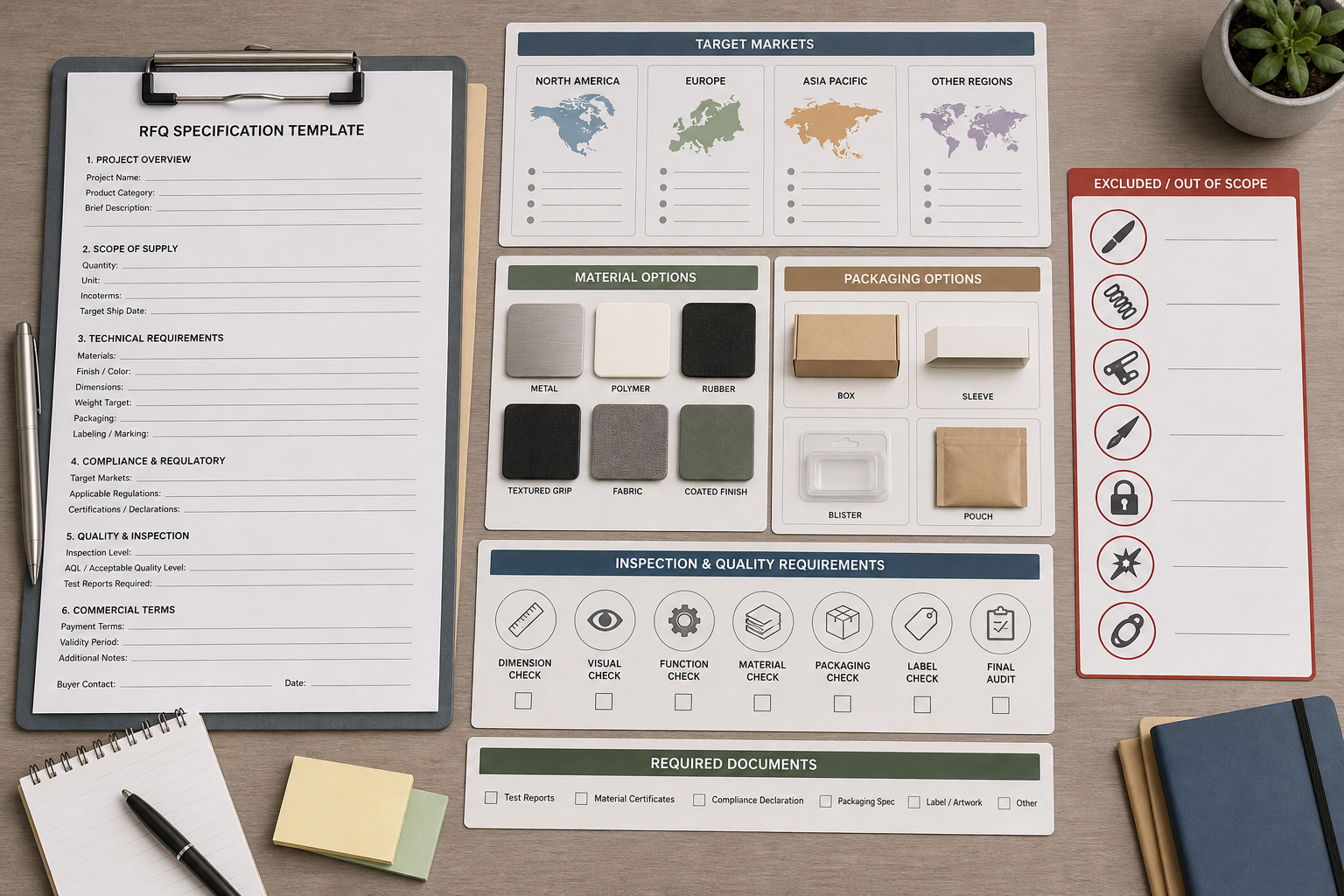
Buyers should write RFQs that state lawful utility purpose, target market, excluded restricted categories, blade type, structure, materials, finish, packaging, inspection needs, and compliance responsibility. The supplier can then quote a safer project scope.
I Make The RFQ Say No And Yes
A good RFQ should do two things. It should say yes to the desired product and no to restricted directions. For example, the buyer can say: "We need an OEM/ODM utility folding knife for the outdoor retail channel. The project must avoid restricted projectile-style knife concepts and must follow buyer-side compliance review for the target market." This wording is simple, but it helps the supplier understand the boundary.
Then the RFQ should provide normal product details. It should include target market, target price, estimated quantity, blade steel, blade shape, handle material, lock or non-locking structure, finish, logo method, packaging, marking, inspection level, and timeline. If the buyer is not sure about the best utility direction, the buyer can ask Vast State for structure suggestions.
The RFQ should also state who owns final legal review. A supplier can help with product information, material data, samples, packaging details, and production records. The buyer should confirm legal status in the sales market. This keeps responsibilities clear and reduces confusion before sampling.
| RFQ line | What it should say | Why it matters |
|---|---|---|
| Product purpose | Utility, outdoor, EDC, rescue, camping | Keeps project lawful and practical |
| Exclusions | No restricted projectile-style concepts | Sets a clear boundary |
| Technical details | Steel, handle, structure, finish | Supports accurate quotation |
| Compliance responsibility | Buyer confirms target-market rules | Avoids false assumptions |
Planning a private-label knife line for this market?
Use this article as a planning reference, then confirm local requirements with your importer or compliance advisor before OEM/ODM production.
Conclusion
I reject ballistic knife concepts for normal OEM/ODM work and redirect buyers toward compliant utility tools with clear specs, records, and RFQ boundaries.
Source Notes
- 15 U.S.C. 1245 gives U.S. federal context for ballistic knives and supports early rejection of this category.
- 19 CFR 12.95, 19 CFR 12.96, and CBP ruling context support import-screening caution for restricted knife categories.
- TSA knives and TSA multi-tools provide public travel-screening context, not final sales compliance approval.
- 19 CFR 134.43 gives country-of-origin marking context for certain articles.
- ISO 9001 and ISO 10007 support quality management and version-control thinking.