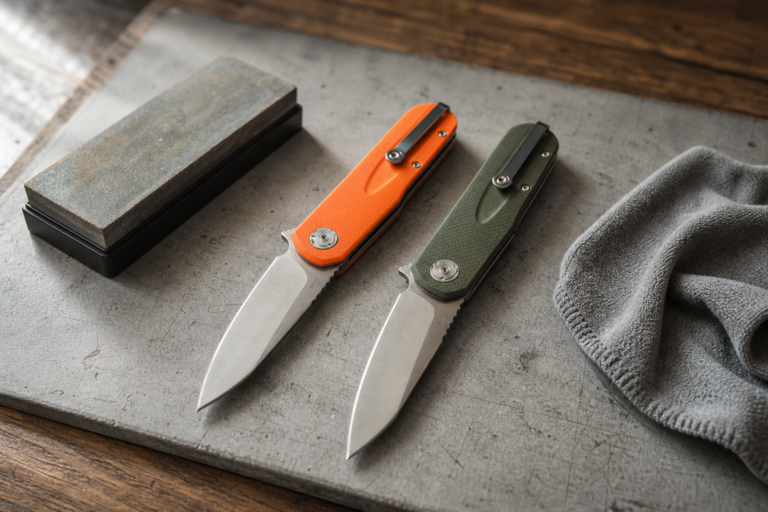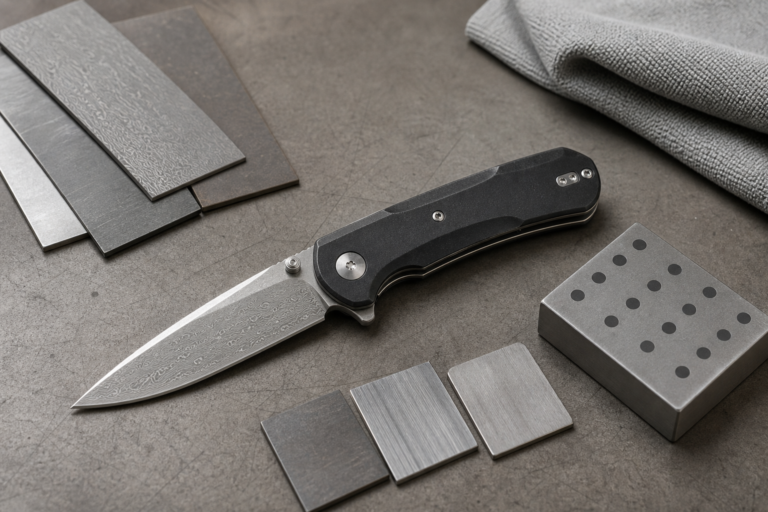
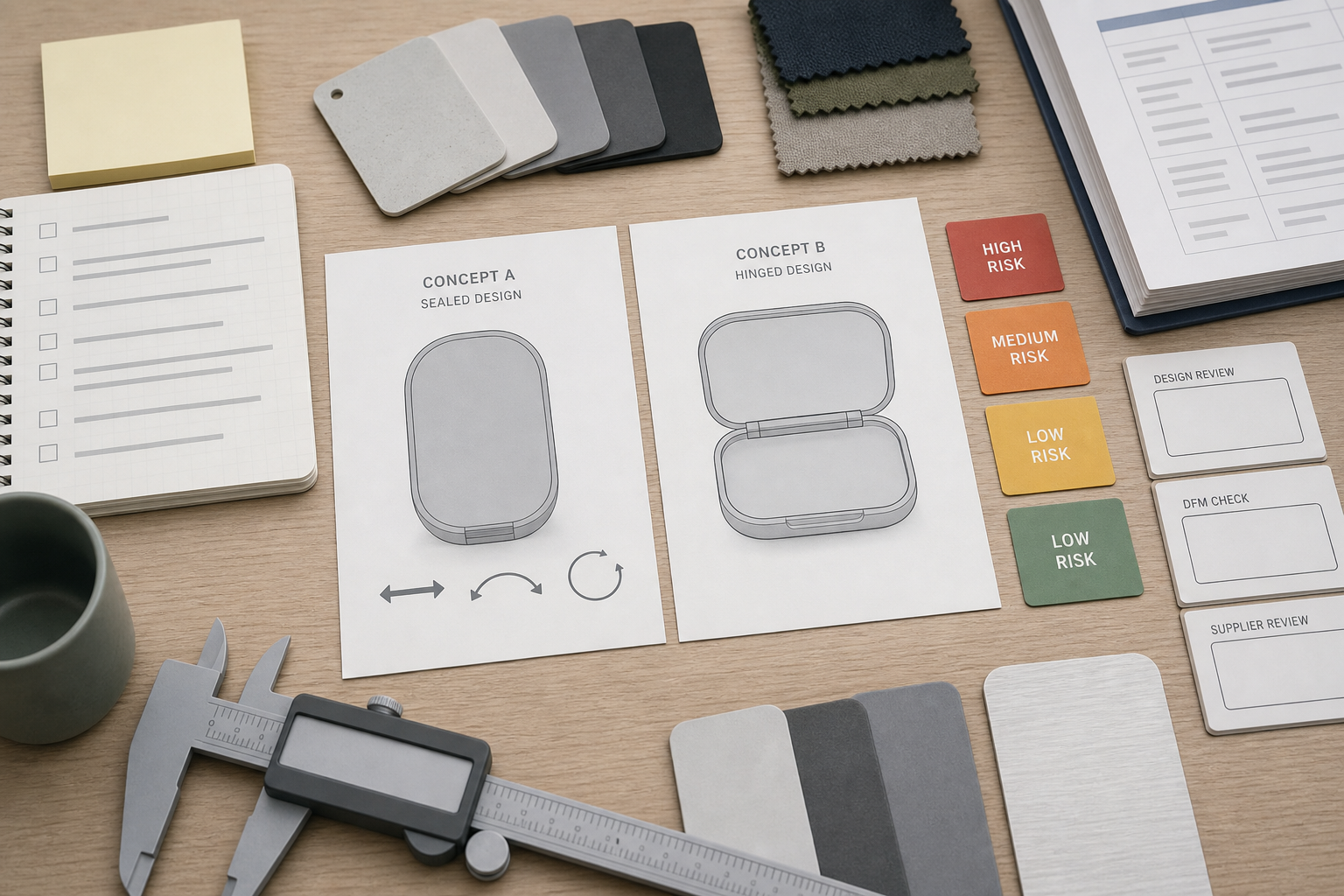
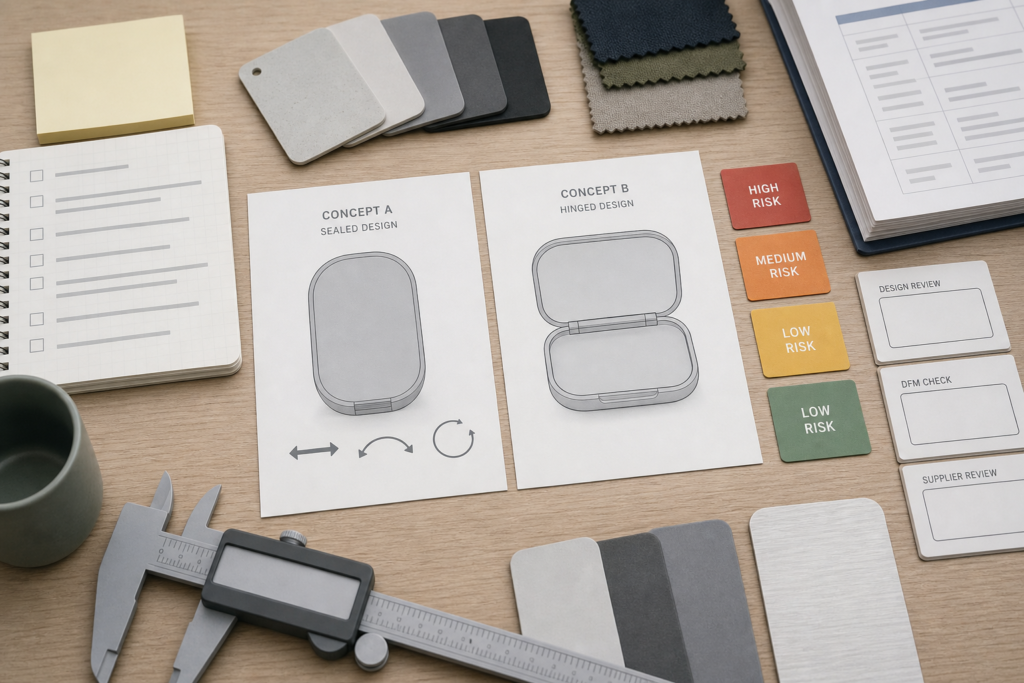
A gravity-release concept may look interesting, but it can create legal, safety, and sourcing risk fast. A careful comparison prevents wasted development.
Buyers should compare gravity-release knives with standard folding knives by checking legal definitions, target market rules, mechanism risk, user purpose, assembly repeatability, packaging claims, and RFQ boundaries. For many OEM/ODM projects, a standard folding structure is the safer commercial path.
Quick buyer brief:
- Answer: Treat gravity-release designs as compliance-sensitive and compare them against safer folding structures.
- Buyer context: This helps knife brands, importers, wholesalers, and distributors avoid risky product briefs.
- Key checks: Legal market review, mechanism type, bias toward closure, lock safety, QC records, packaging wording, and RFQ limits.
Planning a private-label knife line for this market?
Use this article as an early planning reference, then prepare your target market, product category, labeling needs, and buyer-specified compliance requirements before production.
When buyers ask about gravity knives, I do not start with appearance. I start with risk. The words used in laws, import rules, and retail policies can matter more than the drawing. A product that looks like a normal folding knife in one market can be treated differently in another market if its blade can open by gravity or inertia. I am not a lawyer, so I never give legal clearance. What I can do is help buyers compare the structure, remove unclear features, and prepare a better RFQ before sampling money is spent.
Why Should Buyers Treat Gravity-Release Designs As Compliance-Sensitive?
A mechanism idea can look simple on a drawing. If the law treats it as restricted, the project can fail before shipment.
Buyers should treat gravity-release designs as compliance-sensitive because laws and import rules may define them differently from ordinary folding knives. The buyer should confirm target-market rules before sampling or ordering.
I Review The Market Before The Mechanism
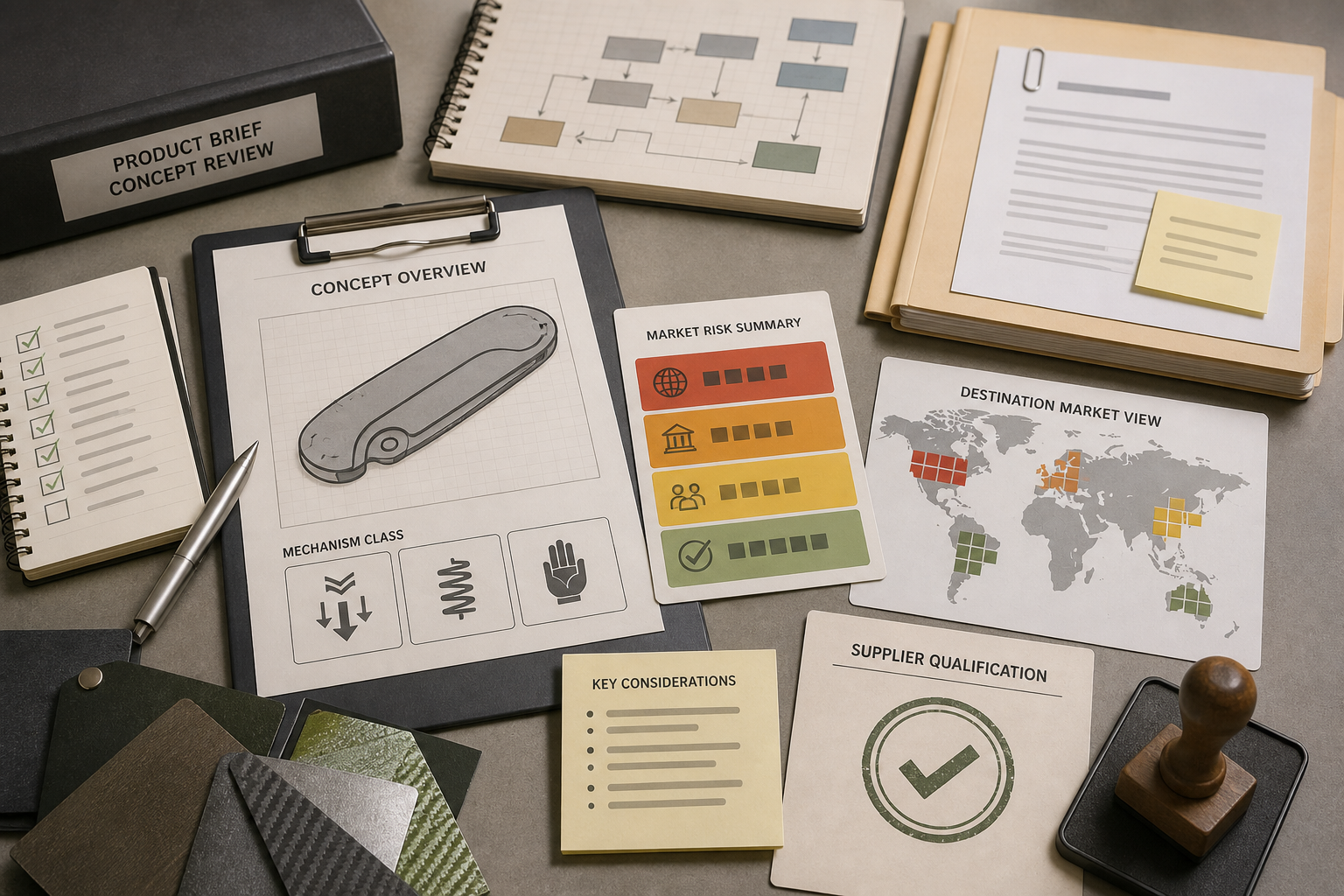
In OEM/ODM work, a gravity-release idea is not just a mechanical question. It is a market-entry question. The buyer may sell in the United States, the United Kingdom, the European Union, Australia, or another region. Each destination can treat knife opening systems, blade length, public carry, import, sale, and online listing rules differently. That means the product brief must start with the target market.
The U.S. Code definition in 15 U.S.C. 1241 includes knives that open automatically by operation of inertia, gravity, or both inside the federal switchblade definition. The same chapter also has exceptions in 15 U.S.C. 1244, including language about a spring, detent, or other mechanism designed to create a bias toward closure. That is why I ask buyers to discuss mechanism language with their compliance advisor before they ask for a sample.
This does not mean every folding knife is the same risk. It means a buyer should be precise. I want to know whether the product is a standard manual folder, assisted-opening folder, button structure, gravity-release concept, or another mechanism. The clearer the mechanism, the easier it is to judge whether the product is suitable for that market.
| Review point | Why it matters | Buyer action |
|---|---|---|
| Target market | Rules differ by country and region | Confirm before RFQ |
| Mechanism type | Legal terms may depend on opening method | Define structure clearly |
| Import channel | Border treatment can differ from retail rules | Ask compliance advisor early |
| Sales copy | Claims can affect marketplace review | Keep wording functional and neutral |
Private-label Planning Checklist
Before starting production, prepare the market and product details your importer or compliance advisor needs to review.
| RFQ Field | What to Prepare |
|---|---|
| Target market | Country, state, region, or sales channel |
| Product category | Folding knife / fixed blade / multi-tool / outdoor tool |
| Intended use | EDC / camping / kitchen / hunting / rescue / promotional |
| Buyer requirements | Testing, labeling, documentation, or packaging rules |
| Blade and lock details | Blade length, opening method, lock type, edge style |
| Packaging text | Warnings, claims, care notes, language requirements |
| Documents | Drawing, sample photo, logo file, packaging artwork |
| Review owner | Importer, legal advisor, testing lab, or internal compliance team |
How Is A Gravity-Release Knife Different From A Standard Folding Knife?
The difference is not only shape. The way the blade moves from closed to open can change risk and inspection needs.
A gravity-release knife relies on gravity or inertia for blade release, while a standard folding knife normally depends on deliberate manual opening and a controlled closing bias. That difference affects legal review, assembly, QC, and market suitability.
I Compare Function Without Teaching Operation
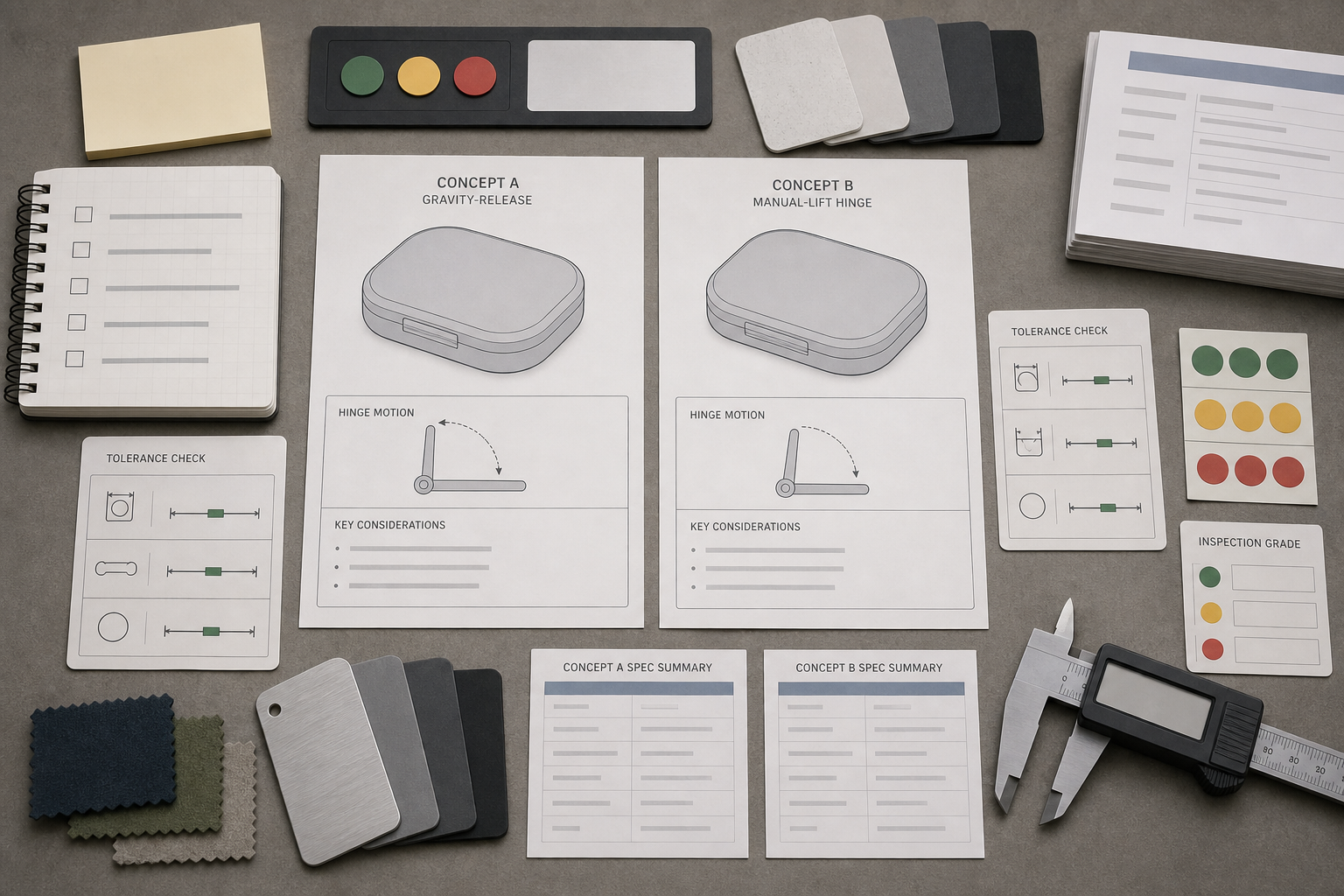
I compare these products at the engineering level. A standard folding knife usually has a blade that rotates around a pivot and is opened by direct manual action. It may use a nail nick, thumb stud, thumb hole, front tab, or other manual feature. It should also have a safe closed condition, stable pivot tension, and clear lock or slip-joint behavior depending on the product type.
A gravity-release design raises different questions. The key concern is whether the blade can leave the handle by gravity, inertia, or a similar action in a way that legal or marketplace reviewers may treat as restricted. I do not need to describe the operating steps to evaluate the product. I need to review the mechanism category, closed-blade retention, lock engagement, blade stop, pivot friction, and whether the structure creates accidental movement risk.
For buyers, this difference matters commercially. A standard folding knife can often be developed with clearer retail positioning. A gravity-release concept may need legal review, import review, platform review, and stricter documentation. The sample may also require more engineering work to control movement and safety. If the buyer does not need that mechanism for a clearly approved market, I usually suggest a standard folder.
| Feature | Gravity-release concept | Standard folding knife |
|---|---|---|
| Opening principle | May involve gravity or inertia | Direct manual opening |
| Compliance review | Usually higher risk | Usually clearer if designed well |
| QC focus | Retention and movement control | Pivot, lock, centering, edge clearance |
| Commercial use | Needs market-specific approval | Better for broad OEM/ODM planning |
Why Do Many OEM/ODM Buyers Prefer Standard Folding Structures?
A risky mechanism can slow quotations, samples, platform approval, and shipment. The buyer may not gain enough commercial value.
Many OEM/ODM buyers prefer standard folding structures because they are easier to explain, quote, inspect, package, and sell across broader channels. They also give more room for cost, material, and branding customization.
I Look For The Widest Practical Product Path
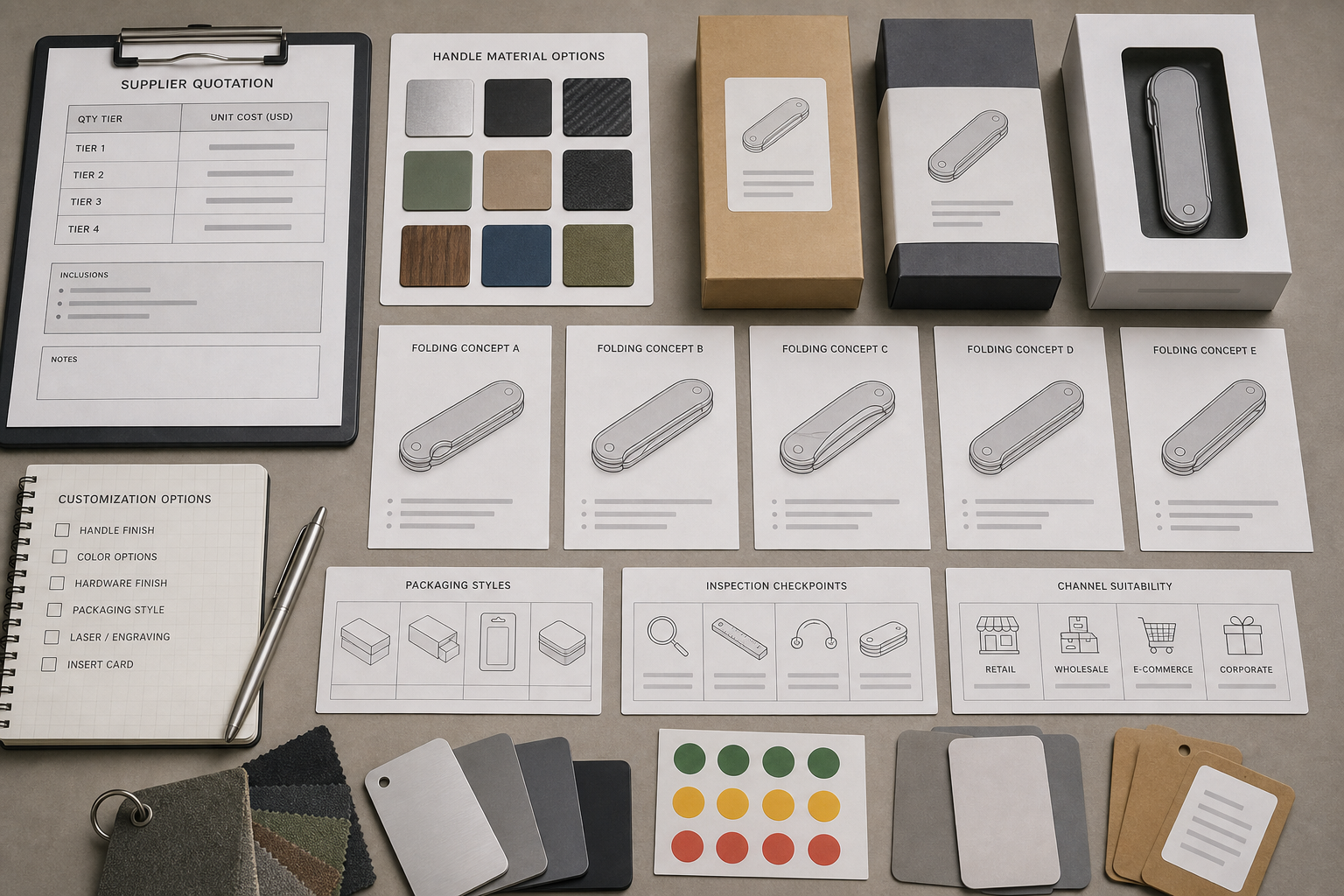
Most B2B buyers do not want a design that creates trouble later. They want a product that can be sampled, quoted, shipped, listed, and reordered. Standard folding structures usually support that goal better. A manual folder with a clear lock type, controlled detent or slip-joint design, and ordinary retail positioning can still feel refined. It can use good steel, strong handle material, clean finish, and better packaging without adding mechanism risk.
This matters for brands and importers. A standard folder can be built as an entry EDC product, outdoor utility product, gift product, private label item, or distributor SKU. The buyer can adjust steel, handle material, color, clip, packaging, and finish to create different price tiers. That flexibility is often more valuable than a mechanism that only appeals to a small market.
I also think about production repeatability. A standard folding knife can still have many quality problems if the pivot, lock, screw torque, edge clearance, or finish is not controlled. But those are familiar manufacturing topics. They can be managed with drawings, samples, fixtures, inspection standards, and final checks. A compliance-sensitive mechanism adds another layer of review, which may not be worth it for many catalog projects.
| Buyer goal | Why standard folders help | Practical control |
|---|---|---|
| Broad retail range | Easier product explanation | Keep design functional |
| Private label | More branding flexibility | Logo, color, packaging |
| Stable repeat orders | Familiar production controls | Records and inspection |
| Price planning | Many structure options | Match tier to cost |
Which Markets Require Extra Legal Review Before RFQ?
Knife rules can change by country, state, city, and sales channel. A supplier cannot guess the buyer's final legal burden.
Buyers need extra legal review when the product may enter markets with specific rules on gravity knives, flick knives, automatic opening, blade length, import, public carry, online sale, or age-controlled delivery.
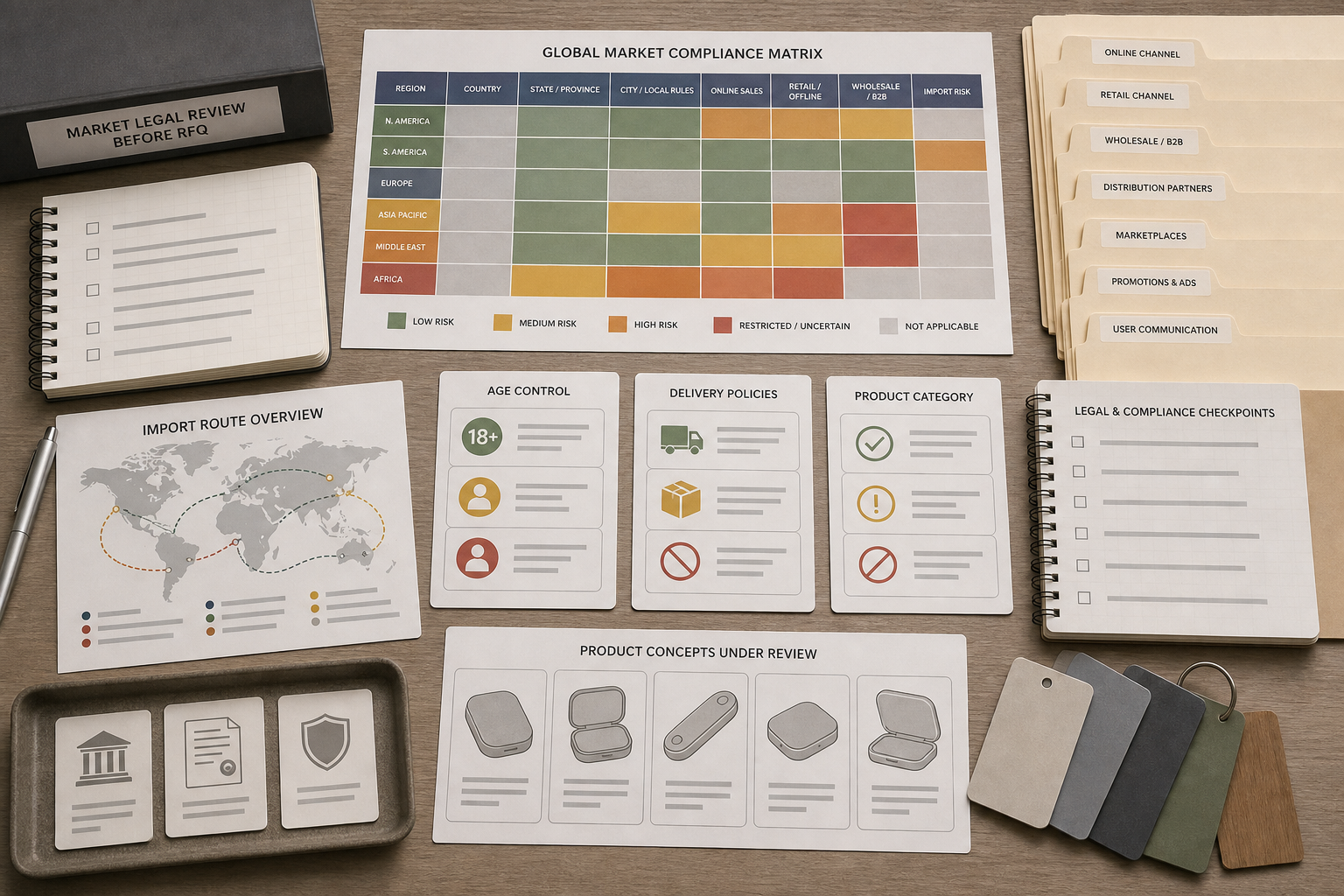
I Ask Buyers To Name The Destination Market
The destination market changes the development plan. A buyer selling into one country may accept a product that another buyer cannot list. A distributor may need different packaging and marking from an online seller. A private label buyer may need a design that works across several regions, not just one.
The United Kingdom is a clear example of why this matters. The GOV.UK page on import controls on offensive weapons says flick knives and gravity knives are described in the Restriction of Offensive Weapons Act 1959. GOV.UK guidance on the Offensive Weapons Act 2019 also states that the Act prohibits private possession of flick knives and gravity knives. That is not a small packaging issue. It can change whether a product should be developed for that market at all.
New York also shows why buyers should check current local rules. The NYPD's knife FAQ says that on May 30, 2019, the New York State ban on gravity knives was repealed, while other knife rules still remain. This example shows that laws can change and local conditions can still matter. I use these sources to remind buyers that a supplier should not be asked to make legal assumptions.
| Market question | Why it matters | Buyer should provide |
|---|---|---|
| Country or region | Import and sale rules differ | Destination market list |
| State or city | Local rules may differ | Local compliance notes |
| Sales channel | Marketplace rules may be stricter | Platform or retailer policy |
| End user | Work, outdoor, retail, or collector use | Intended product role |
How Should Engineering Review Focus On Safety And Repeatability?
A mechanism that moves too freely can create inconsistent samples. That creates quality risk and customer complaints.
Engineering review should focus on closed-blade retention, pivot tolerance, lock engagement, blade centering, edge clearance, screw torque, wear points, and repeatable assembly across production batches.
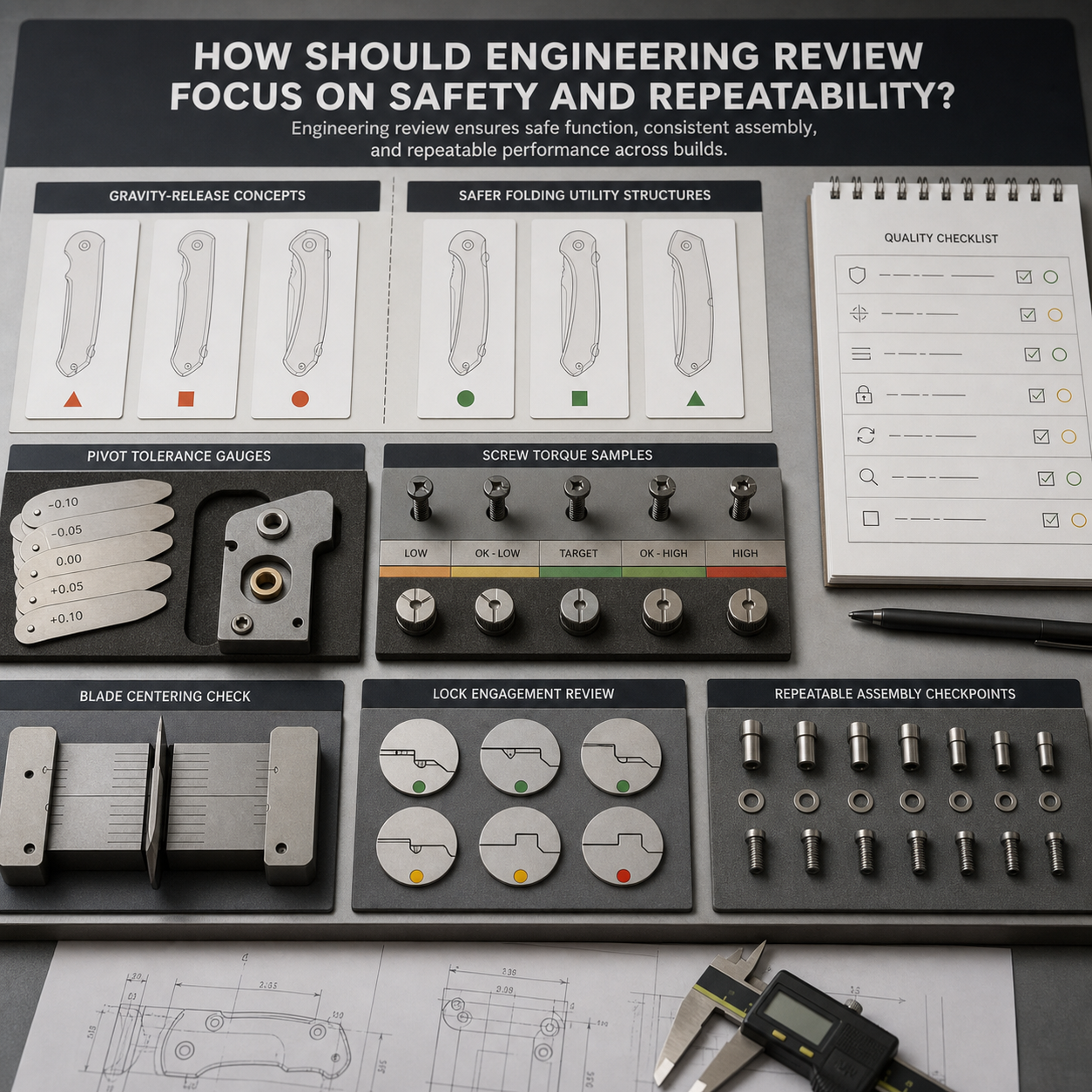
I Treat Movement As A Controlled Relationship
A folding knife is a small machine. The blade, pivot, washer or bearing, liner, lock surface, handle scale, stop pin, and screw system all work together. If one area is loose, tight, rough, or inconsistent, the whole product feels wrong. For gravity-related concepts, these details become even more sensitive because reviewers may focus on how the blade behaves when closed and how easily it moves.
I review the closed condition first. The blade should sit safely inside the handle. The edge should not touch internal parts. The tip should not protrude. The pivot should hold the blade with predictable resistance. The lock or back structure should engage consistently when open. Screws should be set with controlled torque. If the design uses washers or bearings, the choice should match the product tier and QC plan.
I also ask whether the structure can be repeated. A sample maker can sometimes tune one piece by hand. A factory must make many pieces that match the approved sample. That is why I prefer clear drawings, tolerance notes, approved samples, assembly fixtures, and inspection sheets. The goal is not only to make a product that works once. The goal is to make a product that works the same way in mass production.
| Engineering area | What I check | Why it matters |
|---|---|---|
| Closed condition | Blade retention and edge clearance | Reduces safety and review risk |
| Pivot system | Tension, wear, and smoothness | Controls user experience |
| Lock engagement | Contact and stability | Supports confidence in use |
| Assembly method | Torque, fixtures, inspection | Protects repeat production |
What Alternatives Can Create One-Hand Utility Without Gravity-Release Risk?
Buyers may want convenient opening, but they may not need a high-risk mechanism. Safer structures can still meet the product goal.
Alternatives include standard manual folders with nail nicks, thumb studs, thumb holes, front tabs, slip-joint structures, lock-back designs, liner locks, or assisted designs with a clear bias toward closure where legally suitable.
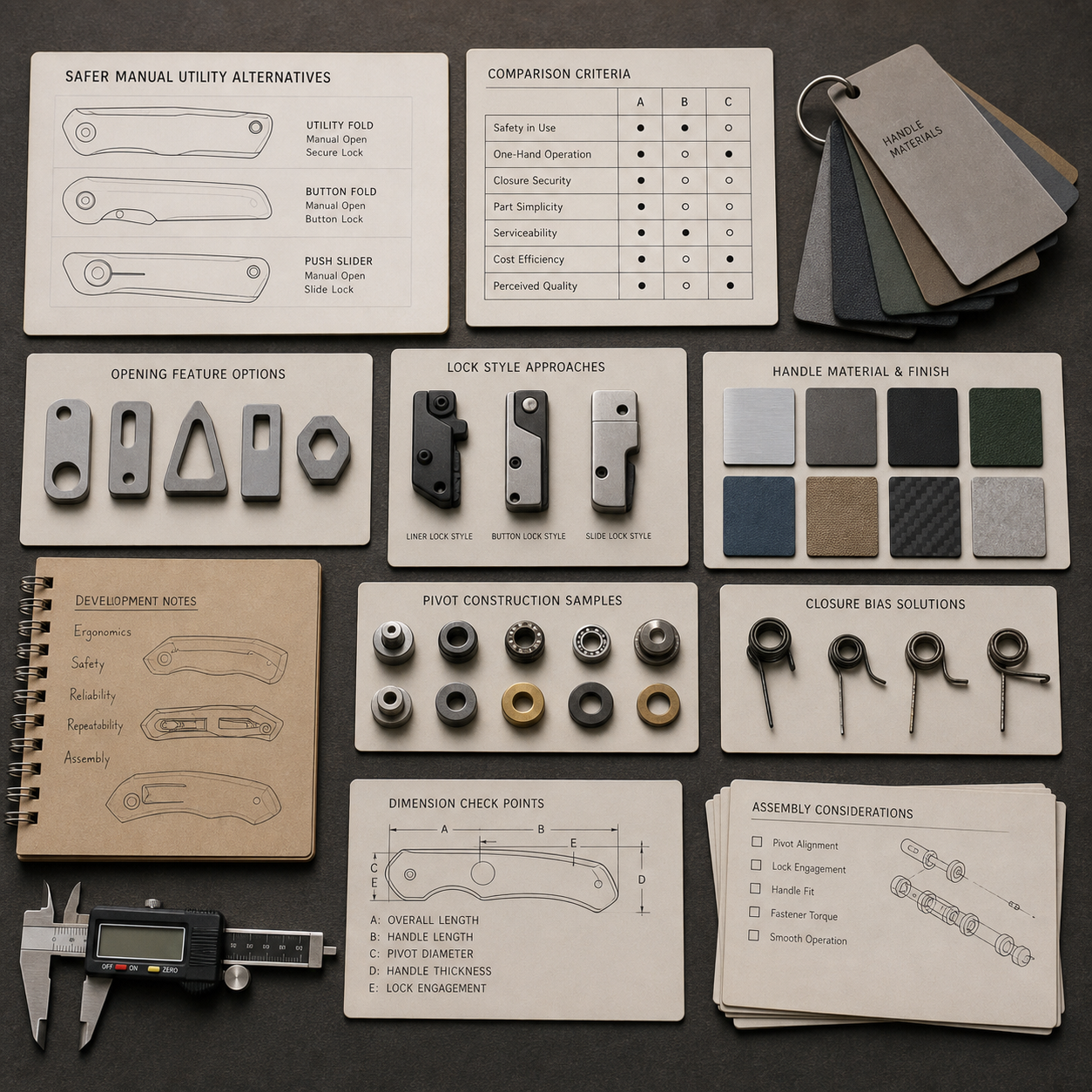
I Start From User Need, Not Mechanism Novelty
Many buyers ask about gravity-release structures because they want convenience, product interest, or a talking point. I try to separate the real user need from the mechanism idea. Does the user need a compact work knife? Does the buyer need a smoother pocket knife? Does the channel need an outdoor folder that can be opened with one hand in normal use? Does the brand need a cost-stable EDC model? These needs can often be met with standard structures.
The U.S. exception language in 15 U.S.C. 1244 includes a knife with a spring, detent, or other mechanism designed to create a bias toward closure and requiring exertion to overcome that bias to assist opening. I do not treat that as universal market clearance. I treat it as a reason to discuss structure carefully with the buyer's compliance advisor.
From a manufacturing view, a standard folder gives more room to build value. We can improve blade steel, heat treatment, handle texture, screw finish, pocket clip, sharpening, packaging, and QC records. These visible improvements often matter more to B2B customers than a risky mechanism. The best design is usually the one that fits the buyer's target market and can be repeated cleanly.
| Alternative | Buyer benefit | Engineering focus |
|---|---|---|
| Nail nick folder | Traditional and simple | Low cost and clean finish |
| Thumb stud or hole | Practical daily opening | Edge clearance and ergonomics |
| Liner or back lock | Familiar retail structure | Lock fit and assembly control |
| Bias-to-close assisted design | Convenience where suitable | Legal review and detent control |
How Should Packaging And Sales Copy Avoid Risky Positioning?
A safe structure can still be hurt by careless packaging. Words and images can change how a product is reviewed.
Packaging and sales copy should avoid aggressive positioning and focus on lawful utility, materials, dimensions, finish, maintenance, packaging contents, origin marking, and buyer-owned branding.
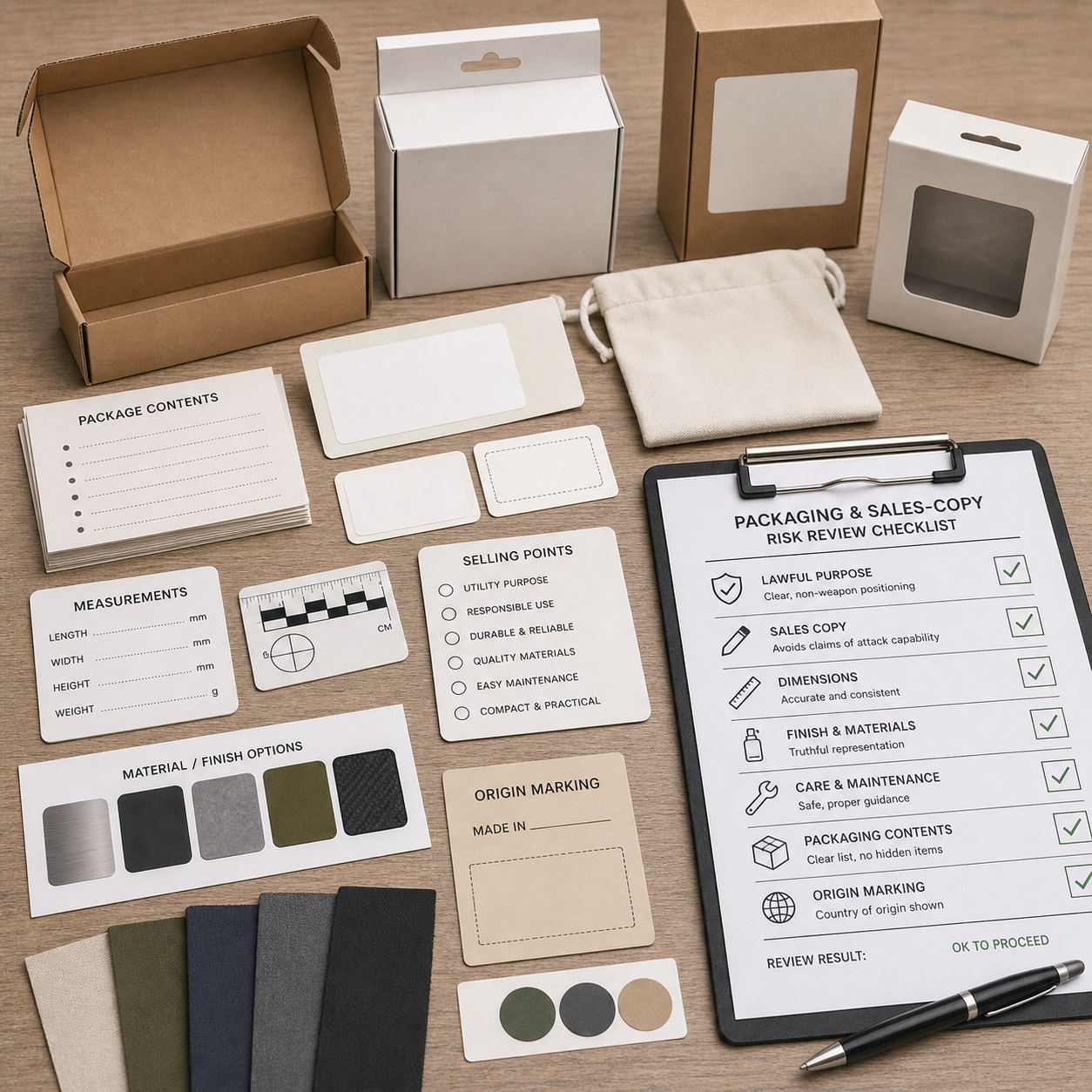
I Keep Product Language Functional
Packaging is part of compliance and brand trust. A buyer may approve a good structure and then create risky wording on the box, product page, or catalog. I avoid that. I prefer functional language about materials, dimensions, edge type, handle grip, finish, packaging contents, and care instructions. The product should be positioned as an outdoor, EDC, utility, work, camping, or general tool only when that matches the target market and local rules.
Packaging should also protect the product. A folding knife needs a closed condition during shipment. The box, pouch, insert, or wrap should stop movement and reduce finish damage. The edge should be protected from contact with packaging surfaces. If the handle is coated, anodized, polished, or textured, the insert should prevent rubbing. A product that arrives scratched creates quality complaints even if the mechanism is correct.
For export, markings should be planned early. Country-of-origin marking, warning labels, age-related retail requirements, and channel-specific labeling may vary. I do not guess these details. I ask the buyer to confirm requirements for the target market and sales channel. Then Vast State can help align packaging structure, label space, insert design, and production packing method.
| Packaging area | Safer direction | Why it helps |
|---|---|---|
| Product wording | Utility and material facts | Reduces review risk |
| Visual style | Clean product photography | Avoids aggressive framing |
| Insert design | Secure closed product | Protects finish and edge |
| Label space | Market-specific information | Supports buyer compliance |
What RFQ Details Help Suppliers Judge A Gravity-Related Knife Project?
A vague RFQ can push a supplier into guessing. Guessing is dangerous when mechanism and law both matter.
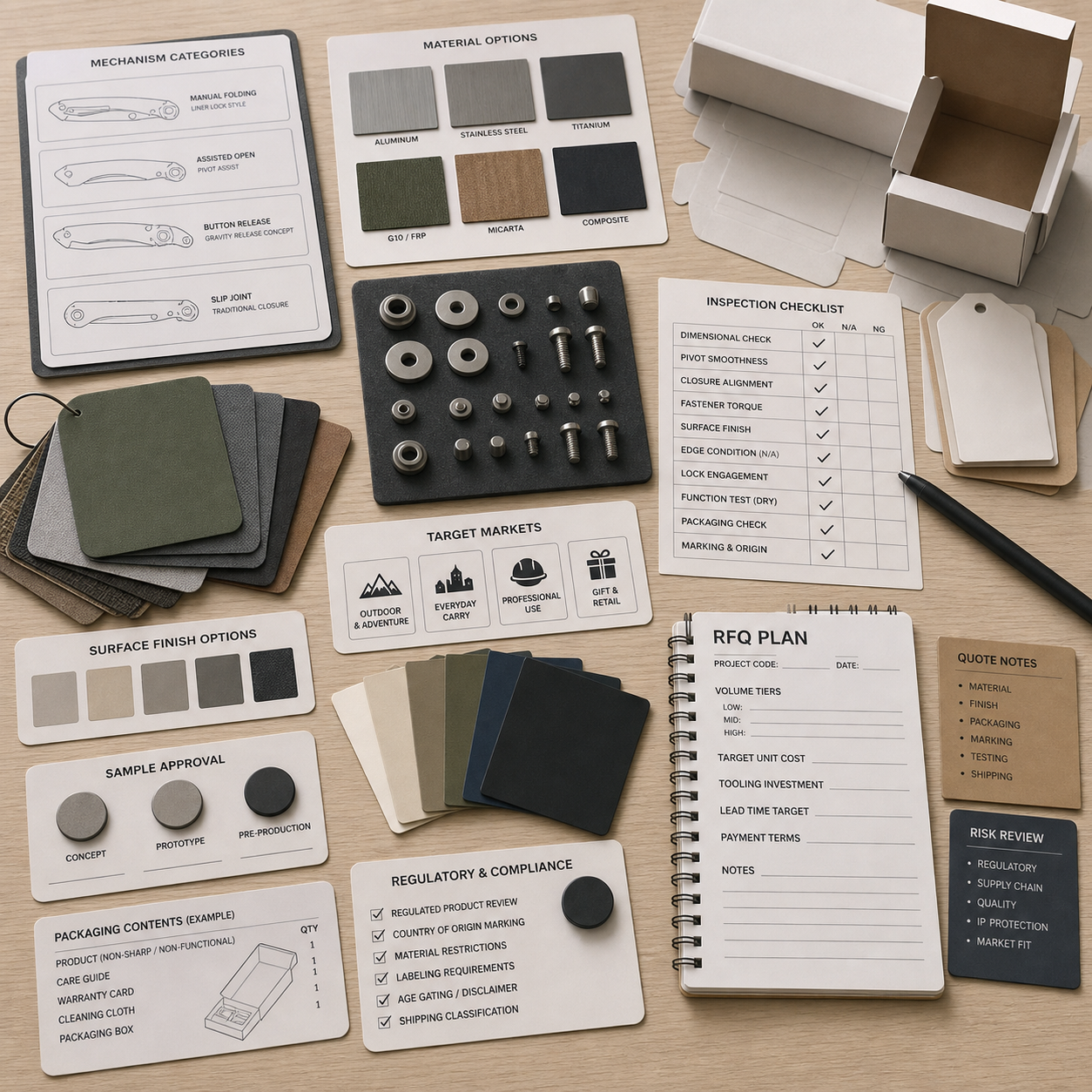
An RFQ should include target market, mechanism type, legal review status, product role, blade steel, handle material, lock type, opening method category, target price, MOQ, packaging, inspection needs, and forbidden features.
I Ask For Boundaries Before Quotation
For this kind of project, I want a clear boundary before I quote. The buyer should state whether the product must be a standard manual folder, whether assisted opening is acceptable, whether gravity-release features are excluded, and which target markets need review. If the buyer has already received legal guidance, that should be noted in the project file. If not, I suggest reviewing the concept before moving to sample work.
The RFQ should also include normal product details. What blade steel is preferred? What handle material should be used? What lock type is acceptable? What size range fits the channel? What packaging level is needed? What is the target price? What is the expected MOQ? What inspection records does the buyer want? These details let Vast State suggest practical alternatives instead of simply saying yes or no to a risky mechanism.
I also ask for forbidden features. This is useful. The buyer can say the product must not rely on gravity or inertia, must not use a button-release structure, must not use aggressive marketing language, or must meet a retailer's internal policy. Clear negative requirements make development easier. They also protect both sides from misunderstanding during sampling.
| RFQ field | What to provide | Why it helps |
|---|---|---|
| Market and channel | Country, region, retailer, platform | Guides compliance review |
| Mechanism boundary | Manual, assisted, or excluded features | Prevents wrong samples |
| Product specification | Steel, handle, lock, finish, size | Supports accurate quotation |
| QC requirement | Function, retention, lock, packaging | Protects repeat production |
Planning a private-label knife line for this market?
Use this article as a planning reference, then confirm local requirements with your importer or compliance advisor before OEM/ODM production.
Conclusion
I compare gravity-release ideas with standard folding knives by prioritizing legal review, safer structures, clear RFQs, engineering control, and repeatable production.
Source Notes
- 15 U.S.C. 1241 and 15 U.S.C. 1244 support the U.S. definition and exception discussion.
- GOV.UK import controls and Offensive Weapons Act 2019 guidance support the UK gravity-knife risk discussion.
- The NYPD knife FAQ supports the point that local rules can change and still need market review.
- ISO 9001, ISO 10007, and the NIST Rockwell hardness guide support process control, version records, and measurement discipline.