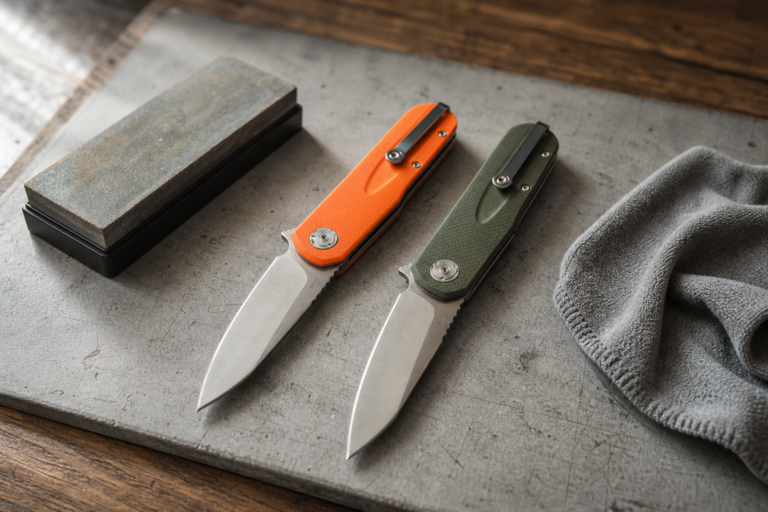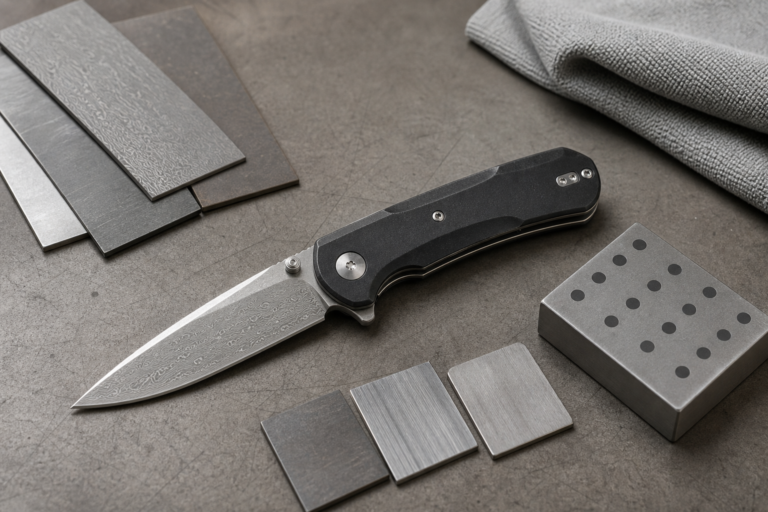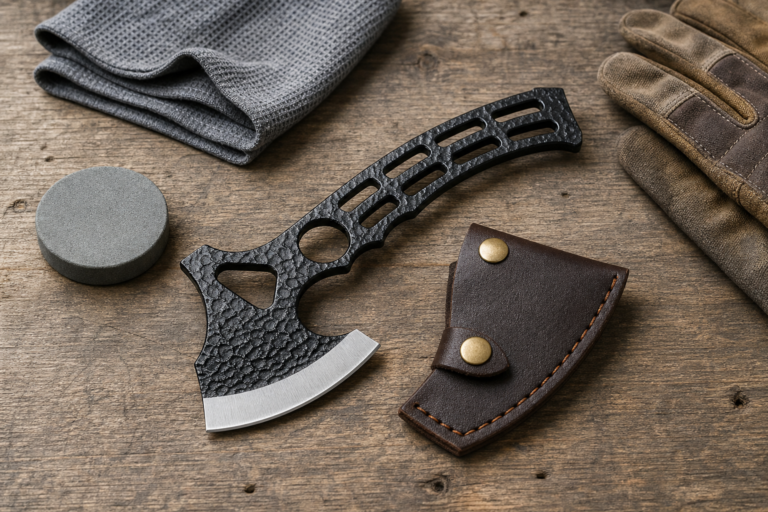
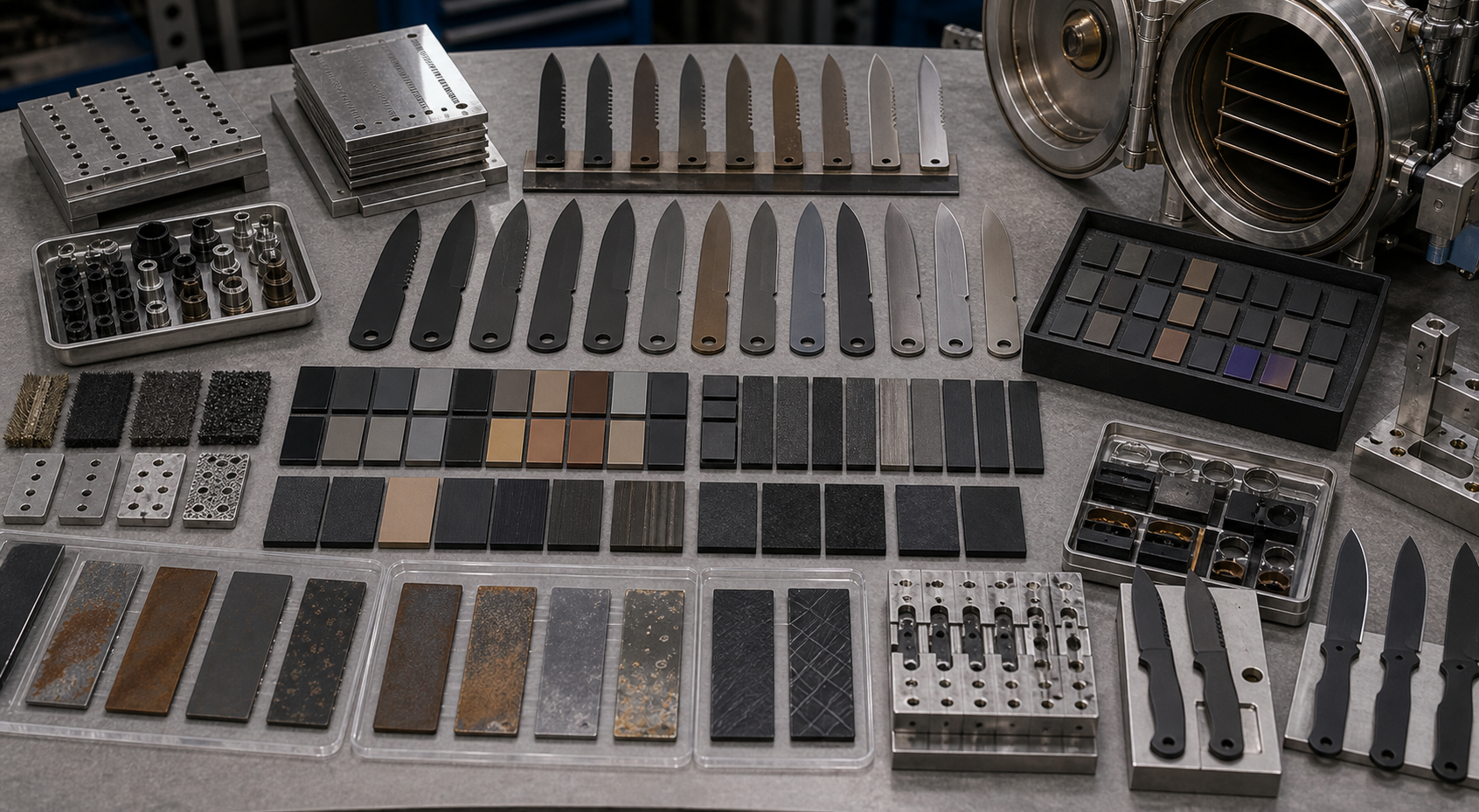
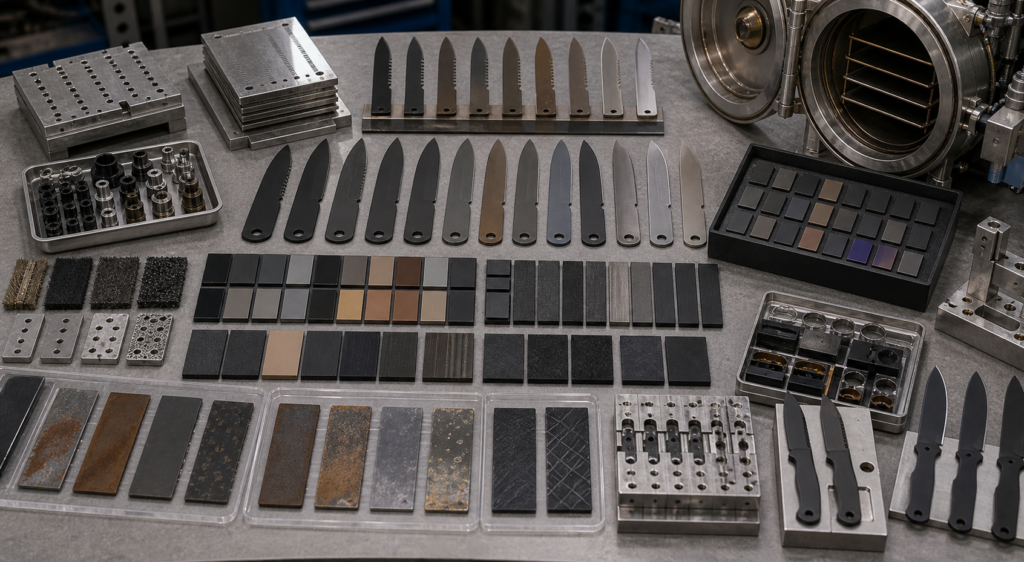
A black blade can look strong online but fail in use. Poor coating choice can create scratches, rust complaints, and return risk.
Knife buyers should choose blade coatings by matching coating type, blade steel, heat treatment, surface preparation, corrosion target, wear target, color requirement, food-contact concern, cost, and inspection method to the knife's real use case.
Quick buyer brief:
- Answer: Blade coating is a functional and cosmetic decision, not only a color choice.
- Buyer context: This helps knife brands, importers, wholesalers, distributors, and sourcing teams compare coating options before RFQ.
- Key checks: Confirm steel, coating type, surface prep, thickness, adhesion, corrosion target, abrasion target, edge sharpening, and care instructions.
Have a knife or multi-tool project in mind?
Send your sketch, CAD file, sample photo, or product idea. Vast State can review manufacturability, suggest materials, estimate MOQ, and prepare a quote for your OEM/ODM project.
When a buyer asks me for a coated blade, I first ask why. Some buyers want a black tactical look. Some want better corrosion resistance. Some want lower reflection. Some want a color that fits packaging and brand style. Some want to hide surface scratches. These are different goals. A coating can help, but it cannot replace the right blade steel, heat treatment, surface preparation, sharpening, and quality control. In OEM sourcing, the best coating is the one that fits the target user, price range, and product promise without creating false expectations.
What Does Blade Coating Actually Do for a Knife?
Many buyers think coating means better quality. That is not always true. A coating helps only when it solves a real product problem.
Blade coating can improve appearance, reduce glare, add wear resistance, support corrosion protection, reduce sticking, or create brand color. It does not fix poor steel, weak heat treatment, bad grinding, or poor sharpening.
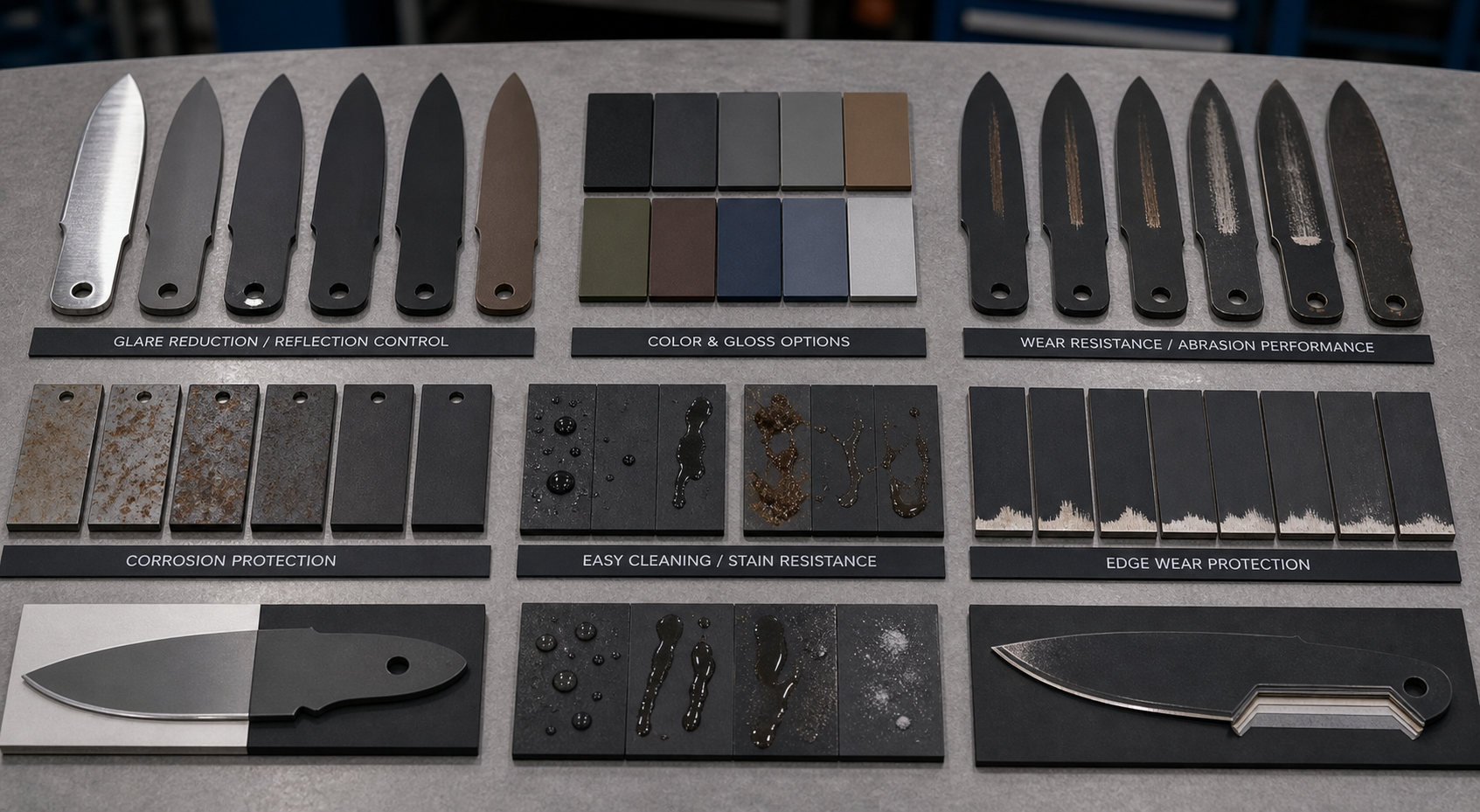
I Separate Coating Goals Before I Quote
Blade coating is a surface decision. It changes the outside of the blade, not the whole material. If the blade steel is too soft, the coating will not create a good cutting tool. If the heat treatment is wrong, the coating will not fix edge failure. If the grinding leaves scratches, the coating may show them or hide them depending on finish and color. This is why I always connect coating with the full blade process.
For B2B buyers, coating can have several uses. It can make a blade look darker and more tactical. It can reduce light reflection for outdoor or rescue use. It can add a layer that helps with wear or corrosion resistance. It can create color options for a private label series. It can also affect how customers clean and maintain the knife. But every benefit has limits. Coatings can scratch. Edges are often sharpened after coating, so the very cutting edge may expose steel. Coating around holes, jimping, fullers, or aggressive grind lines may behave differently from coating on flat areas.
My first sourcing question is simple: What problem should the coating solve? If the buyer cannot answer that, I suggest keeping the blade uncoated or using a simpler finish.
| Coating goal | What it can help | What it cannot replace |
|---|---|---|
| Appearance | Black, gray, or brand color | Good blade geometry |
| Corrosion support | More surface protection | Correct steel and care |
| Wear support | Better scratch or abrasion resistance | Abuse-proof surface |
| Lower reflection | Matte or dark blade look | Functional blade design |
OEM/ODM RFQ Checklist
Prepare these details to help Vast State review your project and provide a more accurate quotation.
| RFQ Field | What to Prepare |
|---|---|
| Project type | OEM from drawing / ODM private label / wholesale catalog |
| Product category | Folding knife / fixed blade / multi-tool / outdoor tool |
| Design status | Idea / sketch / 2D drawing / 3D CAD / physical sample |
| Target price | Ex-factory target price or retail price range |
| MOQ expectation | 500 / 1,000 / 3,000 / 5,000+ pcs |
| Logo method | Laser engraving / etching / printing / molded logo |
| Packaging | Standard packaging / custom retail box / Amazon-ready |
| Market | USA / EU / Japan / Korea / Middle East / other |
| Compliance needs | Buyer-specified testing / documentation / labeling |
| Timeline | Sample deadline / mass production deadline |
Which Blade Coating Types Should Buyers Compare?
Coating names are often mixed together in sourcing conversations. PVD, DLC, ceramic, black oxide, and paint-like coatings are not the same.
Buyers should compare PVD, DLC, ceramic coatings, black oxide, powder or paint-type coatings, and uncoated finishes by function, cost, appearance, thickness, durability, corrosion needs, and target market.
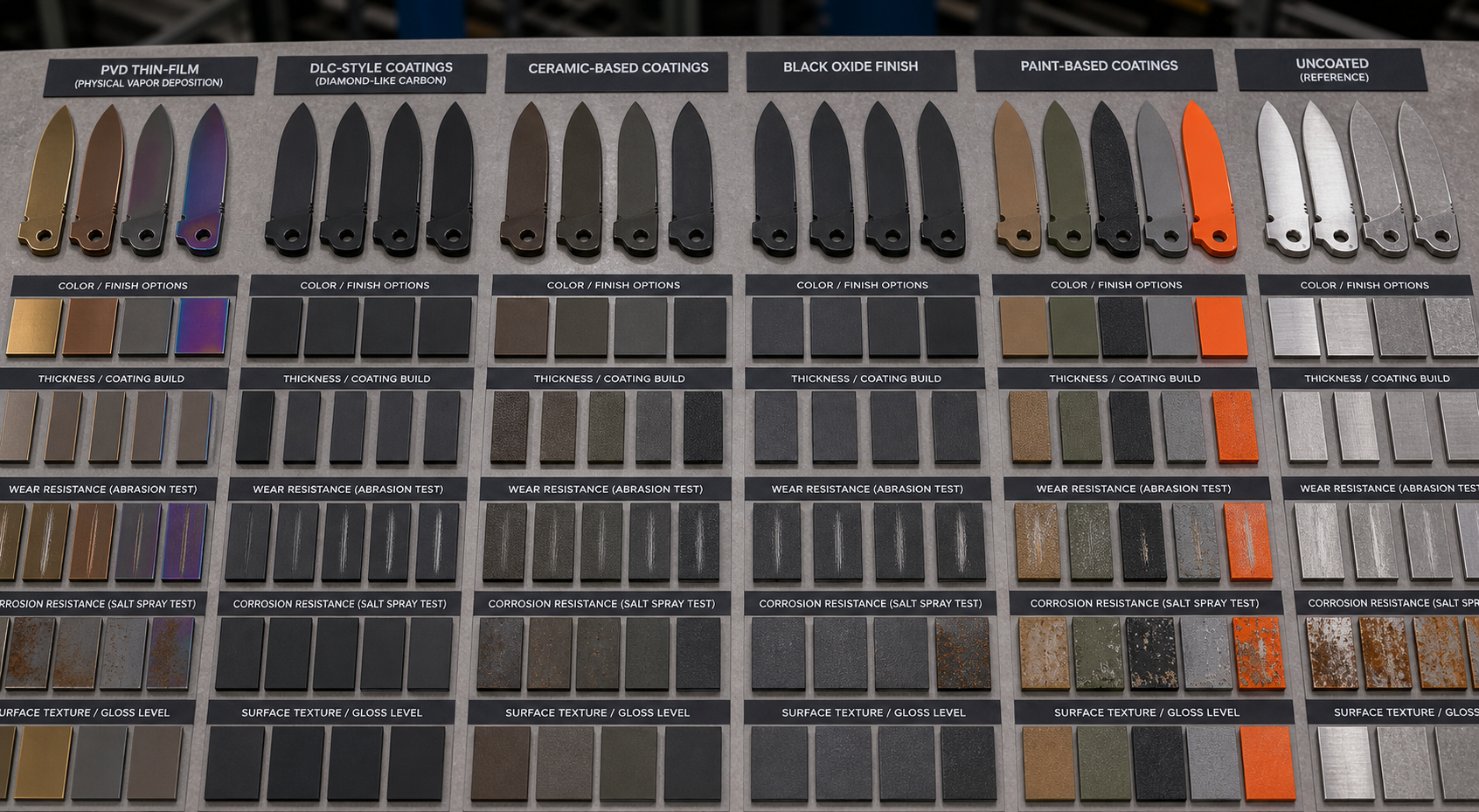
I Use Coating Names Carefully
PVD is a process family. DLC is a coating family often applied through vacuum-based processes. Ceramic coatings are usually different from hard PVD/DLC thin films and may be spray-applied or cured depending on system. Black oxide is a conversion finish, not a thick protective shell. Paint-like or powder-type coatings can add color and coverage, but they may behave differently under abrasion.
Oerlikon Balzers explains that surface treatments can use PVD, PACVD, CVD, heat treatment, and nitriding under vacuum conditions to deposit thin films with defined compositions and characteristics. That helps buyers understand why "PVD" is not a single coating color. It is a process route that can produce different coating systems. Ionbond lists DLC and other thin-film food-contact coatings with thickness ranges and properties such as abrasion resistance, high hardness, anti-sticking, and low friction. That matters when the buyer sells into food processing, kitchen, or utility cutting markets.
Black oxide has a different role. Seminole Metal Finishing explains that black oxide is a hot alkaline finish and that only very limited corrosion protection is obtained under mild corrosive conditions. This means a buyer should not sell black oxide as the same performance category as a high-end DLC or ceramic coating. Each option has a place, but the buyer must use the right name.
| Coating option | Main reason to choose it | Buyer caution |
|---|---|---|
| PVD | Wear-resistant thin film and controlled color | Confirm exact coating, not just process name |
| DLC | Hard black coating with low friction potential | Cost and supplier capability matter |
| Ceramic coating | Color range and corrosion/chemical story | Application quality affects durability |
| Black oxide | Dark conversion finish and low thickness change | Limited corrosion protection without after-treatment |
How Should Coating Match Blade Steel and Heat Treatment?
A coating can make a blade look better, but it cannot correct weak base material. The steel still carries the cutting performance.
Coating should match blade steel, hardness, tempering temperature, corrosion level, surface finish, and coating process temperature. Buyers should confirm coating compatibility before mass production.
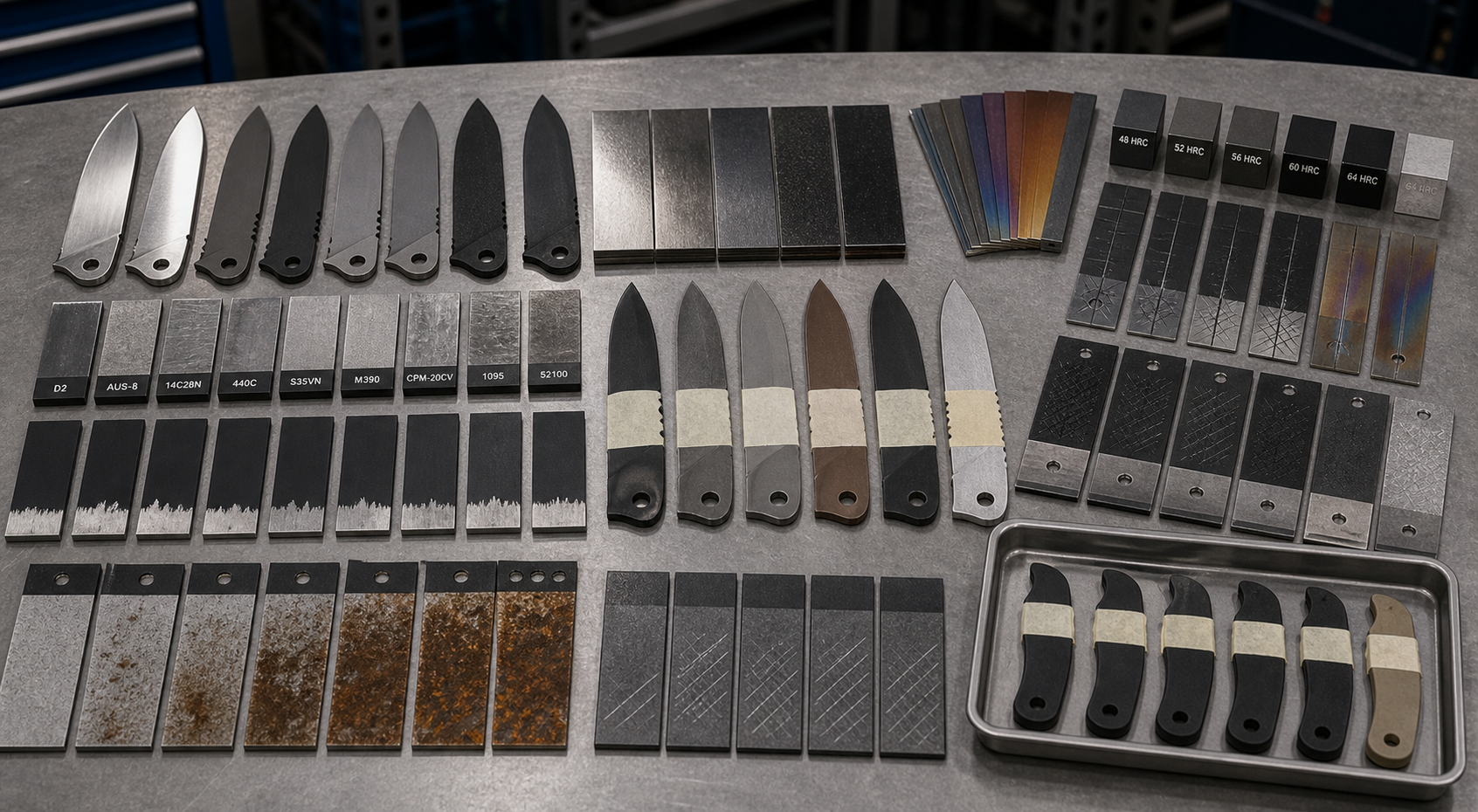
I Start With the Steel, Then Choose the Finish
The best coating plan starts with steel choice. A stainless EDC knife, D2 outdoor knife, 8Cr budget folder, 14C28N pocket knife, and high-carbon fixed blade do not need the same coating logic. Some steels need more corrosion help. Some already have enough corrosion resistance for the target market. Some customers mainly want the black look. Some want abrasion resistance. These choices should be made before coating is quoted.
Heat treatment also matters. Some coating processes use heat. The coating supplier must confirm whether the coating temperature is safe for the steel's heat-treated condition. I do not want a coating process to affect blade hardness or create distortion. In many cases, coating occurs after heat treatment and grinding, but before final sharpening. That means the cutting edge may be exposed after sharpening. Buyers should understand this because a coated blade is not always fully coated at the apex.
Surface finish matters too. A polished surface, bead-blasted surface, stonewashed surface, or satin ground surface can change coating appearance and adhesion. A dark coating over a rough surface will not look the same as a dark coating over a fine satin surface. The buyer should approve production-intent samples, not only sample coupons. The blade geometry, jimping, logos, holes, and grind transitions all affect the final result.
| Base factor | Why it matters | Buyer checkpoint |
|---|---|---|
| Steel type | Drives corrosion and wear need | Match coating to target environment |
| Heat treatment | Can be affected by process temperature | Confirm coating temperature compatibility |
| Surface prep | Affects adhesion and appearance | Approve production-intent finish |
| Sharpening order | Edge may expose steel | Define final edge and care instructions |
What Surface Preparation Affects Coating Quality?
A coating failure often starts before coating. Oil, uneven blasting, scratches, or poor cleaning can create weak adhesion and ugly finish.
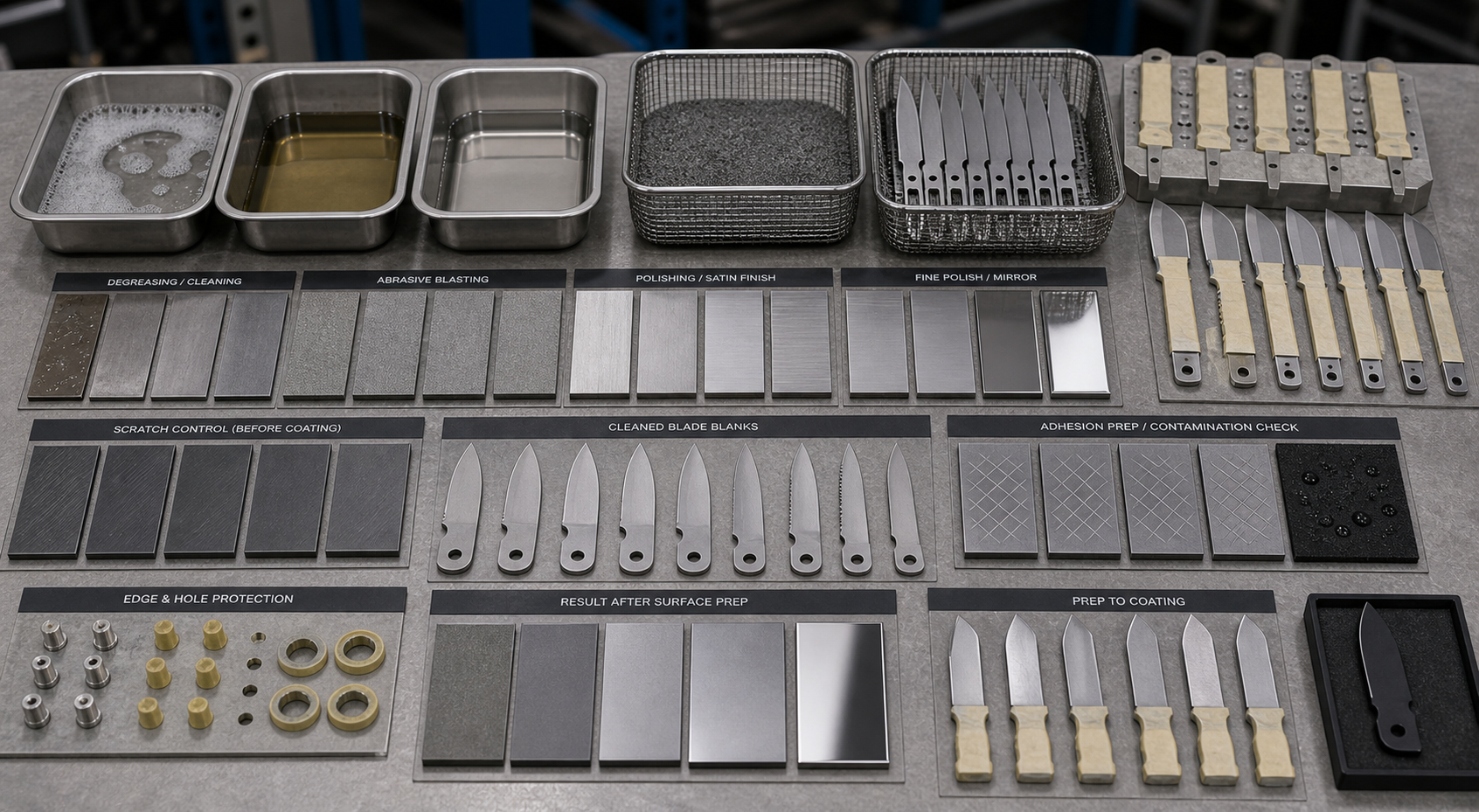
Surface preparation for blade coating should control cleaning, degreasing, blasting, polishing, masking, edge condition, logo method, and handling before coating. Preparation strongly affects adhesion and appearance.
I Treat Coating Prep as a Quality Gate
Surface preparation is one of the most important coating controls. A blade may look ready, but small contamination can cause adhesion problems. Oil from hands, polishing compound, grinding dust, or cleaning residue can affect coating quality. A surface that is too smooth or too rough may not match the coating supplier's recommendation. A logo that is applied before coating may behave differently from a logo applied after coating.
For ceramic-type coatings, surface roughness and clean blasting can be especially important because the coating must bond to the prepared surface. For PVD or DLC systems, coating suppliers also define cleaning and fixturing requirements. In both cases, the buyer should ask how the factory prepares the blades. The answer should not be vague. It should include cleaning, surface finish, masking, and inspection before coating.
Blade shape creates practical issues. A flat blade is easier to coat evenly than a blade with deep fullers, thumb holes, aggressive jimping, or complex grind lines. Coating inside holes and near plunge lines may look different. If the knife has tight tolerances, coating thickness must also be considered. Coating may affect pivot fit, washer area, lock contact, or sheathed fixed blade fit if the design leaves no allowance.
| Prep item | What to control | Why it matters |
|---|---|---|
| Cleaning | Oil, dust, and residue removal | Protects adhesion |
| Surface texture | Blast, satin, or polish level | Controls appearance and bond |
| Masking | Pivot, lock, edge, or logo areas | Protects function and branding |
| Handling | Gloves and clean storage | Reduces contamination before coating |
How Do Buyers Judge Coating Durability and Corrosion Resistance?
Coating claims can sound impressive. But buyers need tests, samples, and realistic language before making promises to customers.
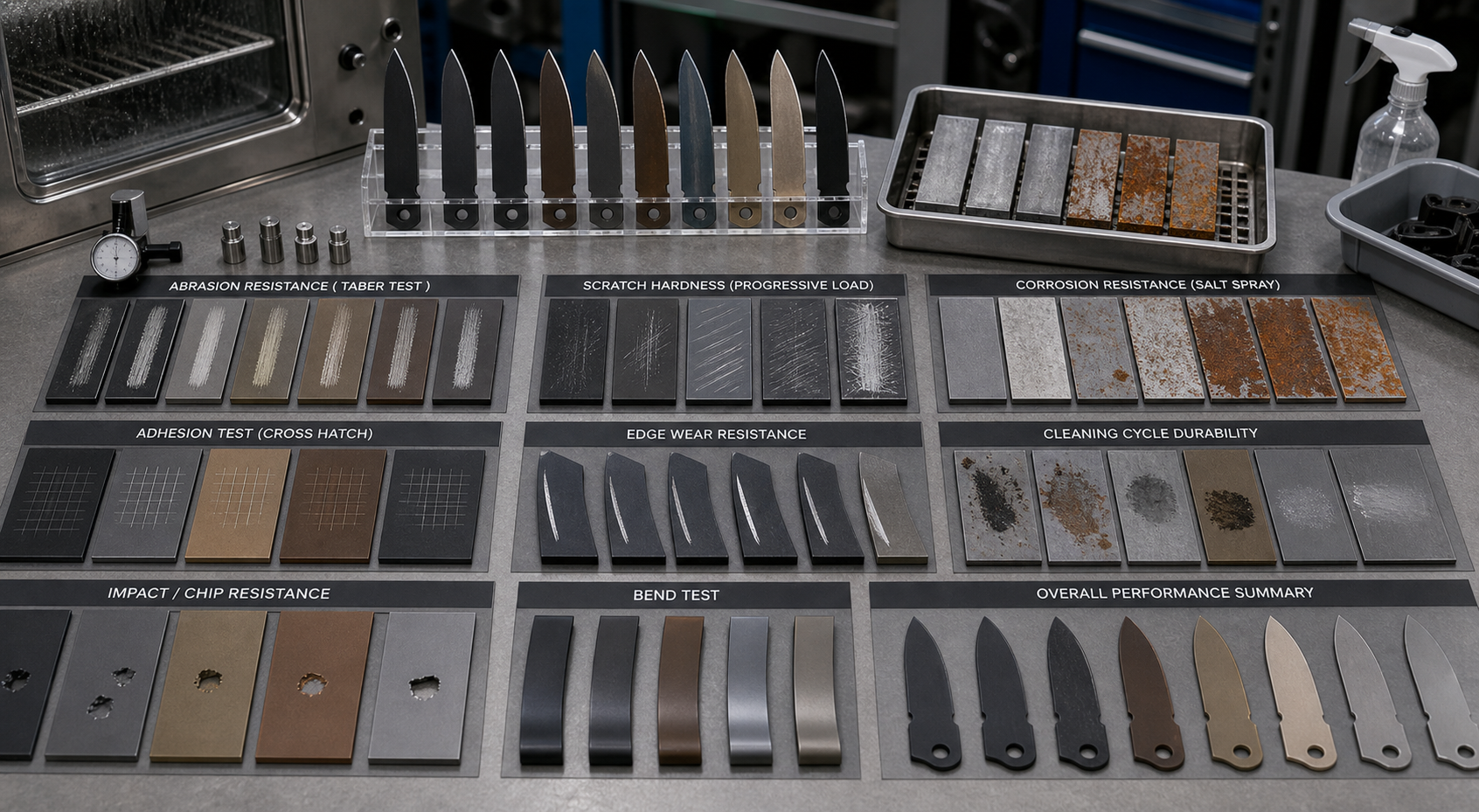
Buyers should judge coating durability by abrasion tests, scratch or hardness references, adhesion checks, corrosion exposure, sample cutting use, cleaning tests, and real product inspection after assembly.
I Ask What Test Supports the Claim
Durability has several meanings. A coating may resist abrasion but still show edge wear. A coating may improve corrosion protection on flat surfaces but still allow rust near the exposed edge, logo cut, scratches, or uncoated pivot area. A coating may look excellent at first but show rub marks after sheath contact or pocket carry. Buyers should avoid broad claims like "scratch-proof" or "rust-proof." Those claims invite complaints.
ASTM D4060 explains a Taber Abraser method for evaluating abrasion resistance of organic coatings and notes that coatings can be damaged by abrasion during service life. ASTM B117 is often used as a salt spray method to produce relative corrosion resistance information for metals and coated metals. These standards are useful references, but they do not automatically predict every real outdoor use case. A knife may see sweat, salt water, soil, food acids, sheath abrasion, pocket grit, cleaning chemicals, and repeated sharpening. So I prefer a mix of supplier test data and practical sample evaluation.
For OEM sourcing, I ask for coating data, production samples, and inspection standards. I also suggest defining acceptable wear language. A coated work knife will wear. The goal is not to pretend it will stay perfect forever. The goal is to choose a coating that matches the price and promise.
| Durability question | Useful check | Buyer note |
|---|---|---|
| Abrasion resistance | ASTM D4060 or supplier wear data | Compare similar coatings carefully |
| Corrosion support | Salt spray or practical exposure test | Exposed edges still need care |
| Adhesion | Cross-cut, tape, bend, or supplier method | Method depends on coating type |
| Real use | Cutting, sheath, pocket, cleaning tests | Best for customer expectation control |
How Should Buyers Choose Between DLC, PVD, Ceramic, and Black Oxide?
The wrong coating can raise cost without improving the product. A sourcing decision should match use, budget, and customer promise.
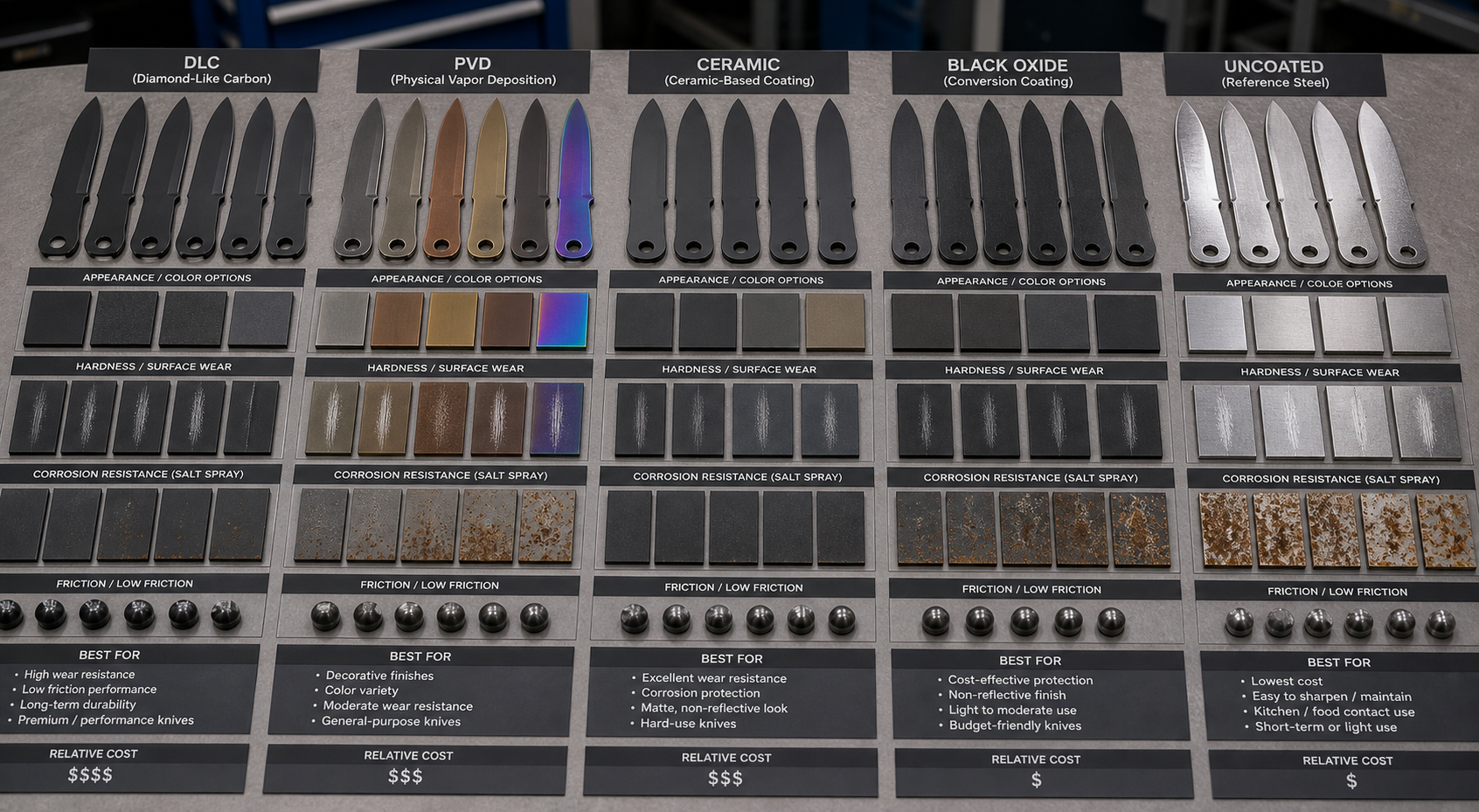
Buyers should choose DLC for hard black low-friction performance needs, PVD for thin-film wear and color options, ceramic coating for color and corrosion goals, and black oxide for low-build dark appearance with limited corrosion expectations.
I Match Coating Type to the Sales Story
DLC is often selected for a black, hard, low-friction, wear-resistant surface. Ionbond lists DLC-related coatings with properties such as abrasion resistance, anti-sticking, high hardness, low friction, and thickness ranges around 1 to 10 um depending on the coating. That kind of coating can make sense for higher-positioned knives, food-related cutting components, or designs where a black functional surface is part of the value proposition.
PVD can cover several coating materials and colors. It can be useful when the buyer wants a controlled thin film and a coating supplier has the right process. But buyers should not ask only for "PVD black" and assume every supplier means the same coating. The exact coating chemistry, thickness, pretreatment, substrate, and surface finish matter.
Ceramic coatings can offer a wider color range and a strong corrosion/aesthetic story. Cerakote describes its ceramic-based coating as a thin layer used across industries to support durability, corrosion resistance, aesthetics, abrasion resistance, and chemical resistance. Since this is a manufacturer claim, I treat it as product context and still ask for coating series, test data, application process, cure method, and sample approval.
Black oxide is useful for a low-build black appearance. It is not the same as high-performance DLC. It can fit some cost-sensitive or low-reflection projects, but buyers should be honest about its limited protection and care needs.
| Option | Good fit | Caution |
|---|---|---|
| DLC | Higher wear and low-friction black coating goals | Higher cost and supplier capability required |
| PVD | Thin-film coating and controlled appearance | Must define exact coating system |
| Ceramic coating | Color range and corrosion/aesthetic goals | Application quality and cure matter |
| Black oxide | Low-build black conversion finish | Limited corrosion protection |
What Quality Control Should a Coated Blade Order Include?
Coating defects can look small in the factory and big in customer reviews. QC should define both function and appearance.
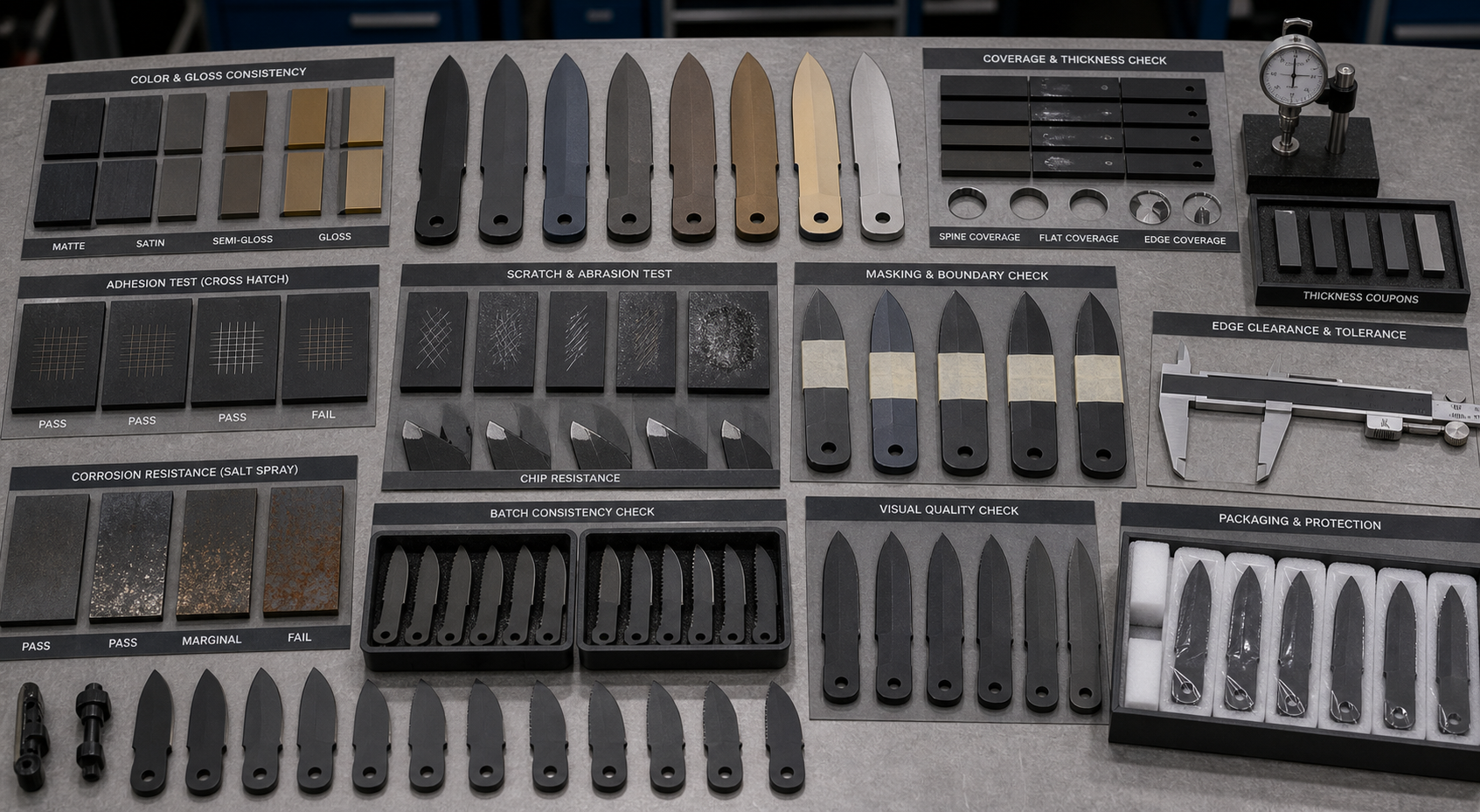
Coated blade QC should check color, gloss, coverage, adhesion, scratches, chips, masking, logo clarity, edge condition, pivot area, lock contact, corrosion exposure, and final assembly fit.
I Inspect Coating Before and After Assembly
Coating inspection should not happen only at the end. First, the blade should be inspected before coating. The surface should be clean and consistent. Second, coated blades should be checked before sharpening or assembly. This catches color, coverage, burnishing, dust, chips, and masking issues early. Third, the assembled knife should be checked because coating may affect fit and movement.
On folding knives, I pay special attention to the pivot area, washer path, blade tang, lock face, stop pin contact, detent track, thumb hole, fuller, and spine jimping. Coating in the wrong area can change action or wear quickly. Sometimes a functional contact area should be masked or finished differently. On fixed blades, I check sheath fit because a tight sheath can rub the coating. On coated kitchen or food-related blades, I ask whether the coating is suitable for food contact and how sharpening exposes the steel edge.
QC should also define cosmetic standards. Is a tiny mark near a hidden tang acceptable? Are color differences between blade and hardware acceptable? Is stonewash over coating planned? Will laser marking cut through the coating or mark on top of it? These details affect customer perception and repeat production.
| QC item | What to inspect | Why it matters |
|---|---|---|
| Coverage | Flat areas, holes, spine, plunge lines | Prevents visual defects |
| Adhesion | Chips, flaking, edge lift | Protects durability |
| Functional areas | Pivot, lock, detent, sheath fit | Protects knife action |
| Cosmetic standard | Color, gloss, marks, logo | Protects retail appearance |
What Should Buyers Say About Coated Blade Care and Limitations?
Customers often expect coatings to stay perfect. If the brand overpromises, normal wear becomes a complaint.
Buyers should explain that coated blades still need cleaning, drying, sharpening, and care. Coatings can wear on edges, contact points, sheath areas, and scratched surfaces.
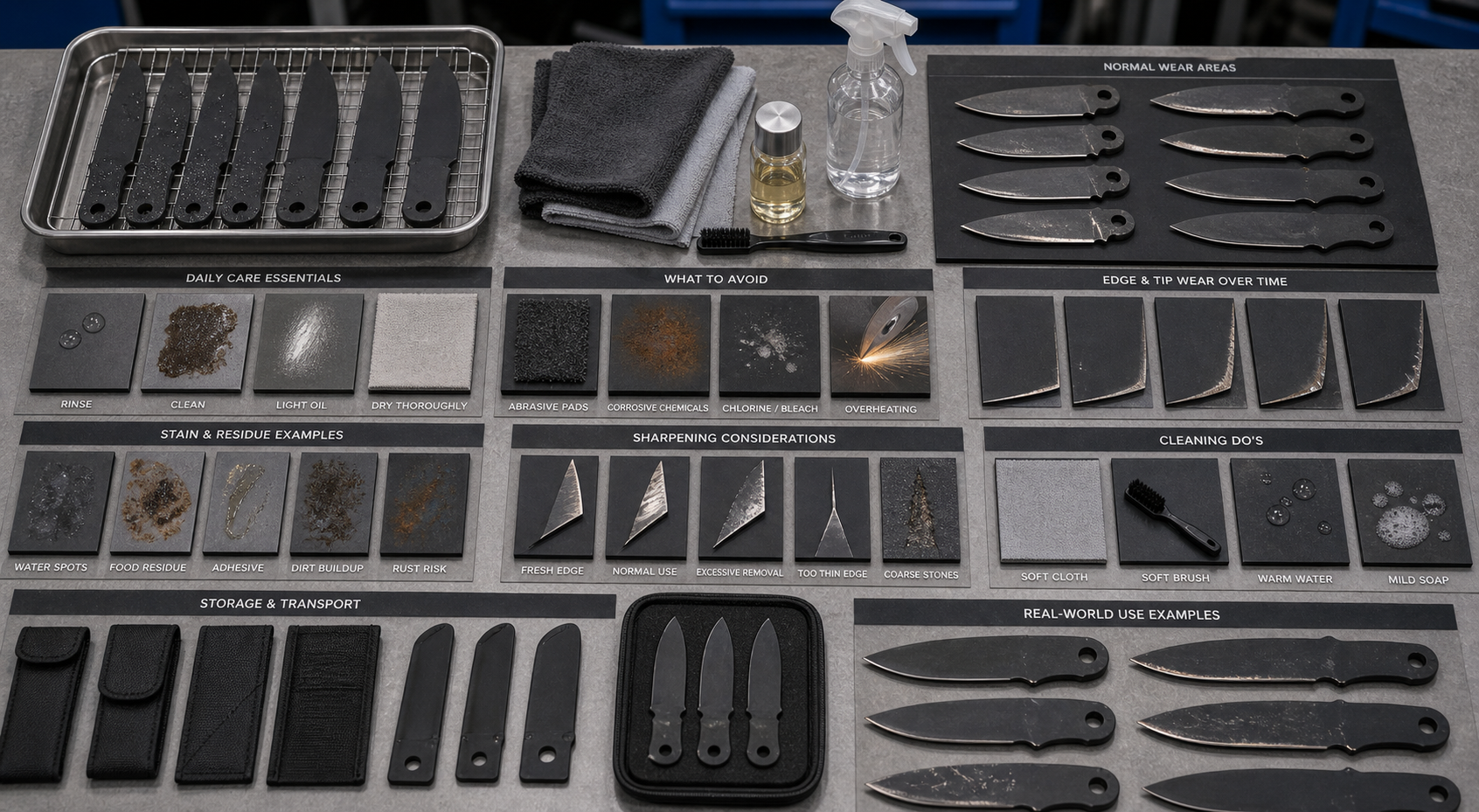
I Write Care Language Before the Product Ships
Coated blades still need care. A coating can reduce maintenance needs, but it does not make a knife maintenance-free. If the blade is used in salt water, acidic food, wet outdoor conditions, or dirty work environments, the user should clean and dry it. If the coating is scratched through to steel, that area may need extra care. If the edge is sharpened, the cutting edge may expose bare steel. If the blade rides tightly in a sheath, contact marks may develop.
This is not a weakness if it is explained honestly. The buyer can include simple care language in the packaging or product page. For example, the brand can say the coating supports corrosion and wear resistance on coated surfaces, but the knife should still be cleaned and dried after use. It can also say that wear marks can appear on contact points with normal use. This kind of language reduces unrealistic expectations.
For B2B buyers, care language is part of quality control. It connects the factory's coating choice with the sales team's product promise. A coating should support the brand. It should not create a customer service problem because the listing said too much.
| Customer question | Better answer | Why it helps |
|---|---|---|
| Will it scratch? | Coatings resist wear differently, but use marks can appear | Avoids false "scratch-proof" claims |
| Will it rust? | Coated areas get support, but exposed steel still needs care | Sets realistic maintenance expectations |
| Can I sharpen it? | Yes, but sharpening may expose steel at the edge | Explains edge behavior |
| Can it contact food? | Confirm the coating series and target use | Avoids unsupported safety claims |
What Should Buyers Include in a Blade Coating RFQ?
A coating RFQ without use case is incomplete. The supplier needs the target problem, not only the target color.
A blade coating RFQ should include blade steel, hardness, finish, coating type, color, thickness target, surface prep, masking areas, logo method, corrosion target, abrasion target, food-contact need, quantity, and inspection standard.
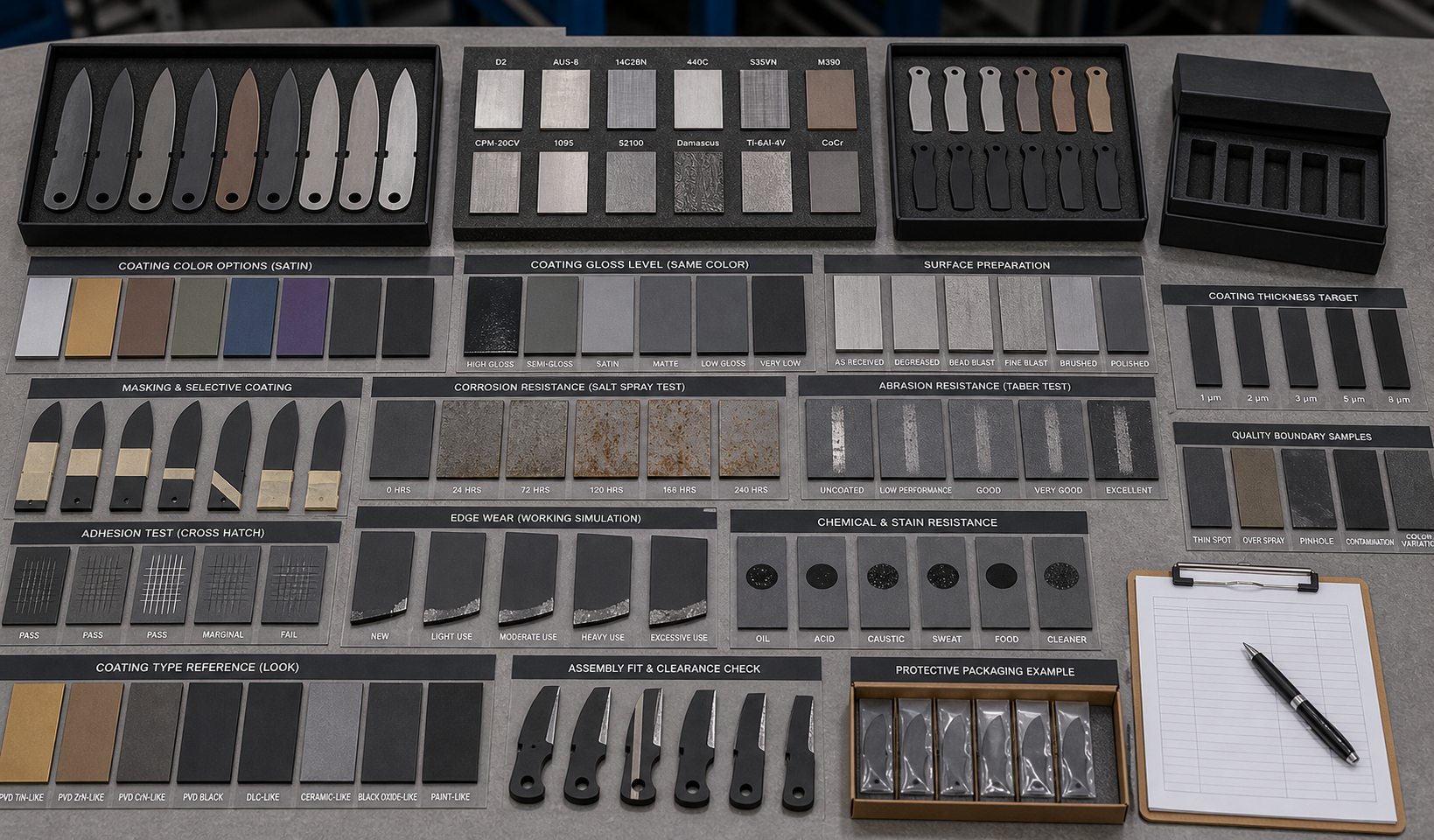
I Ask Buyers to Define Performance and Appearance Together
A strong RFQ should tell the supplier what the coating must do. Is it mainly for black appearance? Is corrosion resistance important? Is the knife for outdoor, EDC, rescue, food prep, fishing, marine use, or display? Is the coating expected to resist sheath rub, pocket carry, cutting abrasion, or cleaning chemicals? Does the buyer need food-contact documentation? These answers change the coating recommendation.
The RFQ should include blade steel, hardness range, blade finish before coating, coating type preference, color, gloss, logo method, and masking requirements. For folding knives, it should mention pivot, washer, detent, stop pin, and lock-contact areas. For fixed blades, it should mention sheath fit and handle assembly order. The buyer should also ask how coating is inspected and what defects are acceptable or not acceptable.
If the buyer is unsure, I prefer to make two or three samples: one practical coating, one visual coating, and one uncoated reference. Then the buyer can compare appearance, cost, action, sheath wear, cleaning, and user expectation. This is faster than arguing from coating names alone.
| RFQ field | What to provide | Why it helps |
|---|---|---|
| Blade base | Steel, hardness, finish, geometry | Confirms coating compatibility |
| Coating target | Color, corrosion, wear, low reflection | Guides coating selection |
| Functional zones | Pivot, lock, edge, sheath, logo | Protects knife performance |
| Inspection plan | Adhesion, color, coverage, wear samples | Supports repeat production |
Turn your idea into a quote-ready knife project.
Share your drawing, sample photo, target quantity, market, and packaging needs. Vast State will review manufacturability and prepare OEM/ODM options.
Conclusion
I choose blade coatings by matching steel, coating type, surface prep, testing, care language, and RFQ details to the buyer's real market.
Source Notes
- Oerlikon Balzers surface solutions supports the description of PVD, PACVD, CVD, heat treatment, nitriding, and vacuum thin-film coating methods.
- Ionbond 40 supports the discussion of DLC-related coatings, food-contact coating context, thickness range, hardness, low friction, abrasion resistance, and anti-sticking use cases.
- Seminole Metal Finishing black oxide supports the black oxide discussion, including its conversion-coating nature and limited corrosion protection.
- ASTM D4060 supports the use of Taber Abraser testing to evaluate abrasion resistance of organic coatings.
- ASTM B117 provides context for salt spray testing as a way to produce relative corrosion resistance information for metals and coated metals.
- Cerakote performance materials provides manufacturer context for ceramic-based coatings, color options, corrosion resistance, abrasion resistance, chemical resistance, and broad industrial use; buyers should still request series-specific data.