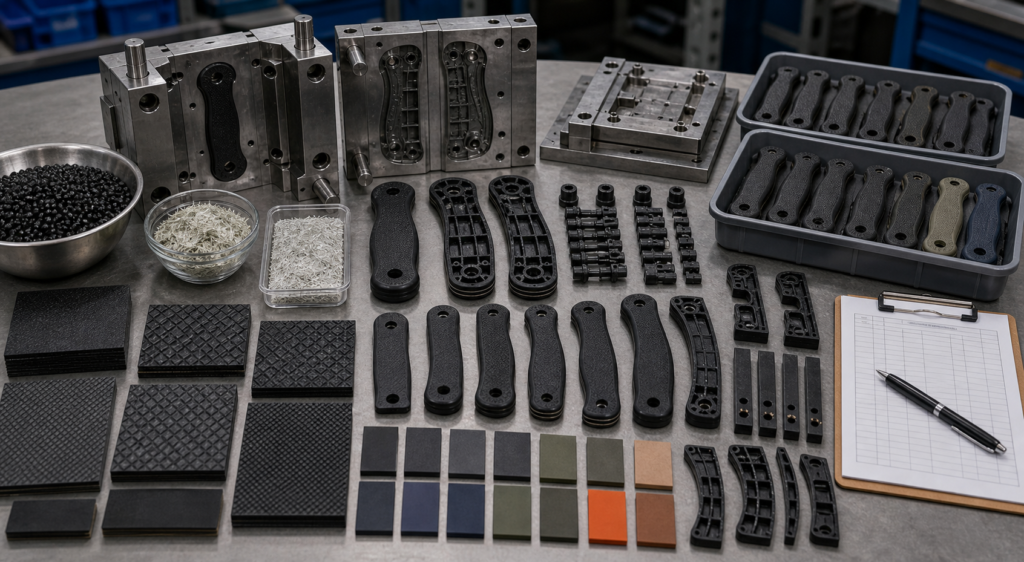
FRN handles can lower cost and weight, but a weak specification creates warping, rough texture, poor screw fit, and cheap hand feel.
Knife buyers should source FRN handles by defining the nylon grade, glass-fiber content, mold design, wall thickness, ribs, texture, color, hardware fit, moisture control, inspection rules, and target market before tooling starts.
Quick buyer brief:
- Answer: FRN can be a strong molded handle option when the design, material, mold, and inspection plan are specified together.
- Buyer context: This helps knife brands, retailers, importers, wholesalers, and private label buyers develop FRN-handled knives.
- Key checks: Confirm PA grade, glass fill, texture, wall thickness, draft, ribs, screw bosses, color, mold plan, and final function.
Have a knife or multi-tool project in mind?
Send your sketch, CAD file, sample photo, or product idea. Vast State can review manufacturability, suggest materials, estimate MOQ, and prepare a quote for your OEM/ODM project.
When I discuss FRN with a buyer, I do not start with the word "durable." I start with the product plan. FRN is usually a molded glass-fiber-reinforced nylon handle material. It can be useful for lightweight folding knives, outdoor tools, rescue tools, and value-focused EDC products. But the result depends on the nylon base, glass-fiber percentage, mold structure, wall thickness, ribs, texture, hardware support, and assembly checks. If the buyer only asks for "FRN handle," the supplier has to guess too much. A strong OEM project turns FRN into a clear production specification.
What Does FRN Mean in Knife Handle Sourcing?
Many buyers use FRN as a simple label. But the label does not tell the factory enough to make a stable handle.
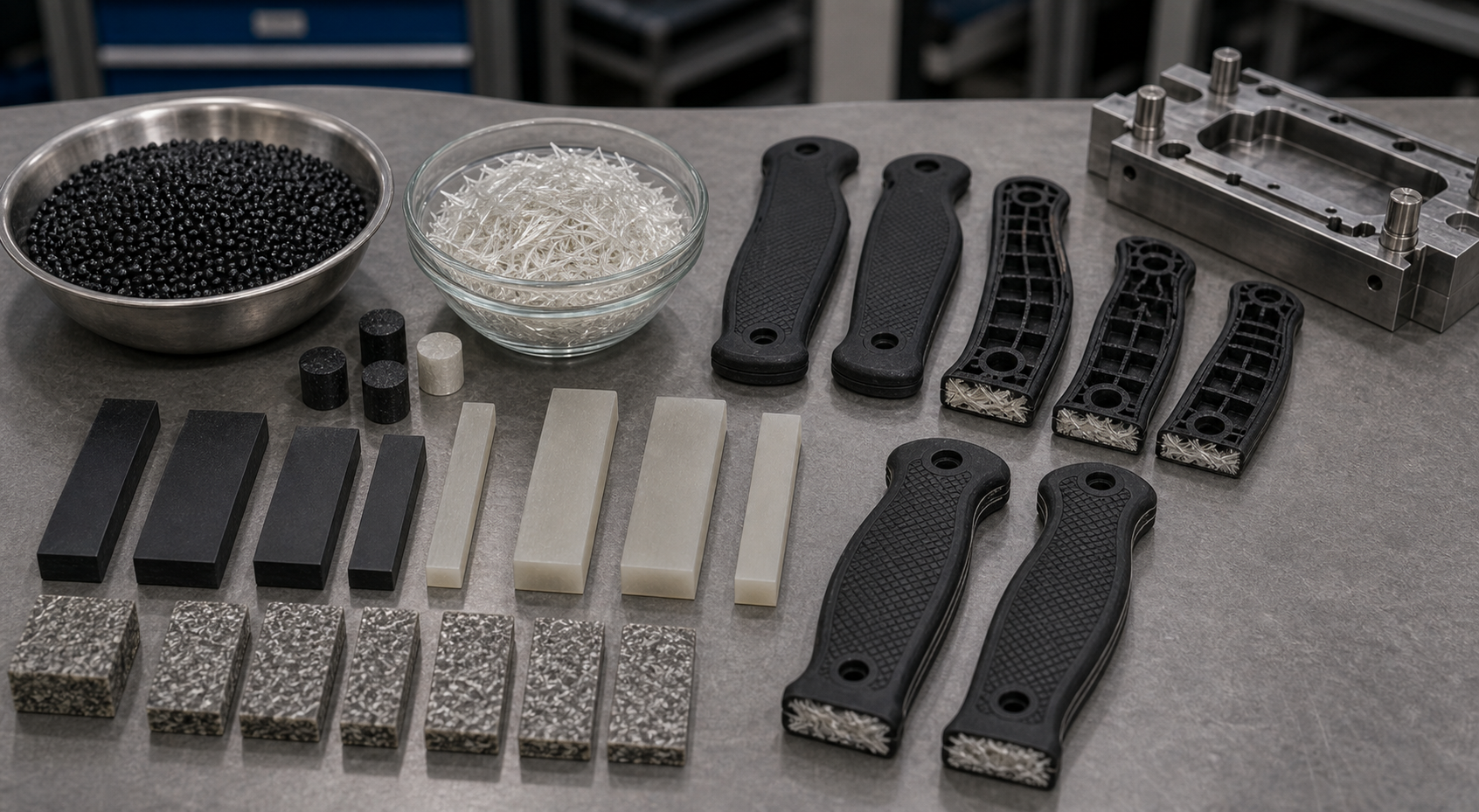
FRN usually means fiberglass reinforced nylon, a polyamide handle material strengthened with glass fibers. In knife sourcing, buyers should define the PA grade, glass-fiber content, color, texture, and molding requirements.
I Define the Material Before I Discuss the Handle Shape
FRN is not one single universal plastic. It is a practical knife-industry term for nylon reinforced with glass fibers. In technical sourcing language, buyers may see terms such as PA6 GF, PA66 GF, PA6-GF30, or PA66-GF30. These terms describe the polyamide base and the glass-fiber reinforcement level. Ensinger explains that glass-filled polyamides have higher rigidity, mechanical strength, hardness, toughness, creep strength, dimensional stability, fatigue strength, and damping than many unfilled choices. Its page on glass filled polyamides also notes that PA66 reinforced with 30 percent or 35 percent glass fiber offers better strength, stiffness, creep resistance, and dimensional stability than unreinforced PA66.
That is why I do not treat FRN as a vague handle word. I ask what the buyer expects from the finished knife. A lightweight EDC folder may need moderate grip and clean pocket feel. A rescue tool may need higher texture and bright color. A budget outdoor knife may need a good balance between cost, stiffness, and mold life. The material choice should follow the product purpose. A good RFQ should not say only "FRN." It should say the intended nylon family, glass fill target if known, color, surface texture, and whether the buyer wants a molded scale, molded full handle, or overmolded structure.
| Term | Practical meaning | Buyer action |
|---|---|---|
| FRN | Fiberglass reinforced nylon handle concept | Ask supplier to specify the exact resin system |
| PA6 GF | Nylon 6 with glass fiber | Check toughness, cost, and molding behavior |
| PA66 GF | Nylon 66 with glass fiber | Check heat and stiffness requirements |
| GF percentage | Glass-fiber loading level | Balance stiffness, surface feel, and mold wear |
OEM/ODM RFQ Checklist
Prepare these details to help Vast State review your project and provide a more accurate quotation.
| RFQ Field | What to Prepare |
|---|---|
| Project type | OEM from drawing / ODM private label / wholesale catalog |
| Product category | Folding knife / fixed blade / multi-tool / outdoor tool |
| Design status | Idea / sketch / 2D drawing / 3D CAD / physical sample |
| Target price | Ex-factory target price or retail price range |
| MOQ expectation | 500 / 1,000 / 3,000 / 5,000+ pcs |
| Logo method | Laser engraving / etching / printing / molded logo |
| Packaging | Standard packaging / custom retail box / Amazon-ready |
| Market | USA / EU / Japan / Korea / Middle East / other |
| Compliance needs | Buyer-specified testing / documentation / labeling |
| Timeline | Sample deadline / mass production deadline |
When Is FRN a Good Choice for Knife Handles?
A molded handle can reduce cost, but only when the project fits the process. Otherwise tooling cost and revisions can eat the savings.
FRN is a good handle choice when buyers need lightweight parts, molded texture, repeatable color, lower per-piece cost at volume, good stiffness, and a practical alternative to machined G10 or metal handles.
I Match FRN to Volume, Weight, and Market Position
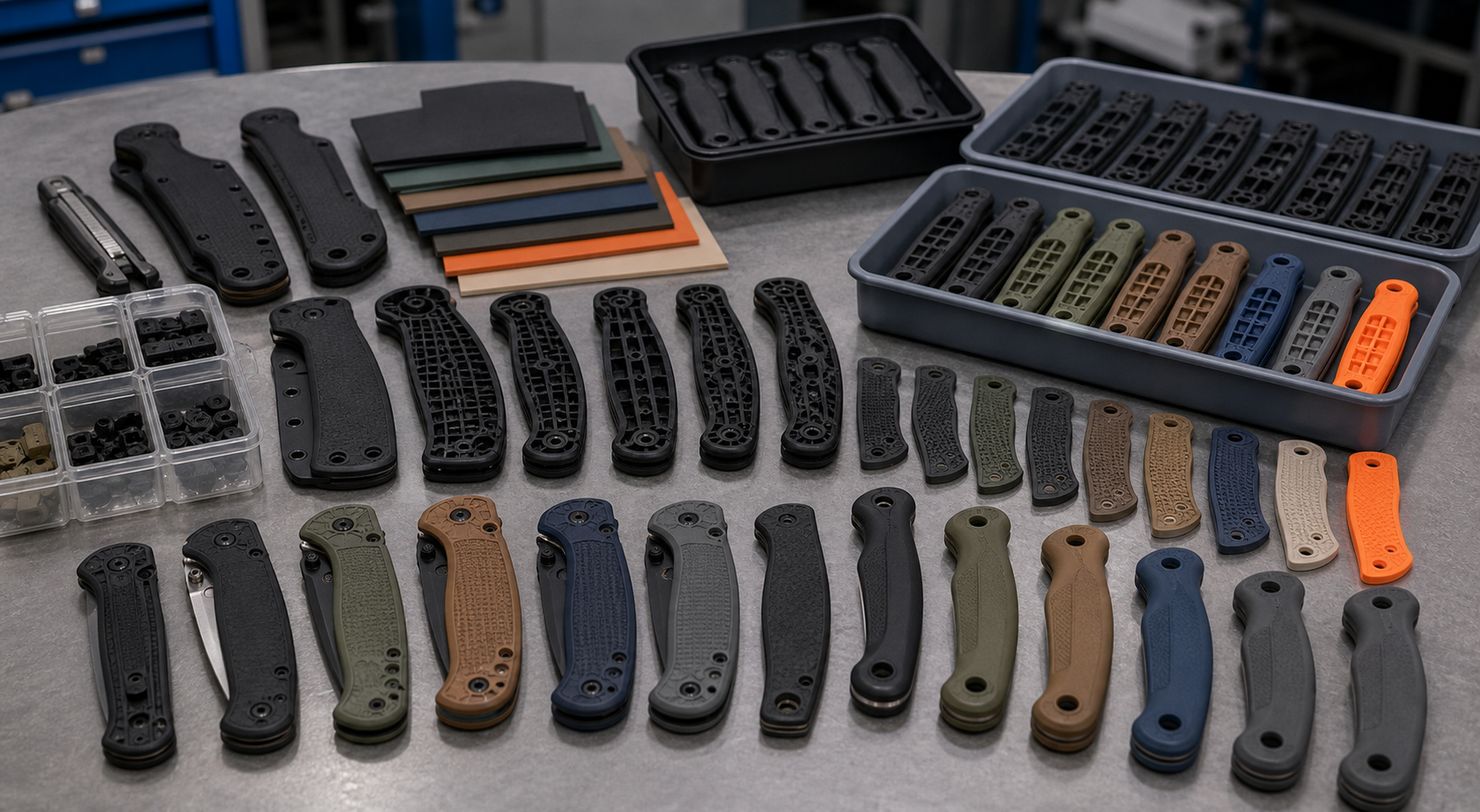
FRN can be very useful for OEM knife projects that need repeatable molded shapes. Unlike G10 or Richlite, which are often cut and machined from sheet material, FRN parts are usually injection molded. That means the buyer pays attention to tooling before production. Once the mold is right, the part can repeat well across larger orders. This can help brands that need stable color, molded texture, ergonomic shape, and lower unit cost after tooling.
The fit is not automatic. If the buyer only needs a small trial order, FRN tooling may not make sense unless the design uses an existing mold or shared platform. If the buyer wants a premium machined feel, G10, micarta, Richlite, aluminum, titanium, or carbon fiber may fit better. If the buyer wants a light, practical, textured, and cost-controlled handle for a mid-volume product, FRN can be a strong candidate.
I also think about the end user. A work knife may need stronger ribs and a rougher texture. A pocket EDC knife may need smoother texture to avoid damaging clothing. A rescue tool may need bright color and glove-friendly grip. A private label retailer may care about color consistency and fast repeat production. FRN is most successful when the buyer's market position matches the molded design.
| Project need | FRN fit | Buyer caution |
|---|---|---|
| Lightweight handle | Strong fit | Still check stiffness around screws and pivot |
| Repeatable molded texture | Strong fit | Texture needs draft and mold planning |
| Very small order | Weaker fit | Tooling cost may not be justified |
| Premium machined look | Depends | G10, aluminum, or carbon fiber may fit better |
Which Nylon Grade and Glass-Fiber Content Should Buyers Discuss?
Not every glass-filled nylon performs the same. The wrong resin can make a handle too flexible, too brittle, too rough, or too costly.
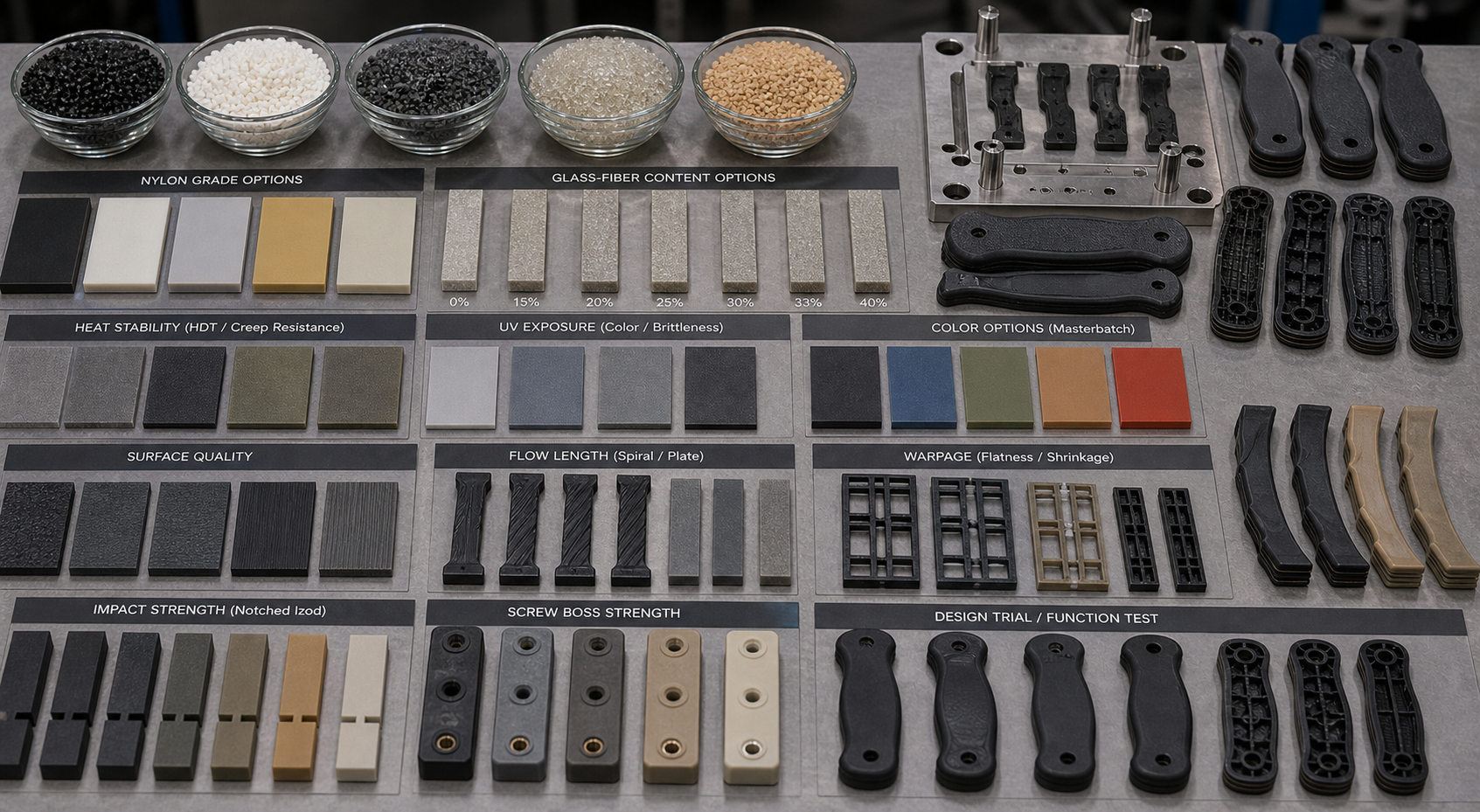
Buyers should discuss PA6, PA66, glass-fiber percentage, heat stabilization, UV needs, color masterbatch, impact modifiers, and supplier datasheets before approving an FRN handle material.
I Ask for a Material Datasheet, Not Just a Material Name
For FRN handles, the base resin matters. PA6 can offer a useful balance of toughness, processability, and cost. PA66 can offer stronger heat and stiffness performance in some applications. Glass fiber raises stiffness and dimensional stability, but it can also affect surface appearance, flow, weld lines, and mold wear. BASF says its glass-fiber reinforced Ultramid polyamide grades are known for high mechanical strength, hardness, rigidity, thermostability, and dimensional stability. That kind of source helps a buyer understand why glass reinforcement matters, but the final choice still depends on the actual grade and handle design.
I usually ask buyers to decide how technical the handle needs to be. A simple budget handle may not need an expensive specialty grade. A rescue tool, outdoor tool, or high-load folder may need better stiffness, heat aging, UV stability, or impact performance. Color also matters. Black is easier to control for many molded parts. Bright colors can show flow marks or color variation more clearly. If the handle needs orange, tan, green, or custom brand color, that should be discussed early.
The best RFQ includes a material target and allows engineering review. It should not lock the project into an unsuitable resin only because a competitor used a similar term.
| Material point | Why it matters | RFQ wording example |
|---|---|---|
| PA6 or PA66 | Controls cost, molding, heat, and stiffness behavior | "Recommend PA6 GF or PA66 GF based on design" |
| Glass-fiber content | Controls stiffness and surface feel | "Target around GF30, confirm by datasheet" |
| Color system | Controls appearance and repeatability | "Black or safety orange, approve color chip" |
| Additives | Support UV, impact, or heat needs | "Advise if UV-stabilized grade is needed" |
How Do Injection Mold Design Details Affect FRN Handle Quality?
FRN is molded, so the handle quality starts before production. A weak mold design can cause warping, sink, weak bosses, and rough ejection marks.
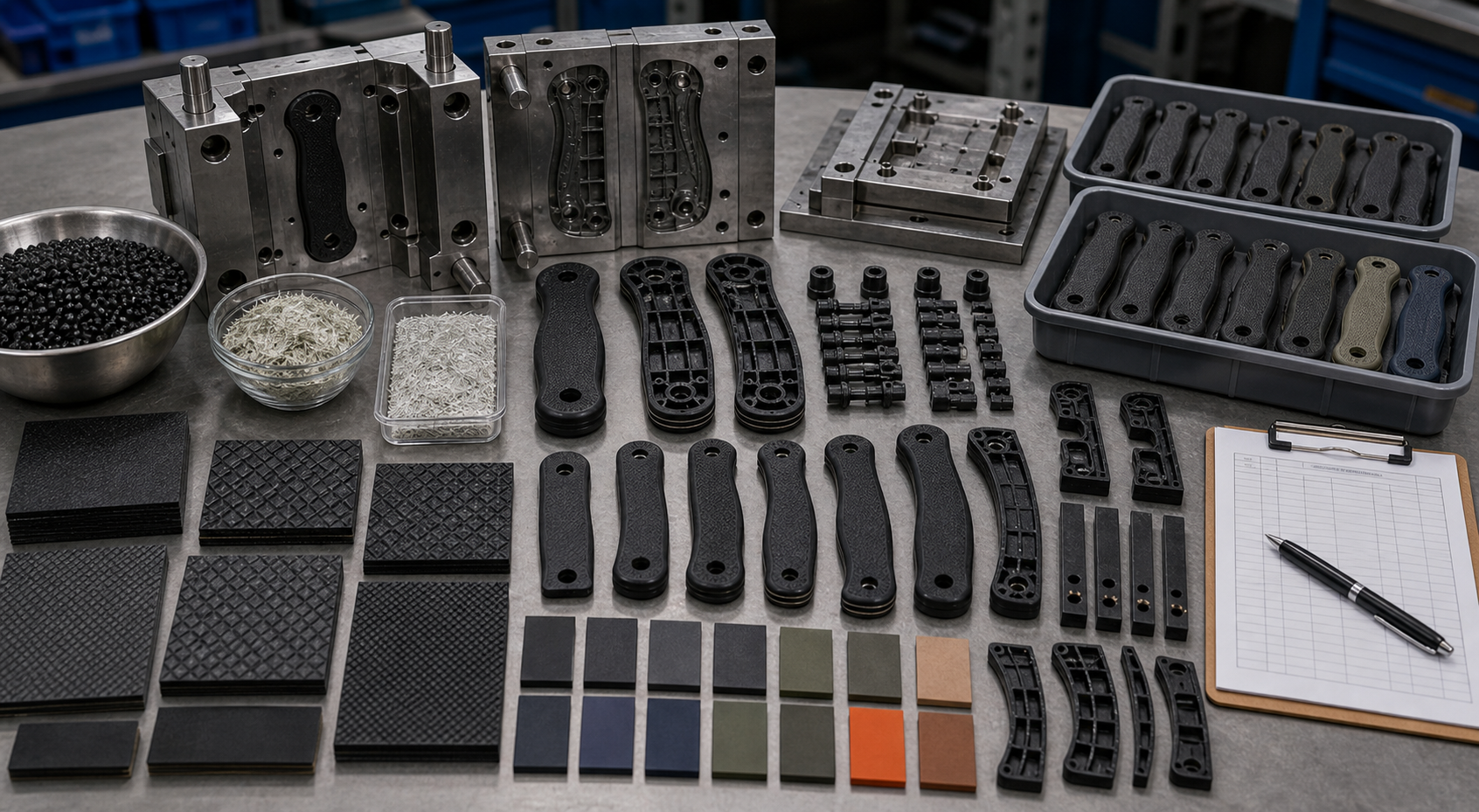
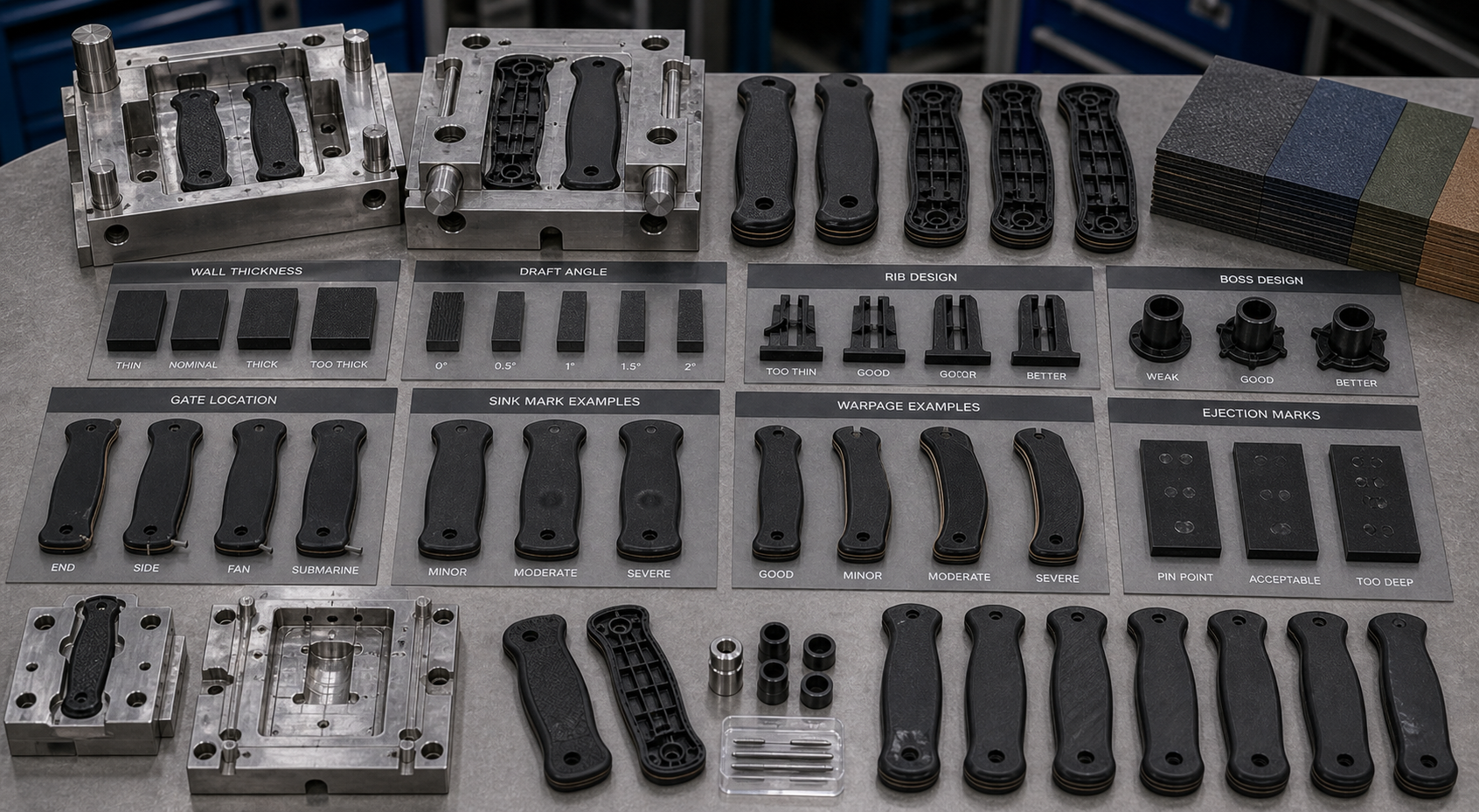
FRN handle quality depends on uniform wall thickness, draft angles, ribs, bosses, radii, gates, ejector marks, parting lines, texture depth, shrinkage control, and mold steel suitable for glass-filled material.
I Review the Handle Like an Injection-Molded Part
A molded FRN handle must follow injection molding rules. Protolabs' injection molding guide says designers should keep walls uniform, use draft, control ribs and bosses, add radii at inside corners, and plan gates because these details affect moldability and part quality. Its plastic injection molding design guidelines also list draft and wall-thickness guidance for nylon and other materials. I use these ideas when discussing FRN knife handles, even though each final mold needs project-specific engineering.
For a folding knife handle, the screw bosses, pivot support, clip holes, liner fit, and backspacer area are critical. A thick boss can sink. A thin boss can crack. A sharp internal corner can create stress. A deep texture without enough draft can scratch during ejection or make the part hard to release. A gate placed in the wrong area can create visible flow marks or weld lines in the grip zone.
This is why I like early DFM review. The buyer should approve not only the shape, but also the likely gate area, parting line, ejector mark location, and texture direction. These details may not sound exciting, but they decide whether the handle feels clean in the hand and looks acceptable in retail.
| Mold detail | Risk if ignored | Practical control |
|---|---|---|
| Wall thickness | Sink, warp, and uneven cooling | Keep walls as uniform as possible |
| Draft angle | Scratches or ejection problems | Add more draft for textured surfaces |
| Bosses and ribs | Weak screws or sink marks | Use ribbed support instead of heavy blocks |
| Gate and ejector marks | Visible cosmetic defects | Place marks away from key grip surfaces |
How Should Texture, Grip, and Surface Finish Be Specified?
FRN can feel secure or cheap depending on texture. A good pattern needs both grip logic and mold logic.
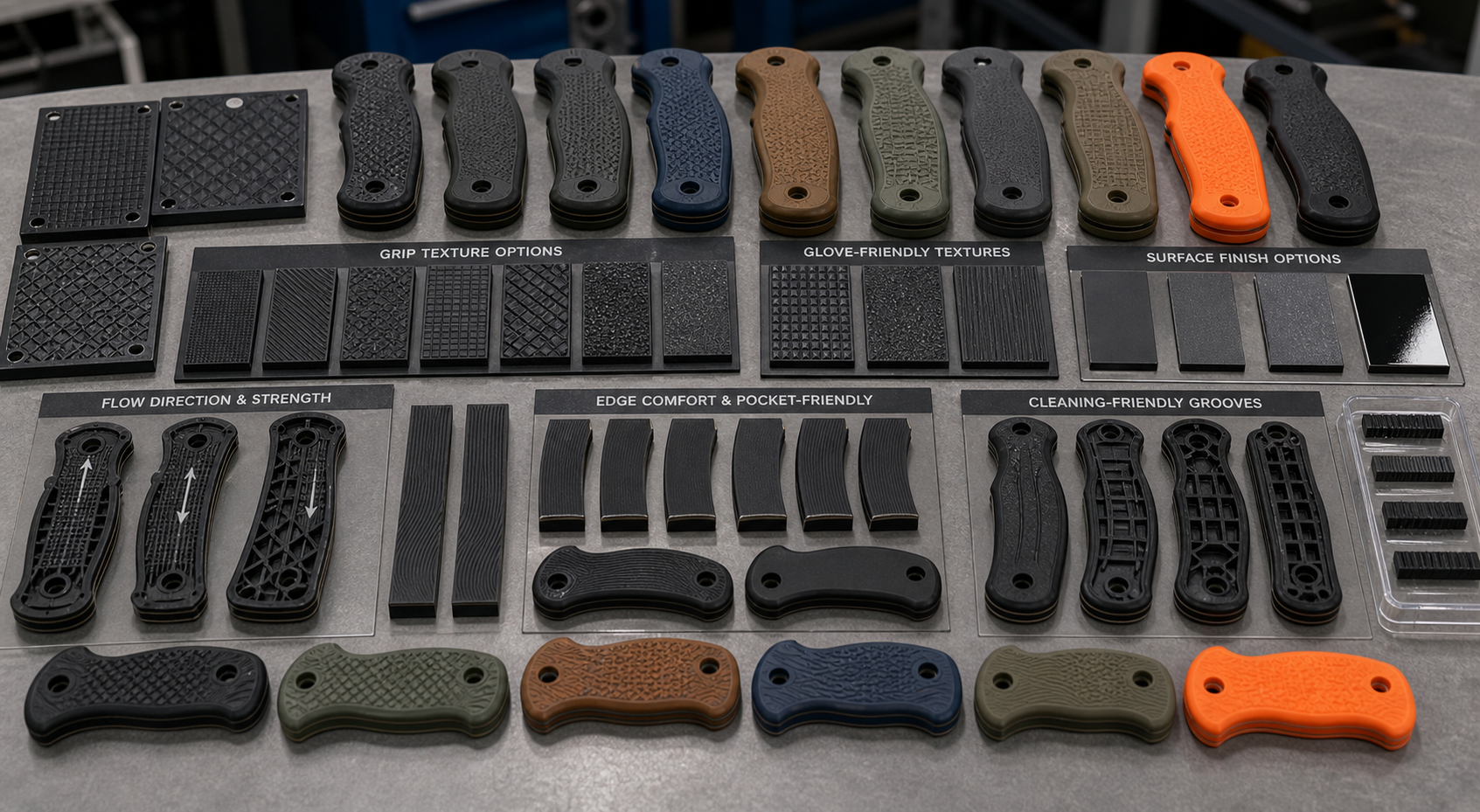
Buyers should specify FRN texture by target user, grip level, pocket comfort, glove use, mold draft, flow direction, cleaning needs, and final cosmetic standard.
I Balance Grip With Carry Comfort
Texture is one of the main reasons buyers choose FRN. A molded handle can include checkering, grooves, directional patterns, raised ribs, molded logos, or ergonomic contour. These features can make the knife feel more purposeful than a flat plastic scale. But texture is easy to overdo. A rough surface may feel secure in gloves, but it can damage pockets. A deep pattern may trap dirt. A shallow pattern may look clean but feel slippery.
I usually ask buyers where the knife will be used. A work knife, rescue knife, or outdoor knife may need a medium or aggressive texture. A daily carry knife may need a milder texture and rounded edges. A retailer selling to broad consumers may prefer a balanced pattern that feels safe but not harsh. If the buyer wants molded branding, I also ask whether it should be raised, recessed, or placed in a non-grip area.
Mold design matters here. Protolabs notes that textured surfaces need more draft than polished ones because friction is higher during ejection. That is important for FRN handle design. The deeper the texture, the more carefully the mold and ejection plan must be reviewed. The best texture is not only attractive. It is moldable, repeatable, comfortable, and matched to the buyer's market.
| Texture choice | Best use | Watch point |
|---|---|---|
| Mild texture | Everyday carry and broad retail | May feel less secure in wet use |
| Medium texture | Outdoor and utility knives | Good balance for many projects |
| Aggressive texture | Gloves, rescue, or work use | Can feel harsh in pockets |
| Molded logo | Brand recognition | Avoid weak thin lettering and sharp edges |
What Quality Checks Should Buyers Request for FRN Handles?
FRN quality cannot be judged only by color. Molded handles need size, fit, function, appearance, and long-term consistency checks.
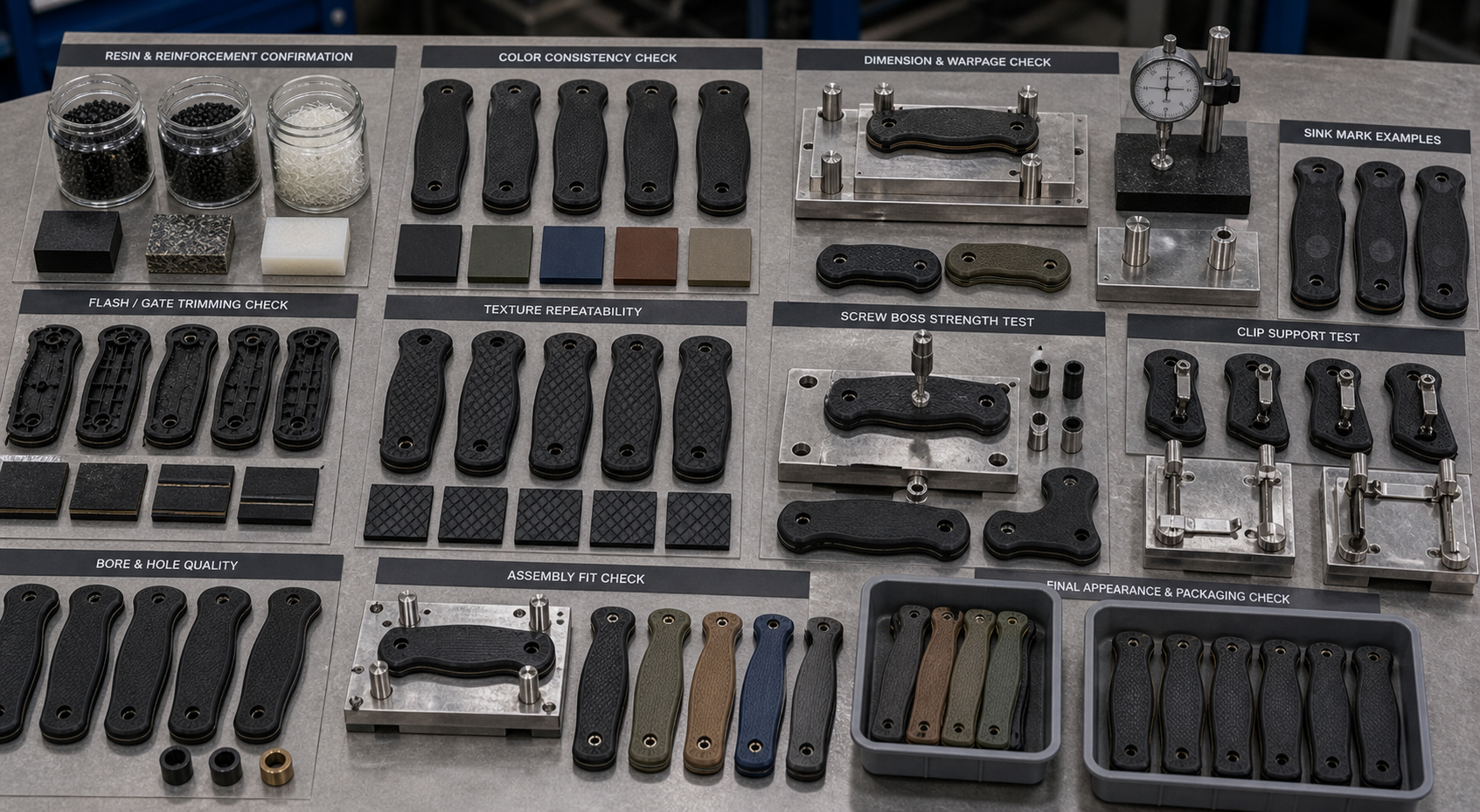
Buyers should request FRN checks for resin confirmation, color, dimensions, warpage, sink marks, flash, gate marks, ejector marks, texture, screw boss strength, liner fit, clip fit, and final knife function.
I Inspect Molded Parts Before Assembly and After Assembly
A molded handle can pass a quick visual check and still create trouble during assembly. The scale may be slightly warped. A boss may be weak. A screw hole may be tight. A clip pad may not sit flat. A textured area may show flow marks. A gate vestige may be uncomfortable in the hand. These problems become expensive if they are found after full assembly.
I prefer inspection in stages. First, check incoming material or material records against the approved resin. Second, check first-shot samples during mold trial. Third, measure critical dimensions before mass assembly. Fourth, inspect assembled knives for screw fit, blade centering, handle gaps, lock function, clip position, and hand feel. Fifth, check packaging because molded handles can rub if packed poorly.
Nylon also needs dimensional thinking because moisture can affect parts. Curbell's nylon material page notes that nylon has relatively high moisture absorption compared with many thermoplastics and that wet-environment parts should account for dimensional changes. For knife buyers, this does not mean FRN is bad. It means tight-fit areas, screw holes, and assembly tolerances should be reviewed with the actual material and production environment in mind.
| Inspection item | What to check | Why it matters |
|---|---|---|
| Material record | Resin grade, color, glass fill | Prevents wrong material substitution |
| Molded part | Warpage, flash, sink, flow marks | Protects appearance and fit |
| Hardware fit | Screws, clip, liners, pivot area | Protects assembly function |
| Final knife | Opening, lockup, handle gaps, grip comfort | Protects user experience |
How Should Buyers Compare FRN With G10, Richlite, Aluminum, and TPE?
Material comparison should follow the target product. If buyers compare only by price, they may choose the wrong handle.
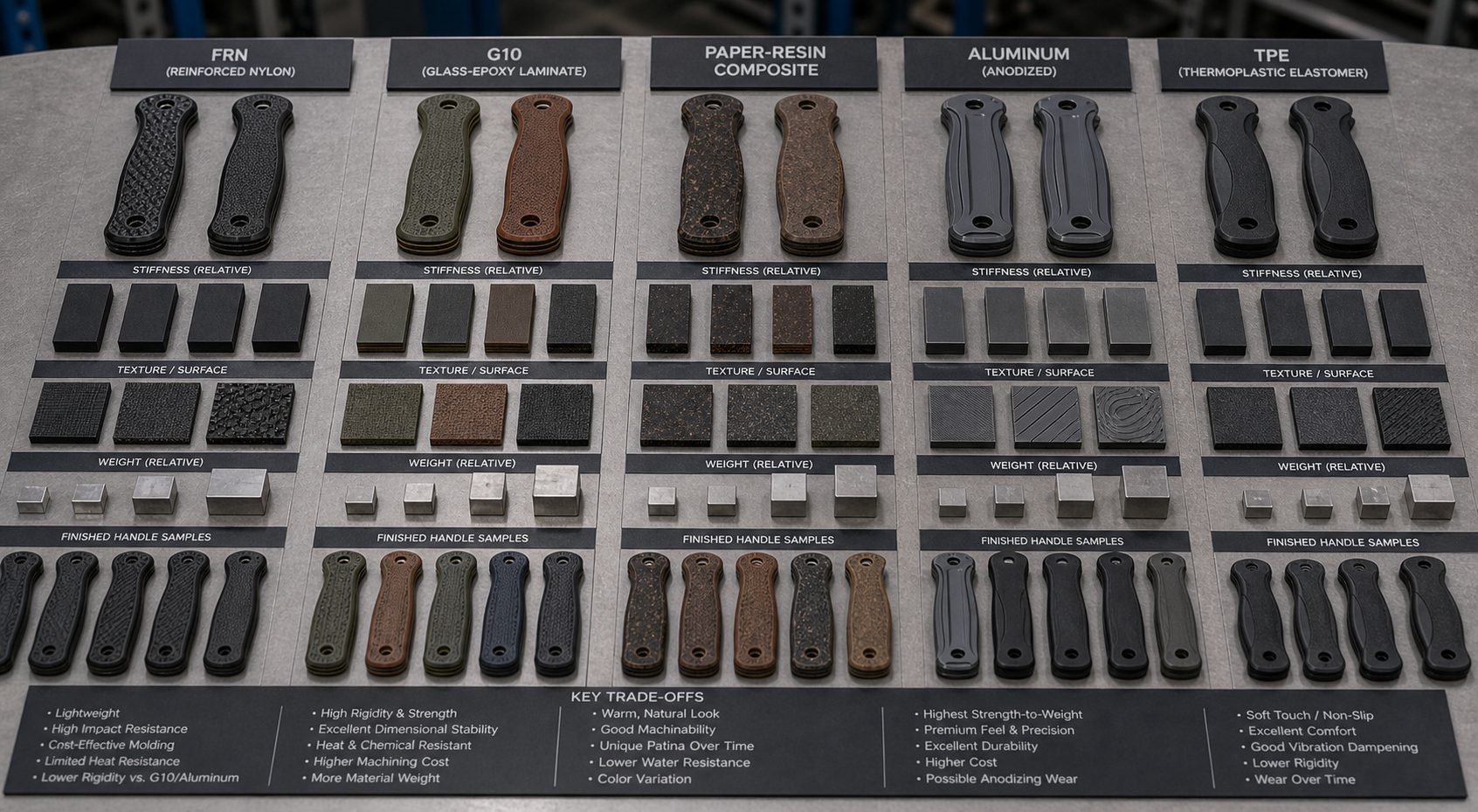
FRN is usually better for molded, lightweight, textured, repeatable volume handles. G10 feels more machined, Richlite feels warmer, aluminum feels cooler and harder, and TPE feels softer but less rigid.
I Choose by Process, Feel, and Business Case
FRN is a molded material choice. That gives it different strengths from machined sheet materials. If a buyer wants molded texture, low weight, repeatable colors, and lower unit cost at volume, FRN can work well. If the buyer wants a machined slab look, G10 may feel stronger in the hand and easier to sample without a dedicated mold. If the buyer wants a warm paper-composite story, Richlite may fit better. If the buyer wants a metal handle feel, aluminum can help, but it changes cost, weight, machining, and finish control. If the buyer wants a rubber-like grip, TPE overmolding can work, but it needs compatibility review.
The comparison also depends on MOQ and tooling. FRN can require mold investment. G10 and Richlite can be machined in lower quantities more easily. Aluminum needs machining and surface treatment. TPE may need overmolding and adhesion control. The buyer should not choose a handle material only because another brand uses it. The buyer should ask: What is my target user? What is my order volume? What hand feel do I want? What surface defects will customers notice? What budget and tooling plan can I support?
This kind of comparison keeps the sourcing discussion practical and avoids overbuilding the product.
| Material | Main advantage | Buyer caution |
|---|---|---|
| FRN | Molded lightweight texture at volume | Tooling and DFM must be right |
| G10 | Strong machined technical feel | More machining time and dust control |
| Richlite | Warm paper-composite appearance | Patina and variation need approval |
| Aluminum | Cool metal feel and clean finish | Higher machining and finishing control |
| TPE | Softer grip and comfort | Adhesion and wear need testing |
What Cost, MOQ, and Tooling Questions Matter for FRN Projects?
FRN can reduce unit cost, but the buyer must understand tooling. A cheap part is not cheap if the mold plan is wrong.
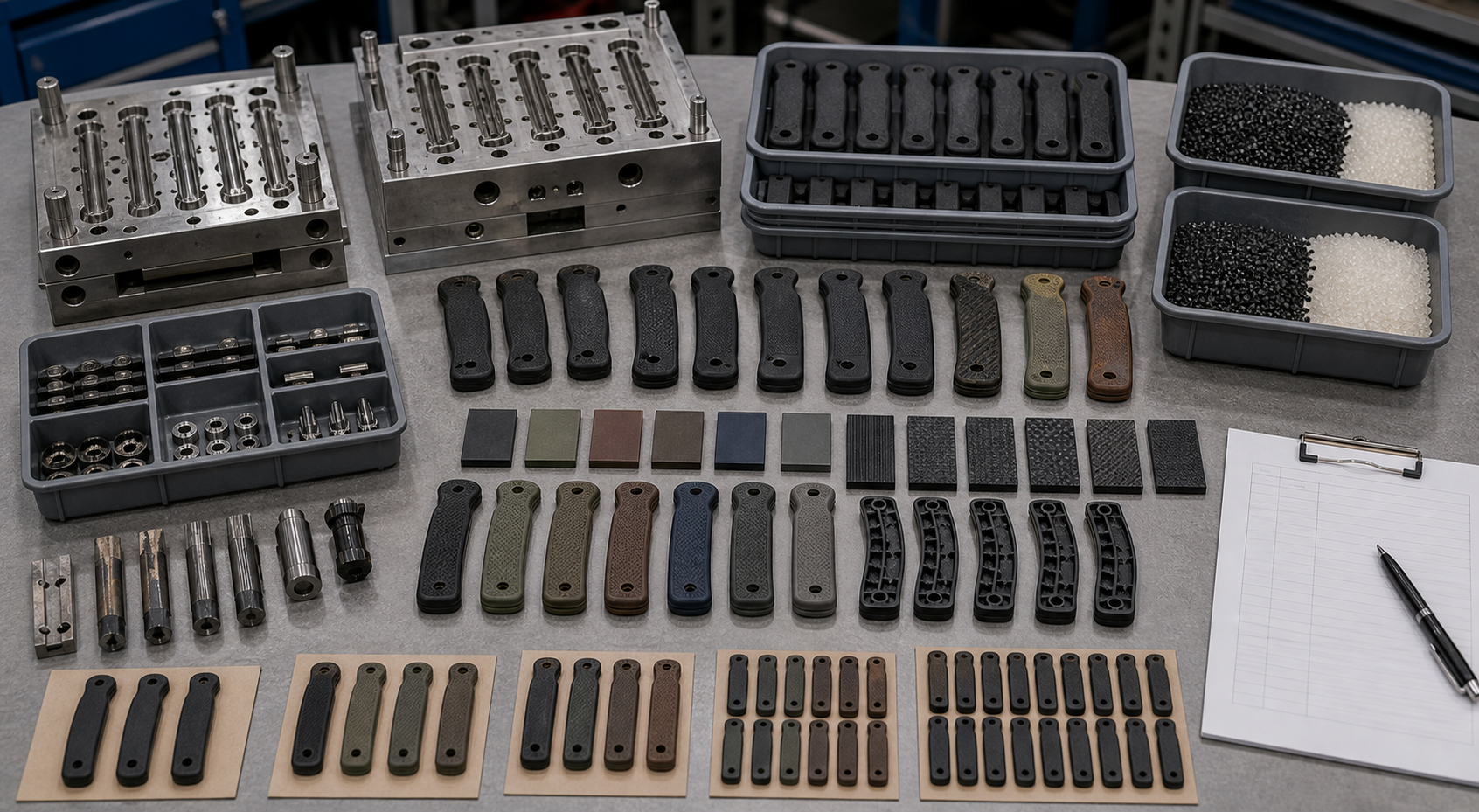
FRN sourcing should review mold cost, cavity count, expected volume, resin cost, color changes, texture complexity, tool steel, trial samples, revision cost, lead time, and long-term repeat production.
I Separate Tooling Logic From Unit Price Logic
FRN projects often look attractive because the molded part cost can be lower at volume. But tooling must be paid for, maintained, and sometimes modified. The buyer should compare total project cost, not only the unit price. A simple handle with an existing mold may be economical. A custom ergonomic handle with deep texture, inserts, side actions, and strict cosmetic requirements can be a larger project.
Tooling questions should come early. How many cavities are needed? What is the expected order volume? Will the same handle be used across several models? Does the design need side actions? Are there undercuts? Is the texture simple enough for easy release? What mold steel is suitable for glass-filled nylon? How many trial rounds are expected before production approval? What happens if the buyer changes the clip position or screw pattern after tooling?
These questions help both sides avoid false savings. Sometimes I suggest a prototype route first. A CNC, 3D printed, or soft-tool sample can help confirm shape before a hard mold. It will not perfectly represent final FRN, but it can reduce design risk. Once the ergonomics and structure are stable, the buyer can move to production tooling with more confidence.
| Cost question | Why it matters | Buyer action |
|---|---|---|
| Mold ownership | Affects long-term repeat production | Clarify ownership and maintenance terms |
| Cavity count | Affects unit output and mold cost | Match mold plan to real demand |
| Texture complexity | Affects ejection and mold machining | Review draft and sample texture early |
| Revision risk | Affects time and cost | Freeze handle geometry before hard tooling |
What Should Buyers Include in an FRN Handle RFQ?
A good FRN quote needs more than a handle idea. Without details, the supplier can only guess material, mold, texture, and cost.
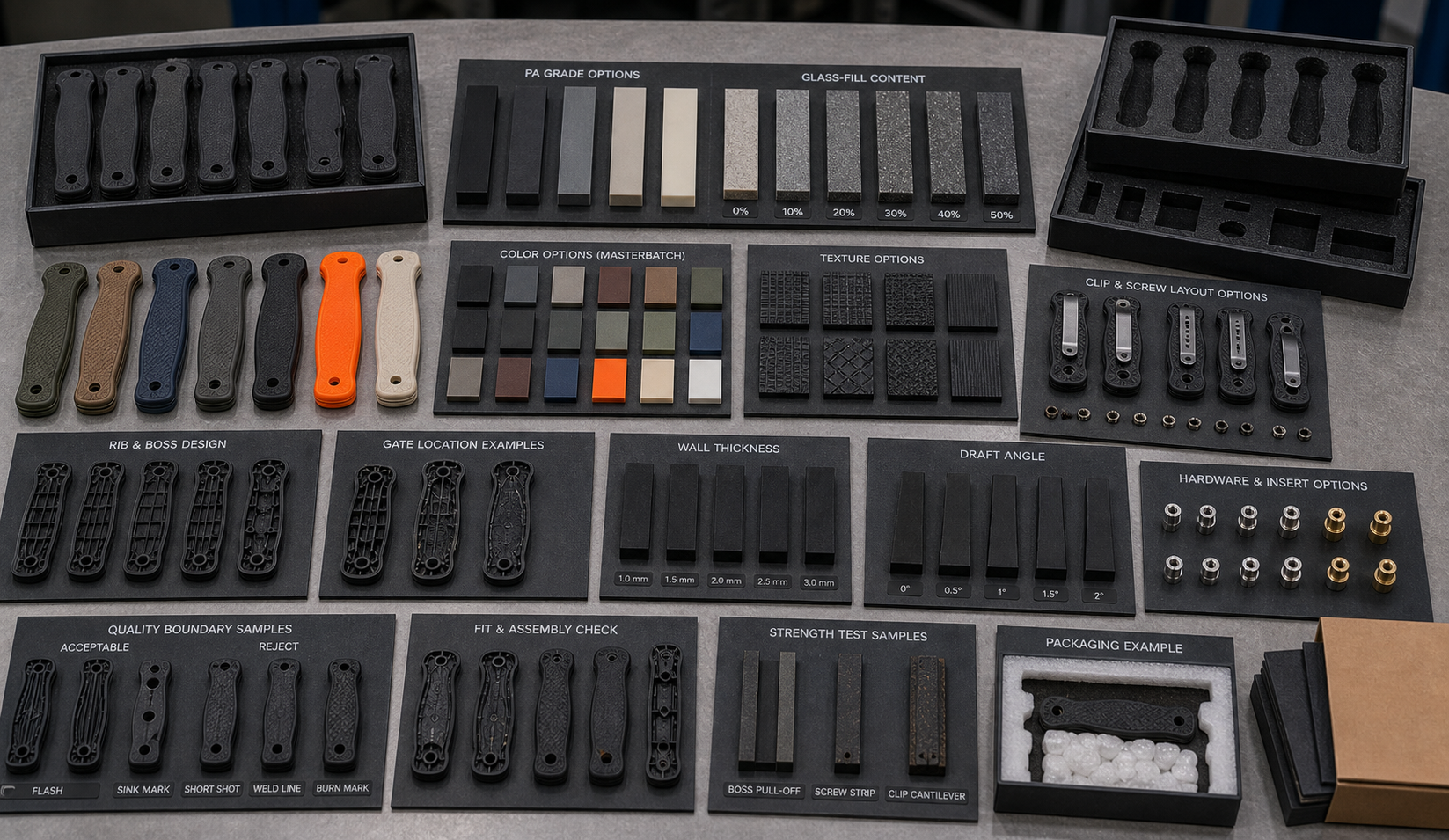
An FRN handle RFQ should include knife type, target market, expected volume, target price, PA grade, glass fill, color, texture, wall thickness, hardware layout, mold plan, packaging, and inspection needs.
I Ask Buyers to Send the Product Goal, Not Only the Material Name
When a buyer asks Vast State for an FRN handle project, I want to understand the knife first. Is it a folding knife, fixed blade, pocket knife, rescue tool, camping tool, or multi-tool component? What market will it sell into? What is the expected volume? What target price should the design support? What blade steel, lock type, clip style, and packaging are planned?
Then I ask for FRN-specific details. Does the buyer want PA6 GF or PA66 GF, or should we recommend a grade? Does the handle need black, orange, green, or custom color? Should the texture be mild, medium, or aggressive? Is the buyer using liners, nested liners, standoffs, a backspacer, or molded structure? Does the clip screw into the FRN directly, into inserts, or into a liner? What areas are cosmetic? Where can gate and ejector marks be accepted?
A clear RFQ lets the supplier quote honestly. It also helps avoid tool changes. If the buyer does not know the technical answer yet, that is fine. The buyer can state the product goal, target cost, market, and performance needs. Then the supplier can recommend the material and structure. That is how OEM development should work.
| RFQ field | What to provide | Why it helps |
|---|---|---|
| Product direction | Knife type, target user, volume, price | Guides material and mold strategy |
| FRN material | PA grade, glass fill, color, additives | Prevents vague material substitution |
| Molded design | Wall, ribs, bosses, texture, draft | Improves manufacturability |
| Inspection plan | Fit, cosmetics, screw strength, function | Supports stable repeat production |
Turn your idea into a quote-ready knife project.
Share your drawing, sample photo, target quantity, market, and packaging needs. Vast State will review manufacturability and prepare OEM/ODM options.
Conclusion
I source better FRN knife handles by connecting resin choice, mold design, texture, hardware fit, inspection, tooling cost, and RFQ detail.
Source Notes
- Ensinger glass filled polyamides supports the explanation of glass-filled PA6 and PA66 strength, stiffness, creep resistance, dimensional stability, and processing options.
- BASF Ultramid supports the point that glass-fiber reinforced polyamide grades can provide mechanical strength, hardness, rigidity, thermal stability, dimensional stability, and creep strength.
- Curbell nylon supports the discussion of nylon as a strong, stiff engineering plastic with glass-filled grades and moisture-related dimensional considerations.
- Protolabs injection molding guide supports the injection molding discussion on wall thickness, draft, ribs, bosses, radii, gates, shrinkage, and texture-related design planning.
- Protolabs plastic injection molding design guidelines provides additional design context on draft, wall thickness, surface finishes, nylon wall guidance, and finishing options.