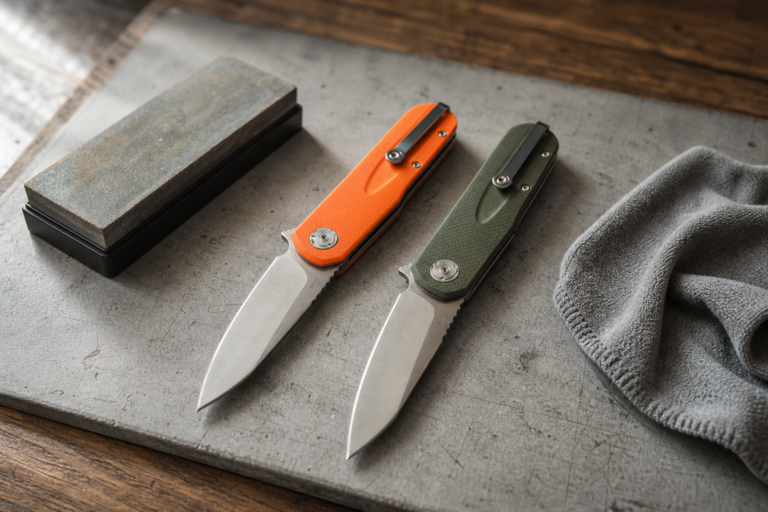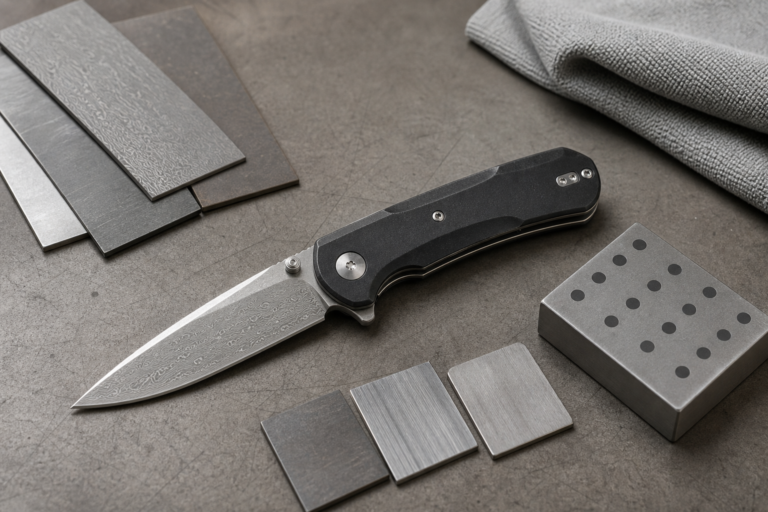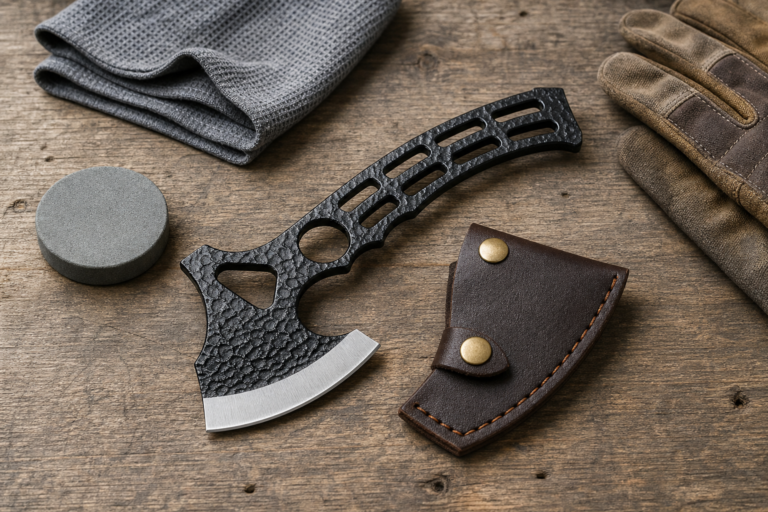
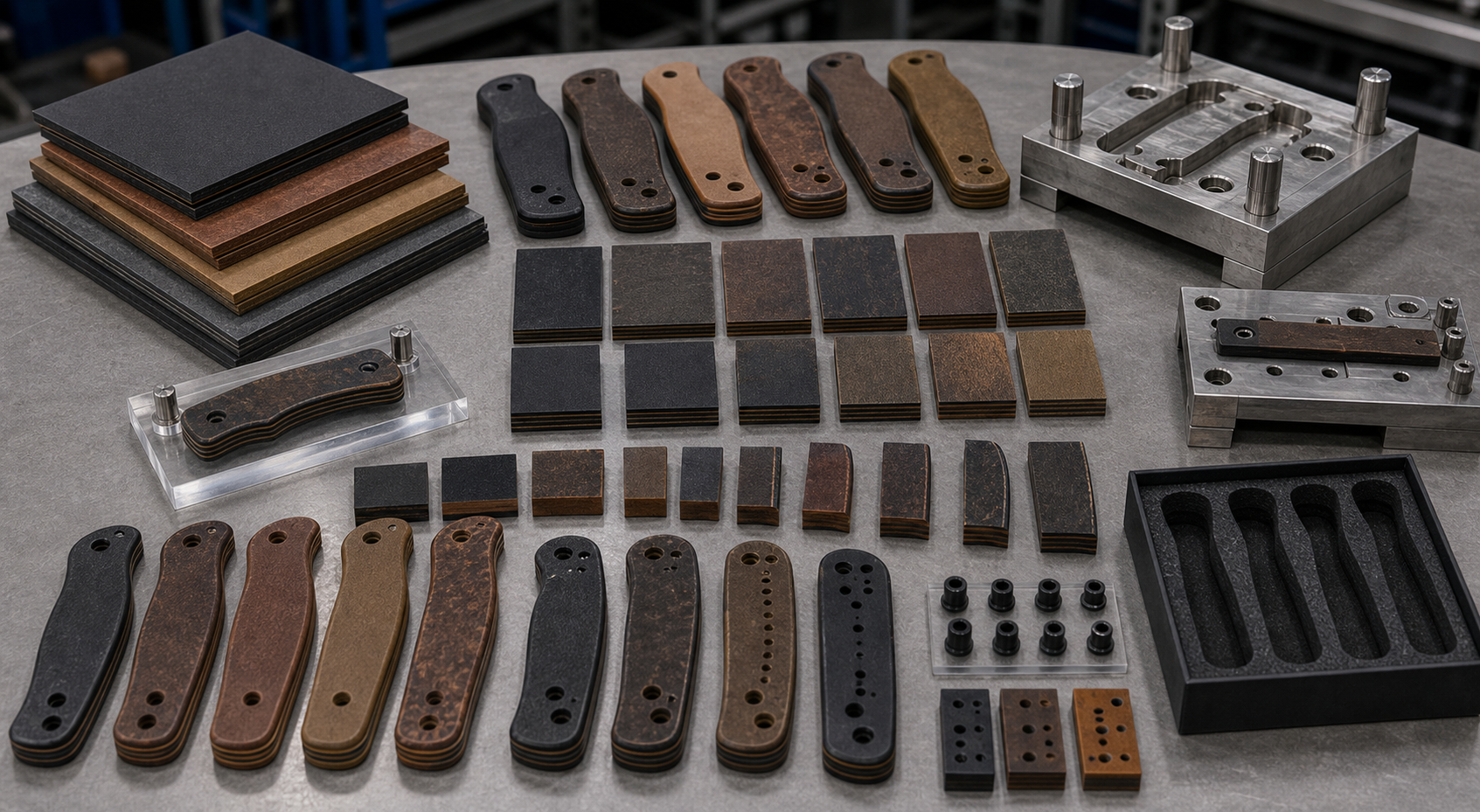
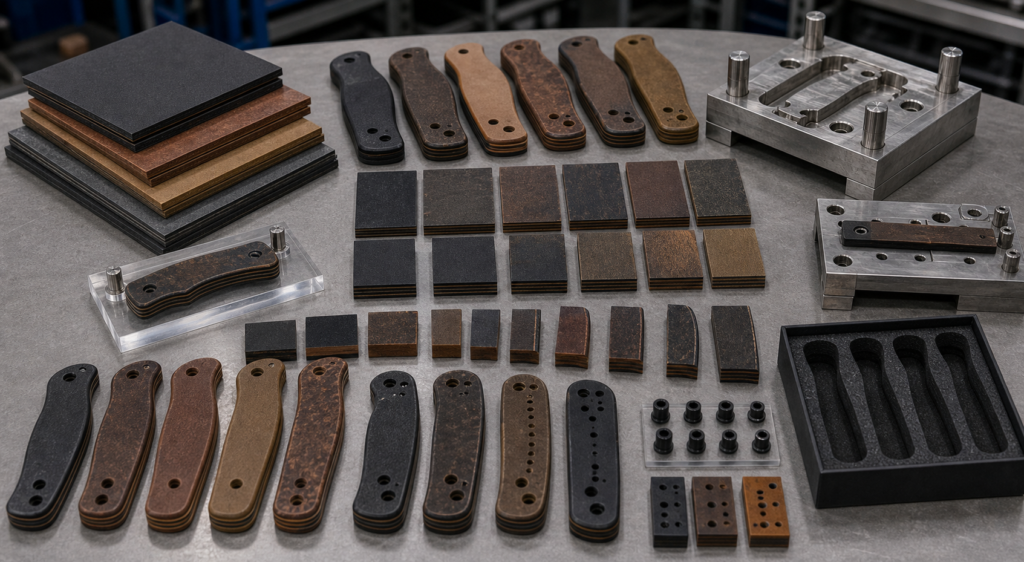
Richlite looks simple, warm, and modern. But if buyers treat it like G10, wood, or plastic, the final handle can miss expectations.
Knife buyers should evaluate Richlite knife scales by material structure, surface look, patina, machining behavior, edge comfort, screw fit, moisture resistance, sustainability documentation, cost position, and production repeatability before approving it for OEM knife projects.
Quick buyer brief:
- Answer: Richlite can be a good knife handle material when buyers want a paper-composite look, stable machining, and a warmer alternative to G10.
- Buyer context: This helps knife brands, importers, wholesalers, and private label buyers compare Richlite before sampling.
- Key checks: Confirm color, thickness, finish, patina expectation, CNC details, screw fit, cleaning, packaging, and inspection standards.
Have a knife or multi-tool project in mind?
Send your sketch, CAD file, sample photo, or product idea. Vast State can review manufacturability, suggest materials, estimate MOQ, and prepare a quote for your OEM/ODM project.
When a buyer asks me about Richlite, I do not answer with only "yes" or "no." I first ask what kind of knife they want to build. Richlite can fit an EDC knife, outdoor fixed blade, kitchen-style utility knife, or private label series with a more natural modern look. But the buyer must understand the material. Richlite is not carbon fiber. It is not glass-filled G10. It is not natural wood. It has its own feel, surface behavior, machining rules, and aging character. A good OEM result comes from matching that character to the right product level and writing the specification clearly.
What Is Richlite and Why Does It Interest Knife Buyers?
Some handle materials sound better in marketing than they feel in production. Richlite is useful, but buyers need the real material story first.
Richlite is a paper-composite sheet material made from paper infused with thermosetting resin and pressed into solid panels. Knife buyers like it because it offers a warm, machinable, stable handle option with a distinct surface look.
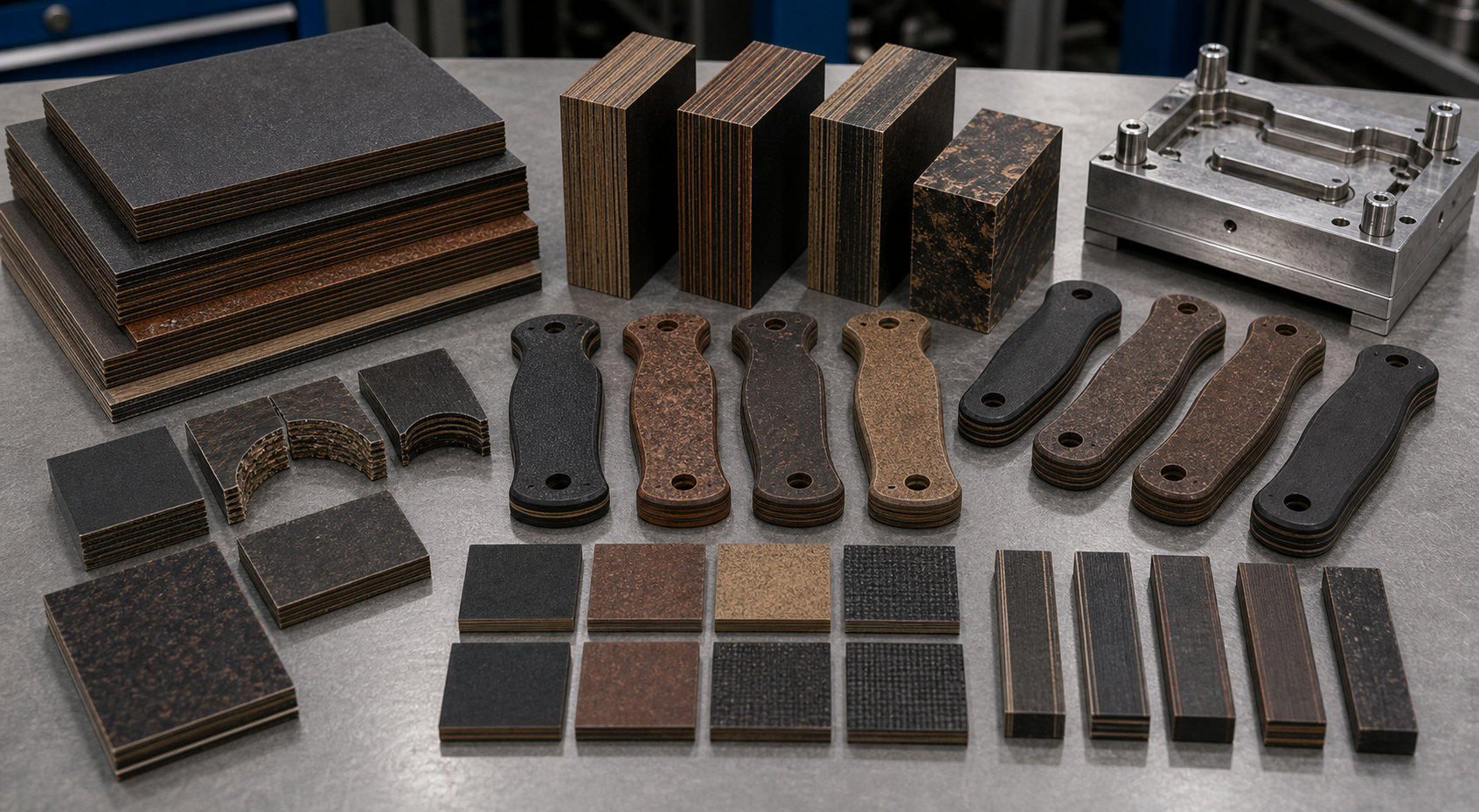
I Treat Richlite as a Paper Composite, Not a Generic Plastic
Richlite describes its material as paper infused with thermosetting resin and pressed into a solid panel. Its What is Richlite page explains that high-grade paper is infused with resin, laid up, pressed under heat and pressure, and cooled into a stable sheet. This matters for knife buyers because the handle is not molded from a soft plastic. It is cut and machined from dense sheet stock.
In practical knife development, that gives Richlite a special position. It can look warmer than G10. It can feel less cold than metal. It can support a more natural, low-sheen product style. It can also be machined into scales, chamfers, countersinks, and contours. But it still needs clear drawings and sample approval. The surface can show natural paper-fiber variation. Some colors can deepen or patina over time. The buyer should not expect every scale to look like a flat digital color chip.
For OEM work, I see Richlite as a good choice when the brand wants a story around paper-composite material, a less aggressive grip than rough G10, and a more refined look than basic plastic. The buyer should define both performance needs and appearance expectations.
| Buyer question | Practical meaning | What I check first |
|---|---|---|
| What is it made from? | Paper and thermosetting resin composite | Material source and product line |
| How does it feel? | Warm, dense, and less glassy than G10 | Surface finish and edge comfort |
| Will it repeat? | Repeatability depends on sheet, color, and machining | Sample standard and batch control |
| Is it right for my knife? | It depends on market position and function | Target user, cost, and handle design |
OEM/ODM RFQ Checklist
Prepare these details to help Vast State review your project and provide a more accurate quotation.
| RFQ Field | What to Prepare |
|---|---|
| Project type | OEM from drawing / ODM private label / wholesale catalog |
| Product category | Folding knife / fixed blade / multi-tool / outdoor tool |
| Design status | Idea / sketch / 2D drawing / 3D CAD / physical sample |
| Target price | Ex-factory target price or retail price range |
| MOQ expectation | 500 / 1,000 / 3,000 / 5,000+ pcs |
| Logo method | Laser engraving / etching / printing / molded logo |
| Packaging | Standard packaging / custom retail box / Amazon-ready |
| Market | USA / EU / Japan / Korea / Middle East / other |
| Compliance needs | Buyer-specified testing / documentation / labeling |
| Timeline | Sample deadline / mass production deadline |
What Are the Main Advantages of Richlite Knife Scales?
A good handle material should not only look different. It should help the product feel better, machine better, or sell better.
Richlite's main advantages are its warm hand feel, stable sheet form, machinability, distinct paper-composite appearance, sustainability story, color options, and ability to support clean OEM handle designs.
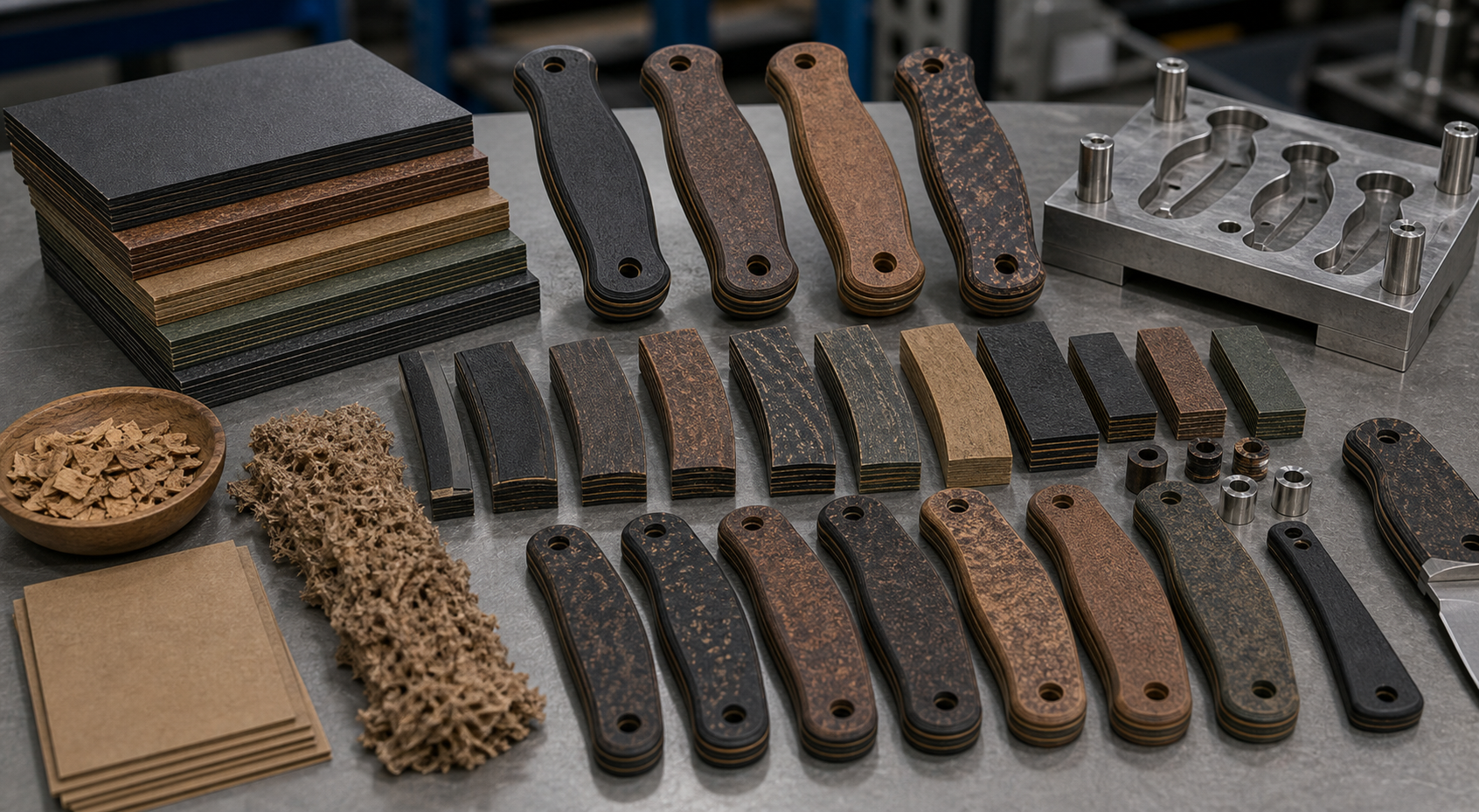
I Use Richlite When the Product Needs Warmth and Control
Richlite can give a knife a different character from G10. G10 often feels technical and strong. Richlite often feels warmer and more natural. This can help an EDC knife, outdoor knife, or lifestyle-oriented product line stand out without moving into wood variation or expensive carbon fiber. For buyers who sell to customers who like practical design with a sustainability angle, Richlite can support a cleaner brand story.
The official Richlite site also positions the material as durable, tactile, sustainable, and machinable. Its resources page lists technical data, fabrication documents, certifications, safety data, size information, and chemical-resistance resources. For a buyer, this documentation is useful because it gives the sourcing team something to request, verify, and keep with the project file. I do not treat documentation as decoration. I treat it as part of the procurement process.
From a production view, Richlite is interesting because it can be CNC cut, drilled, routed, and finished when the process is set correctly. It can work as flat scales, shaped scales, inlays, or accent material. It can also fit private label projects where the buyer wants a handle material that does not feel common. The key is to keep the design honest. Richlite is not chosen only to say "eco." It should also fit the knife structure, price range, and user experience.
| Advantage | Why it helps buyers | Production note |
|---|---|---|
| Warm appearance | Supports lifestyle and outdoor positioning | Approve color and patina expectations |
| Machinability | Allows scales, chamfers, and contours | Use sharp tools and controlled feed |
| Sheet stability | Helps handle scale repeatability | Check thickness and flatness |
| Documentation | Supports sourcing and marketing review | Request current certificates from supplier |
What Are the Main Limits and Risks of Richlite Handles?
Every material has trade-offs. If the buyer ignores them, a good sample can become a difficult production order.
Richlite risks include color variation, patina changes, possible edge damage on sharp corners, sanding marks, dust during fabrication, tool and feed sensitivity, and buyer misunderstanding of its natural surface character.
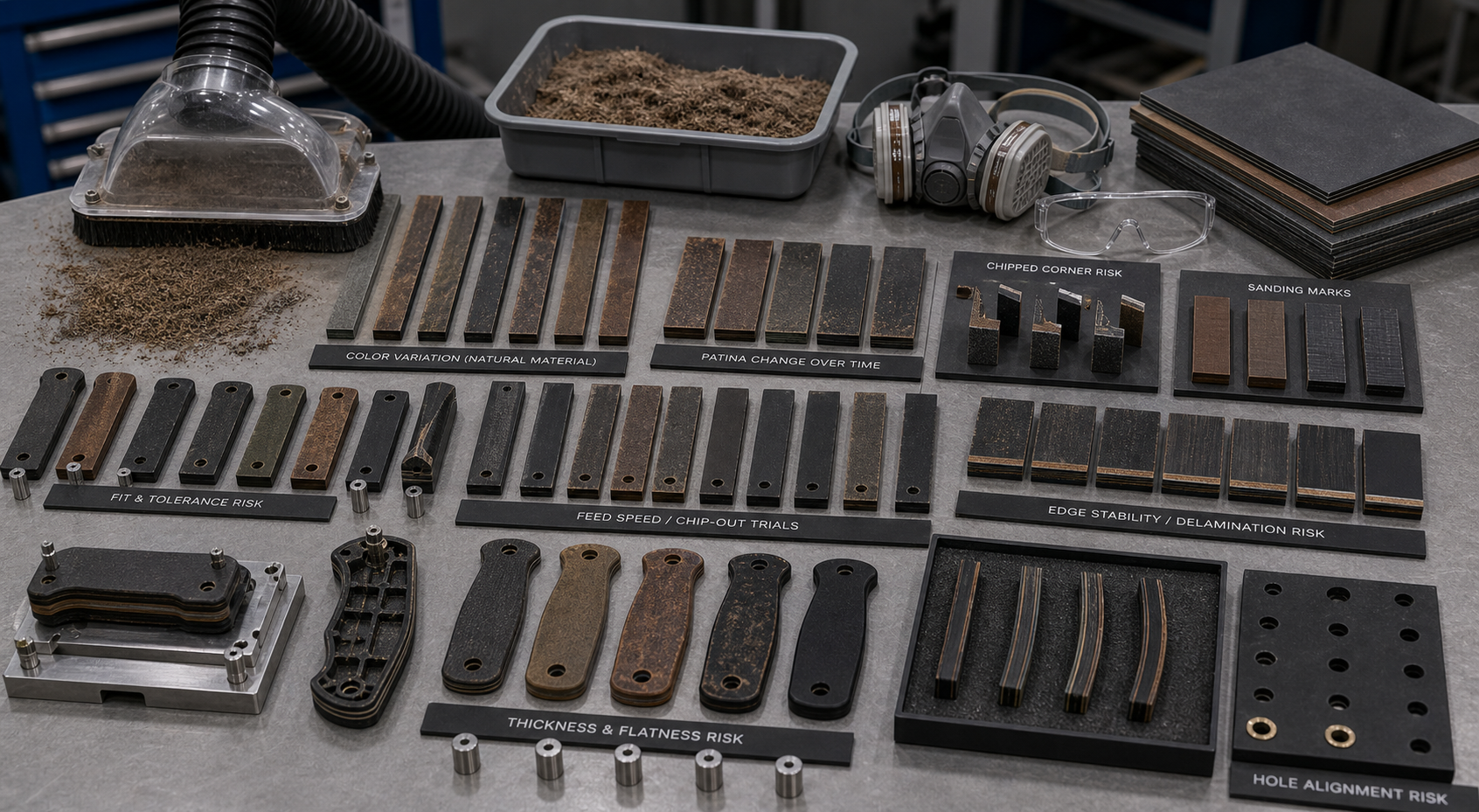
I Explain the Trade-Off Before Sampling
Richlite can be a strong material choice, but I do not oversell it. The buyer should understand that its surface can have natural variation. Some colors may deepen with use and light exposure. This can be a benefit if the buyer wants a natural patina, but it can become a complaint if the buyer expects a perfectly uniform synthetic look. Richlite's own product pages discuss patina and sheet-to-sheet variation for some colors, so the buyer should approve real samples, not only website photos.
The Richlite Fabrication Manual also gives practical warnings. It says smooth feed rates help avoid burning, sharp square edges can be prone to impact damage, and at least a small chamfer or radius is suggested. It also notes that the material can be a dusty fabrication process. These points matter for knife scales because handles have many exposed edges, screw holes, and sometimes small internal cutouts.
In an OEM knife project, I want the buyer to decide how much variation is acceptable. I also want the factory to control tool condition, feed speed, dust cleaning, and edge finishing. Richlite is not difficult when treated correctly. It becomes risky when the buyer expects it to behave like another material.
| Risk | What can happen | How I reduce it |
|---|---|---|
| Color variation | Buyer sees normal variation as defect | Approve physical samples and tolerance range |
| Sharp corners | Edges may feel fragile or uncomfortable | Add chamfer, radius, or hand-feel check |
| Burning marks | Cutting edge can discolor | Use sharp tools and steady feed |
| Dust | Surface and holes may look dirty | Use dust control and cleaning before assembly |
How Does Richlite Compare With G10, Micarta, Carbon Fiber, and Wood?
Material comparisons can get emotional fast. Buyers need a simple decision table, not a popularity contest.
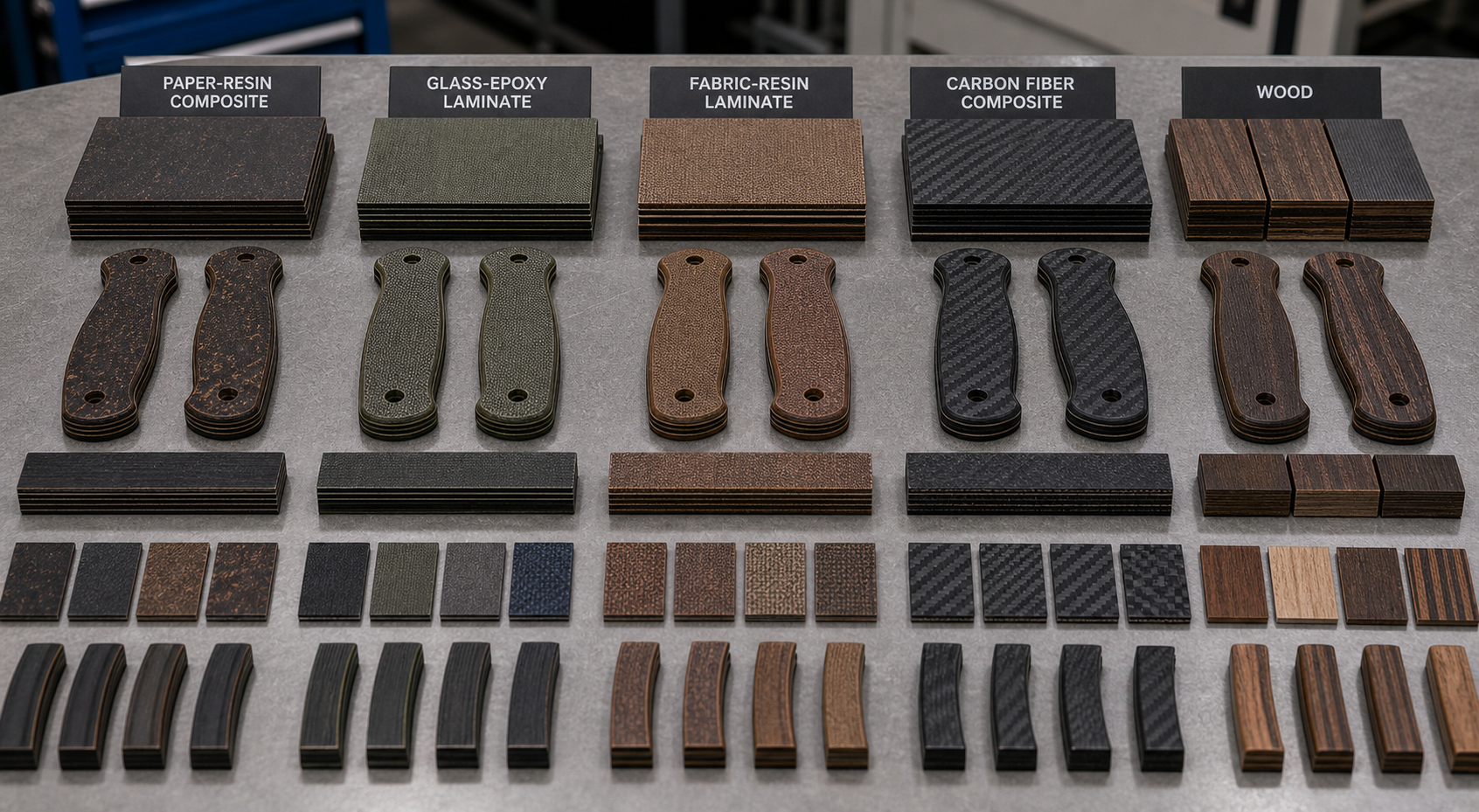
Richlite sits between technical composites and natural-looking materials. It is warmer than G10, more controlled than wood, less visually premium than carbon fiber, and related in feel to paper-based phenolic materials.
I Match the Material to the Knife's Market Position
G10, micarta, carbon fiber, wood, and Richlite can all be good choices. The question is not which material is "best." The question is which material supports the buyer's target market, retail story, production cost, and function. G10 is a glass-epoxy composite. Curbell describes G10/FR-4 glass epoxy as strong, stiff, and dimensionally stable. That makes G10 a practical choice for many working knives, especially when the buyer wants a technical grip feel.
Richlite gives a different message. It can make a handle feel more natural and design-focused. It may work better for a buyer who wants a clean paper-composite story and a warmer hand feel. Micarta can also give warmth, but its fabric base and texture can create a different look. Wood gives natural beauty, but it can vary more and may need more careful moisture and finish control. Carbon fiber gives a higher-end visual signal, but it raises cost and cosmetic expectations.
In real sourcing conversations, I usually make a material shortlist before prototyping. If the buyer sells tactical-style knives, G10 may be easier to explain. If the buyer sells refined EDC knives or outdoor lifestyle products, Richlite can be attractive. If the buyer wants a traditional natural look, wood or micarta may fit better.
| Material | Main buyer reason | Watch point |
|---|---|---|
| Richlite | Warm paper-composite look and machinability | Patina and surface variation must be accepted |
| G10 | Strong technical grip and stiffness | Glass dust and tool wear need control |
| Micarta | Outdoor feel and fabric-based texture | Color and surface variation need approval |
| Carbon fiber | High-end visual positioning | Cost and cosmetic standards rise |
| Wood | Natural story and classic appearance | Moisture, finish, and variation need control |
What Machining and Finishing Details Matter for Richlite Scales?
Richlite can machine well, but it does not forgive careless cutting. Bad feed, sharp corners, or rough sanding can show quickly.
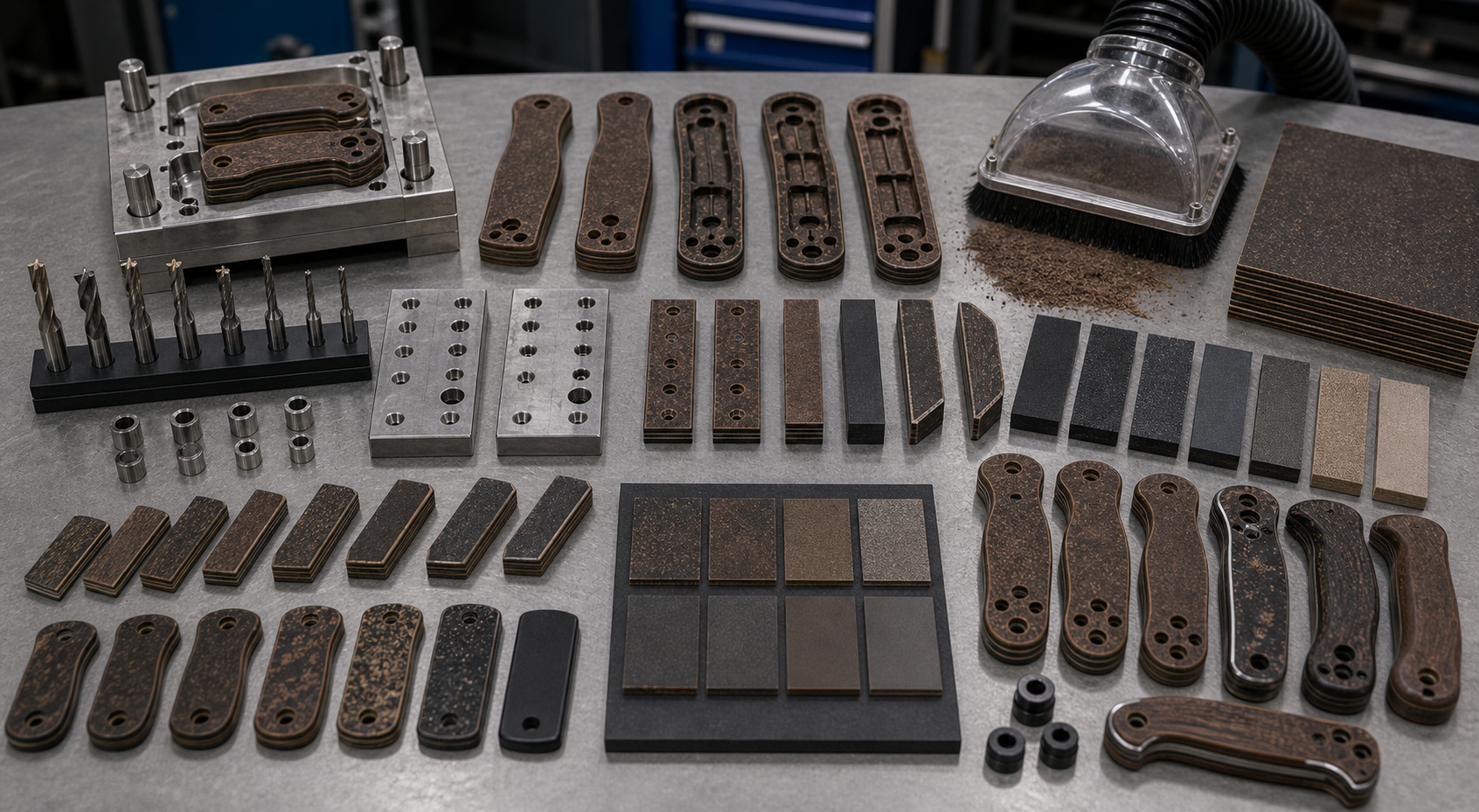
Richlite machining should control cutting speed, feed rate, tool sharpness, drilling, tapping, chamfering, sanding, dust removal, and surface finishing. Buyers should approve both fit and hand feel.
I Pay Attention to Edges, Holes, and Heat
The Richlite Fabrication Manual gives a good production mindset. It says high RPM and even feed help produce clean cuts, and an even rate of speed helps prevent burn marks. It also says sharp carbide bits and multiple passes may be needed for routing, and that CNC machining can be useful for curves and large cutouts. For knife scales, these points translate directly into edge quality, screw-hole quality, and appearance consistency.
I pay special attention to three areas. The first is the outer profile. A clean outline makes the handle look intentional and avoids uneven overhang against liners. The second is the screw and pivot area. Countersinks, clip holes, and backspacer holes need clean alignment. The third is the exposed edge. Richlite can look refined when edges are properly chamfered or rounded. But a square edge can feel harsh and may be more vulnerable to impact.
Finishing is also important. If the buyer wants a matte, satin, or factory-style surface, that should be defined. Over-sanding in one area can change the surface look. Polishing may show scratches faster in use. I usually ask buyers to approve one production-intent handle sample with the final edge treatment, not only a flat material swatch.
| Process detail | Why it matters | Buyer checkpoint |
|---|---|---|
| Cutting route | Controls outline and burn risk | Review edge cleanliness |
| Drilling and tapping | Controls screw fit and assembly | Check hole position and screw seating |
| Chamfer or radius | Controls comfort and edge durability | Approve hand feel |
| Surface finish | Controls appearance and aging | Approve final finish sample |
How Should Buyers Control Color, Patina, Texture, and Surface Expectations?
Many handle disputes are not about strength. They are about what the buyer thought the material would look like.
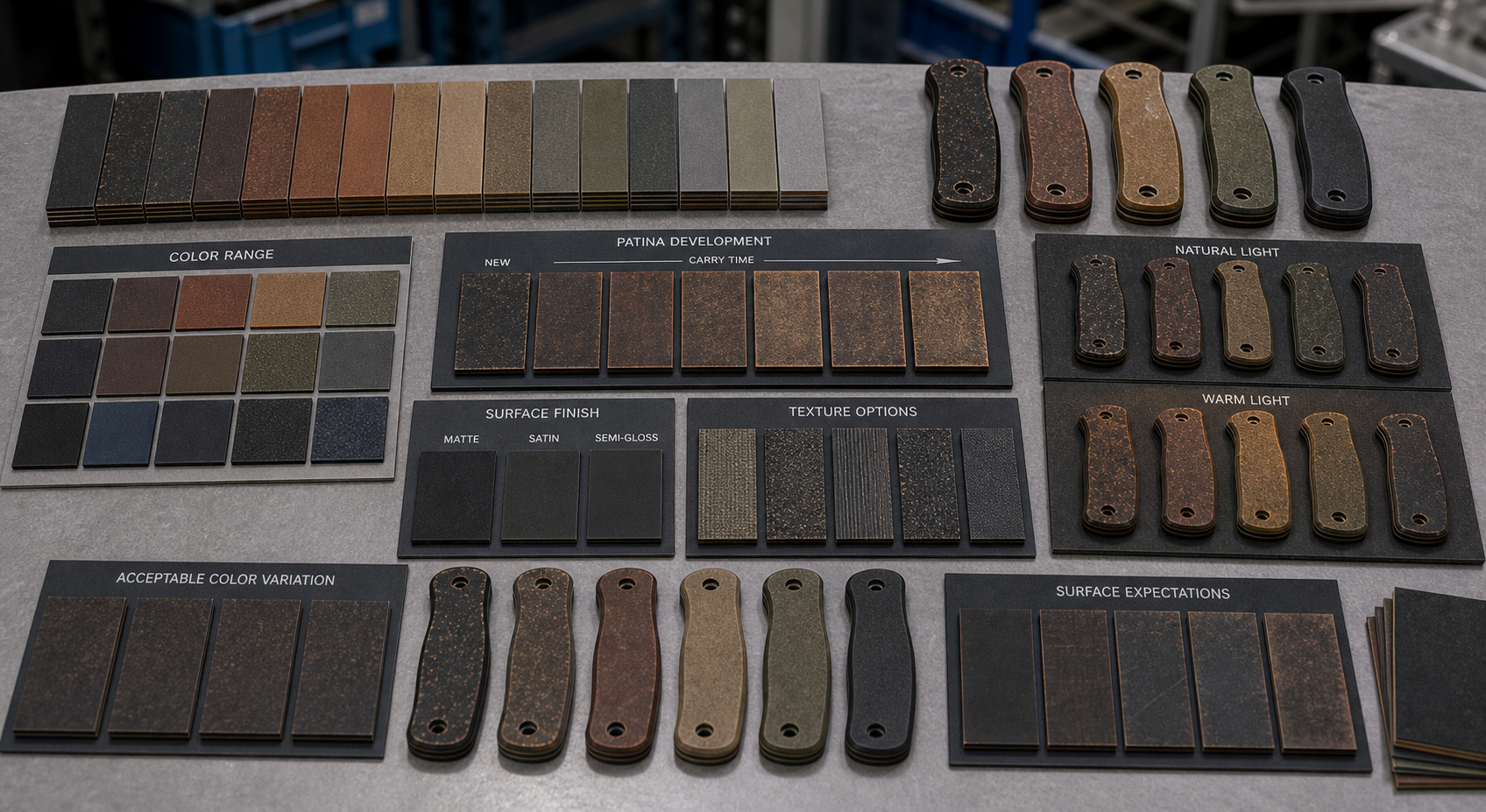
Buyers should control Richlite appearance by approving real color samples, surface finish, acceptable variation, patina expectations, grain direction, batch matching, packaging protection, and final visual inspection rules.
I Make Appearance a Specification, Not a Surprise
Richlite's appearance is part of its value. The material can have depth, warm tone, and subtle fiber pattern. But these same traits can create misunderstanding. A buyer may choose Richlite because it looks natural, then reject normal variation because the purchase order did not define what variation is acceptable. I try to prevent that before the first sample.
The buyer should approve physical material samples. The buyer should also decide whether color change over time is acceptable. Richlite's product descriptions and official pages discuss patina and natural variation for some colors. In a knife handle, this can be attractive because the handle may develop a used, more personal surface. But for a retail brand that needs every unit to look identical on a shelf, this must be discussed carefully.
Texture is another issue. Richlite can be left with a smoother finish or machined with grooves and contours. A deep texture may help grip, but it can also trap dust or change the clean look. A flat smooth scale may look refined, but it may feel less secure in wet or dirty outdoor conditions. The best choice depends on the target user, not on the material name alone.
| Appearance factor | What to define | Why it matters |
|---|---|---|
| Color | Approved sample and batch range | Prevents visual disputes |
| Patina | Whether aging is acceptable | Aligns buyer and end-user expectations |
| Texture | Smooth, grooved, contoured, or custom | Balances grip and clean appearance |
| Grain direction | Direction of visible fiber pattern | Improves consistency across pairs |
What Quality Checks Should a Supplier Apply to Richlite Knife Scales?
A Richlite scale can look good alone but fail after assembly. The supplier must inspect it as part of the whole knife.
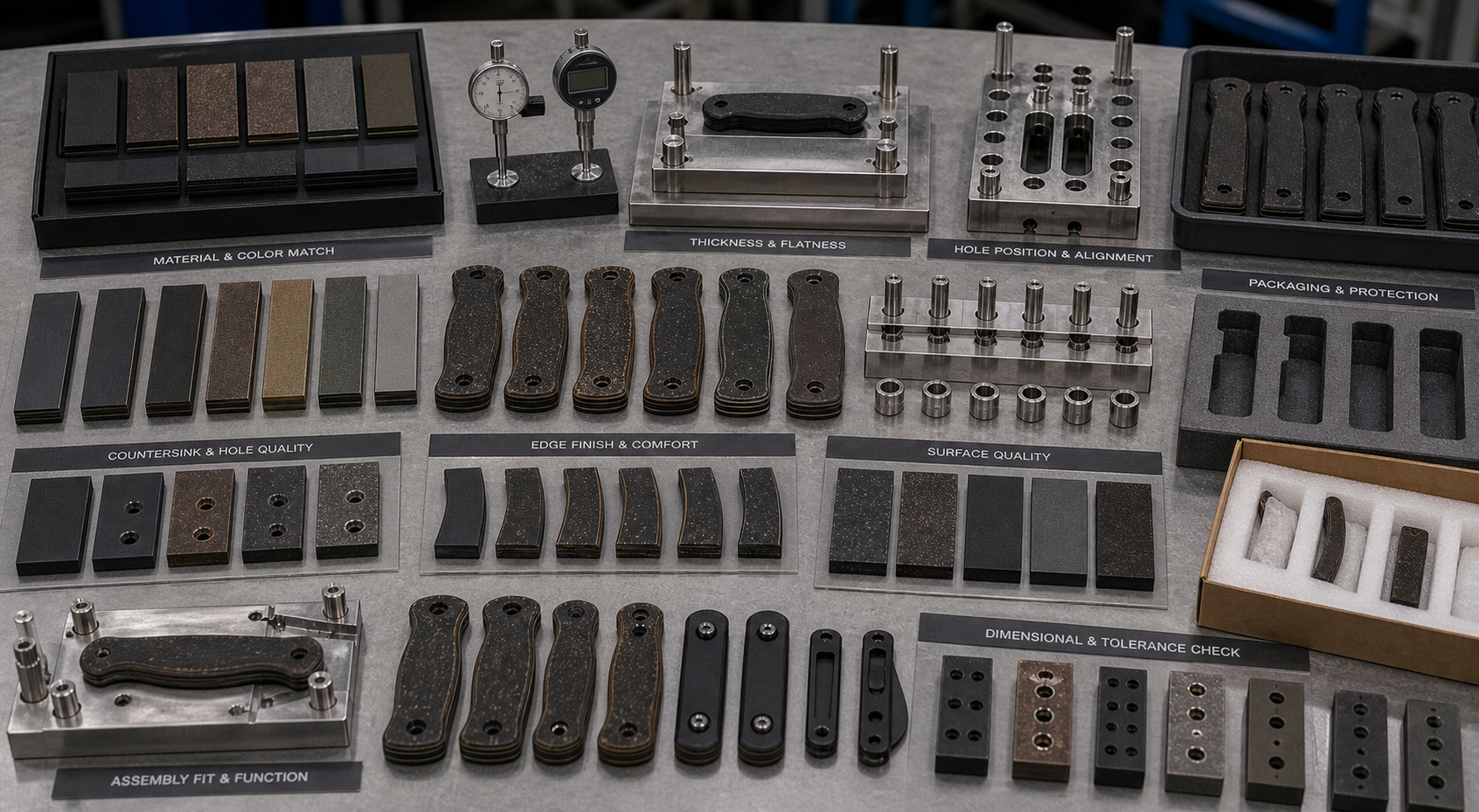
Suppliers should check Richlite scales for material match, thickness, flatness, hole position, countersink quality, edge comfort, surface finish, color consistency, dust cleaning, screw fit, and final knife function.
I Inspect the Scale, Then I Inspect the Knife
A Richlite scale is not only a decorative cover. On a folding knife, it often interacts with liners, standoffs, screws, clip hardware, pivot area, and lock geometry. On a fixed blade, it affects handle balance, pin fit, epoxy fit, edge comfort, and final grip. So the inspection should happen in layers.
First, the supplier should check incoming material. The color, thickness, surface, and sheet condition should match the approved standard. Second, the supplier should inspect machined parts. Hole position, profile, countersink, chamfer, and flatness should be checked before assembly. Third, the assembled knife should be checked. The scale should sit cleanly against the liner or tang. Screws should seat correctly. The surface should be clean. No dust should remain in grooves or holes. The handle should not have sharp hot spots.
For B2B buyers, this inspection protects repeat orders. A good sample does not matter if mass production drifts. I prefer to define a first-article check, in-process checks, and final inspection items in the purchase order or project file. This helps both sides know what "acceptable" means.
| Inspection stage | What to check | Why it matters |
|---|---|---|
| Incoming material | Color, thickness, surface, sheet condition | Prevents wrong material use |
| Machined scale | Holes, profile, countersink, chamfer, flatness | Protects assembly fit |
| Assembly | Screw seating, gaps, alignment, handle feel | Protects product function |
| Final inspection | Clean surface, packaging, pair matching | Protects retail appearance |
What Should Buyers Put in a Richlite Handle RFQ?
A vague Richlite RFQ leads to vague samples. Then the buyer pays for time, freight, and revisions that could be avoided.
A Richlite handle RFQ should include knife type, target market, quantity, target price, material color, thickness, finish, texture, contour, hardware, inspection needs, packaging, and sample approval standards.
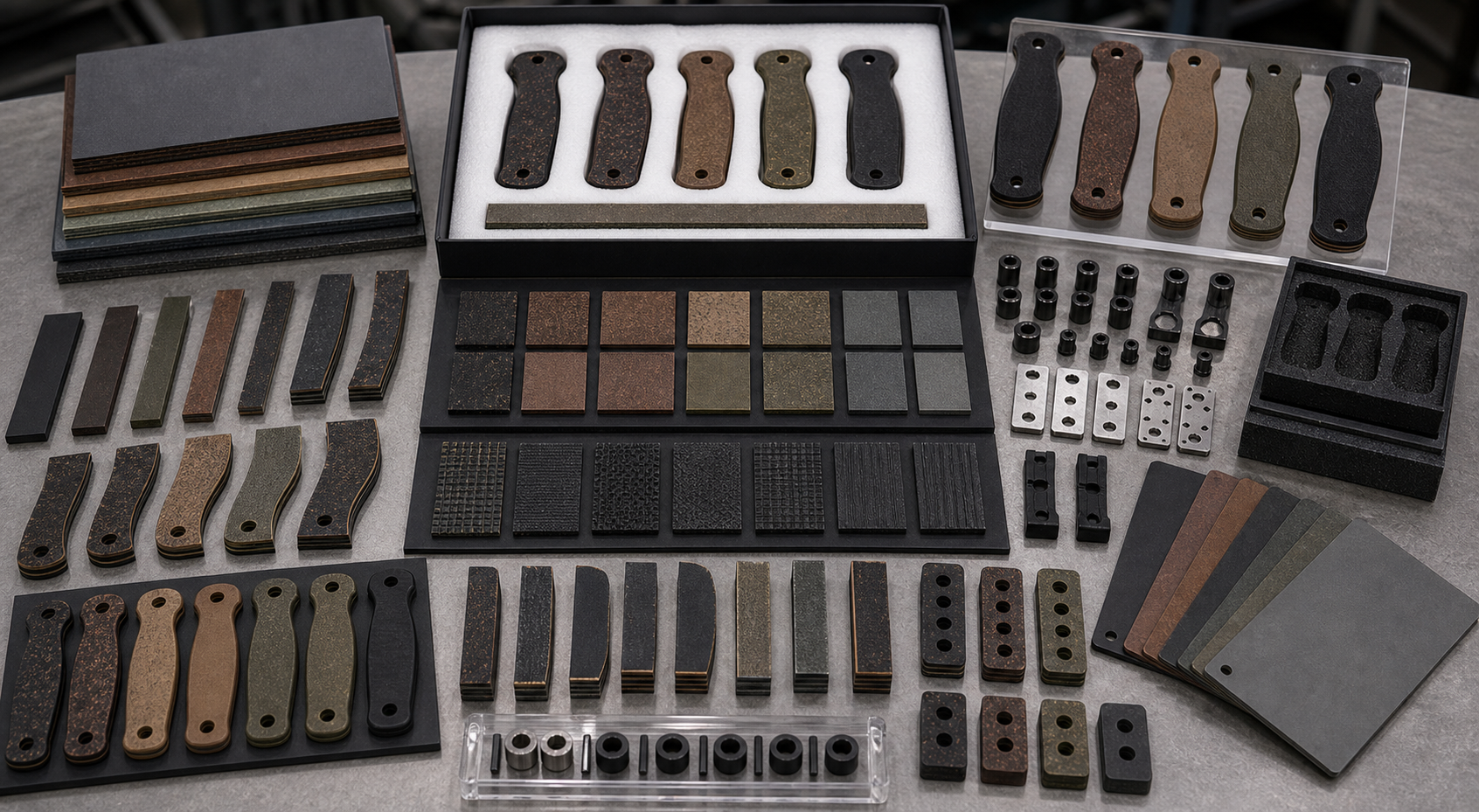
I Ask for the Whole Knife Direction
When a buyer writes "Richlite handle" in an RFQ, I still need much more information. I need the knife type, blade steel, lock structure, target market, order quantity, target price, and packaging direction. I also need to know whether the buyer wants Richlite because of appearance, sustainability documentation, hand feel, or differentiation from G10 and plastic. The reason affects the design.
The RFQ should include color, thickness, scale shape, contour, texture, hole layout, screw style, clip position, and logo method. If the buyer has an existing drawing, I can check manufacturability. If the buyer has only a concept, I can help turn it into a workable design. But I should not guess the target price or the expected handle feel.
For Richlite specifically, I suggest adding a short appearance clause. It should state that natural variation and patina are acceptable within the approved sample range, or that the buyer needs tighter visual matching. I also suggest adding an inspection clause for edge comfort, dust cleaning, screw fit, and final assembly check. This makes the sourcing conversation more practical and protects both buyer and supplier.
| RFQ field | What to provide | Why it helps |
|---|---|---|
| Product direction | Knife type, market, price range, quantity | Guides material and structure choices |
| Richlite detail | Color, thickness, finish, texture, contour | Reduces sample misunderstanding |
| Structure detail | Screws, liners, clip, pins, tang or lock | Protects fit and assembly |
| Quality standard | Sample approval, variation rule, final checks | Supports repeat production |
Turn your idea into a quote-ready knife project.
Share your drawing, sample photo, target quantity, market, and packaging needs. Vast State will review manufacturability and prepare OEM/ODM options.
Conclusion
I evaluate Richlite knife scales by matching material character, machining control, appearance expectations, inspection, and RFQ details to the buyer's real product goal.
Source Notes
- What is Richlite supports the description of Richlite as paper infused with thermosetting resin and pressed into stable panels.
- Richlite sustainability supports the discussion of FSC-certified paper, sustainability documentation, REACH-related statements, HPD, NSF, and GREENGUARD context.
- Richlite resources confirms that Richlite provides technical data, fabrication, certification, safety data, and size documents for specification review.
- Richlite Fabrication Manual supports machining, routing, chamfering, drilling, tapping, dust, and finishing guidance.
- Richlite Properties PDF provides typical density and strength context, but buyers should confirm current data for the exact material grade.
- Curbell Plastics G10/FR-4 supports the G10 comparison as a glass-epoxy composite with strong, stiff, dimensionally stable properties.