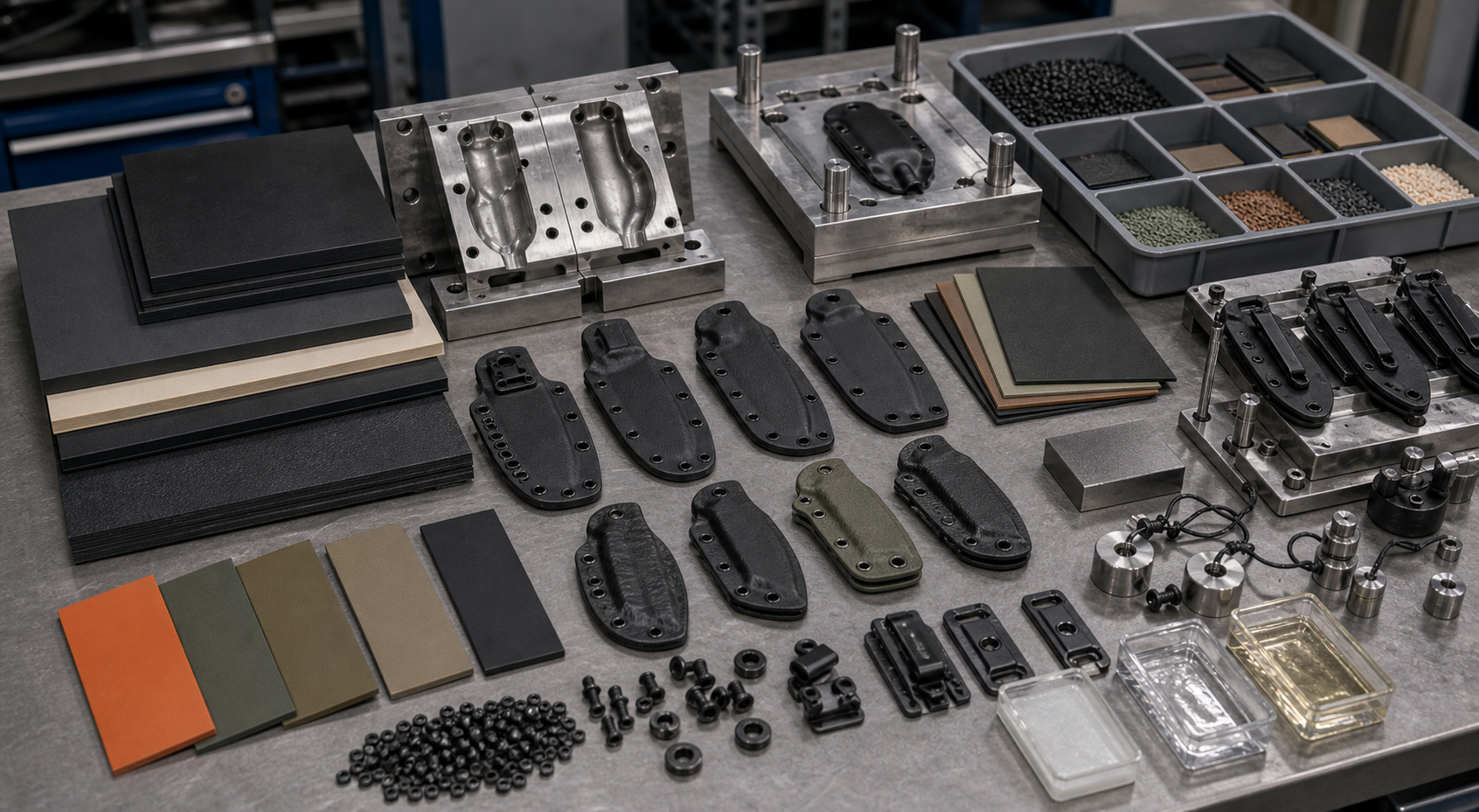
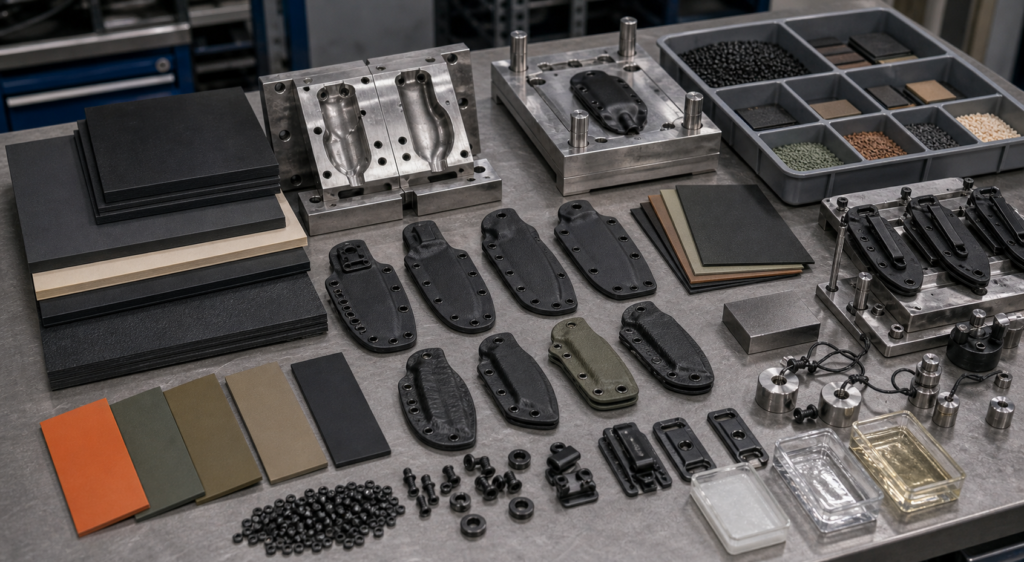
A knife sheath can fail quietly. Poor retention, weak forming, or bad fit can damage the whole product after shipment.
Boltaron and Kydex are both thermoformable sheet materials used for molded sheaths and holsters. Buyers should choose by sheath design, retention need, sheet grade, thickness, forming temperature, impact resistance, color and texture options, chemical exposure, MOQ, and QC standard.
Quick buyer brief:
- Answer: Choose the sheet grade and forming process that match the sheath design, not only the brand name.
- Buyer context: This helps knife brands, outdoor brands, private label buyers, importers, and sourcing managers specify molded sheaths.
- Key checks: Confirm blade type, sheath style, sheet thickness, texture, retention, clip system, drainage, color, forming method, packaging, and inspection standard.
Planning a fixed blade or outdoor knife project?
Share your target use, blade size, steel preference, handle direction, sheath needs, quantity range, and packaging plan. Vast State can help turn it into a quote-ready specification.
When I review a sheath project, I do not ask only whether the buyer wants Boltaron or Kydex. I ask what the sheath must do. A camping knife sheath, a tactical-style sheath, a rescue knife sheath, and a low-cost utility sheath have different needs. The material is important, but the forming process, thickness, hardware layout, retention, drainage, and quality control decide whether the sheath feels secure in real use.
What Are Boltaron and Kydex Sheath Materials?
The material names are familiar, but many RFQs still use them too loosely. A vague sheet request creates vague production results.
Boltaron and Kydex are branded thermoplastic sheet materials used for forming parts such as sheaths, holsters, aircraft interiors, vehicle interiors, and industrial components. For knives, grade, thickness, texture, and forming behavior matter more than name alone.
I Start With Sheet Grade and Sheath Function
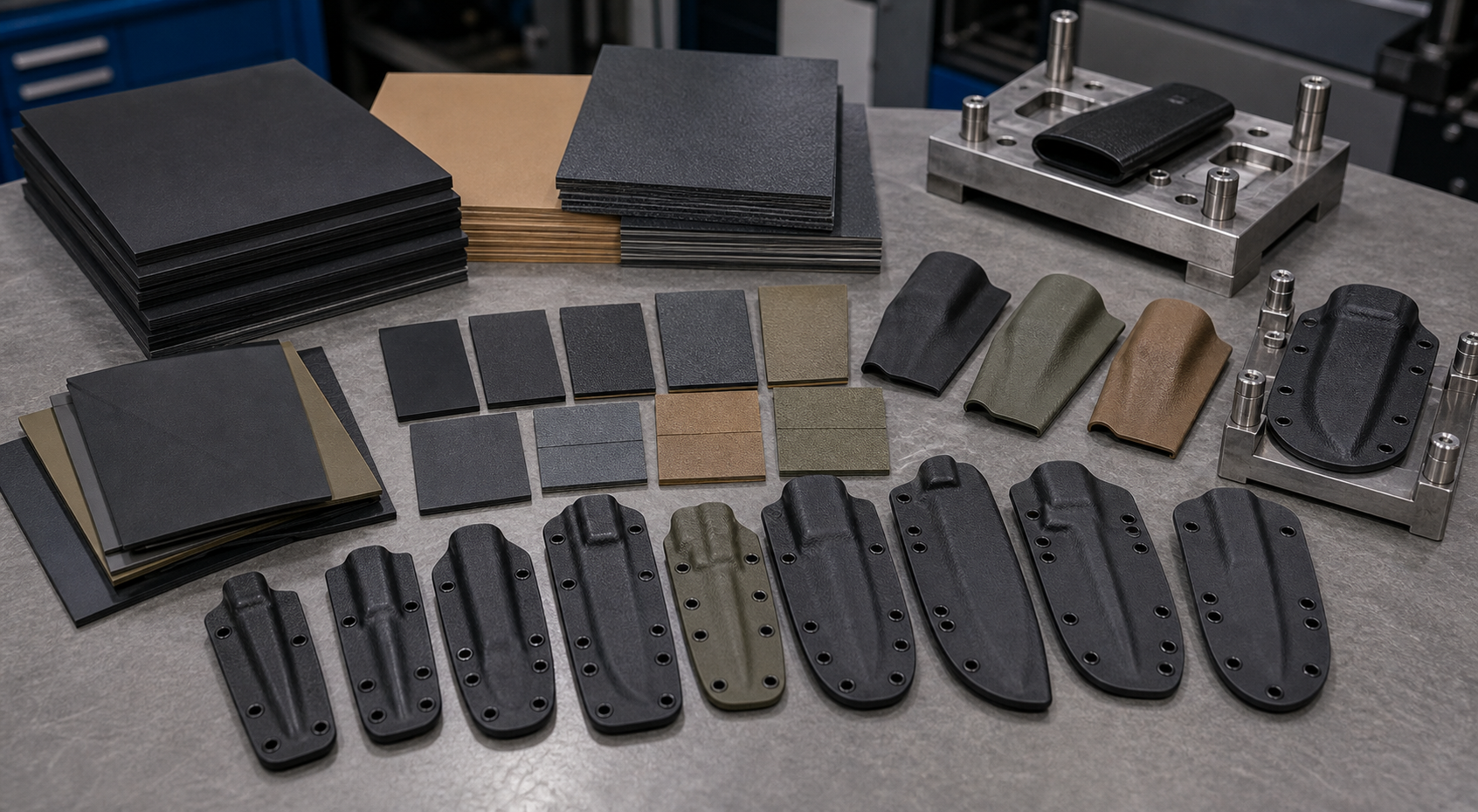
Boltaron and Kydex are both used as thermoformable sheets, but the buyer should not treat either name as a complete specification. SIMONA Boltaron says it manufactures many grades of thermoplastic material for different performance and regulatory requirements. It also lists holster mold application guidance such as thickness range, heat forming temperature, flame rating, and high impact resistance. That is useful for sheath buyers because a sheath also needs controlled forming and repeatable thickness.
SEKISUI describes Kydex thermoplastics as large plastic molding sheets used in applications where injection molding can be unsuitable because of expensive molds. It also describes Kydex brand acrylic modified vinyl chloride sheets as high performance sheets with many variations. For a B2B knife project, that means Kydex is not one fixed sheet. The grade must match the project.
The knife buyer should define the sheath first. Is it taco style or pancake style? Does it need a belt clip, Tek-Lok style mount, lanyard hole, MOLLE compatibility, drainage, thumb ramp, or secondary strap? How much retention should the user feel? Will the product sell into outdoor, EDC, tactical, hunting, rescue, or general utility channels? These questions decide the material choice more than a simple brand preference.
| Specification point | What I check | Why it matters |
|---|---|---|
| Sheet brand and grade | Boltaron grade or Kydex grade | Avoids vague material substitution |
| Thickness | Common sheath gauge range and tolerance | Controls stiffness, retention, and weight |
| Sheath style | Taco, pancake, folded, or modular | Controls forming and rivet layout |
| Hardware | Rivets, eyelets, clip, strap, mounting pattern | Controls real user fit |
OEM/ODM RFQ Checklist
Prepare these details to help Vast State review your project and provide a more accurate quotation.
| RFQ Field | What to Prepare |
|---|---|
| Project type | OEM from drawing / ODM private label / wholesale catalog |
| Product category | Folding knife / fixed blade / multi-tool / outdoor tool |
| Design status | Idea / sketch / 2D drawing / 3D CAD / physical sample |
| Target price | Ex-factory target price or retail price range |
| MOQ expectation | 500 / 1,000 / 3,000 / 5,000+ pcs |
| Logo method | Laser engraving / etching / printing / molded logo |
| Packaging | Standard packaging / custom retail box / Amazon-ready |
| Market | USA / EU / Japan / Korea / Middle East / other |
| Compliance needs | Buyer-specified testing / documentation / labeling |
| Timeline | Sample deadline / mass production deadline |
Which Material Forms and Holds Detail Better?
A sheath can look fine but still lose retention. Poor forming detail can make the blade rattle or bind.
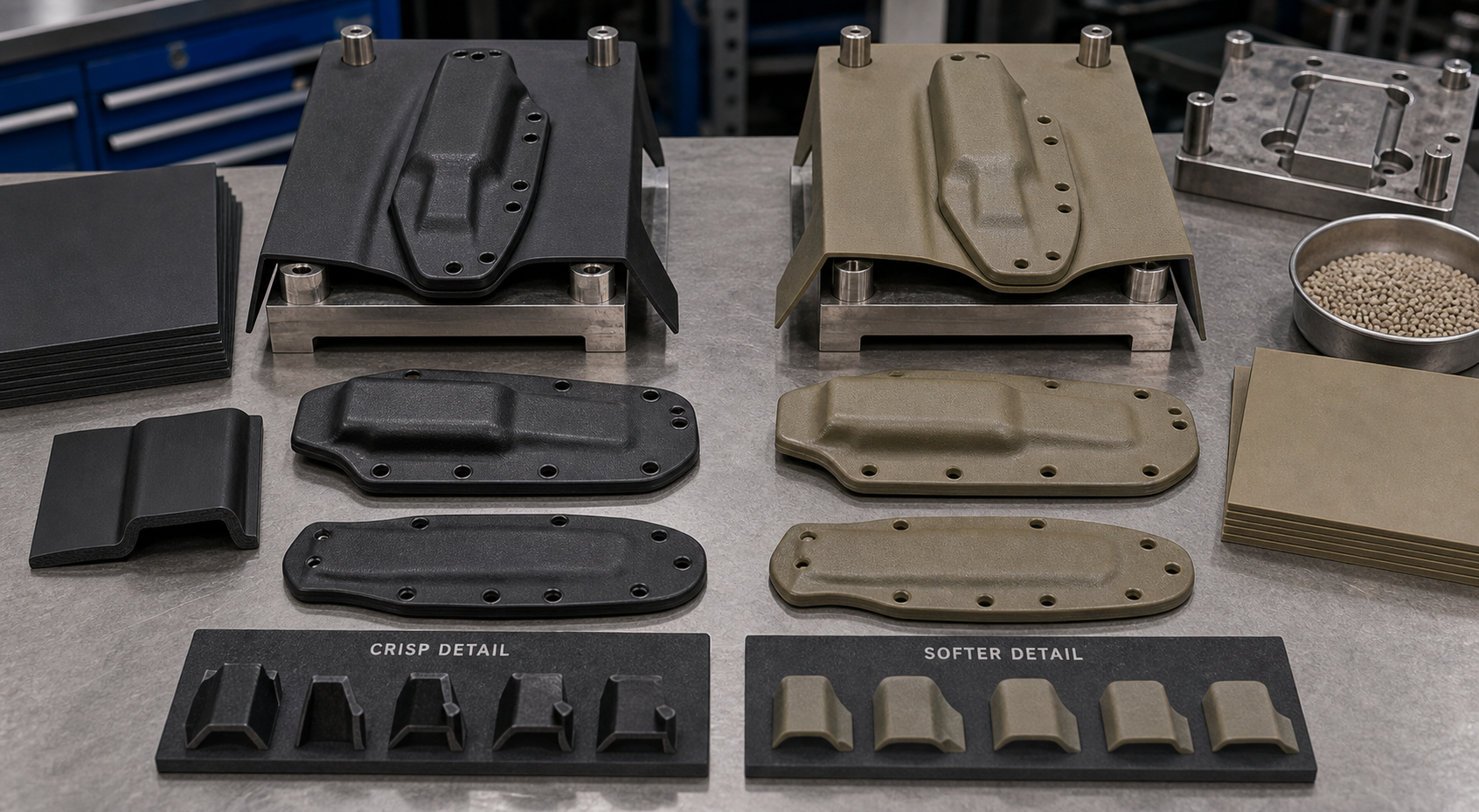
Both Boltaron and Kydex can form detailed sheaths when the grade, thickness, forming heat, mold, pressure, and cooling process are controlled. The better choice depends on the specific grade and the sheath geometry.
I Judge Forming by Retention, Not by Surface Alone
For knife sheaths, forming detail is not decoration. It creates retention, blade clearance, thumb release feel, and how the sheath rides on the belt. SIMONA Boltaron states that its high-performance thermoplastic sheets are engineered for precision mold forming and vacuum forming, and its holster page highlights high impact resistance, easy heat forming, mold retention, and consistent thickness. Those points are directly relevant to formed sheaths.
Kydex also has strong forming support. SEKISUI KYDEX describes Kydex 100 as a high-impact, fire-rated alloy sheet with formability, rigidity, breakage resistance, chemical resistance, and fire retardancy. Its product page also mentions uniform wall thickness and crisp detail. For buyers, this means Kydex can be a serious formed sheath material when the right grade is selected.
The real production question is how the sheet behaves around the blade profile. A thick spine, guard, thumb ramp, finger groove, or exposed tang can make forming more difficult. Too little detail creates loose retention. Too much detail can make draw and re-sheathing uncomfortable. I prefer to tune the mold with sample blades before mass production. I also check whether the sheath scratches the blade finish or contacts the edge in the wrong place.
| Forming factor | Buyer concern | Practical control |
|---|---|---|
| Mold detail | Retention and release feel | Test multiple sample pulls |
| Sheet thickness | Stiffness and snap feel | Match gauge to blade size |
| Cooling process | Shape memory and warpage | Control cooling after forming |
| Blade clearance | Avoid blade rub and rattle | Check inside contact points |
How Should Buyers Compare Retention, Fit, and Safety?
A sheath is not only packaging for the blade. If it does not hold the knife correctly, users lose trust quickly.
Buyers should compare retention force, draw angle, blade clearance, mouth opening, drainage, belt attachment, screw or rivet layout, and whether the sheath protects the edge without creating rattle or unsafe tightness.
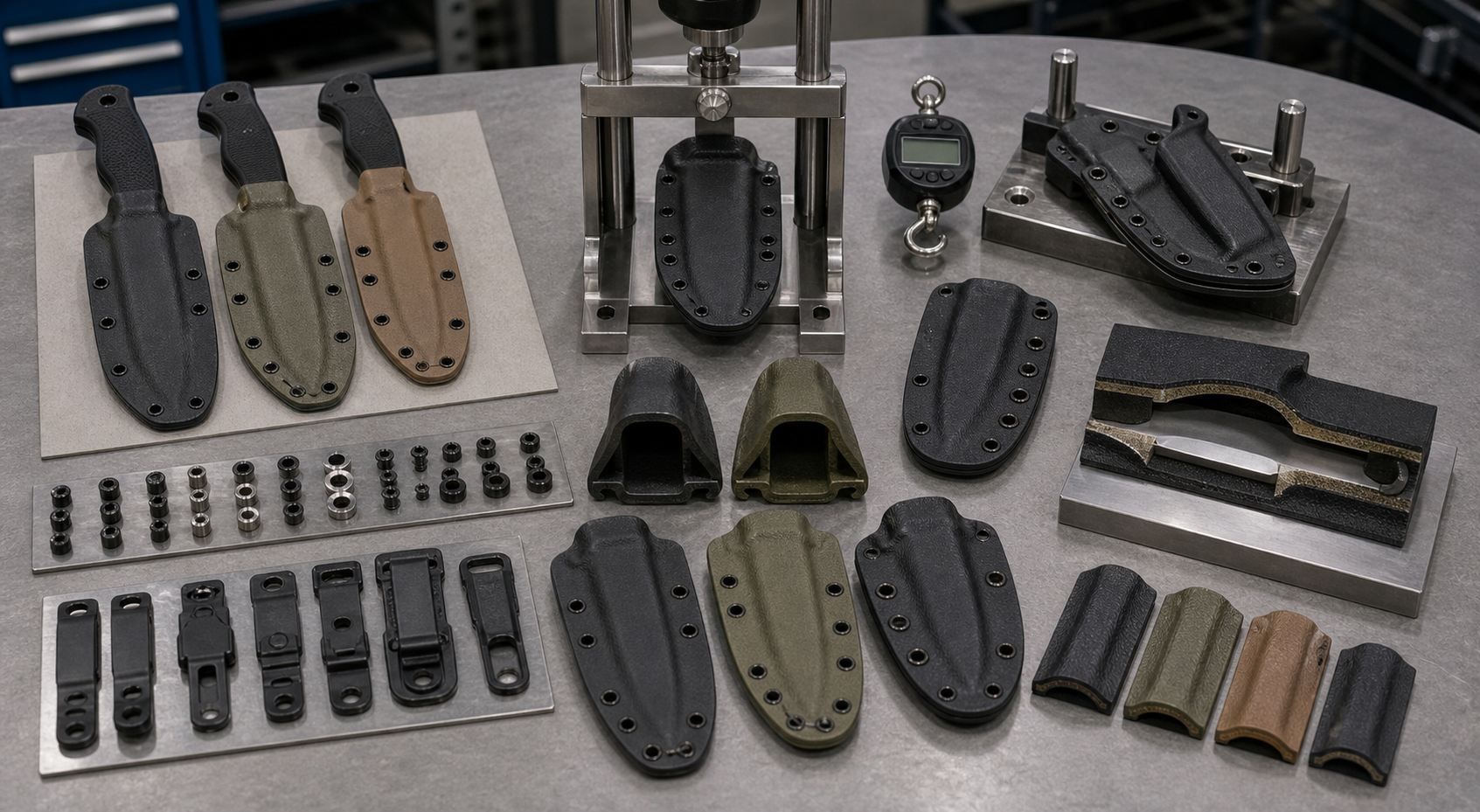
I Test the Sheath as a Product, Not as a Sheet
The buyer should not approve a sheath only because the material is known. A famous sheet name cannot fix a poor sheath design. Retention comes from geometry, pressure, forming detail, rivet placement, blade shape, and hardware layout. The user should be able to insert the knife smoothly, feel secure retention, and draw it without unsafe force.
For fixed blade knives, I check the mouth area first. The opening should guide the knife into the sheath without catching the edge or point. Then I check the blade channel. The inside should not scrape the blade finish heavily or contact the sharpened edge in a way that creates wear. Next I check the retention area. Some designs retain around the handle, some around the guard, and some around blade geometry. The right method depends on the knife.
For belt or outdoor carry, the attachment system matters. Eyelet spacing, screw strength, belt clip orientation, belt loop size, and modular hole pattern should match the buyer's market. A sheath for a camping knife may need drainage and easy cleaning. A rescue or tactical-style product may need more carry options. A value utility sheath may need simple and stable production.
I always tell buyers to approve a complete sheath sample with the real knife, not only with a drawing. Small changes in blade thickness, handle contour, or coating can change the fit.
| Fit point | What can go wrong | What I inspect |
|---|---|---|
| Retention | Too loose or too tight | Pull feel and repeat draw test |
| Blade clearance | Rattle or blade rub | Inside channel and edge contact |
| Mouth opening | Difficult insertion | Entry shape and thumb area |
| Belt attachment | Weak carry experience | Clip, loop, rivets, and screw fit |
How Do Heat, Cold, Chemicals, and Cleaning Affect Sheath Choice?
Outdoor products meet heat, cold, sweat, dirt, and cleaning agents. A sheath material must match the real environment.
Boltaron and Kydex grades can offer impact resistance, chemical resistance, heat forming performance, and cleaning resistance, but buyers should compare exact grade data and test the finished sheath under target use conditions.
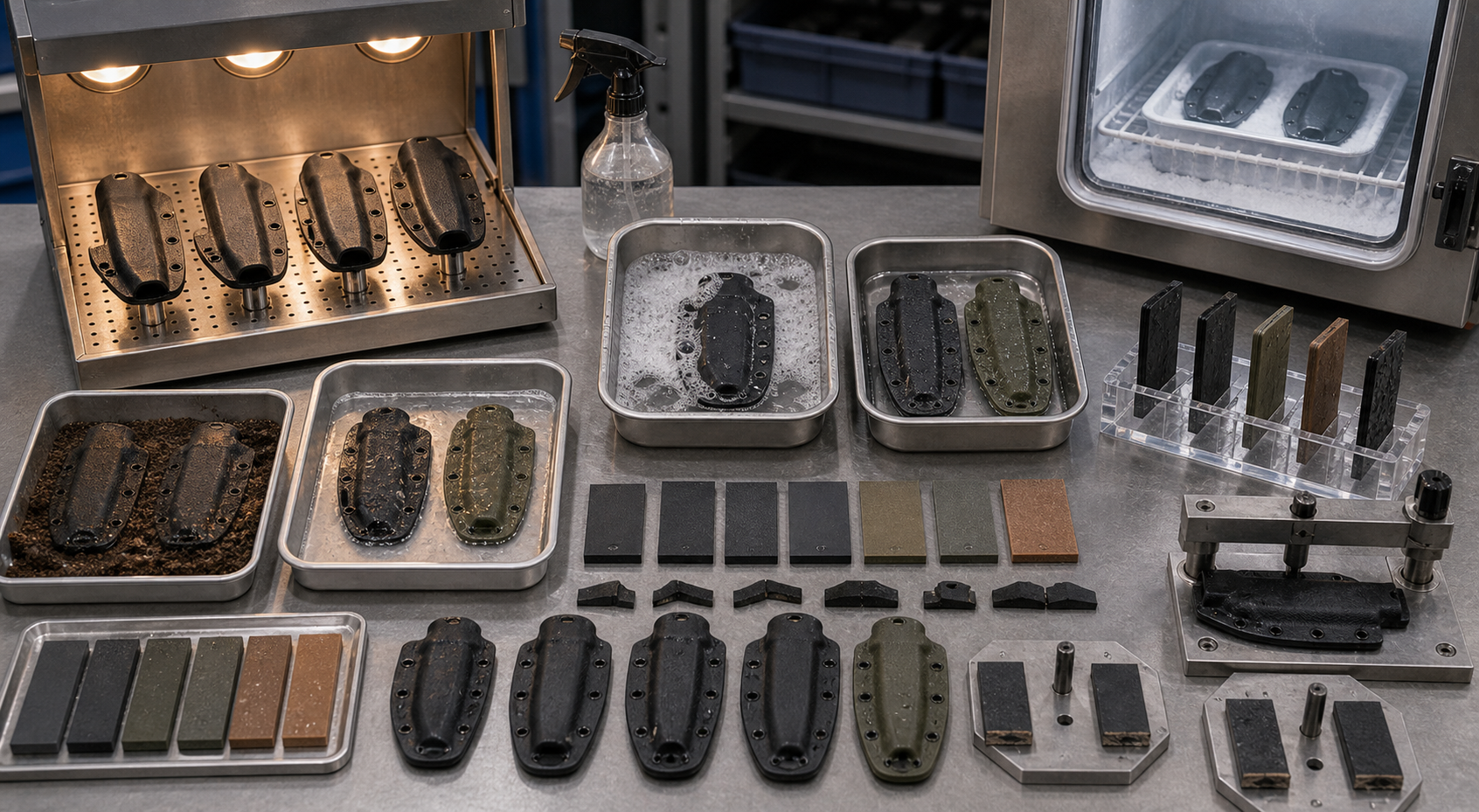
I Do Not Turn Grade Claims Into Finished Product Guarantees
SIMONA Boltaron's holster page describes holster grade Boltaron 4332 with impact, chemical and abrasion resistance, flame test ratings, and performance in cold end-use conditions. It also describes forming and fabrication consistency. These are useful material signals for buyers who need robust sheaths. But I still ask for grade confirmation and finished sheath testing because the final result depends on thickness, forming, design, and hardware.
SEKISUI KYDEX describes Kydex T as less hygroscopic than FR-ABS, typically not requiring pre-drying, and offering impact strength, more uniform forming with less wall thinning, and resistance to cleaning solutions. It also lists color, texture, thickness, rigidity, and forming characteristics. These points are useful when buyers need sheath consistency and production control.
The important word is "grade." Kydex 100, Kydex T, Boltaron 4332, and other grades are not identical. Buyers should not assume that every sheet with a familiar brand name performs the same. The RFQ should ask for the exact grade, sheet thickness, forming temperature range, and supplier recommendation for the intended sheath use.
I also ask about the market. A knife that may sit inside a hot vehicle, be used near saltwater, or be cleaned often has different needs from a simple indoor utility knife. The sheath should be tested for retention after heat exposure, cold exposure, cleaning, and repeated draw cycles when the target market needs that confidence.
| Environment | Buyer question | Practical test |
|---|---|---|
| Heat | Will the sheath deform or loosen? | Retention after controlled heat exposure |
| Cold | Will it crack or lose toughness? | Draw and flex check after cold exposure |
| Chemicals | Will cleaners or oils affect the surface? | Wipe and visual check |
| Dirt and water | Will debris collect inside? | Drainage and cleaning check |
What Color, Texture, and Branding Options Matter for Private Label Sheaths?
Many buyers focus only on black sheaths. That can be safe, but it may miss a brand opportunity.
Color, texture, print, rivet color, clip style, logo method, packaging, and sheath finish can help private label buyers build a clearer product line when the material supplier and MOQ support it.
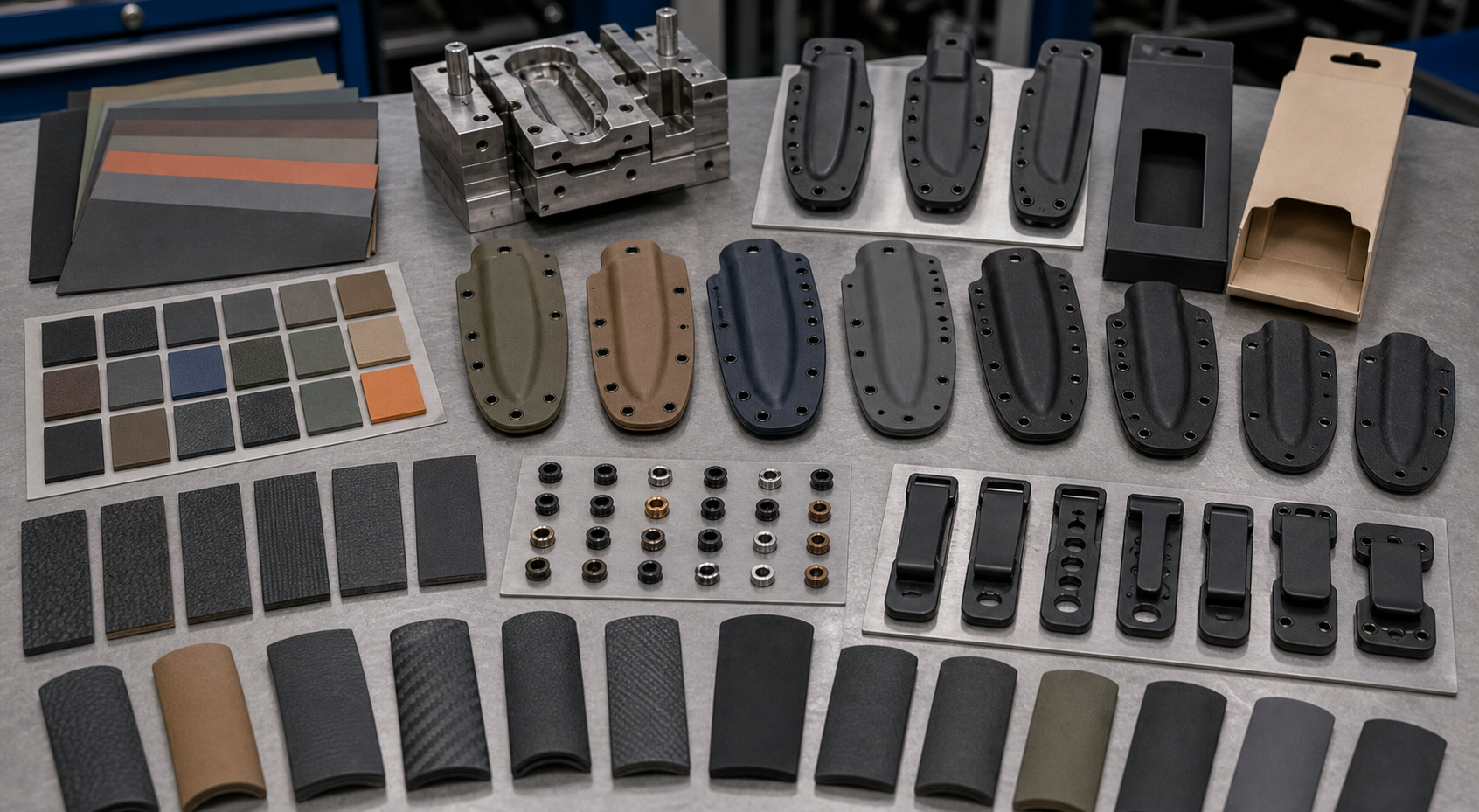
I Connect Sheath Design With the Knife Line
The sheath is often the first thing a buyer's customer touches after opening the box. It should not feel like an afterthought. A black haircell texture sheath is practical and familiar, but not every product needs to be plain black. SIMONA Boltaron states that it offers many colors, textures, and design effects, and its holster page lists options such as carbon fiber texture, translucent, two-tone color, metallic, dual-sided texture, decorative print, and other texture choices. This gives private label buyers more design freedom when MOQ and availability fit.
Kydex also offers broad aesthetic options depending on grade and distributor availability. Kydex 100 and Kydex T pages mention colors, textures, thicknesses, and sheet sizes. For knife buyers, the useful point is that color and texture should be part of the product plan, not an afterthought after the sheath mold is approved.
Branding can be simple. A buyer can use color matching, rivet color, clip style, packaging label, sleeve, hang tag, or a small logo mark. But the method must be chosen carefully. Some logo methods may affect retention, surface finish, or production cost. A deep mark in the wrong place can weaken the look or collect dirt.
I suggest that buyers build a sheath standard for each product tier. A value line may use standard black sheet and simple rivets. A premium outdoor line may use earth-tone texture, stronger clip hardware, and protective packaging. A rescue line may use high-visibility color or special attachment needs.
| Design option | Buyer benefit | Production concern |
|---|---|---|
| Color sheet | Clear brand or market signal | MOQ and color consistency |
| Texture | Grip, scratch hiding, visual style | Retention and cleaning feel |
| Printed or specialty effect | Strong shelf appeal | Cost and repeat availability |
| Hardware finish | Better complete-product look | Screw, rivet, and clip sourcing |
What Quality Checks Should Buyers Use Before Mass Production?
A formed sheath can pass a quick visual check but still fail in real use. QC must test fit and repeatability.
Buyers should inspect sheet identity, thickness, color, texture, forming detail, retention, blade clearance, rivet setting, clip strength, drainage, edge finishing, packing protection, and consistency across production samples.
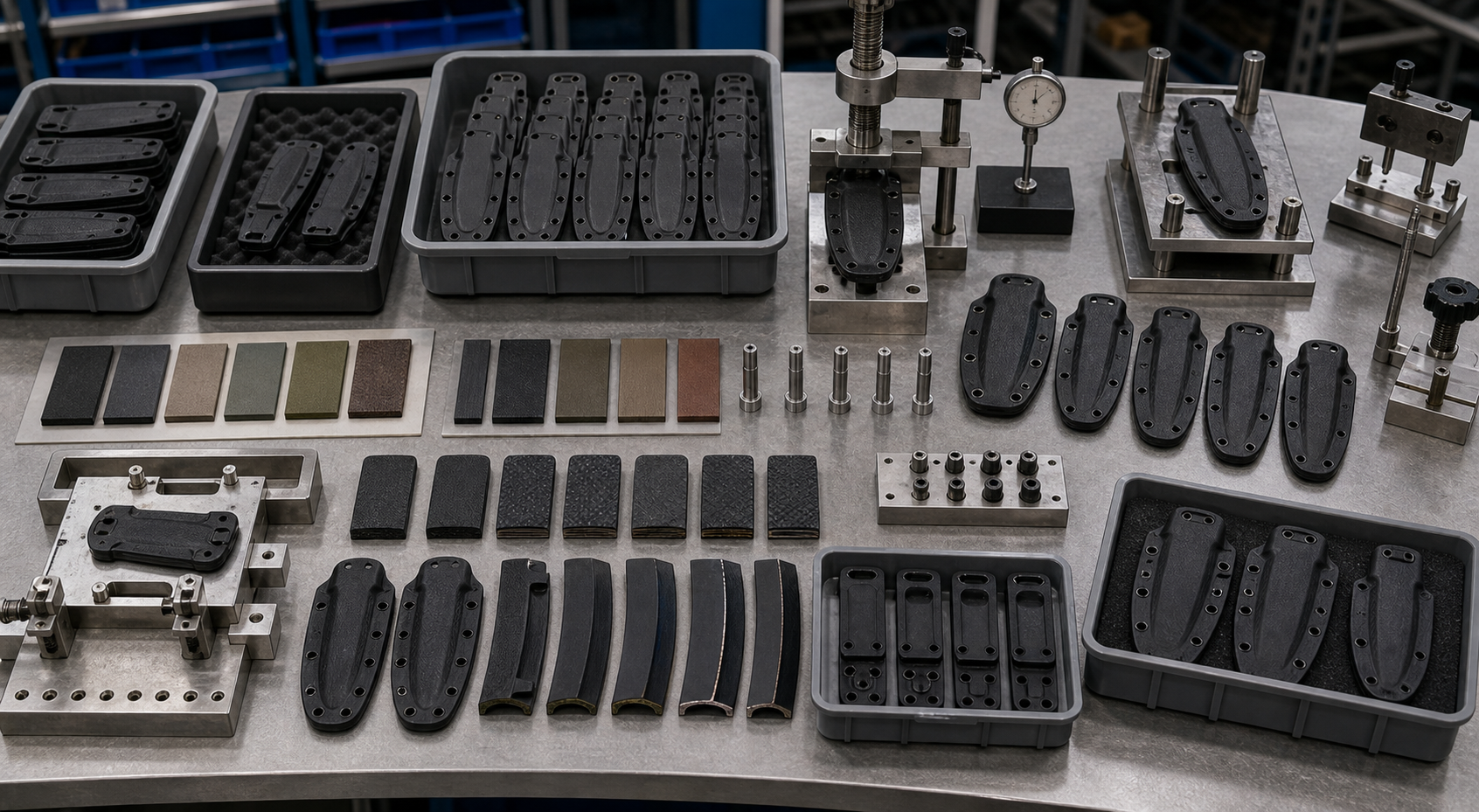
I Make the Sheath QC Standard Separate From Knife QC
The sheath needs its own inspection standard. ISO explains that ISO 9001 supports process clarity, customer needs, variation control, performance data, and evidence-based improvement. I use that thinking for sheath production. A sheath has material, forming, hardware, fit, and packaging risks that are different from blade or handle risks.
The first check is material identity. The buyer should know the sheet brand, grade, thickness, color, and texture. The second check is forming quality. The sheath should have clean detail, stable shape, no unwanted warpage, no burned surface, and no weak thin areas. The third check is functional fit. The knife should seat safely, draw smoothly, and hold securely through repeated use.
Hardware also needs attention. Eyelets or rivets should be set cleanly. Screws should not strip. Belt clips should match the carry angle and belt size. Edges should be smooth enough for user comfort. Drainage holes should work if the product is for outdoor or wet use.
Finally, packaging must protect the sheath. A textured sheath can scratch other parts in the box if packed loosely. A premium sheath should arrive clean, flat, and ready for retail display. For B2B buyers, this protects repeat orders and reduces after-sale complaints.
| QC area | What to inspect | Why it protects the order |
|---|---|---|
| Sheet identity | Brand, grade, thickness, color | Prevents material substitution |
| Forming quality | Detail, shape, warpage, thin spots | Protects retention and appearance |
| Functional fit | Draw, retention, blade clearance | Protects user experience |
| Hardware and packing | Rivets, screws, clips, box protection | Protects shipment consistency |
How Should Buyers Prepare an RFQ for Boltaron or Kydex Sheaths?
If the buyer only says "Kydex sheath," the supplier must guess. Guessing creates cost errors and sample delays.
A strong sheath RFQ should include knife drawings, blade thickness, sheath style, material preference, sheet thickness, retention target, hardware, carry method, color, texture, logo, packaging, test needs, MOQ, and target price.
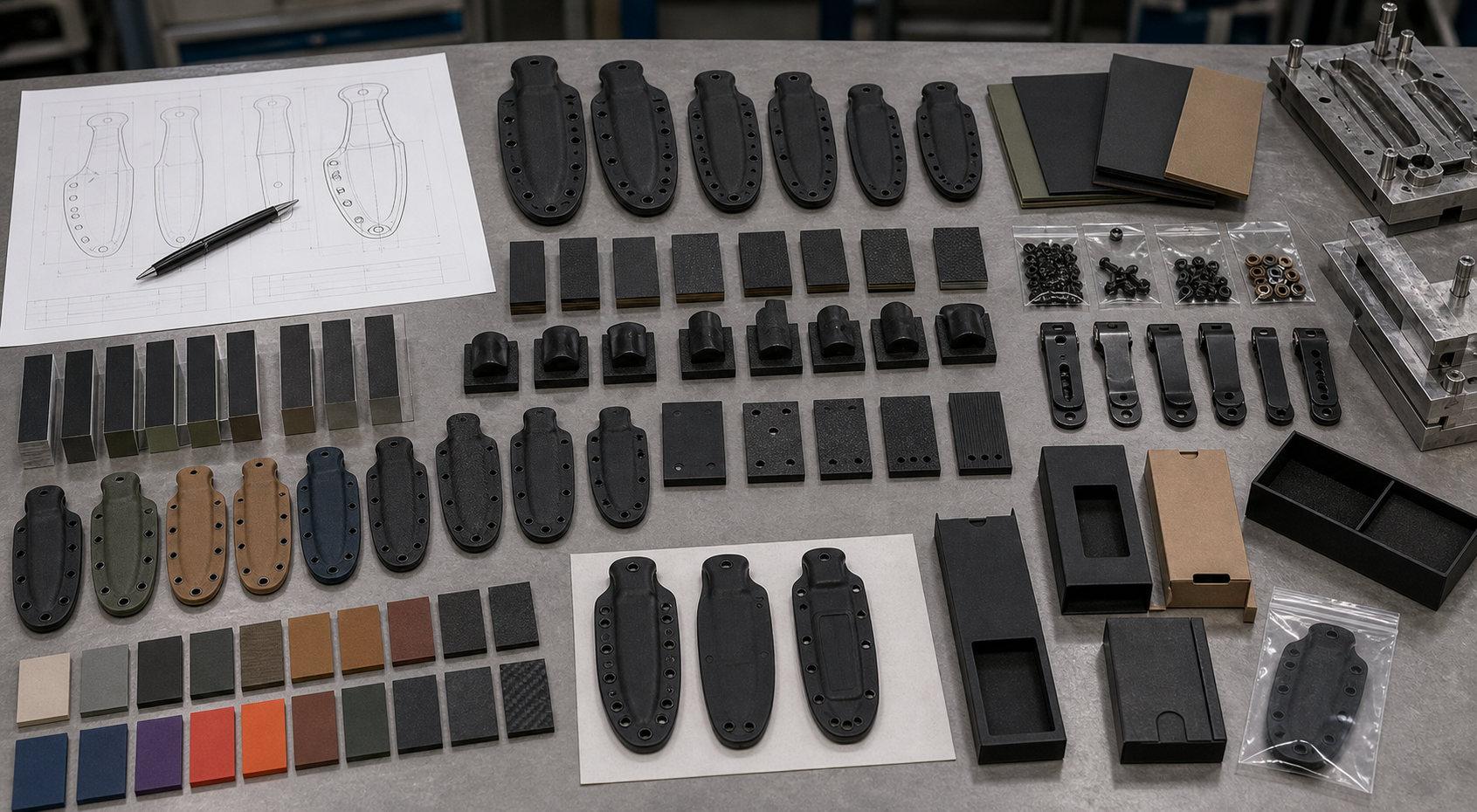
I Ask for the Knife and the Carry Plan Together
The sheath cannot be quoted correctly without the knife. A small change in blade thickness, tip shape, handle guard, coating, or handle contour can change retention and fit. That is why I ask buyers for a drawing, 3D file, physical sample, or at least clear reference photos before confirming the sheath route.
The RFQ should define the sheath style. Taco-style sheaths, pancake-style sheaths, folded sheaths, modular sheaths, and simple blade guards have different material usage and labor needs. The buyer should also define the carry method. Belt clip, belt loop, neck carry, MOLLE mount, pocket clip, and display packaging all change the hardware and hole pattern.
Material preference should be clear but flexible. If the buyer says Boltaron or Kydex, I will still ask which grade, thickness, color, texture, forming standard, and target use. If the buyer is not sure, I can suggest samples. The best RFQ includes target market and price because the sheath must match the knife's retail position.
I also ask buyers to approve samples in stages. First, approve the sheet color and texture. Second, approve the formed sheath with the real knife. Third, approve the full packed product. This order finds problems before mass production and keeps the launch smoother.
| RFQ field | Why I need it | Example decision |
|---|---|---|
| Knife drawing or sample | Controls retention and fit | Blade thickness and guard shape |
| Sheath style | Controls material use and labor | Taco or pancake construction |
| Carry method | Controls hardware layout | Belt clip, loop, MOLLE, or neck carry |
| Test standard | Controls QC and risk | Draw test, heat check, packing check |
Turn this article into a fixed blade project.
Send your target use, blade size, steel, handle direction, sheath needs, quantity, and packaging plan. Vast State can help shape it into a quote-ready project.
Conclusion
I choose Boltaron or Kydex by grade, forming behavior, retention, hardware, color, and QC standard, not by brand name alone.
Source Notes
- SIMONA Boltaron materials supports the discussion of thermoplastic grades, color and texture options, holster mold applications, thickness range, forming temperature, and impact resistance.
- SIMONA Boltaron holsters supports the sheath and holster discussion around impact resistance, heat forming, mold retention, consistent thickness, design options, and fabrication.
- SEKISUI Kydex thermoplastics supports the explanation of Kydex as plastic molding sheets used where expensive injection molds may be unsuitable.
- SEKISUI KYDEX 100 supports the discussion of formability, rigidity, breakage resistance, chemical resistance, sheet options, and crisp detail.
- SEKISUI KYDEX T supports the discussion of impact strength, low hygroscopic behavior, uniform forming, chemical resistance, colors, textures, and thickness options.
- ISO 9001 explained supports the process-control and evidence-based QC approach.