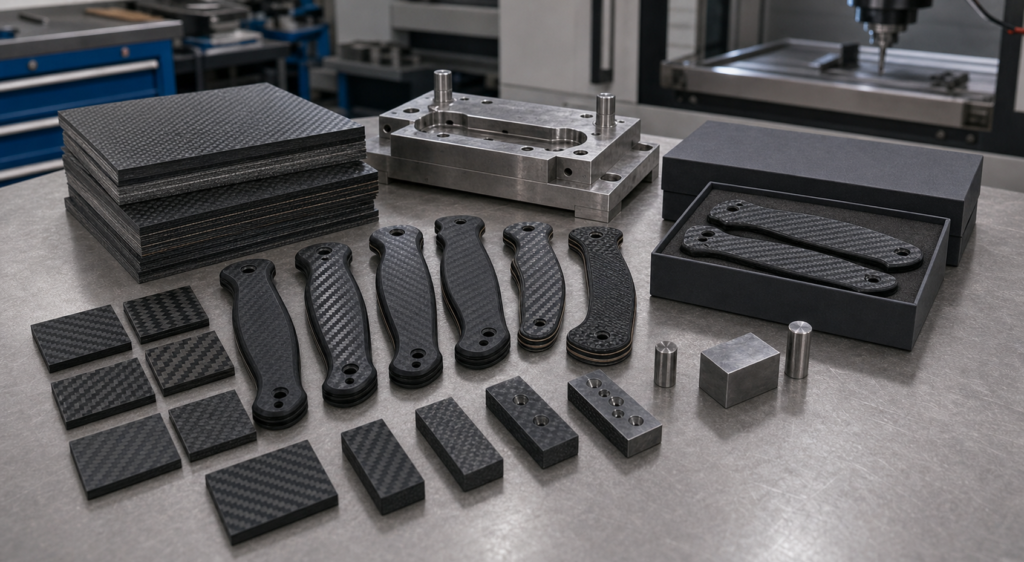
Carbon fiber can make a knife look premium fast. But if buyers only chase the weave, production problems can follow.
Carbon fiber knife scales should be specified by construction, sheet quality, thickness, weave direction, surface finish, edge treatment, screw support, texture, cosmetic standard, and inspection method. A good specification turns carbon fiber from a visual upgrade into a controlled OEM production material.
Quick buyer brief:
- Answer: Carbon fiber scales need clear material, machining, finish, and QC standards before mass production.
- Buyer context: This helps knife brands, importers, private label buyers, and sourcing managers develop carbon fiber handle projects.
- Key checks: Confirm laminate type, thickness, weave, surface finish, clip support, screw holes, chamfers, cosmetic limits, MOQ, target price, and inspection plan.
Have a knife or multi-tool project in mind?
Send your sketch, CAD file, sample photo, or product idea. Vast State can review manufacturability, suggest materials, estimate MOQ, and prepare a quote for your OEM/ODM project.
When I work on a carbon fiber handle project, I do not treat the material as decoration only. The buyer may want a premium look, but the factory has to control the structure, machining, finish, and assembly fit. A carbon fiber scale must hold screws, sit flat, match the liner, support the clip, feel good in the hand, and look consistent across a shipment. That is why I ask for a full specification before I treat it as a production-ready handle material.
What Are Carbon Fiber Knife Scales?
A carbon fiber pattern can look simple in a product photo. But the real material is a layered composite, not just a printed surface.
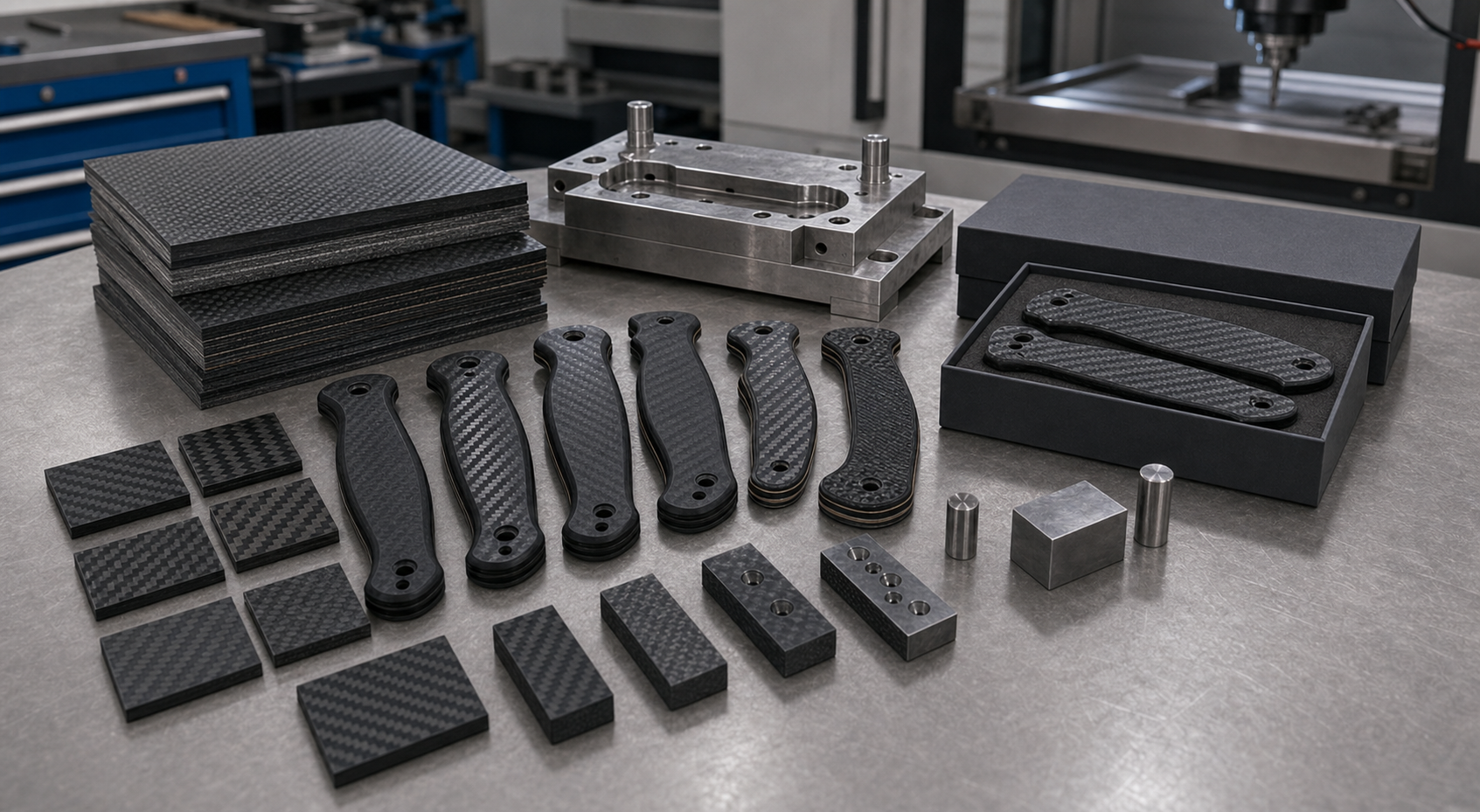
Carbon fiber knife scales are handle parts made from carbon fiber reinforced composite material. They are usually cut or machined from laminated sheet, then finished for edge comfort, grip, appearance, and assembly fit.
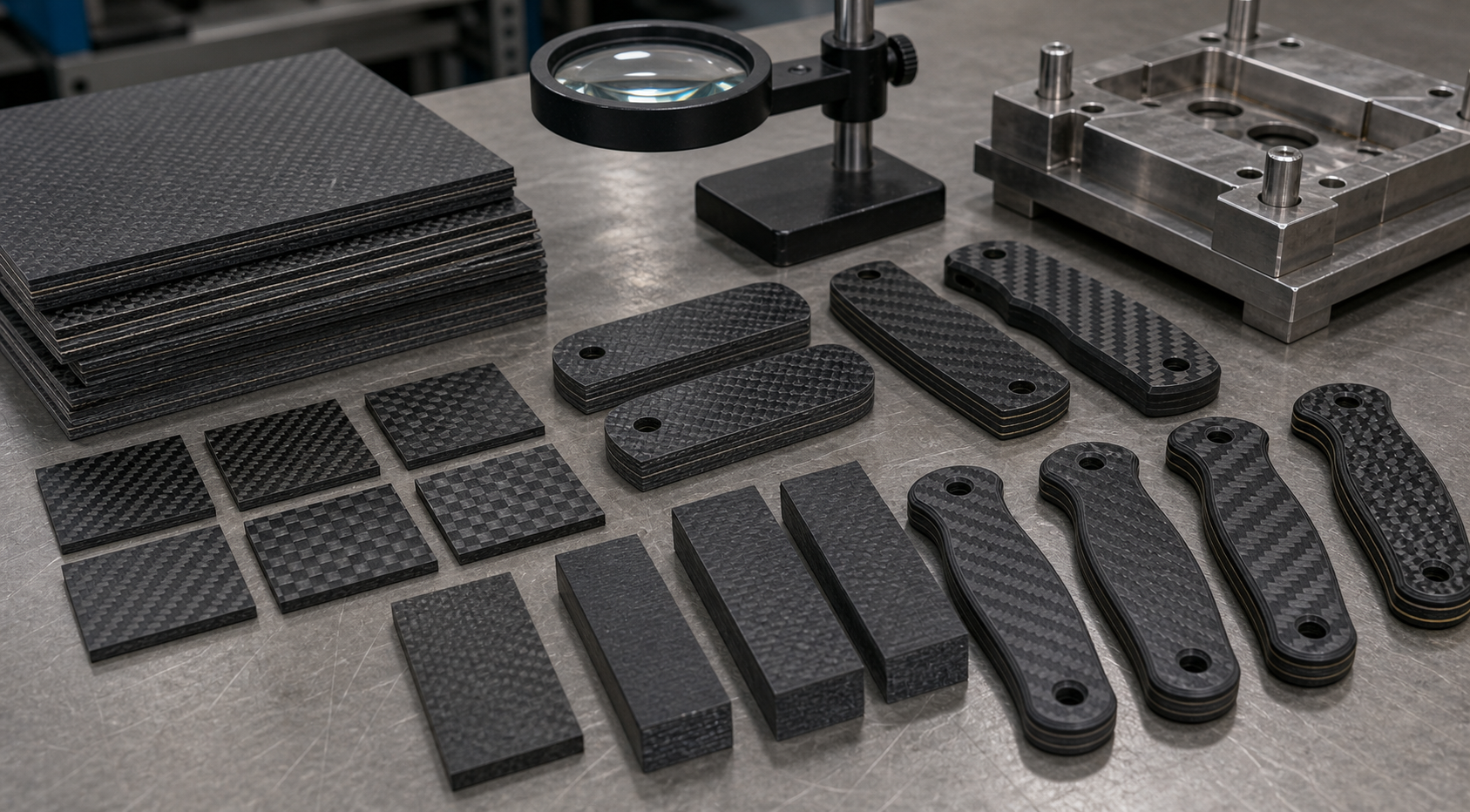
I First Confirm That the Carbon Fiber Is Real and Structural Enough
Carbon fiber is often sold as a premium signal, but buyers need to know what they are actually buying. A real carbon fiber scale is a composite part. OSHA's composites guidance explains that advanced composites combine reinforcing fiber with a resin system, and the resin holds the fibers together and transfers load to the fibers. Toray also explains that carbon fiber and prepreg materials are valued for strength-to-weight ratio, design flexibility, and long-term performance.
For knife handles, this means the buyer should separate three ideas. The first is a full carbon fiber laminate scale. The second is a carbon fiber overlay over another base. The third is a printed or molded carbon fiber look. These are not equal. A full laminate scale can support a stronger material story. An overlay may be acceptable if the buyer explains the construction honestly. A fake pattern may hurt trust if the market expects real carbon fiber.
The supplier also needs details. I want to know the thickness, weave style, fiber orientation, surface finish, backing structure, screw layout, clip area, liner support, and whether the scale is only decorative or functional. A carbon fiber sheet can look beautiful but still be wrong for a knife if the screw holes fray, the edges chip, the weave alignment is inconsistent, or the surface scratches too easily.
| Specification point | What I check | Why it matters |
|---|---|---|
| Construction | Full laminate, overlay, or decorative pattern | Prevents wrong material claims |
| Thickness | Scale thickness and tolerance | Protects assembly fit and handle feel |
| Weave direction | Visual alignment and layout | Protects premium appearance |
| Support structure | Liner, screw hole, and clip support | Protects long-term use |
OEM/ODM RFQ Checklist
Prepare these details to help Vast State review your project and provide a more accurate quotation.
| RFQ Field | What to Prepare |
|---|---|
| Project type | OEM from drawing / ODM private label / wholesale catalog |
| Product category | Folding knife / fixed blade / multi-tool / outdoor tool |
| Design status | Idea / sketch / 2D drawing / 3D CAD / physical sample |
| Target price | Ex-factory target price or retail price range |
| MOQ expectation | 500 / 1,000 / 3,000 / 5,000+ pcs |
| Logo method | Laser engraving / etching / printing / molded logo |
| Packaging | Standard packaging / custom retail box / Amazon-ready |
| Market | USA / EU / Japan / Korea / Middle East / other |
| Compliance needs | Buyer-specified testing / documentation / labeling |
| Timeline | Sample deadline / mass production deadline |
When Do Carbon Fiber Scales Make Commercial Sense?
Carbon fiber can raise cost quickly. If the buyer's customer will not value it, the upgrade may not pay back.
Carbon fiber scales make sense for premium EDC, lightweight folders, collector-style products, and upgraded private label lines. They are weaker commercially for low-price models that must win mainly on cost.
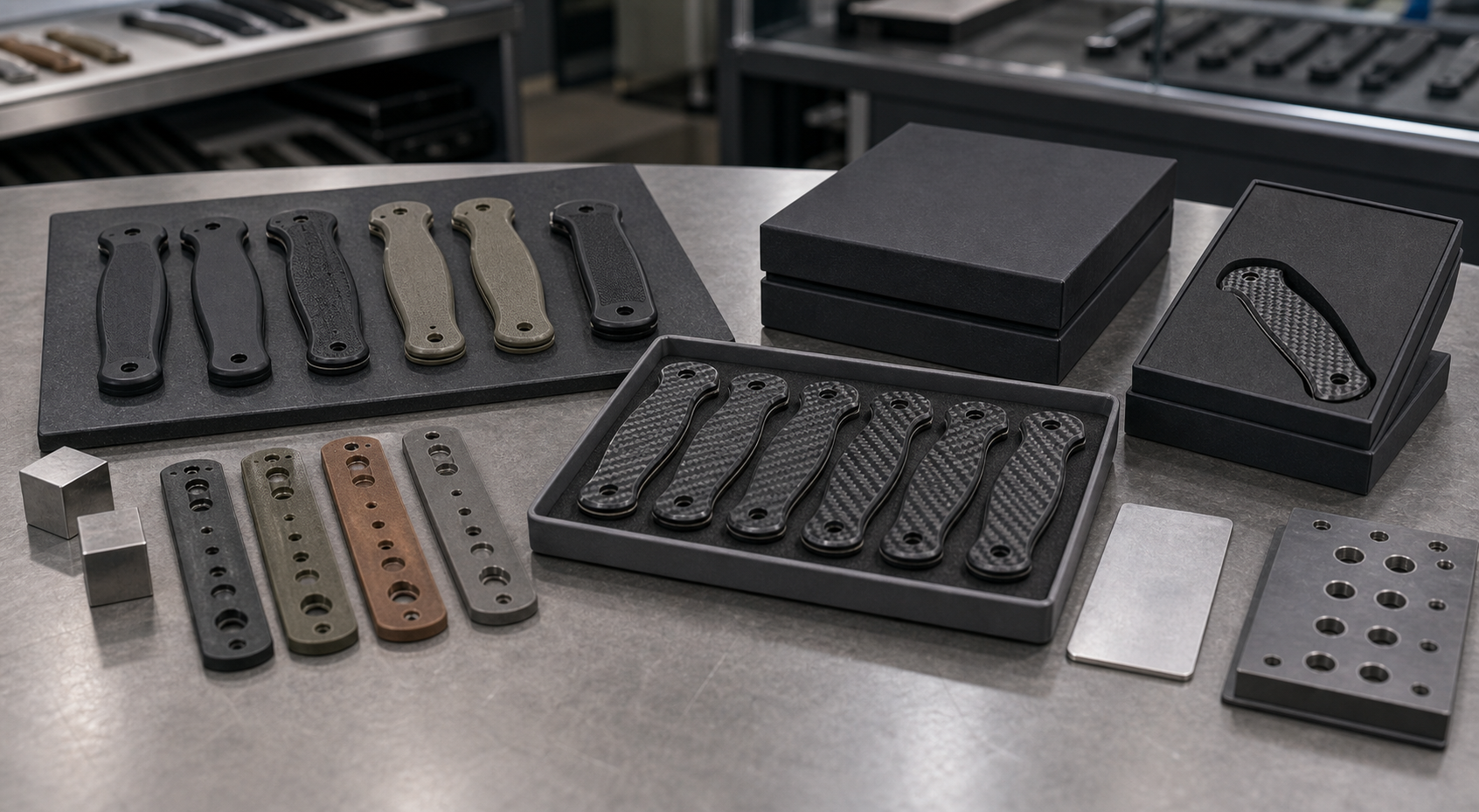
I Use Carbon Fiber When the Product Story Can Support It
Carbon fiber is not a universal answer. It is a positioning tool as much as a material. Toray's carbon fiber product page groups carbon fibers by standard modulus, intermediate modulus, and high modulus, and it explains that carbon fiber products serve industries from industrial equipment to sports and recreation. In knife sourcing, I do not need aerospace-level language to sell a handle scale. I need the right material story for the user's market.
A slim EDC folder can benefit from carbon fiber because the material supports a lightweight and technical image. A premium outdoor folder can use carbon fiber to show an upgrade over standard G10 or stainless handle options. A collector-style knife can use the weave, polish, and machining detail as part of the first impression. A private label buyer can use carbon fiber for an upgraded version while keeping G10 or aluminum for the volume model.
But I avoid carbon fiber when the project is purely cost driven. If the target retail price is tight, the buyer may need to spend the budget on blade steel, lock quality, heat treatment, or packaging instead. A low-cost knife with poor action and a carbon fiber scale is still a weak product. The handle upgrade must fit the whole product level.
I also ask the buyer how the product will be photographed and described. Carbon fiber often sells through visual detail. If the weave is not visible, the finish is too glossy, or the pattern looks distorted, the buyer may not get the premium signal they paid for.
| Product type | Carbon fiber fit | Reason |
|---|---|---|
| Premium EDC folder | Strong | Lightweight and technical product story |
| Collector-style knife | Strong | Visual detail supports value perception |
| Budget utility knife | Usually weak | Cost may be better used elsewhere |
| Upgraded private label line | Strong | Creates a clear good-better product ladder |
How Should Buyers Choose Carbon Fiber Construction and Sheet Quality?
A beautiful surface can hide weak construction. Buyers need to approve more than the top layer.
Buyers should define whether the scale is full carbon fiber laminate, carbon fiber over another material, or a decorative face. They should also approve thickness, weave, resin quality, flatness, and acceptable surface defects.
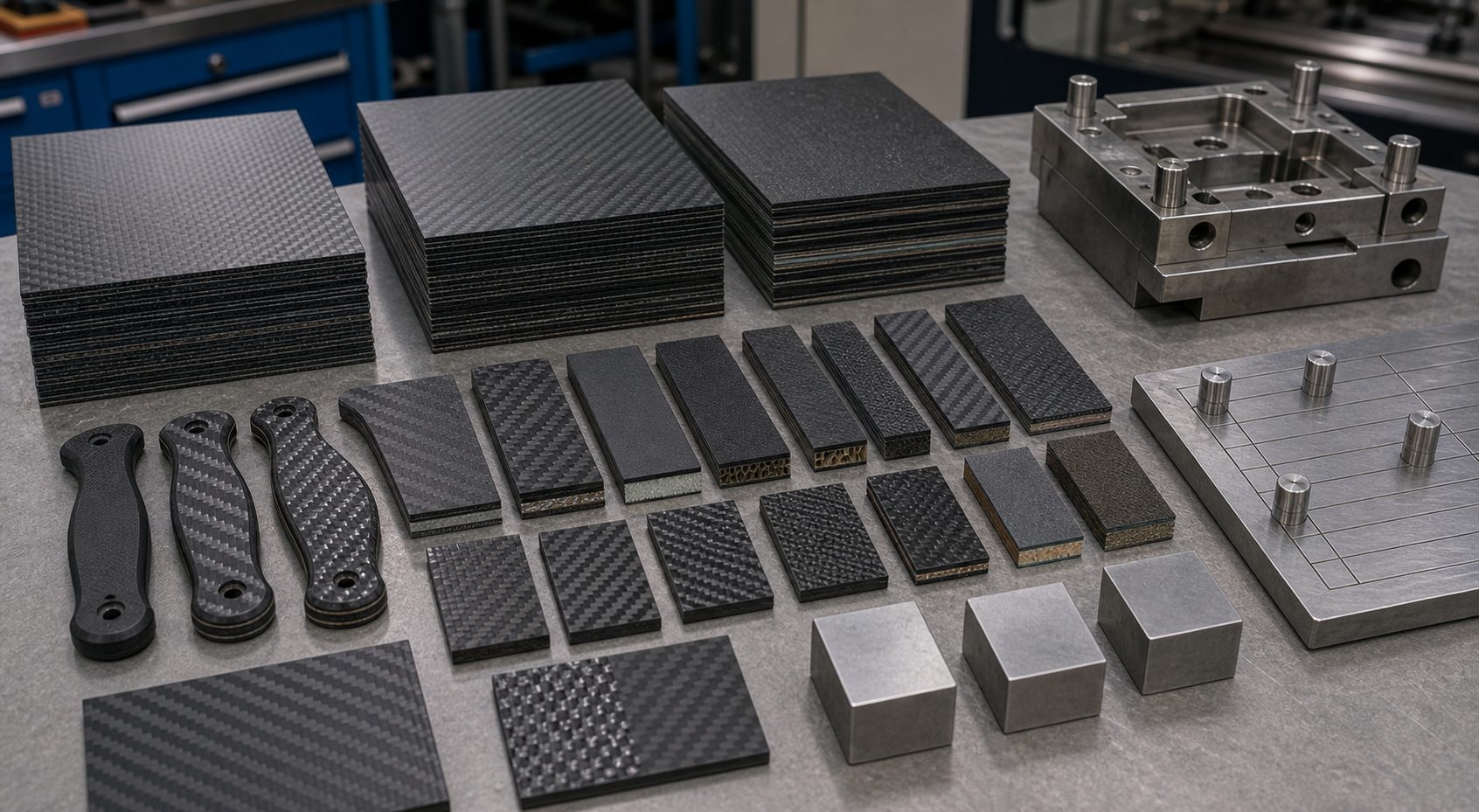
I Approve the Sheet Before I Approve the Knife
Carbon fiber scale quality starts before CNC machining. The sheet must be suitable for the handle design. Toray's prepreg page explains that prepreg materials combine resin systems with carbon fibers or woven carbon and glass fibers, and that processing methods can include hand layup, out-of-autoclave, vacuum-bag-only, and compression molding. I use that as a reminder that "carbon fiber" is not one fixed thing. The final sheet depends on fiber type, resin system, layup, curing, surface, and process control.
For knife handles, buyers usually care most about appearance, flatness, machining behavior, screw support, and edge finish. A good sheet should not show obvious voids, dry spots, warped areas, random weave distortion, or weak resin-rich edges. The buyer should approve the front face and the cross-section. If the handle will have chamfers, contouring, or pocket clip recesses, the edge and layers become visible. That can be attractive, but only if the laminate is clean.
The buyer should also decide whether the carbon fiber is structural or decorative. A thin carbon fiber face bonded to G10, aluminum, or another base may reduce cost and improve support. That can be a smart choice when stated clearly. But it should not be presented as the same as a full carbon fiber scale. The RFQ should say exactly what is required.
I usually ask for a material sample board before final tooling or mass production. This lets the buyer compare matte, satin, polished, twill, plain weave, shred-style, or hybrid visual options before we commit to a full knife sample.
| Construction choice | Benefit | Buyer risk |
|---|---|---|
| Full carbon fiber laminate | Strongest material story | Higher cost and stricter cosmetic control |
| Carbon fiber overlay | Can reduce cost and improve support | Must be described honestly |
| Hybrid carbon fiber and G10 | Balance of look and practicality | Layer bonding and edge look need approval |
| Decorative carbon pattern | Lowest visual-cost route | Can weaken buyer trust if marketed poorly |
What Grip, Weight, and Finish Details Should Buyers Control?
Carbon fiber can look premium but feel slippery. A buyer must control hand feel, not only the weave photo.
Buyers should specify matte, satin, polished, textured, milled, or contoured finish based on the user's grip needs. The best finish balances visual appeal, pocket comfort, and safe hand control.
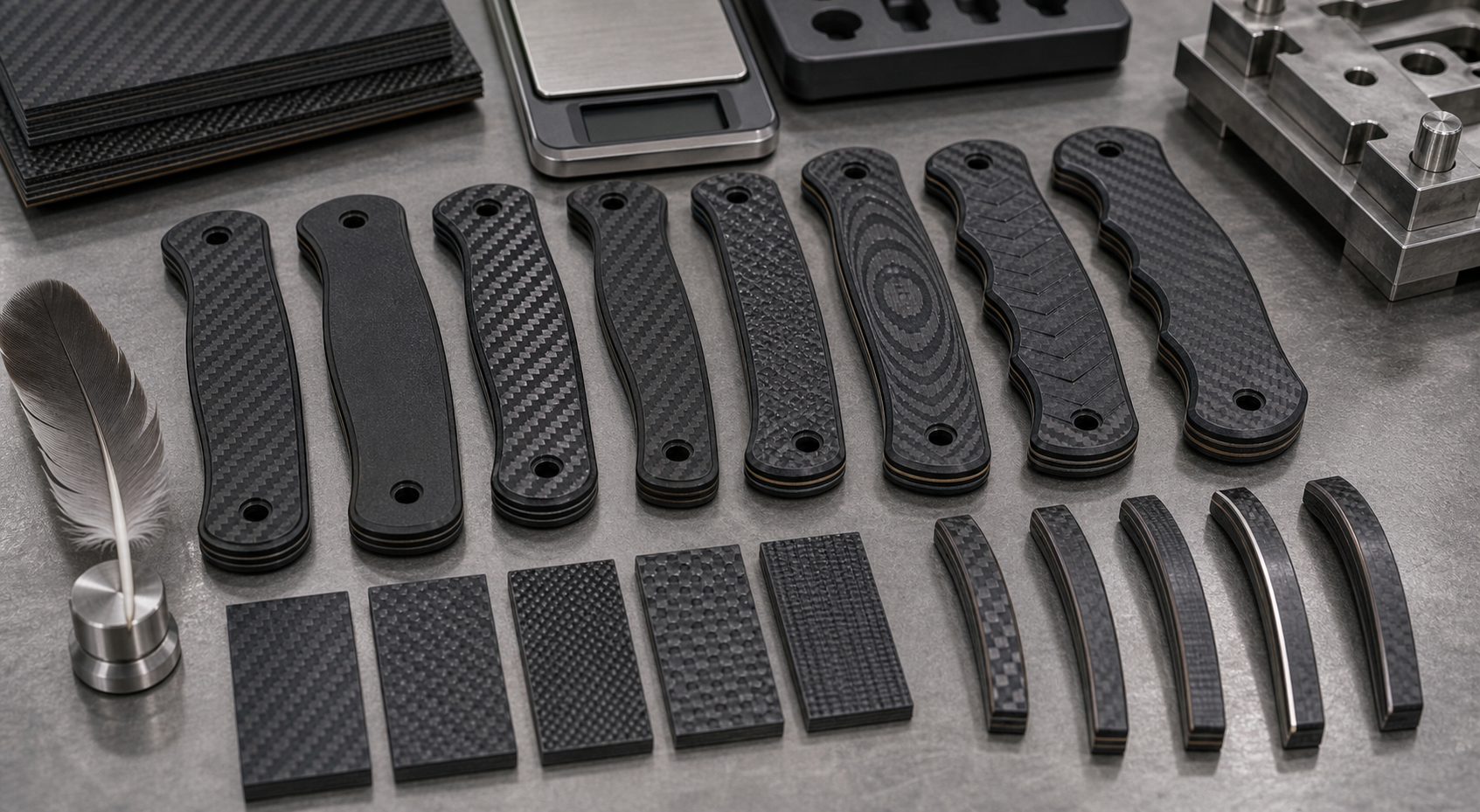
I Balance Premium Look With Real Handling
Carbon fiber often feels lighter than many buyers expect. That can be a strength when the product is a slim EDC knife or a premium pocket knife. It can also create a problem if the rest of the knife feels too heavy, too hollow, or poorly balanced. I always check the whole handle, not only the scale. Liners, backspacer, blade stock, hardware, and clip all change the final feel.
Finish is just as important as weight. A polished carbon fiber scale can look expensive in a product photo, but it may feel slick in the hand. A matte surface can feel more controlled, but it may hide some weave depth. A milled pattern can improve grip, but it adds CNC time and may expose more edge detail. A contoured scale can feel better, but it raises machining cost and inspection needs.
I also pay attention to pocket carry. A very aggressive texture can damage pockets or feel uncomfortable during daily carry. A very smooth scale can slip during harder use. The right answer depends on the user. A gentleman's EDC knife and a work-focused outdoor folder should not share the same surface standard.
The buyer should approve the finish by touch, not only by photo. I prefer to prepare several scale samples with different finish levels. Then the buyer can compare appearance, grip, pocket comfort, and perceived value before choosing the final route.
| Finish detail | Buyer benefit | Production concern |
|---|---|---|
| Polished surface | Strong visual depth | Can feel slippery and show scratches |
| Matte surface | Better controlled feel | May reduce glossy premium look |
| Milled texture | Improves grip | Adds CNC time and edge exposure |
| Chamfered edge | Improves comfort | Must stay consistent across batches |
What Manufacturing Risks Affect Carbon Fiber Scale Production?
Carbon fiber looks clean when finished. But machining can expose problems that were hidden in the sheet.
Main manufacturing risks include delamination, chipping, frayed holes, weave distortion, dust control, tool wear, sharp edges, inconsistent finish, and poor fit with liners, clips, or screws.
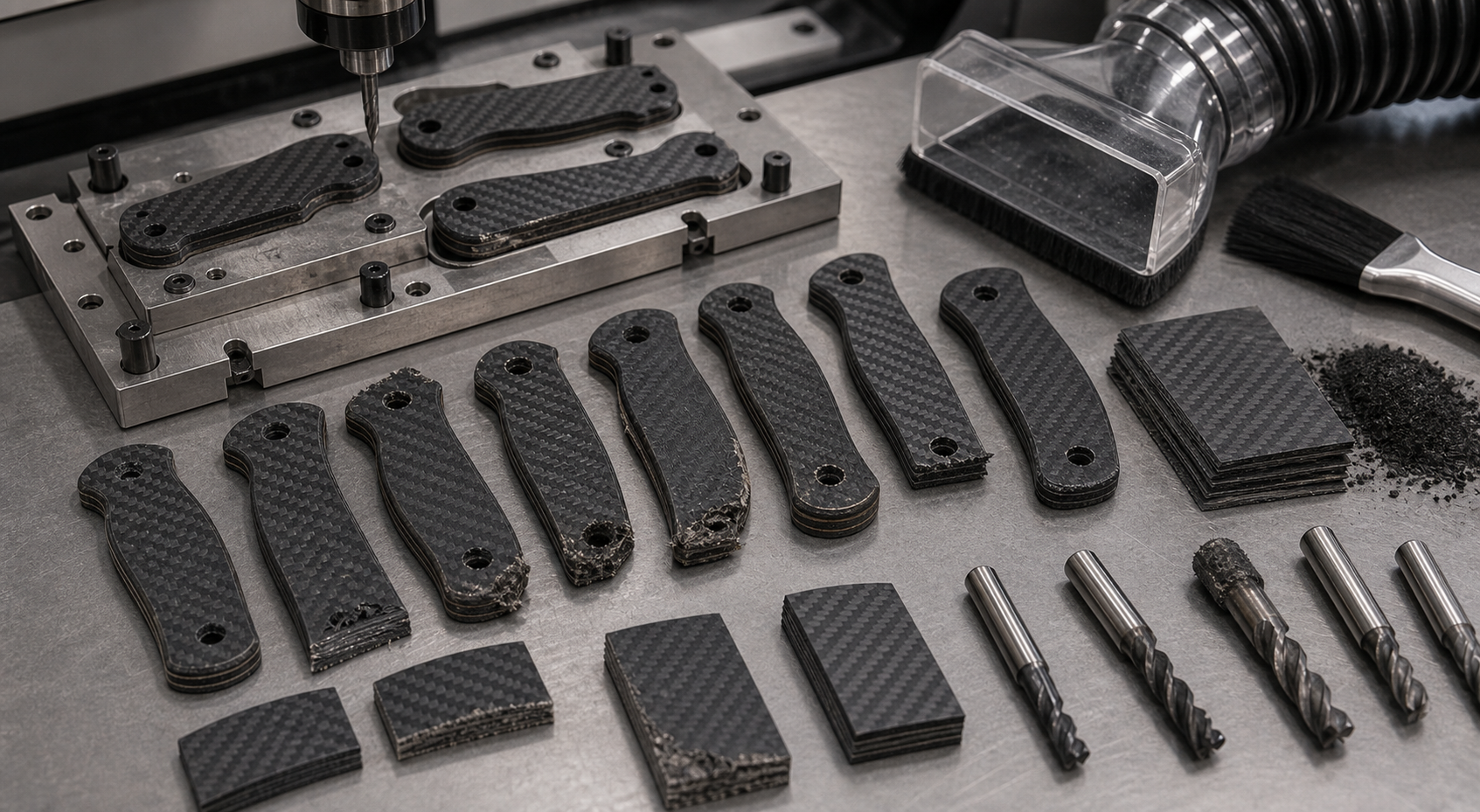
I Control the Edge, the Hole, and the Dust
Carbon fiber machining needs care. OSHA's technical manual explains that advanced composites can use high-strength, high-stiffness fibers and resin systems, and it describes prepregging, molding, curing, and finishing processes. It also notes that carbon fiber handling can create mechanical irritation and abrasion. For knife factories, the practical lesson is clear. Cutting, drilling, sanding, and finishing carbon fiber should use proper dust extraction, protective equipment, tool control, and clean process discipline.
The first production risk is edge quality. Carbon fiber can chip or delaminate if the tool, feed, fixture, or sheet quality is wrong. A tiny edge chip may look small, but it hurts the premium feel. The second risk is screw holes. If holes are rough, frayed, off-center, or weak, the handle can create assembly issues. The pocket clip area is another stress point because users pull on the clip many times.
The third risk is cosmetic consistency. Carbon fiber buyers usually care about pattern alignment, surface gloss, visible voids, resin marks, and weave distortion. These are not small details when the material is chosen mainly for appearance. The factory should define acceptable and unacceptable defects before production.
The fourth risk is over-machining. Deep contours or aggressive texture can look good in a rendering but increase scrap rate in production. I like to make the first sample conservative, then add details only when the sheet, fixture, and QC standard can support them.
| Risk area | What can go wrong | How I control it |
|---|---|---|
| Edge machining | Chipping or delamination | Correct tool, fixture, speed, and chamfer |
| Screw holes | Fraying or poor fit | Hole inspection and assembly test |
| Surface finish | Uneven gloss or visible defects | Approved sample and cosmetic limit |
| Dust and cleanup | Dirty finish or worker exposure | Dust extraction and clean process habits |
What Quality Checks Should Buyers Use Before Mass Production?
A carbon fiber sample can look great under one light. Mass production needs a repeatable inspection standard.
Buyers should check material identity, thickness, flatness, weave alignment, surface finish, edge quality, hole tolerance, clip support, assembly fit, pocket comfort, packaging protection, and cosmetic limits.
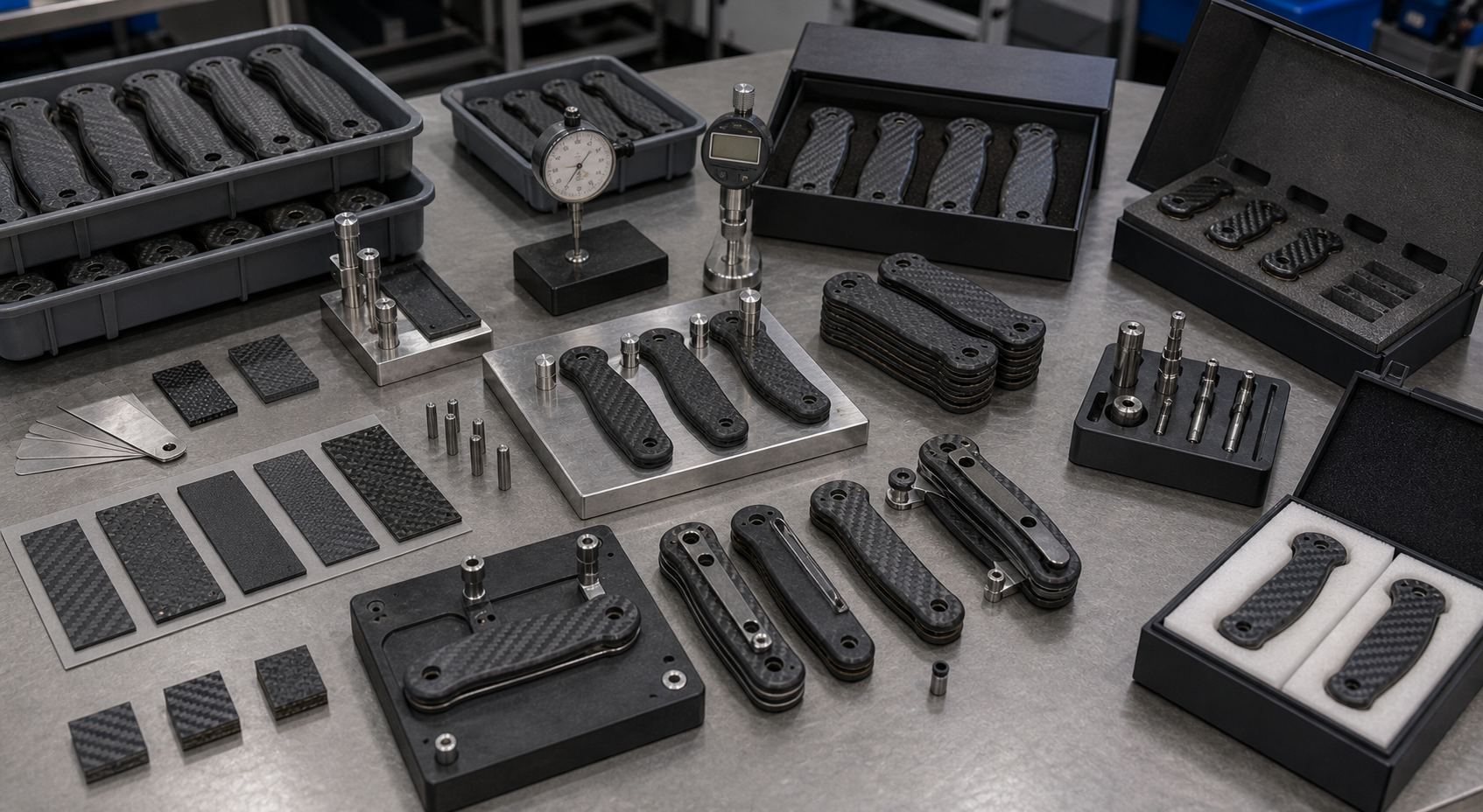
I Approve a Cosmetic Standard, Not Only a Nice Sample
Carbon fiber quality control is more demanding because buyers choose it for both material value and appearance. ISO explains that ISO 9001 supports clear processes, understanding customer needs, variation control, performance data, and evidence-based improvement. That approach fits carbon fiber scale production very well. The buyer and supplier need one shared standard before the order grows.
I start with material identity. Is it full carbon fiber laminate, overlay, or hybrid? Then I check thickness and flatness. A scale that is slightly warped can affect blade centering or handle fit. Next I check hole location, screw seating, liner contact, clip position, and edge finish. A good-looking scale is not enough if it creates assembly pressure.
Then I check appearance. Carbon fiber should have a defined acceptable range for weave alignment, gloss, surface pinholes, resin marks, color tone, exposed layers, and edge marks. The buyer should not expect every woven pattern to be visually identical, but the shipment must stay inside the approved range. A clear photo standard helps.
Packaging also matters. Carbon fiber surfaces can scratch during transport if packed carelessly. I prefer protective layers or sleeves for loose scales and secure spacing for assembled knives. For premium products, the unboxing experience should protect the same material story that the buyer paid for.
| QC check | What to inspect | Why it protects the buyer |
|---|---|---|
| Material identity | Full laminate, overlay, or hybrid | Prevents wrong claims |
| Dimension | Thickness, flatness, holes | Protects assembly fit |
| Appearance | Weave, gloss, edge marks, pinholes | Protects premium perception |
| Packing | Surface protection and spacing | Prevents scratches before sale |
How Should Buyers Prepare an RFQ for Carbon Fiber Knife Scales?
A vague RFQ creates vague pricing. Carbon fiber projects need more detail before the supplier can quote honestly.
A strong RFQ should include knife type, target market, target price, order quantity, scale construction, thickness, weave, finish, texture, clip design, screw layout, packaging, cosmetic standard, and inspection needs.
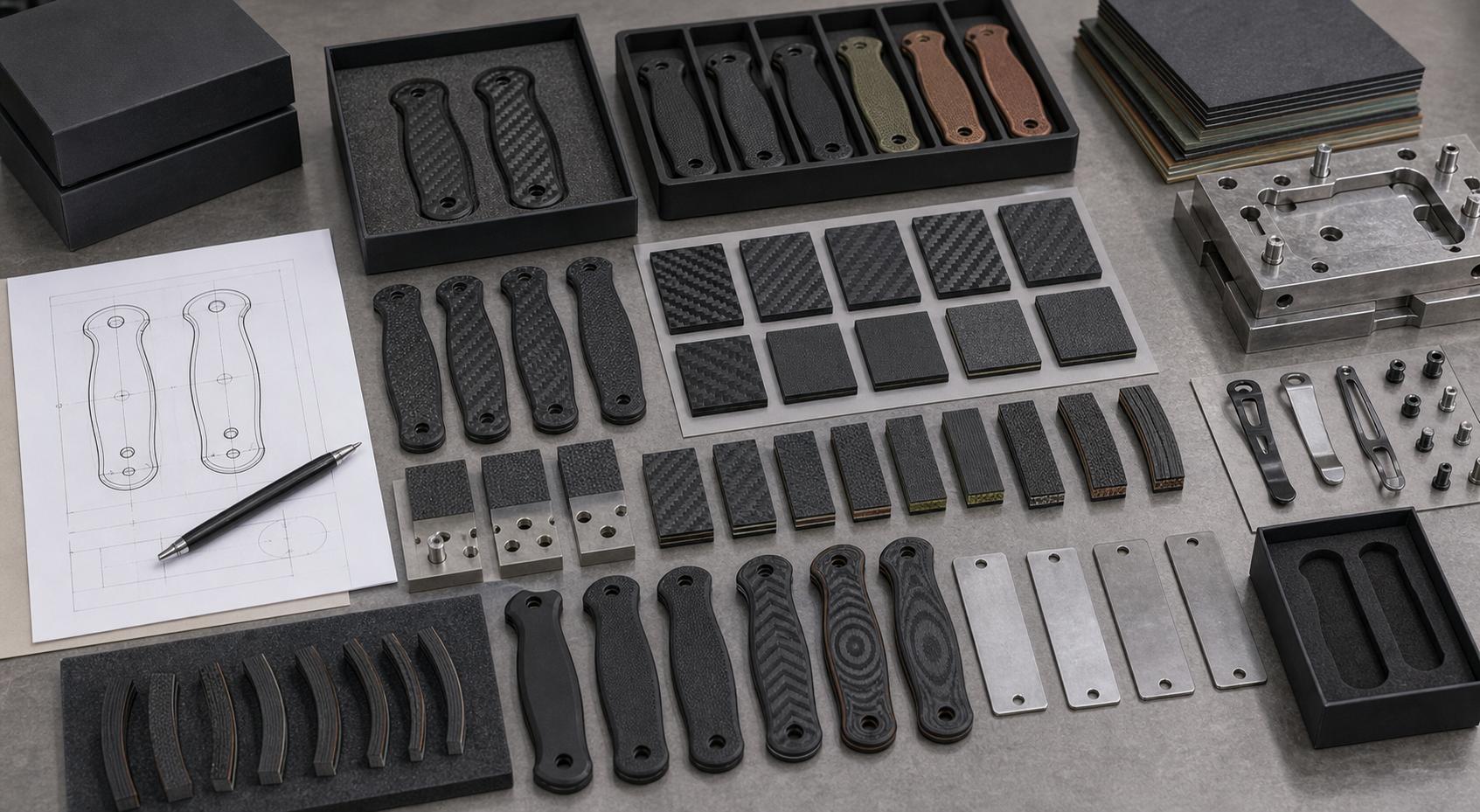
I Ask for the Product Goal Before I Quote the Scale
Carbon fiber scale pricing depends on many details. A flat scale, a contoured scale, a milled scale, and a hybrid overlay scale can have very different costs. A small order and a repeat volume order also need different planning. This is why I do not like RFQs that say only "carbon fiber handle." That phrase is not enough for production.
The buyer should start with the product goal. Is the knife a premium EDC folder, an outdoor folder, a gift set, a tactical-style folder, or an upgrade version of an existing model? Then the buyer should define the target price and the expected order quantity. This helps the supplier decide whether full carbon fiber laminate is realistic or whether a hybrid construction may protect the budget.
Next, the buyer should send handle drawings, reference photos, desired thickness, screw layout, pocket clip position, liner or no-liner structure, preferred finish, texture level, and packaging plan. If the design is not finished, I can help propose options. But I still need the market direction and cost range.
Finally, the buyer should ask for a clear sample plan. I usually recommend approving a material sample first, then a loose scale sample, then a full assembled knife sample. This sequence finds problems early and saves time before mass production.
| RFQ field | Why I need it | Example decision |
|---|---|---|
| Target market | Guides finish and cost level | Premium EDC versus value line |
| Construction type | Controls material and claim | Full carbon fiber or overlay |
| Drawing and hardware | Controls fit and machining | Screw holes, clip pad, liners |
| Cosmetic standard | Controls inspection | Weave alignment and defect limit |
Turn your idea into a quote-ready knife project.
Share your drawing, sample photo, target quantity, market, and packaging needs. Vast State will review manufacturability and prepare OEM/ODM options.
Conclusion
I specify carbon fiber scales by construction, finish, machining, assembly, and QC standards, not by weave appearance alone.
Source Notes
- Toray carbon fiber and prepreg materials supports the discussion of strength-to-weight ratio, design flexibility, processing routes, and material selection.
- Toray carbon fiber products supports the explanation that carbon fiber products vary by modulus, tow size, processing method, and application.
- Toray prepreg materials supports the discussion of resin systems, woven carbon or glass fibers, cure methods, and surface finish considerations.
- OSHA technical manual on advanced composites supports the composite manufacturing and handling-risk context.
- ISO 9001 explained supports the process-control and evidence-based QC approach.