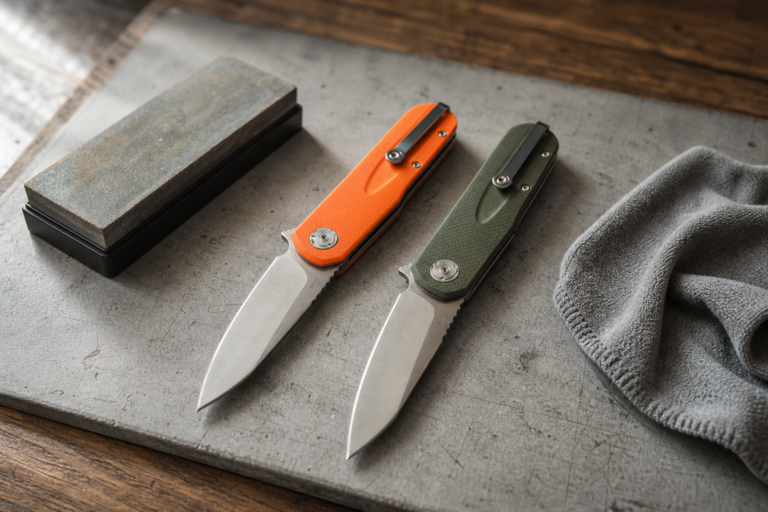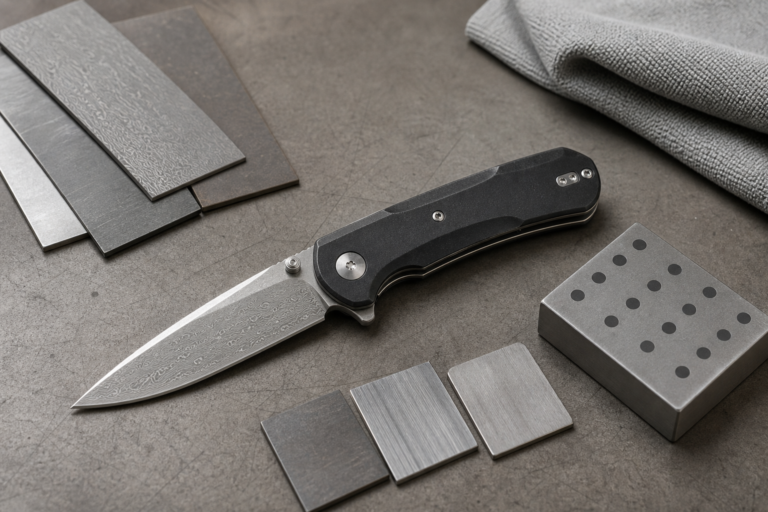
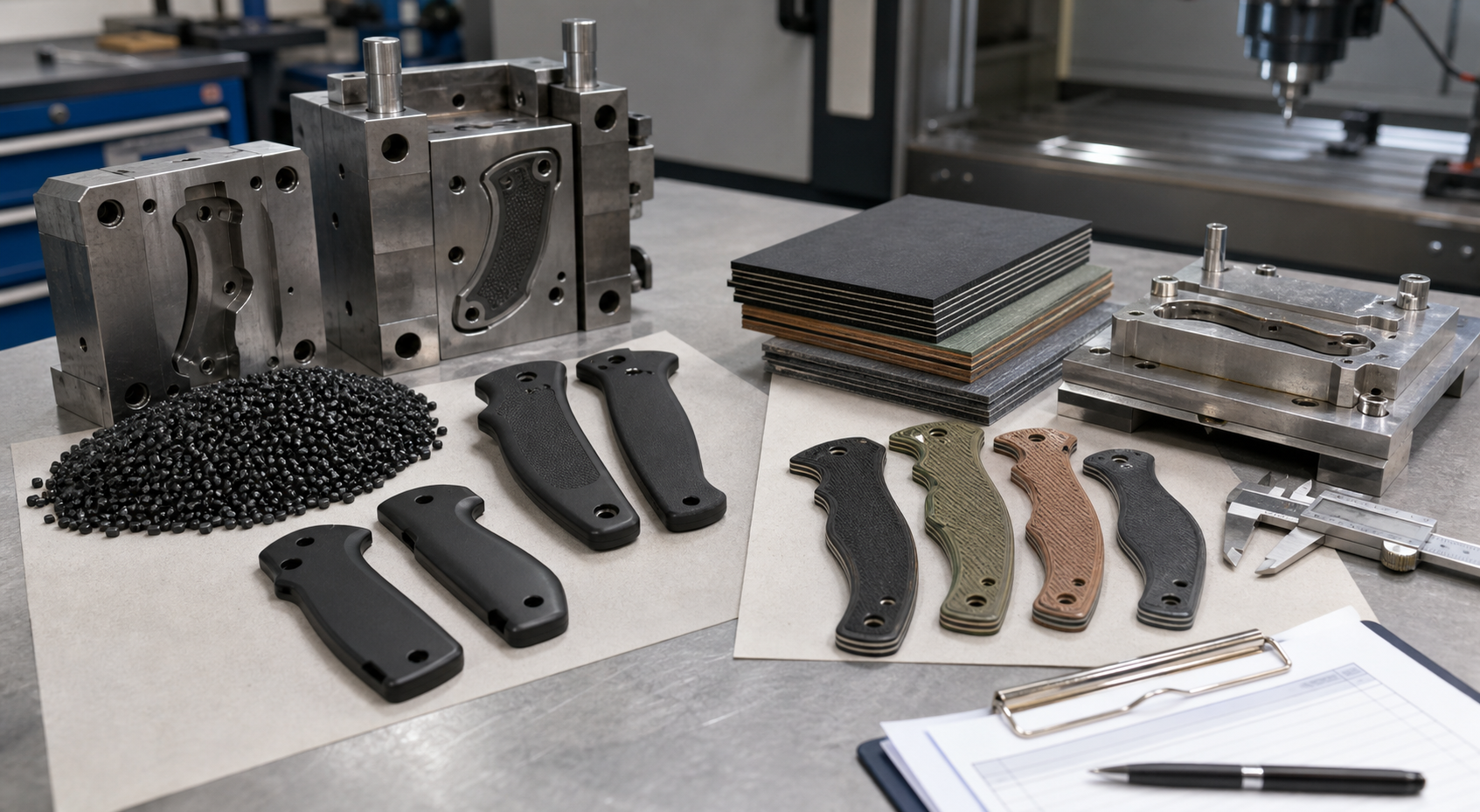
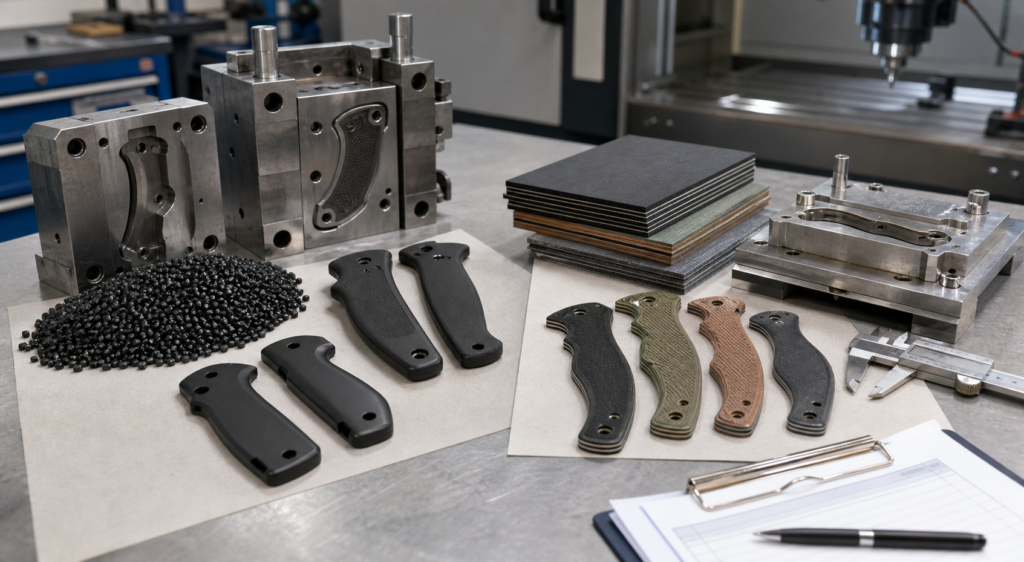
A handle material can quietly decide the whole knife plan. If buyers mix up molded plastic and machined laminate, the quote becomes unstable.
Choose Grivory when the project needs injection molded handles, lower per-piece shaping cost at volume, and integrated features. Choose G10 when the project needs machined laminate scales, stronger texture control, a more solid feel, and higher perceived material value.
Quick buyer brief:
- Answer: Grivory fits molded volume projects; G10 fits machined scale projects with stronger tactile positioning.
- Buyer context: This helps knife brands, importers, private label buyers, and sourcing managers compare handle material routes before RFQ.
- Key checks: Confirm mold cost, order quantity, handle structure, texture, color, screw support, clip area, tolerance, inspection needs, and target price.
Have a knife or multi-tool project in mind?
Send your sketch, CAD file, sample photo, or product idea. Vast State can review manufacturability, suggest materials, estimate MOQ, and prepare a quote for your OEM/ODM project.
When I compare Grivory and G10 with a B2B buyer, I see two different manufacturing paths. Grivory is usually discussed as an engineering thermoplastic for molded parts. G10 is a glass epoxy laminate that is cut and machined into scales. This difference affects tooling, MOQ, texture, cost, product feel, and how fast the factory can repeat the design. The best choice is not only about strength. It is about which production route fits the knife business model.
What Are Grivory and G10 Handle Materials?
Material names can sound equal in a catalog. But one material is molded from granules, while the other is machined from laminate.
Grivory is a family of high-performance polyamide materials used for technical molded components. G10 is a glass fabric and epoxy laminate used as sheet or rod stock. Their structure and production logic are different.
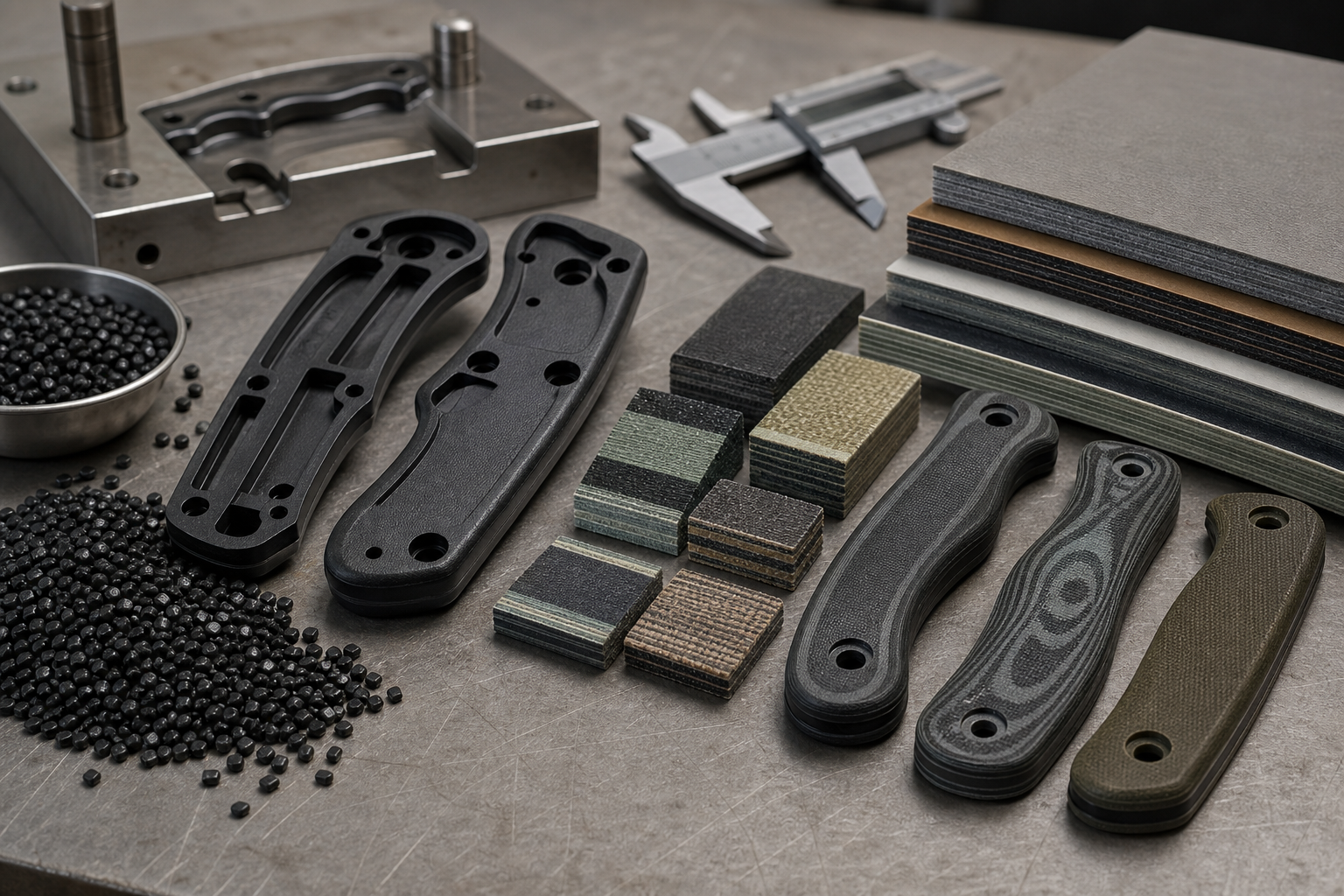
I Treat Them as Different Manufacturing Routes
The first thing I explain is that Grivory and G10 are not two versions of the same handle idea. EMS-GRIVORY describes Grivory GV as materials based on semi-crystalline polyamides with partially aromatic content, supplied as granulate for injection molding or extrusion. The same source lists versions reinforced with glass fibers, mineral, carbon, and other modifications. For knife buyers, this means the handle is usually planned as a molded part, not a cut sheet scale.
G10 starts from a different form. Curbell describes G10/FR-4 glass epoxy as a composite material made from glass fabric and electrical grade epoxy resin. It is available as sheet or rod, and it is used when strength, stiffness, creep resistance, and dimensional stability are needed. In knife production, G10 handle scales are usually cut, drilled, milled, chamfered, textured, and assembled with liners or hardware.
This structure changes the whole project. A Grivory handle can include molded ribs, texture, screw bosses, shape details, and color in the mold. A G10 handle normally needs CNC work and finishing after sheet cutting. A buyer should not ask only, "Which material is stronger?" The better first question is, "Do I want a molded handle system or a machined scale system?"
| Comparison point | Grivory | G10 | Buyer takeaway |
|---|---|---|---|
| Material family | High-performance polyamide | Glass epoxy laminate | They are not the same material type |
| Starting form | Granules for molding or extrusion | Sheet or rod stock | Production route changes the quote |
| Common knife use | Molded handle or molded scales | CNC-machined handle scales | Choose by structure and quantity |
| RFQ detail | Mold design, resin grade, color, texture | Sheet thickness, color, texture, machining | Define process before asking price |
OEM/ODM RFQ Checklist
Prepare these details to help Vast State review your project and provide a more accurate quotation.
| RFQ Field | What to Prepare |
|---|---|
| Project type | OEM from drawing / ODM private label / wholesale catalog |
| Product category | Folding knife / fixed blade / multi-tool / outdoor tool |
| Design status | Idea / sketch / 2D drawing / 3D CAD / physical sample |
| Target price | Ex-factory target price or retail price range |
| MOQ expectation | 500 / 1,000 / 3,000 / 5,000+ pcs |
| Logo method | Laser engraving / etching / printing / molded logo |
| Packaging | Standard packaging / custom retail box / Amazon-ready |
| Market | USA / EU / Japan / Korea / Middle East / other |
| Compliance needs | Buyer-specified testing / documentation / labeling |
| Timeline | Sample deadline / mass production deadline |
Which Material Fits Injection Molding or CNC-Machined Handles Better?
A buyer can lose weeks if the design uses the wrong process. The handle shape must match the manufacturing route.
Grivory fits injection molded handle designs, especially when features can be built into the mold. G10 fits CNC-machined scales where the buyer wants flat stock, contouring, texture, and a more machined product feel.
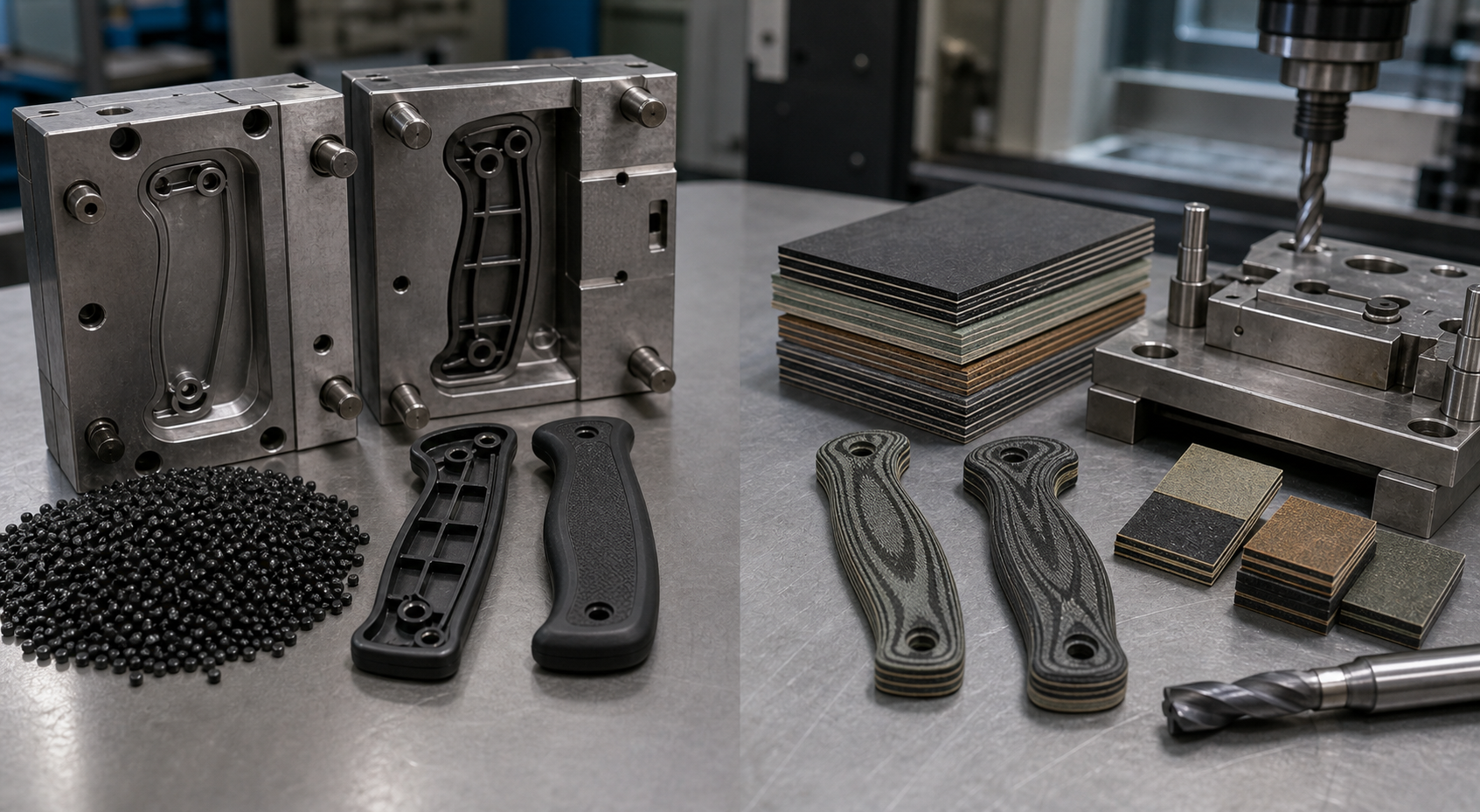
I Decide the Process Before the Material
If the buyer wants a molded handle with integrated texture, ribs, screw posts, pocket clip pads, color, and shape details, Grivory can make sense. EMS-GRIVORY says Grivory GV can be processed by conventional injection molding or extrusion equipment. That matters because tooling can create complex features repeatedly once the mold is correct. The buyer may pay more upfront for tooling, but the per-piece shaping cost can become attractive in volume.
If the buyer wants a machined scale with a denser feel, layered appearance, strong texture options, and easier design changes at small or medium quantity, G10 can be better. G10 does not usually need an injection mold. The supplier can cut sheet stock, CNC the handle profile, drill screw holes, add chamfers, and adjust texture by program. This gives flexibility when the design is still being tested.
The risk is choosing the material too late. If a knife is designed as a thin G10 scale but the buyer later asks for molded Grivory, the internal structure may need to change. Screw support, liner shape, pocket clip mounting, backspacer, and handle thickness may all need review. The same is true in reverse. A molded Grivory handle with deep ribs may not convert cleanly into G10 scales.
For OEM and ODM projects, I prefer to freeze the manufacturing route before the final drawing. This saves time, keeps the quote realistic, and prevents sample revisions that come from process mismatch.
| Design need | Better fit | Why it fits | Risk to control |
|---|---|---|---|
| Integrated molded ribs | Grivory | The mold can form features directly | Tooling must be correct |
| Small batch design changes | G10 | CNC programs and sheets are easier to adjust | Machining cost can be higher per piece |
| High-volume shaped handle | Grivory | Per-piece shaping can be efficient after tooling | Mold cost and MOQ matter |
| Flat or contoured scale | G10 | Sheet stock can be milled and finished | Edge finishing and screw fit matter |
How Do Grip, Texture, and Hand Feel Compare?
A low-cost handle can still fail if it feels cheap or slippery. Buyers need to test the user's hand, not only the CAD.
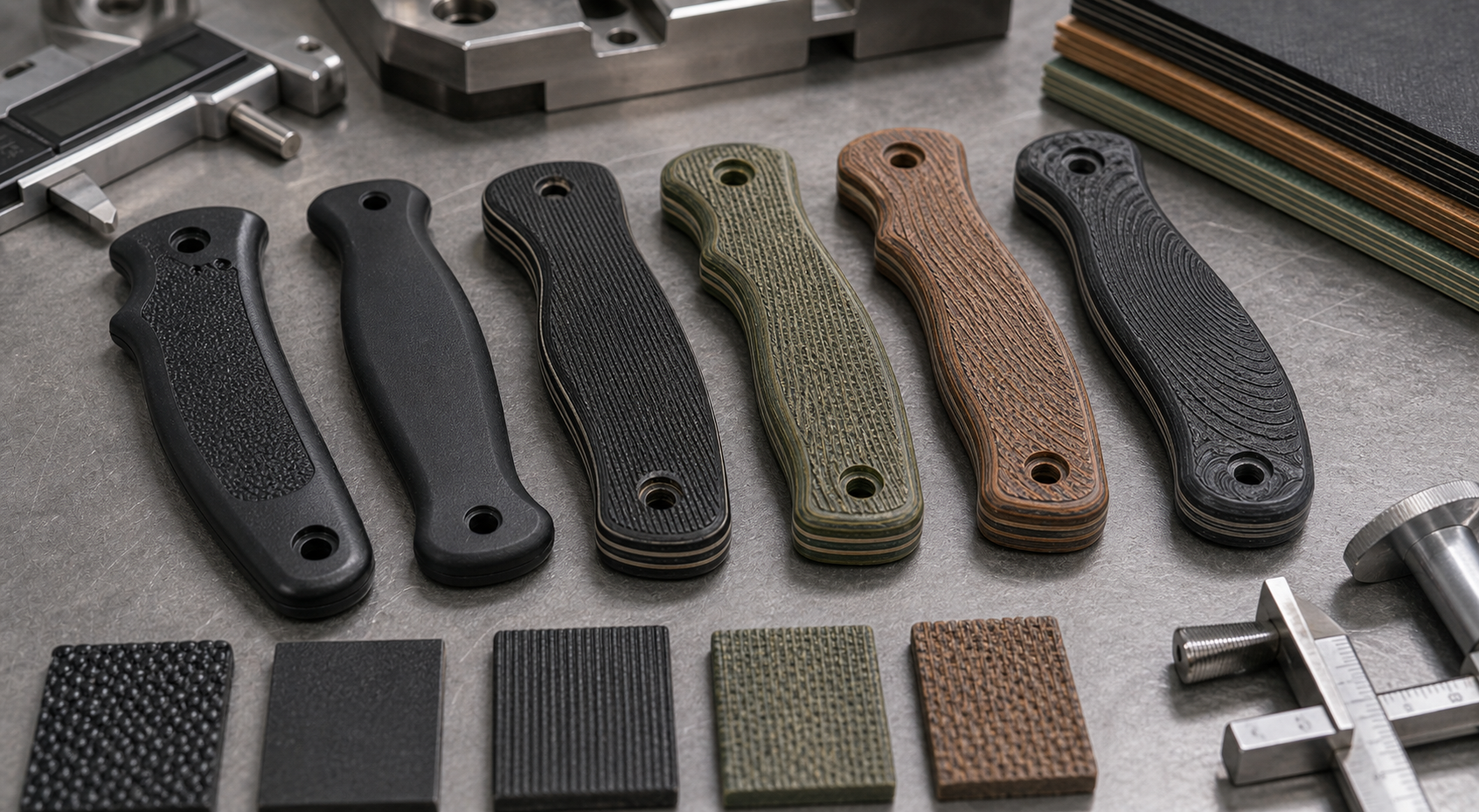
G10 usually gives a more solid and textured feel. Grivory can provide useful molded texture and ergonomic shape, but the surface must avoid a hollow or overly plastic impression.
I Separate Ergonomics From Surface Texture
G10 is often chosen when the buyer wants a stronger tactile signal. A textured G10 scale can feel firm, stable, and grippy. The surface can be milled with grooves, checkering, flat panels, or layered patterns. This helps tactical folders, work knives, and outdoor EDC products where hand control is part of the selling point. The buyer can approve texture depth and edge chamfer by sample.
Grivory can also grip well, but the design logic is different. The mold can create molded patterns, raised areas, ribs, palm swells, and curved shapes. This is useful when the handle needs ergonomic shaping without expensive CNC contouring on each piece. But the buyer must watch surface quality. If the resin grade, mold texture, wall thickness, or internal support is not planned well, the handle can feel light in a bad way. It may also sound hollow if the structure is too thin.
This is why I ask buyers to test more than one sample. A molded handle should be checked for texture feel, seam lines, parting lines, sink marks, clip support, and screw boss strength. A G10 handle should be checked for surface roughness, edge comfort, pocket wear, and screw hole finish. Both can work. But they feel different in the user's hand, and that feeling affects reviews.
| Hand-feel factor | Grivory | G10 | Practical check |
|---|---|---|---|
| Surface texture | Molded into the part | CNC cut or machined into scale | Compare grip with dry and wet hands |
| Shape freedom | Strong when mold is designed well | Good but machining time rises | Test palm comfort and hot spots |
| Perceived solidity | Depends on wall thickness and structure | Often feels denser and more rigid | Check sound, flex, and screw area |
| Pocket comfort | Molded texture can be controlled | Coarse texture can wear pockets | Balance grip with carry comfort |
How Do Strength, Moisture, and Dimensional Stability Affect Knife Design?
Strong material claims can be misleading. The final handle depends on grade, geometry, thickness, screw support, and assembly.
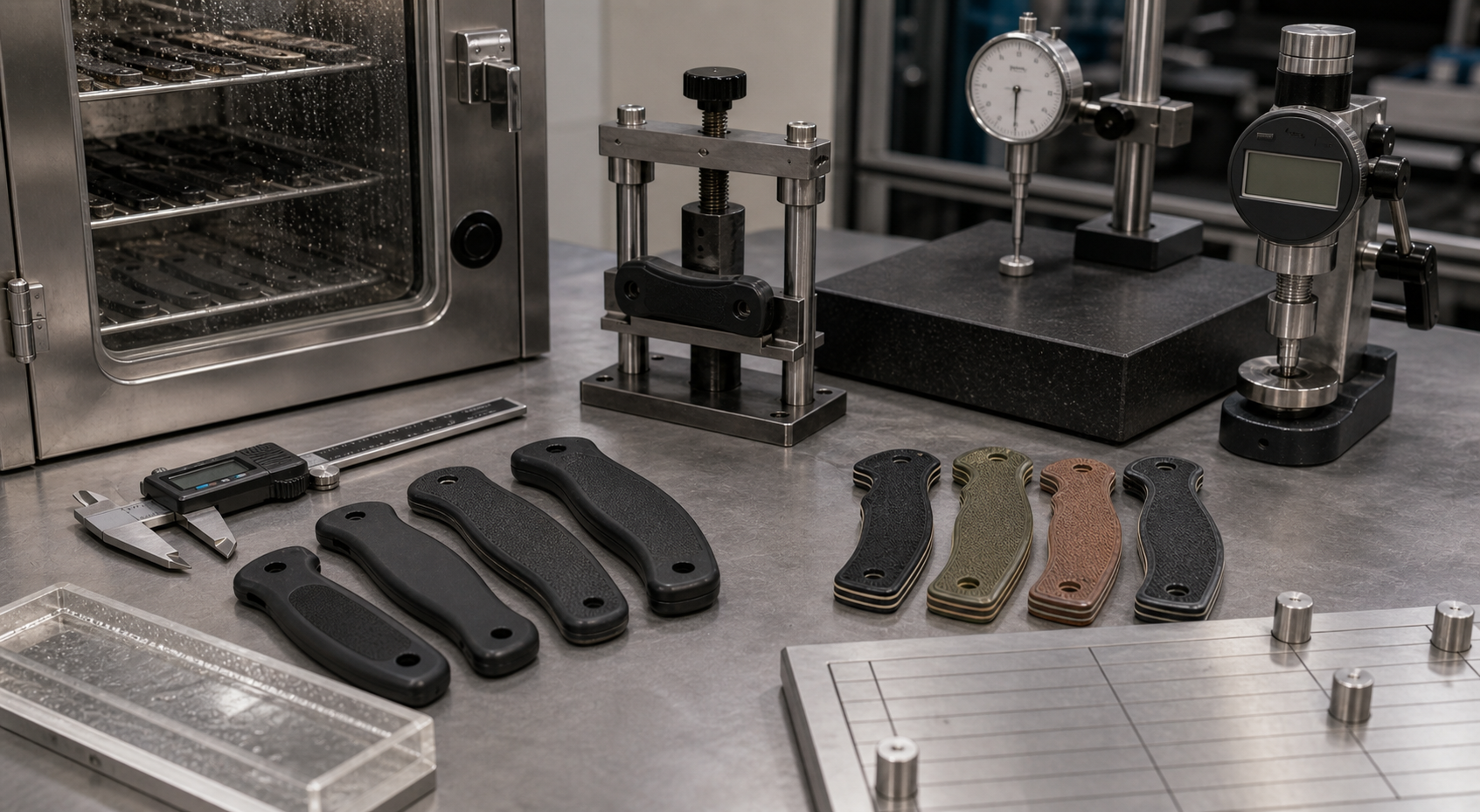
Grivory grades can offer stiffness, low moisture effect, and efficient molded production. G10 offers strong glass epoxy laminate behavior and dimensional stability. Buyers must match the material to the handle structure.
I Check Grade and Geometry Together
EMS-GRIVORY lists Grivory GV characteristics such as high stiffness and strength, little change in property values after moisture absorption, low dampness and water absorption, dimensional stability, low warpage, chemical resistance, good surface quality, and efficient production. Those are useful material directions for knife handles. But I still do not treat the material name as a finished-product guarantee. A thin molded handle with weak screw bosses can fail even if the resin family is good.
Curbell describes G10/FR-4 as strong, stiff, dimensionally stable, and useful for mechanical applications that require strength, stiffness, and creep resistance. This is why G10 is trusted for many handle scale designs. But G10 also has production concerns. Curbell notes that G10/FR-4 can be abrasive on cutting tools and that machining dust can be irritating. This matters for tool life, dust extraction, and finishing quality.
The real design question is where the load goes. A folding knife handle must support pivot screws, body screws, pocket clip screws, lock parts, spacers, and repeated opening and closing forces. A fixed blade handle must support tang shape, fasteners, adhesives, and impact from use. With Grivory, I look at rib design, boss thickness, material flow, shrinkage, and warpage. With G10, I look at thickness, flatness, hole location, edge finish, and liner support.
| Technical factor | Grivory focus | G10 focus | Buyer action |
|---|---|---|---|
| Stiffness | Grade and reinforcement level | Sheet grade and thickness | Ask for material grade and sample test |
| Moisture behavior | Grade data and molded geometry | Laminate stability and finish | Check use environment |
| Screw support | Boss design and wall thickness | Hole tolerance and liner support | Test clip and body screw strength |
| Warpage | Mold flow and cooling | Sheet flatness and machining stress | Inspect assembled knives, not only parts |
Which Material Gives Better Cost Control for Volume OEM Orders?
Cost is not only material price. Tooling, labor, reject risk, finishing time, and MOQ all change the real quote.
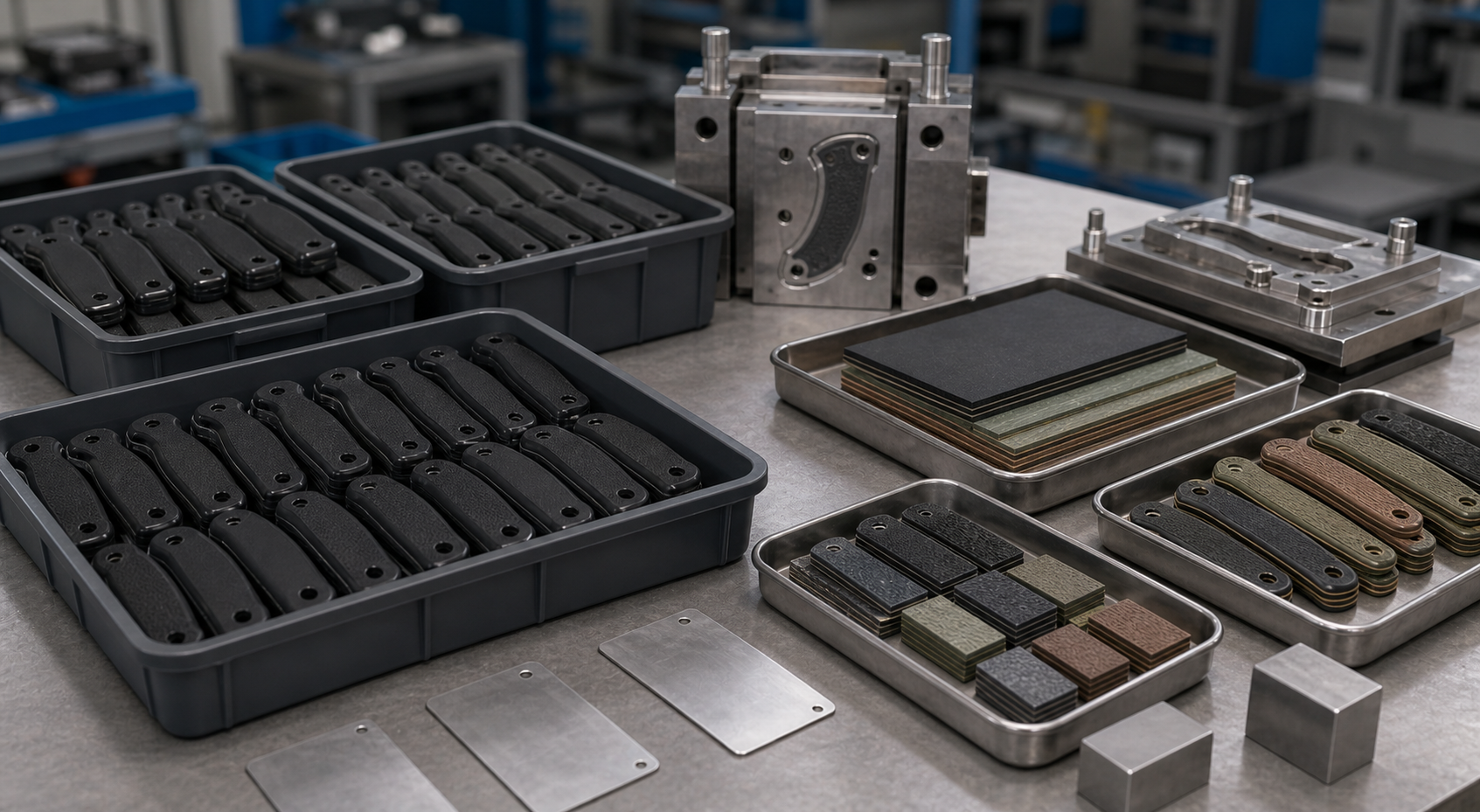
Grivory can be cost-efficient for high-volume molded handles after tooling. G10 can be better for smaller batches, premium texture, and projects that need design changes without mold revision.
I Compare Total Project Cost, Not Only Part Cost
Grivory can look very attractive when the buyer needs volume. Once the mold is made and validated, one molded handle can include shape, texture, color, ribs, screw features, and surface detail in one process. This can reduce machining and hand-finishing time. For value EDC, utility, rescue, or private label products, that can help the buyer hold a target price.
But the mold is not free. The buyer must consider tooling cost, mold lead time, trial samples, resin selection, color matching, shrinkage control, and the minimum order needed to justify the mold. If the buyer expects only a small batch or frequent changes, Grivory may not be the most practical route. A change to clip position, screw boss size, texture, or wall thickness can mean tool modification.
G10 has a different cost curve. The supplier buys sheet stock, cuts the handle profile, drills holes, machines texture, and finishes edges. The per-piece cost may be higher for complex shapes, but the development path is often more flexible. It can be easier to make sample adjustments without rebuilding a mold. This is helpful for a new brand testing the market, or for a mid-range model where material feel is part of the selling point.
My RFQ advice is simple. Ask for two quotes if the design allows it. One quote can be a molded Grivory direction with tooling noted separately. The other can be a G10 scale direction with machining and finishing included. Then compare total cost at the real order quantity.
| Cost factor | Grivory | G10 | RFQ instruction |
|---|---|---|---|
| Upfront cost | Mold and trial cost can be important | Lower tooling need in many cases | Separate tooling from unit cost |
| Unit cost at volume | Can be efficient after validation | Depends on CNC time and finish | Quote at several quantities |
| Design flexibility | Mold changes can be costly | CNC changes can be easier | Use G10 for early design testing |
| Cosmetic labor | Mold surface controls many details | Edge and texture finishing need labor | Ask what is included in QC |
What Quality Checks Should Buyers Use Before Production?
A sample can pass a quick photo review and still fail in assembly. Quality control must match the material process.
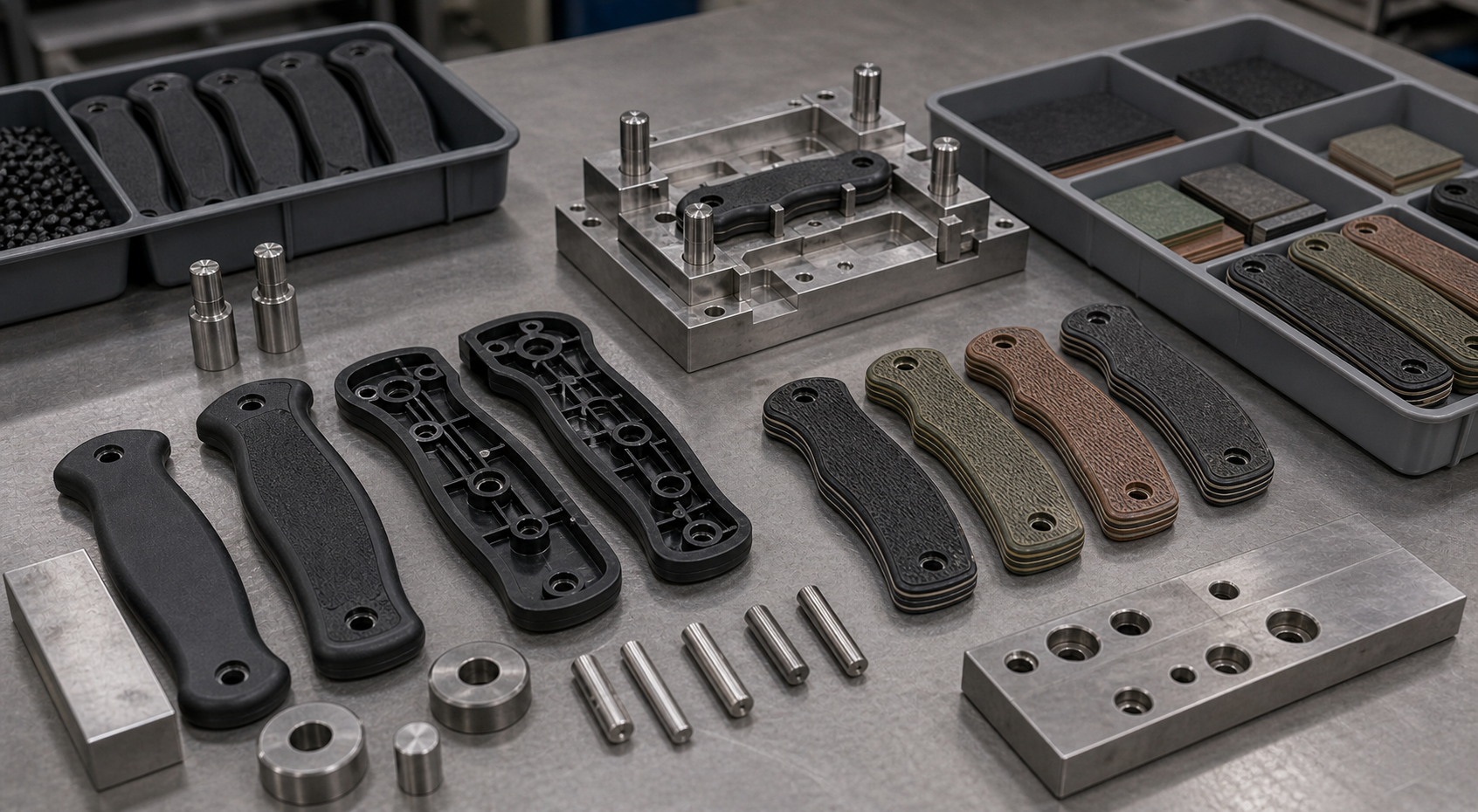
For Grivory, check molding defects, warpage, screw bosses, texture, color, and fit. For G10, check thickness, flatness, machining marks, texture depth, edge finish, hole tolerance, and assembly consistency.
I Use Different QC Lists for Different Processes
The quality checklist should follow the process. ISO explains that ISO 9001 supports clear processes, customer needs, variation control, performance data, and evidence-based improvement. I use that thinking when I help buyers approve handle materials. A molded handle and a machined laminate scale do not fail in the same way, so they should not use the same inspection list.
For Grivory, I check injection molding quality. The buyer should look for sink marks, flow lines, short shots, flash, warpage, weak screw bosses, unstable clip support, color difference, and texture inconsistency. The handle should fit the liner or internal structure without forcing. Screws should seat correctly. The part should not twist the assembly or create blade centering problems.
For G10, I check machining quality. The buyer should inspect thickness, flatness, hole size, hole position, edge chamfer, texture depth, visible machining marks, dust residue, and cosmetic consistency. The handle should feel secure without sharp edges. If the texture is aggressive, the buyer should test pocket wear.
Both materials need full assembly testing. The handle is not an isolated decoration. It affects pivot feel, lock alignment, blade centering, clip strength, and user confidence. Final approval should include assembled samples, not only loose handle parts.
| QC area | Grivory check | G10 check | Why it matters |
|---|---|---|---|
| Dimensional fit | Warpage and molded tolerance | Flatness and CNC tolerance | Protects assembly consistency |
| Screw support | Boss strength and clip pad | Hole quality and liner support | Protects long-term use |
| Surface quality | Flow lines, flash, sink marks | Machining marks and edge finish | Protects buyer perception |
| Functional assembly | Fit with liners and hardware | Fit with liners and hardware | Protects blade centering and action |
Which Material Should Buyers Choose for Different Knife Markets?
One material cannot serve every market. A buyer should connect material choice with price tier, user need, and sales story.
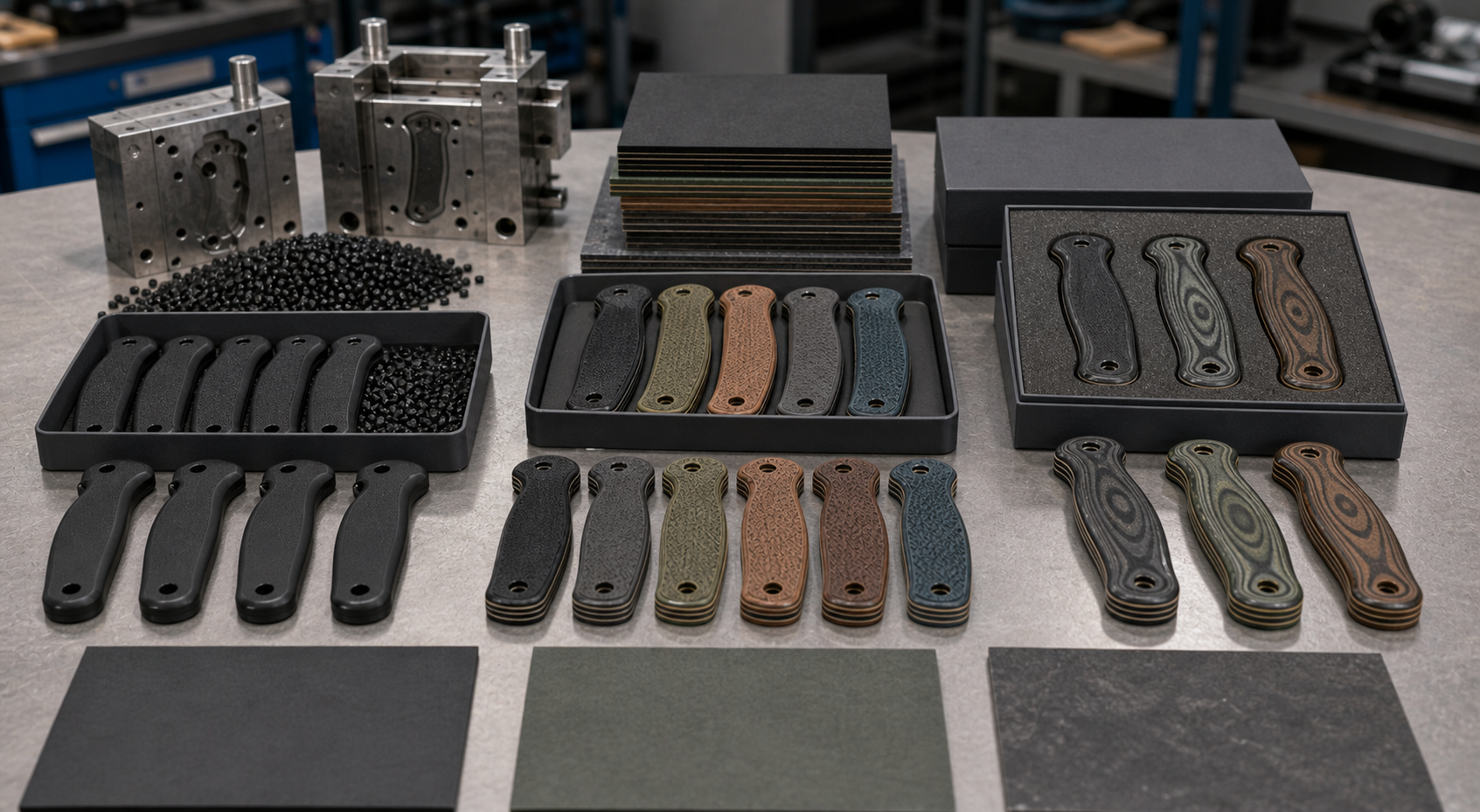
Choose Grivory for value-focused molded EDC, utility, rescue, and high-volume private label knives. Choose G10 for mid-range or higher-positioned knives that need stronger grip, machined feel, and material appeal.
I Build a Product Map Before I Quote
For a value EDC knife, Grivory can be a strong option. The molded handle can keep weight and cost under control while still giving useful shape and texture. For rescue tools or utility knives, molded features can help create finger grooves, grip zones, and color options. If the brand needs a large private label run with stable pricing, Grivory may be worth serious review.
For a tactical-style folder, outdoor folder, or mid-range EDC product, G10 may give a stronger selling feel. The user can see and feel a machined scale. The texture can be more aggressive. The handle can look more like a serious component than a molded shell. This can support a higher retail position if the rest of the knife matches that level.
There are also hybrid strategies. A buyer may use Grivory for a volume model and G10 for an upgraded version. This creates a clear good-better product ladder. The same blade shape can sometimes support different handle options, but the structure must be designed for that from the beginning.
At Vast State, I prefer to show buyers at least two material directions when the target is not fixed. A molded Grivory direction can show cost and volume potential. A G10 direction can show texture and positioning potential. The buyer can then choose based on margin, user expectation, and brand promise.
| Knife market | Stronger material direction | Why it fits | Buyer warning |
|---|---|---|---|
| Value EDC | Grivory | Molded shape and cost control | Mold cost needs volume |
| Rescue or utility tool | Grivory | Integrated texture and color options | Check screw bosses and clip support |
| Mid-range outdoor folder | G10 | Strong grip and solid feel | Control CNC and finishing cost |
| Tactical-style folder | G10 | Texture and perceived toughness | Avoid overly harsh pocket texture |
Turn your idea into a quote-ready knife project.
Share your drawing, sample photo, target quantity, market, and packaging needs. Vast State will review manufacturability and prepare OEM/ODM options.
Conclusion
I choose Grivory for molded volume efficiency and G10 for machined grip, stronger feel, and higher material positioning.
Source Notes
- EMS-GRIVORY Grivory GV supports the description of Grivory GV as a semi-crystalline, partially aromatic polyamide supplied for injection molding or extrusion.
- EMS-GRIVORY Grivory HT supports broader Grivory family context, including high-temperature polyamide positioning and low moisture-effect claims for HT grades.
- Curbell G10/FR-4 glass epoxy supports the G10 structure, sheet form, strength, stiffness, dimensional stability, and machining concern discussion.
- OSHA composites overview supports the general composite definition and the need to consider manufacturing exposure when cutting or sanding composites.
- ISO 9001 explained supports the process-control and evidence-based quality approach used in the QC section.