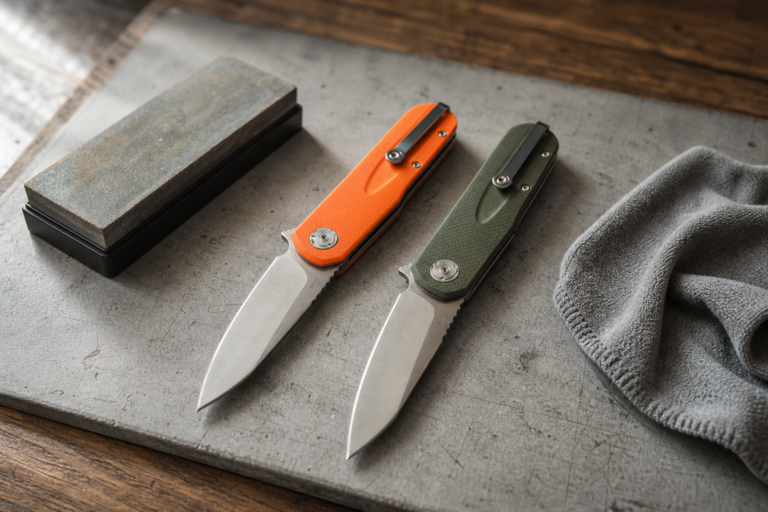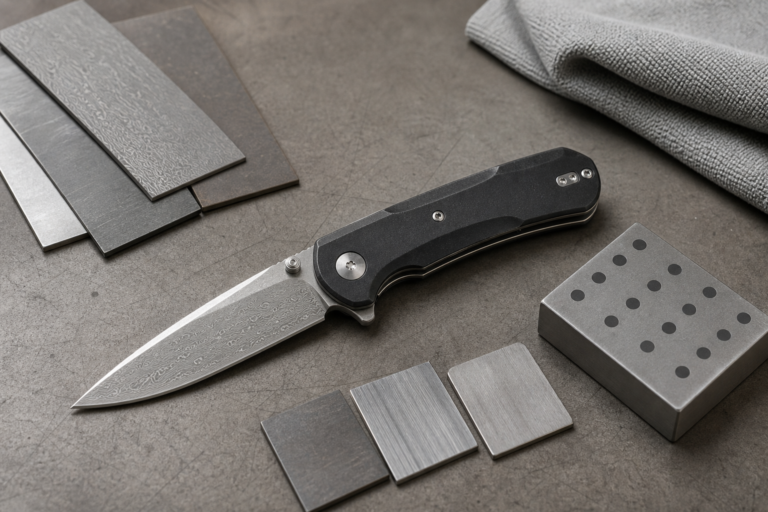
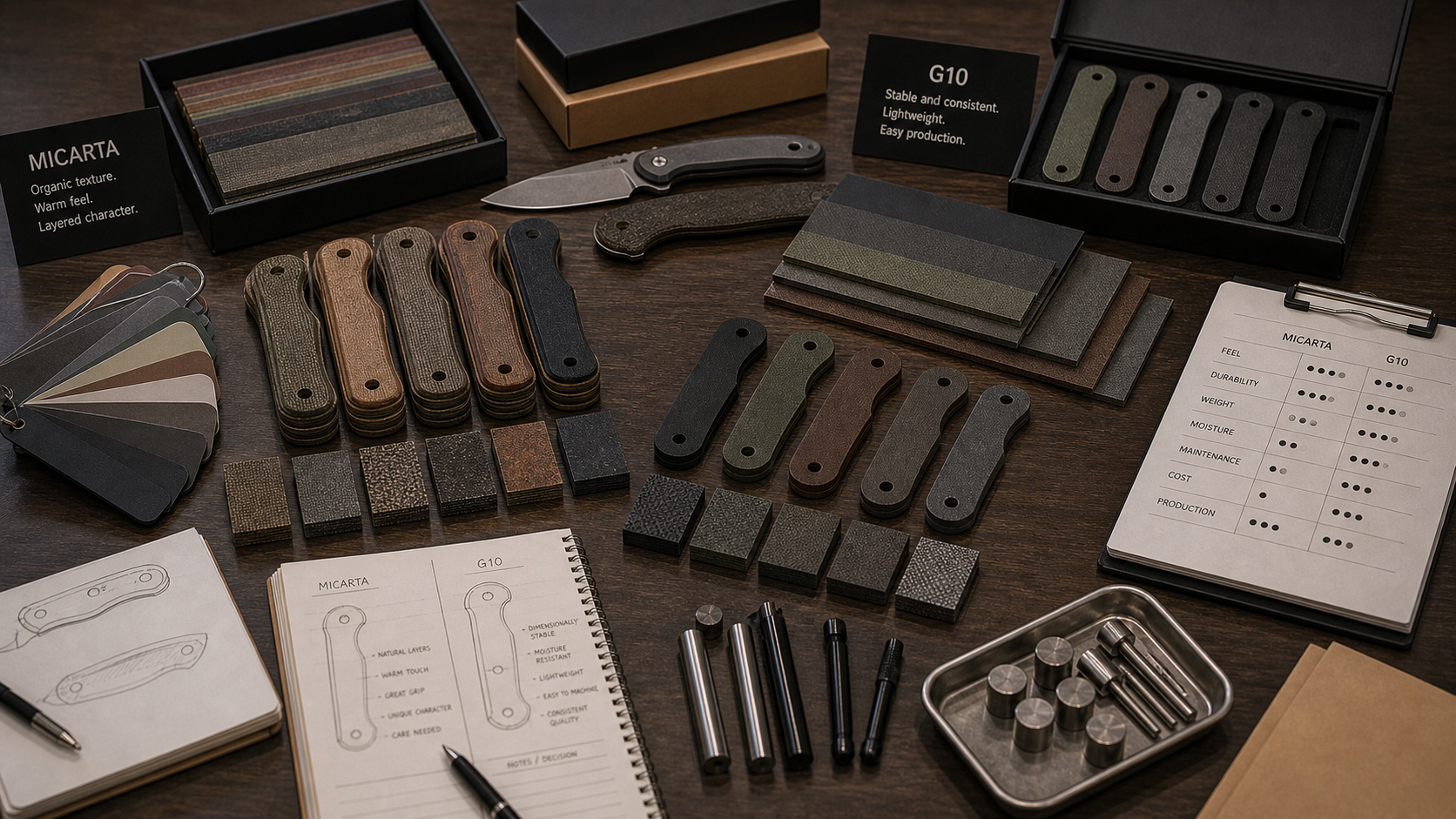
A handle can sell a knife or weaken it. If buyers choose by trend only, the final product may miss the real user.
Micarta is better for warm touch, natural texture, and outdoor storytelling. G10 is better for controlled grip, color consistency, and repeat OEM production. Buyers should choose by target market, hand feel, moisture exposure, machining needs, cost range, and cosmetic standard.
Quick buyer brief:
- Answer: Choose Micarta for natural feel and outdoor character; choose G10 for sharper texture control and stable repeat production.
- Buyer context: This helps knife brands, importers, private label buyers, and sourcing managers compare handle materials before RFQ.
- Key checks: Confirm material grade, thickness, texture, color tolerance, edge finishing, screw support, moisture expectations, MOQ, target price, and QC standard.
Have a knife or multi-tool project in mind?
Send your sketch, CAD file, sample photo, or product idea. Vast State can review manufacturability, suggest materials, estimate MOQ, and prepare a quote for your OEM/ODM project.
When I help a buyer compare Micarta and G10, I do not ask which material is "best" first. I ask where the knife will be sold, who will use it, and what the brand wants the customer to feel. A rugged outdoor knife, a budget EDC knife, a tactical folder, and a private label gift knife need different handle logic. Micarta and G10 can both make strong handle scales. But they do not create the same touch, the same production risk, or the same product story.
What Are Micarta and G10 Handle Materials?
Material names can hide important differences. If the buyer does not understand the structure, the RFQ can become vague fast.
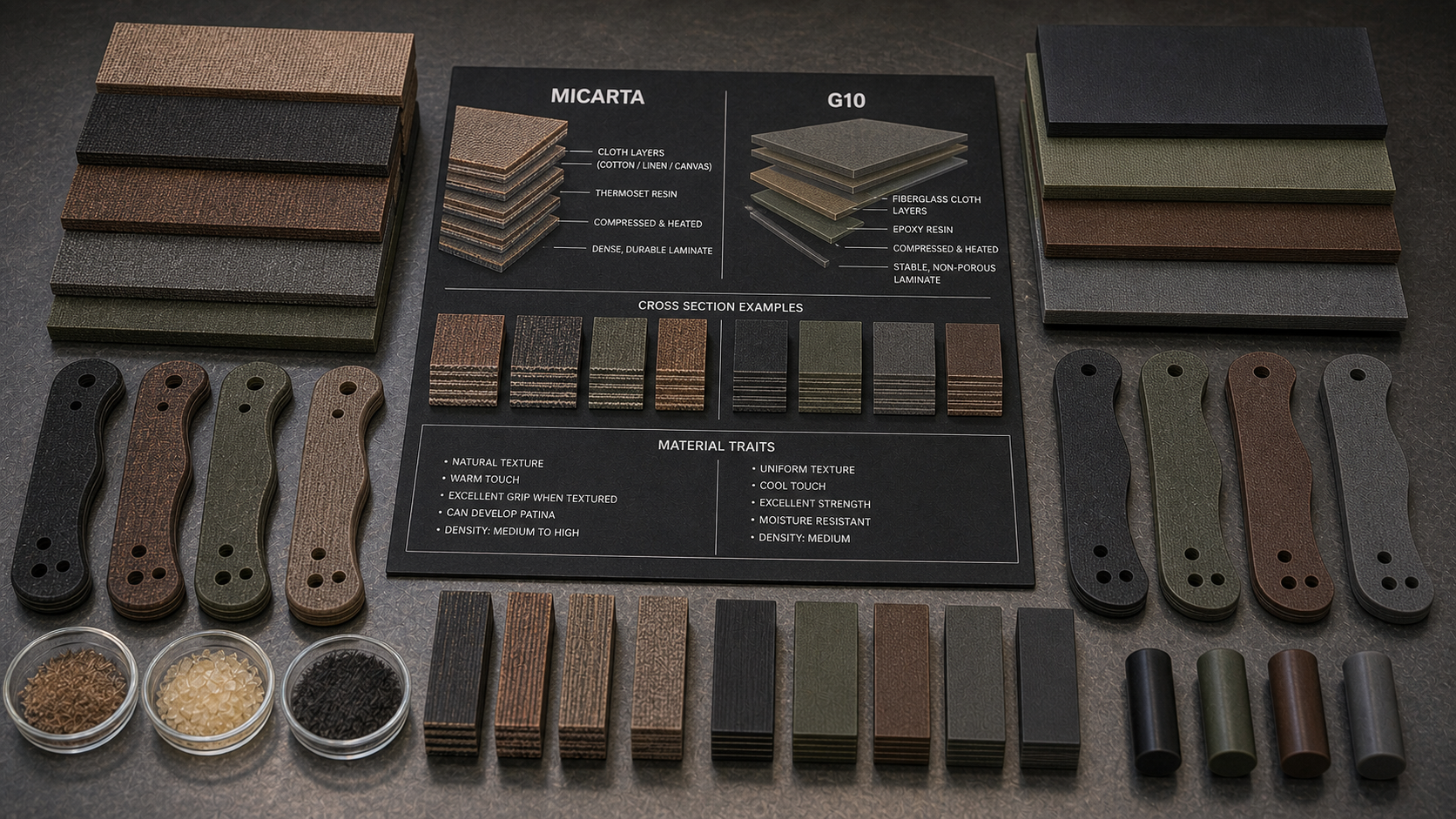
Micarta is usually a fabric or paper reinforced phenolic laminate. G10 is a glass fabric and epoxy laminate. Both are composites, but their fibers, resin systems, texture, and production behavior are different.
I Start With the Laminate, Not the Name
Micarta and G10 are both layered composite materials, but the buyer should not treat them as the same product with different colors. Norplex-Micarta describes paper and cotton phenolic Micarta as a laminated composite style that uses paper or cotton fabric reinforcement with phenolic resin. The same source shows paper, linen, canvas, and burlap versions. That matters for knife handles because each substrate creates a different surface, edge look, and hand feel.
G10 has a different base structure. Curbell describes G10/FR-4 glass epoxy as glass woven fabric bonded with epoxy resin, with minimal water absorption, high mechanical strength, and dimensional stability. In knife production, those traits help with stable handle scales, clear machining, and predictable texture.
OSHA gives a broader definition of polymer matrix composites, explaining that a composite combines a reinforcing fiber with a resin matrix. That definition helps buyers understand the logic. Micarta is not only "old-school." G10 is not only "modern." Both are reinforced laminates. The real question is which reinforcement, resin, surface finish, and production standard fit the product.
For OEM and ODM knife projects, I ask the buyer to define the material more clearly than "Micarta handle" or "G10 handle." I want to know canvas or linen, color layer, thickness, surface finish, chamfer style, screw support, and acceptable color variation. The clearer the material definition, the easier it is to make the sample match mass production.
| Material point | Micarta | G10 | Buyer takeaway |
|---|---|---|---|
| Reinforcement | Paper, canvas, linen, burlap, or similar substrate | Woven glass fabric | The base layer changes texture and appearance |
| Resin style | Often phenolic for common knife-handle use | Epoxy resin | Different resin systems affect machining and finish |
| Visual character | Organic, warm, layered, sometimes varied | Cleaner, sharper, more uniform | Choose by brand story and cosmetic tolerance |
| RFQ wording | Specify type, color, thickness, finish | Specify color, thickness, texture, finish | Do not use only a generic material name |
OEM/ODM RFQ Checklist
Prepare these details to help Vast State review your project and provide a more accurate quotation.
| RFQ Field | What to Prepare |
|---|---|
| Project type | OEM from drawing / ODM private label / wholesale catalog |
| Product category | Folding knife / fixed blade / multi-tool / outdoor tool |
| Design status | Idea / sketch / 2D drawing / 3D CAD / physical sample |
| Target price | Ex-factory target price or retail price range |
| MOQ expectation | 500 / 1,000 / 3,000 / 5,000+ pcs |
| Logo method | Laser engraving / etching / printing / molded logo |
| Packaging | Standard packaging / custom retail box / Amazon-ready |
| Market | USA / EU / Japan / Korea / Middle East / other |
| Compliance needs | Buyer-specified testing / documentation / labeling |
| Timeline | Sample deadline / mass production deadline |
Which Material Gives Better Grip and Hand Feel?
A handle can look strong in photos but feel wrong in use. That mismatch creates weak reviews and slow repeat orders.
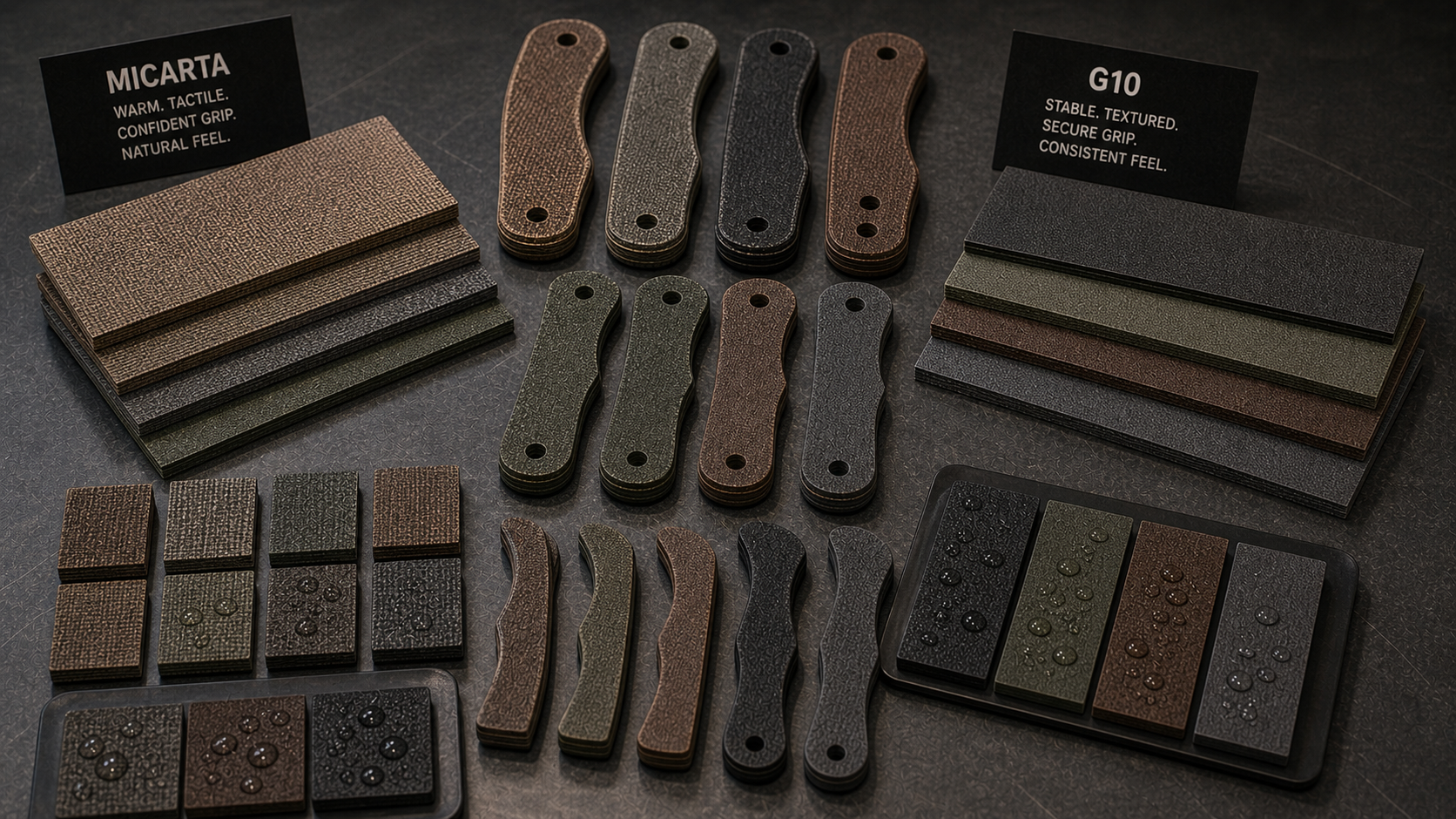
Micarta often feels warmer and more natural in hand. G10 usually gives more controlled traction because CNC texture and surface patterns can be specified more sharply.
I Match Texture to the User's Hand
Micarta is popular because it gives a softer and warmer feeling than many hard synthetic handles. Canvas Micarta can feel grippy without looking too technical. Linen Micarta can feel smoother and more refined. Paper Micarta can support cleaner decorative effects. This gives buyers a useful range. A camping knife, bushcraft-style knife, or heritage outdoor product often benefits from Micarta because the material supports a practical but less industrial story.
G10 gives a different kind of control. It can be machined with deep grooves, crosshatch patterns, raised panels, or cleaner flat surfaces. If the buyer needs a tactical-style folder, rescue tool, work knife, or EDC model that must feel secure in wet or dusty conditions, G10 can be easier to specify. The texture can be aggressive or moderate. The supplier can adjust the pattern based on target use and pocket comfort.
The risk with both materials is over-design. A coarse G10 texture can tear pockets or feel too sharp. A smooth Micarta scale can look beautiful but feel too mild for a working knife. I ask buyers to test the handle with dry hands, wet hands, and gloves when the target market requires it. I also check chamfers. A good handle should grip the hand without hurting the hand.
| Feel factor | Micarta behavior | G10 behavior | Practical decision |
|---|---|---|---|
| Warm touch | Usually stronger | Usually cooler and harder | Use Micarta for natural outdoor feel |
| Grip control | Good with canvas texture | Very controllable with CNC texture | Use G10 when exact traction matters |
| Pocket comfort | Depends on fabric and finish | Depends on texture depth | Test carry feel before approval |
| Edge comfort | Needs clean chamfering | Needs clean chamfering | Do not approve only by top-view photos |
How Do Micarta and G10 Compare for Moisture, Dirt, and Daily Use?
Outdoor knives face sweat, rain, dust, and pocket debris. If the handle finish is wrong, the product ages badly.
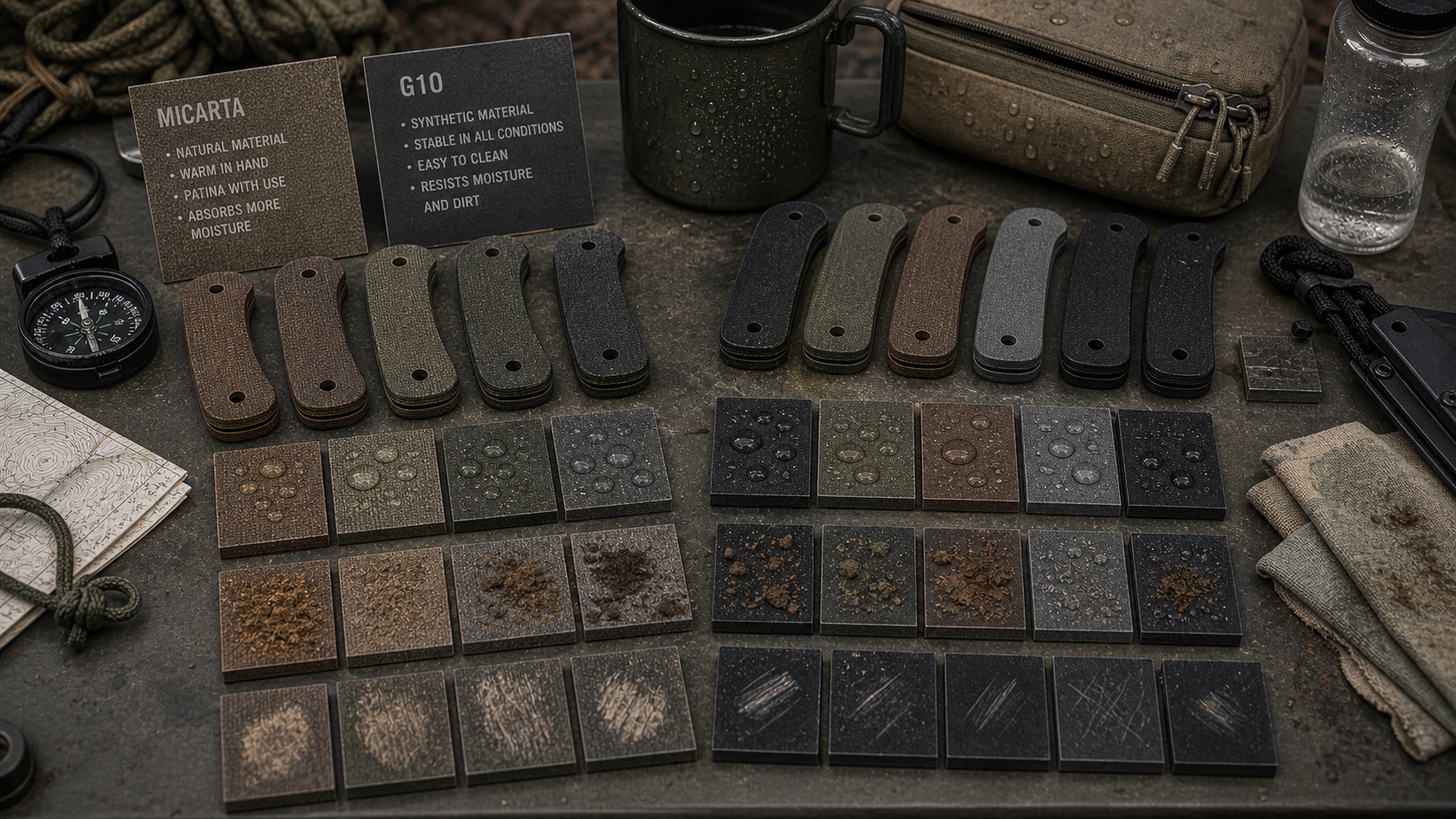
G10 usually offers stronger moisture stability and easier wipe-clean behavior. Micarta can work well outdoors, but buyers should define finish, sealing, texture, and acceptable color change before mass production.
I Separate Real Use From Marketing Language
Many buyers want a handle material that can be sold as outdoor-ready. That phrase is too broad. A buyer needs to ask what kind of outdoor use. A camping knife may face wet hands and dirt. A pocket knife may face sweat and fabric lint. A tactical-style product may need secure grip with gloves. A collector product may need a cleaner cosmetic surface more than dirt resistance.
G10 is often the easier answer when the buyer wants a synthetic handle that resists water exposure and keeps a stable shape. Curbell's description of G10/FR-4 mentions minimal water absorption and dimensional stability. I do not turn that into a promise that every knife handle will perform the same in every condition. The final result still depends on sheet quality, machining, screw holes, liners, edge finishing, and assembly. But G10 gives a clear material direction for moisture-sensitive products.
Micarta can also be excellent for outdoor knives. The texture can feel more secure as it wears in. It can show character. Some users like that. But for B2B buyers, character must be controlled. If color darkens with handling, if oil changes the surface tone, or if fabric layers show differently from piece to piece, the brand must decide whether that is a feature or a defect. I prefer to define this early. A buyer should approve both a fresh sample and a handled sample when the material story depends on natural texture.
| Use condition | Micarta consideration | G10 consideration | Buyer check |
|---|---|---|---|
| Wet hands | Texture can help, finish matters | Strong choice when textured | Test grip after light water exposure |
| Dirt and dust | Surface can hold character | Easier to wipe when not overly coarse | Confirm cleaning expectation |
| Pocket carry | Softer feel can be friendly | Aggressive texture can wear fabric | Balance grip and carry comfort |
| Color aging | Can look natural or inconsistent | Usually more stable visually | Define acceptable variation |
Which Material Is Easier to Machine and Finish in OEM Production?
A prototype can hide production pain. If machining and finishing are slow, cost and lead time can move quickly.
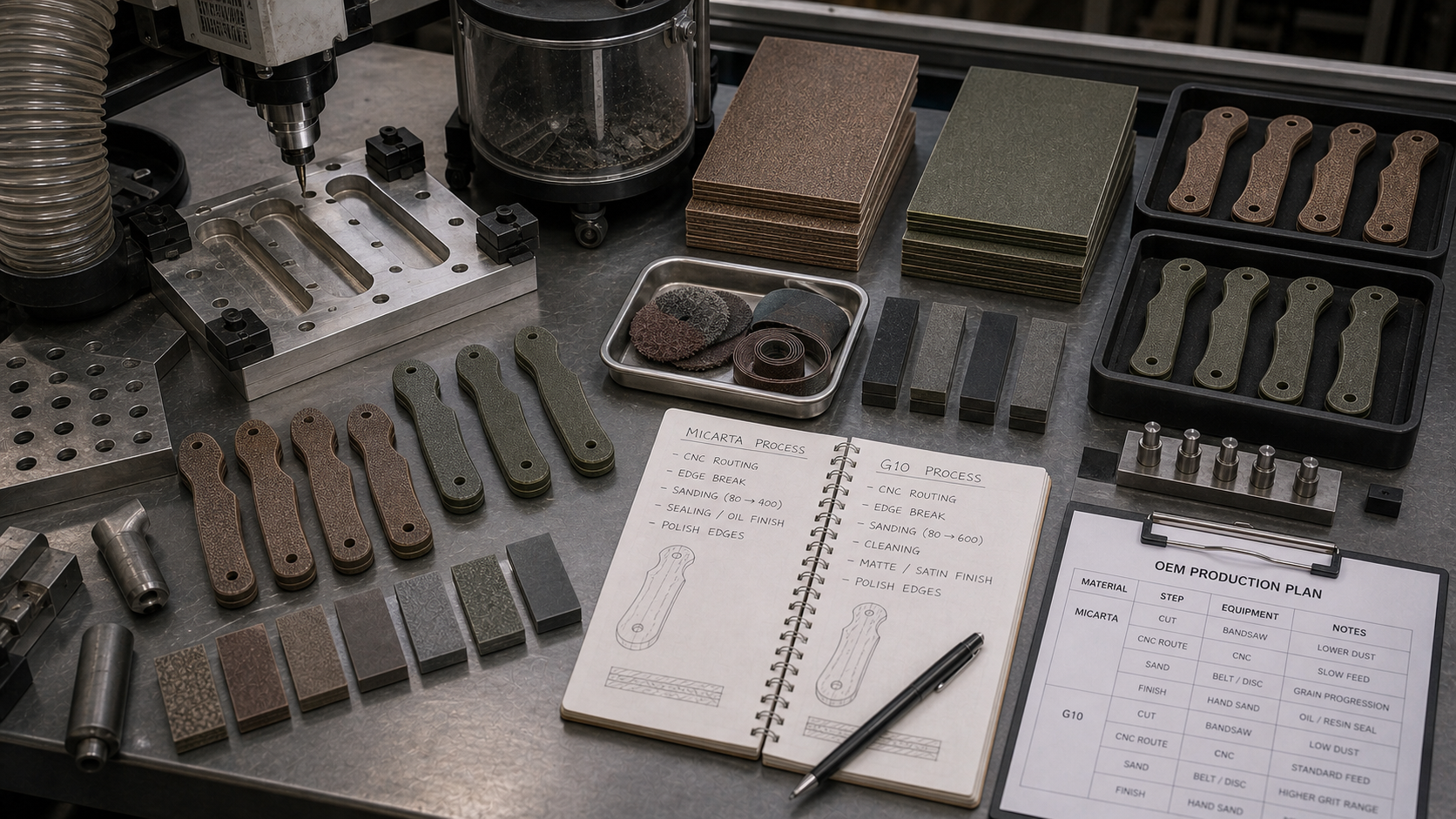
G10 is usually easier to control for repeat machining and texture. Micarta is also workable, but fabric type, resin, dust, edge appearance, and surface finishing need careful agreement.
I Look at Tooling, Dust, and Edge Quality
In knife production, handle material is not only a sheet on a drawing. It becomes screw holes, pivot clearance, clip mounting points, chamfers, contouring, surface texture, and final hand feel. G10 is familiar in many knife factories because it cuts cleanly with the right tools and gives repeatable surface texture. It still needs dust extraction, tool wear control, and proper edge finishing. But it is usually easier to standardize across larger OEM orders.
Micarta can also machine well, but its fabric and resin style matter. Norplex-Micarta's NP325 page notes that a linen phenolic laminate can be suitable for smaller and more intricate shapes than a comparable canvas grade. I do not use that source to claim one knife material is always better. I use it to show why buyers should ask about grade, substrate, and machining needs. Canvas, linen, burlap, and paper-based materials do not behave exactly the same at the edge.
Dust control is also important. OSHA's composites overview explains composite materials and points to potential exposure issues in composite manufacturing. For knife handles, the practical point is simple. Cutting and sanding composite laminates should be controlled with dust collection, PPE, and clean process habits. This protects workers and helps keep the finish clean.
When I quote a Micarta or G10 handle, I do not only quote material cost. I look at CNC time, fixture setup, edge work, manual finishing, reject risk, and inspection time. A simple flat G10 scale and a contoured canvas Micarta scale can have very different production costs.
| Production item | Micarta | G10 | What I ask before quoting |
|---|---|---|---|
| CNC cutting | Depends on grade and fabric | Usually predictable | Shape, holes, contour, and tolerance |
| Surface finishing | Can need more hand control | Can be standardized by texture | Matte, polished, blasted, or milled |
| Edge appearance | Fabric layers may show | Cleaner laminate edge | Chamfer style and acceptable edge look |
| Dust control | Required during cutting and sanding | Required during cutting and sanding | Factory process and cleanup standard |
How Should Buyers Compare Cost, MOQ, and Color Options?
The wrong material choice can push a knife beyond its target price. A nice handle still has to sell.
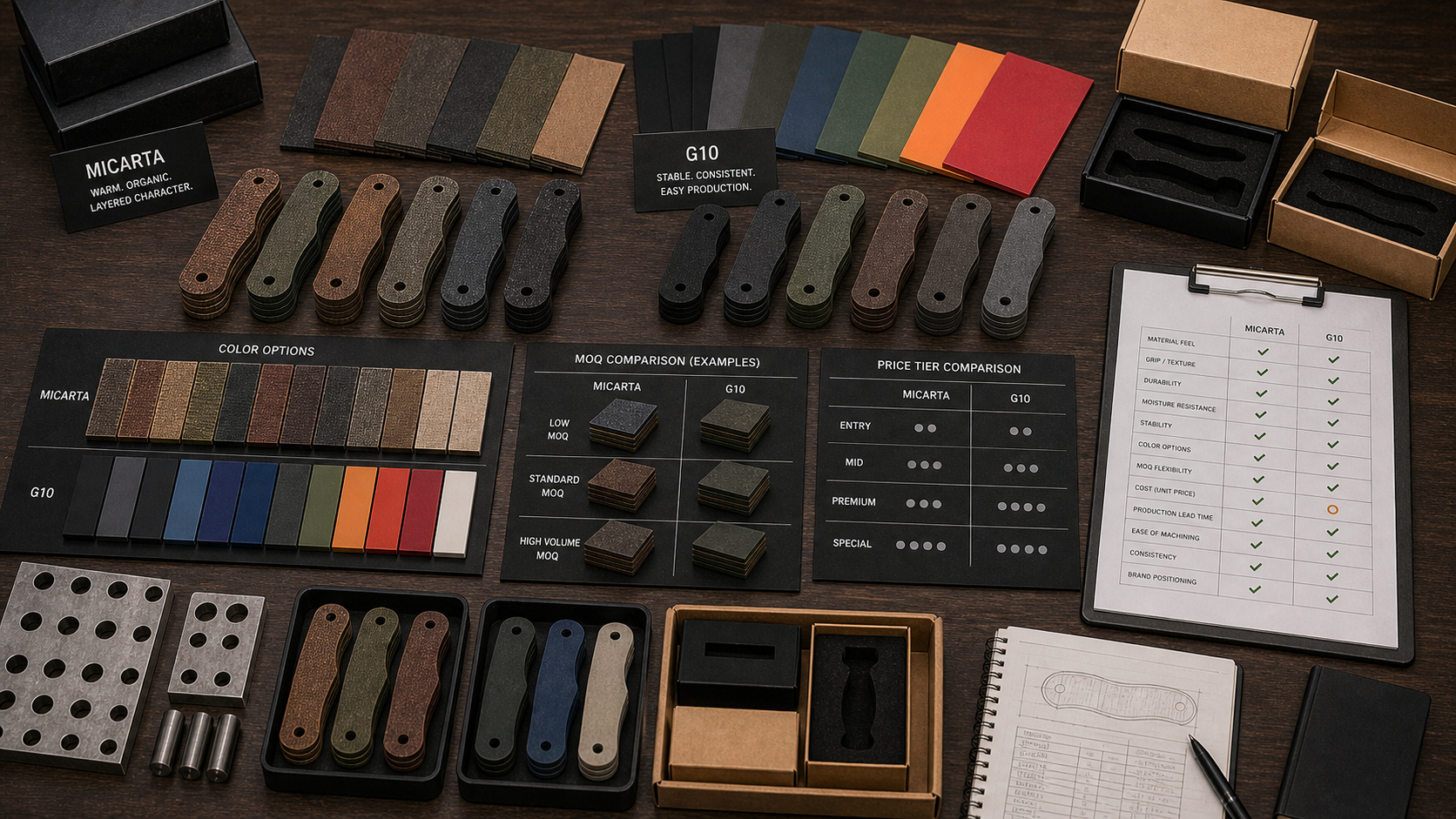
G10 often gives better cost and color control for volume orders. Micarta can support stronger outdoor branding, but MOQ, color availability, sheet yield, and finishing labor must be checked.
I Connect Material Choice to the Sales Channel
For B2B buyers, the handle material must fit the full business case. The target price, expected margin, retail channel, packaging level, and order quantity all matter. G10 often wins when the buyer wants many colors, stable repeat production, and a clear value-to-performance balance. It can work for entry-level, mid-range, and higher-tier products depending on texture, color, machining, and overall knife design.
Micarta often wins when the buyer wants a product story. Outdoor buyers may like canvas Micarta because it feels connected to field use. A traditional pocket knife line may use linen or paper Micarta for a warmer look. A private label camping brand may choose earth-tone Micarta because it fits packaging and brand identity. That story can justify the material if the target customer values it.
MOQ is where many projects become real. Some Micarta colors or layered combinations may require minimum volumes. Some G10 colors are easier to source, while custom colors may still need planning. Sheet yield also matters. A large handle, deep contour, or unusual shape can waste material. If the buyer only compares sheet price, the quote may be misleading.
My RFQ advice is practical. Send the target price, expected annual volume, first order quantity, handle thickness, color requirement, texture level, finish, packaging style, and target market. If the project is still flexible, ask the supplier for two options. One option can be a cost-controlled G10 version. The other can be a Micarta version with stronger outdoor positioning. This gives the buyer a real decision instead of a guess.
| Business factor | Micarta impact | G10 impact | RFQ instruction |
|---|---|---|---|
| Target price | Can rise with special colors or hand finish | Often easier to control | Give target price early |
| MOQ | Some colors or laminates may need minimums | Common colors may be easier | Ask what is standard stock |
| Brand story | Strong outdoor and natural feel | Technical and practical feel | Match material to buyer persona |
| Sheet yield | Shape and contour affect waste | Shape and contour affect waste | Send drawing before final quote |
What Quality Checks Should Buyers Use Before Mass Production?
A handle sample can look good on day one. Mass production needs a written standard that the factory can repeat.
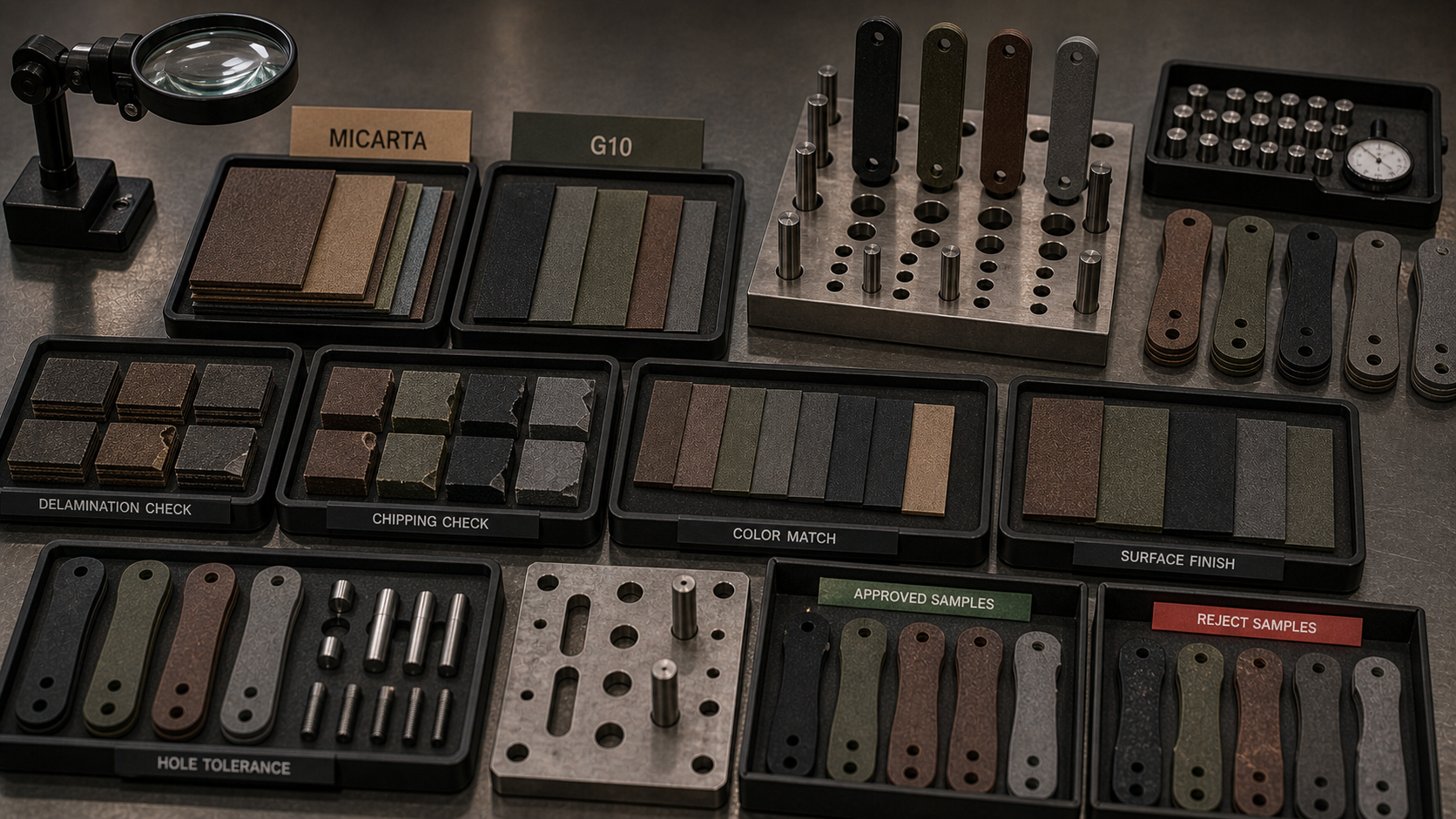
Buyers should check material identity, thickness, color range, texture, edge finish, screw fit, clip support, assembly feel, moisture expectation, cosmetic limits, and packed-product consistency before approval.
I Approve the Standard Before the Order Grows
Quality control should start before mass production, not after packing. ISO explains that ISO 9001 provides requirements for a quality management system and supports process clarity, variation control, and evidence-based improvement. I use that mindset even when the article topic is only handle material. The buyer needs a clear approved standard, not only a nice sample photo.
For Micarta, I check color range, layer visibility, fabric exposure, edge smoothness, surface feel, and whether the final look matches the buyer's brand. Some variation may be acceptable because the material has natural character. But acceptable variation must be written. If one batch looks warm brown and another looks much darker, the buyer and supplier need a shared answer before shipment.
For G10, I check thickness, flatness, color consistency, texture depth, CNC marks, chamfer size, screw fit, and pocket clip seating. G10 can look more uniform, so small cosmetic differences may stand out. A clean QC plan should define what is acceptable and what is not.
I also test the handle inside the full knife assembly. A good scale alone is not enough. The handle must align with liners, screws, pivot, lock area, clip, and packaging. For B2B buyers, this protects repeat orders. A material choice is only successful when the final knife feels consistent across the shipment.
| QC check | Why it matters | Micarta focus | G10 focus |
|---|---|---|---|
| Material identity | Prevents wrong substitution | Fabric and resin type | G10 color and sheet grade |
| Thickness and flatness | Protects assembly fit | Layer stability | Dimensional consistency |
| Texture and edge finish | Protects user feel | Natural feel without rough defects | Grip without sharp discomfort |
| Cosmetic limit | Prevents dispute | Define natural variation | Define color and machining marks |
Which Material Should Buyers Choose for Different Knife Markets?
One material cannot fit every knife line. Buyers need a market map before they lock the specification.
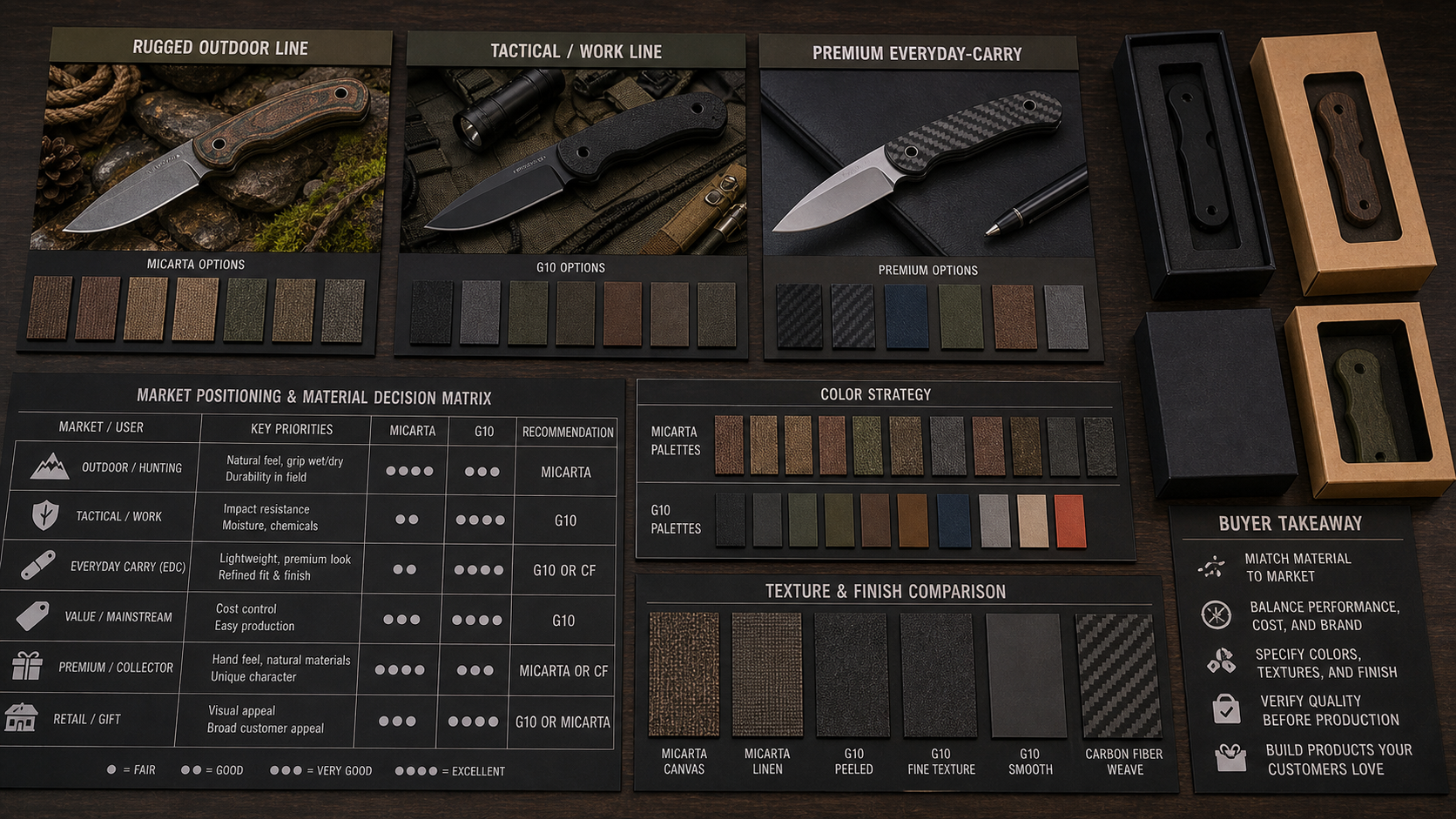
Choose Micarta for outdoor, heritage, camping, and warm-touch designs. Choose G10 for tactical, utility, budget EDC, and high-repeat private label lines. Hybrid strategies can also work.
I Choose by Product Role, Not Habit
When a buyer asks me which handle material to choose, I normally answer with a product map. If the knife is for a camping or bushcraft-style market, Micarta can support the story well. It feels warm, it looks natural, and it can make the knife feel more connected to outdoor use. If the knife is a tactical-style folder or rescue tool, textured G10 may be the safer direction because grip and repeatable traction are easier to define.
For everyday carry, both materials can work. A slim gentleman's EDC knife may use smooth linen Micarta for a softer look. A work EDC knife may use textured G10 for stronger grip. A private label buyer with several price tiers can use G10 for the main volume model and Micarta for a higher-positioned outdoor model. This keeps the product line clear.
The wrong approach is to choose a material only because the market talks about it. Buyers should test the handle with their target blade steel, lock type, weight target, packaging, and retail price. A Micarta handle on a low-price knife can become too costly if the finishing is complex. A plain G10 handle on a higher-end outdoor knife may feel too generic if the design does not add character.
At Vast State, I prefer to turn the question into two or three sample directions. A buyer can compare hand feel, weight, photos, cost, and assembly quality side by side. That makes the material decision much more practical.
| Knife market | Stronger material direction | Why it fits | Buyer warning |
|---|---|---|---|
| Camping and outdoor | Micarta | Warm feel and natural story | Define color variation |
| Tactical and rescue | G10 | Strong texture control | Avoid overly sharp texture |
| Budget EDC | G10 | Stable cost and color options | Keep design from looking generic |
| Heritage or gift line | Micarta | Softer and more traditional appearance | Control finish and packaging story |
Turn your idea into a quote-ready knife project.
Share your drawing, sample photo, target quantity, market, and packaging needs. Vast State will review manufacturability and prepare OEM/ODM options.
Conclusion
I choose Micarta for character and warm outdoor appeal, and G10 for controlled grip, cost, and repeatable OEM production.
Source Notes
- Norplex-Micarta paper, linen, and canvas Micarta supports the description of paper and cotton phenolic Micarta options and color/material variety.
- Norplex-Micarta NP325 gives context on linen phenolic machining and sheet tolerance resources, but it is one grade, not all knife Micarta.
- Curbell G10/FR-4 glass epoxy supports the G10 structure, water absorption, mechanical strength, and dimensional stability discussion.
- OSHA composites overview supports the general composite structure and worker-exposure context for machining and sanding.
- ISO 9001 explained supports the process-control and evidence-based quality mindset used in the QC section.