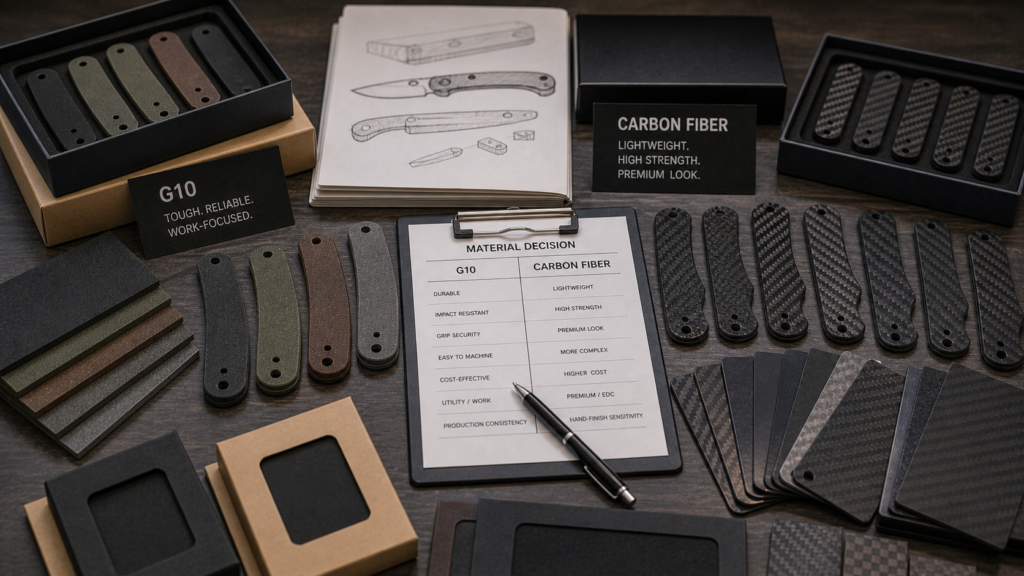
A handle material can make a knife feel right or wrong. If buyers choose by appearance only, complaints often appear after launch.
G10 is usually the safer choice for grip, color options, cost control, and repeat production. Carbon fiber is better when buyers want a lighter, more premium visual story. The best choice depends on target price, user grip needs, weight goal, machining control, and brand positioning.
Quick buyer brief:
- Answer: Choose G10 for practical grip and cost stability; choose carbon fiber for premium lightweight positioning.
- Buyer context: This helps knife brands, importers, private label buyers, and sourcing managers compare handle material choices.
- Key checks: Confirm texture, thickness, weight target, CNC time, edge finishing, dust control, cosmetic standard, packaging claim, MOQ, and target price.
Have a knife or multi-tool project in mind?
Send your sketch, CAD file, sample photo, or product idea. Vast State can review manufacturability, suggest materials, estimate MOQ, and prepare a quote for your OEM/ODM project.
When I review a handle material with a B2B knife buyer, I do not start with "which one looks better." I start with the user and the sales channel. A tactical-style folding knife, a gentleman's EDC knife, a value outdoor knife, and a gift-box collector knife should not all use the same handle logic. G10 and carbon fiber can both work well, but they solve different problems. The buyer needs to know which problem matters most.
What Are G10 and Carbon Fiber Handle Materials?
Material names sound simple. But buyers can still confuse structure, surface, cost, and real product performance.
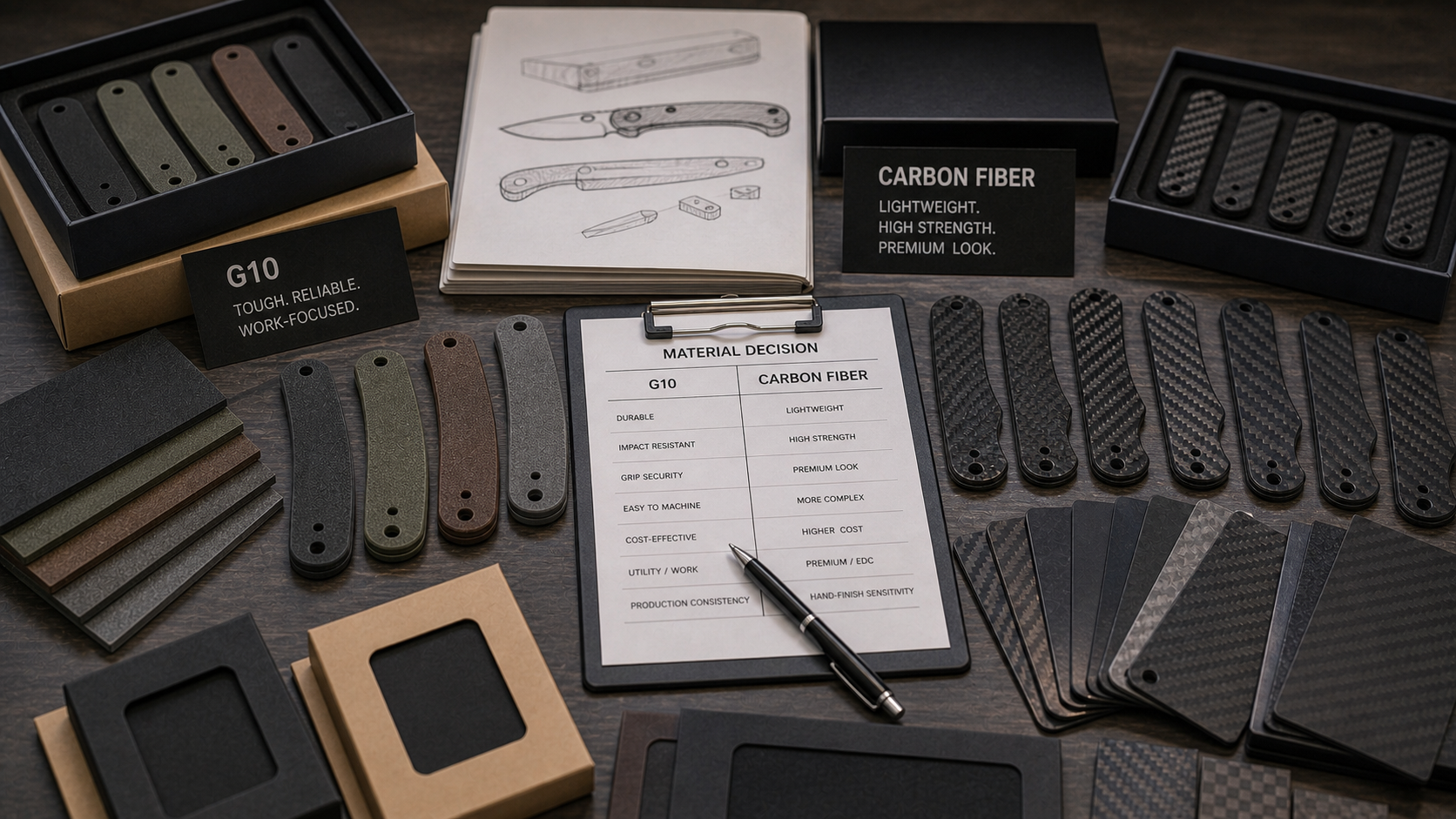
G10 is a glass fabric and epoxy laminate. Carbon fiber handles use carbon fiber reinforcement in a resin matrix or laminate. Both are composites, but they create different cost, weight, texture, and visual results.
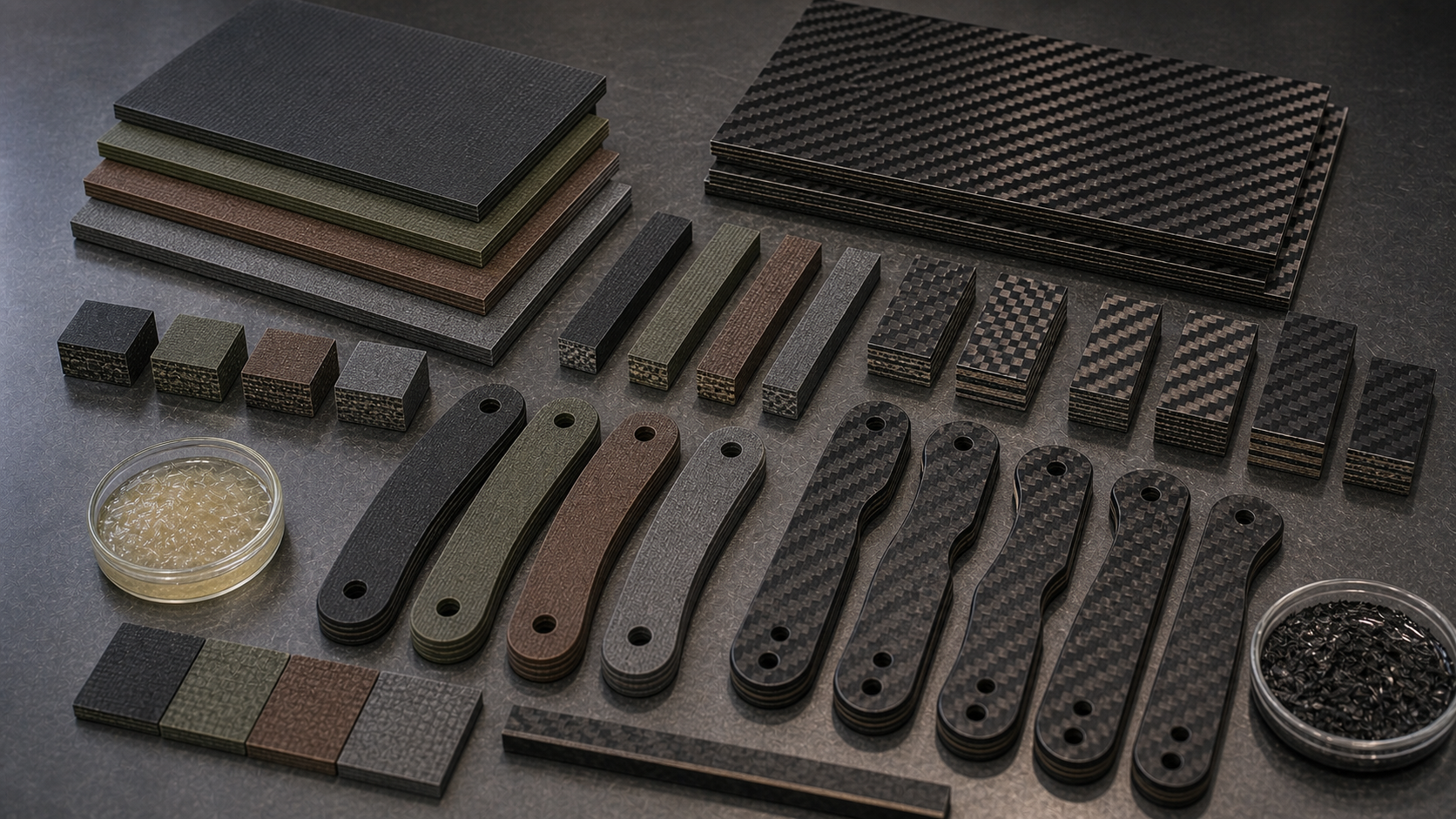
I First Explain the Composite Structure
The first practical difference is structure. G10 is normally made from woven glass fabric bonded with epoxy resin. Curbell describes G10/FR-4 glass epoxy as glass woven fabric bonded with epoxy resin, with high mechanical strength, minimal water absorption, and dimensional stability. This is why G10 is common in knife handles. It machines well, holds texture, accepts many colors, and gives a solid grip when shaped correctly.
Carbon fiber is also a composite, but the reinforcement is carbon fiber rather than glass fiber. OSHA describes polymer matrix composites as materials composed of a reinforcing fiber and a resin matrix. Toray also explains that carbon fiber and prepreg materials offer strength-to-weight advantages and design flexibility. In knife handles, this usually means a light and premium-looking scale when the laminate quality and finishing are controlled.
The mistake is to treat both materials as only surface decoration. They are working handle materials. The scale must support screws, liners, clips, chamfers, texture, pocket wear, moisture exposure, and repeated hand contact. A pretty sheet can still fail as a handle if the machining, edge finishing, or screw support is poor.
| Material | Basic structure | Buyer takeaway |
|---|---|---|
| G10 | Glass fabric plus epoxy resin | Practical, grippy, stable, color-friendly |
| Carbon fiber | Carbon fiber reinforcement plus resin | Light, premium-looking, stiffness-focused |
| Hybrid or overlay | Mixed layers or decorative face | Confirm what is structural and what is cosmetic |
| Fake pattern | Printed or molded look | Avoid misleading material claims |
OEM/ODM RFQ Checklist
Prepare these details to help Vast State review your project and provide a more accurate quotation.
| RFQ Field | What to Prepare |
|---|---|
| Project type | OEM from drawing / ODM private label / wholesale catalog |
| Product category | Folding knife / fixed blade / multi-tool / outdoor tool |
| Design status | Idea / sketch / 2D drawing / 3D CAD / physical sample |
| Target price | Ex-factory target price or retail price range |
| MOQ expectation | 500 / 1,000 / 3,000 / 5,000+ pcs |
| Logo method | Laser engraving / etching / printing / molded logo |
| Packaging | Standard packaging / custom retail box / Amazon-ready |
| Market | USA / EU / Japan / Korea / Middle East / other |
| Compliance needs | Buyer-specified testing / documentation / labeling |
| Timeline | Sample deadline / mass production deadline |
How Do G10 and Carbon Fiber Feel in the Hand?
A handle can look premium but feel slippery. That gap creates bad reviews and weak repeat orders.
G10 usually gives better controllable grip because it can be textured deeply. Carbon fiber can feel smoother and more refined, unless the surface texture or machining pattern is designed for grip.
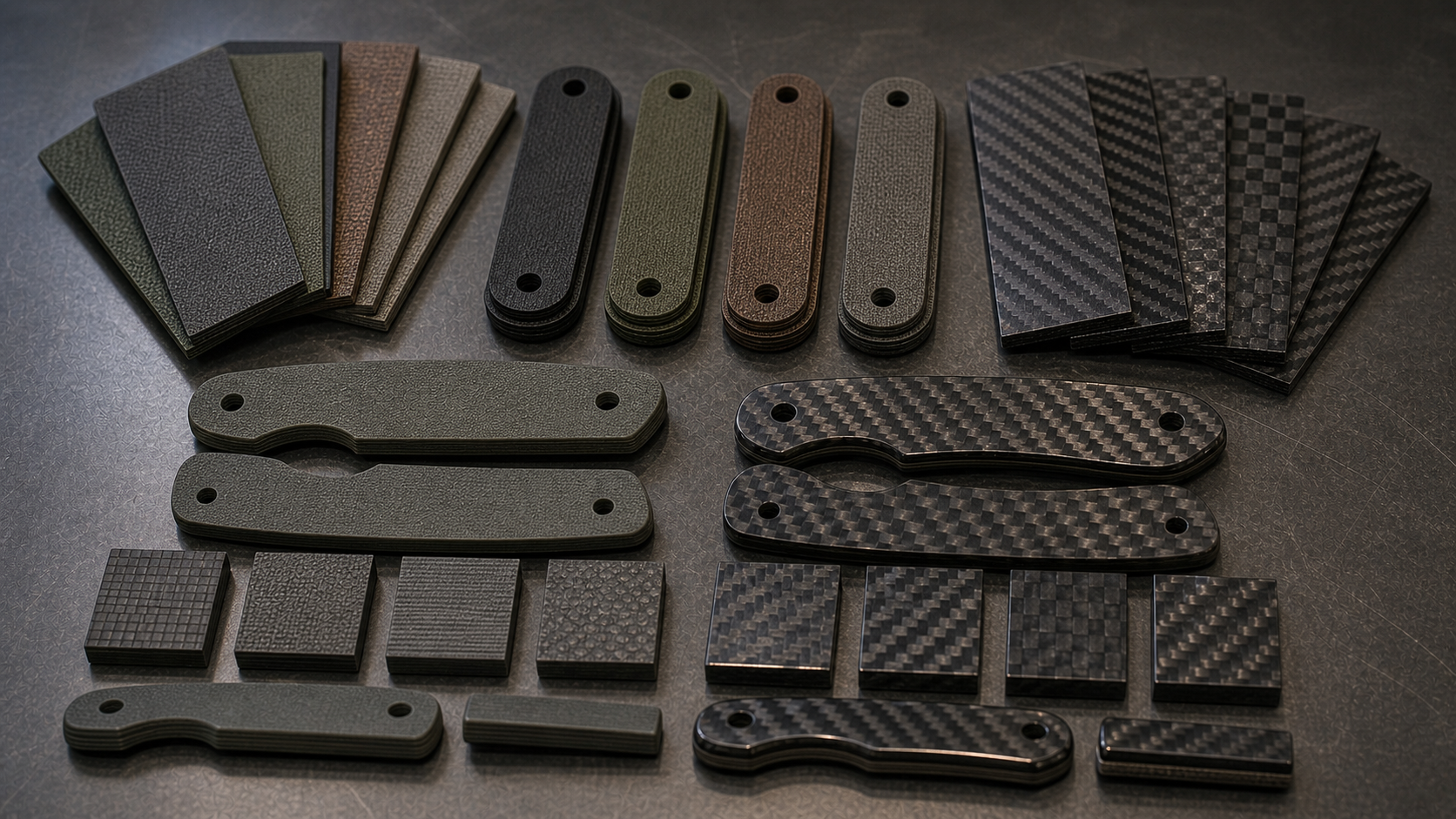
I Match Texture to the User's Job
For many working knives, G10 is easier to recommend because it can be textured in a predictable way. A buyer can choose coarse texture, light texture, milled grooves, layered color effects, or smoother finishing. This flexibility helps when the knife must work in wet, dusty, or gloved hands. A tactical-style folder, rescue tool, camping knife, or budget outdoor knife often benefits from this direct grip advantage.
Carbon fiber can feel very different. A polished carbon fiber scale can look excellent, but it may feel smoother in the hand. That is not always bad. A gentleman's folder, slim EDC knife, or collector-focused knife may need pocket comfort and visual appeal more than aggressive traction. But if the buyer wants carbon fiber for a hard-use knife, the surface design must be planned. The supplier may need milling, texturing, inlay design, or a hybrid structure to improve grip.
I also look at edges. G10 can feel harsh if the edges are not chamfered. Carbon fiber can feel sharp or unfinished if the CNC and polishing steps are weak. The handle should not only pass a photo review. It should pass a hand-feel review with the target user in mind.
| Handle feel factor | G10 tendency | Carbon fiber tendency |
|---|---|---|
| Grip texture | Easy to make aggressive | Needs planned texture if grip is important |
| Pocket comfort | Depends on texture level | Often smoother and more refined |
| Edge feel | Needs chamfer control | Needs careful edge finishing |
| Wet-hand use | Strong when textured | Depends heavily on surface finish |
How Do Weight and Brand Positioning Compare?
Buyers often think carbon fiber automatically means better. That is too simple. The product story must match the price.
Carbon fiber is useful for lightweight and premium positioning. G10 is useful when the buyer wants practical performance, colors, grip, and controlled cost. The better material depends on the knife's market role.
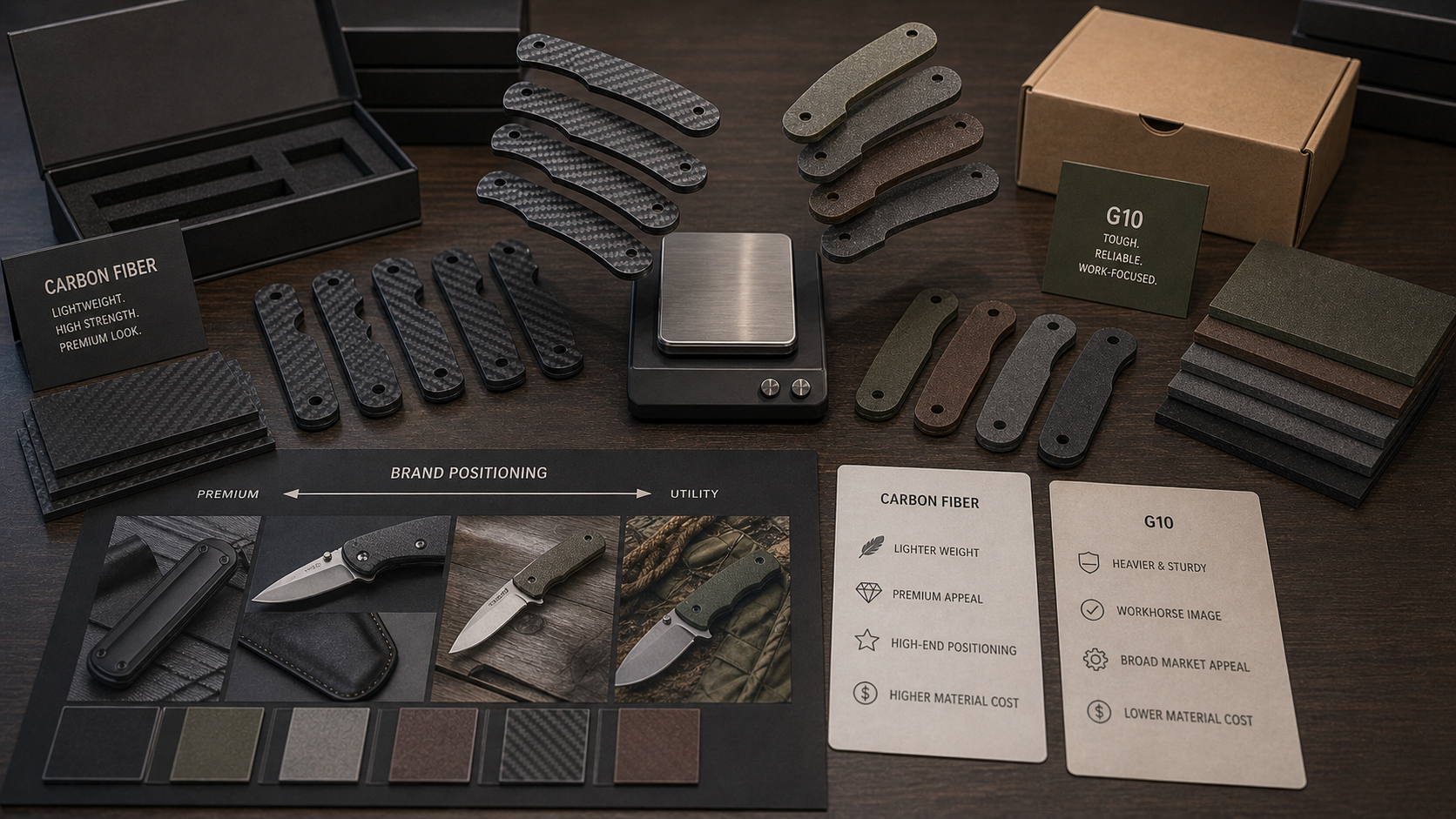
I Use Carbon Fiber When the Story Pays for It
Carbon fiber's biggest value in knife handles is often positioning. Toray describes carbon fiber and prepreg materials as having superior strength-to-weight ratios, design flexibility, and long-term performance. For knife buyers, that translates into a clear product story: lightweight, technical, modern, and premium. A slim EDC knife with carbon fiber scales can feel more upscale than the same design in plain black G10.
But the buyer must ask whether the target customer will pay for that story. Carbon fiber material cost, machining time, cosmetic control, and scrap risk can raise the product cost. If the sales channel is price-sensitive, the extra cost may not return enough value. If the target customer buys based on visual detail, weight, and premium feel, carbon fiber can support the price.
G10 is usually stronger commercially for value-to-performance products. It gives the buyer many colors, layers, and textures without the same premium cost pressure. A black G10 tactical folder, green G10 outdoor knife, or layered G10 private label design can look strong and perform well. It may not feel as luxurious as carbon fiber, but it often fits repeat production better.
I tell buyers to choose the material that supports the product tier. Do not put carbon fiber on a knife that must win only by price. Do not use plain G10 on a product that needs a premium visual signal in the first photo.
| Product positioning | Better fit | Reason |
|---|---|---|
| Value outdoor knife | G10 | Good grip and cost control |
| Tactical folder | G10 or textured carbon fiber | Grip and structure matter |
| Premium slim EDC | Carbon fiber | Light weight and visual appeal |
| Private label volume line | G10 | Easier color and repeat control |
Which Material Is Easier for OEM and ODM Production?
A beautiful sample can become difficult in mass production. Buyers need to think beyond one prototype.
G10 is usually easier for repeat OEM/ODM production because texture, color, machining, and cost are easier to control. Carbon fiber needs tighter cosmetic and edge-finishing control.
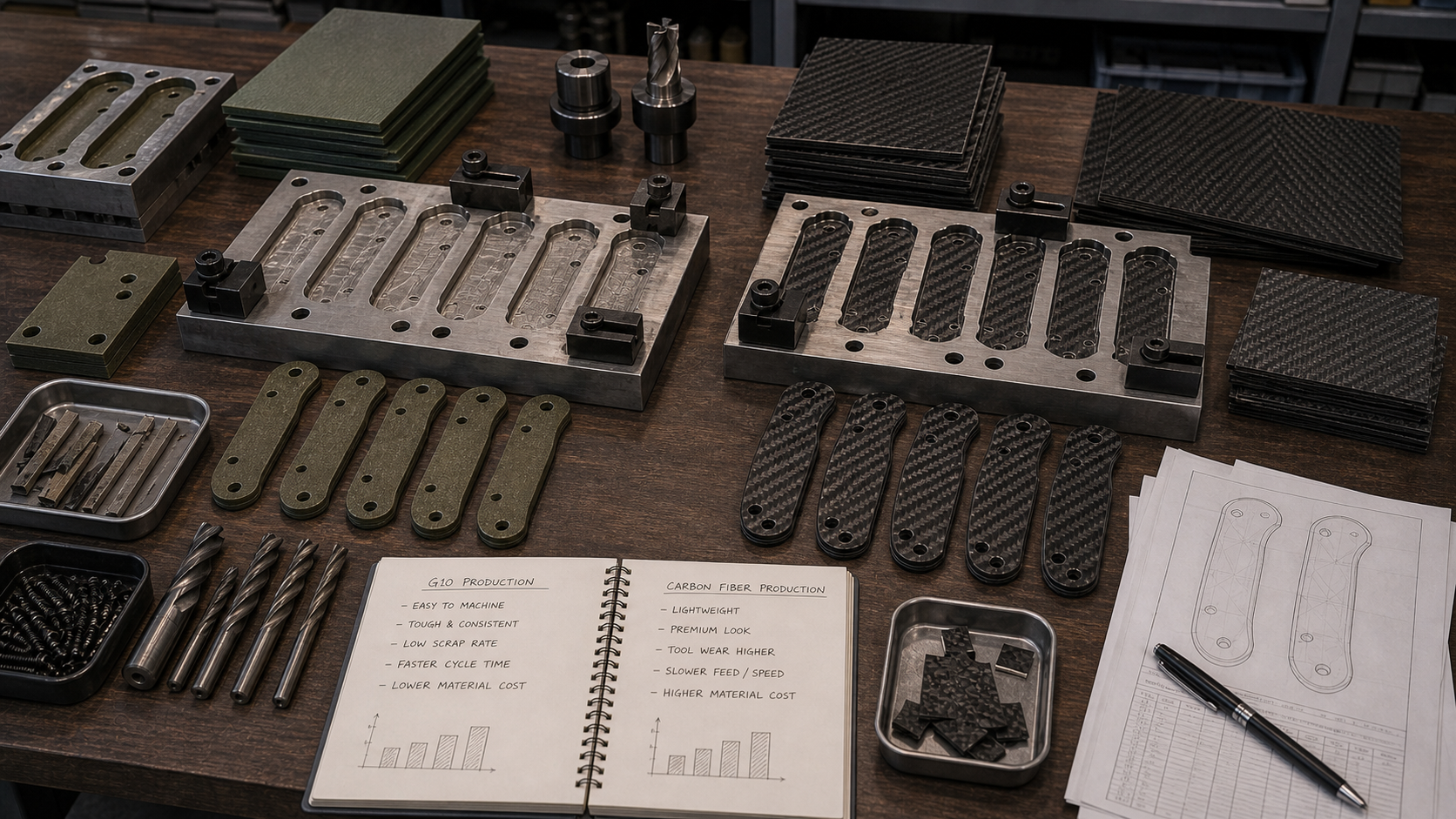
I Check Repeatability Before Approving the Material
In OEM and ODM work, repeatability matters as much as appearance. G10 is often easier to manage because the supplier can source sheets in many colors and thicknesses, texture the surface, CNC the shape, chamfer the edge, and repeat the process with predictable cost. It still needs dust control, tool control, and QC, but it is a familiar production material for knife handle scales.
Carbon fiber needs more attention. The woven pattern must be aligned if the buyer expects a premium look. The surface can show voids, weave distortion, resin marks, or edge defects if the material or finishing is weak. Screw holes and clip areas need support. Thin carbon fiber can feel elegant, but it should not create weak points around hardware. If the knife uses carbon fiber over liners, the internal structure must be clear. If the carbon fiber is only an overlay, the buyer should not market it as a full structural scale without explaining the construction.
This is where product drawings and approved samples matter. The buyer should approve the material type, thickness, surface finish, texture, edge chamfer, screw hole finish, pocket clip support, and acceptable cosmetic range. A supplier can produce better when the standard is visible. A vague request such as "make it carbon fiber" is not enough for a stable order.
| Production factor | G10 | Carbon fiber |
|---|---|---|
| CNC machining | Familiar and repeatable | Requires careful tool and edge control |
| Cosmetic standard | Texture hides small variation | Weave and surface defects are more visible |
| Cost control | Easier for volume lines | Higher material and scrap sensitivity |
| Hardware support | Usually straightforward | Needs attention around holes and clips |
What Quality Risks Should Buyers Check?
Small handle defects can ruin the whole knife. Loose screws, sharp edges, and bad texture are easy for users to notice.
Buyers should inspect material authenticity, thickness, color, weave, texture, screw-hole quality, edge chamfer, fit to liners, clip support, surface finish, and packaging claims.
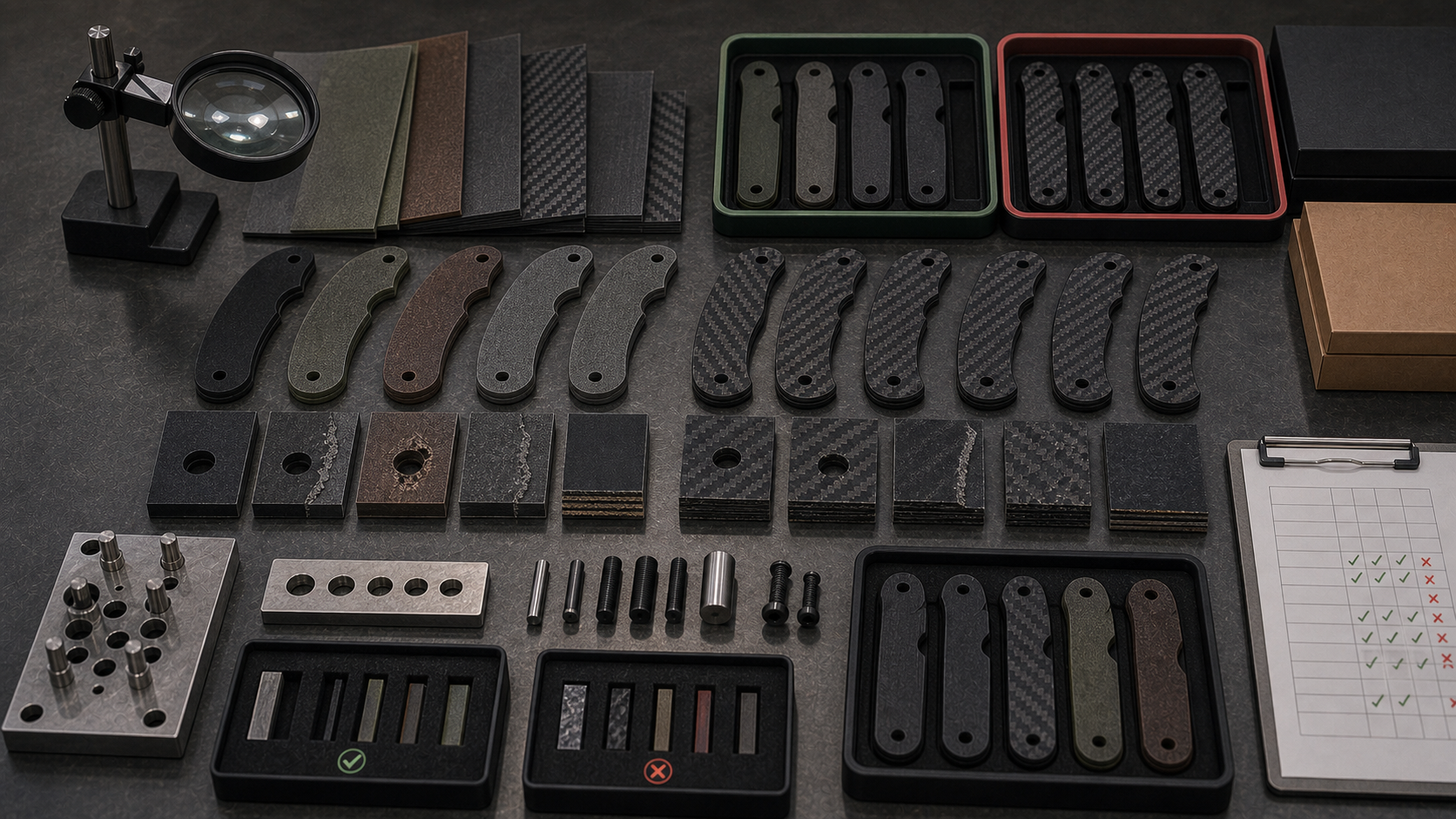
I Inspect the Handle as a Functional Part
The handle is not decoration. It is the part that the user touches every time. For G10, I check texture consistency, color variation, layered edge appearance, flatness, screw-hole quality, chamfer smoothness, and whether the surface feels too sharp or too slippery. For carbon fiber, I also check weave alignment, resin marks, voids, edge finish, delamination risk, and whether the actual material matches the buyer's claim.
Fit is also important. A handle scale must match the liner, backspacer, pivot, screws, and pocket clip. If the handle scale is slightly off, the knife may still open, but it may feel cheap. A proud edge, uneven seam, or rough chamfer can hurt the perceived value. This matters even more for carbon fiber because the buyer is usually paying for a premium feel.
Packaging claim is part of QC too. If the packaging says "carbon fiber," the buyer should know whether it is full carbon fiber laminate, carbon fiber over G10, carbon fiber inlay, or a decorative pattern. If the packaging says G10, the buyer should confirm the material is not only plastic with a textured surface. Clear naming protects the brand and avoids customer confusion.
For B2B orders, I prefer an approval sample and a simple handle checklist. It saves arguments later because the buyer and supplier agree what good means before mass production.
| QC item | Why it matters | Practical check |
|---|---|---|
| Material claim | Protects brand trust | Supplier proof and sample approval |
| Surface texture | Controls grip and comfort | Touch test and visual check |
| Screw holes | Protects assembly stability | Diameter, countersink, and cracking check |
| Edge chamfer | Controls hand feel | Inspect every exposed edge |
How Should Buyers Handle Machining Dust and Workshop Safety?
Composite handles look clean when finished. But machining them can create dust that needs serious control.
Both G10 and carbon fiber are composite materials. Buyers should ask suppliers how they control machining dust, worker protection, cleanup, tooling, and finished-part cleanliness before shipment.
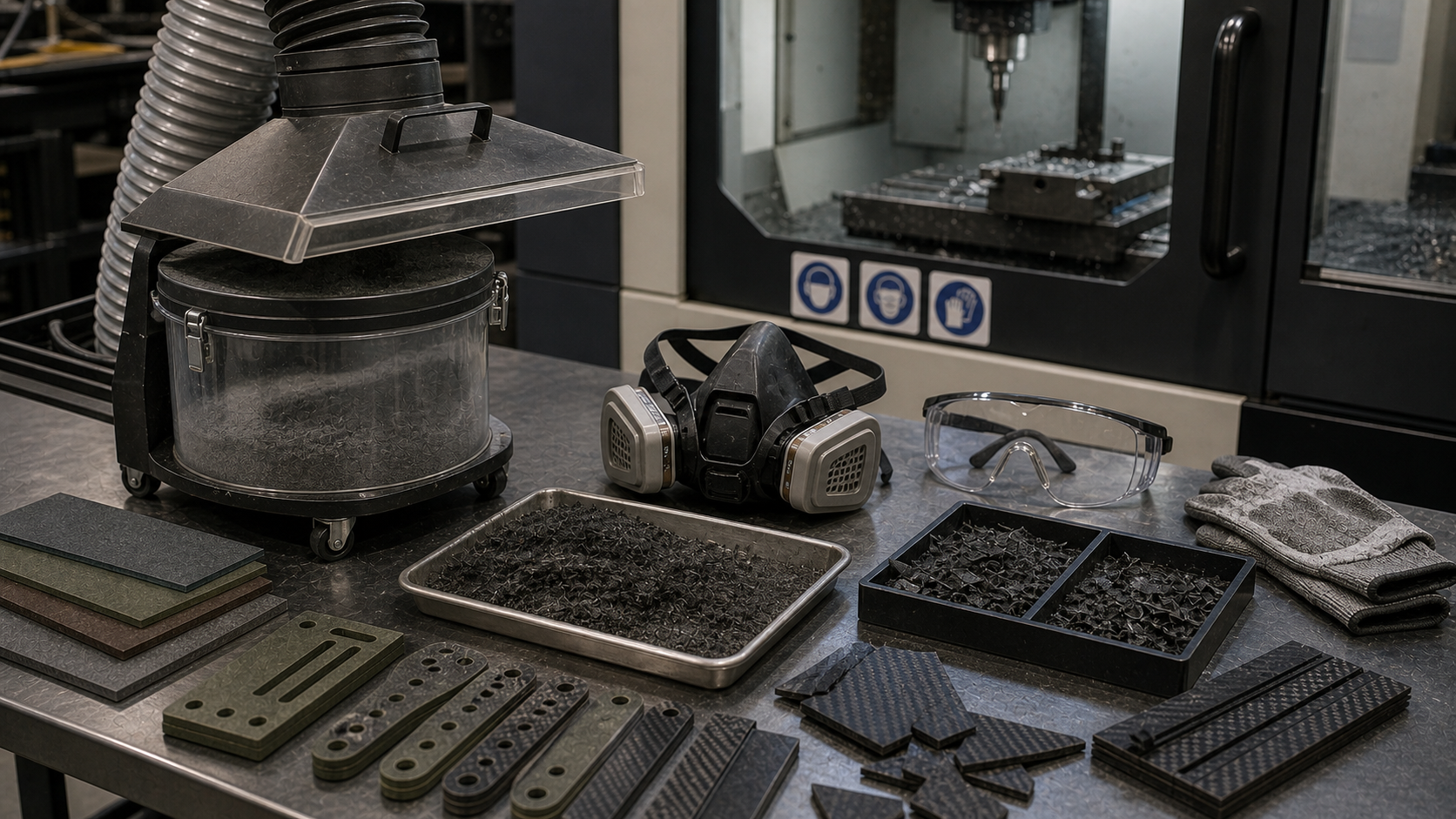
I Include Dust Control in the Supplier Discussion
G10 and carbon fiber both need responsible machining. OSHA's composites overview explains that polymer matrix composites are made from reinforcing fiber and resin matrix, and that manufacturing processes and potential hazards can apply across polymer matrix composites. NIOSH also says fibrous glass can affect eyes, skin, and lungs, and that worker exposure depends on dose, duration, and work being done. For knife handle production, this means cutting, CNC routing, sanding, and finishing should not be treated casually.
This is not a reason to avoid G10 or carbon fiber. These materials are common and useful. It is a reason to ask practical production questions. Does the supplier use dust collection? Are operators protected during routing and sanding? Are parts cleaned before assembly? Is dust kept away from pivot assemblies, bearings, washers, and packaging? Composite dust can also affect the look and feel of the final product if the parts are not cleaned properly.
For buyers, this is part of supplier evaluation. A factory that handles composite materials well usually has cleaner finished parts and fewer small assembly issues. I would rather ask these questions before sampling than discover dust, rough edges, or dirty hardware during final inspection.
| Safety and cleanliness point | Why it matters | Buyer question |
|---|---|---|
| Dust extraction | Protects workers and part cleanliness | How is CNC dust controlled? |
| PPE and work practice | Reduces exposure during machining | What protection is used during sanding? |
| Part cleaning | Protects assembly and packaging | How are scales cleaned before assembly? |
| Tooling control | Keeps edges clean | How often are cutting tools checked? |
How Should OEM and ODM Buyers Specify G10 or Carbon Fiber in an RFQ?
A material name is not enough. Without details, the sample may miss the price, feel, or positioning goal.
The RFQ should specify material type, thickness, texture, color, weave, finish, scale construction, target price, MOQ, knife type, clip support, packaging claim, and inspection standard.
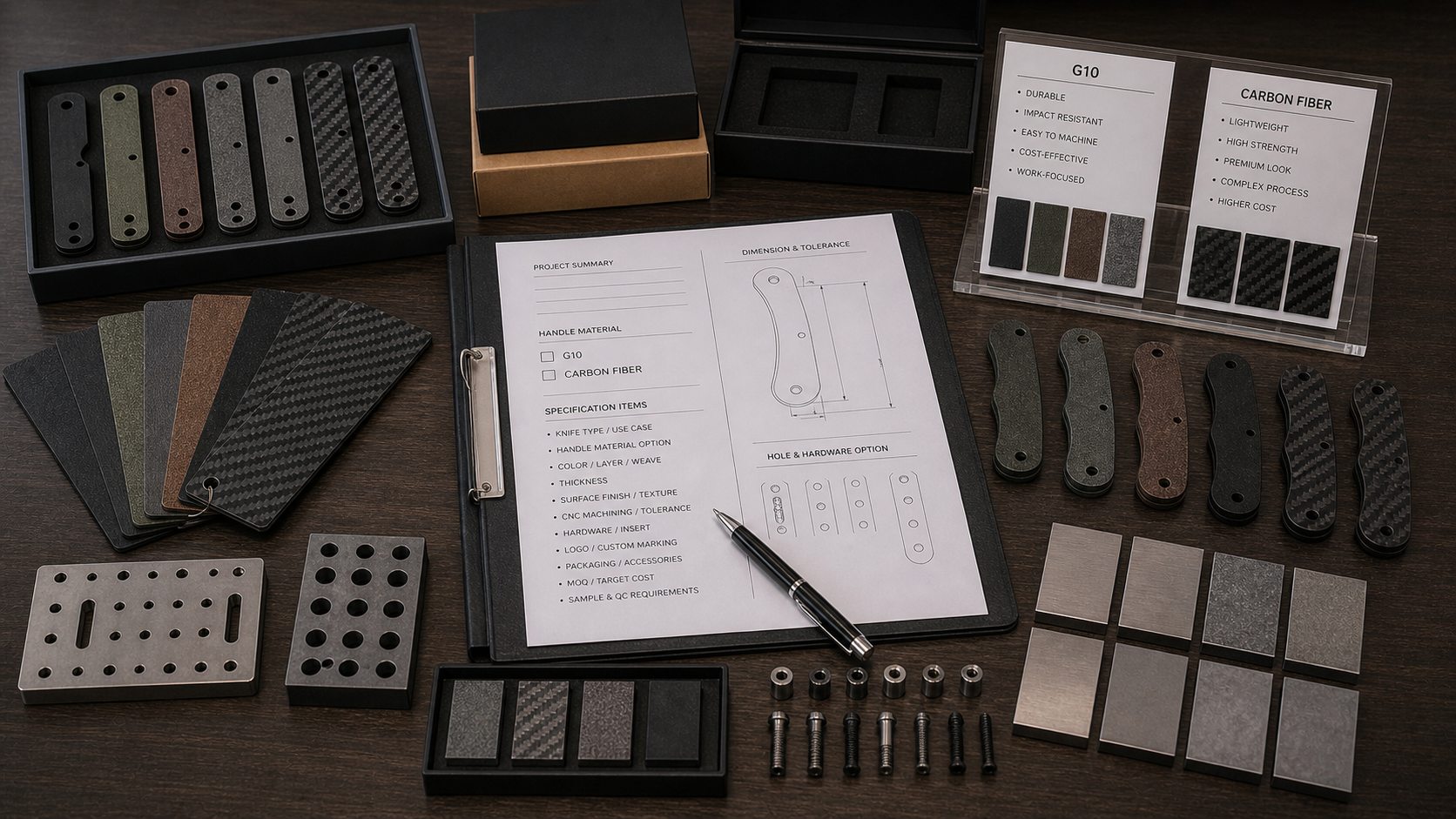
I Ask for the Handle Standard Up Front
When a buyer asks Vast State for a G10 or carbon fiber handle, I want the full product target. What knife type is it? What is the target market? What price range must the final product hit? Should the handle feel aggressive, smooth, slim, premium, tactical, or lightweight? Does the buyer need black G10, layered G10, textured G10, twill carbon fiber, marble carbon fiber, full carbon fiber, carbon fiber overlay, or carbon fiber inlay?
The RFQ should also include construction details. Is the knife liner-supported? Is the handle scale structural? Where is the pocket clip mounted? Are there nested liners, backspacers, or exposed screws? What surface finish is acceptable? What cosmetic variation is allowed? Should the packaging say G10, carbon fiber, carbon fiber inlay, or carbon fiber pattern? These words matter because customers notice material claims.
I also recommend a material decision matrix. If the buyer needs grip, color variety, and cost control, G10 is usually the first sample. If the buyer needs light weight and premium appearance, carbon fiber deserves a sample. If the buyer needs both, a hybrid solution may work. The key is to decide based on product goals, not only trend.
| RFQ field | Why it matters | Example buyer note |
|---|---|---|
| Material structure | Prevents claim confusion | Full carbon fiber or carbon fiber inlay |
| Texture and finish | Controls user feel | Aggressive G10 texture or smooth carbon fiber |
| Target price | Guides material choice | Value line, mid-range, or premium |
| Inspection standard | Protects repeat orders | Weave, chamfer, holes, fit, and surface limit |
Turn your idea into a quote-ready knife project.
Share your drawing, sample photo, target quantity, market, and packaging needs. Vast State will review manufacturability and prepare OEM/ODM options.
Conclusion
G10 wins practical grip and cost control, while carbon fiber wins premium lightweight appeal when buyers control structure, finish, claims, and QC.
Source Notes
- Curbell G10/FR-4 glass epoxy supports the G10 structure, mechanical strength, moisture absorption, and dimensional-stability discussion.
- Toray carbon fiber products supports the carbon fiber strength, stiffness, product variety, and processing-method discussion.
- Toray carbon fiber and prepreg materials supports the strength-to-weight, design-flexibility, lightweighting, and processing discussion.
- OSHA composites overview supports the general definition of polymer matrix composites and the need to consider manufacturing hazards.
- NIOSH fibrous glass page supports the caution around fibrous glass exposure during relevant work.
- ISO 9001 explained supports the general quality-system mindset for repeat production control.