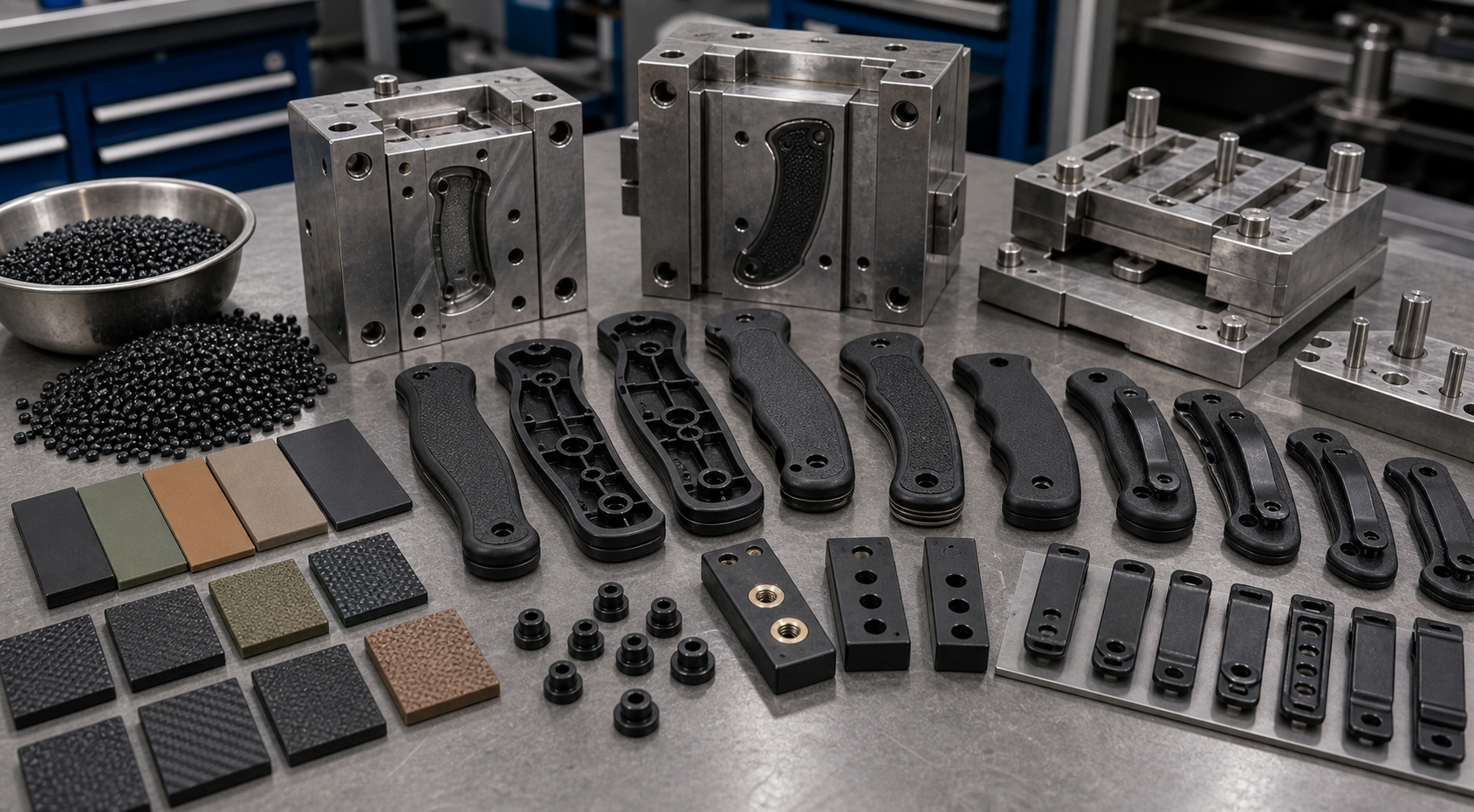
Grivory can make a knife handle lighter and easier to mold. But if buyers treat it as generic plastic, problems appear fast.
Grivory handle material should be specified by exact grade, reinforcement, molding structure, wall thickness, screw support, texture, color, surface quality, moisture and heat expectations, and QC standard. It works best when the knife design is planned around injection molding from the beginning.
Quick buyer brief:
- Answer: Grivory is useful for molded knife handles when grade, structure, and QC are clearly defined.
- Buyer context: This helps knife brands, outdoor brands, private label buyers, importers, wholesalers, and sourcing managers plan molded handle projects.
- Key checks: Confirm Grivory grade, reinforcement, mold design, wall thickness, screw bosses, clip support, texture, color, MOQ, target price, and inspection plan.
Have a knife or multi-tool project in mind?
Send your sketch, CAD file, sample photo, or product idea. Vast State can review manufacturability, suggest materials, estimate MOQ, and prepare a quote for your OEM/ODM project.
When I work with a buyer on a Grivory handle project, I do not treat the handle as a simple molded shell. The material choice affects mold cost, part structure, hand feel, screw support, color, clip strength, and repeat production. Grivory can be a strong direction for value EDC, utility, rescue, and outdoor tools. But the design must respect the material and the injection molding process.
What Is Grivory Material and Why Do Knife Buyers Consider It?
Many buyers hear "Grivory" and think only of a lightweight handle. That is too shallow for a production decision.
Grivory is a family of high-performance polyamide materials from EMS-GRIVORY. Knife buyers consider it for molded handles because it can support stiffness, dimensional stability, low moisture effects, surface quality, and efficient production when the right grade is chosen.
I Treat Grivory as an Engineering Material, Not Generic Plastic
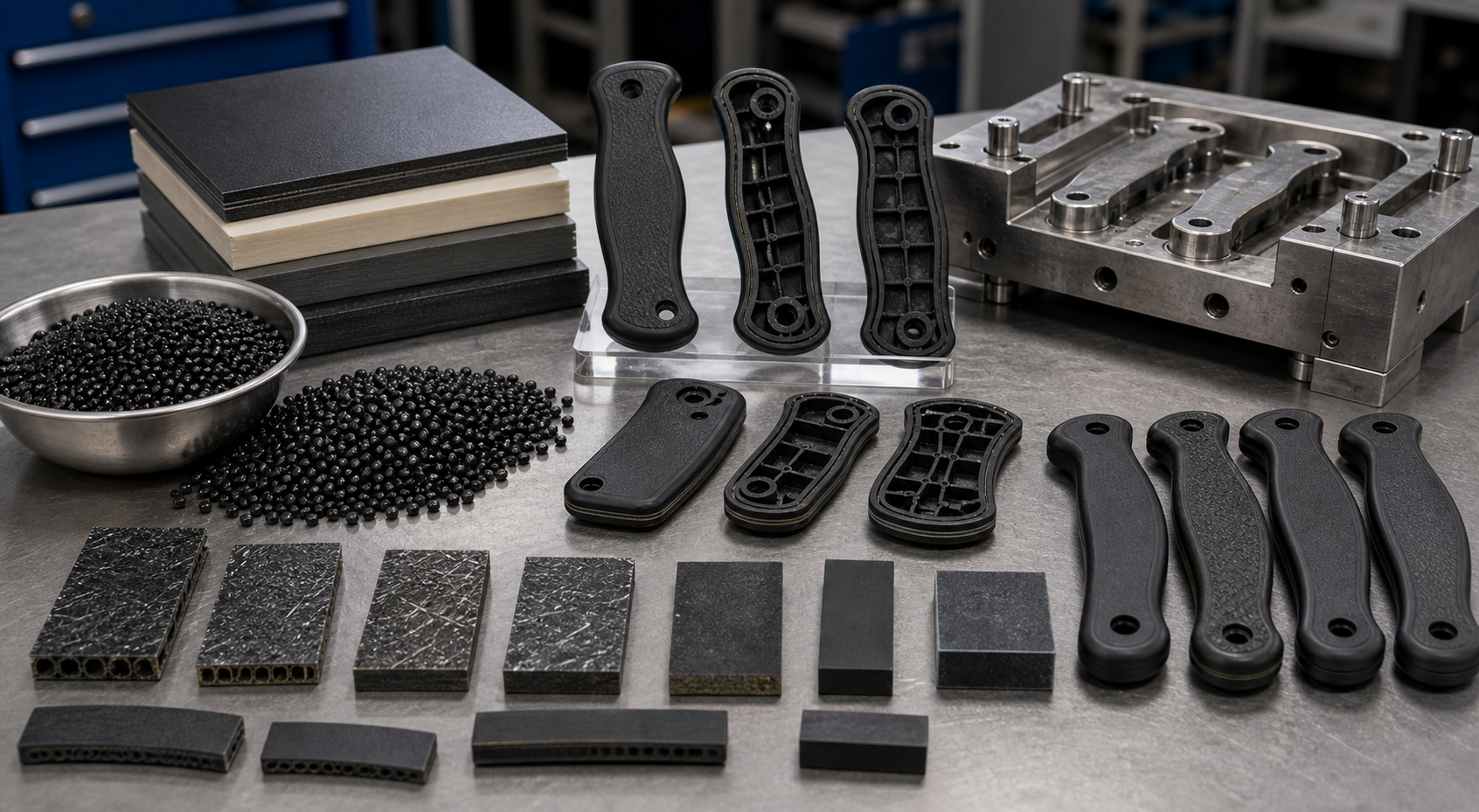
The first point I explain is simple. Grivory is not a loose word for any plastic handle. EMS-GRIVORY describes Grivory GV as a product range based on semi-crystalline polyamides with partially aromatic content. It is supplied as granules for injection molding or extrusion. EMS also lists properties such as stiffness and strength, little change after moisture absorption, low water absorption, dimensional stability, low warpage, chemical resistance, good surface quality, and efficient production.
For a knife buyer, those points are useful, but they are not automatic guarantees. A molded handle is a finished part, not only a resin name. The handle must support screws, lock parts, clips, liners, spacers, and repeated hand pressure. A good material can still perform poorly if the wall thickness is wrong, the screw boss is weak, the mold flow is poor, or the clip pad is under-designed.
That is why I always ask for the exact material direction. Is the buyer thinking about a glass-fiber reinforced Grivory grade, a higher stiffness grade, an impact-resistant option, or a lower warpage option? Does the product need a rigid tactical-style handle, a light EDC handle, or an outdoor utility handle? The right answer depends on the product role.
| Buyer question | Why it matters | Practical answer |
|---|---|---|
| Is it real Grivory? | Prevents vague material substitution | Ask for grade and supplier confirmation |
| Is it reinforced? | Affects stiffness and strength | Confirm reinforcement type and level |
| Is it molded or machined? | Controls tooling and cost | Plan Grivory as a molded route |
| Is it structural or cosmetic? | Affects screws and clip support | Check handle geometry, not only surface |
OEM/ODM RFQ Checklist
Prepare these details to help Vast State review your project and provide a more accurate quotation.
| RFQ Field | What to Prepare |
|---|---|
| Project type | OEM from drawing / ODM private label / wholesale catalog |
| Product category | Folding knife / fixed blade / multi-tool / outdoor tool |
| Design status | Idea / sketch / 2D drawing / 3D CAD / physical sample |
| Target price | Ex-factory target price or retail price range |
| MOQ expectation | 500 / 1,000 / 3,000 / 5,000+ pcs |
| Logo method | Laser engraving / etching / printing / molded logo |
| Packaging | Standard packaging / custom retail box / Amazon-ready |
| Market | USA / EU / Japan / Korea / Middle East / other |
| Compliance needs | Buyer-specified testing / documentation / labeling |
| Timeline | Sample deadline / mass production deadline |
When Is Grivory a Good Choice for Knife Handles?
No material fits every knife. If the buyer chooses Grivory only to reduce cost, the final product may feel weak.
Grivory is a good choice for molded knife handles that need light weight, repeatable shape, integrated texture, color control, efficient volume production, and practical stiffness. It is less suitable when buyers want machined scale appearance or frequent small design changes.
I Use Grivory When Molded Design Adds Value
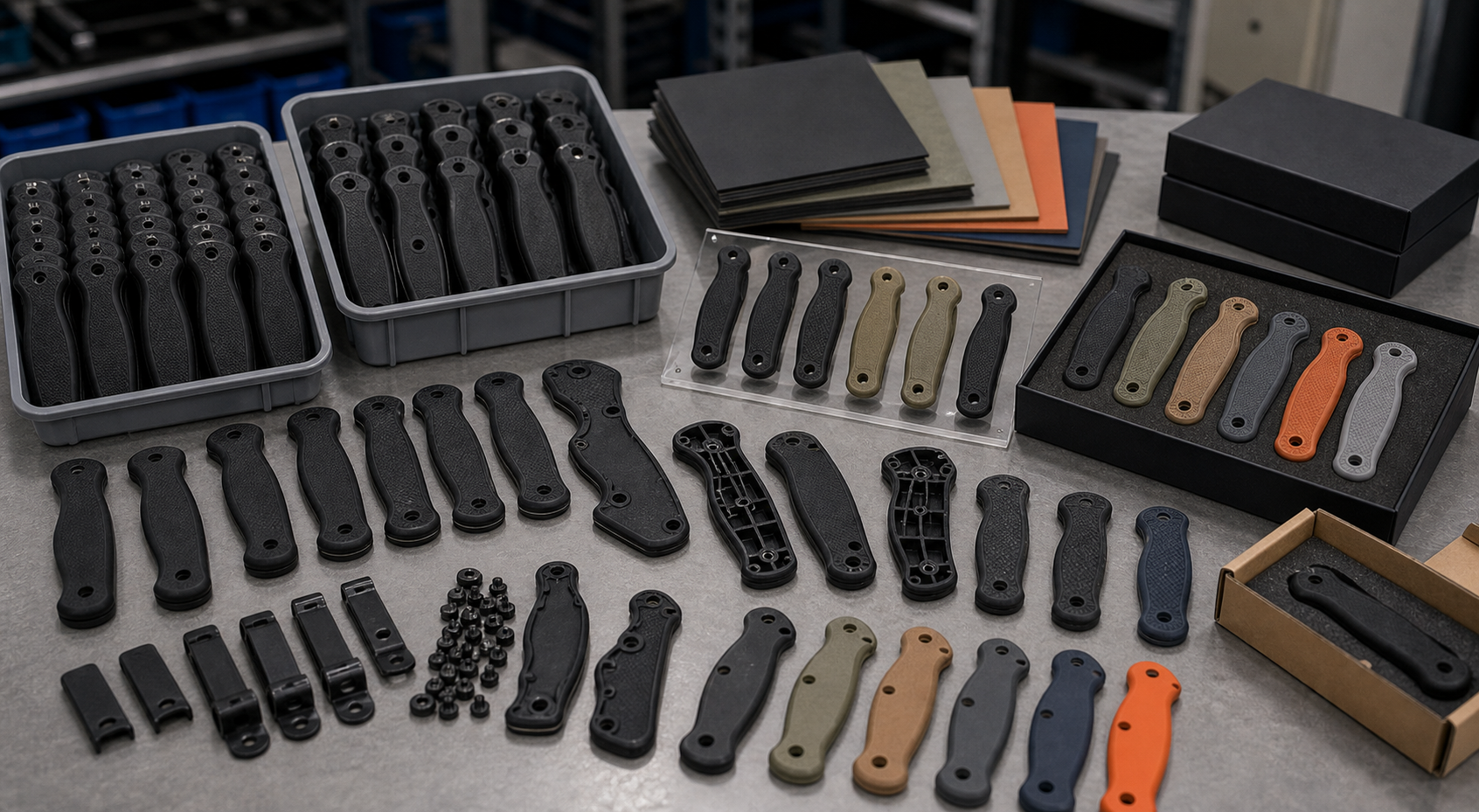
Grivory makes the most sense when the handle design benefits from injection molding. A molded handle can include ribs, texture, finger grooves, screw bosses, pocket clip pads, color, logo zones, and ergonomic shape in one part. That can help a buyer create a value-focused EDC knife, utility knife, rescue tool, or outdoor tool with stable repeat production.
The product should justify the mold. If the buyer only wants a small trial order, a machined G10 or aluminum scale may be easier. If the buyer expects repeat orders and wants a molded product family, Grivory becomes more interesting. The mold cost can be spread across volume, and the part can be optimized for assembly speed.
The market also matters. A budget EDC knife may use Grivory to control weight and cost while still providing molded texture. A rescue tool may use it for bright colors and grip zones. An outdoor utility product may use it for water-friendly construction and easy cleaning. A premium collector knife may not be the best fit if the buyer wants visible carbon fiber, titanium, wood, or machined texture as the main story.
I also consider the buyer's brand promise. If the brand sells practical tools, Grivory can fit well. If the brand sells handcrafted luxury, it may feel too industrial unless the design is very well executed.
| Product goal | Grivory fit | Reason |
|---|---|---|
| Value EDC line | Strong | Molded shape and cost control |
| Rescue or utility tool | Strong | Integrated grip, color, and structure |
| Premium machined folder | Weaker | Buyers may expect G10, carbon fiber, titanium, or aluminum |
| Repeat private label program | Strong | Molded consistency can support volume |
Which Grivory Grade Details Should Buyers Confirm?
A grade name can hide major differences. If the buyer does not confirm the grade, the quote and sample may not match.
Buyers should confirm the Grivory family, reinforcement type, reinforcement level, moisture behavior, heat resistance, flow, warpage, impact requirement, color, surface quality, and whether the exact grade fits the molded handle design.
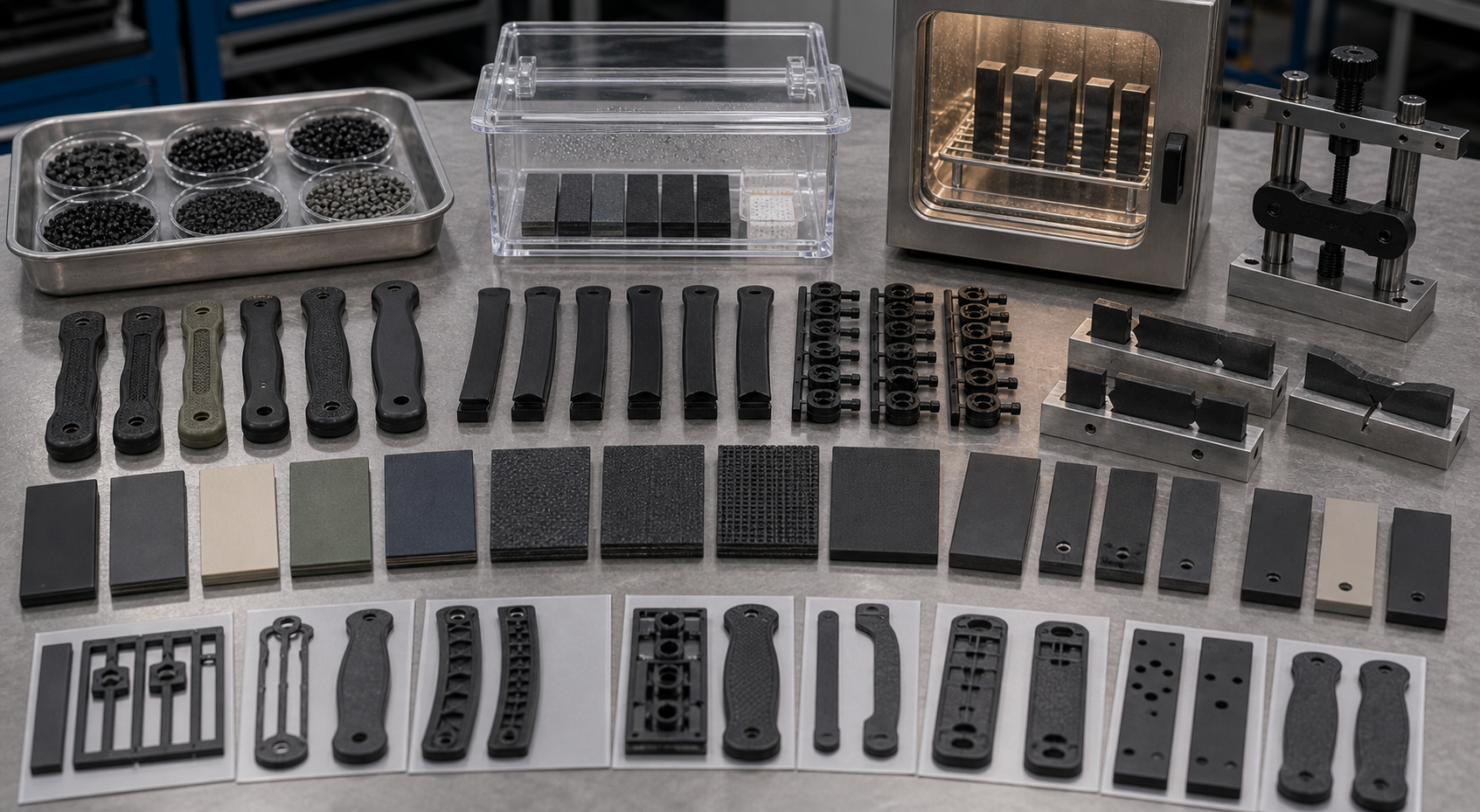
I Ask for the Grade Before I Trust the Claim
EMS-GRIVORY lists several Grivory G grade directions. The Grivory GV page describes options such as glass-fiber reinforced, high stiffness, impact-resistant, mineral-reinforced, carbon-reinforced, good surface quality, and good flow variants. This tells buyers something important. "Grivory" is a family, not one fixed material.
For a knife handle, I usually ask what the grade must solve. If stiffness is the priority, a reinforced grade may be needed. If low warpage is the issue, the supplier may look at a grade direction such as Grivory GVX, which EMS describes with high stiffness and strength, low warpage, and simple processing. If high heat exposure is part of the project, a high-temperature family such as Grivory HT may be discussed, but only if the real use case needs it.
The buyer should avoid over-specifying too early. A higher-performance grade may not be necessary for every knife. It can raise cost, affect molding, or change surface feel. I prefer to start with product requirements: target price, expected use, clip load, screw layout, temperature exposure, appearance, and order quantity. Then the material recommendation can follow.
The buyer should also confirm color and texture compatibility. Some grades may support certain colors or surface finishes better than others. If the brand needs bright colors, matte texture, or logo detail, this should be checked before the mold is finalized.
| Grade detail | Why it matters | Buyer question |
|---|---|---|
| Reinforcement type | Affects stiffness and strength | Is glass, mineral, carbon, or hybrid reinforcement needed? |
| Flow behavior | Affects thin ribs and complex shapes | Can the part fill cleanly in the mold? |
| Warpage control | Affects handle fit and blade centering | Will the molded handle stay flat enough? |
| Surface quality | Affects buyer perception | Can the texture and color meet the brand standard? |
How Does Injection Molding Change Knife Handle Design?
A molded handle cannot simply copy a machined scale. If the design ignores molding, defects and weak points appear.
Injection molding changes handle design because wall thickness, ribs, bosses, gate position, shrinkage, flow, cooling, parting lines, and ejector marks all affect strength, appearance, and assembly fit.
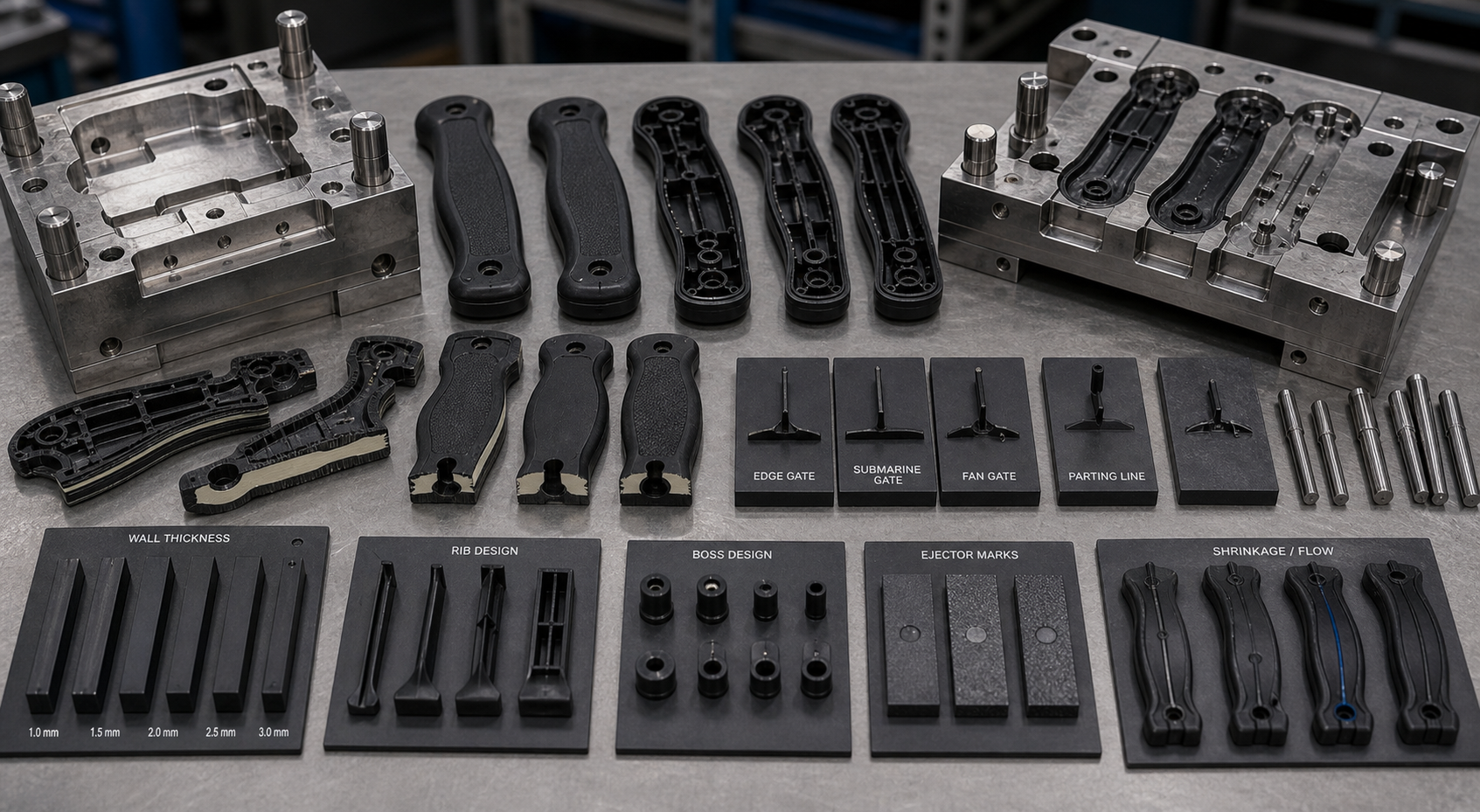
I Design the Handle Around Flow and Support
Injection molding can create efficient parts, but it has rules. A good molded knife handle needs balanced wall thickness, controlled ribs, strong screw bosses, enough clip support, and a clean parting line plan. If the handle has thick and thin areas without control, the part may sink, warp, or show uneven surface quality. If the screw bosses are weak, the handle can fail during assembly or use.
EMS says Grivory GV is supplied as granules for injection molding or extrusion using conventional commercial equipment and molds. Its long-fiber reinforced page also explains that LFT products can be processed using injection molding equipment and that reinforcement type and fiber structure can improve thermal-mechanical properties compared with short fibers. I do not use that to claim every Grivory knife handle needs long fiber reinforcement. I use it to show why material and molding design must be considered together.
For knife buyers, the molded handle should be reviewed like an engineered part. The drawing should show screw positions, liner contact, clip pad, stop pin area, lock clearance, backspacer fit, texture, logo zone, and assembly sequence. If the handle is a one-piece molded structure, internal ribs and support points become even more important.
I also check the mold cost and change risk. A small detail change on a CNC scale may be easy. A small detail change on a mold can cost time and money. That is why buyers should test the concept carefully before the mold is cut.
| Molded design factor | What can go wrong | Practical control |
|---|---|---|
| Wall thickness | Sink marks, warpage, weak feel | Keep thickness balanced |
| Screw bosses | Cracking, stripped screws, weak clip | Design enough support area |
| Gate and flow | Flow marks or incomplete fill | Review mold flow and sample parts |
| Parting and ejector marks | Poor appearance | Place marks away from key surfaces |
What Surface, Texture, and Color Decisions Matter?
A molded handle may be strong but still look cheap. Buyers need to control what the user sees and feels.
Surface, texture, and color decisions matter because they shape grip, perceived value, scratch hiding, brand identity, and consistency. Buyers should approve texture samples, color samples, logo areas, and acceptable cosmetic limits.
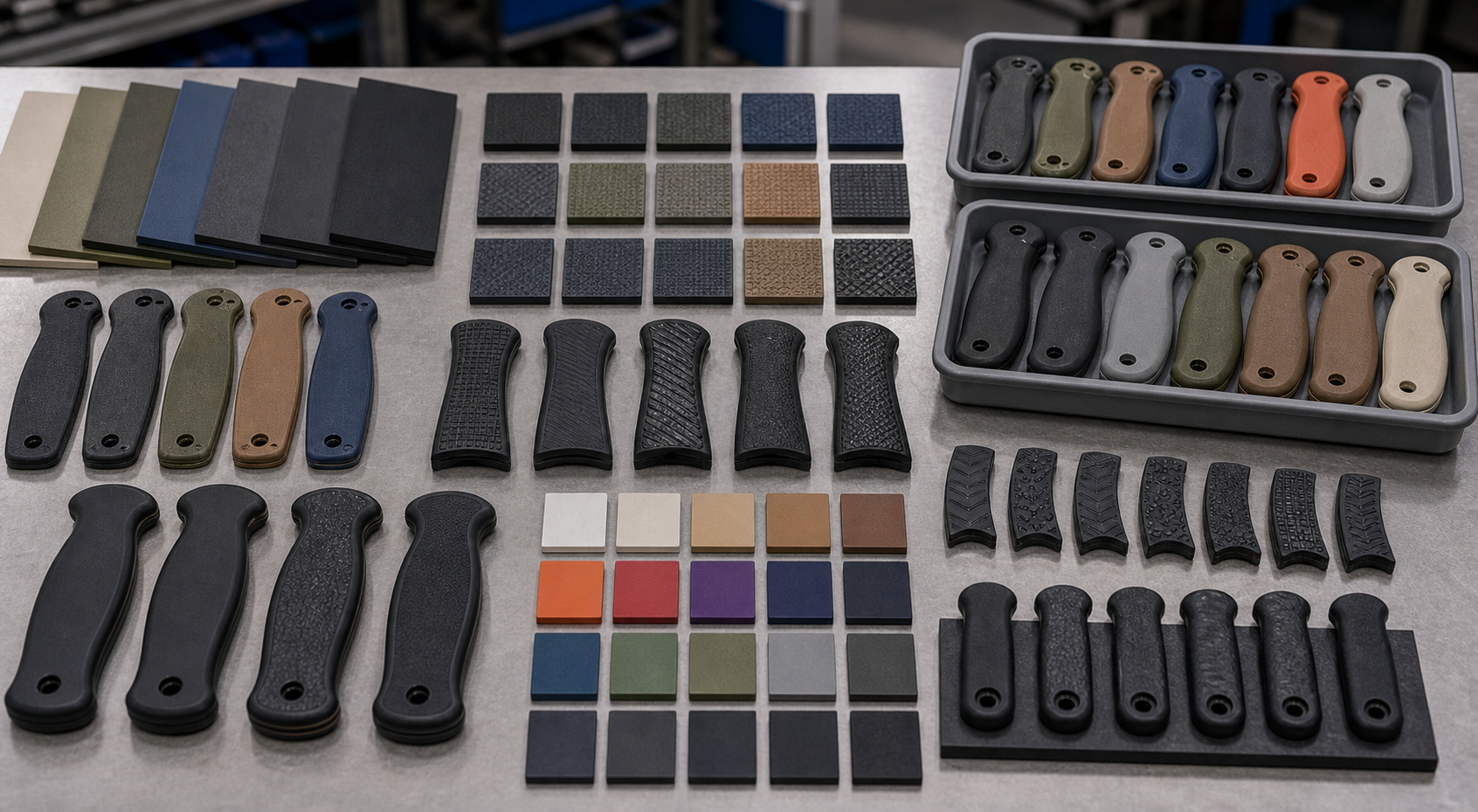
I Make the Handle Feel Intentional, Not Cheap
Molded handles can be practical, but buyers often worry that molded plastic will look low-end. The solution is not always to avoid Grivory. The solution is to design the surface well. Texture, color, edge radius, mold polish, logo area, screw color, and packaging all influence how the handle is perceived.
EMS lists good surface quality and efficient production as Grivory GV characteristics, and the product portfolio page also includes Grinova S as a separate EMS direction for smooth, glossy surface and weathering stability. I mention this because surface quality is not an afterthought in high-performance polymers. Buyers should discuss appearance goals with the supplier early.
For knife handles, texture is more important than decoration. A handle for a rescue tool may need strong grip and high-visibility color. A camping knife may need earth tones and a comfortable matte texture. An EDC knife may need a pocket-friendly surface that does not tear fabric. A low-price utility knife may need a simple texture that forms consistently and hides scratches.
Color also needs control. Bright colors can help rescue and safety markets. Black and dark earth tones are safer for outdoor and tactical-style channels. Custom colors may need MOQ, color matching, and approval samples. I ask buyers to approve color under real lighting because molded polymer can look different in a product photo, under warehouse lights, and in daylight.
| Surface decision | Buyer benefit | Production concern |
|---|---|---|
| Matte texture | Better grip and scratch hiding | Must form consistently |
| Smooth surface | Easier cleaning and modern look | Can feel slippery |
| Bright color | Rescue or safety visibility | Color matching and MOQ |
| Logo zone | Brand recognition | Avoid weak or dirty areas |
What Quality Checks Should Buyers Use for Grivory Handles?
A molded handle can pass a photo review and still fail assembly. QC must test part structure and finished knife fit.
Buyers should check material identity, grade confirmation, color, texture, dimensions, warpage, screw boss strength, clip support, surface defects, assembly fit, blade centering, lock clearance, and packed-product consistency.
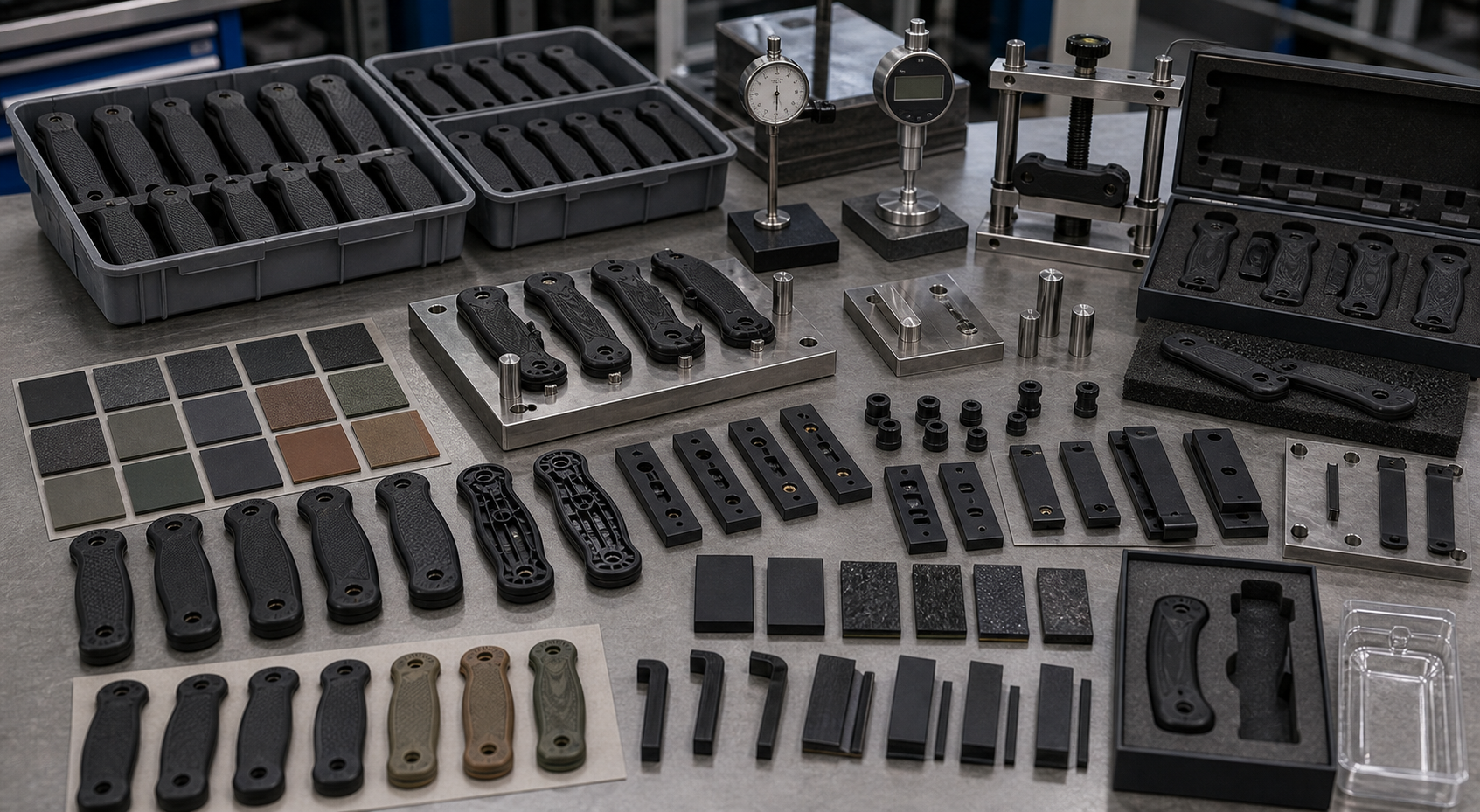
I Inspect the Molded Part and the Assembled Knife
Quality control for a Grivory handle should start with the molded part. ISO explains that ISO 9001 supports identifying processes, understanding customer needs, controlling variation and errors, collecting performance data, and improving based on evidence. I use that same process mindset for molded handle projects.
The first check is material identity. The buyer should know the approved grade, color, and texture. The second check is dimensional stability. A handle part that is slightly warped can make assembly difficult or affect blade centering. The third check is the screw system. Body screws, clip screws, and threaded inserts must seat correctly. If the boss is too thin or the screw area is weak, the handle may fail after repeated use.
The fourth check is appearance. I inspect flow marks, sink marks, short shots, flash, color difference, surface gloss, texture consistency, parting lines, and ejector marks. Some marks may be acceptable if they are placed in hidden areas. But key user-facing surfaces need a clear standard.
The final check is full assembly. The knife should open, close, lock, and carry correctly. The handle should not twist the liner, block the lock, rub the blade, or weaken the clip. A molded handle is successful only when the final knife feels stable and repeatable.
| QC check | What I inspect | Why it matters |
|---|---|---|
| Material and color | Grade, batch, color, texture | Prevents wrong substitution |
| Molded dimensions | Warpage, holes, boss shape | Protects assembly fit |
| Surface quality | Flash, sink, flow marks, texture | Protects buyer perception |
| Functional assembly | Lock, pivot, clip, blade centering | Protects user experience |
How Should Buyers Prepare an RFQ for Grivory Handle Projects?
A vague Grivory RFQ creates mold risk. The supplier needs product, market, and structure details before quoting.
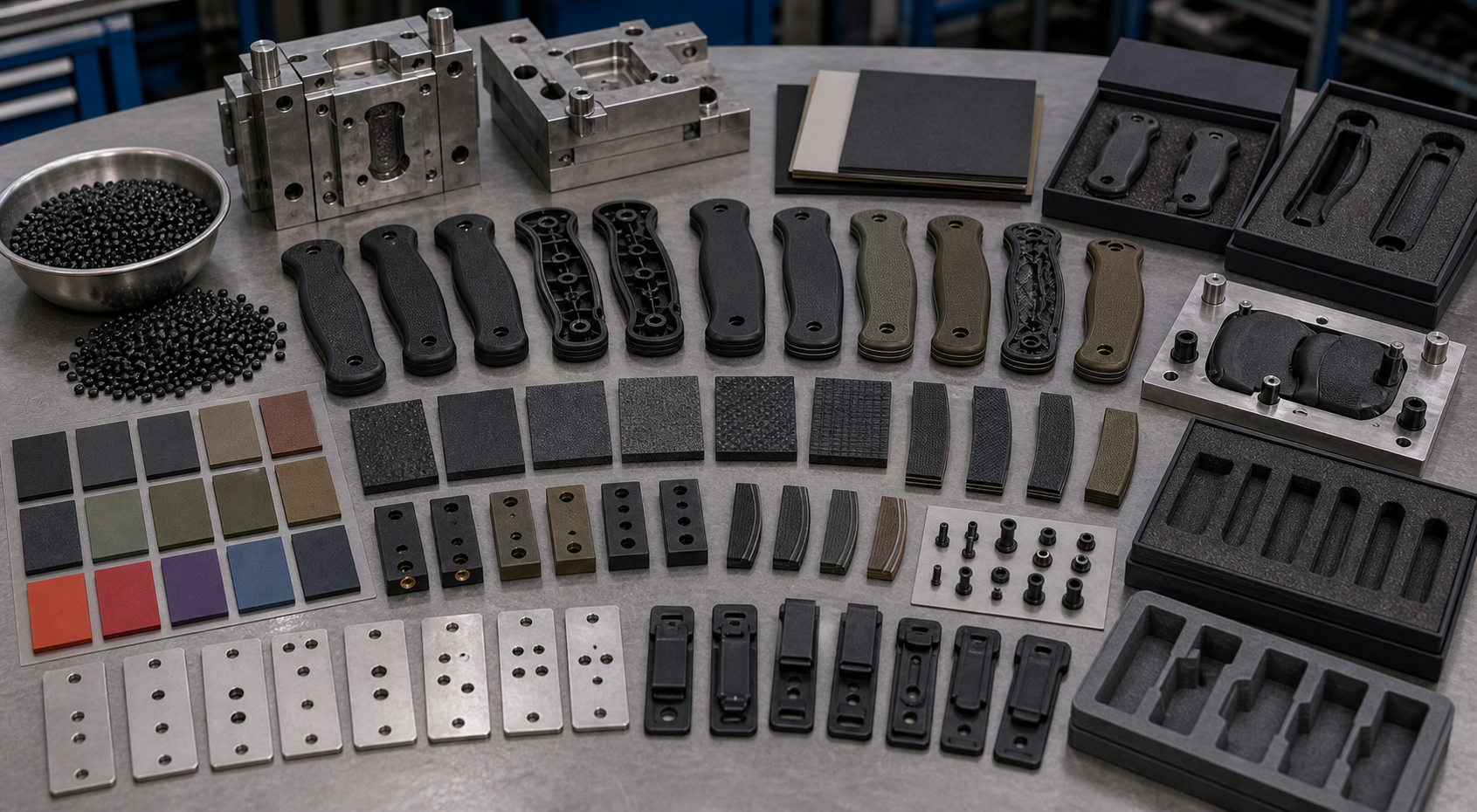
A strong Grivory handle RFQ should include knife type, target market, target price, order quantity, handle structure, grade expectations, color, texture, clip design, screw layout, blade steel, lock type, packaging, test needs, and inspection standard.
I Need the Business Target Before the Mold Plan
For a Grivory handle, the RFQ should start with the business target. Is the buyer building a value EDC knife, a rescue tool, an outdoor folder, a camping fixed blade, or a private label utility knife? What is the target price? What is the expected first order and repeat volume? These details decide whether injection molding is worth the tooling cost.
Then I need the product structure. A folding knife handle needs pivot area support, body screw layout, lock clearance, clip support, liner fit, and backspacer or standoff planning. A fixed blade handle needs tang support, screw or rivet design, grip shape, and possibly overmold or insert decisions. A multi-tool handle may need internal clearances for moving parts. Without these details, the quote is only a guess.
The buyer should also define appearance. Color, texture, logo method, surface finish, packaging, and cosmetic tolerance should be in the RFQ. If the buyer is open to recommendation, that is fine, but the target market and price must be clear.
I usually suggest a staged sample plan. First, confirm material and color. Second, confirm molded handle trial samples. Third, confirm full assembled knife samples. Fourth, confirm packed product samples. This sequence finds problems before mass production and makes repeat orders easier.
| RFQ field | Why I need it | Example decision |
|---|---|---|
| Target market | Guides material and texture | Rescue, EDC, outdoor, or utility |
| Expected volume | Justifies tooling route | Trial order versus repeat program |
| Handle structure | Controls mold and strength | Screw bosses, ribs, clip support |
| Inspection standard | Controls acceptance | Warpage, surface, assembly, packing |
Turn your idea into a quote-ready knife project.
Share your drawing, sample photo, target quantity, market, and packaging needs. Vast State will review manufacturability and prepare OEM/ODM options.
Conclusion
I specify Grivory handles by grade, mold structure, texture, color, hardware support, and QC, not by material name alone.
Source Notes
- EMS-GRIVORY Grivory GV supports the description of Grivory GV as a semi-crystalline partially aromatic polyamide supplied as granules for injection molding or extrusion.
- EMS-GRIVORY Grivory HT supports the discussion of high-temperature Grivory family options, moisture behavior, dimensional stability, and grade differences.
- EMS-GRIVORY Grivory GVX supports the discussion of low warpage, high stiffness, and processing considerations for higher-demand molded parts.
- EMS-GRIVORY LFT polyamides supports the discussion of long-fiber reinforced products, injection molding, stiffness, impact, creep, and low warpage context.
- EMS-GRIVORY product overview supports the broader portfolio context and the need to choose the right grade family.
- ISO 9001 explained supports the process-control and evidence-based QC approach.