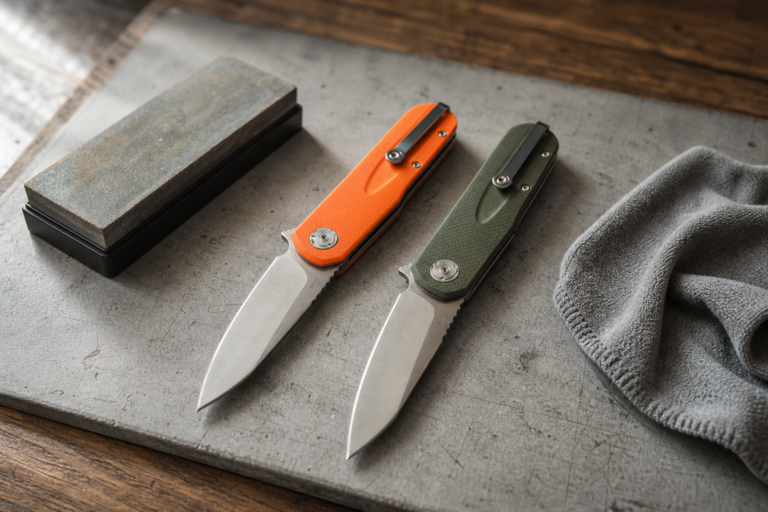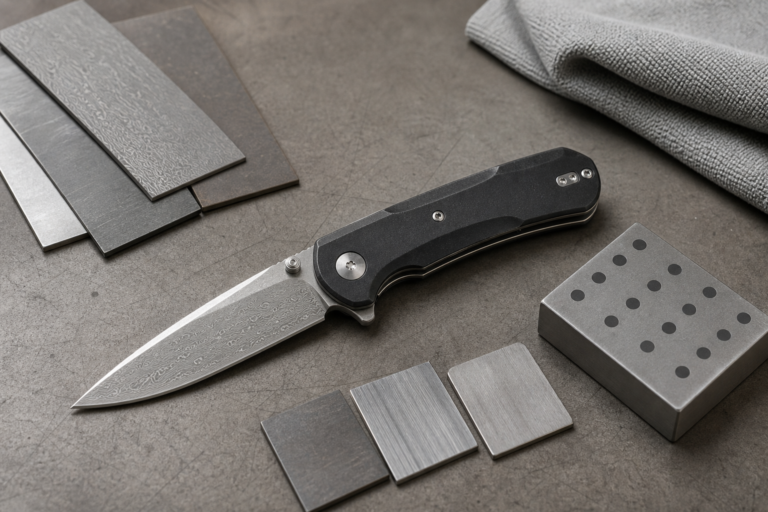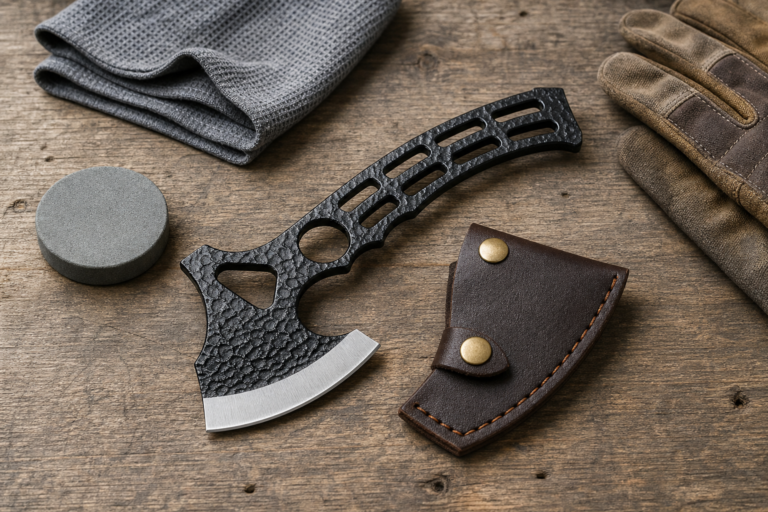
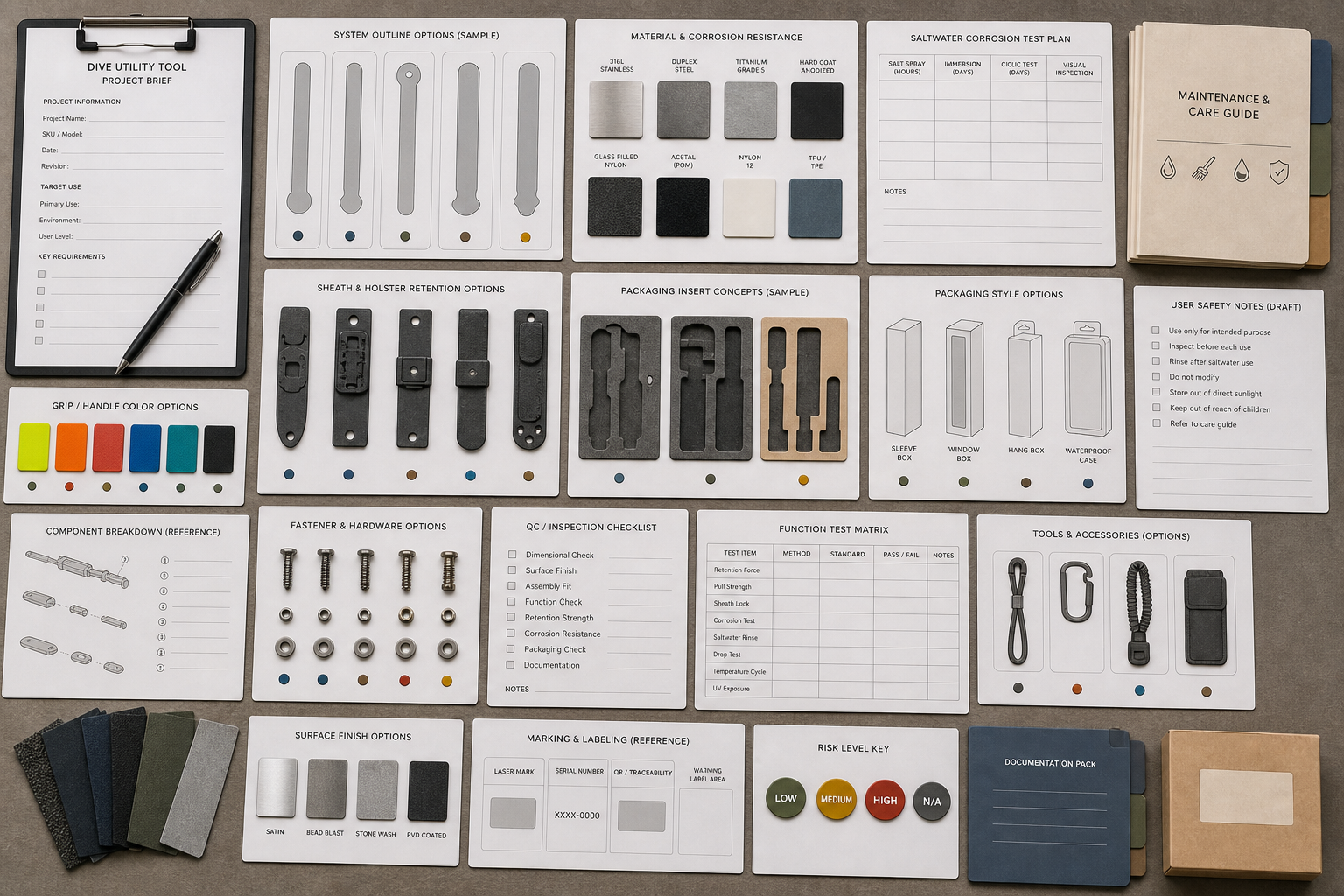
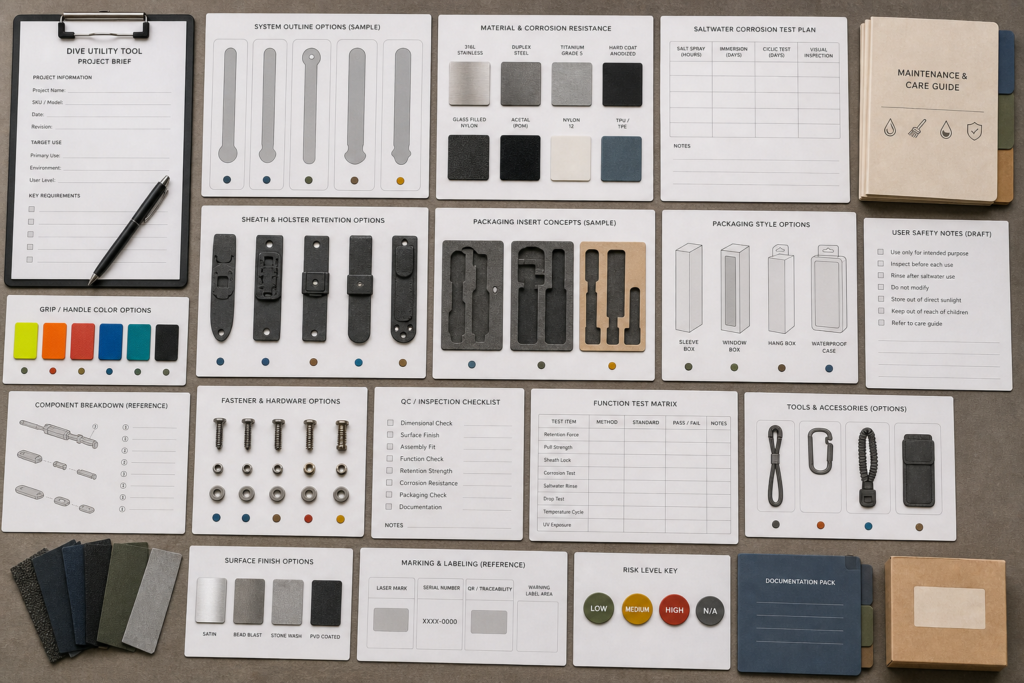
A dive knife can look small in a catalog. But corrosion, sheath failure, weak grip, or vague maintenance copy can hurt the whole product.
B2B buyers should specify dive knives by saltwater material, blade geometry, tip style, grip visibility, sheath retention, maintenance guidance, QC tests, packaging, and RFQ details. A dive knife should be treated as a complete underwater tool system, not only a stainless blade.
Quick buyer brief:
- Answer: Specify the dive knife as a blade, handle, sheath, maintenance, and QC system.
- Buyer context: Useful for dive brands, outdoor brands, importers, wholesalers, and private label buyers.
- Key checks: Corrosion resistance, retention, grip, line-cutting function, packaging notes, inspection plan, and channel fit.
Have a knife or multi-tool project in mind?
Send your sketch, CAD file, sample photo, or product idea. Vast State can review manufacturability, suggest materials, estimate MOQ, and prepare a quote for your OEM/ODM project.
When I review a dive knife project, I ask a different set of questions than I would ask for a pocket knife or camping knife. The tool may need to face saltwater, gloves, low visibility, wet storage, and repeated rinsing. It also needs a sheath that holds securely and releases predictably. For B2B buyers, the project should be built around real product requirements: material, geometry, handle, sheath, packaging, maintenance, and inspection. The goal is not to make a dramatic-looking blade. The goal is to make a sellable, repeatable, and practical underwater tool.
What Role Should a Dive Knife Play in a B2B Product Line?
Some buyers treat a dive knife as a simple add-on. That often creates weak specs, weak packaging, and weak product positioning.
A dive knife should be positioned as a compact underwater utility tool for cutting-line and gear-support situations, with clear limits, responsible maintenance guidance, and channel-ready packaging.
I Define the Product Role Before I Define the Blade
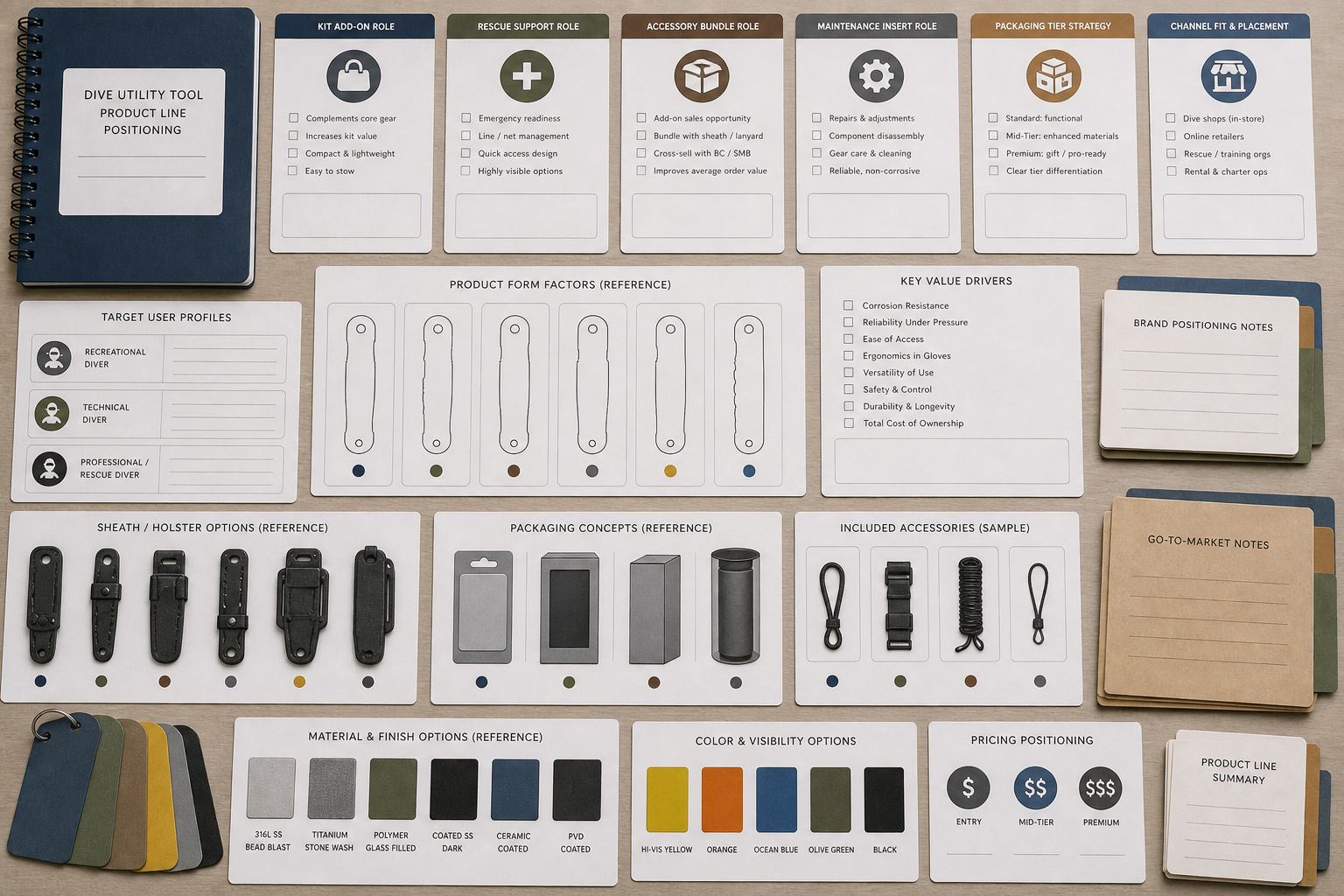
In B2B sourcing, a dive knife can serve different product roles. It may be a compact fixed blade for a diving accessory line. It may be a rescue-style cutting tool for outdoor water sports. It may be part of a broader kit with a sheath, straps, and maintenance insert. It may also be an entry-level private label SKU for distributors. These roles need different choices. A product for serious dive retail may need stronger sheath retention, higher corrosion-resistance expectations, and clearer maintenance copy. A budget water-sports accessory may need simpler construction but still needs safe packaging and honest claims.
The Divers Alert Network discussion of dive knives and cutting devices is useful because it frames cutting tools as practical equipment rather than decoration. OSHA's commercial diving overview also reminds buyers that underwater work is a controlled environment with equipment and safety planning. I do not turn those sources into consumer training. I use them to help buyers understand that a dive knife should be designed around practical function, storage, access, and maintenance.
| Product role | Buyer question | OEM/ODM implication |
|---|---|---|
| Dive accessory | Is it part of a dive gear line? | Stronger corrosion and sheath review |
| Water-sports tool | Is it for kayak, boat, or water rescue retail? | Clear positioning and packaging notes |
| Private label SKU | Is cost the main driver? | Standard materials and simple packaging |
| Kit component | Does it ship with straps or accessories? | Fit, retention, and carton testing matter |
OEM/ODM RFQ Checklist
Prepare these details to help Vast State review your project and provide a more accurate quotation.
| RFQ Field | What to Prepare |
|---|---|
| Project type | OEM from drawing / ODM private label / wholesale catalog |
| Product category | Folding knife / fixed blade / multi-tool / outdoor tool |
| Design status | Idea / sketch / 2D drawing / 3D CAD / physical sample |
| Target price | Ex-factory target price or retail price range |
| MOQ expectation | 500 / 1,000 / 3,000 / 5,000+ pcs |
| Logo method | Laser engraving / etching / printing / molded logo |
| Packaging | Standard packaging / custom retail box / Amazon-ready |
| Market | USA / EU / Japan / Korea / Middle East / other |
| Compliance needs | Buyer-specified testing / documentation / labeling |
| Timeline | Sample deadline / mass production deadline |
How Should Buyers Choose Blade Material for Saltwater Exposure?
Saltwater makes weak material choices visible fast. A shiny sample can still rust, pit, or stain after real use.
Buyers should choose blade material by corrosion resistance, edge needs, heat treatment stability, target price, maintenance expectations, and supplier ability to inspect every batch.
I Balance Corrosion Resistance With Real Manufacturing
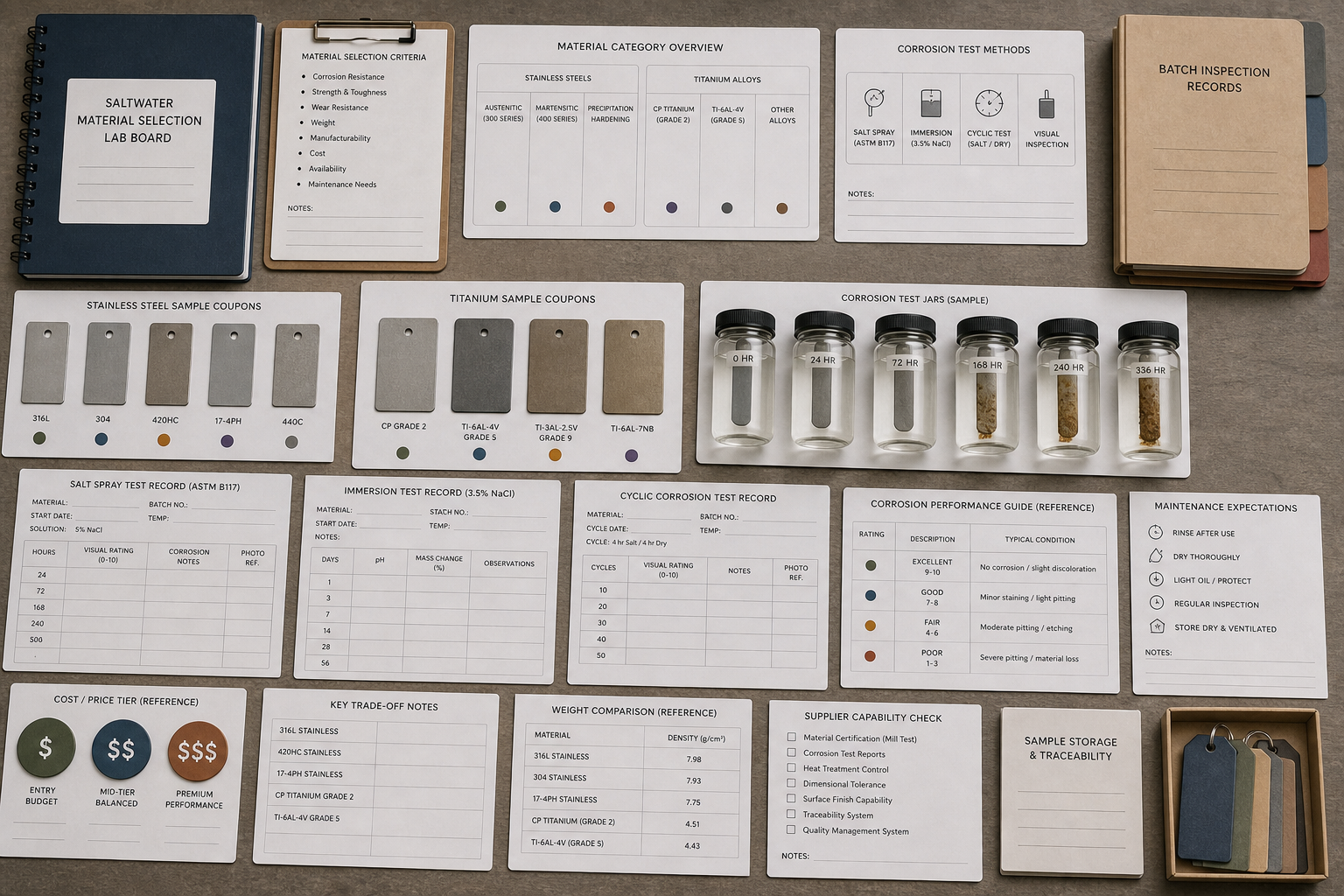
Blade material is one of the most important dive knife decisions. Buyers often ask for stainless steel, titanium, or a coated blade. Each option has tradeoffs. Stainless steel can be cost-effective and easy to manufacture, but the grade and heat treatment must fit the marine use case. Titanium can offer strong corrosion resistance and light weight, but it changes cost, edge expectations, and machining behavior. Coatings can help appearance and corrosion performance, but coatings also need adhesion checks and wear expectations.
For stainless knife steel, Alleima 14C28N is a useful reference because it is designed for knife applications and highlights corrosion resistance as part of the steel's value. That does not mean every dive knife should use that grade. It means buyers should discuss steel choice in a serious way. I ask for target hardness, corrosion expectation, finish, coating, and maintenance copy before quoting. If the buyer wants a lower-cost grade, I explain the tradeoff. If the buyer wants a higher-end product, I ask whether the market will pay for it.
| Material option | Main advantage | Buyer caution |
|---|---|---|
| Stainless steel | Practical cost and knife manufacturing familiarity | Grade and heat treatment matter |
| Titanium | Strong saltwater corrosion appeal and low weight | Higher cost and different edge expectation |
| Coated steel | Visual appeal and extra surface protection | Coating wear and adhesion need review |
| Budget stainless | Lower target cost | Maintenance copy and corrosion claims must be careful |
What Blade Shape and Tip Design Should Buyers Specify?
Blade style can look like branding. In dive tools, it also affects safety perception, packaging, and real utility.
Buyers should specify blade length, tip style, serration area, blunt or pointed profile, line-cutter feature, thickness, edge angle, and finish based on the channel and product role.
I Turn Blade Features Into Production Controls
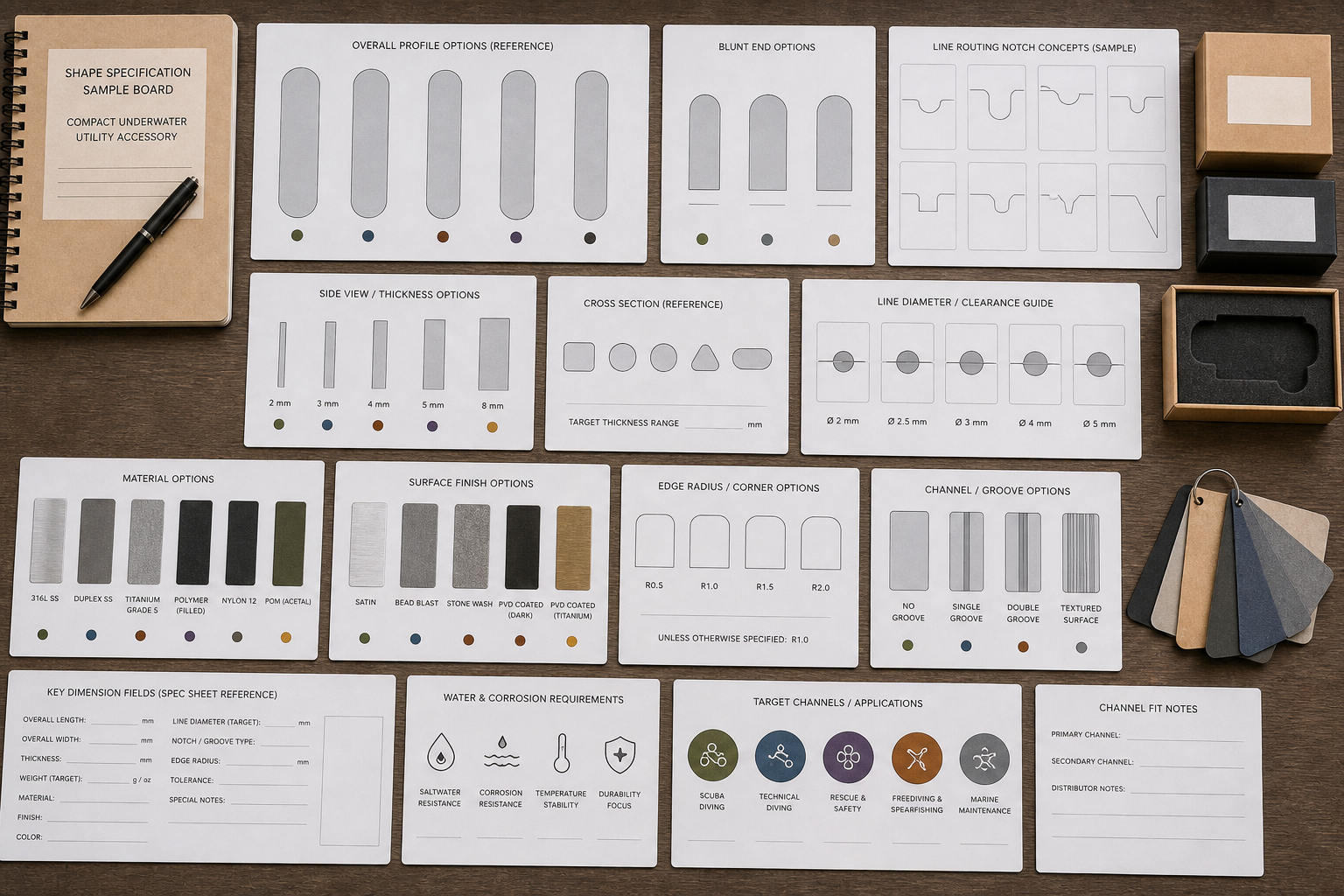
Dive knife blade shape should not be chosen only from a style board. A blunt tip may fit some channels because it reduces piercing perception and can help pry-light utility expectations, although buyers should avoid overpromising. A pointed tip may fit other product lines, but it needs more careful packaging and positioning. Serrations can help with rope or line-cutting expectations, but they add grinding and QC complexity. A line-cutter notch can be useful, but it must be placed and finished cleanly so it does not create burrs or weak geometry.
The challenge is consistency. If the approved sample has a clean serration, the mass-production serration must match. If the notch is too narrow, too rough, or poorly polished, the feature may feel cheap. If the blade is too thick, edge performance may suffer. If the blade is too thin, strength and tip stability may suffer. I ask buyers to approve a drawing, sample, edge finish, and inspection method before production. This protects both product function and brand trust.
| Blade feature | Why buyers request it | Production check |
|---|---|---|
| Blunt tip | Lower piercing perception and practical tool feel | Smooth tip finish and consistent profile |
| Serrated section | Rope or line-cutting expectation | Clean grind and repeatable tooth pattern |
| Line-cutter notch | Compact utility feature | No burrs, proper radius, clean polish |
| Blade thickness | Strength, weight, and feel | Drawing tolerance and batch check |
How Should Handle, Grip, and Visibility Be Designed?
Wet hands and gloves change everything. A handle that feels good on a desk may fail the product experience underwater.
Dive knife handles should use grip-friendly materials, secure construction, bright or high-visibility options, rounded edges, glove-friendly shape, and stable attachment points.
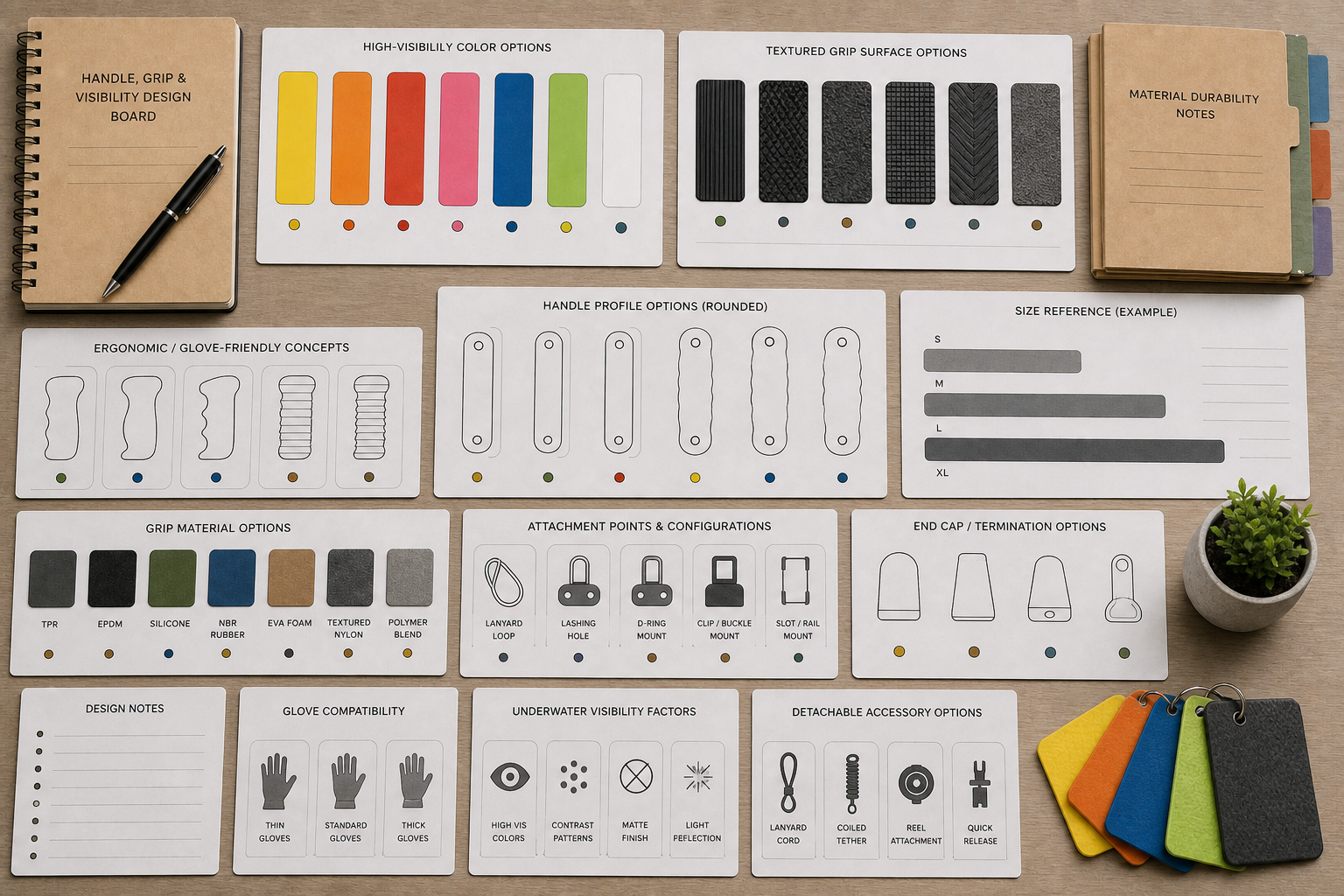
I Treat the Handle as Part of the Underwater Interface
Handle design is one of the easiest places to make a dive knife feel cheap. A narrow handle may save cost but feel unstable. A smooth handle may look clean but become slippery when wet. A dark handle may look serious in photos but become harder to find in low light or inside a gear bag. A weak lanyard hole or strap point may fail distributor expectations. In OEM/ODM work, I prefer to review the handle as a full interface: grip texture, finger indexing, guard shape, balance, edge smoothing, fastener security, and color.
Material choice also matters. TPR, rubber-like overmolds, textured polymer, G10-style material, and stainless handles all create different costs and feelings. A dive brand may prefer a bright handle and matching sheath release. A general outdoor brand may prefer a simpler black handle but still needs texture and grip confidence. I ask buyers to approve handle material samples before tooling, because color, softness, and surface texture can change from sample to mass production. A good handle should support product control without making unrealistic claims.
| Handle detail | What I check | Buyer benefit |
|---|---|---|
| Texture | Wet grip feel and surface consistency | Better perceived control |
| Color | Bright, high-visibility, or brand color | Easier product recognition |
| Construction | Full tang, overmold, screws, or pins | Better durability planning |
| Edge smoothing | Mold lines, corners, and guard edges | Lower complaint risk |
What Sheath and Retention Details Matter Underwater?
A dive knife can fail as a product if the sheath fails. Retention and release design need serious sample testing.
Buyers should review sheath material, drainage, retention lock, strap fit, mounting options, release direction, rattle, corrosion-prone hardware, and packaging protection before approval.
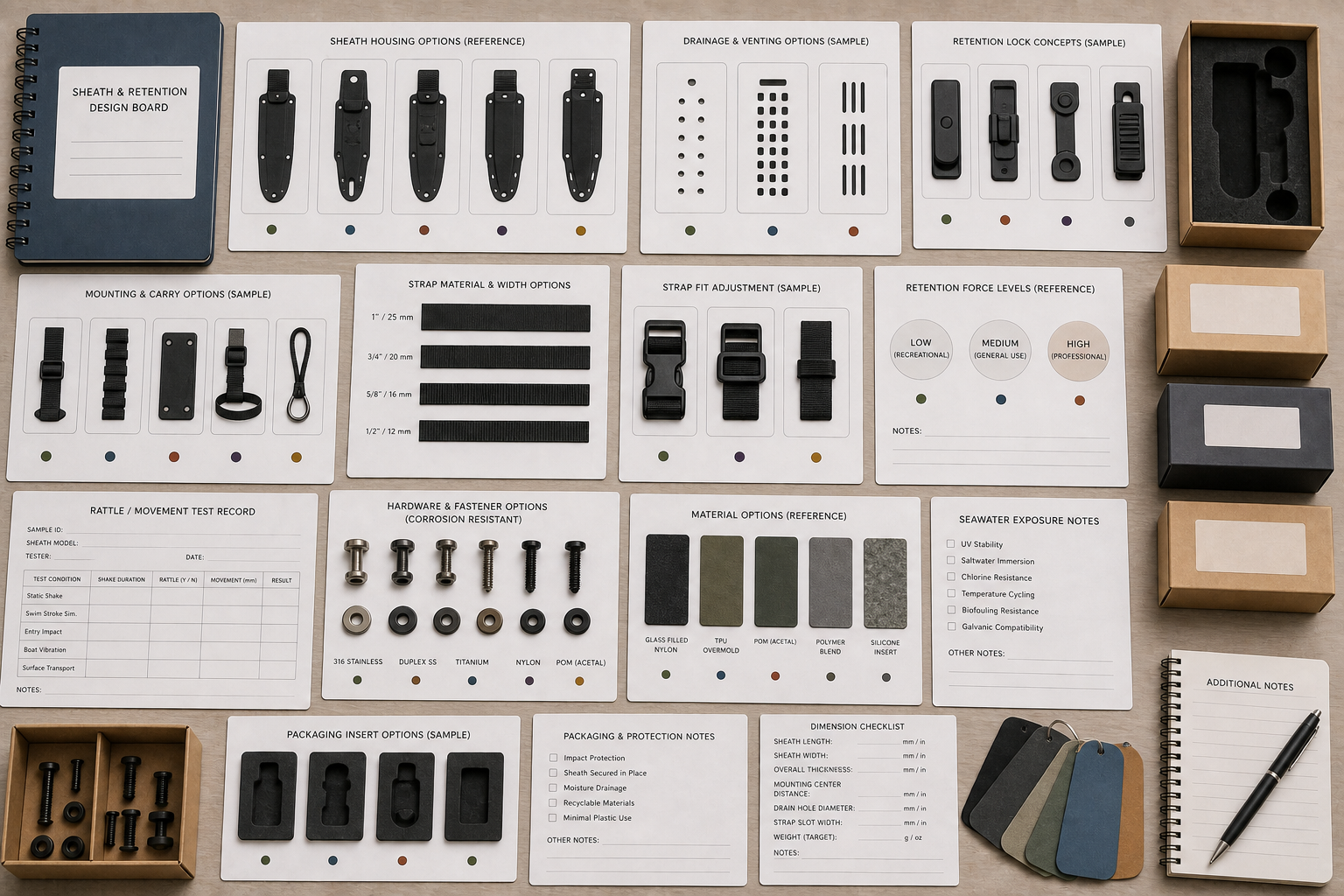
I Review the Sheath Like a Mechanical Product
For dive knives, the sheath is not optional decoration. It is the part that controls storage, retention, access, and transport. A sheath that holds too loosely can create product complaints. A sheath that holds too tightly can feel frustrating. A release button that jams after saltwater exposure can hurt the brand. Metal hardware can corrode if the material choice is poor. Straps can stretch, crack, or feel cheap if the material is not matched to the product level.
OSHA's commercial diving equipment standard gives a useful reminder that equipment and systems matter in underwater work. OSHA's commercial diving directive also includes discussion of a diver-worn knife in commercial settings, which supports the idea that attachment and accessibility are part of equipment planning. In B2B product development, I turn that into practical checks: retention strength, release repeatability, strap length, mounting orientation, drainage, saltwater exposure, and packaging fit. The buyer should approve these details before mass production, not after the first shipment.
| Sheath detail | What to test | Why it matters |
|---|---|---|
| Retention | Shake, pull, and repeat release checks | Reduces lost-tool complaints |
| Drainage | Water can leave the sheath | Helps reduce corrosion risk |
| Mounting | Strap, clip, belt, or BCD-style option | Fits target channel expectations |
| Hardware | Corrosion-resistant screws or rivets | Protects long-term appearance |
What Maintenance and Packaging Information Should Buyers Provide?
Saltwater damage is often blamed on the product. Sometimes the real problem is missing care guidance.
Packaging should include clear maintenance notes about rinsing, drying, storage, corrosion checks, sheath cleaning, edge care by qualified users, and stopping use when damaged.
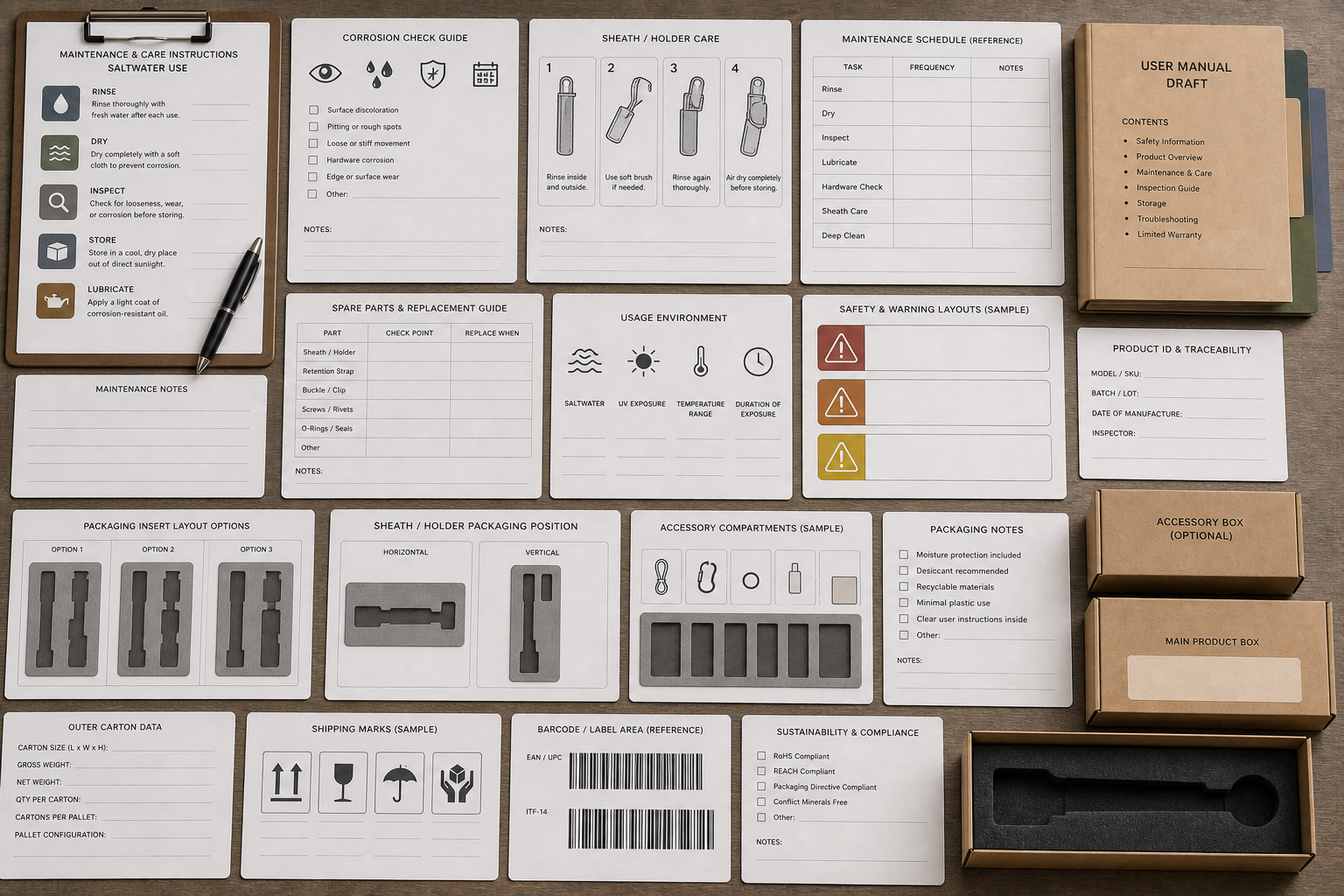
I Use Maintenance Copy to Protect the Buyer and the Brand
Dive knives live in a difficult environment. Even a good stainless product needs care after saltwater exposure. I recommend that buyers include simple maintenance information in the product package or QR page. The copy should be factual and short. It can tell users to rinse the tool with fresh water after saltwater exposure, dry it before storage, check the sheath, inspect hardware, and follow the buyer's approved edge-care advice. It can also warn users to stop using the product if the blade, handle, sheath, or mounting hardware is damaged.
The copy should not become a long technical manual unless the channel requires one. Retail packaging needs clarity. Online listings need accurate product details. Importers may need country-of-origin marking, SKU, barcode, material information, and care notes. Trade.gov explains that HS codes are used to classify traded goods and support shipping documents, duties, and trade reporting. That is why I want product descriptions, material details, and packaging data to match the actual SKU. Good information prevents small questions from becoming shipment or customer-service problems.
| Information item | What to include | Why it helps |
|---|---|---|
| Care note | Rinse, dry, inspect, and store properly | Reduces corrosion complaints |
| Material line | Blade steel, handle, sheath material | Supports retail and import files |
| Warning note | Buyer-approved safety and age language | Supports channel readiness |
| Product data | SKU, barcode, origin, carton details | Helps distributors and brokers |
How Should Buyers Control Corrosion, Hardness, and Batch Quality?
A dive knife sample can look clean on day one. Batch consistency decides whether it remains a good product line.
Buyers should control corrosion expectations, hardness range, edge geometry, sheath retention, handle pull strength, coating adhesion, packaging fit, and final inspection records.
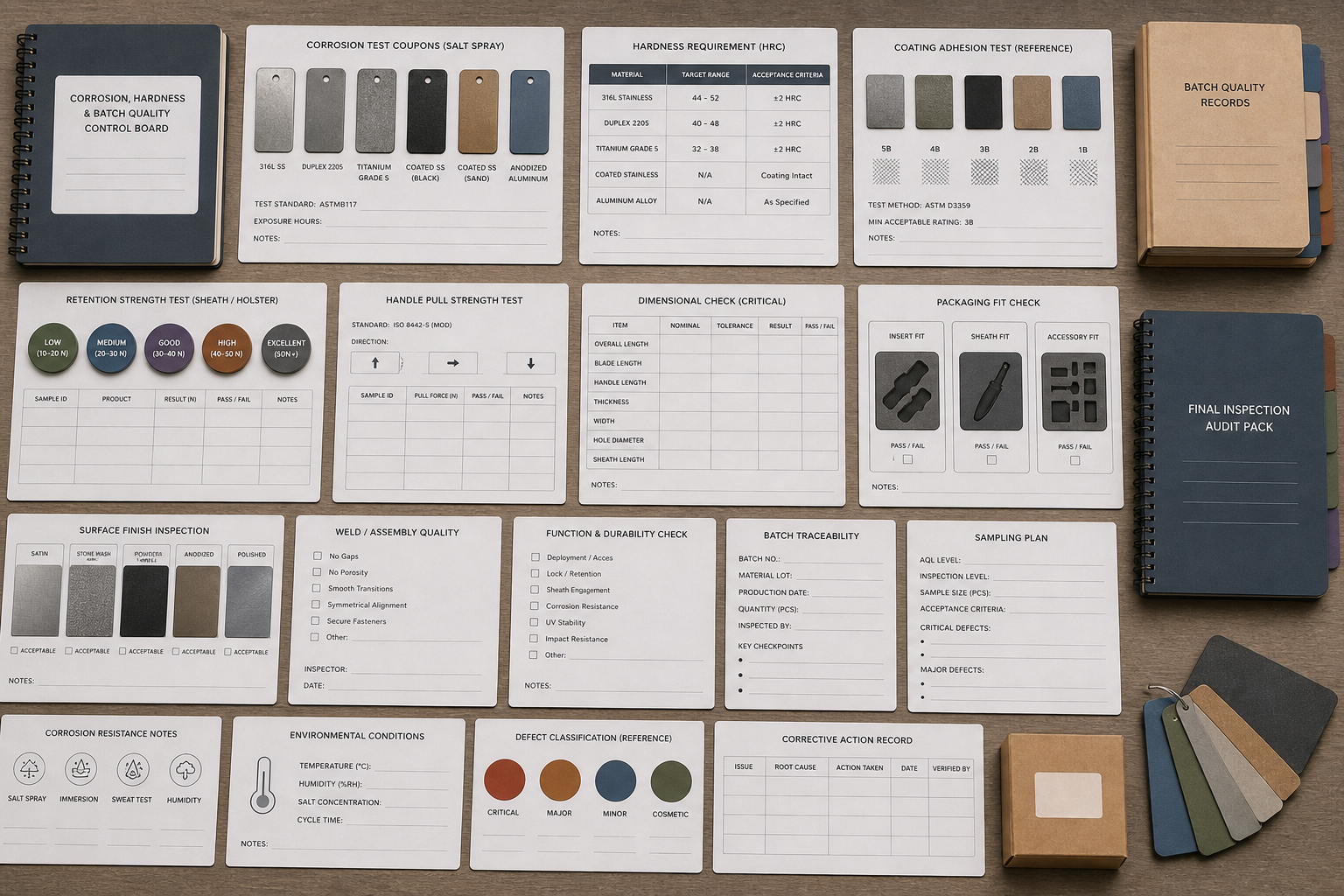
I Make Saltwater Performance Visible Before Shipment
Quality control for dive knives should be more specific than a visual check. I want to see material verification, blade hardness checks, edge consistency, handle security, sheath retention, corrosion review, coating appearance, and packaging fit. A buyer may not need every test for every price level, but the critical points should be defined before the PO. For a premium dive SKU, a buyer may ask for stronger salt-spray or corrosion review. For an entry-level product, the buyer may still need basic rust-prevention guidance and clear product expectations.
The NIST Rockwell hardness guide supports the idea that hardness measurement needs controlled practice and attention to variation. ISO says ISO 9001 supports quality management and meeting customer requirements. I use both ideas in practical factory language. The buyer and factory should agree on what will be measured, how often, and what records will be shared. That way, quality is not only a promise. It becomes a checklist.
| QC area | Inspection focus | Buyer question |
|---|---|---|
| Blade material | Grade, finish, coating, corrosion expectation | What environment is claimed? |
| Hardness | Target range and measurement method | What record will be shared? |
| Sheath retention | Hold strength and release repeatability | Does it match the sample? |
| Handle security | Pull, torque, or bond review | Will it survive normal handling? |
What Should a Dive Knife OEM/ODM RFQ Include?
A short RFQ can hide the most important problems. Dive knife projects need more detail than a size and target price.
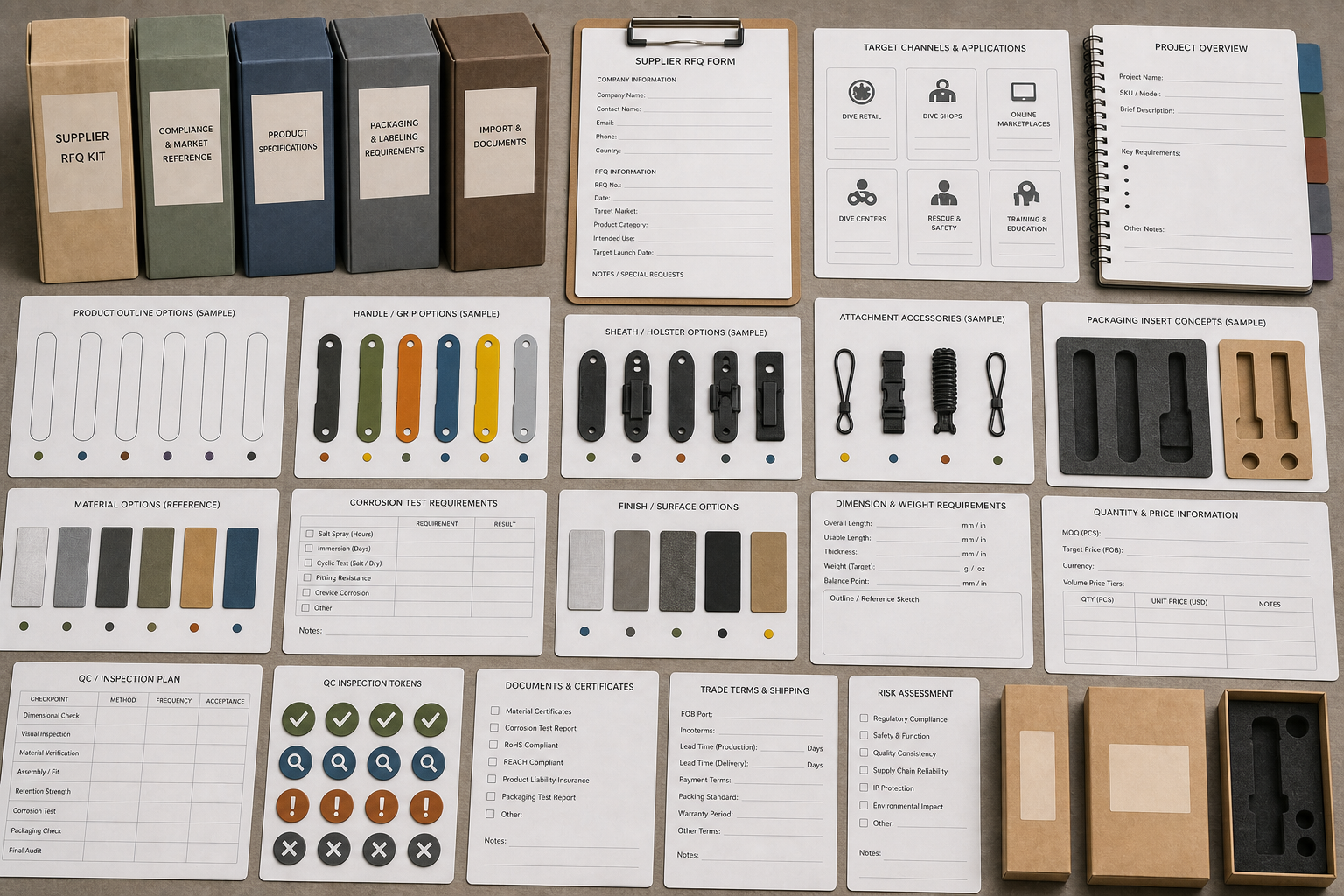
A dive knife RFQ should include target channel, blade material, blade shape, tip style, serration, handle material, sheath design, maintenance insert, packaging, quantity, target price, and inspection needs.
I Need the Market Context Before I Quote
When a buyer asks Vast State for a dive knife quotation, I want to know the target market first. Is the product for dive retail, water sports, rescue-style outdoor gear, promotional kits, or distributor private label? Then I ask for blade material preference, blade length, thickness, tip style, edge type, serration, line-cutter requirement, handle material, color, sheath type, mounting method, packaging, MOQ expectation, target price, and inspection level. If the buyer has channel rules or legal review notes, I want those limits before sampling.
This detail helps me give better advice. If the buyer wants a corrosion-focused dive product, I will discuss material and finish more deeply. If the buyer wants a low-cost water-sports accessory, I will focus on practical construction and honest maintenance copy. Cost control should remove waste before it removes function. A standard handle mold, standard sheath, simpler finish, and compact package can reduce cost. But weak retention, smooth low-grip handles, vague corrosion claims, or visual-only inspection can create larger problems later. If the buyer needs retail packaging, I will ask for barcode, origin marking, warning language, and insert layout. A good RFQ lets the factory propose realistic options instead of guessing. It also helps the buyer compare suppliers by engineering support, not only price.
| RFQ field | Why I need it | Buyer benefit |
|---|---|---|
| Target channel | Dive retail, water sports, distributor, or private label | Better product positioning |
| Blade specification | Material, length, thickness, tip, edge, serration | More accurate quote and sample |
| Handle and sheath | Grip material, color, retention, mounting | Fewer late design changes |
| QC and packaging | Corrosion, hardness, retention, insert, carton | Better launch readiness |
Turn your idea into a quote-ready knife project.
Share your drawing, sample photo, target quantity, market, and packaging needs. Vast State will review manufacturability and prepare OEM/ODM options.
Conclusion
I specify dive knives as complete underwater tool systems: material, blade, grip, sheath, maintenance, QC, packaging, and RFQ must work together.
Source Notes
- Divers Alert Network dive knives and cutting devices supports the article's framing of dive knives as practical cutting tools, not decoration.
- OSHA commercial diving overview supports the broader point that underwater work relies on controlled equipment and safety planning.
- OSHA commercial diving equipment standard supports the need to treat diving gear and systems as controlled equipment.
- Alleima 14C28N knife steel supports the discussion of knife steel and corrosion resistance, but does not prove one steel fits every dive knife.
- NIST Rockwell hardness guide supports the article's hardness measurement and QC discussion.
- ISO 9001 supports the process-control and customer-requirement framing.
- Trade.gov HS code guidance supports the trade classification and documentation discussion.