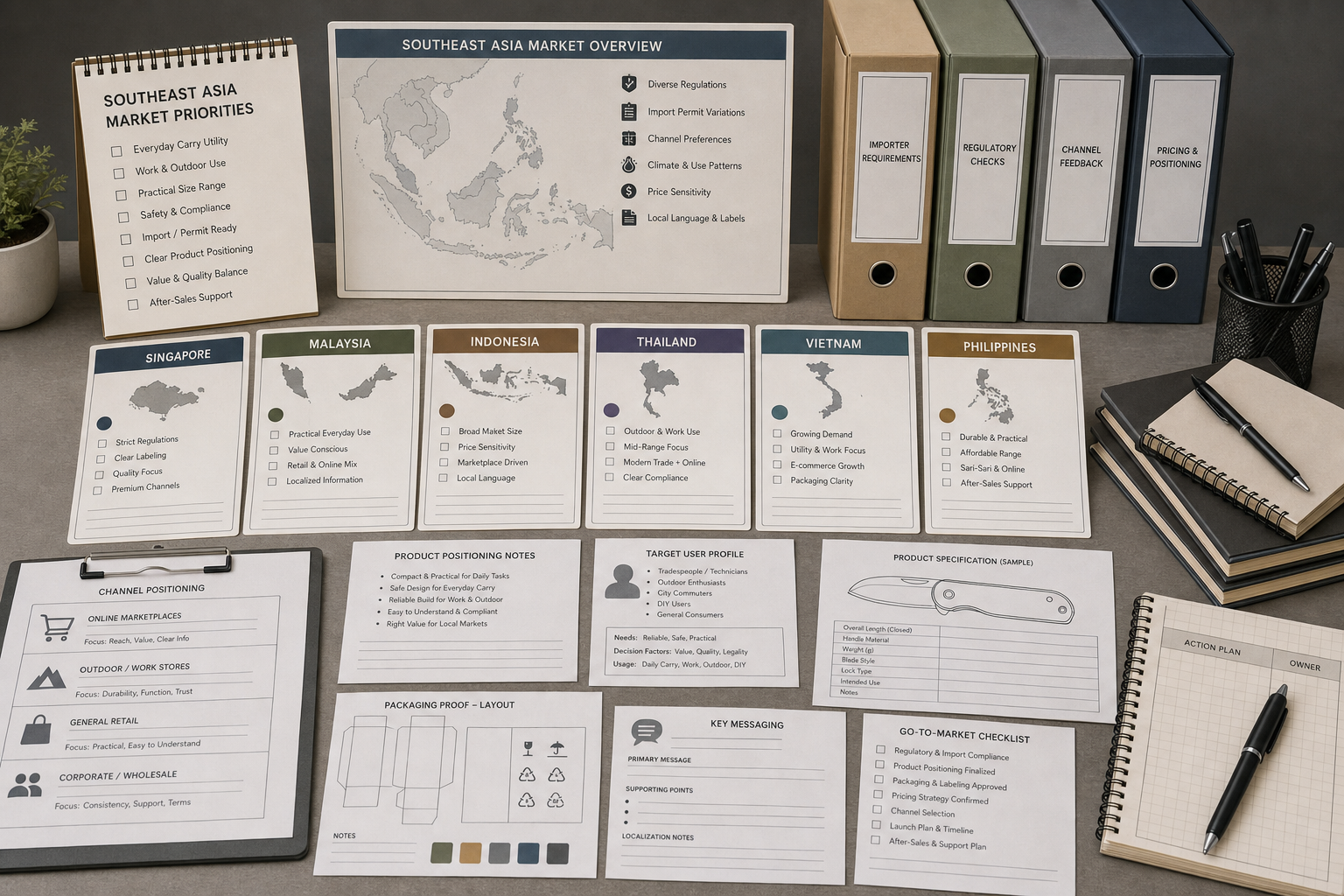
EDC wording can sound simple. But a weak market message can create legal, import, and channel questions. Better positioning starts before production.
Buyers should position EDC folding knives for Southeast Asian markets as practical outdoor, work, or utility tools only after checking local import rules, regulated-item categories, product features, packaging claims, and distributor requirements. This article is not legal advice.
Quick buyer brief:
- Answer: Position the product by market, channel, function, and approved product facts.
- Buyer context: This helps B2B buyers avoid vague "carry" messaging before OEM/ODM production.
- Key checks: Target country, mechanism, blade size, HS reference, packaging wording, importer review, and QC records.
Developing a folding knife line for your brand?
Vast State supports OEM/ODM folding knife projects, including blade steel, lock structure, handle material, finish, logo method, packaging, and quality inspection planning.
When a buyer asks me about EDC folding knives in Southeast Asia, I do not start with lifestyle slogans. I start with product facts and market review. A folding knife may be a useful pocket tool for one sales channel, but it can meet very different questions in another country, airport, marketplace, or retail environment. Official sources show why this matters. Singapore Police explains that GEWCA covers activities such as possession, sale, import, export, and transport of regulated weapons. Singapore Customs also says controlled goods may need authorization before import. That is enough reason to treat EDC as a careful product-positioning project, not just a catalog phrase.
Why Should Buyers Avoid One General Carry Message?
One simple message can create many problems. A slogan that works in one market may create questions in another market.
Buyers should avoid one general carry message because Southeast Asia is not one rulebook. Each target market needs its own product, import, packaging, and channel review.
I Treat EDC As A Market Question
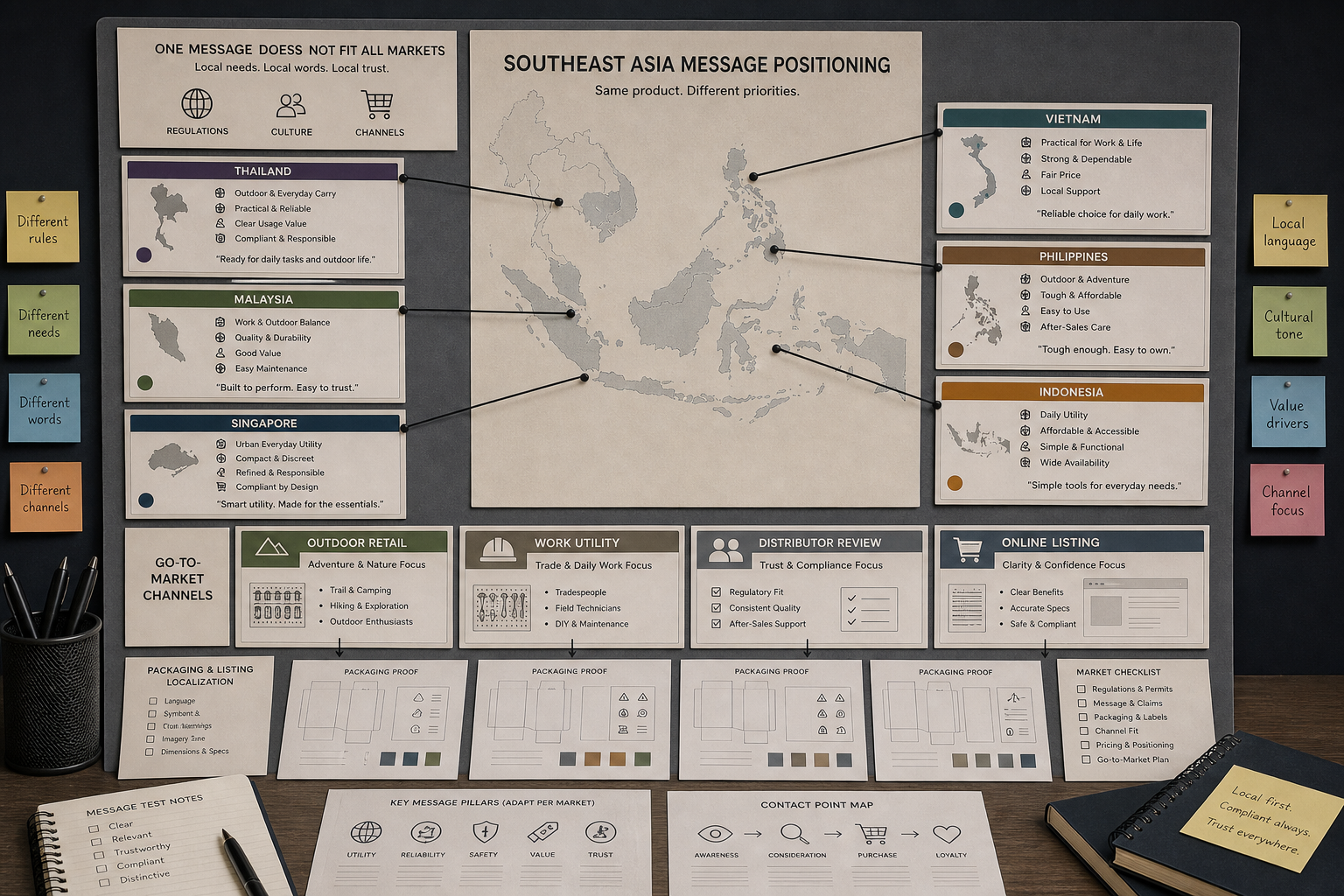
EDC is a popular product idea, but it is not a legal category by itself. In B2B work, I see EDC used to describe compact size, daily utility, simple packaging, and repeat purchase potential. But a buyer still needs to confirm how the product is treated in each destination market. Singapore, Thailand, Malaysia, the Philippines, Vietnam, Indonesia, and other markets can have different customs procedures, police rules, retail restrictions, and platform policies. A supplier should not assume that one product message fits all.
My practical approach is to separate product positioning from final legal approval. I can help define the knife as a compact outdoor utility tool, pocket tool, work knife, or multi-tool if the structure matches that use. The buyer should then ask the importer, broker, distributor, marketplace team, or local adviser to review the wording. This step is boring in the best way. It catches problems before samples, packaging molds, printed cards, and cartons lock the project into a risky direction.
| Positioning question | Why it matters | Better buyer action |
|---|---|---|
| Which market is first? | Rules and channels differ | Name the country or territory in the RFQ |
| Which sales channel? | Online and retail may ask different questions | Confirm platform and distributor rules |
| Which product function? | Vague EDC claims can be unclear | Use practical tool language |
| Who confirms locally? | Factory advice is not legal approval | Assign importer or local reviewer |
OEM/ODM RFQ Checklist
Prepare these details to help Vast State review your project and provide a more accurate quotation.
| RFQ Field | What to Prepare |
|---|---|
| Project type | OEM from drawing / ODM private label / wholesale catalog |
| Product category | Folding knife / fixed blade / multi-tool / outdoor tool |
| Design status | Idea / sketch / 2D drawing / 3D CAD / physical sample |
| Target price | Ex-factory target price or retail price range |
| MOQ expectation | 500 / 1,000 / 3,000 / 5,000+ pcs |
| Logo method | Laser engraving / etching / printing / molded logo |
| Packaging | Standard packaging / custom retail box / Amazon-ready |
| Market | USA / EU / Japan / Korea / Middle East / other |
| Compliance needs | Buyer-specified testing / documentation / labeling |
| Timeline | Sample deadline / mass production deadline |
How Should Buyers Separate Product Positioning From Legal Advice?
Buyers can confuse product advice with legal advice. That creates false confidence and weak launch planning.
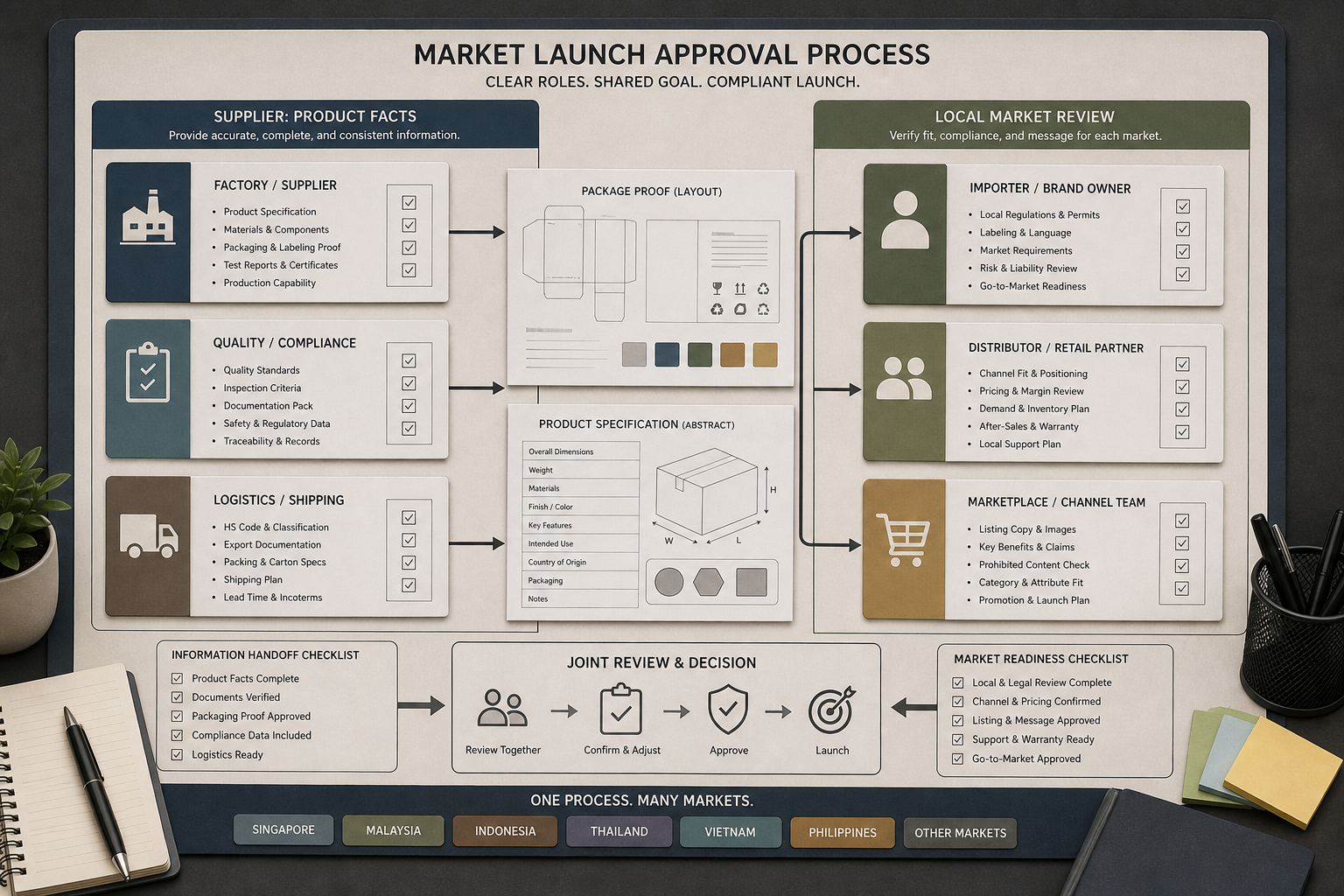
Buyers should let the factory explain product facts and manufacturability, while local experts confirm import, sale, and public-possession rules. The two roles should stay separate.
I Keep The Factory Role Clear
As a manufacturer, I can tell a buyer whether a design is practical to produce. I can explain blade steel, handle material, lock type, opening method, blade length, finish, packaging, MOQ, tooling, and inspection points. I can also tell the buyer when a structure may need extra market review. I cannot give final legal approval for every Southeast Asian country. That approval has to come from the buyer's local side.
This is important because official pages often speak in regulatory language, not catalog language. The Singapore Police GEWCA FAQ says the law governs many activities around guns, explosives, weapons, and noxious substances, including sale, import, export, transport, and disposal. The Singapore Customs controlled goods page says controlled goods need proper authorization from competent authorities before import. These are not small details. They show why a B2B buyer should keep a written record of who confirmed what.
| Role | What this party should do | What this party should not do |
|---|---|---|
| Factory | Provide accurate product facts and samples | Promise final local legality |
| Importer | Check customs and permit requirements | Rely only on product photos |
| Distributor | Review retail channel requirements | Print packaging before review |
| Local adviser | Interpret target-market rules | Replace factory specifications |
Which EDC Folding Knife Features Need Early Review?
Small details can change the review path. A buyer may like a mechanism, but the target market may ask more questions.
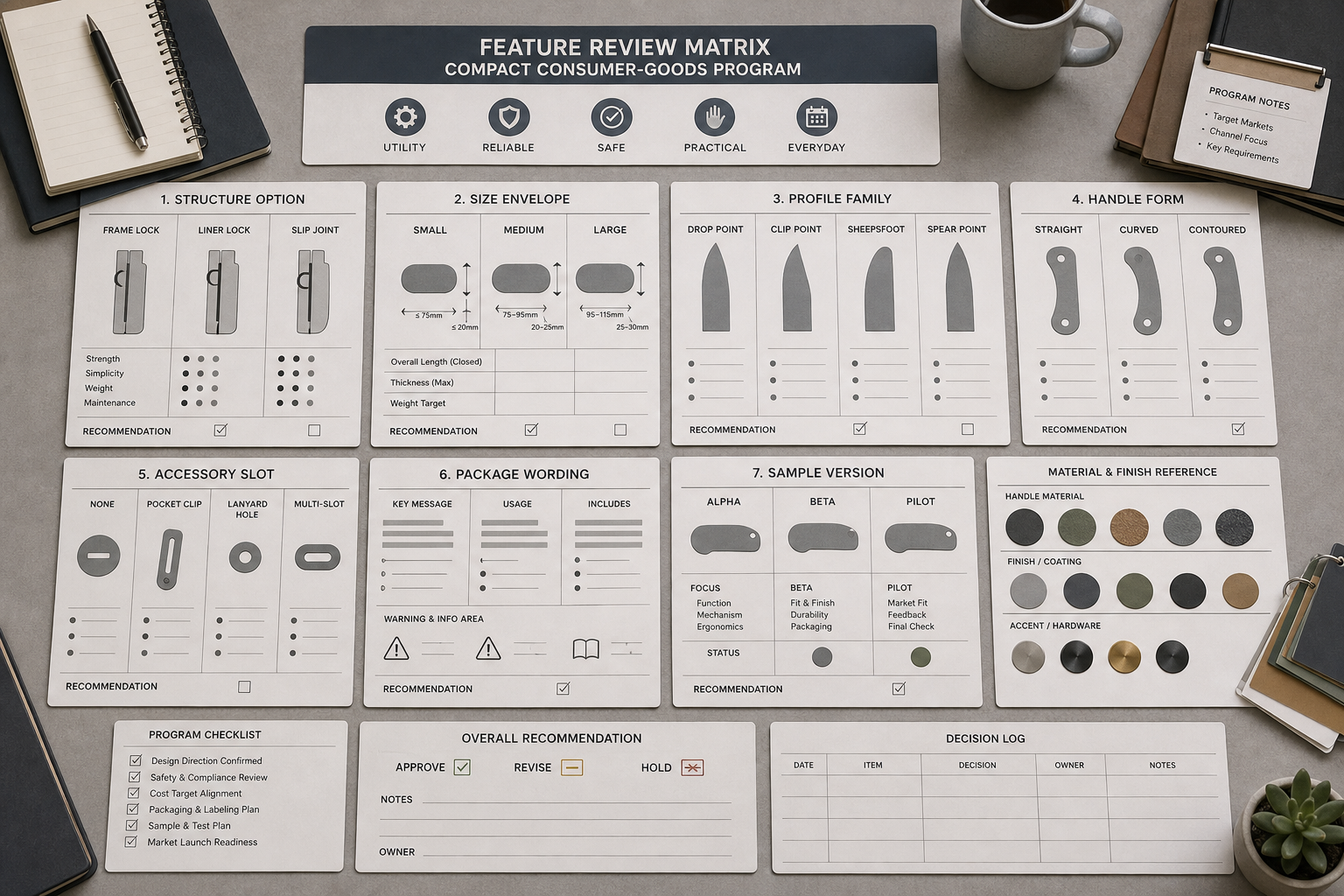
Buyers should review opening method, lock type, blade dimensions, blade shape, handle shape, accessories, and product naming before approving samples for Southeast Asian markets.
I Review Structure Before Style
The product should be reviewed as a structure, not only as a style. Some features look attractive in photos but create extra questions during import or retail review. The Singapore Police guideline on prohibited, controlled, and non-regulated items lists examples such as butterfly or gravity knives, flick knives or switchblades, throwing knives, karambits, and daggers in regulated categories. I do not use that list as a rule for all Southeast Asian markets. I use it as a reminder that mechanism and form matter.
For an OEM or ODM EDC project, I ask buyers to decide what they want the knife to be. A compact outdoor utility folder may need a different structure from a collector-style design or a rescue tool. A nail nick, thumb stud, back lock, liner lock, slip joint, button lock, glass breaker, seatbelt cutter, or multi-tool function should be reviewed before production. If the buyer's local reviewer says one feature is not suitable, I can help adjust the design. This is much easier during concept development than after mass production.
| Feature | Why I check it early | Practical design response |
|---|---|---|
| Opening method | It can affect regulatory and channel review | Confirm allowed mechanism before tooling |
| Blade length | It may matter for local rules or platform review | Record exact measurements |
| Blade and handle form | Some shapes raise extra questions | Match form to practical tool use |
| Accessories | Rescue or multi-tool parts change description | List every function in the spec sheet |
How Should Buyers Prepare Import And Channel Checks?
Good product design still needs the right entry path. A missing permit or unclear description can slow a launch.
Buyers should prepare import and channel checks by sharing product facts with the importer, broker, distributor, and marketplace team before placing a bulk order.
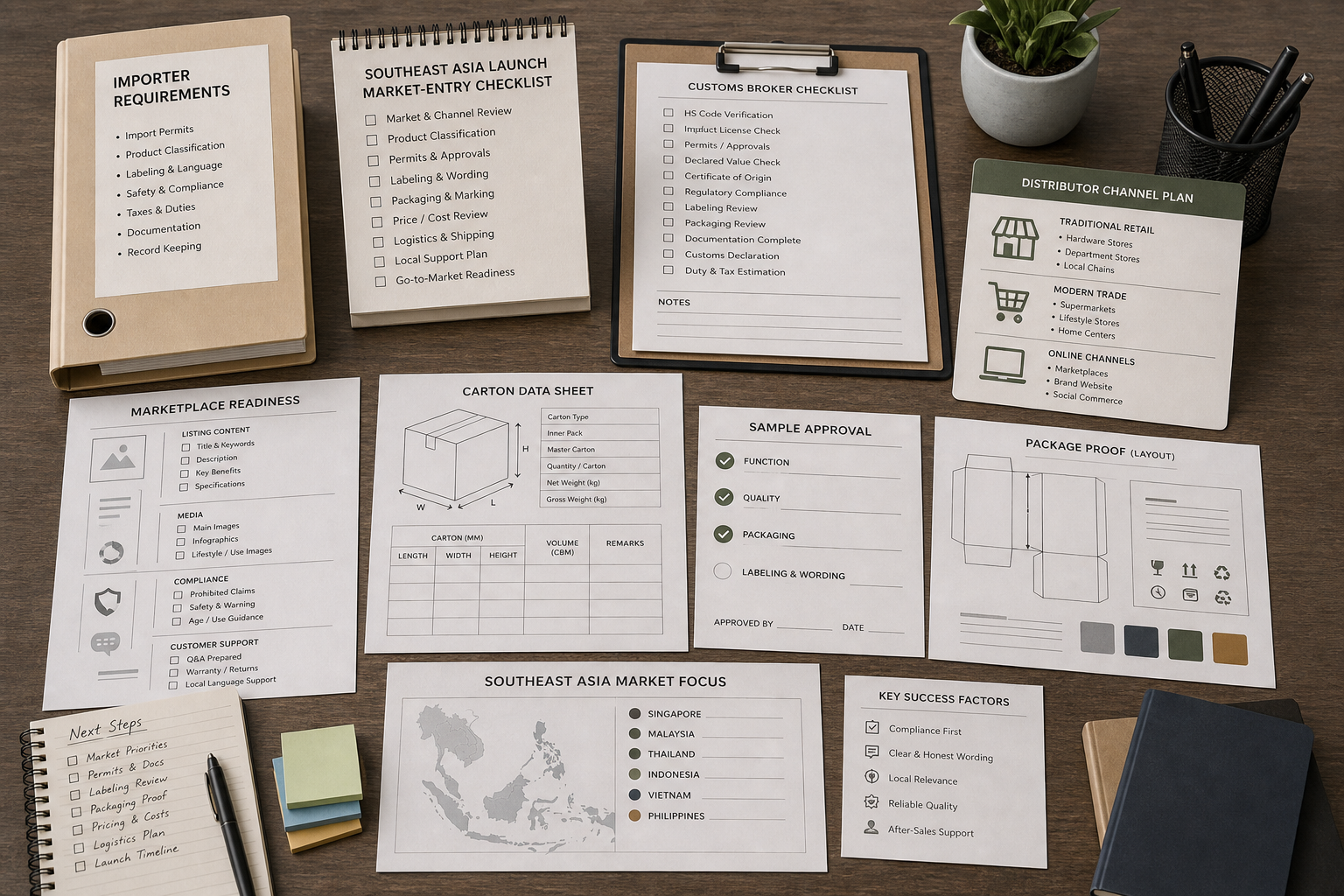
I Want The Importer In The Project Early
The importer should not join the project only after cartons are packed. In Southeast Asia, customs and local agencies can ask different questions depending on the product category. The Thai Customs page on prohibited and restricted goods explains that restricted goods require a permit from related government agencies and that the permit must be presented during customs formalities. The Philippines Bureau of Customs explains that regulated imports or exports may need permits, clearances, licenses, or other requirements from concerned agencies before import or export.
These examples support a practical RFQ rule. The buyer should tell the factory the target market and the intended sales channel. If the product will be sold through retail chains, the distributor may need packaging and safety wording. If it will be sold online, the marketplace may have product-category review. If it will be imported in bulk, the broker may need HS reference, product photos, dimensions, and material details. A clear file reduces confusion.
| Check | Who should review it | Supplier support |
|---|---|---|
| Import pathway | Importer or broker | HS reference, invoice description, packing data |
| Permit question | Competent authority or local adviser | Photos, drawings, mechanism notes |
| Retail listing | Distributor or marketplace team | Product wording and packaging proof |
| Product sample | Buyer and local reviewer | Approved sample and spec sheet |
How Should Packaging Avoid Risky Language?
Packaging can make a practical tool look like the wrong product. The wrong words can create avoidable questions.
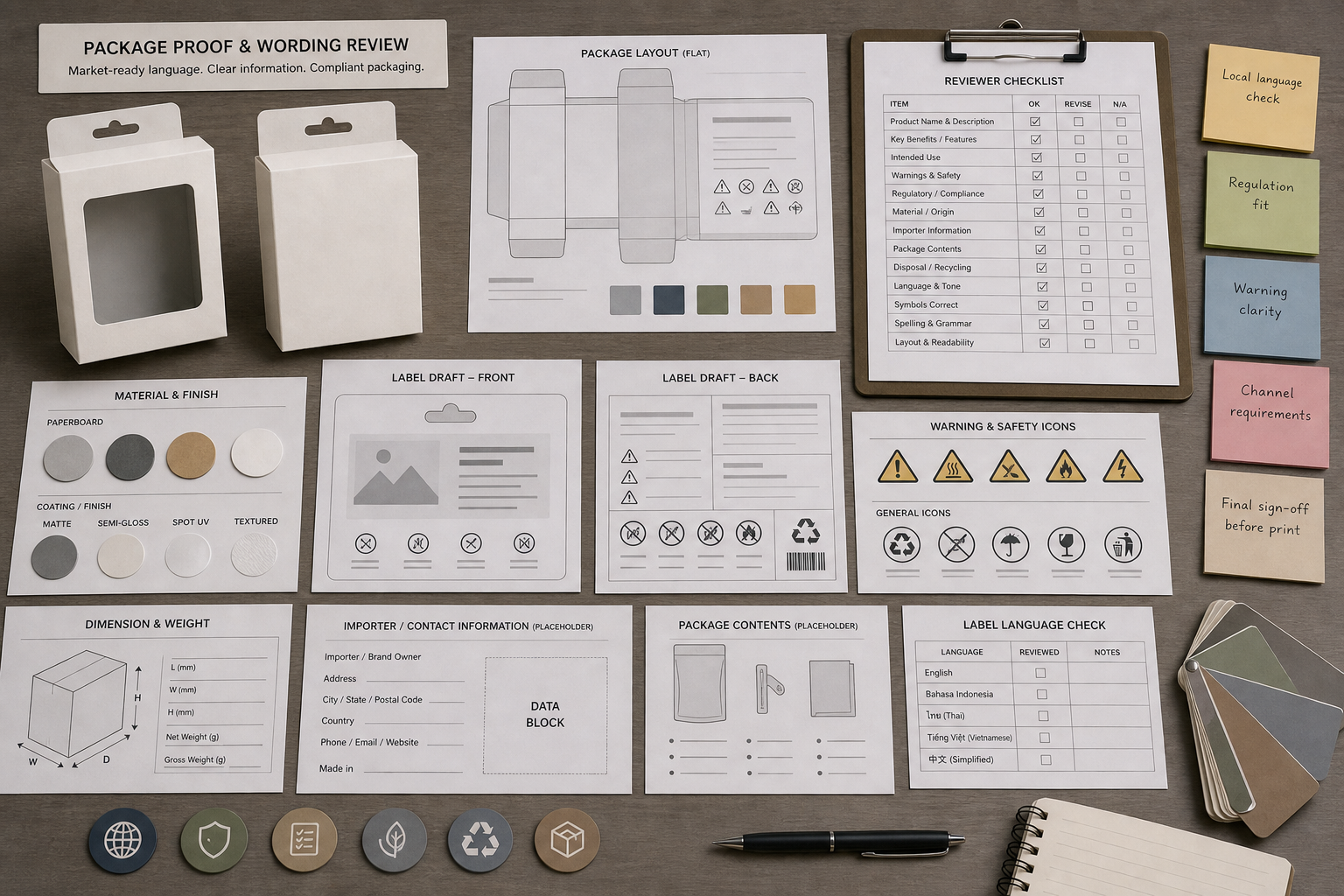
Packaging should use accurate, practical, and market-reviewed language. It should describe materials, dimensions, function, care, importer data, and warnings without exaggerated or aggressive claims.
I Write Packaging Like A Reviewer Will Read It
Many buyers focus on the first customer impression. I agree that packaging has to sell. But in this category, packaging also has to explain the product clearly. I prefer simple functional wording. The package should say what the tool is, what material it uses, what the dimensions are, what care information matters, and who the importer or brand owner is if the market needs that. It should not use language that makes the item sound more extreme than its real purpose.
Private label packaging adds another layer. A buyer may want strong brand language, but the distributor may need conservative wording. The solution is not ugly packaging. The solution is controlled wording. At Vast State, I can prepare several packaging drafts for the buyer's local reviewer. I can also adjust insert cards, warnings, language versions, and barcode placement. I want packaging approved before printing because packaging rework is slow and wasteful.
| Packaging item | Why it matters | Practical wording direction |
|---|---|---|
| Product name | It frames category review | Use outdoor, work, or utility wording when accurate |
| Function list | It explains real use | List practical functions only |
| Warning area | It supports responsible selling | Confirm local wording before print |
| Importer data | It may be needed locally | Add approved company details |
What Product Specs Should The Factory Document?
Loose descriptions create weak reviews. A buyer cannot confirm market fit if the product facts keep changing.
The factory should document blade length, closed length, opening method, lock type, blade steel, handle material, finish, packaging, carton data, sample version, and inspection criteria.
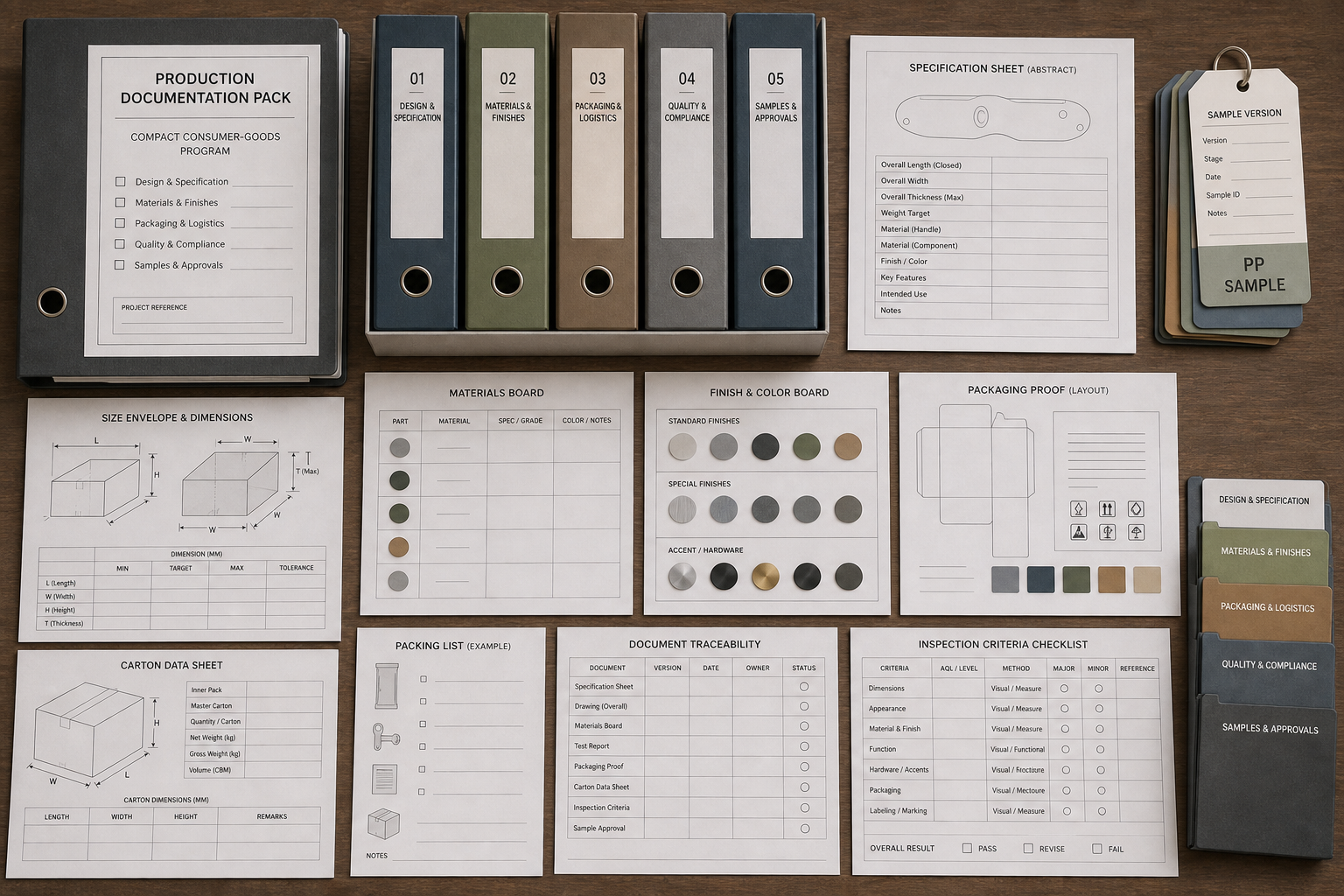
I Build A Spec Pack That Can Travel
A good specification pack should make the same product understandable to the buyer, broker, distributor, factory team, and QC inspector. For a folding knife, I include blade steel, hardness target if agreed, handle material, fastener type, lock type, opening method, blade length, closed length, overall length, weight, finish, logo process, packaging method, carton data, and sample approval photos. If the product is a multi-tool, I list every function.
This document pack supports both compliance review and production control. The UNSD HS 8211 classification detail gives useful customs classification context for knives with cutting blades, including knives having blades other than fixed blades. But an HS reference is not enough. A reviewer still needs real product facts. ISO also describes ISO 9001 as a quality management standard that supports documented processes and customer requirements. I use that mindset in a practical way: write the facts, approve the sample, and make production match the approved version.
| Document | What it records | Why it helps |
|---|---|---|
| Product specification | Size, material, mechanism, finish | Supports buyer and broker review |
| Sample approval sheet | Approved version and photos | Prevents silent changes |
| Packaging proof | Text, barcode, importer data | Supports local channel approval |
| QC checklist | Critical dimensions and function checks | Protects repeat production |
How Should Buyers Build A Southeast Asia RFQ?
A price-only RFQ gives the supplier too little context. The result may be a sample that does not fit the market.
Buyers should build a Southeast Asia RFQ with target market, sales channel, product function, mechanism limits, material needs, packaging requirements, compliance concerns, quantity, and inspection standards.
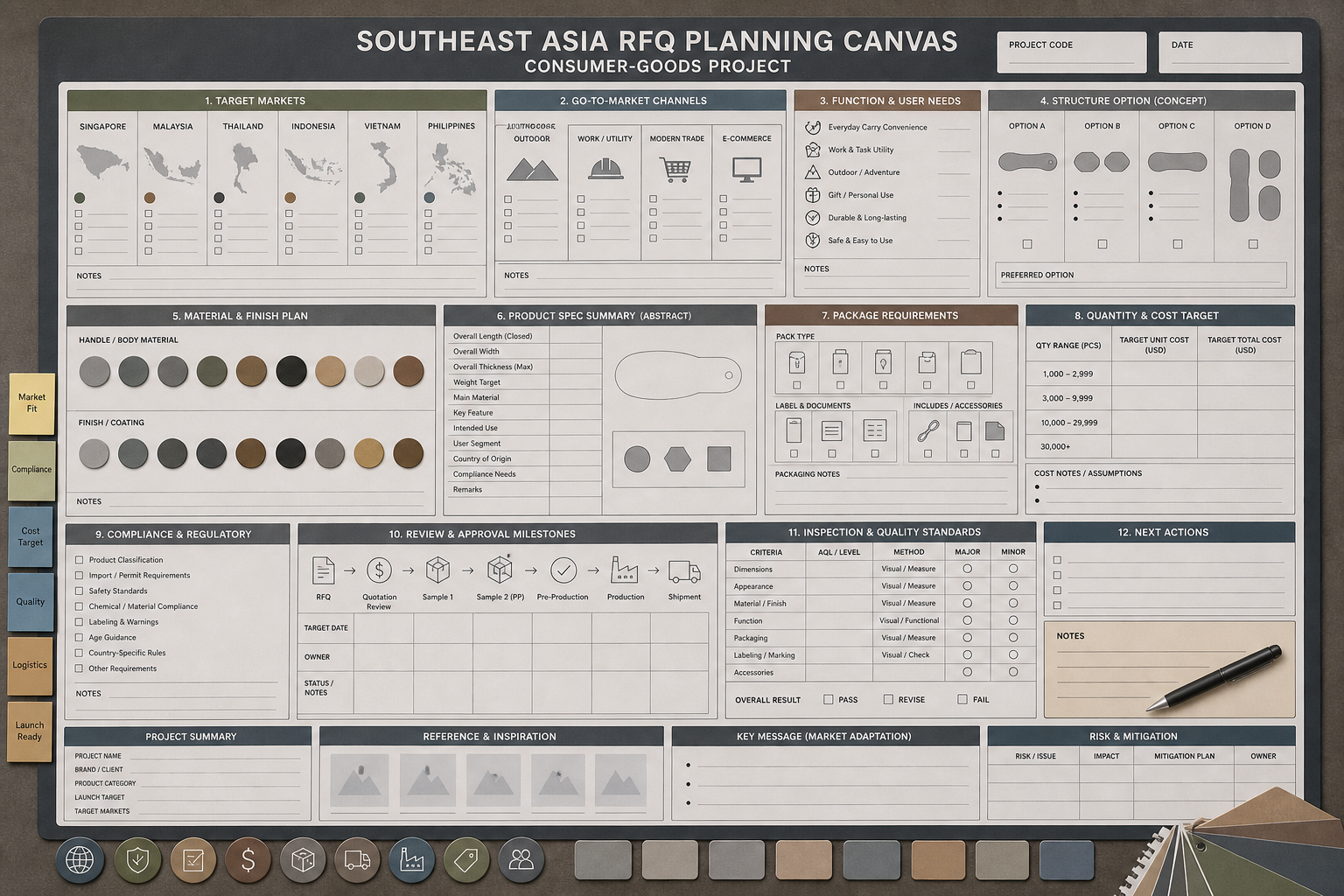
I Ask For The Market Before The Price
The RFQ should tell me where the product is going. If the buyer only says "EDC folding knife," I can quote a product, but I cannot help shape it for the market. A better RFQ says the target country, buyer type, sales channel, retail price range, target FOB range, expected quantity, blade steel, handle material, lock type, opening method, blade length, packaging style, and local review status. If the buyer already has a distributor, I want the distributor's comments early.
This makes development more practical. If the local reviewer says the product should avoid a certain mechanism, I can suggest another structure. If the buyer needs lower cost, I can adjust steel, handle material, finish, hardware, packaging, or assembly complexity. If the buyer wants a utility-first product, I can suggest a simple and stable structure. This is how OEM/ODM work should feel: not only making a drawing, but turning a market goal into a product that can be produced and reviewed clearly.
| RFQ field | Why I need it | Better buyer input |
|---|---|---|
| Target market | It shapes compliance and packaging review | Country or territory list |
| Sales channel | It shapes wording and packaging | Distributor, retail, online, or brand store |
| Mechanism preference | It affects structure and review | Approved opening and lock type |
| Cost target | It guides material and finish choices | FOB range and MOQ expectation |
How Should QC Protect The Approved Market Version?
Approval is not enough if production drifts. A small change in structure, label, or size can reopen the review.
QC should protect the approved market version by checking dimensions, mechanism, lock function, finish, packaging text, label version, carton data, and sample consistency before shipment.
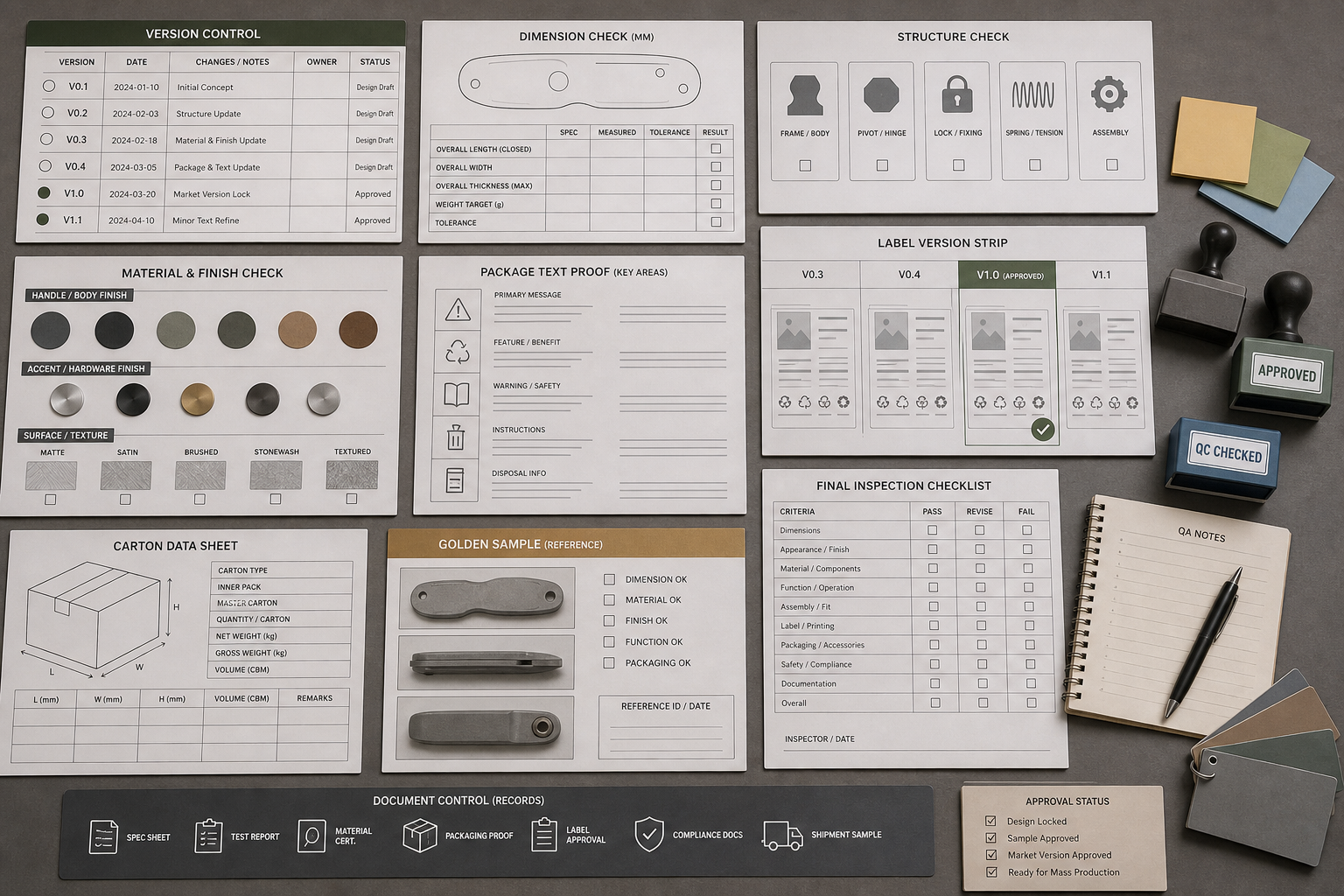
I Turn Market Review Into Inspection Points
Once a buyer approves a Southeast Asia version, the factory must protect that version. QC should not only check scratches and sharpness. It should check the details that were part of the market review. Blade length should match the approved sample. The opening method should not change. The lock type should match the specification. Packaging wording should match the approved proof. Carton labels should match the shipping documents. Product photos should match the buyer's listing review.
This is where practical manufacturing discipline matters. If the buyer approved a simple utility folder, production should not shift to a different mechanism because a component was easier to source. If the buyer approved a specific package, the printer should not revise wording without approval. If the importer reviewed a spec sheet, the shipped product should match that sheet. For repeat orders, I also keep version records so the same product can be made again without reopening old problems.
| QC checkpoint | What I check | Market reason |
|---|---|---|
| Dimensions | Blade length, closed length, weight | Keeps facts consistent |
| Mechanism | Opening method and lock type | Protects approved structure |
| Packaging | Text, warnings, importer data | Matches local review |
| Shipment file | Invoice, packing list, carton marks | Supports entry and channel checks |
Turn this article into a folding knife project.
Share your blade type, lock direction, steel preference, handle material, quantity, target market, and packaging needs. Vast State can prepare OEM/ODM options.
Conclusion
I position EDC folding knives for Southeast Asia by matching product facts, packaging, import review, and QC to each target market.
Source Notes
- Singapore Police GEWCA FAQ supports the need to review regulated-item categories and activities such as sale, import, export, and transport.
- Singapore Police prohibited, controlled, and non-regulated item guideline gives Singapore-specific examples of regulated knife-related items.
- Singapore Customs controlled goods guidance supports checking competent authority authorization before importing controlled goods.
- Thai Customs prohibited and restricted goods page supports the need for permits from related agencies for restricted goods.
- Philippines Bureau of Customs prohibited and restricted importations supports checking permits, clearances, licenses, or other requirements for regulated imports and exports.
- Royal Malaysian Customs Department supports checking whether goods are subject to import or export prohibition orders.
- UNSD HS 8211 classification detail supports the customs classification context for knives with cutting blades.
- ISO 9001 overview supports documented quality management, but it does not prove legal approval for any market.