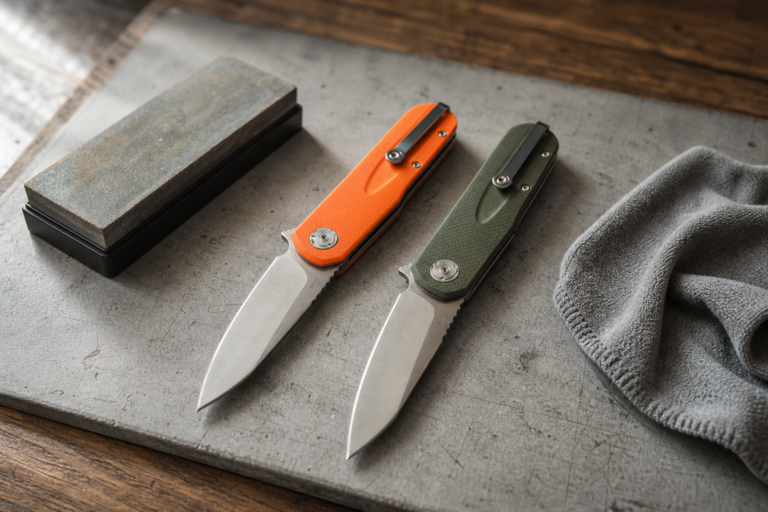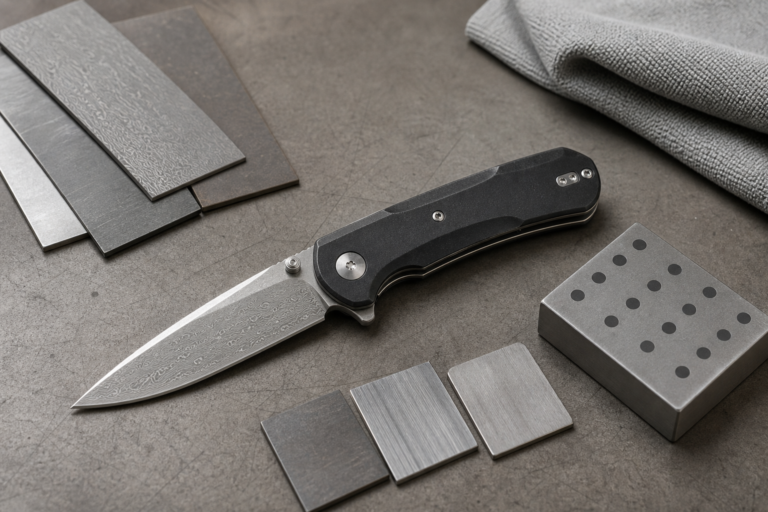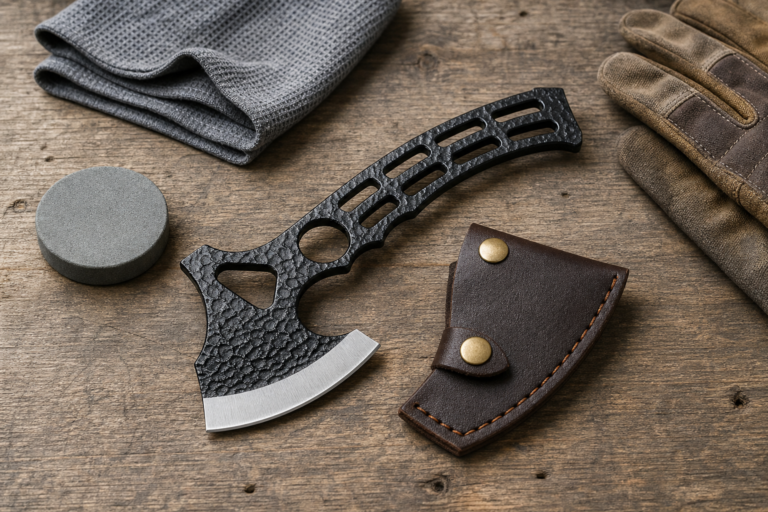
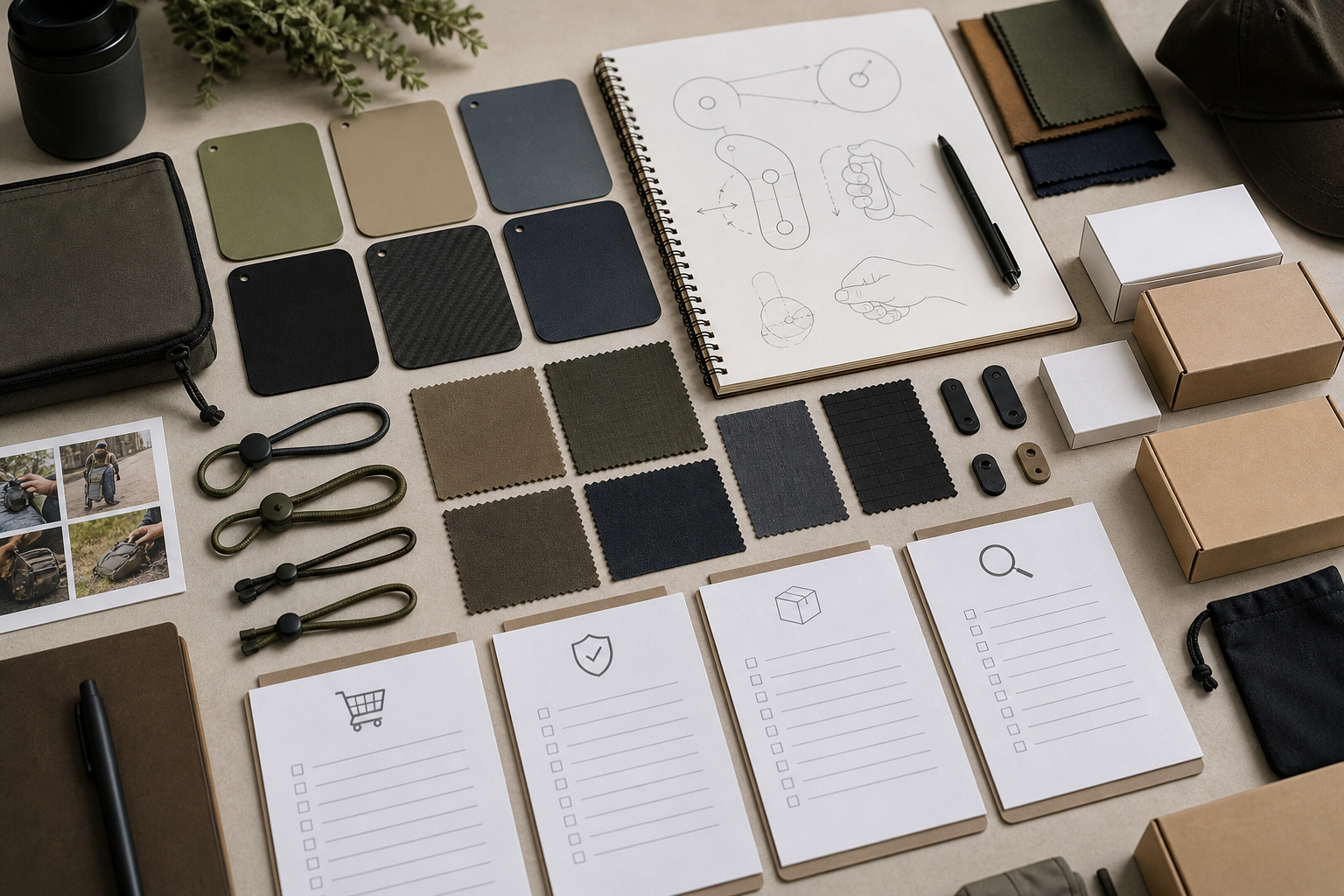
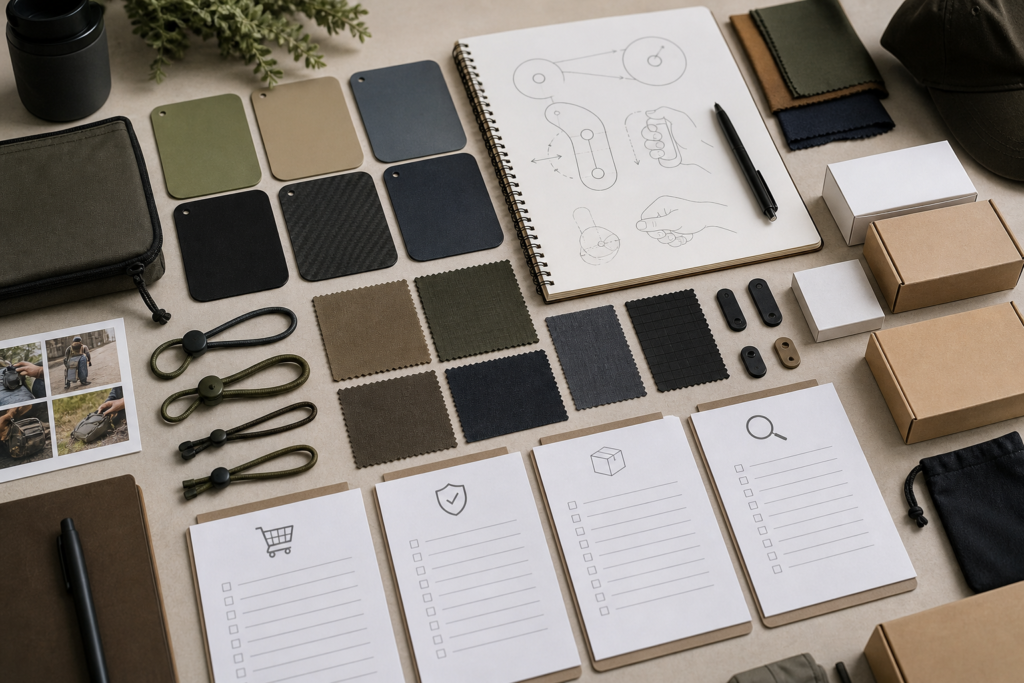
Many EDC knife projects start with one question: which type is best? That vague choice can waste samples. I separate market role from structure.
The best EDC knife for OEM/ODM buyers is the one that matches the target user, market channel, price range, blade steel, handle comfort, lock structure, packaging, compliance needs, and repeat-production QC plan. Daily carry, outdoor, and tactical-style directions need different specifications.
Quick buyer brief:
- Answer: Choose the EDC knife direction by market role, not by a generic ranking.
- Buyer context: Knife brands, outdoor brands, importers, wholesalers, and private label buyers need different EDC products.
- Key checks: Target user, blade steel, handle material, lock type, finish, packaging, MOQ, target price, compliance, and QC records.
Developing a folding knife line for your brand?
Vast State supports OEM/ODM folding knife projects, including blade steel, lock structure, handle material, finish, logo method, packaging, and quality inspection planning.
When a customer asks me for the best EDC knife, I do not answer with one model. I ask where the knife will be sold, who will buy it, what price range it must hit, and what kind of repeat order the customer wants. A daily carry knife should feel light and easy to sell. An outdoor EDC knife may need stronger grip and better corrosion planning. A tactical-style EDC knife may need a stronger visual identity, but it still needs safe structure, practical function, and responsible marketing. In OEM/ODM work, the best direction is the one that can be sampled clearly, produced consistently, and accepted by the buyer's market.
What Should Buyers Define Before Comparing EDC Knife Types?
A buyer can compare many EDC knives and still choose poorly. The problem is not lack of options. It is lack of direction.
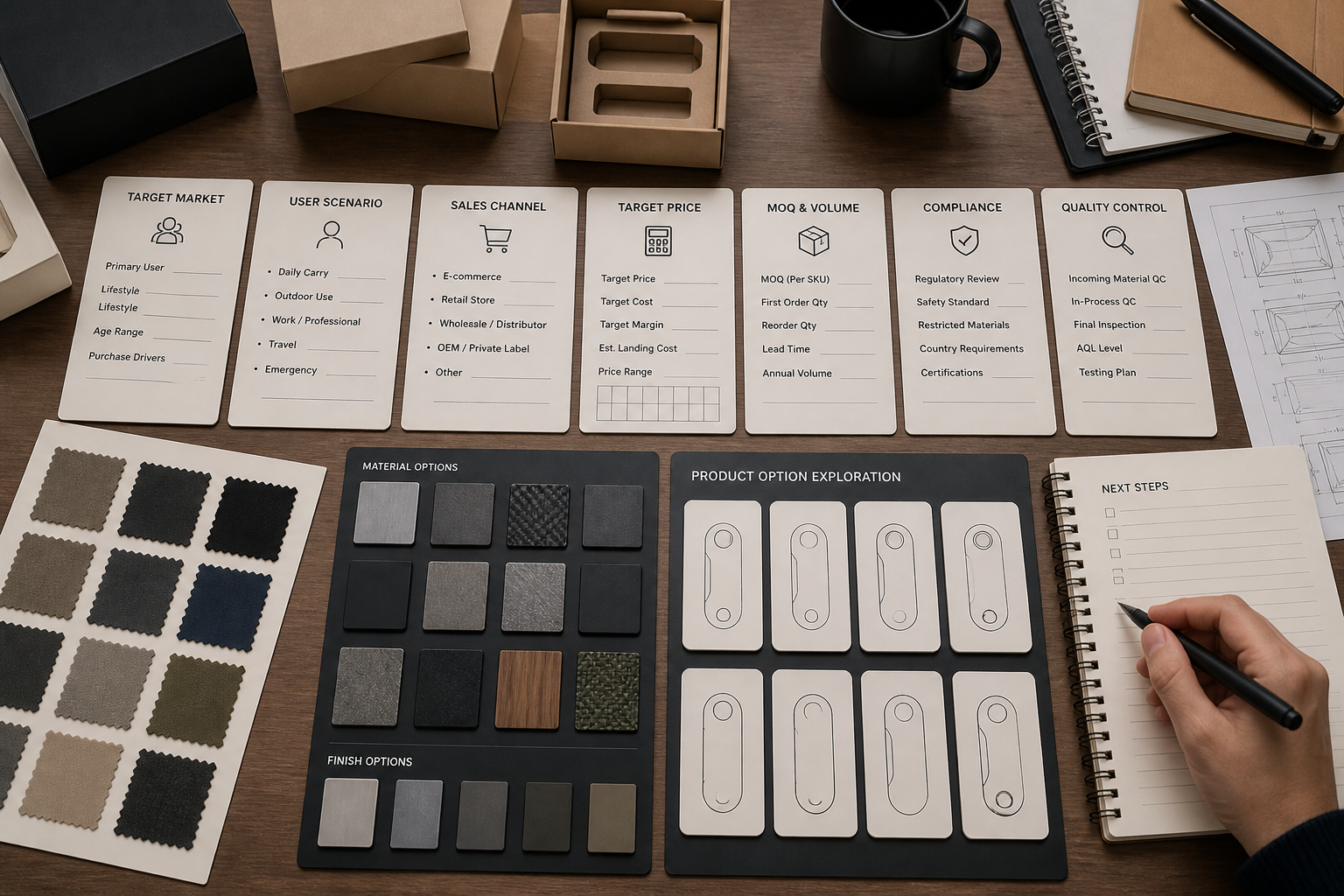
Buyers should define target market, user scenario, sales channel, target price, MOQ expectation, blade size, material level, packaging need, compliance concern, and QC standard before comparing EDC knife types.
I Start With The Buyer Scenario
The word EDC is broad. It can mean a light pocket knife for daily tasks, a compact outdoor helper, a private label promotional product, or a stronger tactical-style item for a specific retail channel. These are not the same product. If the buyer does not define the scenario, the factory has to guess the design direction.
I usually ask simple questions first. Who is the final customer? Is the knife for an outdoor store, a general utility market, an online private label brand, or a distributor catalog? Does the buyer need a low entry price, a balanced mid-range product, or a higher material story? Does the buyer care more about weight, appearance, cutting feel, corrosion resistance, packaging, or customization?
This step prevents a common mistake. A sample may look good by itself but fail the business goal. A heavy steel handle may feel strong, but it may not fit a daily carry line. A higher steel may sound attractive, but it may push the product beyond the target price. The best EDC direction starts with the buyer's market, then moves into structure.
| Planning point | Buyer decision | Why it matters |
|---|---|---|
| Target user | Daily carry, outdoor, utility, tactical-style | Guides size and structure |
| Sales channel | Retail, online, distributor, private label | Guides packaging and price |
| Price range | Entry, mid-range, higher material level | Controls steel and finish choices |
| Repeat order goal | Small batch, seasonal line, long-term SKU | Guides MOQ and tooling choices |
OEM/ODM RFQ Checklist
Prepare these details to help Vast State review your project and provide a more accurate quotation.
| RFQ Field | What to Prepare |
|---|---|
| Project type | OEM from drawing / ODM private label / wholesale catalog |
| Product category | Folding knife / fixed blade / multi-tool / outdoor tool |
| Design status | Idea / sketch / 2D drawing / 3D CAD / physical sample |
| Target price | Ex-factory target price or retail price range |
| MOQ expectation | 500 / 1,000 / 3,000 / 5,000+ pcs |
| Logo method | Laser engraving / etching / printing / molded logo |
| Packaging | Standard packaging / custom retail box / Amazon-ready |
| Market | USA / EU / Japan / Korea / Middle East / other |
| Compliance needs | Buyer-specified testing / documentation / labeling |
| Timeline | Sample deadline / mass production deadline |
How Do Daily Carry, Outdoor, And Tactical-Style EDC Knives Differ?
One EDC label can hide three different products. If the category is unclear, the knife may miss the buyer's real market.
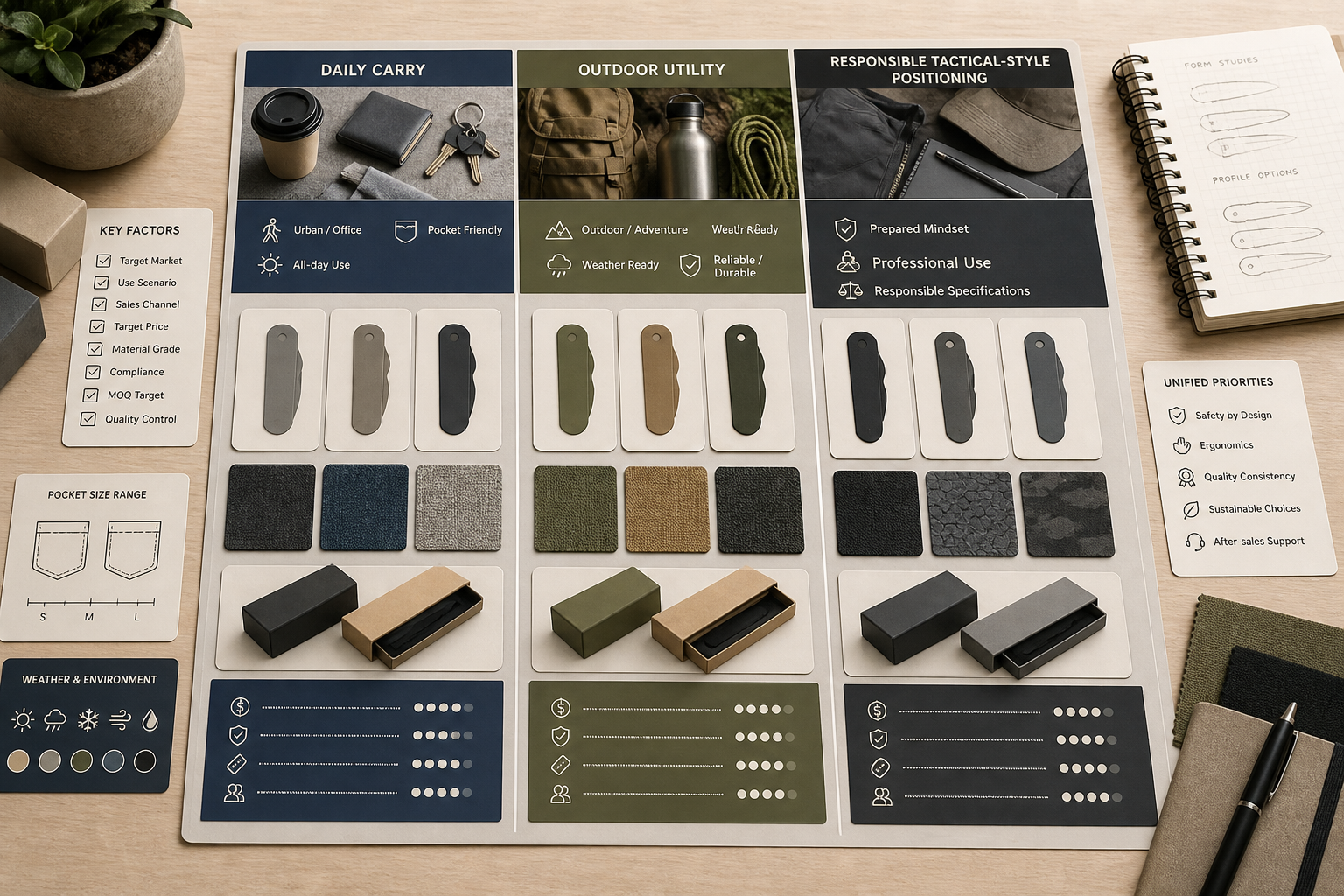
Daily carry EDC knives usually focus on light weight and comfort. Outdoor EDC knives need grip, corrosion planning, and utility. Tactical-style EDC knives need controlled styling, strong structure, and responsible product positioning.
I Treat Each Direction As A Different Specification
A daily carry knife should be easy to handle, not oversized, and comfortable in the pocket. The buyer may want a slim profile, rounded handle edges, smooth opening feel, simple packaging, and a clean finish. The selling point is everyday usefulness, so the product should avoid unnecessary weight and over-complicated parts.
An outdoor EDC knife has a different logic. The user may handle wet material, rope, cartons, food packaging, or camping gear. I think more about grip texture, corrosion resistance, easy cleaning, blade thickness, and handle strength. Public preparedness references such as Ready.gov emergency kit guidance mention basic tool categories like a flashlight, wrench or pliers, and manual can opener, which shows that practical tool planning should start from real tasks. It does not define knife specifications, but it gives useful context for function-based thinking.
A tactical-style EDC knife is more sensitive. I keep the discussion on product design, not unsafe claims. The visual style may use darker finishes, stronger handle texture, and a more assertive shape. But the product still needs practical dimensions, stable lockup, comfortable grip, clean packaging, and lawful market positioning. The factory should not turn style into risky messaging.
| EDC direction | Main buyer need | Product focus |
|---|---|---|
| Daily carry | Easy daily utility | Light weight, comfort, simple finish |
| Outdoor EDC | Practical field use | Grip, corrosion resistance, stronger handle |
| Tactical-style EDC | Strong visual identity | Controlled styling, structure, responsible claims |
| General utility | Broad resale market | Cost balance and repeat consistency |
Which Blade Steel And Heat Treatment Choices Matter Most?
Steel names can impress buyers, but steel alone does not make a good knife. Poor heat treatment can ruin the plan.
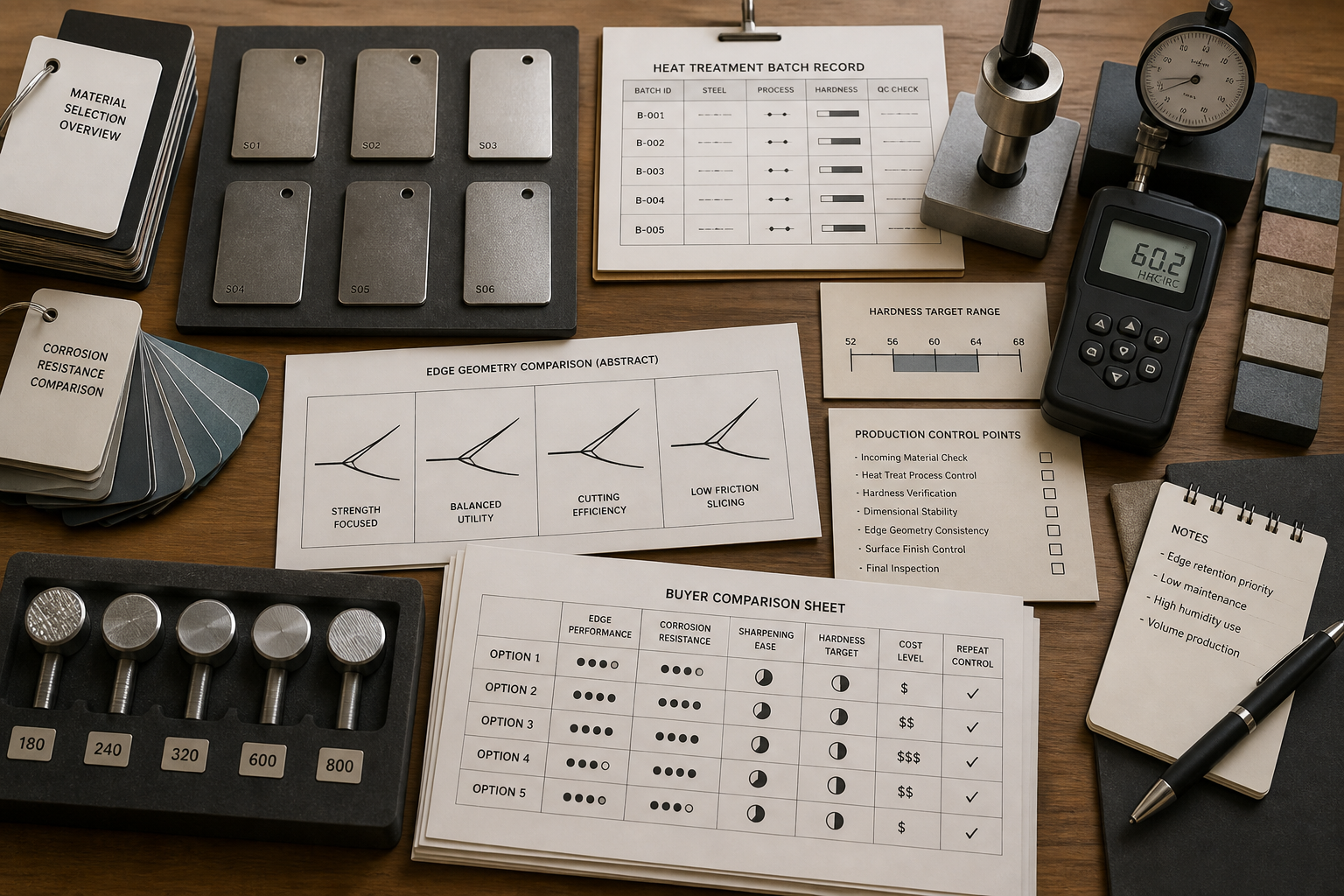
Buyers should choose blade steel by edge needs, corrosion resistance, sharpening expectations, hardness target, heat-treatment stability, cost, and repeat production control.
I Connect Steel Choice With The Real Price Point
For OEM/ODM projects, I do not choose steel by popularity alone. A buyer may ask for a known steel because the market recognizes the name. That can help sales. But I still need to check the target price, machining cost, heat treatment, finish, hardness target, and expected order quantity.
For a stainless EDC direction, Alleima 14C28N knife steel is a useful technical reference because it is made for knife applications and is often discussed for corrosion resistance and edge performance. That does not mean it is the best choice for every project. It means the buyer should compare steel properties against the actual product role.
Heat treatment is just as important. Alleima's guide to hardening and tempering of knife steel explains the need to create hardness while reducing brittleness. In production, I translate that into a practical check: the chosen steel, heat-treatment process, target hardness range, and final test method must work together. I also use hardness records as batch evidence. A good steel without stable process control is not a good B2B product.
| Blade decision | What I check | Buyer impact |
|---|---|---|
| Steel grade | Corrosion, edge, machining, cost | Controls product level |
| Heat treatment | Hardening, tempering, distortion risk | Controls real blade performance |
| Hardness target | Suitable range for steel and use | Supports consistency |
| Finish | Satin, stonewash, coating, polish | Affects cost and appearance |
How Should Handle Material, Grip, And Carry Comfort Be Reviewed?
A blade may attract attention, but the handle decides daily comfort. If the handle feels wrong, the buyer feels the problem fast.
Buyers should review handle material, contour, thickness, texture, edge rounding, fastener layout, clip position, weight balance, color stability, and machining tolerance before sample approval.
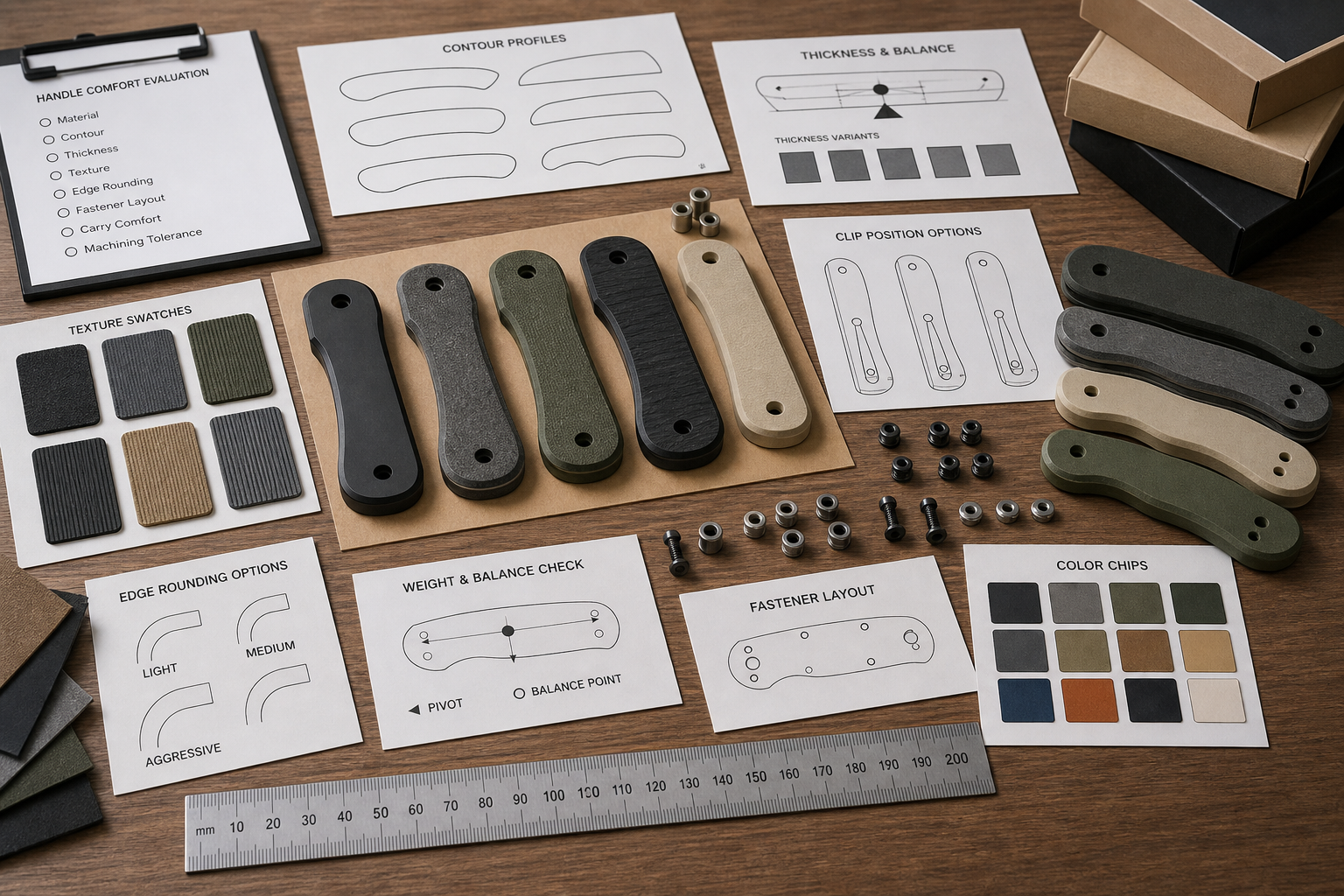
I Check Feel Before I Check Decoration
Handle material is not only a color choice. It affects machining, weight, texture, finish, price, and user comfort. G10, aluminum, stainless steel, micarta, plastic, and wood all create different product stories and production risks. A daily carry knife may need a lighter handle. An outdoor EDC knife may need stronger grip. A tactical-style knife may need a stronger visual texture, but it still needs comfort.
G10 is a common material in knife handles, and material references such as Curbell's G10/FR-4 glass epoxy page are useful because they explain properties such as strength, stiffness, dimensional stability, and machining considerations. The page is not knife-specific, so I use it as material background, not as a final design answer.
In sampling, I check handle thickness, scale fit, screw position, liner support, corner rounding, texture depth, and clip area. If the handle is too sharp, too slick, too heavy, or too thick, the knife may look fine in photos but feel poor in hand. For B2B buyers, comfort is not a soft topic. It affects returns, reviews, reorder confidence, and brand positioning.
| Handle factor | What I check | Practical result |
|---|---|---|
| Material | G10, aluminum, steel, micarta, plastic | Controls weight and cost |
| Texture | Grip depth and cleaning ease | Controls user feel |
| Edge rounding | Corners and pressure points | Improves comfort |
| Assembly fit | Screws, liners, scales, clip | Protects perceived quality |
How Should Lock, Pivot, And Opening Feel Be Specified?
Some samples look finished but feel loose, rough, or unstable. The issue often comes from small moving-part tolerances.
Buyers should specify lock type, pivot structure, washers or bearings, blade centering, side play limit, opening resistance, closing feel, screw control, and inspection method.
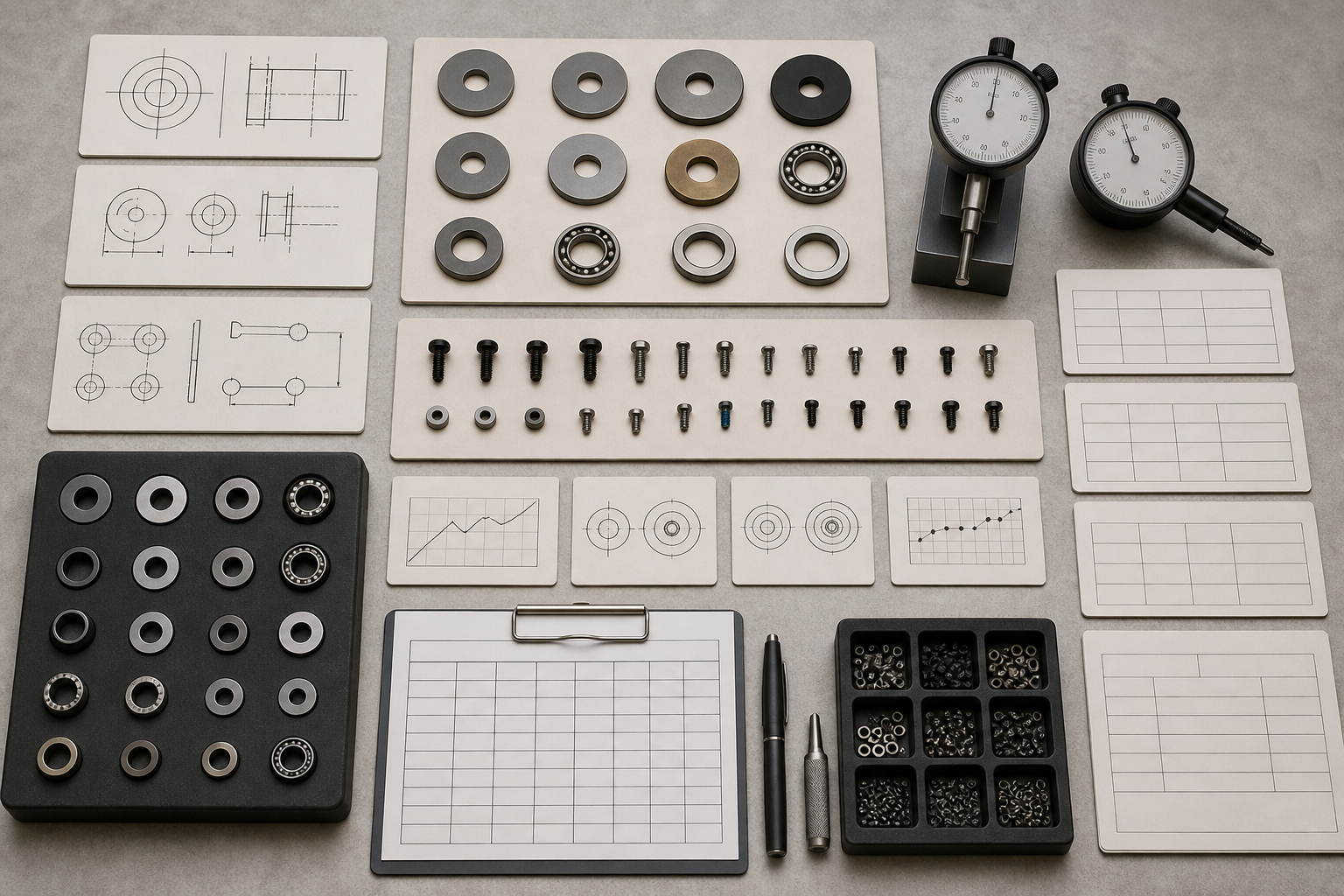
I Control Movement As A Manufacturing Detail
For a folding EDC knife, the moving system is the product experience. The blade, pivot, stop area, washers or bearings, liners, screws, handle scales, and lock surface must work together. If the pivot is too tight, the knife feels rough. If it is too loose, the blade may show side play. If the lock surface is not controlled, the user can feel uncertainty.
The best lock type depends on market level, target price, assembly time, and brand preference. A liner lock may support a broad price range. A frame lock may create a solid feel but can add material and fitting demands. A back lock or button-style structure may fit some buyers, but each structure has its own tolerance needs. I do not treat lock choice as a decoration. I treat it as a production decision.
I also look at how easy the design is to repeat. A sample that needs too much hand adjustment may become risky in mass production. I prefer a structure that can be inspected with clear checks: blade centering, lock engagement, side play, pivot tension, screw stability, and final opening and closing feel. The buyer should approve the feel, not only the photo.
| Mechanism point | What to define | Why it matters |
|---|---|---|
| Lock type | Liner, frame, back, button-style, other | Controls safety feeling and assembly |
| Pivot system | Washer, bearing, screw stack | Controls opening feel |
| Blade centering | Visual and functional tolerance | Protects perceived quality |
| Screw control | Torque, thread fit, thread treatment if needed | Supports repeat stability |
What Packaging, Marking, And Compliance Questions Should Be Planned?
Packaging is often discussed too late. Then the buyer discovers size, marking, or carton problems after the sample is approved.
Buyers should plan retail packaging, pouch, insert, barcode space, country-of-origin marking, warning text if required, carton layout, and destination-market compliance review early.
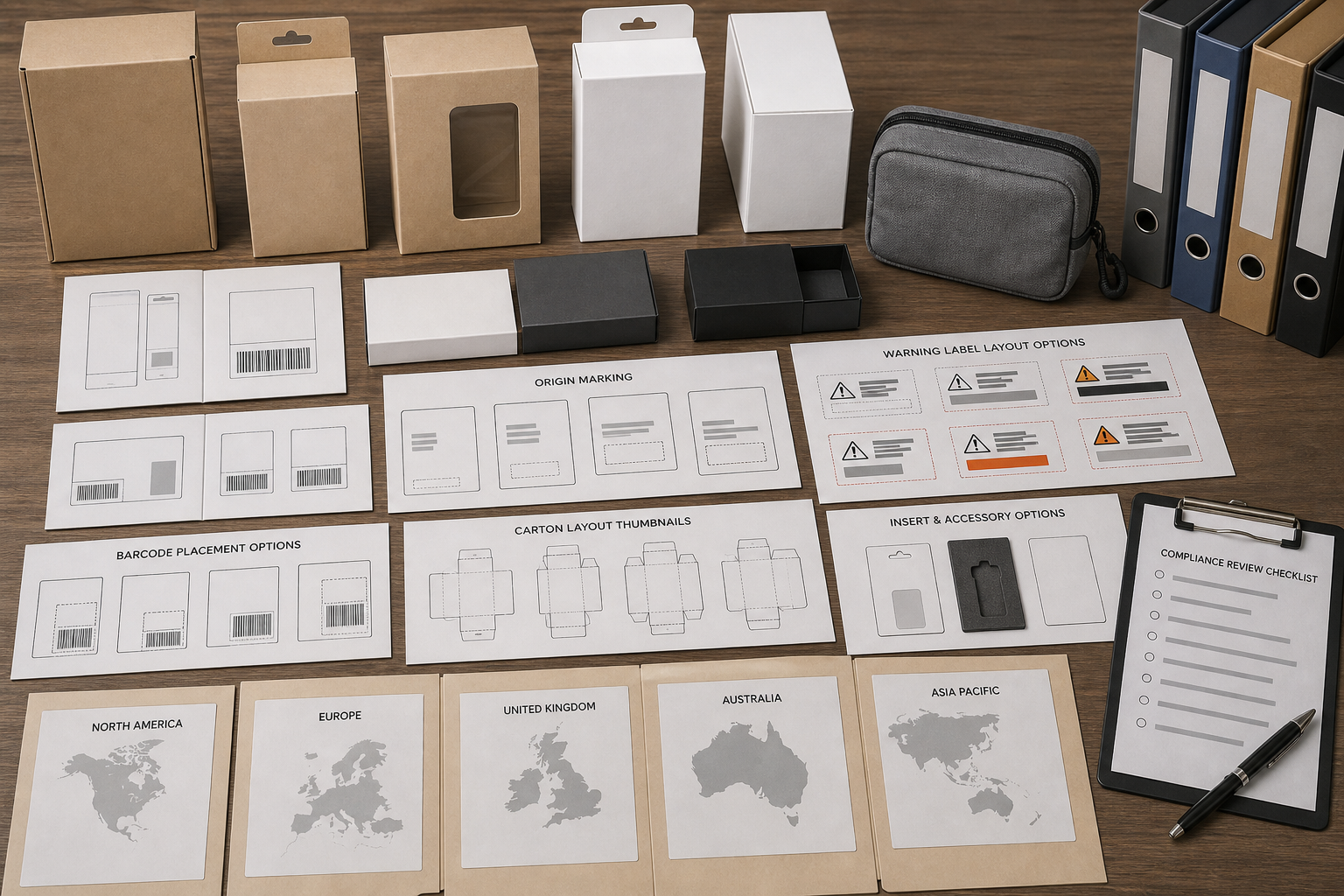
I Treat Packaging As A Sourcing Decision
Packaging affects cost, shipping space, damage risk, retail presentation, and brand trust. A daily carry EDC knife may use a simple box. An outdoor line may need a pouch or stronger insert. A tactical-style product may need a more controlled visual system, but the packaging still needs practical information and carton stability.
Packaging should be tested as a filled package, not as a flat design file. ISO 4180 gives general rules for compiling performance test schedules for complete, filled transport packages. I use that as planning context. It reminds me to think about the box, inner support, full carton, and transport condition together.
Marking also needs early discussion. For the U.S. market, 19 CFR 134.43 includes knives among articles with specific country-of-origin marking methods, with exceptions depending on the rule. This article is manufacturing and sourcing guidance only, not legal advice. Buyers must confirm final requirements for their target market. My role is to make sure the product and packaging leave enough space for the required marking and approval process.
| Packaging area | Buyer decision | Production concern |
|---|---|---|
| Retail box | Simple box, gift box, blister, pouch | Cost and presentation |
| Inner support | Tray, foam, bag, separator | Scratch and movement control |
| Marking | Origin, barcode, importer info, warnings if required | Market entry planning |
| Carton | Master carton, weight, label, count | Shipping stability |
What QC Checks Separate A Sellable EDC Knife From A Risky Sample?
A sample can look good on a desk and still fail repeat orders. QC must connect the approved sample to production.
EDC knife QC should check incoming materials, hardness records, blade dimensions, lock engagement, pivot feel, handle fit, finish, sharpness, packaging, marking, and final sample comparison.
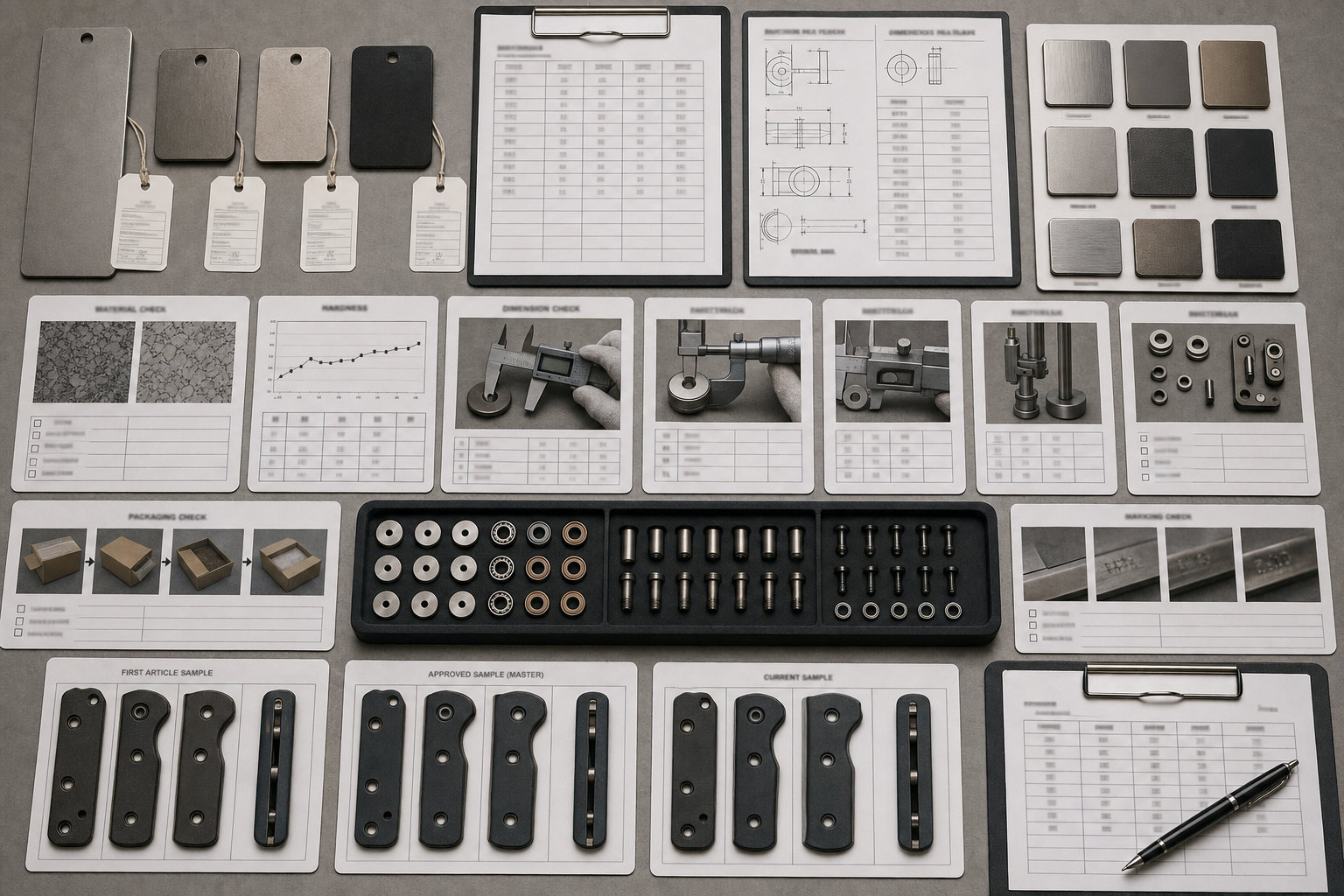
I Want Evidence, Not Only A Nice Sample
For B2B buyers, quality is not one inspection at the end. It starts with material approval, continues through machining and assembly, and ends with final packaging checks. The buyer should not only ask whether the sample is good. The buyer should ask how the same result will be repeated.
Hardness is one example. The NIST Rockwell hardness measurement guide is useful because it supports the idea that hardness measurement needs controlled practice. In factory work, that means the steel grade, heat treatment, hardness target, test method, and records should be connected.
ISO 9001 is also a useful quality-management reference because it focuses on requirements, controlled operations, documented information, performance evaluation, and improvement. The ISO page for ISO 9001 quality management systems supports that process-based thinking. I do not use it to claim certification unless there is separate evidence. I use it as a practical reminder: a good EDC knife line needs process control, not only final sorting.
| QC stage | What to check | Evidence to keep |
|---|---|---|
| Incoming | Steel, handle material, hardware, packaging | Material records and photos |
| In-process | Blade size, hardness, finish, pivot parts | Inspection notes and test records |
| Assembly | Lockup, blade centering, side play, screws | Functional check records |
| Final | Sharpness, appearance, packaging, marking | Final report and approved sample match |
What RFQ Details Help A Factory Build The Right EDC Knife?
A factory cannot quote the right EDC knife from a vague idea. Missing details create wrong samples and slow decisions.
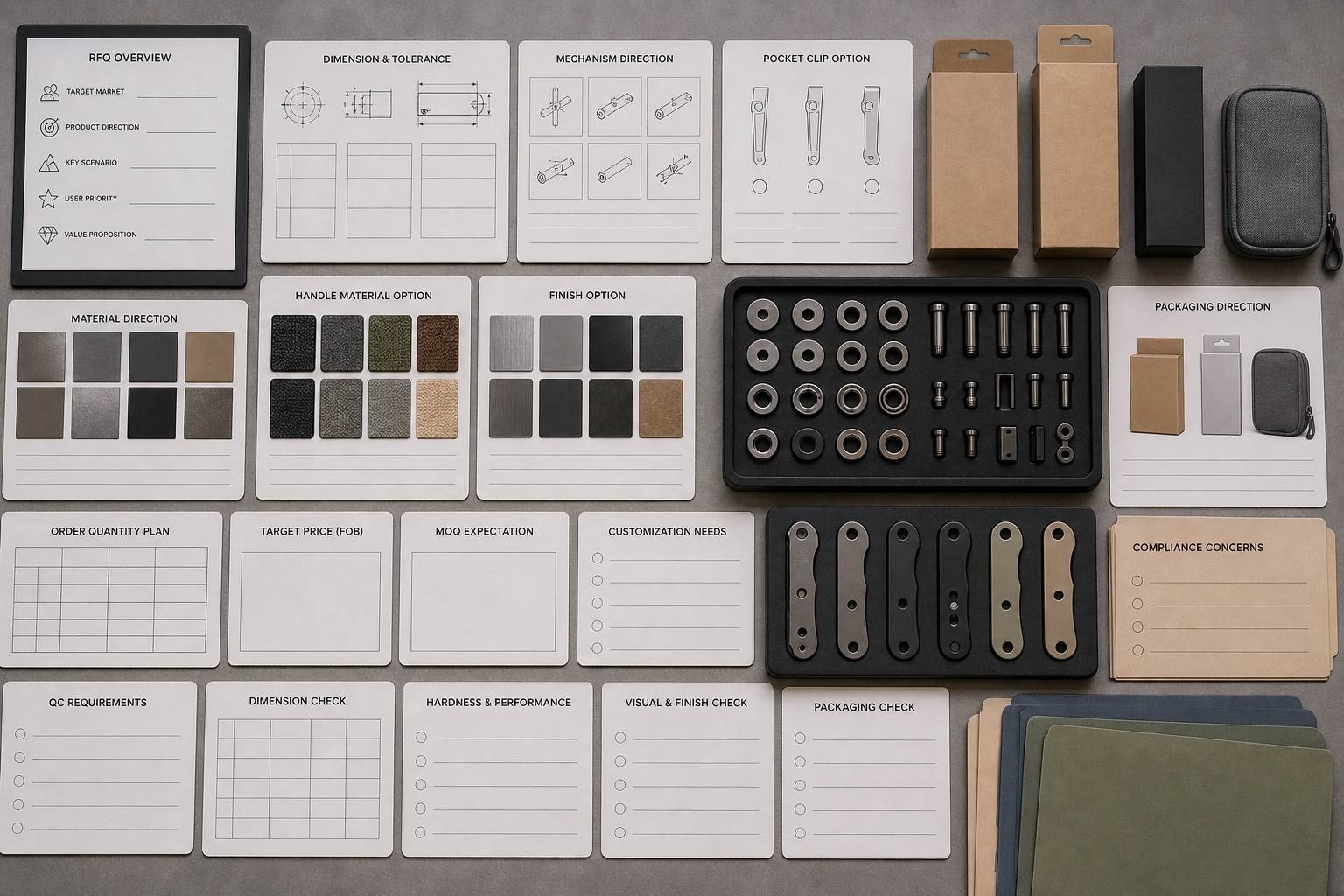
A good EDC knife RFQ should include target market, EDC direction, dimensions, blade steel, handle material, lock type, finish, clip need, packaging, quantity, target price, MOQ expectation, customization, compliance concerns, and QC requirements.
I Ask For A Clear Product Brief
For an OEM/ODM EDC knife project, I want a product brief that connects the business goal with the technical details. The buyer should tell me whether the knife is daily carry, outdoor utility, tactical-style, or broad utility. The buyer should also provide target price, expected quantity, MOQ expectation, size limits, blade shape preference, steel preference, handle material, lock type, finish, logo method, clip need, packaging style, and inspection expectations.
I also ask the buyer to separate core value from upgrade value. Core value includes blade steel, heat treatment, handle comfort, lock stability, and basic packaging. Brand value may include logo method, surface finish, color, clip style, and retail box. Upgrade value may include custom tooling, special handle texture, special insert, or a multi-item set. This ranking helps protect cost, MOQ, and sampling speed.
If the buyer already has drawings, I check manufacturability, tolerance, assembly, and cost. If the buyer only has a market idea, I help turn it into a practical development direction. This can include two or three material paths, such as entry level, balanced level, and higher material level. It can also include packaging options, such as simple box, pouch, or retail set.
Vast State supports customers from concept to production. We can help with prototype development, material selection, lock and structure suggestions, finish options, packaging customization, QC planning, and production follow-up. A clear RFQ lets us respond with practical options instead of guesswork.
| RFQ field | What to include | Why I need it |
|---|---|---|
| Product direction | Daily carry, outdoor, tactical-style, utility | Guides structure |
| Technical spec | Steel, handle, lock, finish, size | Builds accurate samples |
| Commercial target | Quantity, MOQ, target price, channel | Guides quotation paths |
| QC need | Inspection items and approval method | Protects repeat orders |
Turn this article into a folding knife project.
Share your blade type, lock direction, steel preference, handle material, quantity, target market, and packaging needs. Vast State can prepare OEM/ODM options.
Conclusion
I choose the best EDC knife direction by matching market role, manufacturable structure, controlled materials, realistic cost, and repeatable quality.
Source Notes
- Ready.gov emergency kit guidance gives public preparedness context for practical tool categories, but it does not define EDC knife specifications.
- Alleima 14C28N knife steel supports stainless knife steel discussion.
- Alleima hardening and tempering guidance supports heat-treatment and hardness-toughness balance discussion.
- Curbell G10/FR-4 material reference supports handle material background, though it is not knife-specific.
- ISO 4180 supports transport packaging planning for complete, filled packages.
- 19 CFR 134.43 supports early planning for country-of-origin marking when knives enter the U.S. market.
- NIST Rockwell hardness guidance supports controlled hardness measurement practice.
- ISO 9001 supports process-based quality management thinking.