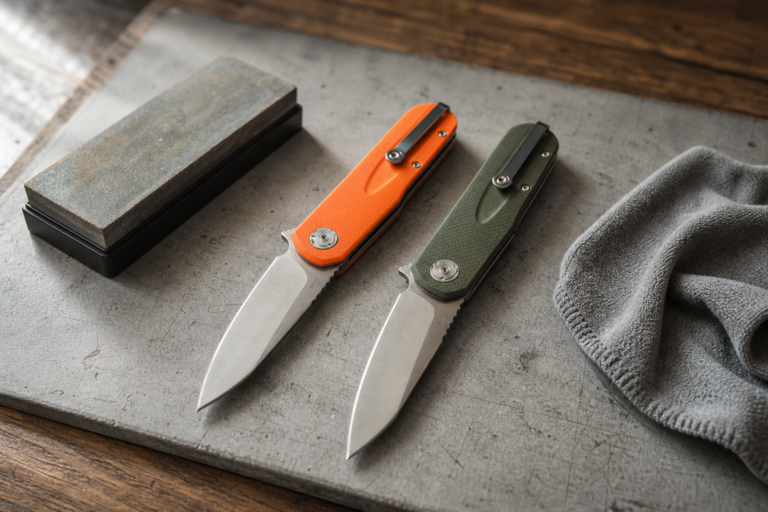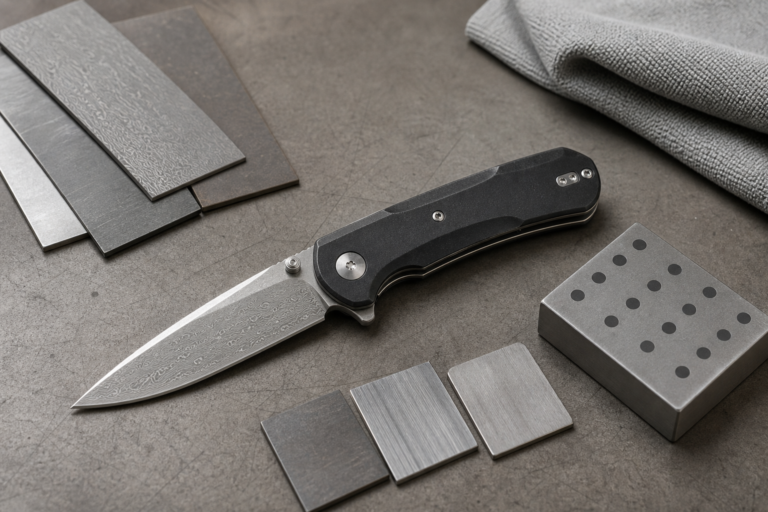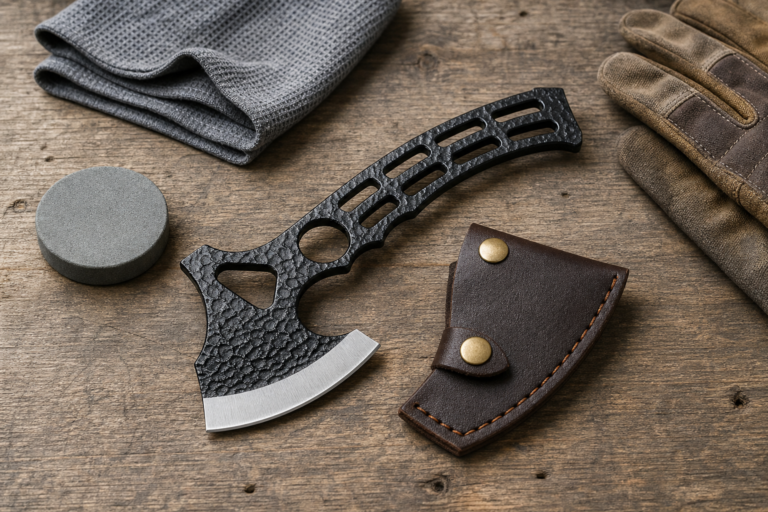
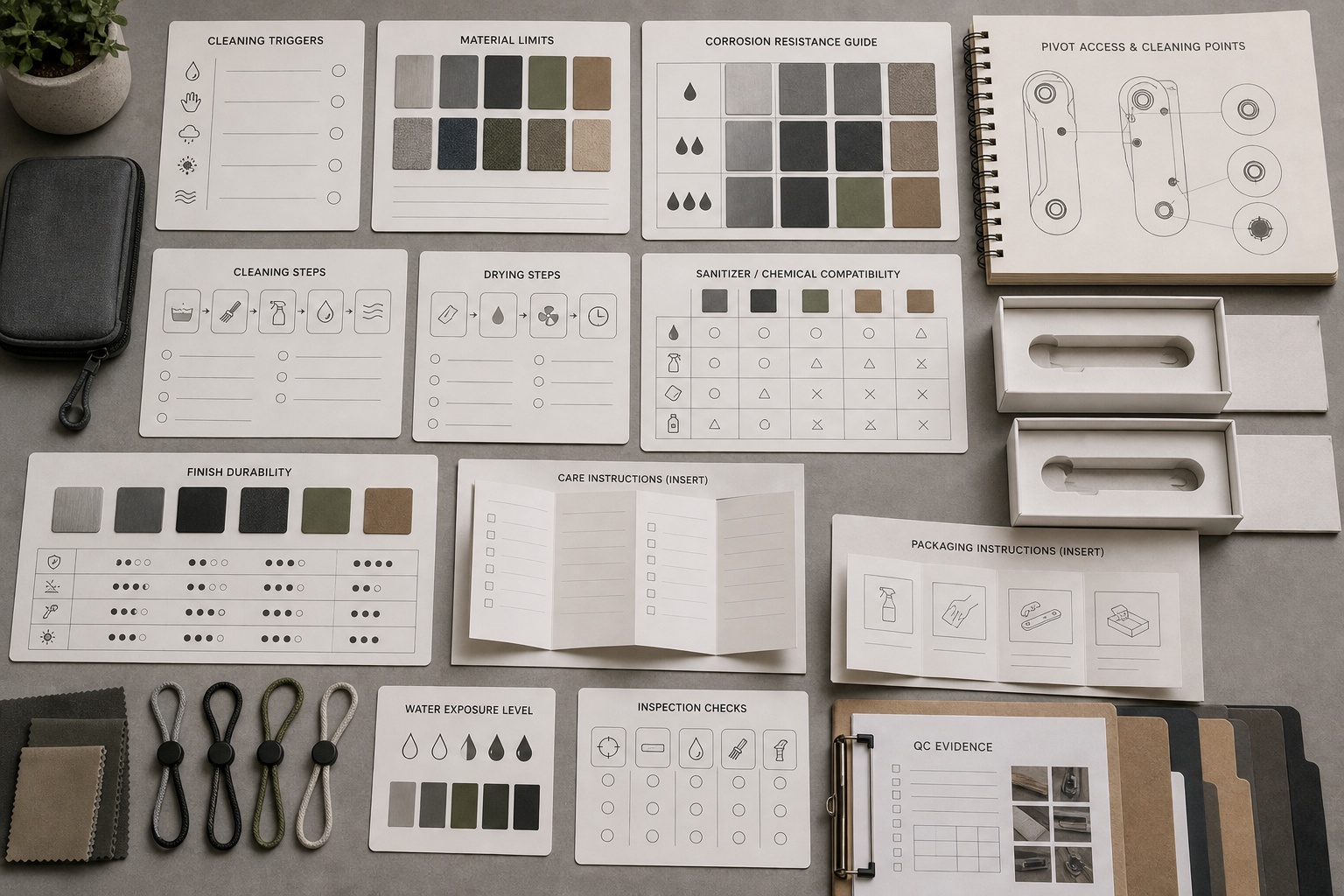
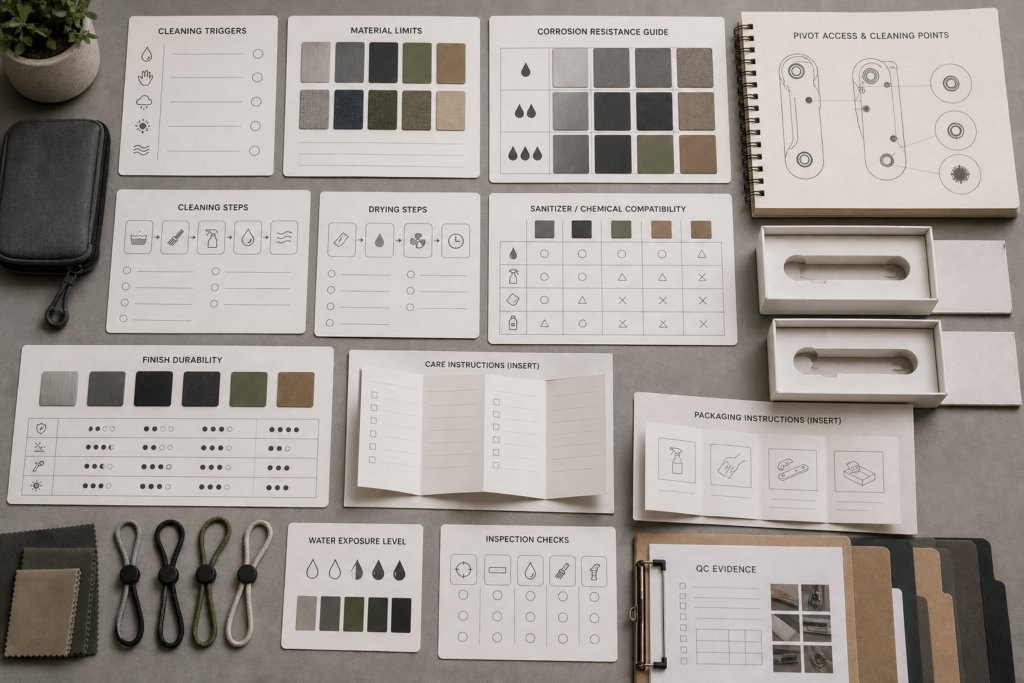
A pocket knife can look clean but still carry residue. If care instructions are vague, buyers face complaints. I plan cleaning guidance during development.
Buyers should plan pocket knife cleaning and sanitation guidance by defining use scenarios, blade steel, handle material, pivot accessibility, finish durability, packaging instructions, sanitizer compatibility, and QC checks before sampling and mass production.
Quick buyer brief:
- Answer: Define cleaning triggers, material limits, and care instructions before approving a pocket knife sample.
- Buyer context: EDC, outdoor, camping, utility, and private label knife lines may need different care guidance.
- Key checks: Steel, handle texture, pivot design, residue traps, finish, packaging copy, sanitizer compatibility, and QC evidence.
Developing a folding knife line for your brand?
Vast State supports OEM/ODM folding knife projects, including blade steel, lock structure, handle material, finish, logo method, packaging, and quality inspection planning.
When a customer asks me when a pocket knife should be cleaned or sanitized, I first translate the question into product planning. A pocket knife for daily carry, outdoor use, camping food preparation, fishing, warehouse utility, or promotional resale will not need the same instruction language. The product structure also matters. A smooth handle is easier to wipe than a deep texture. A simple pivot is easier to maintain than a complex assembly. A corrosion-resistant steel can help, but it does not remove the need for cleaning after moisture or residue. For OEM/ODM projects, care guidance should be part of the product brief, not something added after the packaging is finished.
Why Should Cleaning Guidance Be Planned Before Sampling?
Cleaning instructions often come late. Then the sample, packaging, and material choices may already conflict with the care message.
Cleaning guidance should be planned before sampling because it affects steel choice, handle texture, pivot access, finish durability, packaging copy, market claims, and after-sales risk.
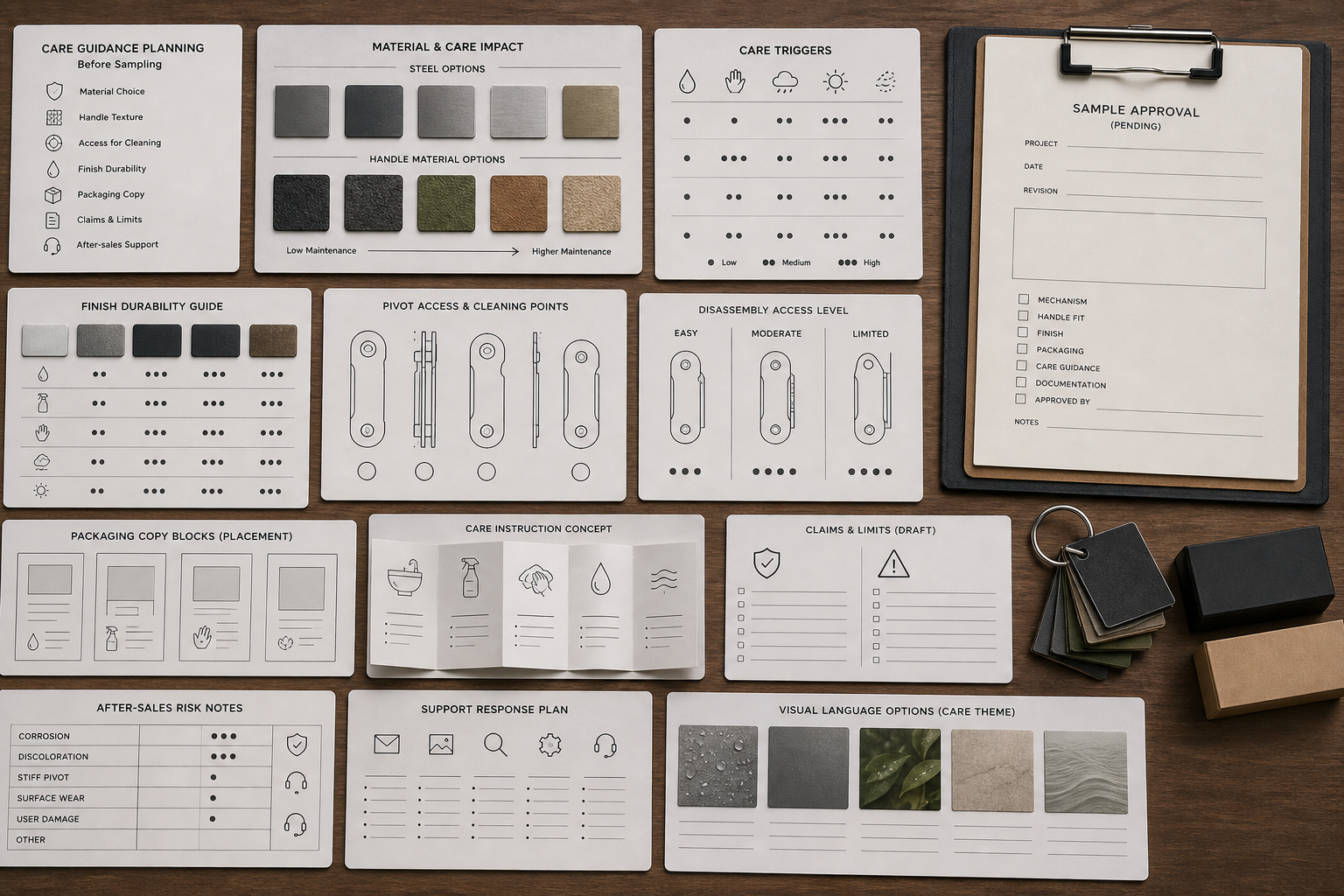
I Treat Care Instructions As Product Design
I do not see cleaning guidance as a small paragraph on the box. I see it as part of the product design. If a buyer wants a pocket knife for outdoor, fishing, camping, food prep, or humid environments, I need to know that early. The product may need a more corrosion-resistant steel, smoother handle surfaces, easier pivot access, simpler hardware, and packaging copy that avoids unrealistic claims.
The same idea applies to daily carry products. A daily carry pocket knife may touch tape, cardboard, fruit, water, sweat, dust, pocket lint, and adhesive residue. The buyer may not want a hygiene-focused product claim, but the knife still needs care guidance. Clear instructions can reduce rust complaints, finish damage, stiff pivots, and customer confusion.
This is important for private label buyers. A factory can help produce the knife, but the brand owner owns the market promise. If the packaging says the knife is easy to clean, the product should support that promise. If the product is not intended for food-contact use, the instruction should not imply it. I prefer to clarify the care scenario before prototype development.
| Planning point | What I ask | Why it matters |
|---|---|---|
| Use scenario | Daily carry, outdoor, camping, fishing, utility | Sets cleaning triggers |
| Product structure | Folding knife, pocket knife, multi-tool | Sets access and residue risk |
| Market claim | Easy care, corrosion resistance, food prep support | Affects wording and proof |
| Packaging copy | Care card, label, insert, manual | Reduces buyer confusion |
OEM/ODM RFQ Checklist
Prepare these details to help Vast State review your project and provide a more accurate quotation.
| RFQ Field | What to Prepare |
|---|---|
| Project type | OEM from drawing / ODM private label / wholesale catalog |
| Product category | Folding knife / fixed blade / multi-tool / outdoor tool |
| Design status | Idea / sketch / 2D drawing / 3D CAD / physical sample |
| Target price | Ex-factory target price or retail price range |
| MOQ expectation | 500 / 1,000 / 3,000 / 5,000+ pcs |
| Logo method | Laser engraving / etching / printing / molded logo |
| Packaging | Standard packaging / custom retail box / Amazon-ready |
| Market | USA / EU / Japan / Korea / Middle East / other |
| Compliance needs | Buyer-specified testing / documentation / labeling |
| Timeline | Sample deadline / mass production deadline |
When Should A Pocket Knife Be Cleaned Rather Than Sanitized?
Many people mix up cleaning, sanitizing, and disinfecting. If the brand uses the wrong word, the instruction can become misleading.
A pocket knife should usually be cleaned after visible dirt, moisture, food residue, adhesive, salt, or outdoor debris. Sanitizing is only relevant when the product is positioned for hygiene-sensitive or food-contact scenarios and the method is compatible.
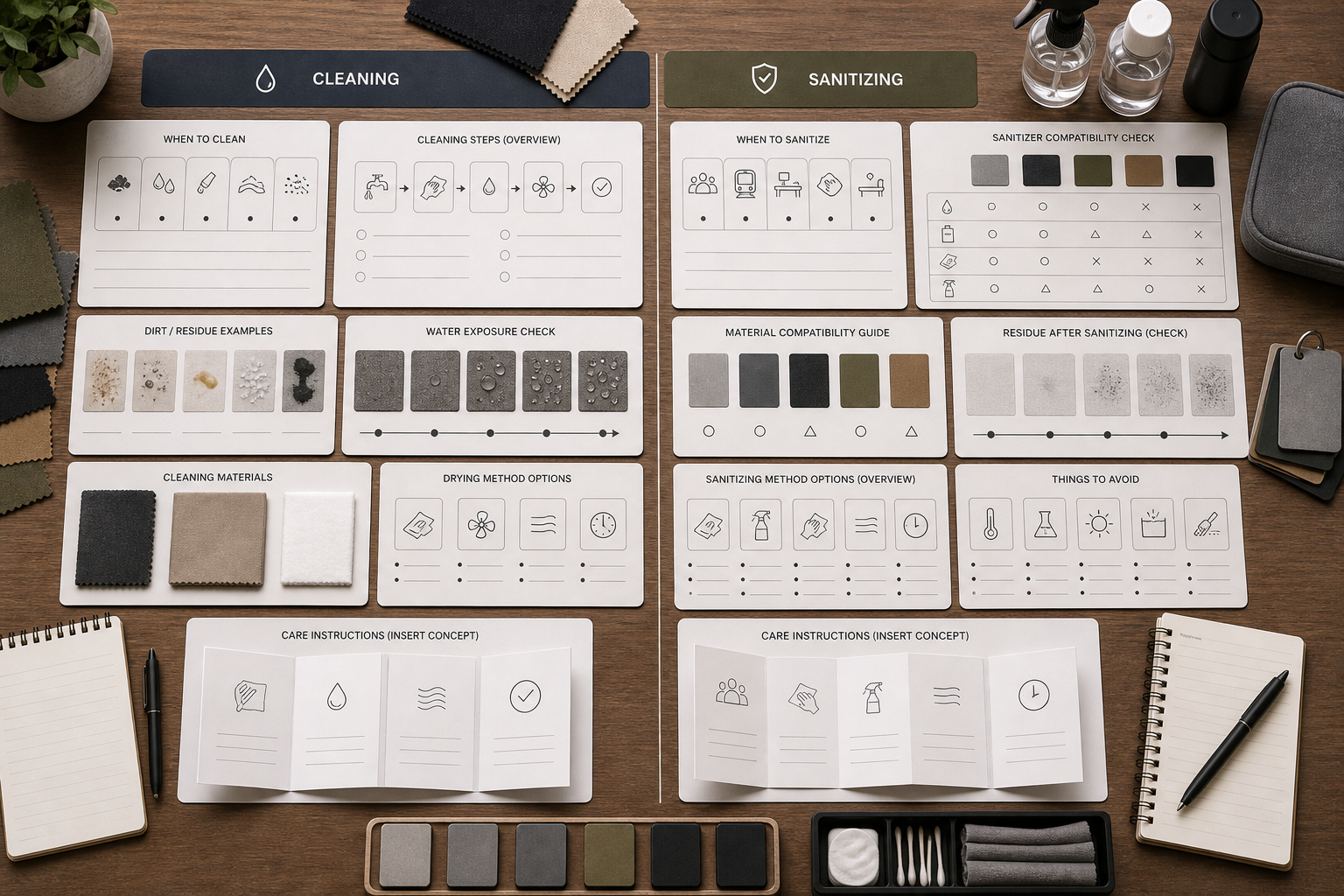
I Keep The Words Practical And Accurate
The CDC cleaning and disinfecting guidance separates the ideas clearly. Cleaning removes germs, dirt, and impurities with water, soap, and scrubbing. Sanitizing reduces germs to levels considered safe by public health codes or regulations. Disinfecting uses chemicals to kill remaining germs on surfaces. CDC also explains that surfaces should be cleaned before sanitizing or disinfecting because dirt can reduce chemical effectiveness.
For pocket knife product planning, this means the default instruction should usually start with cleaning. The buyer can tell users to remove visible residue, dry the knife fully, and keep moving parts free from buildup. Sanitizing language should be used more carefully. It may be relevant if the knife is sold for camping food preparation or another hygiene-sensitive use, but the brand should confirm the correct method for its target market and product materials.
I also avoid overpromising. A knife is not a medical device. A pocket knife product page should not imply sterile performance unless the product has a specific validated basis. For most B2B knife projects, the practical goal is clear: help users clean residue, reduce avoidable corrosion, protect function, and understand when extra sanitation may be needed.
| Term | Plain meaning | Product guidance use |
|---|---|---|
| Cleaning | Removes dirt and residue | Default care instruction |
| Sanitizing | Reduces germs to accepted levels | Use only when relevant and compatible |
| Disinfecting | Kills viruses and bacteria using chemicals | Avoid broad claims without validation |
| Drying | Removes moisture after care | Important for corrosion control |
Which Use Scenarios Need Stronger Care Instructions?
A pocket knife used only for boxes is different from one used around moisture or food. The wrong care message creates risk.
Stronger care instructions are useful for camping, food prep, fishing, humid outdoor use, adhesive-heavy utility work, salt exposure, and any product line sold with hygiene or corrosion-resistance claims.
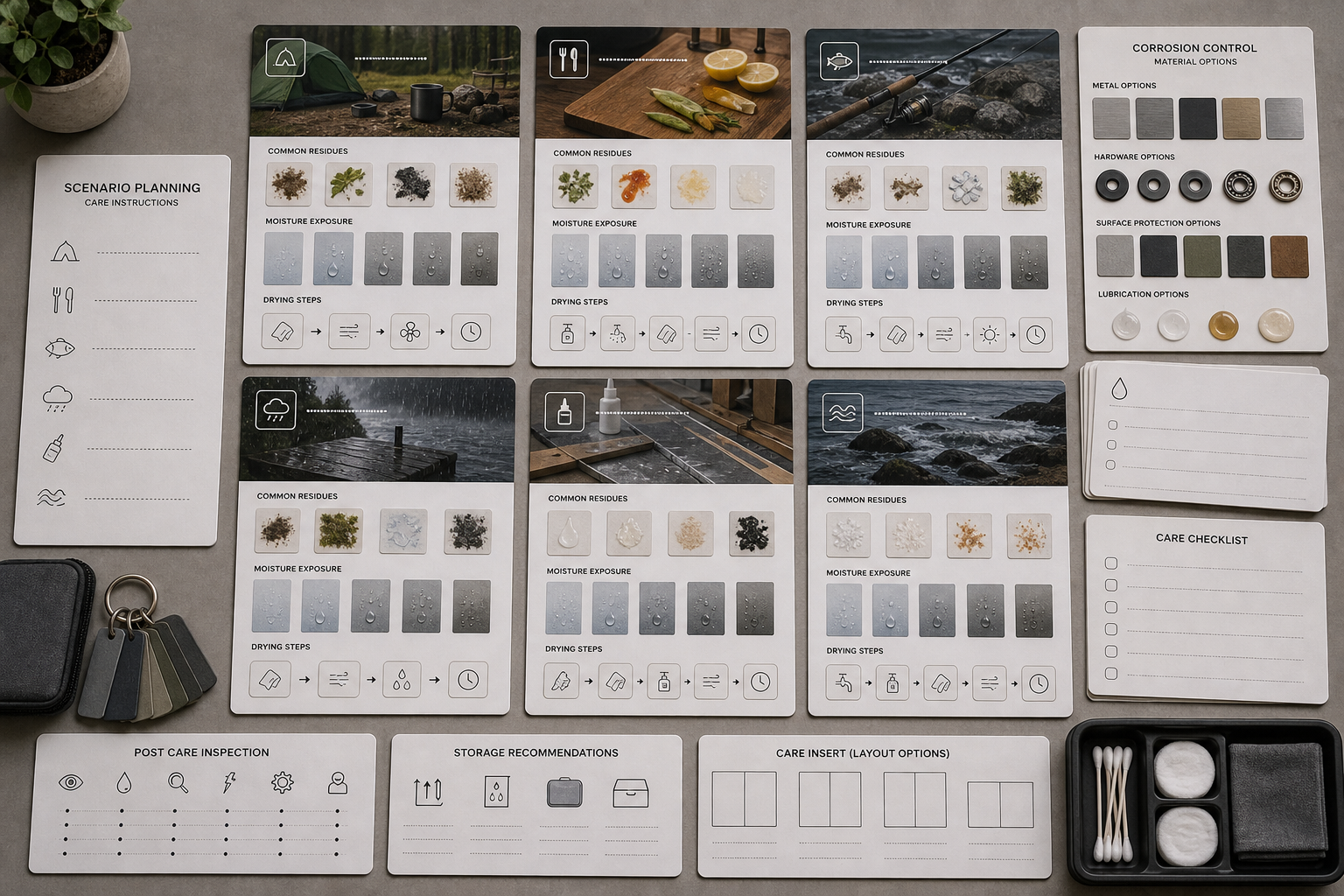
I Match The Instruction To The Real Market
For a daily carry pocket knife, I usually focus on simple cleaning after dirt, moisture, tape residue, fruit juice, or visible buildup. I also recommend clear drying language because many rust complaints come from moisture left in the pivot, liners, or handle gaps. Even stainless steel can develop problems if the product is used in a harsh environment and left wet.
For camping or food-preparation positioning, the buyer needs stronger wording. The FDA Food Code is not written for private pocket knife brands, but it provides useful food-contact context. It says food-contact surfaces and utensils should be clean to sight and touch, and it includes requirements for cleaning and sanitizing food-contact surfaces and utensils. I use this as context only. If a buyer wants to sell a pocket knife for food prep, the buyer should confirm final rules and claims for the market.
For fishing, humid outdoor, or salt-air channels, I think more about corrosion and residue. A product may need better steel choice, smoother finishes, simpler cleaning access, and more direct drying instructions. For warehouse utility, adhesive buildup may be the main issue. The cleaning guidance should match the residue the product is likely to face.
| Scenario | Common residue | Guidance focus |
|---|---|---|
| Daily carry | Dust, lint, tape, fruit residue | Clean and dry after visible residue |
| Camping food prep | Food residue and moisture | Clean first, sanitize only if compatible |
| Fishing or humid outdoor | Water, salt, organic residue | Rinse if appropriate, dry fully, protect pivot |
| Utility work | Tape, cardboard dust, adhesive | Remove buildup before it affects movement |
How Do Blade Steel, Finish, And Heat Treatment Affect Cleaning Risk?
Cleaning is not only about user habits. Material choice decides how well the knife handles moisture, residue, and repeated care.
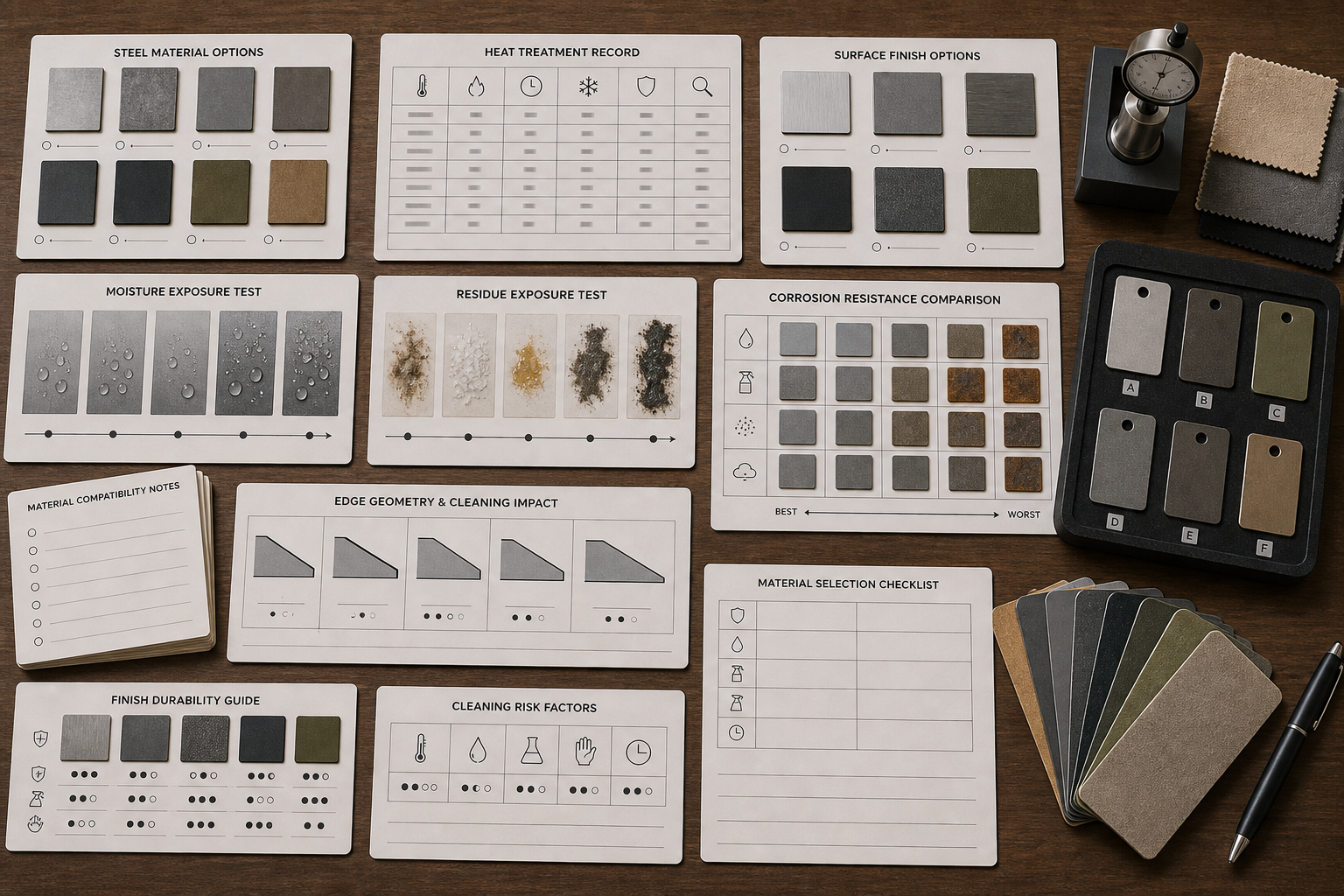
Blade steel, heat treatment, surface finish, edge geometry, and corrosion resistance all affect cleaning risk. Buyers should connect care instructions with the selected steel and finish.
I Do Not Let Steel Names Replace Care Planning
Stainless steel helps, but it is not a promise that the knife can be neglected. For a pocket knife that may meet moisture, fruit acids, sweat, or outdoor residue, I want the steel choice and care message to support each other. A carbon steel line may need stronger drying and oiling language. A stainless line may still need drying after wet use.
Alleima's 14C28N datasheet describes the steel as a martensitic stainless chromium steel for knife applications, including pocket knives, with good corrosion resistance. That makes it a useful reference when buyers want a stainless pocket knife direction. It does not mean every project should use 14C28N. It means corrosion resistance should be discussed as a product requirement, not as a vague selling word.
Heat treatment and finish also matter. Alleima's hardening and tempering guidance supports the idea that hardening and tempering influence final steel properties. In production, I connect steel grade, heat treatment, hardness target, finish, cleaning exposure, and QC records. A rough finish may trap more residue. A coating may need compatibility checks with cleaning methods.
| Blade factor | What I check | Cleaning impact |
|---|---|---|
| Steel grade | Stainless, carbon, tool steel options | Controls corrosion risk |
| Heat treatment | Hardness and toughness balance | Affects real blade performance |
| Finish | Satin, stonewash, coating, polish | Affects residue and cleaning feel |
| Edge and grind | Geometry and burr control | Affects residue retention and user perception |
How Should Handle Material And Pivot Design Support Cleaning?
A blade can be wiped quickly, but the handle and pivot can hide residue. Poor structure makes cleaning harder.
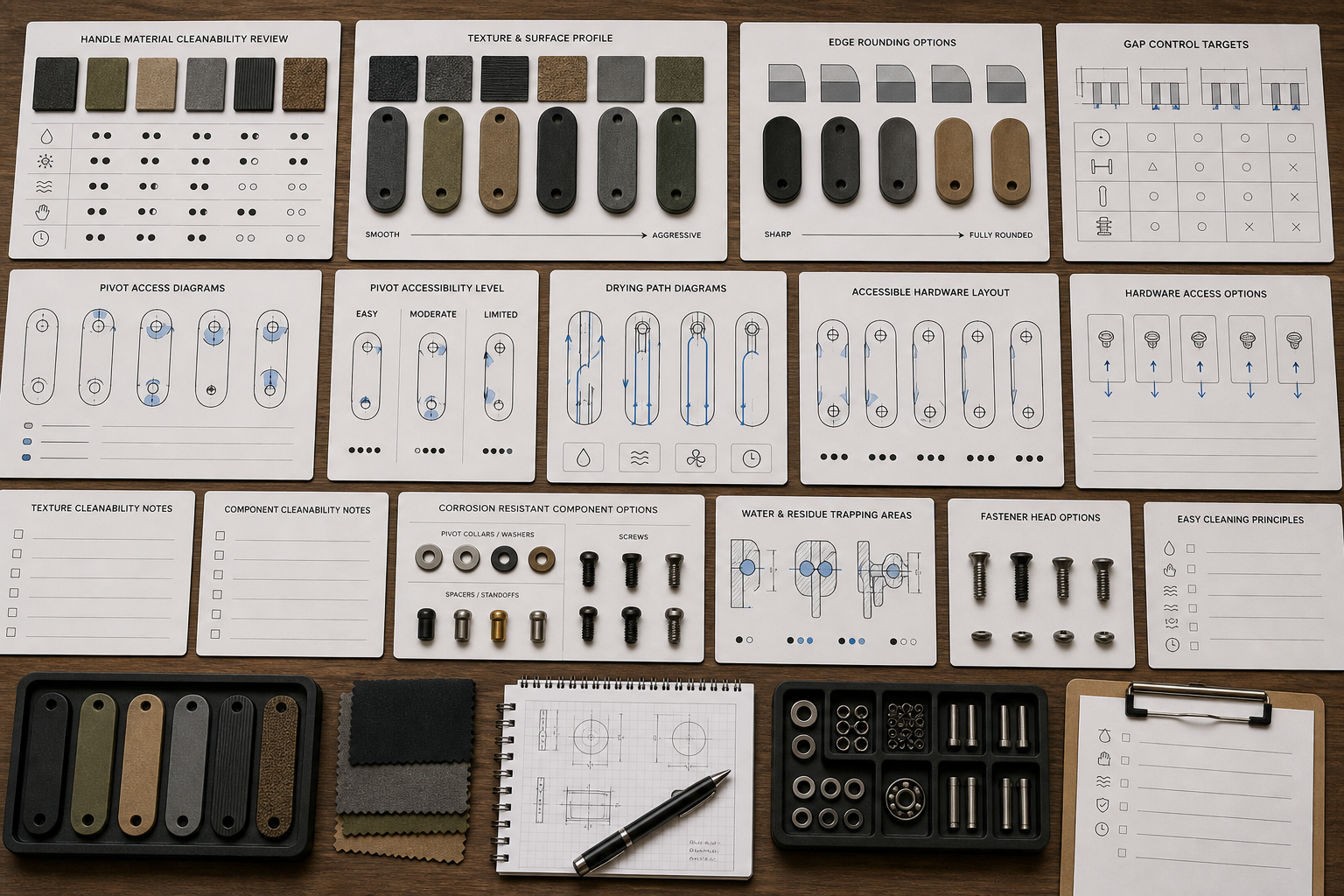
Handle material and pivot design should support cleaning through suitable texture, rounded edges, stable fasteners, controlled gaps, accessible hardware, corrosion-resistant components, and clear drying paths.
I Look For Residue Traps Before Approval
In a folding pocket knife, the pivot and handle area matter a lot. Deep grooves, sharp corners, exposed liners, complex cutouts, and tight gaps can trap residue. Some texture is useful for grip, but extreme texture may be harder to clean. The buyer should decide whether the product should prioritize grip, appearance, easy cleaning, or cost.
Handle material changes the care message. G10 is common in knife handles, and Curbell's G10/FR-4 material reference describes G10/FR-4 as a strong and stiff glass/epoxy composite with dimensional stability, while also noting machining concerns such as abrasive dust. I use that source as material background, not as a knife-specific guarantee. For a pocket knife handle, I still need to check texture depth, edge rounding, screw fit, and cleaning feel in the actual sample.
Pivot design also affects care. A simple, stable pivot stack is easier for users to keep clean than a complicated structure. The factory should check whether residue can be removed without damaging the finish or loosening hardware. The care instructions should not ask users to do something that the product structure cannot tolerate.
| Structure point | What I check | Why it matters |
|---|---|---|
| Handle texture | Grip depth and open grooves | Balances grip and cleanability |
| Gaps and liners | Residue traps and drying paths | Reduces hidden moisture |
| Pivot hardware | Access, screw fit, washer area | Protects movement |
| Clip and fasteners | Dirt collection and cleaning access | Supports daily maintenance |
What Should Packaging And User Instructions Say About Care?
Good packaging can prevent support problems. Poor wording can create claims the product was never designed to meet.
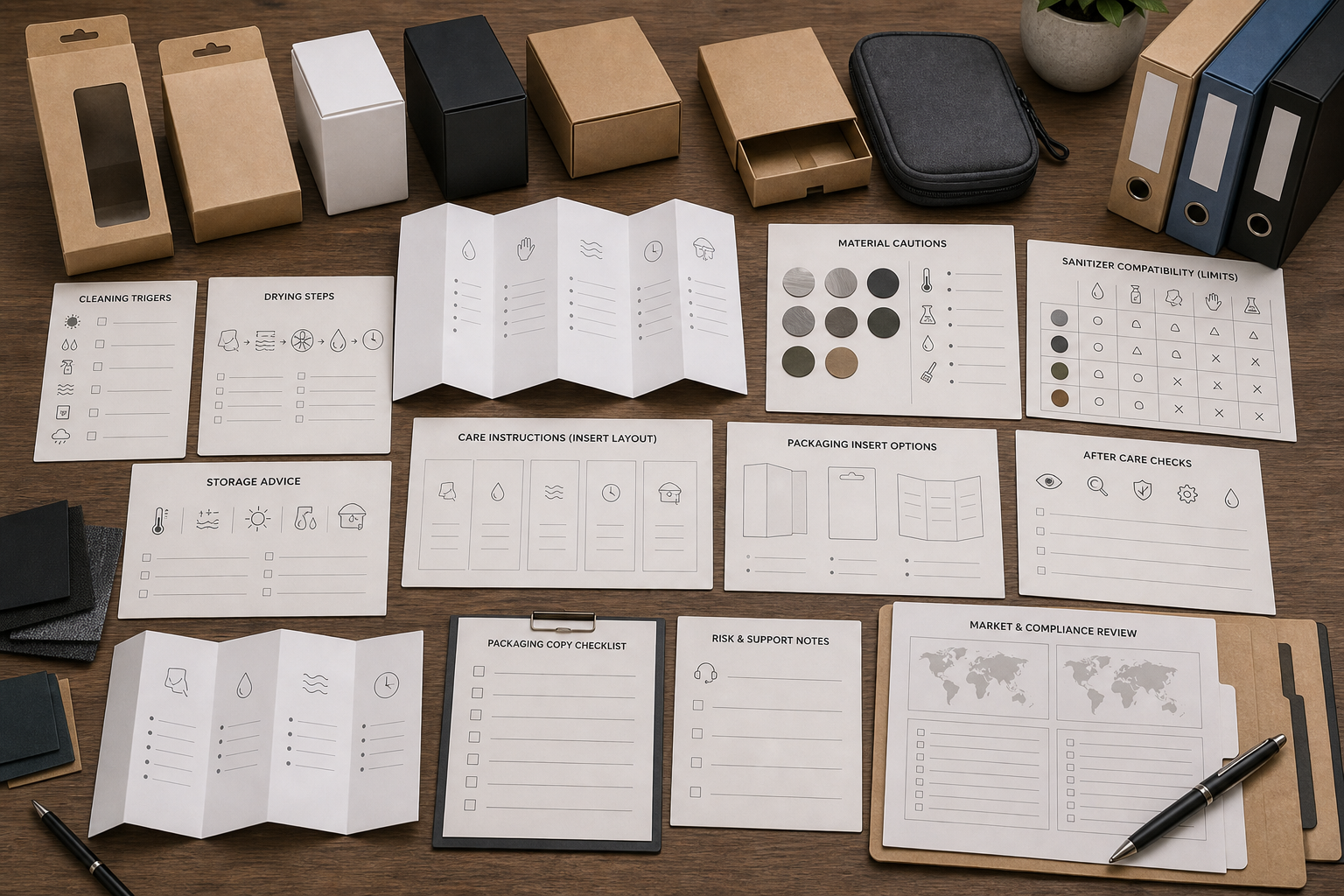
Packaging should explain cleaning triggers, drying steps, material cautions, sanitizer compatibility limits, storage advice, and when the buyer must confirm market-specific hygiene or compliance requirements.
I Prefer Clear Limits Over Big Claims
Care instructions should be short, clear, and realistic. For many pocket knives, the instruction can say to clean after visible residue, dry fully after moisture, avoid harsh chemicals unless confirmed compatible, and keep the pivot area free from buildup. If the product uses wood, coating, special color treatment, adhesive inserts, or a decorative finish, the instruction may need specific cautions.
The EPA explanation of cleaning, sanitizing, and disinfecting products is useful because it reminds brands that sanitizers and disinfectants are regulated products and that label directions matter. I do not turn that into chemical instructions for a pocket knife. I use it as a warning against casual claims. If a brand says a knife can be sanitized with a product, the brand should confirm compatibility and market rules.
Packaging also has a physical side. A knife should arrive clean, protected, and free from loose production dust or oil buildup. ISO 4180 gives planning context for complete, filled transport packages. For buyers, that means the retail box, pouch, insert, blade protection, and master carton should be planned together. Care guidance belongs in that same packaging plan.
| Instruction area | What to include | Why it matters |
|---|---|---|
| Cleaning trigger | Dirt, moisture, food residue, adhesive, salt | Makes care timing clear |
| Drying | Dry blade, handle, pivot, and gaps | Reduces corrosion risk |
| Chemical caution | Use only compatible methods | Protects finish and handle |
| Storage | Store dry and clean | Supports long-term appearance |
What QC Checks Confirm A Pocket Knife Can Be Cleaned Repeatedly?
A sample can survive one wipe and still fail long-term care. QC should check cleaning-related details before mass production.
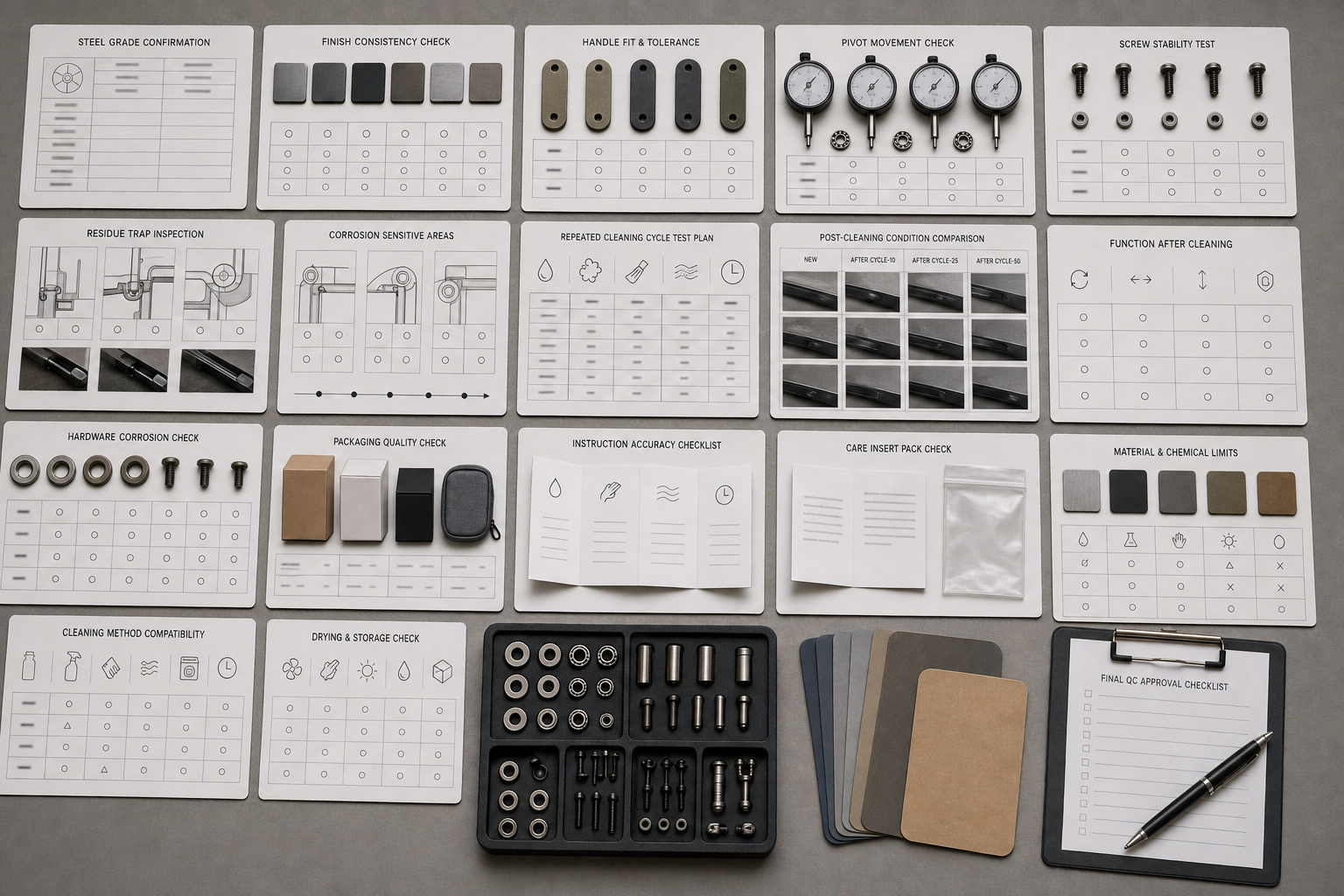
QC should confirm steel grade, finish consistency, handle fit, pivot movement, screw stability, residue traps, corrosion-sensitive areas, packaging cleanliness, instruction accuracy, and post-cleaning sample condition.
I Connect Cleanability To Production Records
Cleanability is not only a design opinion. It can be checked during sampling and production. I look at surface finish, handle gaps, pivot feel before and after cleaning, screw stability, coating behavior, and visible residue retention. If the product has a textured handle, I check whether normal brushing and wiping can remove common residue from the pattern. If the knife has a coating, I check whether the recommended care method affects the finish.
I also connect these checks to the approved sample. A final production batch should match the approved finish, handle fit, pivot feel, and packaging instruction. If the factory changes a surface texture or coating, the care instruction may need review. If the buyer changes packaging from a box to a pouch, storage and moisture protection may also change.
ISO 9001 is useful as a quality-management reference because it focuses on requirements, controlled operations, documented information, performance evaluation, and improvement. The ISO page for ISO 9001 quality management systems supports that process-based thinking. I do not use it to claim certification unless separate evidence exists. I use it to remind buyers that care-related quality should be documented.
| QC stage | What to check | Evidence to keep |
|---|---|---|
| Sample review | Cleaning access, residue traps, finish behavior | Photos and notes |
| Material check | Steel, handle, hardware, coating | Material records |
| Functional check | Pivot feel and lockup after cleaning | Inspection record |
| Final check | Clean package, care insert, sample match | Final report |
What RFQ Details Should Buyers Send For A Cleanable Pocket Knife?
A factory cannot design easy-care features from a vague request. Missing details lead to wrong material and packaging choices.
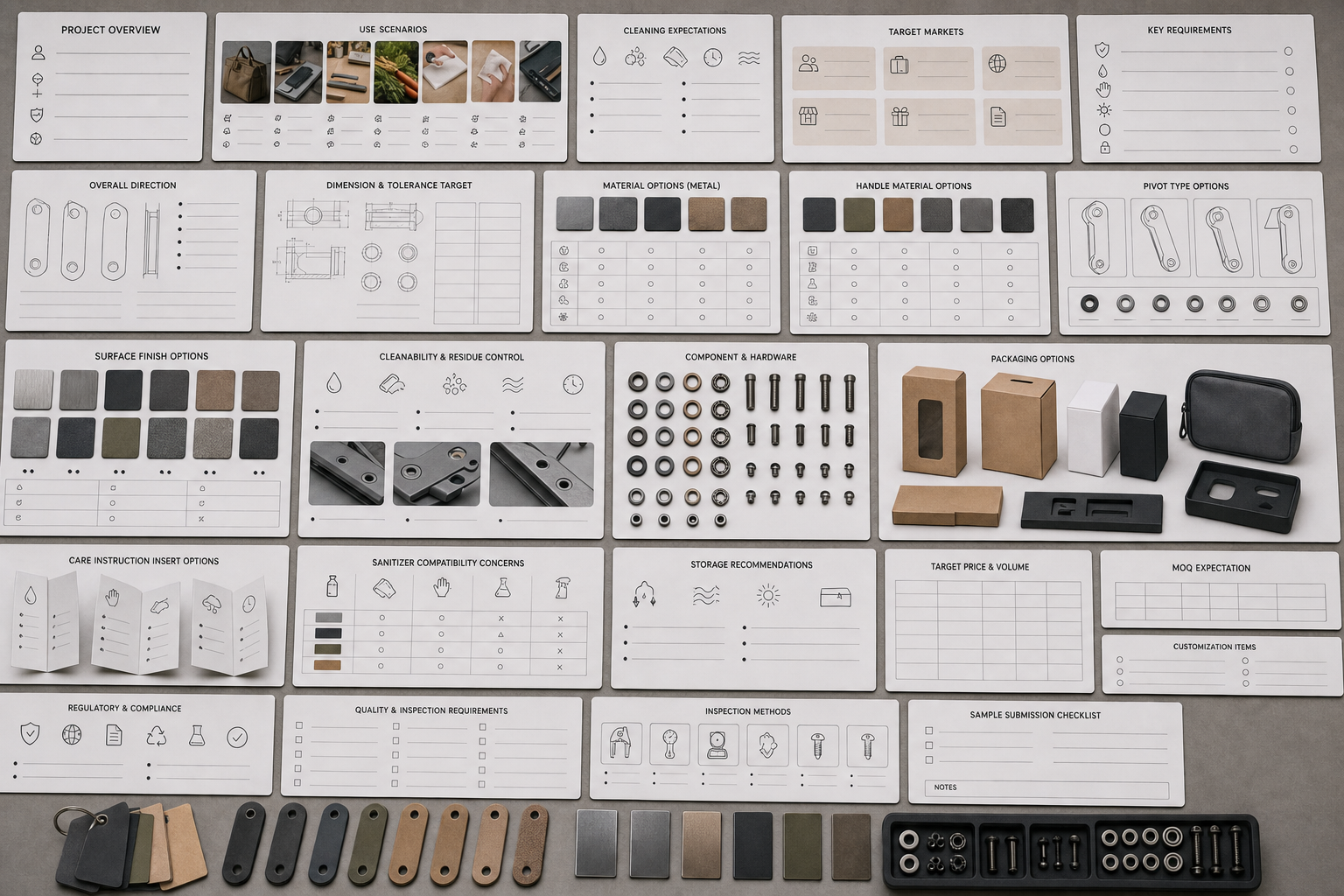
Buyers should send use scenario, cleaning expectation, target market, blade steel, handle material, pivot type, finish, packaging, care instruction needs, sanitizer compatibility concerns, target price, MOQ, and inspection requirements.
I Ask For The Care Scenario In The RFQ
For this kind of project, I want the RFQ to say more than pocket knife. The buyer should explain whether the knife is for daily carry, outdoor use, camping, food prep, fishing, utility work, or a promotional channel. The buyer should also state whether care guidance should focus on simple cleaning, corrosion prevention, food-contact context, or stronger sanitation language.
I also ask for material and cost boundaries. If the buyer wants better corrosion resistance, we can discuss stainless steel options. If the buyer wants easier cleaning, we can discuss smoother handle textures, simpler hardware, and finish choices. If the buyer wants a custom care card, packaging insert, or retail instruction, we should plan that before printing. Cost, MOQ, and customization should be balanced early because custom handles, coatings, inserts, and special packaging can change the quotation path.
Vast State can help B2B buyers turn this into a practical OEM/ODM project. We can support prototype development, material selection, structure suggestions, finish options, packaging customization, QC planning, and production follow-up. This article is sourcing and manufacturing guidance only, not legal, medical, or public health advice. Buyers should confirm final hygiene and compliance claims for their target market.
| RFQ field | What to include | Why I need it |
|---|---|---|
| Use scenario | Daily carry, camping, food prep, fishing, utility | Defines care guidance |
| Technical spec | Steel, handle, finish, pivot, hardware | Controls cleanability |
| Packaging need | Care card, insert, retail box, pouch | Supports clear instructions |
| QC need | Cleaning check, finish check, packaging check | Protects repeat orders |
Turn this article into a folding knife project.
Share your blade type, lock direction, steel preference, handle material, quantity, target market, and packaging needs. Vast State can prepare OEM/ODM options.
Conclusion
I plan pocket knife cleaning guidance by matching real use, cleanable structure, suitable materials, clear packaging, and documented QC checks.
Source Notes
- CDC cleaning and disinfecting guidance supports the distinction between cleaning, sanitizing, and disinfecting.
- EPA guidance on cleaning, sanitizing, and disinfecting products supports caution around sanitizer and disinfectant claims.
- FDA Food Code 2022 provides food-contact surface context, but it is not pocket-knife-specific.
- Alleima 14C28N datasheet supports stainless knife steel and corrosion-resistance discussion.
- Alleima hardening guidance supports heat-treatment discussion.
- Curbell G10/FR-4 reference supports handle material background, though it is not knife-specific.
- ISO 4180 supports transport packaging planning.
- ISO 9001 supports process-based quality management thinking.