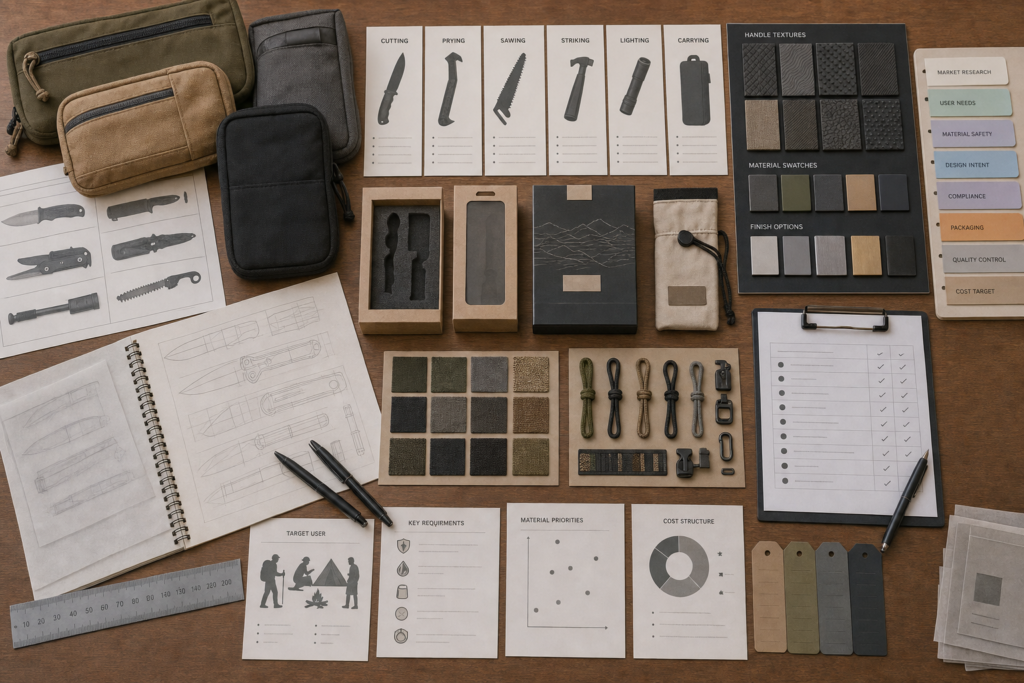
Outdoor survival tool ideas can become messy fast. Too many functions, weak materials, and vague packaging can turn a useful line into a sourcing problem.
Buyers should select outdoor survival tools by defining target users, tool functions, material standards, blade steel, handle design, kit structure, packaging, compliance needs, QC records, target price, MOQ, and RFQ details before sampling.
Quick buyer brief:
- Answer: Build the tool line around real buyer needs, then convert each function into manufacturable specifications.
- Buyer context: This helps outdoor brands, importers, wholesalers, and private label buyers plan practical OEM/ODM tool products.
- Key checks: Target market, tool mix, materials, steel and hardness, ergonomics, packaging, origin marking, QC records, and RFQ detail.
Have a knife or multi-tool project in mind?
Send your sketch, CAD file, sample photo, or product idea. Vast State can review manufacturability, suggest materials, estimate MOQ, and prepare a quote for your OEM/ODM project.
When a buyer asks me to help with an outdoor survival tool line, I do not begin with the longest feature list. I begin with the user, the sales channel, the price range, and the real product role. A camping tool, a compact EDC knife, a rescue tool, and a multi-tool can all belong in the same outdoor category, but they should not follow the same specification. The better path is to make each product useful, manufacturable, safe to package, and consistent in repeat orders.
What Should Buyers Define Before Choosing Outdoor Survival Tools?
A broad tool idea can look exciting but quote poorly. If the buyer cannot define the market, the factory must guess too much.
Buyers should define target market, user type, sales channel, tool role, price range, MOQ expectation, packaging level, compliance concerns, and inspection needs before selecting outdoor survival tools.
I Start With The Buyer Scenario, Not The Tool Count
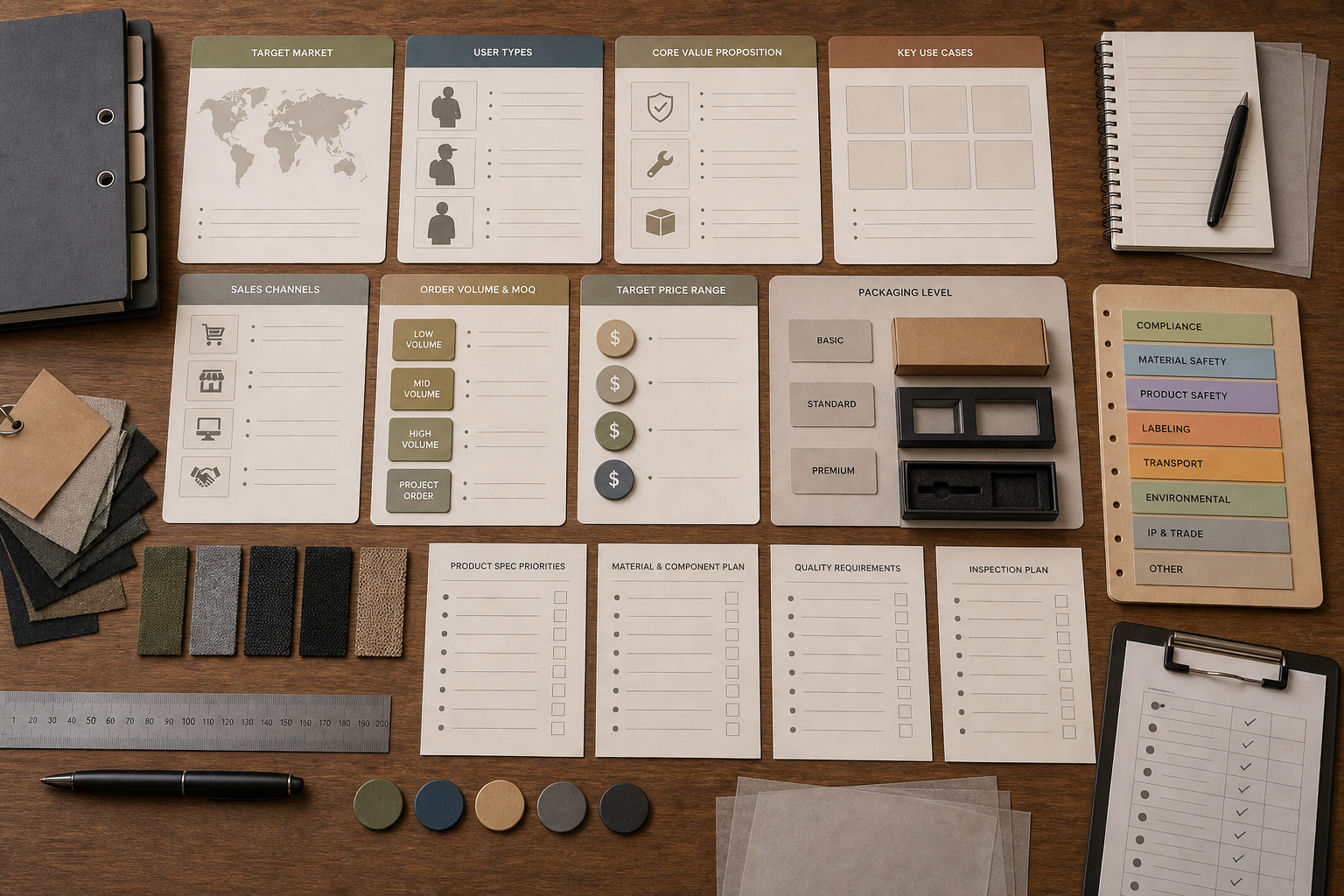
I have seen outdoor tool projects become too crowded. The buyer wants a knife, saw, pliers, opener, fire starter, whistle, flashlight, case, and gift box in one line. The idea may sound complete, but the product can become heavy, costly, hard to inspect, and confusing for the end customer. I prefer to slow down and define the real buying scenario first.
The buyer should tell me whether the product is for camping retail, outdoor gift sets, EDC utility, emergency preparedness, rescue-adjacent retail, or general outdoor wholesale. Each channel needs a different level of function, packaging, and cost control. A budget outdoor set may need fewer tools but stronger packaging. A private label camping line may need better handle material and more consistent finish. A distributor program may need cartons and barcodes more than a complex feature list.
Official preparedness resources can help buyers think in functional categories. Ready.gov's emergency kit guidance mentions items such as a flashlight, wrench or pliers, and manual can opener as part of basic preparedness planning. I use that type of list only as broad context. It does not decide an OEM/ODM product specification. The product brief must still define what the brand wants to sell and what the target market will accept.
| Planning point | Buyer decision | Why it matters |
|---|---|---|
| Target user | Camper, EDC buyer, emergency kit buyer, gift buyer | Guides function and packaging |
| Sales channel | Retail, online, wholesale, private label | Guides price and presentation |
| Product role | Single tool, kit, multi-tool, accessory line | Guides structure and MOQ |
| Inspection need | Basic, standard, or stricter QC | Guides cost and factory process |
OEM/ODM RFQ Checklist
Prepare these details to help Vast State review your project and provide a more accurate quotation.
| RFQ Field | What to Prepare |
|---|---|
| Project type | OEM from drawing / ODM private label / wholesale catalog |
| Product category | Folding knife / fixed blade / multi-tool / outdoor tool |
| Design status | Idea / sketch / 2D drawing / 3D CAD / physical sample |
| Target price | Ex-factory target price or retail price range |
| MOQ expectation | 500 / 1,000 / 3,000 / 5,000+ pcs |
| Logo method | Laser engraving / etching / printing / molded logo |
| Packaging | Standard packaging / custom retail box / Amazon-ready |
| Market | USA / EU / Japan / Korea / Middle East / other |
| Compliance needs | Buyer-specified testing / documentation / labeling |
| Timeline | Sample deadline / mass production deadline |
How Should Tool Functions Guide The Product Mix?
More tools do not always make a stronger product line. If every item overlaps, the buyer pays for complexity without clear value.
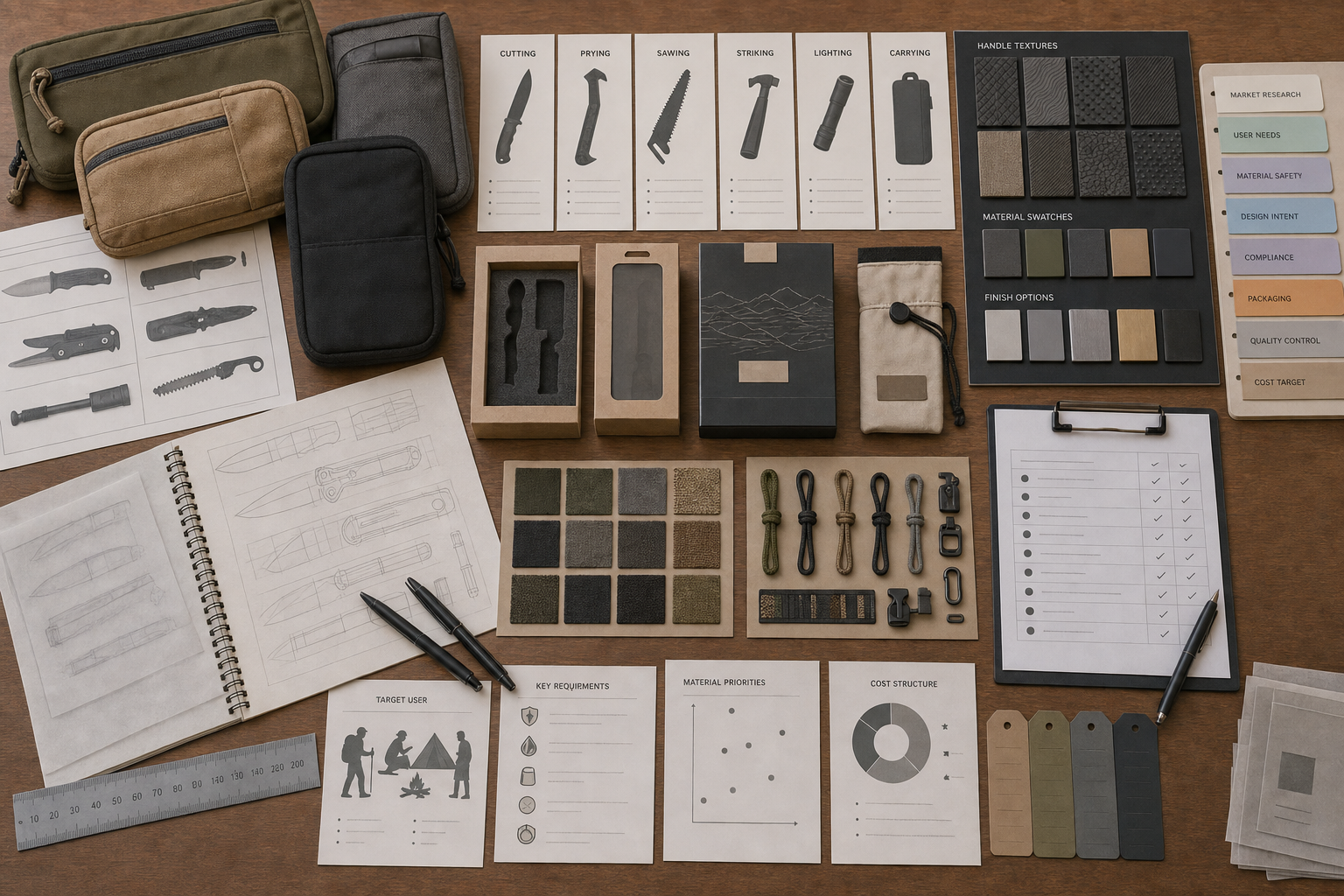
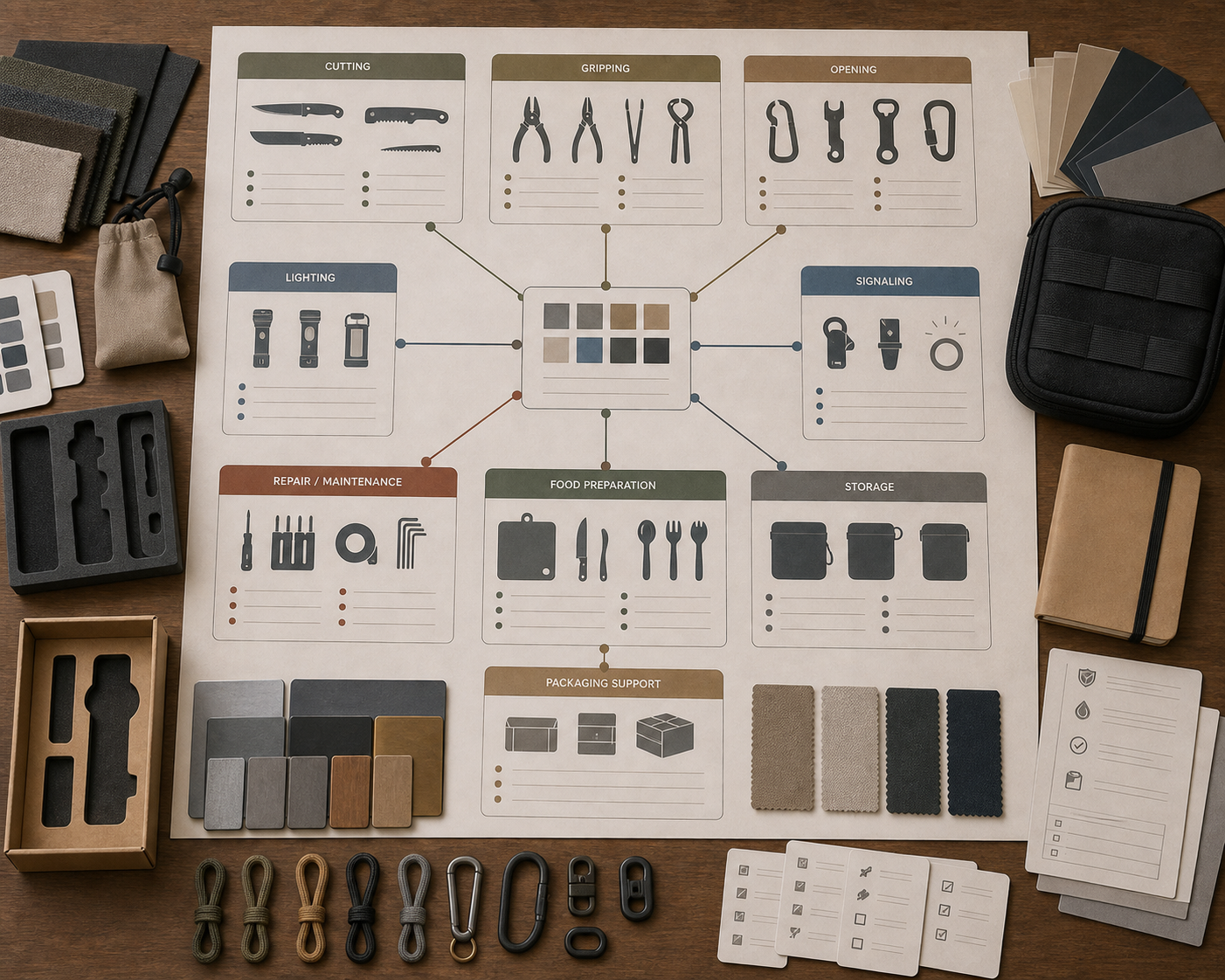
Tool functions should be grouped by cutting, gripping, opening, lighting, signaling, repair, food preparation, storage, and packaging support, then matched to the target buyer and price point.
I Build A Product Mix Around Clear Jobs
For an outdoor survival tool line, I like grouping products by job. One product may handle cutting. Another may handle gripping or small repair tasks. Another may support food preparation or general camping. Another may sit in a kit as an emergency accessory. This keeps the line clear and helps the buyer avoid paying for duplicate functions.
The product mix should also match the sales plan. If the buyer sells single SKUs, each tool must stand alone. If the buyer sells kits, the whole kit must feel balanced. A kit with five low-quality items may perform worse commercially than a kit with three stronger items. Buyers should think about the end customer's first impression, repeat use, and replacement order potential.
For OEM/ODM development, the tool mix affects tooling, assembly, packaging, carton size, MOQ, and inspection. A multi-tool needs moving-part checks. A fixed camping tool needs edge and handle checks. A flashlight or battery product adds a different compliance path, so I usually keep electronics separate unless the buyer already understands those requirements. The best outdoor tool line is not the longest list. It is the clearest match between function, price, and manufacturing stability.
| Function group | Possible product type | Sourcing focus |
|---|---|---|
| Cutting | Folding knife, fixed blade, utility tool | Steel, heat treatment, edge, sheath |
| Gripping and repair | Pliers, multi-tool, driver bits | Pivot, jaw fit, hardware strength |
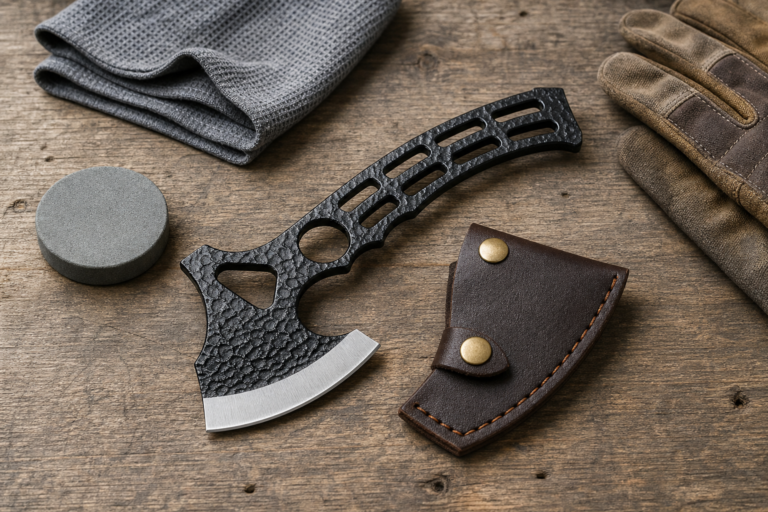
| Food and camp support | Opener, utensil, compact camp tool | Material, cleaning, packaging |
| Storage and kit | Pouch, case, box, insert | Fit, label space, carton efficiency |
Which Knife And Blade Specifications Matter For Outdoor Tool Lines?
A knife can anchor the whole outdoor line. If the blade specification is weak, the buyer's product story becomes hard to support.
Buyers should define blade type, steel grade, heat-treatment target, hardness range, grind, edge geometry, corrosion expectation, finish, handle material, sheath or lock structure, and inspection plan.
I Connect Blade Choice To The Target Market
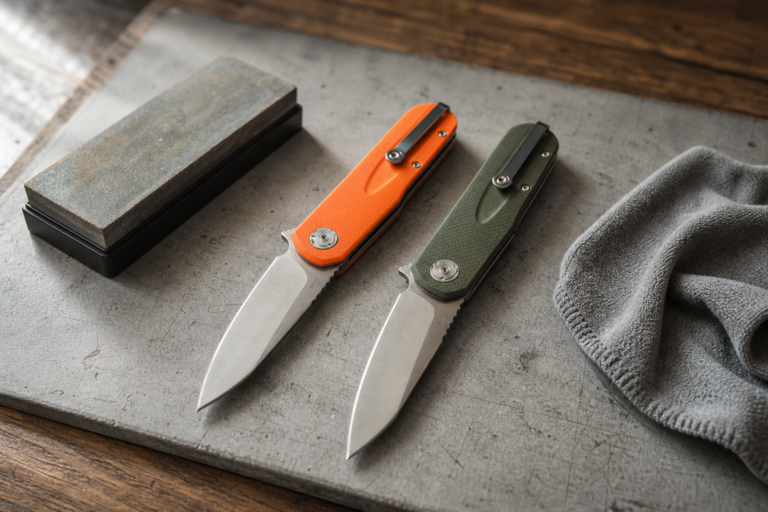
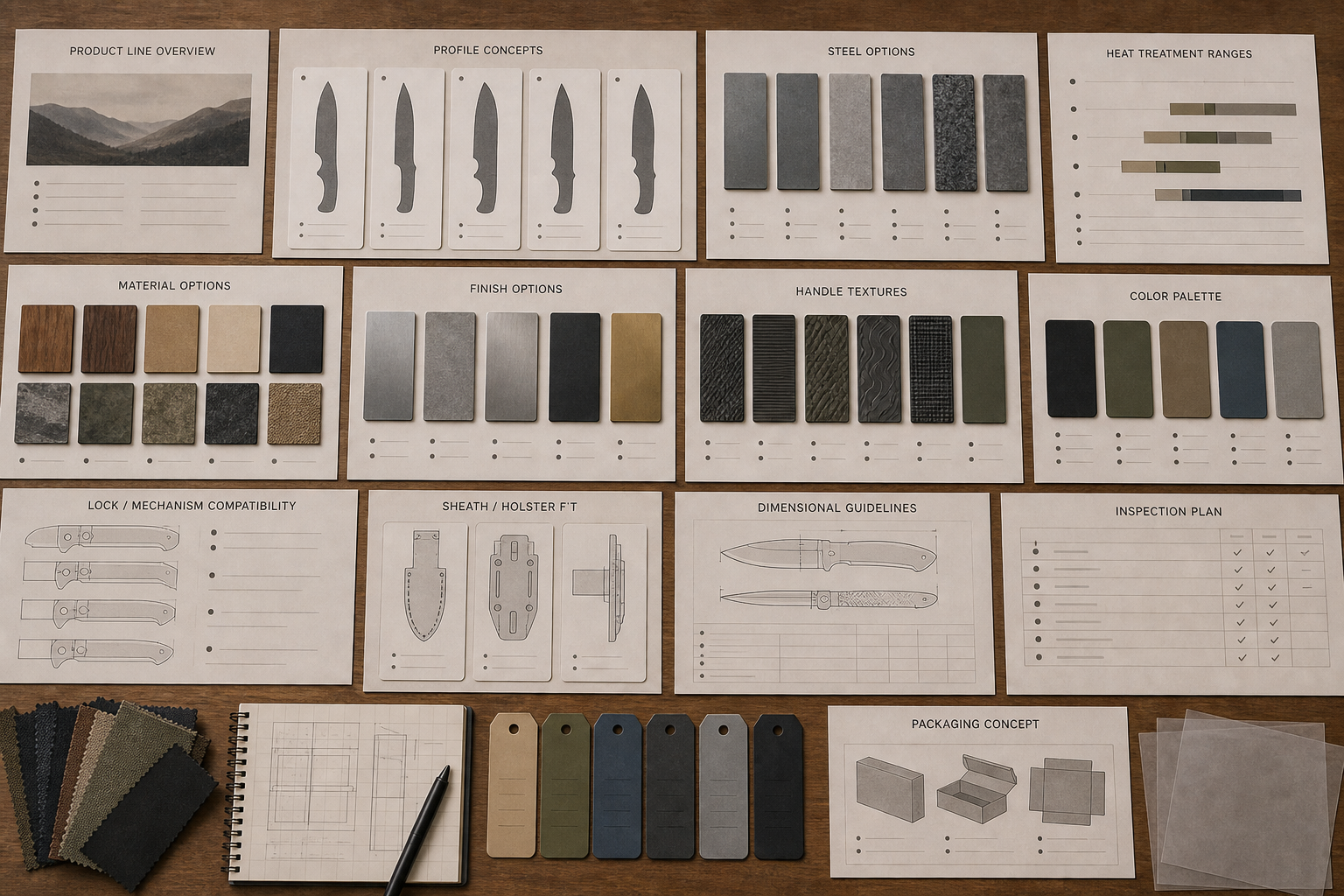
The blade is often the most important outdoor tool decision. A compact folding knife, a fixed blade camping knife, and a utility-style outdoor cutter all need different geometry. The buyer should define blade length, thickness, shape, grind, finish, edge condition, handle material, lock or sheath structure, and packaging requirement before the first sample.
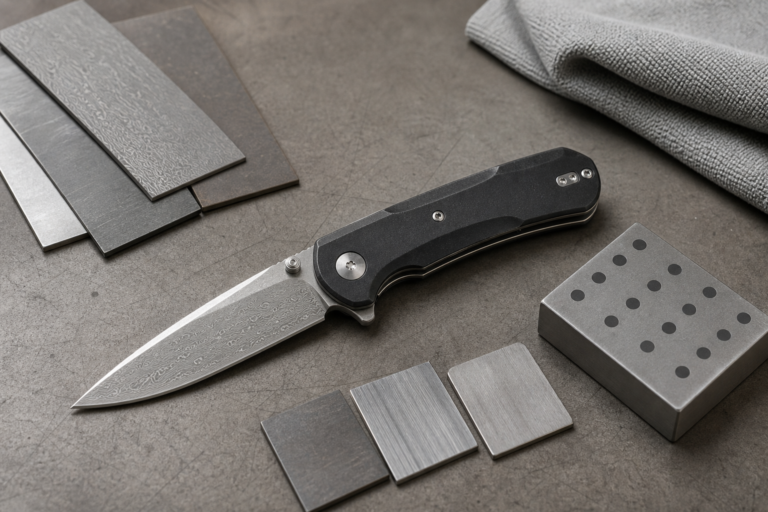
Steel choice should match the target market and price. Alleima describes 14C28N knife steel as a knife steel with a balance of edge performance, hardness, and corrosion resistance. That makes it a useful stainless reference for outdoor knife discussions. But it is not the only choice. A buyer may choose another steel because of cost, finish, availability, or market expectation.
Heat treatment must be discussed with the steel. Alleima's guidance on hardening and tempering explains that the process balances hardness and toughness. For QC, NIST's Rockwell hardness measurement guide supports careful hardness measurement practice. In production, I want a target range, a sampling plan, and records that connect the batch to the approved sample.
| Blade specification | What to define | Why it matters |
|---|---|---|
| Blade type | Folding, fixed, utility, camp tool | Controls structure and packaging |
| Steel and hardness | Grade, target HRC, test method | Controls consistency |
| Geometry | Length, thickness, grind, edge | Controls cost and user expectation |
| Finish | Satin, stonewash, coating, polish | Controls appearance and corrosion plan |
How Should Handle Materials And Ergonomics Be Evaluated?
Outdoor tools are handled in varied conditions. If grip, weight, or hardware is wrong, the product can feel cheap or tiring.
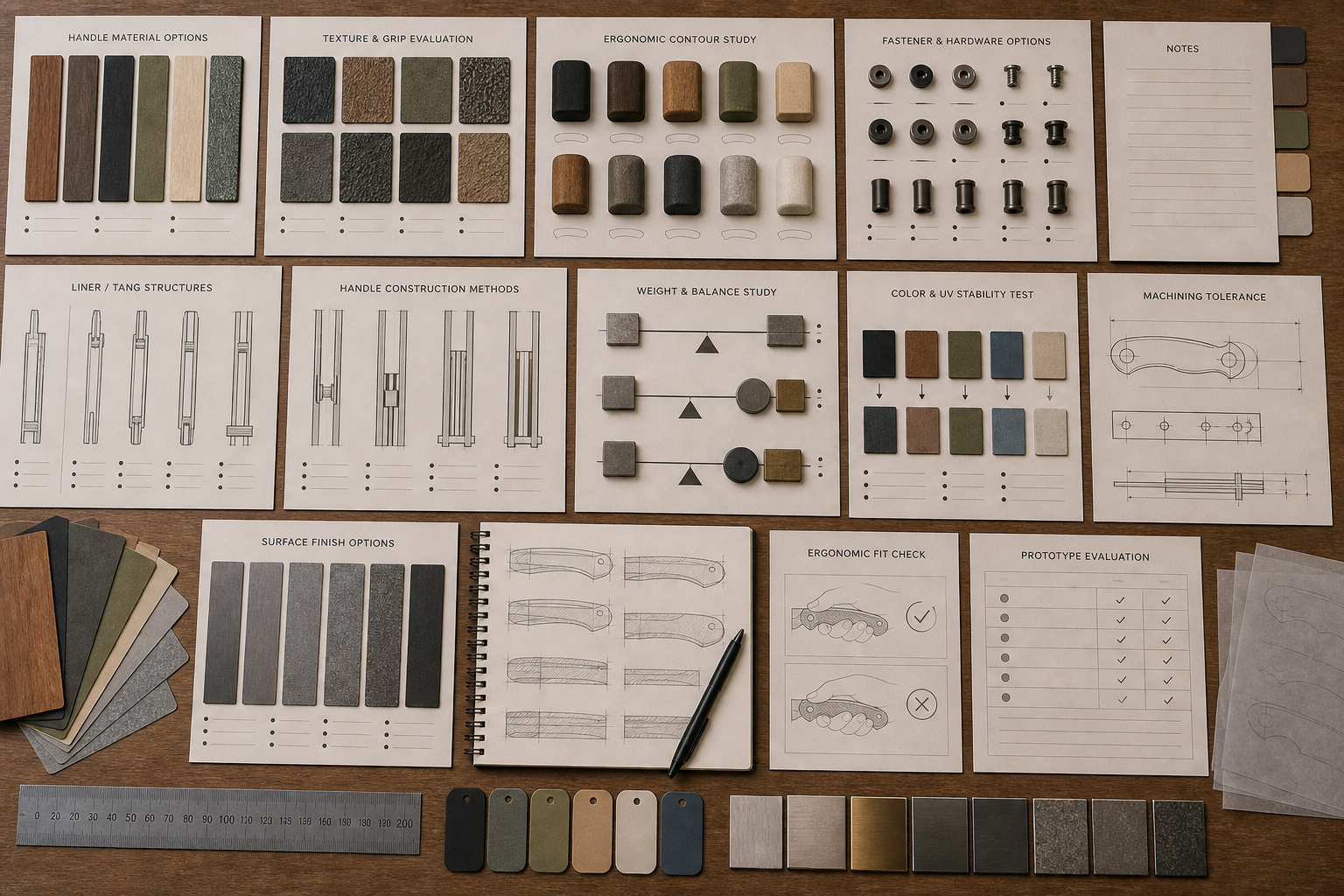
Buyers should evaluate handle material, texture, contour, thickness, edge rounding, fasteners, liner or tang structure, weight balance, color stability, and machining tolerance.
I Judge Handle Feel As A Production Detail
Handle comfort is not only a design issue. It is also a production issue. Material thickness, edge rounding, surface texture, screw height, clip or sheath contact, and weight balance all affect how the tool feels. If the buyer only says "good grip," the factory cannot know whether to adjust texture, material, shape, or assembly.
G10 is often used in knife and outdoor tool handles because it can feel stable and offer practical texture when machined well. Curbell's page on G10/FR-4 glass epoxy describes G10/FR-4 as strong, stiff, and dimensionally stable. It also notes machining concerns such as dust irritation and tool abrasion. That matters in OEM/ODM work because a material choice must include process control, not only product appearance.
Other materials can also fit. Aluminum can reduce weight and support anodized finishes. Stainless steel can feel solid but may increase weight. Wood can support a natural outdoor look but needs more color and moisture control. Rubber-like or molded materials can improve grip but need mold cost and surface checks. I ask buyers to choose handle material based on target price, appearance, grip, cleaning, machining, and repeat production.
| Handle factor | What I check | Buyer impact |
|---|---|---|
| Material | G10, micarta, aluminum, steel, wood, molded grip | Controls cost and feel |
| Texture | Grip level and edge finish | Controls handling comfort |
| Structure | Tang, liner, fastener, clip, spacer | Controls strength perception |
| Color and finish | Batch color, scratches, coating | Controls brand consistency |
How Should Multi-Tools And Camping Accessories Be Integrated?
A tool set can look complete but work poorly. If the parts do not share one quality standard, the line feels inconsistent.
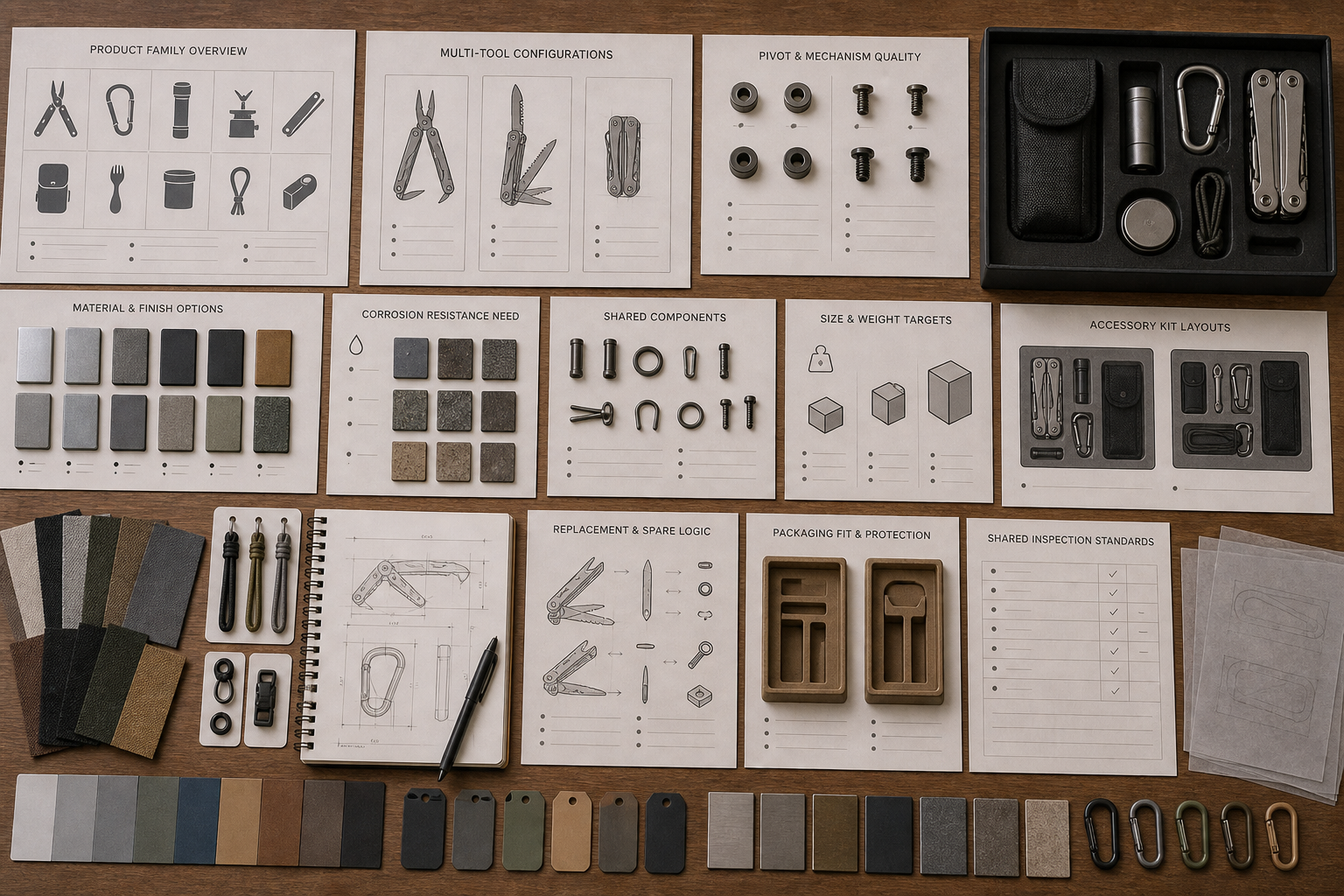
Multi-tools and camping accessories should be integrated by function, size, material, pivot quality, corrosion needs, packaging fit, replacement logic, and shared inspection standards.
I Make The Kit Feel Like One Product Family
Outdoor survival tools often include more than knives. A buyer may want pliers, openers, saws, screwdrivers, compact utensils, whistles, pouches, cases, or small accessory tools. The challenge is not only adding functions. The challenge is making the product line feel coherent.
I first check whether each item has a clear job. If two tools do the same job, the buyer may be paying for unnecessary cost. If one item is much lower quality than the others, the whole kit can feel weak. If one part needs a different packaging or compliance path, the buyer must decide whether the extra complexity is worth it.
Multi-tools require special attention. Pivots, springs, pliers jaws, driver fit, fasteners, and tool folding clearance all need inspection. Camping accessories need material and finish control. Pouches and cases need stitching, fit, and durability checks. When all these parts enter one kit, the packaging must protect each item and still look organized. I prefer a shared style guide and shared QC checklist, even when different components come from different processes.
| Component type | Key control point | Why it matters |
|---|---|---|
| Multi-tool | Pivot, jaw fit, tool clearance, fasteners | Controls function and feel |
| Camp accessory | Material, finish, cleaning, size | Controls usability and cost |
| Pouch or case | Fit, stitching, zipper, insert | Controls presentation and protection |
| Kit layout | SKU mix, weight, box size | Controls shipping and retail value |
How Should Packaging, Marking, And Kit Structure Be Planned?
Packaging can protect a tool line or quietly damage it. Weak inserts, poor labels, and loose parts create buyer complaints.
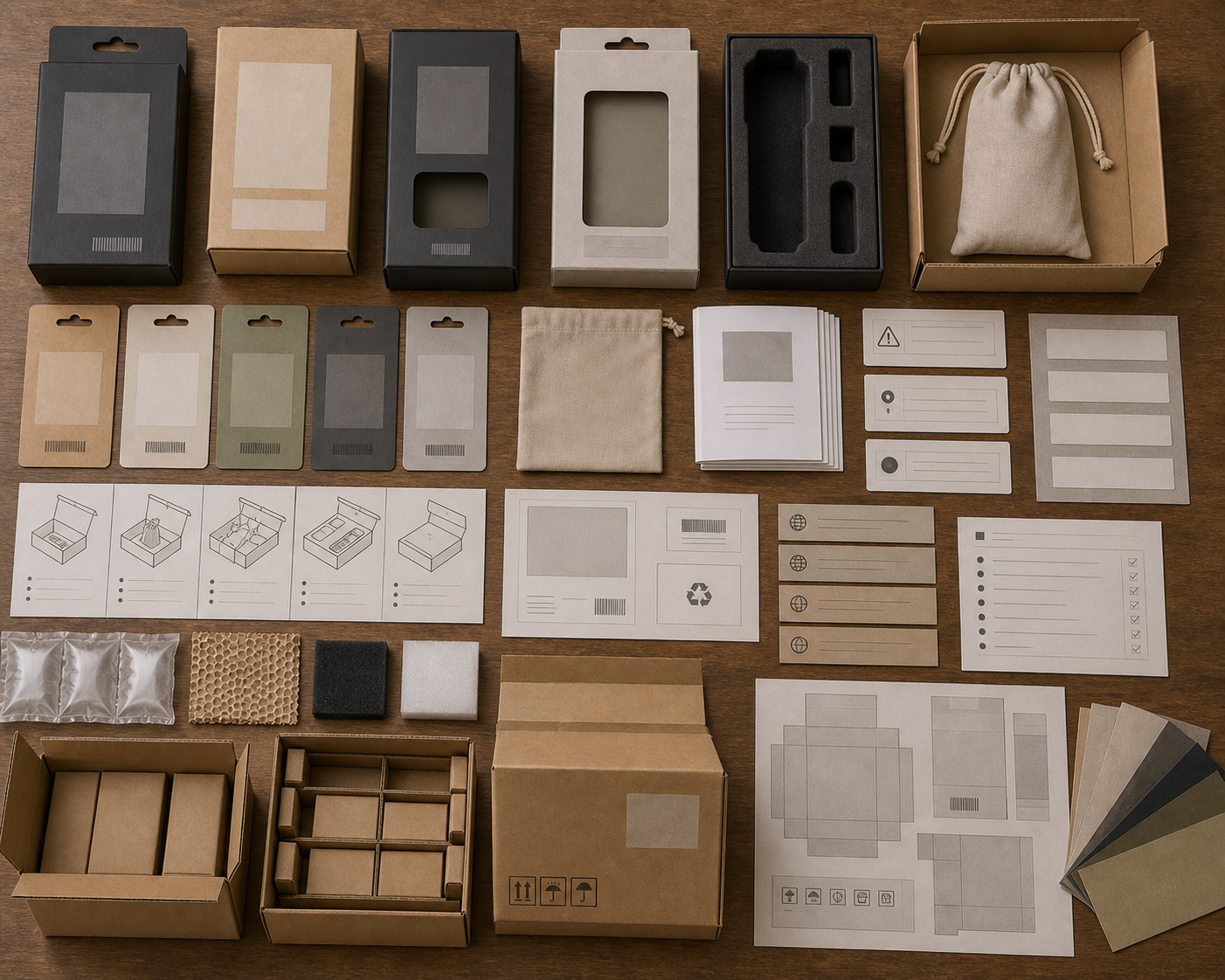
Buyers should plan retail box, pouch, insert, manual, barcode space, country-of-origin marking, warning labels where required, master carton, and transport protection before mass production.
I Treat Packaging As Part Of The Product
Outdoor tools are often heavy, textured, or sharp-edged compared with ordinary consumer goods. Packaging must prevent scratches, loose movement, carton damage, and missing accessories. A pouch may be useful for retail value, but it still needs fit and stitching checks. A foam insert may look clean, but it adds cost and carton size. A simple blister or box may work for a low-cost channel, but it must still protect the product.
ISO 4180 gives general rules for compiling performance test schedules for complete, filled transport packages. I use that concept practically. I think about the full filled package, not only the retail box. The buyer should decide whether the tool line needs drop-related packaging checks, carton compression thinking, humidity protection, barcode space, label placement, or inner pack separation.
Marking also needs early planning. If the product enters the U.S. market, 19 CFR 134.43 lists knives among articles requiring specific country-of-origin marking methods, with limited exceptions depending on the applicable rule. Other markets may have other requirements. The factory can support marking placement and packaging space, but the buyer must confirm final compliance needs.
| Packaging area | What to decide | Why it matters |
|---|---|---|
| Retail pack | Box, pouch, insert, tray | Controls first impression |
| Tool protection | Edge cover, separator, foam, bag | Reduces scratches and missing parts |
| Marking | Origin, barcode, importer, warning if required | Supports market entry |
| Carton | Master carton, label, weight, inner pack | Supports shipping stability |
What QC Checks Keep Outdoor Tool Lines Consistent?
Outdoor tool lines can include many parts. Without a shared QC plan, each component may meet a different standard.
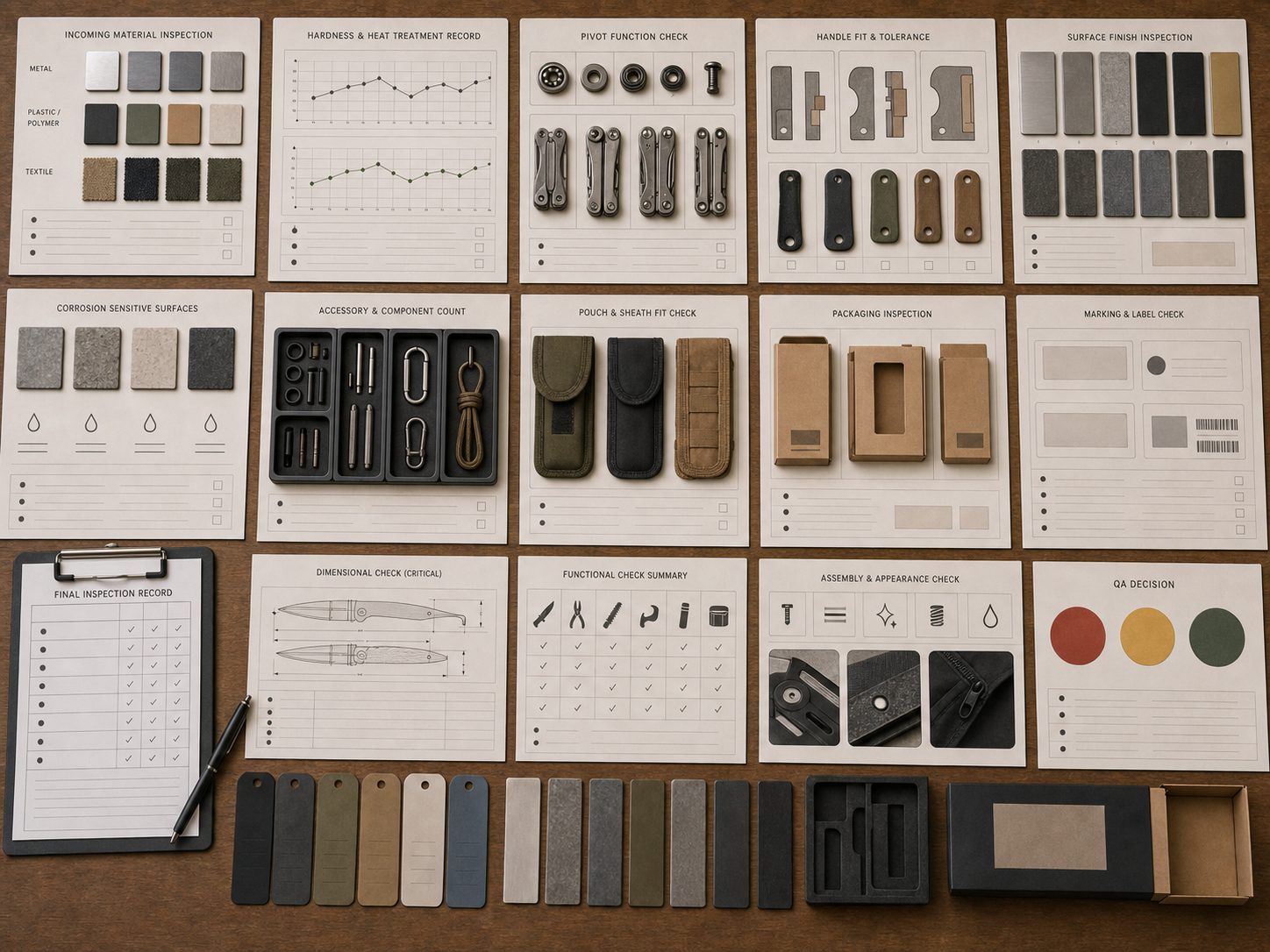
QC should cover incoming materials, blade hardness, pivot function, handle fit, finish, corrosion-sensitive surfaces, accessory count, pouch fit, packaging, marking, and final inspection.
I Build One Control File For The Whole Line
Quality control for an outdoor tool line should not happen only at the end. I prefer a control file that connects approved samples, drawings, material lists, finish references, packaging files, and inspection standards. This is especially important when the line includes several product types, such as a folding knife, multi-tool, pouch, and accessory set.
ISO 9001 is useful as a quality-management reference because it focuses on customer requirements, controlled operations, documented information, performance evaluation, and improvement. The ISO page on ISO 9001 quality management supports that process-based thinking. ISO 10007 also gives guidance on configuration management, which is useful when samples, drawings, materials, or packaging change during development.
In a real project, I would check steel grade, heat treatment, hardness records, blade dimensions, handle fit, pivot movement, lock or joint stability, surface finish, accessory count, pouch fit, retail box condition, carton labels, and final sample comparison. If the buyer wants a kit, the kit should be inspected as a kit. A good knife with a poor pouch or missing accessory can still fail the order.
| QC stage | What to check | Evidence to keep |
|---|---|---|
| Incoming | Steel, handle materials, hardware, pouch materials | Material records and photos |
| In-process | Hardness, dimensions, pivots, finish | Test records and inspection notes |
| Assembly | Fit, movement, fasteners, accessory count | Sample comparison and defect list |
| Final | Packaging, marking, carton, full kit count | Final report and approval record |
What RFQ Details Should Buyers Send Before Sampling?
A tool selection guide is useful only if it becomes a clear RFQ. Without details, the factory can only make assumptions.
Before sampling, buyers should send target market, tool mix, dimensions, materials, steel, handle options, finish, packaging, quantity, MOQ expectation, target price, customization needs, compliance concerns, and inspection requirements.
I Ask For A Product Line Brief
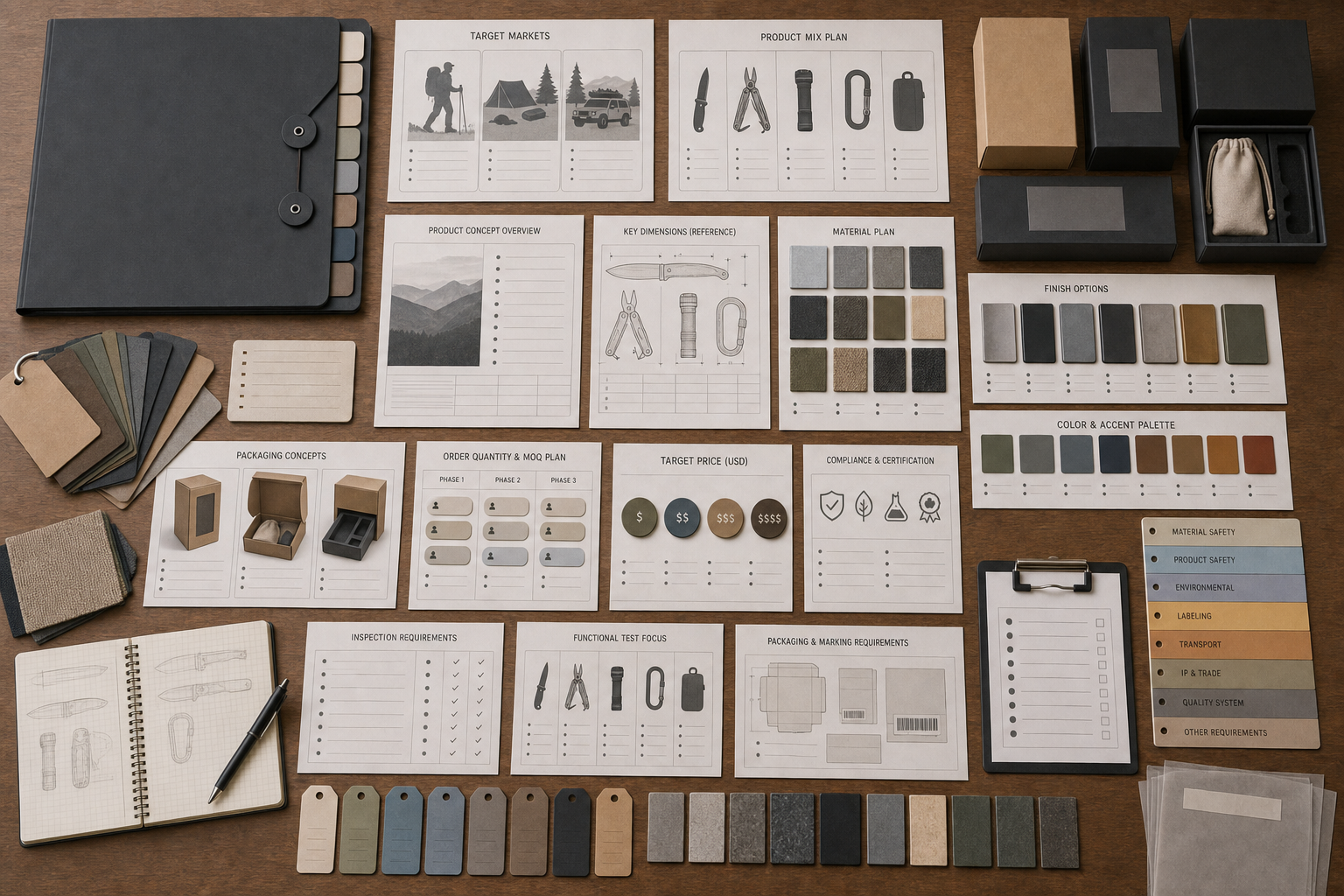
For an outdoor survival tool project, a good RFQ should explain the product line, not only one item. The buyer should list the tool mix, target user, sales channel, expected quantity, MOQ expectation, target price, product dimensions, material preferences, blade steel, handle material, finish, logo method, pouch or case need, retail packaging, carton requirements, and inspection expectations.
I also ask the buyer to rank each feature as must-have, preferred, or optional. A strong blade and stable handle may be must-have. A special coating may be preferred. A gift box may be optional for a lower-cost channel. This helps me suggest several quotation paths instead of one guess. MOQ can also change when the buyer requests a custom handle mold, special color, special coating, or unique packaging, so I prefer to clarify those tradeoffs before sampling.
If the buyer is not sure which tools to include, I can help build a practical product path. But I still need decision boundaries. The buyer should tell me which functions are must-have, which are optional, and which can be removed to meet a price target. The buyer should also state compliance concerns for the target market. This article is manufacturing and sourcing guidance only, not legal advice. The buyer must confirm final product rules for the destination market.
Vast State can support OEM/ODM development from concept to production. We can help with prototype development, material selection, structure suggestions, finish options, packaging customization, QC planning, and production follow-up. The clearer the RFQ, the better the sampling path.
| RFQ field | What to include | Why I need it |
|---|---|---|
| Tool mix | Knife, multi-tool, camping tool, pouch, kit items | Defines product scope |
| Commercial target | Quantity, MOQ expectation, target price | Guides material and process choices |
| Technical spec | Steel, handle, dimensions, finish, packaging | Builds accurate samples |
| Quality need | Inspection items, sample approval method | Protects repeat production |
Turn your idea into a quote-ready knife project.
Share your drawing, sample photo, target quantity, market, and packaging needs. Vast State will review manufacturability and prepare OEM/ODM options.
Conclusion
I select outdoor survival tools by matching real buyer needs with manufacturable functions, controlled materials, practical packaging, QC records, and clear RFQ details.
Source Notes
- Ready.gov emergency kit guidance provides public preparedness context for items such as flashlights, pliers, and manual can openers.
- Alleima 14C28N and Alleima hardening guidance support steel and heat-treatment discussion.
- NIST Rockwell hardness guidance supports careful hardness measurement practice.
- Curbell G10/FR-4 provides material context for G10 strength, stability, and machining concerns.
- ISO 4180 supports packaging test schedule planning for complete, filled transport packages.
- 19 CFR 134.43, ISO 9001, and ISO 10007 support marking, quality-management, and configuration-control references.