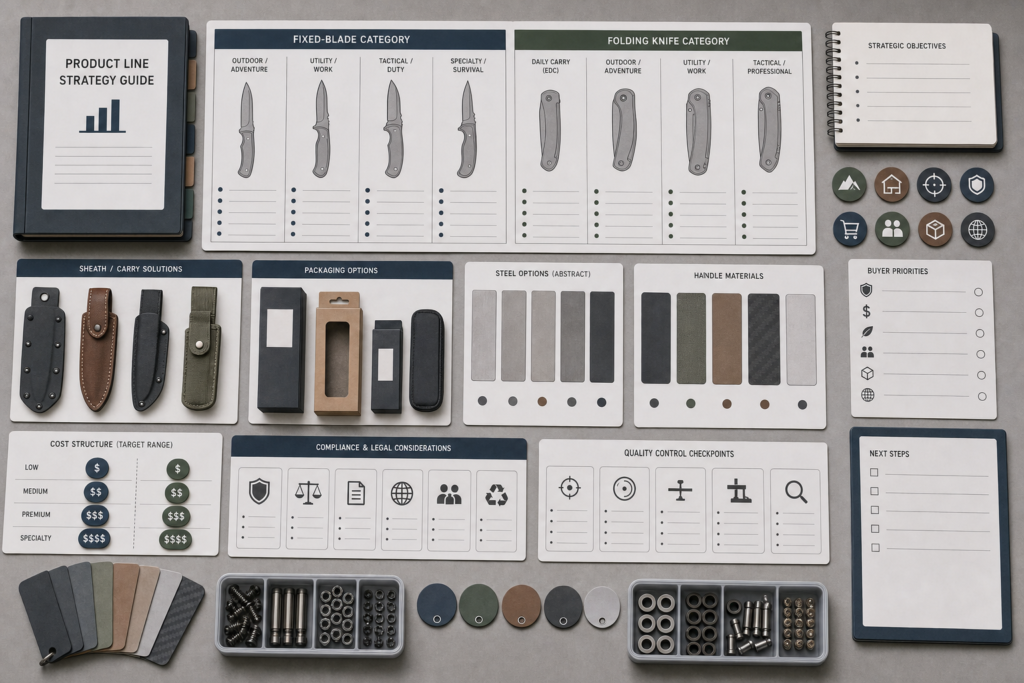
Choosing the wrong knife type can hurt sales. It can also raise cost, packaging risk, and compliance pressure. I compare structure first.
Sellers should choose fixed blade knives for strength, simple structure, outdoor use, and sheath-based value. They should choose folding knives for pocket carry, compact retail appeal, lower shipping volume, and broader EDC positioning. The better choice depends on target user, market rules, cost, packaging, and QC.
Quick buyer brief:
- Answer: Fixed blades suit rugged outdoor use; folding knives suit compact daily-carry and retail programs.
- Buyer context: This helps knife brands, outdoor brands, importers, wholesalers, distributors, and private label buyers plan product lines.
- Key checks: Target user, blade length, structure, lock type, sheath or handle, steel, heat treatment, packaging, compliance market, MOQ, target price, and inspection plan.
Developing a folding knife line for your brand?
Vast State supports OEM/ODM folding knife projects, including blade steel, lock structure, handle material, finish, logo method, packaging, and quality inspection planning.
When I help a seller compare fixed blade knives and folding knives, I do not ask which one is better in general. I ask what the product must do, who will buy it, where it will be sold, how it will be packed, how much it must cost, and how stable the quality must be in repeat production. A fixed blade and a folding knife can both be good products. They simply solve different commercial and manufacturing problems.
When Does a Fixed Blade Knife Make Better Commercial Sense?
A folding knife is not always the better seller. Some outdoor categories need the direct strength and simple structure of a fixed blade.
A fixed blade knife makes better commercial sense when the product needs strength, simple cleaning, outdoor positioning, larger handle comfort, sheath value, and fewer moving-part risks than a folding knife.
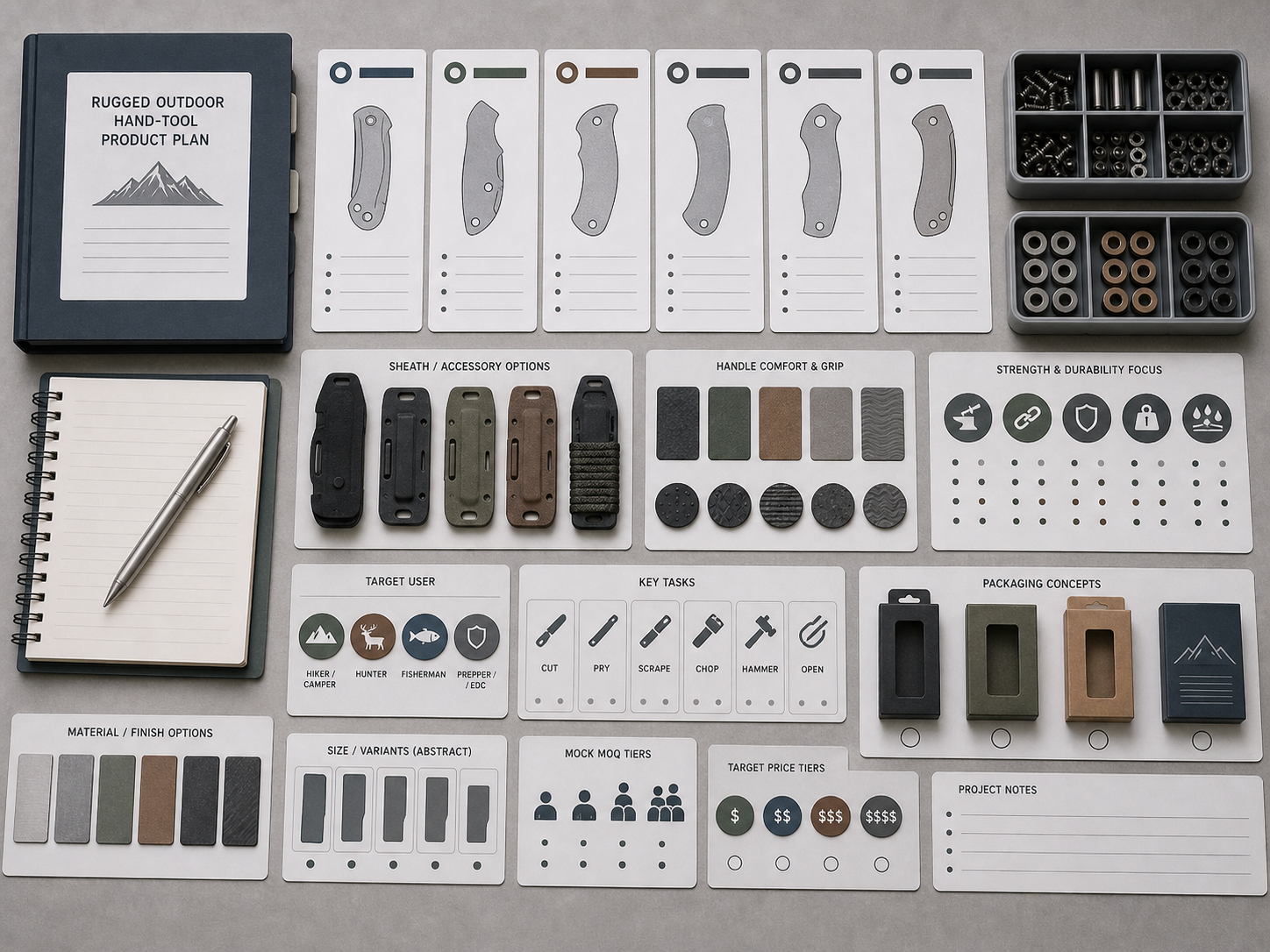
I Use Fixed Blades for Clear Outdoor Value
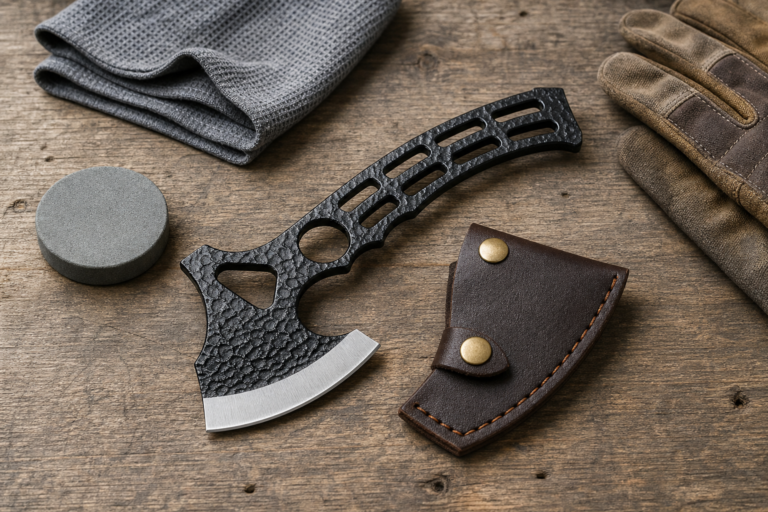
Fixed blade knives often make sense for outdoor, camping, field utility, hunting-style retail, fishing, and gift programs where the buyer wants a strong tool image and a simple product story. A fixed blade can use a full tang or partial tang structure. The handle can be shaped for grip and comfort. The sheath can become part of the value. A well-designed sheath can improve perceived quality, product protection, and retail presentation.
From a manufacturing view, fixed blades remove many folding-knife variables. There is no lock engagement, detent, blade centering, or pivot tension. That does not mean fixed blades are easy. The blade profile, heat treatment, grind, handle fit, rivets or screws, surface finish, edge, sheath fit, and packaging still need control. The sheath is especially important. A weak sheath can make a strong knife feel cheap.
For sellers, fixed blades can support a higher outdoor story when the market allows it. But the seller must check destination-market rules, packaging claims, and shipping requirements. A fixed blade may look simple, but it can still create compliance questions if the sales channel is not ready for it.
| Seller goal | Why fixed blade helps | What to check |
|---|---|---|
| Outdoor positioning | Strong and simple product story | Blade size, sheath, packaging language |
| Higher perceived value | Sheath and handle can add value | Sheath retention and material |
| Simple mechanism | No pivot or lock tuning | Tang, handle fit, edge, finish |
| Gift set program | Larger visual presence | Box size and protection |
OEM/ODM RFQ Checklist
Prepare these details to help Vast State review your project and provide a more accurate quotation.
| RFQ Field | What to Prepare |
|---|---|
| Project type | OEM from drawing / ODM private label / wholesale catalog |
| Product category | Folding knife / fixed blade / multi-tool / outdoor tool |
| Design status | Idea / sketch / 2D drawing / 3D CAD / physical sample |
| Target price | Ex-factory target price or retail price range |
| MOQ expectation | 500 / 1,000 / 3,000 / 5,000+ pcs |
| Logo method | Laser engraving / etching / printing / molded logo |
| Packaging | Standard packaging / custom retail box / Amazon-ready |
| Market | USA / EU / Japan / Korea / Middle East / other |
| Compliance needs | Buyer-specified testing / documentation / labeling |
| Timeline | Sample deadline / mass production deadline |
When Does a Folding Knife Fit Sellers Better?
Some sellers need compact products that move fast through retail and online channels. Folding knives often fit that path.
A folding knife fits sellers better when the product needs compact carry, pocket-size packaging, broad EDC appeal, private label customization, lower package volume, and a product story based on convenience.
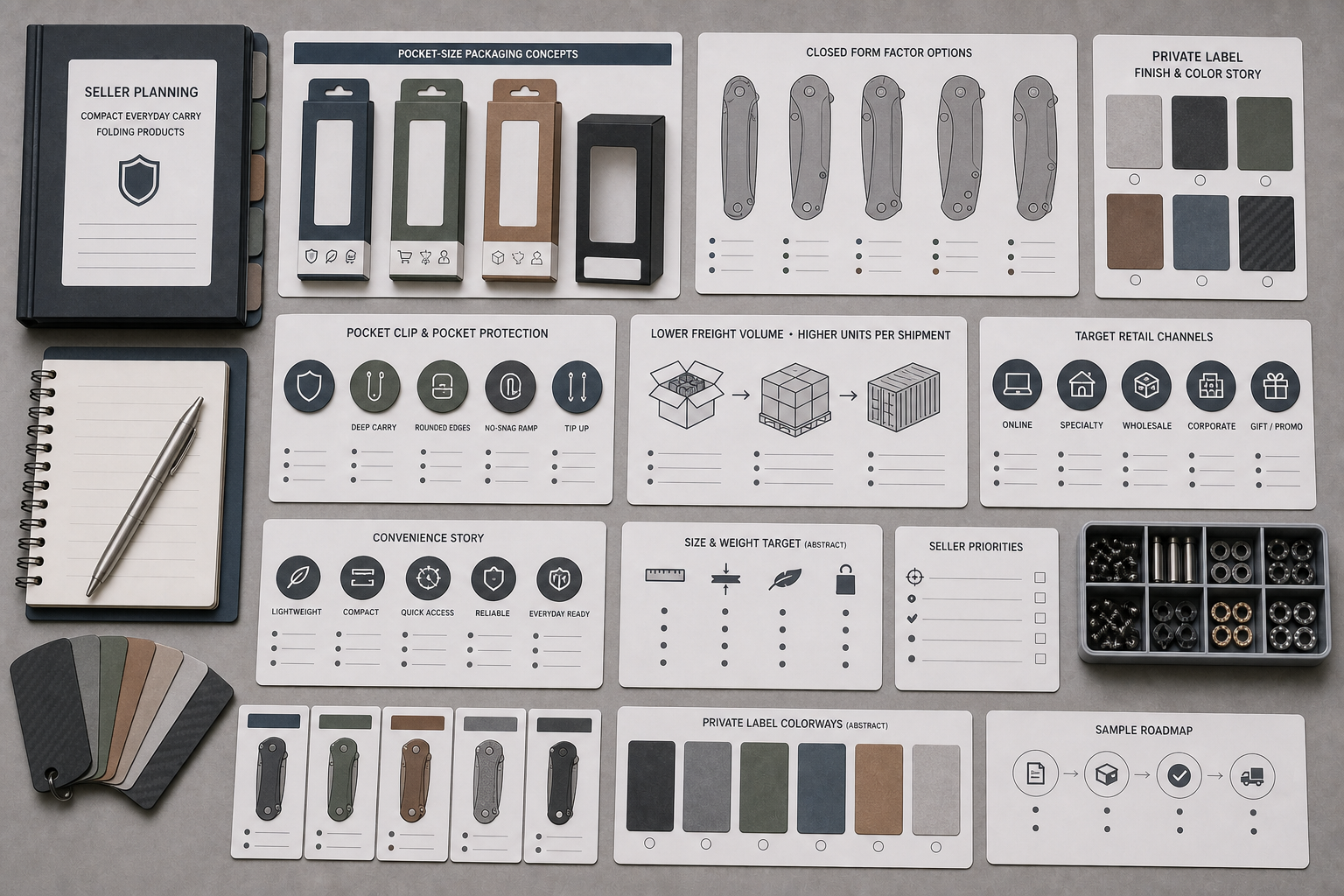
I Choose Folding Knives for Compact Market Fit
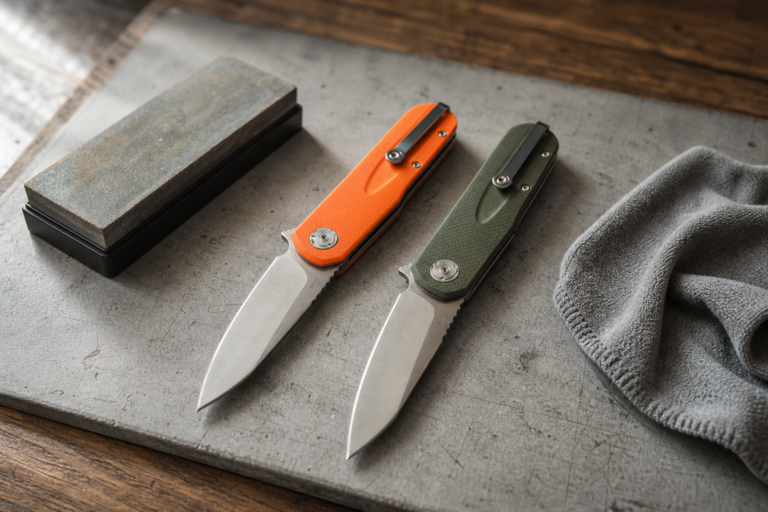
Folding knives are popular because they are compact. That matters for sellers. A folding knife can fit in smaller retail packaging. It can ship in less volume than many fixed blade sets. It can work well for EDC, online retail, promotional products, outdoor accessory lines, and private label programs. The buyer can customize blade shape, handle material, clip, screw color, finish, logo, and packaging.
The tradeoff is mechanical complexity. The blade must open and close correctly. The lock or slip joint must match the intended product level. The pivot must be tuned. The blade should not rub the liner. The screws should hold without creating rough action. The pocket clip must be comfortable and stable. If the design is too thin, too heavy, or too ambitious for the target price, the sample may look fine but production may become unstable.
I also ask sellers to think about market rules. The UK government page on selling, buying and carrying knives gives one example of why folding pocketknife features, blade length, and locking structure can matter in a destination market. That does not define every market, but it reminds sellers that folding does not automatically mean low risk.
| Seller goal | Why folding knife helps | What to check |
|---|---|---|
| Compact retail item | Smaller package and easier display | Closed size and edge protection |
| EDC positioning | Familiar pocket-tool format | Lock type and local rules |
| Private label line | Many customization points | MOQ, finish, logo method, clip |
| Online sales | Easier product photos and bundles | Safety wording and packaging |
How Do Manufacturing Costs Differ Between Fixed Blades and Folding Knives?
Unit price is not only steel weight. Mechanisms, hand adjustment, sheath, packaging, and inspection all change cost.
Fixed blade costs usually depend on steel size, tang, handle material, sheath, finish, and packaging. Folding knife costs depend more on mechanism parts, machining tolerance, lock fitting, assembly time, and functional inspection.
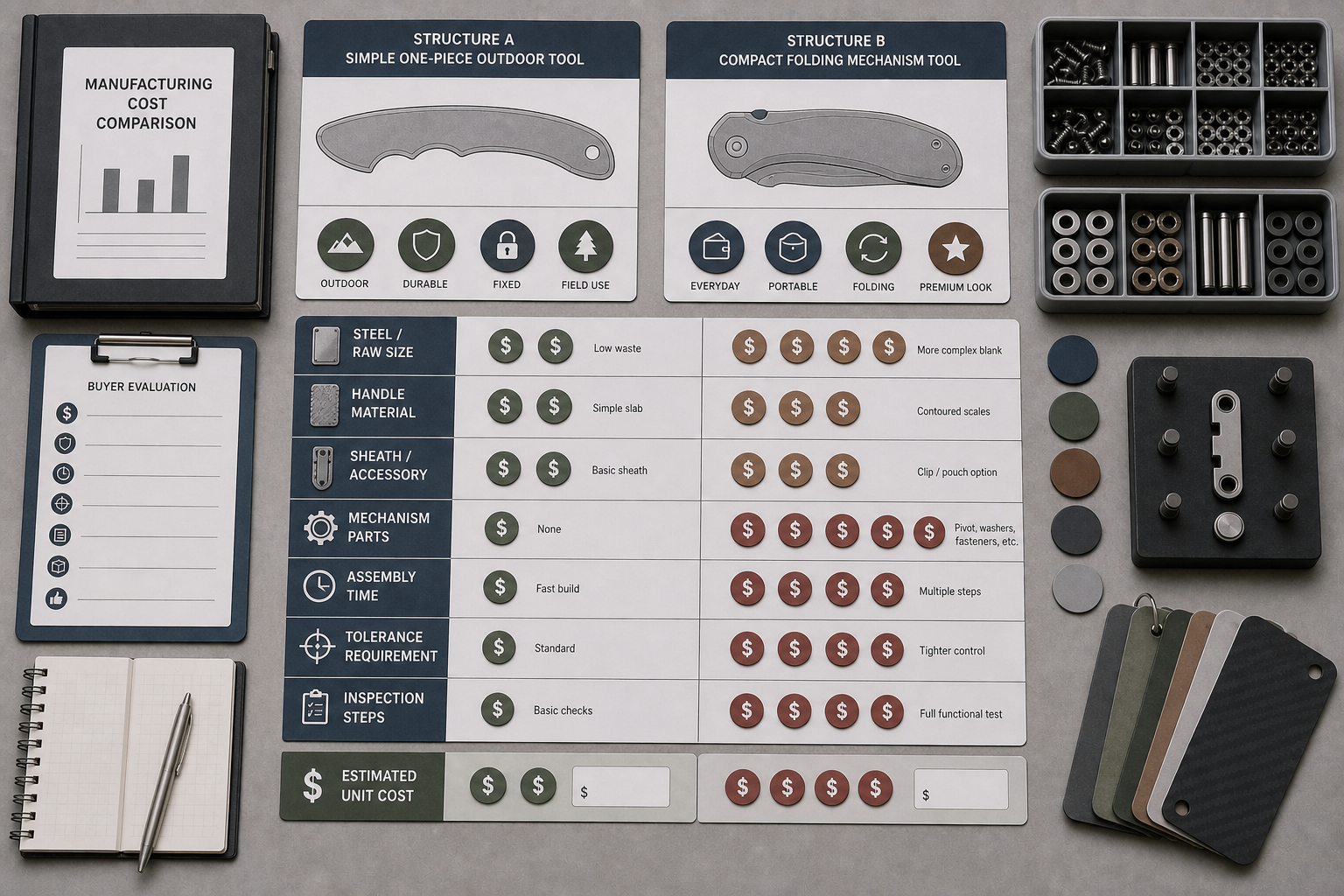
I Compare the Whole Bill of Materials
Many buyers ask which is cheaper. The honest answer is: it depends on the design. A simple fixed blade may cost less than a complex folding knife, but a fixed blade with thick steel, premium handle scales, polished finish, and molded sheath can cost more than a basic liner-lock folder. A folding knife can save package space, but it needs more small parts and assembly control.
For fixed blades, I review steel thickness, blade length, tang style, handle material, fastening method, surface finish, sheath material, sheath retention, belt attachment, and box size. For folding knives, I review blade steel, handle scales, liners, lock type, pivot hardware, washers or bearings, screws, spacer or backspacer, clip, finish, action tuning, and final inspection time.
Sellers should not compare only sample price. They should compare landed value. Package volume affects freight. Sheath defects affect returns. Folding action inconsistency affects reviews. Extra hand tuning affects lead time. If a buyer tells me target price, MOQ, sales channel, and packaging method, I can help find a more realistic product structure.
| Cost driver | Fixed blade impact | Folding knife impact |
|---|---|---|
| Steel | Larger blade and tang can add material | Smaller blade but tighter pivot area |
| Parts | Sheath and handle hardware | Pivot, lock, liners, washers, screws, clip |
| Labor | Grinding, handle fitting, sheath fitting | Assembly, tuning, lock and action checks |
| Packaging | Larger box or sheath display | Smaller box but more mechanism protection |
How Should Sellers Match Steel, Heat Treatment, and Edge Geometry?
The product type does not decide performance alone. Steel, heat treatment, grind, and edge geometry must support the use case.
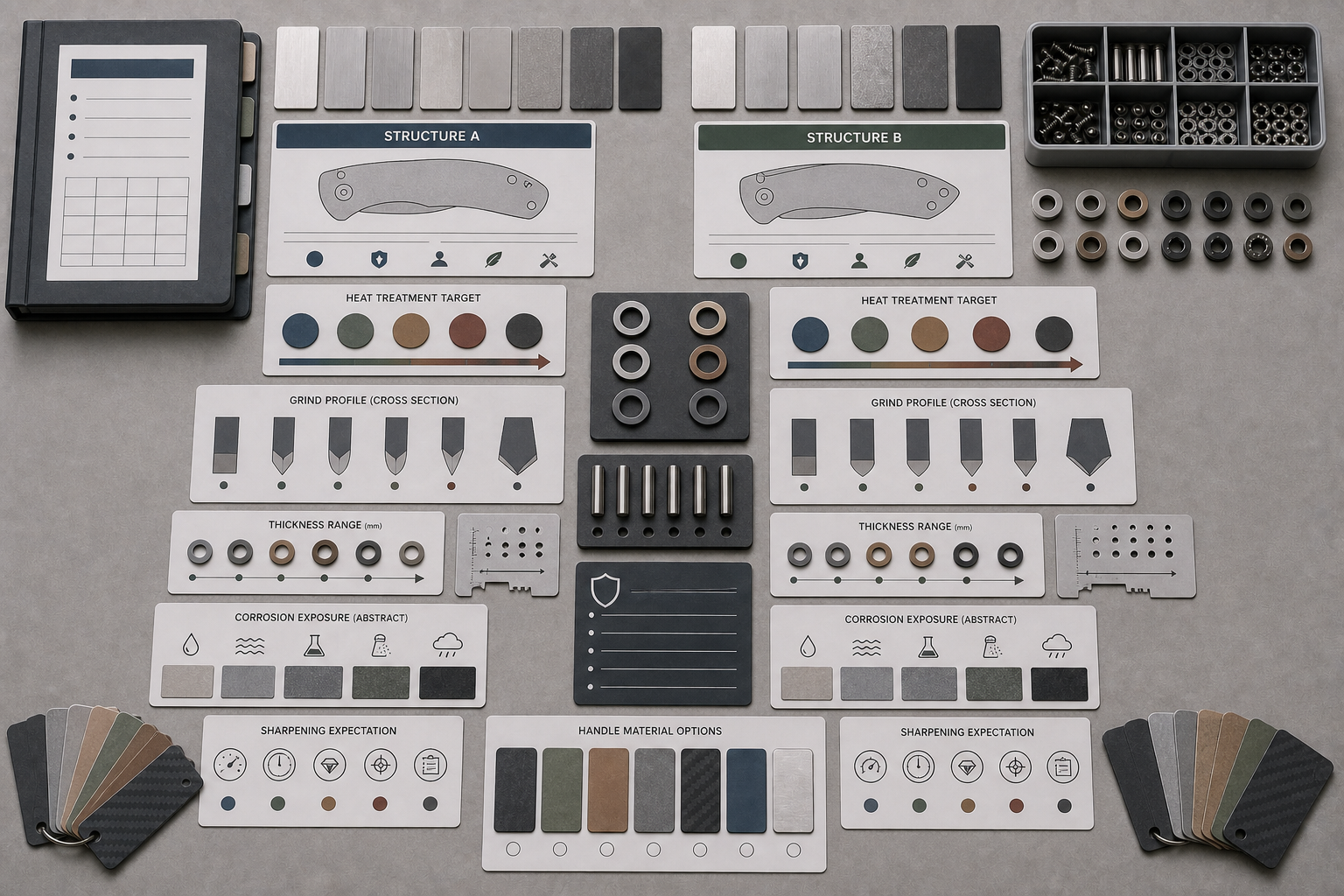
Sellers should match steel, heat treatment, and edge geometry to the knife type, target task, corrosion exposure, sharpening expectation, blade thickness, and product price level.
I Do Not Let the Category Hide the Material Decision
A fixed blade often faces outdoor tasks, larger cuts, and more contact with moisture or dirt. A folding knife often needs a thinner package, smoother action, and a blade geometry that feels useful for daily cutting. Both categories need correct steel and heat treatment. A poor material plan can make either product disappoint the buyer.
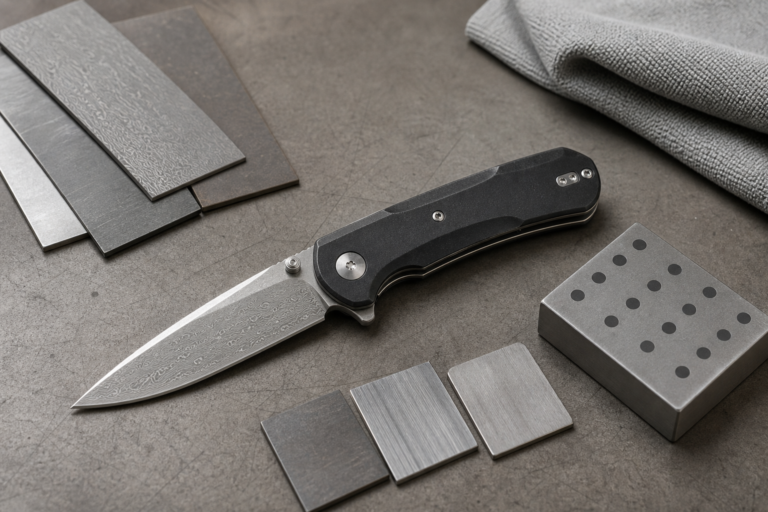
Official steel information helps buyers avoid vague claims. Alleima 14C28N knife steel is described through edge performance, high hardness, corrosion resistance, re-sharpening, and use in pocket knives, hunting knives, fishing knives, and chef knives. I use sources like this to explain tradeoffs. The best steel is not always the most expensive one. It is the steel that matches the product use, target price, and production plan.
Hardness should also be controlled if it is part of the specification. The NIST Rockwell hardness guide explains that good practice helps reduce Rockwell hardness measurement error. For sellers, this means hardness should not be a random number in a catalog. It should be part of the sample and production control plan.
| Product need | Material concern | Practical RFQ note |
|---|---|---|
| Outdoor fixed blade | Toughness and corrosion resistance | Define steel, thickness, hardness range |
| EDC folding knife | Edge stability and re-sharpening | Define steel and edge geometry |
| Budget retail line | Cost and repeatability | Avoid over-specifying materials |
| Higher-positioned line | Finish and performance story | Ask for material data and QC plan |
How Do Packaging and Accessories Change the Seller Decision?
Packaging is not a small detail. It can change cost, freight, shelf value, and customer experience.
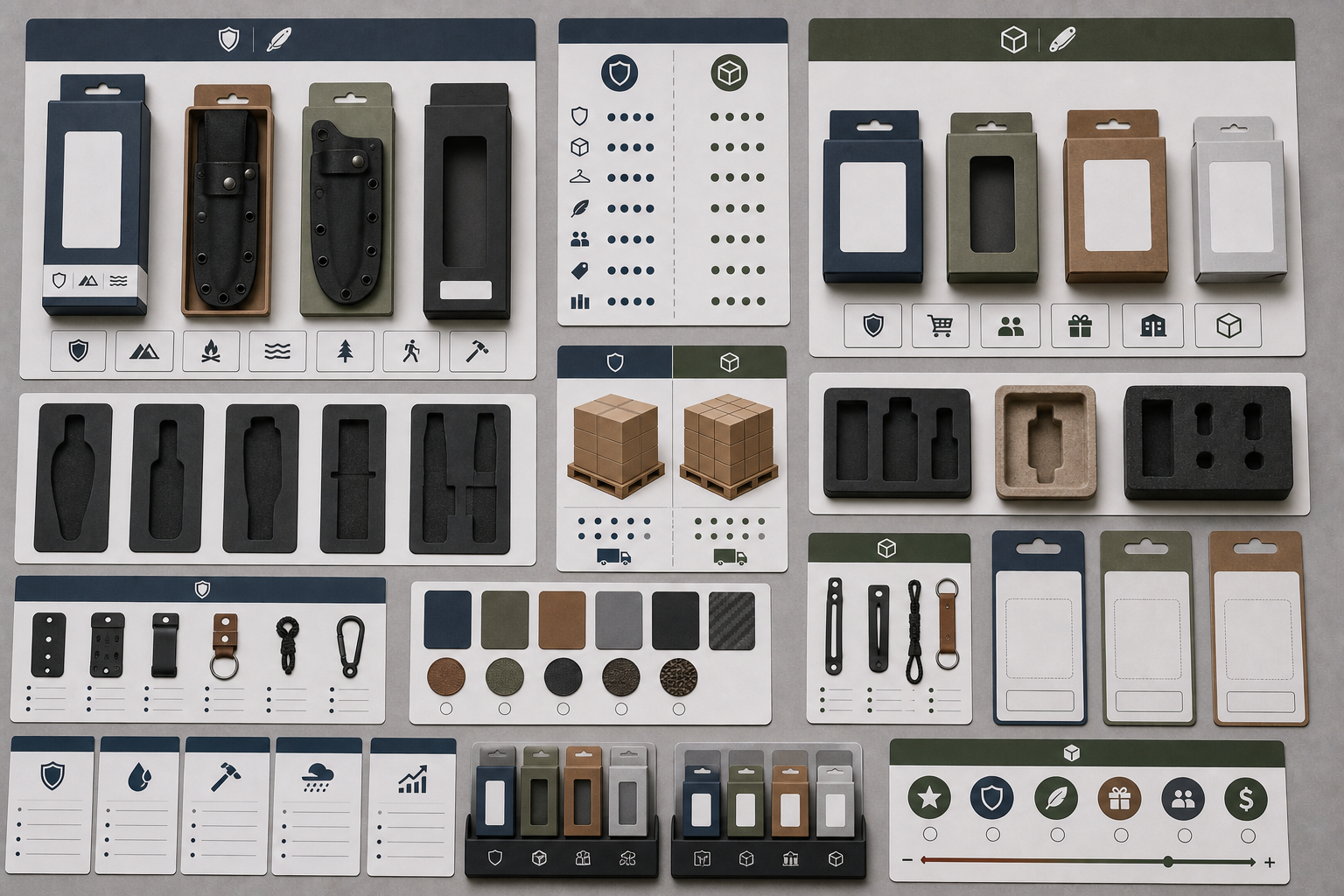
Fixed blades usually need sheath design and larger packaging. Folding knives usually need compact packaging, clip protection, and mechanism protection. Sellers should price packaging before approving samples.
I Treat Accessories as Product Value and Risk
For fixed blades, the sheath is part of the product. A seller can use leather, nylon, Kydex-style plastic, molded plastic, or other materials depending on price and market position. The sheath must hold the knife, protect the edge, feel secure, and match the brand. If the sheath is poor, buyers may blame the whole product, even when the blade is good.
For folding knives, packaging is usually more compact. The seller may use a paper box, gift box, pouch, blister, insert card, or display tray. The packaging should protect the clip, handle finish, edge, and moving parts. The inner tray should not press on the lock or opening area. The box should also support retailer needs such as barcode placement, SKU labels, product warnings, origin marking, and carton data.
Trade terms also matter when sellers compare package volume and delivery responsibility. The ICC explains that Incoterms 2020 are trade terms used in business-to-business contracts for sale and purchase of goods. I do not use Incoterms to choose the knife type, but I do use them to clarify cost responsibility when packaging volume and freight affect the landed cost.
| Packaging factor | Fixed blade | Folding knife |
|---|---|---|
| Main accessory | Sheath | Clip, pouch, small box, insert |
| Freight impact | Often larger package | Usually smaller package |
| Retail display | Strong visual product presence | Compact display and bundle fit |
| QC point | Sheath retention and edge protection | Clip protection and mechanism protection |
What Compliance and Channel Questions Should Sellers Ask?
A product can be manufacturable and still be wrong for a market. Sellers must check rules before production.
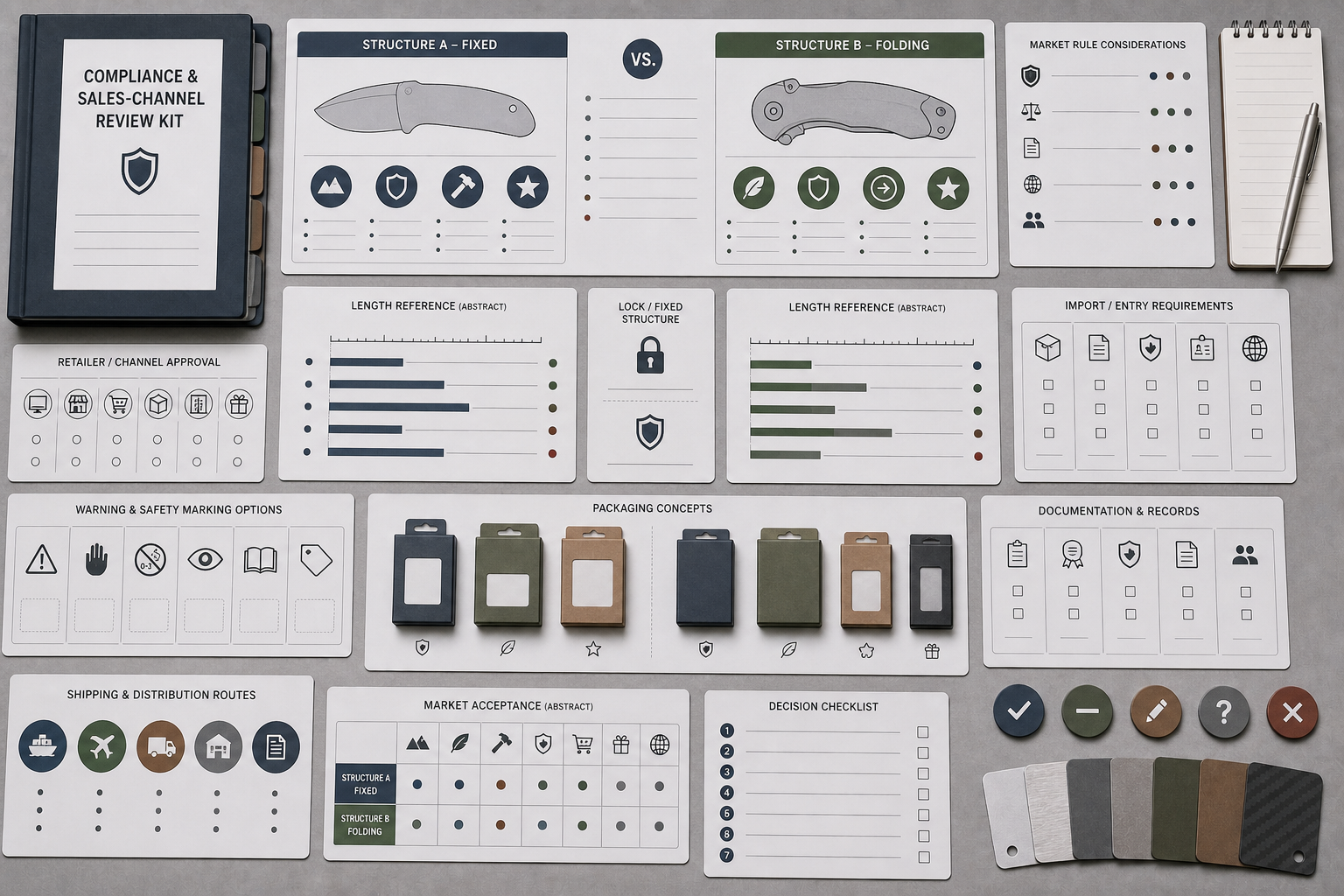
Sellers should ask which markets, retailers, age rules, blade length rules, lock rules, fixed blade rules, packaging warnings, and import requirements apply before choosing fixed blade or folding knife products.
I Put Market Rules Into the Product Brief
Fixed blade vs folding knife is not only a design choice. It is also a market choice. Some retailers may accept folding knives but not fixed blades. Some channels may require age checks. Some markets may treat locking folders differently from non-locking folders. Some importers may need specific documentation. Some online platforms may restrict product wording, images, or categories.
The UK government guidance is a useful reminder. It says most knives cannot be carried in public without a good reason, and it gives an exception for certain folding pocketknives with a cutting edge no longer than 3 inches and no lock. This is UK-specific, but the lesson is broader: sellers should not assume fixed blade, folding, locking, and non-locking products are treated the same in every destination market.
I ask buyers to confirm the legal position with their importer, customs broker, legal adviser, or retailer. As a manufacturer, I can provide product structure, material, packaging, and measurement details. The buyer must confirm whether the product can be sold in the intended channel. This protects both sides before tooling, packaging printing, and production.
| Channel question | Why it matters | Seller action |
|---|---|---|
| Destination market | Rules vary by country and region | Confirm before sampling |
| Retailer category | Some channels limit knife types | Share product structure early |
| Blade length | May affect product description | Define measurement method |
| Lock or sheath | May affect market review | State product structure clearly |
| Warnings | May be required by channel | Prepare packaging fields early |
What QC Checks Should Sellers Require for Each Knife Type?
A good sample does not guarantee repeat orders. Sellers need inspection points that match the product structure.
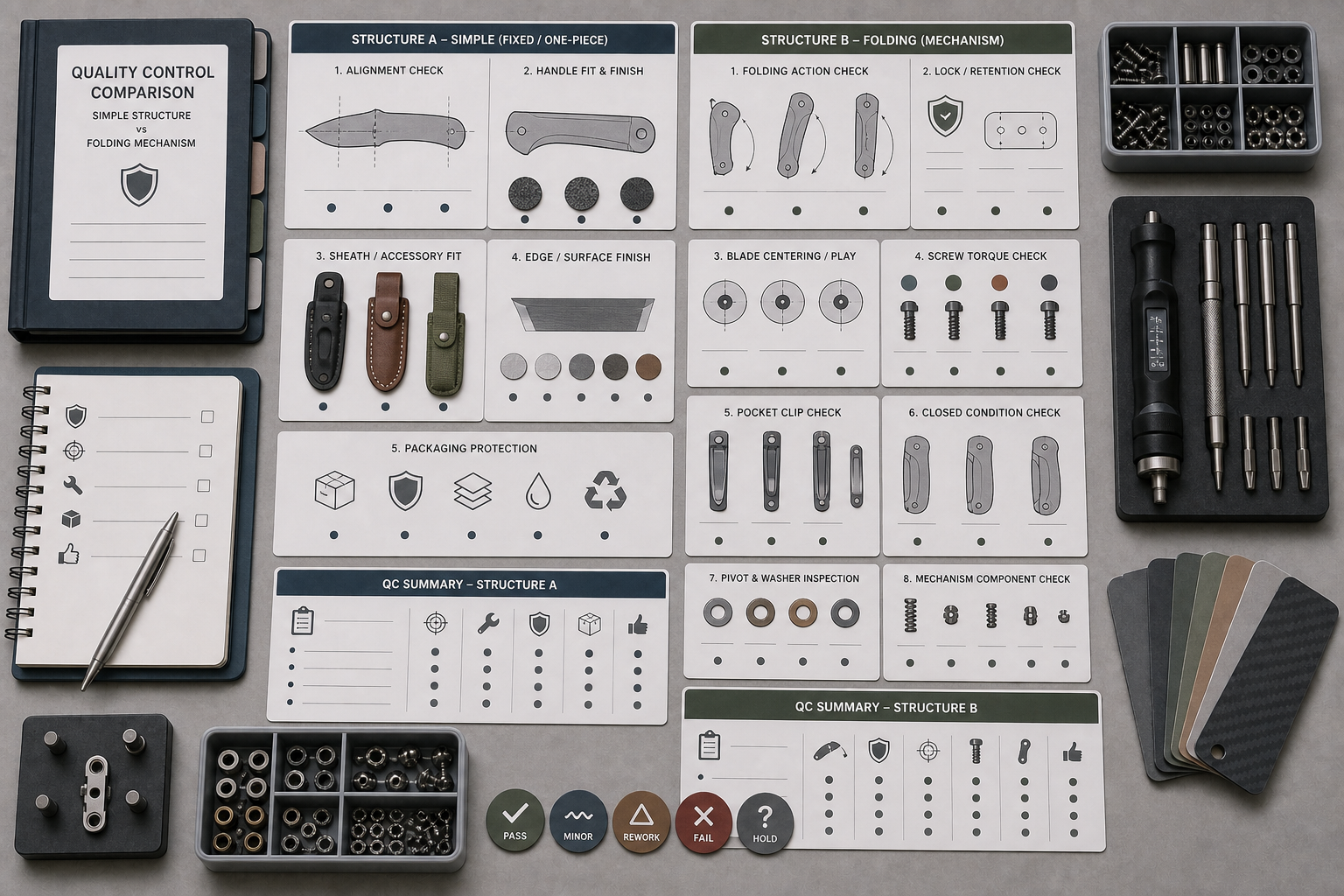
Fixed blade QC should check blade, handle, sheath, edge, finish, and packaging. Folding knife QC should also check action, lock, blade centering, blade play, screw torque, clip, and closed condition.
I Build QC Around the Real Failure Points
For fixed blades, I focus on blade profile, thickness, grind symmetry, edge, hardness when specified, handle fit, handle fasteners, surface finish, sheath retention, sheath edge protection, and packaging. The sheath should not scratch the blade badly or leave the edge exposed. The handle should not have gaps that make the product feel weak. The edge should match the approved sample.
For folding knives, I add more functional checks. The blade should open and close correctly. The lock or slip joint should match the design. The blade should be centered enough for the product level. There should be no unacceptable blade play. The pivot tension should feel consistent. The screws should be secure. The clip should sit properly. The finish should not interfere with the moving parts.
The ISO 9001 supply chain guidance supports a useful principle here: buyers should make requirements, approvals, monitoring, and inspections clear to the supplier. I see this every day. If the buyer does not define the inspection target, the factory has to guess.
| QC area | Fixed blade check | Folding knife check |
|---|---|---|
| Blade | Profile, grind, edge, finish | Profile, grind, edge, centering |
| Structure | Tang and handle fit | Pivot, lock, liners, screws |
| Accessory | Sheath retention and protection | Clip, pouch, package fit |
| Function | Handle comfort and edge readiness | Action, lock, blade play |
| Batch control | Same finish and sheath fit | Same action and screw tension |
What Should Sellers Include in a Fixed Blade vs Folding Knife RFQ?
A vague RFQ creates vague samples. A clear RFQ lets the factory recommend the right structure before money is wasted.
Sellers should include target market, user task, knife type, blade length, blade steel, handle material, lock or sheath requirement, finish, packaging, MOQ, target price, compliance market, and inspection needs.
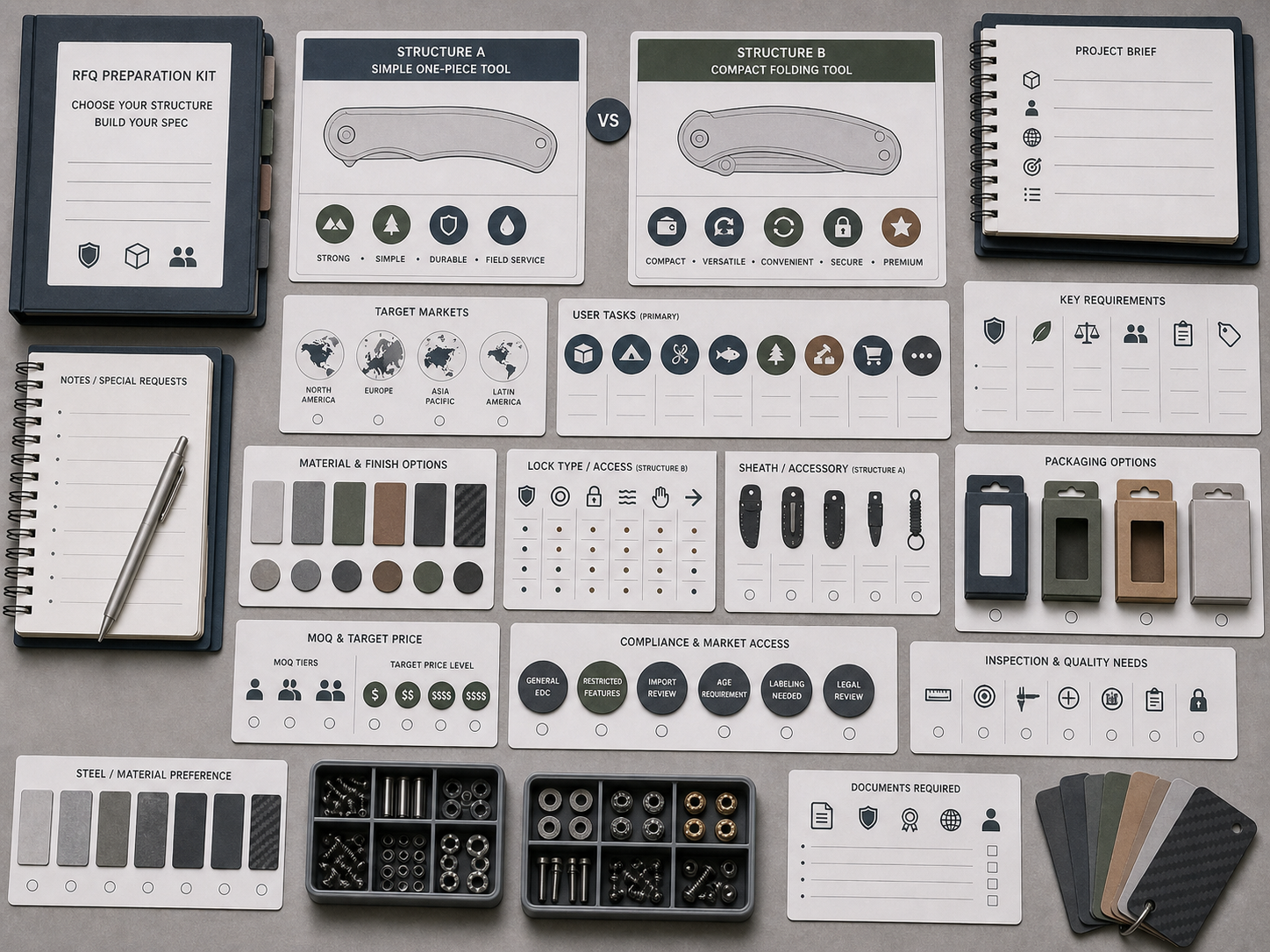
I Ask Sellers to Brief the Product Line
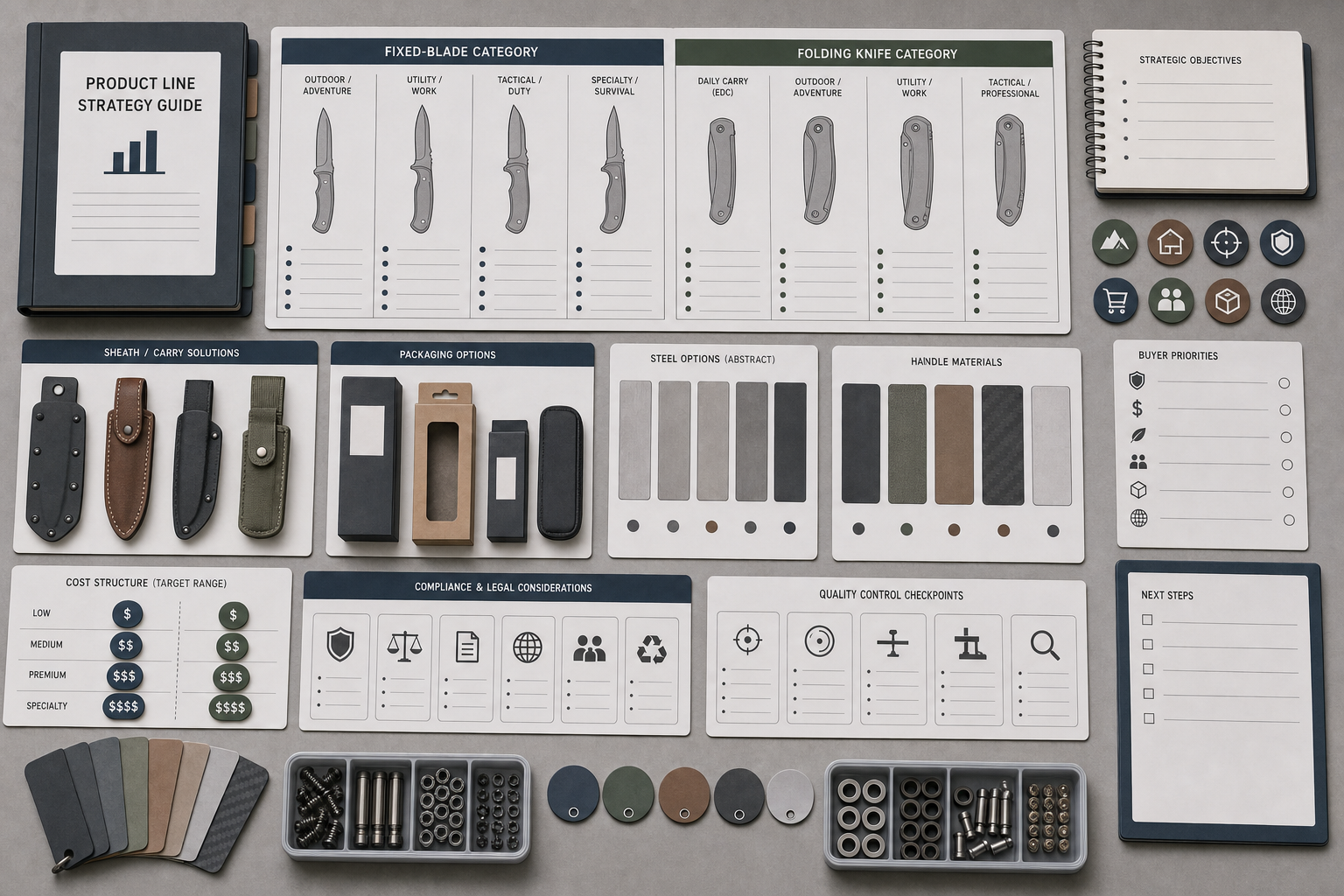
The best RFQ does not only ask "fixed blade or folding knife?" It explains the product line. I want to know whether the seller is building an outdoor camping series, a compact EDC line, a wholesale gift set, a rescue-style program, or a private label retail item. Each direction changes the structure.
For a fixed blade RFQ, the buyer should include blade length, blade thickness, tang style, steel, hardness range if needed, grind, handle material, sheath type, sheath attachment, finish, packaging, and inspection needs. For a folding knife RFQ, the buyer should include blade length, steel, handle material, lock type, pivot system, clip, finish, opening method, closed length, packaging, and functional inspection points.
At Vast State, I use this information to give practical suggestions. Sometimes I recommend fixed blade because the user task and outdoor story are stronger. Sometimes I recommend folding because the seller needs compact packaging and broader retail acceptance. Sometimes I recommend both as a series, with a fixed blade for outdoor kits and a folding knife for EDC add-on sales. The right answer depends on the buyer's market.
| RFQ field | Fixed blade version | Folding knife version |
|---|---|---|
| Product use | Camping, outdoor, field utility | EDC, retail, pocket tool |
| Structure | Tang, handle, sheath | Pivot, lock, liners, clip |
| Material | Steel, handle, sheath | Steel, handle, hardware |
| Packaging | Sheath and larger box | Compact box, pouch, clip protection |
| QC | Blade, handle, sheath, edge | Action, lock, centering, blade play |
Turn this article into a folding knife project.
Share your blade type, lock direction, steel preference, handle material, quantity, target market, and packaging needs. Vast State can prepare OEM/ODM options.
Conclusion
I choose fixed blade or folding knife projects by matching user need, structure, cost, packaging, compliance, QC, and seller positioning.
Source Notes
- AKTI approved knife definitions supports careful use of knife terminology and structure-based product language.
- GOV.UK knife guidance provides market-specific context for folding pocketknife, lock, blade length, and sales rule review.
- Alleima 14C28N knife steel supports the steel tradeoff discussion around edge performance, hardness, corrosion resistance, and knife applications.
- NIST Rockwell hardness guide supports the need for good hardness measurement practice when hardness is specified.
- ISO 9001 in the supply chain supports clear purchasing information, requirements, approvals, monitoring, and inspection expectations.
- Incoterms 2020 provides trade-term context when packaging volume and delivery responsibility affect landed cost.