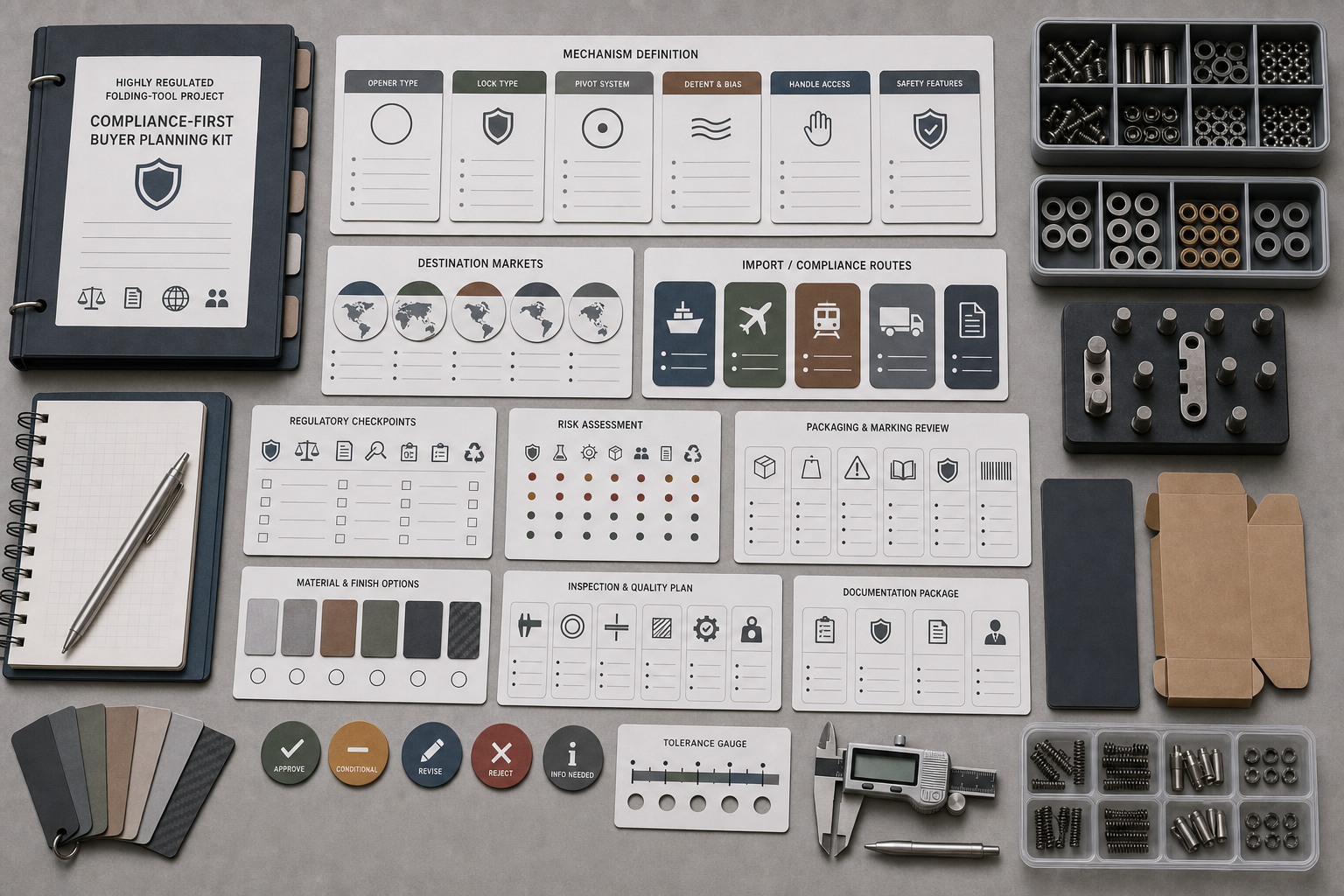
A switchblade idea can look commercially exciting. But one unclear mechanism detail can create legal, import, production, and retail problems.
B2B buyers should evaluate switchblade knife projects by checking the exact opening mechanism, destination-market law, import rules, blade length, release control, spring system, lock reliability, packaging claims, and inspection plan before requesting OEM samples. This article is practical sourcing guidance, not legal advice.
Quick buyer brief:
- Answer: Review law, mechanism, import route, QC, and sales wording before developing switchblade knives.
- Buyer context: This helps knife brands, importers, wholesalers, distributors, and private label buyers avoid risky automatic-knife RFQs.
- Key checks: Button or release control, blade path, spring system, lock engagement, closed retention, blade length, sales market, import route, packaging claim, and legal review.
Planning a private-label knife line for this market?
Use this article as an early planning reference, then prepare your target market, product category, labeling needs, and buyer-specified compliance requirements before production.
When a buyer asks about a switchblade knife project, I slow the conversation down. I do not start with the catalog shape or the target price. I first ask where the product will be sold, how the blade opens, what part releases the blade, what the package will say, and whether the buyer has already checked local rules with the importer or legal adviser. A switchblade knife is not only a product style. It is a sourcing risk category, especially for international B2B buyers.
What Does Switchblade Knife Mean in Product Development?
Switchblade wording is often used loosely. Loose wording creates wrong samples, wrong quotations, and risky sales claims.
In product development, a switchblade knife usually means a folding knife whose blade opens automatically after a release control, spring system, gravity, inertia, or similar mechanism acts on the blade. Buyers must define the mechanism exactly.
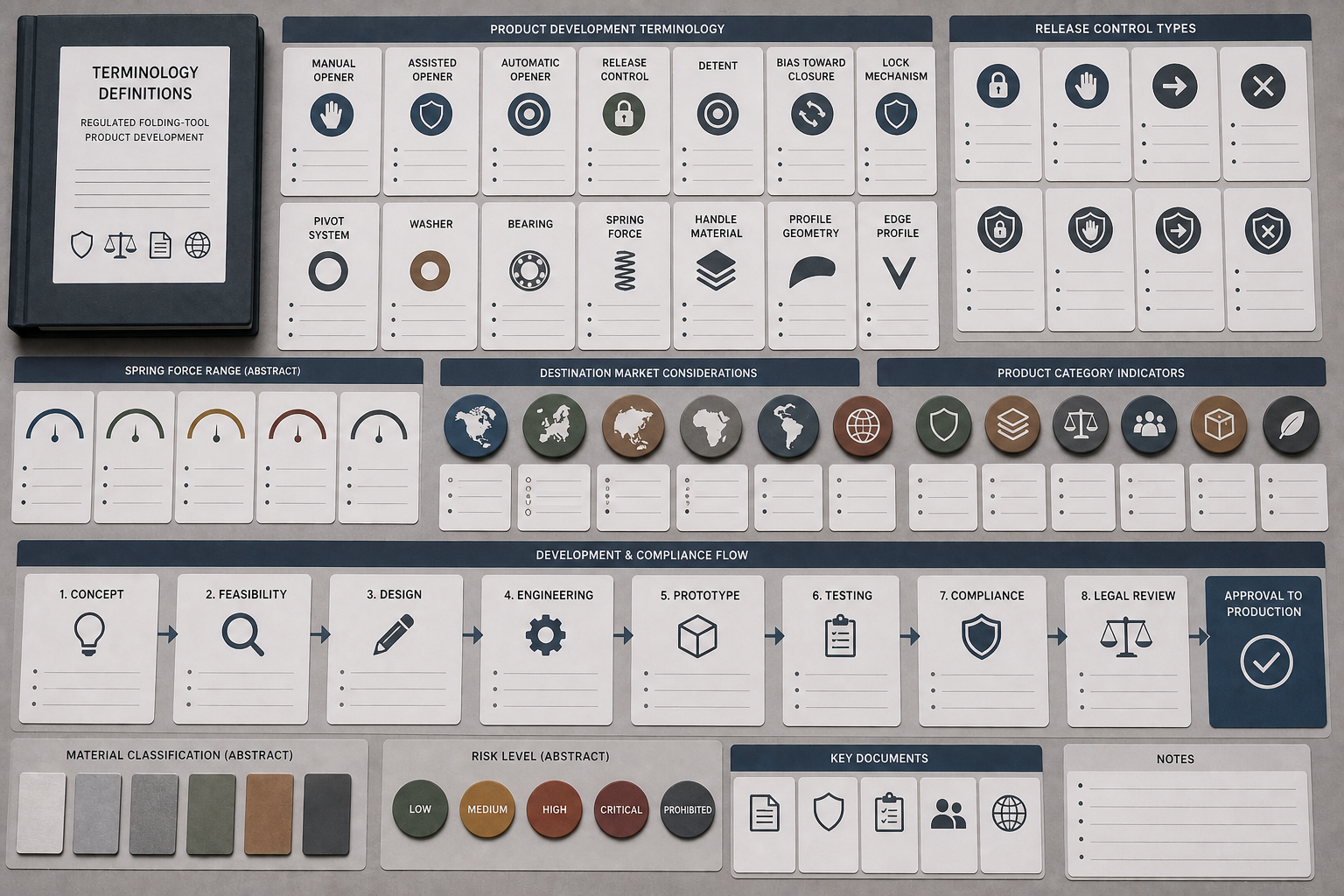
I Define the Mechanism Before I Define the Style
Many buyers use switchblade, automatic knife, flick knife, and push-button knife as if they mean the same thing. In sourcing, that is dangerous. A supplier needs to know whether the buyer means a side-opening automatic folder, an out-the-front automatic mechanism, a gravity-related design, a button-release knife, or a different assisted or manual structure. These are not small naming differences. They affect legality, engineering, spring selection, lock design, assembly time, inspection, packaging, and sales channel acceptance.
The official U.S. Code definition in 15 USC Chapter 29 defines a switchblade knife by automatic opening through a button or device in the handle, or by inertia, gravity, or both. That is a legal definition for a specific federal context. It should not be treated as the only rule that matters worldwide. The buyer still needs destination-market review.
For OEM work, I ask for a mechanism description, not only a product name. I want to know the release control, blade path, spring type, lock type, blade length, handle thickness, close retention, and target market. A switchblade project without these details is not ready for sampling.
| Term buyers use | What I need to clarify | Why it matters |
|---|---|---|
| Switchblade | Opening source and release control | Affects legal and engineering review |
| Automatic knife | Side-opening, OTF, or other structure | Affects parts, assembly, and QC |
| Button knife | Button location and function | Affects classification and tooling |
| Flick knife | Market-specific wording | Affects UK and packaging review |
Private-label Planning Checklist
Before starting production, prepare the market and product details your importer or compliance advisor needs to review.
| RFQ Field | What to Prepare |
|---|---|
| Target market | Country, state, region, or sales channel |
| Product category | Folding knife / fixed blade / multi-tool / outdoor tool |
| Intended use | EDC / camping / kitchen / hunting / rescue / promotional |
| Buyer requirements | Testing, labeling, documentation, or packaging rules |
| Blade and lock details | Blade length, opening method, lock type, edge style |
| Packaging text | Warnings, claims, care notes, language requirements |
| Documents | Drawing, sample photo, logo file, packaging artwork |
| Review owner | Importer, legal advisor, testing lab, or internal compliance team |
Why Should Buyers Check Laws Before Requesting Samples?
A sample can be easy to make but hard to import or sell. Late legal review wastes time and money.
Buyers should check laws before samples because switchblade rules may affect design, import, sale, possession, marketing language, packaging, retailer approval, and shipment route in each destination market.
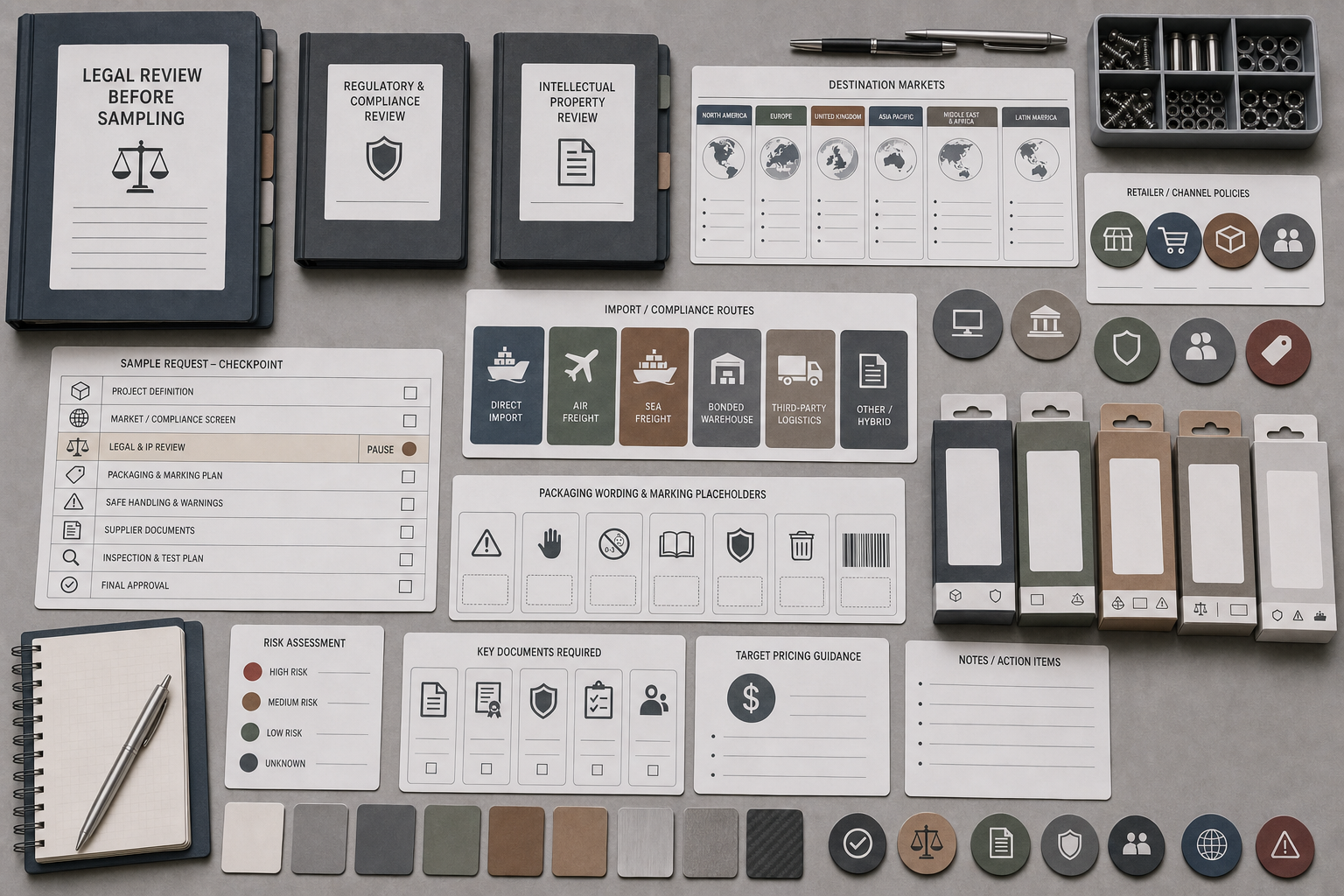
I Put Market Review Before Engineering Approval
For many knife projects, I can begin with function, material, target price, and appearance. For switchblade projects, I must add legal review at the start. A buyer may have a strong sales idea for one market, but the same design can face restrictions in another market. A product name that sounds normal in one country can be a warning sign in another. A button location or opening path that looks like a small detail can change the review.
This is why I ask buyers to confirm the sales country, state or region, importer, channel, customer type, and retailer rules before sampling. I also ask whether the buyer wants a true automatic mechanism or whether a manual folding knife can meet the market need with less risk. Many B2B buyers care about product quality, MOQ, price, and lead time. For switchblade products, they must also care about whether the product can enter the market and whether the sales claim is accurate.
I do not provide legal advice. I provide manufacturing and RFQ guidance. The importer, customs broker, legal adviser, and retailer should confirm the final position. That check should happen before drawings, tooling, packaging, and batch production.
| Review point | Buyer should confirm | Supplier should support |
|---|---|---|
| Sales market | Country, state, retailer, channel | Mechanism and product details |
| Legal definition | Local automatic knife rule | Clear technical description |
| Import route | Whether entry is allowed | Accurate invoice and packing data |
| Packaging claim | Product wording and warnings | Artwork file and label support |
How Do U.S. Federal Rules Affect Switchblade Knife Projects?
Some buyers only check state retail demand. Federal law and customs rules can still affect import and distribution.
U.S. federal rules define switchblade knives and restrict certain interstate and import activity, with specific exceptions. Buyers should not assume a switchblade project is safe because a catalog listing exists.
I Treat U.S. Projects as Import-Sensitive
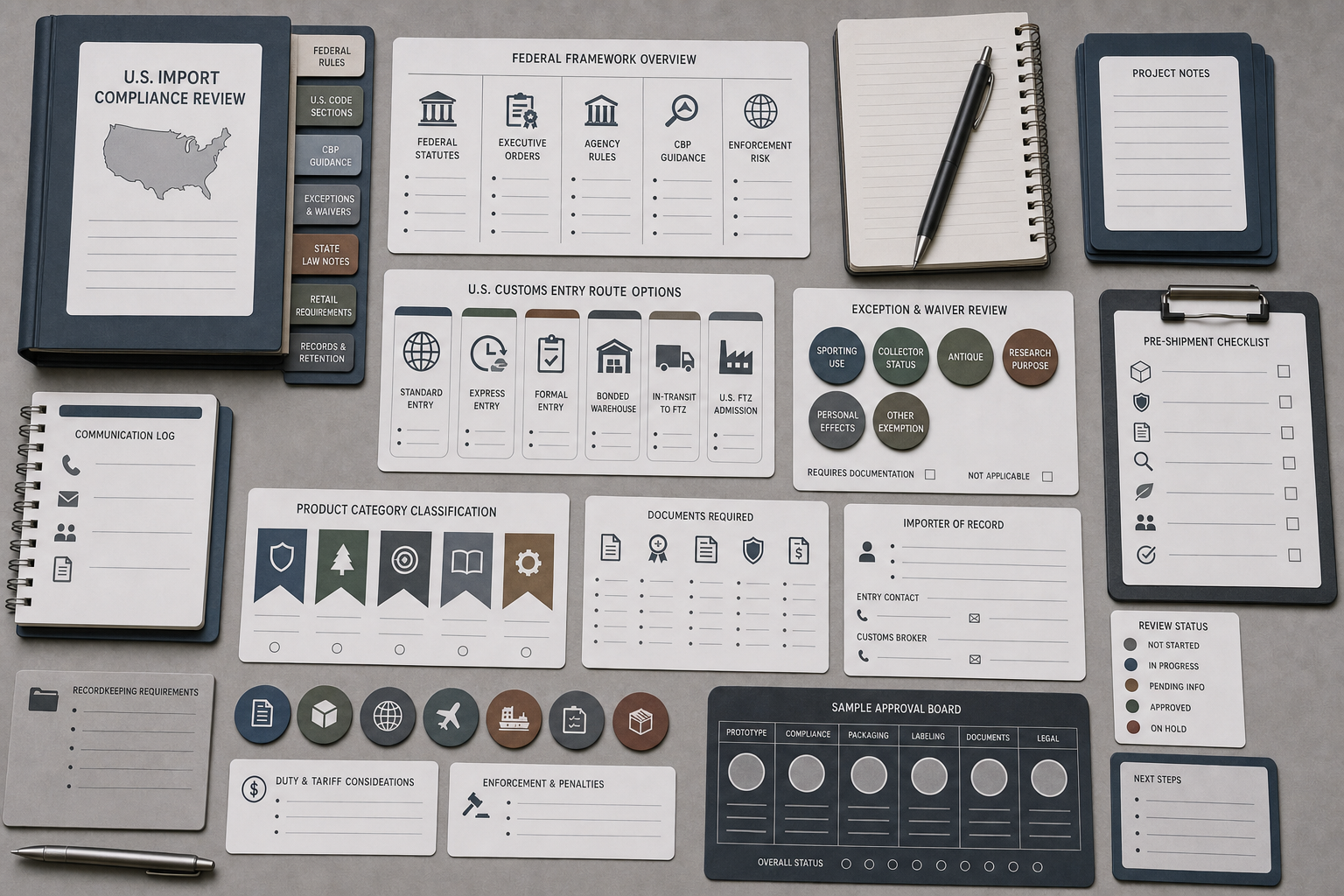
The U.S. federal framework matters because many international buyers sell into the United States or ship through U.S. channels. The current House-hosted 15 USC Chapter 29 includes a definition of switchblade knife and sections covering introduction, manufacture for introduction, transportation, and distribution in interstate commerce. It also lists exceptions in section 1244.
Customs rules matter too. The govinfo PDF for 19 CFR 12.97 and 12.98 states that switchblade knife importations, except as permitted by 15 USC 1244, are contrary to law and subject to forfeiture. It also lists permitted exception scenarios. This is why I do not treat U.S. switchblade projects as ordinary folding knife projects.
For a B2B buyer, the practical action is clear. Before asking a China OEM/ODM factory for samples, confirm whether the product can be imported, who the importer is, which exception if any is claimed, and what documents are needed. If the answer is unclear, pause the automatic mechanism and consider a lower-risk manual design.
| U.S. item | What it affects | Buyer action |
|---|---|---|
| Definition | Whether the product may be treated as switchblade | Define release control and opening path |
| Interstate commerce | Distribution and movement risk | Get legal and importer review |
| Import rule | Entry and forfeiture risk | Confirm admissibility before shipment |
| Exceptions | Narrow allowed scenarios | Do not assume an exception applies |
What Do UK and Canada Rules Show About Market Differences?
One market may use one term. Another market may use another. The product can still face similar risk.
UK and Canada sources show that switchblade, automatic knife, flick knife, gravity-related, and similar mechanisms can be treated differently across markets. B2B buyers must review each destination separately.
I Do Not Export One Assumption to Every Country
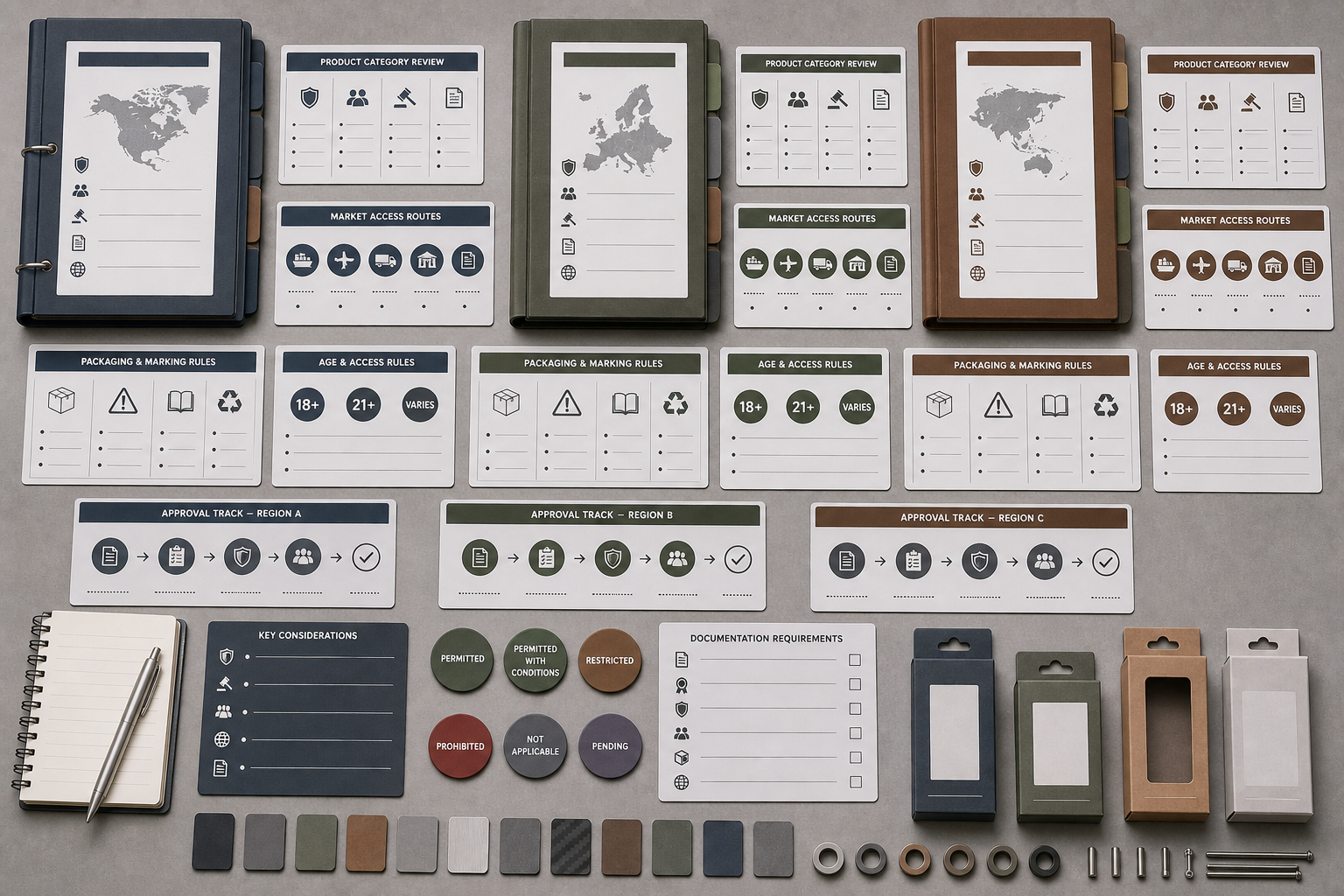
The UK government page on selling, buying and carrying knives lists a flick knife, gravity knife, switchblade, or automatic knife among banned knives and describes it as a knife where the blade opens automatically or is released from the handle by gravity or by pressing a button or something else on the knife. That is a strong warning for buyers who sell into the UK or use UK-oriented packaging language.
Canada is another useful example. The CBSA memorandum D19-13-2 discusses prohibited goods under Canadian import controls and references Criminal Code language for knives that open automatically by gravity, centrifugal force, or hand pressure applied to a button, spring, or other device in or attached to the handle. It also gives import classification guidance for automatic, centrifugal, and gravity-related knives.
These sources do not mean every country has the same rules. They show the opposite. Buyers need a country-by-country review. A design that is not suitable for one market may need a manual-opening alternative, a different product name, or a completely different project direction.
| Market example | Source signal | Buyer takeaway |
|---|---|---|
| UK | Government page lists flick, gravity, switchblade, and automatic knife category | Review UK sale, import, and product language carefully |
| Canada | CBSA guidance discusses automatic and related mechanisms under prohibited goods review | Check import classification before shipment |
| United States | Federal law and customs rules create specific restrictions and exceptions | Confirm importer and admissibility early |
| Other markets | Rules may differ by country or region | Do not reuse one legal answer worldwide |
Which Mechanical Details Should a Switchblade RFQ Define?
An automatic mechanism cannot be quoted well from a product name. The supplier needs real engineering details.
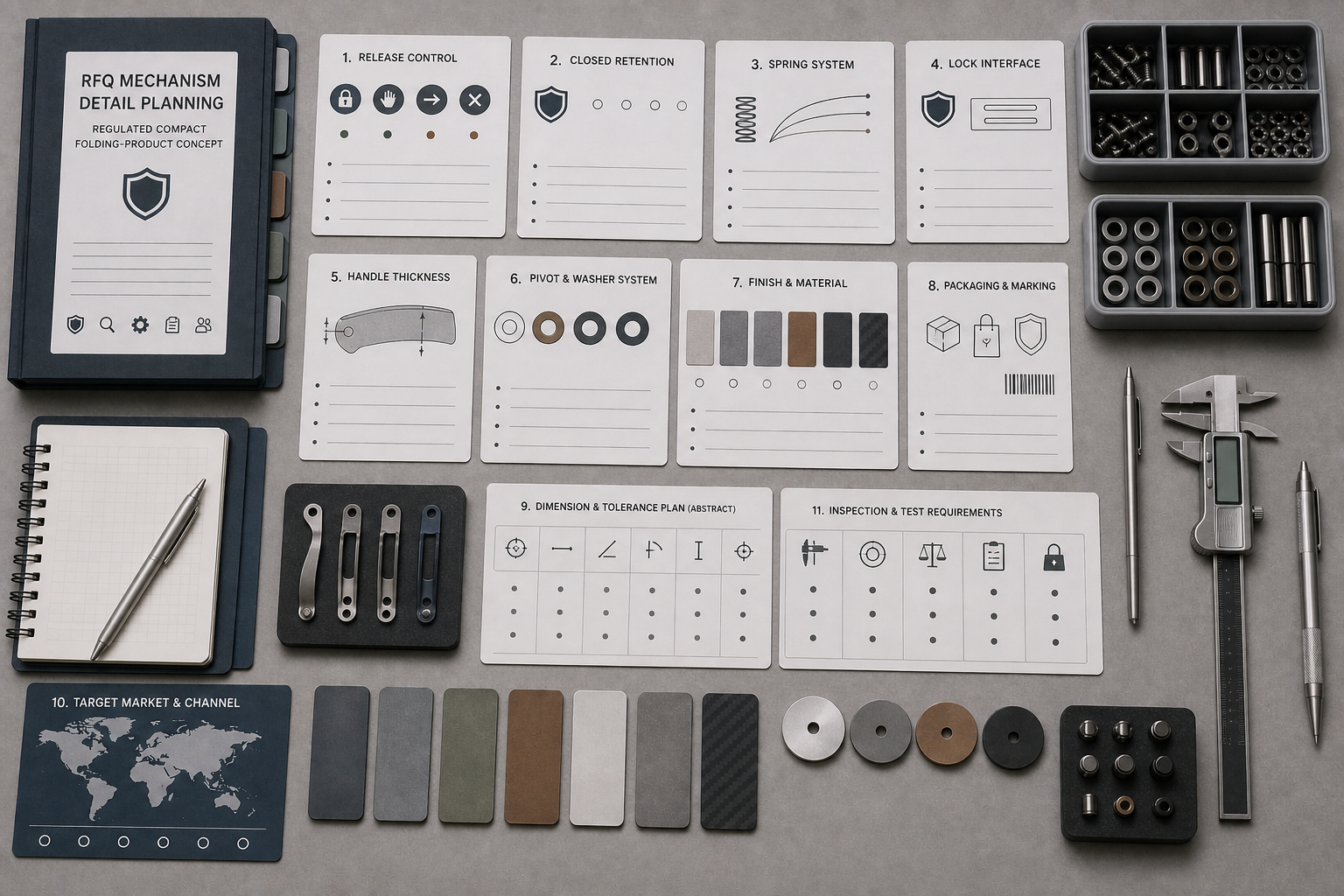
A switchblade RFQ should define release control, spring system, blade path, lock type, blade length, handle thickness, open and closed retention, safety feature if any, steel, finish, packaging, and target market.
I Ask for the Product Structure, Not a Nickname
For a normal manual folder, the buyer can sometimes start with blade shape, steel, handle material, and lock type. For a switchblade project, the RFQ must go deeper. The factory needs to know how the blade is released, where the button or control sits, how the spring is loaded, how the blade is retained when closed, how the lock engages when open, how the user closes the blade, and how the structure avoids accidental release during packaging and transport. This is product engineering, not only styling.
The buyer should also define whether the product is side-opening or out-the-front. These structures use different parts, tolerances, assembly methods, testing points, and cost logic. The blade length and handle size matter because they affect spring force, blade mass, and lock engagement. The finish matters because coating thickness can affect moving parts. The packaging matters because automatic products may need more careful restraint during shipment.
If a buyer does not have drawings, I ask for reference photos, target dimensions, target market, and function priorities. If the buyer has drawings, I ask for 2D and 3D files plus the expected tolerance level. A clear RFQ saves sample rounds.
| RFQ detail | Why it matters | Supplier response needed |
|---|---|---|
| Release control | Affects classification and structure | Confirm location and function |
| Spring system | Affects reliability and assembly | Suggest feasible design |
| Blade path | Affects handle and lock design | Review side-opening or OTF feasibility |
| Closed retention | Affects transport and user trust | Define test method |
| Lock engagement | Affects function and safety perception | Define inspection standard |
What Manufacturing and QC Risks Come With Switchblade Mechanisms?
A switchblade sample can feel good once. Production must repeat the same action hundreds or thousands of times.
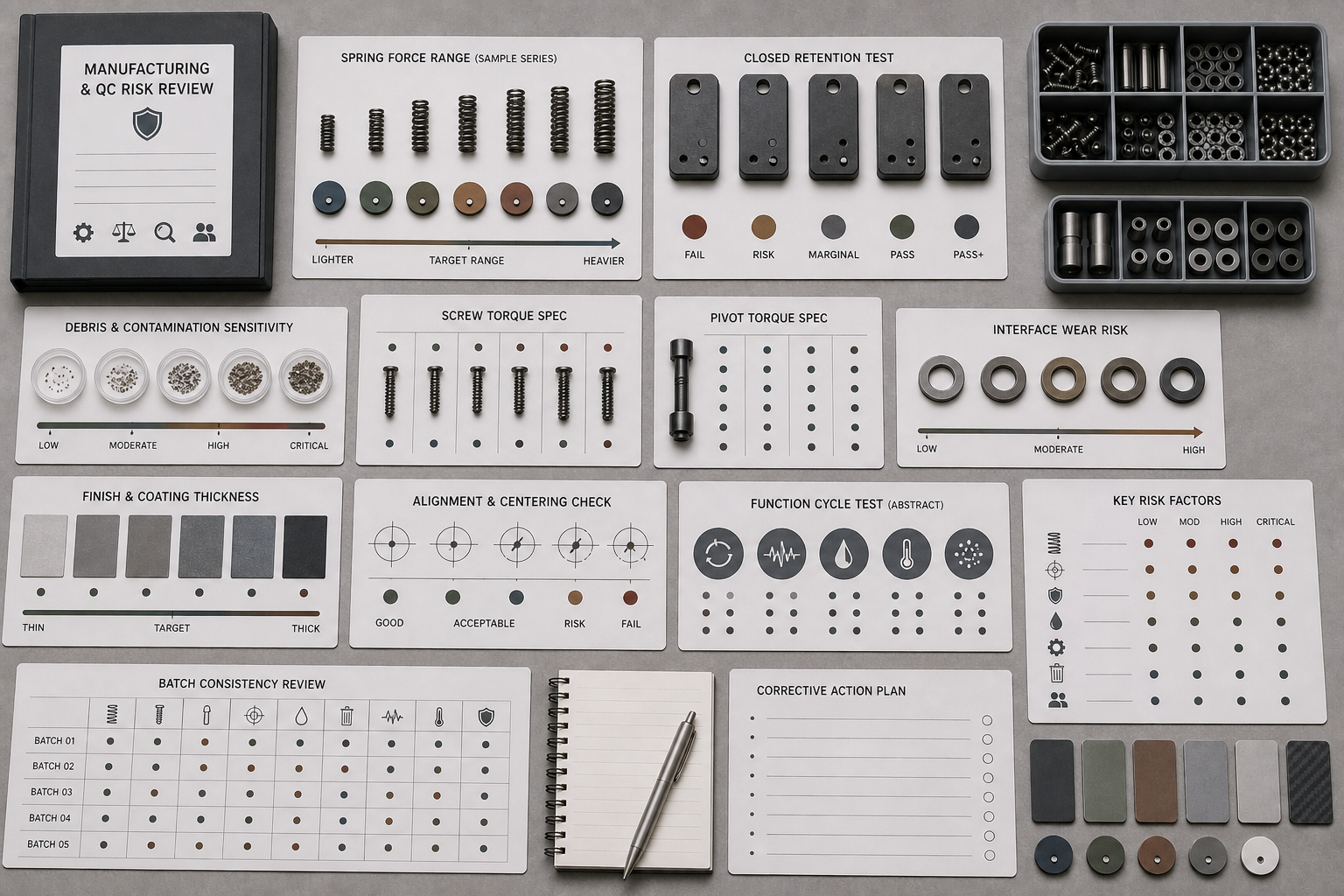
Switchblade mechanisms create manufacturing and QC risks around spring force, button fit, blade travel, lock engagement, closed retention, screw torque, debris sensitivity, finish thickness, assembly skill, and batch consistency.
I Separate Prototype Feel From Batch Control
A switchblade project can fail even when the first prototype feels impressive. The mechanism has many small relationships. The button must fit cleanly. The spring must provide enough force without creating harsh action. The pivot must move smoothly. The lock must engage in a stable way. The blade must remain secure when closed. The handle must protect the mechanism from debris. The finish should not add thickness that blocks movement. The screws must hold without over-tightening the action.
This is why I want inspection points before production starts. The buyer and supplier should agree on opening reliability checks, closed retention checks, lock engagement checks, blade play limits, blade centering, button feel, screw torque, surface finish, edge sharpness, and packaging protection. If hardness is specified, the method and range should be clear. The NIST Rockwell hardness guide is useful because it explains why good measurement practice matters for hardness testing.
Quality management also matters. The ISO 9001 supply chain guidance supports the idea that buyers should clearly define requirements, drawings, approvals, monitoring, and inspection needs. That is exactly how I prefer to manage switchblade projects.
| QC area | What to check | Why it matters |
|---|---|---|
| Spring force | Consistent action across samples | Reduces batch variation |
| Button fit | Smooth release and return | Improves product feel |
| Lock engagement | Stable open position | Protects user trust |
| Closed retention | Blade stays secure when packed | Reduces transport risk |
| Screw torque | Correct tension without binding | Supports repeat assembly |
How Should Packaging, Labels, and Sales Claims Be Controlled?
Packaging can make the risk worse. The wrong words can create problems even if the sample looks acceptable.
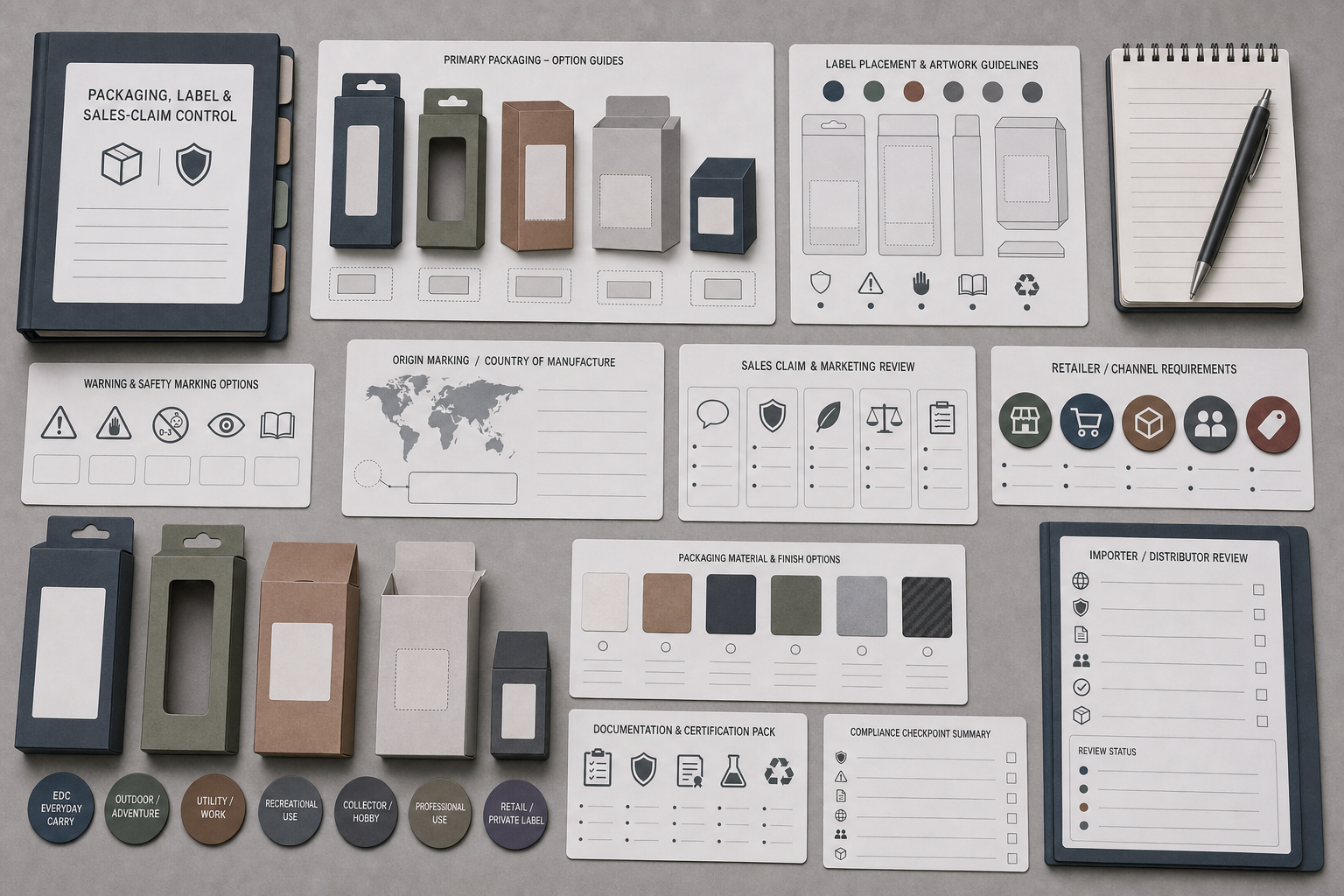
Packaging and sales claims should be controlled by destination market, product category, mechanism description, age-related rules, origin marking, warning language, retailer requirements, and importer review.
I Treat Packaging as Part of Compliance
Private label buyers sometimes think packaging is only a branding task. For switchblade projects, packaging is also a risk-control task. The product name, mechanism wording, blade length, country-of-origin marking, warnings, barcode fields, instruction sheet, carton labels, and retailer requirements should all be reviewed before mass printing. The supplier can help prepare packaging files and physical samples, but the buyer must confirm the legal and retail wording for the destination market.
I prefer plain product language. If a buyer is selling a manual knife, the package should not imply an automatic mechanism. If a buyer is selling an automatic product in a market where that category is restricted, the buyer should stop and review the project before production. If a buyer needs age-related language, origin marking, material claims, or retailer warnings, those items should be in the RFQ.
Packaging also affects physical safety perception during shipment. A switchblade knife should be packed so the blade stays closed and the mechanism is not pressed by the inner tray, foam, sleeve, or carton pressure. A nice box that activates pressure on the release control is a bad box.
| Packaging item | What to control | Why it matters |
|---|---|---|
| Product name | Accurate mechanism wording | Reduces claim risk |
| Blade length | Consistent with measurement method | Supports product description |
| Warnings | Market and retailer needs | Supports responsible sale |
| Inner tray | Prevents pressure on release control | Protects transport condition |
| Carton label | SKU, quantity, origin, shipment data | Supports receiving and customs workflow |
What Should Buyers Include in a Switchblade Knife RFQ?
A vague switchblade RFQ creates slow replies and risky assumptions. A clear RFQ protects both buyer and supplier.
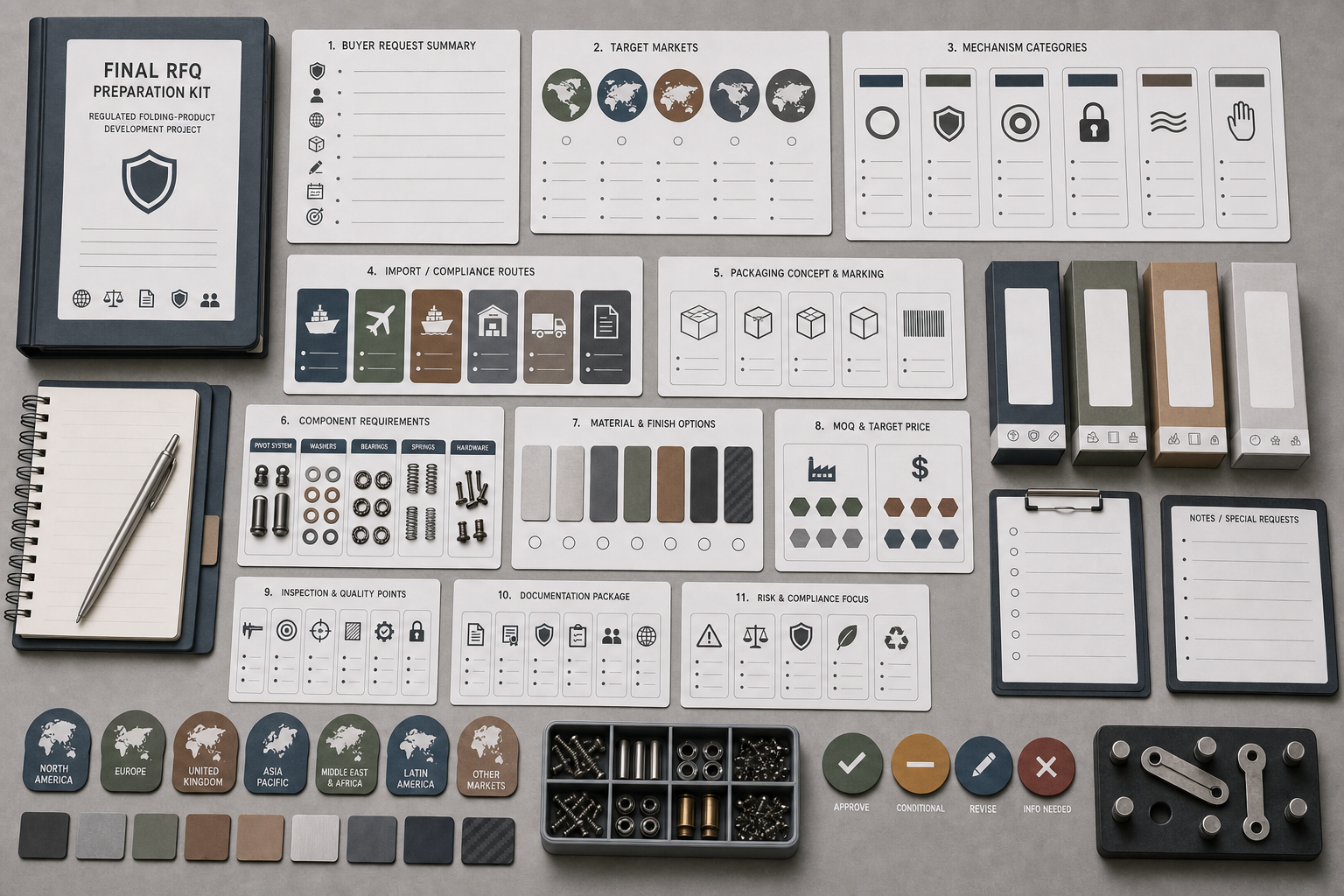
Buyers should include target market, legal review status, mechanism type, release control, blade length, steel, handle material, lock system, finish, packaging, MOQ, target price, inspection points, and import requirements.
I Want the RFQ to Prove the Project Is Ready
A strong switchblade RFQ should not begin with "send price for switchblade." It should explain the product and the market. The buyer should state the destination country, intended sales channel, importer, legal review status, mechanism type, blade length, steel, handle material, lock system, finish, quantity, target price, packaging, and inspection needs. If the product is for a market where switchblade products are restricted, the buyer should not ask the factory to guess a solution.
I also ask for a clear decision path. If the switchblade design is not suitable, should we suggest a manual folding knife? Should we suggest a different lock? Should we keep the same blade shape but remove the automatic mechanism? Should we develop only a non-restricted private label version? These questions help the buyer avoid wasting sample time.
At Vast State, we support concept review, prototype development, material selection, structure suggestions, packaging customization, and production follow-up. For switchblade projects, that support starts with clarity. The buyer must bring market information. The supplier must bring manufacturing feedback. Both sides must avoid assumptions.
| RFQ field | What to include | Why it helps |
|---|---|---|
| Destination market | Country, region, channel, importer | Controls legal and sales review |
| Mechanism details | Release control, spring, blade path | Controls design and quotation |
| Product specification | Blade length, steel, handle, lock, finish | Controls sampling accuracy |
| Packaging plan | Box, warnings, labels, origin marking | Controls retail and shipping needs |
| QC plan | Action, lock, retention, torque, finish | Controls repeat production |
Planning a private-label knife line for this market?
Use this article as a planning reference, then confirm local requirements with your importer or compliance advisor before OEM/ODM production.
Conclusion
I evaluate switchblade projects through legal review, mechanism clarity, import planning, QC control, packaging discipline, and RFQ detail before sampling.
Source Notes
- 15 USC Chapter 29 supports the U.S. federal definition and restriction context for switchblade knives.
- 19 CFR 12.97 and 12.98 supports the U.S. import-risk discussion and exception review.
- GOV.UK knife guidance supports the UK market warning for flick, gravity, switchblade, and automatic knife categories.
- CBSA D19-13-2 supports the Canada import-control discussion for automatic and related mechanisms.
- NIST Rockwell hardness guide supports the need for controlled hardness measurement when hardness is specified.
- ISO 9001 in the supply chain supports clear purchasing requirements, drawings, approvals, monitoring, and inspection expectations.