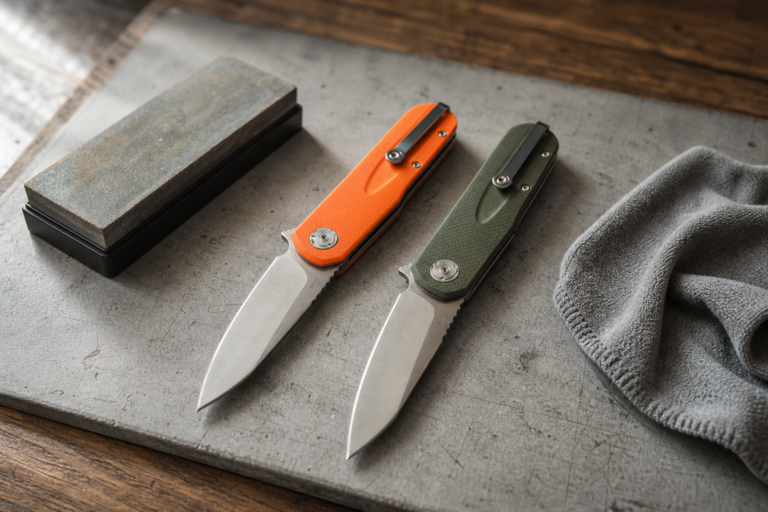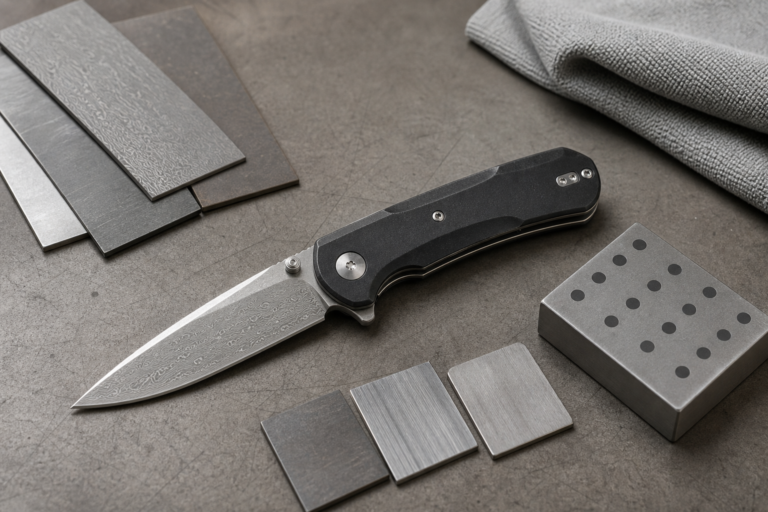
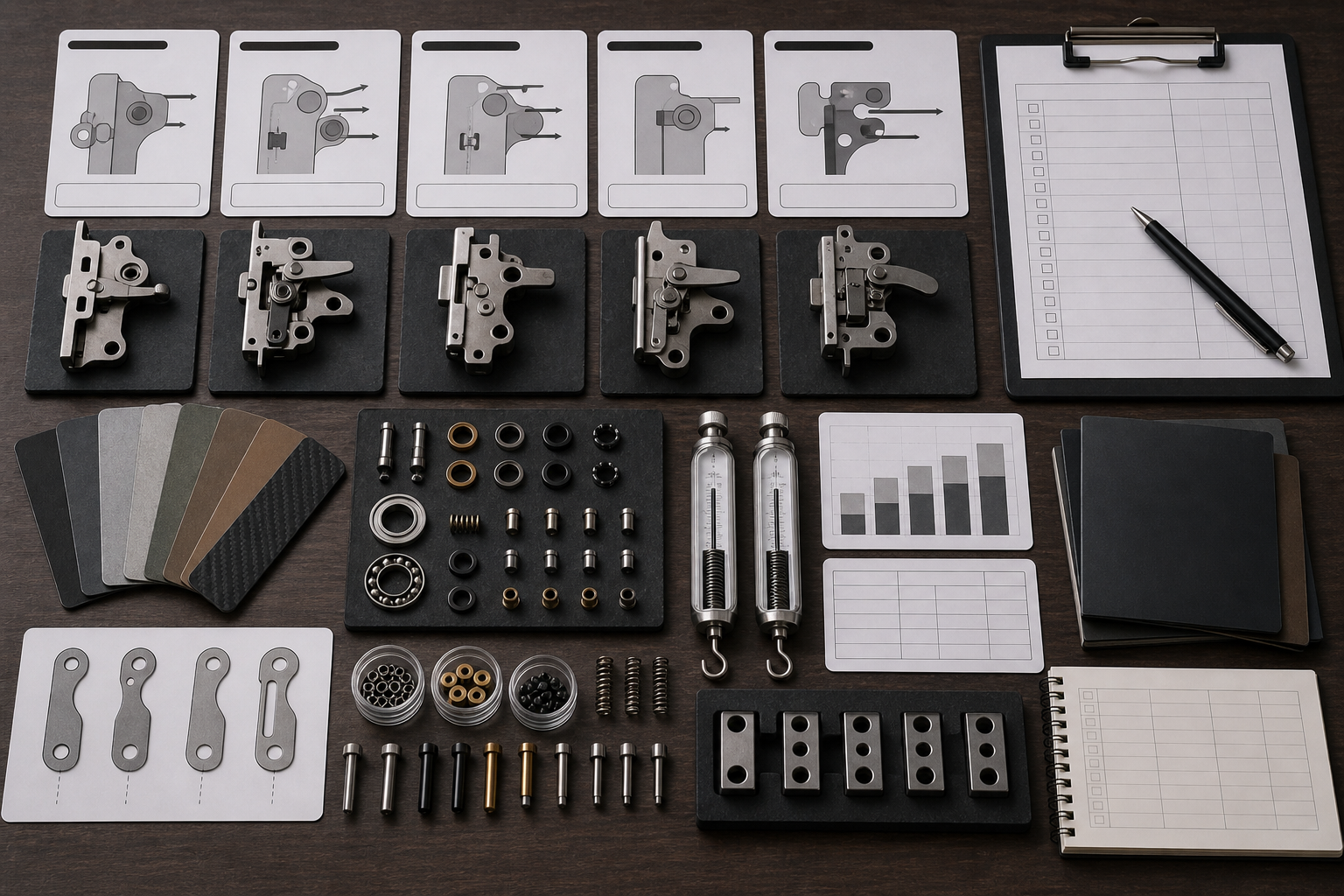
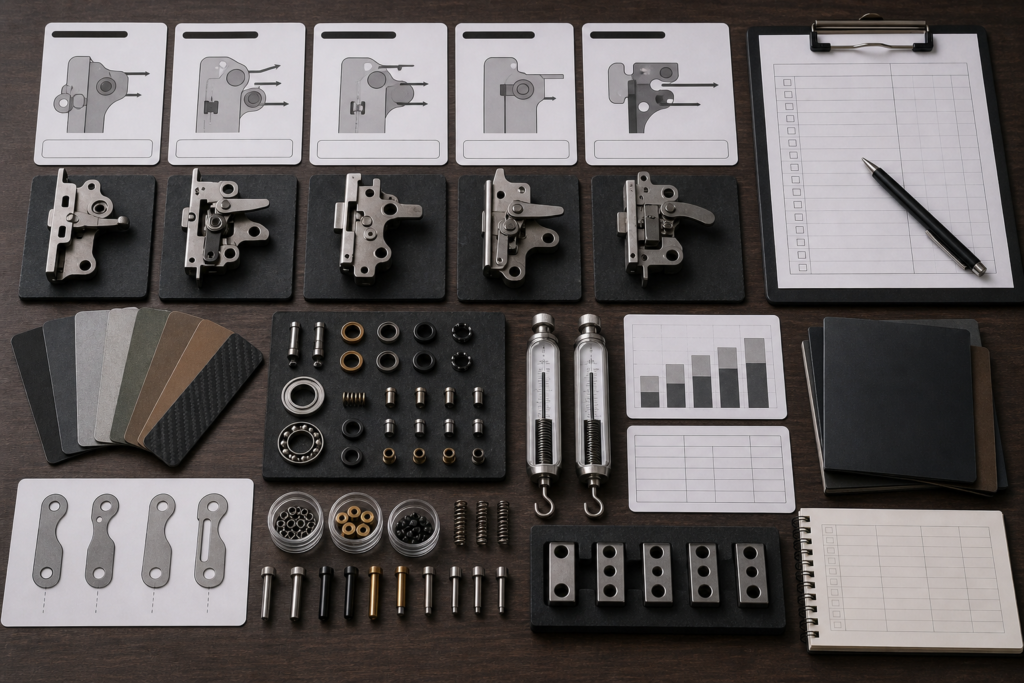
A lock name can sound impressive. But if the structure does not match production, buyers may face poor action, weak consistency, and costly rework.
Buyers should compare folding knife lock mechanisms by checking lock type, blade retention, lock engagement, release feel, machining tolerance, material thickness, assembly time, inspection method, target market rules, and repeat-order stability. Frame, liner, back, and compression-style locks each need different QC and RFQ details.
Quick buyer brief:
- Answer: Choose the lock by product role, manufacturability, QC standard, and target market, not by name alone.
- Buyer context: This helps knife brands, outdoor brands, importers, wholesalers, and private label buyers brief an OEM/ODM factory.
- Key checks: Lock type, closed retention, engagement, lock travel, blade centering, pivot relation, handle stack, material thickness, release feel, inspection limits, packaging, and RFQ files.
Developing a folding knife line for your brand?
Vast State supports OEM/ODM folding knife projects, including blade steel, lock structure, handle material, finish, logo method, packaging, and quality inspection planning.
When I review a folding knife project, I treat the lock as part of the whole structure. A liner lock cannot be judged without the liner thickness, detent, pivot, stop pin, and handle scale. A frame lock cannot be judged without the frame cut, overtravel control, and surface finish. A back lock cannot be judged without spring force, notch fit, and handle machining. A compression-style lock cannot be judged without tab access, tang geometry, and assembly repeatability. A good lock choice is not only about user feel. It is also about cost, tolerance, inspection, packaging, and repeat production.
How Should Buyers Compare Lock Types Before Sampling?
Many buyers ask for a lock by name. That is risky because the same name can hide very different production needs.
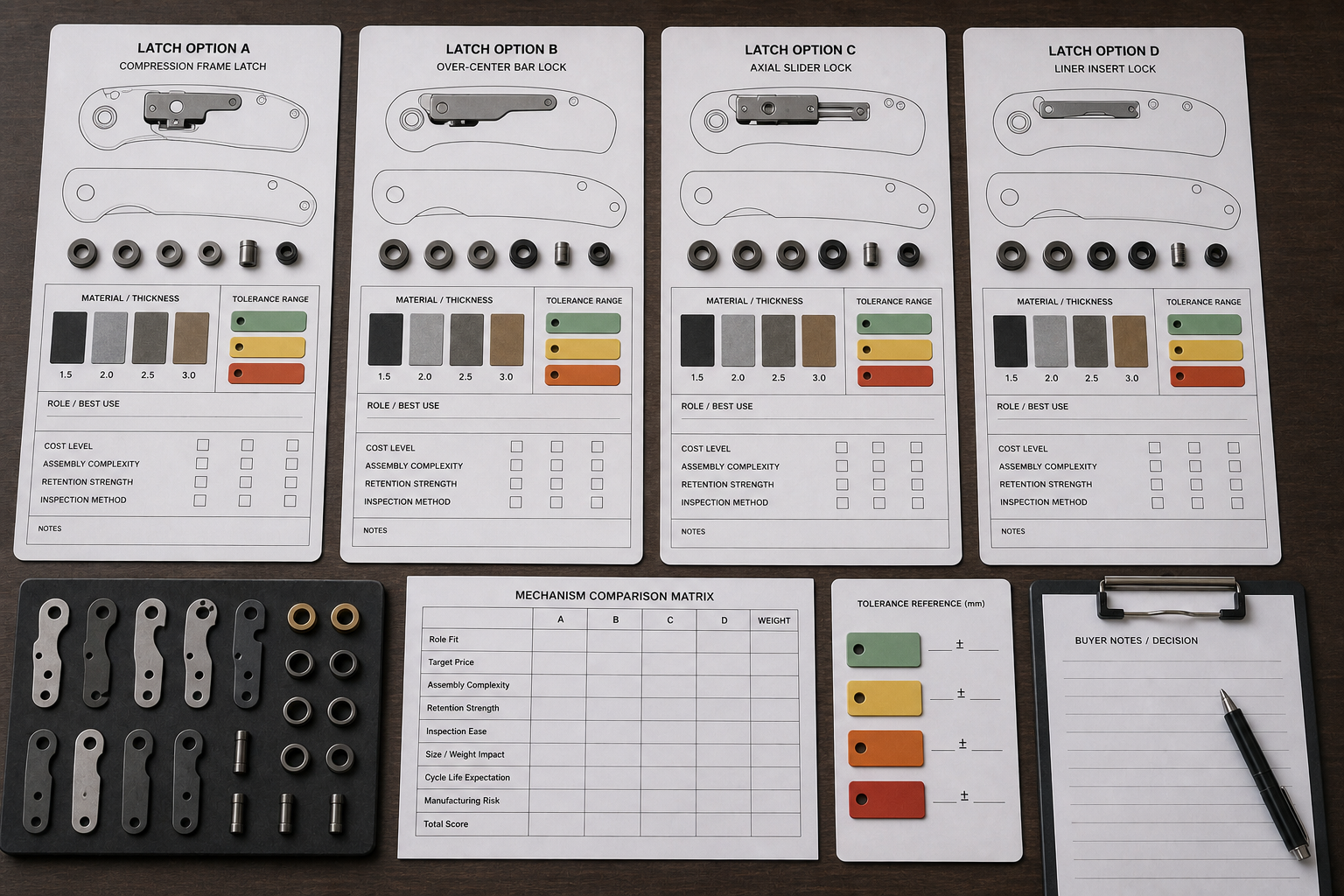
Buyers should compare lock types by product role, target price, expected action, closed retention, lock engagement, assembly complexity, material thickness, inspection method, and target-market requirements.
I Start With The Product Role
I do not choose a folding knife lock only because it is popular. I first ask what the product is supposed to be. A budget EDC line, a work-focused utility folder, a gift item, and a higher-spec outdoor knife should not always use the same lock. The target price affects material thickness, machining time, hardware, and inspection. The target market affects acceptable features and product language. The user expectation affects opening feel, release access, and blade retention.
The AKTI approved knife definitions are useful because they show how knife terms can affect legal and product understanding. I use that kind of source as terminology context, not as factory tolerance guidance. For production, I still need drawings, material choices, lock geometry, pivot details, and inspection standards. I ask buyers to compare each lock type with the same checklist: function, cost, manufacturability, serviceability, compliance review, and repeatability. If a lock is difficult to assemble consistently, it may not be the best choice for a large private label order, even if the sample looks good.
| Comparison point | What I check | Buyer decision |
|---|---|---|
| Product role | EDC, outdoor, utility, gift, or collector-style line | Match lock level to market |
| Target price | Machining, material, and assembly cost | Avoid overbuilding the structure |
| User expectation | Opening feel, release feel, and closed retention | Define sample standard early |
| Market review | Local rules and channel policy | Avoid late redesign |
OEM/ODM RFQ Checklist
Prepare these details to help Vast State review your project and provide a more accurate quotation.
| RFQ Field | What to Prepare |
|---|---|
| Project type | OEM from drawing / ODM private label / wholesale catalog |
| Product category | Folding knife / fixed blade / multi-tool / outdoor tool |
| Design status | Idea / sketch / 2D drawing / 3D CAD / physical sample |
| Target price | Ex-factory target price or retail price range |
| MOQ expectation | 500 / 1,000 / 3,000 / 5,000+ pcs |
| Logo method | Laser engraving / etching / printing / molded logo |
| Packaging | Standard packaging / custom retail box / Amazon-ready |
| Market | USA / EU / Japan / Korea / Middle East / other |
| Compliance needs | Buyer-specified testing / documentation / labeling |
| Timeline | Sample deadline / mass production deadline |
What Makes Liner And Frame Locks Different For Production?
Liner and frame locks may look similar in principle. In production, they create different material, machining, and assembly choices.
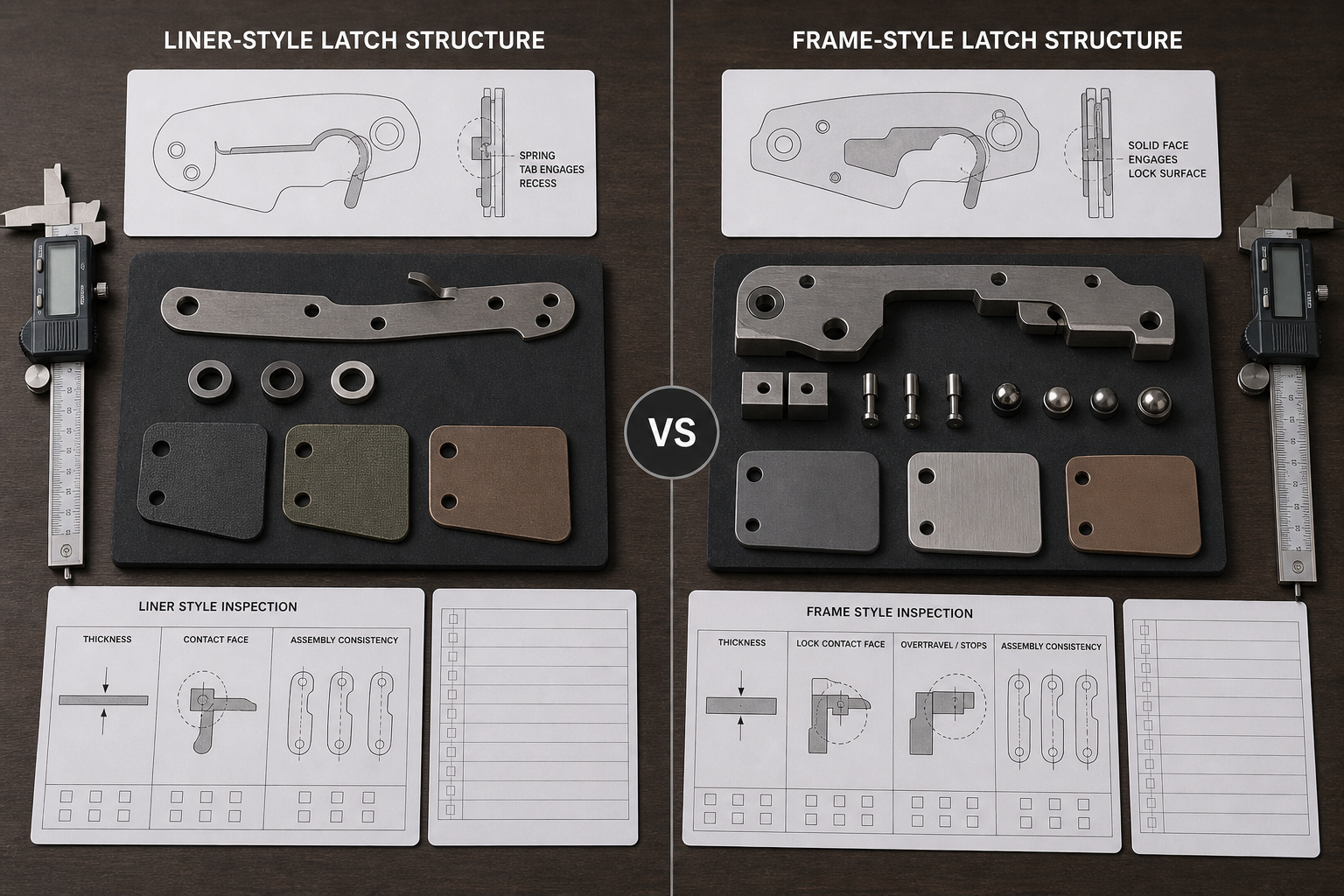
Liner locks use a spring-loaded liner to lock behind the blade, while frame locks use part of the handle frame. Buyers should compare thickness, lock face, detent, overtravel, scale design, and assembly consistency.
I Look At The Lock Bar As A Spring Part
A liner lock usually allows the handle scale to carry the visual design while the metal liner provides the lock spring. This can be useful when the buyer wants G10, micarta, wood, carbon fiber style, or other scale materials. It can also help control cost on many mid-range projects. But the liner must be cut, heat treated or spring-formed as needed, and fitted to the blade tang correctly. If the liner is too soft, too thin, or poorly fitted, lock engagement may be inconsistent.
A frame lock uses part of the handle frame as the lock bar. This can create a strong, clean structure, but it often requires thicker metal, more precise machining, and careful surface treatment. The frame cut, lock face, detent, and overtravel control need attention. AKTI's mechanism page describes a frame or integral lock as using part of the handle in place of the liner and notes that the ball detent principle can be similar to a liner lock. I translate that into factory practice: both locks need controlled spring behavior, detent fit, tang contact, and inspection limits. The difference is where the spring part lives and how much it costs to make it repeat.
| Lock type | Production advantage | Production concern |
|---|---|---|
| Liner lock | Flexible scale design and common assembly path | Liner thickness, lock cut, and detent must be controlled |
| Frame lock | Strong integrated handle structure | Higher machining and finish sensitivity |
| Both types | Clear lock feel and familiar product language | Need lock face, detent, and pivot control |
| Buyer choice | Match appearance, price, and QC level | Do not choose only by lock name |
When Does A Back Lock Make More Sense?
Some buyers ignore back locks because they seem traditional. That can be a mistake for certain product lines.
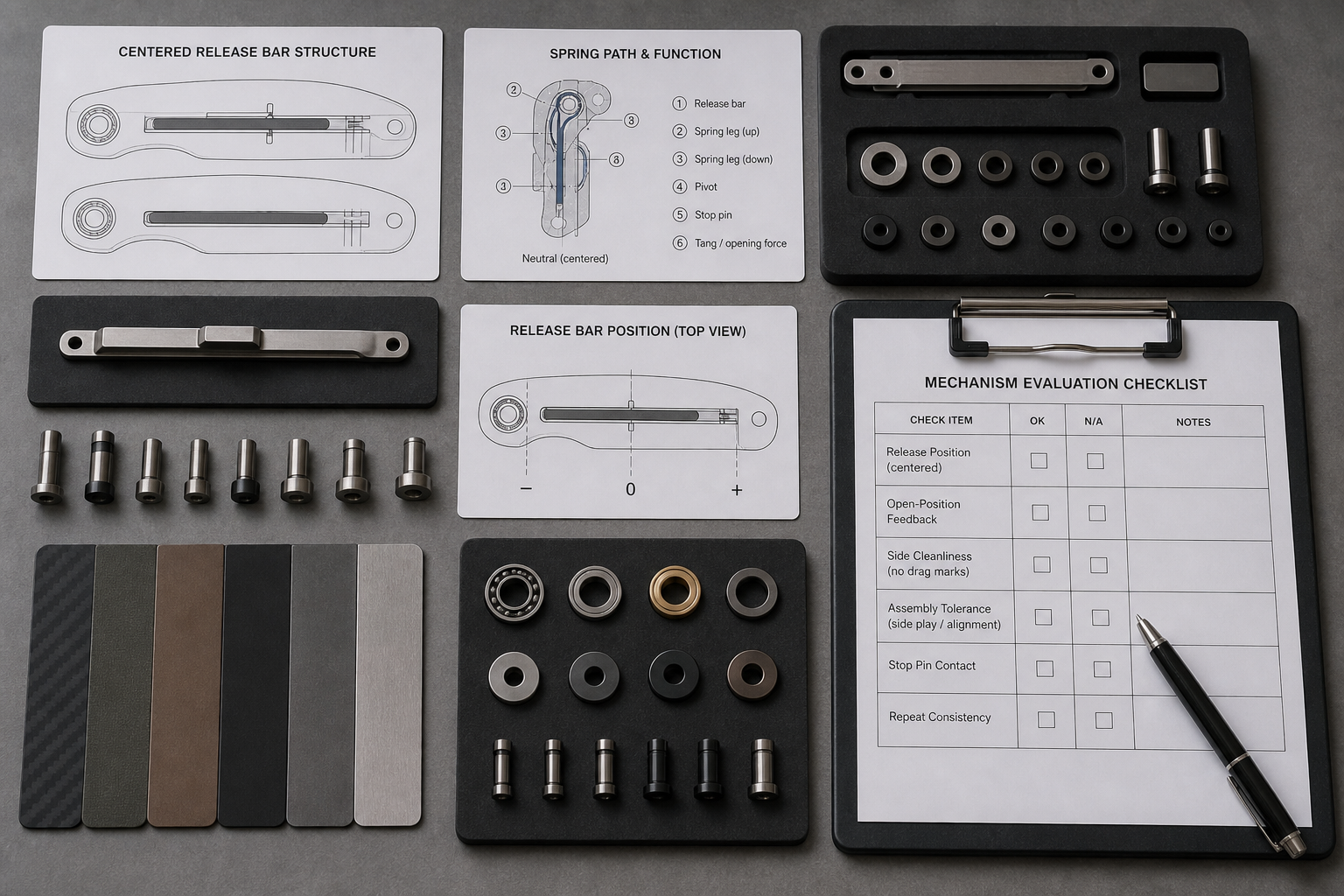
A back lock makes sense when buyers want a centered release position, familiar two-hand closing style, clean handle sides, strong open-position feedback, and a more classic product identity.
I Match Back Locks To The Right Product Story
A back lock can be a good choice when a buyer wants a classic folding knife feeling. It can keep the handle sides cleaner because the release is often placed along the back of the handle. It can also support a familiar retail story for utility, outdoor, and traditional-style pocket knives. However, a back lock is not automatically simpler. The spring bar, blade tang notch, rocker geometry, pivot position, handle channel, and release access must work together.
AKTI's bias and mechanism page explains that a lock back design uses a bar spring and a blade-base notch or mortise to provide a positive lock in the fully open position. I use that concept in product review. I check whether the spring pressure is comfortable, whether the lock seats cleanly, whether the blade has vertical movement, and whether the release area feels practical. Back locks can be very useful for B2B buyers, but they need good machining and assembly. If the buyer wants a slim handle, the internal space must be checked early. If the buyer wants lower cost, the factory should review whether the back lock structure fits the budget.
| Back lock factor | What I check | Why it matters |
|---|---|---|
| Spring bar | Force, fit, and surface finish | Controls release feel and retention |
| Tang notch | Engagement depth and contact surface | Controls open-position stability |
| Handle channel | Space and alignment | Controls assembly consistency |
| Buyer fit | Classic, utility, or outdoor positioning | Supports product story |
How Should Buyers Treat Compression-Style Locks In OEM/ODM Projects?
Compression-style locks can sound advanced. But buyers should not use the name unless the structure, rights, and production path are clear.
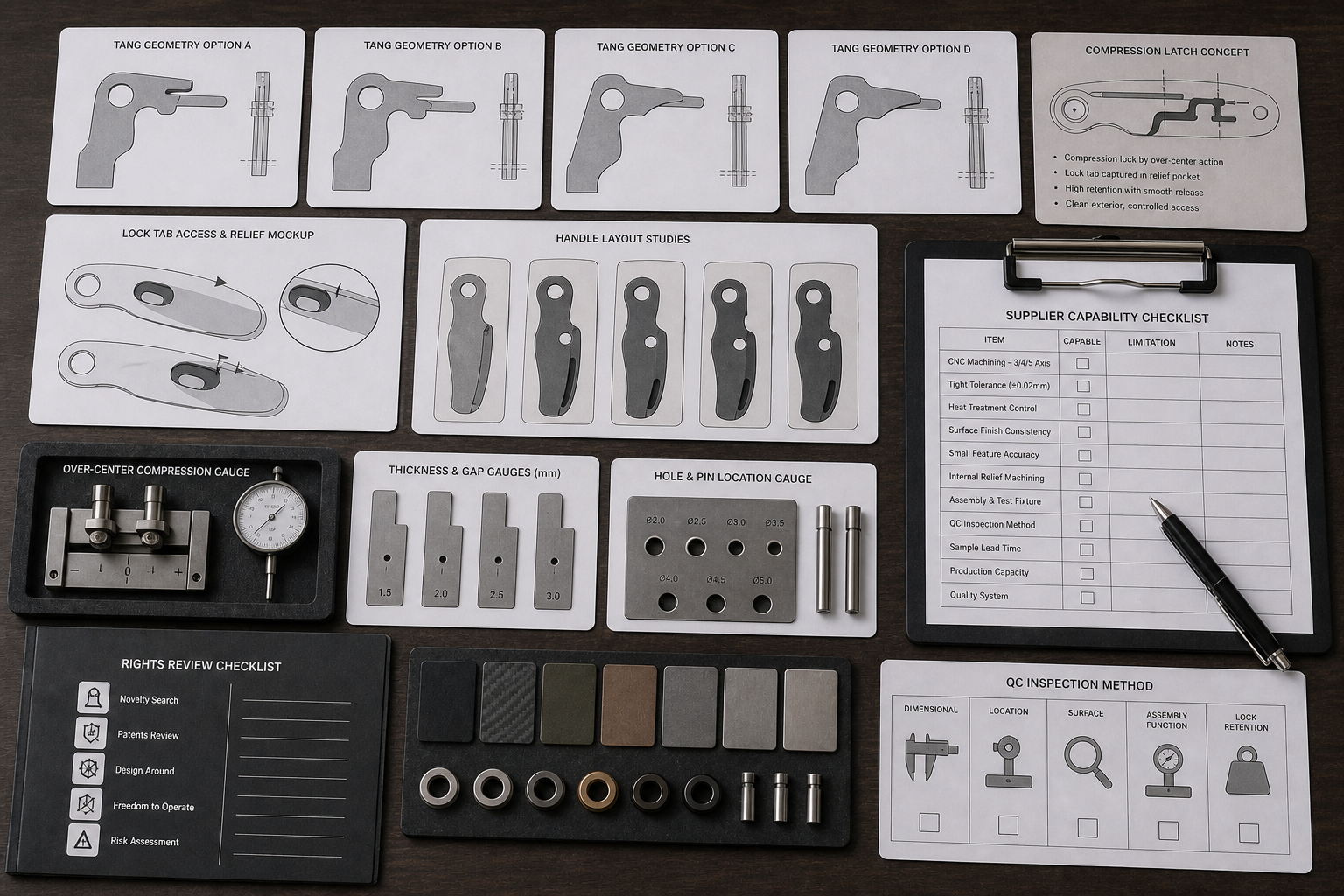
Buyers should treat compression-style locks as a structure to verify carefully: tang geometry, lock tab access, handle layout, user ergonomics, machining tolerance, rights review, QC method, and supplier capability.
I Verify The Structure And The Language
I am careful with compression-style lock requests. Some lock names may be associated with specific brands, design histories, or market expectations. For OEM/ODM development, the buyer should confirm the product rights, naming, and target-market wording before asking a factory to copy a named mechanism. I prefer to describe the actual structure: where the lock tab sits, how it contacts the tang, how the user releases it, how the handle protects the fingers, how the stop pin works, and how the closed blade is retained.
From a factory view, this type of structure needs careful layout. The tab must be accessible but not fragile. The handle must provide enough space. The blade tang must be controlled. The pivot and stop area must align with the lock contact. Assembly workers need a clear inspection standard. Buyers should ask whether the supplier has made similar structures before and what tolerances they can hold. If the goal is a higher-end product, this lock may support a distinct feel. If the goal is a low-cost high-volume line, it may add risk. The best answer depends on budget, MOQ, timeline, tooling, and QC depth.
| Review item | What I verify | Buyer risk if ignored |
|---|---|---|
| Rights and wording | Product name, claim, and market language | Brand or channel conflict |
| Tang geometry | Contact surface and stop position | Poor lock timing |
| Tab access | Release comfort and protection | Bad user experience |
| Supplier capability | Similar work and inspection method | Unstable mass production |
What Lock Interface Details Should QC Inspect?
Lock problems often hide in small contact areas. A casual sample review can miss them.
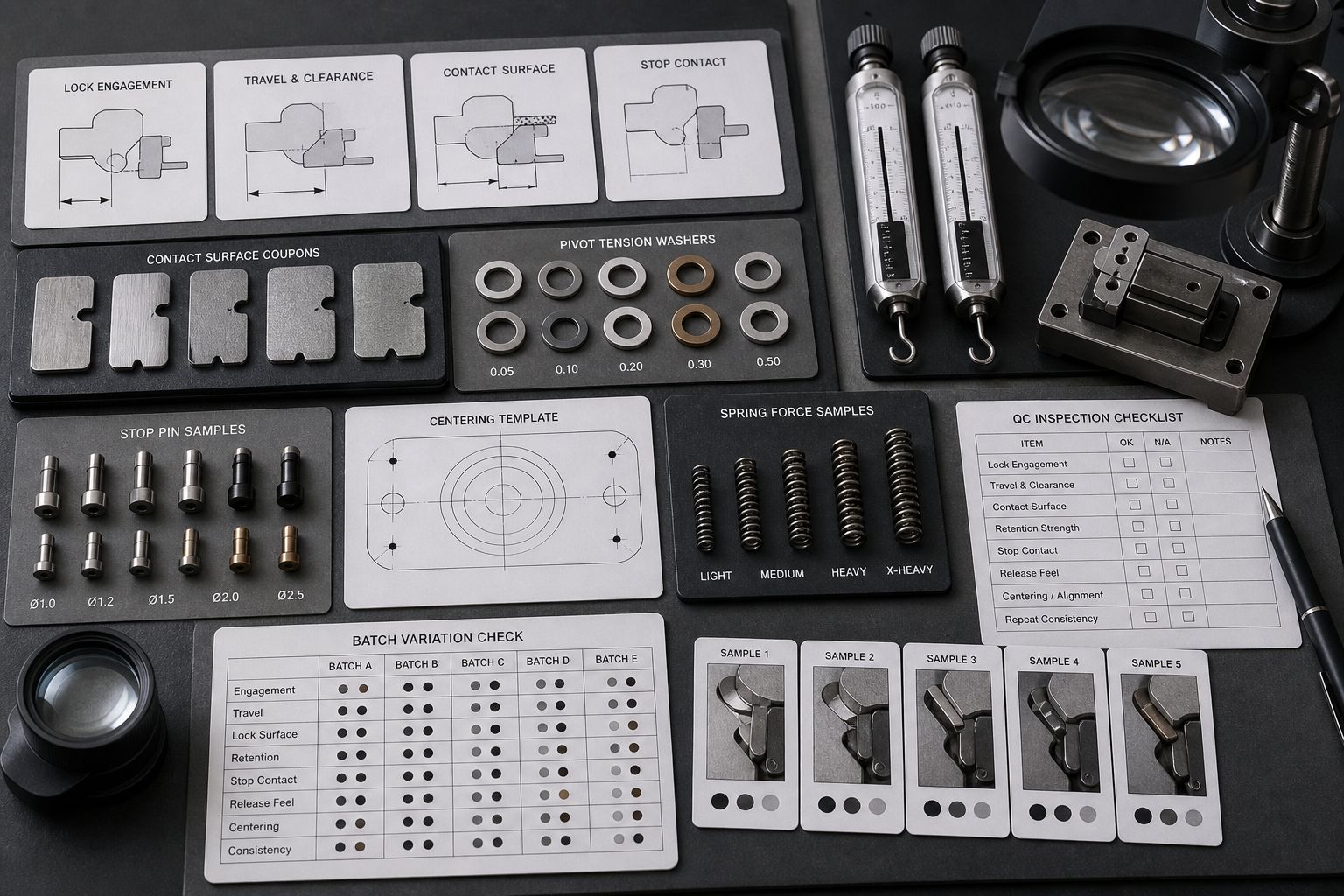
QC should inspect lock engagement, lock travel, contact surface, blade play, closed retention, detent or spring force, stop pin contact, pivot tension, release feel, centering, and batch variation.
I Define Lock Quality In Measurable Terms
I do not like vague lock comments such as "good lockup" without a shared standard. For a production order, the buyer and factory should agree on what will be checked. The lock should engage in the approved range. It should release without uncomfortable force. The blade should not show obvious side play. The stop pin should contact consistently. The closed blade should stay retained during normal handling and packaging. The pivot should not be over-tightened to hide poor fit.
Hardness and surface condition can matter around lock contact areas. The NIST Rockwell hardness measurement guide is useful because it explains that good practice in Rockwell hardness measurement helps reduce measurement error. In a folding knife project, hardness alone does not prove lock quality. But material hardness, heat treatment, surface finish, and contact geometry all affect repeatability. I prefer to combine process checks with functional inspection. A good QC sheet should cover material, machining, assembly, function, appearance, and packaging. That is how a lock becomes a repeatable production feature instead of a lucky sample.
| QC item | What I check | Why it matters |
|---|---|---|
| Engagement | Contact position and travel | Supports consistent open lock feel |
| Blade movement | Side play and vertical movement | Protects perceived quality |
| Closed retention | Detent, spring, or bias behavior | Supports shipping and handling |
| Contact surface | Finish, wear marks, and geometry | Protects repeat function |
How Do Lock Choices Affect Cost, Assembly, And Materials?
Lock selection is also a cost decision. A complex lock can raise machining, scrap, inspection, and assembly time.
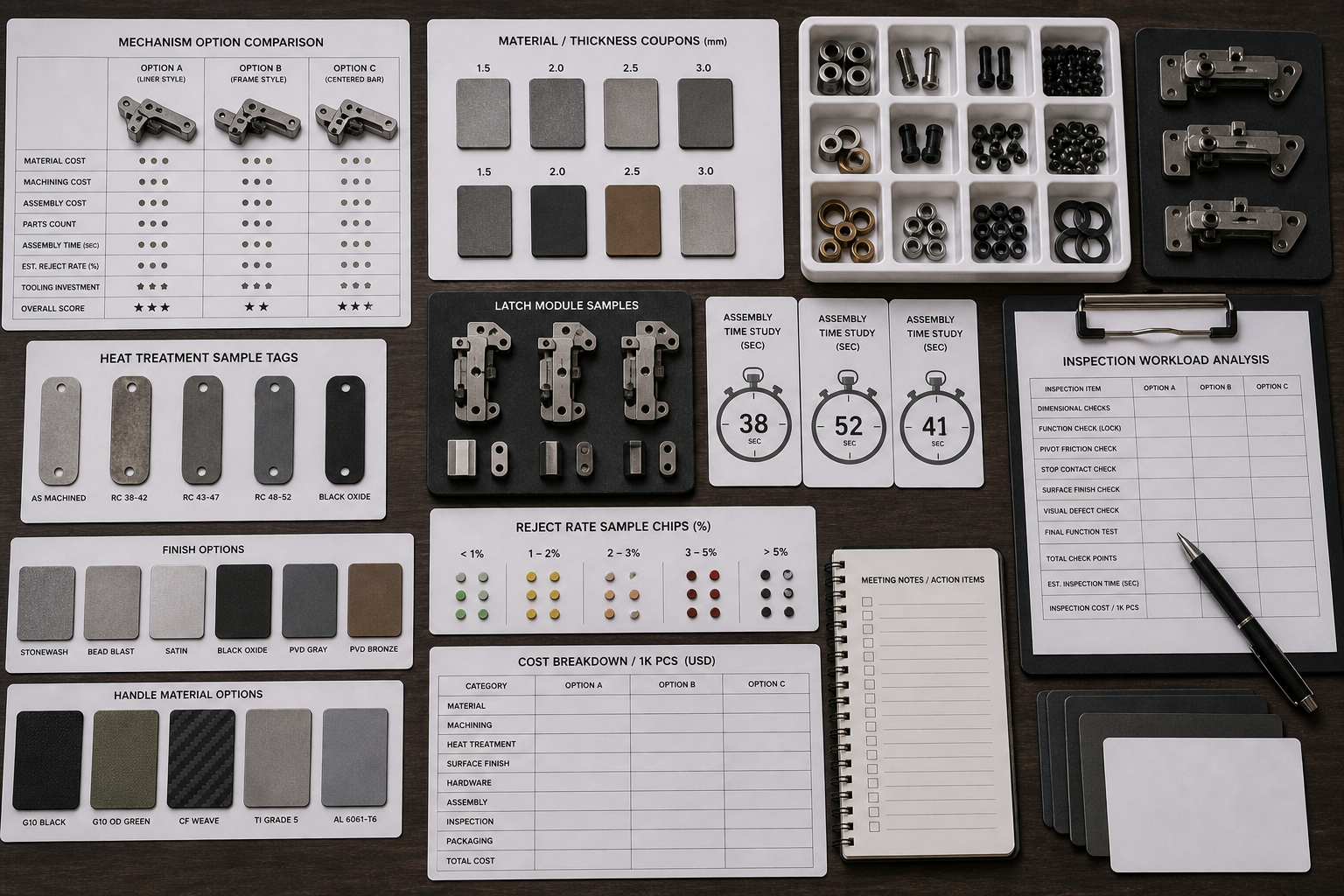
Lock choices affect cost through material thickness, heat treatment, spring behavior, machining accuracy, hardware, assembly time, reject rate, surface finish, and inspection workload.
I Connect The Lock To The Whole BOM
The lock is not a single line in the bill of materials. It changes the whole structure. A liner lock affects liner material, scale support, detent ball, screws, and handle thickness. A frame lock affects handle metal, machining time, surface finish, and clip design. A back lock affects spring bar, handle channel, rocker fit, and release area. A compression-style structure affects handle layout, tang geometry, tab access, and tolerance control. These choices change material cost, labor cost, QC time, and packaging protection.
Material choice should also be practical. A lock part may need spring behavior, wear resistance, and stable contact. The blade steel, liner steel, handle frame material, heat treatment, coating, and finish must work together. Alleima 14C28N knife steel is useful as a modern steel reference because it discusses knife-related properties such as hardness, edge stability, corrosion resistance, and production suitability. I use such data to help buyers think in specifications. I do not assume the most expensive material is best. I choose the material and lock structure that support the target price, function, and repeat production.
| Cost driver | Where it appears | How I control it |
|---|---|---|
| Material thickness | Liners, frame, spring bar, lock tab | Match strength and price level |
| Machining tolerance | Tang, pivot, stop, lock face | Define critical dimensions |
| Assembly time | Lock tuning, pivot tension, detent fit | Use clear work instructions |
| Inspection workload | Lockup, centering, release, retention | Build QC into quotation |
What Compliance, Packaging, And Claim Checks Belong In The Brief?
A lock can change market risk. Rules and platform policies may treat opening features and mechanisms differently.
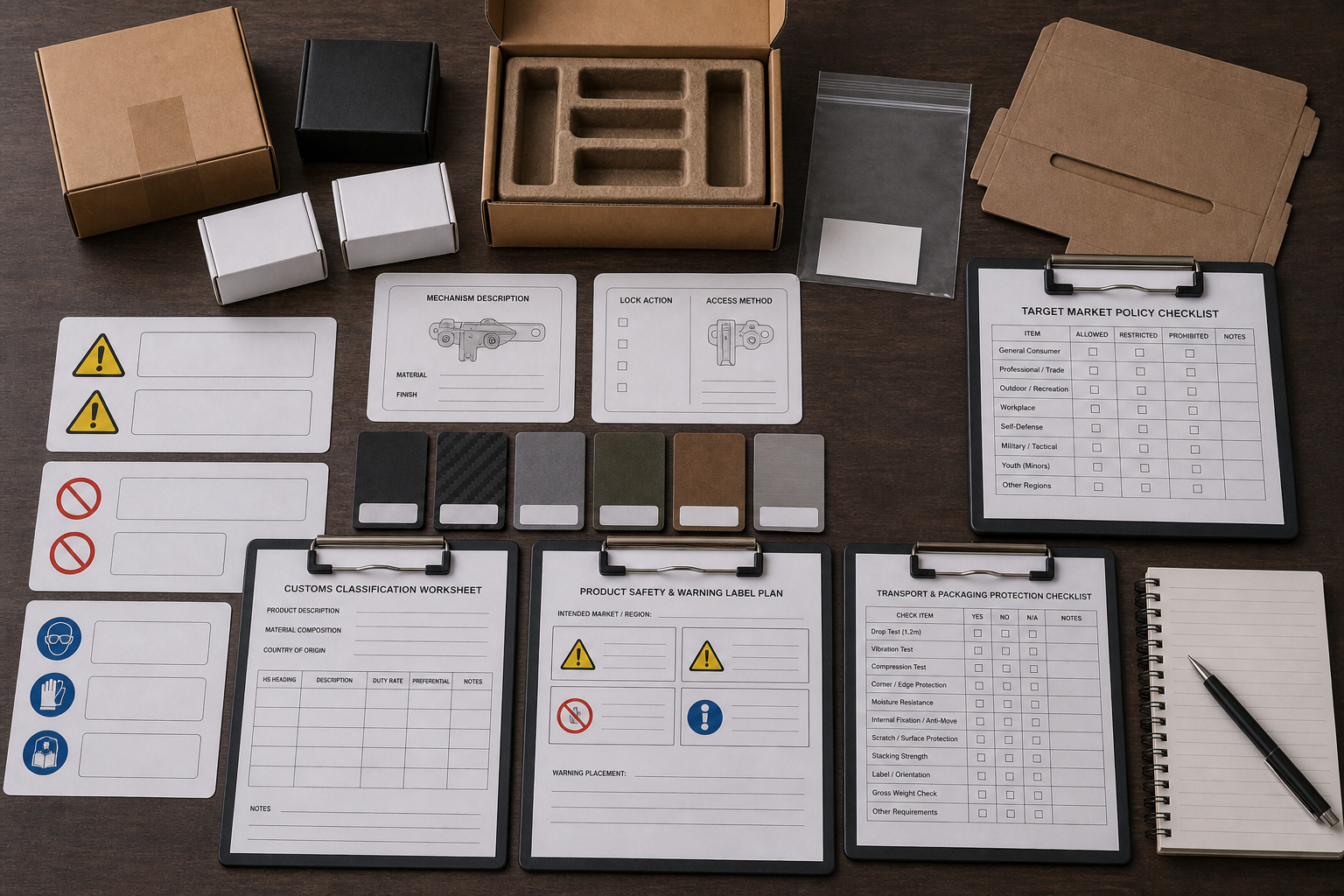
Buyers should review target-market rules, customs classification, marketplace policy, mechanism wording, blade length, lock description, packaging claims, warnings, and transport protection before mass production.
I Treat Lock Language As A Market Input
This section is not legal advice. It is a sourcing reminder. Lock mechanisms, opening features, blade length, and packaging language can matter in different markets and channels. The buyer should confirm local rules, platform policies, carrier limits, and broker guidance before finalizing the sample. A mechanism that is acceptable in one market may create problems in another. A product description can also create risk if it uses unclear terms.
For customs context, the United Nations Statistics Division lists HS 8211 for knives with cutting blades and related subheadings. That helps broker discussion, but it does not settle every import question. Packaging should also protect the lock from damage during transport. ISO 4180 gives general rules for compiling performance test schedules for complete filled transport packages. I use that as a packaging planning reference. I also ask buyers to avoid unsupported claims such as "fail-proof lock" or "legal everywhere." Better packaging names the actual mechanism, material, care notes, and target product category clearly.
| Brief area | What to confirm | Why it matters |
|---|---|---|
| Market rules | Blade length, opening feature, lock wording | Prevents late redesign |
| Classification | HS heading and broker view | Supports import planning |
| Packaging claims | Mechanism name and safety wording | Reduces unsupported promises |
| Transport protection | Insert, box, and carton fit | Protects pivot and lock condition |
What RFQ Details Help A Supplier Quote Lock Mechanisms Accurately?
An unclear lock RFQ forces the factory to guess. Guessing creates unstable samples, wrong prices, and weak QC.
Buyers should send lock type, drawings, blade tang detail, pivot system, stop pin, handle stack, material thickness, detent or spring requirement, release access, target price, quantity, packaging, and QC checklist.
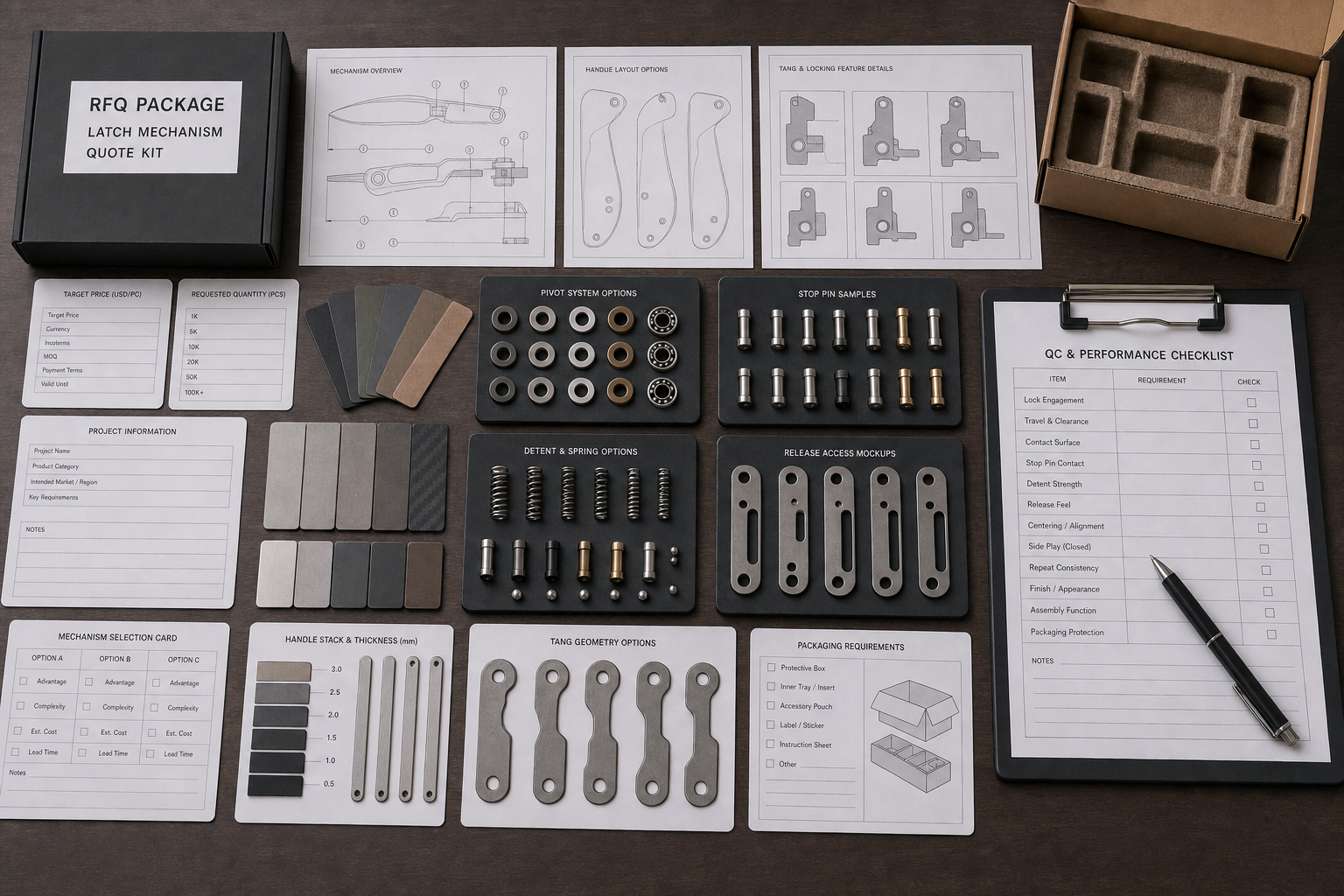
I Ask For A Lock Standard, Not Only A Lock Name
A useful RFQ tells the factory what the buyer really needs. It should include the lock type, product role, target market, target price, estimated quantity, blade steel, blade thickness, tang detail, pivot system, washer or bearing choice, stop pin position, liner or frame material, handle scale material, release access, clip position, finish, packaging, and QC expectation. If the buyer wants a specific lock feel, the buyer should share a sample standard or describe the acceptable range.
I also ask the buyer to mark fixed and flexible items. The buyer may require a frame lock but allow different handle thickness. The buyer may prefer a back lock but accept a liner lock if the price target is tight. The buyer may want a compression-style structure but allow a simpler lock if the timeline is short. ISO 9001 supports quality management thinking around controlled processes and customer requirements. ISO 10007 supports configuration management thinking from concept to later product stages. In factory language, the drawing, approved sample, lock standard, finish board, packaging proof, and inspection sheet should stay together.
| RFQ field | What I need | Why it helps |
|---|---|---|
| Lock definition | Type, structure, and release position | Reduces misunderstanding |
| Critical geometry | Tang, pivot, stop pin, and lock face | Improves quote accuracy |
| Material stack | Blade, liner, frame, scale, spring part | Controls cost and function |
| QC standard | Engagement, release, centering, retention | Supports repeat production |
Turn this article into a folding knife project.
Share your blade type, lock direction, steel preference, handle material, quantity, target market, and packaging needs. Vast State can prepare OEM/ODM options.
Conclusion
I choose better folding knife locks by matching mechanism, material, tolerance, QC, packaging, compliance review, and RFQ details before production.
Source Notes
- AKTI approved knife definitions supports industry terminology context for knife definitions, blade length, and mechanism wording.
- AKTI bias toward closure and knife mechanisms supports discussion of closed retention, slip joint, lock back, liner lock, and frame or integral lock principles.
- NIST Rockwell hardness guide supports hardness measurement discussion for metallic materials.
- Alleima 14C28N knife steel supports modern blade steel specification discussion.
- UNSD HS 8211 supports customs classification context for knives and pocket knives, but local broker advice is still needed.
- ISO 4180 supports packaging performance-test planning for complete filled transport packages.
- ISO 9001 and ISO 10007 support quality management and configuration record concepts used in this article.