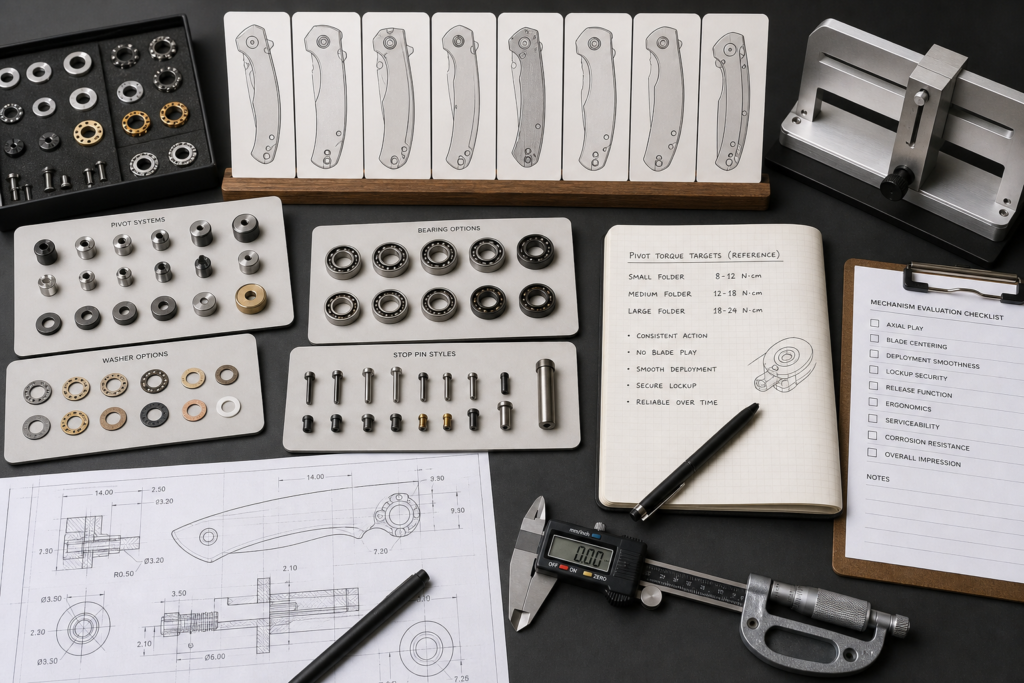
A folding knife can look finished but still feel loose, rough, or unsafe. The mechanism must be engineered, assembled, and inspected.
Buyers should evaluate folding knife opening and locking mechanisms by checking pivot structure, washers or bearings, detent feel, stop pin contact, lock engagement, blade centering, screw control, corrosion risk, and repeatable QC records before mass production.
Quick buyer brief:
- Answer: Treat opening and locking as a controlled mechanical system, not only a product feature.
- Buyer context: This helps knife brands, outdoor brands, importers, wholesalers, and private label buyers approve safer, smoother, and more repeatable folding knife projects.
- Key checks: Pivot fit, washers or bearings, detent, stop pin, lock contact, centering, screw torque, hardness, corrosion, and AQL inspection.
Developing a folding knife line for your brand?
Vast State supports OEM/ODM folding knife projects, including blade steel, lock structure, handle material, finish, logo method, packaging, and quality inspection planning.
When I review a folding knife project, I look past the closed appearance. A folding knife is a compact moving product. The blade, pivot, liner, lock, washer, bearing, stop pin, detent, screw, and handle scale all need to work together. If one detail is wrong, the buyer may see blade play, poor centering, hard opening, weak lock feel, or unstable production. This is why I discuss opening and locking early in the OEM/ODM process, before the buyer spends money on tooling, packaging, or mass production.
Why Should Buyers Treat Opening and Locking as Product Engineering?
Some buyers judge a folding knife only by style. That is risky because the hidden mechanism decides daily user trust.
Opening and locking should be treated as product engineering because they control smoothness, safety, blade position, repeatability, assembly time, and buyer confidence in bulk production.
I Review the Mechanism Before I Trust the Sample
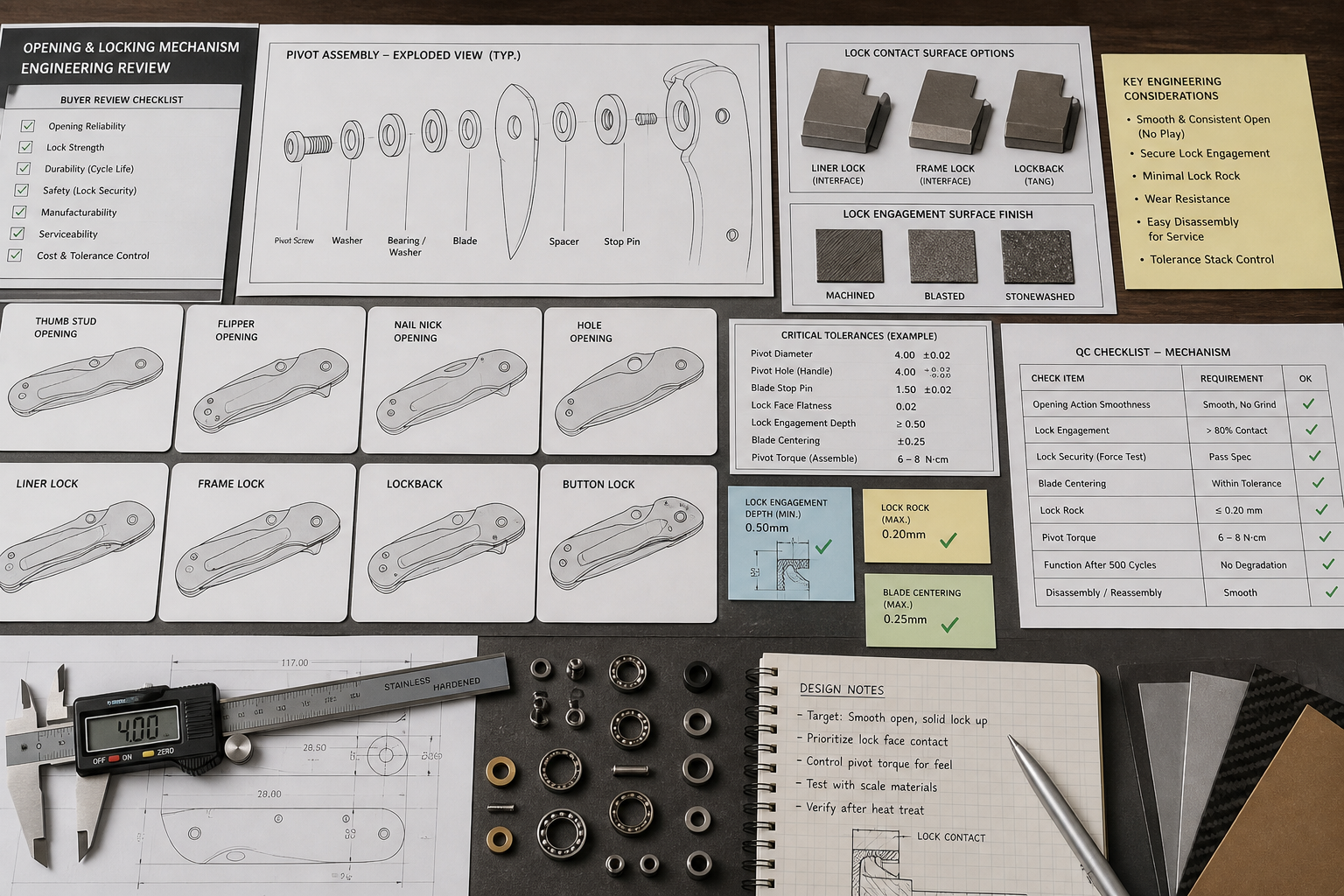
A first sample can look good in photos but still hide a weak mechanism. I check how the blade rotates, where it stops, how the lock engages, how the lock releases, how the blade sits when closed, and whether the same feel can be repeated by production workers. This is not only a technical habit. It protects the buyer's brand. If a user feels blade play or poor lock contact, the user may not care how good the handle material looks.
Opening and locking also affect cost. A simple washer structure may be stable and cost-effective. A bearing structure can feel smoother, but it may need better part precision and cleaner assembly. A liner lock may suit one target price. A back lock or button lock may need different parts and different QC points. I always connect the mechanism to the product level, target market, order quantity, and assembly process. For B2B buyers, the best mechanism is not the most complex one. It is the one that supports the promised feel, the price range, and stable repeat production.
| Engineering question | What I check | Why it matters |
|---|---|---|
| Opening path | Pivot, washer or bearing, detent, blade clearance | Controls smoothness and closing safety |
| Lock relationship | Tang angle, contact area, release feeling | Controls lock stability and user trust |
| Closed position | Blade centering, tip position, handle clearance | Controls perceived quality |
| Production repeatability | Assembly steps and inspection points | Controls cost and consistency |
OEM/ODM RFQ Checklist
Prepare these details to help Vast State review your project and provide a more accurate quotation.
| RFQ Field | What to Prepare |
|---|---|
| Project type | OEM from drawing / ODM private label / wholesale catalog |
| Product category | Folding knife / fixed blade / multi-tool / outdoor tool |
| Design status | Idea / sketch / 2D drawing / 3D CAD / physical sample |
| Target price | Ex-factory target price or retail price range |
| MOQ expectation | 500 / 1,000 / 3,000 / 5,000+ pcs |
| Logo method | Laser engraving / etching / printing / molded logo |
| Packaging | Standard packaging / custom retail box / Amazon-ready |
| Market | USA / EU / Japan / Korea / Middle East / other |
| Compliance needs | Buyer-specified testing / documentation / labeling |
| Timeline | Sample deadline / mass production deadline |
What Parts Create the Opening Action in a Folding Knife?
A folding knife does not open smoothly by chance. Several small parts must share the same geometry.
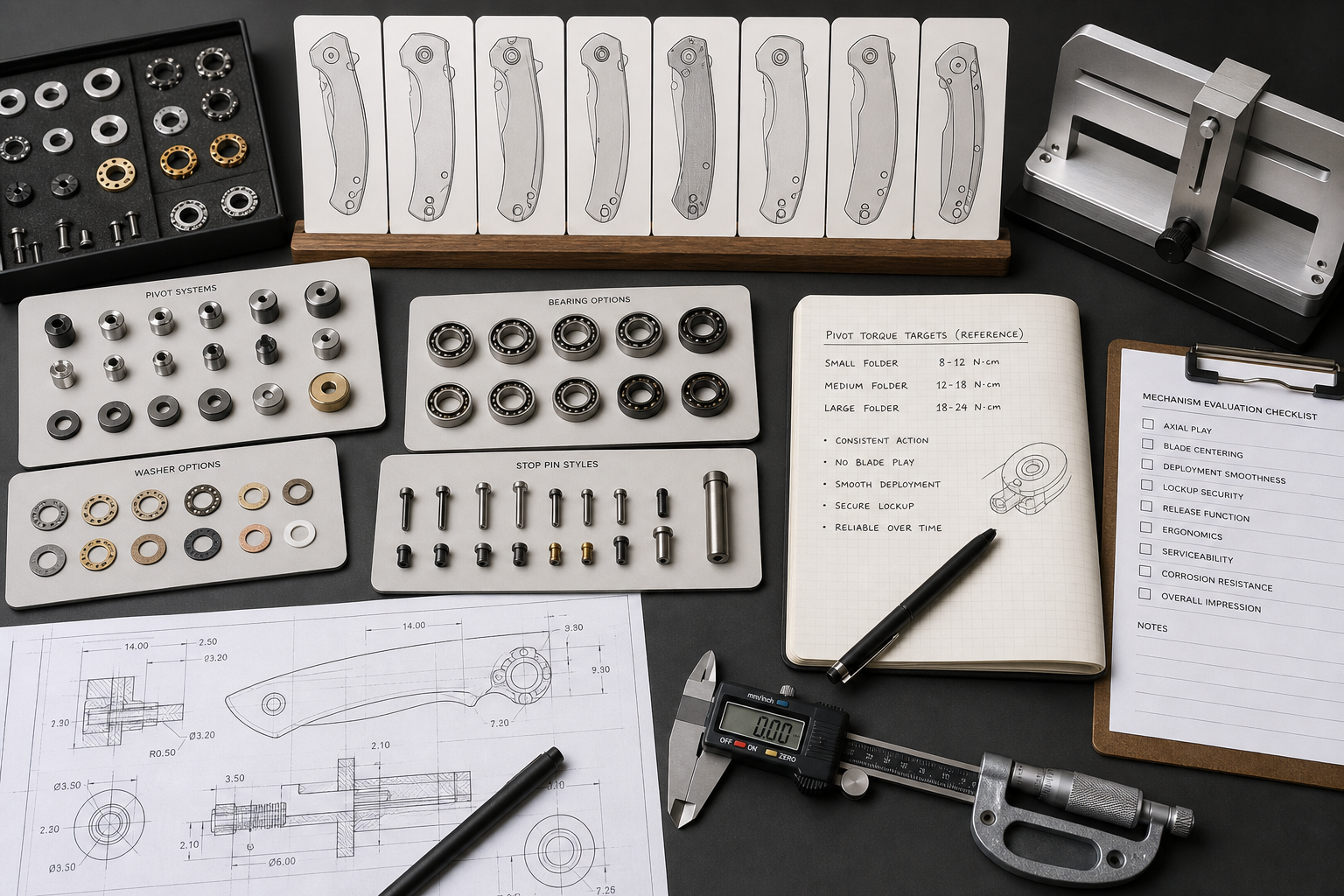
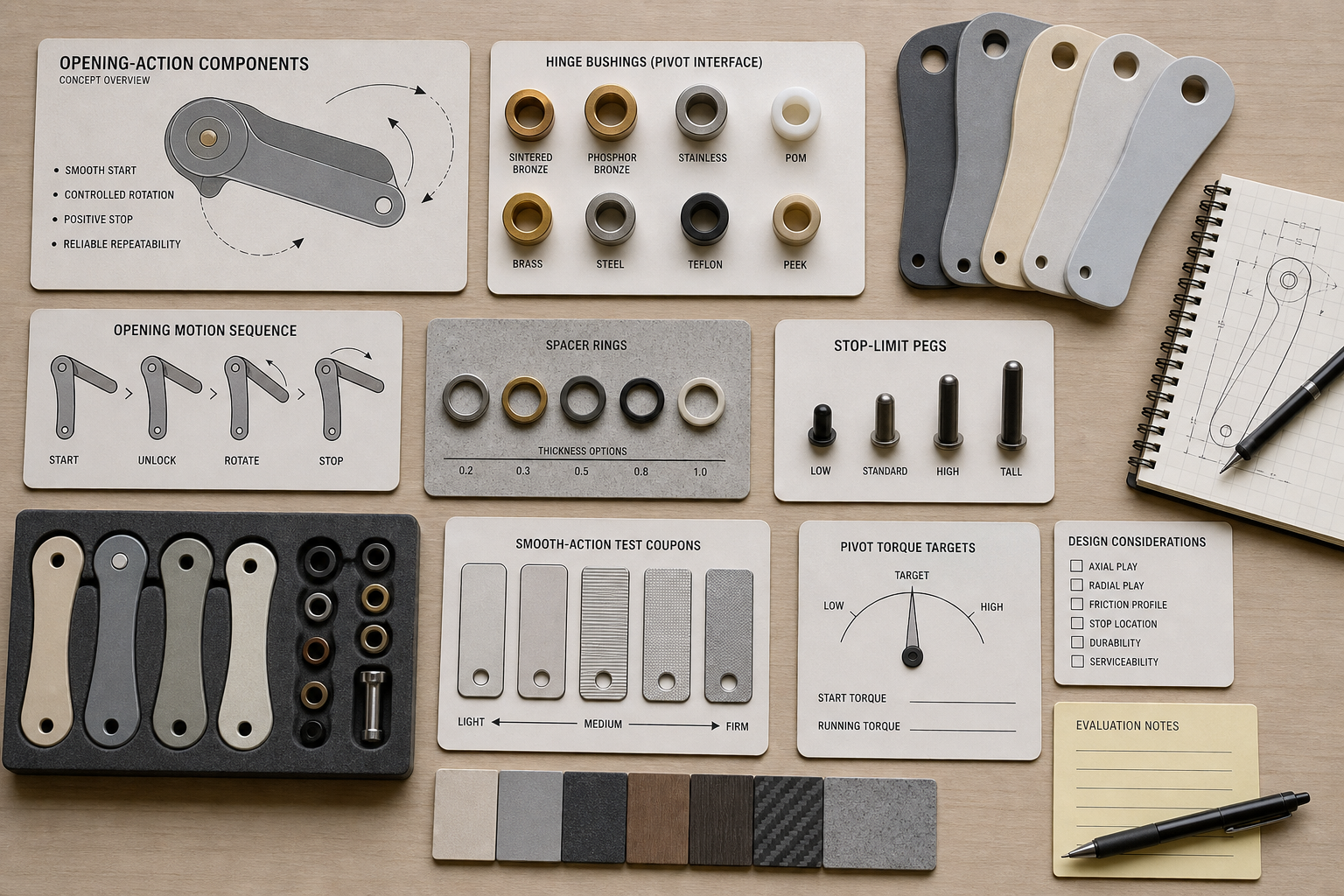
The opening action comes from the pivot, blade tang, washers or bearings, liners, handle scales, detent system, stop pin, and screw tension. Each part affects friction, alignment, and final feel.
I Build the Feel From Small Relationships
The pivot area is the heart of the opening action. The blade rotates around the pivot. The washer or bearing separates moving surfaces. The liner and handle scale hold the structure. The detent helps control the closed position and initial opening feel. The stop pin defines the open stop point. The screw tension changes friction and side play. A small error in any part can change the whole feel.
I usually ask buyers what kind of opening feel they want before I recommend a structure. Some buyers want a clean, controlled action. Some want a lighter action. Some care most about cost and durability. I avoid making mechanism promises until I know the design. A thin handle, heavy blade, thick coating, deep texture, or tight pocket clip location can all affect the action. General hand tool guidance from NIOSH on selecting non-powered hand tools reminds me that tool design should consider user comfort and the task. In folding knife production, I use that same practical thinking to review opening access, handle shape, and the force needed to operate the product safely.
| Part | Mechanism role | Common buyer concern |
|---|---|---|
| Pivot | Main rotation point | Smoothness and side play |
| Washer or bearing | Reduces friction between surfaces | Action feel and assembly cleanliness |
| Detent | Helps hold the blade closed | Closed security and opening feel |
| Stop pin | Defines open and closed stop points | Lock position and impact consistency |
How Do Washers, Bearings, and Pivot Fit Change the Feel?
Two folding knives can use the same blade steel and still feel different. The pivot system often explains the difference.
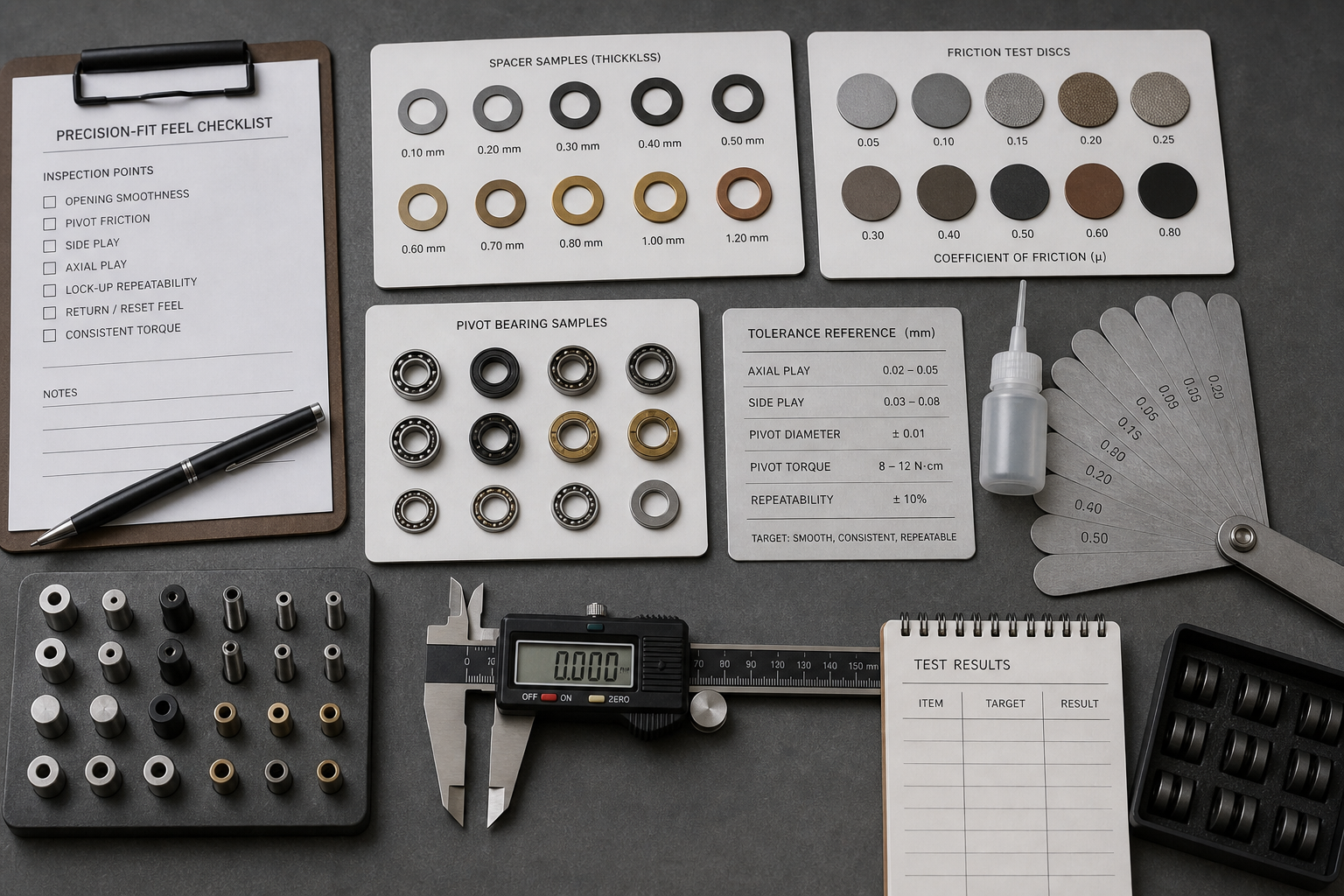
Washers, bearings, and pivot fit change the feel by controlling friction, side play, alignment, assembly sensitivity, cleaning needs, and long-term consistency.
I Choose the Pivot System for the Order, Not for the Buzzword
Washers and bearings both have a place. A washer system can be simple, stable, and forgiving for many production levels. A bearing system can provide a smoother action, but it often needs tighter machining, cleaner parts, and better assembly discipline. If the handle and blade geometry are not well controlled, bearings alone will not fix the knife. If the pivot screw is too tight, action can become heavy. If it is too loose, the blade may have side play. If the pivot hole tolerance drifts, the whole knife can feel inconsistent.
This is where the buyer should ask practical questions. What washer material is used? Is the bearing cage protected from dirt during assembly? What pivot diameter and tolerance are planned? How will workers control screw tension? Will thread treatment be used? Will the approved sample become the reference for action feel? I prefer to test several samples, not only one. A single good sample can hide a process that is hard to repeat. If five or ten samples feel similar, I trust the process more. If every sample feels different, the structure or assembly method needs review before mass production.
| Pivot option | Main benefit | Production caution |
|---|---|---|
| Washer system | Stable and cost-effective | Needs flat surfaces and proper tension |
| Bearing system | Smooth action potential | Needs clean assembly and tighter fit |
| Oversized pivot | More stable structure | Can increase machining cost |
| Adjustable screw | Easy action adjustment | Needs torque and thread control |
What Should Buyers Know About Lock Types and Engagement?
A lock name does not prove lock quality. The real issue is how the parts contact and repeat.
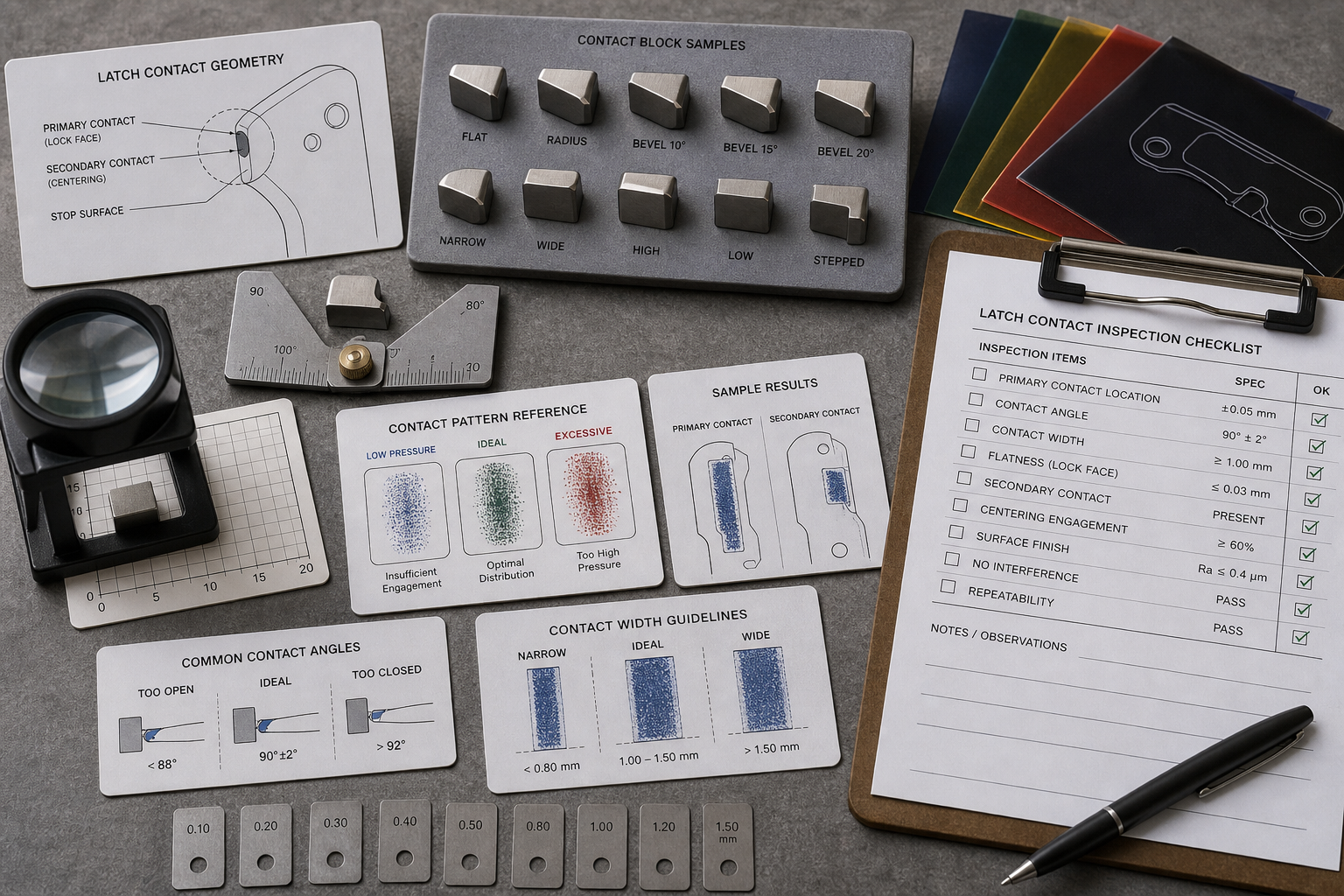
Buyers should review lock type, contact geometry, engagement depth, release feeling, vertical movement, side play, wear surface, and whether the lock can be assembled consistently at scale.
I Inspect Lock Contact as a Working Surface
Lock types can include liner lock, frame lock, back lock, button lock, crossbar-style lock, slip joint, and other structures. Each one has its own production logic. A liner lock depends on lock bar contact with the blade tang. A back lock depends on the fit between the lock bar and the blade notch. A button or crossbar-style structure depends on small moving parts and spring behavior. A slip joint is different because it does not provide the same lock behavior as a locking mechanism. I do not treat these names as quality levels. I treat them as structures that need proper geometry.
Lock engagement should be stable without feeling forced. I check whether the lock contacts too early or too late, whether there is vertical movement, whether the release feels clear, and whether the lock surface will remain consistent after repeated inspection cycles. If parts are hardened, the testing method must be controlled. The NIST Rockwell hardness measurement guide is useful because it explains that hardness measurement practice affects the reliability of test results. For knife production, hardness data should support process control, not become a decorative number in a report.
| Lock review point | What I inspect | Why it matters |
|---|---|---|
| Contact geometry | Tang and lock surface fit | Controls stable engagement |
| Engagement range | Early, middle, or late contact position | Affects buyer acceptance |
| Release feel | Ease and consistency of release | Affects user experience |
| Wear surface | Hardness and finish of contact area | Affects long-term feel |
Why Are Detent, Stop Pin, and Blade Centering Important?
Small details can create big complaints. Detent, stop pin, and centering problems are easy for buyers to notice.
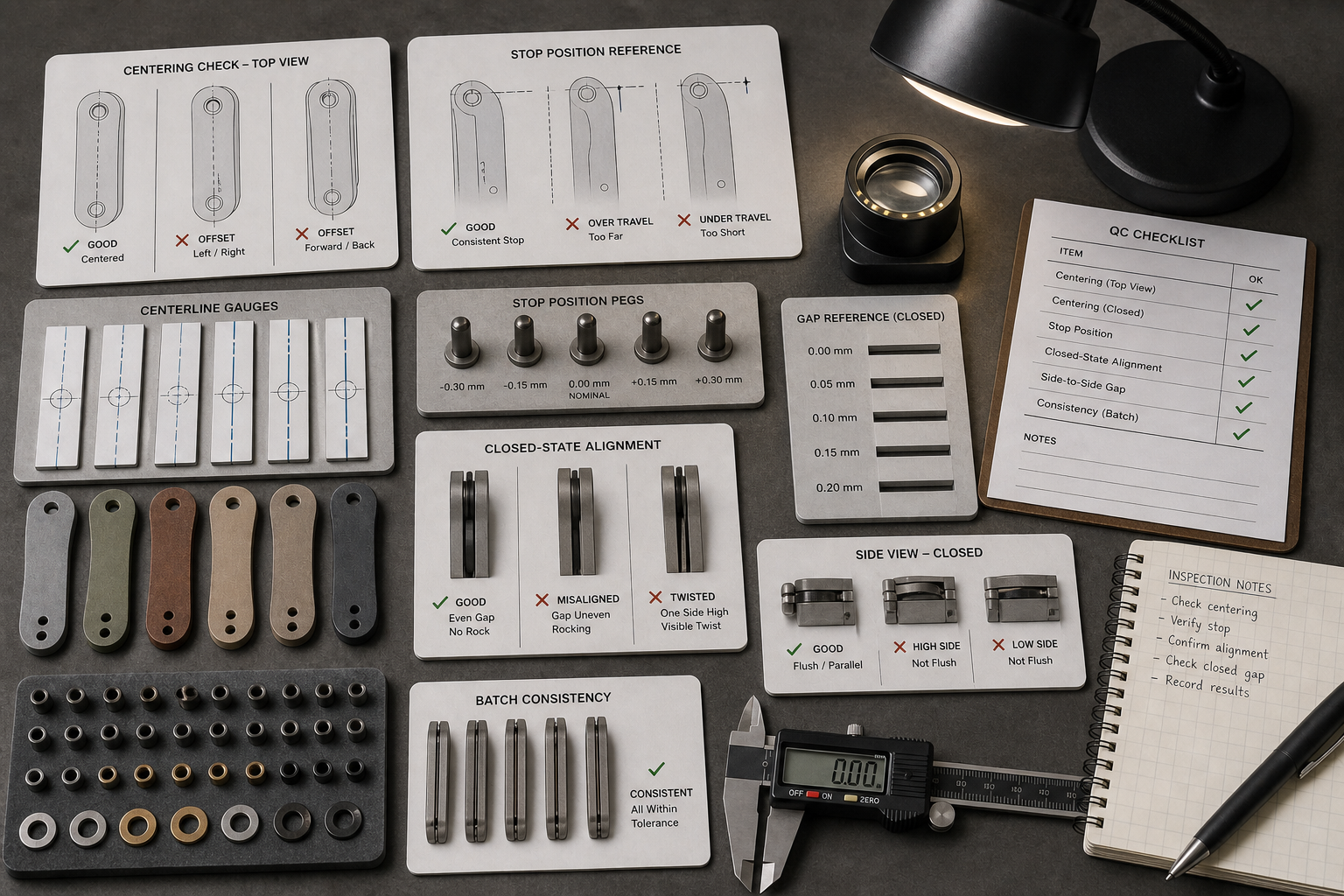
Detent, stop pin, and blade centering matter because they control closed security, opening feel, open stop position, blade alignment, tip safety inside the handle, and perceived quality.
I Use These Details to Read the Whole Mechanism
Detent, stop pin, and blade centering tell me a lot about the mechanism. If the detent is too weak, the closed blade may not feel secure enough. If it is too strong, opening can feel heavy or inconsistent. If the stop pin contact is not clean, the open position may shift. If the blade is not centered, the user may think the knife is poorly assembled even if the blade does not rub. These issues often come from tolerance stack-up, not one single mistake.
Blade centering can be affected by blade grinding, liner flatness, washer thickness, bearing seat depth, pivot fit, handle scale pressure, screw tension, and lock bar pressure. This is why I never fix centering by guessing. I inspect the full stack. I also compare several samples because one centered sample does not prove the production process. For B2B buyers, it is useful to define acceptance rules. For example, the blade should not rub the liner or handle, the tip should remain inside the handle when closed, the open stop should feel stable, and the detent should match the approved sample. Written rules save time during final inspection.
| Detail | What it controls | Inspection method |
|---|---|---|
| Detent | Closed feel and initial opening force | Compare with approved sample |
| Stop pin | Open stop and blade position | Check contact and movement |
| Centering | Closed blade alignment | Visual check and rub check |
| Tip position | Closed safety inside handle | Closed-state inspection |
How Should Screws, Torque, and Assembly Process Be Controlled?
Small screws can create large production problems. Loose, tight, or uneven assembly changes the whole mechanism.
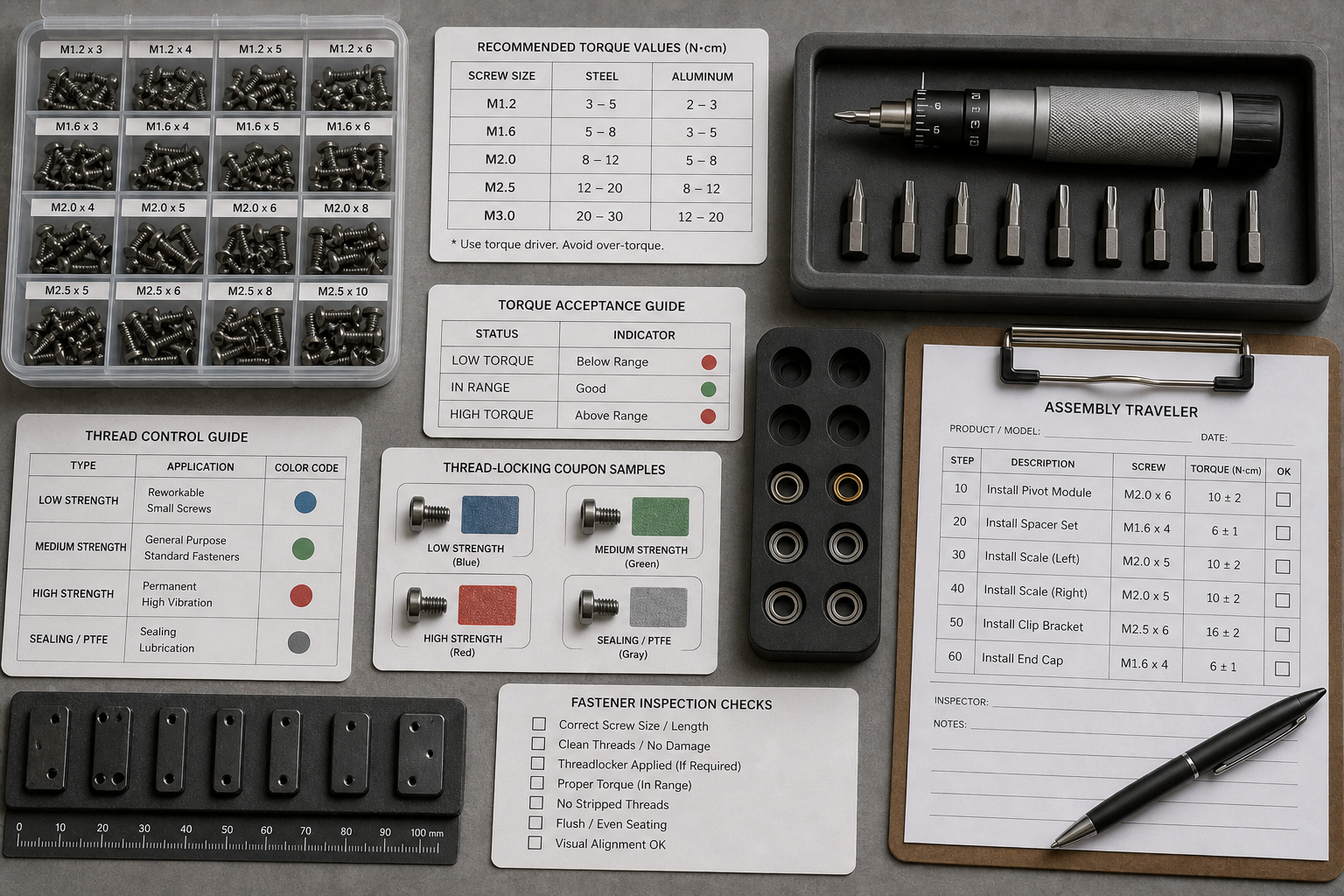
Screws, torque, and assembly should be controlled with defined tools, worker training, screw sequence, thread treatment, pivot adjustment rules, and final action inspection.
I Treat Assembly as a Repeatable Process
In folding knife production, assembly is not just putting parts together. The sequence matters. The pivot screw, body screws, backspacer, clip screws, washers, bearings, liner, and scales all affect the final feel. If workers tighten screws in different ways, the action may vary from piece to piece. If the pivot screw is adjusted by feel only, one worker may create a smooth knife and another may create side play. If thread treatment is overused, it can contaminate moving parts. If it is underused, screws may loosen during transport or use.
This is where controlled tools and work instructions help. The ISO page for ISO 6789-1 hand torque tools describes conformance testing and marking requirements for hand torque tools used for controlled tightening of screws and nuts. A knife factory does not need to turn every operation into a laboratory. But if the product depends on screws, a defined torque approach can reduce variation. I like to define assembly sequence, target feel, acceptable side play, action feel, and final inspection steps before mass production starts.
| Assembly control | What it prevents | Buyer benefit |
|---|---|---|
| Torque tool | Over-tightening or loose screws | More stable action feel |
| Screw sequence | Uneven liner and scale pressure | Better centering and fit |
| Thread treatment rule | Contamination or loosening | More consistent assembly |
| Final action check | Rough action or side play | Better shipment quality |
What QC Tests Should Folding Knife Mechanisms Pass?
One good prototype does not protect a full order. Mechanisms need inspection rules that production can repeat.
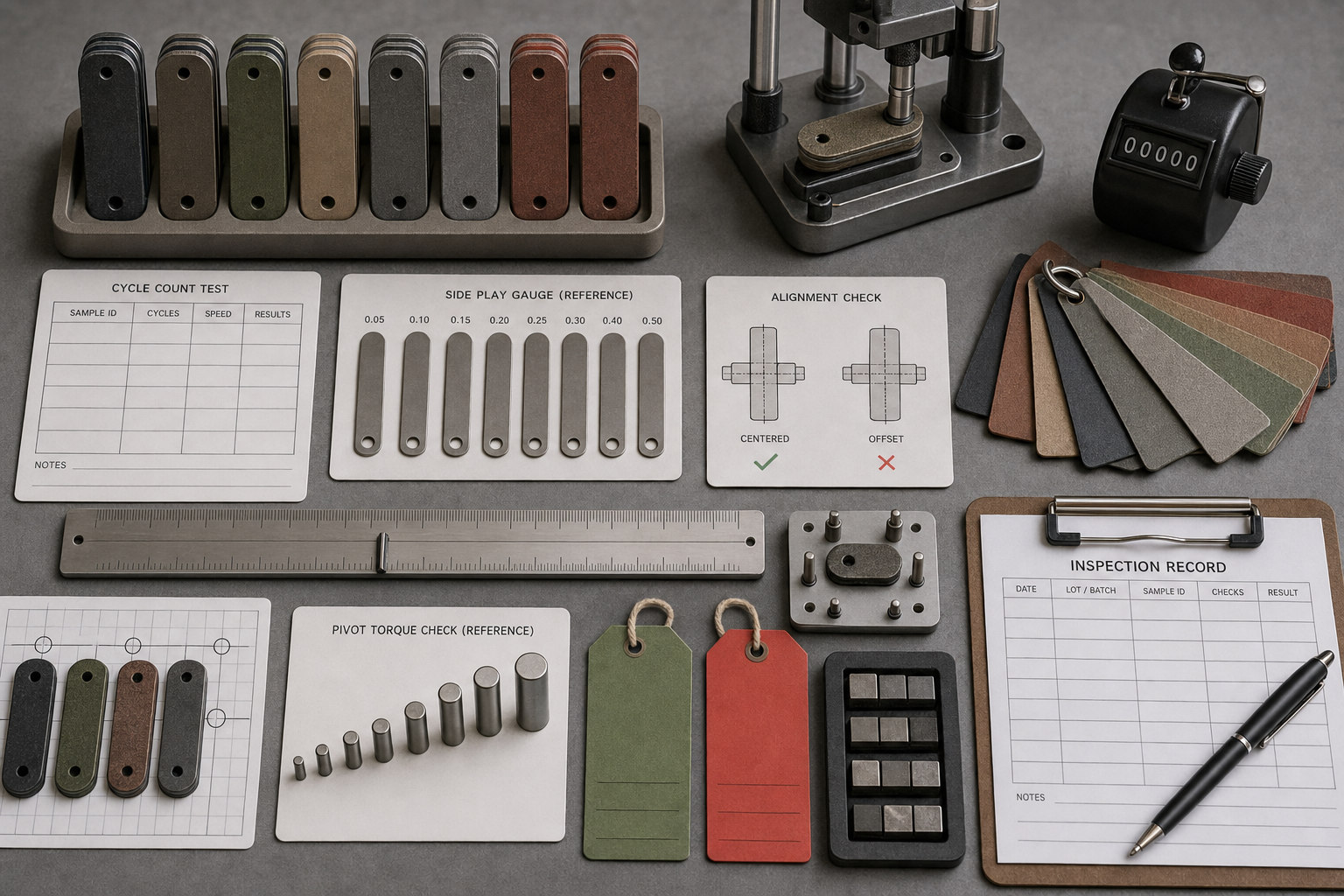
Folding knife mechanism QC should check opening feel, lock engagement, blade play, centering, closed tip position, screw security, surface finish, corrosion risk, packaging protection, and sample matching.
I Turn Mechanism Feel Into Written Acceptance Rules
Mechanism inspection has both measurable and judgment-based points. Hole diameter, screw height, pivot size, and blade centering can be inspected with tools or visual rules. Opening feel and lock release need trained comparison against the approved sample. I like to create a defect reference for serious issues: blade rub, obvious side play, lock not engaging, lock sticking badly, exposed tip in closed position, missing screw, loose screw, poor centering, and rough action. These rules help the QC team make the same decision across a lot.
For lot inspection, ISO 2859-1:2026 gives official context for AQL-indexed sampling inspection by attributes. It does not tell a knife buyer what defect limits to choose, but it supports the idea that lot inspection should be structured. Corrosion can also affect mechanisms, especially screws, liners, bearings, and springs. ISO 9227 salt spray tests give context for controlled corrosion checks on metallic materials and coatings. I use this type of source as a reference point when buyers need hardware corrosion review for humid or coastal markets.
| QC item | Acceptance focus | Record to keep |
|---|---|---|
| Opening feel | Smooth and close to approved sample | Function checklist |
| Lock engagement | Stable contact and release | Lock inspection record |
| Centering and play | No rub and no unacceptable movement | Visual and fit record |
| Hardware condition | No missing, loose, or corroded parts | Final inspection report |
How Can RFQ Details Help Suppliers Develop the Right Mechanism?
A vague RFQ can create the wrong mechanism. The supplier needs product goals before choosing structure.
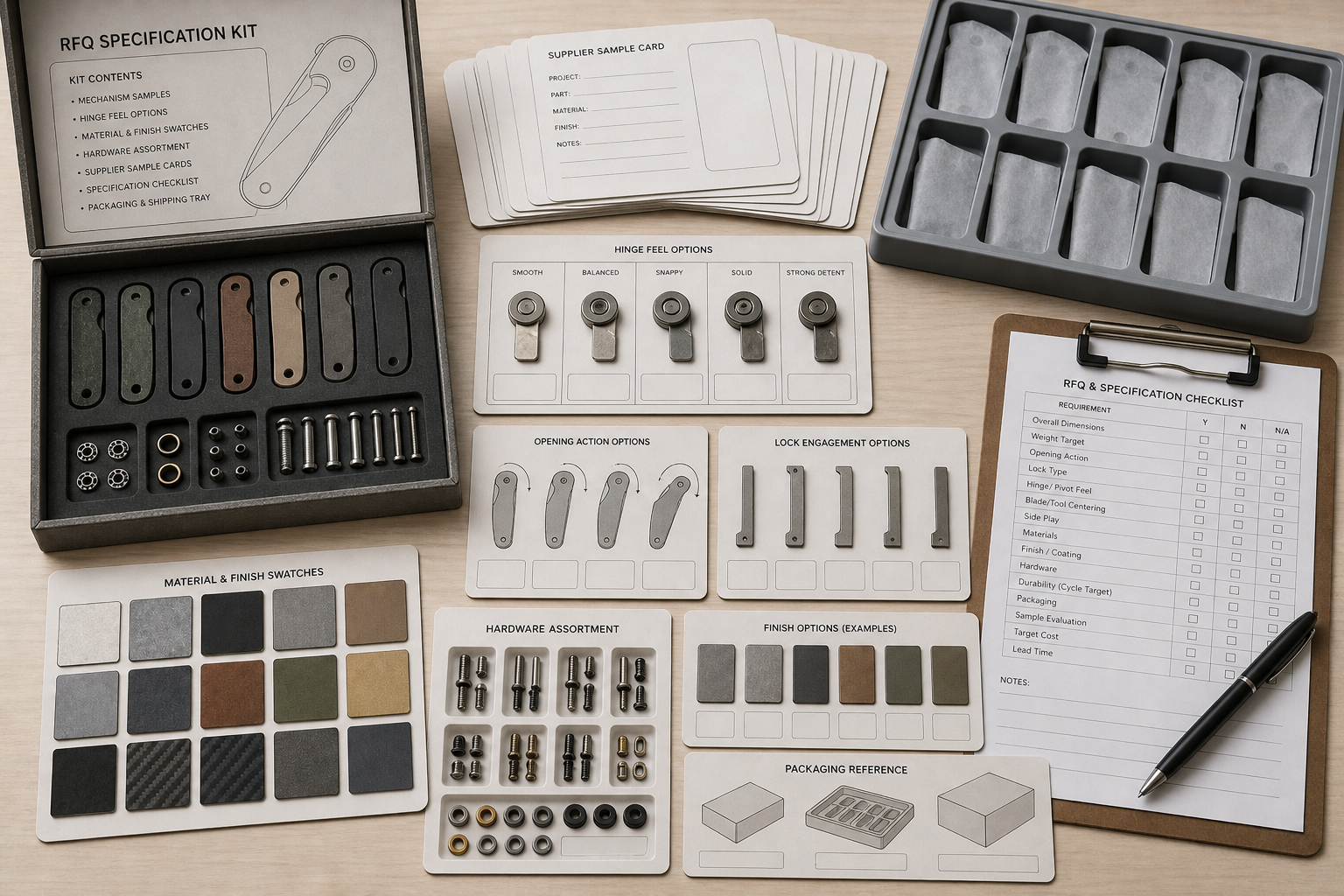
RFQ details should include knife type, opening style, lock type, blade size, handle material, target market, price range, MOQ, finish, packaging, inspection level, and any required sample tests.
I Quote Better When the Buyer Defines the Mechanism Goal
When a buyer asks for a folding knife quote, I need more than an overall length and blade steel. I need to know how the buyer wants the knife to open, what lock type they prefer, what product level they target, what market they sell into, and what price range they need. If the buyer already has a drawing, I review manufacturability. If the buyer only has a rough concept, I suggest a practical structure based on cost, function, and production risk.
The RFQ should also mention inspection requirements. Does the buyer need an action sample before tooling? Does the buyer want washer or bearing options compared? Does the buyer need screw torque rules, lock engagement photos, hardness records for key surfaces, corrosion review for hardware, or AQL final inspection? For a quality system mindset, ISO 9001 quality management supports the broader idea of customer requirements, process control, and continual improvement. In practical OEM/ODM work, this means the supplier should turn the buyer's mechanism goal into drawings, samples, process checks, and final inspection records.
| RFQ detail | Why it matters | Better buyer input |
|---|---|---|
| Opening structure | Controls pivot, washer, bearing, and access | Washer, bearing, or supplier suggestion |
| Lock type | Controls parts and QC points | Liner lock, back lock, button lock, or open option |
| Target market | Controls product level and cost | EDC, outdoor, retail, private label |
| Inspection need | Controls records and acceptance | Action check, lock check, AQL, photos |
Turn this article into a folding knife project.
Share your blade type, lock direction, steel preference, handle material, quantity, target market, and packaging needs. Vast State can prepare OEM/ODM options.
Conclusion
I evaluate folding knife mechanisms by checking every moving relationship, then turning the approved feel into repeatable assembly and QC rules.
Source Notes
- ISO 6789-1 supports the importance of controlled screw tightening tools where small fasteners affect assembly.
- NIST Rockwell hardness guidance supports the need for careful hardness measurement when hardened lock or tang surfaces are reviewed.
- ISO 2859-1:2026 supports structured lot-by-lot inspection by attributes.
- ISO 9227 supports corrosion test context for metallic hardware and coatings.
- NIOSH hand tool guidance gives general context for handle and hand-tool comfort, while ISO 9001 supports process and quality-system thinking.