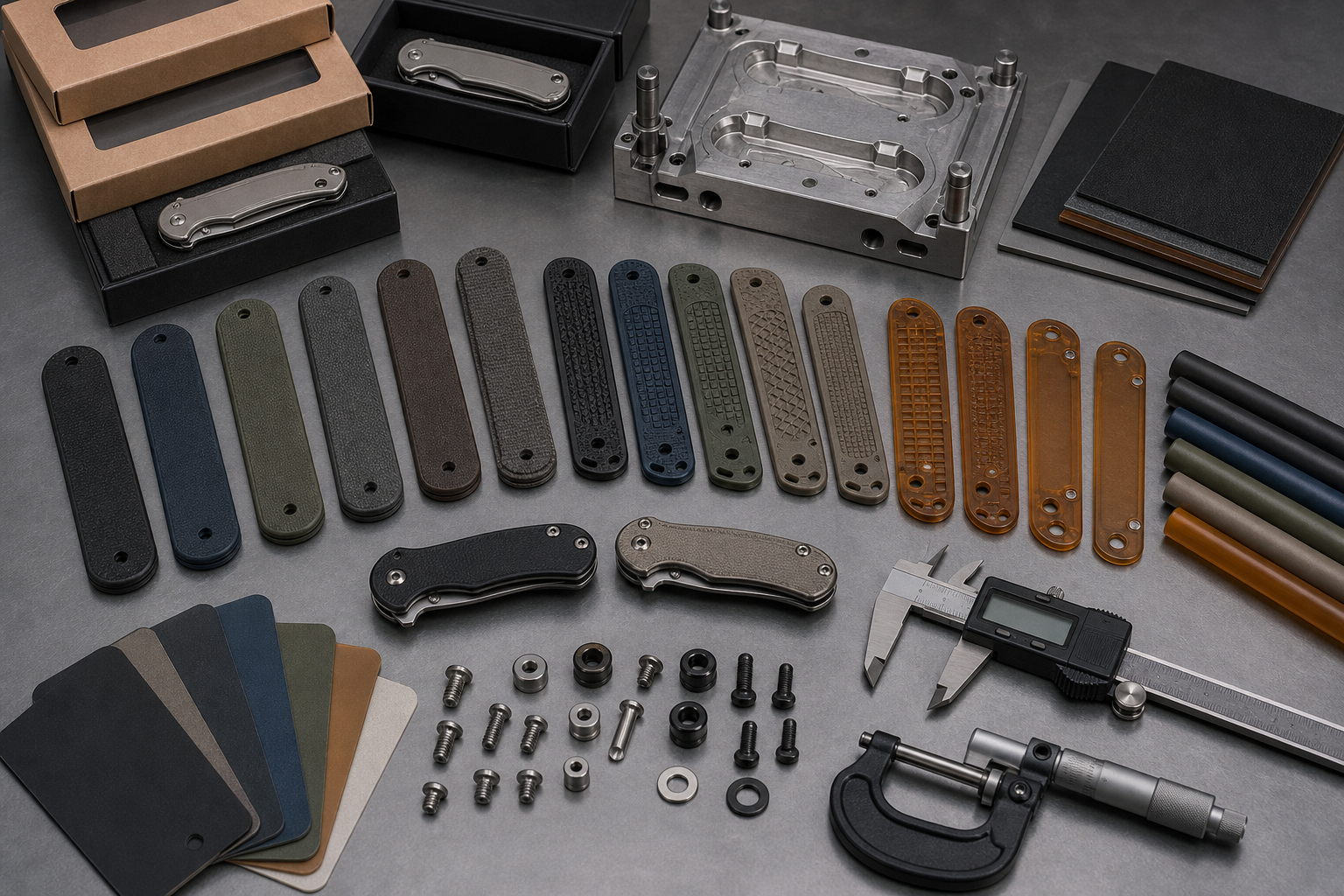
A handle material can look right in photos but fail in production. Cost, tooling, grip, color, and repeatability all matter.
OEM knife buyers should compare G10, Grivory, ULTEM, and FRN by production method first. G10 is usually CNC-machined from laminate sheet. Grivory and FRN-style polyamides usually fit injection-molded handles. ULTEM/PEI fits premium transparent or high-heat positioning when cost supports it.
Quick buyer brief:
- Answer: Choose G10 for machined grip, Grivory/FRN for molded volume, and ULTEM for special premium positioning.
- Buyer context: This helps knife brands, outdoor brands, importers, wholesalers, distributors, and private label buyers.
- Key checks: Product tier, tooling budget, MOQ, material cost, grip texture, mold design, machining dust, color control, screw fit, and quality inspection.
When buyers ask me about G10 vs Grivory vs ULTEM vs FRN, I first separate sheet materials from molded materials. This is the point many early projects miss. G10 is usually selected when the buyer wants machined handle scales with strong grip and familiar knife-market appeal. Grivory and FRN-style materials are usually selected when the buyer wants injection-molded handles, lower part weight, texture from the mold, and better unit cost at volume. ULTEM, which is SABIC's PEI material family, is more of a special-positioning material. It can look distinctive, but it must match price, design, and buyer expectation.
What Should Buyers Decide Before Comparing These Handle Materials?
Material names can distract buyers. If the production method is unclear, the quote will be unclear and the sample may not match the business goal.
Buyers should decide the knife type, target price, order quantity, production method, tooling budget, handle texture, color, liner structure, clip design, packaging story, and inspection standard before choosing G10, Grivory, ULTEM, or FRN.
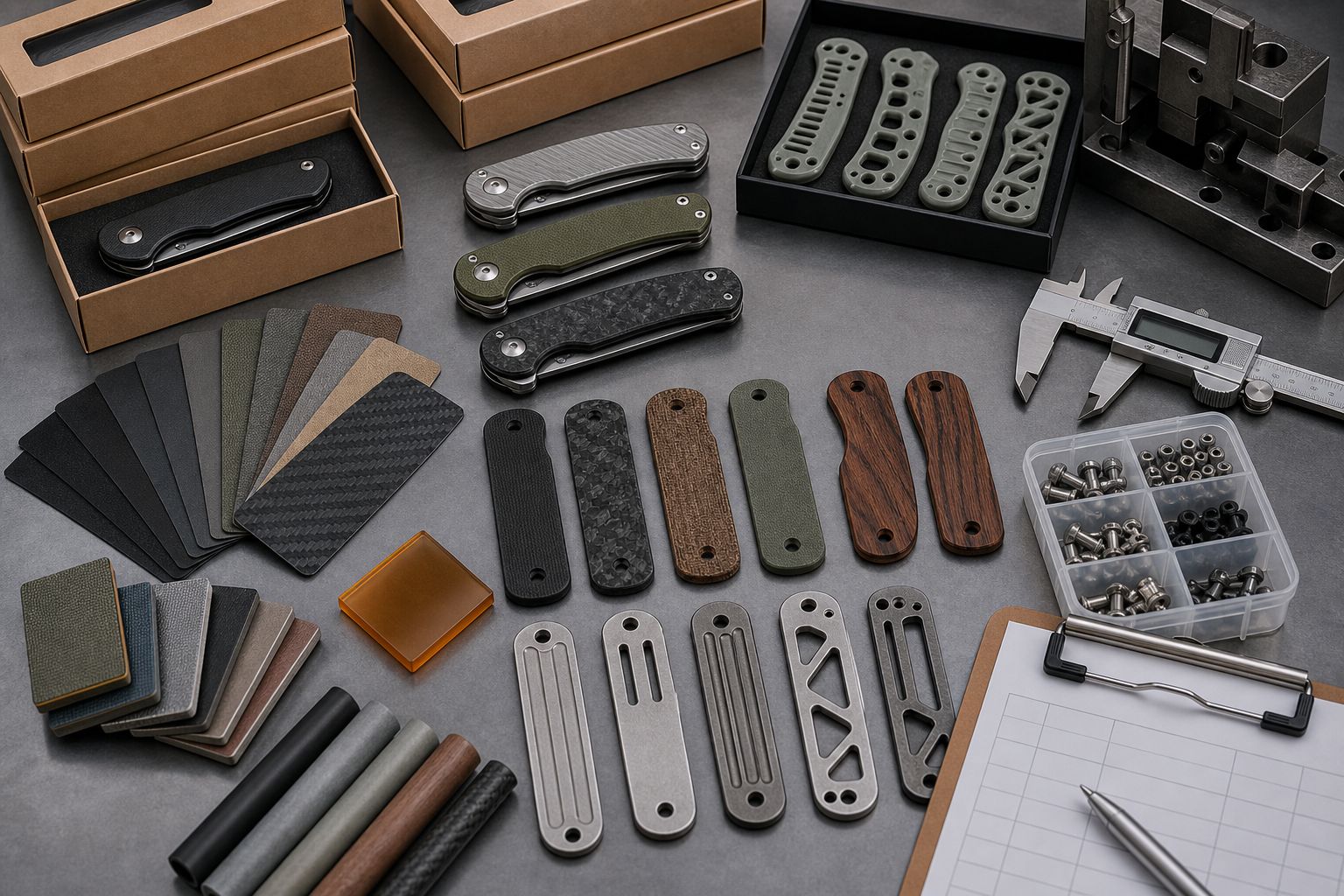
I Start With Process, Not Popularity
The first question is not "Which material is best?" The first question is "How will this handle be made?" G10 is normally cut and CNC-machined from laminate sheet. That works well for lower MOQ, custom colors, textured scales, and designs that need quick sampling without injection tooling. The buyer pays more for machining time, but avoids mold cost.
Grivory and FRN-style materials are different. They are usually injection-molded polyamide materials. They can make sense when the buyer has enough quantity to support tooling and wants lighter molded handles, integrated texture, thinner ribs, molded clip features, or a consistent shape across large runs. But mold design must be correct, because mold changes can be expensive.
ULTEM/PEI sits in another position. SABIC describes ULTEM resin as an amorphous PEI family with elevated thermal resistance, strength, stiffness, dimensional stability, and broad chemical resistance. In knife handles, buyers often notice its amber translucent look. That look can sell, but it should not be the only reason to choose it.
For Vast State projects, I ask buyers to define product tier first. A cost-sensitive catalog knife and a premium EDC knife need different material logic.
| Decision point | Why it matters | Practical direction |
|---|---|---|
| Production method | Controls tooling and unit cost | CNC sheet or injection molding |
| MOQ | Controls whether mold cost makes sense | Lower MOQ often favors G10 |
| Product tier | Controls material story and price | ULTEM needs a clear premium reason |
| Handle structure | Controls liner, screw, and clip fit | Confirm stack-up before sampling |
When Is G10 the Better Choice for OEM Knife Handles?
G10 is familiar and practical, but it is not automatically cheap. Deep texture, complex contours, and tool wear can raise cost.
G10 is better when buyers need machined handle scales, strong stiffness, grip texture, color flexibility, lower tooling risk, and easier custom sampling for folding knives, pocket knives, and outdoor tools.
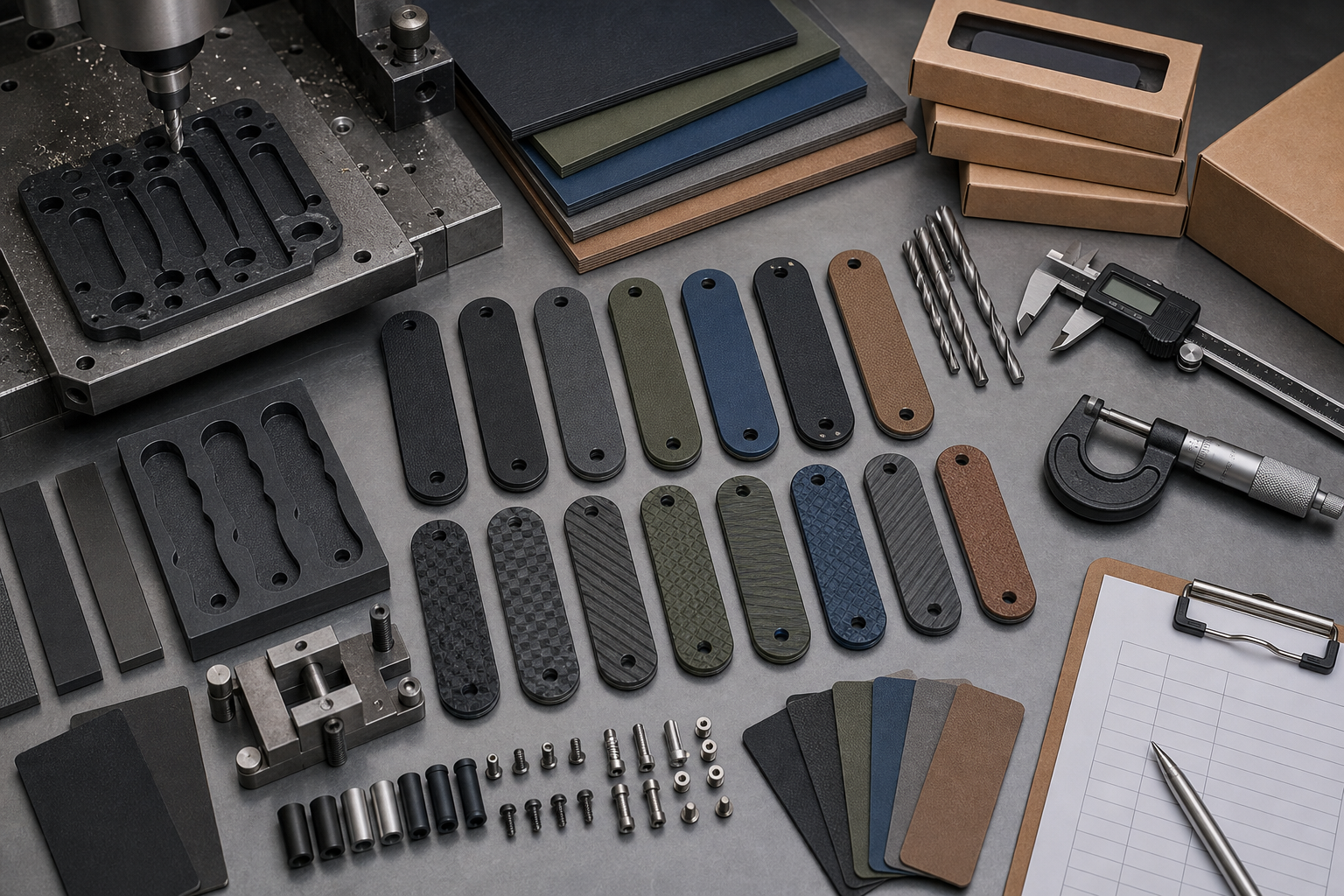
I Use G10 When the Buyer Needs Flexible Customization
G10/FR-4 is a glass fabric and epoxy resin composite. Curbell Plastics describes it as strong, stiff, dimensionally stable, and useful for high-strength mechanical parts. For knife handles, that means G10 can support a solid feeling without metal weight. It can also be machined with different textures, edge breaks, chamfers, grooves, layers, and colors.
I often use G10 when the buyer wants a practical custom folding knife without investing in injection tooling. A buyer can sample black G10, colored G10, layered G10, or textured G10 faster than a molded polymer handle. This helps early OEM/ODM development because the product can change after sample feedback. If the grip is too aggressive, we can adjust the CNC texture. If the edge feels sharp, we can change the radius. If the color is not right, we can approve another sheet.
The downside is machining cost and dust. Curbell notes that G10/FR-4 can be abrasive on cutting tools and that dust can be irritating during machining. That matters in real production. Tool wear, dust control, surface cleanup, and edge finishing are part of the cost. Buyers should not compare raw sheet price only.
For mid-range and rugged EDC knives, G10 remains very practical. It has a strong knife-market meaning and a clear buyer story: grippy, tough-feeling, customizable, and familiar.
| G10 factor | Buyer benefit | Production concern |
|---|---|---|
| CNC machining | Flexible samples and custom texture | More machining time per piece |
| High stiffness | Solid handle feel | Edge comfort still needs finishing |
| Color options | Private label styling | Physical sample approval is needed |
| Glass epoxy laminate | Strong and stable | Tool wear and dust control matter |
When Do Grivory and FRN-Style Materials Make More Sense?
Molded handles can reduce unit cost, but only when the project has enough quantity and a stable design.
Grivory and FRN-style glass-reinforced polyamides make sense when buyers need injection-molded handles, light weight, integrated texture, consistent shape, lower unit cost at volume, and design freedom after tooling approval.
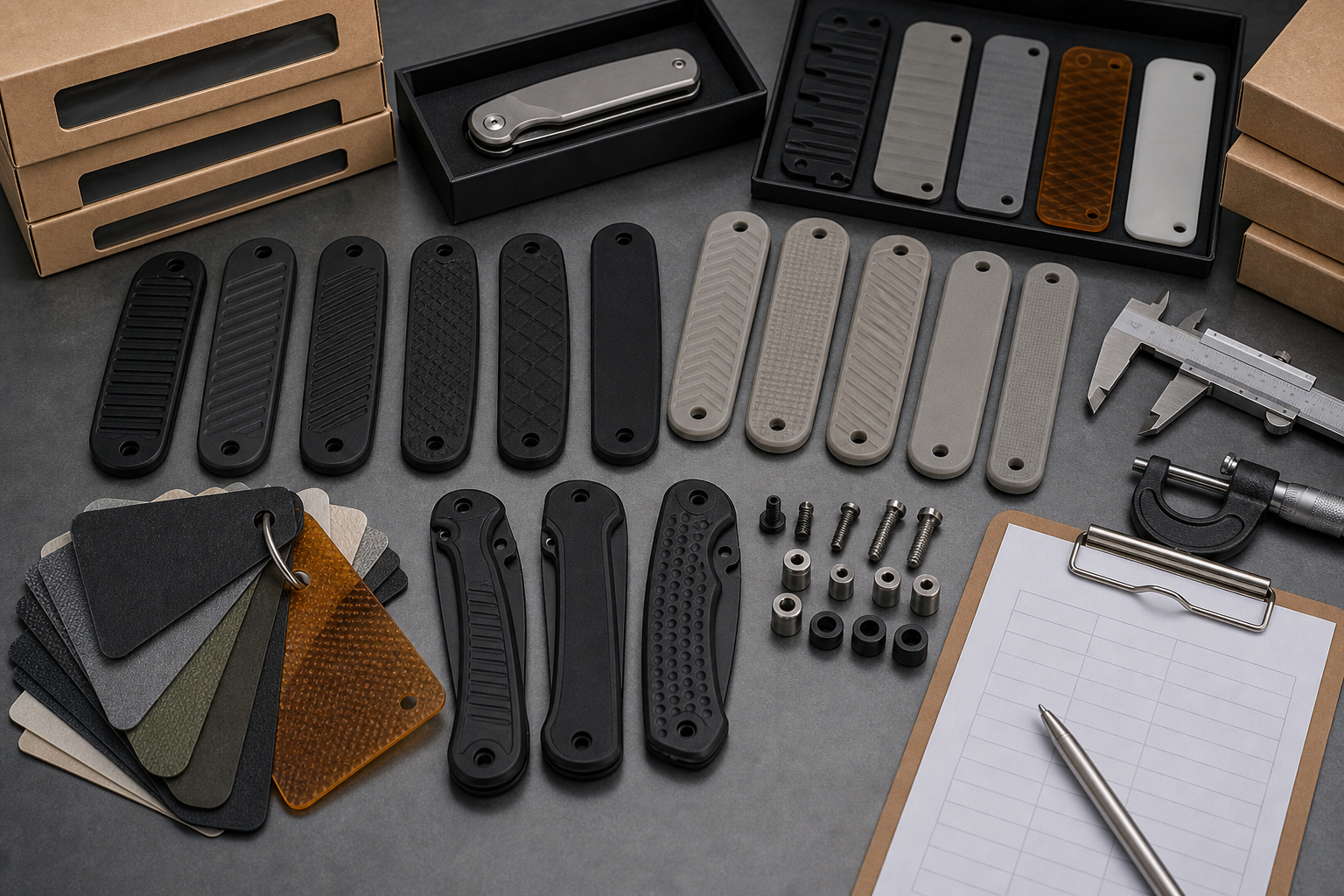
I Use Molded Polyamide When Volume Can Pay for Tooling
FRN in the knife market usually means fiber-reinforced nylon. It is a market term, not one exact resin grade. It can include glass-filled nylon or similar reinforced polyamide materials. BASF's Ultramid page describes glass-fiber reinforced polyamide grades as having high mechanical strength, hardness, rigidity, heat stability, dimensional stability, and high creep strength. That gives useful background for FRN-style handle thinking.
Grivory is more specific. EMS-GRIVORY describes Grivory GV as a partially aromatic polyamide supplied in granulate form for injection molding or extrusion. The company highlights high stiffness and strength, little change after moisture absorption, low water absorption, dimensional stability, low warpage, chemical resistance, good surface quality, and economical production. These points explain why Grivory can be attractive for molded knife handles.
In OEM work, molded materials make sense when the buyer wants a lightweight handle with a repeatable shape. Molded texture can be built directly into the tool. Ribs can add stiffness without a heavy solid slab. Screw bosses, clip pads, and liner pockets can be designed into the part. Once the mold is stable, unit cost can be attractive at volume.
But the risk is tooling. If the buyer changes the screw location, handle contour, texture, or clip after mold approval, changes can be slow and costly. I recommend molded handles only when the design is mature or the order quantity justifies the tooling path.
| Material path | Best fit | Buyer watch point |
|---|---|---|
| Grivory | Molded structural handle parts | Grade selection and mold design |
| FRN-style polyamide | Lightweight molded handles | Resin grade and fiber content |
| Molded texture | Consistent grip at volume | Texture must be approved before tooling |
| Integrated ribs | Stiffness with lower weight | Part design must avoid warpage |
When Does ULTEM or PEI Fit a Knife Handle Project?
ULTEM can create strong visual interest. But a distinctive look does not automatically create a better business case.
ULTEM/PEI fits knife handles when buyers want a premium or special visual story, good dimensional stability, elevated thermal performance, chemical resistance, and a translucent or technical appearance that the market will pay for.
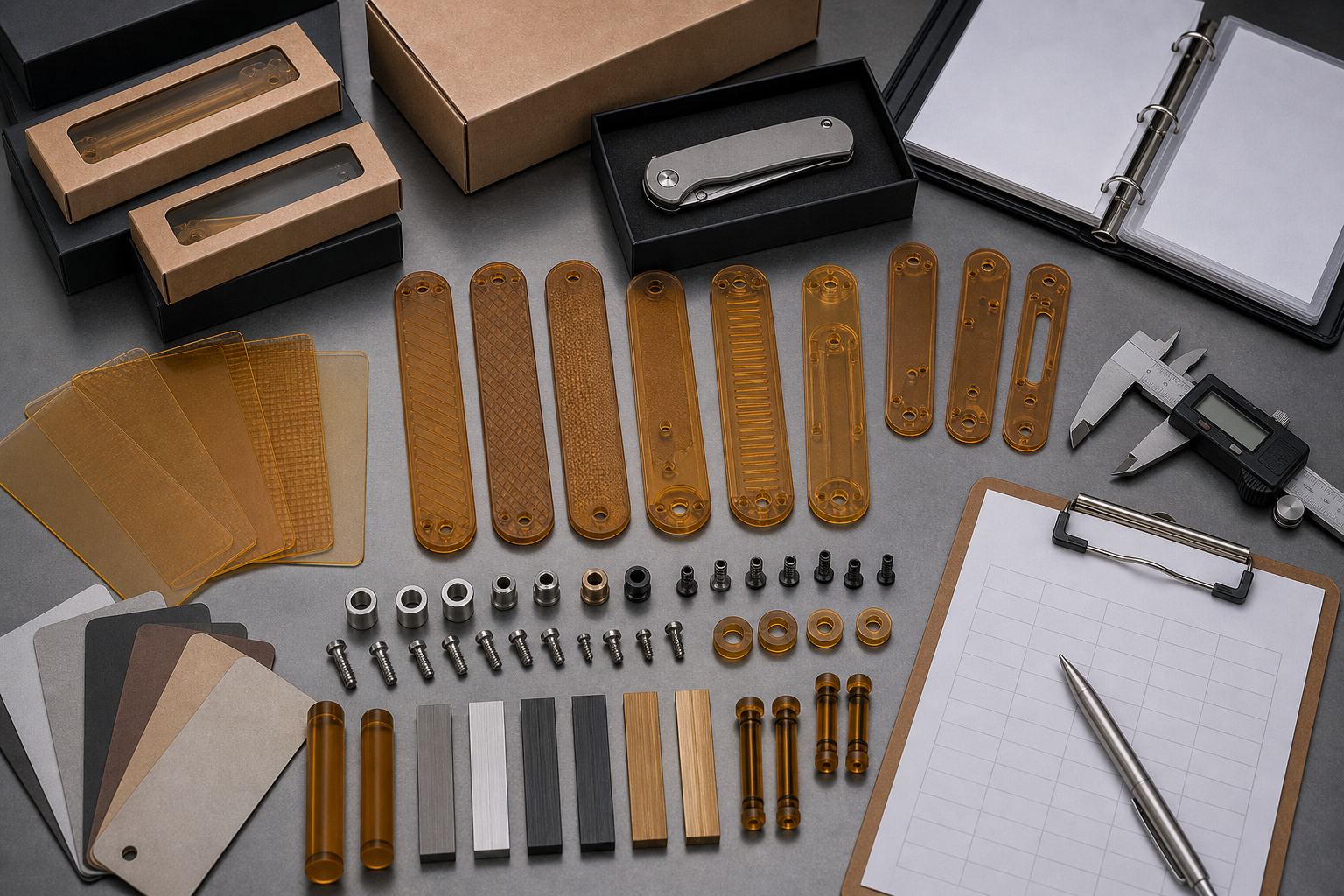
I Treat ULTEM as a Design Statement
ULTEM is SABIC's PEI resin family. SABIC states that ULTEM resins offer elevated thermal resistance, high strength and stiffness, broad chemical resistance, dimensional stability, and processability. SABIC also notes that ULTEM resins are available in transparent and opaque custom colors, as well as glass-filled grades. For knife buyers, the most visible point is often the translucent amber look. That can create a modern, technical, and collectible product feel.
However, I do not suggest ULTEM only because it looks different. A knife handle must still feel comfortable, hold screws correctly, resist cracking around holes, match the lock and liner structure, and make sense for the price. If the buyer wants a budget knife, ULTEM may be too expensive or too difficult to explain. If the buyer wants a premium EDC knife, a transparent or translucent PEI handle can support a distinct story.
ULTEM also requires careful product communication. Some buyers use "Ultem" loosely to describe any amber PEI-like material. For B2B projects, that is risky. If the buyer needs genuine SABIC ULTEM material, the RFQ should say so clearly and ask for material confirmation. If the buyer accepts generic PEI, the supplier should state that clearly. The product page should not make a brand claim unless the material is confirmed.
| ULTEM/PEI factor | Buyer benefit | Production concern |
|---|---|---|
| Translucent look | Strong visual identity | Must match brand and price tier |
| Dimensional stability | Supports technical positioning | Screw-hole design still matters |
| High-heat resin story | Useful for premium copy | Avoid unsupported material claims |
| Custom colors and grades | More design options | Grade confirmation is important |
How Do Tooling, MOQ, and Cost Change the Material Choice?
The same handle design can look affordable or expensive depending on process. Buyers need to compare total cost, not only material names.
Tooling and MOQ often decide the handle material. G10 has lower tooling risk but higher per-piece machining. Grivory and FRN need mold investment but can reduce unit cost at volume. ULTEM needs premium pricing or special positioning.
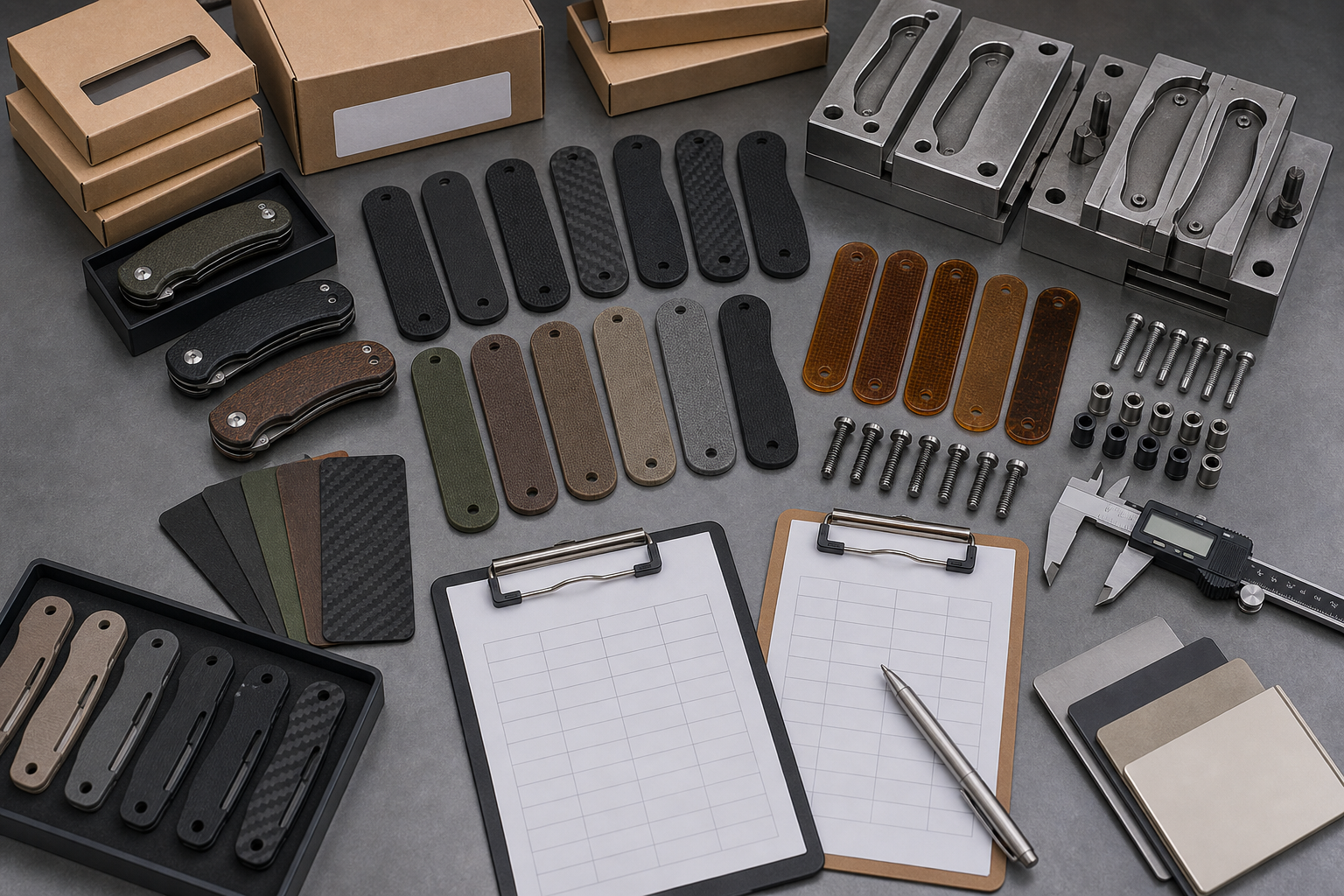
I Compare the Full Manufacturing Path
Material selection can mislead buyers when tooling and MOQ are ignored. G10 may cost more per part because every scale needs cutting, drilling, CNC texture, edge finishing, and inspection. But it can be easier for small batches and custom development because there is no expensive injection mold. That makes G10 strong for sampling, limited runs, and private label projects with moderate quantity.
Grivory and FRN-style materials can be more efficient after tooling is complete. The mold can create shape, texture, ribs, screw bosses, and internal features in one process. This can reduce assembly work and weight. But the buyer must pay for tooling, wait for mold development, and approve the texture and structure before mass production. Molded handles are less forgiving when the design changes late.
ULTEM/PEI can be machined or molded depending on the project, grade, and sourcing route. It often needs a stronger product story because buyers may pay more for the material and visual effect. The cost must be recovered through retail price or brand positioning.
For B2B buyers, I suggest making a two-path comparison. Path one: G10 CNC handle with lower tooling risk. Path two: molded FRN or Grivory handle with tooling but better volume logic. If the premium story matters, add ULTEM as a third option.
| Cost factor | G10 | Grivory / FRN | ULTEM / PEI |
|---|---|---|---|
| Tooling | Low to moderate | Higher mold cost | Depends on machining or molding |
| Unit cost at volume | Higher machining content | Better after mold approval | Often premium |
| Design changes | Easier before production | Harder after tooling | Depends on process |
| Best quantity logic | Small to mid runs | Mid to large runs | Premium or special runs |
What Quality Risks Should Buyers Check Before Mass Production?
Handle problems often look small at first. Later they affect blade centering, screw tightness, comfort, packaging, and customer trust.
Buyers should check scale thickness, flatness, texture, color, screw fit, clip fit, liner fit, warpage, edge comfort, logo position, and assembly performance before approving mass production.
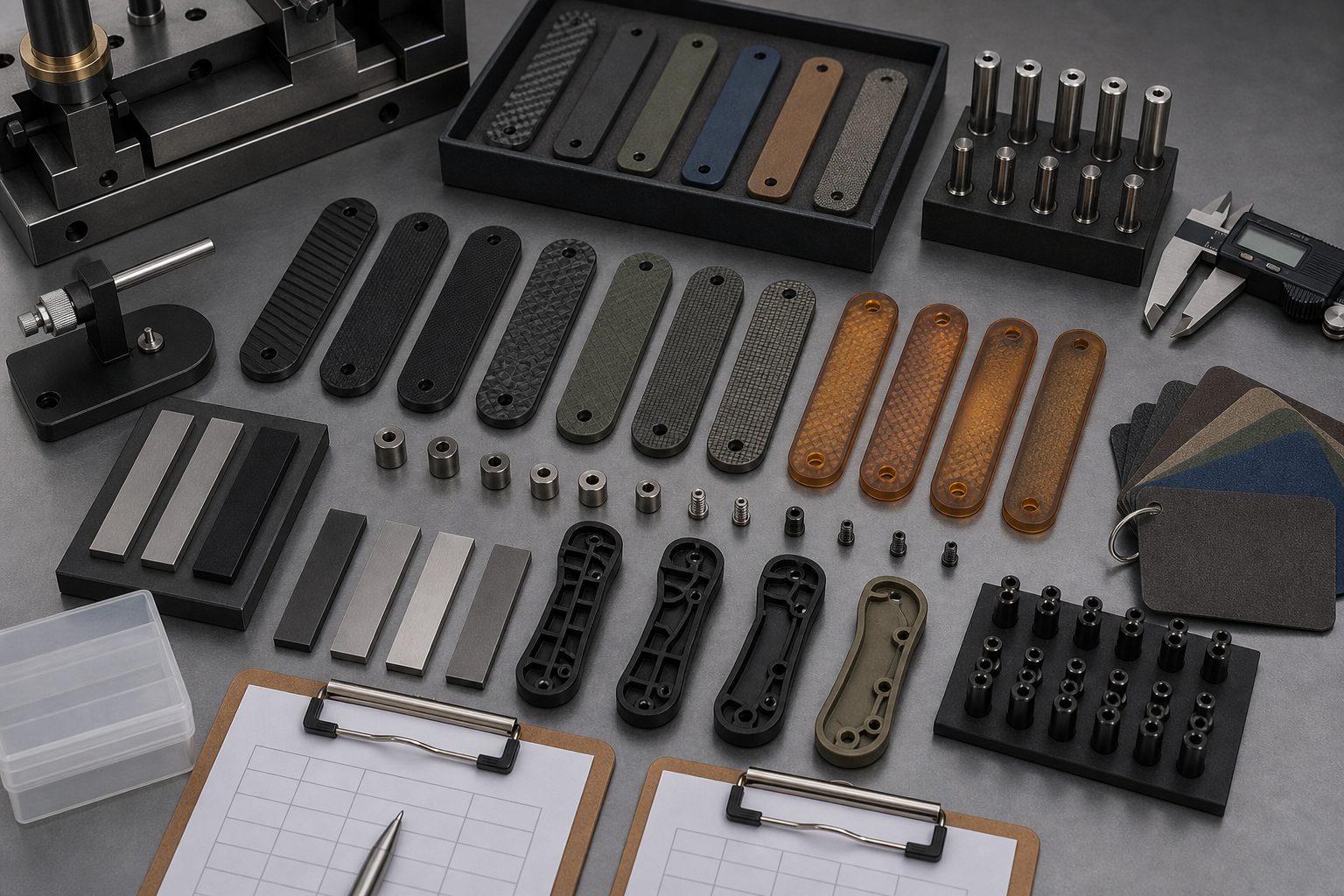
I Inspect the Handle as Part of the Knife System
A handle is not accepted when the material arrives. It is accepted when the assembled knife works correctly. For a folding knife, handle thickness can affect screw length, pivot stack-up, liner support, blade centering, and clip fit. For a fixed blade, handle material affects bonding, pin fit, contour comfort, and edge finishing. For a multi-tool, handle or scale material can affect screw positions and part clearance.
Each material has its own risks. G10 can chip at edges or around holes if machining is rushed. It can also have irritating dust during cutting, so the factory should use proper dust control and finishing. OSHA's synthetic mineral fiber page gives general workplace context for glass-fiber exposure control, which supports the need for process care. Molded Grivory or FRN-style handles can warp if part design, gate position, cooling, or fiber orientation is not controlled. ULTEM/PEI can look attractive but still needs screw-hole strength and finish approval.
I also check visual consistency. G10 color, molded polymer color, ULTEM transparency, texture depth, and logo placement must match the approved sample. The buyer should approve physical samples, not only photos. The inspection checklist should include function and appearance together.
This is where a process mindset helps. ISO 9001 is useful as a quality-management reference because it focuses on customer requirements, process control, performance evaluation, and improvement. For handle materials, that means the approved sample and inspection plan should guide production.
| Quality risk | Where it appears | Control point |
|---|---|---|
| Thickness variation | Assembly and blade centering | Incoming and in-process measurement |
| Warpage | Molded handles and liners | Mold design and cooling control |
| Texture mismatch | Grip and product appearance | Physical sample approval |
| Screw-hole weakness | Clip, liner, and pivot areas | Hole design and torque checks |
| Color variation | Brand consistency | Batch approval and final inspection |
What Should Buyers Put in the RFQ for G10, Grivory, ULTEM, or FRN?
A material name is not enough for a real quotation. The supplier needs product, process, and inspection details.
The RFQ should include knife type, target market, target price, MOQ, handle material options, production method, tooling budget, texture, color, thickness, liner structure, screw details, logo method, packaging, and inspection requirements.
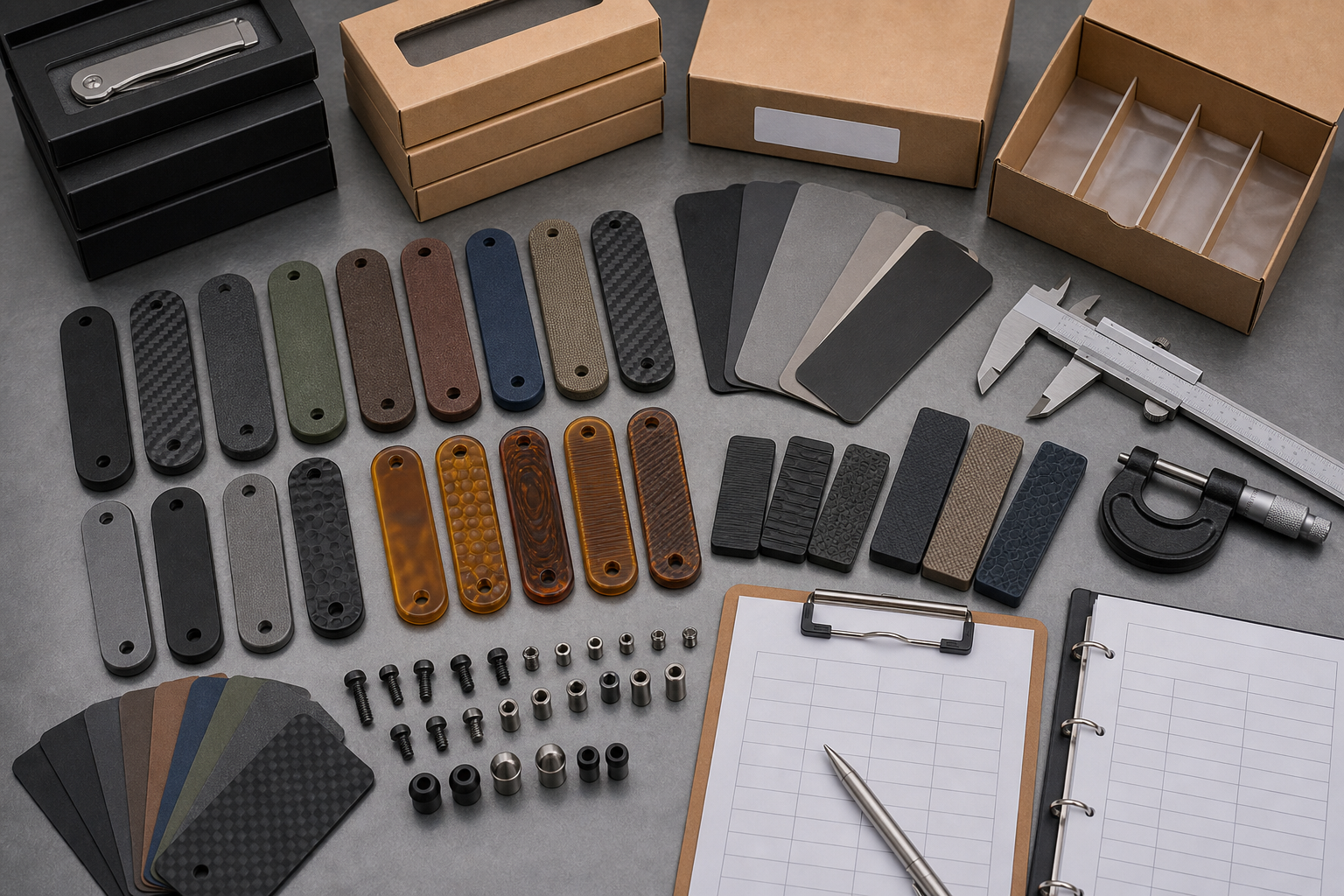
I Ask for Both a Material Option and a Production Option
The strongest RFQ does not simply ask for "G10 or FRN." It asks the supplier to compare production paths. For example, a buyer can request one CNC-machined G10 option and one injection-molded FRN or Grivory option. If the buyer wants a premium version, the RFQ can request an ULTEM/PEI option with clear material confirmation. This lets the buyer compare tooling cost, unit cost, MOQ, sample timeline, and product story.
The RFQ should also define handle details. For G10, I need color, thickness, texture, contour, screw hole design, and finish. For Grivory or FRN, I need mold expectations, target texture, reinforcement level if known, color, part stiffness, liner needs, and expected quantity. For ULTEM, I need to know whether the buyer requires genuine SABIC ULTEM or accepts generic PEI. That difference matters for sourcing and product claims.
Packaging should not be ignored. A G10 handle may be described as machined glass epoxy laminate. A molded FRN handle may be described as lightweight reinforced nylon. A Grivory handle may support a technical polymer story if the material is confirmed. ULTEM/PEI may support a premium transparent technical look. The final wording should be true, simple, and approved by the buyer.
At Vast State, I use this information to recommend the most practical route. Sometimes the best answer is not the most interesting material. It is the material that fits the buyer's cost, MOQ, market, and quality target.
| RFQ field | What to include | Why it helps |
|---|---|---|
| Material options | G10, Grivory, FRN-style PA, ULTEM/PEI | Enables real comparison |
| Production method | CNC machining or injection molding | Clarifies tooling and unit cost |
| Handle details | Thickness, texture, color, holes, liner structure | Prevents vague pricing |
| Material claim | Brand-name resin or generic category | Avoids unsupported product copy |
| Inspection needs | Fit, color, warpage, screw strength, texture | Protects repeat production |
Conclusion
I compare G10, Grivory, ULTEM, and FRN by process, price, quantity, and product fit. The best material is the one production can repeat.
Source Notes
- Curbell G10/FR-4 supports G10's glass epoxy structure, stiffness, dimensional stability, and machining cautions.
- EMS-GRIVORY Grivory GV supports Grivory's stiffness, strength, lower moisture influence, dimensional stability, low warpage, surface quality, and injection-molding context.
- EMS-GRIVORY LFT polyamides supports long-fiber reinforced polyamide guidance and molded structural-material context.
- SABIC ULTEM resin supports ULTEM/PEI thermal, strength, stiffness, dimensional stability, chemical-resistance, color, and glass-filled-grade discussion.
- BASF Ultramid supports generic glass-fiber reinforced polyamide context for FRN-style materials.
- OSHA synthetic mineral fibers gives workplace exposure-control context for fiber-related dust.
- ISO 9001 supports the quality-management and repeatable process-control discussion.