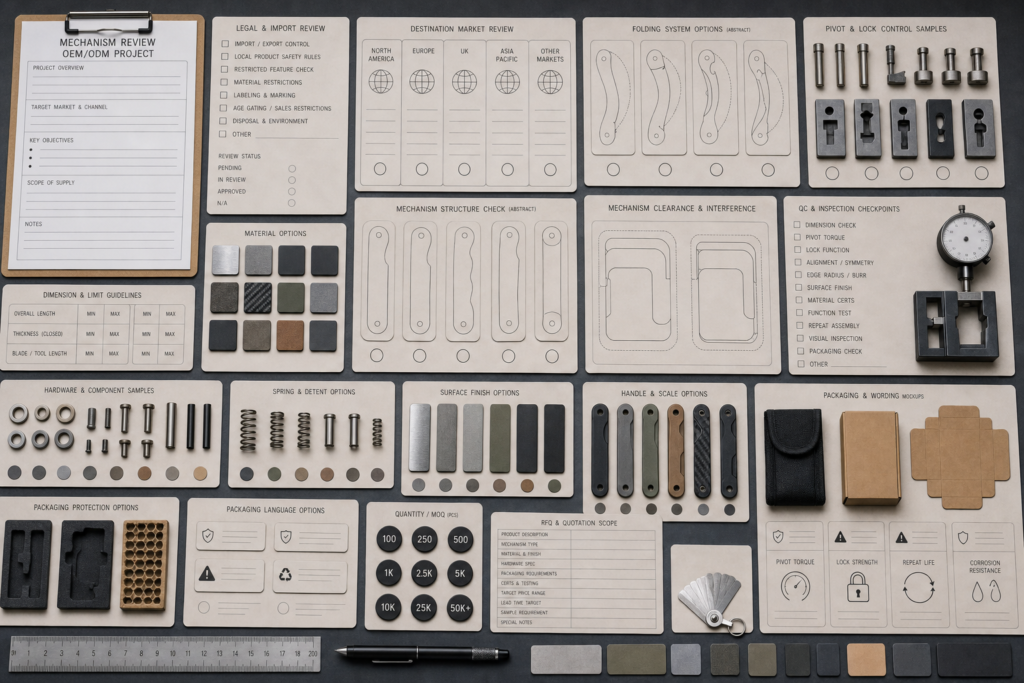
A gravity knife idea can look simple, but the mechanism can create serious market risk. I treat it as a legal-review and engineering-control project.
Buyers should evaluate gravity knife projects by confirming destination rules, import limits, mechanism design, lock and pivot structure, material choice, packaging language, QC checks, and RFQ details. This is a B2B manufacturing guide, not legal advice or user instruction.
Quick buyer brief:
- Answer: Treat gravity knife projects as mechanism-sensitive OEM/ODM programs.
- Buyer context: This helps brands and importers avoid unclear sourcing decisions.
- Key checks: Legal review, opening system, bias toward closure, lock safety, QC, packaging, and RFQ scope.
Planning a private-label knife line for this market?
Use this article as an early planning reference, then prepare your target market, product category, labeling needs, and buyer-specified compliance requirements before production.
When a buyer asks me about a gravity knife project, I slow the conversation down. The main issue is not whether a sample can be made. The real issue is whether the mechanism, product language, target market, and import route can be reviewed responsibly. This article is not legal advice. It is a practical OEM/ODM sourcing guide for buyers who want to evaluate a mechanism-sensitive knife project before sample cost, tooling, packaging, and production follow-up begin.
What Does "Gravity Knife" Mean in a B2B Sourcing Project?
A product name can hide the real risk. If the buyer and factory define it differently, the sample may move in the wrong direction.
In B2B sourcing, a gravity knife project means a folding knife concept where blade movement and lock release need careful legal, mechanical, and quality review. I define the mechanism first, then decide whether the project is suitable for the target market.
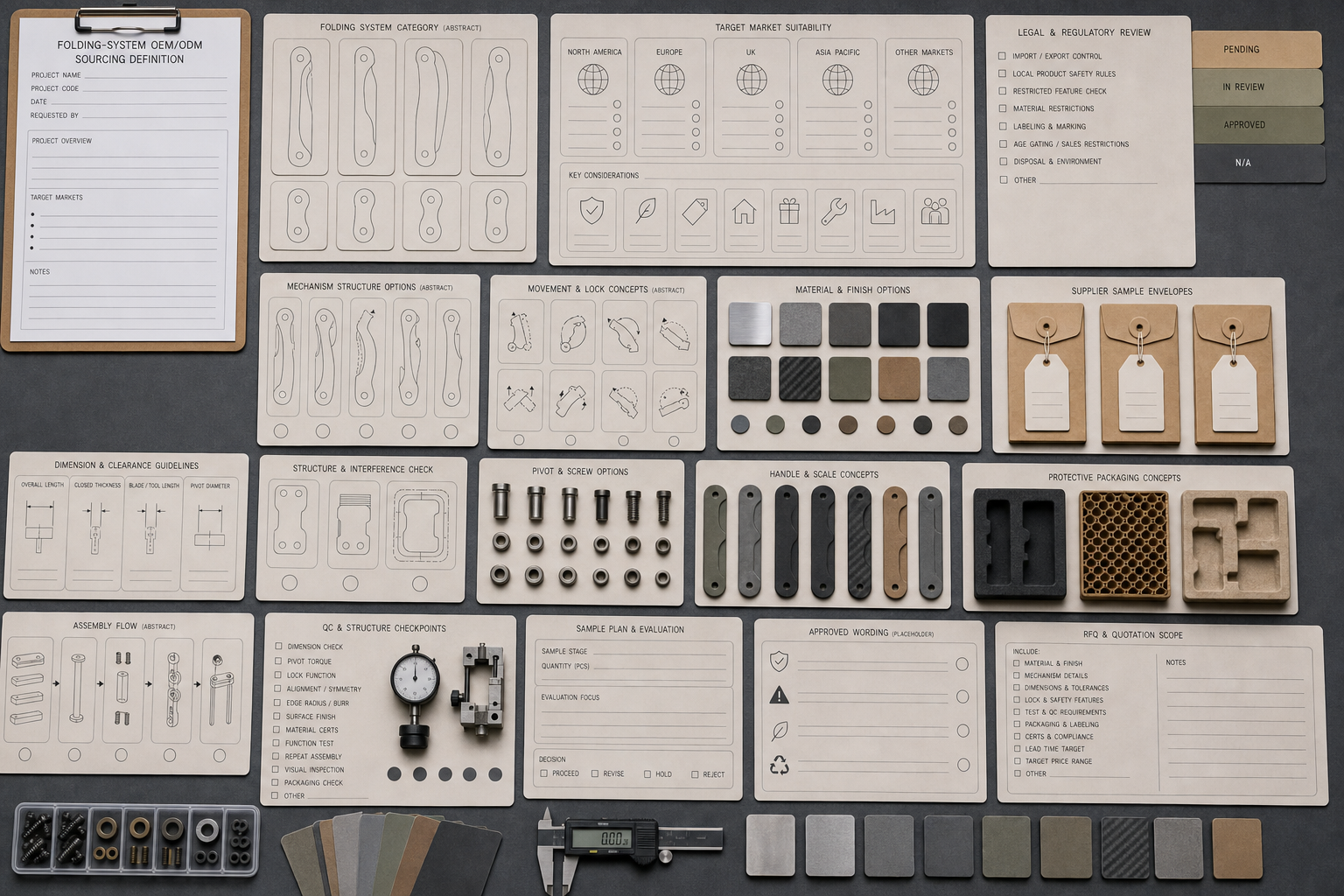
I define the mechanism before I quote
For an OEM or ODM project, I do not treat "gravity knife" as a casual marketing word. I ask what the buyer means by the mechanism. Does the buyer refer to historical style, blade movement, lock release, visual inspiration, or a market category? These details change the whole project. A knife that opens automatically by gravity or inertia may fall into a restricted category in some legal systems. A manual folding knife with a bias toward closure may be treated differently in some contexts, but the buyer must confirm that through legal review.
The U.S. Code chapter on switchblade knives is useful background because it references blades that open automatically by inertia, gravity, or both. I do not use that source as worldwide legal advice. I use it to show why mechanism language matters. Before I make samples, I want the buyer to define the destination market, sales channel, import route, and allowed mechanism. This protects the buyer, the factory, and the product launch plan.
| Definition point | What I ask | Why it matters |
|---|---|---|
| Mechanism intent | Historical style or active mechanism | It changes compliance review |
| Product format | Folding knife or fixed blade alternative | It changes structure and inspection |
| Market category | Utility, outdoor, collector, or specialty | It affects positioning and packaging |
| Legal review | Buyer-confirmed destination rules | It reduces late-stage project failure |
Private-label Planning Checklist
Before starting production, prepare the market and product details your importer or compliance advisor needs to review.
| RFQ Field | What to Prepare |
|---|---|
| Target market | Country, state, region, or sales channel |
| Product category | Folding knife / fixed blade / multi-tool / outdoor tool |
| Intended use | EDC / camping / kitchen / hunting / rescue / promotional |
| Buyer requirements | Testing, labeling, documentation, or packaging rules |
| Blade and lock details | Blade length, opening method, lock type, edge style |
| Packaging text | Warnings, claims, care notes, language requirements |
| Documents | Drawing, sample photo, logo file, packaging artwork |
| Review owner | Importer, legal advisor, testing lab, or internal compliance team |
Why Should Buyers Review Legal and Import Risk Before Sampling?
A sample can be approved before the sales channel is approved. That mistake can waste design time, packaging work, and production deposits.
Buyers should review legal and import risk before sampling because mechanism-based knife rules can vary by country, state, channel, and transport context. The factory can support specifications, but the buyer must confirm legal suitability.
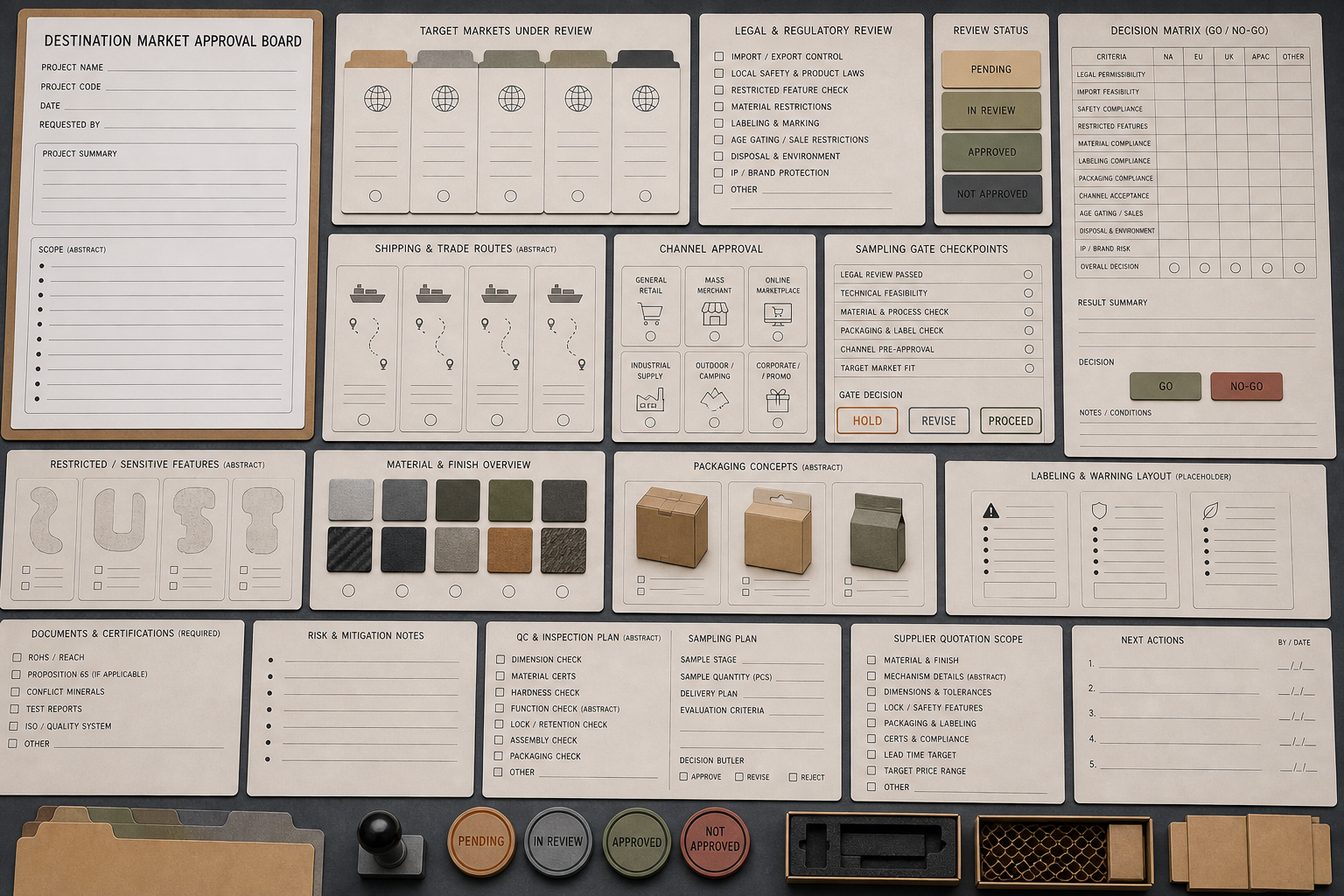
I separate manufacturing support from legal approval
As a knife manufacturer, I can help with drawings, prototype details, material options, lock structure, finish, packaging, and quality inspection. I cannot decide whether a mechanism-sensitive knife is allowed in every destination market. This is why I ask buyers to complete legal and channel review before they ask for tooling or bulk production. The product may also face transport screening limits. The TSA page for pocket knives gives useful air-travel screening context, but it is not a complete product law.
Import risk can also come from unclear documentation. A buyer should avoid vague product descriptions, unclear mechanism wording, or packaging claims that do not match the approved product. If the destination requires special declarations or category review, that should be handled before shipment planning. This is not about slowing a project down. It is about making the project real. A clear legal position lets the factory focus on manufacturability, quality, and cost instead of guessing what the final product should be.
| Review area | Buyer responsibility | Factory support |
|---|---|---|
| Destination law | Confirm allowed product category | Provide drawings and specifications |
| Import route | Confirm document and category needs | Provide product details and packing data |
| Sales channel | Confirm platform or distributor limits | Adjust packaging and listing assets |
| Transport context | Confirm travel and shipment restrictions | Support safe packaging and carton plans |
How Should Mechanism Design Be Evaluated Responsibly?
The mechanism is the heart of the risk. If the design is not controlled, the product can drift away from the approved concept.
Mechanism design should be evaluated through blade movement, lock release, pivot tolerance, detent behavior, bias toward closure, screw control, and repeat assembly. I review engineering evidence, not user techniques.
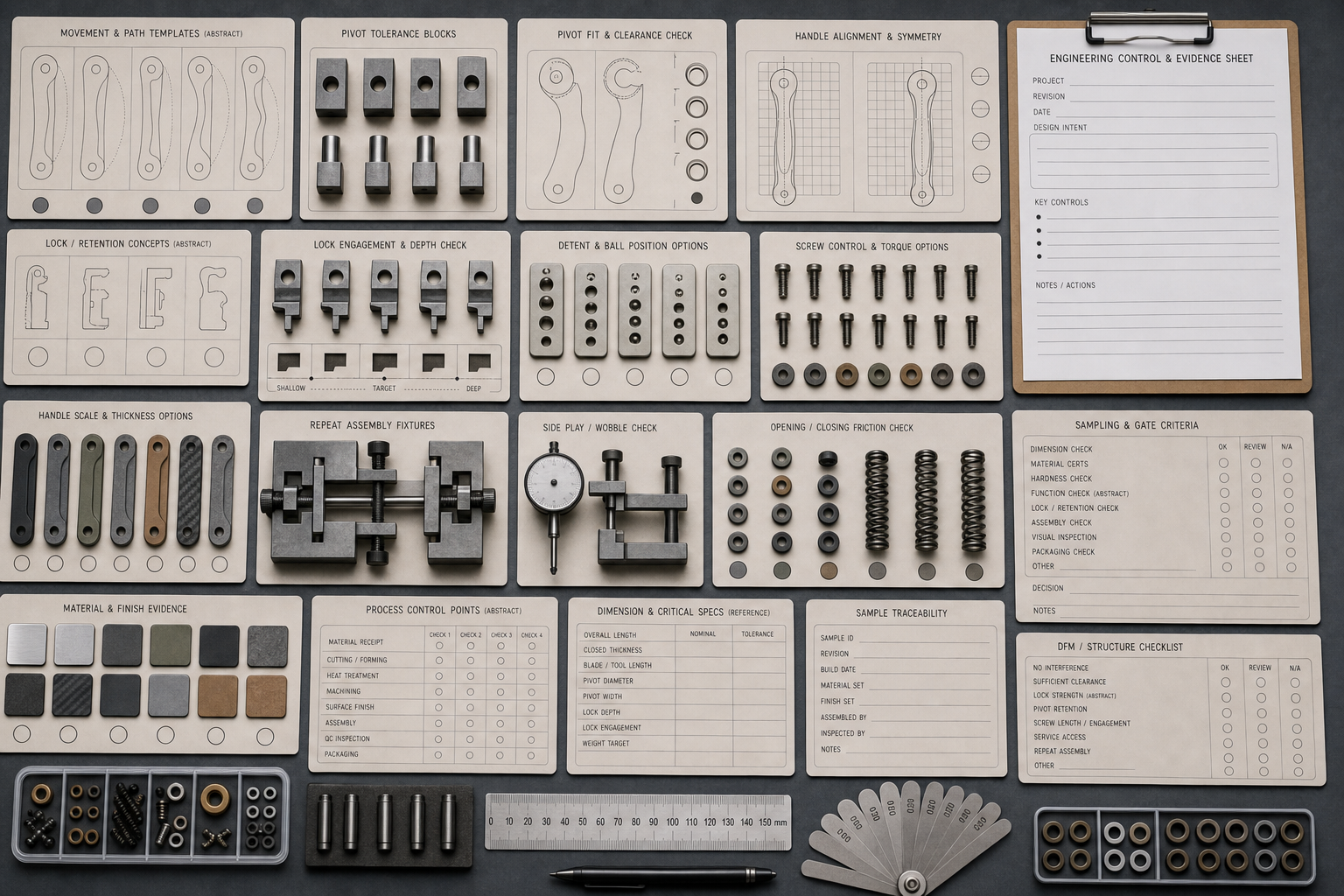
I test the mechanism as a tolerance chain
For a gravity knife project, the key manufacturing question is not only "Can the blade move?" The better question is "Can the mechanism stay within the buyer-approved specification across many units?" The pivot, liner, lock surface, detent, stop pin, screw torque, washer or bearing choice, blade weight, and handle geometry all affect the result. A small change in one part can change the way the whole product behaves.
I prefer to review the mechanism in stages. First, I check drawings and risk points. Second, I make a prototype and record the parts that need adjustment. Third, I run a small pilot batch to see whether assembly workers can repeat the same result. If the design needs too much hand fitting, mass production may become unstable. A good buyer should ask for clear mechanism criteria in the RFQ. The factory should respond with drawings, sample feedback, and a practical QC plan. The discussion should stay technical and responsible.
| Mechanism factor | What I check | Why it matters |
|---|---|---|
| Pivot fit | Hole tolerance and screw tension | It affects movement and centering |
| Lock release | Engagement and release consistency | It affects product safety checks |
| Detent or bias | Closure control and approved behavior | It affects category review |
| Blade weight | Movement under normal inspection | It affects mechanism repeatability |
Which Materials and Heat Treatment Choices Support Stable Production?
A mechanism-sensitive knife cannot rely on appearance alone. Poor steel or weak heat treatment can make the product unreliable.
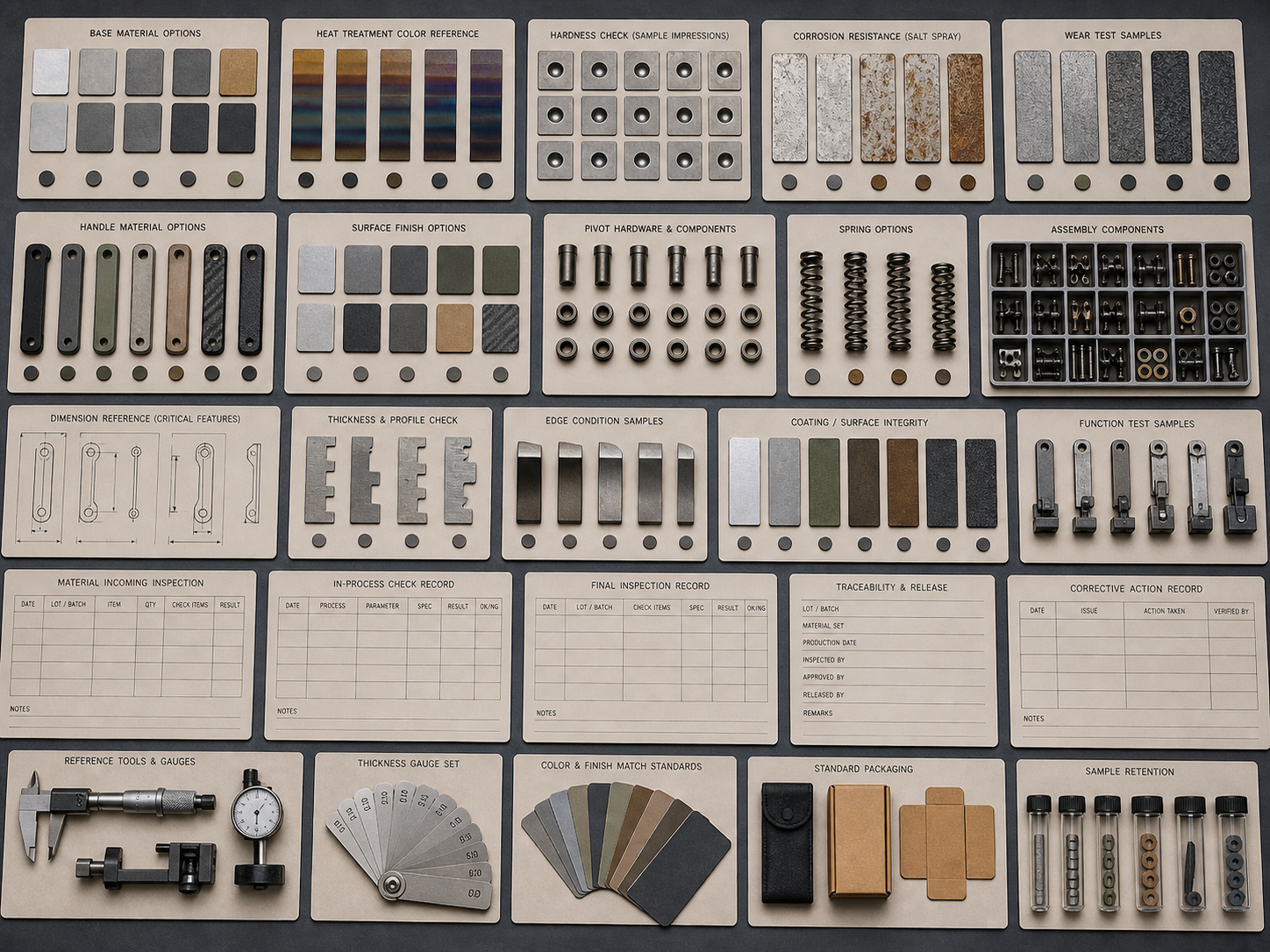
Materials and heat treatment support stable production by controlling blade strength, corrosion resistance, wear, lock surface durability, and batch consistency. I match steel and handle material to the project level and market need.
I choose material for function and repeatability
Blade steel affects more than the edge. It also affects grinding, heat treatment, corrosion resistance, lock interface wear, and final cost. A stainless knife steel such as Alleima 14C28N can be suitable when the buyer wants a balance of edge performance and corrosion resistance. A different buyer may choose another steel because of price, finish, or local market expectation. I do not choose steel by slogan. I choose it by product target.
Heat treatment is equally important. Alleima's guide to hardening and tempering of knife steel explains the balance between hardness and brittleness. In production, this means I need a practical hardness target, batch record, and grinding control. If a lock contact area is too soft, wear may increase. If a blade is too brittle, the product may not meet the buyer's normal-use expectation. The buyer should ask for realistic material options and inspection records, not only a steel name on a specification sheet.
| Material decision | What I review | Buyer result |
|---|---|---|
| Blade steel | Corrosion, wear, toughness, cost | Better match to market tier |
| Heat treatment | Hardness target and process record | More stable batch performance |
| Handle material | Weight, machining, finish, grip feel | Better product positioning |
| Hardware | Screw material and pivot wear | More consistent assembly |
How Should Lock, Pivot, and Bias-Toward-Closure Details Be Checked?
A small lock or pivot issue can change the product category and the user experience. Buyers should not leave this vague.
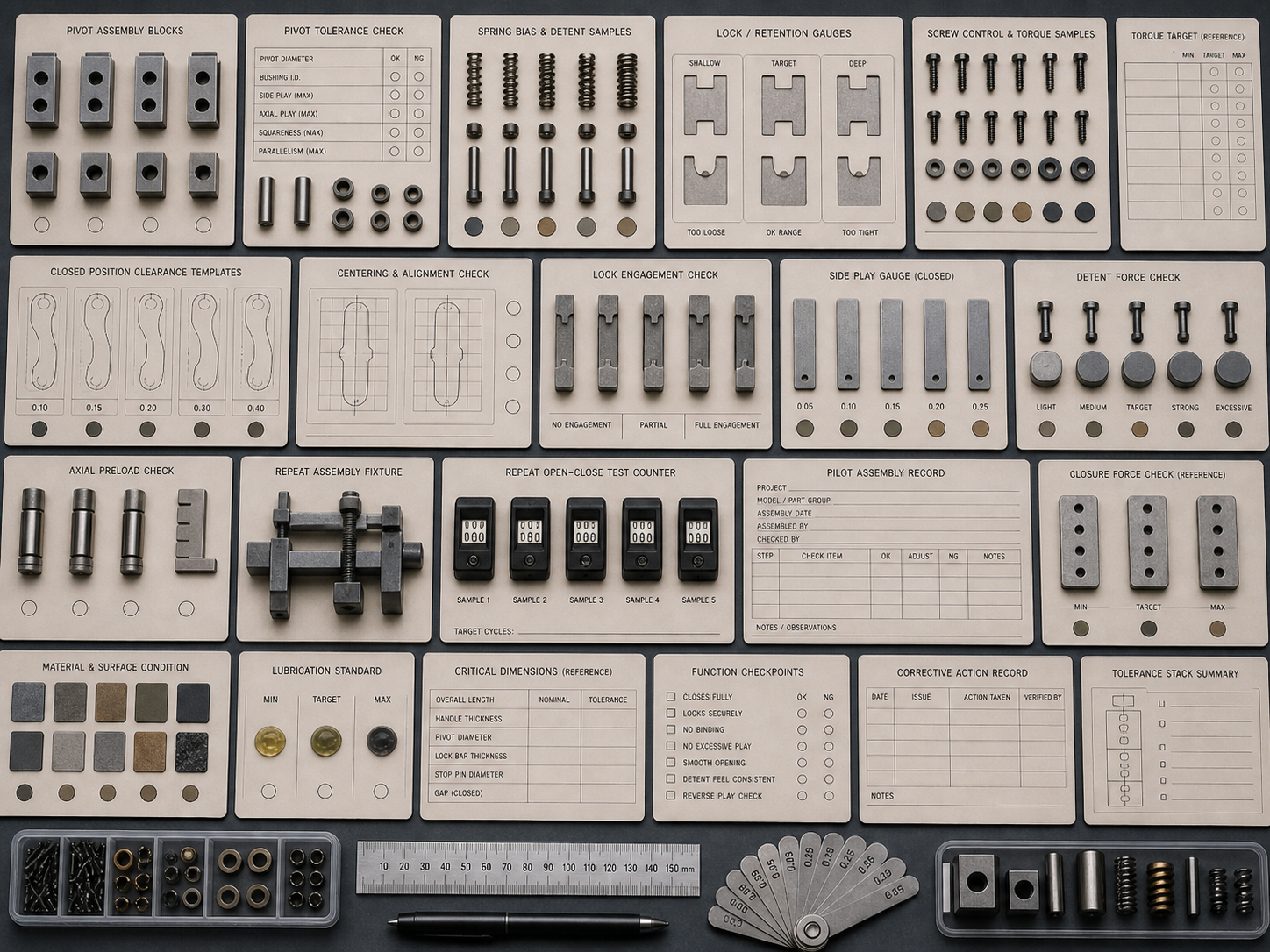
Lock, pivot, and bias-toward-closure details should be checked with drawings, prototype testing, pilot assembly, and QC criteria. I confirm the product stays within the approved mechanism specification.
I make the approved mechanism measurable
The phrase "bias toward closure" can become important in mechanism review because it describes whether the blade tends to stay closed until a deliberate manual force is applied. I do not use this phrase as legal advice. I use it as an engineering requirement that must be defined, tested, and documented if the buyer needs it for the target market. The U.S. Code includes an exception for certain knives that contain a spring, detent, or other mechanism designed to create a bias toward closure. That makes clear wording and testing important.
In production, the lock and pivot must be measured as a system. If pivot tension is too loose, the behavior may change. If it is too tight, the product may feel poor. If the detent is inconsistent, one unit may pass and another may fail the buyer's review. I prefer to define acceptable ranges before production. That can include screw torque, blade centering, lock engagement, closed retention, side play, and sample retention for future comparison. This keeps the project under control.
| Detail | Check method | Control purpose |
|---|---|---|
| Pivot screw | Torque and movement check | Keeps behavior consistent |
| Lock face | Engagement and wear review | Supports safe function |
| Detent or spring | Closed retention check | Supports approved mechanism |
| Stop pin | Position and contact check | Reduces play and misalignment |
What Packaging and Product Positioning Should Buyers Prepare?
Even a controlled product can look risky if the packaging is careless. Product language can create trouble after the knife is finished.
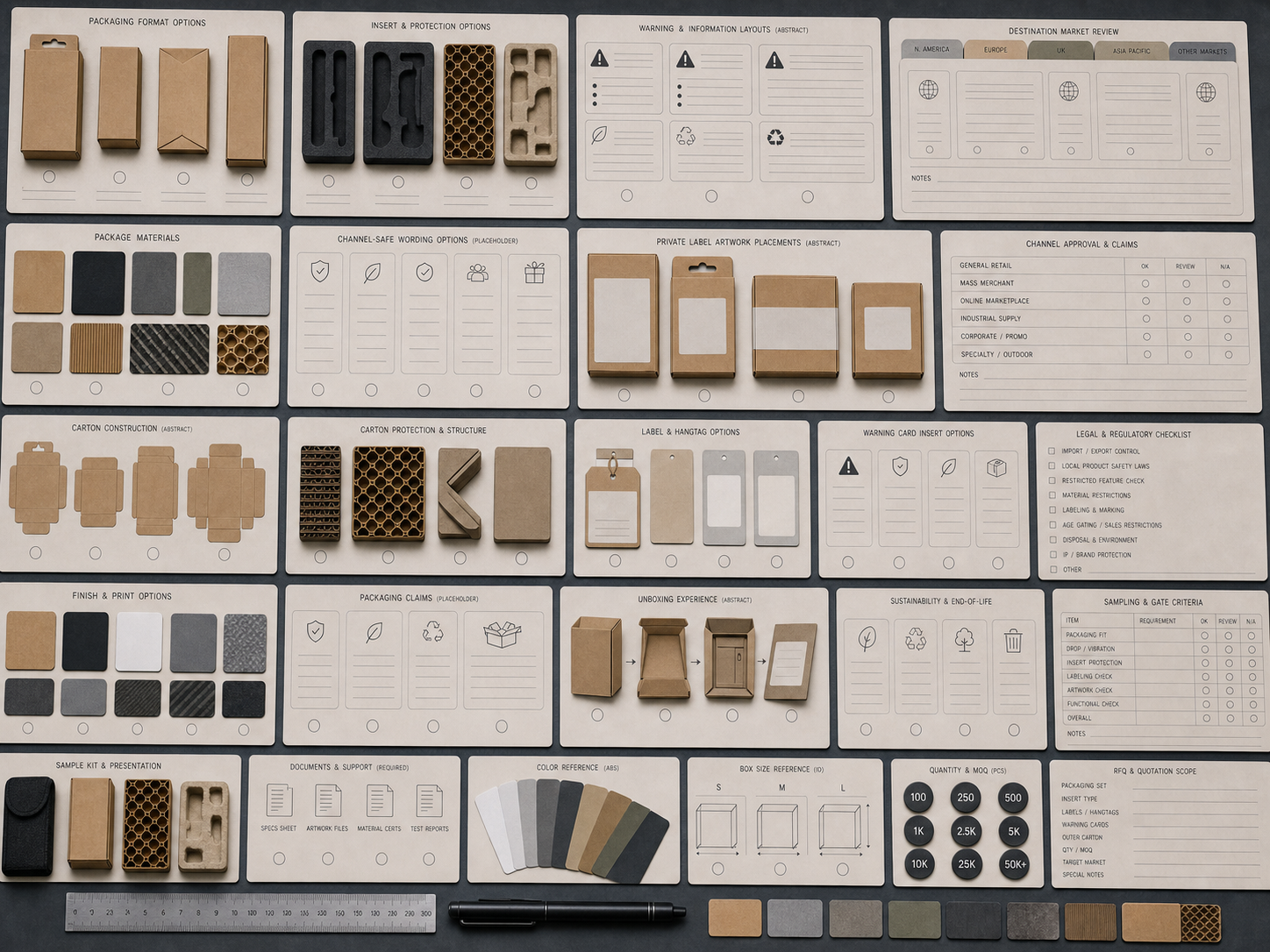
Buyers should prepare restrained packaging and clear product positioning. I recommend practical descriptions, destination-reviewed warnings, accurate mechanism wording, safe inserts, and private label artwork that matches the approved product.
I treat packaging as part of compliance control
Packaging is not only a box. It is a product-control document in physical form. It tells the retailer, distributor, and end buyer what the product is meant to be. For a gravity knife project, I recommend neutral product language. The packaging can explain blade steel, handle material, finish, dimensions, care, and responsible ownership language approved by the buyer. It should not use dramatic claims or create a mismatch with the approved legal review.
The inside of the package matters too. A folding knife should be closed and protected. The insert should stop movement during shipping. The carton plan should protect samples and bulk goods from rubbing, screw loosening, and finish damage. If spare parts, instruction sheets, warning cards, or barcodes are required, they should be listed in the packaging specification. This helps final inspection. It also helps importers and distributors because the product arrives with fewer surprises. A strong private label project is not just a good sample. It is a controlled package, document set, and repeatable production plan.
| Packaging point | What to prepare | Why it matters |
|---|---|---|
| Product wording | Buyer-approved neutral description | Reduces channel risk |
| Insert design | Closed-position protection | Reduces shipping damage |
| Warning card | Destination-reviewed language | Supports responsible sale |
| Carton plan | Quantity, label, and protection | Helps export follow-up |
What QC Checks Help Control Mechanism-Sensitive Knife Orders?
One perfect sample does not prove the order is stable. Mechanism-sensitive products need checks at every stage.
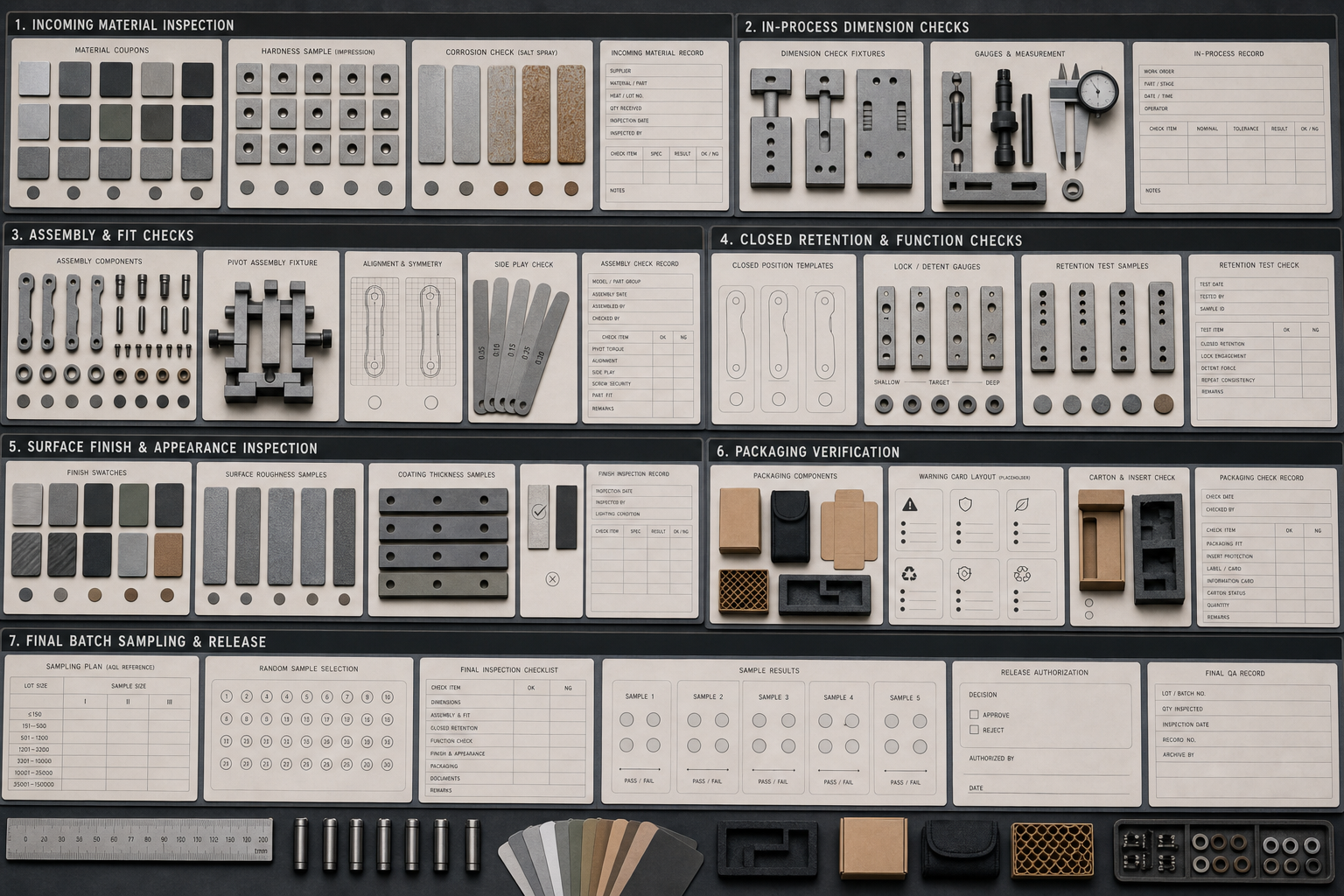
QC checks for mechanism-sensitive knife orders should cover incoming material, blade processing, heat treatment, pivot and lock assembly, closed retention, finish, packaging, and final batch sampling.
I build QC around repeatability
For a mechanism-sensitive order, final inspection should not be the first serious checkpoint. Incoming inspection should confirm steel, handle material, hardware, and packaging parts. Blade processing checks should cover profile, pivot hole, lock contact area, and bevel consistency. Heat treatment checks should include hardness records. The NIST guide to Rockwell hardness measurement is useful because it explains why good measurement practice reduces errors.
Assembly inspection is especially important. The factory should check blade centering, lock engagement, side play, screw torque, closed retention, and approved mechanism behavior. Final inspection should verify appearance, finish, sharpness, packaging contents, carton marks, and sample retention. I also like using a signed golden sample when the buyer approves it. The golden sample gives the factory and buyer a shared reference. It reduces arguments about what "same as sample" means during mass production.
| QC stage | Main checks | Buyer benefit |
|---|---|---|
| Incoming QC | Steel, handle, screws, packaging | Prevents weak inputs |
| Process QC | Profile, holes, heat treatment, finish | Finds problems early |
| Assembly QC | Pivot, lock, centering, retention | Controls mechanism behavior |
| Final QC | Appearance, pack, carton, sample match | Supports shipment confidence |
What Should a Gravity Knife RFQ Include Before Quotation?
A short RFQ can force the supplier to guess. Guessing is dangerous when the mechanism affects cost, law, and quality.
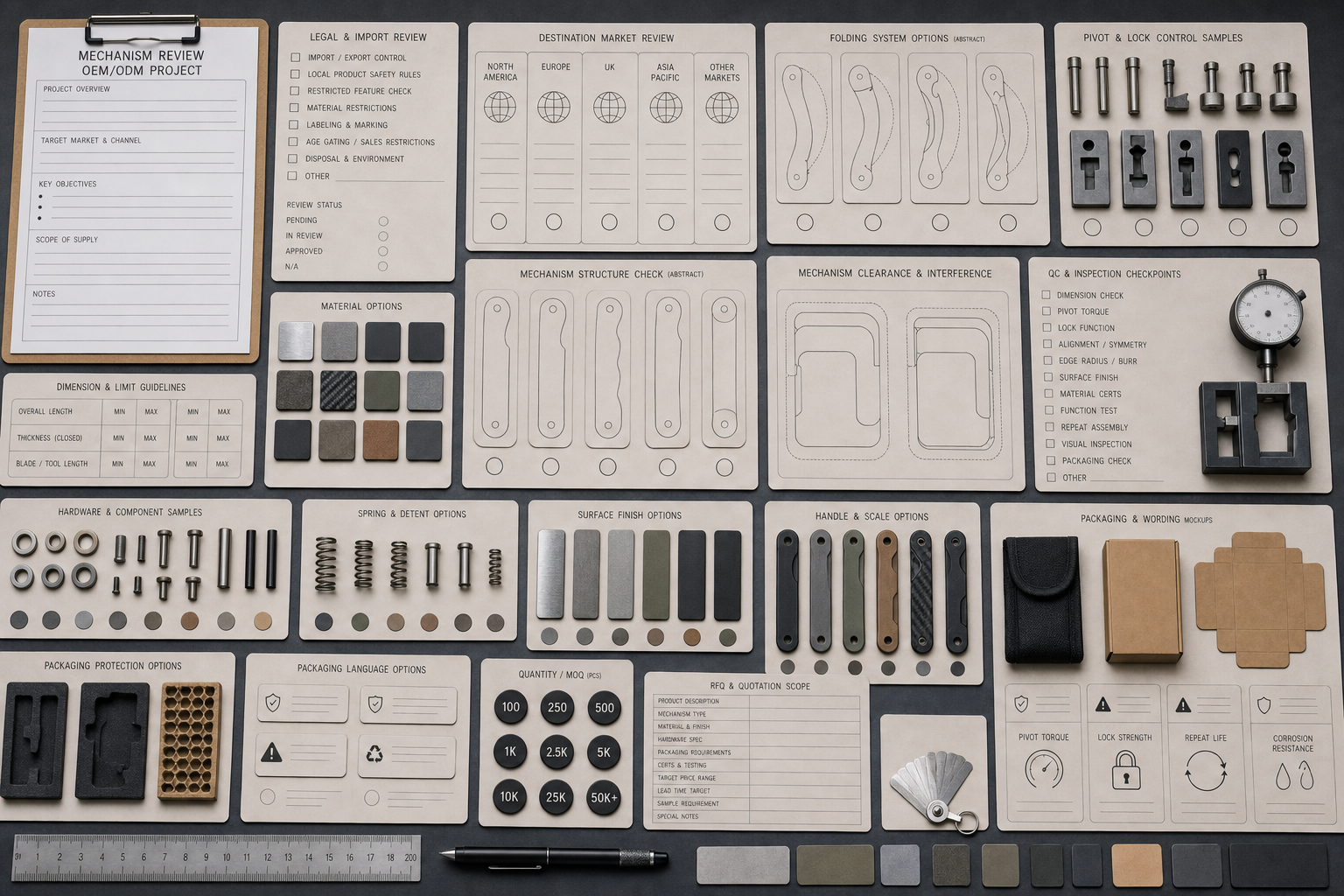
A gravity knife RFQ should include target market, legal review status, approved mechanism requirement, blade steel, handle material, lock type, finish, packaging, MOQ, target price, sample needs, and inspection criteria.
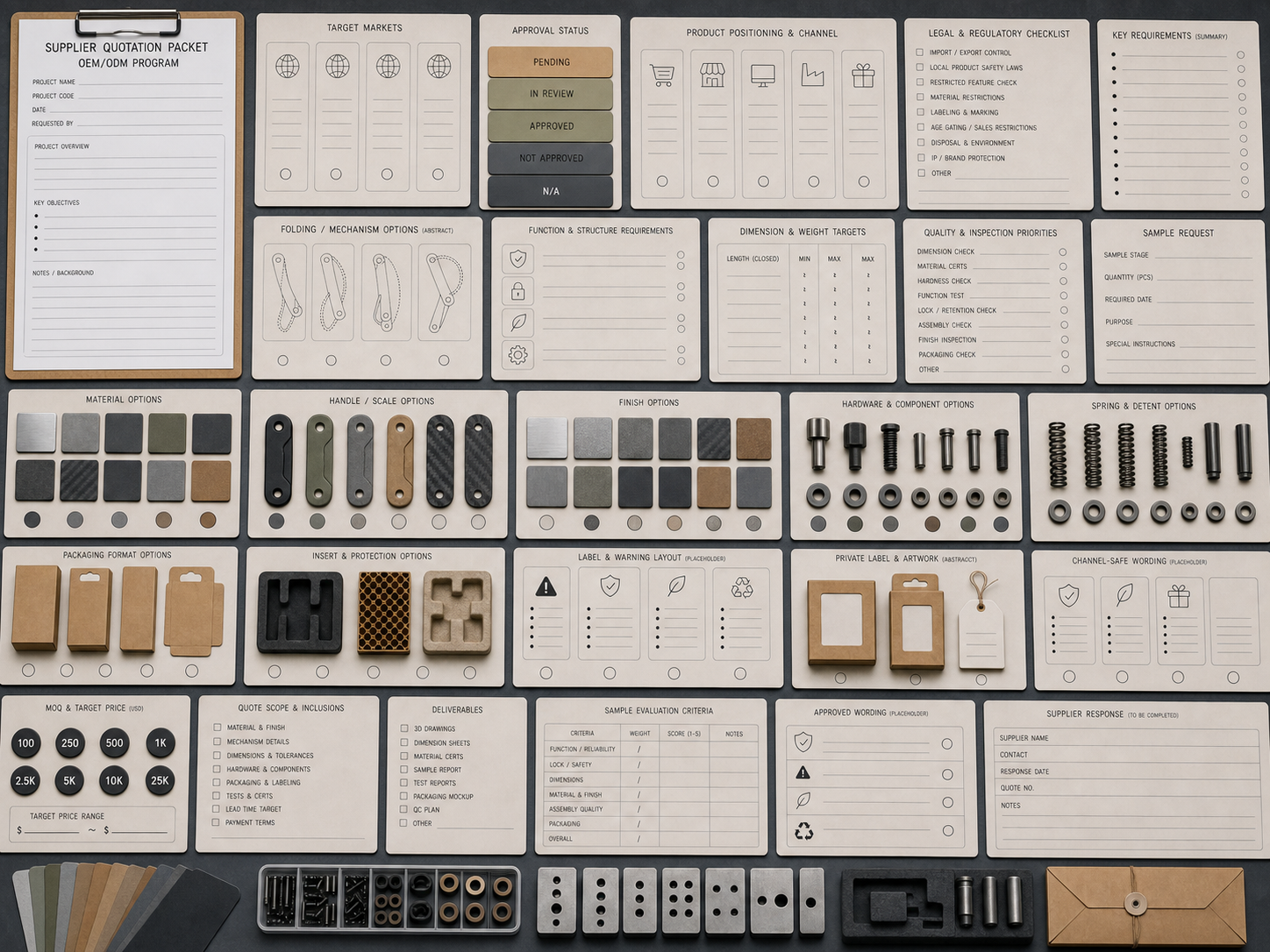
I ask buyers to make the risky details explicit
Before I quote a gravity knife project, I need more than a reference photo. I need the buyer to state the destination market, sales channel, and legal review status. I also need the approved mechanism requirement. If the buyer needs a manual folding design with a clear bias toward closure, that should be written into the RFQ. If the buyer wants to avoid restricted categories, that should also be clear. The factory can then propose manufacturable options instead of guessing.
The RFQ should also include blade steel, thickness, finish, handle material, lock preference, hardware color, logo method, packaging format, warning language, MOQ, target price range, and sample deadline. For inspection, I recommend listing hardness, pivot, lock, blade centering, closed retention, surface finish, sharpness, packaging contents, and carton marks. The more precise the RFQ is, the more useful the quotation becomes. At Vast State, I see this as the difference between a loose idea and a project that can move from concept to production with fewer surprises.
| RFQ field | What to include | Why it helps |
|---|---|---|
| Market review | Destination and legal review status | Prevents unsuitable sampling |
| Mechanism requirement | Approved movement and closure behavior | Guides engineering design |
| Product details | Steel, handle, lock, finish, logo | Supports accurate quotation |
| QC plan | Hardness, pivot, lock, packaging checks | Reduces production disputes |
Planning a private-label knife line for this market?
Use this article as a planning reference, then confirm local requirements with your importer or compliance advisor before OEM/ODM production.
Conclusion
I evaluate gravity knife projects through legal review, controlled mechanism design, stable materials, clear packaging, strict QC, and detailed RFQ planning.
Source Notes
- U.S. Code Title 15 Chapter 29 supports why gravity and inertia wording can matter for mechanism review.
- TSA pocket knife guidance gives travel-screening context for sharp items, but it is not full product law.
- Alleima 14C28N data supports the steel and corrosion-resistance discussion.
- Alleima hardening guidance supports the hardness and brittleness balance.
- NIST Rockwell guide supports careful hardness measurement.
- ISO 9000 family page supports process-based quality control thinking.