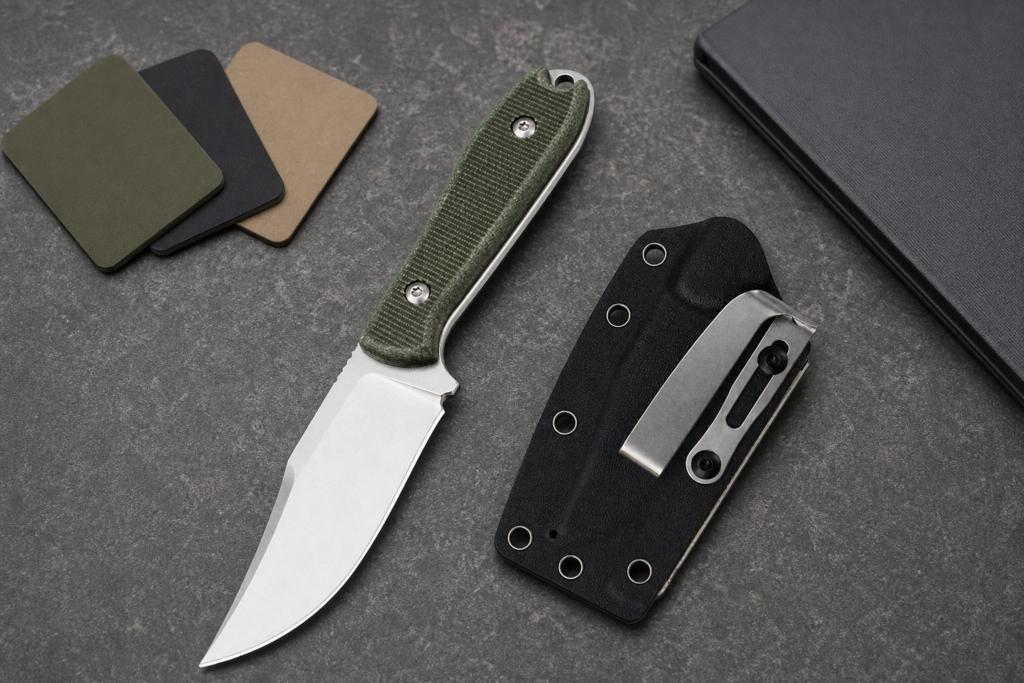
Choosing a hunting knife spec sounds simple. It becomes risky when buyers choose by style before use case, market, and inspection.
Buyers should choose hunting knife specifications by defining the target outdoor use, blade size, blade profile, steel and heat treatment, handle ergonomics, sheath, packaging, safety guidance, claims, compliance scope, and QC limits before approving OEM/ODM samples.
Quick buyer brief:
- Answer: The right hunting knife specification is not the most dramatic blade or the most expensive material. It is the spec that matches the buyer's customer, price range, market rules, supplier capability, and quality-control plan.
- Buyer context: This guide is for outdoor brands, hunting and camping brands, knife brands, sporting-goods buyers, importers, distributors, private label teams, and OEM/ODM sourcing managers.
- Key checks: Target user, outdoor task, blade length, blade thickness, blade profile, grind, edge angle target, steel, hardness range, corrosion plan, handle material, grip texture, sheath retention, packaging, instructions, claim evidence, and final inspection records.
Planning a fixed blade or outdoor knife project?
Share your target use, blade size, steel preference, handle direction, sheath needs, quantity range, and packaging plan. Vast State can help turn it into a quote-ready specification.
Many consumer articles explain how to choose a hunting knife by blade shape, size, and handle feel. That is useful, but OEM/ODM buyers need a different layer of thinking. They must choose specifications that can be quoted, sampled, produced, inspected, packaged, and sold without creating unclear claims or avoidable safety problems.
This article treats hunting knives as lawful outdoor fixed-blade tools for practical field, camping, and retail product lines. It does not cover combat, self-defense, or weapon positioning. The goal is to help buyers turn a general idea into a controlled product brief.
Why Should the Use Case Come Before the Knife Style?
A dramatic-looking knife can be a poor commercial product.
The use case should come before style because blade length, tip shape, handle grip, sheath retention, packaging, care copy, and QC checks all depend on how the customer will actually use and store the knife.
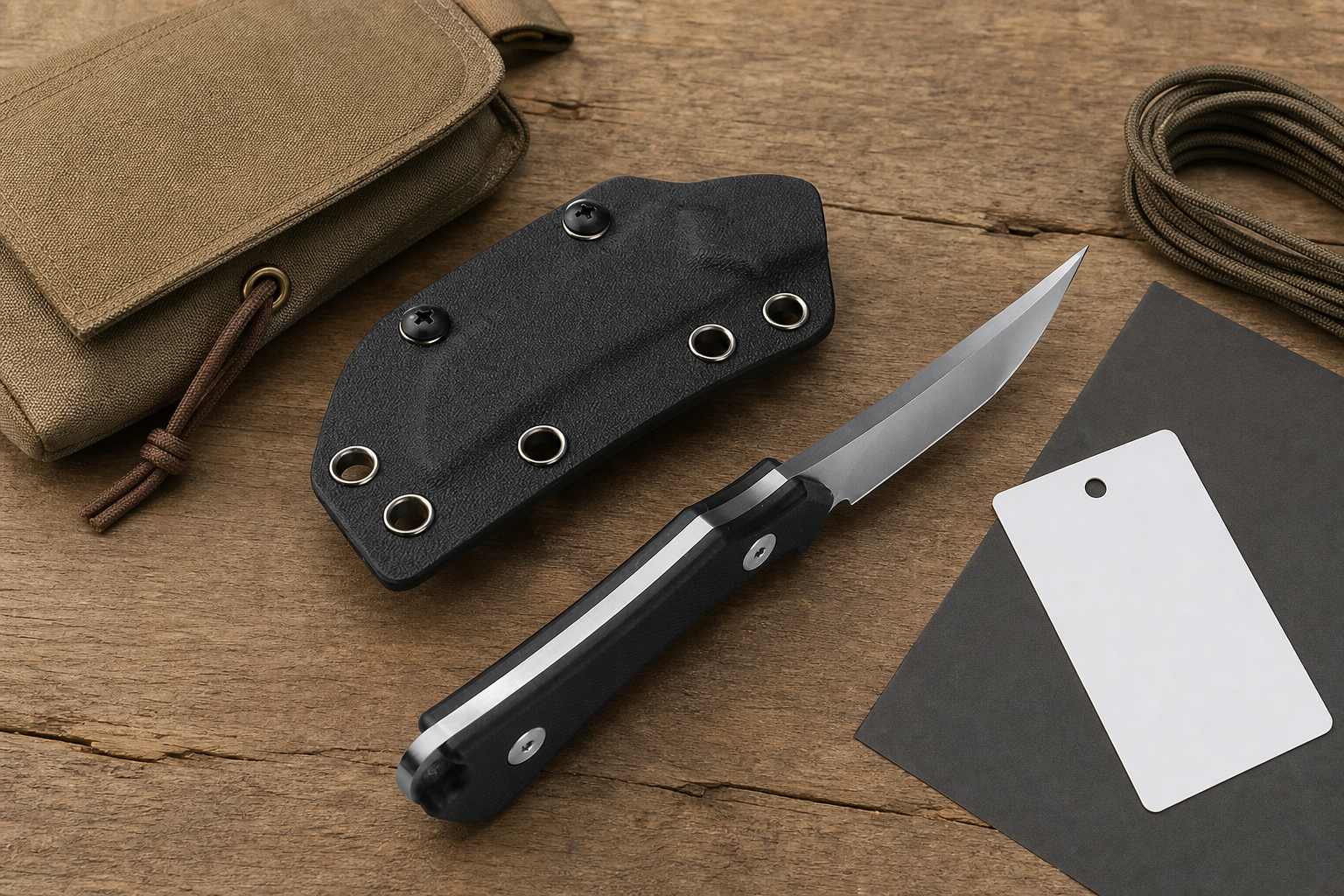
I Start With the Customer and Channel
A knife sold through a camping brand, hunting retailer, gift channel, farm-and-ranch catalog, or general outdoor store may need different specifications. The buyer should decide who the customer is before choosing blade style. A beginner outdoor customer may need simple storage instructions and conservative packaging. A specialty field customer may expect stronger handle texture and better sheath retention. A gift buyer may care more about finish, packaging, and presentation.
The CPSC manufacturing best practices page supports the idea that product safety should be considered during design, including foreseeable consumer use and risk reduction. For buyers, that means the product brief should explain intended use, storage, handling, and packaging before the supplier builds samples.
Useful use-case questions:
- Is the knife for camping, hunting support, outdoor utility, retail gift, or general field use?
- Will customers use it with dry hands, wet hands, gloves, or cold conditions?
- Is the product meant for a sheath, box, pouch, or retail display?
- What price point must it meet?
- Which market rules or retailer policies may affect blade size, opening, labeling, or wording?
| Use case factor | Why it matters | Buyer output |
|---|---|---|
| Target user | Defines grip and safety copy | User profile in RFQ |
| Sales channel | Affects packaging and claims | Channel notes |
| Outdoor condition | Affects handle and corrosion plan | Material requirements |
| Price range | Controls steel and sheath options | Cost target |
| Market scope | Affects labels and claims | Compliance checklist |
OEM/ODM RFQ Checklist
Prepare these details to help Vast State review your project and provide a more accurate quotation.
| RFQ Field | What to Prepare |
|---|---|
| Project type | OEM from drawing / ODM private label / wholesale catalog |
| Product category | Folding knife / fixed blade / multi-tool / outdoor tool |
| Design status | Idea / sketch / 2D drawing / 3D CAD / physical sample |
| Target price | Ex-factory target price or retail price range |
| MOQ expectation | 500 / 1,000 / 3,000 / 5,000+ pcs |
| Logo method | Laser engraving / etching / printing / molded logo |
| Packaging | Standard packaging / custom retail box / Amazon-ready |
| Market | USA / EU / Japan / Korea / Middle East / other |
| Compliance needs | Buyer-specified testing / documentation / labeling |
| Timeline | Sample deadline / mass production deadline |
How Should Buyers Decide Blade Size and Profile?
Blade size should match the task, sheath, package, and market.
Buyers should decide blade size and profile by balancing cutting task, point strength, belly, blade thickness, handle control, sheath fit, package size, legal sensitivity, and customer expectations.
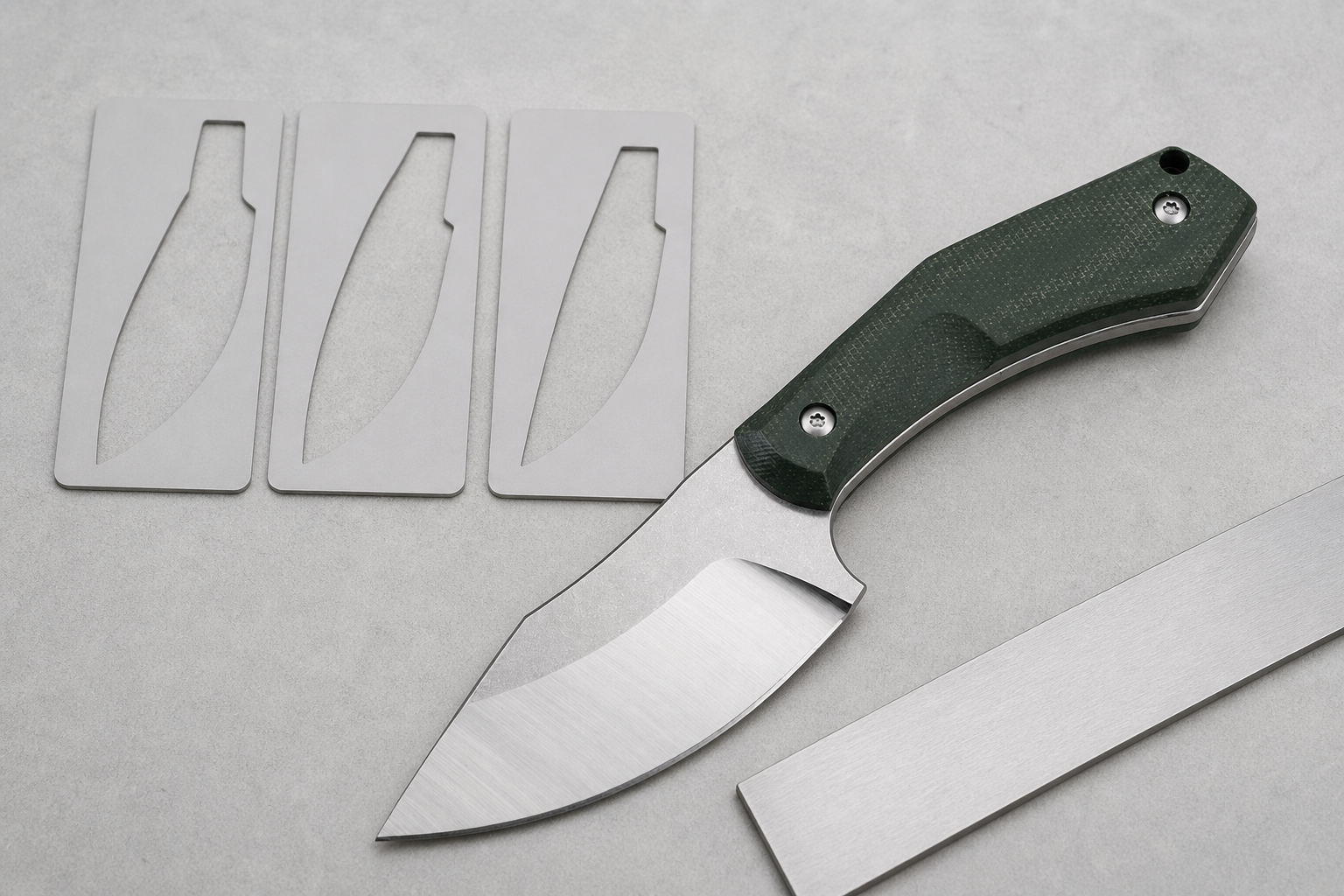
I Avoid Oversizing Without a Reason
Many buyers assume a larger blade has higher perceived value. Sometimes that is true in retail photos. It can also create problems. A larger blade may require a larger sheath, heavier package, stronger point protection, more material cost, more shipping weight, and more careful warning copy. A smaller blade may be more practical, but it must still feel credible for the target customer.
Blade profile also matters. A drop-point style may suit broad outdoor utility. A clip-point style may look traditional but needs point-strength review. A trailing-point style may offer belly, but it can affect sheath and package fit. A general utility profile may be easier to position for mainstream outdoor use. The buyer should not choose a profile only because it looks aggressive.
The CCOHS sharp blade safety guidance supports general principles such as using the right tool for the job, inspecting tools, and storing sharp tools securely. For a buyer, that means the blade should be appropriate for the intended cutting task and easy to store safely.
Blade fields to define:
- Blade length and overall length
- Blade thickness and width
- Profile and point location
- Grind type and grind height
- Edge angle target or sharpening method
- Tip strength expectation
- Sheath fit and closed package clearance
- Finish, logo, and marking location
Which Steel, Heat Treatment, and Finish Choices Make Sense?
Steel choice is important, but process control decides whether the steel works.
Buyers should choose steel, heat treatment, hardness range, finish, coating, corrosion plan, sharpening method, and test records based on target use, cost, supplier capability, and claim evidence.
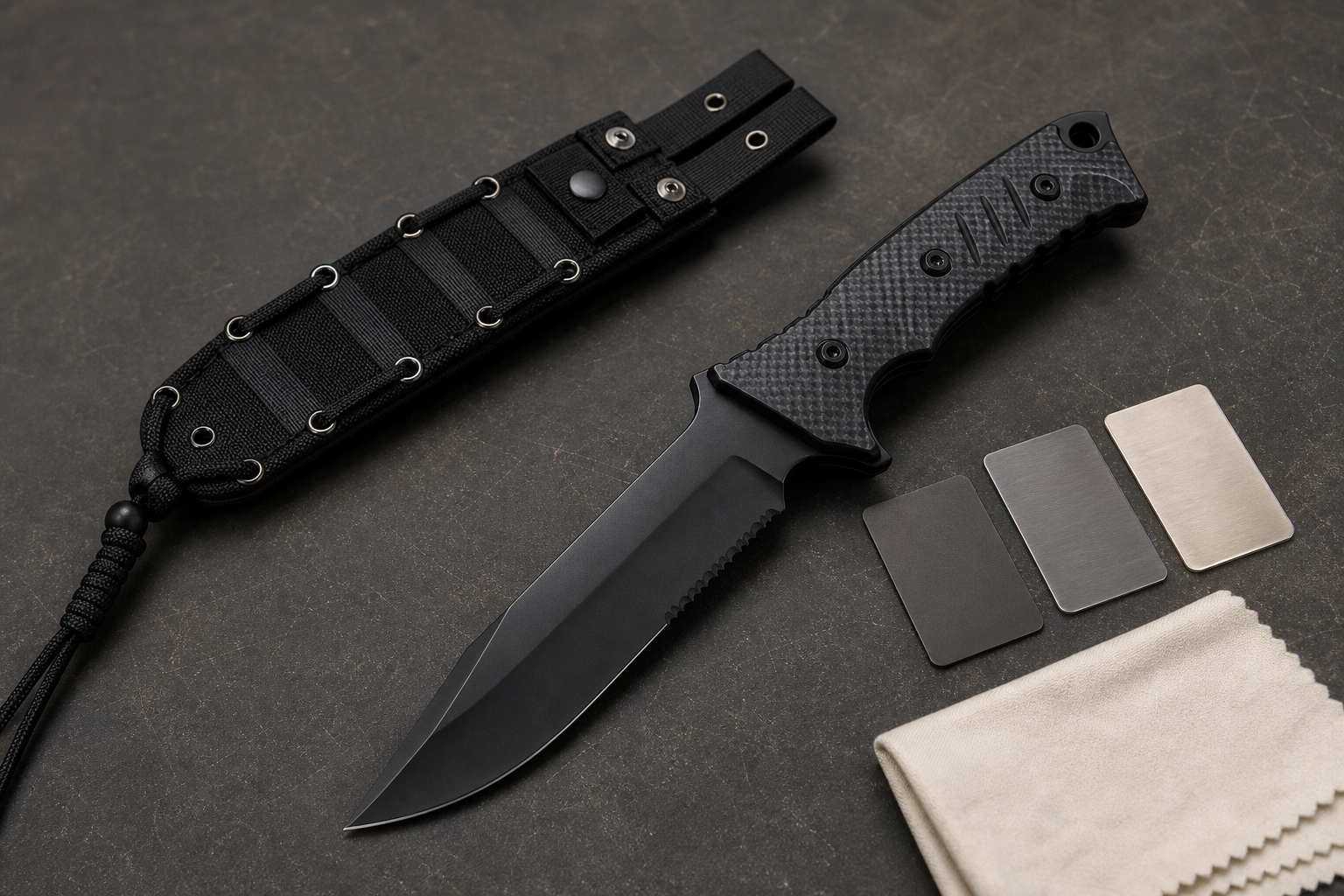
I Ask for the Steel System, Not Only the Steel Name
A steel name can help sell a knife, but it does not guarantee performance. Heat treatment, blade thickness, grind, edge angle, surface finish, and quality control all affect the final product. Buyers should avoid making strong claims from steel grade alone.
For a value outdoor line, a simple stainless steel may be practical if the buyer wants corrosion resistance and easy care. For a more performance-focused line, the buyer may choose a higher grade with a more controlled heat treatment. For carbon steel, the buyer must plan care copy and corrosion expectations. For coated blades, the buyer must define coating type, adhesion expectations, scratch limits, and honest claim wording.
The NIST dimensional metrology page supports the broader manufacturing principle that measurement helps process improvement and part control. For knife buyers, this mindset applies to blade thickness, grind height, hardness checks, edge symmetry, and finished dimensions.
Useful steel and process fields:
- Steel grade or acceptable alternatives
- Heat-treatment route and hardness range
- Hardness sample plan
- Blade thickness after finishing
- Edge angle target
- Finish or coating method
- Corrosion-prevention packaging
- Care and maintenance copy
- Claim evidence for steel, edge, or coating language
How Should Buyers Choose Handle Material and Ergonomics?
The handle determines whether customers trust the knife in hand.
Buyers should choose handle material and ergonomics by defining grip condition, hand comfort, contour, thickness, texture, edge radius, fasteners, liners, natural variation, odor, cleaning, and packaging contact points.
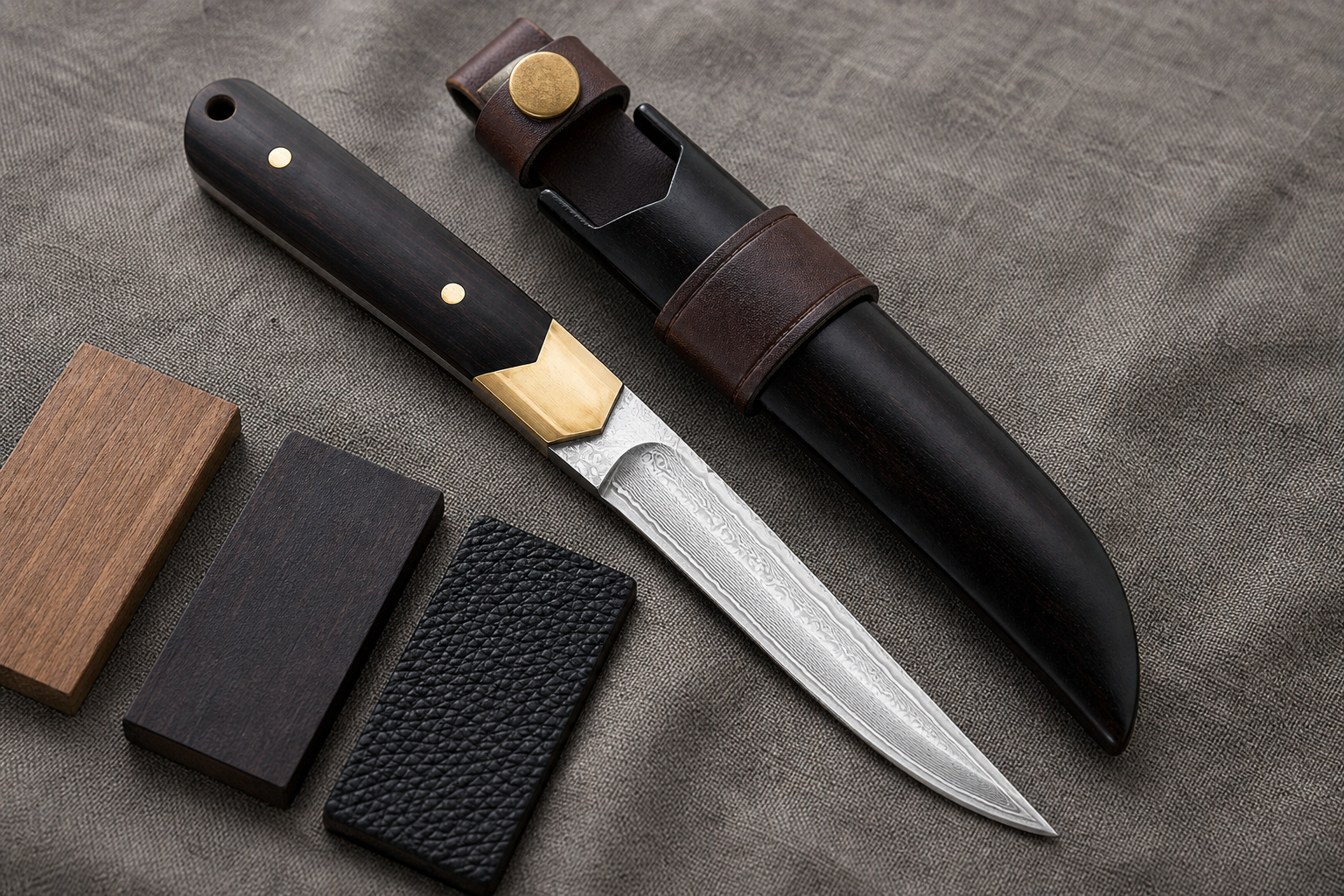
I Test Handle Feel With the Final Blade and Sheath
The CCOHS hand tool design guidance gives useful principles for hand-tool ergonomics, including handle design, grip, texture, weight, and hazards. A hunting or outdoor knife is a handheld tool, so the handle should be specified as part of the tool interface.
Handle material is not only decoration. Wood can feel warm and traditional, but it needs moisture and variation control. Molded polymer can be repeatable and cost-effective, but it can feel cheap if poorly textured. Rubber-like materials can improve wet grip, but buyers should check odor, aging, and dust pickup. Laminates can feel strong and technical, but machining and edge finishing must be controlled.
Handle specification should include:
- Material family and grade
- Thickness and contour
- Texture and edge radius
- Fastener type and spacing
- Grip tests with dry, wet, or gloved hands where relevant
- Color range and natural variation limits
- Cleaning and care instructions
- Fit with sheath and package
The handle should be tested with the final blade and final sheath. A handle that feels good alone may fail if it makes sheath insertion awkward or changes balance.
How Should Sheath and Carry Method Affect the Knife Choice?
For fixed-blade outdoor knives, the sheath is part of the product.
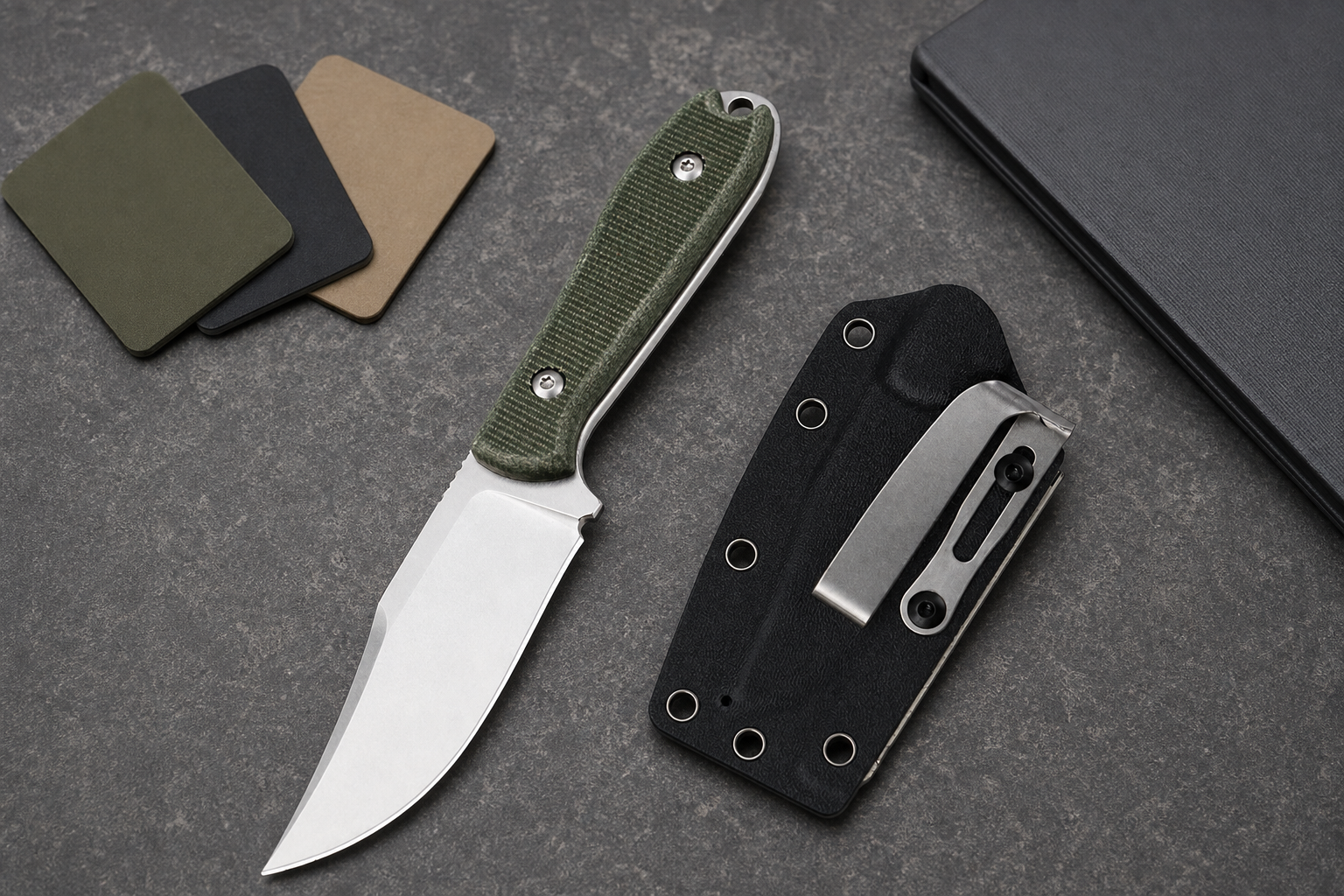
Buyers should choose the knife and sheath together by defining blade coverage, point protection, retention, belt loop or storage role, moisture behavior, stitch or rivet placement, package fit, and user instructions.
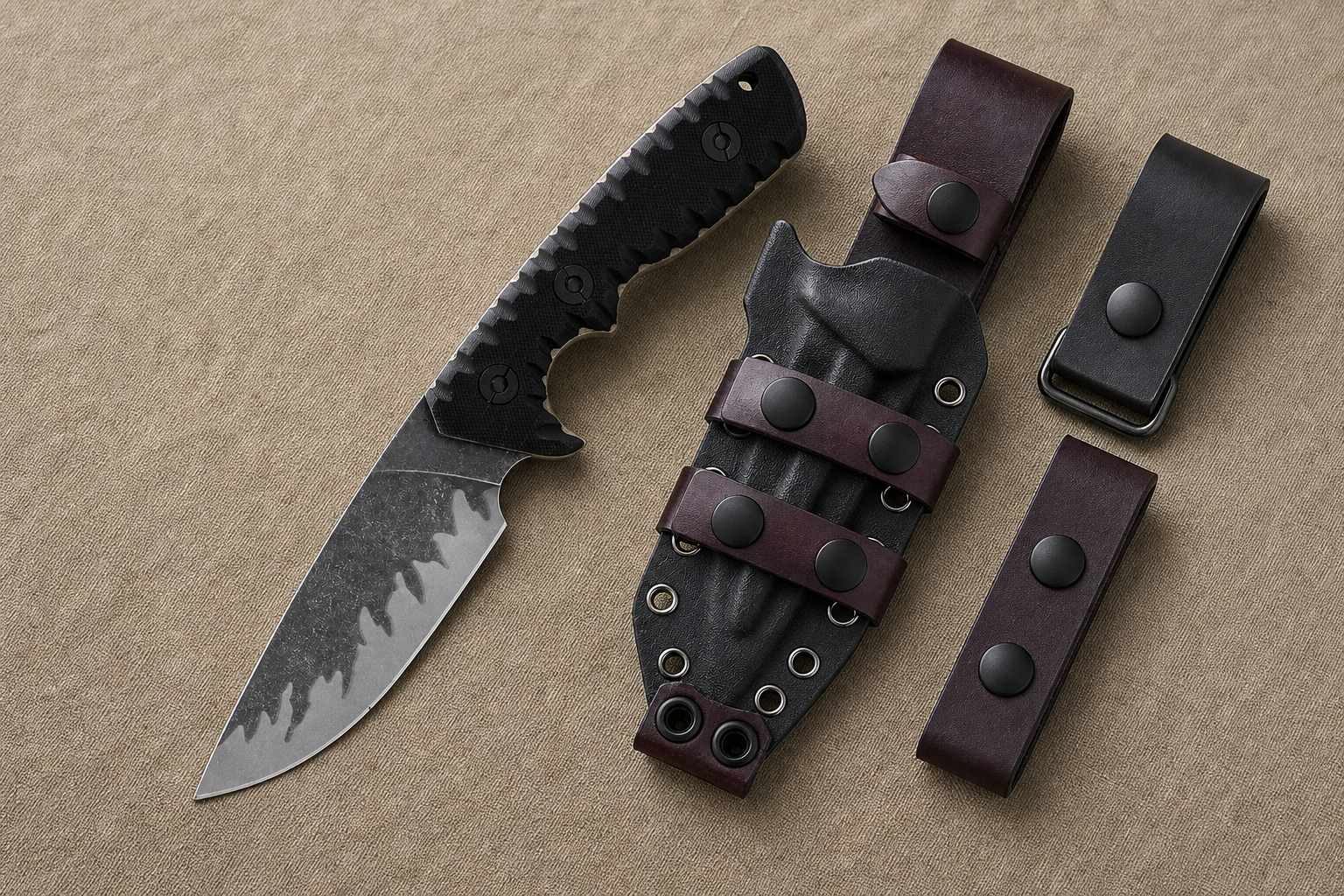
I Do Not Treat the Sheath as an Afterthought
A fixed-blade outdoor knife is incomplete without a storage plan. The sheath, guard, pouch, or package insert protects the blade, user, retail staff, warehouse team, and package. A beautiful knife with a loose sheath or exposed point can create returns and safety concerns.
Sheath material should match use and price. Leather can feel premium but needs moisture care and chemical review. Synthetic sheaths can be repeatable and weather-resistant, but they need fit, rattle, retention, and edge-contact checks. A simple blade guard may suit retail packaging but may not support outdoor carry. The buyer should define the purpose clearly.
Sheath specification should cover:
- Blade insertion depth
- Point and edge coverage
- Retention method
- Belt loop or storage role
- Stitch, rivet, or molded contact points
- Drainage or moisture plan if relevant
- Color and surface finish
- Packaging fit and movement
- Care and safety wording
The sheath should be approved with production knife samples, not only with a drawing.
What Packaging, Labeling, and Claim Questions Matter?
Packaging and claims can create risk if they overpromise or confuse use.
Buyers should review packaging, labels, warnings, care instructions, age positioning, importer details, local market rules, steel claims, environmental claims, and outdoor-performance claims before printing.
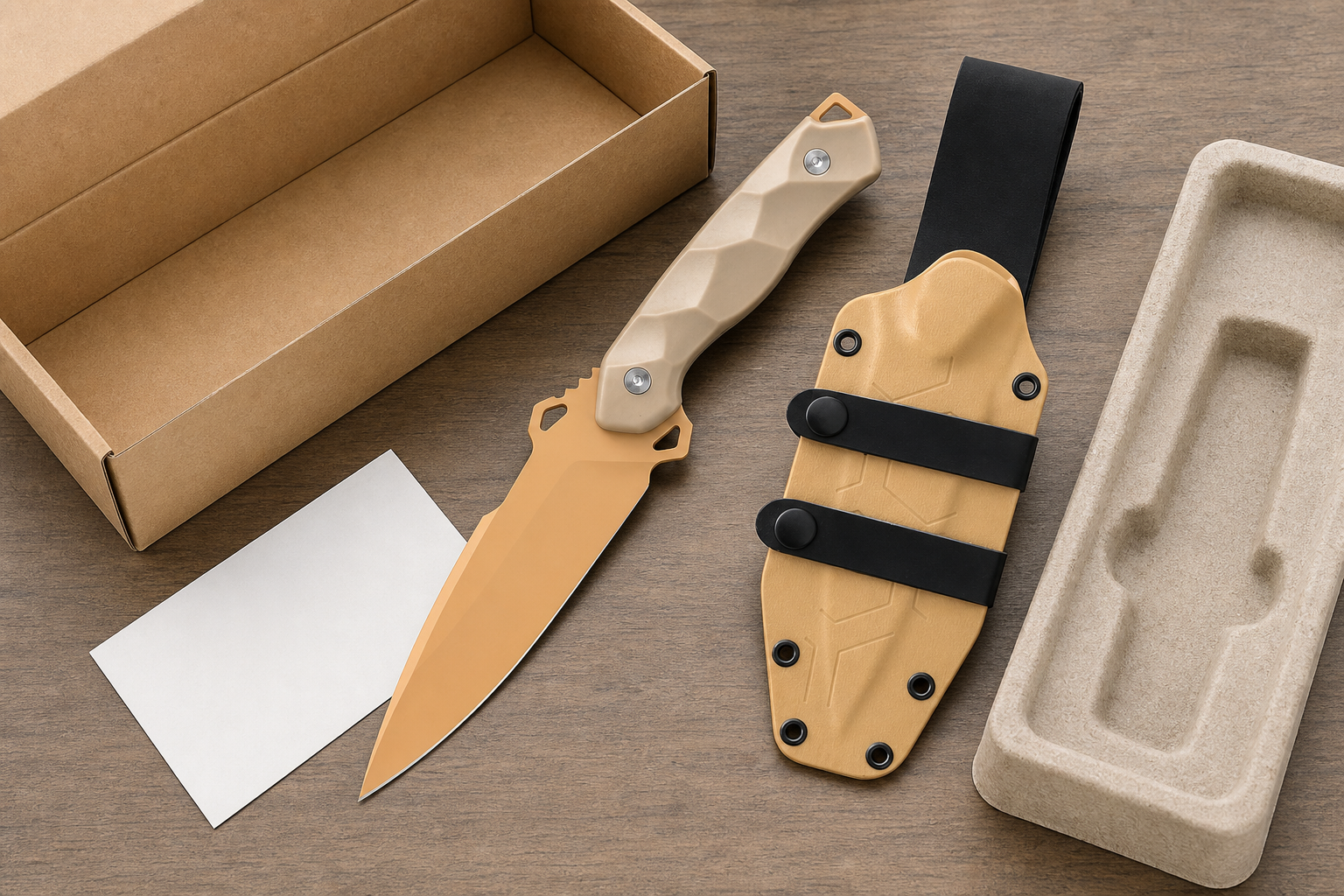
I Keep Product Claims Narrow and Evidence-Based
The CPSC labeling overview notes that labeling requirements may depend on product type, design, components, and intended age group. A buyer should review labeling by target market and sales channel, especially for sharp outdoor products.
The FTC advertising and marketing guidance is also useful because advertising should be truthful and not misleading. If a package claims premium steel, corrosion resistance, handmade quality, professional grade, eco material, recycled content, or extreme durability, the buyer should have evidence and careful wording.
Packaging should answer practical questions:
- What is the knife intended for?
- How should it be stored?
- How should the sheath or guard be used?
- What care is needed after wet use?
- What local rules should the user follow?
- What claims are supported by records?
- Which warnings must be visible during unboxing?
Good packaging supports the product. It should not turn a practical outdoor tool into an exaggerated claim.
What QC Checks Should Confirm the Final Specification?
A specification is only useful if it becomes an inspection checklist.
QC should confirm blade dimensions, profile, grind, edge, hardness target, handle fit, fasteners, sheath retention, finish, packaging movement, warning placement, documentation, and approved-sample match.
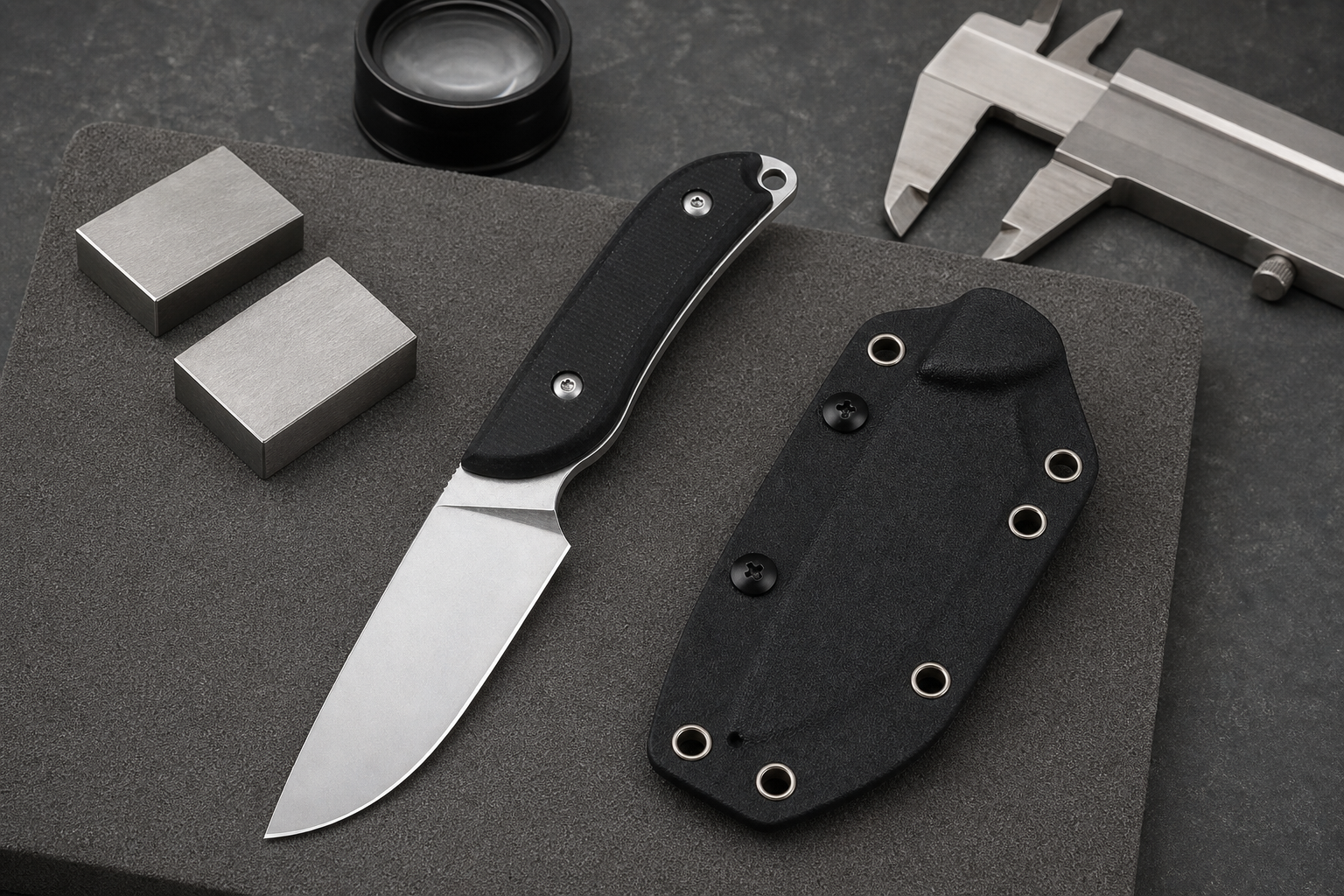
I Use the RFQ as the QC Starting Point
The RFQ should not disappear after quotation. It should become the inspection checklist. If the RFQ specifies blade length, inspect blade length. If it specifies handle material, verify the material record. If it specifies sheath retention, test retention. If it specifies warning placement, check the package.
ISO 9001 is useful as a quality-management reference because it frames quality around defined requirements, customer expectations, records, and improvement. Buyers do not need to claim certification to use that mindset. They can define requirements, inspect production, record results, and handle nonconformities consistently.
Useful QC records include:
- Approved drawing revision
- Approved physical sample
- BOM with material grades
- Steel and heat-treatment records
- Hardness check results
- Handle material and color range approval
- Sheath retention and fit check
- Packaging fit photos
- Warning and instruction version
- Final inspection report
The buyer should define pass/fail limits before shipment. "Looks good" is not a QC plan.
How Can Buyers Avoid Over-Specifying the Knife?
More features do not always make a better product.
Buyers can avoid over-specifying by separating must-have function from decorative upgrades, controlling cost gates, simplifying first-run features, and adding premium variants only after the core product is stable.
I Put a Cost Gate Before Every Upgrade
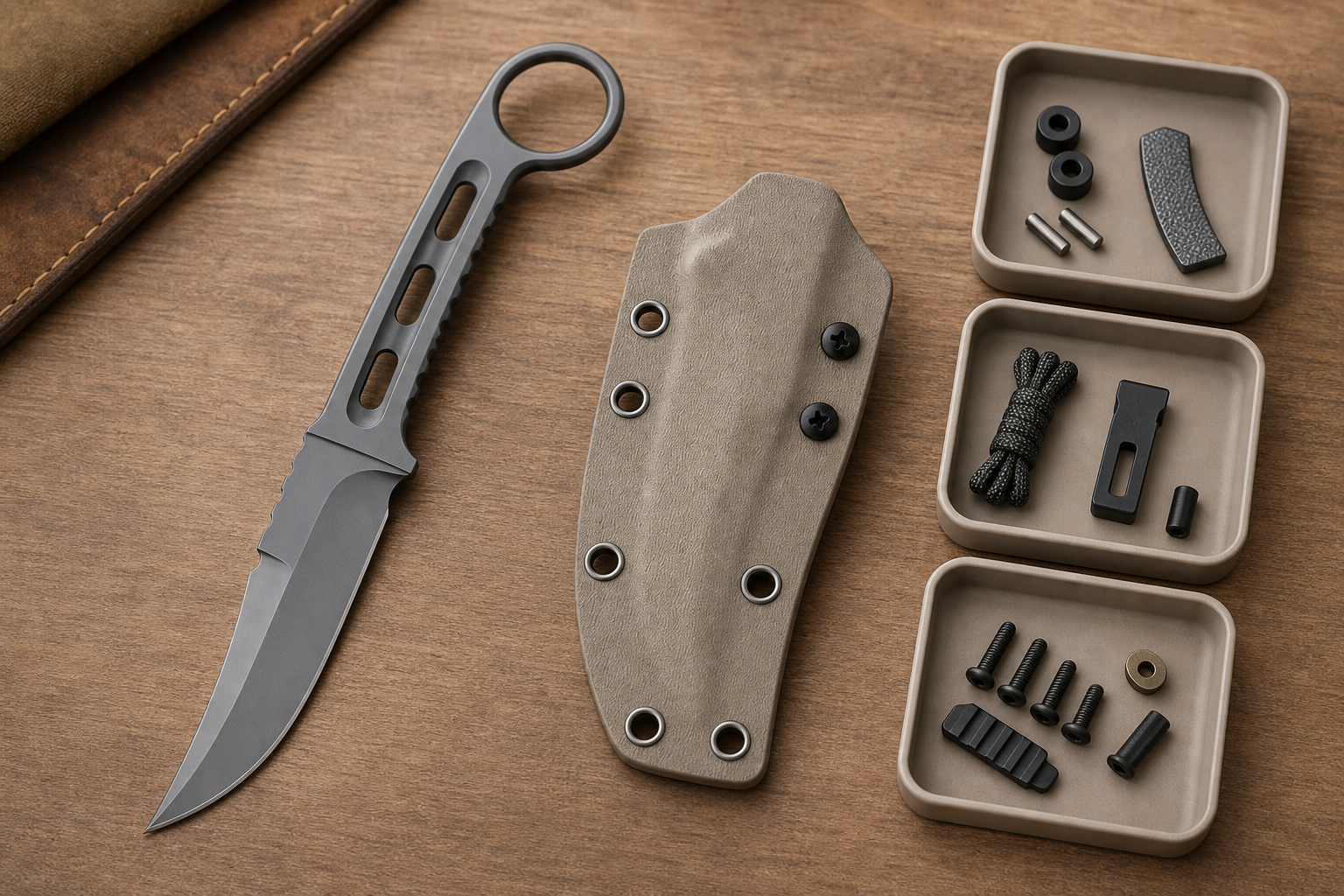
It is easy to add features: thicker blade, higher steel grade, custom sheath, decorative handle, coating, premium package, extra insert, special logo, and more tests. Some features may be worth it. Others may only raise cost and slow production.
Buyers should ask:
- Does this feature help the target user?
- Does it support the sales channel?
- Does it fit the target price?
- Does it require new tooling?
- Does it change compliance or claim evidence?
- Does it make inspection harder?
- Does it create repair or warranty risk?
A first production run should prove the core product. Premium variants can come later. A disciplined buyer does not remove value; they remove confusion.
How Can Vast State Help Buyers Choose Hunting Knife Specifications?
Vast State can help buyers turn product ideas into controlled outdoor knife specifications.
Vast State helps buyers choose hunting and outdoor knife specifications by aligning use case, blade geometry, steel, handle, sheath, packaging, claim wording, compliance documents, QC limits, and supplier RFQ records.
I Keep the Specification Practical and Inspectable
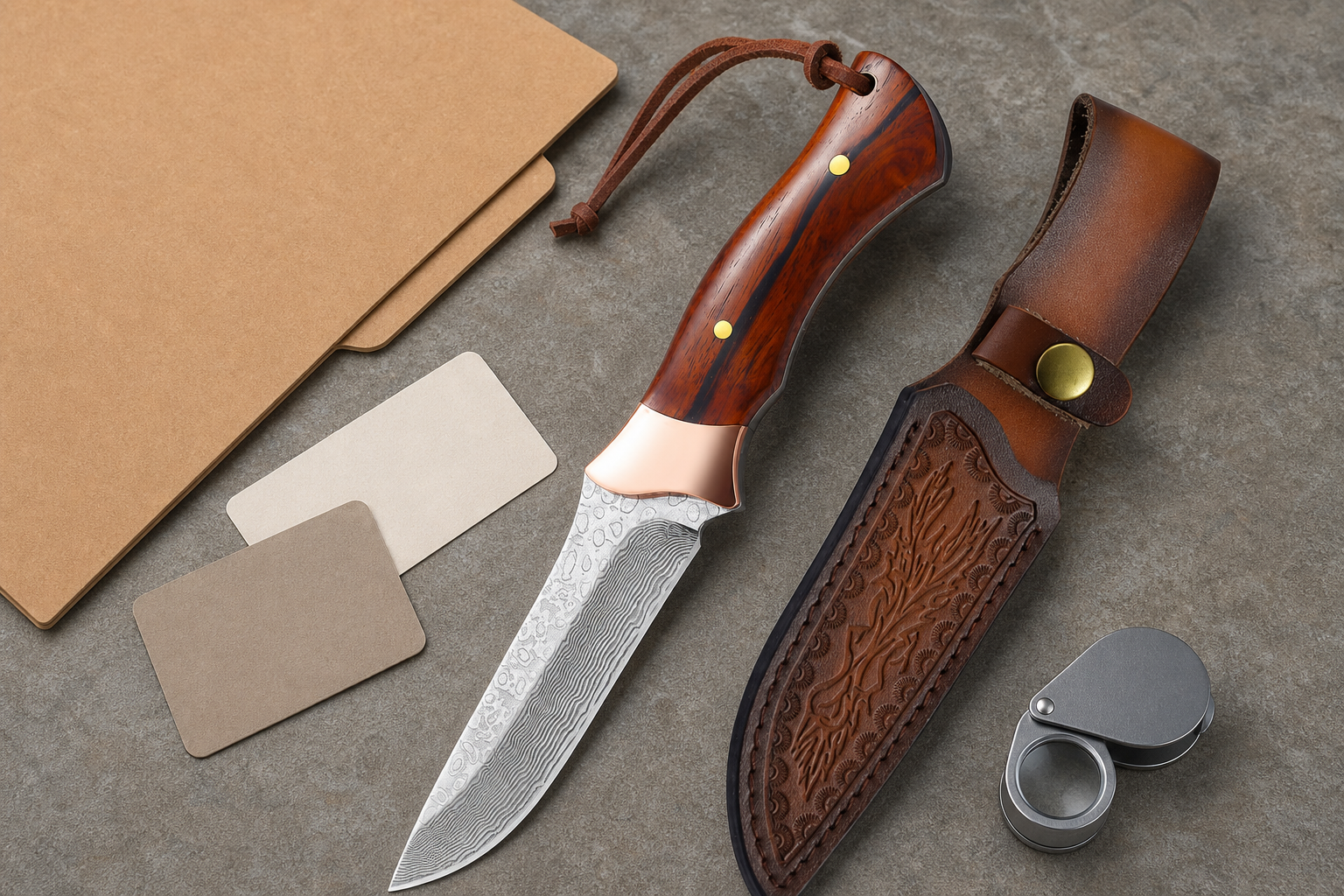
Vast State can help buyers avoid two common problems. The first is choosing a knife only by appearance. The second is adding too many features before the buyer has a stable target customer and price range. Both problems create sourcing friction.
We can help define the product brief first: target market, customer type, intended outdoor use, price range, order quantity, packaging channel, and compliance needs. Then we translate that brief into blade length, profile, steel, hardness range, handle material, sheath type, finish, packaging, instruction copy, and inspection criteria.
Vast State can support:
- Hunting and outdoor knife specification briefs
- Blade size and profile selection
- Steel and heat-treatment planning
- Handle and sheath material review
- Packaging and claim review
- QC checklist and defect examples
- Supplier RFQ schema
- Sample revision records
The goal is simple: choose a knife specification that the customer understands, the supplier can repeat, and the buyer can inspect.
Turn this article into a fixed blade project.
Send your target use, blade size, steel, handle direction, sheath needs, quantity, and packaging plan. Vast State can help shape it into a quote-ready project.
Conclusion
The right hunting knife specification balances use case, blade, steel, handle, sheath, package, claims, compliance, and repeatable QC.