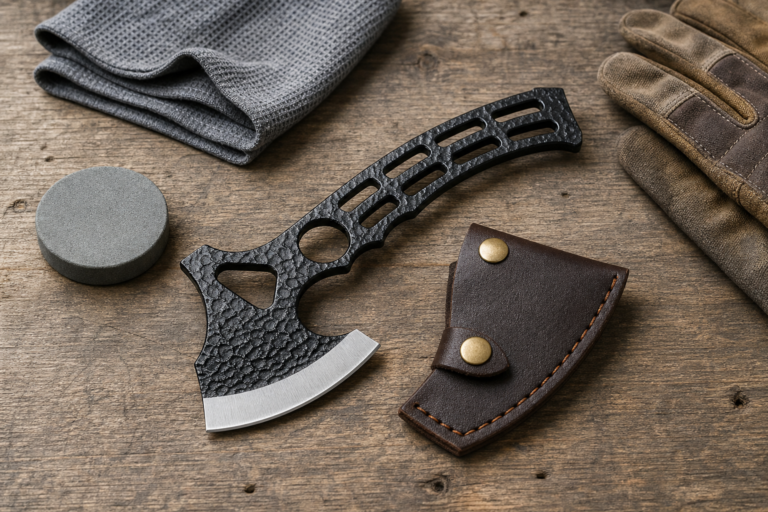
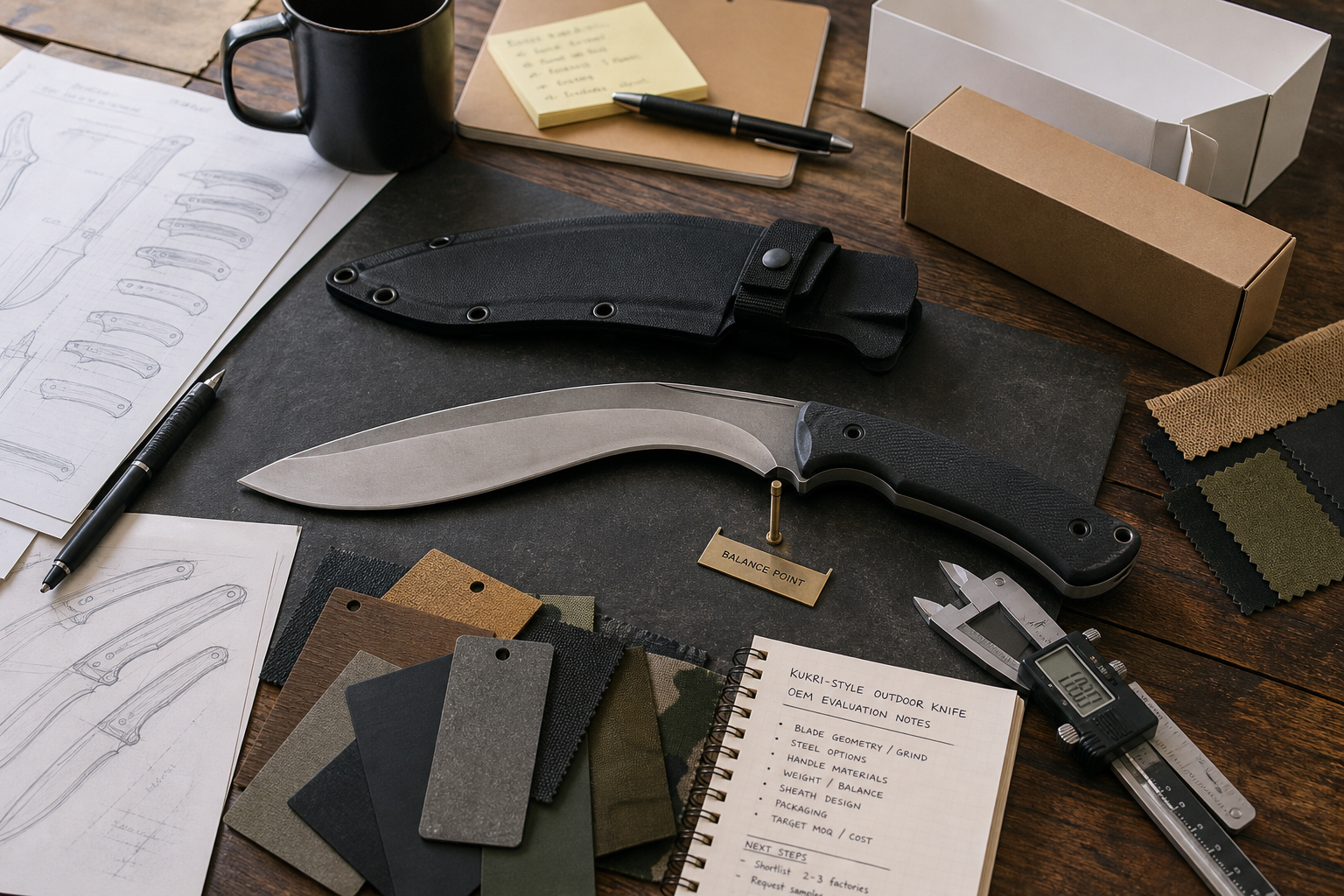
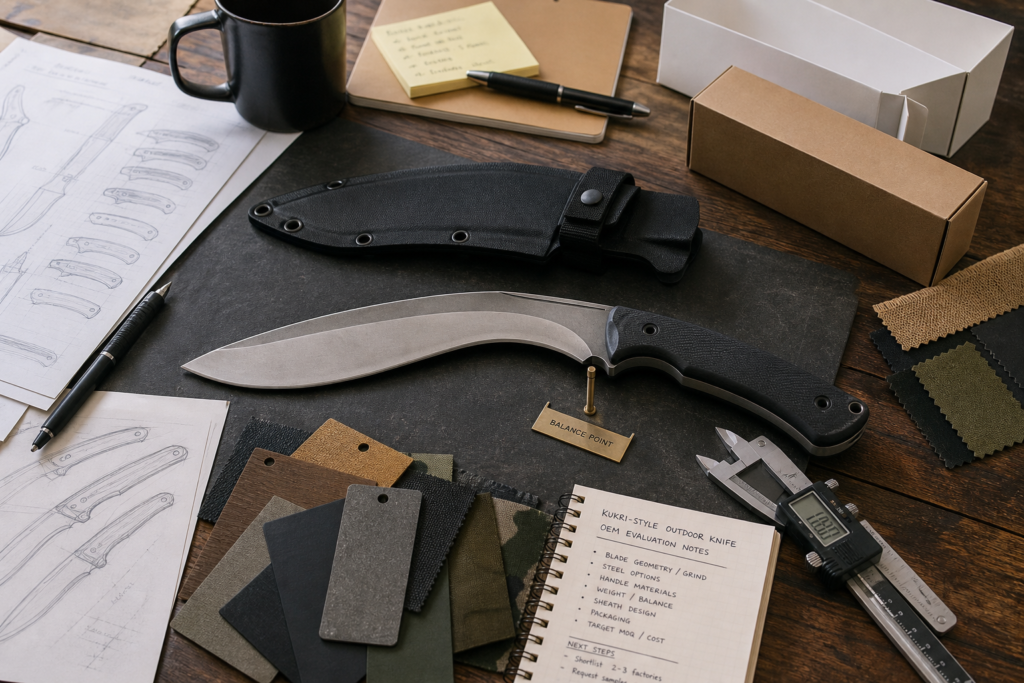
A kukri-style knife can look powerful on a product page. If the balance, handle, sheath, or claim is wrong, buyers inherit the problem.
Buyers should evaluate kukri-style outdoor knives by checking the use case, forward-curved blade geometry, size, weight, steel, heat treatment, handle control, sheath safety, packaging language, compliance needs, and repeatable QC. The product should be positioned as an outdoor cutting tool, not as a fantasy or fighting item.
Quick buyer brief:
- Answer: Treat kukri style as a purpose-driven outdoor tool shape, then define blade geometry, balance, materials, handle, sheath, safety wording, sample tests, and inspection points.
- Buyer context: This helps knife brands, outdoor brands, camping tool brands, importers, wholesalers, distributors, private label buyers, and sourcing managers.
- Key checks: Blade curve, belly height, tip position, spine thickness, weight distribution, grind, heat treatment, handle retention, sheath fit, corrosion protection, packaging claims, and target-market restrictions.
Planning a fixed blade or outdoor knife project?
Share your target use, blade size, steel preference, handle direction, sheath needs, quantity range, and packaging plan. Vast State can help turn it into a quote-ready specification.
When I discuss a kukri-style project with a B2B buyer, I slow the conversation down. This blade shape has a strong identity. It also has practical manufacturing risks. A forward-curved blade can be useful for outdoor chopping, camp work, brush clearing, and heavy utility tasks, but only when the product is designed honestly. If the knife becomes too thick, too heavy, too sharp near the wrong area, or too dramatic in appearance, it can miss the buyer's market. I prefer to define the product like any other OEM/ODM knife project: target user, target price, material, safety boundary, manufacturing stability, and repeat order consistency.
Why Should Buyers Treat Kukri Style as a Purpose-Driven Outdoor Tool?
Some buyers choose kukri style only because it looks distinctive. That is risky. Shape should follow function.
Buyers should treat kukri style as a purpose-driven outdoor tool because its curved profile, forward weight, and broad belly affect cutting feel, safety, packaging, and market positioning more than a normal straight fixed blade.
I Start by Separating Heritage From Product Claims
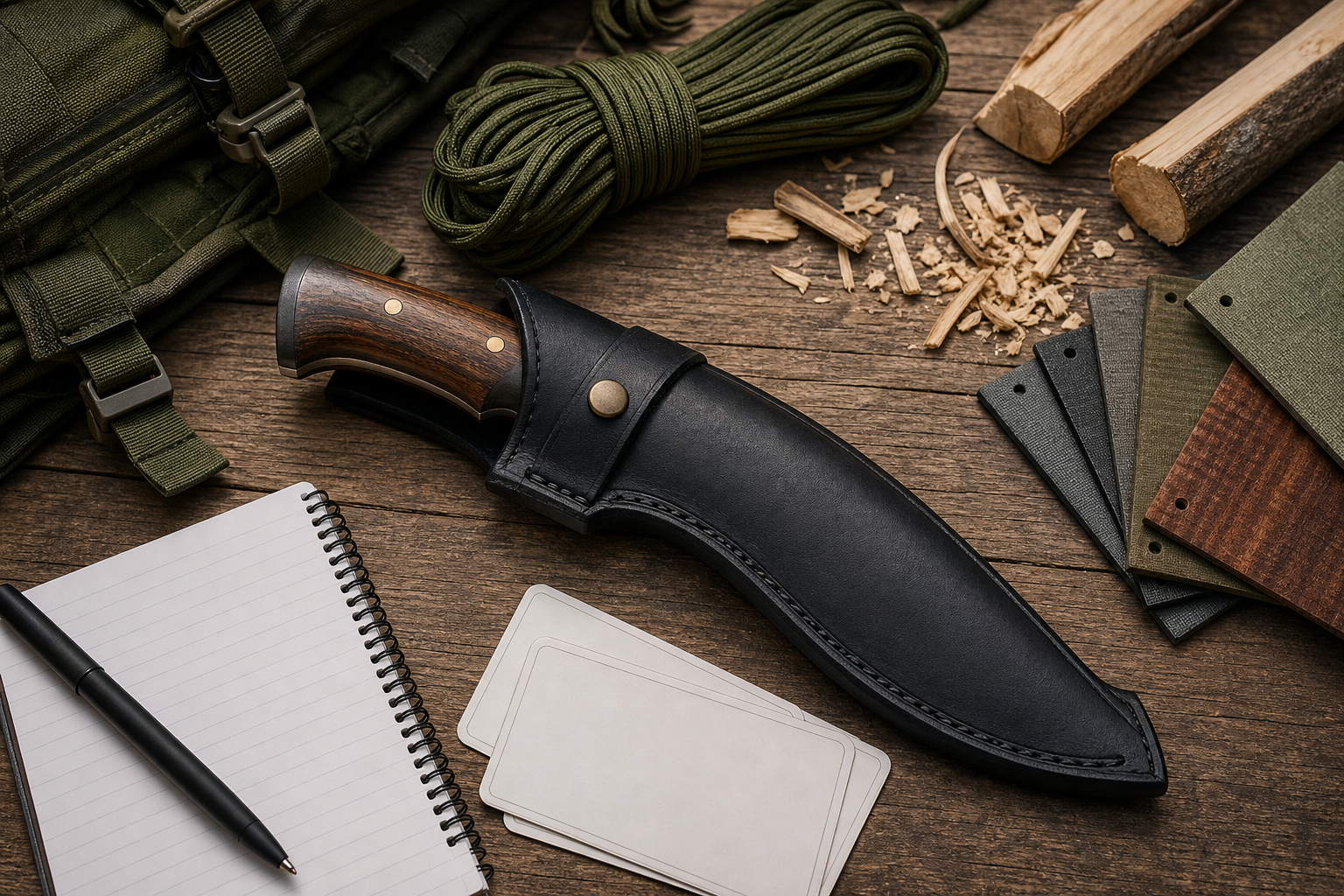
The kukri has a long cultural and historical background. The National Army Museum collection describes a kukri as a curved knife connected with Gurkha history and notes that it has been used for both peaceful and warlike purposes. For a modern B2B product brief, I do not use that history as a marketing shortcut. I use it as a reminder that the shape carries meaning and should be handled carefully.
For an outdoor brand, the safer and more useful direction is usually "kukri-style outdoor knife" or "forward-curved camp knife." This keeps the focus on outdoor utility, not conflict. A buyer can then discuss the product in terms of clearing small branches, camp preparation, field repair, brush work, and general heavy cutting tasks where lawful. The article should not promise self-defense value, combat performance, or tactical superiority.
The buyer should also decide whether this product fits the brand. A minimalist EDC brand may not need a large forward-weighted fixed blade. A camping, bushcraft, survival, or field tool brand may have a clearer reason to include it. Importers and distributors should also think about retailer acceptance. Some retailers want practical outdoor language. Some avoid aggressive blade shapes. A good supplier should help the buyer shape the concept before drawings become samples.
| Positioning question | What I check | Why it matters |
|---|---|---|
| Target user | Camper, outdoor worker, collector, utility buyer | It guides size and language |
| Product role | Camp tool, brush tool, heavy utility knife | It guides geometry |
| Brand fit | Practical outdoor vs display item | It affects packaging and photos |
| Market boundary | Legal and retail acceptance | It prevents avoidable problems |
OEM/ODM RFQ Checklist
Prepare these details to help Vast State review your project and provide a more accurate quotation.
| RFQ Field | What to Prepare |
|---|---|
| Project type | OEM from drawing / ODM private label / wholesale catalog |
| Product category | Folding knife / fixed blade / multi-tool / outdoor tool |
| Design status | Idea / sketch / 2D drawing / 3D CAD / physical sample |
| Target price | Ex-factory target price or retail price range |
| MOQ expectation | 500 / 1,000 / 3,000 / 5,000+ pcs |
| Logo method | Laser engraving / etching / printing / molded logo |
| Packaging | Standard packaging / custom retail box / Amazon-ready |
| Market | USA / EU / Japan / Korea / Middle East / other |
| Compliance needs | Buyer-specified testing / documentation / labeling |
| Timeline | Sample deadline / mass production deadline |
How Does the Forward-Curved Blade Shape Affect Cutting Performance?
The curve is not decoration. If the curve is wrong, the knife may feel awkward or unsafe.
The forward-curved blade shape affects cutting performance by moving more blade mass toward the front, increasing the belly, changing the chopping angle, and changing how the user controls the edge during outdoor cutting tasks.
I Look at Curve, Belly, Tip, and Edge Path Together
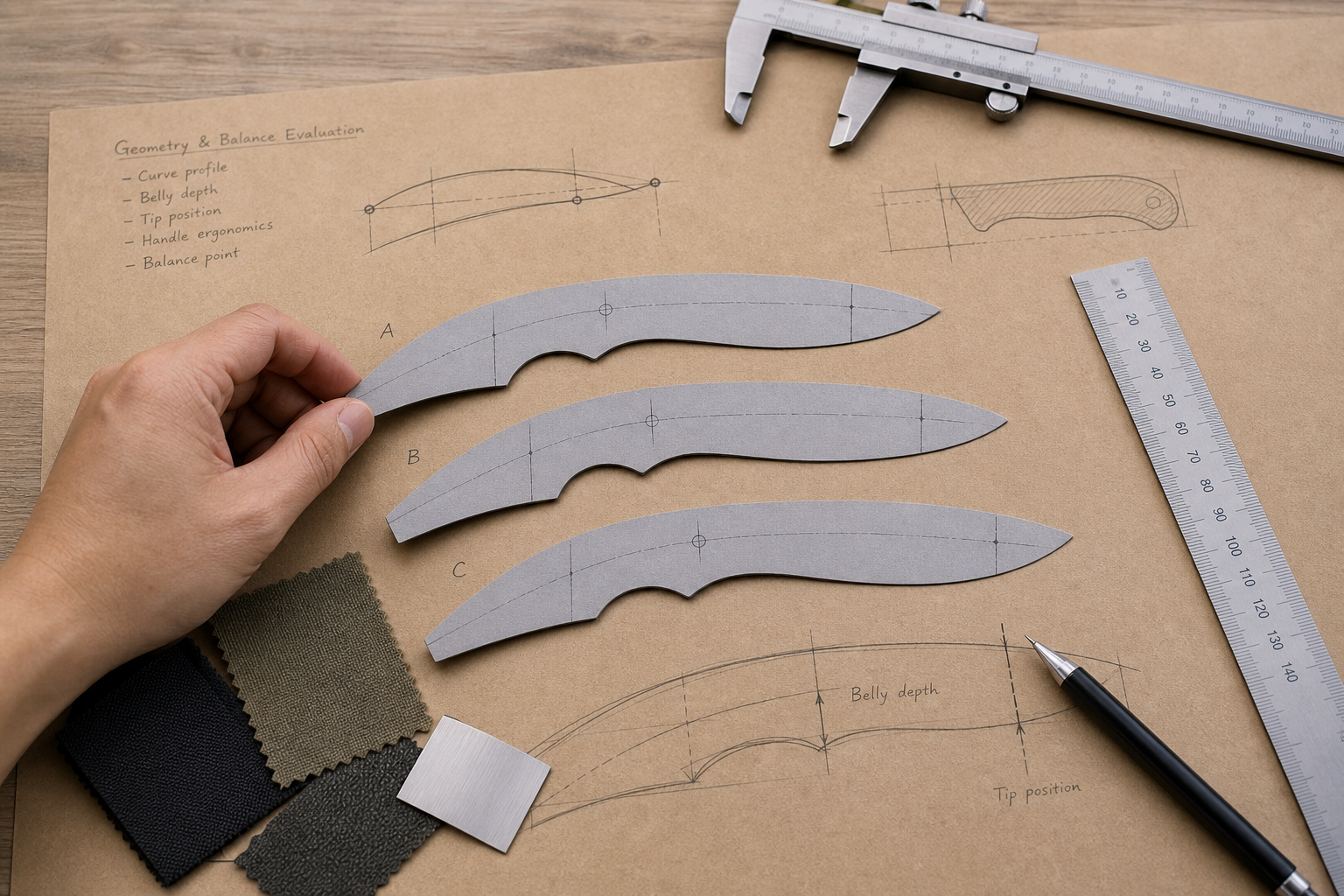
A kukri-style blade usually has more belly and more forward presence than a standard fixed blade. That can help with chopping and slicing through fibrous outdoor material. It can also create a heavy or unbalanced product if the design is not controlled. The curve should not be exaggerated only for visual impact. I check whether the edge path makes sense for the intended user.
The belly height matters. A broad belly can create strong cutting contact, but it also changes sharpening and sheath fit. The tip position matters too. A tip that sits too high may reduce control. A tip that sits too low may make the blade look dramatic but less practical for general use. The grind matters because this blade type may face harder impact than a simple slicing knife. A very thin edge may cut well at first but suffer if the knife is marketed for heavy outdoor work.
The spine thickness and taper also need attention. A thick spine can make the product feel strong, but it increases weight and cost. It can also make the knife feel slow. A thinner spine can improve handling, but it may not support heavy tasks. The buyer should decide the work level first, then tune the shape.
For OEM/ODM development, I prefer to compare several blade profiles at sample stage. One drawing may look right on screen, but the real balance in hand can be different.
| Geometry factor | Practical effect | Buyer decision |
|---|---|---|
| Forward curve | More front-focused cutting feel | Keep it useful, not exaggerated |
| Belly height | More cutting contact | Balance cutting and sheath fit |
| Tip position | Control and appearance | Avoid fantasy shapes |
| Spine thickness | Strength, weight, cost | Match real task level |
What Size, Thickness, and Balance Should Buyers Specify?
A kukri-style knife can become too large very quickly. Bigger is not automatically better.
Buyers should specify size, thickness, and balance by defining the intended cutting task, carry method, user strength, retail price range, shipping weight, sheath design, and expected handling comfort.
I Define the Carry Experience Before Finalizing the Drawing
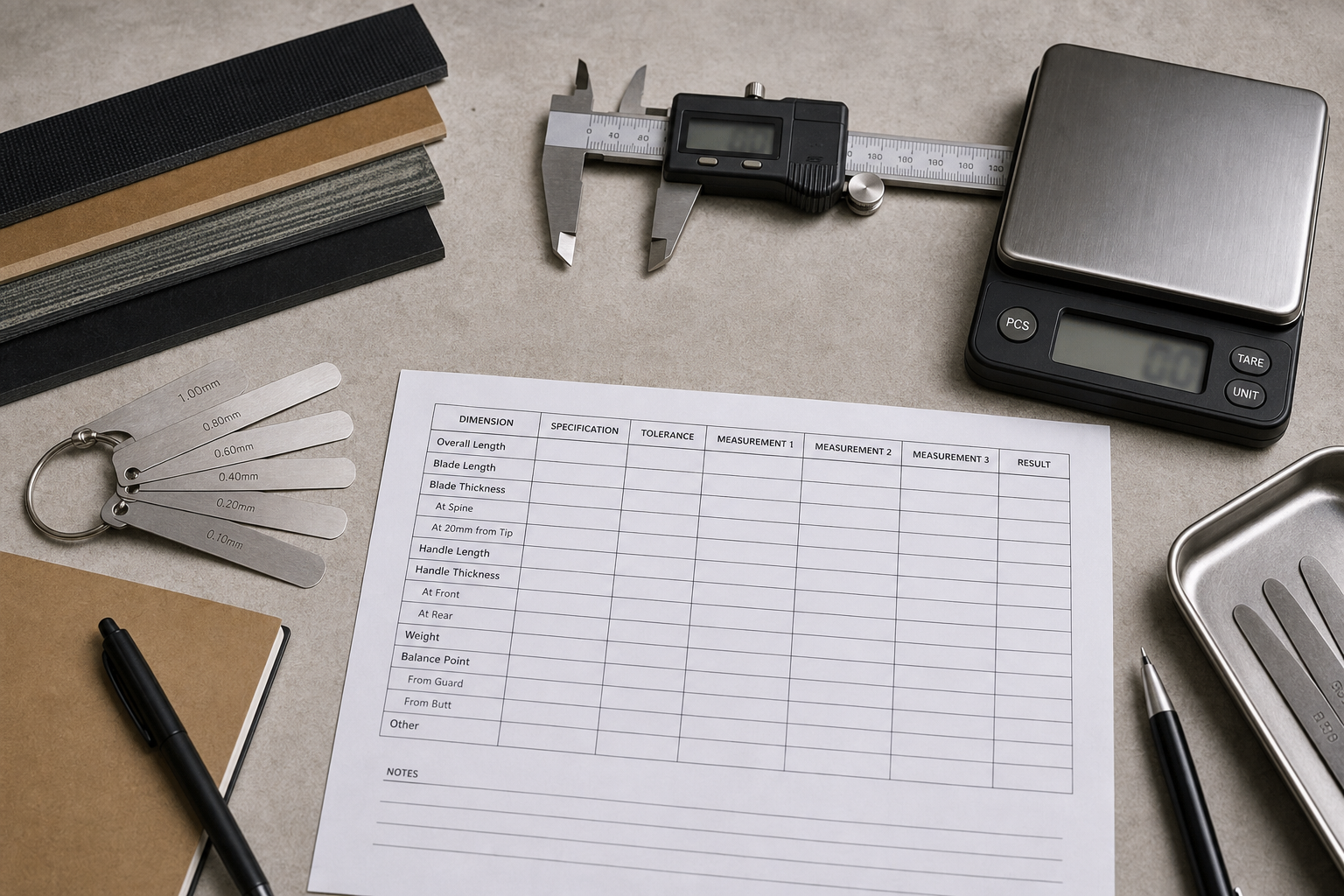
A product drawing may focus on blade length, but the user feels total size and weight. A kukri-style outdoor knife needs enough blade presence to justify the shape, but it must still be realistic to carry, store, package, and sell. If the knife is too heavy, many customers will leave it at home. If it is too light, it may not deliver the expected cutting feel.
I usually discuss three product levels with buyers. A compact kukri-style utility knife can use the shape mainly as a design cue. It may fit smaller outdoor kits and lower shipping weight. A mid-size camp knife can offer a more useful balance between cutting ability and carry. A heavy brush tool requires stronger material, a more secure handle, a better sheath, stronger packaging, and more careful safety wording.
Thickness should match the use case. Buyers often ask for thick blades because they associate thickness with quality. But thick blades increase steel consumption, grinding time, heat treatment risk, shipping weight, and user fatigue. A well-designed blade does not need to be overbuilt to feel dependable.
Balance point is one of the most important sample checks. A forward balance can support chopping tasks, but too much forward weight makes the tool tiring. I ask the buyer to approve not only the drawing, but also the physical handling feel.
| Size factor | What it changes | What I ask the buyer |
|---|---|---|
| Blade length | Cutting reach and carry burden | Is this for camp use or compact utility? |
| Spine thickness | Strength and weight | Does the task justify the material? |
| Balance point | Swing feel and control | Is forward weight useful or tiring? |
| Overall weight | Shipping and user comfort | Can the target customer carry it? |
Which Steel, Heat Treatment, and Finish Choices Fit Kukri-Style Knives?
The steel name alone cannot make this design work. Heat treatment and edge geometry matter just as much.
Kukri-style knives need steel, heat treatment, and finish choices that support impact resistance, edge stability, corrosion resistance, manufacturability, price target, and the buyer's real outdoor use case.
I Match Steel to Task, Not to Buzzwords
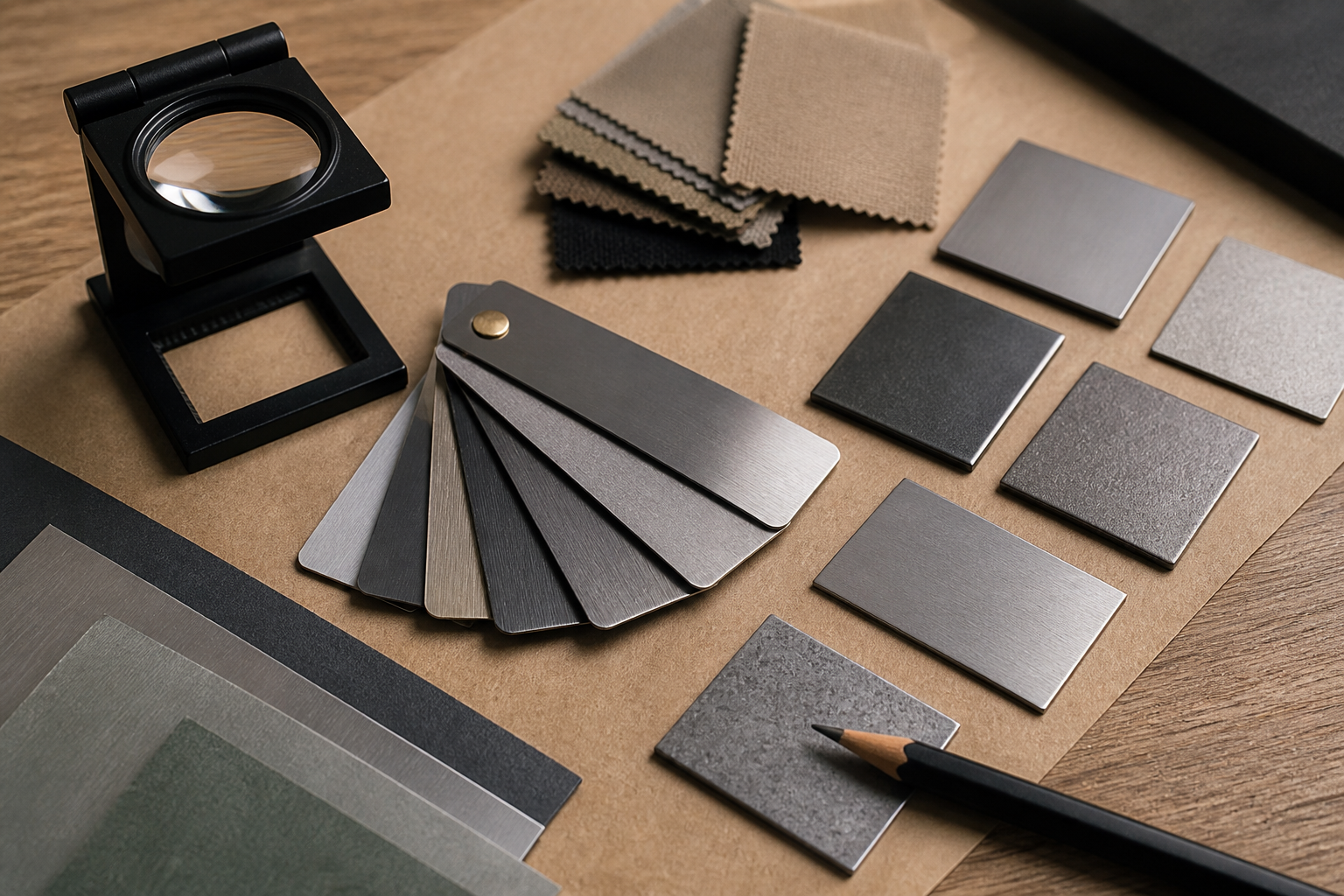
For a forward-curved outdoor knife, I think about toughness, edge stability, corrosion resistance, sharpening, and price. Some buyers want stainless steel because their customers expect lower maintenance. Some want carbon steel because they like toughness, easy sharpening, or traditional outdoor positioning. Some want D2-style tool steel because it sounds strong in the market. The right answer depends on the product, heat treatment, finish, and user education.
Official material resources help buyers discuss steel more clearly. For example, Alleima 14C28N knife steel is presented by Alleima as offering edge performance, hardness, and corrosion resistance for knife applications. That does not mean it is automatically the best choice for every kukri-style knife. It means buyers should compare steel by real properties instead of only by popularity.
Heat treatment is critical. A blade that is too hard may chip under heavier outdoor work. A blade that is too soft may roll or lose edge performance too fast. The target hardness should match blade thickness, edge angle, steel grade, and expected use. Finish also matters. A coated blade can help with corrosion protection and style, but the coating must be durable and consistent. A stonewashed or satin finish may look cleaner, but it may need clearer care instructions.
I also ask buyers to think about sharpening. A large curved edge may not be as simple for beginners to sharpen as a straight blade. Packaging and product pages should not hide that.
| Material choice | Main benefit | Production concern |
|---|---|---|
| Stainless knife steel | Better corrosion resistance | Needs correct heat treatment |
| Carbon steel | Outdoor tradition and easy sharpening | Needs rust prevention |
| Tool steel | Strong market perception | Needs honest maintenance guidance |
| Coated finish | Protection and visual style | Check adhesion and edge wear |
How Should Handle and Sheath Design Support Real Outdoor Use?
The blade gets attention, but the handle and sheath decide whether users trust the product.
Handle and sheath design should support grip retention, comfort, safe draw, secure storage, belt or pack carry, moisture control, edge protection, and packaging stability for the target outdoor market.
I Treat the Handle as a Safety Part
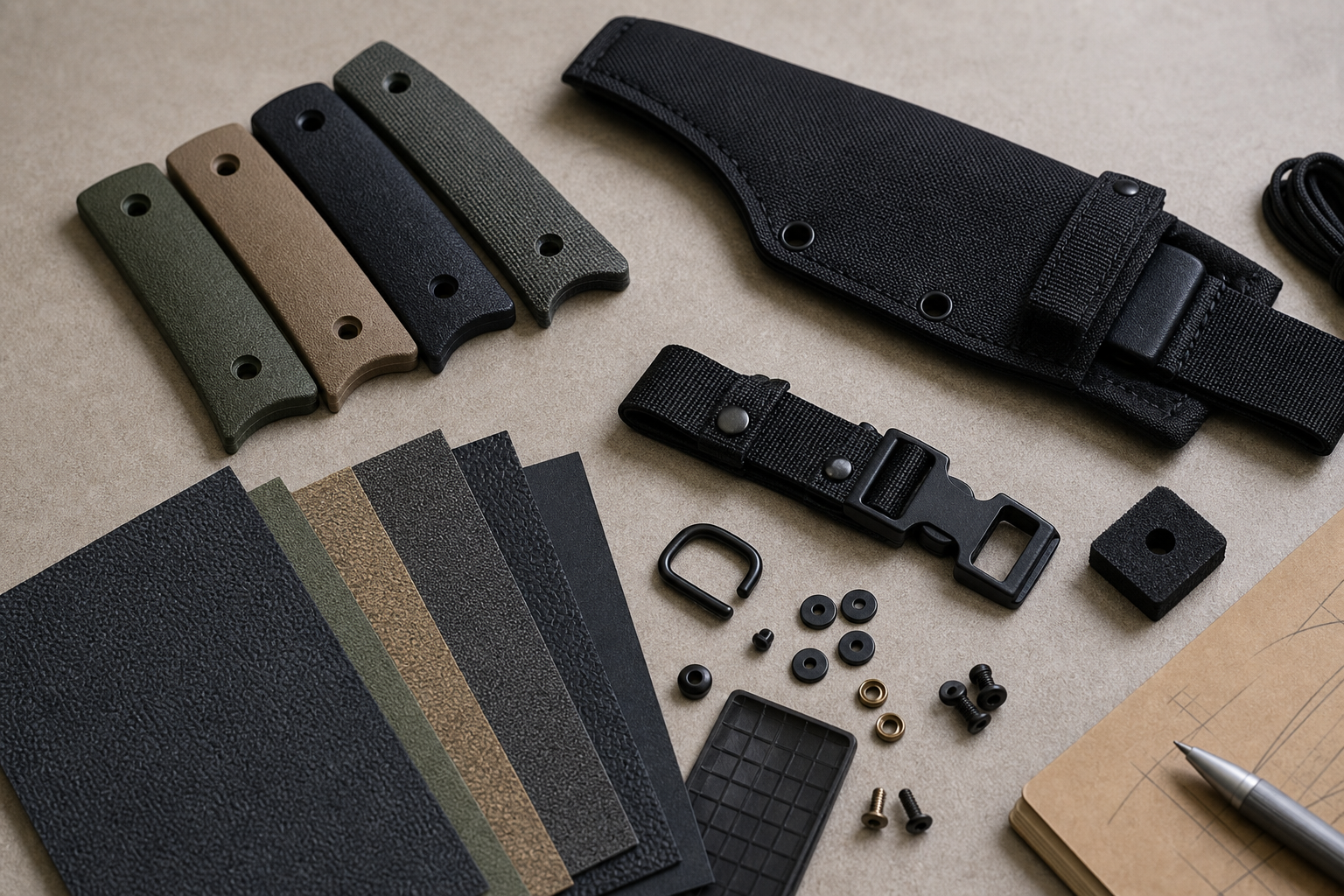
Kukri-style knives often have forward weight. That means the handle must help the user keep control. A smooth handle may look clean, but it can feel insecure when the hand is wet, cold, or tired. A very aggressive texture may improve grip, but it can create hot spots. The buyer should define whether the product is for occasional camp use, harder outdoor work, or display-oriented retail.
Handle materials create different cost and performance results. G10, micarta, rubberized material, wood, TPR, and molded polymer all have a place. Wood can support a warmer, traditional look, but it needs stable finishing. G10 and micarta can look technical and durable, but machining and dust control matter. Rubberized handles can improve comfort, but bonding and long-term aging should be checked.
Tang construction also matters. For heavier fixed blades, buyers often prefer full tang or strong hidden tang designs. The supplier should explain how the tang, fasteners, adhesive, and handle scales work together. A decorative handle that loosens after repeated use will damage the brand.
The sheath is just as important. A kukri-style blade has a broad curved profile, so sheath fit must be controlled. The edge should not cut the sheath during insertion. The retention should be secure without making the knife difficult to remove. If the product uses nylon, leather, polymer, Kydex-style sheet, or molded sheath parts, each choice changes cost, tooling, and perception.
| Part | What I check | Buyer value |
|---|---|---|
| Handle shape | Palm swell, guard, rear retention | Better control |
| Handle material | Grip, cost, durability | Better market fit |
| Tang and fasteners | Strength and stability | Fewer returns |
| Sheath fit | Retention and edge protection | Safer storage |
What Safety, Packaging, and Compliance Boundaries Should Buyers Plan?
Poor wording can create problems even when the knife is well made. Claims must stay practical and lawful.
Buyers should plan safety, packaging, and compliance boundaries by avoiding self-defense claims, defining safe tool use, checking target-market knife rules, preparing correct importer documents, and adding clear care and storage instructions.
I Keep the Marketing Language Practical
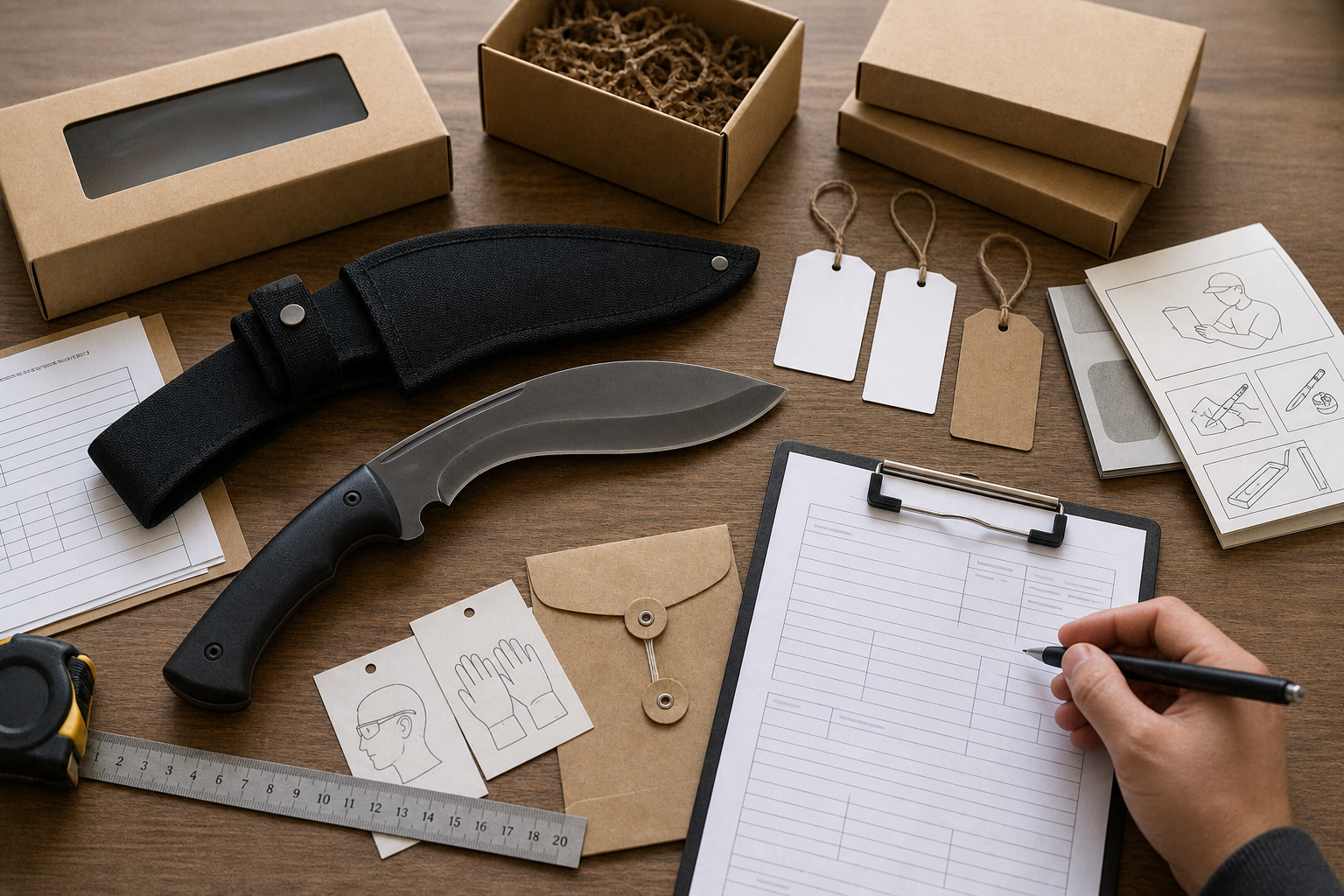
For this blade type, packaging language matters. I avoid words that push the product toward fighting, combat, intimidation, or self-defense. I prefer plain outdoor terms such as camp cutting, brush clearing where lawful, campsite preparation, field utility, and heavy outdoor chores. Even then, the buyer should check whether those claims match the product and whether local law allows the product to be sold and carried.
The buyer should also include clear safe-use boundaries. The CCOHS hand-tool guidance supports choosing the right tool, keeping cutting tools sharp and covered, and not cutting toward yourself. For a kukri-style outdoor knife, that means the instruction card should cover storage, sheath use, edge care, safe working direction, PPE where appropriate, and adult-only handling if needed.
Compliance is market-specific. I do not tell buyers that one rule covers every country or region. Knife laws can depend on blade length, fixed blade status, carry method, packaging, age restriction, sales channel, and local interpretation. The buyer should confirm rules for the destination market before production.
For U.S. consumer products, the CPSC General Certificate of Conformity page is useful when a product is subject to applicable CPSC safety rules. It reminds buyers to think about certificates, test records, importer information, and product identification where rules apply. For knives, the exact document need depends on the product and market. The practical lesson is simple: document decisions early.
| Planning area | What to prepare | Why it matters |
|---|---|---|
| Claims | Outdoor utility wording | Reduces brand and legal risk |
| Instructions | Safe cutting and storage guidance | Helps users understand limits |
| Compliance | Target-market rule check | Avoids blocked sales |
| Documentation | Test and product records | Supports importer and retailer needs |
How Should Buyers Test Kukri-Style Samples Before Mass Production?
A sample photo cannot prove handling. The buyer needs practical tests before approval.
Buyers should test kukri-style samples by checking balance, grip security, sheath retention, edge geometry, cutting performance on intended materials, heat treatment consistency, corrosion resistance, finish durability, packaging fit, and repeatable QC points.
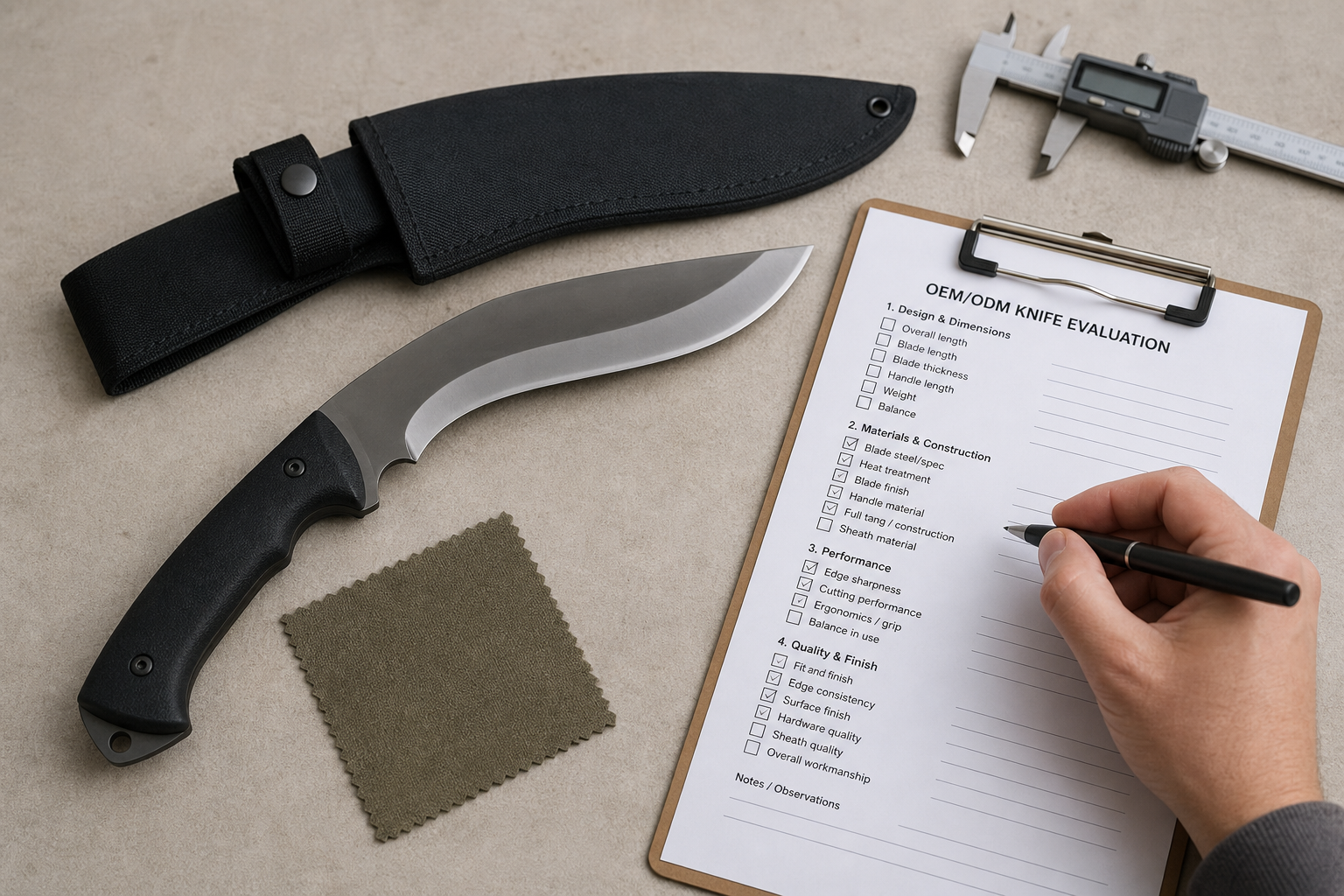
I Test the Product Against the Promise
Sample testing should start with the product promise. If the knife is sold as a camp tool, test controlled cutting tasks that match that claim. If it is sold as a brush tool, test suitable outdoor material in a safe environment. If it is sold as a collectible or display product, the buyer still needs edge protection, handle stability, finish quality, and packaging safety.
Balance testing is important. I pick up the sample, check the forward weight, and ask whether a normal user can control it. I check whether the handle shape prevents slipping during repeated movement. I check whether the rear handle shape supports retention without creating discomfort.
Sheath testing is also essential. The knife should not rattle excessively, fall out easily, or cut the sheath during normal insertion. The belt loop, snap, rivet, and stitching should match the tool weight. If the sheath is too weak, the product feels unsafe even if the blade is good.
The blade should be inspected after testing. I look for edge rolling, chipping, coating wear, loose scales, handle cracks, rust marks, and packaging damage. If the buyer wants a specific test method, it should be written into the RFQ. Otherwise, sample approval may become subjective.
| Sample test | What to check | Pass question |
|---|---|---|
| Balance | Forward weight and control | Can the user handle it safely? |
| Edge | Cutting and post-test damage | Does the edge match the claim? |
| Handle | Grip and fastener stability | Does anything loosen? |
| Sheath | Retention and insertion | Does it store safely? |
What QC Standards Matter in Kukri-Style Knife Production?
The shape is harder to control than a simple straight blade. Production needs clear inspection points.
Mass-production QC should check steel, heat treatment, blade profile, grind symmetry, edge condition, handle fit, fasteners, sheath retention, finish consistency, logo placement, packaging, and batch records.
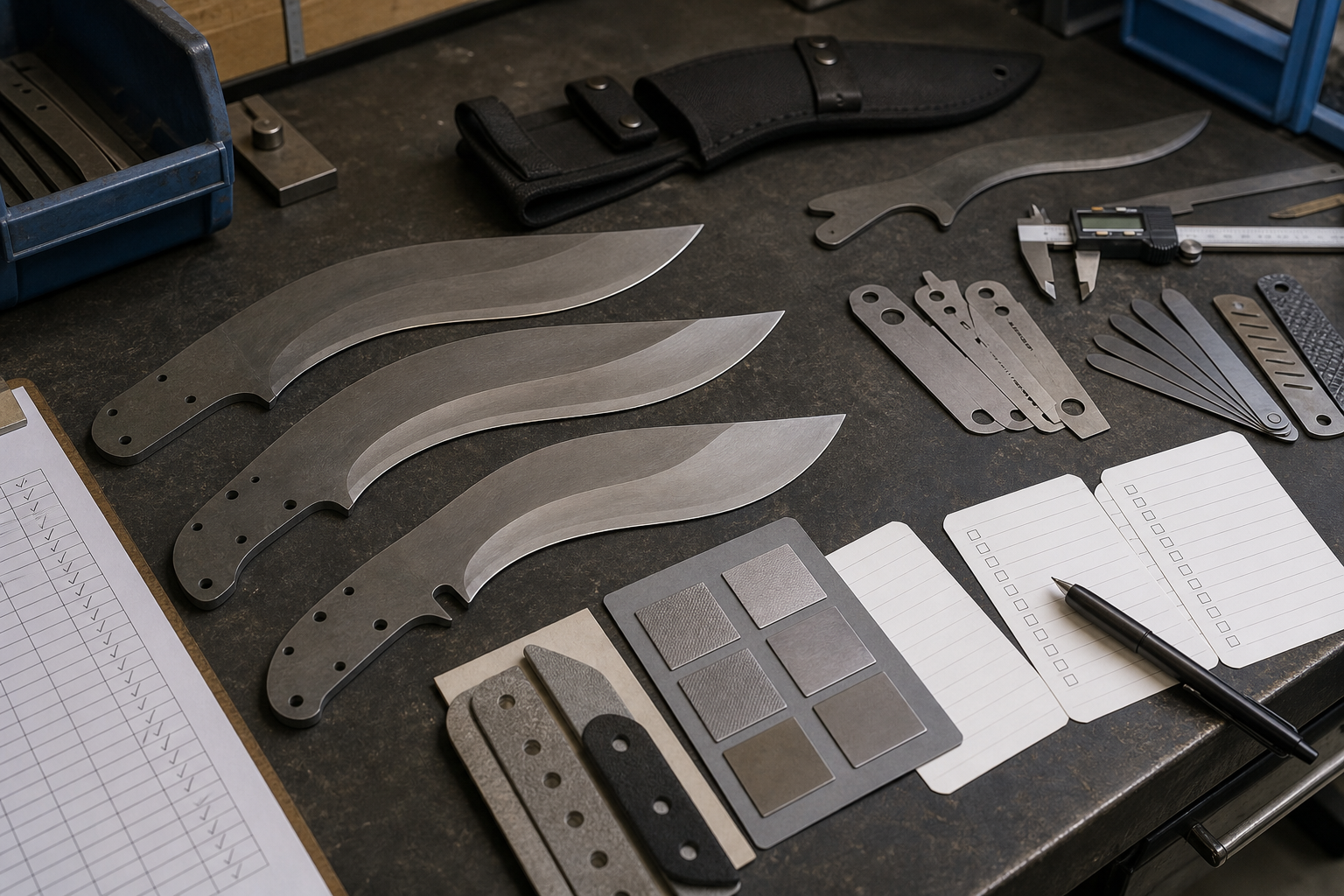
I Make the Inspection Standard Specific Enough to Repeat
Kukri-style production should not depend only on a final visual check. The blade curve needs a profile template or drawing tolerance. The grind should be even enough for the product level. The edge should be free from obvious burrs and chips. The heat treatment result should be checked according to the chosen steel and target hardness. The handle should fit tightly with no sharp seams, loose scales, proud fasteners, or cracks.
The sheath should be part of QC, not an afterthought. The blade shape can stress the sheath during insertion and removal. The edge must be covered. Retention must be checked. If the sheath uses rivets, stitching, snaps, belt loops, or molded friction fit, those parts need inspection.
OSHA's hand-tool rule says employers are responsible for the safe condition of tools used by employees. This is a workplace requirement, not a knife factory specification, but it supports the mindset that tools must be safe and serviceable before use. In B2B manufacturing, that means QC should check function, not only appearance.
For repeat orders, I recommend keeping a golden sample, packaging sample, defect limit samples, and clear inspection sheet. The buyer and supplier should agree on cosmetic tolerance, functional rejection points, and packaging acceptance before mass production.
| QC point | What to check | Why it matters |
|---|---|---|
| Blade profile | Curve and tip position | Keeps design consistent |
| Grind and edge | Symmetry and burrs | Supports performance |
| Handle assembly | Fit, fasteners, comfort | Prevents return issues |
| Sheath and package | Retention and protection | Supports safe delivery |
How Can Vast State Support Kukri-Style Outdoor Knife Development?
This blade style needs practical control from concept to shipment. A catalog image is not enough.
Vast State can support kukri-style outdoor knife development through concept review, blade geometry suggestions, material selection, prototype development, handle and sheath design, packaging customization, QC planning, and production follow-up.
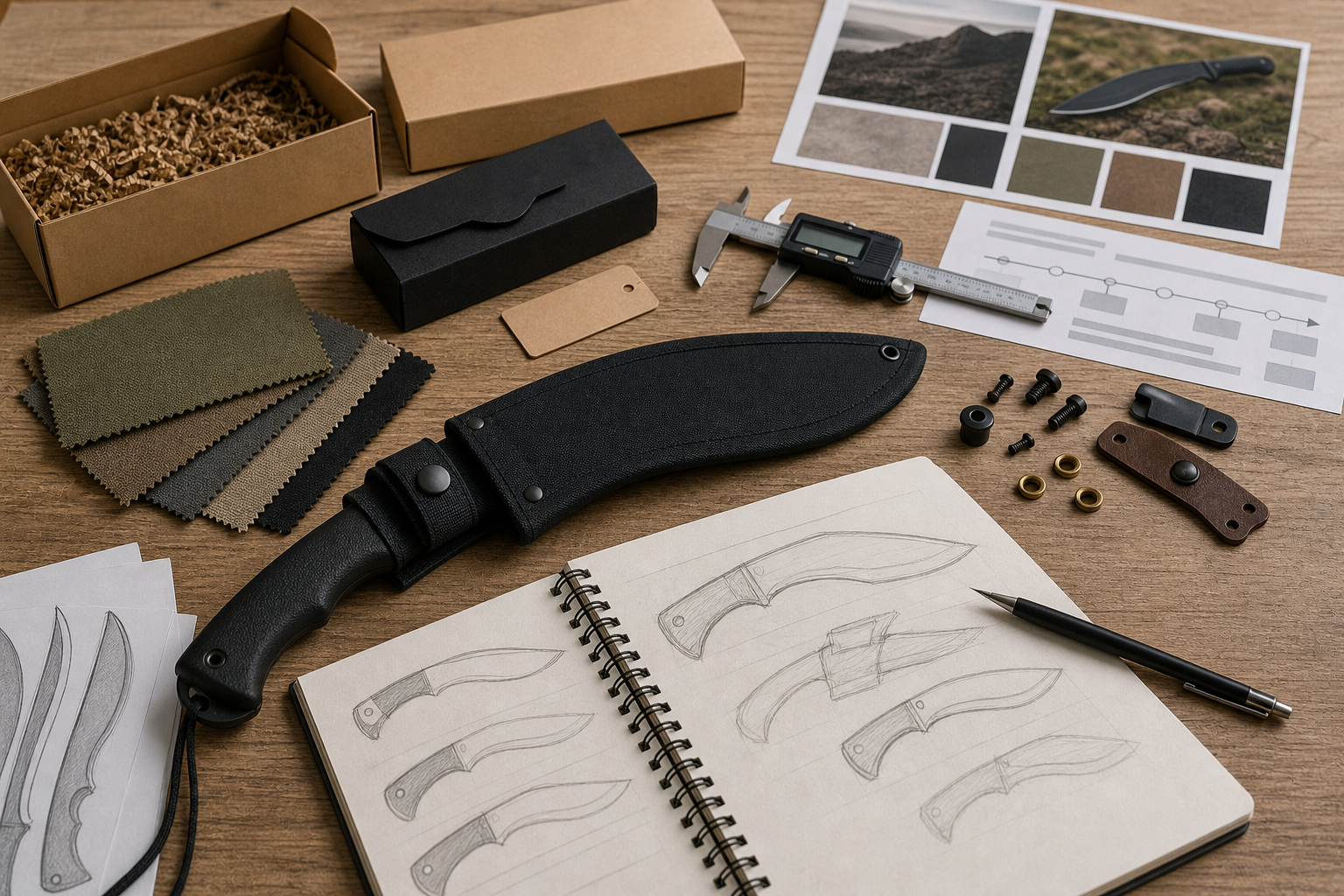
I Help Buyers Turn a Strong Shape Into a Manufacturable Product
Vast State is an OEM/ODM knife and outdoor tool manufacturer based in Yangjiang, China. We support international B2B customers with folding knives, fixed blade knives, pocket knives, camping tools, rescue tools, and multi-tools. A kukri-style outdoor knife sits naturally inside the fixed blade and camping tool area, but it needs careful development because the shape can easily become too heavy, too dramatic, or too hard to package safely.
When a buyer brings this idea to us, I start with the market. Who will use the knife? What price range does the buyer need? What size can the channel accept? Does the brand need a practical camp tool, a premium outdoor product, or a lower-cost utility item? From there, we discuss blade profile, steel, finish, handle material, tang construction, sheath structure, logo placement, retail packaging, and test requirements.
If the buyer already has a finished design, we review manufacturability. If the buyer has only a rough idea, we help turn it into a product direction that can be sampled. We also keep communication practical. If a feature adds cost without helping the target user, I say so. If a blade shape creates sheath or safety issues, I explain the production risk before the buyer spends money on tooling.
Our goal is not only to manufacture a knife. Our goal is to help buyers build products that fit their market, price range, and brand position while staying realistic in mass production.
| Support area | What we help with | Buyer value |
|---|---|---|
| Concept review | Use case, size, price target | Clearer direction |
| Engineering input | Profile, steel, handle, sheath | Fewer sample issues |
| Customization | Logo, finish, packaging | Stronger brand fit |
| QC follow-up | Function and appearance checks | More stable repeat orders |
Turn this article into a fixed blade project.
Send your target use, blade size, steel, handle direction, sheath needs, quantity, and packaging plan. Vast State can help shape it into a quote-ready project.
Conclusion
I evaluate kukri-style knives by connecting heritage, outdoor function, blade geometry, materials, safety wording, sheath quality, and repeatable production control.
Source Notes
- National Army Museum supports the historical background of kukri as a curved Gurkha-associated knife with both peaceful and warlike historical uses.
- Alleima supports material discussion around 14C28N as a knife steel with edge performance, hardness, and corrosion resistance.
- CCOHS supports safe hand-tool guidance, including choosing the right tool, covering sharp edges, and avoiding unsafe cutting direction.
- OSHA supports the broader tool-condition mindset through its hand-tool safe-condition requirement.
- CPSC supports early documentation thinking for general-use products subject to applicable CPSC safety rules.