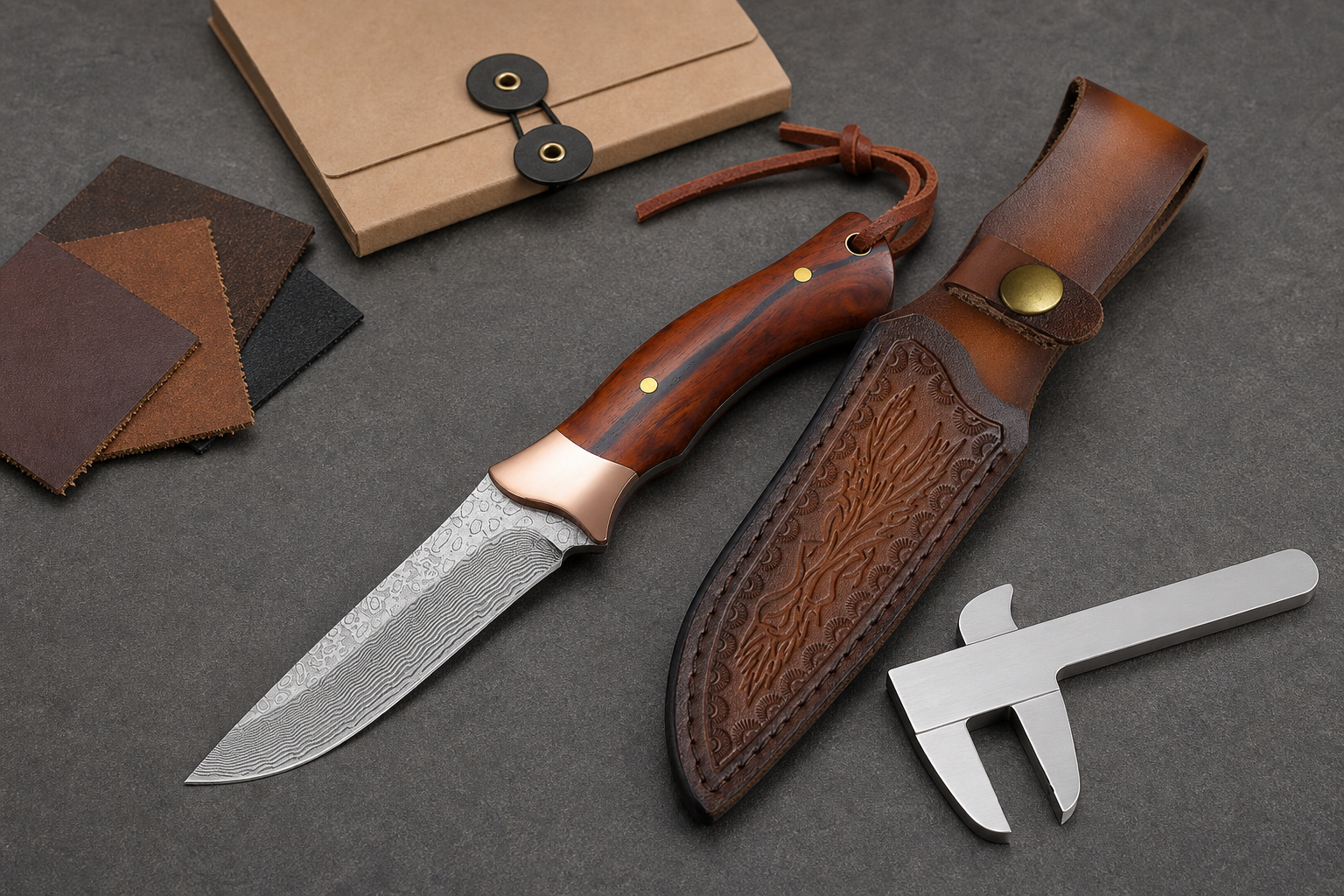
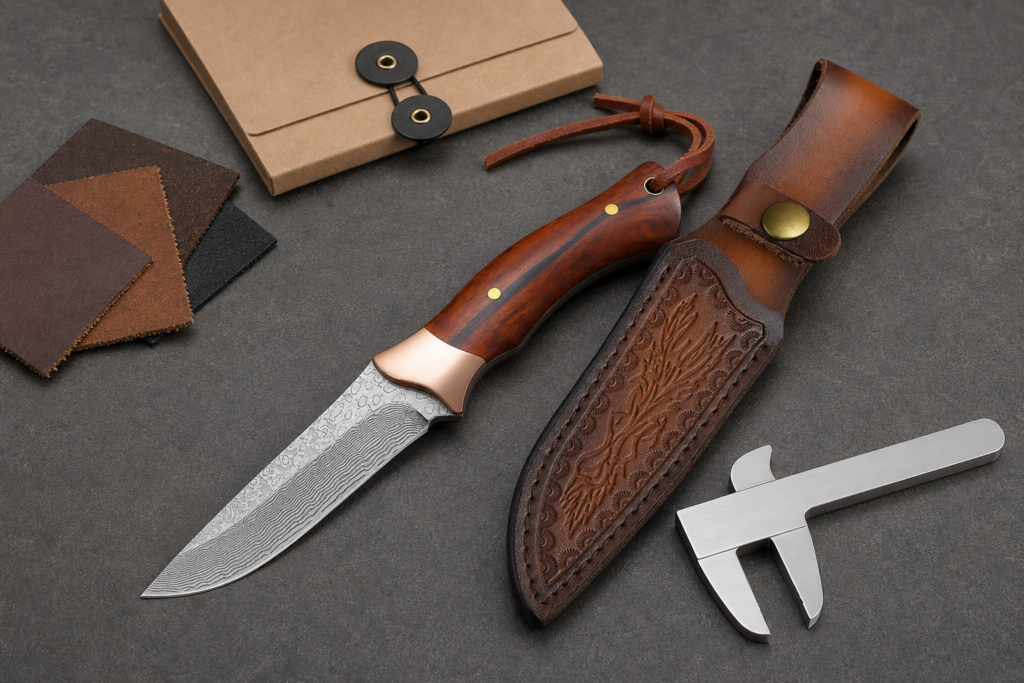
A leather sheath is not only an accessory. It protects the blade, the user, the package, and the product story.
Buyers should specify leather knife sheaths by defining knife fit, blade coverage, retention, leather type, thickness, welt, stitching, rivets, belt attachment, moisture behavior, chemical compliance, care instructions, packaging, and QC tests before approving OEM/ODM samples.
Quick buyer brief:
- Answer: A good leather sheath brief should control safety, fit, durability, finish, compliance, and user maintenance, not just color and logo placement.
- Buyer context: This guide is for knife brands, outdoor brands, hunting-accessory brands, kitchenware brands, EDC brands, importers, distributors, private label buyers, and OEM/ODM sourcing teams.
- Key checks: Leather source, tanning route, thickness, welt design, blade insertion depth, point coverage, retention force, stitching, rivets, belt loop, drainage or moisture plan, edge finishing, chemical testing, packaging protection, care copy, and final inspection records.
Planning a fixed blade or outdoor knife project?
Share your target use, blade size, steel preference, handle direction, sheath needs, quantity range, and packaging plan. Vast State can help turn it into a quote-ready specification.
Many buyers search for how to make a leather sheath because they want to understand the structure. But for an OEM/ODM knife project, the better question is not how one person crafts a sheath by hand. The better question is how a buyer can specify a sheath that fits the knife, protects the user, looks consistent, and can be repeated in production.
Leather sheaths can add real value to fixed blade knives, outdoor kits, traditional-style products, and premium gift lines. They can also create problems if the blade cuts through the stitch line, the point is not covered, the leather shrinks, the rivets scratch the knife, the belt loop fails, or the care instructions are missing.
Why Should a Leather Sheath Be Treated as a Safety Component?
The sheath controls a sharp product after the user stops cutting.
Buyers should treat a leather sheath as a safety component because it covers the blade and point, controls storage, affects carry, protects packaging, and reduces accidental contact during handling.
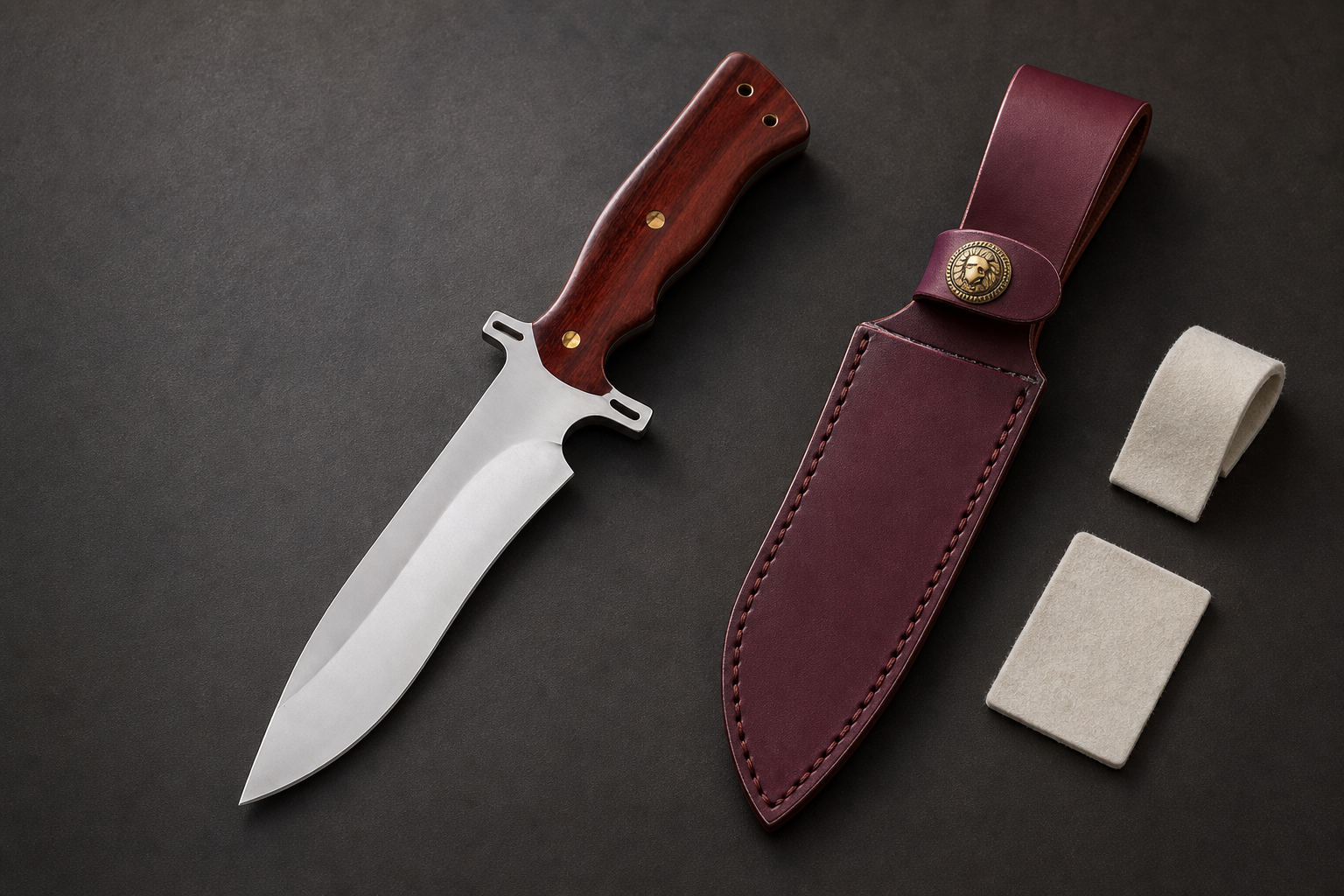
I Do Not Approve a Sheath Only by Appearance
A sheath can look beautiful and still fail the product. It may be too loose, too tight, too shallow, too soft near the point, or stitched too close to the blade path. It may smell strongly, stain the blade, absorb moisture, crack in dry storage, or deform during shipping. These issues are not cosmetic. They affect safety and customer trust.
The CCOHS sharp blade safety guidance supports the broad principle that sharp tools need controlled handling and storage. A sheath is part of that control system. It should keep the edge and point away from fingers, packaging workers, warehouse staff, and customers when the knife is not in use.
For buyers, this means the sheath should be included in the product specification and inspection plan. It should not be treated as a last-minute add-on. The buyer should approve the sheath with the actual knife sample, not with a generic blade blank. A small change in blade length, guard shape, handle swell, or tip profile can change sheath fit.
| Sheath risk | What can go wrong | Buyer control |
|---|---|---|
| Poor coverage | Tip or edge exposed | Define insertion depth and point cover |
| Weak retention | Knife falls out | Retention test |
| Wrong welt | Blade cuts stitching | Welt design review |
| Bad packaging fit | Sheath bends or stains | Pack-out check |
OEM/ODM RFQ Checklist
Prepare these details to help Vast State review your project and provide a more accurate quotation.
| RFQ Field | What to Prepare |
|---|---|
| Project type | OEM from drawing / ODM private label / wholesale catalog |
| Product category | Folding knife / fixed blade / multi-tool / outdoor tool |
| Design status | Idea / sketch / 2D drawing / 3D CAD / physical sample |
| Target price | Ex-factory target price or retail price range |
| MOQ expectation | 500 / 1,000 / 3,000 / 5,000+ pcs |
| Logo method | Laser engraving / etching / printing / molded logo |
| Packaging | Standard packaging / custom retail box / Amazon-ready |
| Market | USA / EU / Japan / Korea / Middle East / other |
| Compliance needs | Buyer-specified testing / documentation / labeling |
| Timeline | Sample deadline / mass production deadline |
What Leather Type, Thickness, and Finish Should Buyers Specify?
Leather selection affects structure, feel, odor, moisture, color, and compliance.
Buyers should specify leather type, thickness, temper, finish, color tolerance, grain consistency, backing treatment, odor limit, moisture behavior, restricted substances, and supplier traceability.
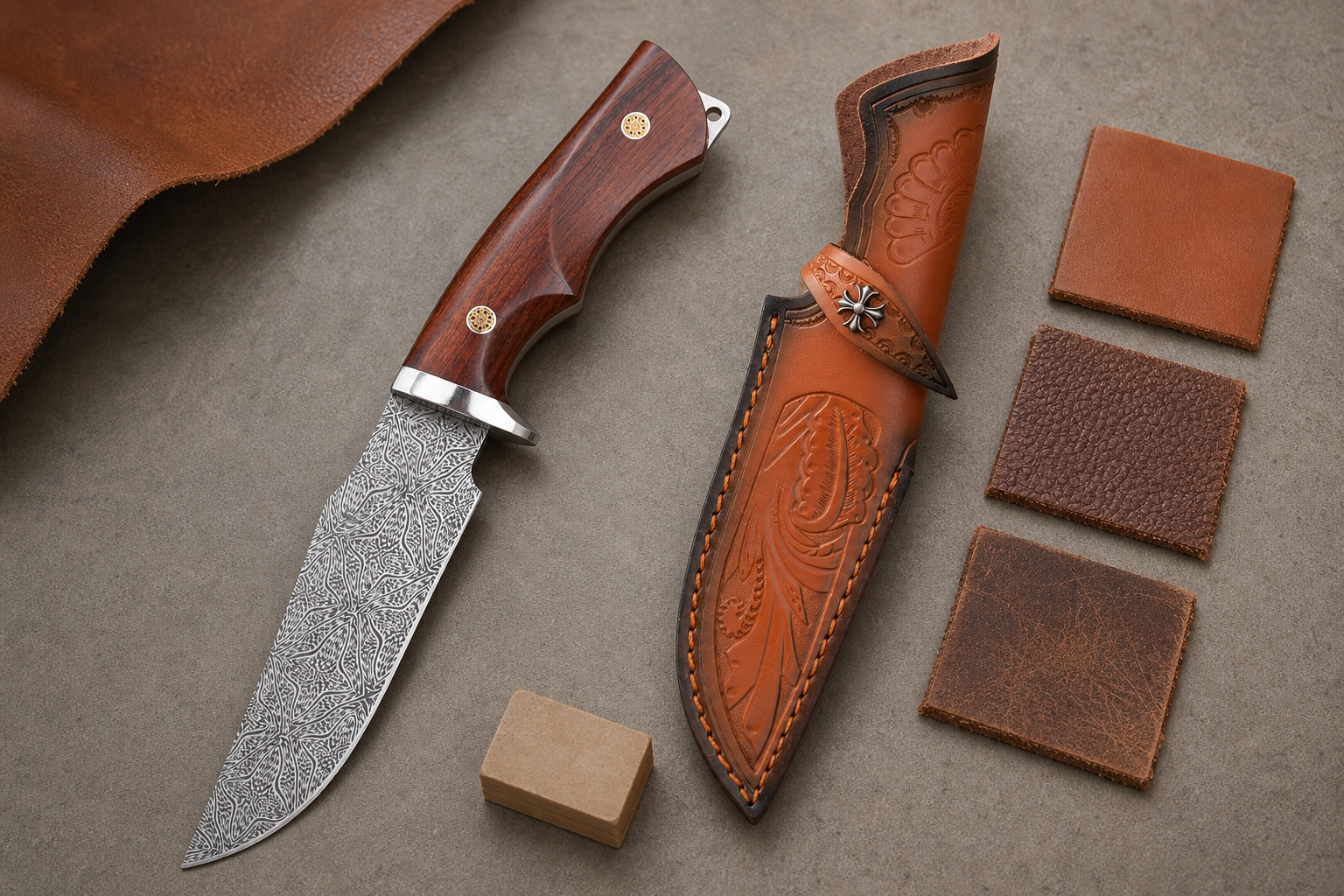
I Match Leather to Function Before Color
Leather is not one material. Vegetable-tanned leather, chrome-tanned leather, oil-treated leather, split leather, full-grain leather, corrected-grain leather, and bonded materials can behave differently. Some may mold well. Some may resist water better. Some may feel premium. Some may be cheaper but less durable. The buyer should not only choose a brown or black color.
Leather thickness matters. A sheath that is too thin may collapse, flex, or let the blade telegraph through. A sheath that is too thick may feel bulky or make insertion difficult. Temper matters too. A very soft leather may feel pleasant but may not hold shape. A very stiff leather may protect well but may be uncomfortable or crack if finished poorly.
The buyer should define:
- Leather type or acceptable alternatives
- Thickness range
- Temper or stiffness target
- Surface finish and backing finish
- Color tolerance
- Odor acceptance
- Grain consistency
- Moisture and staining expectations
- Chemical compliance requirements
- Whether synthetic leather is allowed as an alternative
The Leather Working Group manufacturer audit standard gives buyers one non-competitor reference point for leather supply-chain questions such as traceability, chemical management, environmental management, and facility practices. It does not replace product testing, but it can support supplier qualification.
How Should Fit, Retention, and Blade Coverage Be Defined?
Leather sheath fit should be measurable, not judged only by feel.
Buyers should define blade insertion depth, point coverage, edge clearance, handle exposure, retention force, draw direction, rattle limit, belt orientation, and whether the sheath is for storage, carry, or packaging protection.
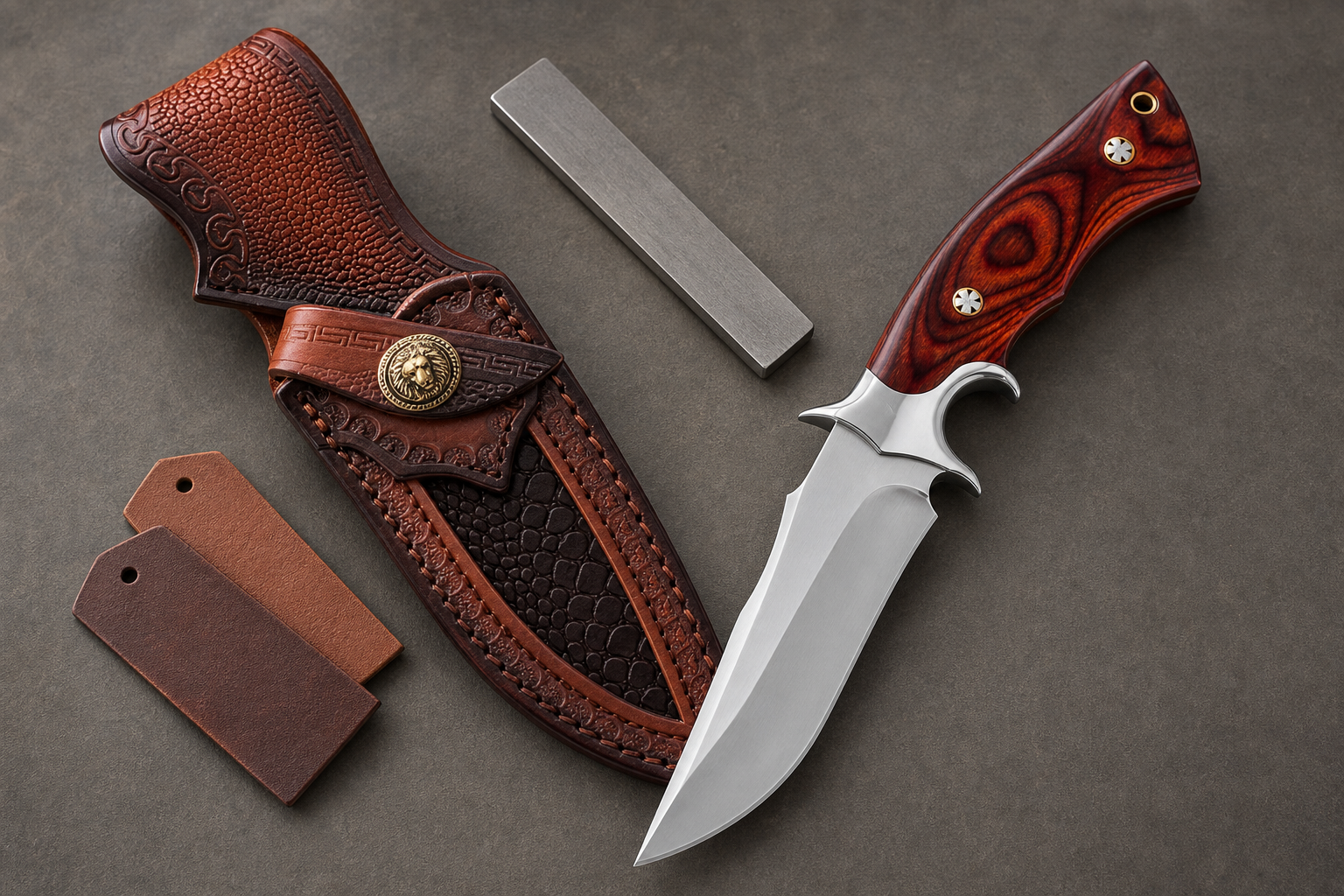
I Test the Sheath With the Actual Knife
A leather sheath should be matched to the actual knife, including blade thickness, tip shape, guard, handle contour, and balance. A sheath made from a drawing may look right but fail when the production knife changes slightly. This is why boundary samples are useful. The buyer should test the minimum and maximum acceptable knife dimensions with the sheath.
NIST dimensional metrology supports the role of measurement in manufacturing and process improvement. For sheath projects, measurement is practical: blade length, blade thickness, guard width, sheath mouth width, seam spacing, welt thickness, belt loop dimensions, and finished sheath length can all be checked.
Retention should match the product. A storage sheath may need secure blade coverage but not aggressive retention. A belt-carry outdoor sheath may need stronger retention and a snap, strap, friction fit, or formed mouth. A gift-box sheath may need a balanced fit so customers can insert and remove the knife without fighting the product.
The buyer should define a test. For example, a supplier can perform a controlled inverted-hold or pull test with a specified sample size. The exact method should be agreed by the buyer and supplier. Avoid vague instructions like "make it tight."
What Are Welt, Stitching, Rivet, and Belt Loop Requirements?
Small construction details decide whether the sheath survives real use.
Buyers should specify welt material, seam allowance, stitch type, thread material, stitch density, rivet placement, reinforcement points, belt loop size, snap hardware, and edge finishing.
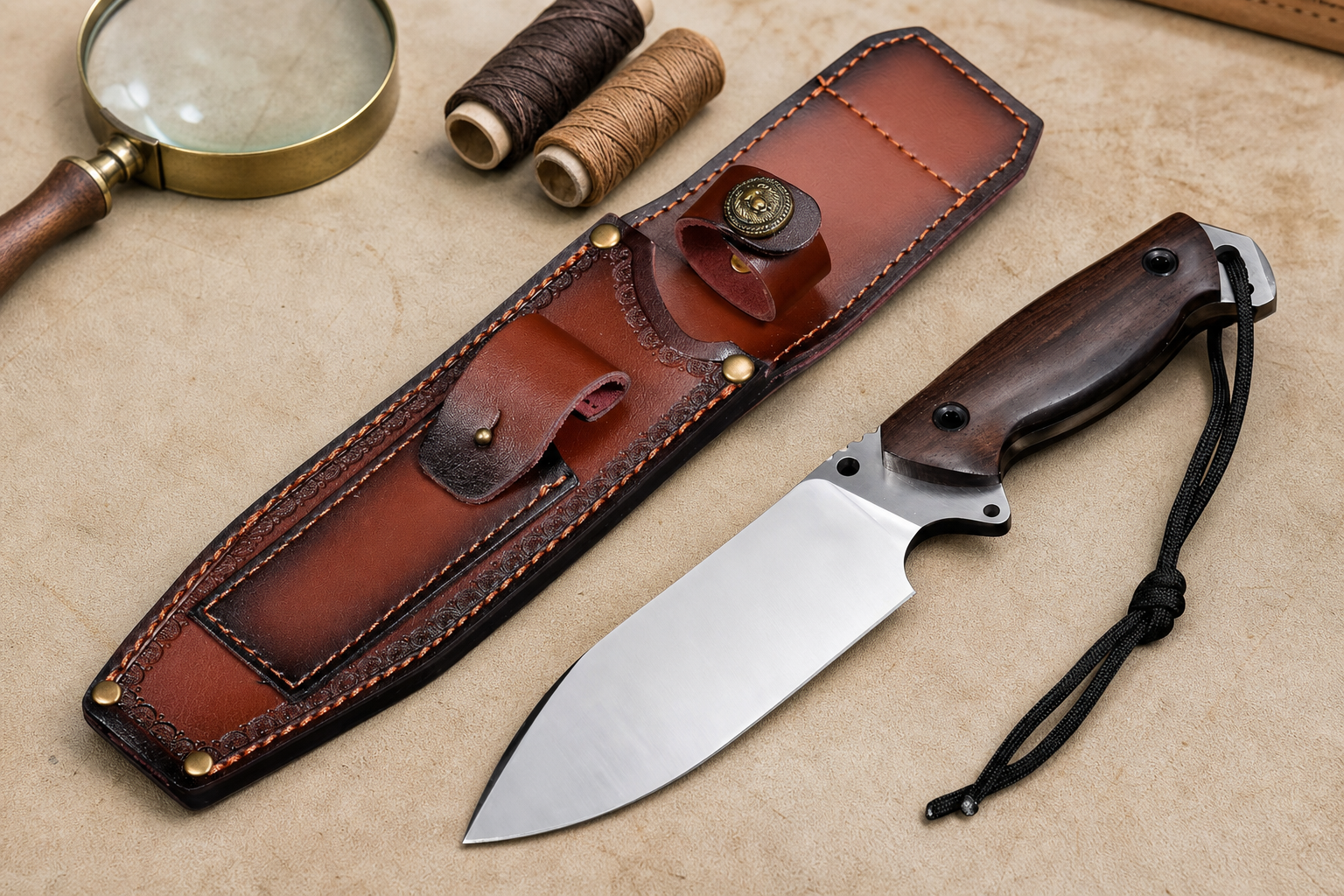
I Use Construction Details to Protect the Seam
The welt is one of the most important parts of many leather sheaths. It is the layer that helps keep the blade edge away from the stitch line. If the welt is too thin, misplaced, or missing where needed, the blade can cut stitches over time. If the welt is too thick, the sheath may become bulky or poorly fitted.
Stitching needs its own specification. Buyers should define thread type, color, stitch density, seam distance from edge, backstitch or lock method, and acceptable thread ends. A nice stitch line in one sample does not guarantee mass production consistency. Thread tension, hole spacing, and operator skill matter.
Rivets can reinforce stress points, but poor placement can scratch the blade or weaken leather. Belt loops need actual belt-size targets. A loop that fits one display belt may fail with the customer's belt. Snaps and straps should be checked for open and close force, corrosion resistance, and alignment.
Useful construction checks:
- Welt follows blade edge safely.
- Stitch line is outside the blade path.
- Rivets do not touch the blade edge.
- Belt loop fits target belt width.
- Snap or strap does not block safe insertion.
- Edges are burnished, sealed, or finished consistently.
How Should Moisture, Corrosion, and Care Instructions Be Planned?
Leather can protect a knife, but it can also hold moisture against the blade.
Buyers should plan moisture behavior, corrosion risk, drying instructions, oil or conditioner guidance, storage warnings, blade finish compatibility, and packaging humidity control for leather sheath projects.
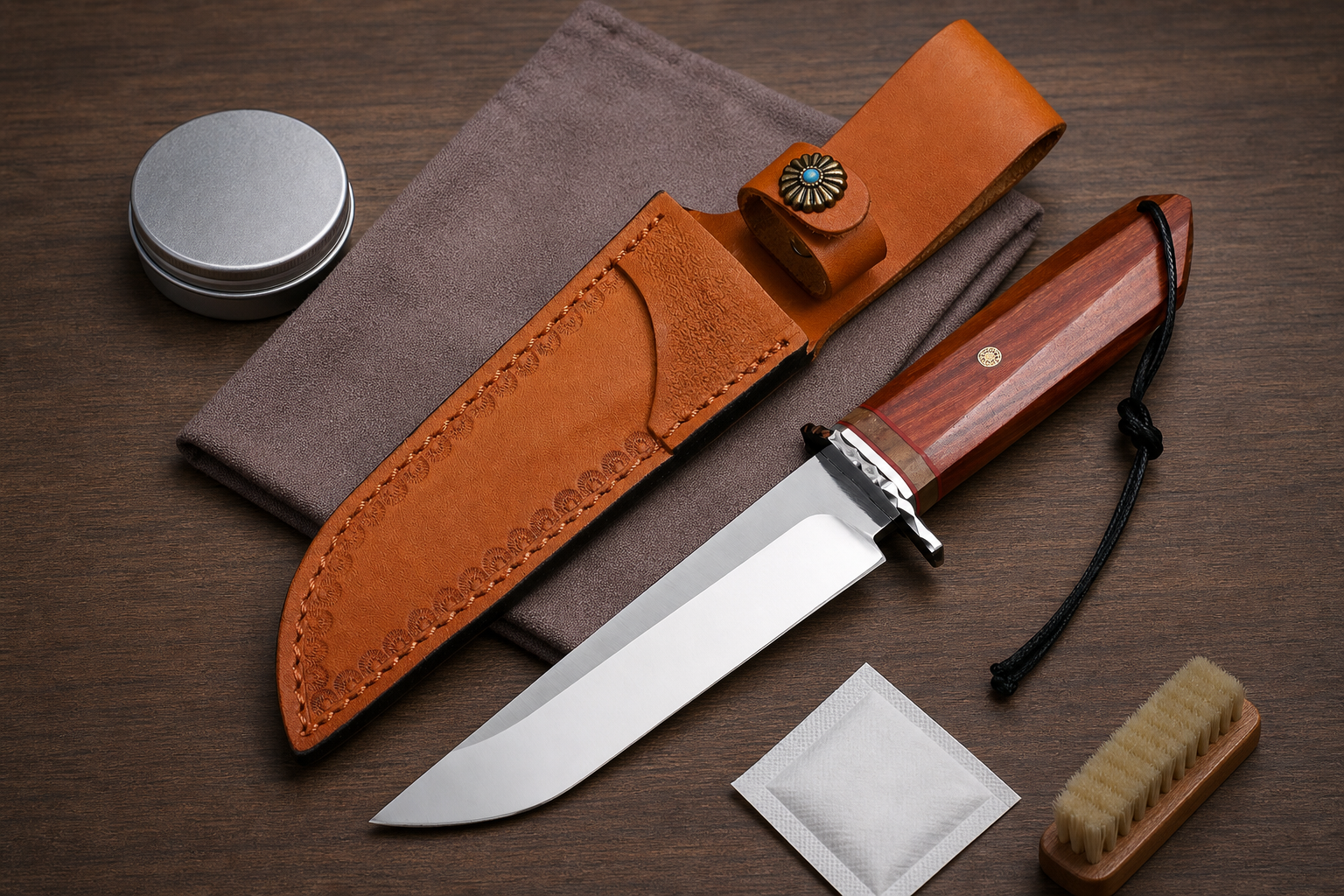
I Do Not Present Leather as Maintenance-Free
Leather is a natural material. It can absorb moisture, dry out, darken, stain, or change over time. If the blade is carbon steel, moisture trapped inside a sheath can increase corrosion risk. If the blade has a coating, the sheath can create wear points. If the sheath is dyed, poor colorfastness can stain hands, packaging, or handle material.
The buyer should write care instructions before packaging is approved. The instructions should tell customers not to store a wet knife in the sheath, to dry the knife before storage, to let damp leather dry naturally, and to use appropriate leather care only when suitable. If the product is sold for outdoor use, the copy should explain that leather can age and patina.
Care copy should be short:
- Dry the knife before sheathing.
- Do not store wet leather in a sealed bag.
- Let damp leather dry at room temperature.
- Keep away from prolonged soaking or high heat.
- Use suitable leather care only if recommended.
- Check local climate and storage conditions.
This is not only customer service. It is claim control. If the brand says "weatherproof leather sheath," it needs evidence and scope. "Durable leather sheath with care instructions" is usually safer and more honest.
Which Chemical and Market Compliance Questions Matter for Leather Sheaths?
Leather sheaths touch hands, clothing, packaging, and sometimes belts.
Buyers should review restricted substances, chromium VI, azo dyes, nickel hardware, phthalates in coatings, market labelling, age positioning, odor, colorfastness, and test-report scope before shipment.
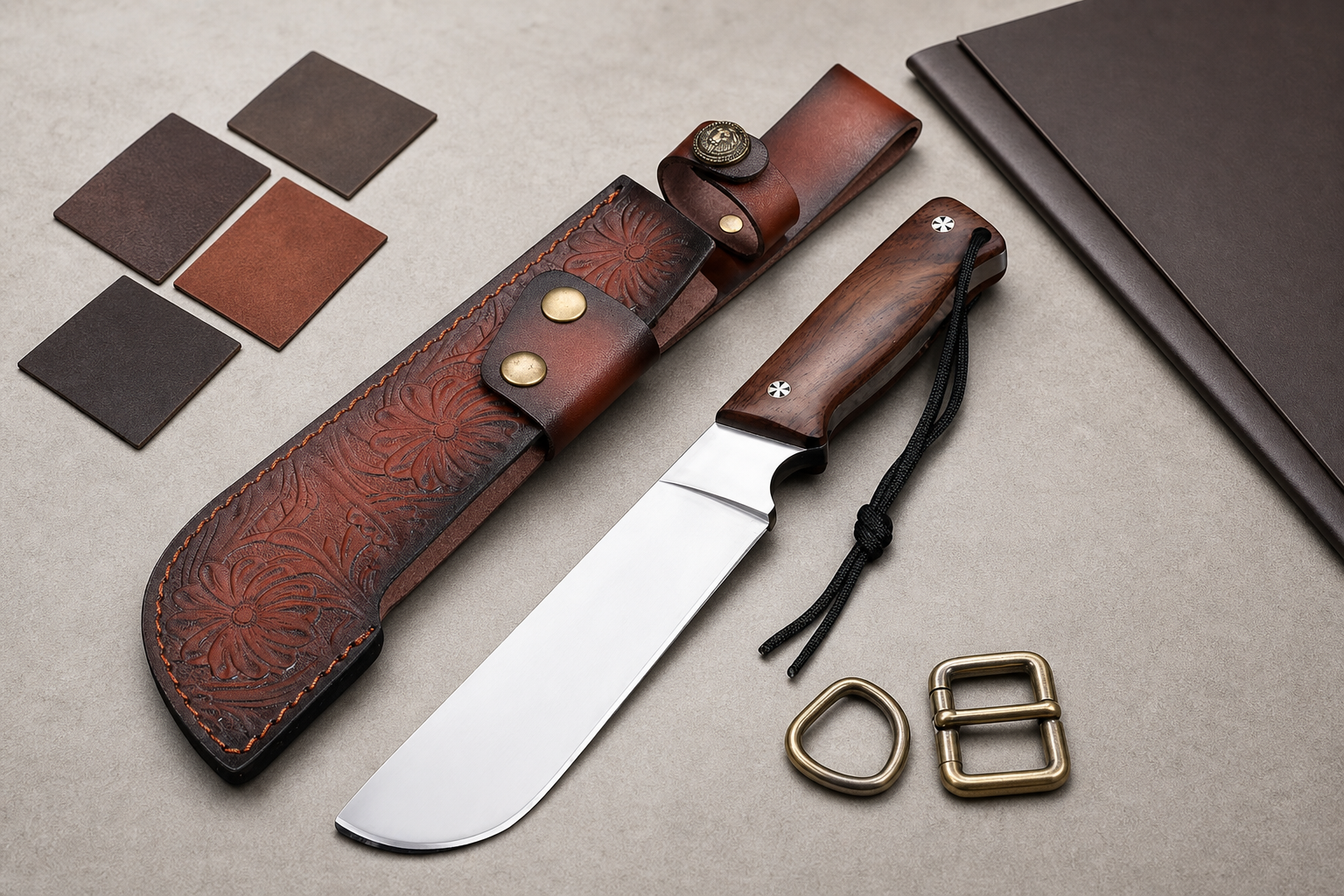
I Ask for Test Scope, Not Just a Certificate
Leather compliance depends on the target market and the final product. EU, U.S., UK, and other markets may have different requirements or customer expectations. If the sheath can touch skin or clothing, buyers should review chemical restrictions and test reports carefully.
The ECHA information on skin sensitising chemicals notes that chromium VI in leather articles has been restricted in the EU since May 2015. The EUR-Lex Regulation (EU) No 301/2014 page shows the regulatory background for chromium VI compounds in leather articles and leather parts coming into contact with skin. For knife buyers, the practical lesson is not to guess. Ask for current market-specific test reports.
Buyers should confirm:
- Leather material tested matches production leather.
- Color and finish tested match production color.
- Hardware and snaps are included where required.
- Coatings, adhesives, and dyes are included where required.
- Test report date is current enough for the buyer's policy.
- Lab, report number, and scope are clear.
- The target market is named.
If a supplier sends a vague "eco leather" certificate with no product scope, it is not enough for serious sourcing.
What Packaging and User Instructions Should Buyers Add?
A sheath needs instructions because users may misunderstand leather care and storage.
Packaging should explain safe insertion, blade coverage, moisture care, leather aging, storage limits, belt attachment, hardware use, local carry rules, and when to stop using a damaged sheath.
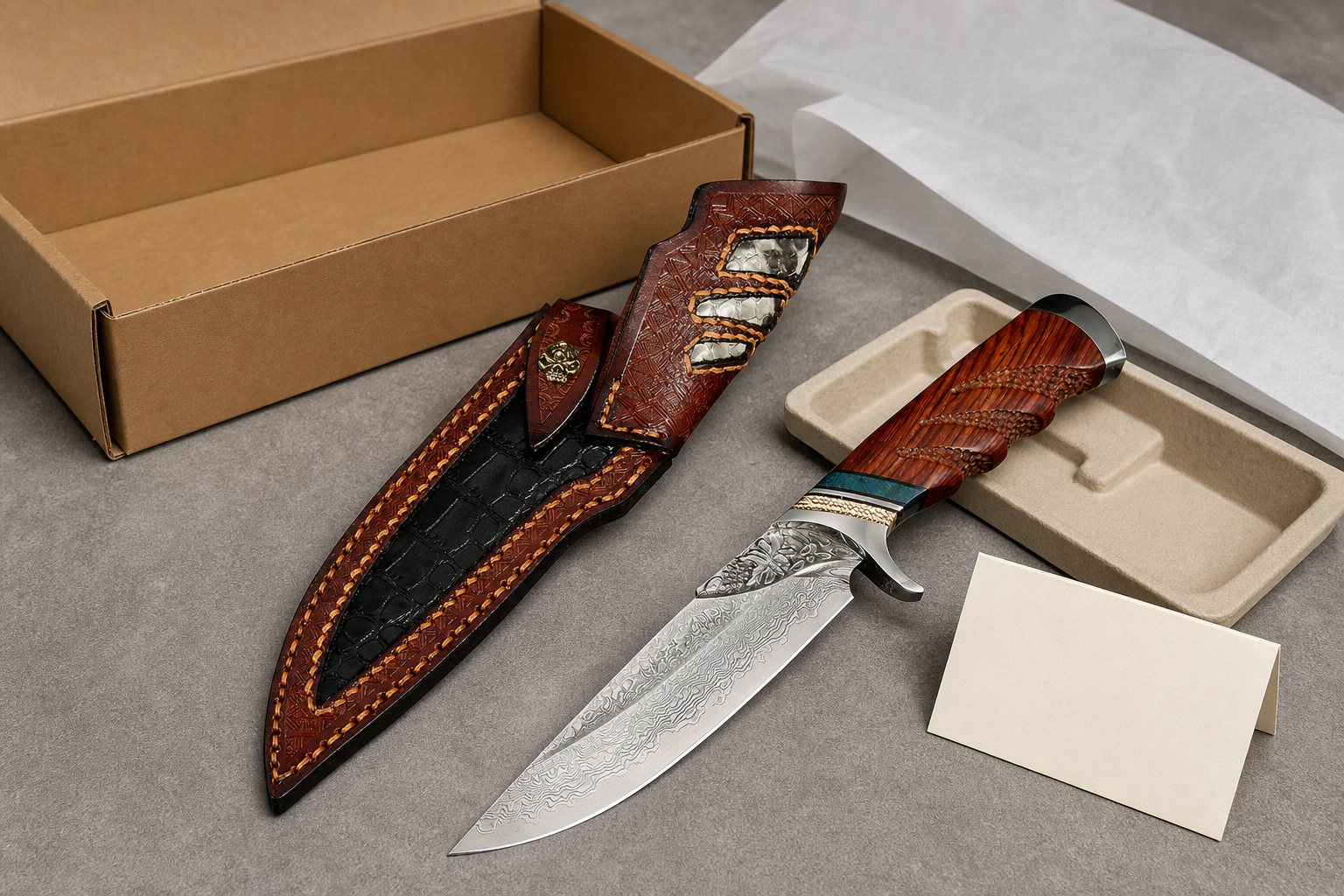
I Keep Instructions Short and Usable
The CPSC labeling overview notes that labeling requirements can depend on product type, design, components, and age group, and that other federal or state requirements may apply. A leather sheath is not automatically subject to one universal label rule, but buyers should still review packaging and warning needs by market.
Good instruction copy should cover:
- Insert only the intended knife model.
- Keep fingers away from the sheath mouth during insertion.
- Make sure the blade is fully seated.
- Keep the knife sheathed when not in use.
- Do not use the sheath if stitches, rivets, straps, or leather are damaged.
- Dry the knife before sheathing.
- Do not store wet leather in sealed packaging.
- Follow local carry and transport rules.
Instruction text should match the final product. If there is a retention strap, explain it. If there is a belt loop, define intended orientation. If there is a snap, explain closure without using force. If the sheath is for storage only, do not imply belt carry.
What QC Checks Should Buyers Require Before Shipment?
Leather sheath quality should be checked with the knife and with the package.
QC should verify leather thickness, fit, retention, blade coverage, welt placement, stitch quality, rivet placement, belt loop strength, color, odor, finish, chemical reports, packaging fit, and instruction placement.
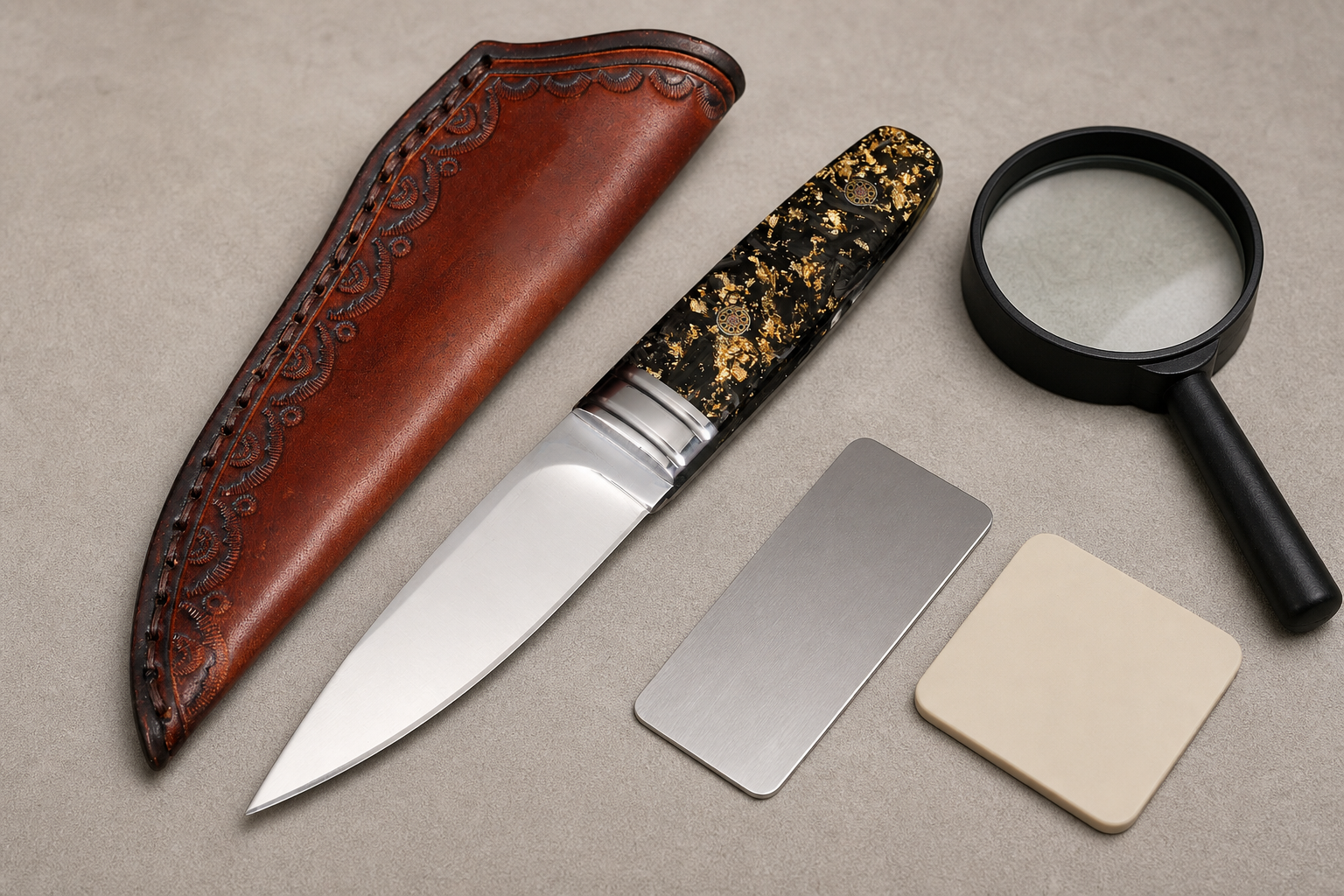
I Build the Inspection Around Real Failure Points
ISO 9001 supports defined quality management requirements and process control. For leather sheath projects, that means the buyer should define inspection criteria, not only approve a nice sales sample.
Useful QC records include:
- Leather thickness check
- Color and grain check
- Odor check
- Fit with actual production knife
- Retention test
- Point and edge coverage check
- Welt placement check
- Stitch density and thread-end check
- Rivet and snap placement check
- Belt loop dimension and strength check
- Moisture or staining review where relevant
- Chemical compliance report review
- Packaging fit and movement check
- Instruction insert placement
- Final inspection report
The buyer should also define acceptance limits. How loose is too loose? How much color variation is acceptable? Is natural leather grain variation allowed? Does a small scuff fail inspection? Does a strong odor require airing, rework, or rejection? These answers should be agreed before mass production.
How Can Vast State Help Buyers Develop Leather Knife Sheaths?
Vast State can help buyers connect sheath design with the knife, market, and production process.
Vast State helps buyers develop leather knife sheaths by aligning material selection, fit, retention, construction details, chemical compliance, care copy, packaging, sample review, and QC records.
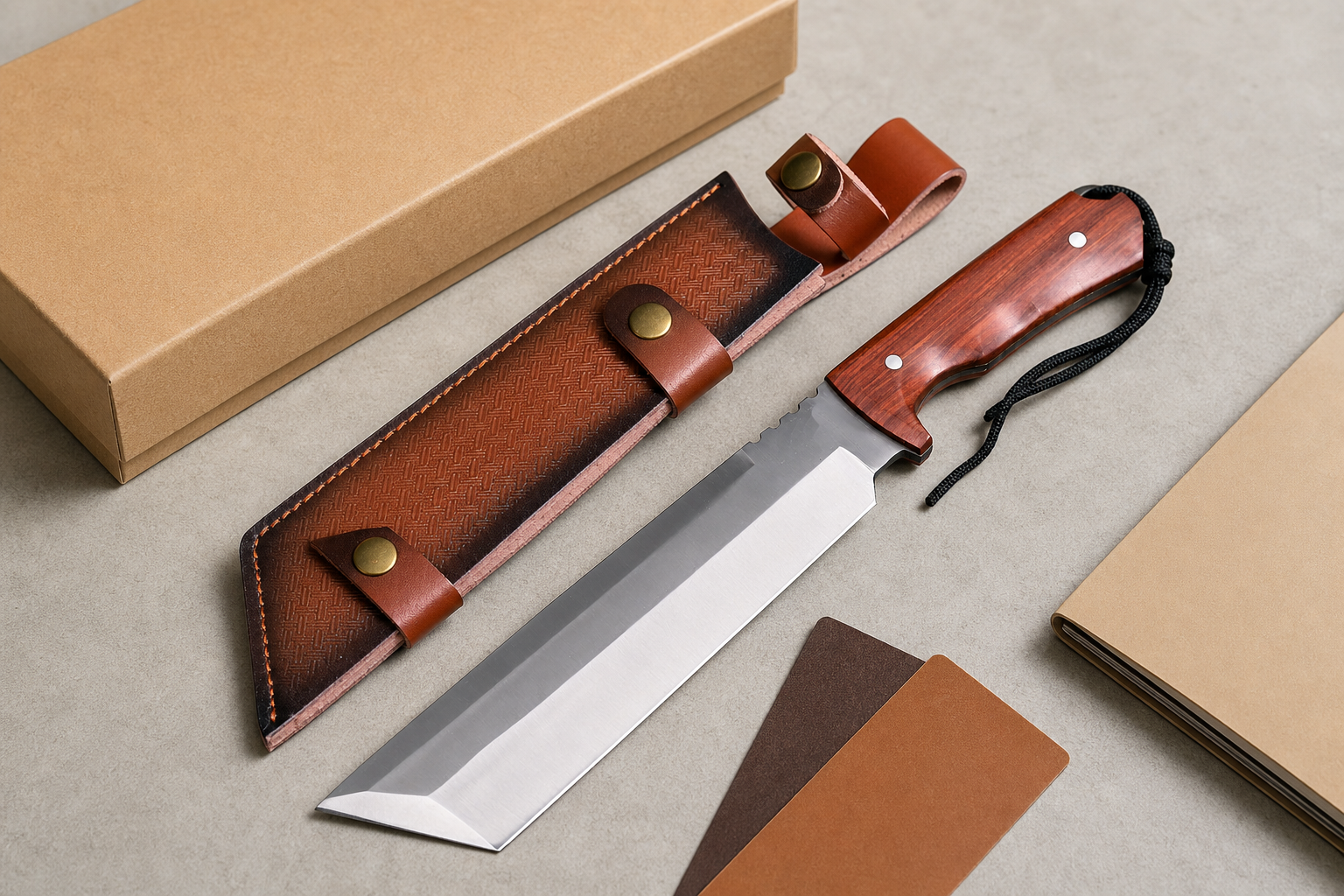
I Prefer Sheath Planning During Knife Sampling
Vast State can help buyers specify leather sheaths while the knife itself is still in sampling. That timing matters. If the blade length, guard, handle shape, or packaging size changes, the sheath may need revision. It is cheaper to adjust during sampling than after thousands of sheaths are cut and stitched.
We can help define whether the sheath is for storage, belt carry, gift packaging, outdoor utility, or retail presentation. Then we connect the use case to leather thickness, welt, stitching, retention, belt loop, hardware, finish, care copy, and test reports. We can also help create supplier RFQ fields so the factory does not guess.
Vast State can support:
- Leather sheath product brief
- Knife-to-sheath fit checklist
- Leather material and finish options
- Retention and coverage requirements
- Construction detail review
- Chemical compliance document list
- Packaging and care wording
- Pre-shipment QC checklist
- RFQ schema for supplier communication
The goal is simple: the sheath should look good, fit well, protect the knife, protect the customer, and stay repeatable in production.
Turn this article into a fixed blade project.
Send your target use, blade size, steel, handle direction, sheath needs, quantity, and packaging plan. Vast State can help shape it into a quote-ready project.
Conclusion
A leather knife sheath should be specified as a safety, fit, material, compliance, packaging, and QC system, not just a handmade-looking accessory.