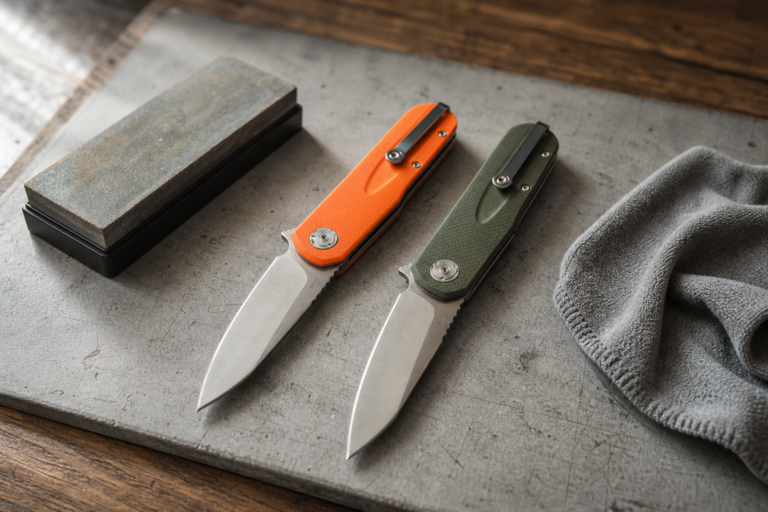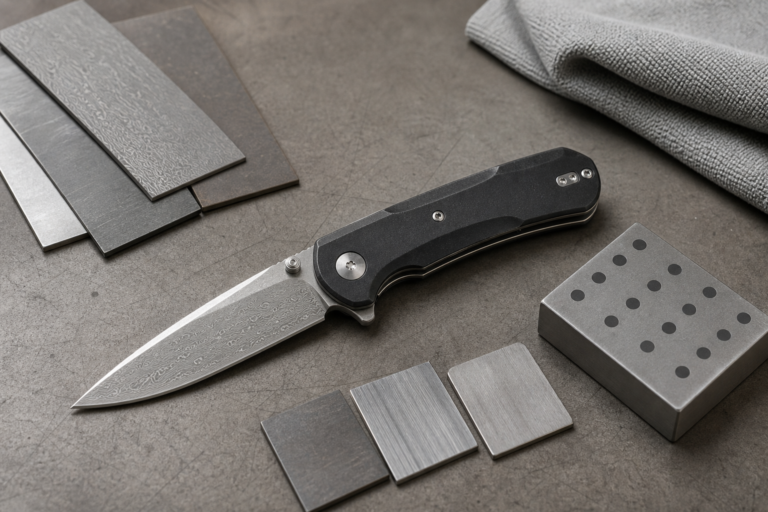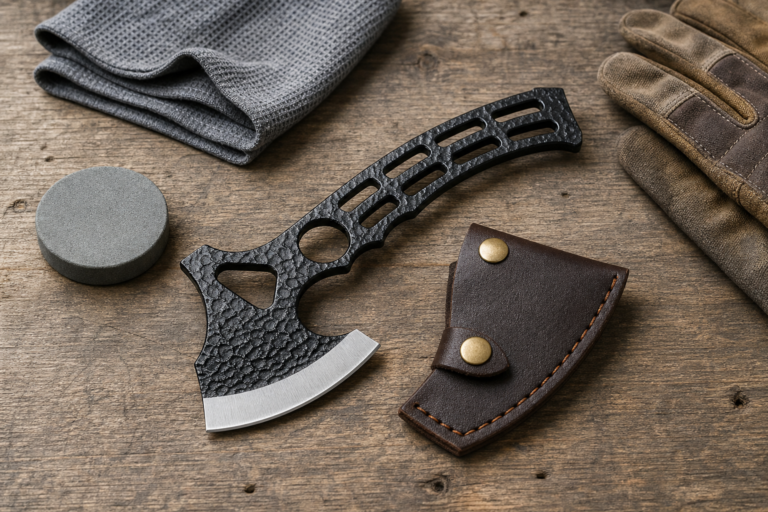
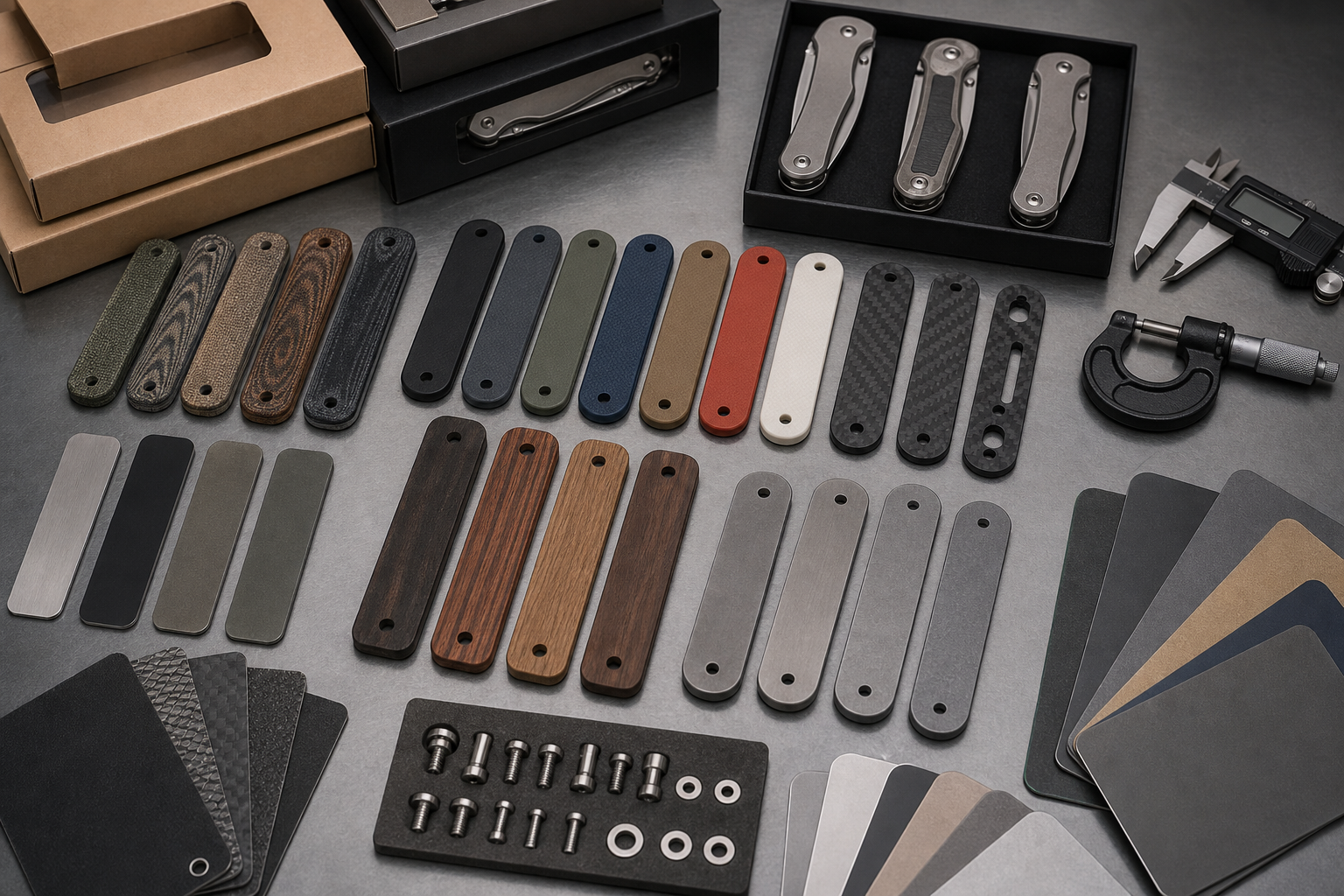
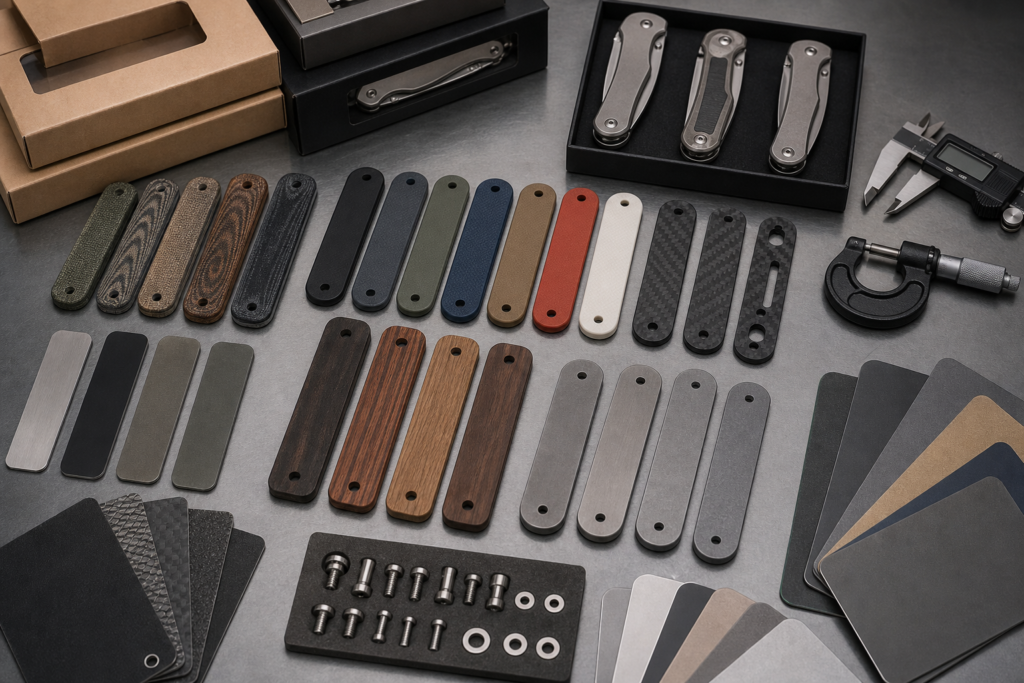
A handle material can sell a knife or ruin it. The wrong choice can hurt grip, cost, machining, color, and repeat production.
OEM knife buyers should choose handle material by target market, grip feel, weight, appearance, machining risk, moisture behavior, price tier, MOQ, color control, and packaging story. Micarta, G10, carbon fiber, aluminum, wood, FRN, and titanium all fit different product goals.
Quick buyer brief:
- Answer: Match handle material to product tier, use case, cost, and manufacturing control.
- Buyer context: This helps knife brands, outdoor brands, importers, distributors, wholesalers, and private label buyers.
- Key checks: Grip texture, weight, machining dust, tool wear, color consistency, moisture behavior, screw stability, MOQ, finish, and target price.
Have a knife or multi-tool project in mind?
Send your sketch, CAD file, sample photo, or product idea. Vast State can review manufacturability, suggest materials, estimate MOQ, and prepare a quote for your OEM/ODM project.
When I help a buyer choose a knife handle material, I do not start with the most fashionable option. I start with the product. A rugged outdoor folder, a light EDC knife, a premium collector-style knife, a rescue tool, and a private label catalog knife should not use the same handle logic. The handle material affects how the knife feels in the hand, how it looks in photos, how fast it machines, how much dust it creates, how stable the color is, and how easy it is to repeat in production. For B2B buyers, the right material is not only attractive. It must support function, margin, MOQ, and brand positioning.
What Should Buyers Decide Before Comparing Handle Materials?
Many buyers compare materials too early. They pick a name first, then discover the design, price, or market does not fit.
Buyers should decide the knife type, target user, price tier, weight goal, grip requirement, finish style, color range, logo method, packaging story, MOQ, and inspection standard before comparing handle materials.
I Match the Handle to the Whole Knife
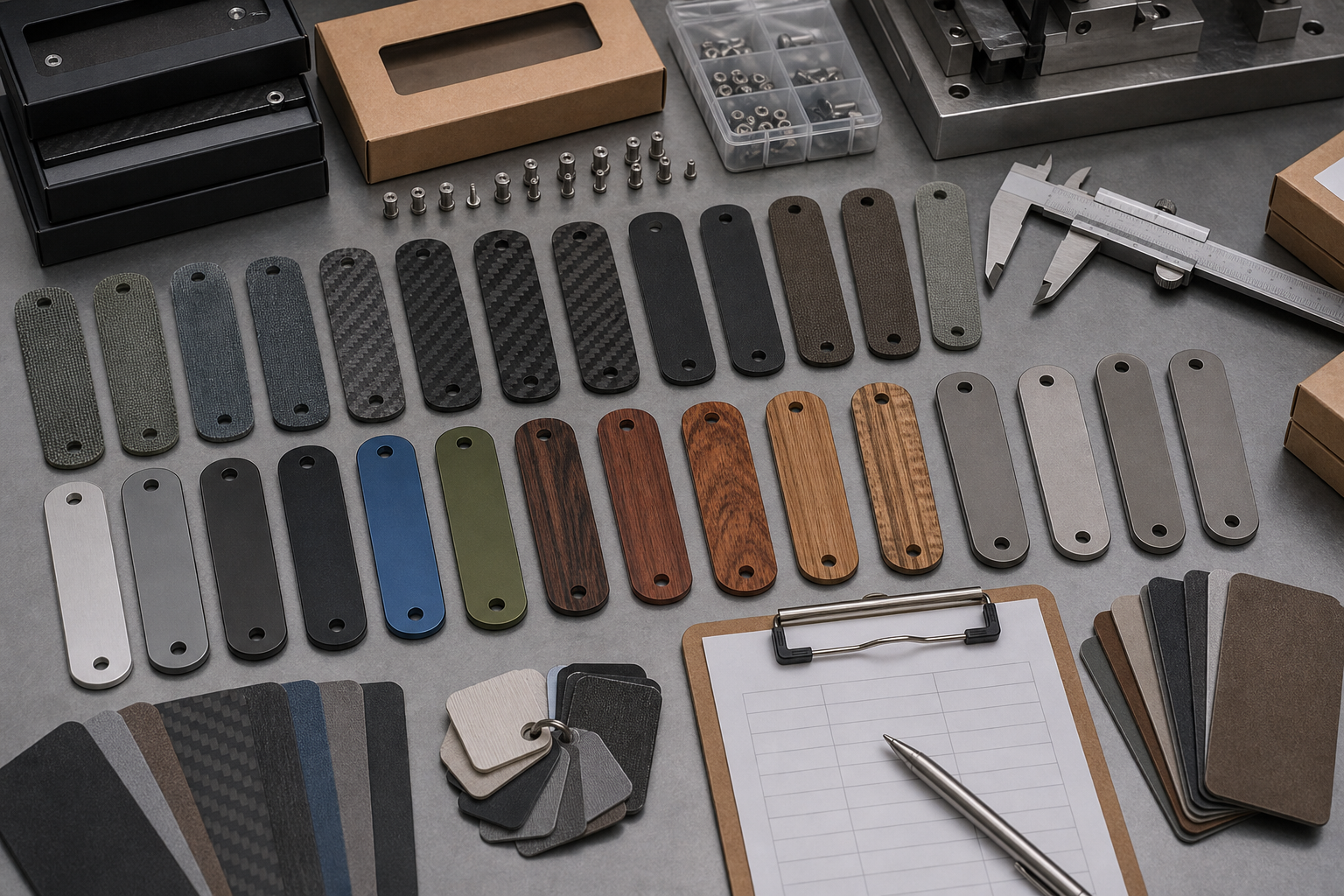
The handle is not a separate decoration. It works with the blade, lock, liner, spacer, screws, clip, finish, and packaging. If the blade steel is premium but the handle feels cheap, the product becomes uneven. If the handle material is expensive but the blade steel is basic, the buyer may not recover the cost. If the handle is beautiful but hard to machine, the sample may look good while mass production becomes slow.
I usually ask buyers simple questions first. Is the knife for EDC, outdoor, tactical-style, camping, rescue, utility, or gift use? Should it feel warm, grippy, light, refined, rugged, or low-cost? Is the product meant for online photos, retail shelves, or professional users? Does the buyer need a smooth handle, milled texture, bead blast, peel-ply texture, anodized color, natural grain, or layered pattern?
I also ask about quantity and repeat orders. Some materials are easy to source in many colors. Some need minimum volume. Some show natural variation, which can be attractive but harder to control. Some materials are abrasive during machining and increase tool wear. Some create dust that needs better workshop control. These details affect cost and lead time.
| Decision factor | What it controls | Buyer question |
|---|---|---|
| Target user | Grip, weight, style, durability | Who will use the knife and where? |
| Price tier | Material cost and finish level | Is this value, mid-range, or premium? |
| Production quantity | MOQ and material availability | Is this a sample run or repeat program? |
| Brand story | Packaging and product page copy | Should the handle feel rugged, refined, or technical? |
OEM/ODM RFQ Checklist
Prepare these details to help Vast State review your project and provide a more accurate quotation.
| RFQ Field | What to Prepare |
|---|---|
| Project type | OEM from drawing / ODM private label / wholesale catalog |
| Product category | Folding knife / fixed blade / multi-tool / outdoor tool |
| Design status | Idea / sketch / 2D drawing / 3D CAD / physical sample |
| Target price | Ex-factory target price or retail price range |
| MOQ expectation | 500 / 1,000 / 3,000 / 5,000+ pcs |
| Logo method | Laser engraving / etching / printing / molded logo |
| Packaging | Standard packaging / custom retail box / Amazon-ready |
| Market | USA / EU / Japan / Korea / Middle East / other |
| Compliance needs | Buyer-specified testing / documentation / labeling |
| Timeline | Sample deadline / mass production deadline |
When Does Micarta Make Sense for OEM Knife Handles?
Micarta can look natural and practical. But buyers should understand texture, color variation, moisture feel, and brand expectations first.
Micarta makes sense when buyers want a warm, grippy, layered composite handle with a rugged or traditional look. It fits outdoor, EDC, fixed blade, and work-knife projects where feel matters.
I Use Micarta When Feel and Character Matter
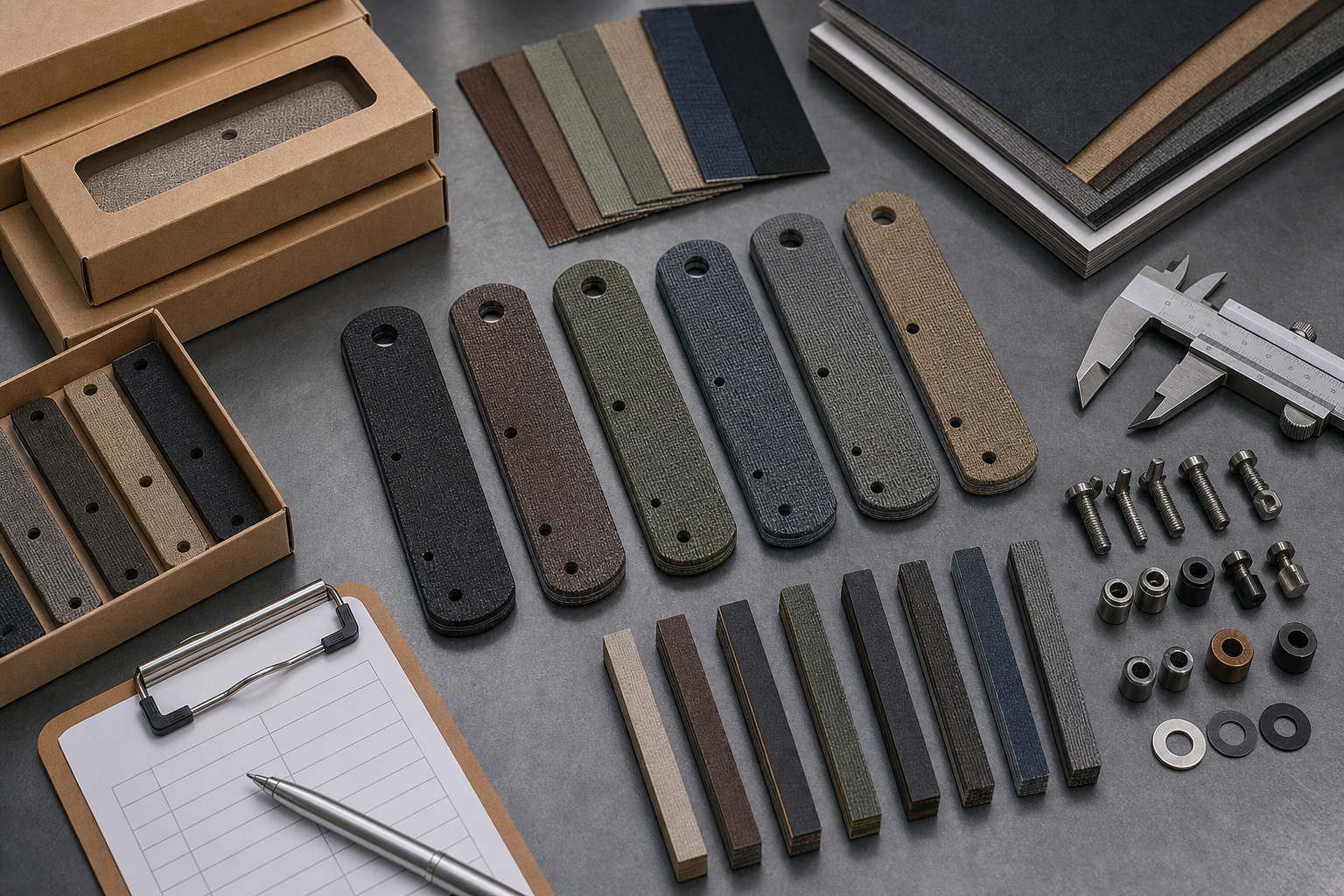
Micarta is often used as a general word in the knife market, but the original Micarta brand is connected with Norplex-Micarta. Norplex describes Micarta as a paper and cotton fabric reinforced phenolic laminate, with paper, linen, and canvas versions. That detail matters because not all "micarta-style" materials feel or machine the same way. Buyers should ask what reinforcement and resin system are being used, not only accept the material name.
For knives, Micarta is useful when the buyer wants a handle that feels less cold and more organic than metal or carbon fiber. Canvas Micarta can give a rugged texture. Linen Micarta can feel finer and more refined. Paper Micarta can create a cleaner, smoother look. The surface finish changes the feeling a lot. A polished Micarta handle may feel smoother. A blasted or machined texture can improve grip.
The commercial advantage is that Micarta can support an outdoor, craft, heritage, or rugged product story. It photographs well because the layers and texture feel real. The risk is variation. Colors, layers, and surface absorption can differ by supplier and batch. Some buyers love that character. Some need strict color matching. For private label projects, I ask the buyer to approve real material samples before mass production.
| Micarta choice | Best use | Production point |
|---|---|---|
| Canvas Micarta | Rugged outdoor and work knives | Texture and color variation need approval |
| Linen Micarta | More refined EDC or fixed blades | Finer fabric look and smoother finish |
| Paper Micarta | Cleaner visual style | More sensitive to surface finish choices |
| Layered colors | Strong product-page appeal | Batch consistency and MOQ must be checked |
When Is G10 the More Practical Handle Choice?
G10 can look simple, but it is one of the most practical OEM materials. The challenge is machining control and texture planning.
G10 is practical when buyers need a strong, stiff, dimensionally stable, textured, color-flexible handle material with good repeatability for folding knives, pocket knives, outdoor tools, and utility knives.
I Use G10 When Repeatability and Grip Are Important
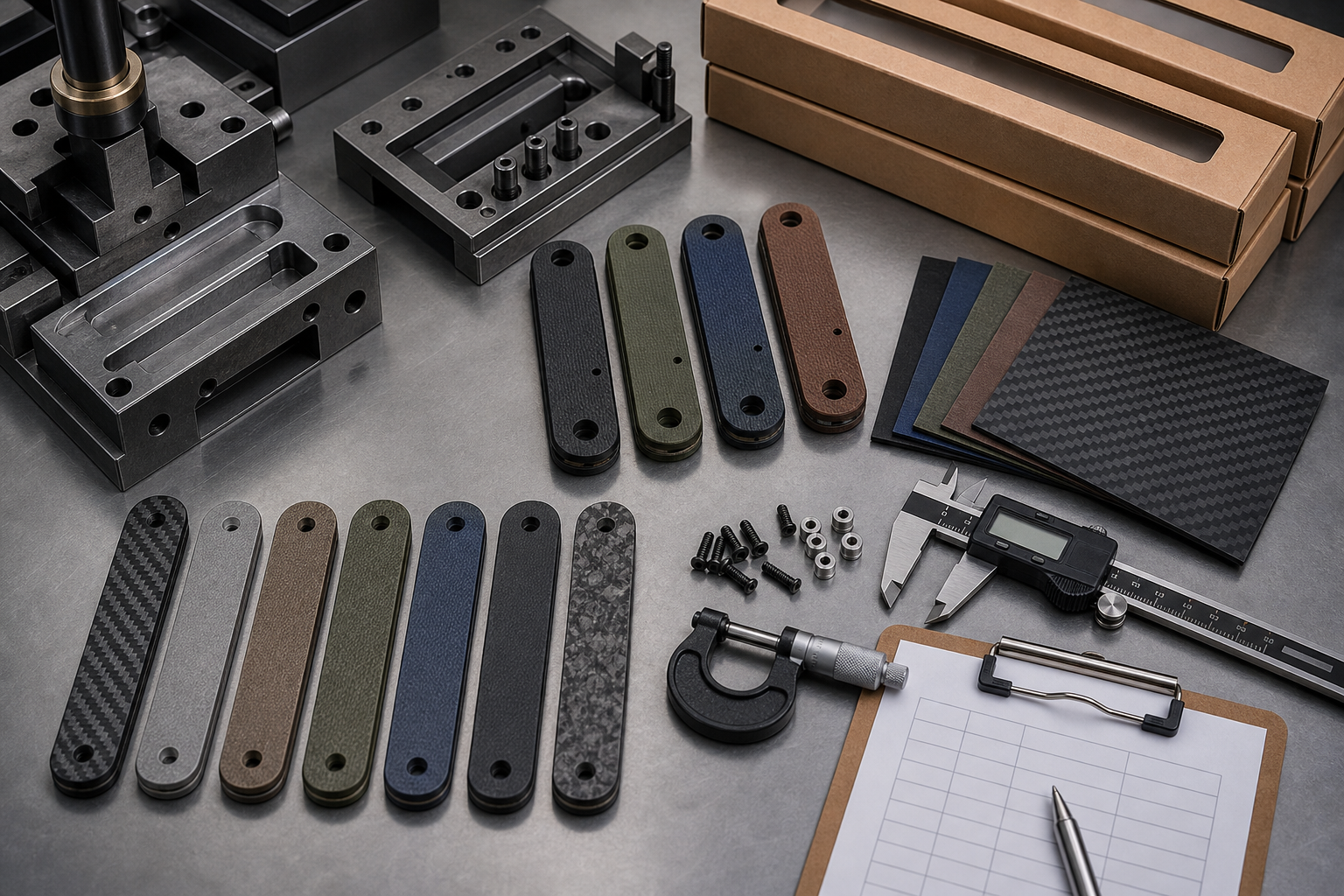
G10 is a glass fabric and epoxy resin laminate. Curbell Plastics describes G10/FR-4 glass epoxy as strong, stiff, dimensionally stable, and useful for high-strength mechanical parts. That is why many knife buyers like G10. It can be machined into textured scales, colored in many ways, and repeated more predictably than many natural materials.
For folding knives, G10 can be a very practical choice. It can work with liners, nested liners, spacers, screws, clips, and texture patterns. It can support budget-friendly and mid-range products, depending on thickness, color, machining time, and finish. Buyers can use black G10 for a clean work-knife look, colored G10 for brand identity, or layered G10 for visual contrast after machining.
The trade-off is machining. G10 is abrasive on cutting tools, and Curbell notes that machining dust can be irritating. That means the factory must control dust, tool wear, edge finishing, and worker safety. It also means deep textures, complex contouring, or many screw holes can increase machining time. A buyer should not compare only the sheet price. The finished handle cost includes CNC time, tool life, surface cleanup, inspection, and scrap risk.
For many B2B projects, G10 is the safe middle path. It is practical, strong, grippy, and familiar to knife customers. But it still needs a clear texture and color plan.
| G10 factor | Why it helps | What to control |
|---|---|---|
| Strength and stiffness | Supports folding knife structure | Thickness, liners, screw positions |
| Texture options | Improves grip and product identity | CNC time and finish consistency |
| Color flexibility | Supports private label styling | Batch color approval |
| Abrasive machining | Affects production cost | Tool wear, dust, edge cleanup |
When Should Buyers Use Carbon Fiber, Aluminum, Titanium, Wood, or FRN?
Some materials look premium online but may not fit the price target. Others look simple but solve the real production problem.
Carbon fiber suits lightweight premium knives. Aluminum suits colorful machined handles. Titanium suits high-end metal construction. Wood suits natural style. FRN or nylon-type polymers suit lightweight, molded, cost-controlled production.
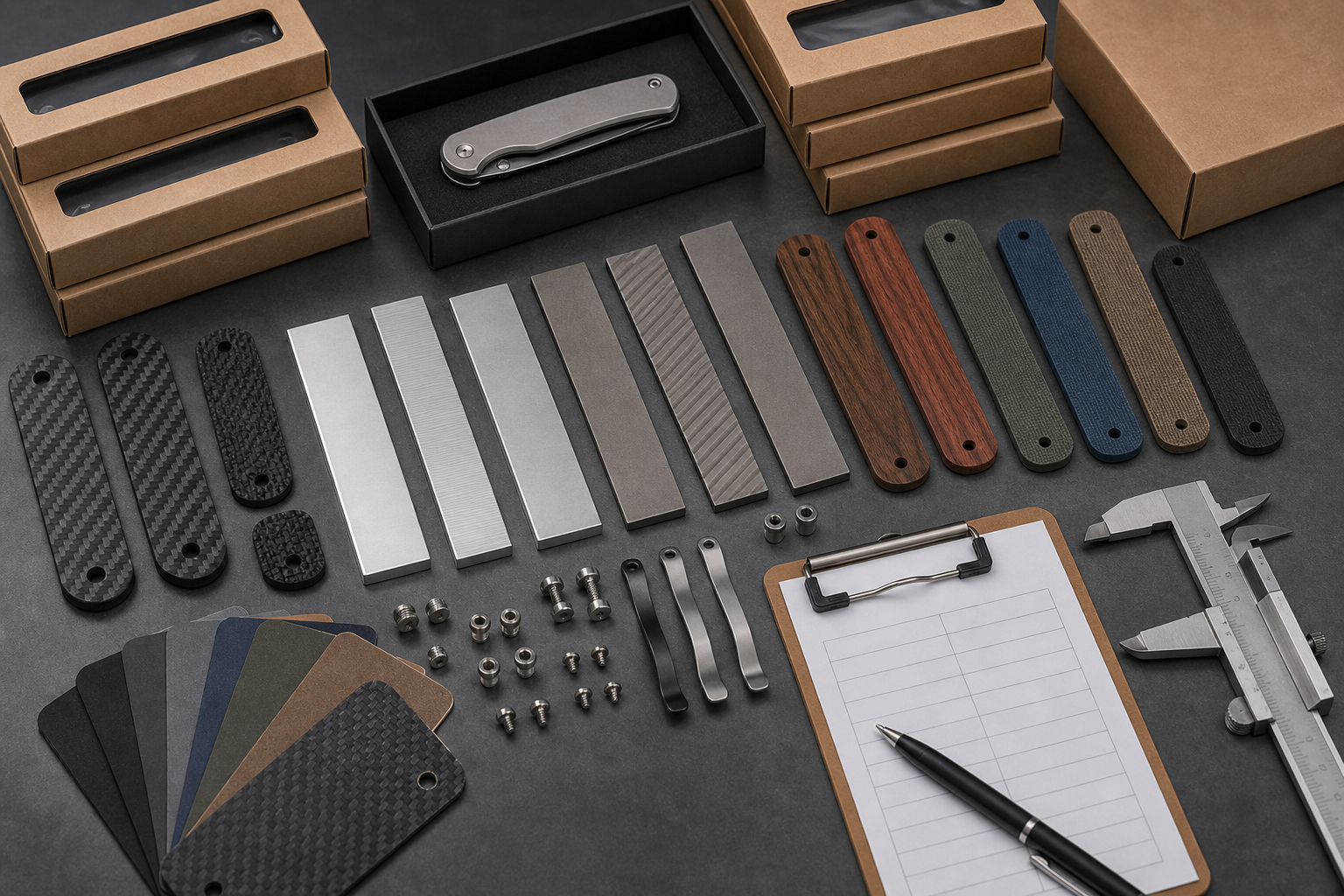
I Treat "Beyond" Materials as Product-Tier Choices
Carbon fiber is the most common premium visual option in this group. Hexcel describes carbon fiber as strong, stiff, light, and corrosion resistant, with wide use in advanced aerospace, industrial, and sports equipment applications. For knives, carbon fiber can create a clear premium impression and reduce weight. But it can also be expensive, slippery if finished too smooth, and sensitive to layup quality and surface finish. A carbon fiber handle should match a higher product tier.
Aluminum is useful when the buyer wants a modern metal handle, anodized color, and CNC-machined shape. It can feel cold compared with Micarta or G10, but it supports strong color identity. Titanium is usually more premium and can support frame-lock designs, but it raises cost and machining difficulty. Wood gives warmth and natural character, but it brings variation, moisture concerns, and more careful finishing. FRN or nylon-type reinforced polymer can work well for lightweight molded handles, especially when the buyer needs cost control and larger production, but mold cost and texture design must be planned.
The best choice depends on the product tier. A premium carbon fiber handle on a low-cost blade may feel mismatched. A basic polymer handle on a high-end blade may weaken the product story. A wood handle can be beautiful, but buyers must accept natural variation. A metal handle can feel refined, but weight and temperature feel matter.
| Material | Best fit | Main watch point |
|---|---|---|
| Carbon fiber | Premium lightweight EDC | Cost, layup, grip, surface finish |
| Aluminum | Colorful machined handles | Anodizing consistency and scratch risk |
| Titanium | High-end metal folders | Cost, machining time, lock design |
| Wood | Natural or gift-oriented knives | Moisture, cracks, color variation |
| FRN or nylon-type polymer | Lightweight cost-controlled production | Mold cost and texture design |
How Do Texture, Tolerance, and Finish Affect Handle Material Performance?
A material can be good in sheet form but poor after machining. The finished handle is what the customer feels.
Texture, tolerance, and finish affect grip, comfort, screw fit, blade centering, pocket wear, color consistency, cleaning, and perceived quality. Buyers should approve finished handle samples, not only raw material swatches.
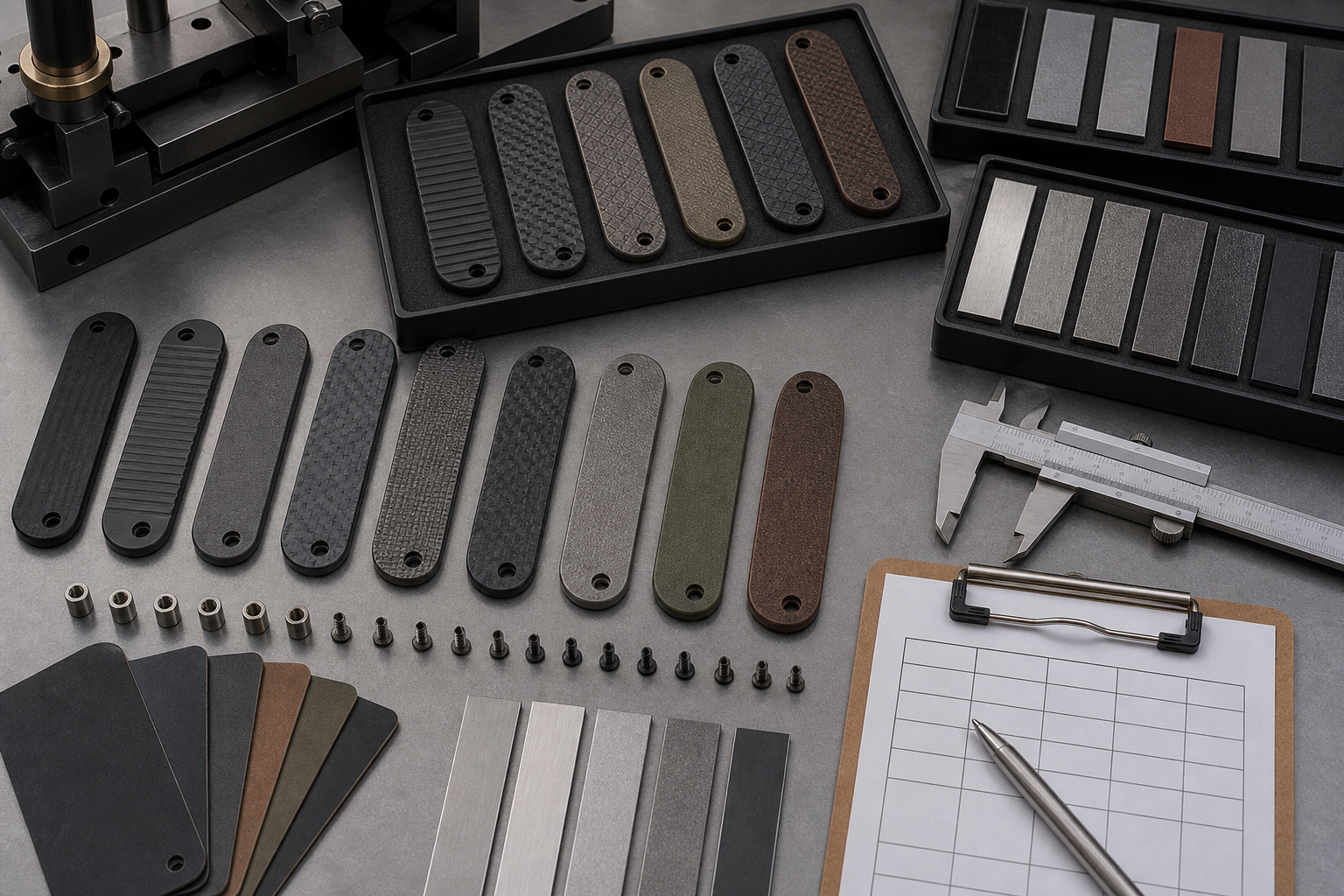
I Approve the Finished Feel, Not Only the Material Name
Material names are not enough. Two G10 handles can feel completely different if one has a sharp peel-ply surface and the other has a smooth machined contour. Two Micarta handles can look different if one is polished and the other is bead blasted. Carbon fiber can feel slippery, grippy, glossy, matte, flat, or contoured depending on layup and finish. Aluminum can look premium when anodizing is consistent, but it can look cheap if color or machining marks are uneven.
Tolerance also matters. Handle scale thickness affects screw length, liner fit, clip fit, and blade centering. A small thickness difference can change how the pivot area stacks together. Texture depth can affect pocket wear. Sharp handle edges can feel uncomfortable. Screw countersinks can chip or look rough if the material is brittle or the machining is rushed.
For production, I prefer to create a handle approval sample that includes texture, edge break, screw fit, logo position, color, and final assembly. I also want the buyer to approve how the handle looks under normal lighting, not only in studio photos. Color can shift between material batches and finishes.
This is where quality control becomes practical. ISO 9001 is useful as a quality-management reference because it focuses on process control and customer requirements. For a knife handle program, that means approved samples, material checks, in-process inspection, and final assembly checks should connect.
| Handle detail | Customer effect | Production control |
|---|---|---|
| Texture depth | Grip and pocket wear | CNC program and finish approval |
| Scale thickness | Assembly and blade centering | Incoming and in-process measurement |
| Edge break | Comfort in hand | Deburring and hand-feel inspection |
| Color and pattern | Brand appearance | Batch sample approval |
| Screw fit | Long-term stability | Countersink and torque checks |
What Should Buyers Put in an RFQ for Knife Handle Materials?
A vague handle request creates vague pricing. The supplier may quote the cheapest assumption instead of the right product.
An RFQ should include knife type, target user, handle material options, thickness, texture, color, finish, logo method, liner structure, screw hardware, quantity, target price, packaging needs, and inspection requirements.
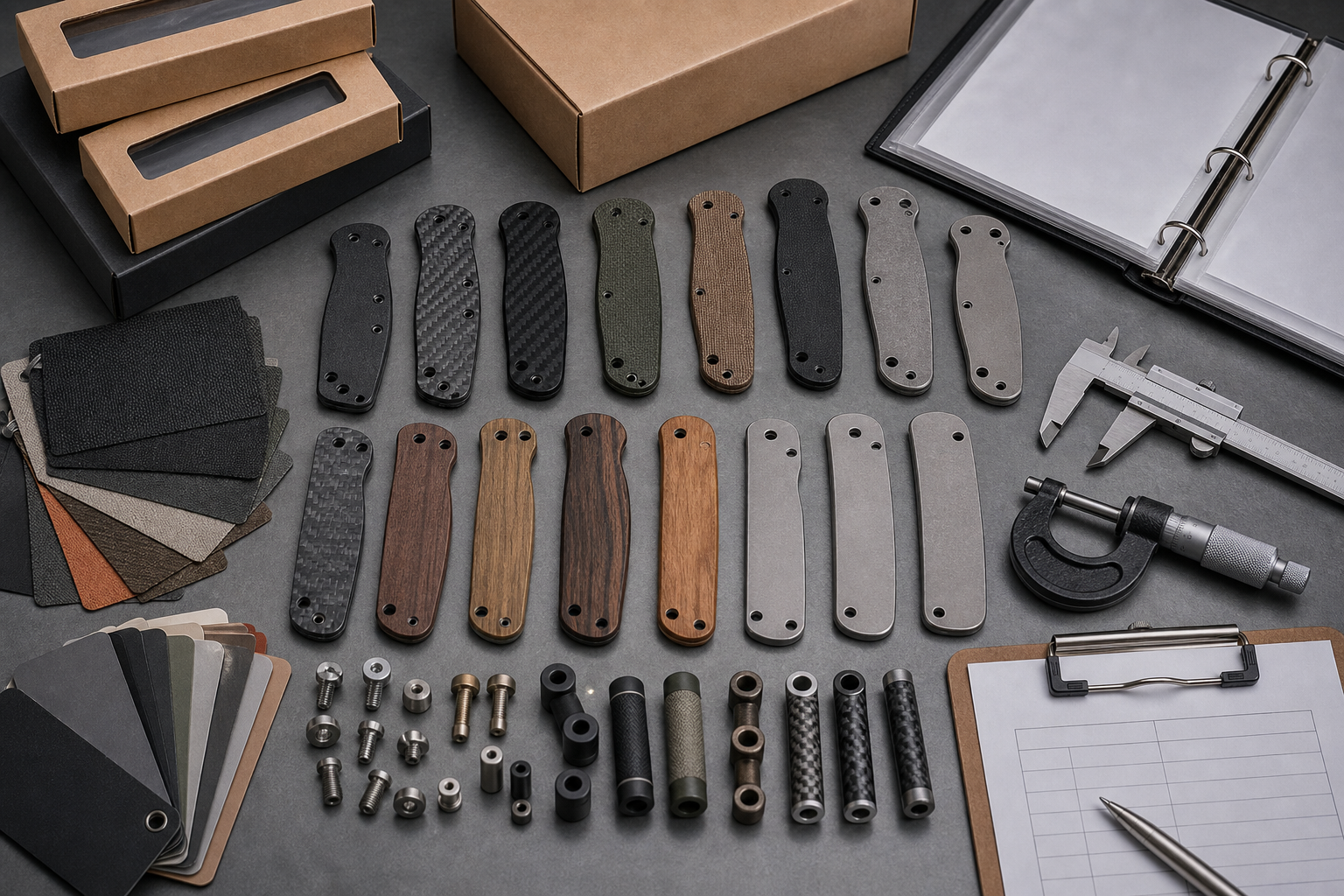
I Ask Buyers to Define the Handle Like a Product, Not an Accessory
The handle material should be part of the RFQ from the start. If the buyer only writes "G10 handle" or "Micarta handle," the supplier still has to guess color, thickness, texture, contour, edge finish, screw layout, liner type, logo method, and packaging story. Those guesses can change cost and lead time. They can also make supplier quotes impossible to compare.
A better RFQ includes the product category first. Is the project a folding knife, fixed blade, pocket knife, camping tool, rescue tool, or multi-tool? Then the buyer should state target market, target price, expected MOQ, preferred handle material, backup material, color, surface texture, thickness, contour, screw hardware, clip position, liner structure, and finish. If the buyer wants a premium model and a lower-cost model, the RFQ can ask for two options.
I also recommend adding inspection needs. For handle materials, inspection should include color, thickness, screw fit, surface texture, edge comfort, logo position, assembly fit, and packaging appearance. If the material is abrasive or dusty during machining, the supplier should account for process control in the quotation. If the material has natural variation, the buyer should approve an acceptable range.
At Vast State, I use this RFQ information to suggest practical options. Sometimes the first material idea is right. Sometimes a buyer should switch from carbon fiber to G10, from wood to Micarta, or from aluminum to reinforced polymer to meet the target price and user expectation.
| RFQ field | Why it matters | Example input |
|---|---|---|
| Handle material | Controls cost, feel, and story | Canvas Micarta, black G10, carbon fiber, aluminum |
| Texture and finish | Controls grip and appearance | Peel-ply, CNC texture, blasted, polished, anodized |
| Structure | Controls assembly and stability | Full liner, nested liner, spacer, backspacer |
| Color requirement | Controls sourcing and approval | Pantone target or approved physical sample |
| Inspection standard | Controls repeat production | Thickness, screw fit, color, texture, edge comfort |
Turn your idea into a quote-ready knife project.
Share your drawing, sample photo, target quantity, market, and packaging needs. Vast State will review manufacturability and prepare OEM/ODM options.
Conclusion
I choose handle materials by product fit, not popularity. The right material must support grip, cost, machining, appearance, and repeat production.
Source Notes
- Norplex-Micarta UltreX Micarta supports the Micarta discussion and its paper, linen, and canvas phenolic laminate background.
- Curbell G10/FR-4 glass epoxy supports G10/FR-4 composition, strength, stiffness, dimensional stability, and machining cautions.
- Hexcel HexTow carbon fiber supports the carbon fiber discussion around strength, stiffness, light weight, and industrial composite use.
- OSHA synthetic mineral fibers gives occupational context for fiber-related exposure control, though it is not knife-specific.
- ISO 9001 supports the broader quality-management point about controlled processes and customer requirements.