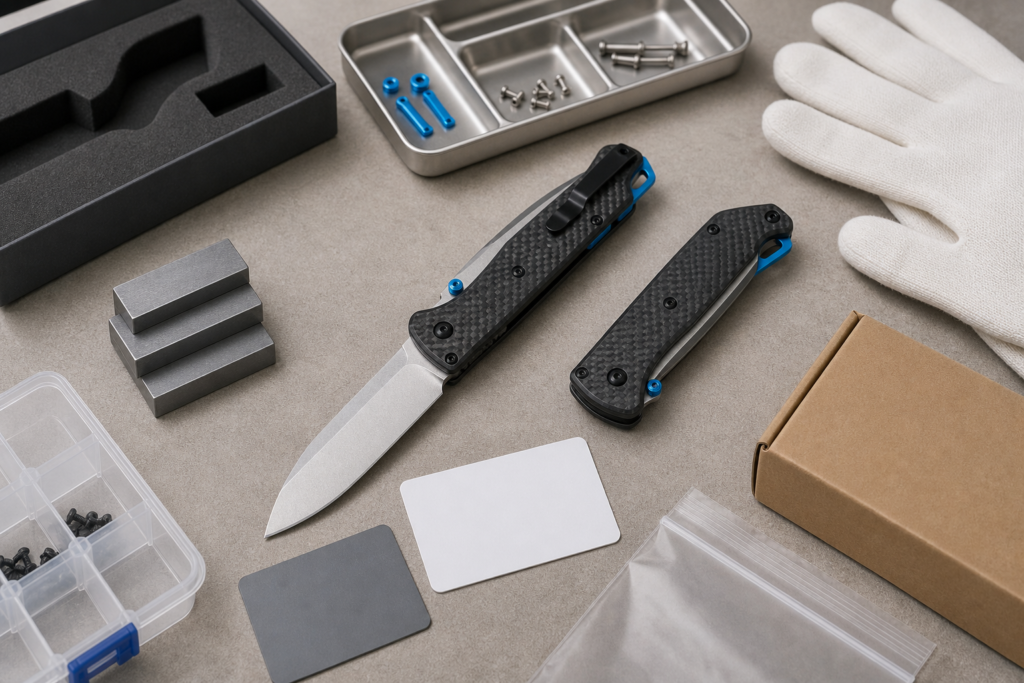
An OTF knife can look like a compact mechanism choice. If buyers treat it casually, they may miss import, sales, labeling, and QC risk.
Buyers should verify OTF knife products by documenting whether the blade opens automatically out the front, how the actuator works, how the blade locks, whether target markets allow it, how it will be labeled, and how every batch will be inspected before shipment.
Quick buyer brief:
- Answer: OTF means out-the-front blade movement, but the key sourcing issue is whether the product is automatic, assisted, manual, or otherwise restricted in the target market.
- Buyer context: This guide is for knife brands, importers, distributors, e-commerce sellers, private label teams, and OEM/ODM sourcing managers.
- Key checks: OTF mechanism type, single-action or double-action function, button or slider position, blade travel, blade length, lockup, closed-state retention, spring system, import classification, state/local review, marketplace rules, adult-use positioning, warning label, claim evidence, and final QC.
Have a knife or multi-tool project in mind?
Send your sketch, CAD file, sample photo, or product idea. Vast State can review manufacturability, suggest materials, estimate MOQ, and prepare a quote for your OEM/ODM project.
This article treats OTF knives as adult-tool products that need mechanism classification, target-market review, labeling, and QC. It does not provide self-defense advice, combat instruction, intimidation copy, concealed-carry guidance, opening tricks, or law-bypass tactics. It is not legal advice. Buyers should confirm rules in every target country, state, province, marketplace, and carrier channel before selling.
OTF is a useful internal shorthand, but it is not enough for a purchase order. A responsible buyer needs to know how the blade moves, what activates it, how it locks, how it stays closed, where it will be sold, and what the public copy says.
What Does OTF Mean in Knife Sourcing?
The term describes direction.
In knife sourcing, OTF usually means the blade travels out through the front of the handle instead of rotating from the side, but buyers must still classify the opening mechanism.
I Define OTF Before I Discuss Features
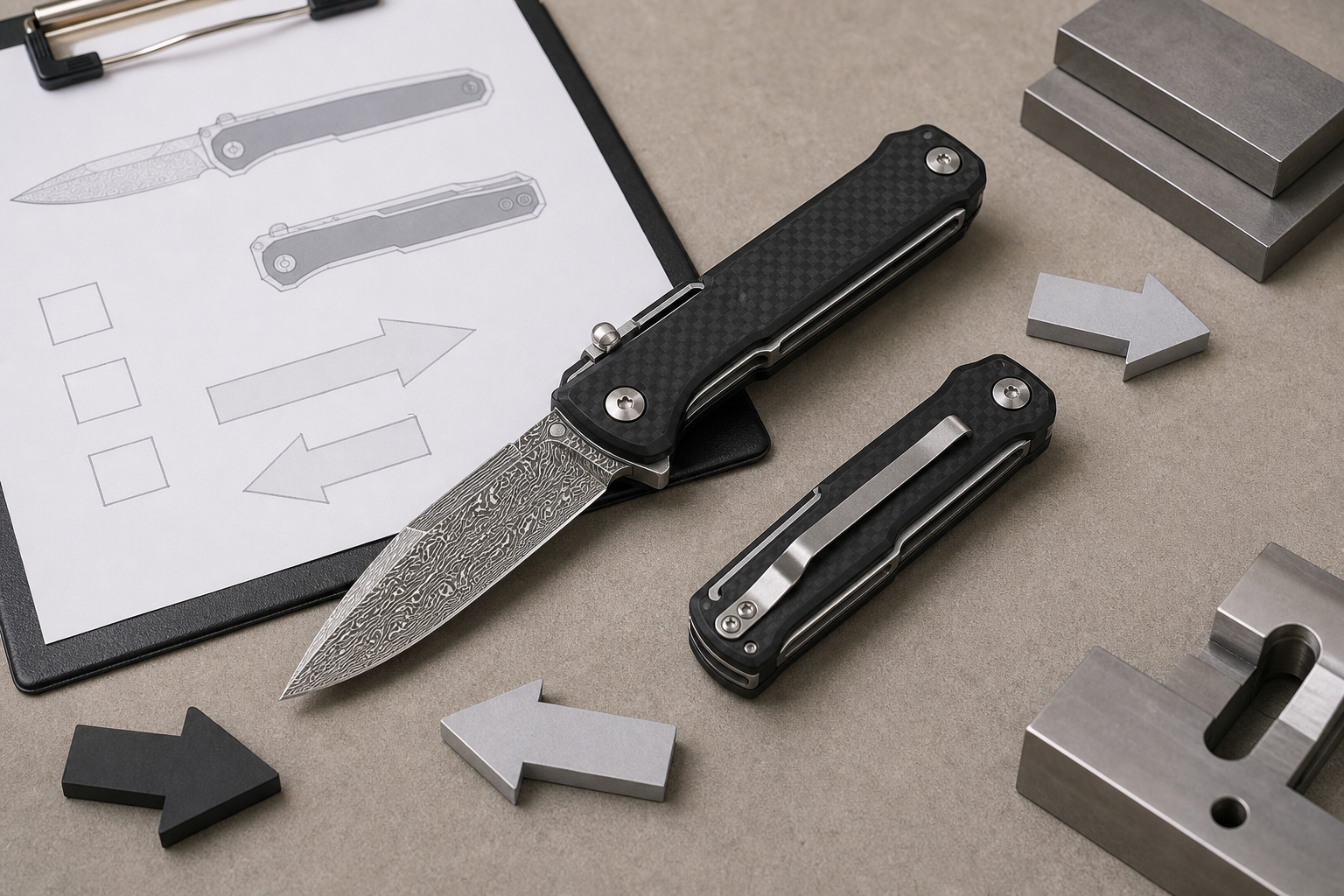
OTF stands for out the front. In a product conversation, that means the blade moves forward through the front of the handle. That is different from a side-opening folder, where the blade rotates around a pivot. However, the blade direction does not answer every compliance or quality question.
An OTF knife may be automatic, manual, decorative, training-only, or a sample with restricted movement. The sourcing file should not rely on the catalog name. The RFQ should define whether the blade opens by a slider, button, spring, manual pull, gravity, inertia, or another mechanism.
The official 15 U.S.C. 1241 definitions define switchblade knife around a blade that opens automatically by pressure on a handle device, inertia, gravity, or both. That is why OTF direction alone is not the full issue. Buyers must document the exact opening behavior.
| Term | What It Describes | Buyer Question |
|---|---|---|
| OTF | Blade exits through the front | Is it automatic, manual, or another mechanism? |
| Side-opening | Blade rotates from the side | How is it activated and locked? |
| Automatic | Blade opens automatically | Is the target market allowed? |
| Assisted | User overcomes bias toward closure | Is the mechanism documented? |
OEM/ODM RFQ Checklist
Prepare these details to help Vast State review your project and provide a more accurate quotation.
| RFQ Field | What to Prepare |
|---|---|
| Project type | OEM from drawing / ODM private label / wholesale catalog |
| Product category | Folding knife / fixed blade / multi-tool / outdoor tool |
| Design status | Idea / sketch / 2D drawing / 3D CAD / physical sample |
| Target price | Ex-factory target price or retail price range |
| MOQ expectation | 500 / 1,000 / 3,000 / 5,000+ pcs |
| Logo method | Laser engraving / etching / printing / molded logo |
| Packaging | Standard packaging / custom retail box / Amazon-ready |
| Market | USA / EU / Japan / Korea / Middle East / other |
| Compliance needs | Buyer-specified testing / documentation / labeling |
| Timeline | Sample deadline / mass production deadline |
Why Is OTF Classification More Sensitive Than a Simple Feature List?
Mechanism changes risk.
OTF classification is sensitive because a front-opening blade often involves springs, sliders, lock parts, and automatic action that can affect legal, import, marketplace, and safety review.
I Keep the Feature List Attached to the Law Review
Many OTF product pages focus on blade shape, handle material, finish, and compact size. Those details matter, but they are not the first risk. The first risk is classification. A buyer must know whether the product will be treated as an automatic knife, a switchblade, a restricted import, or a product that cannot be listed on a target marketplace.
The official 15 U.S.C. 1242 text addresses introduction, manufacture for introduction, transportation, or distribution of switchblade knives in interstate commerce. Import rules also matter. The 19 CFR 12.95 text defines switchblade knives for import controls and includes knives that open automatically by handle pressure, inertia, gravity, or both.
The buyer should not use a supplier comment such as "OTF is legal" as a decision basis. The correct question is narrower: for this exact mechanism, in this exact market, sold through this exact channel, under this exact labeling and customer policy, can we import and sell it?
What Mechanism Details Should the RFQ Capture?
The small parts matter.
An OTF RFQ should define actuator type, spring or drive system, single-action or double-action function, blade travel, lockup, closed retention, blade play, and failure reset method.
I Do Not Approve an OTF by Exterior Shape
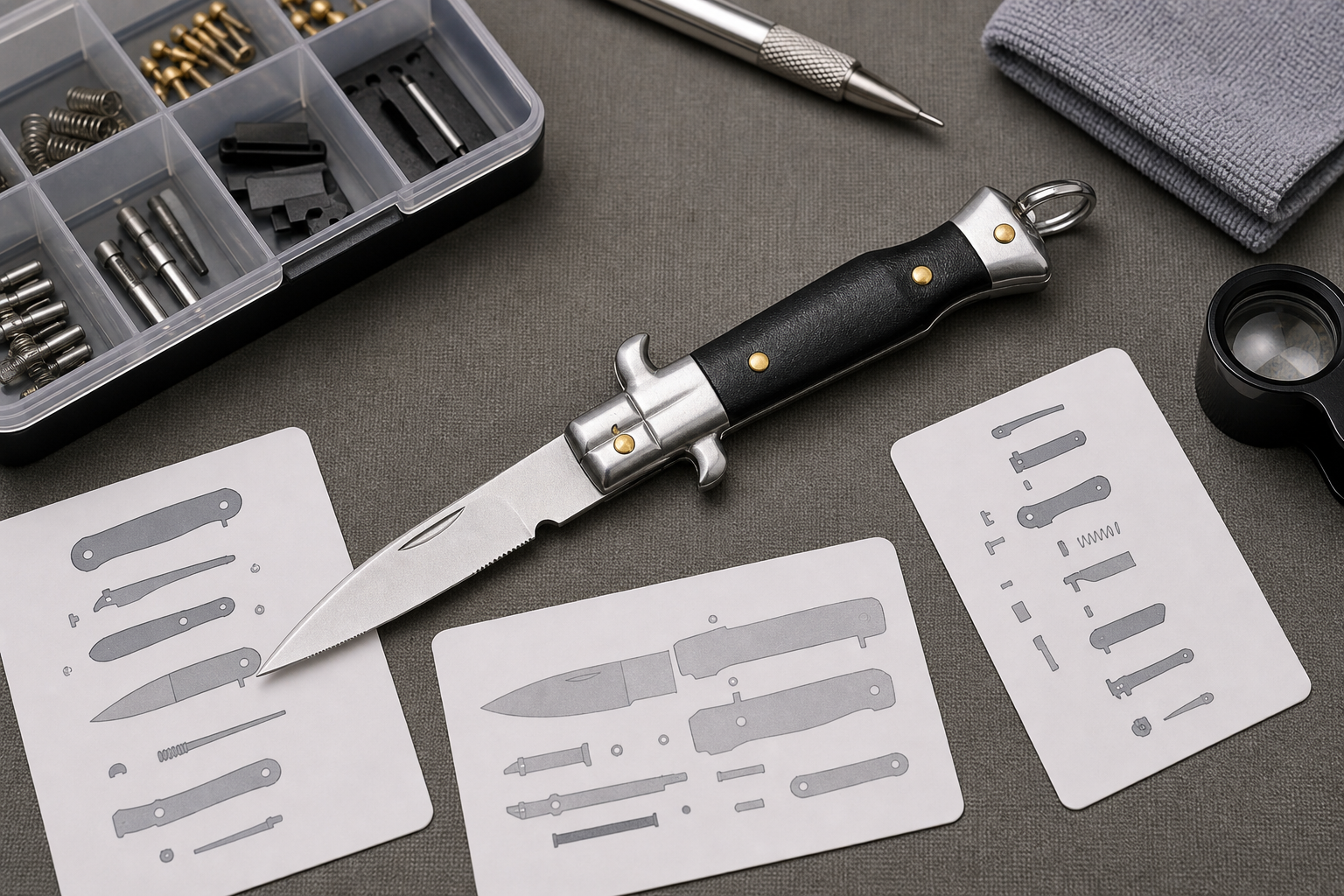
The exterior handle shape tells only part of the story. OTF quality depends on hidden parts. The slider, track, spring, lock gate, blade tang, stop surfaces, screws, and handle body must work together. A sample may feel good once and fail after repeated cycling if tolerances are weak.
The RFQ should define:
- Single-action or double-action design
- Actuator type and position
- Blade length and blade travel
- Spring or drive component
- Lock engagement method
- Closed-state retention
- Blade play tolerance
- Reset behavior after obstruction
- Screw and body construction
- Lubrication or cleaning limits
- Approved sample standard
The buyer should also ask whether any part substitution is allowed. For OTF products, changing the spring, slider, lock gate, blade stock, or handle channel can change both function and classification evidence. Any substitution should require written approval.
| Mechanism Area | Why It Matters | RFQ Evidence |
|---|---|---|
| Actuator | Defines user input | Photos, drawings, sample inspection |
| Spring system | Controls blade movement | Supplier declaration and test sample |
| Lockup | Controls open-state stability | Lock inspection method |
| Closed retention | Controls storage safety | Closed-state test |
How Should Buyers Review Import and Market Access?
Check access first.
Before sourcing OTF knives, buyers should review import controls, federal rules, state and local restrictions, marketplace policy, carrier rules, customer eligibility, and buyer documentation.
I Verify the Path to Sale Before Tooling
OTF products can be expensive to develop. The buyer should not pay for tooling, packaging, photos, or inventory before checking whether the product can move through the intended commercial path.
The 19 CFR 12.96 text addresses imports unrestricted under the Act, while 19 CFR 12.95 defines switchblade knives for that import context. These rules are a reminder that import classification is not only a sales issue. It can affect whether goods are admitted.
Buyer review should include:
- Country of origin
- Import destination
- Buyer eligibility
- Invoice description
- HS code and customs notes
- Federal restrictions
- State and local restrictions
- Marketplace policy
- Shipping carrier policy
- Age policy
- Return policy
- Customer service script
If the sales channel rejects OTF products or automatic knives, the buyer should not try to hide the mechanism in vague copy. That creates more risk. The safer route is accurate classification and channel-specific approval.
What Safety and Labeling Language Should OTF Packaging Use?
The label should be direct.
OTF packaging should use adult-use positioning, sharp-edge warnings, mechanism identification, safe storage language, local-law reminders, inspection advice, and keep-away-from-children wording.
I Let the Packaging Reduce Misunderstanding
OTF knives can be misunderstood if the package only emphasizes speed, surprise, or dramatic action. Responsible packaging should explain what the product is, who it is for, how to store it safely, and what limits apply.
The CPSC labeling requirements overview explains that labeling can depend on product type, design, components, and intended age group. The CPSC children's products guidance also notes that packaging, display, promotion, advertising, manufacturer statements, and consumer recognition can matter when determining whether a product is intended for children.
OTF packaging should avoid youth appeal, toy-like colors, cartoon graphics, combat themes, concealment claims, and self-defense positioning. It should include clear warnings such as:
- Sharp edge
- Adult product
- Keep away from children
- Check local laws before purchase, possession, transport, or carry
- Keep closed or protected when not in use
- Do not use if damaged
- Follow cleaning and storage instructions
Clear labeling helps protect the buyer, the retailer, and the end user.
How Should Marketing Explain OTF Features Without Creating Risk?
Claims need proof.
Marketing should explain OTF features with neutral mechanism, material, size, lock, finish, and QC details rather than speed hype, self-defense claims, or "legal everywhere" promises.
I Keep Copy Boring Enough to Be Safe
OTF marketing can become risky when it uses words like fastest, deadliest, tactical, self-defense, hidden, undetectable, military, or legal everywhere. Those phrases may create compliance, marketplace, retailer, and trust problems.
The FTC advertising and marketing basics state that advertising claims should be truthful, not deceptive or unfair, and evidence-based. Buyers should apply that to every OTF feature claim.
Safer listing details include:
- OTF mechanism classification after review
- Blade length
- Blade steel
- Handle material
- Lock type
- Closed length
- Weight
- Finish
- Care instructions
- Adult-use warning
- Local-law reminder
If the buyer claims cycle life, lock strength, corrosion resistance, or coating durability, the test method and record should be kept with the product file. If the evidence is not available, the claim should be removed or softened.
What QC Tests Are Specific to OTF Products?
Inspection must follow the mechanism.
OTF QC should inspect blade deployment, retraction, lock engagement, closed retention, actuator feel, blade play, tip condition, screw security, labeling, packaging, and sample consistency.
I Inspect the Track, Lock, and Closed State
OTF products need normal knife inspection plus mechanism-specific inspection. The blade must move through the handle path cleanly. The lock must engage correctly. The blade must not rattle beyond the approved range. The product must stay safely closed during normal handling and packaging.
Final QC should cover:
- Approved sample comparison
- Blade length and closed length
- Blade travel
- Deployment and retraction function
- Lock engagement
- Blade play
- Actuator feel
- Closed-state retention
- Screw and body fit
- Tip and edge condition
- Burr inspection
- Label and warning check
- Packaging protection
- Carton marking
The CCOHS sharp blades guidance supports practical safety themes around sharp edges, right-tool use, inspection, and storage. Those ideas belong in both packaging and QC thinking.
What Should the Purchase File Include?
Documentation prevents drift.
The purchase file should include mechanism classification, legal review notes, target market approval, supplier declaration, drawings, samples, labels, claim evidence, and final inspection records.
I Keep Classification With the Order
OTF projects should not rely on scattered messages. The buyer should keep one product file that follows the order from RFQ to shipment. This file helps the team avoid accidental changes and supports future reorders.
The file should include:
- Original RFQ
- Mechanism description
- Supplier declaration
- Drawings and photos
- Approved sample
- Target market review
- Import and carrier notes
- Marketplace approval notes
- Label files
- Marketing claim evidence
- QC checklist
- Final inspection report
- Change-control record
If the supplier changes the spring, slider, lock, blade length, blade travel, or handle channel, the buyer should pause shipment and re-review classification. OTF products are not a good place for silent substitutions.
Turn your idea into a quote-ready knife project.
Share your drawing, sample photo, target quantity, market, and packaging needs. Vast State will review manufacturability and prepare OEM/ODM options.
Conclusion
OTF knife sourcing starts with mechanism classification. Confirm market access, labels, claims, adult positioning, and QC before production.