Pocket knife compliance is not one national yes-or-no answer. A safe product can still fail in the wrong market or sales channel.
Before selling pocket knives in a U.S. target market, buyers should check federal restrictions, state statutes, local rules, blade length, lock type, opening method, age limits, restricted places, import status, marketplace policy, advertising claims, packaging warnings, and QC records.
Quick buyer brief:
- Answer: Treat U.S. pocket knife compliance as a market-entry checklist, not a generic state-law blog post.
- Buyer context: This guide is for knife brands, outdoor brands, EDC brands, importers, distributors, private label buyers, marketplace sellers, and OEM/ODM sourcing teams.
- Key checks: Federal switchblade and ballistic knife rules, state and local restrictions, blade length, automatic or assisted opening language, lock type, concealed carry language, age controls, travel copy, product labelling, warning placement, import review, marketplace policy, and legal review.
Planning a private-label knife line for this market?
Use this article as an early planning reference, then prepare your target market, product category, labeling needs, and buyer-specified compliance requirements before production.
Many buyers ask for "U.S. state knife laws" because they want one quick answer. I understand the need. But for a B2B knife project, a simple state-law summary is usually not enough. The final risk depends on product design, customer age, sales channel, local rules, restricted places, shipping, import status, advertising copy, and how the product is actually positioned.
This article is not legal advice. It is a practical sourcing and product-content checklist. It helps buyers know which questions to ask before they place a pocket knife into a U.S. sales channel. The goal is to prevent careless claims like "legal everywhere," "airport safe," or "unrestricted carry" from reaching the product page or packaging.
Why Should Buyers Treat U.S. Knife Rules as a Market-Entry Checklist?
A state-law article can become outdated. A checklist can guide better review every time.
Buyers should treat U.S. knife rules as a market-entry checklist because federal law, state law, local rules, product features, channel policies, and customer use context can all affect the final decision.
I Do Not Use One Legal Sentence for the Whole U.S.
The United States is not one simple pocket knife market. A product may face federal rules, state statutes, city or county rules, marketplace rules, retailer policies, school or government building restrictions, airport rules, and age-related selling controls. A buyer who only asks, "Is this legal in the U.S.?" is asking the wrong first question.
The better question is: "Where will this product be sold, how will it be described, who can buy it, how will it be shipped, and what design features need review?" That question turns legal uncertainty into a workflow. It also prevents sales teams from using careless copy.
The Legal Information Institute state-law collection gathers state-by-state legal source materials. This is useful because it reminds buyers to check actual state sources instead of relying only on old summaries. It does not mean a sourcing manager should interpret every statute alone. It means the buyer should build a process for checking the target market.
| Compliance layer | Buyer question | Practical action |
|---|---|---|
| Federal | Is the design restricted by federal law? | Review switchblade and ballistic knife rules |
| State | Does the state restrict carry, sale, possession, or blade type? | Check current state sources |
| Local | Do city or county rules add limits? | Ask counsel or distributor |
| Channel | Does the marketplace or retailer allow it? | Review platform policy |
Private-label Planning Checklist
Before starting production, prepare the market and product details your importer or compliance advisor needs to review.
| RFQ Field | What to Prepare |
|---|---|
| Target market | Country, state, region, or sales channel |
| Product category | Folding knife / fixed blade / multi-tool / outdoor tool |
| Intended use | EDC / camping / kitchen / hunting / rescue / promotional |
| Buyer requirements | Testing, labeling, documentation, or packaging rules |
| Blade and lock details | Blade length, opening method, lock type, edge style |
| Packaging text | Warnings, claims, care notes, language requirements |
| Documents | Drawing, sample photo, logo file, packaging artwork |
| Review owner | Importer, legal advisor, testing lab, or internal compliance team |
Which Knife Features Should Buyers Check First?
Compliance starts with product design, not after the product page is written.
Buyers should check blade length, opening method, lock type, edge style, handle design, clip position, closed length, intended use, package contents, and product naming before approving a pocket knife for a U.S. market.
I Start With Physical Features Before Marketing
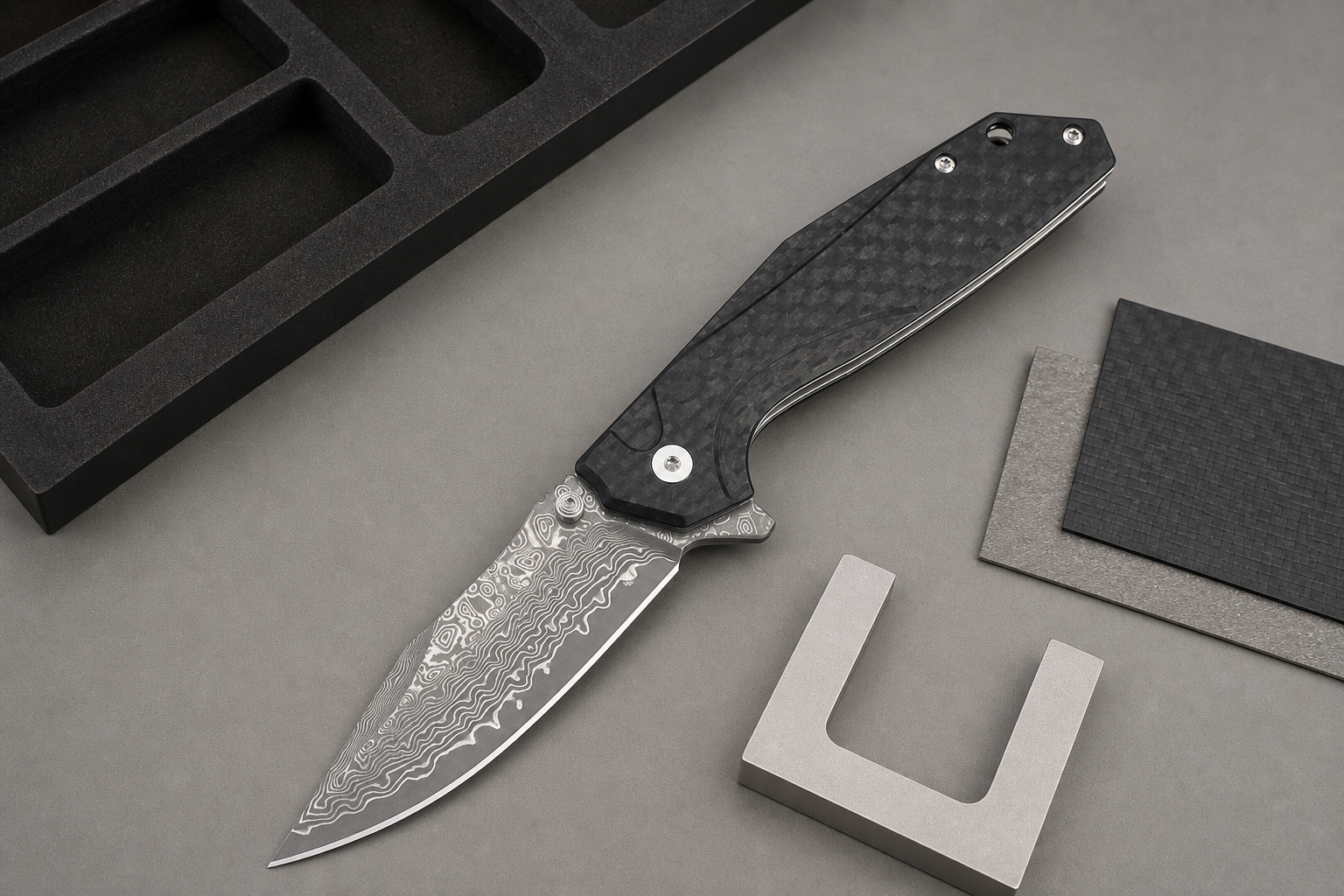
A buyer cannot review compliance from the title alone. "Pocket knife" is too broad. The feature list matters. A small non-locking folding knife may raise different questions than a locking folder. An assisted-opening design may require a different review from a nail-nick slip joint. A long blade, double edge, automatic opening method, gravity-style opening, or unusual mechanism can change the review.
The buyer should prepare a product feature sheet before asking legal or channel questions. That sheet should include blade length, cutting edge length, closed length, opening method, whether the blade locks open, whether the knife has a pocket clip, whether the knife is sold with a pouch or sheath, whether the product uses terms like automatic or assisted, and what user tasks the brand intends to mention.
This feature sheet also helps the supplier. If the buyer wants a safe and broad retail line, the supplier may recommend a simpler opening method, a conservative blade length, and careful packaging. If the buyer wants a specialty design, the buyer should budget more time for review.
| Feature | Why it matters | Buyer record |
|---|---|---|
| Blade length | Rules may use blade or cutting-edge dimensions | Drawing and measurement report |
| Opening method | Automatic, assisted, or gravity terms may matter | Mechanism description |
| Lock type | Locking knives may be treated differently in some places | Lock specification |
| Product copy | Words can create use-positioning risk | Approved claim list |
How Should Buyers Review Federal Switchblade and Ballistic Knife Rules?
Federal law does not answer every state question, but it cannot be ignored.
Buyers should review federal rules for switchblade knives, automatic-opening definitions, interstate commerce, restricted jurisdictions, ballistic knives, import considerations, and exceptions before approving U.S. distribution.
I Keep Federal Review Separate From State Review
The U.S. Code switchblade provisions on GovInfo include definitions for switchblade knives and address interstate commerce, specific jurisdictions, exceptions, and ballistic knives. For buyers, the main lesson is not to guess based on product photos. Opening method and mechanism language matter.
A buyer should ask these federal-level questions:
- Does the product open automatically by button, device, inertia, gravity, or another restricted mechanism?
- Does the product include a spring, detent, or bias-toward-closure mechanism that needs careful classification?
- Could the design be considered a ballistic knife?
- Will the product be imported, shipped interstate, or sold through a national channel?
- Does the product page use words that create confusion about the mechanism?
Federal review is only one layer. A product that passes one federal question may still face state, local, channel, or restricted-place issues. That is why the buyer should keep records: design drawings, mechanism description, sample photos, supplier statements, and legal review notes.
For B2B work, I prefer to avoid borderline mechanism language unless the buyer has reviewed the market carefully. A simpler, clearly described folding mechanism often makes product communication easier.
How Should Buyers Check State and Local Rules?
State rules can change the market plan. Local rules can add another layer.
Buyers should check state and local rules for sale, possession, carry, concealed carry, age, blade type, blade length, lock type, restricted places, and prohibited designs in each target market.
I Prefer Current Primary Sources Over Old Summaries
Knife law summaries can be helpful for orientation, but they can become stale. The buyer should not rely on one blog table for every sales decision. State statutes, official state websites, municipal codes, legal counsel, distributor guidance, and marketplace policy all matter.
The USA.gov state consumer protection directory helps users find state consumer protection offices. It is not a knife-law database, but it is a useful reminder that state-level rules and enforcement contacts exist. Buyers selling into the U.S. should know how to locate state resources and route questions to counsel when needed.
For each target market, the buyer should check:
- State possession and carry rules
- Concealed carry definitions
- Restrictions on automatic, gravity, switchblade, dagger-style, double-edge, or unusual designs
- Blade length thresholds
- Age-related sale rules
- School, government building, courthouse, airport, event, and public transit restrictions
- City or county rules that may differ from state-level rules
- Marketplace and retailer policies
This does not mean the product page should explain every law. It means the brand should avoid legal promises it cannot control.
What Should Product Pages and Ads Say About Legality?
Marketing copy can create compliance risk even when the product itself is ordinary.
Product pages and ads should use cautious legal wording, avoid unrestricted-carry claims, tell customers to check local rules, and keep all performance and safety claims truthful, specific, and evidence-based.
I Remove "Legal Everywhere" Before It Reaches the Page
The FTC advertising and marketing guidance explains that advertising claims must be truthful, not misleading, and evidence-based. For pocket knife sellers, legal and performance claims should be treated the same way. If the brand cannot substantiate a claim, it should not publish it.
Unsafe phrases include:
- Legal in all 50 states
- Carry anywhere
- Airport safe
- No restrictions
- Self-defense ready
- Tactical public carry
- Unbreakable
- Rust-proof
- Maintenance-free
Better language is practical and limited:
- Check local laws before purchase, carry, or transport.
- Rules may vary by state, city, blade length, lock type, opening method, age, and location.
- Use only for intended cutting tasks.
- Keep closed when not in use.
- Follow all school, workplace, transit, airport, event, and building rules.
The product page should sell the tool honestly. It can explain utility, materials, handling, maintenance, and packaging. It should not encourage risky carry or misuse.
What Packaging and Labelling Checks Should Buyers Add?
Packaging should support safe use and honest sale conditions.
Buyers should add packaging checks for warnings, age guidance, safe-use instructions, care instructions, blade protection, product identity, country-of-origin review, tracking needs, and market-specific labelling requirements.
I Treat the Package as a Compliance Surface
The CPSC labeling overview notes that labeling requirements can depend on product type, design, components, and age group, and that other federal or state requirements may apply. A pocket knife buyer should not assume one universal label is enough.
Pocket knife packaging should normally include:
- Product identity and model or SKU
- Safe-use warning
- Storage and handling reminder
- Age or sales restriction language where required
- Care instructions for the blade and handle
- Local-rule reminder
- Importer or responsible party information where needed
- Country-of-origin review
- QR code or support link where useful
The packaging should also protect the product. A folding knife should be closed. A fixed blade should be sheathed. A sharp product should not move freely inside the package. The package insert should not be buried where the customer cannot see it.
For OEM/ODM work, the buyer should approve packaging copy before mass production. The supplier should send photos of the final package, insert, and label placement.
How Should Import, Shipping, and Marketplace Policies Be Checked?
A product can be legal to own in one place and still be blocked by import, shipping, or platform rules.
Buyers should check import classification, restricted knife types, carrier rules, marketplace policy, retailer policy, hazardous material concerns, age controls, and fulfillment restrictions before launch.
I Check the Sales Path, Not Only the Knife
The CBP guidance for personal knives, switchblades, and swords reminds travelers that import and local possession or transport rules can both matter. For commercial buyers, the broader point is clear: import review and local-market review are separate steps.
The buyer should also check marketplace and retailer rules. Some platforms restrict knives by blade type, opening mechanism, age gate, product title, images, or permitted categories. A design that can be sold through one channel may be rejected by another. That creates cost if the buyer has already produced inventory and packaging.
Shipping should also be reviewed. A pocket knife is not only a product-page item; it is a physical sharp object moving through warehouses and carriers. The buyer should check:
- Import classification and product description
- Restricted design categories
- Carrier acceptance rules
- Fulfillment center policies
- Marketplace listing rules
- Age verification or customer eligibility rules
- Return handling instructions
- Packaging protection for warehouse staff and customers
These checks should happen before the purchase order, not after the goods arrive.
How Should Travel and Carry Claims Be Written?
Travel and carry language is where many knife listings become careless.
Buyers should avoid travel-safe and unrestricted-carry claims, explain that rules vary, and tell customers to check airline, transit, workplace, school, building, event, state, and local rules.
I Separate Storage, Transport, and Public Carry
The TSA knives guidance states that knives are not allowed in carry-on bags and that sharp objects in checked bags should be sheathed or securely wrapped. That is a travel-screening rule, not a blanket state-law answer. A buyer should not turn it into "travel legal."
Product copy should separate three ideas:
- Storage at home or in a kit
- Transport in luggage, vehicle, package, or checked bag
- Carry in public
Each idea can have different rules. A product may be stored lawfully at home but restricted in schools, courthouses, airports, events, transit systems, or certain city areas. A product may be permitted in checked baggage but not in carry-on baggage. A product may be allowed by one carrier and still restricted by local law at the destination.
Safe copy example: "Check current local laws and carrier rules before carrying or transporting this knife. Do not bring knives into airports, schools, government buildings, events, or restricted locations unless clearly permitted by applicable rules."
This wording is less exciting than marketing hype. That is exactly why it is safer.
What QC Records Should Support U.S. Market Compliance?
Compliance claims need records behind them.
Buyers should keep drawings, measurement reports, mechanism descriptions, material records, packaging approvals, warning-copy approvals, marketplace policy checks, legal review notes, and final inspection reports.
I Turn Compliance Questions Into Inspection Items
If the product page says the blade is under a target length, QC should measure it. If the listing says the knife is manual opening, the supplier should describe the mechanism clearly. If the packaging includes an age warning, final inspection should confirm that the warning appears on the correct package. If the product includes a pouch, the BOM and inspection report should confirm it.
NIST dimensional metrology supports the role of measurement in manufacturing improvement. ISO 9001 supports defined quality management requirements and process control. For buyers, those principles mean that compliance-sensitive claims should be tied to inspection records.
Useful records include:
- Final product drawing
- Blade length and closed length measurement report
- Mechanism description and sample photos
- Lock function and blade play inspection
- Material and finish records
- Packaging artwork approval
- Warning and insert placement photos
- Product-page claim review
- Marketplace policy review
- Legal review notes by target market
The buyer should keep these records with the purchase order and final shipment file. If the product changes, the review should happen again.
How Can Vast State Help Buyers Prepare for U.S. Pocket Knife Sales?
Vast State can help buyers turn legal uncertainty into a practical sourcing workflow.
Vast State helps buyers prepare pocket knife projects by aligning product design, target market, packaging, safe-use copy, claim guardrails, inspection records, and RFQ details before production.
I Prefer Compliance Planning Before Sample Approval
Vast State does not replace legal counsel. It can help buyers prepare better questions and better product files before counsel, distributor, or marketplace review. This matters because many compliance problems begin with vague product briefs.
For example, if a buyer wants a compact pocket knife for broad U.S. sales, we can help define a conservative feature set, clear product-page language, responsible packaging, and inspection points. If the buyer wants a special mechanism or a more aggressive design, we can help flag which details need review before sampling goes too far.
Vast State can support:
- U.S. target-market question list
- Product feature sheet
- Safe-use and local-rule reminder copy
- Packaging warning draft
- Product-page claim guardrails
- Mechanism and blade-length QC checklist
- Supplier RFQ fields
- Final inspection record planning
The best time to review these items is before mass production. A buyer can still change blade length, opening method, packaging, and copy during sampling. After goods are packed, every change becomes slower and more expensive.
Planning a private-label knife line for this market?
Use this article as a planning reference, then confirm local requirements with your importer or compliance advisor before OEM/ODM production.
Conclusion
U.S. pocket knife compliance should be handled as a target-market checklist that connects design, copy, packaging, channels, and QC records before launch.