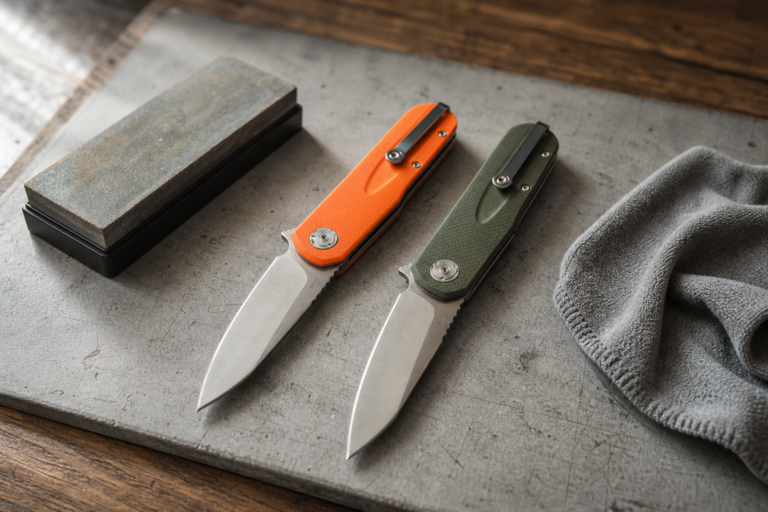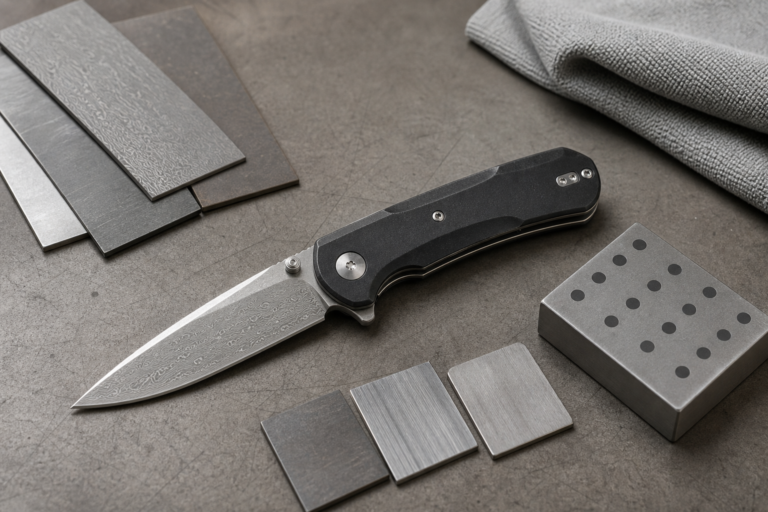
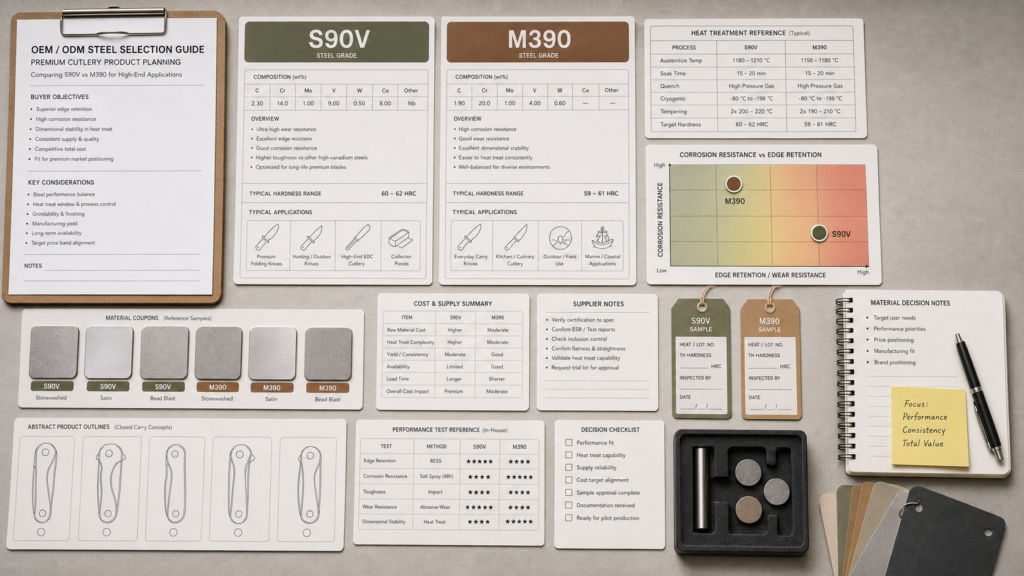
A steel name can sell attention, but it can also create wrong expectations. I compare S90V and M390 by product fit, not hype.
S90V usually fits OEM/ODM knives that prioritize long abrasive edge life, while M390 often fits projects needing a wider balance of wear resistance, corrosion resistance, polishability, and market recognition. The better choice depends on heat treatment, edge geometry, cost, supply, and the buyer's target user.
Quick buyer brief:
- Answer: S90V is more edge-life focused; M390 is more balanced for corrosion, finish, and broad market appeal.
- Buyer context: This helps knife brands, importers, wholesalers, and sourcing managers choose steel before sampling.
- Key checks: Alloy design, heat treatment, hardness target, grinding cost, corrosion need, SKU positioning, and QC records.
Planning a knife project with this steel?
Send us your target market, MOQ, price range, and blade type. Vast State can help you choose the right steel, HRC range, finish, handle material, and QC requirements for OEM/ODM production.
When a customer asks me whether S90V or M390 is sharper, I slow the question down. Steel does not become sharp by its name. Sharpness comes from grinding, edge angle, finishing, burr control, heat treatment, and inspection. Steel mainly decides how the edge behaves after use, how much corrosion risk the product carries, how difficult it is to grind, and how the buyer can position the knife. That is the practical question for B2B projects.
Why Is "Sharpest" the Wrong Starting Question for S90V and M390?
The word sharpest sounds simple, but it hides the real decision. A sharp sample can still become the wrong production steel.
Buyers should not choose S90V or M390 by initial sharpness alone. They should compare edge retention, corrosion resistance, toughness, grindability, heat treatment control, cost, supply, and target market.
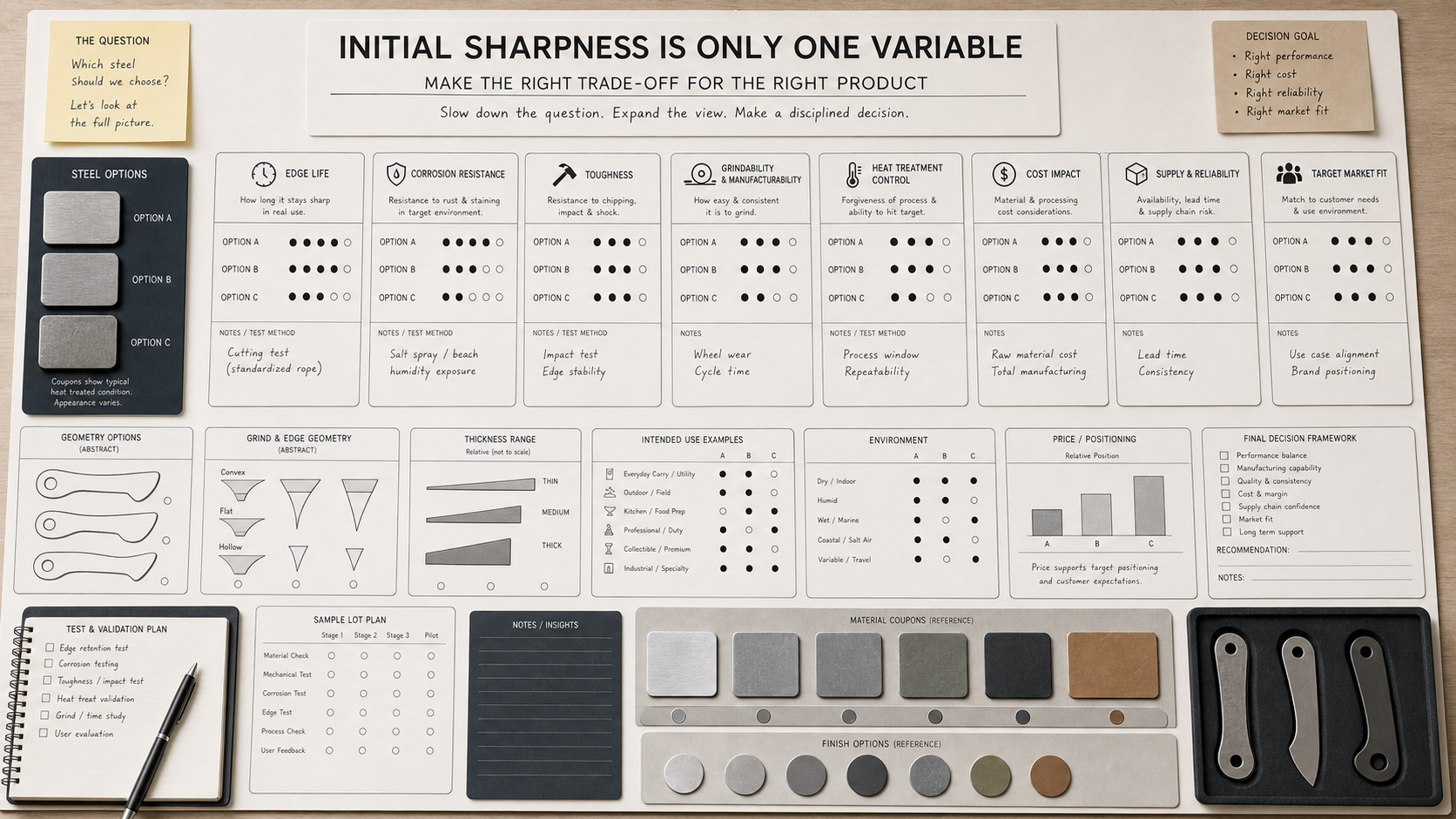
I separate initial sharpness from working edge life
In OEM and ODM knife development, I never treat sharpness as one number. A good factory can sharpen many steels to a clean edge. The harder question is what happens after repeated cutting, exposure to moisture, customer sharpening, and normal wear. S90V and M390 are both powder metallurgy stainless steels used in higher-positioned knife projects, but they are not the same business decision.
I use "sharpness" in three layers. The first layer is initial cutting feel from edge geometry and sharpening. The second is edge retention, which is how long the knife keeps useful cutting ability. The third is edge stability, which depends on hardness, toughness, edge angle, and heat treatment. Knife Steel Nerds explains that edge geometry can strongly change edge retention, so steel alone does not predict the final knife. That is close to what I see in production. A well-ground M390 blade can beat a poorly treated S90V blade in the buyer's hand. A well-executed S90V blade can give a stronger edge-life story for abrasive cutting. The RFQ must define the full product, not only the steel name.
| Question | What it really means | Buyer takeaway |
|---|---|---|
| Which is sharper? | Initial edge geometry and sharpening quality | Both can be made sharp |
| Which cuts longer? | Wear resistance, hardness, and edge angle | S90V often has the stronger edge-life angle |
| Which is easier to sell? | Market recognition and product positioning | M390 may be easier for broad premium-style SKUs |
| Which is safer for production? | Heat treatment, grinding, supply, and QC | The factory process decides the result |
Quote-ready RFQ Checklist for This Steel
To get an accurate OEM/ODM quote, prepare these details before contacting a knife manufacturer.
| RFQ Field | What to Prepare |
|---|---|
| Product type | Folding knife / fixed blade / multi-tool / kitchen knife |
| Target market | US / EU / outdoor retail / promotional / tactical / EDC |
| Steel option | 4116 / 14C28N / D2 / N690 / Nitro-V |
| Target HRC | Example: 55-57 HRC, 58-60 HRC |
| Blade finish | Satin / stonewash / black coating / bead blast |
| Handle material | G10 / micarta / aluminum / stainless steel / wood |
| Lock or structure | Liner lock / frame lock / slip joint / full tang |
| Estimated quantity | 500 / 1,000 / 3,000 / 5,000+ pcs |
| Packaging | White box / color box / blister / pouch / gift box |
| Required documents | Drawing / sample photo / logo file / packaging artwork |
How Do S90V and M390 Differ in Alloy Design?
Two steels can both be stainless powder metallurgy steels and still behave differently. The alloy recipe sets the direction.
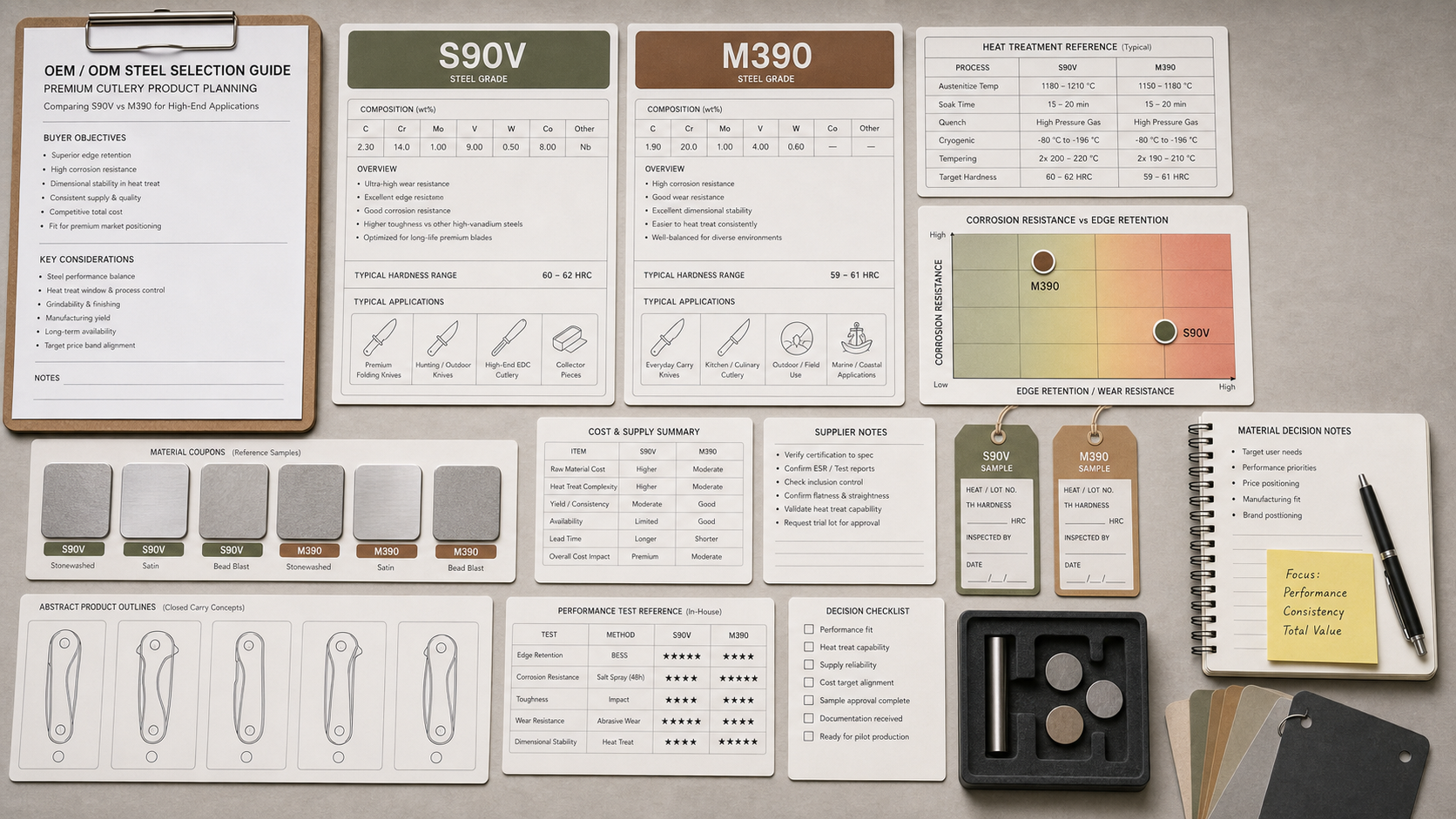
S90V uses very high vanadium content for strong wear resistance, while M390 uses high chromium with vanadium, molybdenum, and tungsten to support wear resistance, corrosion resistance, polishability, and dimensional stability.
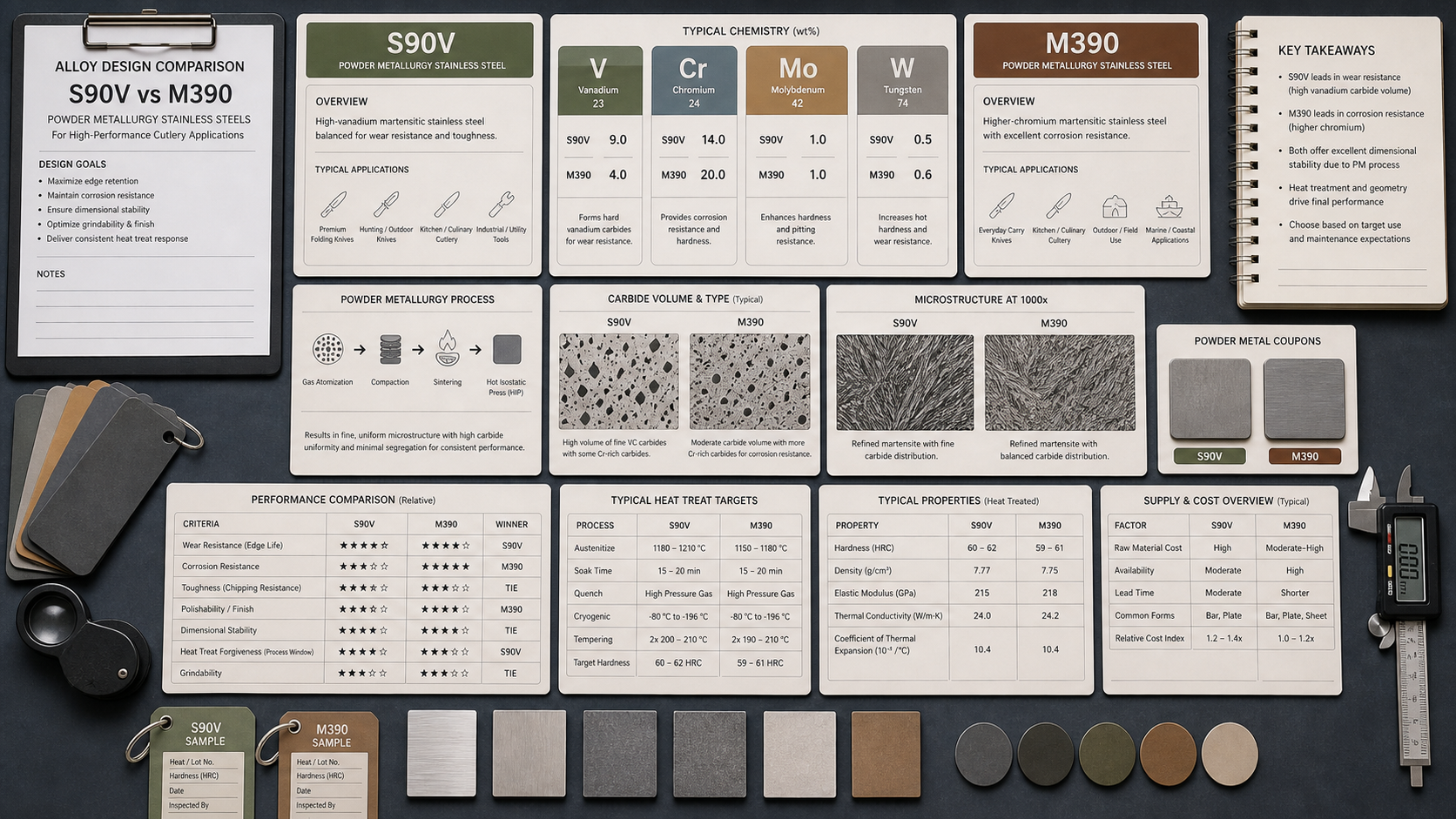
I read the alloy direction before I choose the SKU
The supplier-hosted Crucible CPM S90V data sheet lists a typical composition of 2.3 percent carbon, 14 percent chromium, 1 percent molybdenum, and 9 percent vanadium. It also describes S90V as a martensitic stainless steel with a high volume of vanadium carbides for very strong wear resistance. In practical knife language, that means S90V is built around edge-life and abrasion resistance.
The official Bohler M390 MICROCLEAN data sheet lists 1.9 percent carbon, 20 percent chromium, 1 percent molybdenum, 4 percent vanadium, and 0.6 percent tungsten. Bohler describes M390 as a powder metallurgy corrosion-resistant martensitic chromium steel with very high wear resistance and good corrosion resistance. This alloy direction often makes M390 attractive for buyers who want a strong stainless story, clean finish, and wide market recognition. I do not see one steel as automatically better. I see two different design strategies.
| Steel | Alloy direction | Practical meaning |
|---|---|---|
| S90V | Very high vanadium with stainless chromium level | Strong abrasive wear resistance |
| M390 | High chromium with vanadium, molybdenum, and tungsten | Strong balance of wear and corrosion resistance |
| Both | Powder metallurgy stainless steels | Need controlled heat treatment and grinding |
| Neither | A magic answer by name only | Final knife depends on execution |
What Does Edge Retention Mean for Real Knife Projects?
Edge retention sounds like a simple sales claim. If the edge angle is wrong, the claim can fail in real use.
Edge retention means useful cutting life under a defined cutting condition. For OEM/ODM projects, I connect it to hardness, carbide content, edge angle, blade geometry, user behavior, and inspection standards.
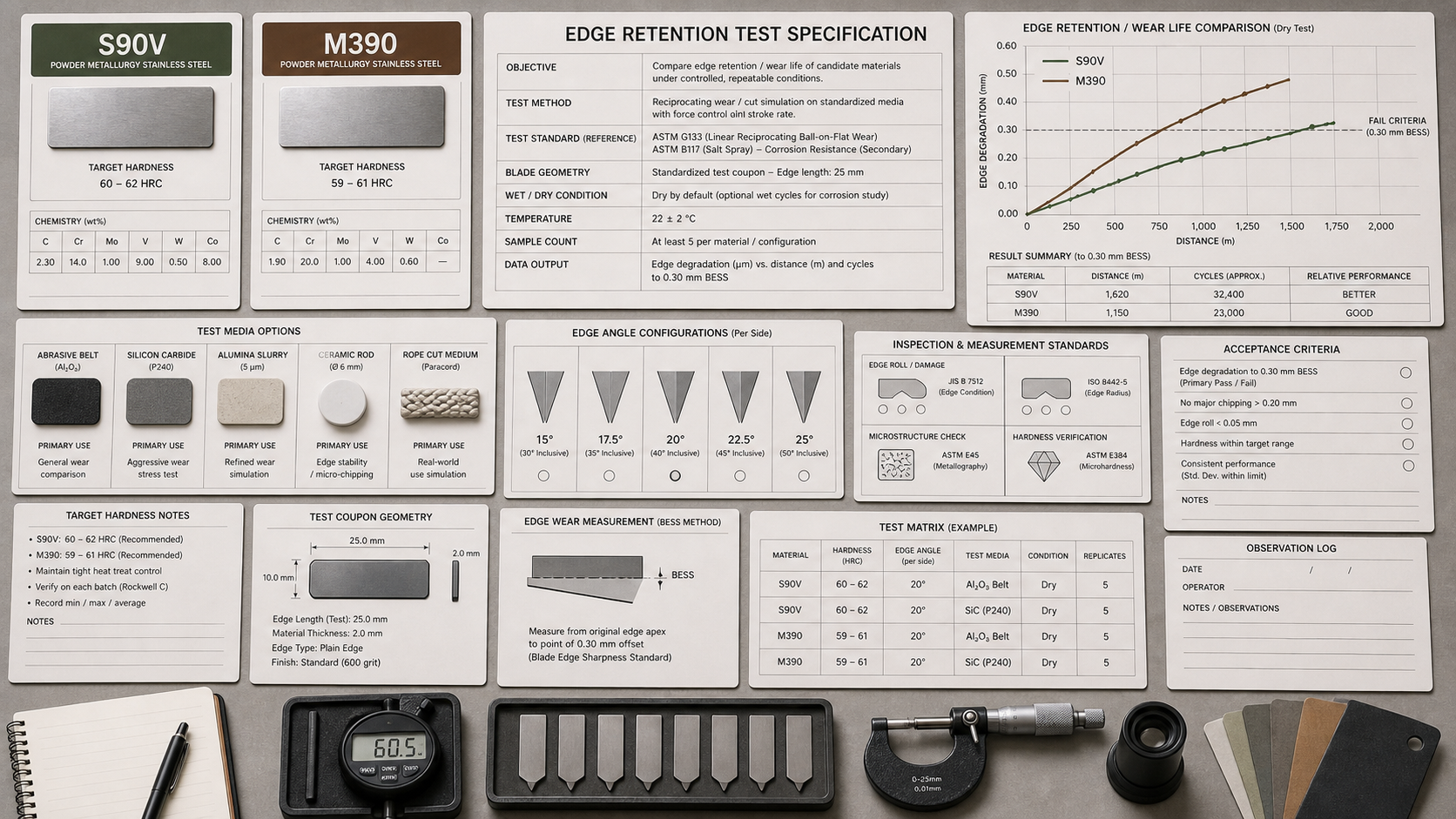
I define the cutting job before I promise edge life
S90V often gives buyers a stronger edge-retention story because its high vanadium content supports hard vanadium carbide formation. The S90V data sheet also compares its wear resistance favorably against 440C and D2 in its own test context. That does not mean every S90V knife will cut longer than every M390 knife. Heat treatment, hardness, edge angle, finish, and the cutting material can change the result.
Knife Steel Nerds explains that edge retention in CATRA-style testing is strongly affected by hardness, carbide volume, carbide type, and edge angle. This is a useful reminder for buyers. A warehouse utility knife, outdoor folding knife, hunting-style folder, and gentleman pocket knife do not need the same edge geometry. If the buyer wants a thin slicer, I ask about chipping risk. If the buyer wants a robust utility edge, I ask whether the user will notice the extra wear resistance enough to justify grinding cost and steel cost. S90V can make sense when the brand story is long edge life for abrasive cutting. M390 can make sense when the buyer wants high performance with stronger corrosion and finishing appeal.
| Edge-retention factor | Why it matters | RFQ control point |
|---|---|---|
| Hardness | Supports wear resistance and edge stability | Define target HRC range |
| Edge angle | Changes cutting life and chip resistance | Set sharpening specification |
| Carbide system | Affects abrasive wear resistance | Match steel to use case |
| Cutting media | Cardboard, rope, food, wood, or mixed tasks | Define realistic product claims |
How Should Corrosion Resistance Affect the Steel Choice?
A knife can cut well and still disappoint buyers if rust complaints appear. Corrosion risk is a market-positioning issue.
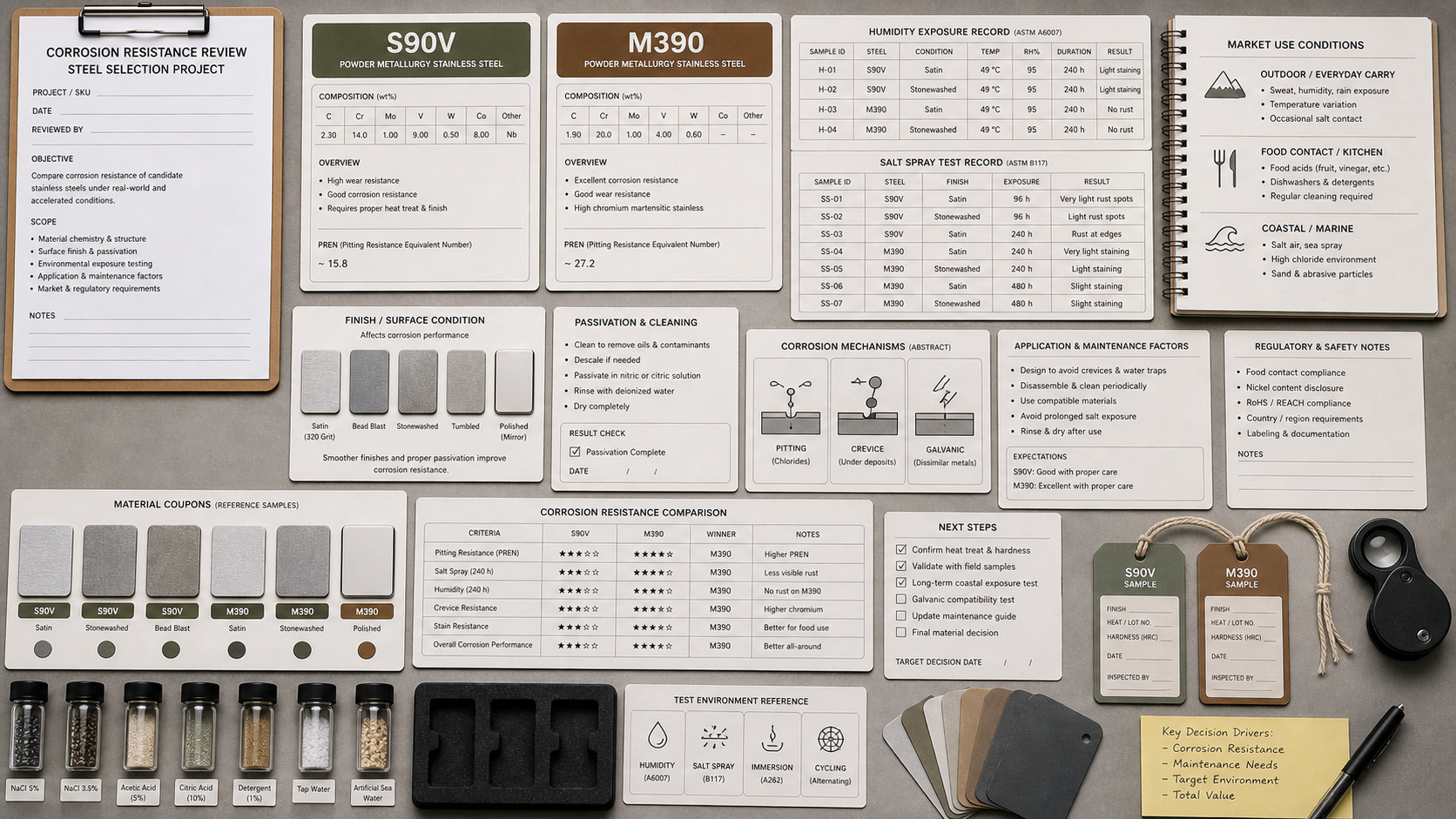
M390 usually gives a stronger corrosion-resistance story because of its high chromium alloy design, while S90V still offers stainless corrosion resistance but is more wear-resistance focused.
I match corrosion need to the buyer's market
For outdoor, coastal, humid, food-adjacent, or daily pocket-carry markets, corrosion resistance can matter as much as edge life. Bohler describes M390 as a corrosion-resistant martensitic chromium steel with good corrosion resistance and very high wear resistance. Its 20 percent chromium content is one reason buyers often see M390 as a strong stainless option. This can help brands that want a cleaner maintenance story.
S90V is also a stainless steel, and the S90V data sheet says it has corrosion resistance equal to or better than 440C in its listed comparison. But S90V's product story is usually more about wear resistance. In manufacturing discussions, I ask the buyer where the knife will be sold and how customers will maintain it. A coastal EDC program may value M390's corrosion story. A dry-market cutting tool may value S90V's wear story. Finish matters too. Stonewash, satin, bead blast, coating, and polishing all affect how users perceive quality and maintenance. For B2B buyers, the right answer is not only chemistry. It is chemistry plus finish plus user expectation.
| Market condition | Possible concern | Practical steel direction |
|---|---|---|
| Humid or coastal markets | Rust complaints and care burden | M390 often has a stronger story |
| Abrasive cutting markets | Edge wear over time | S90V often has a stronger story |
| Gift or display-oriented SKUs | Finish and polish consistency | M390 may be easier to position |
| Utility work SKUs | Cutting life and controlled edge angle | S90V may justify the upgrade |
How Do Heat Treatment and Hardness Control Change the Result?
An expensive steel can underperform if heat treatment drifts. Buyers should not pay for a name without process control.
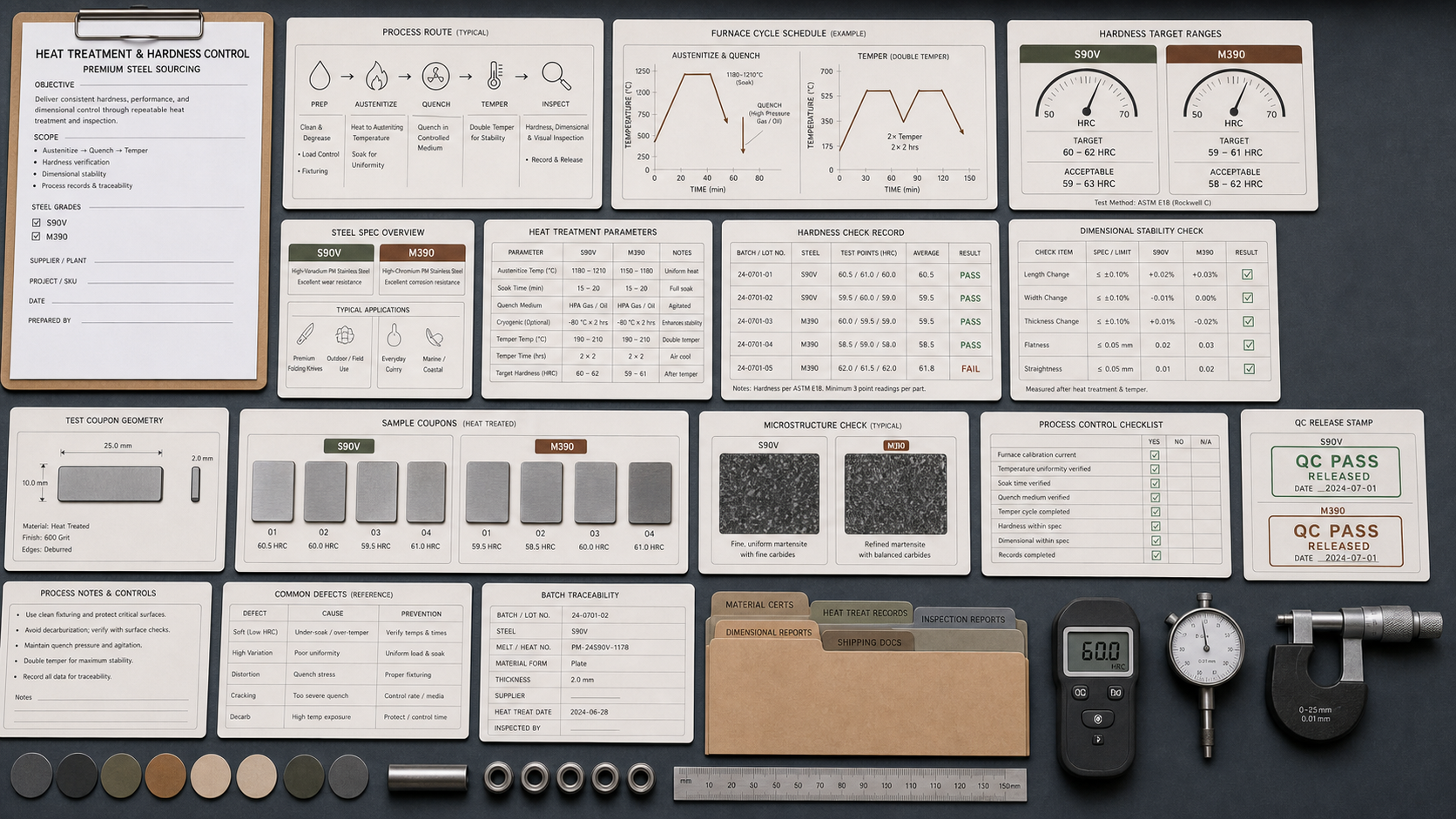
Heat treatment and hardness control decide whether S90V or M390 reaches the intended balance of hardness, corrosion resistance, wear resistance, toughness, dimensional stability, and repeat production quality.
I ask for the hardness target before mass production
The S90V data sheet lists detailed thermal treatment guidance, including hardening, quenching, double tempering, cryogenic option, and an aim hardness range of HRC 56 to 59 in that sheet. It also warns that certain tempering ranges can reduce performance. The M390 data sheet lists hardening and tempering procedures, deep-freezing guidance for residual austenite transformation, and different tempering approaches for corrosion resistance or wear resistance. These details matter because steel choice and heat treatment are one decision, not two separate decisions.
For B2B projects, I ask the buyer to approve a target hardness range and a testing plan. The NIST Rockwell hardness guide explains that good practice in Rockwell hardness measurement helps reduce measurement error. That matters when buyers compare batches or suppliers. If one batch is tested loosely and another is tested carefully, the numbers may not be comparable. I also want records by batch, not only a verbal promise. Premium steel without testing records is a weak procurement decision.
| Heat-treatment item | What I control | Why it matters |
|---|---|---|
| Austenitizing and quench | Match process to steel data | Supports correct structure |
| Tempering route | Balance corrosion, wear, and stability | Avoids wrong performance target |
| Hardness testing | Use consistent Rockwell practice | Makes batches comparable |
| Batch record | Link sample, process, and inspection | Supports repeat orders |
What Manufacturing Challenges Should Buyers Expect With These Steels?
High-alloy powder steels can raise cost quietly. Grinding time, tooling wear, and reject risk can change the real price.
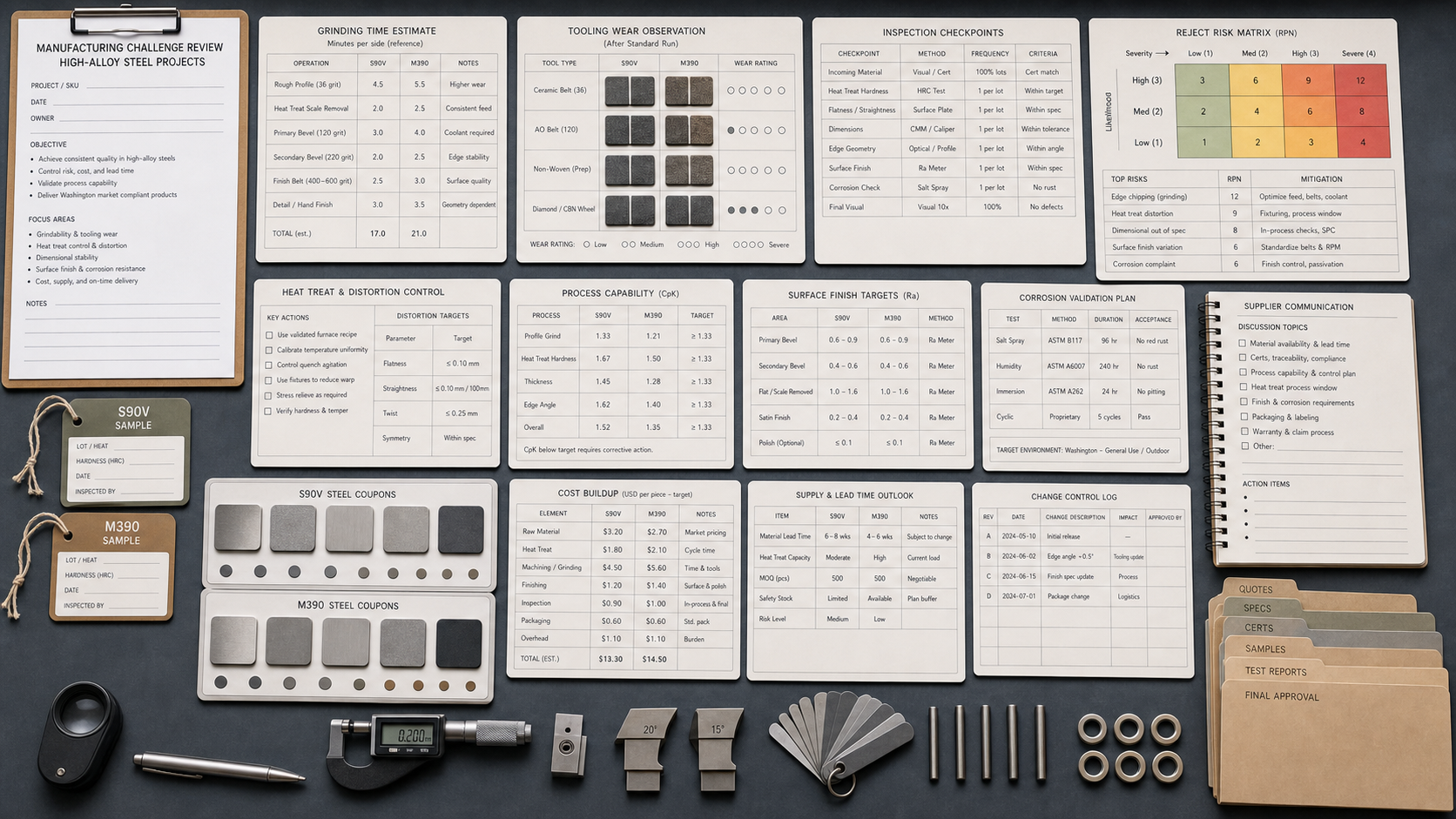
Buyers should expect S90V and M390 to require careful grinding, heat treatment, sharpening, inspection, and supplier communication. S90V may be more demanding because of its high vanadium carbide content.
I quote the process, not only the steel bar
S90V and M390 are not budget steel choices. They can increase raw material cost, machining time, grinding difficulty, sharpening effort, inspection needs, and scrap risk. The S90V data sheet notes that machinability and grindability can be more difficult because of high vanadium carbide content. That is exactly the kind of sentence a buyer should notice before asking for a low target price. If the factory needs more careful belts, slower grinding, better cooling, or more inspection, the cost must be built into the RFQ.
M390 is also not a simple steel. It needs controlled heat treatment, proper finishing, and clear batch records. But it can be easier to position for a wider customer base because buyers know the name and the corrosion story is strong. In production, I also think about blade shape. Thin tips, deep hollow grinds, aggressive swedges, and very fine edges increase risk on high-carbide steels. If the buyer wants a durable outdoor folder, I may recommend a practical blade geometry instead of chasing the thinnest possible edge. A stable product is better than a dramatic sample that cannot repeat well.
| Production factor | S90V concern | M390 concern |
|---|---|---|
| Grinding | High vanadium carbides can slow grinding | Still needs careful belt and heat control |
| Sharpening | Burr control and finish need attention | Edge consistency still matters |
| Heat treatment | Needs correct route and testing | Needs correct route and testing |
| Cost | Higher process cost may be noticeable | Brand value must justify steel cost |
Which Knife Categories Fit S90V or M390 Better?
The same steel can be excellent in one SKU and wasteful in another. Product category should lead the choice.
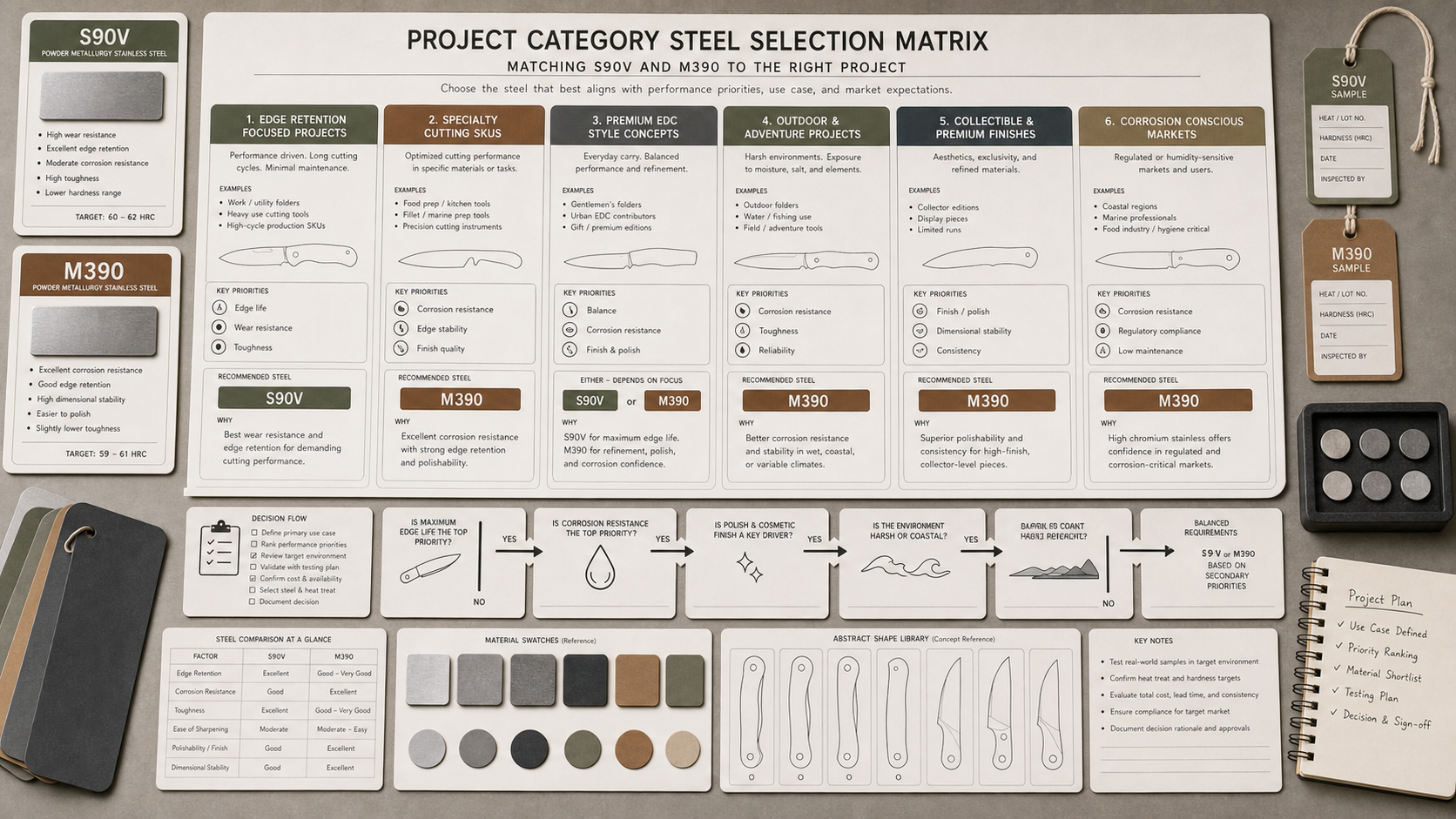
S90V often fits edge-retention-focused folding knives and specialty cutting SKUs, while M390 often fits premium-style EDC, outdoor, collectible, and corrosion-conscious projects that need broad appeal.
I connect steel to brand promise
For a compact EDC knife, M390 can be an easy story. It gives buyers a known steel name, good corrosion resistance, good wear resistance, and strong finish potential. That can fit brand programs where the customer cares about clean machining, smooth action, attractive packaging, and a recognizable specification. For a cutting-performance-focused folder, S90V can create a clearer edge-life promise, especially when the buyer's audience understands steel.
But I also look at the end user. If the user will sharpen often with basic tools, a very wear-resistant steel may frustrate them. If the user works in humid environments, corrosion resistance and finish may matter more than maximum abrasion resistance. If the knife has a thin blade tip or a very thin edge, I ask about chipping risk and warranty expectations. For fixed blades, rescue tools, or heavy utility shapes, I may recommend reviewing tougher steels before jumping to either S90V or M390. The best OEM/ODM answer is rarely "choose the most famous steel." It is "choose the steel that supports the product promise and can be produced consistently."
| Knife category | Better-fit direction | Reason |
|---|---|---|
| Premium-style EDC folder | M390 often fits well | Balanced corrosion, wear, finish, and recognition |
| Abrasive cutting folder | S90V often fits well | Strong edge-life story |
| Coastal outdoor SKU | M390 often fits well | Stronger corrosion-positioning angle |
| Thin or high-impact utility knife | Review other steels too | Toughness and edge stability may matter more |
What Should Buyers Put in an S90V or M390 RFQ?
A vague RFQ creates vague samples. Steel selection needs enough detail for the factory to control the result.
An S90V or M390 RFQ should include target market, knife type, steel choice, hardness range, heat treatment route, edge angle, finish, QC tests, packaging claim, MOQ, cost target, and supply expectations.
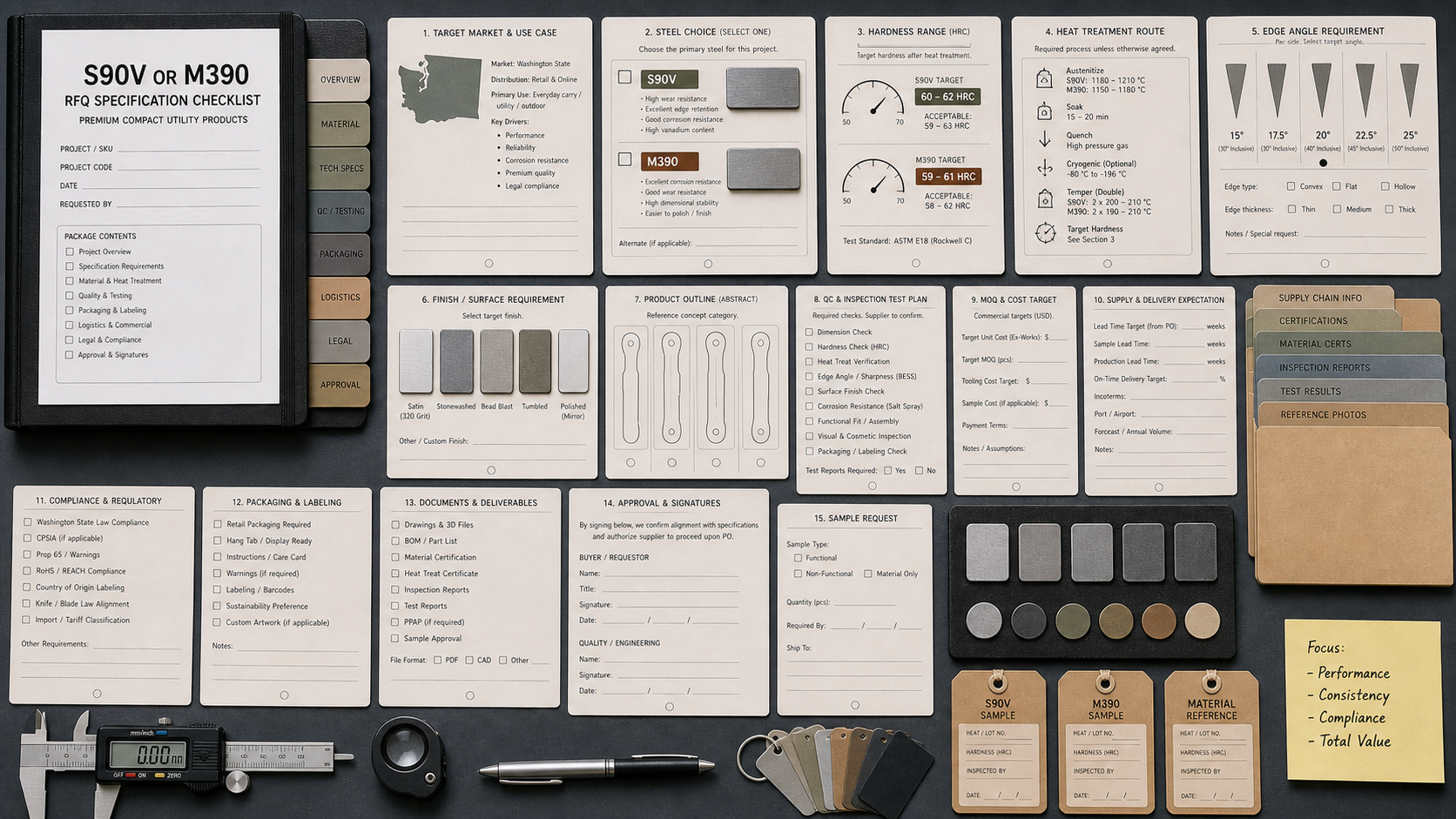
I make steel selection measurable
When buyers send me an RFQ for S90V or M390, I want to see the intended SKU position first. Is the knife for a high-edge-retention story, a corrosion-resistant EDC story, an outdoor brand, a collector line, or a distributor catalog? Then I need the mechanical details: blade length, thickness, grind, lock type, handle material, opening structure, finish, and packaging. After that, I ask for the hardness target and QC expectation.
The RFQ should also say whether the buyer needs material certificates, hardness test records, sample cutting checks, salt-spray or humidity checks, or third-party inspection. I do not add tests only to look formal. I add tests when they help the buyer sell, repeat, and defend the product claim. The ISO 9000 family is useful background because it frames quality management around meeting customer expectations and process control. In knife sourcing, that means the steel choice must be turned into drawings, records, inspection steps, and change control. That is how a premium steel name becomes a repeatable product.
| RFQ field | What to specify | Why it matters |
|---|---|---|
| Steel and source | S90V or M390, supply expectation | Prevents substitution confusion |
| Heat treatment | Target HRC and record requirement | Controls performance |
| Edge geometry | Angle, bevel, sharpening finish | Controls real sharpness |
| QC package | Hardness, appearance, function, packaging | Supports repeat production |
Ready to use this material in your next knife line?
Vast State can help you compare blade steels, heat treatment ranges, handle materials, finishes, packaging options, and QC requirements based on your target market and quantity.
Conclusion
I choose S90V for edge-life focus and M390 for balanced stainless appeal, but I only approve either steel when process control supports the product.
Source Notes
- The S90V data sheet supports the article's claims about high vanadium content, wear resistance, heat treatment guidance, and grinding difficulty.
- The Bohler M390 MICROCLEAN data sheet supports the article's claims about M390 composition, powder metallurgy route, corrosion resistance, wear resistance, and heat treatment guidance.
- Knife Steel Nerds supports the article's caution that edge retention depends on steel, hardness, carbides, and edge geometry.
- The NIST Rockwell hardness guide supports the need for consistent hardness measurement practice.
- The ISO 9000 family supports the process-control and repeat-production quality-management angle.