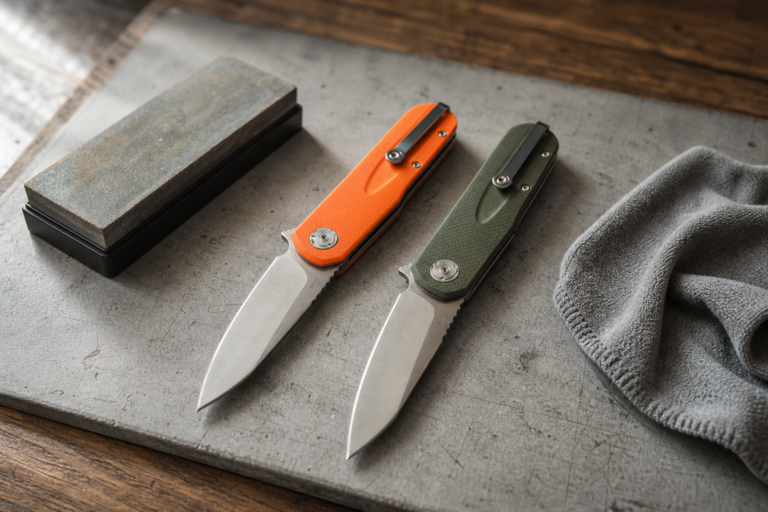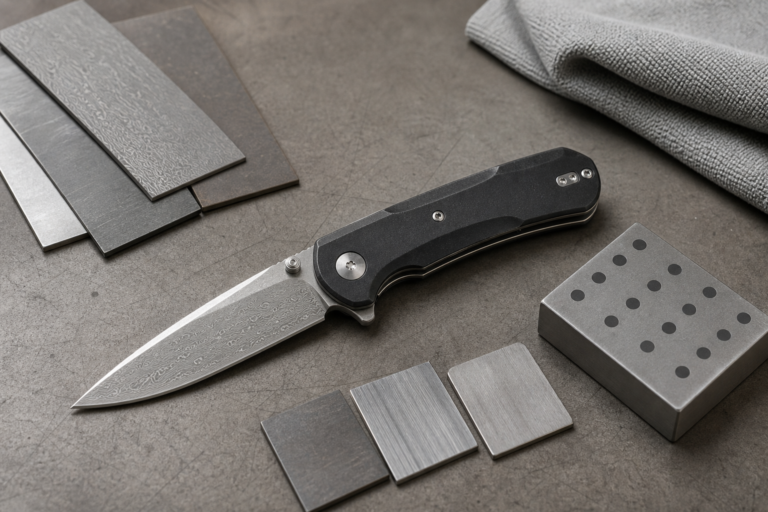
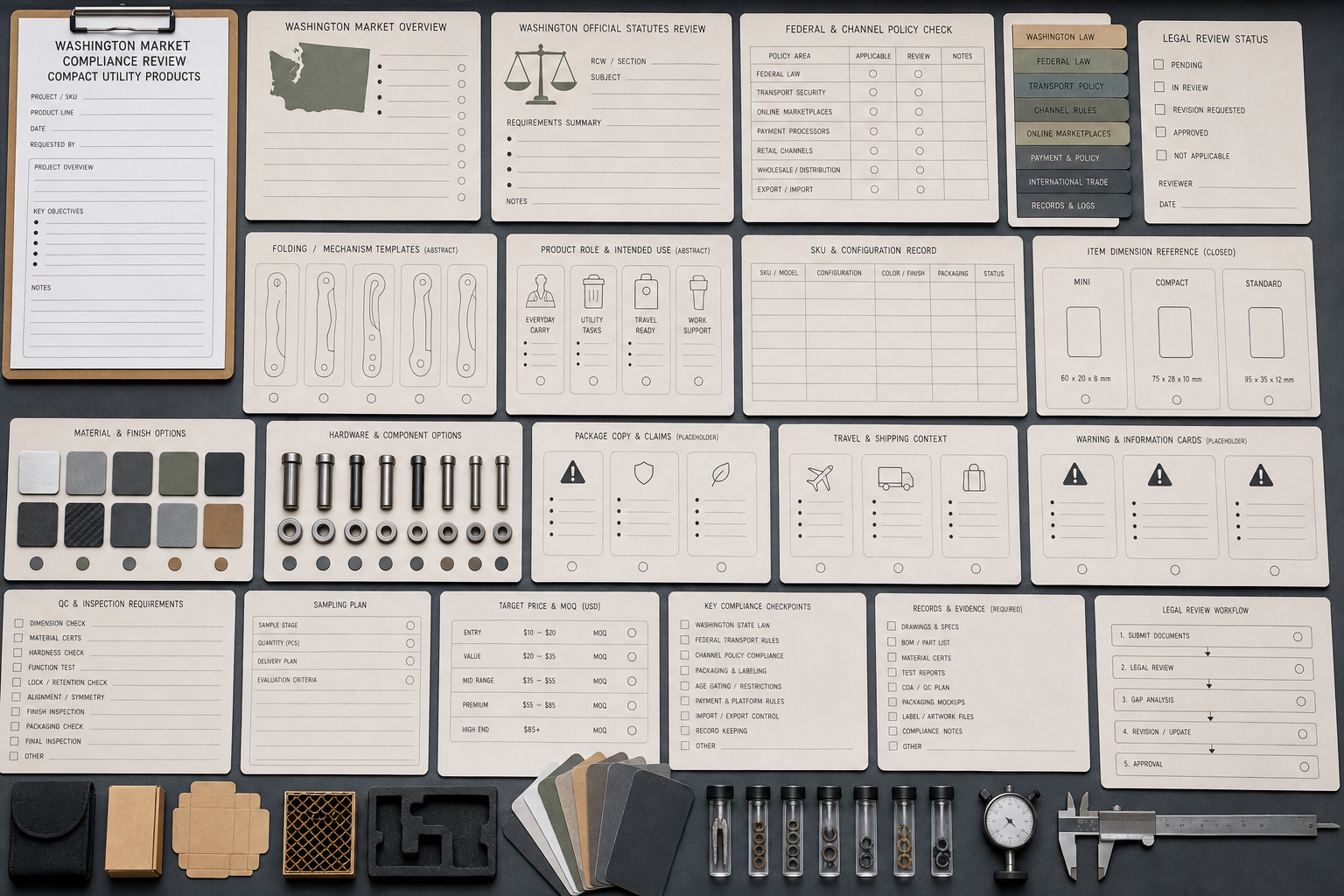
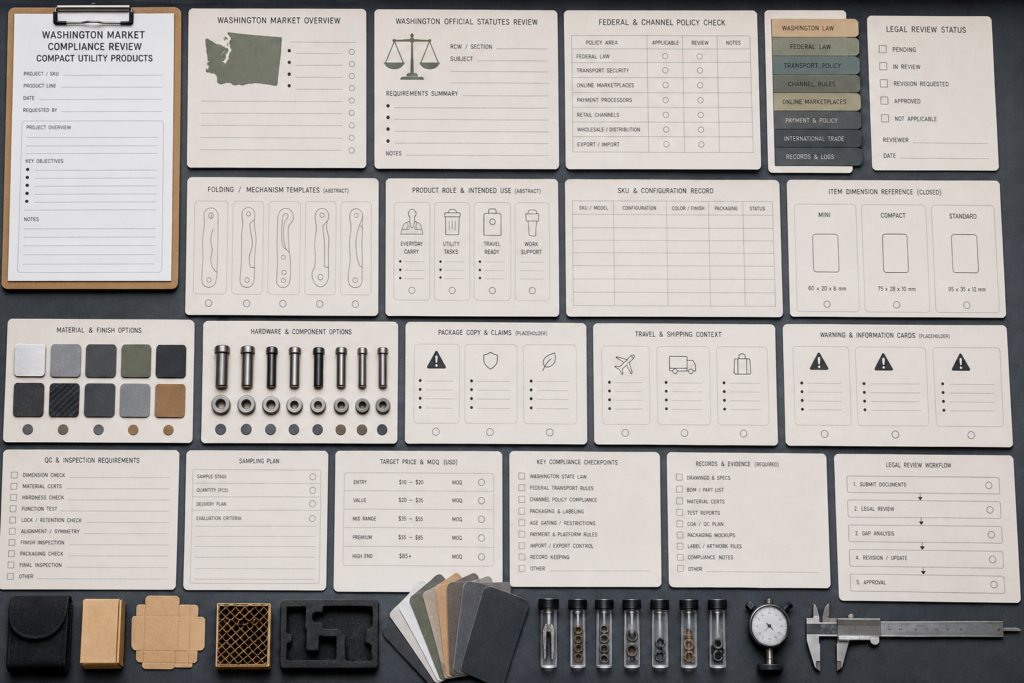
Washington can look like one more U.S. market, but a wrong mechanism choice can create sales risk before the first shipment leaves the factory.
Buyers should check Washington pocket knife projects by reviewing state spring blade rules, federal switchblade restrictions, channel policies, product mechanism details, packaging language, travel warnings, QC records, and legal review before mass production.
Quick buyer brief:
- Answer: Treat Washington as a market-specific compliance review, not a generic pocket knife market.
- Buyer context: This helps knife brands, importers, wholesalers, distributors, and private label buyers prepare safer RFQs.
- Key checks: Mechanism, spring action, gravity action, blade type, SKU records, packaging claims, sales channel rules, and legal review.
- Important note: This article is not legal advice. Buyers should ask qualified counsel to review current Washington and local requirements before sale.
Planning a private-label knife line for this market?
Use this article as an early planning reference, then prepare your target market, product category, labeling needs, and buyer-specified compliance requirements before production.
When a buyer asks about Washington knife law, I do not answer with a simple yes or no. I turn the question into a product and sales review. What is the opening mechanism? Is there any spring release? Can the blade move into position by gravity? What does the listing say? Which channel will sell it? Does the buyer need a professional legal memo before launch? For OEM and ODM projects, this early review protects sampling time, tooling money, and long-term buyer trust.
Why Should Washington Be Treated as a Market-Specific Knife Compliance Project?
A pocket knife that sells in one state may create risk in another. If the RFQ ignores the target market, the whole project can drift.
Washington should be treated as a market-specific compliance project because state law, federal rules, platform policy, logistics practice, and local review can all affect product design and sales language.
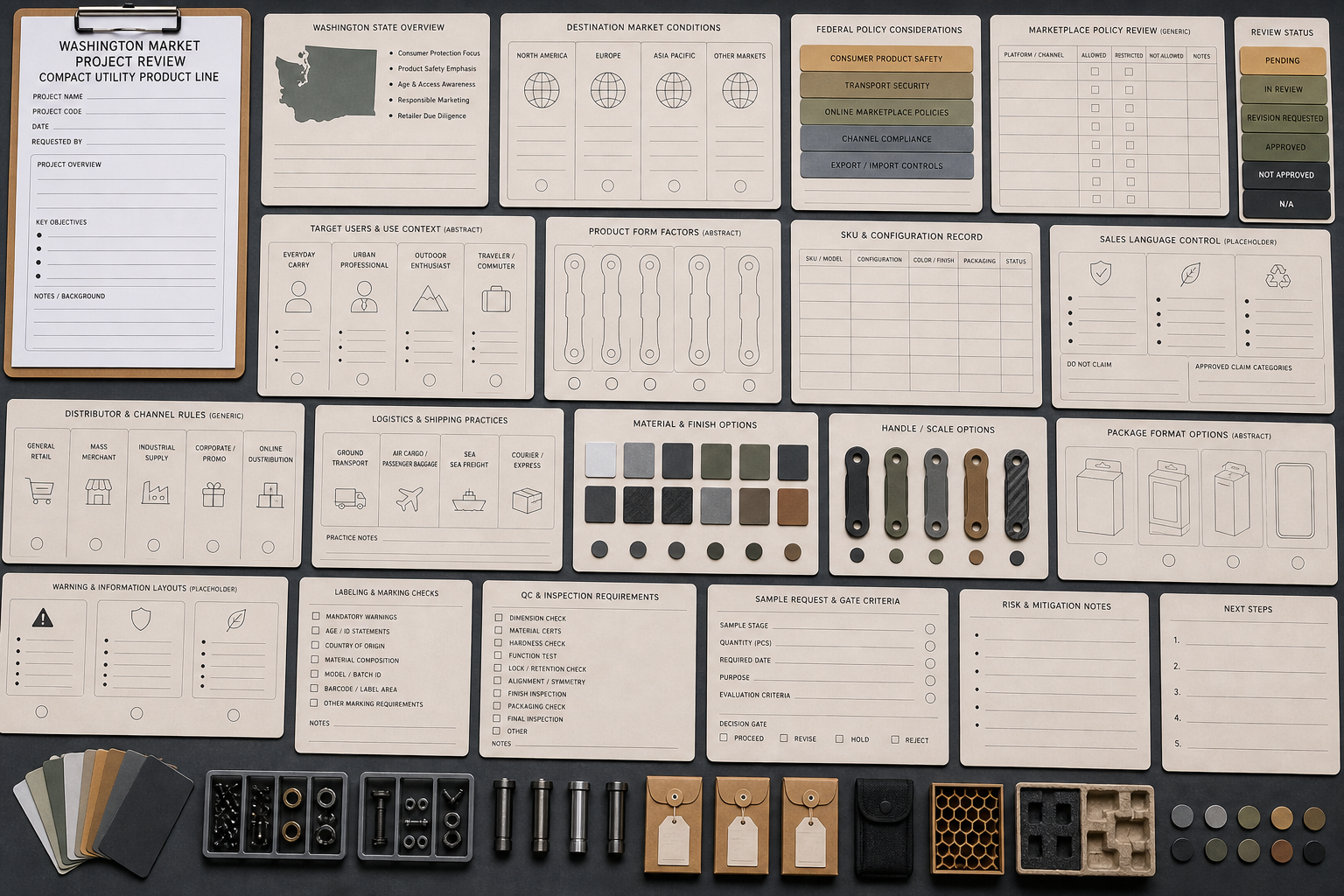
I start with the sales market, not the knife name
Many buyers ask for a "Washington knife law guide" because they want a fast answer. In manufacturing, I prefer a slower and safer question: what product are we trying to sell into Washington, and what proof can we keep before shipment? A pocket knife can be manual, assisted by a bias-toward-closure structure, automatic, gravity-related, rescue-oriented, outdoor-focused, or part of a multi-tool. Those differences matter.
For Vast State, the compliance review starts before the sample. I ask the buyer to identify the target customer, sales channel, blade style, opening structure, lock type, packaging copy, SKU name, and intended distribution method. If the project has any mechanism that could be interpreted as automatic or gravity-opening, I flag it for legal review. This is not because every product is prohibited. It is because the cost of redesign is much lower before tooling, packaging, photography, and inventory are finished.
| Review area | What I ask the buyer | Why it matters |
|---|---|---|
| Sales market | Is Washington a direct target? | State review must happen before launch |
| Mechanism | Manual, assisted, automatic, or gravity-related? | The mechanism changes risk |
| Channel | Wholesale, online, retail, government, or distributor? | Policies can be stricter than law |
| Documentation | Can we keep specs and approvals? | Records protect repeat production |
Private-label Planning Checklist
Before starting production, prepare the market and product details your importer or compliance advisor needs to review.
| RFQ Field | What to Prepare |
|---|---|
| Target market | Country, state, region, or sales channel |
| Product category | Folding knife / fixed blade / multi-tool / outdoor tool |
| Intended use | EDC / camping / kitchen / hunting / rescue / promotional |
| Buyer requirements | Testing, labeling, documentation, or packaging rules |
| Blade and lock details | Blade length, opening method, lock type, edge style |
| Packaging text | Warnings, claims, care notes, language requirements |
| Documents | Drawing, sample photo, logo file, packaging artwork |
| Review owner | Importer, legal advisor, testing lab, or internal compliance team |
Which Washington Knife Statutes Should Buyers Review First?
Legal summaries can become outdated or oversimplified. A buyer should not build a product plan from a forum answer.
Buyers should begin with the official Washington RCW pages for restricted weapon provisions, spring blade wording, specific exemptions, and public handling rules, then confirm current meaning with counsel.
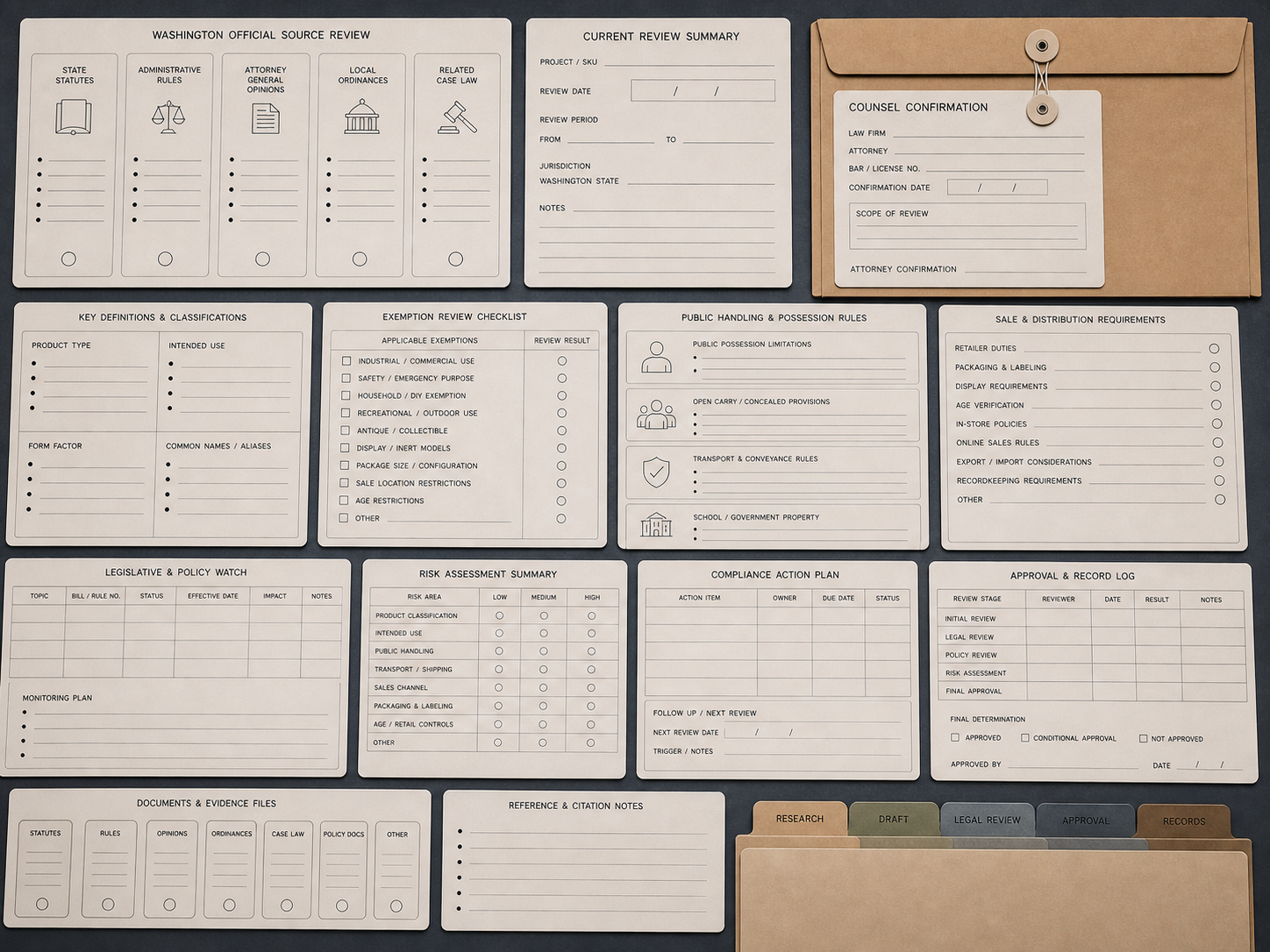
I use official sources before sales opinions
For Washington projects, I first check the official Washington State Legislature pages. RCW 9.41.250 is important because it names spring blade knives in a restricted category and gives the state wording for that term. It also explains that certain bias-toward-closure assisted designs are treated differently from spring blade knives when they require physical effort to overcome the bias.
I also check RCW 9.41.251, because it discusses limited professional and evaluation-related situations connected with spring blade knives. That does not mean a normal retail product can rely on those situations. It means buyers should separate general retail products from agency, rescue, military, test, or distributor-related programs and ask counsel which route applies. RCW 9.41.270 is also useful for sales language because it addresses public handling that can cause safety alarm. I do not use that section as product design permission. I use it as a reason to avoid careless marketing claims.
| Source to review | Buyer takeaway | Manufacturing action |
|---|---|---|
| RCW 9.41.250 | Spring blade wording matters | Review mechanism before sampling |
| RCW 9.41.251 | Some limited professional situations exist | Separate retail and agency programs |
| RCW 9.41.270 | Public handling language can matter | Avoid risky marketing copy |
| Legal counsel review | Interpretation can change by facts | Confirm before mass production |
How Should Buyers Evaluate Spring-Blade and Automatic-Opening Risk?
The riskiest mistake is assuming that a small knife is safe to sell because it looks ordinary. Mechanism is often more important than size.
Buyers should evaluate spring-blade and automatic-opening risk by documenting the release method, bias-toward-closure design, gravity behavior, prototype action, and intended sales channel before approving samples.
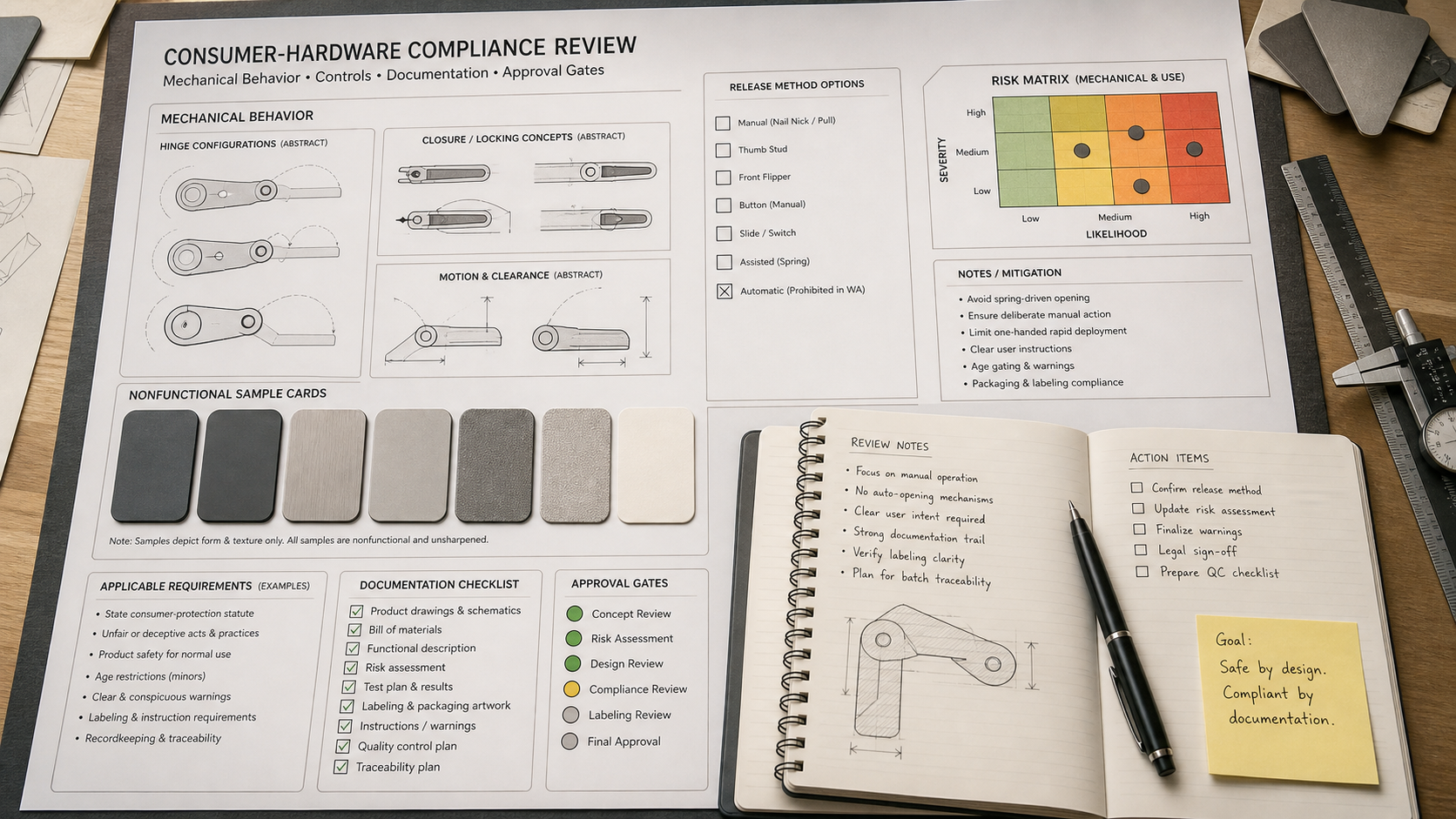
I define the mechanism before I quote the project
In an OEM or ODM RFQ, "pocket knife" is not enough information. I need to know how the blade opens, what part initiates movement, whether a spring releases the blade, whether the blade can move into position by gravity, and whether the design has a bias toward closure. Washington's official wording makes this distinction important. It is possible for two knives to look similar in a photo but carry very different compliance risk because of their internal action.
This is why I ask for mechanism photos, CAD details, sample videos for internal review, and a written mechanism description. If a buyer wants an assisted opening product, I ask whether the design truly requires the user to overcome a closing bias. If the buyer wants an automatic product, I treat it as a legal-review item before any promise on pricing or delivery. If a design depends on gravity movement, I do the same. The goal is not to make the article a legal opinion. The goal is to keep the factory, buyer, and brand from treating mechanism risk as an afterthought.
| Mechanism question | What I document | Why buyers need it |
|---|---|---|
| Manual opening | Thumb stud, nail nick, or other manual input | Lower mechanism ambiguity |
| Assisted opening | Bias-toward-closure structure and user effort | Helps counsel review classification |
| Automatic action | Spring release and trigger method | High-risk review before quoting |
| Gravity movement | Whether blade moves into position by gravity | Must be flagged early |
How Should Blade Type, Size, and Mechanism Choices Be Documented?
A product can fail review because the buyer cannot prove what was ordered. Memory is not a compliance system.
Buyers should document blade length, blade shape, opening method, lock type, handle structure, SKU name, sample version, test result, and approved packaging copy for every Washington-targeted knife.
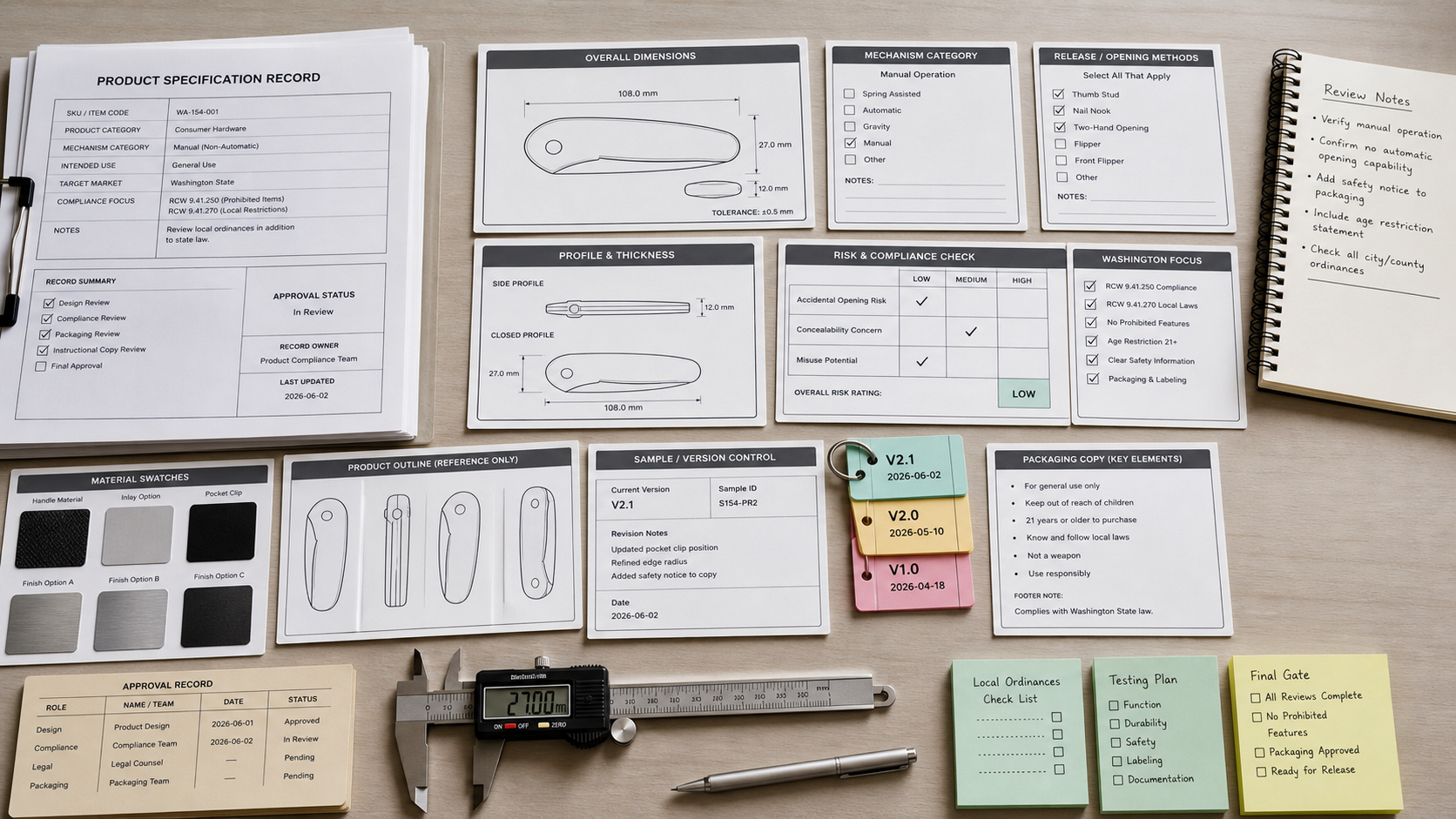
I make the compliance file part of the product file
In knife manufacturing, product records usually include drawings, material choices, hardness targets, color samples, logo artwork, packaging files, and inspection standards. For Washington-targeted products, I add mechanism and sales review records to the same file. If we change the pivot, detent, spring, lock, blade length, thumb stud, or packaging claim, the file needs an updated version.
This matters because buyers often develop several similar SKUs at the same time. One version may be a manual liner lock. Another may be an assisted version. Another may have a different blade length or rescue feature. If these records are mixed, the wrong listing can be matched to the wrong knife. For B2B buyers, documentation is not paperwork for its own sake. It helps compare supplier quotes, approve samples, answer distributor questions, and show that the product was reviewed before mass production. At Vast State, I prefer clear SKU control because it keeps product development practical.
| Record item | Example detail | Why it helps |
|---|---|---|
| Blade data | Length, thickness, steel, finish | Supports product and legal review |
| Mechanism data | Opening method and lock structure | Flags spring or gravity risk |
| Sample version | Date, revision, approved sample | Prevents mixed versions |
| Packaging copy | Claims, warnings, SKU text | Controls sales language |
What Product Listing and Packaging Language Should Buyers Control?
Even a compliant product can create trouble if the listing makes the wrong promise. Marketing words can travel faster than specifications.
Buyers should control product listing and packaging language by avoiding aggressive claims, matching copy to actual mechanism, including age and safety warnings, and keeping legal-review notes with the SKU.
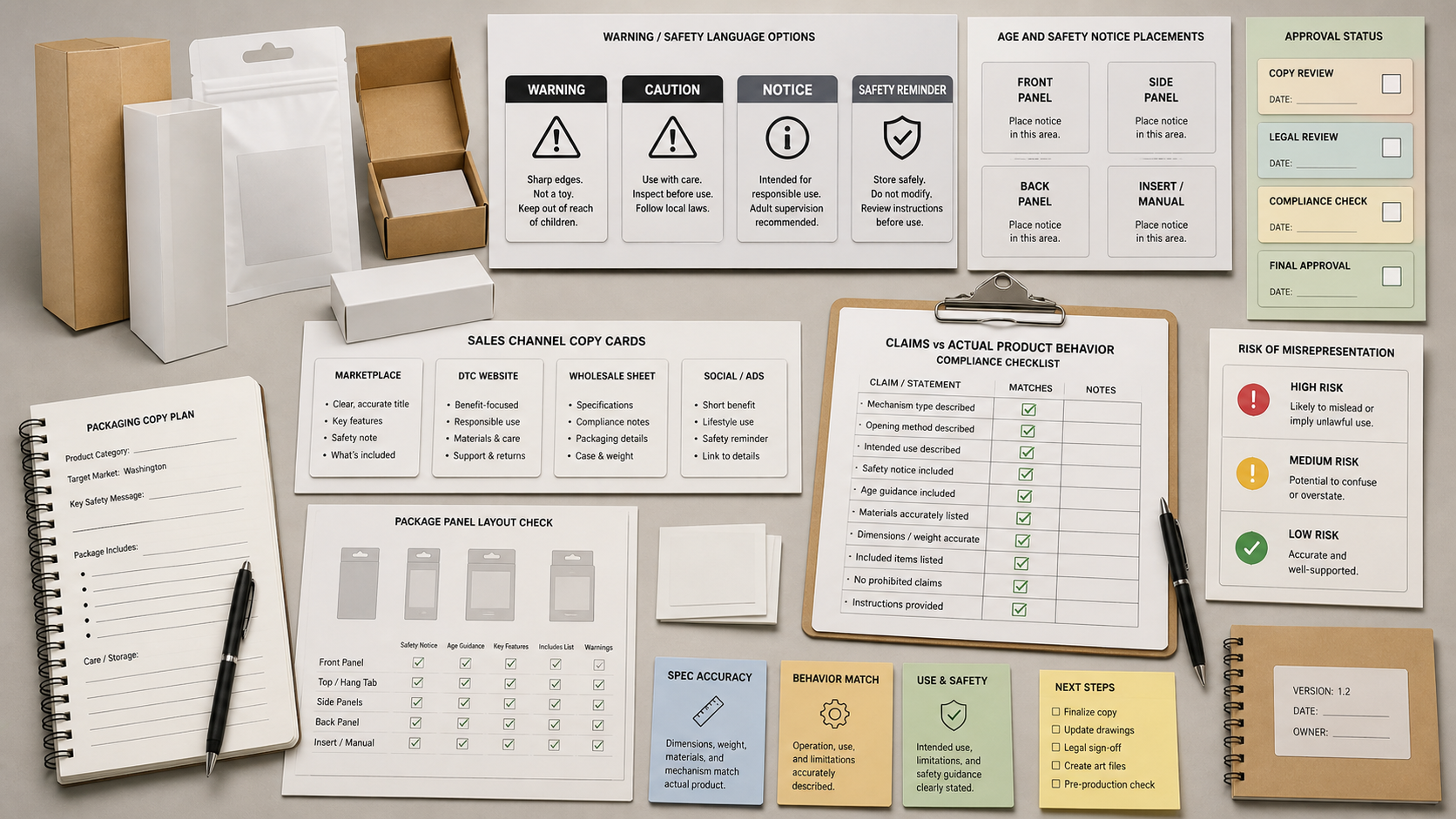
I treat copy as part of the product
For knife projects, buyers sometimes think the factory only needs to make the metal parts. In real B2B work, the product also includes the title, listing bullets, packaging, insert card, instruction sheet, warning label, and distributor sell sheet. If these materials describe the mechanism incorrectly, the product can create confusion even when the sample is built correctly.
For Washington-targeted pocket knives, I prefer plain and accurate copy. If the knife is manual, say it is manual. If it has an assisted structure, do not describe it as automatic. If it is designed for outdoor, EDC, camping, warehouse, or general utility channels, keep the language practical. Avoid claims that encourage unsafe public behavior or oversell the knife beyond its intended product category. Packaging should also support the buyer's market: age guidance where appropriate, safe handling reminders, channel-specific warnings, and distributor-required labels. Counsel should review the final language before launch, especially for online marketplaces where policy enforcement can be stricter than statutory wording.
| Copy area | What I control | Buyer benefit |
|---|---|---|
| Product title | Accurate knife type and mechanism | Reduces classification confusion |
| Bullet points | Practical use and material facts | Avoids exaggerated claims |
| Packaging | Warning and SKU consistency | Helps retail and distributor review |
| Marketplace data | Category, attributes, images | Reduces listing takedown risk |
Which Import, Travel, and Sales-Channel Checks Still Matter?
State review is not the only gate. A product can pass one review and still fail a platform, freight, or travel-related check.
Buyers should also check federal switchblade rules, TSA travel guidance, marketplace policies, distributor requirements, shipping rules, and local sales restrictions before launching a Washington-targeted knife.
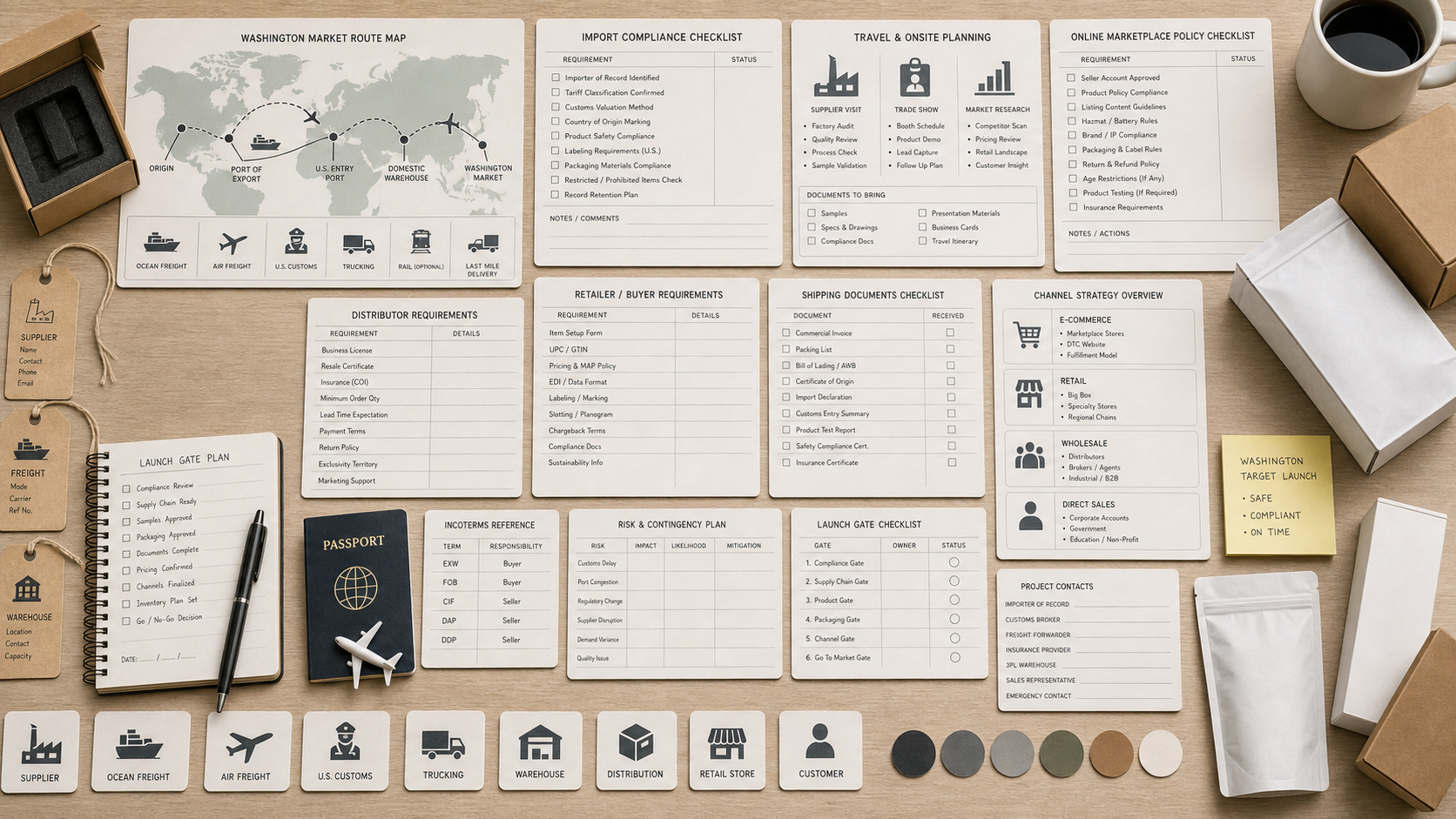
I separate legal review from channel approval
For U.S. sales, federal rules can matter alongside state law. The official U.S. Code page for 15 U.S.C. Chapter 29 covers federal switchblade restrictions and exceptions, including a bias-toward-closure assisted-opening exception. This source does not replace Washington review. It adds another layer for buyers who import, transport, distribute, or sell across state lines.
Travel information is also not a sales permission document. The TSA page for pocket knives says pocket knives are not allowed in carry-on bags and may be packed in checked bags, with final screening decisions made by TSA officers. I use that as a consumer-facing warning reference, not as product approval. Marketplace rules, retailer policies, distributor contracts, and local rules may also be stricter than a buyer expects. That is why I ask buyers to confirm channel policy before packaging is printed. A product that cannot be listed cleanly is a commercial problem even if the factory made it well.
| Check | What to confirm | Why it matters |
|---|---|---|
| Federal rules | Switchblade and assisted-opening treatment | Interstate sales risk |
| TSA guidance | Travel warning language | Reduces consumer confusion |
| Marketplace policy | Category and mechanism acceptance | Protects listing stability |
| Distributor rules | Contract and retail requirements | Prevents rejected inventory |
What QC and Recordkeeping Help Support a Washington Sales Review?
Compliance cannot rely on the first sample only. Production drift can change how a knife behaves.
QC and recordkeeping should include approved samples, mechanism checks, opening-force observations, blade measurements, packaging approvals, inspection photos, batch records, and change-control notes.
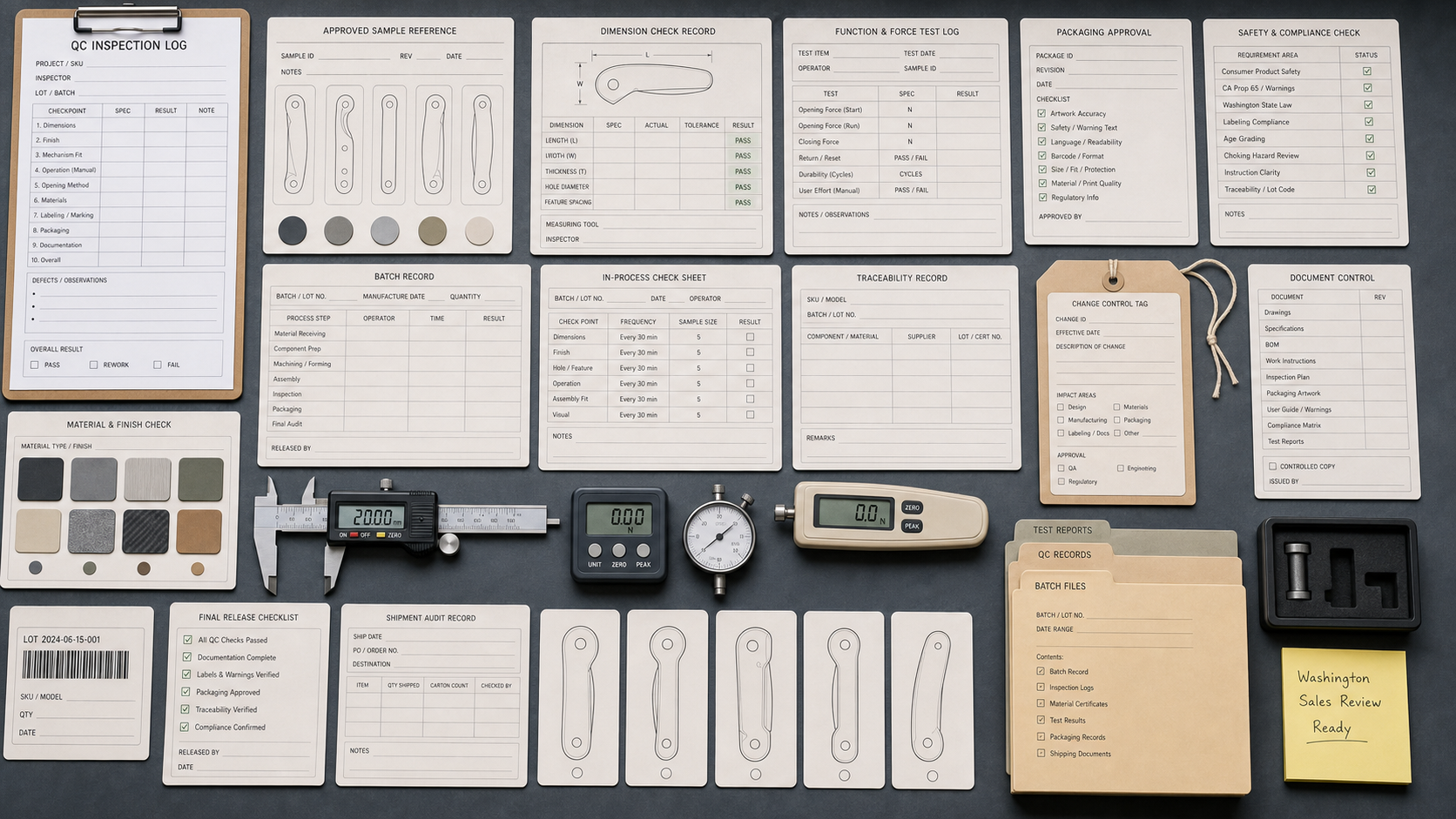
I connect QC with compliance, not only appearance
For a Washington-targeted SKU, QC should not only ask whether the knife looks good. It should ask whether the production units match the approved mechanism, blade length, lock structure, packaging, and listing records. A small component change can affect action. A packaging revision can change how the product is described. A supplier substitution can change performance or classification review. These are real B2B risks.
The ISO 9000 family is useful as a general quality-management reference because it emphasizes consistent products, customer expectations, process control, and continual improvement. I do not claim ISO language solves Washington law. I use the same process mindset: define the requirement, approve the sample, control the change, inspect the batch, and keep the record. This is especially important for private label buyers who may order repeat batches months later. If the factory can show what was approved and what changed, the buyer has a better foundation for legal, distributor, and customer-service review.
| QC record | What it should show | Why buyers need it |
|---|---|---|
| Golden sample | Approved structure and finish | Baseline for inspection |
| Mechanism check | Opening method matches approval | Helps control legal review risk |
| Packaging approval | Final label and warning version | Keeps copy consistent |
| Change log | Any component or copy revision | Protects repeat orders |
What Should a Washington Pocket Knife RFQ Include?
A weak RFQ asks only for price. A strong RFQ tells the supplier what must be reviewed before price means anything.
A Washington pocket knife RFQ should include target market, mechanism type, blade details, lock structure, packaging language, sales channel, compliance review needs, QC records, and required legal approval steps.
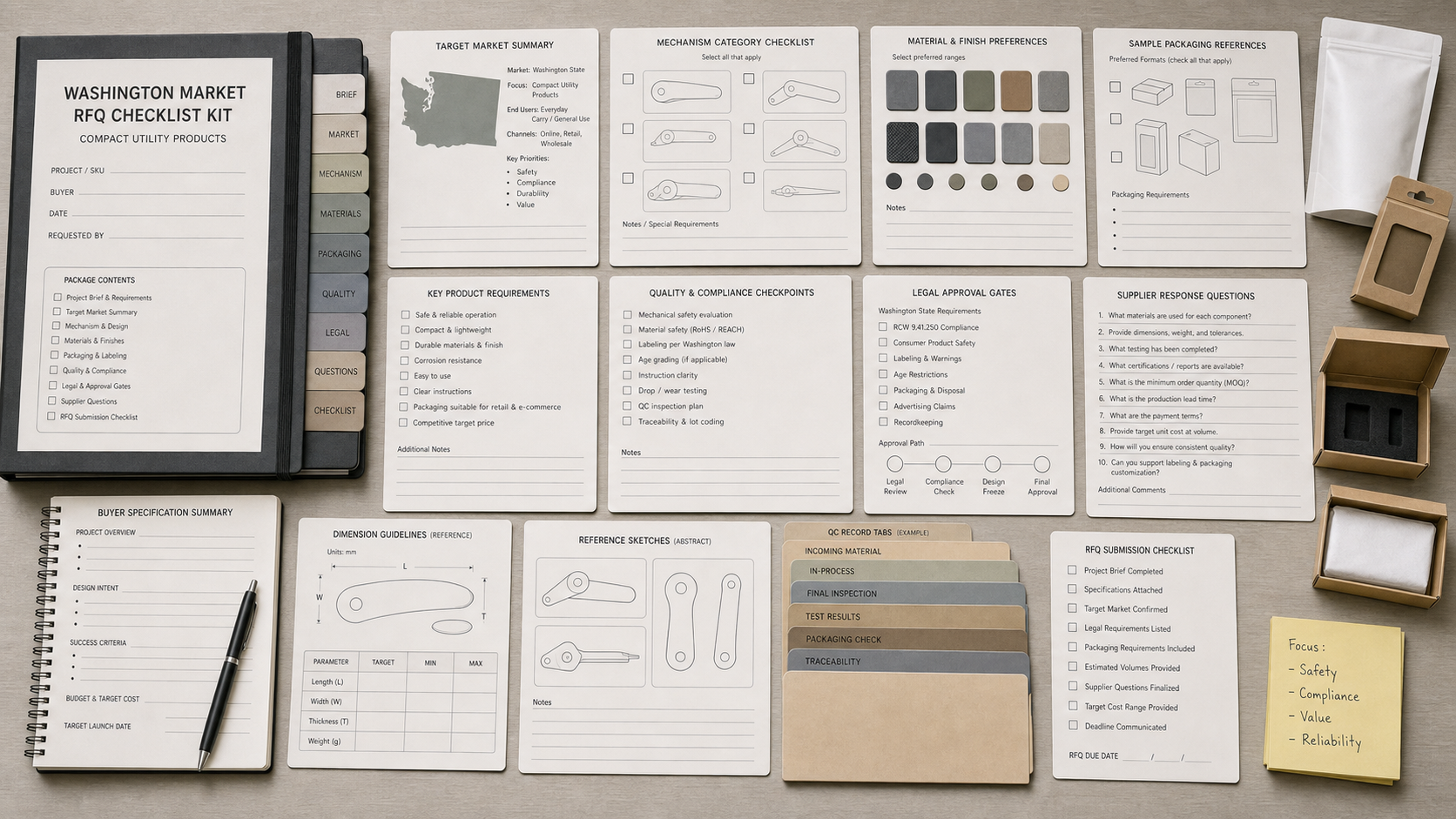
I make the RFQ specific enough to prevent wrong samples
For Washington-targeted pocket knife projects, I want the buyer's RFQ to say more than "make a folding knife." It should identify the target sales state, product category, opening method, lock structure, blade length, blade steel, handle material, packaging plan, listing language, and whether legal review is required before sampling. If the buyer already has counsel, the RFQ should include the approved design boundaries. If not, the RFQ should say that final production depends on legal review.
This also helps me as the manufacturer. I can suggest practical manual-opening designs, bias-toward-closure assisted designs for legal review, or alternative structures that better fit the buyer's channel. I can also prepare samples and QC documents in a way that supports the buyer's internal approval. Good RFQs reduce waste. They also make supplier comparison fair, because every factory is quoting the same risk-controlled product. For B2B buyers, this is how a legal topic becomes a workable product development process.
| RFQ item | What to include | Why it helps |
|---|---|---|
| Target market | Washington plus other states | Sets review scope |
| Mechanism | Manual, assisted, automatic, or gravity-related | Prevents wrong quoting |
| Legal step | Counsel review before mass production | Reduces launch risk |
| QC package | Sample approval and batch records | Supports repeat production |
Planning a private-label knife line for this market?
Use this article as a planning reference, then confirm local requirements with your importer or compliance advisor before OEM/ODM production.
Conclusion
For Washington-targeted pocket knives, I control the product, mechanism, copy, records, and review path before production, because compliance starts at the RFQ.
Source Notes
- This article is not legal advice and should not replace qualified legal review.
- Primary sources reviewed: Washington State Legislature RCW 9.41.250, RCW 9.41.251, RCW 9.41.270, U.S. Code 15 U.S.C. Chapter 29, TSA pocket knife guidance, and ISO 9000 family quality-management overview.
- Washington law and local rules can change, so buyers should verify the current official text before sale.