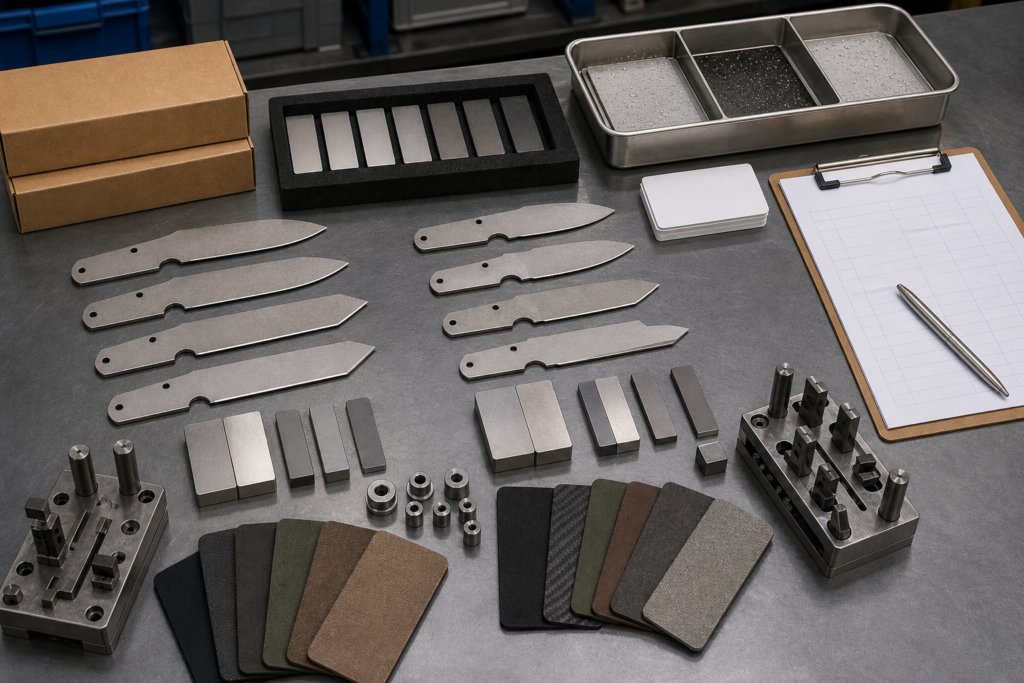
Steel names can sell a knife fast. But the wrong steel choice can raise cost, slow production, and create user complaints.
S90V is better when buyers want maximum wear resistance and long edge life in controlled use. MagnaCut is better when buyers want a broader balance of toughness, corrosion resistance, edge stability, and easier market acceptance for outdoor and EDC knives.
Quick buyer brief:
- Answer: Choose S90V for wear resistance and MagnaCut for balanced outdoor performance.
- Buyer context: This helps knife brands, importers, wholesalers, distributors, and private label buyers plan premium OEM knife projects.
- Key checks: Steel availability, heat treatment target, blade geometry, grinding difficulty, corrosion expectation, target retail price, warranty risk, and QC plan.
Planning a knife project with this steel?
Send us your target market, MOQ, price range, and blade type. Vast State can help you choose the right steel, HRC range, finish, handle material, and QC requirements for OEM/ODM production.
When I discuss S90V and MagnaCut with B2B buyers, I start with the knife's real job. A steel chart is useful, but it is not the product. A thin EDC folder, a fishing knife, a premium outdoor fixed blade, and a collector-focused folding knife all need different risk control. The steel must match the buyer's market, price range, user care habits, sharpening tolerance, and production schedule. For Vast State, the better choice is not always the more famous steel. The better choice is the steel that supports the product promise and can be produced consistently.
What Is the Short Answer for S90V vs. MagnaCut?
Many buyers ask for the "best" steel. That question sounds simple, but it usually hides different market goals.
S90V is the stronger choice for high wear resistance and long edge life. MagnaCut is the stronger choice for balanced toughness, corrosion resistance, thin-edge stability, and broader outdoor or EDC positioning.
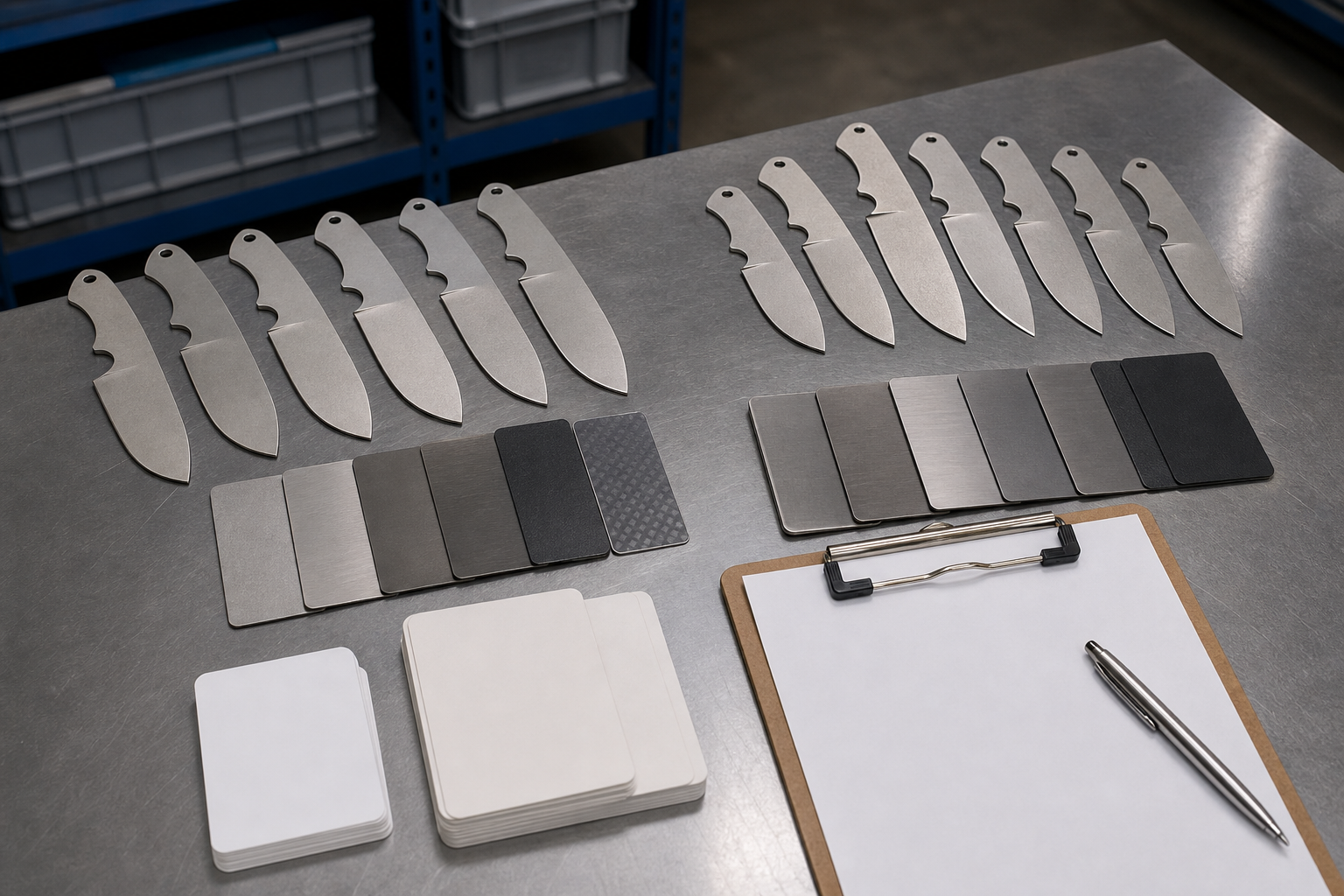
I Match the Steel to the Promise
S90V and MagnaCut are both premium powder metallurgy stainless knife steels. They are not budget materials, and they should not be chosen only because the name looks strong in a product title. I use S90V when the product story is built around long edge holding, dry cutting, cardboard, rope, light industrial work, or a premium collector audience that accepts harder sharpening. I use MagnaCut when the product needs a more balanced promise: outdoor use, wet conditions, thinner edges, better toughness, and less worry about corrosion complaints.
Niagara Specialty Metals says its CPM cutlery alloys have different mixes of toughness, wear, and corrosion resistance, and it identifies S90V as the highest wear-resistance option and MagnaCut as the highest corrosion-resistance option in that cutlery group. That is a useful buyer summary, but I still need to connect it to the final knife. A very thick MagnaCut blade can still cut poorly. A very thin S90V blade with the wrong heat treatment can still chip. Steel selection is only one part of product design.
For OEM buyers, I usually define the product promise first. Then I check whether the steel supports that promise without creating too much production risk.
| Buyer goal | Better starting point | Why I choose it |
|---|---|---|
| Long edge life in dry cutting | S90V | It has very high vanadium carbide content and wear resistance |
| Outdoor and humid use | MagnaCut | It offers stronger corrosion resistance and toughness balance |
| Thin slicer geometry | MagnaCut | It supports thinner edges with lower chipping risk |
| Collector or steel-enthusiast product | S90V or MagnaCut | The choice depends on the marketing story and heat treatment proof |
Quote-ready RFQ Checklist for This Steel
To get an accurate OEM/ODM quote, prepare these details before contacting a knife manufacturer.
| RFQ Field | What to Prepare |
|---|---|
| Product type | Folding knife / fixed blade / multi-tool / kitchen knife |
| Target market | US / EU / outdoor retail / promotional / tactical / EDC |
| Steel option | 4116 / 14C28N / D2 / N690 / Nitro-V |
| Target HRC | Example: 55-57 HRC, 58-60 HRC |
| Blade finish | Satin / stonewash / black coating / bead blast |
| Handle material | G10 / micarta / aluminum / stainless steel / wood |
| Lock or structure | Liner lock / frame lock / slip joint / full tang |
| Estimated quantity | 500 / 1,000 / 3,000 / 5,000+ pcs |
| Packaging | White box / color box / blister / pouch / gift box |
| Required documents | Drawing / sample photo / logo file / packaging artwork |
How Do Composition and Carbides Change Knife Performance?
Steel composition can look like chemistry trivia. But carbide type and volume strongly affect grinding, edge holding, toughness, and corrosion.
S90V uses high carbon, high chromium, and high vanadium for extreme wear resistance. MagnaCut uses lower chromium carbide formation, vanadium, niobium, molybdenum, and nitrogen to balance toughness, corrosion resistance, and edge performance.
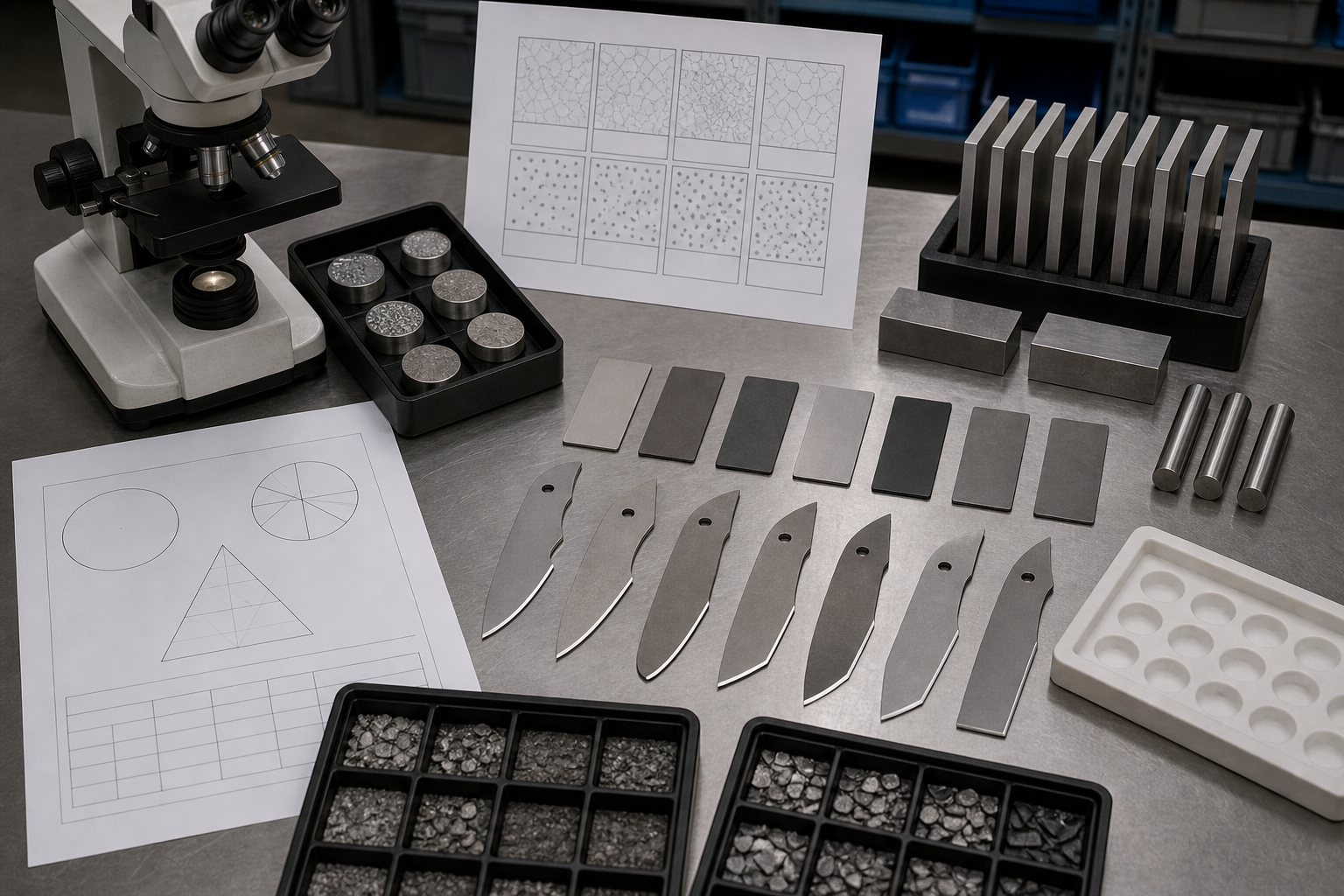
I Look at Carbides Before I Look at Hype
The Niagara S90V data sheet lists CPM S90V with 2.30 carbon, 14.00 chromium, 1.00 molybdenum, and 9.00 vanadium. That explains why S90V is known for wear resistance. Vanadium carbides are very hard, and a high volume of them helps the edge resist abrasive wear. The same feature can make grinding slower and sharpening harder for end users. This is why I do not recommend S90V for every daily-carry project. It can be excellent, but it asks more from the factory and from the user.
MagnaCut follows a different design idea. The Niagara MagnaCut data sheet lists CPM MagnaCut with 1.15 carbon, 10.70 chromium, 4.00 vanadium, 2.00 molybdenum, 2.00 niobium, and 0.20 nitrogen. The MagnaCut data sheet also says its design avoids chromium carbide in the heat-treated microstructure. That matters because chromium tied up in carbides does not help corrosion resistance in the same way. MagnaCut uses small vanadium and niobium carbides to keep wear resistance useful while protecting toughness and corrosion behavior.
For a buyer, the lesson is practical. S90V is more specialized. MagnaCut is more forgiving across mixed-use knives. I still need the right heat treatment, but the design direction is different.
| Steel factor | S90V direction | MagnaCut direction |
|---|---|---|
| Main carbide story | High vanadium carbide volume | Smaller vanadium and niobium carbides |
| Production impact | Slower grinding and harder finishing | More balanced machining and grinding behavior |
| User impact | Long wear life but harder sharpening | Balanced edge, toughness, and corrosion resistance |
| Best product fit | Premium edge-retention models | Outdoor, EDC, and broad premium models |
Which Steel Holds an Edge Longer in Real Use?
Edge retention is attractive in marketing. But a high wear number does not automatically mean the best user experience.
S90V generally has higher abrasive edge retention than MagnaCut. MagnaCut has lower wear resistance than S90V, but it can keep a working edge well when geometry, toughness, corrosion resistance, and heat treatment are controlled.
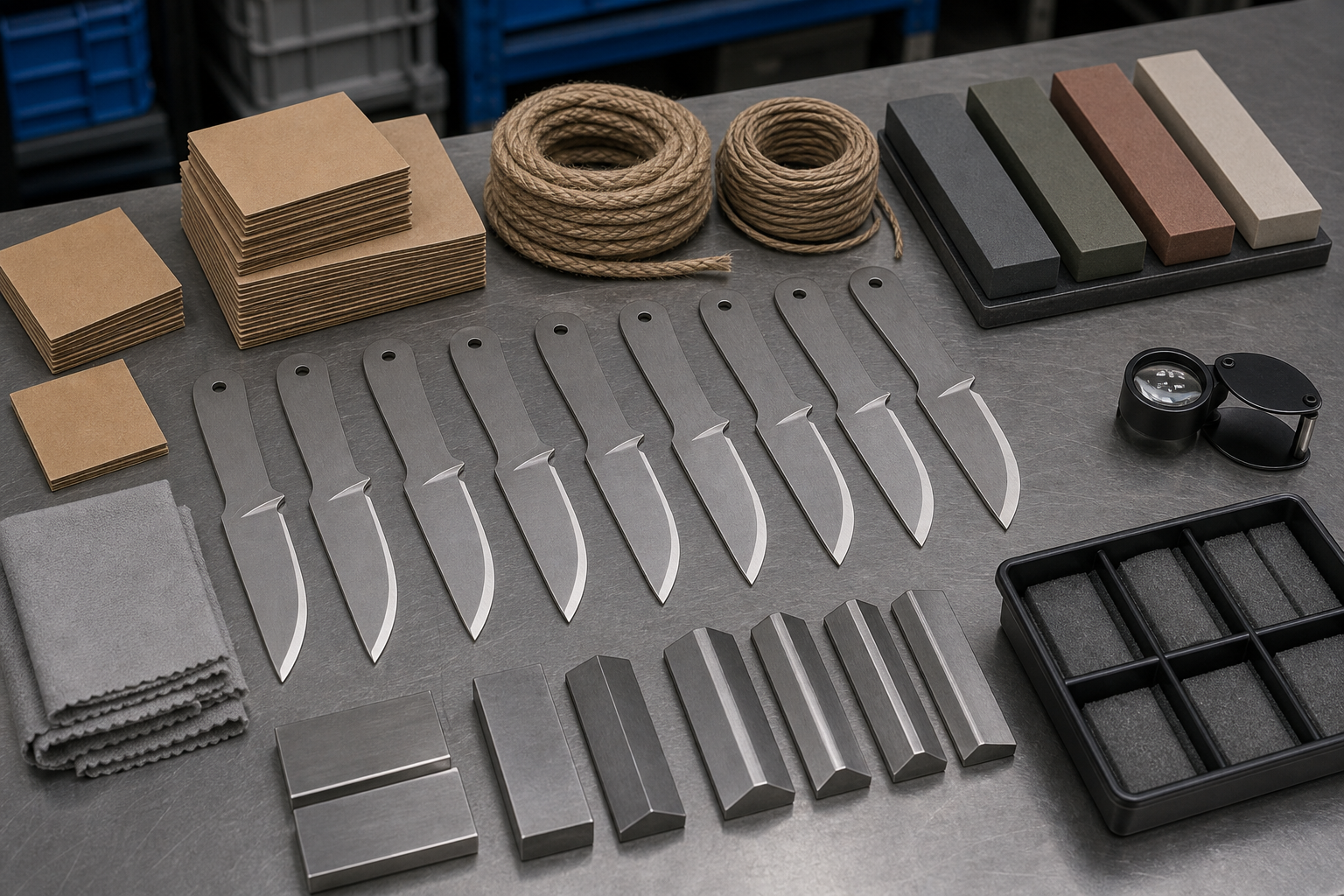
I Separate Wear Resistance From Total Edge Life
The MagnaCut data sheet includes CATRA results relative to 440C ESR. It lists MagnaCut at 135 percent and S90V at 195 percent in that comparison. This supports a clear point: if the buyer cares mainly about abrasive wear, S90V has the advantage. That can help a premium folder aimed at users who cut cardboard, rope, synthetic materials, or other abrasive media.
But I avoid writing product copy that says "S90V is always better." Edge life can fail in several ways. A knife can dull from wear, micro-chipping, rolling, corrosion at the edge, or poor sharpening. Knife Steel Nerds explains this broader idea when discussing MagnaCut, noting that edge retention is more than wear resistance. I agree with that from production experience. A steel with strong wear resistance still needs the right edge angle, blade thickness, sharpening finish, and hardness target.
For many daily users, MagnaCut can feel more balanced. It may not beat S90V in pure abrasion tests, but it can support thinner practical geometry and better corrosion resistance. That helps when the buyer wants fewer complaints from outdoor users, fishing users, humid markets, or general EDC buyers.
| Edge question | S90V answer | MagnaCut answer |
|---|---|---|
| Pure abrasive wear | Stronger advantage | Good, but not as high as S90V |
| Sharpening ease | More difficult | Usually more manageable |
| Thin-edge confidence | Needs careful geometry | Better toughness support |
| Marketing message | Long edge holding | Balanced performance |
Which Steel Handles Toughness and Corrosion Better?
A knife with long edge life can still disappoint if it chips or stains. Premium users notice both problems quickly.
MagnaCut is usually the better choice for toughness and corrosion resistance. S90V gives strong wear resistance and useful stainless behavior, but MagnaCut is more balanced for wet, outdoor, and thin-edge applications.
I Treat Chipping and Corrosion as Warranty Risks
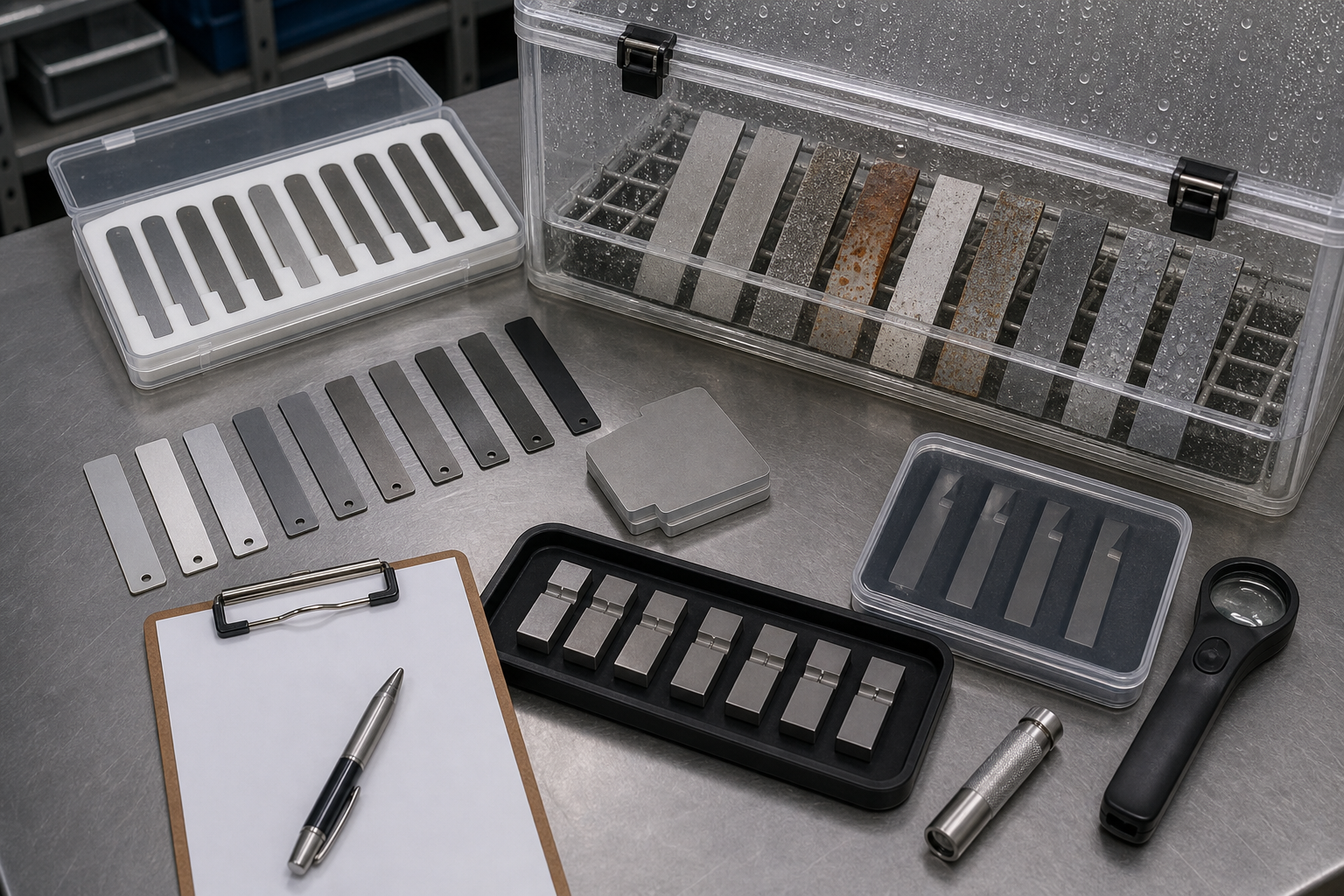
The MagnaCut data sheet lists Charpy toughness values that show a strong difference. It lists MagnaCut at 38 ft-lbs at 62.5 HRC and S90V at 17 ft-lbs at 61 HRC in the same comparison table. I do not use those numbers as a complete prediction for every knife, because blade shape and heat treatment still matter. But they do show why MagnaCut is often easier to recommend for larger blades, thinner edges, outdoor fixed blades, and hard-use EDC projects.
Corrosion also matters more than many buyers expect. S90V is a stainless tool steel and has useful corrosion resistance. Niagara states S90V has corrosion resistance equal to or better than 440C ESR. But MagnaCut was designed to improve the hardness-corrosion balance by avoiding chromium carbides in the heat-treated microstructure. That gives it a cleaner story for fishing knives, camping knives, coastal markets, and general outdoor products.
From a B2B view, corrosion resistance is not only a technical claim. It affects product reviews, return risk, care instructions, packaging copy, and customer support. If the knife will be sold to casual users who may not clean and oil the blade carefully, MagnaCut often gives the brand more room for real-world use.
| Risk area | S90V concern | MagnaCut advantage |
|---|---|---|
| Edge chipping | Higher risk if geometry is too thin | Better toughness support |
| Wet use | Good stainless behavior, but not the safest story | Stronger corrosion positioning |
| Casual user care | Needs clearer maintenance guidance | More forgiving in humid use |
| Warranty language | Avoid overpromising toughness | Easier to position as balanced |
What Heat Treatment and Manufacturing Checks Matter Most?
Premium steel does not save a poor process. A weak heat treatment or rushed grinding plan can ruin the product.
Buyers should define hardness targets, heat treatment route, cryo or cold treatment need, grinding method, edge geometry, hardness testing, blade flatness, and final inspection before choosing S90V or MagnaCut.
I Ask for the Process Before I Approve the Steel
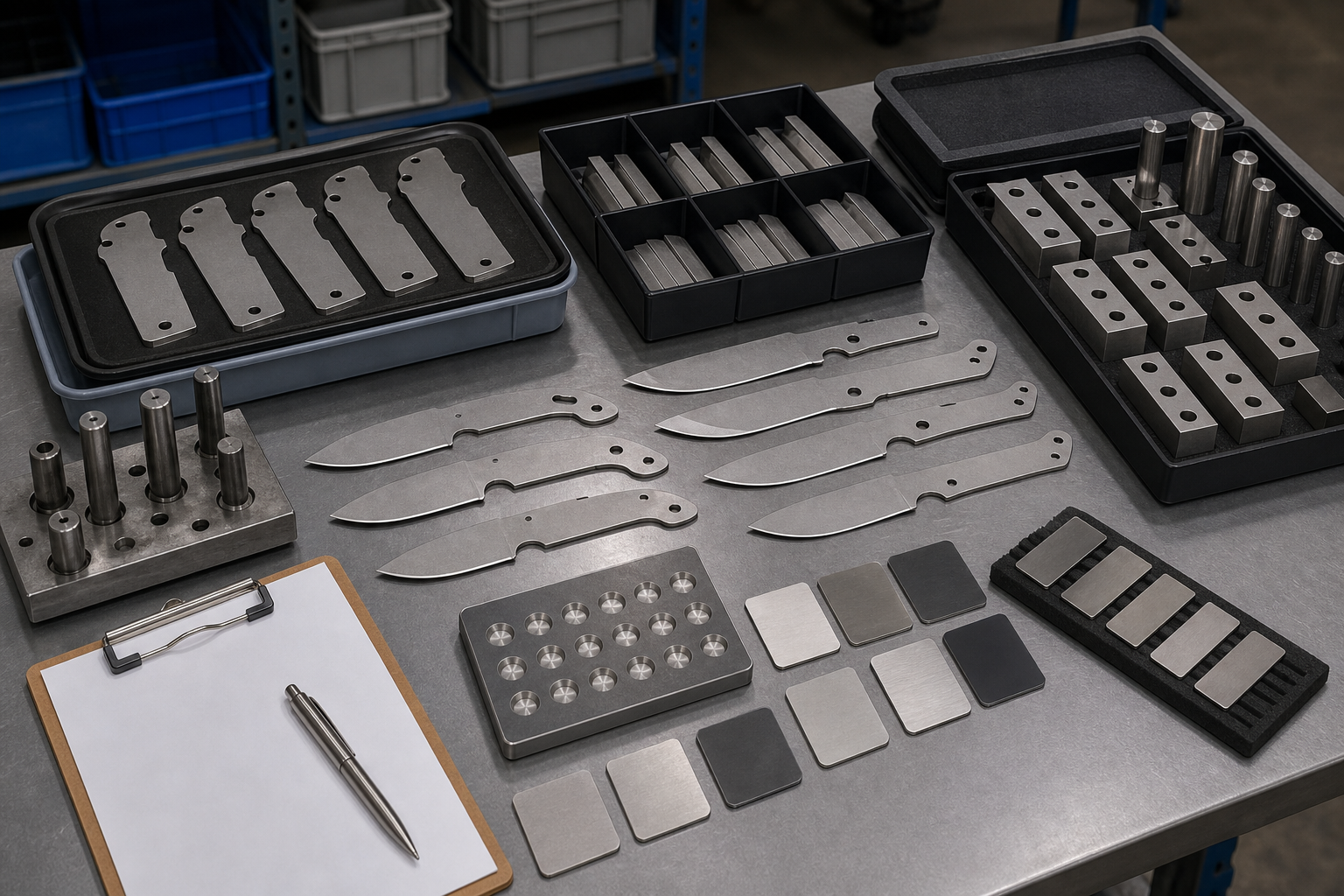
S90V and MagnaCut both need disciplined processing. The S90V data sheet lists an aim hardness of HRC 56/59 and notes that tempering above 800 F may reduce corrosion resistance, while tempering between about 800 F and 1000 F is not recommended because of embrittlement risk in martensitic stainless steels. It also says S90V's high vanadium carbide content makes machining and grinding more difficult than D2 or 440C ESR. That matters to cost and lead time.
The MagnaCut data sheet lists an aim hardness of 60-63 HRC and a recommended heat treatment with a 2050 F austenitize, quench, double temper at 350 F, and possible freeze treatment. It also notes that results can vary with hardening method and section size. This is why I never treat a steel name as enough proof. I want the buyer and factory to agree on the hardness range, test method, acceptable variation, edge thickness before sharpening, bevel finish, and inspection standard.
NIST's Rockwell hardness guide is useful because it reminds buyers that hardness testing has sources of variability and that good practice helps reduce measurement errors. In real production, I want test coupons or sample blades, recorded hardness points, blade centering checks for folders, flatness checks, and cutting-edge inspection. ISO 9001 is also relevant because it focuses on planned processes, customer requirements, performance evaluation, and improvement. That mindset fits premium steel projects well.
| Manufacturing check | Why it matters | Buyer action |
|---|---|---|
| Hardness target | Controls edge stability and toughness | Put HRC range in the RFQ |
| Heat treatment route | Changes corrosion, hardness, and retained austenite | Ask for process notes or sample validation |
| Grinding plan | S90V especially can increase grinding time | Confirm wheel, belt, and finish expectations |
| Final QC | Prevents premium steel from hiding basic defects | Inspect hardness, edge, finish, flatness, and assembly |
How Should OEM Buyers Build the RFQ Around S90V or MagnaCut?
A steel request without product context leads to vague quotes. That creates confusion before sampling even starts.
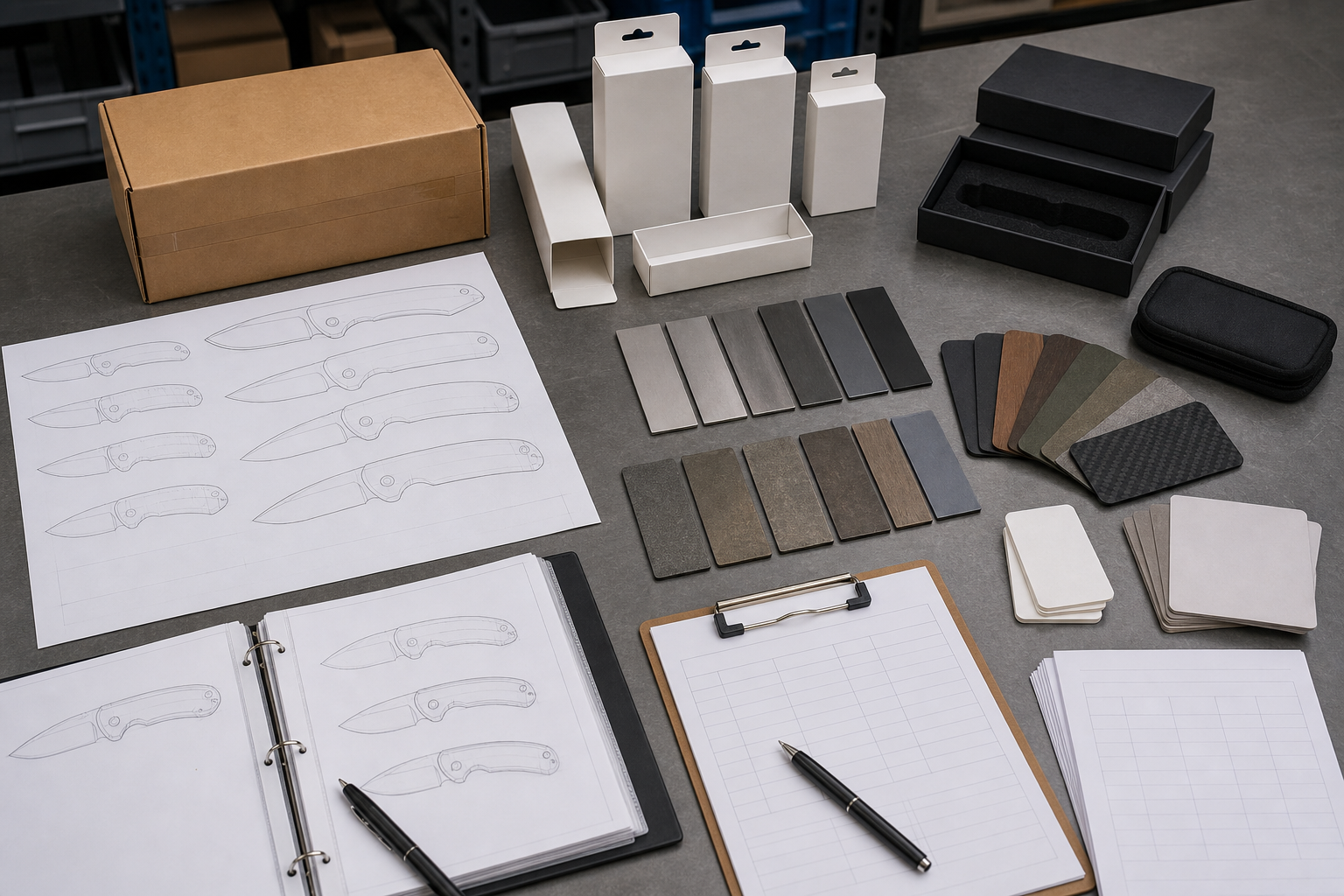
An RFQ should state knife type, target user, steel preference, backup steel, hardness target, blade geometry, finish, MOQ, target price, packaging, inspection standard, market, delivery term, and sample schedule.
I Turn the Steel Choice Into a Production Brief
For Vast State projects, I ask buyers to describe the product before asking for the steel quote. Is it a premium EDC folder, outdoor fixed blade, hunting knife, rescue tool, or collector-style limited run? What is the target retail range? What does the user cut? Will the market care more about long edge life, salt resistance, toughness, or easy sharpening? These questions change whether S90V or MagnaCut makes sense.
I also ask for a backup plan. Premium powder steel availability can shift. Erasteel announced in 2025 that it acquired part of the assets of Crucible Industries, including powder metallurgy-related assets. Niagara also states that it works with Erasteel and Carpenter Technology to keep CPM steel chemistry, performance, and quality alive. I do not read that as a reason to panic. I read it as a reason to verify supply, lead time, distributor path, and documentation before promising launch dates to a buyer's market.
The RFQ should also define delivery terms. Trade.gov explains that Incoterms clarify tasks, costs, and risks between buyers and sellers in export transactions. For a knife project, I want FOB, EXW, CIF, or DDP expectations discussed early. Steel cost is only one part of the landed product cost. Packaging, inspection, logistics, and compliance review also matter.
| RFQ field | What to include | Why it helps |
|---|---|---|
| Product use | EDC, outdoor, fishing, collector, work | Guides steel and geometry choice |
| Steel plan | S90V, MagnaCut, and backup option | Reduces sourcing risk |
| Technical target | HRC, blade thickness, edge angle, finish | Makes samples measurable |
| Commercial target | MOQ, target price, Incoterm, schedule | Makes quotation realistic |
Ready to use this material in your next knife line?
Vast State can help you compare blade steels, heat treatment ranges, handle materials, finishes, packaging options, and QC requirements based on your target market and quantity.
Conclusion
I choose S90V for maximum wear resistance and MagnaCut for balanced premium performance, then I verify heat treatment, geometry, supply, and QC.
Source Notes
- Niagara S90V data sheet supports S90V composition, wear resistance, heat treatment, corrosion notes, and grindability concerns.
- Niagara MagnaCut data sheet supports MagnaCut composition, toughness, CATRA comparison, corrosion design, and heat treatment guidance.
- Knife Steel Nerds on MagnaCut supports the broader explanation that edge retention is more than wear resistance.
- Erasteel's Crucible asset announcement supports the 2025 supply-chain context for CPM-related assets.
- NIST Rockwell hardness guidance supports the need for controlled hardness measurement.
- ISO 9001 and Trade.gov Incoterms support process-control and RFQ/logistics clarity.