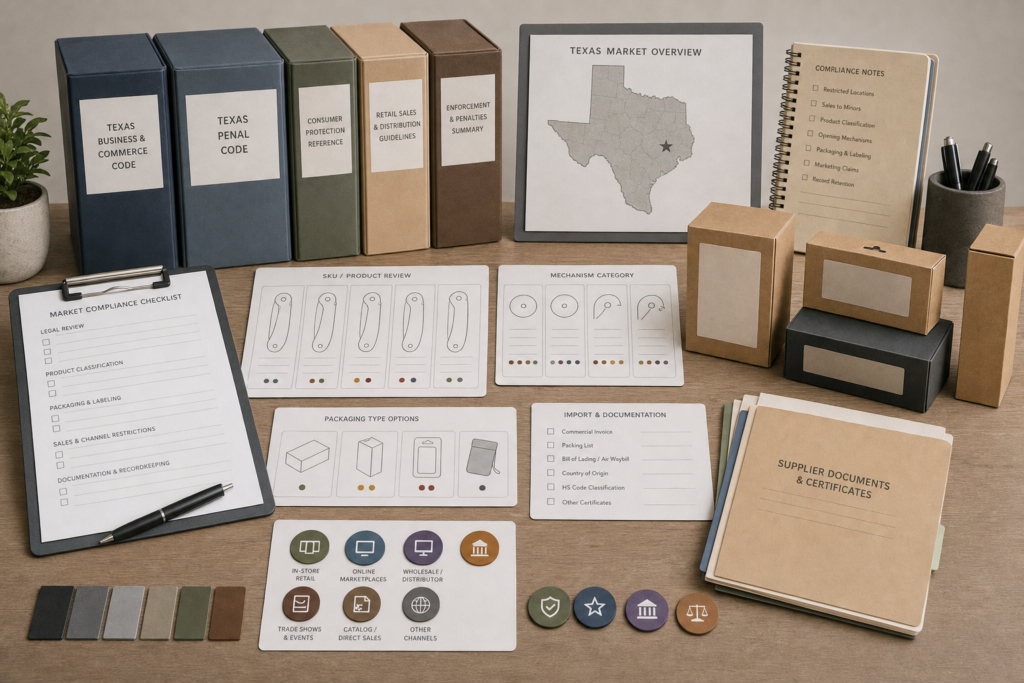
Texas knife demand can look simple. But one wrong SKU description, blade length, or retail channel can create avoidable sales risk.
B2B buyers should check Texas knife definitions, blade length, age-related sales rules, restricted places, federal switchblade language, import documents, and product copy before selling gravity or pocket knives in Texas. This article is sourcing guidance, not legal advice.
Quick buyer brief:
- Answer: Classify the knife first, then check Texas and federal rules.
- Buyer context: Useful for brands, importers, wholesalers, distributors, and private label buyers.
- Key checks: Blade length, opening structure, buyer age policy, channel limits, labeling, and import files.
Planning a private-label knife line for this market?
Use this article as an early planning reference, then prepare your target market, product category, labeling needs, and buyer-specified compliance requirements before production.
When I review a Texas-focused knife project, I do not start with the marketing name. I start with the physical product. Is it a pocket knife, a long blade folder, a rescue tool, a utility SKU, an automatic design, or a gravity-related mechanism? The answer affects product positioning, packaging, sales policy, and RFQ details. As reviewed on May 23, 2026, I treat Texas as a market where the buyer should check state definitions, federal switchblade wording, import documentation, and retail controls before placing an OEM/ODM order.
Which Texas Law Sources Should Buyers Review First?
Legal shortcuts feel fast. They can also lead buyers to outdated terms, weak product copy, and poor distributor guidance.
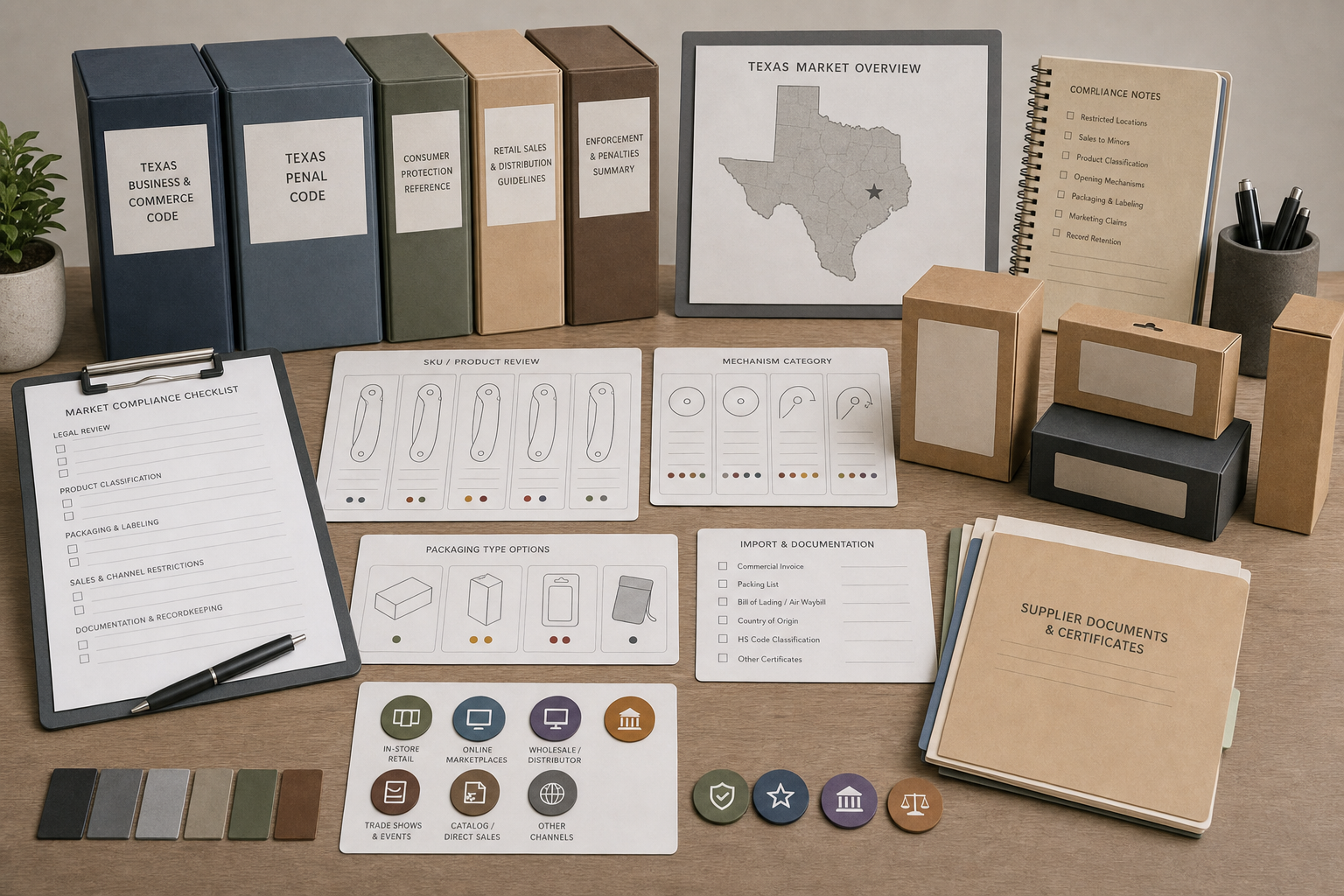
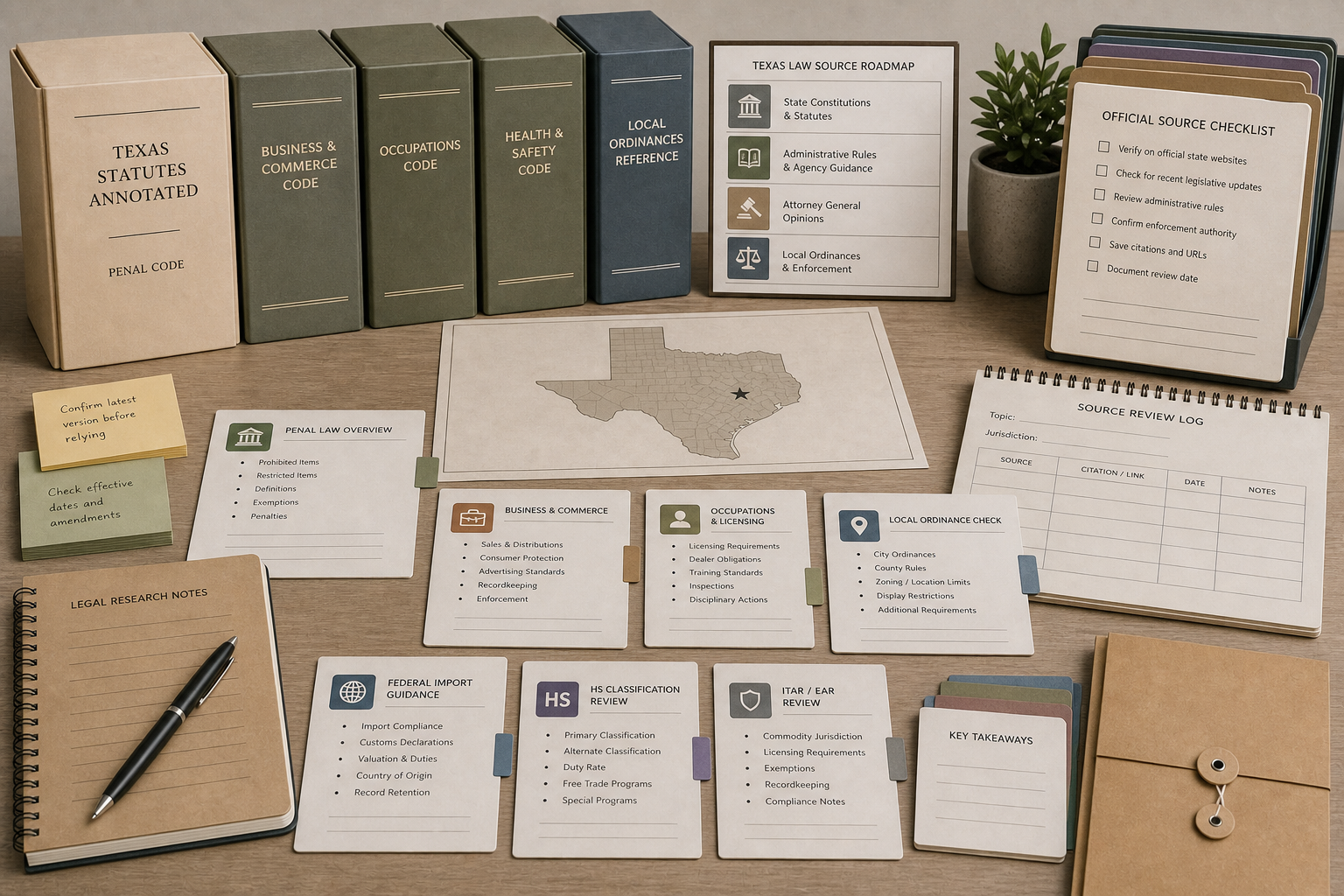
Buyers should review Texas Penal Code Chapter 46, Texas Local Government Code Section 229.001, federal switchblade law, CBP import guidance, and HS classification resources before selling knife SKUs in Texas.
I Build the Article Around Primary Sources
For a legal compliance topic, I do not rely on product listings or forum summaries. I first check the official legal sources that affect how a buyer should classify and sell the product. The main state source is Texas Penal Code Chapter 46, which includes weapon definitions, location-restricted knife language, certain sales restrictions, and restricted-place rules. I also check Texas Local Government Code Section 229.001, because it addresses municipal regulation of knives and commerce in knives.
For gravity or automatic-style mechanisms, I also check federal language. The Federal Switchblade Act in 15 U.S.C. 1241-1245 defines switchblade knives in a way that includes automatic opening by button and opening by inertia or gravity. That matters for interstate commerce, import planning, and channel review. For importers, I add CBP importer guidance and Trade.gov HS code guidance to the review list. These sources do not replace legal counsel, but they give the buyer a better document checklist before RFQ.
| Source area | What I check | Why it matters for buyers |
|---|---|---|
| Texas Penal Code Chapter 46 | Knife definitions, places, transfer rules | It frames state-level product risk |
| Texas Local Government Code 229.001 | Municipal knife regulation boundary | It helps buyers discuss local rule concerns |
| 15 U.S.C. 1241-1245 | Federal switchblade definition and commerce limits | It affects gravity and automatic-style designs |
| CBP and HS resources | Import entry and classification basics | It supports customs and product documentation |
Private-label Planning Checklist
Before starting production, prepare the market and product details your importer or compliance advisor needs to review.
| RFQ Field | What to Prepare |
|---|---|
| Target market | Country, state, region, or sales channel |
| Product category | Folding knife / fixed blade / multi-tool / outdoor tool |
| Intended use | EDC / camping / kitchen / hunting / rescue / promotional |
| Buyer requirements | Testing, labeling, documentation, or packaging rules |
| Blade and lock details | Blade length, opening method, lock type, edge style |
| Packaging text | Warnings, claims, care notes, language requirements |
| Documents | Drawing, sample photo, logo file, packaging artwork |
| Review owner | Importer, legal advisor, testing lab, or internal compliance team |
How Should Buyers Classify a Gravity Knife or Pocket Knife SKU?
A name can be misleading. A product called a pocket knife may still raise questions if the action or blade length changes.
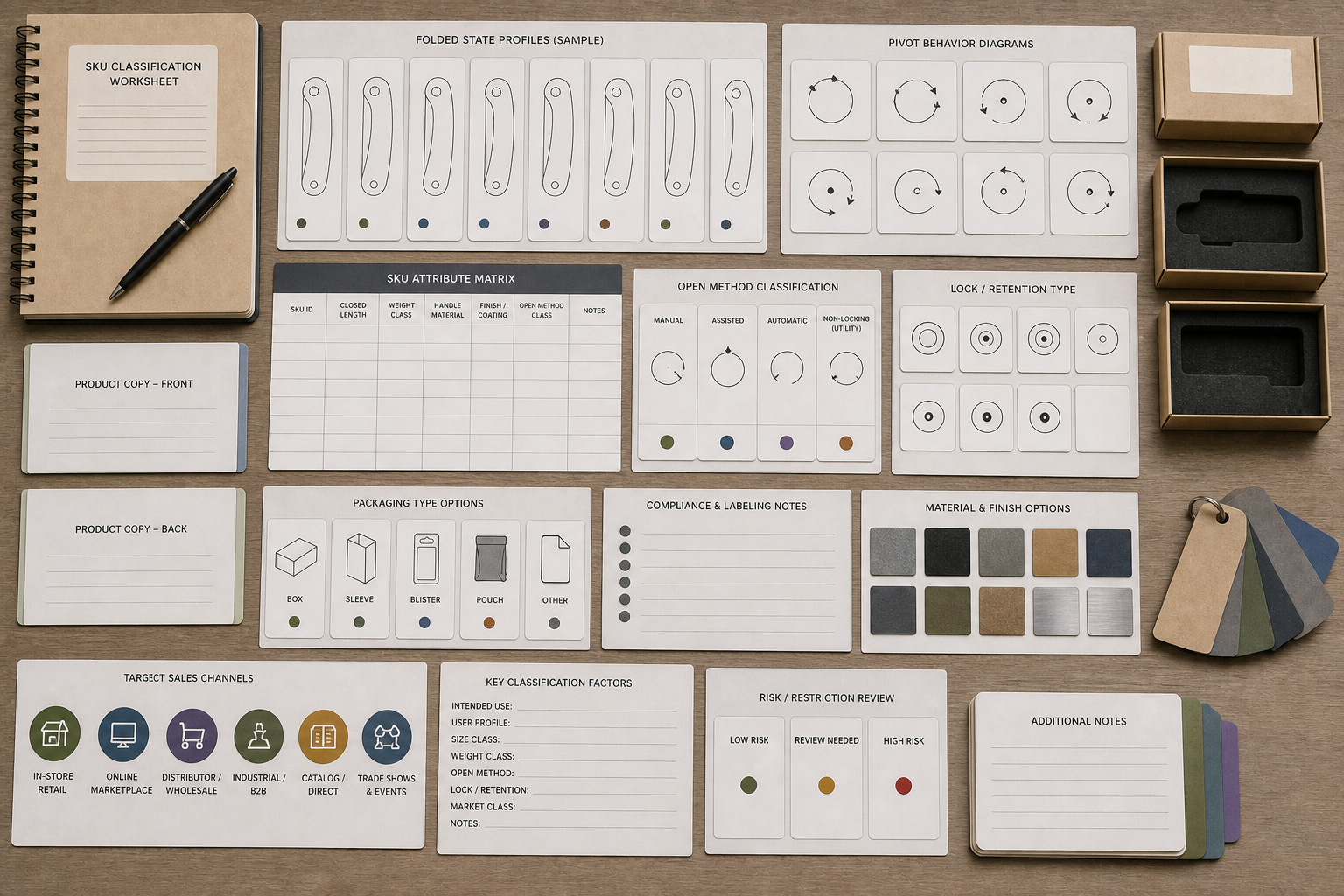
Buyers should classify each SKU by physical features: blade length, opening method, locking system, intended use, packaging copy, and target sales channel, not by the marketing title alone.
I Separate Product Reality From Marketing Language
In OEM/ODM work, I often see buyers use broad terms such as EDC knife, pocket knife, gravity knife, automatic knife, rescue knife, or outdoor folder. Those words help a sales team talk about a product, but they are not enough for compliance review. I need a physical feature list. I check blade length from the correct measuring point, blade style, lock type, pivot system, detent strength, opening method, closing control, handle shape, clip position, and package claim. I also ask whether the SKU will be sold online, through distributors, in stores, or through promotional channels.
This matters because Texas and federal law do not always use the same practical language that buyers use in catalogs. A gravity-related mechanism may require review under federal switchblade language even when a buyer is focused on Texas. A longer blade may move a SKU into location-restricted knife review under Texas law. A product sold as a rescue tool may still need the same blade-length and sales-channel check. My advice is simple: classify the SKU before building the packaging and before sending the PO.
| Classification item | Buyer question | RFQ detail to provide |
|---|---|---|
| Blade length | Is the blade over the Texas location-restricted threshold? | Exact blade length and measuring method |
| Opening method | Manual, assisted, automatic, or gravity-related? | Mechanism description and prototype video for legal review |
| Lock system | Liner lock, frame lock, button lock, back lock, or other? | Lock type and safety test expectation |
| Sales channel | Online, retail, distributor, or restricted program? | Channel policy and age-check process |
What Is a Location-Restricted Knife Under Texas Law?
Blade length can look like a small spec. In Texas, that small spec changes how buyers should review the product.
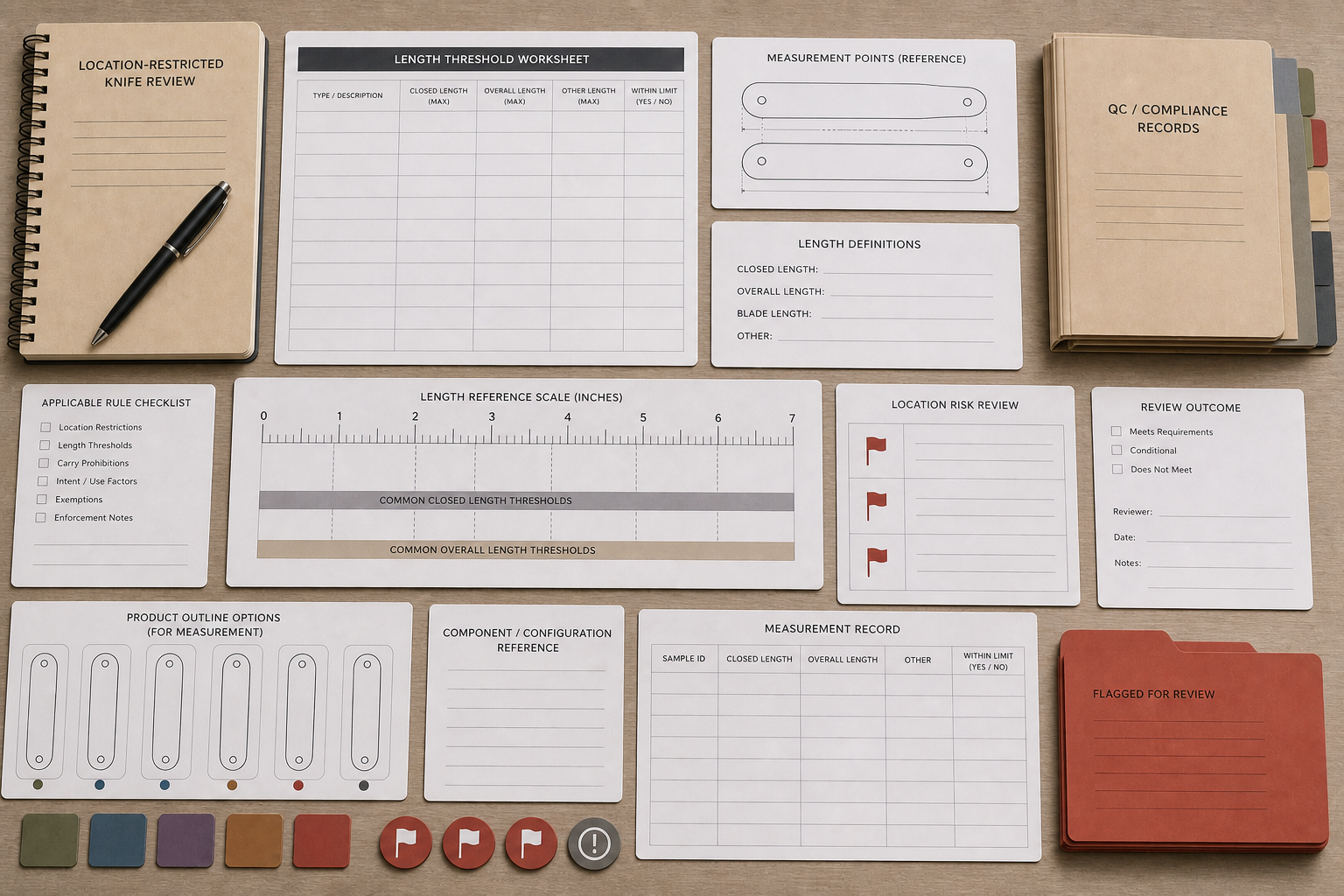
Texas Penal Code Chapter 46 defines a location-restricted knife as a knife with a blade over five and one-half inches. Buyers should flag these SKUs before packaging, retail, or distributor launch.
I Treat Blade Length as a Control Point
The Texas definition creates a practical sourcing lesson. Before I quote a Texas-facing knife, I want the buyer to confirm whether the blade is over five and one-half inches. If yes, I mark the SKU for extra review. I do not treat that as a product failure. Many outdoor and utility buyers may still want longer blades. But I treat it as a different sales and documentation situation.
For manufacturing, the key is consistency. The approved sample cannot be just under a threshold while mass production drifts above it because of grinding variation, blade profile change, or drawing revision. I ask for a controlled drawing, blade length tolerance, inspection point, and packaging name that does not overstate legal suitability. I also suggest that buyers keep product pages factual. A phrase like "long blade outdoor folding knife" is safer than exaggerated claims that push the product into the wrong market perception. If the buyer is unsure, the final legal decision should come from counsel or the distributor's compliance team.
| Blade-length task | Manufacturing control | Buyer-side use |
|---|---|---|
| Confirm threshold status | Measure sample and production pieces | Decide whether extra review is needed |
| Set drawing tolerance | Control blade profile and grinding | Avoid spec drift across batches |
| Record inspection result | Keep QC measurement records | Support distributor questions |
| Adjust product copy | Use factual product language | Reduce avoidable sales confusion |
What Should Buyers Know About Sales to Minors?
A product can be lawful for one buyer but unsuitable for another sales process. Age controls are part of channel design.
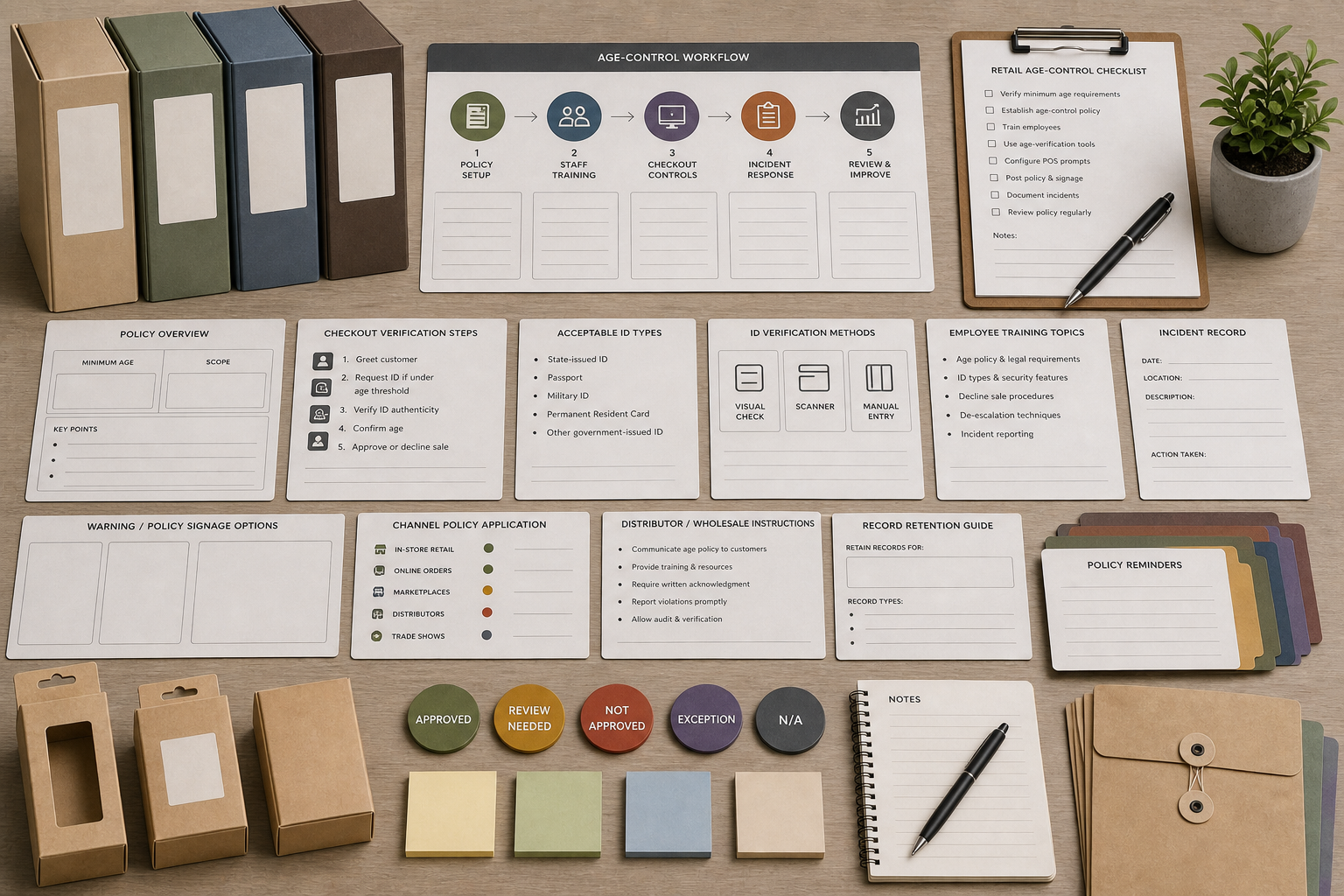
Buyers should review Texas rules on transfer of location-restricted knives to people under 18 and build age-check, distributor, and retail instructions into the sales plan.
I Ask About the Buyer Before I Ask About the Box
Texas Penal Code Chapter 46 includes transfer language for location-restricted knives and children under 18. For B2B buyers, the lesson is not to turn a factory into a legal advisor. The lesson is to design a practical sales policy before the goods arrive. If a knife is over the Texas location-restricted threshold, the buyer should decide how online stores, distributors, and retail partners will check age and communicate sales limits.
This is especially important for private label projects. Packaging may travel from a factory in Yangjiang to a U.S. importer, then to a distributor, then to a retailer. If the carton, product page, and retail data do not identify the SKU clearly, downstream teams may miss the policy. I recommend adding an internal compliance note to the SKU master file. The final consumer-facing wording should be reviewed by the buyer's legal team, but the manufacturing file can still help. It can include blade length, opening mechanism, lock type, intended market, and packaging version.
| Sales control | What the buyer should decide | Why it helps |
|---|---|---|
| Age policy | Whether the SKU needs age verification | It reduces channel confusion |
| SKU flag | Internal label for longer blade products | It helps distributors sort products |
| Product data | Blade length and mechanism fields | It supports marketplace review |
| Packaging review | Factual claim and caution wording | It avoids broad unsupported promises |
Which Places and Sales Channels Create Extra Review Needs?
Some buyers focus only on product legality. But the same knife may face different rules in certain places or channels.
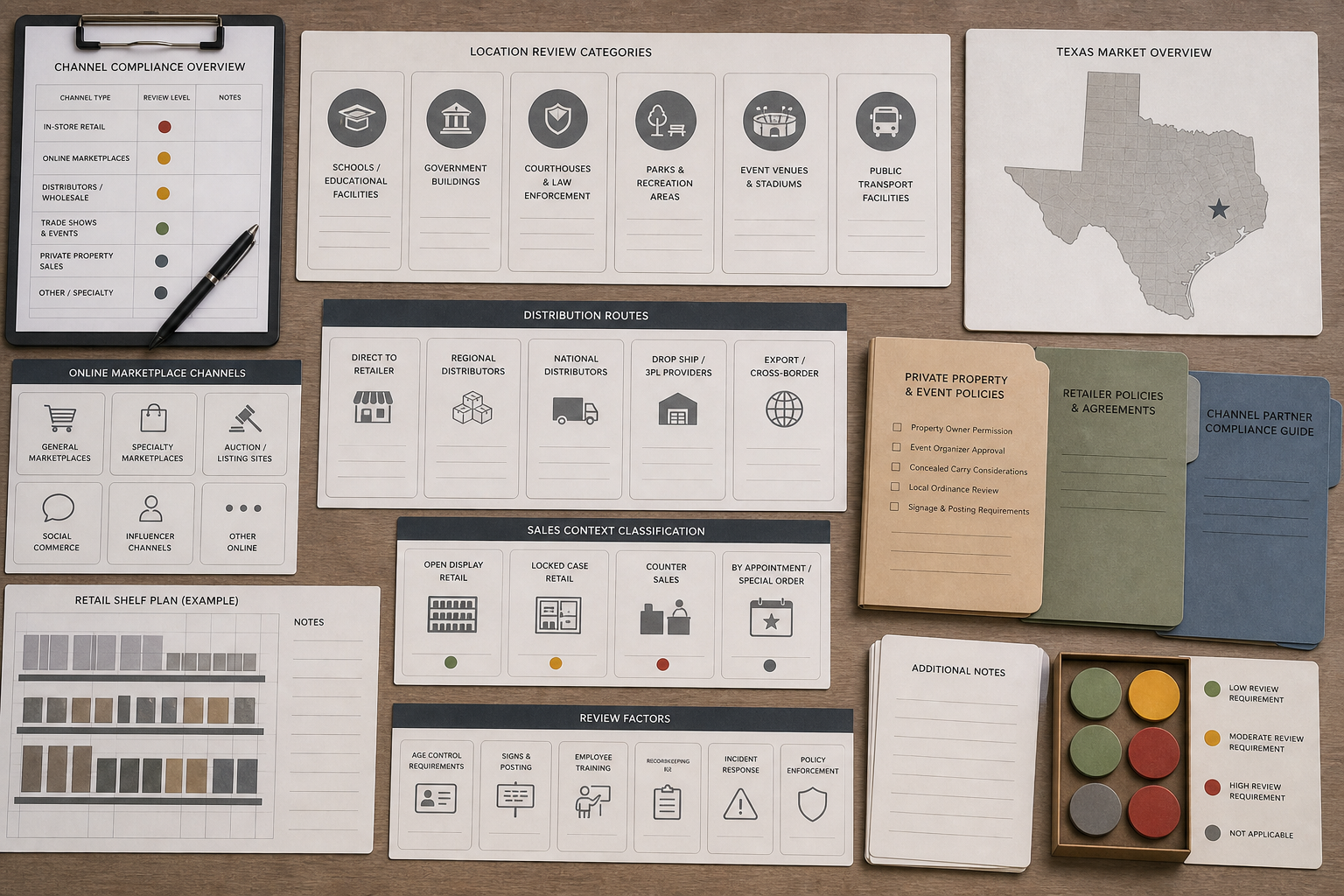
Buyers should review Texas restricted-place rules, retailer policies, marketplace terms, distributor requirements, and private-property controls before deciding where a knife SKU will be sold.
I Separate State Law From Channel Permission
Texas Penal Code Chapter 46 lists restricted places for location-restricted knives, including schools and other sensitive locations. A buyer selling products for the Texas market should not turn this into a user instruction page. The useful B2B point is product-channel planning. If the SKU may be sold through outdoor retailers, marketplaces, sporting goods distributors, or institutional buyers, the buyer should know how each channel treats longer blades and opening mechanisms.
Marketplace terms can be stricter than state law. A retailer may reject a product name, image, or action description even if the buyer believes the product is lawful. A distributor may require age-check notes, carton labels, or product data fields. A private property operator may set its own access rules. I tell buyers to handle this before mass production because packaging redesign after production is expensive. The factory can support practical changes, such as package copy, barcode labels, SKU grouping, manual wording, and carton marks. But the buyer must confirm the rules for the actual sales channel.
| Review area | Practical question | Manufacturing impact |
|---|---|---|
| Restricted places | Does the product need clear channel notes? | Add SKU-level compliance notes |
| Marketplace terms | Does the platform allow the mechanism and name? | Adjust title, photos, and descriptions |
| Distributor policy | Does the distributor require age or product flags? | Add packaging or carton identifiers |
| Retail display | Does the store need special product handling? | Plan packaging and master carton layout |
How Should Buyers Treat Gravity, Automatic, and Assisted Opening Designs?
Opening action can create the biggest misunderstanding. A tiny spring, detent, or button can change review needs.
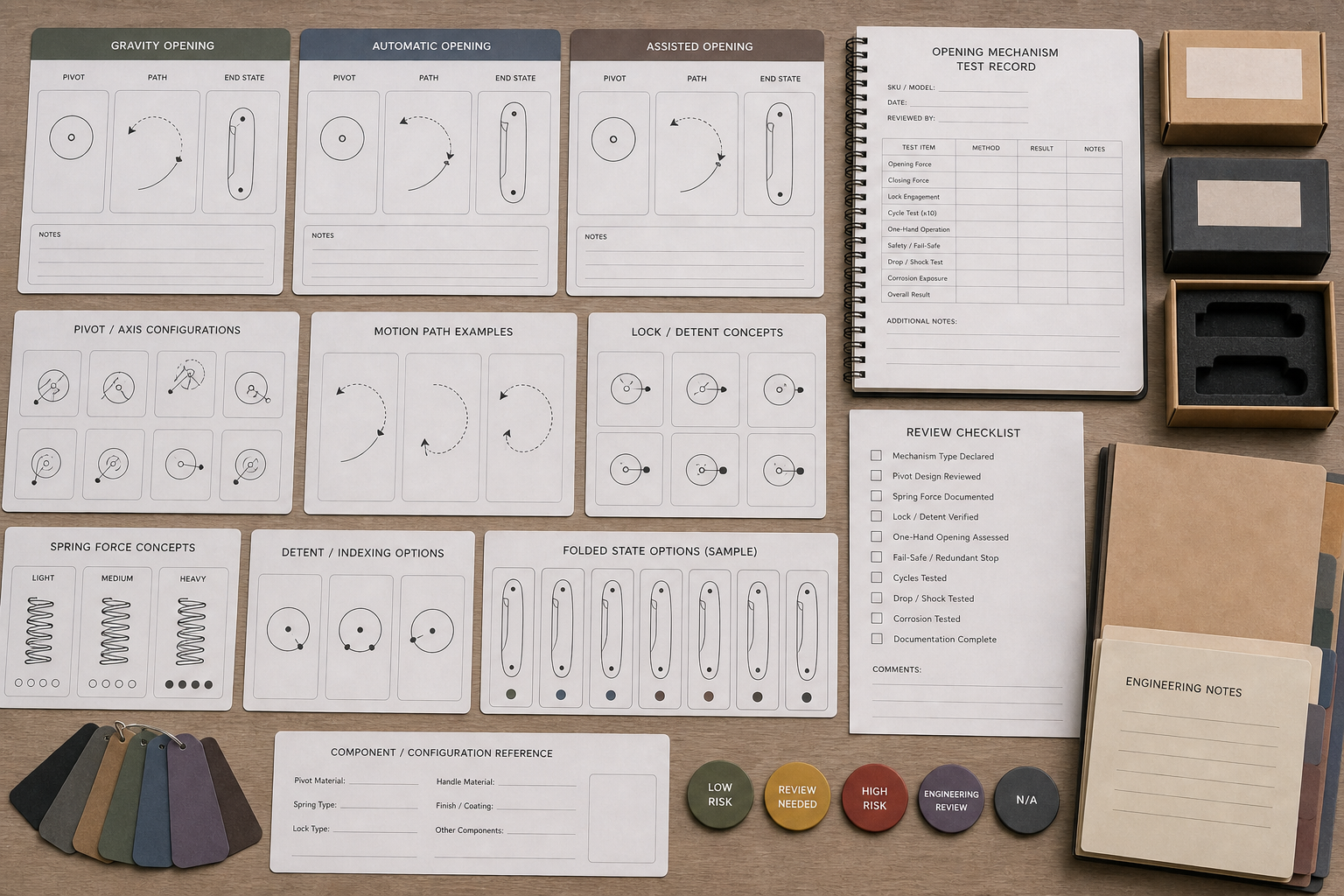
Buyers should separate manual, assisted, automatic, and gravity-related mechanisms, then review federal switchblade language and Texas product positioning before approving samples.
I Require Mechanism Clarity Before Sampling
The word "gravity knife" needs careful handling. Texas product review should not ignore federal law. The federal switchblade definition in 15 U.S.C. 1241 includes automatic opening by hand pressure on a button or similar device in the handle, and opening by inertia, gravity, or both. It also includes exceptions, including an assisted-opening type concept where a spring, detent, or other mechanism creates bias toward closure and the user must overcome that bias by hand, wrist, or arm pressure.
For OEM/ODM work, I do not guess based on a name. I ask for a mechanism brief. Does the blade stay biased toward closure? Is there a button, spring, sliding release, or lock release that opens the blade? Does the blade open by gravity when a release is used? Does the product need a mechanism change to fit the buyer's target channel? A small engineering change can affect tooling, spring choice, pivot tolerance, and QC. This is why the legal and engineering review should happen before the buyer approves a sample.
| Mechanism type | What to document | Buyer review need |
|---|---|---|
| Manual folder | Thumb stud, nail nick, flipper-style tab, or hole | Confirm channel policy and product copy |
| Assisted opening | Bias toward closure and user action | Review federal exception language with counsel |
| Automatic opening | Button or device in handle | High review need for federal and channel rules |
| Gravity-related action | Inertia or gravity opening behavior | High review need before import or sale |
What Packaging, Labeling, and Product Copy Should Buyers Prepare?
Good engineering can still be hurt by careless packaging. Overstated claims create problems long after shipment.
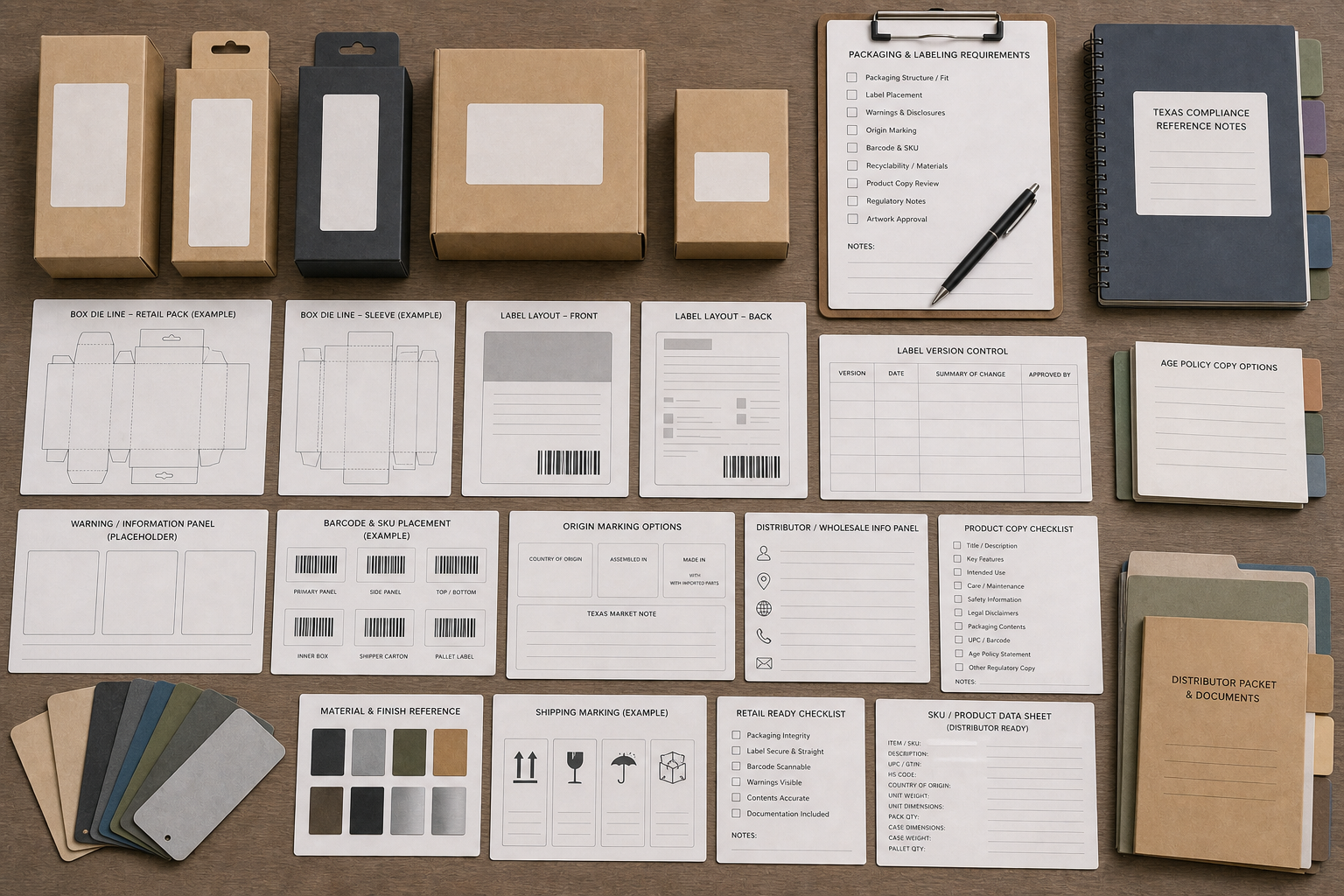
Buyers should prepare factual product copy, blade length data, mechanism descriptions, age-policy notes, country-of-origin marking, packaging version control, and distributor-ready SKU data.
I Keep Packaging Factual and Traceable
Packaging is not only a design surface. It is a compliance and sales tool. For Texas-facing knife projects, I prefer simple and factual wording. The package should identify the product type, material, basic function, country-of-origin marking where required, and any buyer-approved sales note. It should not make broad legal claims. It should not promise suitability for every location or every buyer. It should not use language that creates a risky impression for marketplaces.
For production, version control matters. If the buyer updates a warning line, barcode, age note, or product title, I need the final approved artwork before mass printing. I also need to match the package to the correct SKU. For private label buyers, a factory can help with packaging structure, insert card, hangtag, box, blister, QR code placement, and carton labeling. But the legal wording and sales policy should come from the buyer. CBP also reminds importers to understand policies, procedures, and entry requirements for the commodity they import, so product documentation should not be an afterthought.
| Packaging item | What to include | What to avoid |
|---|---|---|
| Product name | Factual knife type and SKU | Overheated claims or unclear terms |
| Spec line | Blade length, steel, handle material | Unchecked or inconsistent measurements |
| Sales note | Buyer-approved age or channel language | Factory-invented legal promises |
| Carton label | SKU, quantity, origin, package version | Mixed versions in one shipment |
| Import file | HS or HTS, invoice wording, origin marking | Weak customs or broker documents |
What Should Buyers Include in a Texas-Focused RFQ?
A vague RFQ creates vague risk. The factory cannot control compliance if the buyer hides the target market.
Buyers should include target market, blade length, opening mechanism, lock type, material choices, packaging needs, sales channel, age policy, import requirements, and inspection expectations in the RFQ.
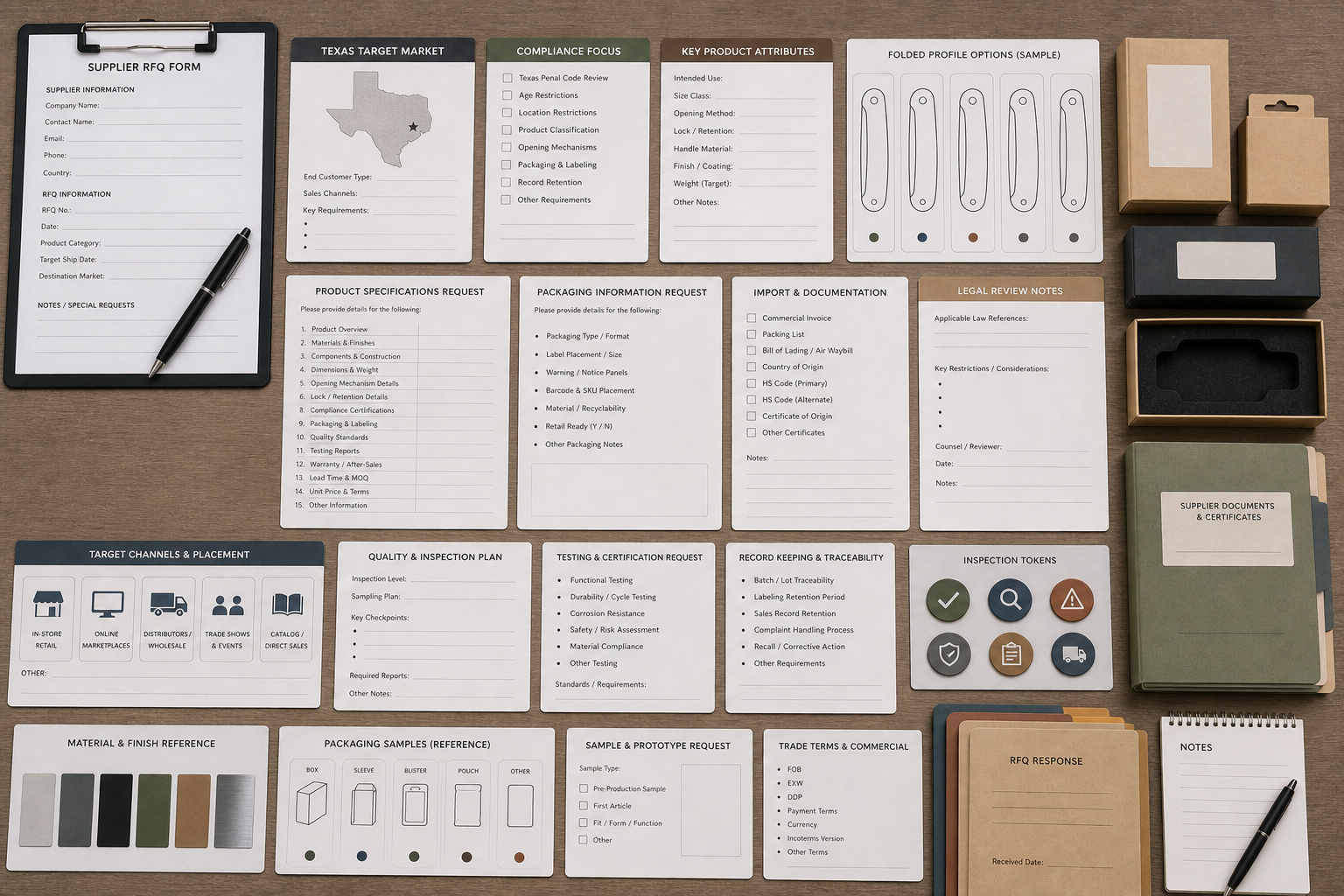
I Make the RFQ Useful for Engineering and Compliance
When a buyer asks Vast State for a Texas-focused knife project, I prefer an RFQ that is practical. It should not only say "pocket knife" or "gravity knife." It should include the intended state or country, expected selling channel, blade length target, maximum blade length, opening mechanism, lock type, handle material, blade steel, finish, packaging type, carton method, MOQ expectation, target price, and any internal compliance policy. If the buyer has legal counsel notes, the factory should know the design limits that affect sampling.
This helps both sides. The buyer gets a design that better fits the target channel. The factory avoids making a beautiful sample that later needs a mechanism change, shorter blade, new packaging, or different sales wording. For Texas, I would mark location-restricted status, age-policy relevance, mechanism type, and import documentation as required discussion points. I would also ask whether the buyer needs separate SKUs for different markets. Sometimes one conservative product is enough. Sometimes a buyer needs different versions for different channels. The RFQ is where that decision starts.
| RFQ field | Why I need it | Buyer benefit |
|---|---|---|
| Target market | It shapes legal and channel review | Fewer late design changes |
| Blade and mechanism | It affects Texas and federal review | Better product classification |
| Packaging plan | It affects retail and distributor readiness | Cleaner launch process |
| Inspection needs | It controls consistency across batches | Stronger repeat production |
Planning a private-label knife line for this market?
Use this article as a planning reference, then confirm local requirements with your importer or compliance advisor before OEM/ODM production.
Conclusion
I treat Texas knife sales as a classification, documentation, and channel-control project before it becomes a production order.
Source Notes
- Texas Penal Code Chapter 46 supports Texas definitions, location-restricted knife language, restricted-place review, and certain transfer rules.
- Texas Local Government Code Section 229.001 supports the municipal regulation discussion for knives and commerce in knives.
- 15 U.S.C. 1241-1245 supports federal switchblade and gravity/inertia wording, but buyers still need legal review for their exact SKU.
- CBP importer guidance supports the need to understand import procedures and commodity-specific entry requirements.
- Trade.gov HS code guidance supports the role of HS codes in trade classification and shipping documentation.